Curl CORBA Clients: Integrating Distributed Objects
With the World Wide Web
by
Jason Sugg
Submitted to the Department of Electrical Engineering and Computer
Science in partial fulfillment of the requirements for the Degrees of
Bachelor of Science in Computer Science and Engineering and Master
of Engineering in Electrical Engineering and Computer Science
at the
MASSACHUSETTS INSTITUTE OF TECHNOLOGY
May 21, 1997
OCT
2
91997
© Jason Sugg, 1997. All Rights Reserved.
LI RAPBiES
The author hereby grants to M.I.T. permission to
repro-duce and distribute publicly paper and electronic copies
of this thesis and to grant others the right to do so.
Author ...
. ... .
.
..
.
...
Department of Eletrical Engine 'g
and Computer Science
May 21, 1997
Certified by
...
...
...
... . ...
.
...
/Steve
Ward
Professor
Thesis Supervisor
Accepted by ...
...
...
..
Arthur C. Smith
Chairman, Department Committee on Graduate Theses
Curl CORBA Clients: Integrating Distributed Objects With the World
Wide Web
by
Jason Sugg
Submitted to the
Department of Electrical Engineering and Computer Science
on May 21, 1997, in partial fulfillment of the requirements for the
degrees of
Master of Engineering in Electrical Engineering and Computer Science
and
Bachelor of Science in Computer Science and Engineering
Abstract
The object paradigm for distributed systems is rapidly replacing the traditional
client-server model. This new paradigm creates sophisticated new ways of providing data and
services to web-based clients. A partial implementation of the CORBA distributed object
system in the Curl web programming language provides browser-based Curl clients with
access to all CORBA objects accessible over the Internet. This implementation is built in
such a way as to allow easy addition of new pathways to objects. This partial
implementa-tion leaves much room for future work building the system into a full CORBA ORB.
Thesis Supervisor: Steve Ward
Table of Contents
1 Introduction ...
... 9
1.1
Distributed Objects ...
... 9
1.2 Distributed Object Systems...10
1.3 CORBA... 11
1.4 Curl and CORBA ...
11
2 Request Generation and Invocation ...
13
2.1
CORBA Invocation Interfaces ...
...
13
2.2 Object References ...
... 14
2.3 R equests ...
. 14
2.4 Invoking Requests...
...
... 15
2.4.1
Synchronous Invocations ... ...
15
2.4.2
Asynchronous Invocations ... 16
3 The General Inter-ORB Protocol ...
19
3.1
The General Inter-ORB Protocol...
... 19
3.2 GIOP Transport Layers ... 19
3.3 Common Data Representation ...
...
20
3.3.1
Encapsulations ...
...
... 21
3.4 GIOP Messages... 21
3.4.1
Request ... ... 22
3.4.2 Reply ...
... 22
3.4.3 Others ...
... 23
3.5 The Internet Inter-ORB Protocol ... 23
4
Request Implementation ...
25
4.1
Implementation Overview ...
...
25
4.2 Profiles ...
... 25
4.3
GIOP Profiles ... 27
4.4 IIOP Curl Profiles ...
28
5 Type M appings ...
... 29
5.2 Type M apping Overview ...
30
5.3 Basic Types ...
... 31
5.4 Constructed Types ... ... 31
5.4.1
Structures ...
31
5.4.2 Unions ...
... 32
5.4.3 Enum erations ...
... ... 34
5.5 Tem plate Types... ... 34
5.5.1 Sequences ... ... 35
5.5.2 Strings ... ... 36
5.6 Arrays...
... 37
5.7 Exceptions... ... 37
5.8 Pseudo-objects ... ... 38
5.8.1 TypeCodes ...
... ... 38
5.8.2 Any ...
... 39
5.8.3 Object References ... . ... ...
39
5.8.4 Principal ...
... 39
6 Future W ork ...
... 41
6.1 Static Invocation Interface ... . ...
...
41
6.2 Interface Repository ... 41
6.3 CORBA Services ... ... 41
6.4 Servers... ... 42
7 Conclusion ...
... 43
Appendix A Curl ORBlet Source Code ... ...
45
A .1 ORB/request.curl ... ... 45
A .2 ORB/nvlist.curl ...
... 47
A .3 ORB/ior.curl...49
A .4 ORB/types.curl...50
A .5 ORB/exceptions.curl ... 52
A .6 ORB/ir.curl...56
A .7 ORB/typecode.curl... ...
... 59
A .8 ORB/G IOP/giop.curl ...
... ... 74
A .9 ORB/GIOP/iiop.curl ...
84
A .10 ORB/G IOP/cdr.curl ... ... 87
Bibliography ...
111
Chapter 1
Introduction
1.1 Distributed Objects
For years, the sockets-based client-server model has been the dominant paradigm for
dis-tributed systems. The model fit well with the predominant computing environment -
low-end client machines acting as user interfaces to larger, more powerful servers. But as
com-puting power has become cheaper the network landscape has changed, and the traditional
client-server approach has seized to fit as well as it used to. In light of these changes, the
computing world has been witnessing a paradigm shift away from the traditional
client-server model and towards a distributed object model in which the distinction between
cli-ent and server is blurred, and the emphasis is instead on objects which may live anywhere
on the network. Like their predecessor client-server systems, support for these distributed
object systems will soon be necessary in all commercial programming systems.
In the old client-server model, a labor of coordination was required to build a working
client and server. The two parties had to agree on what server port they were going to talk
through, what functions were going to be provided by the server, and the manner of
mar-shalling arguments between them. The introduction of the Remote Procedure Call (RPC)
standard alleviated some of these worries by masking hardware differences and network
layers, but left the machines and many of the worries that accompany them visible in the
programming model.
Distributed object systems attempt to ease programmer headaches further by allowing
programmers to see the network as a collection of objects providing and requesting
ser-vices rather than as a collection of distinct machines running programs which wish to
communicate with one another. This additional layer of abstraction adds a number of
ben-efits, including location transparency for objects, convenient directory services, a
compo-nent software paradigm, and the ability to dynamically add and utilize new network
services.
The exact meaning of the much-bantered term "object" depends greatly on which
object system is being described, but both of the dominant distributed object systems
pro-vide data encapsulation mechanisms, and at least one of them also propro-vides inheritance
and polymorphism. The benefits these principles can offer to programming languages
have long been recognized, but until recently it was not understood how to extend those
benefits to systems as a whole.
1.2 Distributed Object Systems
Currently two distributed object systems dominate. The first is Microsoft's Component
Object Model (COM). COM started as a lightweight, single-machine standard for
encap-sulating data and the services necessary to utilize that data for use between processes on
the same machine, and has been extended in an ad hoc fashion to allow distributed sharing
of services. The second system is the Common Object Request Broker Architecture
(CORBA). CORBA is a heavy-duty object system providing both inheritance and
poly-morphism in addition to the encapsulation provided by COM. Defined as a standard by the
Object Management Group (OMG), an industry consortium of over 500 companies,
CORBA is rapidly becoming the object system of choice for commercial applications.
Consequently, CORBA support greatly enhances the Curl programming system's potential
as a future platform for building distributed applications.
Figure 1.1: The Common Object Request Broker Architecture
1.3 CORBA
The layout of CORBA is shown in Figure 1. The terms "client" and "server" in the figure
have meaning only in relation to specific transactions. In CORBA, instead of certain
monolithic processes acting as servers all the time and other smaller processes as clients,
each process is viewed as an object which can act as both a client and a server. Each object
provides a specific small set of services, but may act as a client of other objects while
per-forming those services. All communications between objects are brokered by an Object
Request Broker (ORB). The ORB helps clients locate server objects, delivers requests and
replies between client and server, and may provide other services such as verifying client
and server identities for security purposes, providing generic access to persistent memory,
or helping clients locate servers which fulfill a certain need.
1.4 Curl and CORBA
Web content could be greatly enhanced by making the CORBA object universe accessible
to browser-based web programs. Variable data such as stock quotes or weather conditions
could be fetched in a direct and convenient way from CORBA objects accessible via the
Internet or secure web purchases made using CORBA's security service. In fact, it is
pos-sible that the web could eventually become fully integrated with the universe of distributed
objects, so that a web browser might become an object browser which provides views of
objects and the services or content they provide. Likewise, the world of distributed objects
could greatly benefit from the portability provided by browser-based clients.
But the problem of providing a browser-based client with access to CORBA objects
presents some architectural and systemic problems. Most importantly, it is not obvious
how to allow an arbitrary client running on an arbitrary browser to utilize the services of
an arbitrary ORB. Since a web-based client could potentially be anywhere on the Internet,
some mechanism must be devised for allowing the client access to an ORB's objects from
outside that ORB's domain. Such a mechanism should preserve the security of the ORB,
while providing access to all of the ORB's public services as well as its objects.
Fortunately, CORBA defines an ORB interoperability protocol which allows methods
of an object in one ORB to be invoked from the domain of a different ORB while
preserv-ing security features. To utilize this protocol in Curl, a mini-ORB, or ORBlet was
imple-mented which is downloaded to the browser along with the Curl program, and which
knows how to communicate with other ORBs using the standard interoperability protocol.
The ORBlet provides a standard client interface to the CORBA object universe for its
browser-based clients, but relies entirely on other ORBs for its actual functionality. The
ORBlet is not quite a full ORB because it does not currently support server interfaces.
Consequently, browser-based objects may act only as clients of other objects, and not as
servers.
The following chapters describe the interface and implementation of the Curl ORBlet.
Chapter 2 describes the interface the ORBlet provides to client programmers. Chapter 3
describes the CORBA interoperability protocol which the ORBlet uses to communicate
with server objects. Chapter 4 describes the ORBlet's implementation of that protocol, and
Chapter
5 describes the type mappings from CORBA's Interface Definition Language to
Curl.
Chapter 2
Request Generation and Invocation
2.1 CORBA Invocation Interfaces
CORBA was defined as a standard for allowing any object to share its services with other
distributed objects without the restrictions normally imposed by network location,
plat-form difference, or source language difference. To allow clients to utilize the services of
other objects in this transparent fashion, CORBA defines two ORB client interfaces which
differ in their generality and ease of use. The less general Static Invocation Interface (SII)
is very similar to the RPC interface. As with RPC, specifications of the server's interfaces
must be compiled beforehand into platform and language-specific stubs which hide all of
the details involved in talking to the server over the network, including marshaling and
unmarshaling of arguments and results, and network transport specifics. From the
pro-grammer's perspective, the methods of a particular server appear as local methods
belong-ing to that server's object reference, and can be invoked in the same way as any other
method in the language. This ease of use is the defining characteristic of the SII.
The Dynamic Invocation Interface (DII) is more difficult to use, but far more general.
When using the DII, server methods do not appear conveniently as methods on local
objects, but also no pre-compiled stubs are required to invoke operations. Instead, the DII
provides a uniform interface for a client to invoke any operation on any object by
explic-itly specifying the desired operation and the parameters to it. The programmer must also
explicitly start the invocation, and possibly manually retrieve any operation results. This
process is undeniably tedious, but has the appeal from an ORB implementor's perspective
of requiring less development to give CORBA programmers access to all available
objects. Also note that this generality allows an SII to be built with relative ease by writing
a stub-generating IDL compiler which utilizes the underlying DII mechanisms.
The Curl ORBlet currently supports only the DII, both because of its generality and
because the DII does not require a full CORBA Curl language mapping. It is expected that
a stub-generator will be built on top of the DII at some later point, after the language
map-ping has been finalized. Until then, the DII can provide full, albeit somewhat tedious,
access to the distributed object universe.
2.2
Object References
An object reference reliably names a unique CORBA object. Object references can be
obtained from a number of sources, but most will come from the naming or trader
ser-vices. The naming service is just a directory service, supplying object references which
match particular names. The trader service is a full-fledged object location service which
allows searches for servers to be performed on the basis of keyword arguments. Object
references can be used to obtain a variety of information about an object, as well as to
invoke methods on the object in the SII. As discussed in the next section, object references
are used in the DII to generate dynamic requests to objects. In general, object references
are valid only to the ORB which issued them. The Curl ORBlet overcomes this problem
by relying on the interoperable object references (IOR) defined as part of the
interopera-bility standard which it uses to communicate with other ORBs. Object references are
implemented in Curl by the Object class. Object currently supports only the
create_request object reference method.
2.3 Requests
In the DII, requests for services are actually delivered from a client to a server by the
Request Curl object. A Request hides all of the mechanics of the delivery, and
together object references and Requests eliminate any necessity for the user to know
about where a server is physically located in either a network or platform sense. The
pro-cess of invoking a server method is now purely logical.
Requests are created through the create_request method of the server's object
reference. The user specifies to create_request the operation to be invoked and the
context and arguments for that operation, and gets back a Request object which knows
how to invoke the specified operation on that particular server. If no arguments are
speci-fied, the programmer must use the Request object's add_arg method to specify the
arguments one by one. Whichever method is used to specify the operation's arguments,
they must be specified in the same order in which they appear in the operation's Interface
Definition Language (IDL) specification. All operation arguments are specified through
the use of NamedValues. A NamedValue is a structure which pairs a parameter name
with a CORBA any value and a flag denoting the type of the parameter
-
either in,
out, or inout. 1
All Request methods return an unsigned status code, with zero indicating success and
any other value indicating an error. The specific value is meant to serve as a diagnostic,
giving more information about the exact nature of the error on a method-specific basis.
2.4 Invoking Requests
After the user has finished building the request, he may invoke it either synchronously or
asynchronously. In both types of invocations, the result of the call is left in a
Named-value parameter specified in the original call to create_request.
2.4.1 Synchronous Invocations
Request provides the blocking method invoke to invoke operations
synchro-nously. invoke guarantees that when it returns, the operation has completed
fully, and that the operation result has been left in the result parameter specified to
create_request. As well, all out or inout parameters in the operation's argument
list have been properly updated.
If invoke encounters an error somewhere in the invocation process or receives an
exception from the server, it will throw an exception identifying the problem. Local
excep-tions and server-thrown system excepexcep-tions are handled correctly, but there is currently a
recognized problem with the DII regarding operation-specific exceptions. In the current
specification, not enough information is provided to the Request object to guarantee that
operation-specific exceptions can be unmarshaled without consulting an interface
reposi-tory, a feature the Curl ORBlet is not guaranteed to have access to. Therefore, if the server
throws an operation-specific exception, the system passes up a USER_EXCEPTION
exception containing the unmarshaled, CDR-encoded exception returned from the
opera-tion (see Chapter 3 for a discussion of the Common Data Representaopera-tion). The user can
then use the exception's TypeCode to unmarshal the exception.
This solution violates the abstraction barrier between the user's invocation of an
oper-ation and the underlying mechanics of how that operoper-ation is actually invoked, but it is the
simplest solution which insures that no information is lost to the user. There are currently
efforts underway to remedy the problems with the DII specification. As soon as these
efforts are complete, the abstraction violation should be fixed and all exceptions
unmar-shaled at or below the Request level.
2.4.2 Asynchronous Invocations
The non-blocking Request method send provides asynchronous invocation
abili-ties. send takes a single argument which tells whether or not a response from the
opera-tion is expected, and makes no guarantees about the state of the invocaopera-tion or the state of
the passed parameters after it returns. Instead, if the user expects a response, he must
explicitly check on the status of the invocation using the get_response method of the
Request object. In most cases, get_response returns a status code indicating
whether or not the operation has been completed. If it has completed, then it is guaranteed
that the return value of the operation has been left in the result parameter passed to
create_request, and that all out and inout parameters in the argument list have
been updated. If an exception was generated by the operation, then a local exception is
generated and thrown by get_response. The handling of operation-specific exceptions
is the same as in the synchronous case.
Chapter 3
The General Inter-ORB Protocol
3.1 The General Inter-ORB Protocol
Every object in the CORBA universe dwells in some ORB domain, accessible through that
ORB to all the other objects in that domain. For most distributed object applications, this
arrangement is not a problem. But the fact that the Curl ORBlet could be running on any
browser anywhere on the Internet places it essentially outside the domain of any ORB, so
it must utilize some other mechanism for communicating with server objects. Fortunately,
CORBA defines a protocol which allows objects in one ORB's domain to utilize the
ser-vices of objects in a different ORB domain. Since the Curl ORBlet essentially provides a
mini-domain for its clients, it uses this interoperability protocol to provide those clients
with access to objects in the domains of other ORBs.
CORBA defines the General Inter-ORB Protocol (GIOP) as a standard way to allow
objects in different ORB domains to communicate across a network using a general
con-nection-oriented transport protocol. To support this communication, GIOP defines a small
set of messages which may be exchanged and a common data representation for use in
those messages. For actual use, GIOP must be mapped to specific transport protocols.
CORBA currently defines only the mapping of GIOP onto TCP/IP, known as the Internet
Inter-ORB Protocol (IIOP).
3.2 GIOP Transport Layers
GIOP defines a small set of criteria that must be met by any transport protocol onto which
it is to be mapped. Intuitively, the criteria roughly correspond to whether or not the
proto-col is equivalent in functionality to TCP/IP. First, the protoproto-col must be reliable and
con-nection-oriented. Then the ORB must be able to view the transport layer which
implements the protocol as a virtual byte stream without any restrictions on message size
or requirements for fragmentation. Third, there should be some provision for notification
of unexpected connection loss. Finally, the manner of initiating connections must be
simi-lar to the connection model of TCP/IP. Any transport protocol which provides these
fea-tures is capable of supporting GIOP.
13.3 Common Data Representation
The unit of communication in GIOP is an octet stream. The CORBA standard defines an
octet stream as "an arbitrarily long sequence of eight-bit values (octets) with a
well-defined beginning."
2GIOP defines two types of octet streams -
encapsulations and GIOP
messages. All data is encoded into octet streams according to the Common Data
Repre-sentation (CDR) transfer syntax, which defines low-level repreRepre-sentations for all of the data
types discussed in Chapter 5.
Representations in the CDR syntax may be either big or little
endian, so that two machines of the same byte-ordering should not need to perform any
byte-swapping on the messages they exchange. Furthermore, to allow for efficient
han-dling by architectures which enforce data alignment restrictions, all CDR-encoded data
must be aligned on boundaries natural to the type of the data. For example, a CORBA long
integer, which takes up four bytes, must be aligned in an octet stream on a word
bound-ary.
3In the Curl ORBlet, encoded octet streams are implemented by the
CDR-buf fer class. CDR-CDR-buf fer provides methods to properly encode and decode all data
types, as well as methods to encode or decode values based on a TypeCode (see Chapter
5 for details on TypeCodes). Alignment restrictions are handled automatically by
CDR-buffer. To maintain portability, a CDR-buffer does not assume any particular
byte-1. The Common Object Request Broker: Architecture and Specification, Revision 2.0, p. 12-3.
2. Ibid., p. 12-4. 3. Ibid., p. 12-2.
ordering for its host machine, but relies instead on the class's endian attribute to
deter-mine in which byte-order it should encode or interpret octet stream data.
While this independence from the host architecture's data representation has
advan-tages for portability, it also has some negative efficiency implications. Instead of being
able to copy native representations of data directly into a message and setting the
byte-ordering of the message appropriately, the representations must be explicitly computed
from the value of the data since the ORBlet cannot depend on a particular underlying
rep-resentation. A possible future optimization might place the CDR-buffer code directly
into the kernel so that it could be written to run natively and take advantage of the
underly-ing architecture's representation of the data.
3.3.1 Encapsulations
As mentioned above, GIOP defines two types of octet streams, encapsulations and
messages. Encapsulations are octet streams into which data may be marshaled, but which
are independent of any particular communication context. GIOP uses encapsulations in
several spots where it is desirable that data not be required to be completely unmarshaled
before handling. For example, the parameters of a CDR-encoded TypeCode are encoded
as an encapsulation. Encapsulations are represented as unbounded octet sequences in
which the first octet of the stream determines the byte order in which the rest of the stream
is encoded. The Curl ORBlet provides the CDR-encapsulation class as an
imple-mentation of encapsulations.
3.4 GIOP Messages
In GIOP, all communication between ORBs takes place through GIOP messages. There is
a small set of messages, seven in total, which among them allow ORBs to cooperate on the
full range of standard services. All GIOP messages have a standard header which
identi-fies the protocol (GIOP) and version at use in the message, the byte-ordering of the
mes-sage, the type of the mesmes-sage, and the length in bytes of the message. In addition,
particular messages may have particular headers giving more information about the
mes-sage's contents.
1In the Curl ORBlet, the class GIOP-msg descends from CDR-buffer, and provides
methods to extract standard header information. For every supported message type, there
is a class which descends from GIOP-msg which provides methods for extracting
mes-sage-type specific data. When a connection is established, a thread is spun off to wait for a
response. When one comes, the textual data received from the network port is cast into a
message of the appropriate type based on the message-type value in the GIOP header.
3.4.1 Request
Request messages are always sent from client to server and are used by one ORB to
request that an operation be invoked on an object in another ORB. The message includes a
key identifying the object on which the operation is to be invoked, a string identifying that
operation, any parameters to be passed to the operation, and optionally a context for the
operation. Request messages are implemented by the GIOP-request-msg class in the
Curl ORBlet.
3.4.2 Reply
Reply messages are always sent by a server in response to a request message. They
contain a service context being passed back to the client, a reply status indicating the
out-come of the operation, and a body which contains data appropriate to the outout-come. If the
operation completed successfully, the body of the message contains the result of the
oper-ation followed by all out or inout parameter values. If an exception occurred, the body
of the message contains the exception. The third possibility is that the server sent back a
location forward, in which case the body of the message contains an object reference
pointing to the actual location of the requested server. In the Curl ORBlet, the
GIOP-reply-msg class implements reply messages.
3.4.3 Others
GIOP defines several other types of messages for various purposes. There is a
CloseC-onnection message which the server uses to indicate that it is shutting down the transport
connection to the client. There is also a MessageError message which may be sent by
either client or server to indicate that a badly formed message was received. The final two
message types are for requesting location information on objects. These last two types are
not supported in the Curl ORBlet.
3.5
The Internet Inter-ORB Protocol
Currently TCP/IP is the only transport protocol onto which GIOP has been mapped. The
TCP/IP mapping is known as the Internet Inter-ORB Protocol (IIOP). IIOP defines a
for-mat for specifying the locations of objects accessible over TCP/IP and some connection
usage rules.
1Chapter 4
Request Implementation
4.1 Implementation Overview
The Request class is only the tip of the Curl ORBlet iceberg. While it forms the entirety
of the user's view of the request invocation process, there is much more going on behind
the scenes. Arguments must be marshaled, requests delivered, and results unmarshaled, all
in a portable and consistent manner. Furthermore, although the ORBlet currently only
knows how to invoke methods on CORBA objects over TCP/IP, it is likely that in the
future users will want to invoke requests through other pathways. For example, the
CORBA specification includes a protocol for allowing objects in the CORBA universe to
interoperate with COM objects. Given the widespread availability of COM objects, the
ability to use them from within a Curl client could be very useful. An architecture which
allows easy addition of new pathways of invocation such as this one is therefore preferable
to one that relies on TCP/IP even at its highest layers.
4.2 Profiles
The Curl ORBlet uses the time-honored approach of layering and the object-oriented
prin-ciple of polymorphism to build an architecture which supports the easy addition of new
invocation pathways. At the top level of this hierarchy is the Prof ile class. A Profile
encapsulates all knowledge about how to access a particular object through a certain
path-way. For objects that can be accessed via multiple pathways, there are multiple
Pro-files. An object reference contains all the Profiles which belong to its object, and
when a Request is created from the object reference it is given a Profile which it
uses to communicate with the object.
The Profile provides a standard interface for the Request object to invoke
requests on the server. Methods are provided for invoking requests both synchronously
and asynchronously. Both methods take as arguments the operation to be invoked, a
bool-ean variable indicating whether or not a response is expected, and a list of parameters, as
well as places to leave any result, any exception that might be raised, and a status variable
which indicates when the operation is complete and what the outcome was.
Upon return the synchronous method, InvokeBlockedRequest, leaves a result
status in its status parameter. If this status indicates successful completion of the
opera-tion, then InvokeBlockedRequest guarantees that any return value has been left in
result, and all out and inout parameters in the parameter list have been updated. If
the status indicates that an exception was thrown, then the exception object has been left in
the user-specified location. The same rules apply to the asynchronous method,
Invo-keNonBlockedRequest, except that the status variable will be set to NOT_DONE until
the operation is completed.
Specific methods of delivery are added to the system by creating classes that inherit
from Profile, implementing InvokeBlockedRequest and
InvokeNon-BlockedRequest as appropriate for the specific delivery method. Currently the only
delivery method supported is the General Inter-ORB Protocol.
Figure 4.1: The Curl ORBlet request invocation hierarchy
4.3 GIOP Profiles
The GIOP request invocation functionality discussed in Chapter 3 is made available to the
request invocation hierarchy through the GIOP-profile class. GIOP-profile
descends from Profile and provides incomplete implementations of
Invoke-BlockedRequest and InvokeNonInvoke-BlockedRequest which use GIOP messages to
communicate the request to the server. The implementations are incomplete because they
rely on unimplemented methods for interfacing with the underlying transport, including
methods to open a connection, send a GIOP message, and receive a GIOP message. To
complete the implementation, descendants of GIOP-prof ile implement these methods
for specific transports.
The availability of an asynchronous invocation mechanism in the DII implies the
pres-ence of some sort of threading at lower layers of the invocation hierarchy.
GIOP-pro-file is the layer where that threading takes place. Both the synchronous and
asynchronous invocation methods spawn listener threads that wait for results to come back
and then take actions appropriate to the type of the received message. When this listener
thread is finished, it changes the GIOP-profile's status attribute to signal the
invoking thread that it is done. The synchronous invocation method waits until the listener
thread finishes before returning, while the asynchronous method returns as soon as the
thread has been spun off and the request message sent. Note that the current
GIOP-pro-f i 1 e implementation supports at most one outstanding request at any time.
4.4 IIOP Curl Profiles
The implementation of the Curl ORBlet's request invocation mechanism is completed in
the IIOP-profile class. IIOP-profile descends from GIOP-profile, and
pro-vides TCP/IP-based implementations of the transport methods defined in its parent class
using the Curl kernel's NetworkPort mechanism.
Chapter
5
Type Mappings
5.1 CORBA types
CORBA is designed to allow diverse objects running on diverse platforms and written in
diverse source languages to utilize each other's services. To mask all these differences, all
CORBA objects declare their interfaces in a platform-neutral, purely declarative Interface
Definition Language (IDL) which is derived from C++. An IDL interface declaration
com-pletely specifies the object's interface, but specifies nothing about the object's
implemen-tation, including source language or platform. IDL specifies a variety of types that can be
used in interface declarations, and in order to maintain consistency with the rest of the
uni-verse of CORBA objects, a mapping into Curl for these types must be defined before the
request invocation mechanism described in Chapter 4 will function correctly.
The available IDL types fall into four distinct categories of varying complexity. At the
simplest level, the usual quanta of data make up the basic IDL types
-
short, long, signed
and unsigned integers, both normal and double precision floating point types, a boolean
type, and a character type as well as an 8-bit octet quantity that is guaranteed not to
undergo any conversions in transmission. In turn, these basic types form the foundation
that the other three type categories build on. The constructed types package data of other
types in various ways, and include IDL structures, discriminated unions, and
enumera-tions. Template types allow definition of new types based on a set of template parameters,
and include a string type and a dynamic array type. Static arrays are similar to C's arrays.
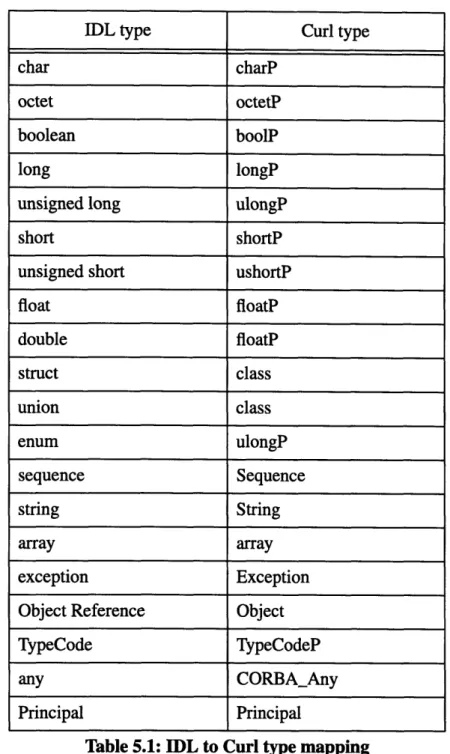
1IDL type
Curl type
char
charP
octet
octetP
boolean
boolP
long
longP
unsigned long
ulongP
short
shortP
unsigned short
ushortP
float
floatP
double
floatP
struct
class
union
class
enum
ulongP
sequence
Sequence
string
String
array
array
exception
Exception
Object Reference
Object
TypeCode
TypeCodeP
any
CORBA_Any
Principal
Principal
Table 5.1: IDL to Curl type mapping
5.2
Type Mapping Overview
The implementation of the Curl ORBlet places certain functional requirements on the
mappings from IDL to Curl. All of the mapped types are required to support dynamic
cre-ation of instances using the Curl new function with no additional required arguments,
although additional optional arguments are fine. This requirement stems from the need to
dynamically generate new instances of types when decoding CDR-encoded sequences.
The only exception to this rule are arrays (see section
5.6). Furthermore, to support CDR
decoding all types must support call by reference.
5.3
Basic Types
The basic IDL types cannot be mapped directly to the basic Curl types because new
instances of basic Curl types cannot be created with the new function, nor can basic types
be passed by reference. Instead, a layer of indirection must be added to provide the
func-tionality required from the types. To provide this indirection, each basic IDL type maps to
a Curl wrapper class with a single member, val, which stores the basic type value. For
example, the IDL char type maps to the following Curl class:
{define-class charP
{}
val: char
}
All the wrapper classes have names formed by appending "P" to the type's IDL name.
5.4
Constructed Types
5.4.1
Structures
Similar to a struct in C, an IDL struct is a collection of data members which can
each be separately accessed. As one would expect, a s truc t maps directly to a Curl class
of the same name. For each member of the structure, there is a class member of the same
name whose type is determined by the mapping of the structure member's type into Curl.
Note that the ordering of the class members does not have to be the same as in the type's
IDL definition. An init method must be provided to initialize all the members and
insure there are no void references.
As an example, consider the following IDL definition:
struct Foo {
long fee;
char initial;
boolean paid;
}
This IDL definition maps to the following Curl class:
(define-class Foo {(
fee:
longP
initial: charP
paid: booleanP
{define {init}
{set self.fee {new longP}}
(set self.name (new charP}}
{set self.paid {new booleanP}}}
}
Additional functions may be defined in the class by the user, and the init method
may take optional arguments.
5.4.2 Unions
An IDL union is similar to the union type in C, but whereas in C the type currently
held in the union must be explicitly tracked by the programmer, IDL unions are
dis-criminated using a mechanism similar to C's switch statement. A discriminator type is
specified in the union declaration, and each union member is assigned a label value of
the same type as the discriminator. When the value of the union's discriminator matches
the label of a particular member, then that member becomes the current value of the
union. A default label may be specified for at most one member. When the value of
the discriminator fails to match any of the other cases, this default-labeled value
becomes the value of the union.
As with s truc ts, a union maps to a Curl class of the same name. For each member
of the union, there is a class member of the union member's mapped type with the
same name. The class must have a member named "_d" of the union discriminator's
mapped type which serves as the discriminator value. To select which member of the
union is currently active, the user must directly set the _d member. To access the value
of the union, the class must provide a function named "_value" to examine the
dis-criminator and return the appropriate member. In addition, the class must provide a
func-tion named "_index" which returns the zero-based index of the currently selected
member. This index must reflect the member's location in the IDL union definition, so
that it can be used in the TypeCode functions member_type, member_label, and
member_name to retrieve TypeCode information about the currently selected member.
This functionality is used, for example, in encoding a union into the Common Data
Repre-sentation. As with structures, an init method must also be provided to initialize all the
members so there are no void references in the instance.
As an example, consider the following IDL union definition, where Foo is the
struc-ture defined in the struct example above:
union Data switch (char)
case 'n': long num;
case '1': char letter;
case 'b': boolean pred;
default: Foo info;
This IDL definition maps to the following Curl class:
{define-class Data {}
_d: charP
num: longP
letter: charP
pred:boolP
info :
Foo
{define {init}
{set self._d {new charP}}
{set self.num {new longP}}
{set self.letter {new charP}}
{set self.pred {new boolP}}
{set self.info {new Foo}}}
{define {_value} :any
{cond {{= self._d.val #\n} {return self.num)}}
{{= self._d.val #\1} {return self.letter}}
((=
self._d.val #\b) {return self.pred))}
{else (return self.info}}}}))
{define {_indexl:ulong
{cond
{{=
self._d.val #\n} {return 0}}
{{=
self._d.val #\1} (return 1}1
{{=
self._d.val #\b} {return 2}))
{else {return 31)}}
As with structs, additional methods may be defined in the class.
5.4.3
Enumerations
IDL enumerations are almost identical to C enumerations. Enumerations define a new
data type that can take on one of a set of values specified along with the enumeration
dec-laration. In the Curl CORBA system, enum types map to the Curl type ulongP, with
each value declared in the enum's definition becoming a constant equal to that value's
zero-based index in the enumeration sequence. Note that this means that enumeration
con-stants have type ulong and cannot be passed directly as enumeration values.
As an example, consider the IDL definition:
enum fruit {apple, orange, banana, guava};
This IDL definition maps to the following Curl code:
{define-constant fruit: type=ulongP)
{define-constant apple:ulong=0
}
{define-constant orange:ulong=l}
(define-constant banana:ulong=2
{define-constant guava:ulong=3}
As a consequence of this mapping, there is no checking to insure that enum variables
are only taking on appropriate values. Such checking is left to the user or the stub compiler
when one becomes available.
5.5
Template Types
Curl currently lacks support for template or parameterized types. This part of the type
mapping is therefore at best tentative, and is expected to evolve as Curl's support for
parameterized types improves.
5.5.1 Sequences
IDL sequences are one-dimensional dynamic arrays characterized by two
parame-ters, a content type and a maximum length. The length parameter may be left unspecified,
in which case the sequence is unbounded. IDL sequence types map to descendants of
the Sequence Curl class. Sequence provides functions to add elements (put),
refer-ence an element (aref), remove an element (remove), set an already extant element to a
new value (set), and find out how many elements are currently in the sequence
(length). Sequence also provides both the content-type function to return the
Curl type of the data the sequence is intended to hold, and the bound function to return
the maximum length of the sequence, both of which are useful in decoding CDR-encoded
streams. Both put and set check the type of the passed element against the content type
to provide a measure of type safety. put, set, and aref all perform bounds checking as
well, with put checking against the maximum length of the sequence and set and aref
checking against the current length of the sequence.
A particular CORBA sequence type would map to a descendant of the Curl
Sequence class. The descendant class should provide an init constructor to initialize
the base Sequence class with the proper content type and bound. The name of the
descendant class is formed from the IDL declaration by starting with the string
"Sequence_" and appending the type identifiers spaced by underscores followed by the
length, if any, separated with an underscore. For example, the IDL type declaration
"sequence<long, 10>" maps to the Curl class name "Sequence_long_10", and
the recursive declaration "sequence<sequence<char>
>"
would map to the class
name "Sequence_Sequence_char".
As an example of the sequence mapping, consider the following IDL declaration:
sequence<boolean, 15> predicates;
This IDL declaration maps to a Curl variable "predicates" whose type is the class
Sequence_boolean_l15,
defined here:
{define-class Sequence_boolean_15 {Sequence}
{define {init}
{invoke-method Sequence 'init self theType=boolP
maxlen=15 }
}
}
Although
IDL
syntactically allows recursive type specifications, sequences are the
only place where such specifications are allowed. Since sequences can have a length of
zero, they can provide a bottoming out of the recursion that none of the other IDL types
can provide
5.5.2 Strings
CORBA strings are closely related to sequences. Like sequences, strings
are parameterized, but they only take one parameter, a maximum length. As with
sequences, this bound can be left unspecified in which case the string is unbounded.
The content type of strings is always char. The CORBA specification states that
"[s]trings are singled out as a separate type because many languages have special built-in
functions or standard library functions for string manipulation."
'In Curl, the String
class is used to map CORBA strings. String provides some generalized string
manipulation functions, as well as bounds checking against a maximum length.
As with sequences, particular bounded strings map to descendants of the String
class which provide
init
methods to properly initialize the bounds checking parameters.
Unbounded strings map directly to the String class. The name mappings for
strings are also similar to that for sequences. A bounded string name just maps to
the class name "String_" followed by the length of the string. For example, the name
"string<10>"
would
map
to the Curl class name "String_10".
5.6
Arrays
IDL also defines multidimensional static arrays. Array declarations require explicit
bounds on each dimension, and their sizes are fixed at compile time. An IDL array maps
directly to a Curl array whose content type is the mapped type of the IDL array. Arrays
are currently the only exception to the rule about types being required to support a call to
the new function with no additional arguments. Curl array types are specified by the type
they store, and not their length, so the length must be specified as an argument to the
ini-tializer. Code that relies on a no-argument constructor being available for an arbitrary type
should therefore check for array types and handle them as a special case.
5.7
Exceptions
IDL allows an operation to declare exceptions that it might raise under unusual
condi-tions. IDL exceptions are similar to structs in that other data can be aggregated in
them. In the Curl CORBA system, all IDL exceptions map to descendants of the
Exception class. The exception's IDL identifier is available as the _id member of
the Exception it maps to. For specific exceptions, each data member maps to a
member of the same name in the Exception. The type of each Exception member is
the mapping of the corresponding exception member's IDL type into Curl.
CORBA defines a small set of standard exceptions that may be returned from any
operation. Each exception represents a broad category of errors and carries with it a minor
code to give more detail about the exact nature of the error. These minor codes are
cur-rently implementation-dependent, although there are efforts underway now to standardize
them for the purposes of ORB interoperability. Each system exception also carries a
completion_status member which indicates whether the operation was definitely
completed before the error occurred, definitely not completed, or maybe completed.
5.8
Pseudo-objects
CORBA defines certain objects which are implemented directly by the ORB. These
pseudo-objects look like normal CORBA objects, but invocations of their methods do not
follow the normal course of method invocation. Because they are implemented by the
ORB, they must be created by the ORB upon explicit request from the user through
well-defined functions.
5.8.1 TypeCodes
A CORBA TypeCode is meta-data which fully describes an IDL type, in fact a
TypeCode is equivalent to the IDL definition of the type. A TypeCode provides
meth-ods for deciding what kind of type it describes as well as for accessing all the data about
that type. Each kind of constructed type has specific methods for accessing the data about
it; if a method is called on a TypeCode describing an incompatible kind, then a
Bad-Kind exception is thrown. In the Curl ORBlet, TypeCodes are implemented by the
TypeCode class. Note that since TypeCodes are immutable, they must be passed in a
wrapper class just like the basic types.
CORBA specifies that TypeCode constants be provided for each of the basic types as
well as for unbounded strings. In the Curl ORBlet, these constants are implemented as
functions which return a TypeCode object of the proper kind. CORBA also defines
func-tions for constructing TypeCodes for constructed and template types which are also
pro-vided by the ORBlet.
Given the dynamism of the Curl runtime type environment, a pleasing approach to
TypeCodes would integrate them with Curl runtime types, allowing the dynamic
cre-ation of any IDL type. One possible approach would be to create a TypeCode class that
descended from the type class, and added TCKind values and the functional interface
specified for TypeCodes.
5.8.2 Any
CORBA defines an any type which, like Curl's any type, packages type information
along with a value of that type. In the Curl ORBlet, the IDL any type maps to the
CORBA_Any class, which just packages a TypeCode with a Curl any value.
5.8.3 Object References
The most important pseudo-object from a user's perspective is the object reference.
Embodied by the Obj ec t class, object references are the user's view of CORBA objects.
Information about an object is obtained through its reference, and methods of that object
are invoked through its reference. The CORBA standard defines a number of methods for
the Obj ect class, but in the current implementation of the Curl ORBlet, only the
meth-ods directly supporting object method invocation have been implemented.
There is a bootstrap problem in obtaining initial object references. CORBA addresses
this problem by defining a pair of functions, list_initial_services and
resolve_initial_ref erences, which are intended to be used in tandem to obtain
object references for initial services like the naming service, from which further object
ref-erences can be obtained. The mapping of these functions into the Curl ORBlet is not yet
defined, as there is no standard set of services guaranteed to be available, but any solution
will probably involve passing a configuration file along with the ORBlet that somehow
encodes a set of services and where to go to find them.
5.8.4 Principal
Principal pseudo-objects are used to identify callers to the objects they are calling
for security purposes. The security service specification will eventually define a standard
representation for Principal values, but until then they have no standard format. In the
Curl ORBlet, Principals map to an empty class of the same name.
Chapter 6
Future Work
Currently the ORBlet provides only the bare minimum of CORBA functionality, but
even-tually it should evolve into a full-featured ORB. This evolution provides plenty of
oppor-tunities for future work.
6.1 Static Invocation Interface
Availability of an SII would greatly simplify the programming model of the Curl ORBlet.
Instead of the tedious Request-building process described in Chapter 2, users would be
able to directly invoke an object's methods as if they were local. Creation of an SII would
require building a compiler which generated Curl object stubs from IDL declarations of
the object's interface. These stubs could rely on the already implemented DII, or for a
more efficient approach they could directly handle the sending and receiving of GIOP
messages themselves.
6.2 Interface Repository
The interface repository forms an integral part of most ORBs, allowing dynamic
investiga-tion of object interfaces, but the current Curl ORBlet is oblivious. A model for how to
access a repository needs to be defined, and the IDL types declared for the repository need
to be compiled to Curl.
6.3 CORBA Services
CORBA defines a number of useful services to aid in object transactions. The ORBlet
should eventually provide full support for these services, as they are where the advantage
of a distributed object approach becomes most obvious, but currently the ORBlet knows
nothing about them. Providing support would entail defining a mapping into Curl for the
interfaces specified by CORBA and implementing that mapping.
6.4 Servers
The Curl ORBlet does not currently support servers. Even though it is not immediately
obvious how server functionality could be useful in a browser-based program, when one
starts looking at efforts such as the X consortium's Fresco project, many uses become
apparent. In Fresco, graphical interface components are CORBA objects which must be
able to receive requests in order to function properly.' A curl implementation of this user
interface would therefore require server support. To provide server support, the server
ORB interfaces as defined by CORBA would have to be implemented.
Chapter
7
Conclusion
The world of distributed computing is rapidly shifting away from the traditional
client-server model and towards an object model which affords systems as a whole many of the
same benefits which object-oriented principles have long brought to programming
lan-guages. By encapsulating functionality within objects this model makes it possible to
build up applications out of discrete components, possibly from different vendors. No
longer do the details of an object's implementation get in the way of its general and
wide-spread use. Now the interface is most important instead, and any client which knows the
interface has access to the functionality provided by the object.
At the same time, the web and the sophistication of its content are growing at a
light-ning pace, and with that growth has come an increased demand for sophisticated data and
services as well as a realization that the old web models for dynamic content are no longer
sufficient. The Common Gateway Interface was never more than an ad hoc add-on to
sim-ulate dynamic content, and under the intense usage of today CGI has started to show
cracks. A new method of providing services via the web is much needed.
It is not hard to see these two trends converging to create a new network landscape
where portable browser-based clients utilize distributed server objects to provide dynamic
and sophisticated data and services to users. In this new web, Curl's support for the
dis-tributed object system CORBA in the form of the Curl ORBlet greatly enhances its
poten-tial as a platform for building distributed applications.
Appendix A
Curl ORBlet Source Code
A.1 ORB/request.curl
II
File: ORB/request.curlI
Defines: The Request and Profile classes (include "types.curl"}(include "exceptions.curl"}
the Status type is defined for returning result status codes. a Status value of 0 generally indicates success, while anything else generally indicates a failure of some kind with the specific value giving more detail about the exact failure. these failure values are not standard from one function to another, but should be documented with each function.
(define-constant Status:type=ulong} (define-constant StatusP:type=ulongP} II status codes {define-constant STATUS_OK:Status=0} {define-constant NOT_DONE:Status=l} (define-constant UNKNOWN_EXC:Status=l) {define-constant SYS_EXC_STATUS:Status=2} {define-constant USER_EXC_STATUS:Status=3}
II
bit-masks for flags{define-constant INV_NO_RESPONSE:long=#x00000001} {define Request {} target:Profile args: NVList op:Identifier ctx:Context result:NamedValue status:StatusP exc:exceptionP
(define
(init
target: CORBA-Profile ctx:Context op:Identifier args:NVList result:NamedValue}{set self.ctx ctx} {set self.args args} {set self.op op}
(set self.result result} {set self.target target}
(set self.status {new StatusP val=STATUS_OK))}}})
{define {add_arg name:Identifier argtype:TypeCode argval:any argflags:Flags):Status
{let val:CORBA_Any={new CORBA_Any argval argtype) {self.args.add-value name val argflags)))
{define (invoke invoke_flags:Flags}:Status
{let repl-expected:bool={bit-and invoke_flags INV_NO_RESPONSE)
I1
initialize{set self.status {new StatusP val=NOT_DONE)) {set self.exc {new exceptionP)}}
II
invoke request{self.target.InvokeBlockedRequest self.op repl-expected self.args self.ctx
self.status self.exc}
I
check result statusSif
we got an exception then throw it, it should haveSbeen
created for us by the profile{if {or {= self.status.val SYSTEM_EXCEPTION)
{= self.status.val USER_EXCEPTION))
{throw exc.val}}))
i1 otherwise we're OK
{return STATUS_OK)))
{define {send invoke_flags:Flags}:Status
{let repl-expected:bool=(bit-and invoke_flags INV_NORESPONSE)
II initialize
(set self.status {new StatusP val=NOTDONE}} {set self.exc {new exceptionP))
11 invoke request
{self.target.InvokeNonBlockedRequest self.op repl-expected self.args self.ctx
self.status self.exc)
11 if we made it to this point then we're OK, at least for now
{return STATUSOK}))
{define {get_response response_flags:Flags}:Status
I1
check to see if we've gotten a reply {if {= self.status.val NOT_DONE){return NOREPLY}}
I
check for exceptions, if we got one throw it up, it should haveSbeen
created for us by the profile(if {or {= self.status.val SYSTEM_EXCEPTION) (= self.status.val USER_EXCEPTION}}))
{throw exc.val}})
SI
otherwise we've returned and everything is OK {return STATUS_OK))(define-class Profile {}
{define {InvokeBlockedRequest op:text repl-expected:bool
params:NVList result:NamedValue context:Context
exc:exceptionP}:Status
}
(define {InvokeNonBlockedRequest op:text repl-expected:bool params:NVList result:NamedValue context:Context status:StatusP exc:exceptionP}:Status
}
A.2 ORB/nvlist.curl
File: ORB/nvlist.curlDefines: NamedValue and NVList, both of which are data structures used to specify arguments to the DII
{include "typecode.curl"} {include "debug.curl"} {define-constant Status:type=int} {define-class NamedValue {} name:Identifier argument:CORBA_Any arg_modes:Flags
{define {init name:Identifier argument:CORBA_Any item_flags:Flags} (set self.name name}
{set self.argument argument} {set self.arg_modes itemflags}}
{define {print}
(if {not {void? self.name}} {begin
(printout "name: "}
(println {self.name.toText}}}} {if {not {void? self.argument)) {begin
{printout "arg type: "}
{println self.argument.item_type) {printout "arg val: "}
(println self.argument.item}}} {printout "arg flags: "}
{println self.arg_modes}}
{define-class NVListElement {} value:NamedValue