ERAPharm
EU-Projects
62
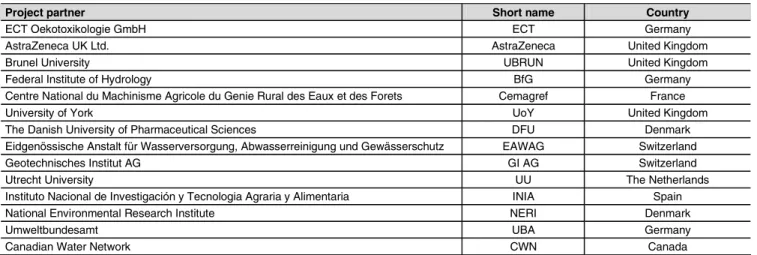
Project partner Short name Country
ECT Oekotoxikologie GmbH ECT Germany
AstraZeneca UK Ltd. AstraZeneca United Kingdom
Brunel University UBRUN United Kingdom
Federal Institute of Hydrology BfG Germany
Centre National du Machinisme Agricole du Genie Rural des Eaux et des Forets Cemagref France
University of York UoY United Kingdom
The Danish University of Pharmaceutical Sciences DFU Denmark
Eidgenössische Anstalt für Wasserversorgung, Abwasserreinigung und Gewässerschutz EAWAG Switzerland
Geotechnisches Institut AG GI AG Switzerland
Utrecht University UU The Netherlands
Instituto Nacional de Investigación y Tecnologia Agraria y Alimentaria INIA Spain
National Environmental Research Institute NERI Denmark
Umweltbundesamt UBA Germany
Canadian Water Network CWN Canada
© 2005 ecomed publishers (Verlagsgruppe Hüthig Jehle Rehm GmbH), D-86899 Landsberg and Tokyo • Mumbai • Seoul • Melbourne • Paris ESPR – Environ Sci & Pollut Res 12121212 (2) 62 – 65 (2005)12
EU Projects
The EU-project ERAPharm
Incentives for the further development of guidance documents?
Thomas Knacker1*, Karen Duis1, Thomas Ternes2, Kathrin Fenner3, Beate Escher3,
Heike Schmitt4, Jörg Römbke1, Jeanne Garric5, Thomas Hutchinson6 and Alistair B.A. Boxall7
1ECT Oekotoxikologie GmbH, Böttgerstr. 2-14, D-65439 Flörsheim/Main, Germany 2Bundesanstalt für Gewässerkunde (BfG), Am Mainzer Tor 1, D-56068 Koblenz, Germany
3Eidgenössische Anstalt für Wasserversorgung, Abwasserreinigung und Gewässerschutz (EAWAG), Ueberlandstrasse 133, CH-8600 Duebendorf, Switzerland
4RIVM – LER, Postbox 1, 3720 BA Bilthoven, The Netherlands
5Cemagref, 3 bis, Quai Chauveau, CP 220, 69336 Lyon Cedex 09, France 6AstraZeneca R&D, Global Safety Assessment, S-151 85 Södertälje, Sweden 7Central Science Laboratory, Sand Hutton, York YO41 1LZ, UK
* Corresponding author ([email protected])
1 The ERAPharm Consortium
The ERAPharm consortium consists of 14 partners from eight different countries (seven European countries and Canada; Table 1). It comprises representatives from the in-terest groups involved in the registration of pharmaceuti-cals (i.e. competent authorities, pharmaceutical industry), scientists from universities and research institutes and two SMEs (small to medium-sized enterprises). The project is co-ordinated by ECT Oekotoxikologie GmbH.
2 Project Objectives
The overall objective of ERAPharm is to improve and com-plement existing knowledge and procedures for the envi-ronmental risk assessment of human and veterinary phar-maceuticals. ERAPharm will cover
• fate and exposure assessment, • effects assessment and • environmental risk assessment.
An overview of the structure and the work packages of the project is given in Fig. 1 and Table 2, respectively.
DOI: http://dx.doi.org/10.1065/espr2005.02.238 Abstract
Triggered by the detection of a large variety of pharmaceuticals in surface waters, soils and groundwaters across the world (e.g. Halling-Sørensen et al. 1998, Daughton & Ternes 1999, Jones et al. 2001, Heberer 2002) and the widespread occurrence of endocrine active compounds and related effects in the environment (e.g. Purdom et al. 1994, Tyler et al. 1998, Vethaak et al. 2002), pharmaceuticals in the environment have become an issue for both the scientific and the public community. During the last few years, our understanding of the fate and effects of pharmaceuticals in the environment has pro-gressed significantly. However, there are still a number of uncertain-ties concerning the effects of pharmaceuticals on the environment and the assessment of potential exposure (e.g. Hanisch et al. 2004, Salomon 2005). These uncertainties will be addressed by the EU-project 'Environmental risk assessment of pharmaceuticals' (ERAPharm). This project, a specific targeted research project, is carried out within the priority 'Global change and ecosystems' of the 6th framework
pro-gramme of the European Union. ERAPharm has started on 1st
Oc-tober 2004; the project duration is three years.
Keywords: ERAPharm (environmental risk assessment of pharma-ceuticals); EU projects; exposure; global change; human and veteri-nary pharmaceuticals; persistence of chemicals; pharmaceuticals in surface waters, soils and groundwaters; risk assessment
EU-Projects
ERAPharm
ESPR – Environ Sci & Pollut Res 1212121212 (2) 2005
63
Based on existing regulatory frameworks on the environmen-tal risk assessment (ERA) of pharmaceuticals and on the out-come of previous projects (e.g. the EU-projects ERAVMIS, POSEIDON and REMPHARMAWATER), ERAPharm will address the following aspects for both human and veterinary pharmaceuticals.
2.1 Fate and exposure assessment
ERAPharm will focus on understanding major fate proc-esses and exposure routes which have so far not been stud-ied at all or only to a small extent, namely input from pas-ture animals and through the application of manure and sewage sludge to land.
The factors and processes affecting the behaviour of phar-maceuticals and selected transformation products in relevant environmental matrices (water, sediment, soil and manure) will be investigated in a series of laboratory, semi-field and field studies. Data will be generated on the sorption behav-iour and persistence of human and veterinary pharma-ceuticals for a range of environmental conditions (e.g. dif-ferent soil and sediment characteristics, difdif-ferent microbial diversity, freshwater vs. marine conditions). The effects of the application matrix (e.g. manure, sludge) on behaviour will also be considered. Based on the results of these tests, recommendations will be provided on experimental
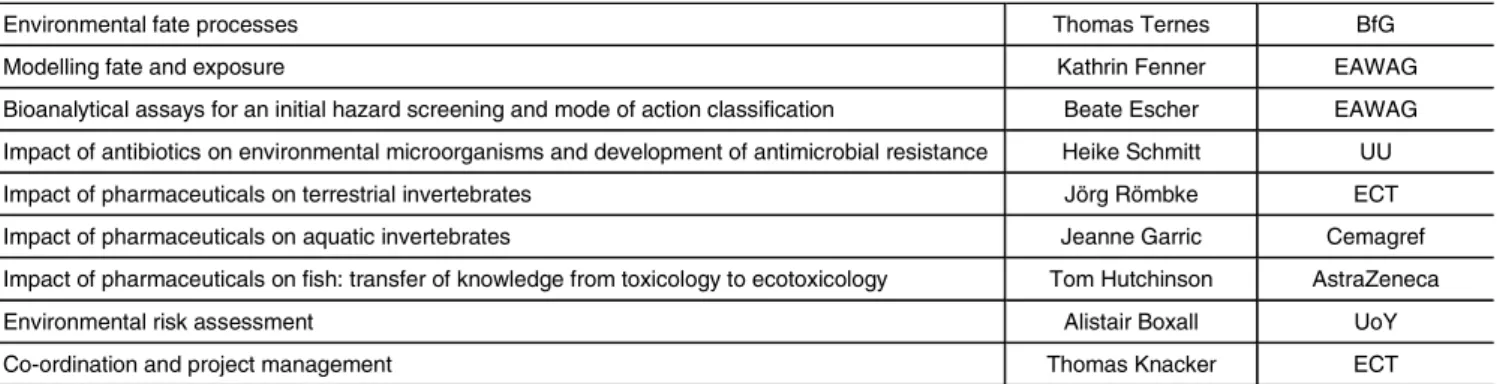
ap-Table 2: Work packages and responsible leaders of work packages within ERAPharm
Environmental risk assessment
Fate & exposure
assessment Effects assessment
Expo sur e mo d elli n g F ate p ro ces se s B ioa na ly ti ca l t est s Mi cr oor ga n isms Ter restr ial inv ertebrates Aqu a ti c invert eb rates Fi sh
Environmental risk assessment
Fate & exposure
assessment Effects assessment
Expo sur e mo d elli n g F ate p ro ces se s B ioa na ly ti ca l t est s Mi cr oor ga n isms Ter restr ial inv ertebrates Aqu a ti c invert eb rates Fi sh
Environmental fate processes Thomas Ternes BfG
Modelling fate and exposure Kathrin Fenner EAWAG
Bioanalytical assays for an initial hazard screening and mode of action classification Beate Escher EAWAG Impact of antibiotics on environmental microorganisms and development of antimicrobial resistance Heike Schmitt UU
Impact of pharmaceuticals on terrestrial invertebrates Jörg Römbke ECT
Impact of pharmaceuticals on aquatic invertebrates Jeanne Garric Cemagref
Impact of pharmaceuticals on fish: transfer of knowledge from toxicology to ecotoxicology Tom Hutchinson AstraZeneca
Environmental risk assessment Alistair Boxall UoY
Co-ordination and project management Thomas Knacker ECT
Fig. 1: Overview of the structure of the project
proaches for assessing the fate of pharmaceuticals as part of the ERA process. Models for predicting key fate parameters (e.g. sorption and persistence) will be evaluated and, where possible, further developed.
A scenario-based exposure assessment system will be devel-oped for predicting concentrations of human and veterinary pharmaceuticals in soils, surface waters and sediments as well as their leaching potential to groundwater. The FOCUS modelling tools, which are in regulatory use for pesticides, will be used as a starting point for developing a higher-tier exposure assessment system for pharmaceuticals. This sys-tem will consist of a suite of standard scenarios (for charac-teristically different regions of the EU member and acces-sion states including Mediterranean and Eastern European regions) for exposure of the terrestrial and aquatic environ-ment to pharmaceuticals and a set of adapted, process-based fate and transport models for soil, surface water and leach-ing/runoff. The exposure assessment system will be verified using data generated in the above-mentioned fate studies. 2.2 Effects assessment
ERAPharm will contribute to investigating whether envi-ronmentally relevant concentrations of human and veteri-nary pharmaceuticals pose a risk to aquatic and terrestrial organisms. The project will also improve methods and strat-egies for assessing the effects of pharmaceuticals. Given the fact that many pharmaceuticals contain various functional groups, multiple modes of action can be expected (Escher & Hermens 2002). Moreover, pharmaceuticals that are of-ten designed to target specific receptor structures in mam-mals or in other target organisms such as pathogens and parasites, may elicit different types of effects in non-target organisms (Seiler 2002). Due to the lack of knowledge on these types of effects, test batteries covering many possible modes of action are required in order to effectively assess the potential environmental hazard caused by pharmaceuticals. A good strategy to achieve this is to include species from dif-ferent taxa and with difdif-ferent reproduction strategies (Sanchez & Tarazona 2002). Taking this into account, ERAPharm will improve ecotoxicological test methods in order to detect the effects of pharmaceuticals from different therapeutic classes in bacteria, aquatic and terrestrial invertebrates and fish at different levels of biological organisation (individual,
popula-ERAPharm
EU-Projects
64
ESPR – Environ Sci & Pollut Res 1212121212 (2) 2005tion, community). The capability of single-species tests to pre-dict effects at higher levels of biological organisation will be elucidated by micro-/mesocosm and field studies.
Emphasis will be placed on pharmaceuticals with a specific mode of action in the environment. Data generated in the effect work packages will provide the basis for improving guidance on how to address specific effects (i.e. for target-ing the effects assessment), for determintarget-ing relationships between acute and chronic toxicity and for evaluating the current fixed environmental concentration action limits that are used in the ERAs of pharmaceuticals.
A battery of in vitro and low complexity bioanalytical tests covering relevant modes of action will be used for screening the pharmaceuticals. The test battery is based on the initial interactions of the pharmaceuticals with their targets in cells and on the onset of defence and repair mechanisms in the cells. The test results will provide a first hazard characteri-sation and a classification according to the mode(s) of toxic action. They will be used for targeting the in vivo tests with invertebrates and fish. In addition, it is planned to screen degradation products, which have been identified and iso-lated in the fate studies and/or metabolites.
The impact of human and veterinary antibiotics on the struc-ture and function of the microbial community will be inves-tigated for the terrestrial and the aquatic (freshwater and marine) environment. This aspect has hardly been looked at in the context of environmental risk assessments, although the diversity of the microbial community is thought to be critical to soil health and soil quality (Garbeva 2004). Spe-cial emphasis will be placed on the potential of antibiotics to increase genetically-encoded resistance. Different microbial test systems will be evaluated with regard to their suitability for inclusion in the ERA procedure for pharmaceuticals. The effects of human and veterinary pharmaceuticals on ter-restrial invertebrates will be studied on the laboratory, semi-field, e.g. terrestrial model ecosystems (Knacker et al. 2004), and field scale, taking the environmental conditions in dif-ferent European regions into account. Both structural and functional endpoints will be considered. A main focus will be to systematically evaluate the effects of parasiticides on dung flies and beetles since there is concern about the effects of these compounds on pasture ecology (Floate et al. 2005). Effects of human and veterinary pharmaceuticals on aquatic invertebrates will be investigated considering both exposure via the water column and exposure via the sediment. While terrestrial organisms may be exposed locally and temporar-ily to higher concentrations of pharmaceuticals (e.g. when veterinary pharmaceuticals such as parasiticides are admin-istered to grazing animals), aquatic animals are typically exposed continuously to relatively constant low levels of pharmaceuticals, especially with regard to human pharma-ceuticals. Emphasis will thus be placed on life-cycle and multi-generation tests. In these tests, a broad spectrum of ecologically-relevant endpoints and indirect effects can be evaluated. Energy-based models (Péry et al. 2003) will be used to predict effects at the population level. The impact of pharmaceuticals will be investigated at the single-species and
microcosm level. In addition, the project will be able to draw upon long-term mesocosm studies with aquatic invertebrates that are performed by the Canadian Water Network. Chronic effects of human pharmaceuticals on fish will be in-vestigated. As vertebrates with target structures that are often very similar to those in humans, fish are very likely to be af-fected by human pharmaceuticals as was demonstrated e.g. for ethinylestradiol (Larsson et al. 1999). Within ERAPharm, information from pharmaco- and toxicodynamic studies with mammalian species and from mechanistic (molecular bio-logical) studies will be used to supplement fish tests with additional specific endpoints in order to detect chronic ef-fects of human pharmaceuticals. It will be evaluated whether data on pharmaco- and toxicodynamics in mammalian spe-cies can be used to predict potentially hazardous environ-mental concentrations and the type of effects to be expected in fish and in other environmental organisms.
2.3 Environmental risk assessment
The information on fate and effects of pharmaceuticals in the environment and the improved techniques for determin-ing exposure and effect concentrations, which have been generated by the above-mentioned studies, will be used to propose improvements of existing ERA procedures for hu-man and veterinary pharmaceuticals (CVMP/VICH 2000 and 2004, EMEA/CHMP 2005). ERAPharm will develop screening approaches for identifying (1) those substances that require testing, (2) those environmental compartments and organisms that are most at risk, and (3) the potential to bioaccumulate. The results of these approaches can then be used to target testing. Moreover, PEC action limits and trig-ger values of the current ERA procedures will be evaluated. Pragmatic approaches will be developed for evaluating the risks of transformation products. These approaches will draw upon current research in the pesticides area, where methods for assessing fate and effects of transformation products based on the structure and physico-chemical properties of the trans-formation product and the parent compound are being devel-oped (e.g. Fenner et al. 2003, Sinclair & Boxall 2003). A web-based database with information on fate and effects of pharmaceuticals will be compiled and a web-based risk assessment system will be developed. Case studies will be carried out, i.e. both the newly developed methodologies and the current ERA approaches will be applied to two se-lected pharmaceuticals. Based on the results, recommenda-tions on the environmental risk assessment of human and vet-erinary pharmaceuticals will be provided that will be made available to regulators, industry and the scientific community.
Acknowledgement. We would like to thank all ERAPharm-partners,
especially Jason Snape (AstraZeneca), John Sumpter (UBRUN), Dirk Löffler (BfG), Alexandre Péry (Cemagref), Bent Halling-Sørensen (DFU), Alfredo Alder (EAWAG), Christian Zipper (GI AG), Joop Hermens (UU), José Tarazona (INIA), John Jensen (NERI), Ines Rönnefahrt (UBA), Mark Servos (CWN) as well as Markus Liebig and Johann Moltmann (ECT). Furthermore we gratefully acknowledge the financial support granted by the European Commission (Contract No. 511135).
EU-Projects
ERAPharm
ESPR – Environ Sci & Pollut Res 1212121212 (2) 2005
65
References
CVMP/VICH (2000): VICH Topic GL6 (Ecotoxicity Phase I) Step 7. Guideline on environmental impact assessment (EIAS) for vet-erinary medicinal products – Phase I (CVMP/VICH/592/98) CVMP/VICH (2004): VICH Topic GL 38 (Environmental impact
assessments (EIAs)) for veterinary medicinal products (VMPs) – Phase II (CVMP/VICH/790/03-Final)
Daughton CD, Ternes T (1999): Pharmaceuticals and personal care products in the environment: agents of subtle change? A review. Environ Health Perspect 107, 907–938
EMEA/CHMP (2005): Note for guidance on environmental risk assessment of medicinal products for human use. Draft (CHMP/ SWP/4447/00 draft)
Escher BI, Hermens JLM (2002): Modes of action in ecotoxicology: their role in body burdens, species sensitivity, QSARs, and mix-ture effects. Environ Sci Technol 36, 4201–4217
Fenner K, Scheringer M, Hungerbühler K (2003): Joint persist-ence of transformation products in chemicals assessment: case studies and uncertainty analysis. Risk Analysis 23, 35–53 Floate KD, Wardhaugh KG, Boxall ABA, Sherratt TN (2005):
Fecal residues of veterinary parasiticides: nontarget effects in the pasture environment. Annu Rev Entomol 50, 153–179 Garbeva P, van Veen JA, van Elsas JD (2004): Microbial diversity
in soil: selection microbial populations by plant and soil type and implications for disease suppressiveness. Annu Rev Phyto-pathol 42, 243–270
Halling-Sørensen B, Nielsen SN, Lanzky PF, Ingerslev F, Holten-Lützhoft HC, Joergensen SE (1998): Occurrence, fate and ef-fects of pharmaceutical substances in the environment. A re-view. Chemosphere 36, 357–393
Hanisch B, Abbas B, Kratz W, Schüürmann G (2004): Humanarz-neimittel im aquatischen Ökosystem – Bewertungsansatz zur Abschätzung des ökotoxikologischen Risikos von Arzneimittel-rückständen. UWSF – Z Umweltchem Ökotox 16, 223–238 Heberer T (2002): Occurrence, fate, and removal of
pharmaceu-tical residues in the aquatic environment: a review of recent research data. Toxicol Letters 131, 5–17
Jones OAH, Voulvoulis N, Lester JN (2001): Human pharmaceu-ticals in the aquatic environment: a review. Environ Technol 22, 1383–1394
Knacker T, van Gestel CAM, Jones SE, Soares AMVM, Schallnaß H-J, Förster B, Edwards CA (2004): Ring-testing and field
validation of a terrestrial model ecosystem (TME) – An instru-ment for testing potentially harmful substances: conceptual approach and study design. Ecotoxicology 13, 9–27
Larsson DGJ, Adolfsson-Erici M, Parkkonen J, Pettersson M, Berg AH, Olsson E, Förlin L (1999): Ethinyloestradiol – An unde-sired fish contraceptive. Aquat Toxicol 45, 91–97
Péry ARR, Ducrot V, Mons R, Garric J (2003): Modelling toxic-ity and mode of action of chemicals to analyse growth and emergence tests with the midge Chironomus riparius. Aquat Toxicol 65, 281–292
Purdom CE, Hardiman PA, Bye VJ, Eno NC, Tyler CR, Sumpter JP (1994): Estrogenic effects of effluents from sewage treat-ment works. Chem Ecol 8, 275–285
Salomon M (2005) Arzneimittel in der aquatischen Umwelt – Der Rat von Sachverständigen für Umweltfragen: Handlungsbedarf. UWSF – Z Umweltchem Ökotox 17, 50–53
Sanchez P, Tarazona JV (2002): Development of a multispecies system for testing reproductive effects on aquatic invertebrates. Experience with Daphnia magna, Chironomus prasinus and
Lymnaea peregra. Aquat Toxicol 60, 249–256
Seiler JP (2002): Pharmacodynamic activity of drugs and eco-toxicology – Can the two be connected? Toxicol Letters 131, 105–115
Sinclair CJ, Boxall ABA (2003): Assessing the ecotoxicity of pes-ticide transformation products. Environ Sci Technol 37, 4617– 4625
Tyler CR, Jobling S, Sumpter JP (1998): Endocrine disruption in wildlife, a critical review of the evidence. Crit Rev Toxicol 28, 319–361
Vethaak AD, Rijs GBS, Schrap SM, Ruiter H, Gerritsen A, Lahr J, Belfroid AC, de Boer J, Bulder AS, Kuiper RV, Legler J, Murk AJ, de Voogt P, van der Velde EG, Verhaar HJM (2002): Estro-gens and xeno-estroEstro-gens in the aquatic environment of the Neth-erlands. Occurrence, potency and biological effects. RIZA/ RIKZ-Report Nr. 2002.001
Received: February 9th, 2005 Accepted: February 13th, 2005
OnlineFirst: February 14th, 2005
Related projects of the 6th EU framework programme
Project title Acronym Objective Co-ordinator Further information
Novel methods for integrated risk assessment of cumulative stressors in Europe
NoMiracle Development of methods for assessing the cumulative risks from combined exposures to multiple stressors Hans Løkke, National Environmental Research Institute, Silkeborg, Denmark http://viso.jrc.it/nomiracle
Models for assessing and forecasting the impact of environmental key pollutants on marine and freshwater ecosystems and biodiversity
MODELKEY Development of predictive modelling tools, effect-assessment and analytical methods applicable to European freshwater and marine ecosystems
Werner Brack,
Environmental Research Centre (UFZ), Leipzig, Germany
http://www.modelkey.org
Integrated modelling of the river-sediment-soil-groundwater system; advanced tools for the management of catchment areas and river basins in the context of global change
Aquaterra Improvement of the scientific basis for river basin manage-ment through a better under-standing of the river-sediment-soil-groundwater system
Peter Grathwohl, Eberhard-Karls-University Tübingen, Germany