HAL Id: inserm-02307178
https://www.hal.inserm.fr/inserm-02307178
Submitted on 7 Oct 2019
HAL is a multi-disciplinary open access
archive for the deposit and dissemination of
sci-entific research documents, whether they are
pub-lished or not. The documents may come from
teaching and research institutions in France or
abroad, or from public or private research centers.
L’archive ouverte pluridisciplinaire HAL, est
destinée au dépôt et à la diffusion de documents
scientifiques de niveau recherche, publiés ou non,
émanant des établissements d’enseignement et de
recherche français ou étrangers, des laboratoires
publics ou privés.
Marie-Catherine Beuscart-Zéphir
To cite this version:
Romaric Marcilly, Elske Ammenwerth, Erin Roehrer, Julie Niès, Marie-Catherine Beuscart-Zéphir.
Evidence-based usability design principles for medication alerting systems. BMC Medical Informatics
and Decision Making, BioMed Central, 2018, 18 (1), pp.69. �10.1186/s12911-018-0615-9�.
�inserm-02307178�
R E S E A R C H A R T I C L E
Open Access
Evidence-based usability design principles
for medication alerting systems
Romaric Marcilly
1*, Elske Ammenwerth
2, Erin Roehrer
3, Julie Niès
4and Marie-Catherine Beuscart-Zéphir
1Abstract
Background: Usability flaws in medication alerting systems may have a negative impact on clinical use and patient safety. In order to prevent the release of alerting systems that contain such flaws, it is necessary to provide designers and evaluators with evidence-based usability design principles. The objective of the present study was to develop a comprehensive, structured list of evidence-based usability design principles for medication alerting systems. Methods: Nine sets of design principles for medication alerting systems were analyzed, summarized, and structured. We then matched the summarized principles with a list of usability flaws in order to determine the level of underlying evidence.
Results: Fifty-eight principles were summarized from the literature and two additional principles were defined, so that each flaw was matched with a principle. We organized the 60 summarized usability design principles into 6 meta-principles, 38 principles, and 16 sub-principles. Only 15 principles were not matched with a usability flaw. The 6 meta-principles respectively covered the improvement of the signal-to-noise ratio, the support for collaborative
working, the fit with a clinician’s workflow, the data display, the transparency of the alerting system, and the actionable
tools to be provided within an alert.
Conclusions: It is possible to develop an evidence-based, structured, comprehensive list of usability design principles that are specific to medication alerting systems and are illustrated by the corresponding usability flaws. This list represents an improvement over the current literature. Each principle is now associated with the best available evidence of its violation. This knowledge may help to improve the usability of medication alerting systems and, ultimately, decrease the
harmful consequences of the systems’ usability flaws.
Keywords: Human engineering, Usability, Alerting system, Decision support, Design Background
Medication alerting systems “provide real-time notifica-tion of errors, potential hazards or omissions” related to the prescription of medications, and thus help clinicians to make informed decisions (nota bene: in the present report, a“clinician” is defined as any healthcare profes-sional who interacts with the patient; the term therefore encompasses physicians, nurses and pharmacists) [1]. These promising technologies can change prescribers’ behavior by helping them avoid errors [2] and, ulti-mately, can improve the quality of the medication
management process [3]. Nonetheless, the design and the implementation of these tools may introduce nega-tive, unforeseen side effects: poor integration into the clinical workflow [4], acceptance issues, and decreased safety and quality of care, for example [5]. Some of these issues are related to the usability of the alerting systems [6]; they are caused by defects in the design of the sys-tem, i.e. usability flaws. For instance, alerts may be poorly integrated into the workflow and may appear too late in the decision-making process – rendering the alerting system useless [7,8]. In other cases, the content of the alert is either incomplete or not visible enough to adequately support a clinician’s decision making – lead-ing to incorrect clinical decisions [9]. This lack of infor-mation also increases the clinician’s cognitive load [10]. Alerts may be poorly written or explained - causing
* Correspondence:[email protected]
1
Univ. Lille, INSERM, CHU Lille, CIC-IT / Evalab 1403 - Centre d’Investigation
clinique, EA 2694, F-59000 Lille, France, Maison Régionale de la Recherche Clinique, 6 rue du professeur Laguesse, 59000 Lille France
Full list of author information is available at the end of the article
© The Author(s). 2018 Open Access This article is distributed under the terms of the Creative Commons Attribution 4.0
International License (http://creativecommons.org/licenses/by/4.0/), which permits unrestricted use, distribution, and
reproduction in any medium, provided you give appropriate credit to the original author(s) and the source, provide a link to the Creative Commons license, and indicate if changes were made. The Creative Commons Public Domain Dedication waiver (http://creativecommons.org/publicdomain/zero/1.0/) applies to the data made available in this article, unless otherwise stated.
misunderstandings or at least creating difficulties in un-derstanding them. These cognitive issues may also lead to incorrect clinical decisions [11–13]. In summary, these and other usability flaws in the alerting system may have severe consequences, such as rejection of the alerting system, and incorrect clinical decisions. There-fore, the usability of an alerting system warrants special scrutiny, with a view to avoiding usability-induced use errors at least.
To prevent the usability of alerting systems from intro-ducing errors, usability activities (e.g. design specifications and prototype evaluation) must be undertaken during the technology development process [14]. The implementa-tion of those activities requires a sound knowledge of good usability design principles (also known as usability heuristics and usability criteria). Violation of those principles may generate usability flaws in the technology. With a view to helping companies to avoid the release of medication alerting systems that contain unintentional violations of these principles, it is necessary to provide designers and evaluators with easy access to relevant, illus-trated usability design principles and to convince them of the value of applying these principles to design decisions. In summary, designers and evaluators of medication alert-ing systems need to access evidence-based usability design principles, i.e. usability design principles that have proven their value in practice [15]. As far as we know, the present study is the first to have provided evidence-based usability design principles for medication alerting systems.
Putting together a body of evidence relies on the accu-mulation of results that demonstrate the positive value of applying design principles. Unfortunately, publications in the field of usability evaluation tend to report only negative results, i.e. instances of usability flaws. This reporting bias prevents the collection of evidence to show that applying principles is beneficial. Hence, although it is not yet possible to demonstrate the posi-tive value of applying usability design principles, it is still
possible to demonstrate the negative consequences of violating them.
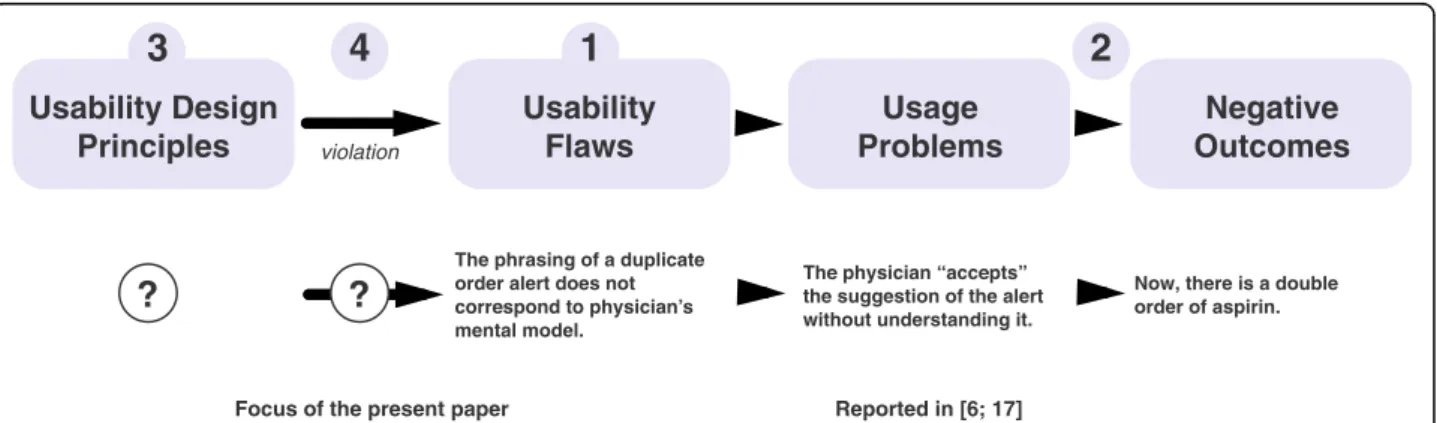
In previous research, we started to develop a usability knowledge framework (Fig. 1; [16]). We have used this framework to gather evidence-based usability design principles for medication alerting systems. In a first step, we performed a systematic review of the literature to identify the usability flaws in medication alerting systems used in hospital and/or primary care (active or passive alerts, and use as a standalone system or integrated into a larger information system) [17]. In a second step, we searched for the consequences of these flaws on users (usage problems; e.g. alert fatigue and missed informa-tion) and on the work system (negative outcomes; e.g. a decrease in effectiveness, and patient safety issues), and linked them to their cause [6].
The third step involves identifying, summarizing, and organizing published design principles so as to avoid “reinventing” principles as far as possible. The fourth step (in line with previous work by Nielsen [18]) seeks to match usability flaws to the usability design principles that could fix them and thus obtain empirical illustra-tions of the principles’ violation. The present study tack-led the third and fourth steps. The results will help to establishing evidence in support of these principles.
The present study had two objectives. Firstly, it sought to identify and organize literature reports of usability de-sign principles for medication alerting systems in hos-pital or primary care settings into a comprehensive, structured list of design principles. Secondly, the study sought to match this list with the set of usability flaws identified in the systematic review [17], in order to as-sess the fit between known usability flaws and known existing design principles and thus illustrate violations of these principles.
Methods
A two-step methodology was applied.
Fig. 1 Top: a graphical representation of the evidence-based usability knowledge framework. The numbering refers to the four steps, as described in the text. The question marks refer to the steps tackled in the present study. Bottom: an instance of the cause-consequence chain linking a usability flaw, a usage problem and a negative outcome (adapted from [27])
Gathering and structuring usability design principles
We searched peer-reviewed journals and conference pa-pers for published consensus sets of usability design principles for medication alerting systems (i.e. principles that experts in the field had agreed on). The“grey” litera-ture was excluded because the quality of the information may vary. Hence, we searched PubMed, Scopus, and Ergonomics Abstracts databases for articles addressing both“medication alerting systems” and “usability” topics. With this goal in mind, we used the screening and eligibil-ity assessment steps from our previous systematic review [17] to identify papers purposefully providing at least one usability design principle dedicated to medication alerting systems. We excluded system-specific papers providing recommendations on improving usability because these principles are not applicable to a broad range of systems. This task was updated on March 30th 2016. The literature search was intended to provide an overview of published sets of usability design principles for medication alerting systems, rather than being systematic and reproducible. The database search was completed by examining the in-vestigators’ personal libraries and by screening the refer-ences of the selected publications. Two investigators (MCBZ and RM) decided on the final list of publications by consensus.
Once relevant publications had been identified, one in-vestigator (RM) extracted all items referring to usability design principles from each publication. Next, the inves-tigator grouped together principles with similar purposes and organized them hierarchically. A second investigator (MCBZ) independently crosschecked the hierarchical organization of the principles. Disagreements were solved by discussion until a consensus was reached. Lastly, the two investigators summarized the principles that had been grouped together.
Matching usability design principles to known usability flaws
One investigator (RM) checked the list of usability flaws published in the on-line appendices of Marcilly et al. [17] against the structured list of usability design principles. A second investigator (MCBZ) crosschecked the results. Dis-agreements were discussed until a consensus was reached. The items referring to usability flaws were either descrip-tions of the technology’s defects observed during field studies or usability tests, answers to interviews/question-naires, or users’ positive or negative comments about the characteristics of the technology collected during their interaction with the system. A usability flaw was matched to a given usability design principle if it was an instance of a violation of the said principle. Reciprocally, a usability design principle matched a usability flaw if the application of the principle stopped the flaw from occurring. If a flaw did not match any of the usability design principles, then
we considered the possible extension (broadening) of an existing principle to other contexts so that it covered a wider range of flaws. If no principles could be extended to cover the flaw, we defined a new principle.
The matching process was intended to be as unequivocal as possible, i.e. one flaw matched one principle. However, if a given usability flaw violated several principles (e.g. at different levels of granularity), we matched that flaw to the most significantly violated principles (based on our experi-ence). It should be noted that a given principle could be matched with several instances of the same flaw.
Figure2illustrates the matching process. Both investi-gators performed the descriptive analysis of the matches. Results
Gathering and structuring usability design principles
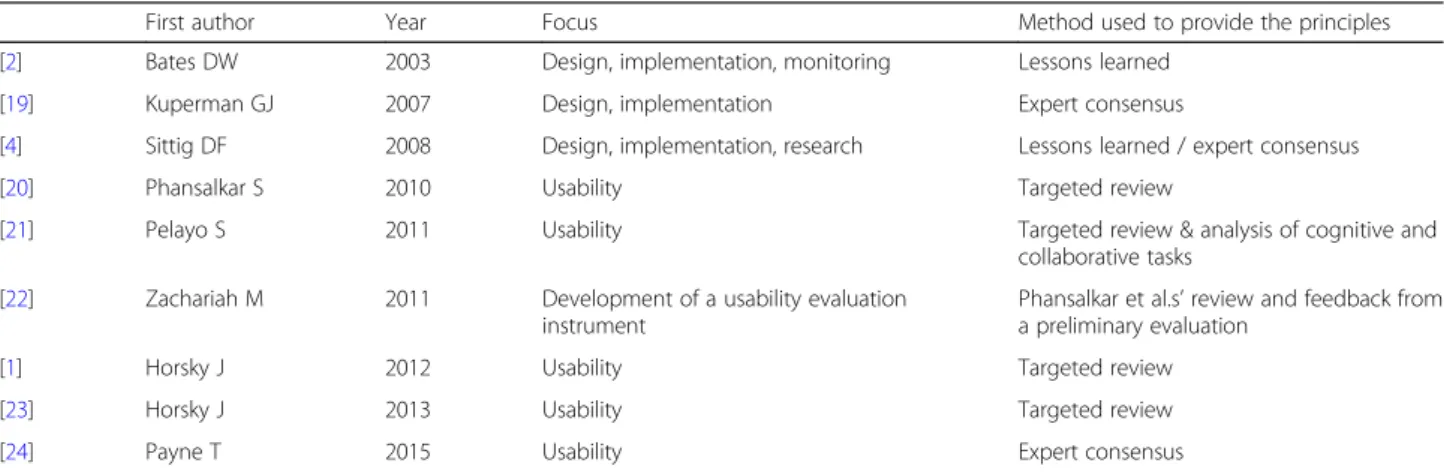
We identified 9 publications on design principles dedi-cated to medication alerting systems (Table1).
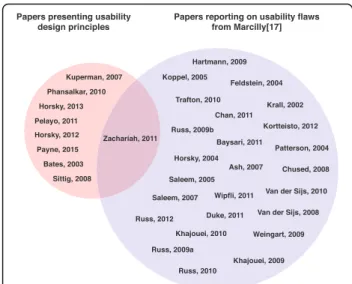
Figure 3 describes the sets of publications analyzed. One publication (Zachariah et al. [22]) was included in both sets; although this publication was an extension of another set of design principles described by Phansalkar et al. [20], it contained a few usability design principles not found in the original publication [20]. The publica-tion also gave a list of usability flaws detected using heuristics. Despite the potential for self-matching bias, this publication was included because our objective was to obtain the most comprehensive possible list of design principles. Moreover, it was found that virtually all first authors of the set of usability design principles were co-authors of one or more studies included in the review of usability flaws (e.g.[1,4,20,23]).
A total of 345 items referring to usability design princi-ples were extracted from the 9 publications (see Add-itional file1: Appendix 1) and then organized. The level of agreement between the two investigators regarding the organization of the items was very high, with full agree-ment for 92.6% of the combinations, discussion needed for 6%, and disagreement for 1.3%. After a consensus meeting, the items were summarized into 58 principles. No significant inconsistencies between principles from dif-ferent publications were noticed. The summarized princi-ples displayed different granularity levels, and some were more tangible and precise than others; they could there-fore be organized hierarchically into 6 meta-principles, 36 principles, and 16 sub-principles (Fig.4, Table2).
Overall, the 9 publications contributed to different ex-tents to the set of summarized principles: the contribu-tions ranged from 12% [22] to 69% [24] (see Additional file2: Appendix 2).
The level of support for each of the summarized prin-ciples (in terms of number of publications in which they were found) varied: one summarized principle was sup-ported by all 9 papers (#49 “Include actionable tools
within the alert”), “Suggest, do not impose” (#42) was supported by 8 publications, and 6 principles were found in 1 publication. When considering the overall meta-principles and their components (i.e. related prin-ciples and sub-prinprin-ciples), the level of support ranged from 5 publications for meta-principle E (“Make the sys-tem transparent for the user”) to 9 publications for meta-principle D (“Display relevant data within the alert”) and meta-principle F (“Include actionable tools within the alert”).
Matching usability design principles with known usability flaws
The two investigators agreed well on the matching between usability flaws and usability design principles, with full agreement for 54.6% of matches, partial
agreement for 31% (agreement on the main corre-sponding principle but a need to match the flaw with a second principle), discussion needed for 13.4%, and disagreement for 1%. Of the 58 principles, 34 directly matched at least one instance of a usability flaw, nine were broadened to cover a flaw, and 15 were not matched at all (see Additional file 3: Appendix 3). Two new principles were defined so that all flaws matched a principle (#46, provide “a description of the characteristics of the tools included in the alert” to users, and #57, include a “send the alert into the clinical note template” function in the alert).
After the addition of the 2 new principles, the final set comprised 60 summarized usability design principles: 6 meta-principles, 38 principles, and 16 sub-principles. The 6 meta-principles were as follows:
Fig. 2 Illustration of the matching process, using meta-principle E (#44) and one of its sub-principles (#48). The usability design principles found in the literature were summarized and organized hierarchically (left). The usability flaws identified in the systematic review were collated by topic (right). Next, the correspondence between a given type of flaw and a given summarized principle was established based on the principle’s ability (if applied) to fix the usability flaw. This correspondence is represented by a double arrow. When a usability flaw could not be fixed by any of the design principles in the literature, we either extended an existing principle or created a new one (single arrow). The illustration presents an extension of principle #48 (in italics)
Table 1 Main characteristics of the publications on usability design principles
First author Year Focus Method used to provide the principles
[2] Bates DW 2003 Design, implementation, monitoring Lessons learned
[19] Kuperman GJ 2007 Design, implementation Expert consensus
[4] Sittig DF 2008 Design, implementation, research Lessons learned / expert consensus
[20] Phansalkar S 2010 Usability Targeted review
[21] Pelayo S 2011 Usability Targeted review & analysis of cognitive and
collaborative tasks
[22] Zachariah M 2011 Development of a usability evaluation
instrument
Phansalkar et al.s’ review and feedback from
a preliminary evaluation
[1] Horsky J 2012 Usability Targeted review
[23] Horsky J 2013 Usability Targeted review
A. Improve the system’s signal-to-noise ratio, in order to decrease the frequency of over-alerting. In addition to the drugs ordered, the alert strategy should take into account parameters such as the patient’s clinical context or the clinician’s specialty. Moreover, the system must provide tools to customize the knowledge implemented within it and to monitor alert overrides.
B. Support collaborative work, advocate a team approach, and make the system a team player. The alerting system must encourage collaboration between the healthcare professional managing medications (e.g. physicians, pharmacists and nurses). Overall, alerts must deliver the same information to all clinicians, even if additional supplementary data can be presented as a function of the healthcare professional’s role. The alerting system must help clinicians to understand how other healthcare professionals have already managed the alert.
C. Fit with clinicians’ workflow and their mental model. The alerting system must comply with clinicians’ needs and tasks. Alerts must be presented at the right moment in the decision-making process. Only the most severe alerts must interrupt the users; other alerts must be displayed more discreetly. Alerts must be concise, under-standable and consistently structured so that users can easily find the relevant data. Once the alert has been satisfied, the clinicians must be able to resume their tasks easily.
D. Display relevant data within the alert. The system must provide clinicians with the
information needed to make informed decisions. This includes the cause of the unsafe event (the medications involved), the description of the unsafe event, the severity/priority of the event, the mechanism of the interaction, the patient’s clinical context, and evidence supporting the alert. Lastly, the system must suggest – but not impose – a means of remedying or monitoring the unsafe event.
E. Make the system transparent for the user. The alerting system must help clinicians to understand what the system can and cannot do and how it works, in order to prevent erroneous interpretation of its behavior. The user must have access to (i) the types of data that are checked, (ii) the formulas and rules applied, (iii) the list of the unsafe events that are targeted, and (iv) a description of the alerts’ levels of severity.
F. Include actionable tools within the alert. The alert must provide several tools that help clinicians to easily and quickly translate their alert-informed clinical decision into actions: for example, buttons to modify/cancel/discontinue an order or override the alert, to order actions for monitoring an event, and to provide patient education. Other tools are recommended for managing the alert: pulling up the alert at a later time, sending the alert into a clinical note, removing the alert for a patient, and gaining access to the patient’s medical records.
The final list of summarized usability design principles is given in Fig. 4. Table2 provides a detailed version of the principles and corresponding flaws.
Discussion
Answers to study questions
The present study sought primarily to provide a specific, comprehensive, structured list of usability design princi-ples for the medication alerting systems implemented in hospital or primary care settings. The secondary object-ive was to pair this list with the set of documented us-ability flaws, assess the match between the usus-ability flaws that are known and the existing design principles, obtain illustrations of the existing violations of the prin-ciples, and present evidence that not applying usability design principles may be detrimental.
A total of 60 specific usability design principles for medication alerting systems were identified and organized hierarchically around 6 meta-principles: (A) improve the signal-to-noise ratio, (B) support collabora-tive work, (C) fit the clinicians’ workflow and their mental model, (D) display relevant data within the alert, (E) make the system transparent for the user, and (F) include actionable tools within the alert. The
Fig. 3 Sets of papers analyzed. Left: the set of papers analyzed to establish a structured list of usability design principles for medication alerting systems. Right: the set of papers analyzed to establish the list of usability flaws in medication alerting systems [17]
Fig. 4 Hierarc hical or ganization of the me ta-principles, principles, and sub-pr inciples spe cifically related to medi cation alerting system s. Meta-pr inciples are displ ayed at the top in col ored boxe s. Principles are pre sented in the linke d col ored boxe s. Sub-p rinciples are pre sente d in the border-fre e area s b e low the principles
Table 2 Summarized usability design principles, and descriptions of the main corresponding flaws. Prin ciples and sub-principles are presented respectiv ely as first and second indents. Principles that have been added or extend ed to complete the mat ching process are given in italics. The oblique bars indicate the absence of co rresponding flaws U sability design princ iples Summ ary of corr espondi ng flaws M eta-prin cipl e A: #1 Imp rove the signal -to-noise rat io by improving the sen sitivity an d the spec ificity of the alerting system in order to de creas e the num ber of irrele vant alerts [ 1 , 4 , 19 , 20 , 23 ] (e.g ., system (non-m edic al) ale rts, alerts with litt le eviden ce, low cl inical releva nce or red unda nt alerts, aler ts that req uire no action ). There are too many alerts [ 8 , 25 – 29 ] som e are red unda nt [ 10 , 25 , 27 , 30 , 31 ] or irrele vant [ 11 , 31 ], othe r do not need any action [ 29 ]. Pot ential event s are over-or under-detect ed [ 10 ] due to sen sitivity/specificity issues [ 32 ] o r inappropr iate triggering threshol ds [ 11 ]. #2 Che ck the accu racy of the info rmation retrieve d from the CPO E (Comp uteriz ed Phy sician O rder Entry) /E HR (Elec tronic H ealth Re cord) [ 19 ], che ck whe ther they are out dated an d / or reco nciliate d [ 1 , 23 ]. #3 Us e ad equate eviden ce -based alert knowled ge base [ 19 ]. It shoul d be reg ularly up-dated /maint ained [ 1 , 2 ] (see #13). Alert s are inc onsiste nt with EHR data [ 10 ] especially with lists of pat ient ’s actual medications [ 10 , 12 , 32 , 33 ] or with patie nt ’s dia gnoses [ 34 ]. Medi cations interac tions highl ighted by the alerts are unk nown in pharmac eutical refe rence boo ks [ 27 ]. Kn owledg e support ing the alerts is not updat ed [ 34 ]. #4 In crease the va riety of the sources of info rmat ion used in the triggering mod el (e.g . several all ergy bas es [ 19 ]) and reco ncile mu ltiples entrie s [ 1 ]; when dat a are mi ssing (degraded cond itions) , the system mu st cont inue to fu nction [ 1 ]. / #5 Con sider tempo ral dimens ions: interval b e tween dru gs ’administration [ 23 ]: dis tinguish “now ”, “standing ”, and “future ” orde rs, evolut ion of the unsa fe even t: inc rease the se verity o f the unsa fe eve nt if it gets worse [ 21 ], time lab tests are ov erdue [ 1 , 19 ], in ter val betw een th e a ppear ance of the u nsa fe event a nd the ad m ini st ra ti o n of d ru g s. The alert is irrelevant because the adve rse effect it prese nts happens too fast to be manage able [ 29 ]. The syst em does not dis tinguish orde rs spec ified as “now ” and those specifie d as “futu re ” or “standing ” [ 31 ]. #6 Con sider patien t clinica l cont ext [ 1 , 19 , 23 , 24 ]: be sides the spec ific dru g reg imen(s) (e.g . dose, ro ute, duratio n o f therapy, sequen ce of initiating co-t herapy, ti ming of co-a dminis tration), add patien t and laboratory dat a into the expect ed inte raction (e.g . age, gende r, body weight , mitigat ing circ umstan ces, predisposing ris ks factors, dru g serum level, renal function, co-m orbidit y, and previou s exp erience s). Cons ider th e point during patient ’s stay at which the ale rt is pre sented . Medi cation order chec king is not pat ient tailore d [ 26 , 35 ]: alerts may be vali d but not app licab le to pat ient cl inical cont ext [ 10 , 31 , 36 ]: e.g. pregnanc y alerts for mal e patie nts and wo men of non-child-bearing age [ 32 ], no distin ction be tween tru e allerg ies an d side effects [ 10 , 27 ]. An alert that is sup posed to app ear the last day of the stay (wh ich is unfores eeable) app ears every day [ 34 ]. #7 Con sider act ions alrea dy ta ken by the provid er (e.g. dose adj ustm ent) [ 21 ] and prov ider-specifi c data [ 1 , 23 ] (e.g. cl inical spec ialty: some drug s may be used off -label, others may be vo luntari ly dup licated triggerin g “dupli cate orde rs ” [ 19 ]). Alert s app ear while the correc tive or monito ring actions have already b e e n take n b y the phy sicians [ 29 ]. Some correcti ve actions that are clinical ly rel evant are not accept ed by the system [ 36 ]. In som e spec ialties, adverse even ts are intent ional [ 29 , 32 ] (e.g . psych iatry [ 32 ]); in othe r, drugs are used off-l abel (e.g. pe diatrics [ 32 ]). Clinicians already know the alerts [ 25 , 29 ]. #8 In clude fuzzy logic-based algo rith ms , m u lti-attribut e utility mod el an d filters into the triggering mod el to chang e alerts ’activation whe n ce rtain condit ions app ly [ 1 , 19 , 20 ]. Define app ropri ately thre shold s to tri gger the alerts and to prior itize the ale rts accord ing to the patient ’s clinical cont ext and the se verity o f the unsa fe eve nt [ 1 , 4 , 20 , 23 ] (see #28). Alert s triggering threshol ds are too low [ 26 ]. Alert s are not orde red by severity level [ 22 ]. Non-s ignificant, or low inc idenc e, ale rts are presen ted [ 11 , 12 , 29 ]. #9 Com bine alert s [ 1 ]: / #10 Recomm endation s mus t b e combi ned in a consistent way for patien ts wit h co morbi dities [ 4 ]. / #11 Agg regate low severit y alert s in a single displa y to be review ed all at once at a convenie nt point in the work flow [ 1 , 20 , 23 ]. Alert s are not grouped accord ing to their se verity [ 22 ]. #12 S up po rt mo ni tori ng of th e u sage of alerts an d thei r cu st omiz ati o n [ 1 , 2 , 19 , 23 , 24 ] /
Table 2 Summarized usability design principles, and descriptions of the main corresponding flaws. Principles and sub-principles are presented respectiv ely as first and second indents. Principles that have been added or extended to complete the matching process are given in italics. Th e oblique ba rs indicate the absence of co rresponding flaws (Continued) Usab ility de sign principles Summary of correspondi ng flaws #13 A llo w e xpert co m mittees in each organiz a tion to adapt the know ledge-b ase and suggestions for action to loc al pract ices and guidelines and to rem ove pot ential err o rs fr om the b ase. Customizations should p ersist across ver sion upgr ades [ 19 , 23 , 24 ]. Alerts are in conflicts with local and com mon practic es [ 10 , 27 , 36 ]. #14 Moni tor alerts ’ overri de re ason s: ale rts frequ ently overr idden and of little valu e should be cons idered for remo val or for a chang e of the ir prese ntation format (e.g. intr usiveness) [ 1 , 2 , 19 , 23 , 24 ]. Ho wever, d o not el iminat e o r turn off releva nt ale rts even for spec ialists [ 24 ]. / #15 Allow institutiona l flexib ility in deter mining int errupt ive vs. non -interr uptiv e alerts [ 23 , 24 ]. / Me ta-prin ciple B: #16 S upport the collaborative work. Advocat e a team app roac h [ 24 ], make the ale rting system a team player [ 21 ]. The system doe s not inform physicians whethe r pharm acists review the ir justif ication of override and / or find the m usef ul [ 10 ]. #17 Pro vide functions to suppo rt the team awa reness of the alert manag ement [ 21 , 24 ]: (see #56). / #18 S ign a l the a vailabil ity o f in formati on to all u sers [ 21 ] (even to non-pre scribing clinicians [ 24 ]). / #19 D isplay ove rride reasons ent ered by a phy sician to nu rses and pharm acists in order to allow them to understand the ratio nale for ov erriding [ 1 , 19 , 21 , 23 , 24 ]. Justifications and com ments are dis played to no one [ 37 ] # 2 0 D isp lay alerts to co ncern e d cli ni ci ans and then to n o n -p rescribing clinicians as a se con d check [ 24 ]. R e di re ct al e rt s th at do n o t conce rn p hys ici an s to su p por t st af f [ 1 ]. Pharmac ists rece ive alerts that conce rn physicians (e.g . drug interact ion [ 38 ]). Phy sician s rece ive alerts related to dru gs administrat ion that conc ern nurs es [ 11 , 29 ]. Physi otherapi sts an d nurs es receive alerts rel ated to the ordering of dru gs while they do not prescrib e [ 26 ]. #21 Displ ay consistent ly the basic alert cont ent, i.e. the m ain element s o f the alert , amon gst all clinicia ns [ 21 , 24 ]. None thele ss, the de tailed presen tation may di ffer b as ed on clini cians ’exp e rtise (e. g. pharm aci sts m ay n eed mo re p h ar ma co lo gic al da ta ) [ 1 , 23 ], on their role (pr iv ileges, respons ibil itie s) and o n the contex t o f u se [ 24 ]. Details ma y b e p resented upo n req u est [ 21 ]. The way data are displ ayed is not adequ ate for all clinicians ’type s [ 10 ]. #22 S hare patien t clinica l info rmat ion in the alert summ ary screen wit h all clin icians (e.g. wit h ph armacist s) [ 1 , 4 ]. / Me ta-prin ciple C: #23 F it th e cli ni ci ans ’wo rk fl ow and th e ir men tal model [ 1 , 2 , 4 , 20 ]. Menta l mod el implem ented in the system doe s not fit users ' one [ 12 ]. #24 Displ ay the alert at the app ropriate time during the decision making[ 1 , 2 , 24 ] or later dur ing the me dication manage ment proc ess [ 19 ]. Aler ts appear out o f the logical w orkflow [ 30 ], either to o la te in the ordering pr ocess [ 7 , 8 , 25 , 31 , 38 , 39 ]o rt o o e ar ly[ 7 , 31 ]. #25 Alert s must be displa yed and full y access ible qu ickly : screen trans ition time mu st be well under a second [ 1 , 2 ], avoid sc rolling and tab s [ 24 ]. A ler ts ap pear ance is del ayed [ 12 ]: lags/down-times o f 8 sec. [ 28 ]u pt o1 5s e c.[ 10 ]. Cl inici ans mu st exp lore several p arts o f the al erts to get all relevan t d at a [ 9 ]: they m u st scroll [ 10 , 11 , 22 ], ex p lo re se ve ra lt ab s[ 9 , 40 ], or find informa tion in tool tips [ 26 ] b eca u se shor t ver sion s o f alerts are no t sufficientl y informati ve [ 31 ]. #26 Displ ay alert s over the CPOE/EH R screen in clo se proximi ty to the releva nt cont rols and displays [ 20 , 23 ]. Alerts are outsid e the region of the screen whe re clinicians are looking [ 26 , 34 ].
Table 2 Summarized usability design principles, and descriptions of the main corresponding flaws. Principles and sub-principles are presented respectiv ely as first and second indents. Principles that have been added or extended to complete the matching process are given in italics. Th e oblique ba rs indicate the absence of co rresponding flaws (Continued) Usab ility de sign principles Summary of correspondi ng flaws #27 S tream line user s’ work flow in resp onse to alerts [ 22 ]. Make the resolution of alerts quick an d ea sy (few steps) through scr e en oper ations [ 1 , 22 , 24 ]: cancel or re set alerts in resp o n se to th e ap p ro p ri ate corre ctive acti on ,d o n o t req u ire acknowledg ment befo re a cor rective actio n [ 20 ]. Af ter the al er t is resolv ed, resume th e w or kflo w [ 19 ] (s e e #49). / #28 Ada pt the displa y of the alert to its type (me dicat ion ale rts, syst em alerts) and its severity [ 19 , 20 , 23 , 24 ]. Alerts of different severity levels and o f d ifferent ty pes are not d istinguished [ 22 ]. #29 Adapt alert ’s forma t (e.g . colo r, symb ol) and loc ation on the sc reen [ 20 , 24 ]. More severe ale rts mu st be placed within the focal reg ion of the user ’s visual field in orde r o f import ance while non severe alerts m u st b e placed in sid e regions [ 1 , 20 , 23 ]. Distinguish sy stem vs. medi cation ale rt mess ages [ 20 ]. Alerts are not distinguished by severity nor by type [ 10 , 22 , 32 ]. All alerts look the sam e [ 22 ] #30 Adapt alert ’s intr usive ness [ 1 , 4 , 19 , 21 , 23 24 ]. Interrupt ive alerts should be reserve d for h ig h sev eri ty w ar ni n g and u sed jud icious ly: they shou ld requ ire an e xp licit resp o n se .L e ss im p ortant alerts mu st be d isp la yed le ss intrus ive ly (e.g .o n -de mand ) as messages n o t requiring any actions. Do not u se p op-up aler ts for system m essag es. H igh ri sk al er ts ar e not seen wh en not intrusiv e [ 31 ]. On th e co n tr ar y, lo w ris k ale rt s tha t p o p -u p ann oy us e rs . Moreov er, n o n -med ica tion ale rts are too intru siv e [ 30 ] and contr ibute to desensitize the users [ 10 , 27 ]. #31 Use a consistent struct ured alert templ at e acro ss the var ious sys tems used by the clinicia ns [ 23 , 24 ]. Alerts combi ned but not st ructure d cause vis ualization difficulti es [ 10 , 12 , 27 , 34 ]: users face difficulti es to find specif ic dat a [ 11 ]. The lack of gui dance bo ther users and their unde rstandi ng [ 30 , 35 , 41 ]. Useful ond emand information available in EHR is not available in the alerts [ 22 ]. #32 M ake the a lert co ncise a n d actionable ; the descrip tion of the pro blem shoul d be sh or ter tha n 10 w o rds [ 1 , 19 , 24 , 24 ]; labels of bu tt on mu st b e concise too [ 1 ] (see #49). Alerts contain too much te xt or extraneo us information [ 10 , 25 , 30 , 41 ]. #33 P re sent the m ost criti ca l inf ormati on o n th e top -l evel o f th e a lert : the unsa fe even t, its causes and its severity [ 1 , 23 , 24 ]. Then disp lay on-d eman d (linked ) info rmat ion on back ground and second ary cons ideration s (cont extu al info rmation, mec hanism of interact ion an d evide nce[ 19 , 24 ]. The suggest ion of action could be prese nted either at the top le vel or on-de mand [ 20 , 24 ] (see #36). No data are h ig hlig hted within the alert [ 9 , 10 ], the alert is on a p ar ag ra ph form [ 41 ]. #34 Use consistent terms , phras es, class ificat ions, colors and definit ions (e.g. for the severity) [ 1 , 21 , 22 ]. / #35 Termin ology and messa ges sh ould su it local convent ions [ 23 ] and be unde rstandable and non-amb iguous [ 1 , 23 ]. The message conve yed by the alert is not understand able [ 10 , 12 , 40 ]: the text is ambiguous [ 41 ]. Icons used are misinte rpreted [ 28 , 41 ] as we ll as butt ons labels [ 35 ]. Me ta-prin ciple D: #36 Displ ay releva nt data within the alert [ 1 , 20 , 23 , 24 ] (see #33). For the releva nt tools to propos e, se e meta -princi ples F. / # 3 7 T he ca use o f th e u n saf e event and its char act eristics (e.g. dose) [ 1 , 19 , 20 , 23 ]. Use the medi cation name as or dered as well as ge neric drug names wh en iden tifying the interac tion [ 24 ], do not focus on pharm acolo gical / the rapeutic class es [ 24 ]. Alert doe s not provi de information on wh y it is triggered [ 10 , 12 , 27 ]. #38 The unsa fe event (potential or cur rently h ap pening) [ 19 , 20 , 23 , 24 ]. Do not use g e neric term (e. g. ris k), prefer concre te de scrip tion [ 24 ]. Pr esent the frequency o r incidence o f th e u ns afe e ve n t [ 24 ]. Alert doe s not inform on the unsa fe eve nt [ 9 , 10 , 12 , 27 ]. #39 The severit y / priori ty of the unsa fe event [ 1 , 20 , 23 , 24 ]: use col or code and a sign al word to info rm on the se verity [ 20 ]. Alert doe s not inform on the severity of the unsafe event [ 9 , 10 , 27 ]. #40 The mecha nism of the inte raction (po ssibly by em bedded links) [ 23 , 24 ]. Alert doe s not provi de information on how the causes of the unsa fe even t cond uct to the unsafe event [ 9 ].
Table 2 Summarized usability design principles, and descriptions of the main corresponding flaws. Principles and sub-principles are presented respectiv ely as first and second indents. Principles that have been added or extended to complete the matching process are given in italics. Th e oblique ba rs indicate the absence of co rresponding flaws (Continued) Usab ility de sign principles Summary of correspondi ng flaws #41 Relev ant data suppo rtin g the dec ision -making proces s and the sug gestion s of action [ 1 , 4 , 23 , 24 ]: e.g. contex tual inf ormation, modifyi ng an d predisposing factors (e.g .c o-m o rb id ity o r la b -va lue s). Provid e a link to a su mma ry of p ati ent clinica l d ata [ 23 ]. Display data n ecess a ry to in terpret va lu es p rovided (e.g. thresho ld s). The alert doe s not provi de essen tial patie nt inf ormation for the pre scriber [ 10 ]. User can link to outside sources of info rmation from elsewh ere in the system , but there is no link with in the ale rt [ 22 ]. Even whe n alerts provide patient biological results , the threshol ds to interp ret the m are not pre sented [ 9 ]. #42 S uggest , do not impo se. Make the syst em a clinic ian ’s part ner [ 21 ]: provi de clinical ly appro priate sugge stions of action for miti gating the pot ential ha rm, do not im pose [ 1 , 19 , 20 , 23 , 24 ]. Presen t possible ancill ary orders such as monito ring/ sur veillance actions , dru g alt ernative (incl. Dose and frequency) and / o r orde r mod ificat ion or canc ellation [ 1 , 2 , 23 , 24 ]. Make the suggestion s actionable [ 24 ] (see meta -prin ciple F). In case of mult iple sugge stions, prior itize the m and prese nt their conditions of application [ 24 ]. Ju sti fy sug gest ions [ 21 , 24 ]: ch ec k loca lly suggestions [ 24 ] and incl ude link to institu tion-s p eci fic gu idel ines [ 19 ], mak e co n sensual su gg estions [ 1 , 19 ]. Monitor w hether or no t u sers followed through with the suggested action they started; if users fail notify them th ey d id n o t fin is h the ac tion th ey star ted [ 22 ]. Alerts do not provi de sugge stions of action [ 10 , 22 , 29 , 41 ] nor alternative treat ment options [ 9 ]. Alerts provide erroneous suggestion s of action [ 35 ]. #43 E viden ce su pportin g the alert (incl. Stre ngt h and sour ce) using symb ols/lette r/ numbers [ 24 ]. In clude a link to a m or e co m plete d oc umenta tion (mon o g ra ph, e vidence, extended infor m at io n ,context) [ 1 , 2 , 19 , 23 , 24 ]. Alerts do not provi de existing evide nce or the evidence that support s the ale rt is poor and contradict clinicians ’know le dge [ 10 , 27 , 29 ]. The ale rt doe s not presen t evide nce reference s [ 9 ]. Me ta-prin ciple E: #44 Mak e the system tra nspa rent for the us er. The sy stem must not be a black box and its cove rage must be acce ssible to its user [ 19 ]. Inform use rs whe n necessary data are mi ssing (e.g. severity of the unsafe even t) [ 24 ]. Make acce ssibl e: The decision support is invis ible to users [ 42 ]: cap abilities and limit ations of the syst em alon g with types of data that are chec ked are not shown to the users [ 10 , 27 , 42 ]. #45 The alerting algo rithm / logic / formul as implemented within the system [ 1 , 20 , 23 ]. No alerts are appearing afte r o rdering me dications although clinicians expect one to com e u p for a patient [ 12 ]. The calculation form ulas that the sy stem applies are not understood by clinicians [ 7 ]. # 4 6 A descr iption of the char acteristics of th e tools includ ed in th e aler t (e.g . dura tion of activa tion). The system is not expli cit abou t how to use and manage alerts effect ively [ 31 ]: it doe s not make it clear that one can tu rn off som e alerts [ 10 ] and for how mu ch time [ 36 ]. #47 E xplana tions on the grading sys tems : le vels of severity used by the ale rting system (and their num ber by unsa fe eve nt) [ 20 , 24 ], and explanations of the ir class ification as unsafe even ts [ 20 ]). The system doe s not explai n the levels of severity that are used [ 22 ]. #48 The events that are checke d by the alert ing system [ 20 ] and th e type and form at of data (e.g., free-text, origin of the data (othe r hospita l data), name of drugs vs. Anato mic al The ra peut ic Chem ic al-A TC codes) The system doe s not explai n w h ich interact ions are actually chec ked [ 10 ], whic h pat ients ’data are analyz ed [ 31 ], whe ther orders in free te xt are chec ked [ 10 ] and whethe r che cking is bas ed on drugs ’name s or on ATC cod es [ 13 ]. Me ta-prin ciple F: #49 Include act ionabl e too ls within the alert to all ow clinicians to take actions intuit ively, easil y and quickl y [ 1 , 2 , 4 , 19 – 24 ]; displ ay thos e tools clo se to the sugge stions they are related to [ 23 ] (see #27 and #32). The list of actionable tools shoul d includ e: There are de ad end s in which clinic ians face no reas onable option s to pro ceed [ 28 ]; there are no useful action able opt ions [ 22 ]. #50 M odify the orde r be ing ent ered (or its dose ) [ 1 , 22 – 24 ]. For instanc e, propos e fo rm ula ry d ru gs lists [ 19 ] for form ula ry d ru g alerts. A llow o rdering a drug sug g est e d [ 23 ] or a n ew d ru g :i n this cas e, clearl y state that the e xis ting d ru g w ill b e d is co n ti n ued if the new o n e is finalized [ 23 ], open a p re-p opula ted or der in g screen for the new d rug [ 23 ]. The system doe s not guide users for switching a me dication [ 41 ]. #51 Disco nti nue the pre existing active dru g [ 22 – 24 ]. The system doe s not guide user for disc ontinu ing a medication [ 41 ]. #52 Can cel the existing / new orde r [ 1 , 22 – 24 ]. /
Table 2 Summarized usability design principles, and descriptions of the main corresponding flaws. Principles and sub-principles are presented respectiv ely as first and second indents. Principles that have been added or extended to complete the matching process are given in italics. Th e oblique ba rs indicate the absence of co rresponding flaws (Continued) Usab ility de sign principles Summary of correspondi ng flaws #53 Ord er lab tests or action s for monito ring as jus tified by the alert [ 1 , 24 ]. / #54 Pro vide patien t edu cation [ 24 ]. / #55 Dela y the alert for a predete rmined amou nt of time (“ sno oze ” fu nction) [ 24 ], allow users to ge t the ale rt again. Alerts cannot be pulle d u p lat er, hin dering ale rt resolution [ 10 , 36 ]. Moreo ver, it is not poss ible to get the ale rt again [ 11 ]. #56 S end the alert to anothe r clin ician [ 24 ]. The system d oes not suppo rt the tra n sm ission o f alerts to others clin ic ian s [ 28 ]. # 57 Send th e aler t into the clini cal note templa te The system doe s not allow clinicians to sen d the ale rts into a te mplate for patien t’ s record [ 28 , 41 ]. #58 Ov errid e the alert (me aning cont inue orde ring, ignoring the alert) [ 22 – 24 ]. Most severe unsa fe event s must be more difficult to overr ide (e.g. req uire a second confirmation, or even no possibility of o verr iding [ 23 ]) than les s severe ones. A lerts mu st req u ir e th e re ason for o ver ri d e [ 24 ] (especially the m ost cr itical ones, optiona l o therwise [ 23 ]. Avo id text e ntries, p rop o se a list o f 3– 4 (m ax 5 item s) sel e ctable cod e d reas o n s; rea son s m ust b e 1– 2 w ord long [ 19 , 23 , 24 ]. The system doe s not provi de appropriate option s for justi fying overr ides [ 28 ]. The sy stem is not explicit about the necessi ty to enter a justif ication [ 37 ]; moreove r, free -text entrie s are not effect ive in the overr ide justific ation logic [ 10 ] and enteri ng dat a to justify override s is seen as time burden [ 10 , 36 ]. #59 All ow prov iders to remove redund ant alerts for a patie nt who ha s previou sly tolerat ed a dru gs com bination (after more than one overr ide) or whe n providers feel they have sufficie nt pract ice an d know ledge abou t this alert or whe n the alert is out dated for a spec ific pat ient [ 1 , 23 ]. The system doe s not provi de users the poss ibility to rem ove irrele vant alerts that the refore continu e to appear [ 28 ]. #60 All ow use rs access easily pat ient ’s recor d from the alert sc reen to chang e errone ous data (e.g. allergy) or to add new data. Do not req uire ent ering addit ional data in the alert [ 1 , 19 ]. The system asks the users to ent er data in the alert and then in the patien t record, le ading to wasting time an d doub le docum entat ion [ 28 ].
9 analyzed publications contributed to this list to dif-ferent extents; we consider that the collation of sev-eral sets of usability design principles found in the literature expands the variety of topics represented in each individual set.
The match between the summarized usability design principles and the list of documented usability flaws was quite good: 34 principles were directly matched, and the context of application was extended for 9 principles. Nonetheless, 15 principles did not match any of the doc-umented usability flaws. In view of the hierarchical organization of the principles, some principles are also not matched because their meta-principle or one or more of their sub-principles are matched - thus artifi-cially reducing the quality of the match. We also identi-fied limited gaps in the principles found in the literature; two new principles had to be created.
From a qualitative point of view, a few instances of usability flaws appear to contradict the corresponding usability design principles. For instance, some princi-ples recommend including non-prescribers (e.g. phar-macists and nurses) in the alert management process, in order to promote collaboration between healthcare professionals (e.g. #20). However, it has been reported that nurses are annoyed by medication alerts that interrupt their work [26]. The balance between pro-moting collaboration between healthcare professionals and not disrupting non-prescribers’ tasks is delicate. Overall, instances of usability flaws must be used so that the corresponding design principles are not taken too literally.
Study strengths
The results of the present study represent an improve-ment with respect to the current literature. We did not change the principles extracted from the literature. By combining and summarizing the extracted principles, they are now clearly identified, listed, and organized hierarchically into a comprehensive, consistent, and structured hierarchy. Furthermore, the process of matching the principles to the usability flaws allows one to identifying evidence to show that not applying these principles has negative consequences. Each principle is now associated with the best available evidence of its violation. As far as we know, the present study is the first to have drawn up this type of list.
In addition to providing evidence, the matching process also provided concrete illustrations of violations of usability design principles. The illustrations may help people designing and evaluating alerting systems to identify the“usability mistakes” that should not be made or to catch these mistakes during the evaluation phases. In fact, the illustrations provide a clearer understanding of the design principles to be applied.
The retrieval of the usability design principles might have biased the representativeness of the principles and the flaws. We considered only publications reporting general sets of design principles, rather than evaluations giving system-specific usability recommen-dations. Grey literature was excluded. Moreover, most of the analysis was performed by one investigator, with a second investigator independently crosscheck-ing the results. Together, these biases might have caused us to miss a few relevant principles. Conse-quently, the principles that we extended or created in the present study may have already been described in other publications (e.g. as system-specific recommen-dations on usability). Likewise, some usability flaws might have been missed during the systematic review [17] due to publication and reporting biases: it might have been possible to match principles not matched in the present study with usability flaws documented outside our review [17]. Despite these limitations, the match between the usability design principles and the usability flaws was quite good and ensured that the principles and flaws retrieved were representative. This good level of matching might be due (at least in part) to the inclusion of Zachariah’s publication [22] and reports written by closely linked authors in both sets of publications (i.e. the set used to establish the list of principles and the set used to establish the list of flaws, e.g. [4, 20, 23]). In the present study, the risk of self-matching bias was considered to be ac-ceptable because our objective was to obtain the most comprehensive possible list of design principles and corresponding flaws. On the contrary, not including a publication in one set because its authors had also worked on a publication included in the other set could have led us to ignore relevant usability design principles and/or usability flaws.
The frequency of appearance of the design principles was analyzed in order to establish the level of support for the design principles (i.e. the number of publications they were found in). However, we do not interpret this number as an indicator of which principles should be prioritized. Firstly, reporting and publishing biases and differences in the focus of the publications analyzed may have biased the frequency of appearance. Even without these biases, prioritizing the principles would imply that we are able to predict the severity of the consequences of the related usability flaws. However, the severity de-pends on many other factors, such as the system’s other features and other flaws, and the context of use. This is one reason why most sets of design principles - whether developed for interactive systems (e.g. Nielsen’s [43] and Scapin’s [44] sets) or for a specific type of technology (e.g. the ones included in our analysis) - do not prioritize
Fig . 5 Norm an ’s “seven stages of action ” mod el, as applied to the interac tion with a medi cation ale rting system. Top: Lo op a (on the left; “displ ay/read ” the alert) represents the core interac tion. Loo p b (“ acknowledge ment ”) represents a second order interact ion: not all alerting sy stems require alerts to be ackno wledged . Usab ility de sign principles that cou ld (if app lied) im prove the qua lity of the interac tion are linked to the corr espon ding stage of the mod el , when po ssible
principles. Design principles can be prioritized by a per-son who is aware of the alerting system’s characteristics and context of use.
In the present study, we addressed the evidence in favor of usability design principles by examining the violation of these principles. Evidence to suggest that applying design principles is beneficial has not yet been considered, due to reporting bias in the litera-ture. Even though our present evidence is not based on instances of successful design, it may be convin-cing enough to persuade designers to apply usability design principles. Once researchers have begun to report on the positive usability characteristics of medication alerting system, the present analysis will have to be updated.
The significance of the present results for a user interacting with a medication alerting system
Usability design principles are related to various compo-nents of the alerting system: the triggering model, the knowledge implemented, the cognitive model implemented in the system, the information displayed, and the tools pro-posed within the alert. Applying these usability design prin-ciples might improve the clinician-alerting system interaction and the collaboration between clinicians. Ac-cording to Norman’s “seven stages of action” model [45], the user’s interaction with a system encompasses two stages: the action stage translates a goal into an action sequence, and the evaluation stage compares the changes perceived in the world with the initial goal of the action (see Fig.5). A clinician interacts with an alerting system in order to check the appropriateness of the prescriptions (step 1). Two “action and evaluation loops” may then be described. The main loop is “display/read” the alert. The second “acknowledgement” loop depends on the alerting system model; in some models, acknowledgment is not required.
For the“display/read” loop (loop a, Fig.5, left), improving the overall usability of the alerting system by applying the whole set of design principles may facilitate the interaction and increase the clinician’s intention to use the alerting sys-tem (step 2). More specifically, the whole “improving the signal-to-noise ratio” meta-principle may help to improve the relevance of the alerts, decrease alert fatigue, and thus increase the clinician’s will to use the alerting system. In step 3, principles such as“signal the availability of informa-tion to all users” (#18) and “display the alert at the appro-priate time” (#24) could make it easier to notice and retrieve alerts. In step 4, applying the “fit the clinician’s workflow” meta-principle may help the clinician to display the alerts. Once alerts are displayed, clinicians have to read and interpret them (in steps 5 and 6). Applying the“use a consistent structured alert template”, “display relevant data”, and “make the system transparent” principles (#31,
#36, and #44, respectively) may make the alerts more readable and help the clinicians to interpret them. Lastly, “extend[ing] the sources of information used in the trigger-ing model” (#4) may make it easier for clinicians to assess the alerts’ relevance (step 7).
Once alerts are interpreted, physicians may have to acknowledge them (loop b, Fig. 5, right). Applying the “suggest - do not impose” principle (#42) may increase the probability with which a clinician acknowledges the alert and perform corrective actions (step 2). Next, “includ[ing] actionable tools within the alerts” (#49) may make it easier and quicker to specify and execute corrective actions (e.g. modify the order; step 3). If a physician overrides an alert and enters the reason why, “display[ing] override reason” (#19) might help other clinicians to interpret the alert’s acknowledgement status (step 6) and decide whether or not the alert has been properly assessed.
In summary, applying this set of usability design princi-ples might improve both the action and evaluation stages of a user’s interaction with the alerting system - mainly in the“display/read” loop but also in the “acknowledgement” loop. Some principles go beyond Norman’s model, which relates to an individual’s interaction with the alerting system and not interactions between clinicians or the clinicians’ workflow. Adhering to the “fit the clinicians’ workflow” meta-principle might decrease the risk of rejec-tion. Moreover, if the “support collaborative work” meta-principle were to be applied, the alerting system could truly help clinicians to gain the same mental repre-sentation of the prescription being checked; this would help them to coordinate their actions and improve patient safety.
Generalizability of the study
The list of usability flaws used in the matching process might increase over time, depending on whether new publications report usability flaws. Moreover, technology evolves rapidly, and the related principles might change accordingly. For instance, the principles presented here are formulated for medication alerting systems imple-mented on laptop and/or desktop computers. However, as mobile health technologies are refined and expanded, alerting systems will be progressively installed on mobile devices. This might modify the applicability of the us-ability design principles listed here. It will therefore be essential to update this work regularly and take account of the latest trends and developments. However, the maintenance of this knowledge may be time-consuming, and represents a challenge for human factors specialists in the field of medical informatics. Manufacturers should be associated with this process.
Some design principles insist on the need for promot-ing collaboration between clinicians (#16) but ignore the
key person in the medication management process - the patient. Only principle #54 mentions the patient (being able to “provide patient education”). However, as for other information technologies, the implementation of an alerting system changes the nature of the patient-clinician interaction [46]. It is important to en-sure that poor usability has not damaged the patient-clinician interaction. On the contrary, increased usability should underpin patient-clinician discussion, empower the patient [47], and ensure that care remains patient-centered. The current literature on the usability of medication alerting systems does not consider the pa-tient as a stakeholder in medication management. Future research on the usability of medication alerting system should integrate patients as stakeholders in medication management, so as to adapt or extend usability design principles to their specific features.
Although the structured design principles target only medication alerting systems implemented in hospital or primary care settings, some principles may be applied to other kinds of alerting systems. For in-stance, part of the “fit the clinicians’ workflow” meta-principle could also be applied to laboratory re-sult alerting systems. Nonetheless, the evidence that underpins the principles presented here is valid for medication alerting systems only.
In addition to the results, the method used to build this set of evidence-based usability design principles could also be applied to evidence-based usability design principles for other kinds of technology. However, this method is very time-consuming, and requires in-depth knowledge of the usability of the technology in question if the data are to be analyzed correctly.
Turning the results into a usable, practical tool for designers and evaluators
The present set of evidence-based usability design princi-ples for medication alerting systems must be made access-ible to and usable by designers and evaluators. At present, the principles are presented as a printable table (Table 2) that might not be ideal for optimal use. We intend to use the table to develop tools that present the evidence-based knowledge in a way that suits the needs of the various sys-tem designers and evaluators (usability experts, computer scientists, etc.) in various contexts of use (design, evaluation, procurement processes, etc.). With that aim in mind, we have started to identify the needs of medication alerting system designers and evaluators [48]. Accordingly, we developed (i) a checklist that measure the appropriate use of evidence-based principles in the design of medica-tion alerting systems, and (ii) a set of interactive design instructions illustrated by visual representations of good and bad usability practices, in order to help designers make informed design decisions.
This list of usability design principles should help de-signers to make evidence-based usability design decisions. Nonetheless, and even though we believe that the list is helpful, it is not intended to be used as a stand-alone sys-tem or to replace the requirement for expertise in usability and design. Firstly, the present list does not include gen-eral design principles for unspecified interactive systems; it must therefore be used in combination with sets of general usability design principles for interactive systems (e.g. [43,44]). Secondly, several principles require insights into the users’ cognitive tasks and their decision-making processes in order to adjust (for instance) an alert’s format and the moment at which it appears (e.g. #24). Hence, work system and cognitive work analyses [49] must be performed so the principles are applied in an optimal way. Thirdly, principles moderate each other; they must not be applied alone or in an unquestioning manner. Human factors specialists and designers must use their expertise to determine which principles must be applied and how they must be applied, given the characteristics of the aler-ting system and the setaler-ting in which it is implemented in (hospital vs. primary care, for example). In summary, this structured list of usability design principles must be used as a support for expertise and not as a substitute for it.
Applying some of the principles listed here may present specific technical and organizational challenges when seeking to tailor alerts. For instance, the“prioritize the alerts according to patient’s clinical context and the severity of the unsafe event” (#8) principle requires access to valid data on the patient’s clinical context, stay, and treatment. However, these data are often not stan-dardized or structured enough to be used in the alerting system’s set of rules [50]. Further research is needed to overcome these challenges.
Ultimately, presenting designers and evaluators with evidence-based knowledge may help to decrease the occurrence of unforeseen and potentially harmful usability-induced use errors. Nonetheless, one must be aware that improving the usability of an existing system or ensuring that the usability of a system under development is optimal is no guarantee of success. Other issues arising during the development of a medication alerting system (e.g. an error-ridden knowledge base, a poor implementa-tion process, unsuitable settings, etc.) can ruin even opti-mal levels of usability. Even though it is necessary to consider usability during the design, development, and evaluation of medication alerting systems, one must never neglect the relevant technical, social, and managerial fac-tors that also contribute to the system’s success or failure. Conclusions
In the present study, we developed an evidence-based, structured, specific, comprehensive list of usability design principles for medication alerting systems, and then
illustrated them with the corresponding usability flaws. This list should help designers and usability experts to gain a better understanding of usability design principles. We ex-pect that the list can be used during the design and evalu-ation processes of medicevalu-ation alerting systems, in order to prevent usability issues that could have a counterproductive impact on clinicians (e.g. alert fatigue) and potentially harmful outcomes for patients (e.g. errors in medication dosing). Although operational barriers may complicate the deployment and maintenance of the evidence-based usabil-ity design principles presented in the present study, our re-sults show that the approach is feasible. Indeed, our approach could be transferred to other health information technologies for the generation of specific lists of evidence-based usability design principles. In this way, de-signers and evaluators could be provided with tools to help them avoid usability design issues in health information technology and thus decrease the likelihood of unforeseen and potentially harmful usability-induced use errors. Additional files
Additional file 1:Appendix 1. List of usability design principles identified in the 9 papers and the corresponding usability design principles summarized (for definitions, please refer to Table2). (DOCX 248 kb) Additional file 2:Appendix 2. The 9 papers’ contributions to the summarized principles. Crosses show that a given principle is mentioned in a paper. The right-hand-most column gives the number of papers mentioning a given principle. The bottom two rows present the number of principles men-tioned by each paper and the proportion of the full list of principles menmen-tioned by each paper. It should be noted that the percentages are based on the 58 principles summarized in step 1. Principles #46 and #57 were created after the matching process and therefore were not included here. (DOCX 56 kb) Additional file 3Appendix 3. Results of the matching between instances of usability flaws (from Marcilly et al. [17]) and the usability design principles summarized in the present study. (DOCX 82 kb)
Abbreviations
ATC:Anatomical Therapeutic Chemical; CPOE: Computerized Physician Order Entry; EHR: Electronic Health Record
Acknowledgements
The authors would like to thank the staff at the University of Lille 2 library for their very efficient work in retrieving the required publication. The author would like to thank Melissa Baysari for her feedback on the wording of Table 2, Emmanuel Castets and Pierre-François Gautier for the figures’ design. Fi-nally, the authors would like to thank the reviewers and editors for their con-structive comments.
Availability of data and materials
The dataset(s) supporting the conclusions of this article is(are) included within the article (and its additional file(s)).
Authors’ contributions
RM designed the study, retrieved the data, performed the analysis and wrote the paper. EA helped to design the study, provided methodological support and supported the writing of the paper by reading it several times and providing advice to improve the report of the study. ER supported the writing of the paper by reading it several times and validating it. Additionally, ER checked English spelling and grammar. JN provided a methodological support and supported the writing of the paper by reading it several times and providing advice to improve the report of the study. MCBZ retrieved the data, performed the analysis and supported the writing
report of the study.
All authors approved the present version of the paper. Ethics approval and consent to participate Not applicable.
Competing interests
The authors declare that they have no competing interests.
Publisher’s Note
Springer Nature remains neutral with regard to jurisdictional claims in published maps and institutional affiliations.
Author details
1
Univ. Lille, INSERM, CHU Lille, CIC-IT / Evalab 1403 - Centre d’Investigation
clinique, EA 2694, F-59000 Lille, France, Maison Régionale de la Recherche
Clinique, 6 rue du professeur Laguesse, 59000 Lille France.2Institute of
Medical Informatics, UMIT– University for Health Sciences, Medical
Informatics and Technology, 6060 Hall in Tirol, Austria.3eHealth Services
Research Group, School of Engineering and ICT, University of Tasmania,
Private Bag 87, Hobart, Tasmania 7001, Australia.4General Electric Healthcare
Partners, 92772, Boulogne Billancourt cedex, France.
Received: 22 June 2017 Accepted: 23 May 2018
References
1. Horsky J, Schiff GD, Johnston D, Mercincavage L, Bell D, Middleton B. Interface design principles for usable decision support: a targeted review of best practices for clinical prescribing interventions. J Biomed Inform. 2012; 45:1202–16.
2. Bates DW, Kuperman GJ, Wang S, Gandhi T, Kittler A, Volk L, Spurr C, Khorasani R, Tanasijevic M, Middleton B. Ten commendments for effective clinical decision support: making the practice of evidence-based medicine a reality. J Am Med Inform Assoc. 2003;10:523–30.
3. Jaspers MW, Smeulers M, Vermeulen H, Peute LW. Effects of clinical decision-support systems on practitioner performance and patient outcomes: a synthesis of high-quality systematic review findings. J Am Med Inform Assoc. 2011;18:327–34.
4. Sittig DF, Wright A, Osheroff JA, Middleton B, Teich JM, Ash JS, Campbell E, Bates DW. Grand challenges in clinical decision support. J Biomed Inform. 2008;41:387–92.
5. Campbell EM, Guappone KP, Sittig DF, Dykstra RH, Ash JS. Computerized provider order entry adoption: implications for clinical workflow. J Gen Intern Med. 2009;24:21–6.
6. Marcilly R, Ammenwerth E, Roehrer E, Pelayo S, Vasseur F, Beuscart-Zephir MC. Usability flaws in medication alerting systems: impact on usage and work system. Yearb Med Inform. 2015;10:55–67.
7. Horsky J, Kaufman DR, Patel VL. Computer-based drug ordering: evaluation of interaction with a decision-support system. Stud Health Technol Inform. 2004;107:1063–7.
8. Ash JS, Sittig DF, Campbell EM, Guappone KP, Dykstra RH. Some unintended consequences of clinical decision support systems. AMIA Annu Symp Proc. 2007:26–30.
9. Duke JD, Bolchini DA. Successful model and visual design for creating context-aware drug-drug interaction alerts. AMIA Annu Symp Proc. 2011: 339–48.
10. Russ AL, Zillich AJ, McManus MS, Doebbeling BN, Saleem JJ. Prescribers' interactions with medication alerts at the point of prescribing: a multi-method, in situ investigation of the human-computer interaction. Int J Med Inform. 2012;81:232–43.
11. van der Sijs H, van Gelter T, Vulto A, Berg M, Aarts J. Understanding handling of drug safety alerts: a simulation study. Int J Med Inform. 2010;79:361–9. 12. Russ AL, Saleem JJ, McManus MS, Zillich AJ, Doebbling BN. Computerized
medication alerts and prescriber mental models: observing routine patient care. Proc Human Factors Ergon Soc Annu Meet. 2009;53:655–9. 13. Hartmann Hamilton AR, Anhoj J, Hellebek A, Egebart J, Bjorn B, Lilja B.
Computerised physician order entry (CPOE). Stud Health Technol Inform. 2009;148:159–62.