Compilation using
Correct-by-Construction
Program Synthesis
by
Clément Pit-Claudel
Submitted to the Department of Electrical Engineering and Computer Science
in partial fulfillment of the requirements for the degree of
Master of Science in Electrical Engineering and Computer Science
at the
MASSACHUSETTS INSTITUTE OF TECHNOLOGY
September 2016
© Massachusetts Institute of Technology 2016. All rights reserved.
Author . . . .
Department of Electrical Engineering and Computer Science
August 30, 2016
Certified by . . . .
Adam Chlipala
Associate Professor without Tenure
Thesis Supervisor
Accepted by . . . .
Leslie A. Kolodziejski
Chair, Department Committee on Graduate Theses
Compilation Using Correct-by-Construction Program Synthesis
by
Clément Pit-Claudel
Submitted to the Department of Electrical Engineering and Computer Science on August 30, 2016, in partial fulfillment of the requirements for the degree of
Master of Science in Electrical Engineering and Computer Science
Abstract
Extracting and compiling certified programs may introduce bugs in otherwise proven-correct code, reducing the extent of the guarantees that proof assistants and proven- correct-by-construction program-derivation frameworks provide. We explore a novel approach to extracting and compiling embedded domain-specific languages developed in a proof assis-tant (Coq), showing how it allows us to extend correctness guarantees all the way down to a verification-aware assembly language. Our core idea is to phrase compilation of shallowly embedded programs to a lower-level deeply embedded language as a synthe-sis problem, solved using simple proof-search techniques. This technique is extensible (support for individual language constructs is provided by a user-extensible database of compilation tactics and lemmas) and allows the source programs to depend on axiomati-cally specified methods of externally implemented data structures, delaying linking to the assembly stage. Composed with the Fiat and Bedrock frameworks, our new method pro-vides the first proof-generating automatic translation from SQL-style relational programs into executable assembly code.
Thesis Supervisor: Adam Chlipala
Contents
1 Introduction 9
1.1 Components . . . 15
1.1.1 Top: Fiat . . . 15
1.1.2 Bottom: Bedrock, Cito, Facade. . . 17
1.1.3 Middle: Functional to imperative compiler . . . 19
1.2 Going from Fiat to Facade. . . 19
1.2.1 Challenges. . . 20
1.2.2 A new twist on compiler design . . . 24
2 Background 25 2.1 Deductive synthesis in Fiat . . . 25
2.2 Verified compilation to Bedrock . . . 31
2.2.1 Semantics of Facade . . . 31
2.3 Issues with traditional extraction. . . 34
3 Overview 37 4 Technical description 43 4.1 Core definitions . . . 44 4.1.1 Telescopes . . . 44 4.1.2 NameTags . . . 45 4.1.3 FacadeWrappers . . . 46 4.1.4 WeakEq . . . 47
4.1.5 SameValues and TelEq . . . 48
4.1.6 ProgOk . . . 50
4.2 Supporting lemmas and proof automation . . . 51
4.2.1 FacadeWrapper . . . 51
4.2.2 WeakEq . . . 52
4.2.3 SameValues and TelEq . . . 52
4.2.4 ProgOk . . . 53
4.2.5 Call rules . . . 55
4.3 Compilation infrastructure . . . 63
4.3.1 Setting up . . . 63
6 CONTENTS
4.3.3 Compiling loops . . . 65
4.3.4 Extending the compiler . . . 67
4.3.5 Cleaning up the resulting programs. . . 68
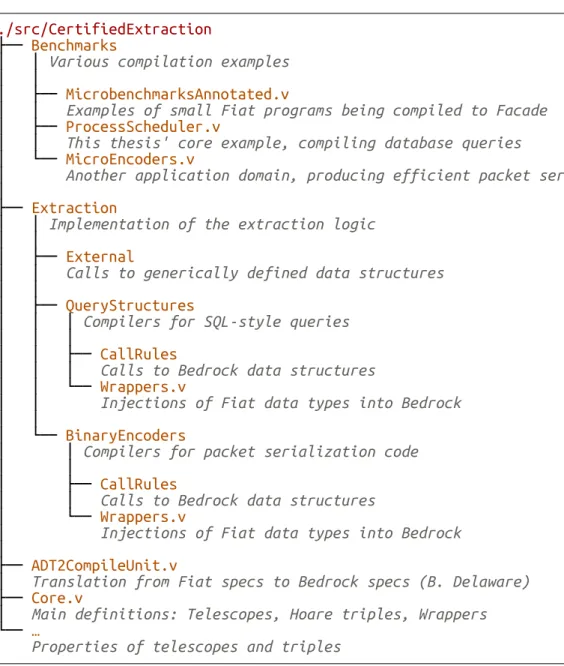
5 Notes about the implementation 71 5.1 Organization of the Coq sources . . . 72
5.2 Highly automated proofs in SMT style . . . 73
5.2.1 The learn tactic. . . 73
5.2.2 Saturation proofs . . . 74
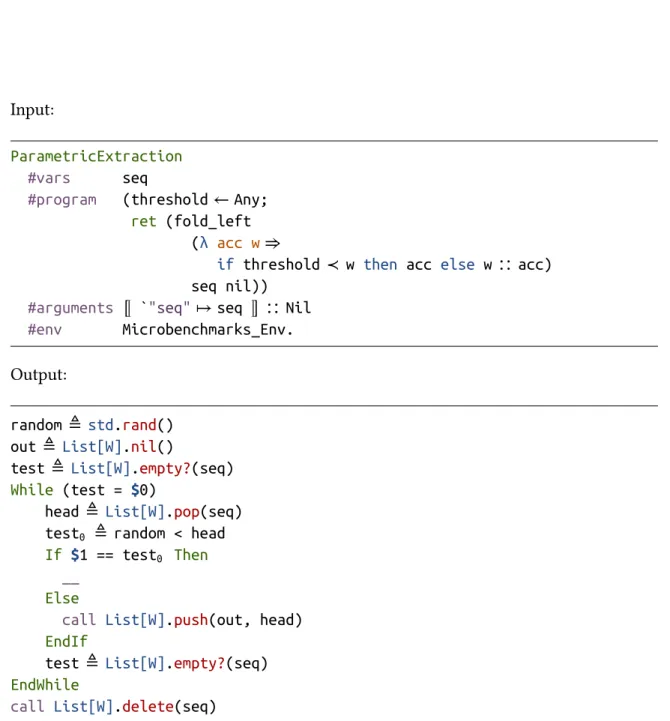
6 Case studies and experimental results 77 6.1 Microbenchmarks . . . 77
6.1.1 Architecture of the microbenchmark compiler . . . 81
6.1.2 Adding support for an additional nondeterministic operation . . . 82
6.1.3 Case study in extending the compiler . . . 85
6.1.4 Hooks and intrinsics . . . 86
6.2 Binary encoders . . . 88
6.2.1 The binary encoders domain-specific language . . . 90
6.2.2 Could binary encoders be extracted to OCaml? . . . 91
6.2.3 Extracting binary encoders to Facade . . . 94
6.3 SQL queries . . . 100
6.3.1 Motivating example . . . 100
6.3.2 Source language . . . 101
6.3.3 High-level specifications . . . 102
6.3.4 Refined programs . . . 102
6.3.5 Compiling and extracting query-structures code . . . 105
6.3.6 Evaluation . . . 115
7 Other approaches and related work 119 7.1 Imperative/HOL . . . 119
7.2 CakeML extraction . . . 120
7.3 Cogent . . . 120
7.4 Reflection and denotation . . . 121
7.5 Program extraction . . . 122 7.6 Translation validation . . . 122 7.7 Compiler verification . . . 123 7.8 Extensible compilation . . . 124 7.9 Program synthesis . . . 125 Conclusion 127 Future work . . . 127 Acknowledgments 129 Bibliography 131
List of Figures
1.1 Two abstraction-breaking programs . . . 11
1.2 Overview of the Fiat-to-Assembly pipeline . . . 15
1.3 Extraction does not work on Fiat programs . . . 21
2.1 Fiat’s encoding of the nondeterminism monad . . . 26
2.2 A simple Fiat derivation (specifications) . . . 28
2.3 A simple Fiat derivation (lemmas) . . . 29
2.4 A simple Fiat derivation (final refinement) . . . 30
3.1 Three compilation rules . . . 41
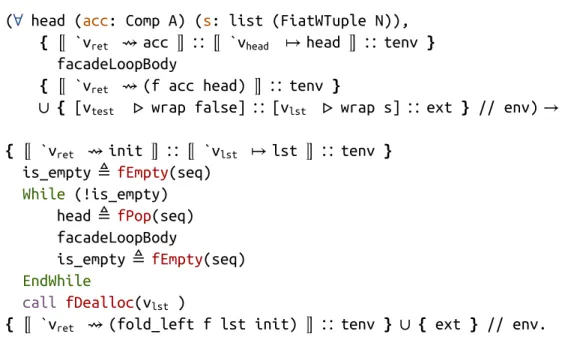
4.1 The FoldL call rule (inference rule version) . . . 66
4.2 The FoldL call rule (Gallina version) . . . 66
5.1 Organization of the Coq sources of this thesis . . . 72
6.1 Microbenchmark: simple arithmetic . . . 79
6.2 Microbenchmark: simple loops . . . 79
6.3 Microbenchmark: arithmetic, loops, and nondeterministic choices . . . 80
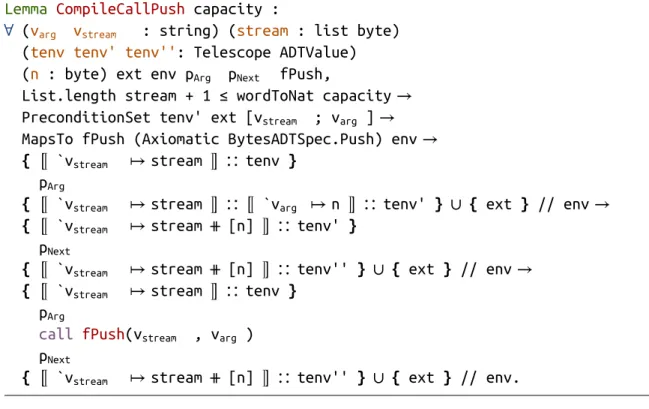
6.4 TheByteString.Pushcall rule . . . 98
6.5 Specifications of the process scheduler . . . 103
6.6 Refined implementation of the process scheduler . . . 104
6.7 ExtractedSpawnmethod . . . 107
6.8 ExtractedEnumeratemethod . . . 108
6.9 ExtractedGetCPUTimemethod . . . 108
Chapter 1
Introduction
Program errors, or bugs, are a well-known and costly reality of software development. Bugs arise from a wide variety of situations, such as simple programming mistakes, in-correct assumptions about program state, improper handling of exceptional situations, misconfigurations, incorrect assumptions about other software components, miscompila-tions, etc.; accordingly, significant research and engineering effort has been dedicated to devising techniques to reduce software errors caused by incorrect programming, yielding tools and concepts such as design patterns, software abstraction, encapsulation, compile-and run-time checks, type systems, program verification, compile-and program synthesis. Lan-guages that strive to reduce the possibility of programming errors by exposing program-mers to abstractions remote from a machine’s actual workings are usually described as
high-level languages; conversely, languages that mostly provide access to primitive
ma-chine operations are usually called low-level. High-level languages offer significant pro-ductivity benefits and eliminate large classes of errors (incorrect memory accesses, certain types of memory leaks, certain classes of data races, etc.).
These benefits, unfortunately, most often come with significant costs (garbage collec-tion, array bounds checks, dynamic type checks, coarse-grained locking, etc.). Even when
10 CHAPTER 1. INTRODUCTION
languages offer so-called zero-cost abstractions (high-level patterns guaranteed to have no additional run-time costs over their low-level counterparts), they still put constraints on the programs that users may express: by abstracting away some of the machine’s bare-metal characteristics, they make certain sequences of machine operations inexpressible or expressible at higher cost (two famous examples of such abstraction-breaking patterns are presented in figure1.1). Some languages work around this by offering unsafe blocks or foreign-function interfaces to lower-level languages (C# has unsafe sections, OCaml and Haskell have arbitrary casting typing operators Obj.magic and unsafeCoerce, C++ allows reinterpret_cast-ing, and C lets programmers use inline assembly); in both cases, however, the guarantees of the high-level language do not extend to the low-level code fragment, and the boundary introduces another opportunity for subtle errors.
Complex, low-level code in real-life systems is often the result of multiple rewrites, reimplementing performance-critical sections in lower-level languages and hand-tuning the resulting programs. Given this, it is an easy step to imagine that such complex code could be derived by applying a series of transformations: manually (programming by re-finement), or even better automatically (as is to some extent done by multiple-passes com-pilers internally and by various other types of interpreters and code generators: profile-guided optimizers, auto-tuners, superoptimizers, etc.).
But the general-purpose automatic code generation found in mainstream compilers often falls short, in terms of performance, of human-tuned low-level programs: program-mers frequently have highly domain-specific (or even program-specific) insight that the compiler does not have access to. Various mechanisms have thus been proposed to let users leverage such specific insight: domain-specific languages with more targeted opti-mizations and better configurability (SQL and database indices, for example), embedded domain-specific languages to handle well-delimited tasks inside of larger programs (regu-lar expressions, Microsoft’s language-integrated queries), or compiler-provided hooks to
11
void send (short *to, short *from,
int count) {
int n = (count + 7) / 8;
switch (count % 8){
case 0: do { *to = *from++;
case 7: *to = *from++;
case 6: *to = *from++;
case 5: *to = *from++;
case 4: *to = *from++;
case 3: *to = *from++;
case 2: *to = *from++;
case 1: *to = *from++; } while (--n > 0); }
}
float Q_rsqrt(float number) {
long i;
float x2, y;
const float threehalfs = 1.5F; x2 = number * 0.5F; y = number; i = *(long*)&y; i = 0x5f3759df - (i >> 1); y = *(float*)&i; y = y * (threehalfs - (x2 * y * y)); return y; }
Figure 1.1: Example of low-level programs whose logic is harder to express in high-level languages. Left: Duff’s device (valid in C and C++) implements an unrolled loop with no separate setup code by transferring control directly into the body of the loop, at an offset based on the remainder modulo 8 of its argument. Right: Quake 3’s fast inverse square root computes a close approximation of1/
√𝑥by doing integer arithmetic on the bits of an IEEE floating point number.
12 CHAPTER 1. INTRODUCTION
introduce new optimizations at various levels (often in the form of same-language opti-mization passes). All these methods, however, suffer from a common problem: extensi-bility. Each mechanism can be thought of as a domain-specific language of optimizations, and each of these languages makes expressing certain optimizations easy but leaves oth-ers hard (if not impossible) to express. A parser-generation library, for example, might not support the right parsing algorithm; a regular-expression library may have exponen-tial complexity in corner cases; an SQL engine might miss an opportunity to use an index; and a particular optimization might not be expressible in a compiler’s rewriting language or may not fit in one of the already-existing hooks. Fundamentally, one of the core is-sues is that these tools are separated into two components: core infrastructure and user-programmable extensions. Even in the best-designed cases, compilers are not fully open to user modification. The result is disappointing: program performance can be improved up to a point, but critical sections need to be rewritten in a low-level language when the limits of tunability are reached.
Such an architecture makes sense, of course. The internals of a compiler, as well as existing extensions, might rely on subtle invariants; allowing users to inspect and modify these internals in arbitrary ways runs the risk of letting them introduce subtle and complex errors. Verification, fortunately, offers a different route.
Progress in tactic languages, a way to program proof assistants to discover complex proofs or drive complex proof-producing processes, has made it practical to build tools that leverage general-purpose proof assistants to synthesize correct-by-construction pro-grams: concretely, automated reasoning is used to derive programs with little to no user intervention, while guaranteeing that the final results respect certain constraints. Fiat (Delaware et al.2015), for example, leverages the programming-by-refinement methodol-ogy to offer an extensible framework for building domain-specific languages and proof-producing compilers for these languages. It has much of the flavor of manual
program-13
ming by refinement, thus allowing users to leverage arbitrarily complex optimizations to transform high-level programs into efficient functional code, but it also introduces lightweight automation to take away most of the pain of the process: a query planner in Fiat, for example, would not be a monolithic engine with predetermined extension points; instead, it would be a collection of refinement procedures (each guaranteeing correctness of individual transformations by producing machine-checkable proofs), assembled into a compiler. To some extent, compiler designers and users are placed on equal footing: users can verify arbitrarily complex optimizations and insert them at arbitrary points in the compilation process.
But Fiat solves only part of the problem. Indeed, Fiat is fundamentally a single-lan-guage tool: all Fiat programs are encoded as Gallina terms (Gallina is the programming language of the Coq proof assistant), making it hard to express low-level optimizations in Fiat and weakening Fiat’s correctness guarantees (Fiat programs are extracted into OCaml and compiled to machine code using unverified software components). There are good reasons for these two limitations: first, embedding itself in Gallina lets Fiat inherit its semantics and thereby leverage Coq’s reduction machinery and powerful collection of primitive tactics (primitive tactics, such asrewriteandsimpl, are programs
implement-ing small steps of mathematical reasonimplement-ing). Second, certified extraction is a complex and, unlike certified compilation, only recently studied problem: the fundamental issue can be summarized by saying that a proof assistant’s logic cannot directly be used to reason about itself. Since Fiat programs are written in Gallina, a compiler from Fiat to another language cannot be written in Gallina.
This thesis overcomes these difficulties by introducing a novel proof-producing com-pilation technique, deriving imperative implementations of functional Fiat programs by recasting the compilation task as a synthesis problem and using lightweight Hoare-style pre- and postconditions to drive the proof-search process. This novel approach is
extensi-14 CHAPTER 1. INTRODUCTION
ble and safe: users can express arbitrary cross-language optimizations, with no risk of jeop-ardizing the correctness of the final programs. It bypasses the issue of certified extraction by producing machine-checkable correctness certificates with each compiled program: these certificates are type-theoretic proofs, whose elaboration is done as the program is being constructed. Furthermore, our approach makes it straightforward to build domain-specific compilers from collections of verified translation components, each tasked with handling specific patterns appearing in source programs. By reassembling these pieces of logic, or writing new ones, our users tailor extraction to their own domains and programs, maximizing performance while ensuring correctness of the resulting low-level programs.
Verification is usually seen as a high-cost burden on otherwise rapid program-develop-ment cycles, but in our case verification is an asset: working in a proof assistant allows us to aggressively optimize input programs, while relying on a small trusted logical core to reject soundness-breaking transformations. Thus we never shun optimizations for fear that they might be incorrect: any optimization is fair game, as long as we can justify its correctness in the particular context of the specific program on which we wish to apply it.
This compilation technique allows us to bridge the last gap in the implementation of a long-standing vision: a complete stack transforming high-level specifications into efficient assembly programs, while sacrificing little to no performance and guaranteeing correctness (the flavor of correctness that we guarantee is partial correctness: we produce proofs that our compiled programs do the right thing under the assumption that they terminate, but we do not guarantee termination). Composed with the Fiat and Bedrock frameworks, our new method indeed provides the first fully proof-generating automatic translation from SQL-style relational programs into executable assembly code, bottoming out in fast and lightweight assembly programs.
1.1. COMPONENTS 15
1.1 Components
To carry out this vision, we segment the translation from specifications to assembly into a sequence of smaller steps. At the top lies Fiat (Delaware et al.2015), a framework for writing domain-specific languages in the Coq proof assistant (The Coq development team 2015). Specifications written in these domain-specific languages are translated and opti-mized by refinement to produce efficient, potentially nondeterministic, purely functional programs. At the bottom of the stack lies Facade, an Algol-like imperative language that ensures linear use of heap-allocated data and can thus expose memory as an unordered collection of names and values. Facade compiles to Cito (a very similar language in which the linearity constraint is relaxed to allow pointer aliasing), and Cito compiles to Bedrock, a verification-aware assembly language that can straightforwardly be extracted to x86 as-sembly (this simple step is currently unverified). All of these parts are previous work: in this thesis, we describe the design and implementation of a proof-producing compiler be-tween refined Fiat programs and Facade. The following paragraphs give a more detailed overview of each part of our stack.
High-level specifications
Non-deterministic functional programs
Imperative
C-like programs Assembly code
Machine-checked refinement Proof-producing synthesis Verified compilation
Figure 1.2: Overview of the Fiat-to-Assembly pipeline
1.1.1 Top: Fiat
At its core, Fiat is simply a collection of Coq tactics and lemmas to reason about the non-determinism monad (Figure2.1). Authors of Fiat programs mix purely functional Gallina
16 CHAPTER 1. INTRODUCTION
code with values obtained through Fiat’s Pick operation (which models the selection of a value satisfying an arbitrary predicate) to produce shallowly embedded programs and specifications. For example, a Fiat programmer might write a specification of the follow-ing form:
Definition approximate_fixpoint (f:ℝ → ℝ) (ε: ℝ) : Comp (ℝ * ℝ) ≜ (** Compute an ε-approximate fixpoint ‘x’ of ‘f’
and return the pair (x, f x) **) x← {x | abs (f x - x) ≤ ε};
ret (x, f x)
Library authors using Fiat are then free to define domain-specific combinators that desugar to uses of Pick and bind, while exposing a nicer syntax for a given domain. For example, one might define the following simple DSL:
Notation FIXPOINT f ≜ {x | f x = x}
Notation ARGMAX f ≜ {x | ∀ y, f y ≤ f x}
Notation ARGMIN f ≜ {x | ∀ y, f y ≥ f x}
Concretely, Fiat has been used to define DSLs for SQL-style queries, BNF-style gram-mars, and binary encoders (serialization routines); work is planned on using it to derive SMT-style checkers.
High level specifications are then refined, using domain-specific automation written in Ltac (Coq’s tactic language), to produce efficient functional programs. This refinement step substitutes most uses of Pick with programs whose outputs satisfy the Pick condi-tion (for example, one might refine {l' | sorted l' ∧ Permutacondi-tion l l'} withret
(mergesort l)).
In most cases, the resulting programs are thus directly executable, deterministic Gal-lina programs, which can be extracted and executed using Coq’s extraction mechanism and the standard OCaml compiler—this is the approach followed by the original Fiat paper (Delaware et al.2015).
1.1. COMPONENTS 17 In more complex cases, however, it can also be useful to leave some Picks in the final program, thereby leaving responsibility for full refinement to later stages of the pipeline (this is discussed in more detail inthe next chapter).
1.1.2 Bottom: Bedrock, Cito, Facade
Bedrock is a fairly typical assembly language, extended with precise semantics that allow programmers to reason about assembly programs. Bedrock functions are specified using Hoare-style pre- and postconditions expressed in separation logic, and a linking theorem allows programmers to combine individual Bedrock functions into larger units. An exam-ple Bedrock program taken from Bedrock’s current sources and described in a 2013 paper (Chlipala2013), together with a specification and proof of correctness, is given below:
Definition swapS : spec ≜ SPEC("x", "y") reserving 2
Al v, Al w,
PRE [V] V "x"↪ v ∗ V "y"↪ w
POST[_] V "x"↪ w ∗ V "y"↪ v.
Definition swap ≜ bmodule "swap" {{
bfunction "swap" ("x", "y", "v", "w") [swapS] "v"←*"x"; "w"←*"y"; "x"*←"w"; "y"*←"v"; Return 0 end }}.
Theorem swapOk : moduleOk swap.
vcgen; abstract sep_auto.
Qed.
Cito is a much-higher-level imperative language by Wang et al. (2014), featuring rel-atively straightforward imperative semantics and offering a compiler to Bedrock with a
18 CHAPTER 1. INTRODUCTION
machine-checked proof of partial correctness. Cito’s main strengths are its support for separate compilation and its handling of function calls: a Cito program can make either operational calls, which transfer control to a Cito method whose body is explicitly known, or axiomatic calls, which transfer control to a method described only in terms of input-output specifications. Such axiomatic calls are resolved at link time, by providing for each such call a concrete implementation verified to respect the input-output specifications that the source program relies on. The following code samples present an example of such an axiomatic specification for a logical left-shift operation, as well as a Cito program making an axiomatic call to this specification, assuming that the nameIntrinsics.LSLpoints to it.
Definition lsl : AxiomaticSpec unit.
refine {|
PreCond ≜ λ args⇒
∃ x, args = [SCA _ x]; PostCond ≜ λ args ret⇒
∃ x, args = [(SCA _ x, None)] ∧ ret = SCA _ ($2⊗ x)
|}; crush_types.
Defined.
output ≜ DCall Intrinsics.LSL(input)
Facade, finally, shares almost all of Cito’s syntax but exposes very different opera-tional semantics. Using a collection of syntactic checks on input programs, Facade ensures that each allocated structure is only pointed to by a single name and that no heap-allocated memory is leaked. This allows Facade to present to the user a simple interface to memory, as a collection of names and values. An inductive proof guarantees that injecting Facade’s syntax into Cito yields a valid Cito program with equivalent partial-correctness semantics. An example Facade program is presented below:
1.2. GOING FROM FIAT TO FACADE 19
offset ≜ 0
len ≜ List[W].length(lst) max ≜ List[W].get(lst, offset)
While (offset < len)
elem ≜ List[W].get(lst, offset)
If elem > max Then
max ≜ elem Else __ EndIf offset ≜ offset + 1 EndWhile
1.1.3 Middle: Functional to imperative compiler
The missing piece of this stack is a Fiat-to-Facade compiler: a procedure capable of pro-ducing, given a Fiat program, an equivalent Facade program1. This translation should be correct and extensible: users should be able to inject their own domain-specific insight and suggest problem-specific optimizations.
1.2 Going from Fiat to Facade
This Fiat-to-Facade translation task is atypical and presents a number of challenges, dis-cussed below:
1This equivalence is the subject of aprecise definitiongiven in section4.1.6; informally, it guarantees
that the Facade program (if it terminates) outputs a value whose machine representation is the low-level equivalent of one of the results allowed by the original high-level specification, according to a user-supplied equivalence. The next section introduces the task and challenges in more detail.
20 CHAPTER 1. INTRODUCTION
1.2.1 Challenges
This is not a traditional verified compiler
Typical verified compilers consume and produce deeply embedded programs. That is, verified compilers are semantics-preserving transformation mapping each abstract syntax tree (AST) of a source language (encoded as a value of an inductive type) into an AST of a target language. Our task, on the other hand, is often described as extraction, or reflection: it is, to some extent, the reverse of denotation: we want to produce a procedure that takes as input a shallowly embedded Fiat program and produces a deeply embedded Facade program as the result.
Such a program cannot be expressed in Coq’s Calculus of Inductive Constructions (CIC): letting a Gallina program inspect the syntax used to construct its arguments (a process usually called “reflection”) would be soundness-breaking, as it would break the various conversion rules of the CIC. In particular, it is true in Coq that if a (possibly open) term 𝑎 reduces to 𝑎′, then for any function 𝑓 , (𝑓 𝑎) reduces to (𝑓 𝑎′). Thus a Gallina
function must return the same value regardless of how reduced its input is. Concretely, this means that a Gallina program cannot discriminate betweenlet x ≜ f() in x + x and f() + f(), making most forms of interesting reflection impossible2.
There is no hope, therefore, to produce a Gallina function translating (“extracting”) Fiat programs into Facade programs; instead, we need to manipulate Fiat programs externally, using an unverified procedure to produce our compiled Facade programs.
The compiler must be correct
Not being able to write the translation in Gallina, however, should not prevent us from ensuring that the resulting programs are correct: indeed, instead of proving the compiler 2Another way to understand this is to notice that the only discriminating construct in the CIC ismatch,
1.2. GOING FROM FIAT TO FACADE 21 correct, we can certify each of its runs. Thus, we want the compiler to be proof-producing instead of proven-correct.
The final correctness statement that we wish to obtain is one that connects the output of the compiled Facade program to a subset of the values allowed by the (nondeterministic) source program.
Source programs may not be directly executable
The structure of refined Fiat programs prevents us from using Coq’s built-in extraction: not only is this procedure excessively rigid, but it also does not handle our embedding of the nondeterminism monad. Indeed, due to the way in which Fiat programs are encoded (as functions from values to propositions), extraction erases Fiat terms entirely (Figure 1.3).
Definition PickDoubleOrNext (input: ℕ) : Comp ℕ ≜ {x | List.In x [2 * input; 2 * input + 1]}.
Extraction PickDoubleOrNext. (* type pickDoubleOrNext = __ *)
Figure 1.3: An example Fiat program that multiplies its input by two and optionally adds one. Extracting this program yields an empty type, instead of a program returning either of the permitted values (Comp ℕ is the same as ℕ → ℙ, which the extraction engine erases).
To circumvent this issue, our compiler must recognize the semantics of Fiat’s encoding and produce a Facade program whose results are permitted by the original programs.
Low-level representations are user-specified
To preserve abstraction, we do not want to constrain high-level specifications to be writ-ten in terms of low-level data structures: for example, we wish to allow users to formulate
22 CHAPTER 1. INTRODUCTION
their high-level specifications in terms of purely functional data structures such as induc-tively defined linked lists, sets or multisets represented as functions from a type to Prop or ℕ, etc. Similarly, we want to allow users to reason about bounded natural numbers and Booleans naturally, instead of having to manipulate an explicit encoding into machine words.
On the other hand, to achieve optimal performance and interoperability, we do want the low-level programs to manipulate simple imperative structures, instead of defining an analogue of each inductive structure used in the high-level specifications or in the refined Fiat programs. Thus we need users to be able to specify injections from high-level data types into the types exposed by Bedrock through Facade, and we need to translate manipulations of the original, pure structures into operations offered by the low-level structures.
The compiler must be extensible
Traditional compilers are constructed as sequences of passes, alternating same-language rewriting with translation into lower-level languages. In this setting, extensibility is often achieved by providing hooks into the rewriting phases, allowing the most daring users to add new rewriting rules.3 The translation phases, on the other hand, are seldom extensible (in a functional context, these phases are usually implemented via recursive descent over the source ASTs).
Limiting extensibility to rewritings is convenient but restrictive: on the one hand this decomposition helps ensure correctness (as long as each rewriting preserves the semantics of the program being transformed, adding rewritings cannot jeopardize the correctness of the final implementation), but on the other hand many optimizations cannot be captured 3GHC, for example, allows user programs to include specialrewriting pragmas, such asRULES"map/map"
1.2. GOING FROM FIAT TO FACADE 23 as rewritings without introducing intermediate languages.
We do not want to impose such a restriction on the compilation process translating Fiat to Facade. Instead, we wish to let users teach the compiler about new cross-language optimization opportunities (complex optimizations that are not simply representable as rewritings in either the source or target language), without staking correctness and with-out having to introduce an intermediate language mixing Facade’s imperative semantics with Gallina’s.
Additionally, we do not want to artificially constrain optimizations by requiring that the conditions under which they are applied be completely decidable predicates express-ible in Gallina; instead, since we are already in the context of a proof-producing compiler, each optimization should be allowed to produce a proof of correctness tailored to the particular program being compiled and the particular instance of the optimization being applied.
As a concrete example, a useful optimization could be to translate a purely functional fold over a list of scalars into a destructive iteration over a mutable stack (as long as the original list is not reused later on in the program).
Facade doesn’t have a garbage collector
Facade is an imperative language with manually managed memory. Though it exposes a simplified view of memory (as a map of names to values), it does not automatically handle deallocation of data structures after they fall out of scope. Instead, it requires programs to ensure that all newly allocated memory has been properly deallocated before returning control to the caller (with the exception of the return value, of course). This flexibility is convenient, but it introduces additional challenges: our compiler must precisely track allocated memory and ensure that the relevant destructors are called before returning.
24 CHAPTER 1. INTRODUCTION
1.2.2 A new twist on compiler design
Taken together, these challenges call for a new approach to compiler design: instead of im-plementing them as monolithic translation functions, we assemble domain-specific com-pilers from collections of small and specialized routines, each tasked with recognizing a particular pattern of the source language. The correctness of these routines need not be established, as they only drive the compilation process by contributing to an ongoing dia-logue with the proof assistant: this ensures that mistakes in compilation routines cannot imperil the correctness of the final program.
This thesis describes a concrete, lightweight implementation of this new approach. We start by presenting some background and details (Section2) about existing systems that we reuse. We then give anoverviewof our technique (Section2), before describing it infull detail(Section4), along withimplementation notes(Section5). We finish by pre-sentingconcrete results(Section6) obtained using this technique, discussingalternative approaches and related work(Section7), andconcludingwith directions for future work and final remarks.
Chapter 2
Background
Before presenting the details of our Fiat-to-Facade translation, we give further informa-tion about the source and target languages and highlight issues with tradiinforma-tional extracinforma-tion.
2.1 Deductive synthesis in Fiat
Fiat programs are encoded using a type Comp A of computations returning values of type A and written using the usual Bind and Return monad combinators (Wadler1995), as well as an additional nondeterministic choice operator Pick that lifts a function A → ℙ(which
can be though of as describing a set of values of type A) into a computation (in Fiat’s encoding, Comp A is exactly A → ℙ, and Pick is simply the identity function). Figure2.1
displays the definitions of Fiat’s Pick, Bind, and Return combinators.
Fiat additionally defines a computes_to relation, to express that a value is permitted by a computation. A Fiat program P computes to a value a, denoted P ↝ a, iff the proposition (P a) holds (which is sometimes alternatively written as a ∈ P, in line with the set interpretation assigned to A → ℙ).
26 CHAPTER 2. BACKGROUND
Definition Comp ≜ @Ensemble.
Definition Return : A→ Comp A ≜ Singleton A.
Definition Pick (P : Ensemble A) : Comp A ≜ P.
Definition Bind (ca : Comp A) (k : A→ Comp B) : Comp B ≜
λ b⇒∃ a, a ∈ ca ∧ (k a) ∈ b.
Figure 2.1: Fiat’s encoding of the nondeterminism monad. Ensemble A is defined in Coq’s standard library as A → ℙ.
if C2admits only a subset of the values permitted by C1(i.e. ∀ a, C2 ↝ a → C1 ↝ a,
which could alternatively be written C2 ⊆ C1).
Starting from high-level specifications, such as SQL queries or parser grammars, Fiat programs are refined to suppress most nondeterministic choices and introduce more ef-ficient operations. Additionally, Fiat programs, when part of a Fiat ADT (abstract data type, a collection of methods), may operate on internal state whose concrete type can be changed as long as this transformation does not affect the output of the ADT’s methods (Delaware et al.2015).
The tactics driving the refinement, often referred to collectively as an “optimization script,” select an appropriate type for the ADT’s internal state and take advantage of the available nondeterminism in the program being refined to make efficient implementa-tion choices. For example, an optimizaimplementa-tion script might refine {x | List.In x (map f sequence)} into ret (f (hd sequence)), provided that it can prove that sequence is
nonempty.
Removing all nondeterminism, however, is not always the best that a well-written op-timization script can do. In some cases, nondeterministic choices can be left in the refined program to encode calls to axiomatically specified, externally implemented data structures and functions. As an example, consider plugging a verified key-value store implementa-tion into a Fiat refinement. The Fiat program might reason about such a collecimplementa-tion as an
2.1. DEDUCTIVE SYNTHESIS IN FIAT 27 abstract function K → option V: the result of enumerating a store’s keys could then be described as {keys | ∀ k, List.In k keys ↔ ∃ v, store k = Some v}.
• On the one hand, if the key-value store is implemented as a verified Gallina module exposing a keys function returning a list of the keys present in the store, then the type of maps could be changed from abstract functions to the module’s storage type, and the nondeterministic choice above could then be refined intoret (keys store).
This would, however, prevent further stages of the compilation chain from swapping that Gallina implementation for a potentially more efficient implementation, unless that other implementation produced keys in the very same order as the verified Gallina implementation available at refinement time. Indeed, by choosing (keys store), the refinement process would have committed to the specific ordering used by the Gallina implementation of keys.
• On the other hand, the refinement script could take advantage of the wiggle room left by the Pick to allow linking the refined programs, after compilation down to a lower-level language, against various data structures (even data structures that do not admit canonical representations — that is, data structures such as Union-Find that may admit multiple distinct internal states for a single high-level representa-tion). Concretely, one would preserve the nondeterminism throughout the refine-ment and subsequent compilation process and leverage it to select, at link time, an implementation of a key-value store whose keys method does not guarantee a par-ticular return order.
This last point is crucial. Fundamentally, a Pick gives us two types of nondeterminism: one that allows us to pick different deterministic implementations, and one that allows implementations to rely on private state to produce different answers when given what appears to be the same input at the Fiat level. Concretely, although the value (remove k
28 CHAPTER 2. BACKGROUND
(add k v store))may be indistinguishable at the Fiat level from the unmodified value store, an implementation might rely on internal, mutable data structures whose state is affected by the succession of calls to add and remove. This is a common pattern: in gen-eral terms, the order in which commutative or canceling operations are applied to a data structure may make no difference in terms of high-level representations while making a difference in terms of internal states of low-level implementations. Nondeterministic specifications allow these low-level implementations to safely expose their internal state and answer requests with optimal performance; it also makes it possible to link against implementations that do not admit canonical representations, such as implementations of disjoint-set data structures based on forests.
Figures2.2,2.3, and2.4, authored by Adam Chlipala, present a full example of a simple Fiat derivation.
Require Import Tutorial.
(** A specification of what it means to choose a number that is not in a particular list *)
Definition notInList (ls : list ℕ) ≜ {n : ℕ | ~In n ls}.
(** We can use a simple property to justify a decomposition of the original spec. *)
Theorem notInList_decompose ls :
(upper← {upper | ∀ n, In n ls→ upper ≥ n}; {beyond | beyond > upper})
⊆ (notInList ls)
Proof.
refines; firstorder.
Qed.
Figure 2.2: Specifications for a simple Fiat derivation; the aim is to refine a program that, given a list of numbers, produces a number that does not belong to that list. Figure2.3 shows relevant utility lemmas, and figure2.4shows the final derivation.
2.1. DEDUCTIVE SYNTHESIS IN FIAT 29
(** A simple traversal will find the maximum list element, which is a good upper bound. *)
Definition listMax ≜ fold_right max 0.
(** …and we can prove it! *)
Theorem listMax_upperBound init ls :
∀ n, In n ls→ fold_right max init ls ≥ n.
Proof.
induction ls; simpl; intuition; try arithmetic.
apply IHls in H0; arithmetic.
Qed.
(** Now we restate that result as a computation refinement. *)
Theorem listMax_refines ls :
ret (listMax ls) ⊆ {upper | ∀ n, In n ls→ upper ≥ n}
Proof.
refines; apply listMax_upperBound.
Qed.
(** An easy way to find a number higher than another: add 1! *)
Theorem increment_refines n :
ret (n + 1) ⊆ {higher | higher > n}.
Proof.
refines; arithmetic.
Qed.
Figure 2.3: Utilities required to complete the derivation whose specifications are shown in figure2.2.
30 CHAPTER 2. BACKGROUND
(** Let's derive an efficient implementation.
Intermediate goals are italicized and preceded by [⊢]. *)
Theorem implementation :
{ f : list ℕ → Comp ℕ | ∀ ls, (f ls) ⊆ (notInList ls) }.
Proof.
begin.
⊢ (?f ls) ⊆ (notInList ls)
rewrite notInList_decompose.
⊢ (?f ls) ⊆ (upper ← {upper : ℕ | ∀ n : ℕ, In n ls → upper ≥ n};
{beyond : ℕ | beyond > upper})
rewrite listMax_refines.
⊢ (?f ls) ⊆ (upper ←ret (listMax ls); {beyond : ℕ | beyond > upper})
setoid_rewrite increment_refines. ⊢ (?f ls) ⊆ (upper ←ret (listMax ls);
ret (upper + 1))
monad_simpl.
⊢ (?f ls) ⊆ (ret (listMax ls + 1))
finish honing.
Defined.
(** We can extract the program that we found as a standlone, executable Gallina term. *)
Definition impl ≜ Eval simpl in projT1 implementation.
= λ l : list ℕ ⇒ret (listMax l + 1)
Eval compute in impl [1; 7; 8; 2; 13; 6].
= ret 14
2.2. VERIFIED COMPILATION TO BEDROCK 31
2.2 Verified compilation to Bedrock
Verified compilation into low-level assembly is a well-studied research domain (Kumar et al.2014; Leroy2006); still, few projects support separate compilation smoothly (Gu et al. 2015; Stewart et al.2015).
2.2.1 Semantics of Facade
Facade (Wang2016), the language that our compiler targets, is a recent extension of Cito (Wang et al.2014) that facilitates reasoning about memory allocation by exposing a mem-ory as a map of keys to values.
Facade programs are packaged in modules, augmented with various proofs to form
compile units; each compile unit comprises a collection of possibly mutually recursive
methods, along with exports (axiomatic specifications of these methods for use by the mod-ule’s clients), imports (specifications of all external functions that the modmod-ule’s methods depend on), and various proofs used internally by the compiler. These proofs guarantee many facts about each method of the module (packaged as DFFun entries in the DFModule record, which lives within the CompileUnit record). A subset of these facts is summarized below:
1. Method arguments are not overwritten by direct assignments (ret_not_in_args, no_assign_to_argsin DFacade.v’s OperationalSpec).
2. Compiler-reserved names do not appear in method bodies, nor in method argu-ments or return variables (args_name_ok, ret_name_ok, syntax_ok in Operational-Spec).
3. Method arguments have unique names, no uninitialized variables are read, function calls have the right numbers of arguments, and the sum of the number of local
32 CHAPTER 2. BACKGROUND
variables and the depth of the function body is less than 232 (is_good_func).
4. The axiomatic specification of each method is refined by the operational semantic of its body (ops_refines_axs, whose actual definition is very close to that ofProgOk presented in section4.1.6); this entails guaranteeing that the program is safe to run in initial conditions satisfying the method’s axiomatic preconditions and that it then yields a return value permitted by the method’s axiomatic postcondition. This also guarantees, as a side condition of safety, facts such as the following (SafeCallOp, SafeCallAx):
• All functions that the method calls to are properly imported—that is, each ax-iomatic call to an external function should be to one of the functions listed in the module’s imports.
• Memory is never leaked by the input program: variables containing a refer-ence to a block of heap-allocated memory are never on the left side of an as-signment.
Most of these proofs (1, 2, 3) are reflective (Boutin1997): each of them checks a decid-able property of a Facade program or module, and the corresponding goals can thus be discharged by computation.
Reasoning about Facade programs
The semantics of Facade programs are described through two predicates, Safe and RunsTo, which characterize the conditions in which it is safe to run a program and the results of running it:
• Safe is a coinductive predicate taking a program and an initial memory state and asserting that running the program in that starting state will never cause it to get
2.2. VERIFIED COMPILATION TO BEDROCK 33 stuck (thus the program won’t access undefined memory, nor call a method without ensuring that its preconditions are verified; it may, however, loop indefinitely).
• RunsTo is an inductive predicate taking a program, an initial state, and a final state; it describes the operational semantics of the Facade programming language.
These predicates are phrased in terms of Facade states, finite maps of strings to Facade
values, themselves either scalars (32-bit stack-allocated machine words) or ADT values
(in Facade parlance, an ADT value is an arbitrary heap-allocated object, constructed, ma-nipulated, and deallocated through externally supplied functions). Bedrock and Facade developments are parametric in the choice of type used to represent heap-allocated val-ues: the only constraint is that libraries being linked together agree on this choice of type. In general, one picks a sum type in which each alternative described a distinct low-level data structure. Here is an example of such a type:
Inductive ADTValue ≜ | WordList (ws : list W)
| WTupleList (ts : list (list W))
| ByteString (capacity: W) (bs: string)
Compiling Facade programs
Once a fully constructed module has been assembled, one can invoke the Facade compiler to produce a Cito module. Feeding this module to the Cito compiler produces low-level Bedrock assembly code, which can then be soundly linked against verified implementa-tions of any external methods that the code depends on, yielding a closed Bedrock library guaranteed to obey the very same axiomatic semantics as the ones present in the original Facade module. Finally, extracting this Bedrock code to x86 assembly yields executable binaries.
34 CHAPTER 2. BACKGROUND
2.3 Issues with traditional extraction
The task that we describe in this thesis is very close to the problem of extraction. Tradi-tional extraction is an unverified procedure that unsoundly inspects programs expressed in the logic of a proof assistant and produces a compilable program in an often closely related language. In Coq (Letouzey2003), an OCaml plugin for extraction can be used to derive executable OCaml programs from Gallina sources. Although extraction was used in the original Fiat paper to obtain executable programs, it is not sufficient for our purposes:
• Extraction is unverified. Though there exists a pen-and-paper proof (Letouzey 2004) that the extraction logic is sound, no machine-checked proof has been writ-ten to establish the correctness of the corresponding implementation. Additionally, no verified compiler exists for any of the languages that extraction targets (mainly OCaml, though Haskell or Scheme code can also be obtained with a little bit of additional effort).
• Extraction erases propositions and proofs. This is very convenient in general, but it works against Fiat’s encoding of computations as functions returning propositions: this encoding causes extraction to discard most Fiat programs (as demonstrated earlierin figure1.3). Thus, to use standard extraction, Fiat refinements must bottom out into fully refined programs, instead of leaving bits of nondeterminism where linking against external data structures with non-fully-deterministic specifications could be useful.
• Extraction is not soundly extensible. Any optimizing transformation must be done either on the original Gallina terms or (unsoundly) on the resulting OCaml program. Though OCaml offers a rich programming environment covering both functional
2.3. ISSUES WITH TRADITIONAL EXTRACTION 35 and imperative styles, there are no readily available mechanized semantic of OCaml to express transformations in. Additionally, as argued earlier in this thesis, certain transformations are best expressed and verified (for reasoning simplicity) as part of the extraction itself. The Coq to OCaml extraction engine provides the embryo of such a customization facility through itsExtract ConstantandExtract Induc-tivecommands, but these mechanisms are unchecked, error-prone, and potentially
unsound.
• Extraction is single-language. To preserve soundness, data structures used by Gal-lina programs must be written in GalGal-lina as well and extracted along with the orig-inal programs. This prevents Gallina programs from depending on separately com-piled, verified data structures written in other languages (such as imperative lan-guages or assembly).
Chapter 3
Overview
Chapter4presents an in-depth account of our technique. Before diving in, however, it is useful to present the general intuition on a concrete example. We illustrate the compila-tion process on a simple example, starting with the following Fiat program p, simulating a die roll with 0 indicating the failing case:
p ≜ r ← Any
ret (if r ≺ 7 then r else 0)
This program samples a random number using a call to an external function and re-turns its absolute value (≺ denotes a Boolean version of the less-than predicate). To com-pile this program to Facade (described later), we synthesize a Facade program p, according to the following specification (in this section, to help with understanding, slanted variables such as prog live in Facade land, underlined variables such as comp are Fiat computations, and regular variables such as p are Gallina terms; these annotations are omitted in the rest of this document):
• p, when started in a blank state (no variables defined, written ∅), must be safe; that is, p must not call functions without ensuring that their arguments are
prop-38 CHAPTER 3. OVERVIEW
erly allocated and verifying the required preconditions; it may not access undefined variables; etc.
• p, when started in a blank state, must reach (if it terminates) a final state where all temporary data structures that p allocated have been deallocated and where the variable out has a value equivalent to the Fiat program p shown above.
We write ∅ p ⟦ `"out" ⇝ p ⟧ to summarize this specification; we read it as “the Facade program p, starting in a blank state, behaves properly and stores a value equivalent to the Fiat term p in the variable out.” One can think of it as a typical Hoare triple, with ad-ditional constraints on the pre- and postconditions to facilitate synthesis. Indeed, instead of the usual context where Hoare triples are used to help ensure that a program conforms to its specification, we use them here to drive the synthesis process; putting additional constraints helps us avoid unrealizable postconditions (⊥) and helps the compiler synthe-size the Facade program. The precise definition shown in chapter4is constructed in such a way that Facade’s semantics guarantee that any Facade program respecting this specifi-cation will (if it terminates) correctly set the return value to one of the values permitted by the original Fiat program.
The final program that we wish to obtain looks like the following:
tmp ≜ std.rand() comp ≜ tmp < 7 If comp Then out ≜ tmp Else out ≜ 0 EndIf
Expanding the definition of p, we find that we need to find a program p such that
∅
p
⟦`"out" ⇝
r ← Any
39
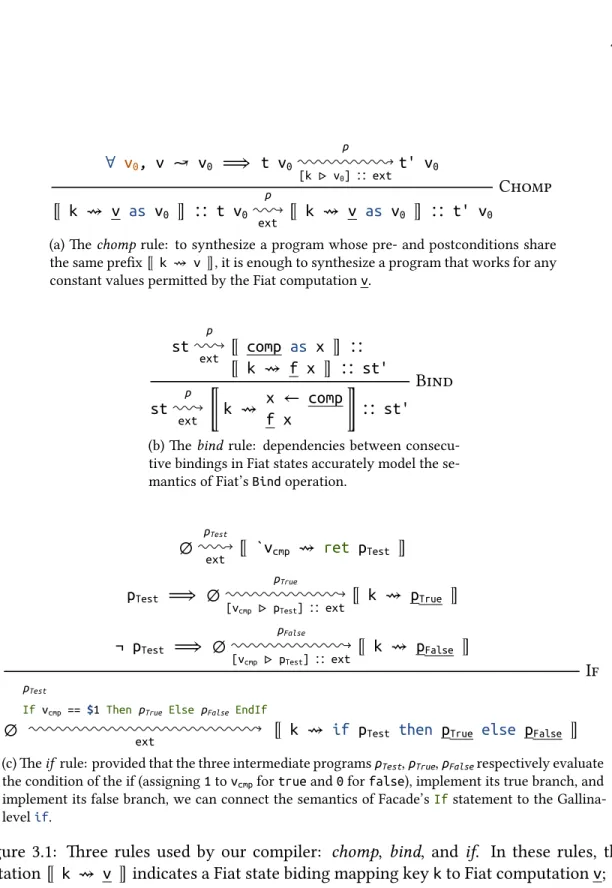
We use our first compilation lemma, a variant of thebind rule(Figure3.1b) to connect the semantics of Fiat’s bind operation (the ← operator of monads) to the meaning of , which yields the following synthesis goal:
∅
p
⟦ `"tmp" ⇝ Any as r ⟧ ∷ ⟦ `"out" ⇝ ret (if r ≺ 7 then r else 0) ⟧ In this step, we have broken down a Fiat-level bind (r ← Any; …) assigned to a single variable into two parts, assigned to two variables: tmp, holding the result of the call to Any, and out, holding the final result. The double square-bracket notation describes states where the first variable tmp can be bound to any of the variables allowed by the call to Any, and where the second variable has one of the values allowed by the addition operation: although the addition is deterministic, it depends on the value returned by Any, bound as r at the Gallina level (the double-colon operator (∷) is syntactic sugar for the consing operation on Fiat states). Note that the description of Fiat states that we use is causal: we need to be able to track dependencies between different variables. Thus the ordering of the individual bindings matters: the Fiat term that we assign to out depends on the particular value that the computation Any returns.
We then break down p into two smaller programs: the first starts in a blank state and is only concerned with the assignment to tmp; the second one starts in a state where tmp is already assigned and uses that value to construct the final result:
∅
p1
⟦ `"tmp" ⇝ Any as r ⟧ ⟦ `"tmp" ⇝ Any as r ⟧
p2
⟦ `"tmp" ⇝ Any as r ⟧ ∷ ⟦ `"out" ⇝ ret … ⟧ Notice the similarity between the specification of p1and the original specification of p:
just like p moved from a blank state to a state binding out to a Fiat expression, p1moves
from a blank state to a state binding tmp to a Fiat expression. At this point, a lemma about Facade’s semantics tells us that tmp ≜ std.rand() is a good choice for p1(this is a call
40 CHAPTER 3. OVERVIEW rule forstd.rand; a lemma, presumably written by the author of thestd.randfunction, that connects its low-level semantics to that of the high-level Fiat construct Any). We are therefore only left with p2to synthesize: noticing the common prefix of the starting and
ending states, we apply the chomp rule, transforming the problem into the following:
∀ r, Any ↝ r → ∅
p2
["tmp" ▹ r] ⟦ `"out" ⇝ ret (if r ≺ 7 then r else 0) ⟧
The additional mapping pictured under the arrow expresses an extra assumption that we can make about the starting and ending states: they must both map tmp to the same value r (the notation [k ▹ v] is a compact notation for an unordered map containing a single binding (k, v)). Since this is wrapped in a universal quantifier, what we are really requiring is that the synthesized program be valid regardless of the particular value returned by the call to Any1. In this form, the synthesis goal matches the conclusion of the Ifcompilation lemma: given three programs which respectively set a comparison variable vcmpto 1 if r ≺ 7 and 0 otherwise (pTest), compile the true branch of the conditional (pTrue),
and compile the false branch of the conditional (pFalse), the following Facade program
obeys the specification above:
pTest If vcmp == $1 Then pTrue Else pFalse EndIf
This gives us three new synthesis goals, which we can handle recursively. The three rules that we used are summarized in figure3.1.
1A slight subtlety here is that the formulation may lead one to think that we may end up constructing a
different program for each value of r. This is not the case: p2is an existential variable whose context does
41 ∀ v0, v ↝ v0 ⟹ t v0 p [k ▹ v0] ∷ ext t' v0 ⟦ k ⇝ v as v0 ⟧ ∷ t v0 p ext ⟦ k ⇝ v as v0 ⟧ ∷ t' v0 Chomp
(a) The chomp rule: to synthesize a program whose pre- and postconditions share the same prefix ⟦ k ⇝ v ⟧, it is enough to synthesize a program that works for any constant values permitted by the Fiat computation v.
st p ext ⟦ comp as x ⟧ ∷ ⟦ k ⇝ f x ⟧ ∷ st' st p ext ⟦k ⇝ x ← comp f x ⟧∷ st' Bind
(b) The bind rule: dependencies between consecu-tive bindings in Fiat states accurately model the se-mantics of Fiat’s Bind operation.
∅
pTest
ext ⟦ `vcmp ⇝ ret pTest ⟧ pTest ⟹ ∅
pTrue
[vcmp ▹ pTest] ∷ ext ⟦ k ⇝ pTrue ⟧ ¬ pTest ⟹ ∅
pFalse
[vcmp ▹ pTest] ∷ ext ⟦ k ⇝ pFalse ⟧
∅
pTest
If vcmp == $1 Then pTrue Else pFalse EndIf
ext ⟦ k ⇝ if pTest then pTrue else pFalse ⟧ If
(c) The if rule: provided that the three intermediate programs pTest, pTrue, pFalserespectively evaluate
the condition of the if (assigning 1 to vcmpfor true and 0 for false), implement its true branch, and
implement its false branch, we can connect the semantics of Facade’sIfstatement to the
Gallina-levelif.
Figure 3.1: Three rules used by our compiler: chomp, bind, and if. In these rules, the notation ⟦ k ⇝ v ⟧ indicates a Fiat state biding mapping key k to Fiat computation v; [k ▹ v], on the other hand, indicates a Facade state binding mapping key k to Gallina value v.
Chapter 4
Technical description
This chapter describes our implementation in detail; when relevant, it points to the appro-priate parts of our Coq development1(curious readers are encouraged to explore the code using this thesis as a guide for the implementation: the next chaptergives more details about the layout of the source tree).
At the core of our contribution is a relation (ProgOk) that connects Facade programs to pairs of Fiat states. Fiat states are ordered collections of named bindings, which can profitably be thought of as a compact and highly structured way to express pre- and post-conditions on Facade programs. To describe the full compilation process, we start by pre-senting the core definitions that allow us to connect Fiat and Facade programs through Fiat and Facade states, then discuss some of the crucial lemmas about these definition and how they are proved, detail how we translate nondeterministic choices to calls to ex-ternally specified functions, and finally present the details of our compilation logic and infrastructure.
1A snapshot of our development is tagged as fiat-to-facade-MS-2016 in the Fiat repository athttps: //github.com/mit-plv/fiat/; setup instructions are in src/CertifiedExtraction/README.rst
44 CHAPTER 4. TECHNICAL DESCRIPTION
4.1 Core definitions
4.1.1 Telescopes
We start by defining Fiat states, using a structure called a Telescope. Fiat states are concise and convenient ways to connect the semantics of Fiat and Facade: instead of expressing the pre- and postconditions that a Facade program must satisfy as a pair of arbitrary propositions, we collect all this information in a single data structure. The Coq definition of a telescope is given below (av is a type describing low-level ADTs known to Bedrock):
Inductive Telescope (av: Type) : Type ≜ | Nil : Telescope av
| Cons : ∀ T (key: NameTag av T) (val: Comp T)
(tail: T→ Telescope av), Telescope av.
As this definition makes clear, Fiat states have interesting properties that Facade states do not possess (recall that Facade states are unordered collections mapping variable names to either machine words, or heap-allocated ADTs described by the type av):
• They allow nondeterminism in values by storing computations instead of actual values. For example, it is legal to write Cons `"k" (λ x ⇒ x > 1) Nil.
• They do not directly distinguish between heap- and stack-allocated values, nor re-strict values to Bedrock types; instead, they attach a “name tag” (Section 4.1.2) to each bindings.
• They capture dependencies between variables by introducing an explicit ordering between them, allowing later bindings to depend on the values taken by previous ones.
4.1. CORE DEFINITIONS 45 In a sense, Fiat states are hybrids between Fiat programs and Facade states. As we will later see, a Fiat state is essentially isomorphic to a monadic program with names attributed to some of the bindings; thus, just like a Fiat program describes a set of acceptable return values, a Fiat state describes a set of acceptable environments (collections of names and values)—or, in other words, a set of acceptable Facade states.
To make telescopes easier on the eyes, we denote the telescope Cons k v (λ w ⇒ t w)as ⟦ k ⇝ v as w ⟧ ∷ t w. Furthermore, when v is in the formret v0we write ⟦ k
↦ v0 as w ⟧ ∷ t w instead, and when the tail of the telescope does not depend on the
bound variable w we omit theasclause: ⟦ k ↦ v ⟧ ∷ ….
4.1.2 NameTags
Each binding in a telescope comes with a name tag:
Inductive NameTag av T ≜ | NTNone : NameTag av T
| NTSome (key: string) (H: FacadeWrapper (Value av) T) : NameTag av T. This tag describes which name refers to the associated value and how the value is represented in terms of low-level Bedrock types. Tags can be either of the following two values:
• NTNone, in which case the binding is anonymous and is simply a convenient way of expressing a monadic Bind; we might write, for example, something like the following to describe the Fiat program x ← Any; ret x + x(inside telescopes, we abbreviate NTSome k _ by writing `k, and NTNone by stripping the arrow)
⟦ Any as x ⟧ ∷ ⟦ `"out"↦ x + x ⟧ ∷ Nil
46 CHAPTER 4. TECHNICAL DESCRIPTION
type class describing how the associated value should be represented in terms of Bedrock types. This injection (aFacadeWrapperinstance—section 4.1.3), is crucial to connect Fiat states to Facade states: it would be inconvenient to restrict Fiat pro-grams to manipulating Bedrock types, but Facade propro-grams have no knowledge of the complex types used at the Fiat level—instead, they think in terms of Facade’s Valuetype, which allows either machine words (W) or low-level ADTs (encoded in a user-supplied type av):
Inductive Value {av} ≜ | SCA : W→ Value | ADT : av→ Value.
To give an intuition of why these name tags are important, we return briefly to the definition of Telescopes. As previously mentioned, each cons cell of a telescope contains a computation, and a tail represented as a function mapping values permitted by the head to telescopes. This is a mixed-embedding analogue of a monadic Bind, where the consing op-eration plays the deeply embedded role of the shallow monadic binding. For this analogy to hold, though, we need the tail function to be passed a value of precisely the type of the head. This essentially prevents us from storing in telescopes only the low-level represen-tation of values: since telescope tails compute on Fiat-level types, we cannot pass them low-level Bedrock encoding of these types (even less so given that Bedrock’s encoding collapses all types into a single sum type).
4.1.3 FacadeWrappers
Injections from arbitrary Gallina types into low-level Bedrock types can be conveniently described by packaging them into instances of a FacadeWrapper type class (the impor-tance of the injectivity requirement will become apparent when we discuss the relation
4.1. CORE DEFINITIONS 47 used to connect Fiat and Facade states):
Class FacadeWrapper (WrappingType WrappedType: Type) ≜ { wrap: WrappedType→ WrappingType;
wrap_inj: ∀ v v', wrap v = wrap v'→ v = v' }.
4.1.4 WeakEq
The last missing element before we can connect Fiat and Facade states is a way to capture Facade’s memory-tracking constraints: while Facade allows overwriting scalars and does not require them to be deallocated before returning control to the caller, it imposes much stronger restrictions on heap-allocated values. Accordingly, we define three relations on Facade states:
• SameADTs ensures that two Facade states have exactly the same heap-allocated vari-ables:
Definition SameADTs {av} m1 m2 ≜
∀ k v, MapsTo k (@ADT av v) m1 ↔
MapsTo k (@ADT av v) m2.
• SameSCAs ensures that the scalar bindings of one Facade state are all present in a second Facade state:
Definition SameSCAs {av} m1 m2 ≜
∀ k v, MapsTo k (@SCA av v) m1 →
MapsTo k (@SCA av v) m2.
• WeakEq combines these two predicates:
Definition WeakEq {av} m1 m2 ≜
48 CHAPTER 4. TECHNICAL DESCRIPTION
4.1.5 SameValues and TelEq
The preceding definitions are enough to give the details of the relation connecting Fiat and Facade states. The recursive SameValues predicate expresses the fact that a particular Fa-cade state is allowed by a given Fiat state, augmented for convenience with an unordered collection of deterministic bindings (this unordered collection will prove useful to describe bindings that are unmodified throughout a program’s execution):
Fixpoint SameValues {av} ext fmap (tenv: Telescope av) ≜
match tenv with
| Nil⇒ WeakEq ext fmap | Cons T key val tail⇒
match key with
| NTSome k _⇒
match StringMap.find k fmap with
| Some v⇒∃ w, val↝ w ∧ v = wrap w ∧
SameValues ext (StringMap.remove k fmap) (tail w) | None⇒⊥
end
| NTNone⇒∃ w, val↝ w ∧
SameValues ext fmap (tail w)
end end.
This relation expresses the following: a Facade state is related to a given Fiat state if there exists a sequence of nondeterministic choices such that all bindings of the Fiat telescope (augmented with the unordered collection of bindings) are exactly reflected in the Facade state, and any left-over bindings are only to stack-allocated values.
This ensures that:
• The Facade state’s heap-allocated values are exactly the low-level encodings (“wrap-pings”) of the values found along one of the nondeterministic paths in the Fiat tele-scope augmented with the unordered collection ext.
4.1. CORE DEFINITIONS 49 • The Facade state’s stack-allocated values are a superset of the low-level encodings (“wrappings”) of the values along the same nondeterministic path in the Fiat tele-scope augmented with ext.
Note how the injectivity requirement comes into play: all that we can learn from a SameValuesinstance is an equality between two wrapped values (v = wrap w, where v is extracted from fmap and thus is most often itself a wrap v0). To be able to substitute v0
for w, in the call to tail w, we need to be able to learn v0 = wfrom v = wrap w, i.e. from
wrap v0 = wrap w; the other alternative being to require each telescope tail to be paired
with a proof that the corresponding function is a morphism for the particular wrapping function used in the same cons cell (in other words, one could require the results returned by the tail function to depend only on the value of wrap v, regardless of the specific value of w—which amounts to∀ w w', wrap w = wrap w' → tail w = tail w').
We write fmap ≲ tenv ∪ ext to make developments more readable. The following examples show how SameValues behaves, starting with valid examples:
• ["x" ▹ 1] ∷ ["y" ▹ (1,1)] ≲ ⟦ `"y" ↦ (1,1) ⟧ ∪ ["x" ▹ 1] • ["x" ▹ 1] ∷ ["y" ▹ (1,1)] ≲ ⟦ `"x" ↦ 1 ⟧ ∷ ⟦ `"y" ↦ (1,1) ⟧ ∪ ∅ • ["x" ▹ 1] ∷ ["y" ▹ (1,1)] ≲ ⟦ `"x" ⇝ Any as x ⟧ ∷ ⟦ `"y" ↦ (x,x) ⟧ ∪ ∅ • ["x" ▹ 1] ∷ ["y" ▹ (1,1)] ∷ ["z" ▹ 2] ≲ ⟦ `"x" ⇝ Any as x ⟧ ∷ ⟦ `"y" ↦ (x,x) ⟧ ∪ ∅
(We lost track of the ["z" ▹ 2] binding; since 2 is a scalar, that is not an issue.)
50 CHAPTER 4. TECHNICAL DESCRIPTION
• ["x" ▹ 1] ≴
⟦ `"y" ↦ (1,1) ⟧ ∪ ["x" ▹ 1]
("y"is missing; this is an issue because (1,1) is an instance of the pair ADT, not a scalar.)
• ["x" ▹ 1] ∷ ["y" ▹ (1,2)] ≴
⟦ `"x" ⇝ Any as x ⟧ ∷ ⟦ `"y" ↦ (x,x) ⟧ ∪ ∅ (The value of"y"is not consistent with (x,x).) • ["x" ▹ 1] ∷ ["y" ▹ (1,1)] ∷ ["z" ▹ (1,2)] ≴
⟦ `"x" ⇝ Any as x ⟧ ∷ ⟦ `"y" ↦ (x,x) ⟧ ∪ ∅
(We lost track of the ["z" ▹ (1,2)] binding; since (1,2) is encoded as an ADT value, that is an issue.)
The SameValues relation can conveniently be used to define an equivalence relation on telescopes, TelEq:
Definition TelEq {A} ext (T1 T2: Telescope A) ≜
∀ st, st ≲ T1 ∪ ext ↔
st ≲ T2 ∪ ext.
Due to this definition, any relation that only manipulates Fiat states through SameVal-ueswill automatically be a morphism for TelEq.
4.1.6 ProgOk
All of these definitions lead us to the final correctness condition that we base the syn-thesis process on. ProgOk summarizes the behavior of a Facade program in terms of two Fiat states initial_tstate and final_tstate both augmented with the same unordered collection of bindings ext: