Determinants of plant establishment success in
a multispecies introduction experiment with
native and alien species
Anne Kempela,1, Thomas Chrobocka, Markus Fischera, Rudolf Philippe Rohrb,c, and Mark van Kleunena,d
aInstitute of Plant Sciences, University of Bern, 3013 Bern, Switzerland;bUnit of Ecology and Evolution, University of Fribourg, 1700 Fribourg, Switzerland; cIntegrative Ecology Group, Estación Biológica de Doñana, Consejo Superior de Investigaciones Cientificas, 41092 Seville, Spain; anddEcology, Department of Biology, University of Konstanz, 78457 Konstanz, Germany
Determinants of plant establishment and invasion are a key issue in ecology and evolution. Although establishment success varies substantially among species, the importance of species traits and extrinsic factors as determinants of establishment in existing communities has remained difficult to prove in observational studies because they can be confounded and mask each other. Therefore, we conducted a large multispeciesfield experiment to disentangle the relative importance of extrinsic factors vs. species characteristics for the establishment success of plants in grass-lands. We introduced 48 alien and 45 native plant species at different seed numbers into multiple grassland sites with or without experimental soil disturbance and related their establish-ment success to species traits assessed in five independent multispecies greenhouse experiments. High propagule pressure and high seed mass were the most important factors increasing establishment success in the very beginning of the experiment. However, after 3 y, propagule pressure became less important, and species traits related to biotic interactions (including herbivore resistance and responses to shading and competition) became the most important drivers of success or failure. The relative impor-tance of different traits was environment-dependent and changed over time. Our approach of combining a multispecies introduction experiment in thefield with trait data from independent multi-species experiments in the greenhouse allowed us to detect the relative importance of species traits for early establishment and provided evidence that species traits—fine-tuned by environmen-tal factors—determine success or failure of alien and native plants in temperate grasslands.
community assembly
|
functional traits|
bioticfilterW
hy certain plant species are able to colonize and establish in particular areas—and hence the processes governing rarity or commonness of native species and invasiveness of alien species—is a long-standing key question in ecology (1–3). Func-tional and life-history traits may determine which species can successfully establish at a particular site. However, unambiguous identification and quantification of the importance of species traits associated with invasion success of alien and native spe-cies in existing communities (4–8) has proven extremely dif-ficult (9).A major obstacle for unraveling key traits leading to success of alien and native plants is that seed availability (propagule prsure) and environmental characteristics codetermine plant es-tablishment (10). High seed availability and disturbance are likely to facilitate establishment (11, 12), whereas high pro-ductivity—which implies strong competition for light (13)—is likely to impede establishment (14). Although some traits have been found to correlate with establishment and subsequent in-vasion success of alien plants (15, 16), more and more studies claim that extrinsic factors—mainly propagule pressure (i.e., in-troduction effort) and disturbance—are the key drivers of inva-sions, overriding the importance of species traits (17–19). In
observational studies, however, effects of these extrinsic factors might have been overestimated, because they might be biased due to more frequent introduction of alien species with specific traits (20–22).
Despite the difficulty of disentangling extrinsic and intrinsic factors, there have been many attempts to identify traits associ-ated with success or failure of native (4, 6–8) and alien species (15, 16). However, these attempts face the fundamental difficulty that the identities of unsuccessful species are usually not known. Moreover, species traits are often obtained from trait databases (e.g., refs. 22–24), which—despite their vast amount of data—are mainly restricted to simple traits. Furthermore, given the potential relevance of herbivory and competition for establishment (25, 26), data on traits related to biotic interactions might be crucial.
The importance of species characteristics and extrinsic factors for establishment success of alien and native species can only be disentangled unambiguously with controlled introductions of large numbers of species (4) combined with an independent screening of their traits. This unique approach has several advantages. First, when experimentally introducing species, the identity of both successful and unsuccessful species is known. Second, extrinsic factors, such as time since introduction and propagule pressure, are known and identical for all species. Third, environmental conditions at sites of introduction, such as high levels of disturbance or high standing biomass, are controlled for and cannot confound associations between traits and es-tablishment success of plant species. However, to determine the importance of species traits, the screening of relevant traits should include easily measurable characteristics, such as geo-graphic origin and seed mass, as well as traits that are more complex and directly related to biotic interactions. Assessing complex traits for not just few, but a wide range of species, requires large experiments conducted under common envi-ronmental conditions, and therefore these studies have not been attempted yet.
Here, we disentangled the roles of species traits, soil distur-bance, and propagule pressure for early plant-establishment success with an experimental approach that combined multi-species greenhouse and garden experiments assessing multi-species traits with an introduction experiment at multiplefield sites. We introduced 48 alien and 45 native herbaceous plant species into 16 grassland sites, which varied in standing biomass. We used grassland sites because they are a major vegetation type in
Author contributions: M.F. and M.v.K. designed research; A.K. designed the herbivore resistance experiment; A.K. and T.C. performed research; A.K., R.P.R., and M.v.K. analyzed data; and A.K., M.F., and M.v.K. wrote the paper.
The authors declare no conflict of interest.
1To whom correspondence should be addressed. E-mail: [email protected].
This article contains supporting information
ECOLO
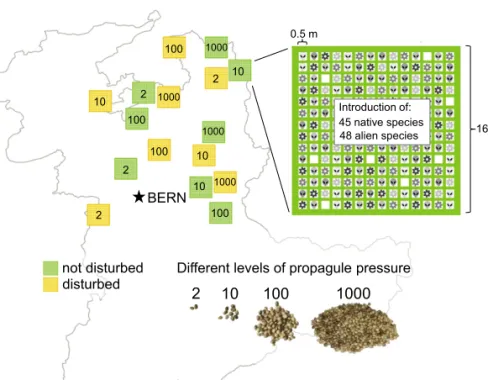
Central Europe and of high value for biodiversity. The sites re-ceived one of four different levels of propagule pressure (2, 10, 100, or 1,000 seeds per species), and eight of the sites were disturbed by soil tilling at the start of the experiment (Fig. 1). For 3 y, we monitored all species. In parallel greenhouse and garden experiments, we assessed species traits widely considered im-portant for establishment [seed mass, germination percentage (21), shoot–root ratio, growth rate, shade-avoidance plasticity, response to competition, and herbivore resistance (27)]. Com-bining thefield results with our trait data allowed us to identify the most important determinants of plant establishment in temperate grasslands. Moreover, using alien and native species allowed us to test the recently posited idea that the success of alien and native species is driven by the same factors (28). Results
Of the 93 plant species introduced as seeds into the 16 sites, 64 (28 natives and 36 aliens) were found at least once and 12 (9 natives and 3 aliens) flowered during the 3 y of the study
(Table S1).
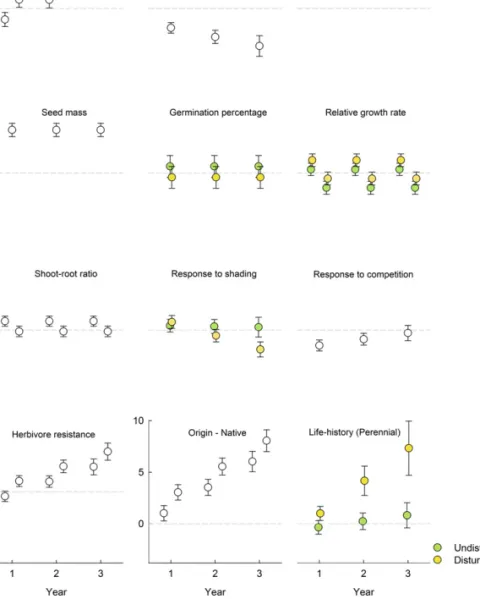
Environmental Factors and Introduction Effort. Establishment was lowest in sites with high standing biomass and higher in sites with disturbed soil than in undisturbed ones. Both effects increased over time (Fig. 2 and Table S2). However, once a species had successfully established, standing biomass and soil disturbance did not affect the number of established individuals (Table S3). The main extrinsic factor increasing early establishment (Figs. 2 and 3) and the number of established individuals (Table S3) was high propagule pressure (i.e., number of seeds sown). However, the relative importance of propagule pressure decreased signif-icantly during the 3 y (Fig. 2 andTable S2).
Species Characteristics. Species characteristics accounted for considerable variation in establishment, and the traits directly related to biotic interactions became the most relevant with time (Fig. 3). The most important species traits in thefirst census— where establishment likely reflected germination success and seedling survival—were high seed mass and a strong negative response to competition. The latter could also be interpreted as
an ability to take advantage of competition-free conditions (14) (higher biomass when growing alone than when growing under competition; Figs. 2 and 3), which might be beneficial for plants at an early establishment phase. Although the effect of seed mass remained constant during the 3 y, the effect of the response to competition declined, and other species characteristics became more important (Figs. 2 and 3 andTable S2).
In the third year, a high resistance against generalist herbivores was the characteristic that, along with being native, was most im-portant for establishment success (Figs. 2 and 3). Moreover, species that established more successfully in disturbed sites showed lower shade-avoidance plasticity (i.e., were less able to elongate their hypocotyls in response to experimental shading;Table S2and Fig. 2). Over time, perennial plants established more successfully than nonperennial ones, particularly in disturbed sites (Fig. 2 and
Table S2). Furthermore, native plant species established
signifi-cantly better than alien ones, and this difference increased over time (Fig. 2 andTable S2). Effects of all other traits accounted for a smaller percentage of the explained variation (Figs. 2 and 3).
Ourfinal model had pseudo-R2values of 0.85 and 0.97 when we used null models with and without random factors, re-spectively. Thus, including both species characteristics and ex-trinsic factors explained a high proportion of the variation in establishment success.
Interaction of Species Status with Other Factors.Because few alien species persisted beyond the first year, we had to restrict the analysis of interactions of status with other factors tofirst-year data (Table S1). Herbivore resistance and standing biomass of the vegetation were equally important for both native and alien species (Table S4 and Fig. S1). However, a high growth rate increased establishment of native but not of alien species, and a negative response to competition—i.e., a high ability to take advantage of competition-free conditions—increased establish-ment of alien but not native species (Table S4andFig. S1). Thus, to some extent, the traits determining establishment success differed between native and alien species.
BERN 1000 1000 1000 1000 2 2 2 2 10 10 10 10 100 100 100 100
Different levels of propagule pressure
2 10 100 1000 disturbed not disturbed 16 m 0.5 m Introduction of: 45 native species 48 alien species
Fig. 1. Design of the introduction experiment. Each of 16 grassland sites in the Canton of Bern were assigned to one of eight combinations of dis-turbance (no disdis-turbance, tilling of soil) and propa-gule pressure. Within each site, we introduced 45 native and 48 ornamental alien plant species into two randomly chosen 0.25-m2subplots (1, 5, 50, and 500 seeds per subplot). During a 3-y period, we assessed the establishment success of each species in spring and late summer.
Discussion
Identifying the traits that promote plant establishment is chal-lenging, because their importance may depend on environmental characteristics and might be obscured by historical aspects. For alien species, quantifying the importance of introduction history (e.g., propagule pressure) is difficult, because many introduced species were chosen by humans (21), and often species with certain traits were introduced in higher numbers. With our unique comparative experimental approach, combining con-trolled introductions of many species with independent experi-mental screenings of their traits, we demonstrated that plant traits, especially those linked to biotic interactions, and extrinsic factors are important drivers of plant establishment in central European grasslands. We showed that the importance of species traits depends on the environment and changes over time, which is likely to have masked some of their effects in previous studies. Environmental Factors and Introduction Effort.Establishment suc-cess decreased with increasing standing biomass and was higher with than without soil disturbance. Although both factors af-fected species presence or absence, they did not affect the number of established individuals. Thisfinding suggests that the resident vegetation acts as an environmentalfilter constraining the initial establishment of certain species but that, once the filter is passed, other factors determine their abundances.
Propagule pressure has been suggested as a main driver of establishment success of introduced alien species (12, 18). In our study, it was indeed the main extrinsic factor determining es-tablishment success and the number of established individuals. However, its relative importance decreased over time. This finding indicates that high propagule pressure indeed increases early establishment but has less effect on persistence in sub-sequent years. The frequently reported importance of propagule pressure at later invasion stages (19) possibly reflects that propa-gule pressure and invasiveness traits have been confounded, be-cause species with traits promoting establishment have been introduced in larger numbers and more frequently (20). Species Characteristics.It has been hypothesized that a successful plant is characterized by fast germination, fast growth, high phenotypic plasticity, high competitive ability (15, 29), and re-sistance to generalist herbivores (30). Species traits in our study, independent of species status, accounted for a considerable proportion of the explained variation in early establishment, and, interestingly, traits directly linked to biotic interactions were the most relevant at the end of the experiment. Thisfinding is in line with general expectations from community assembly and in-vasion theory (31, 32). Initial abiotic filters constrain establish-ment of species without certain physiological traits. Once having passed these abiotic filters, species need to pass biotic filters to persist in a community. The importance of biotic-interaction Fig. 2. Estimates± SEM of the effect of extrinsic factors and species characteristics on establishment. Estimates indicate how much the logit of the es-tablishment probability increases when moving from one factor level to the other (e.g., from no disturbance to disturbance) or, in the case of covariates (e.g., seed mass), when increasing the covariate by one unit (i.e., by one SD). Effects of several factors changed between years, between seasons, or between disturbed and nondisturbed sites (significant interactions with year, season, or disturbance; Table S2). Separate symbols for un-disturbed and un-disturbed sites indicate significant two-way or higher-order interaction of disturbance with the respective factor (e.g., life history).
ECOLO
traits in our study highlights the overall importance of biotic filters for plant establishment.
Establishment in thefirst year is likely to reflect germination success and seedling survival. Accordingly, species with high seed mass, a trait often associated with high seedling survivorship, especially under competitive conditions (33), established better than species with lower seed mass. Species more susceptible to competition were also more successful. However, competition indices are generally difficult to interpret because a negative response to competition might also reflect a better ability to take advantage of increased resource availability under competition-free conditions (14, 34, 35). Perennial species established more successfully than annual species did. Probably, this result reflects that our annual mowing, which is typical for this type of grass-lands, removed all annuals not having produced seeds, whereas perennials were able to resprout.
Among the traits linked to biotic interactions, high resistance against generalist herbivores was of particular importance, es-pecially in summer when herbivory is likely to peak in grasslands. Although alien species might to some degree be released from specialist herbivores, as predicted by the enemy-release hy-pothesis (36), both native and alien species benefited from her-bivore resistance. This finding indicates a strong pressure by generalist herbivores on both native and alien plants. Hence, a basic level of resistance against generalists is essential for es-tablishment of herbaceous species in grasslands. Further, the species establishing more successfully in sites with disturbed soil were the ones less able to plastically elongate their hypocotyls under experimental shading. Thus, less plastic species had an advantage over more plastic ones in sites where stem elongation was not required—a strong indication of the often predicted, but rarely demonstrated, costs of plasticity (37). In general, the high
importance of biological-interaction traits in our study indicates that establishment is strongly constrained by the outcome of interactions with other organisms.
Species Status.Only a few alien species established in thefield. This result is not surprising because we used a random sample of horticultural alien species, and it mirrorsfindings that prob-lematic invasive species make up a relatively modest subset of all alien species (38). Nevertheless, the established aliens and natives provide valuable general information on traits leading to success in grasslands.
The advantage of natives over aliens could not entirely be explained by the traits we measured, which exemplifies the dif-ficulty of accurately explaining species performance based solely on trait information. Alien and native species therefore might well differ in further characteristics that we did not measure, such as fundamental niches or seed dormancy. It could also be that certain traits vary across ontogenetic stages and thus might not have been caught entirely by our measures. Although we are limited in our ability to test for what exactly caused the differ-ence in establishment of alien and native species, it is important to consider the origin when testing for determinants of estab-lishment success, because the introduction of species from dif-ferent origins might be biased and confounded with specific traits (21, 22).
Interactions of Species Status with Other Factors.It has been sug-gested that the effects of extrinsic factors and species traits on establishment should not differ between alien and native plant species (28). A recent experiment showed that invasive alien and widespread native species showed similar biomass responses to nutrient addition (34). However, a recent analysis of the German Flora demonstrated that, although widespread alien and native plant species share some beneficial traits, they differ in others (22). With our multispecies experiments, we also showed that establishment success of alien and native species was partly driven by different factors (Table S4andFig. S1). We therefore suggest that, although most traits might be equally beneficial for alien and native species, the importance of some traits might differ for aliens and natives, and this possibility should be con-sidered when searching for determinants of plant establishment. Synthesis.Identifying and quantifying the importance of factors that determine the success of alien (5, 15–17) and native species (6–8) is challenging, because of the frequent confounding of ex-trinsic factors with species characteristics. Although exex-trinsic fac-tors were significant determinants of early establishment success in our study, species characteristics, especially the ones linked to biotic interactions, were equally important. It will be interesting to see whether thesefindings are also valid for grassland habitats in other parts of the world and for other habitat types.
It has frequently been suggested that the importance of traits affecting establishment is context-dependent (15), but few studies have shown this result rigorously. Here, we showed that the effects of certain traits on early establishment differed between experimentally disturbed and undisturbed sites and changed over time. For example, high resistance against herbivores did not affect the veryfirst stage of establishment but became essential for later plant persistence, and high initial growth rate increased early establishment in disturbed but not in undisturbed sites. Hence, species traits that determine plant success arefine-tuned by environmental factors.
Materials and Methods
Plant Species. We used seeds of 48 alien and 45 native herbaceous plant species from 15 different plant families (Table S5). Horticulture is the major introduction pathway for most invasive plant species (39). We therefore used alien species that are commercially available in Switzerland as ornamental Fig. 3. The relative importance of extrinsic factors and species
character-istics determining early plant establishment success over time. Sectors of the pie charts represent differences in deviance between the full model and a model without the factor of interest. Factors explaining<3.5% of the explained variation in all censuses where assigned to the category“others.” Species characteristics (nonyellow colors), and especially those directly re-lated to biotic interactions (green colors), explained a considerable pro-portion of the explained variation and their relative importance increased over time.
garden plants. We did not introduce problematic invasive species, because such a deliberate selection would have been nonrandom and would be prohibited in Switzerland (for details on species selection, seeSI Materials and Methods, section S1).
Field Experiment. In thefield, we tested how the establishment success of the 93 plant species depended on experimental propagule pressure and soil disturbance in grasslands. We used 16 grassland sites (240 m2each), be-longing to the same community type in the Canton of Bern (Switzerland;
Table S6). All sites were used at low intensity by farmers and were 0.5–50 km apart from each other. We used a factorial design with two levels of soil disturbance (tilling of soil and no disturbance) and four levels of propagule pressure (2, 10, 100, and 1,000 seeds) for each of the 93 species. Because each of the eight combinations of soil disturbance and propagule pressure and their replicates required a separate site, we had two replicates per factorial combination. Each of the 16 sites was randomly assigned to one of the eight combinations of soil disturbance and propagule pressure. The eight sites assigned to the soil-disturbance treatment were tilled 3 wk before sowing, and the tilling destroyed the grass sward more or less completely. The other sites were mown to facilitate sowing; such an early mowing in spring is not unusual in the region.
At each site, we marked 196 subplots of 0.5 m× 0.5 m, separated from each other by 0.5 m. To consider spatial environmental heterogeneity within the sites, the seeds of each of the 93 plant species were divided equally over two randomly chosen subplots (Fig. 1). In the beginning of May 2008, we sowed 2 seeds per species (1 per subplot) at four sites, 10 seeds per species (5 per subplot) at another four sites, 100 seeds per species (50 per subplot) at a further four sites, and 1,000 seeds per species (500 per subplot) at the remaining four sites. To create identical seed densities at each level of propagule pressure, we adjusted the size of the area in which we sowed the seeds in such a way that we had a density of one seed per 5 cm2(e.g., when we sowed 50 seeds in a subplot, we spread the seeds out in the central 250 cm2). All 16 sites were mown once a year in October. Over 3 y, we assessed twice a year—once in spring and once in late summer—whether and how many plants of each species had established in each subplot. As an envi-ronmental variable, we assessed the standing biomass of each grassland by cutting the biomass offive randomly chosen 0.5-m × 0.5-m patches in August 2009 and assessing the mean dry weight per square meter.
Species Characteristics. In independent greenhouse and garden experiments (Muri, Canton of Bern), we assessed several traits widely believed to increase establishment success—seed mass, germination percentage, shoot–root ra-tio, and relative growth rate (RGR)—and also traits that are directly linked to biotic interactions—shade-avoidance plasticity, response to competition, and resistance against a generalist herbivore. Because some of these traits might vary with ontogeny, we assessed each of the traits at the stage at which we expected it to be ecologically important. Correlations between traits are given inTable S7, and mean trait values of alien and native plant species are given inTable S8.
Seed Mass, Germination Percentage, and ShaAvoidance Plasticity. We de-termined the 1,000-seed mass for each of the 93 species. We assessed ger-mination percentages by sowing 50 seeds into each of 12 trays (600 seeds per species). We randomly assigned trays to 12 blocks in a greenhouse and covered 6 of the blocks with a green mesh (Poly-Schattentuch; Neeser), which reduced light intensity by 60%. After sowing, we counted seedlings three times a week. For each tray, we assessed the proportion of germinated seeds (germination percentage) and then calculated the mean germination per-centage per species (21).
Two weeks after germination, we measured hypocotyl lengths of six offspring per plant species and light treatment. As an index of shade-avoidance plasticity, we calculated the log-response ratio of the hypocotyl length for shaded and unshaded seedlings of each species. Because of low germination percentages for some species (21) and the absence of visible hypocotyls for others, shade-avoidance plasticity could be measured only for 55 of the 93 species (16 natives and 39 alien species;Table S5).
Shoot–Root Ratio and Relative Growth Rate of Young Plants. Two weeks after germination, on day 14 in the experiment described above, we harvested six randomly selected offspring per plant species and determined their dry masses. For each species, we then transplanted six additional offspring in-dividually into pots. On day 42, we harvested these transplanted plants and determined dry masses of roots and shoots. We calculated the shoot–root ratio and the RGR of each species as: RGR= [ln(total massday 42)− ln(total massday 14)]/(day 42− day 14). Because of low germination percentages of
some species, this experiment included 67 instead of 93 species (25 native and 42 alien species;Table S5).
Response to Competition. To determine the response to competition, a si-multaneous start for all species was important for the experiment. Therefore, we germinated in a staggered way, starting with the plant species that re-quired the longest time to germination. We then transplanted 16 seedlings per species separately into 1-L pots in May 2009. In 8 of 16 pots, we planted a circle of 10 competitors around the target seedling, consisting of two seedlings offive native plant species dominant in many Swiss grasslands (Holcus lanatus, Lolium perenne, Plantago lanceolata, Poa pratensis, and Trifolium repens).
At the end of the experiment in early September 2009, we harvested aboveground biomass of all target plants and determined their dry masses. As an index of the response to competition, we calculated the log-response ratio of biomass with and without competition for each species. Because of low germination percentages for some species, this experiment included 62 of the 93 species (19 native and 43 alien species;Table S5).
Resistance to Herbivory. To assess the resistance to herbivory, we used larvae of the Egyptian cotton leafworm, Spodoptera littoralis (Boisduval; Lepi-doptera: Noctuidae) as bioassay herbivore. The extreme polyphagy of S. littoralis makes it an excellent bioassay species for comparing leaf palat-ability across plant species from different families. Its feeding response is therefore used as integrative and functionally relevant measure of plant resistance against generalist herbivores (27). Caterpillars originated from a laboratory stock (Institute of Cell Biology).
In August 2008, we germinated our plant species. We then plantedfive seedlings per species into 1-L pots in a greenhouse (15 °C night, 28 °C day, and a constant day length of 14 h). Confamilial native and alien species were tested at the same time. After 8 wk of growth, we enclosed all plants in-dividually into perforated polyester bags and added one third-instar larva of S. littoralis as bioassay caterpillar to each plant. The caterpillar was allowed to feed for 5 d. We assessed the change in biomass of the bioassay cater-pillars by recording their fresh mass before and after feeding. As a measure of constitutive resistance, we used mean adjustedfinal mass (considering the effects of initial mass as covariate) (27) of caterpillars. We reversed the sign of adjusted caterpillar masses for easier interpretation—i.e., high values corresponded to high resistance. In a parallel experiment, in which cater-pillars were allowed to feed on detached leaves in Petri dishes, the change in caterpillar mass was positively correlated with consumed leaf mass (n= 58, r= 0.46, P < 0.0001). Because of low germination percentages for some species, this experiment included 58 of the 93 species (18 native and 40 alien species;Table S5).
Synthesis and Statistical Analysis. Because some trait-assessment experiments could only be performed for a reduced number of species, we had complete data on all traits for 45 of 93 species. Our data on counts of established plants contained more zeros than would be expected for a Poisson or negative binomial distribution. Therefore, we analyzed our data in two steps. First, we analyzed establishment success across the six censuses as the presence–ab-sence of a species in a subplot (i.e., zeros vs. nonzeros), using generalized linear mixed-effects models (GLMMs) with a binomial distribution. The use of GLMMs allowed us to incorporate several random effects while handling nonnormal data (40). In a second step, for the subset of presence-only data, we modeled numbers of established plants, using linear mixed models for each of the six censuses separately.
Presence–Absence of Species per Subplot. We used GLMMs with the function lmer of the lme4 package (41) in R (42). We included data for all censuses and used the presence–absence of a species in a subplot for each census as the response variable. We started with a full model including the extrinsic var-iables {standing biomass of the grassland, soil disturbance (yes or no), propagule pressure [continuous (log-transformed): 1, 5, 50 or 500 seeds]}, the species characteristics [species status (native or alien), life history (pe-rennial or nonpe(pe-rennial), 1,000-seed mass, germination percentage in the greenhouse, shade avoidance plasticity, shoot–root ratio, RGR, response to competition, and resistance to herbivory], year (1–3), and season (spring or summer) asfixed factors. Continuous variables were scaled to means of zero and SDs of one to facilitate comparisons of their effects (43). To avoid overfitting, we could not include all possible interactions. However, because a major objective of the study was to test whether the importance of species characteristics depends on the environment, we included the interaction of eachfixed factor with disturbance. Because the importance of all factors might change over time, we also included interactions of eachfixed factor ×
ECOLO
season and eachfixed factor × year; the three-way interactions of each fixed factor× disturbance × season, each fixed factor × disturbance × year, and eachfixed factor × season × year; and the four-way interactions of each fixed factor × disturbance × season × year (Table S2).
We corrected for taxonomy by including plant family as a random factor. Other random factors were plant species nested within plant family, site, subplot (categorical, 1–2,976) nested within site, and census (categorical). We reduced the model offixed terms by stepwise deletion of nonsignificant terms and compared the resulting model to the previous one by using log likelihood-ratio tests (43). We used the multcomp library of R (44) to obtain estimates and SEs for each factor level. We calculated a pseudo-R2 as a goodness-of-fit measure (SI Materials and Methods, section S2).
It has been suggested that the importance of certain species traits for establishment might be the same for alien and native species (28). Because of low establishment success of aliens toward the end of the experiment, we could not test this hypothesis in our complete dataset. We therefore per-formed a separate analysis on data of thefirst year only where we included, in addition to the above mentioned factors, interactions of species status with all other variables (Table S4).
Number of Established Plants in a Subplot. We removed all zero data and fitted a linear mixed model with the log-transformed number of established plants per subplot as response variable (Gaussian error distribution). Because some subplots with established plants in one census had zero plants in an-other census, we could not run an analysis including all censuses to assess the change in importance of every factor over time. Therefore, we performed the analyses separately for each of the six censuses.
We used all extrinsic variables and species characteristics asfixed factors and the interaction of eachfixed factor with soil disturbance. As random factors, we included plant family, plant species nested within plant family,
and site. We reduced thefixed terms by stepwise deletion of nonsignificant terms, compared the resulting model with the previous one using log like-lihood-ratio tests, and obtained estimates and SEs for each factor level as described above.
Because of low numbers of observations in the censuses of the second and third year, the models did not converge, and we had to exclude all inter-actions with soil disturbance. Additionally, in the last three censuses, we also had to exclude life history and shade-avoidance plasticity (which were the least significant factors) to achieve convergence.
Relative Importance of Factors. To identify the factors accounting for most of the explained variation in establishment success, we ran models with the presence–absence of the species as the response variable for each of the six censuses separately. Asfixed factors, we used all extrinsic variables and species characteristics (main terms); as random factors, we used site and species nested within plant family. For each census, we ran the full model and alternately removed one of thefixed factors. We then compared the full model to models without the factor of interest and assessed the difference in deviance. This difference indicates the amount explained by each factor and thus yields a good indication of the relative importance of each factor at each census.
ACKNOWLEDGMENTS. We thank C. Ball, A. Bucharova, C. Föhr, D. Kolly, S. Zingg, and A. Gygax for assistance; all the farmers for providing their land; and E. Allan, O. Bossdorf, B. Schmid, and two anonymous reviewers for help-ful comments on earlier drafts. This work was supported by Swiss National Science Foundation Project 31003A-117722, by the National Centre of Compe-tence in Research“Plant Survival,” and by Seventh Framework Programme for Research– Research Potential of Convergence Regions, Grant 264125 EcoGenes.
1. Grubb PJ (1977) Maintenance of species-richness in plant communities—importance of regeneration niche. Biol Rev Camb Philos Soc 52(1):107–145.
2. Gaston R (1994) Rarity (Chapman & Hall, London).
3. Chesson P (2000) Mechanisms of maintenance of species diversity. Annu Rev Ecol Syst 31(1):343–366.
4. Thompson K, Hodgson JG, Grime JP, Burke MJW (2001) Plant traits and temporal scale: evidence from a 5-year invasion experiment using native species. J Ecol 89(6): 1054–1060.
5. Kolar CS, Lodge DM (2001) Progress in invasion biology: Predicting invaders. Trends Ecol Evol 16(4):199–204.
6. Murray BR, et al. (2002) How life-history and ecological traits relate to species rarity and commonness at varying spatial scales. Aust J Ecol 27(3):291–310.
7. Pywell RF, et al. (2003) Plant traits as predictors of performance in ecological resto-ration. J Appl Ecol 40(1):65–77.
8. Lavergne S, et al. (2004) The biology and ecology of narrow endemic and widespread plants: A comparative study of trait variation in 20 congeneric pairs. Oikos 107(3): 505–518.
9. Wardle DA, Bardgett RD, Callaway RM, van der Putten WH (2011) Terrestrial eco-system responses to species gains and losses. Science 332(6035):1273–1277. 10. Soberon J (2007) Grinnellian and Eltonian niches and geographic distributions of
species. Ecol Lett 10(12):1115–1123.
11. Huston MA (1994) Biological Diversity. The Coexistence of Species on Changing Landscapes (Cambridge Univ Press, Cambridge, UK).
12. Myers JA, Harms KE (2009) Seed arrival, ecologicalfilters, and plant species richness: A meta-analysis. Ecol Lett 12(11):1250–1260.
13. Hautier Y, Niklaus PA, Hector A (2009) Competition for light causes plant biodiversity loss after eutrophication. Science 324(5927):636–638.
14. Davis MA, Grime JP, Thompson K (2000) Fluctuating resources in plant communities: A general theory of invasibility. J Ecol 88(3):528–534.
15. Pyšek P, Richardson DM (2007) Biological Invasions, ed Nentwig W (Springer, Hei-delberg), pp 97–126.
16. van Kleunen M, Weber E, Fischer M (2010) A meta-analysis of trait differences be-tween invasive and non-invasive plant species. Ecol Lett 13(2):235–245.
17. Dawson W, Burslem DFRP, Hulme PE (2011) The comparative importance of species traits and introduction characteristics in tropical invasions. Divers Distrib 17(6): 1111–1121.
18. Lockwood JL, Cassey P, Blackburn T (2005) The role of propagule pressure in ex-plaining species invasions. Trends Ecol Evol 20(5):223–228.
19. Simberloff D (2009) The role of propagule pressure in biological invasions. Annu Rev Ecol Evol Syst 40(1):81–102.
20. Colautti RI, Grigorovich IA, MacIsaac HJ (2006) Propagule pressure: A null model for biological invasions. Biol Invasions 8(5):1023–1037.
21. Chrobock T, Kempel A, Fischer M, van Kleunen M (2011) Introduction bias: Cultivated alien plant species germinate faster and more abundantly than native species in Switzerland. Basic Appl Ecol 12(3):244–250.
22. Knapp S, Kühn I (2012) Origin matters: Widely distributed native and non-native species benefit from different functional traits. Ecol Lett 15(7):696–703.
23. Kühn I, Durka W, Klotz S (2004) BiolFlor—a new plant-trait database as a tool for plant invasion ecology. Divers Distrib 10(5–6):363–365.
24. Thompson K, McCarthy MA (2008) Traits of British alien and native urban plants. J Ecol 96(5):853–859.
25. Herms DA, Mattson WJ (1992) The dilemma of plants—to grow or defend. Q Rev Biol 67(3):283–335.
26. Levine JM, Adler PB, Yelenik SG (2004) A meta-analysis of biotic resistance to exotic plant invasions. Ecol Lett 7(10):975–989.
27. Kempel A, Schädler M, Chrobock T, Fischer M, van Kleunen M (2011) Tradeoffs as-sociated with constitutive and induced plant resistance against herbivory. Proc Natl Acad Sci USA 108(14):5685–5689.
28. Thompson K, Davis MA (2011) Why research on traits of invasive plants tells us very little. Trends Ecol Evol 26(4):155–156.
29. Baker HG (1965) The Genetics of Colonizing Species, eds Baker HG, Stebbins GL (Ac-ademic, New York), pp 147–169.
30. Müller-Schärer H, Schaffner U, Steinger T (2004) Evolution in invasive plants: im-plications for biological control. Trends Ecol Evol 19(8):417–422.
31. HilleRisLambers J, Adler PB, Harpole WS, Levine JM, Mayfield MM (2012) Rethinking community assembly through the lens of coexistence theory. Annu Rev Ecol Evol Syst 43(1):227–248.
32. Catford JA, Jansson R, Nilsson C (2009) Reducing redundancy in invasion ecology by integrating hypotheses into a single theoretical framework. Divers Distrib 15(1):22–40. 33. Leishman MR, Murray BR (2001) The relationship between seed size and abundance in
plant communities: Model predictions and observed patterns. Oikos 94(1):151–161. 34. Dawson W, Fischer M, van Kleunen M (2012) Common and rare plant species respond
differently to fertilization and competition, whether they are alien or native. Ecol Lett 15(8):873–880.
35. Dawson W, Rohr RP, van Kleunen M, Fischer M (2012) Alien plant species with a wider global distribution are better able to capitalize on increased resource availability. New Phytol 194(3):859–867.
36. Keane RM, Crawley MJ (2002) Exotic plant invasions and the enemy release hypoth-esis. Trends Ecol Evol 17(4):164–170.
37. van Kleunen M, Fischer M (2007) Progress in the detection of costs of plasticity. New Phytol 176(4):727–730.
38. Williamson M, Fitter A (1996) Varying success of invaders. Ecology 77(6):1661–1666. 39. Hulme PE, et al. (2008) Grasping at the routes of biological invasions: A framework for
integrating pathways into policy. J Appl Ecol 45(2):403–414.
40. Pinheiro JC, Bates DM (2000) Mixed-Effects Models in S and S-PLUS (Springer, New York).
41. Bates D, Maechler M (2009) lme4: Linear mixed-effects models using S4 classes. R package, Version 0.999375-32. http://CRAN.R-project.org/package=lme4.
42. R Devolopment Core Team (2010) R: A Language and Environment for Statistical Computing (R Foundation for Statistical Computing, Vienna).
43. Zuur A, Ieno EN, Saveliev AA, Smith GM (2009) Mixed Effects Models and Extensions in Ecology with R (Springer, New York).
44. Hothorn T, Bretz F, Westfall P (2008) Simultaneous inference in general parametric models. Biom J 50(3):346–363.