Supporting Information for
Organogelators from hepta(p-benzamide) hetero sequences
Helga Seyler, Andreas F.M. Kilbinger*
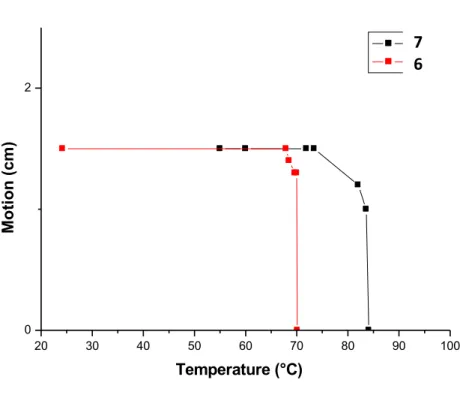
20 30 40 50 60 70 80 90 100 0 2 9 8 Moti o n (cm) Temperature (°C)
Figure SI-‐‑1. Melting temperatures of the gels 6 and 7, determined by the dropping ball
method.
7 6
Figure SI-‐‑2. Fmoc-‐‑UV cleavage detection (ABI431 peptide synthesizer) for hetero-‐‑
heptamers 6 (top) and 7 (bottom).
1295,8 1329,7 1100 1200 1300 1400 1500 [M(K-salt)+K]+ mass/charge [M(Na-salt)+Na]+ 9 1175 1197,1 1213,1 1229,1 1188,1 1100 1150 1200 1250 1300 1350 1400 [M+Na]+ [M(Na-salt)+Na]+ [M(K-salt)+Na]+ [M(K-salt)+K]+ mass/charge 8
Figure SI-3. MALDI-ToF mass spectra of oligomers 7 (left) and 6 (right).
1
2
3
4
5
6
7
7 6Full Experimental Section
General. Technical and p. a. quality solvents were purchased from Acros Organics.
Dichloromethane and DMSO were purchased from Fisher Scientific. N-‐Methylpyrrolidinone (NMP) was kindly donated by BASF and stored over molecular sieve (4 Å). 9-‐ Flourenylmethoxycarbonyl-‐chloride (Fmoc-‐Cl) and Wang resin were obtained by Iris Biotech GmbH, all other chemical reagents were purchased from Acros Organics and were used without further purification. Deuterated solvents (DMSO-‐d6 and CDCl3) were purchased from Deutero
GmbH.
Instrumentation. Standard 1H and 13C nuclear magnetic resonance spectra were recorded on a
Bruker AC (300 MHz) or on a Bruker AMX 400 (400 MHz). 2D COSY and NOESY experiments were acquired on a Bruker AMX 400. Infrared spectra were recorded on a Nicolet 5 DXC FT-‐IR spectrometer. RP-‐HPLC analysis was performed on a Hewlett Packard HP 1090 Liquid Chromatograph equipped with PerfectSil column (MZ Analysentechnik, Mainz, Germany, 250 x 4.0 mm; 120 ODS-‐2 5 µm). The samples were eluted with an acetonitrile/water gradient that started from 10 % acetonitrile rising to 90 % over a period of 35 min and maintained constant for additional 10 min. Both solvents were buffered with 0.1 % TFA. UV-‐detection was performed at 254 nm. Melting points were recorded on a FP 62 Mettler Toledo in a capillary tube and are uncorrected. Field desorption mass spectra were measured on a Finnigan MAT 95 and ESI mass spectra on a Micromass Q-‐TOF Ultima 3. Matrix-‐assisted laser desorption and ionization time-‐of-‐ flight (MALDI-‐TOF) measurements were performed on a Shimadzu Axima CFR MALDI-‐TOF mass spectrometer equipped with a nitrogen laser delivering 3 ns laser pulses at 337 nm. 2-‐(4-‐ hydroxyphenylazo) benzoic acid (HABA) was used as matrix. A Philips EM 420 transmission electron microscope using a LaB6 cathode at an acceleration voltage of 120 kV was used to
obtain TEM-‐images. TEM grids (carbon film on copper, 300 mesh) were obtained from Electron Microscopy Sciences, Hatfield, PA, USA. The synthesis of the oligomers was performed on an Applied Biosystems ABI 431a automated peptide synthesizer using standard Fmoc chemistry protocols. Modules A, G and E were modified as described in detail before. 1,2
4-‐Acetamidosalicylic acid (1). Acetyl chloride (23.2 ml, 1 eq.) was added dropwise into a cold
solution of 4-‐aminosalicylic acid (50 g, 0.33 mol, 1 eq.) in pyridine (250 ml) under an inert atmosphere. The solution was further refluxed for 2 hrs. The cold reaction mixture was poured
1 Ryu, J.-‐H.; Hong, D.-‐J.; Lee, M. Chem. Commun. 2008, 1043-‐1054.
to a mixture of 800 ml ice and 400 ml 6N hydrochloric acid. The solid was filtered, washed with water and dried to give 1 (54g, 85%).
mp: 222 ºC.
1H-‐NMR: δ (300 MHz, DMSO-‐d
6) 2.06 (s, 3 H); 7.04 (d, 3J = 8.46 Hz, 1 H); 7.34 (s, 1 H); 7.70 (d, 3J =
8.46 Hz, 1H); 10.21 (s, 1H).
13C-‐NMR and DEPT: δ (300 MHz, DMSO-‐d
6) 24.29 (+); 105.77 (+); 107.48; 110.11 (+); 131.05 (+); 145.7; 162.21; 169.2; 171.69. IR ν (cm-‐1): 3350, 2872, 1676, 1599, 1535, 1383, 1282, 1222, 1162. RP-‐HPLC (min): 9.9 M (FD): m/z (%) = 195.6 (100); 196.6 (9.3); 197.6 (0.49); calc.[C9H9NO4] = 195.1
4-‐Acetamido-‐2-‐hexyloxy-‐benzoic acid hexyl ester (2). 1 (37.1 g, 0.19 mol), dry acetone (700 ml),
153 ml 1-bromohexane (153 ml, 1.1 mol), 18-‐crown-‐6 (1,5 g), anhydrous K2CO3 (229,8 g) and KI
were heated for 50 hrs under reflux and inert atmosphere. The solvent was removed under reduced pressure, water (460 ml) was added to the residue, the resulting solution extracted with dichloromethane, dried over magnesium sulfate and the solvent removed on a rotary evaporator. The residue was cooled over night at -‐18 ºC, the precipitate was collected by suction filtration, washed with cold petroleum and dried in vacuum to give 2 as a beige solid (56.7 g, 82 %). mp: 66 ºC. 1H-‐NMR: δ (300 MHz, DMSO-‐d 6) 0.84-‐0.89 (m, 6 H); 1.25-‐1.49 (m, 12 H); 1.59-‐1.76 (m, 4 H); 2.06 (s, 3H); 3.94 (t, 3J = 6.25 Hz, 2 H); 4.15 (t, 3J = 6.4 Hz, 2 H); 7.16 (dd, 4J = 1.7 Hz, 3J = 8.6 Hz, 1 H); 7.47 (d, 4J = 1.47 Hz, 1 H); 7.64 (d, 3J = 8.46 Hz, 1 H); 10.18 (s, 1 H).
13C-‐NMR and DEPT: δ (300 MHz, DMSO-‐d
6) 13.87 (+); 22.08 (+); 22.14 (+); 24.2 (+); 25.21 (-‐); 25.3 (-‐); 28.31 (-‐); 28.68 (-‐); 31.03 (-‐); 31.08 (-‐). IR ν (cm-‐1): 3306, 3272, 2955, 2932, 2856, 1679, 1662, 1595, 1543, 1409, 1274, 1261, 1191, 1138, 831. RP-‐HPLC (min): 35.6 M (FD): m/z (%) = 363.4 (100); 364.4 (19); calc.[C21H33NO4] = 363.2
4-‐Amino-‐2-‐hexyloxy-‐benzoic acid (3). A solution of 2 (55.3 g, 0.15 mol), KOH (35 g) and ethanol
(550 ml) were heated under reflux for 50 hrs. The solvent was then removed under reduced pressure, the residue dissolved in water (550 ml) and neutralized with 6N HCl. The precipitate was collected, washed well with water and dried under vacuum at 60 ºC to give 3 (30.3 g, 85%). mp: 122 ºC.
1H-‐NMR: δ (300 MHz, DMSO-‐d
6) 0.87 (t, 3J = 6.99 Hz, 3 H); 1.26-‐1.31 (m, 4 H); 1.43 (m, 2 H);
1.71 (tt, 2 H); 3.93 (t, 3J = 6.4 Hz, 2 H); 5.86 (s, 2H); 6.14 (dd, 4J = 1.84 Hz, 3J = 8.46 Hz, 1 H); 6.2
(d, 4J = 2.21 Hz, 1 H); 7.50 (d, 3J = 8.82 Hz, 1 H); 11.31 (s, 1 H).
13C-‐NMR and DEPT: δ (300 MHz, DMSO-‐d
6) 13.88 (+); 22.08 (-‐); 25.09 (-‐); 28.58 (-‐); 30.94 (-‐); 67.98 (-‐); 97.22 (+); 105.82 (+); 106.06; 133.79 (+); 154.49; 160.42; 166.34. IR ν (cm-‐1): 3428, 3345, 3232, 2930, 1685, 1586, 1456, 1401, 1339, 1267, 1191, 998, 831. RP-‐HPLC (min): 21.9 min. M (FD): m/z (%) = 237.8 (100); 238.8 (17); 239.8 (1.4); calc.[C13H19NO3] = 237.1
N-‐Fmoc-‐4-‐amino-‐2-‐hexyloxy benzoic acid (4). 3 (19.9 g, 84 mmol) was dissolved in dry NMP
(140 ml) under an inert atmosphere followed by the dropwise addition of Fmoc-‐Cl (21.67 g, 83.8 mmol) in dry NMP (55 ml). After 24 hrs, the reaction mixture was poured slowly into 280 ml water. The beige precipitate was collected by filtration, washed with water, petroleum ether and recrystallized from toluene to afford 4 (38.6 g, 89%).
mp: 159 ºC. 1H-‐NMR: δ (300 MHz, DMSO-‐d 6) 0.86 (t, 3J = 6.62 Hz, 3 H); 1.27-‐1.30 (m, 4 H); 1.43 (m, 2 H); 1.71 (tt, 2 H); 3.95 (t, 3J = 6.25 Hz, 2 H); 4.32 (t, 3J = 6.62 Hz, 1 H); 4.52 (d, 3J = 6.62 Hz, 2 H); 7.08 (d, 3J = 8.09 Hz, 1H); 7.33-‐7.45 (m, 5 H); 7.65 (d, 3J = 8.46 Hz, 1H); 7.76 (d, 3J = 6.99 Hz, 2 H); 7.91 (d, 3J = 7.35 Hz, 2 H), 9.98 (s, 1H).
13C-‐NMR and DEPT: δ (300 MHz, DMSO-‐d
6) 13.87 (+); 22.06 (-‐); 25.01 (-‐); 28.5 (-‐); 30.9 (-‐); 46.56 (+); 65.8 (-‐); 68.15 (-‐); 102.63 (+); 109.34 (+); 114.43; 120.19 (+); 125.11 (+); 127.13 (+); 127.71 (+); 132.34 (+); 140.82; 143.69; 143.87; 153.24; 158.94; 166.57. IR ν (cm-‐1): 3302, 3218, 2952, 2932, 2856, 1738, 1710, 1608, 1528, 1414, 1309, 1196, 1103, 736. RP-‐HPLC (min): 34.9 M (FD): m/z (%) = 459.5 (100); 460.6 (16.7); calc.[C28H29NO5] = 459.2
N-‐Fmoc-‐p-‐amino benzoic acid. p-‐Aminobenzoic acid (10 g, 73 mmol) was dissolved in dry NMP
(50 ml) under an inert atmosphere followed by the dropwise addition of Fmoc-‐Cl (18.9 g, 73 mmol) in dry NMP (50 ml). After 24 hrs, the reaction mixture was poured slowly into 400 ml water. The colorless precipitate was collected by filtration, washed with water and dried in vacuum at 120 ºC to give N-‐Fmoc-‐p-‐amino benzoic acid (24.8 g, 94%).
mp: 215 ºC (dec.)
1H-‐NMR: δ (300 MHz, DMSO-‐d
6) 4.33 (t, 3J = 6.25 Hz, 1 H); 4.54 (d, 3J = 6.25 Hz, 2 H); 7.33-‐7.45
(m, 4 H); 7.57 (d, 3J = 7.35 Hz, 2 H); 7.76 (d, 3J = 7.35 Hz, 2 H); 7.89 (m, 4 H), 10.08 (s, 1H); 12.69
(s, 1H).
13C-‐NMR and DEPT: δ (300 MHz, DMSO-‐d
6) 46.61 (+); 65.83 (-‐); 117.5 (+); 120.22 (+); 124.48; 125.14 (+); 127.17 (+); 127.74 (+); 130.48 (+); 140.86; 143.31; 143.74; 153.31; 167.03. IR ν (cm-‐1): 3344, 2970, 2887, 2660, 2544, 1709, 1673, 1610, 1592, 1526, 1511, 1411, 1311, 1282, 1221, 1052, 850, 736. RP-‐HPLC (min): 26.6 min. M (FD): m/z (%) = 359.1 (100); 360.1 (17.4); calc.[C22H17NO4] = 359.1
General method for resin functionalization (GM 1). Wang resin (417 mg, 0.25 mmol) was
swollen in a minimum amount of dry NMP. Fmoc amino acid 4 or Fmoc-‐p-‐amino benzoic acid (2 mmol) was dissolved in NMP (2 ml) and thionyl chloride (0.22 ml, 3 mmol) was added. After 2 hrs, the solution was evacuated for 30 min and poured onto the Wang resin. After 24 hrs the resin was drained and washed 4 times with NMP. Unreacted functional groups on the resin were capped with a solution of 4-‐nitrobenzoyl chloride (0.46 g, 2.5 mmol) in NMP (1.5 ml).
General method for the preparation of acid chlorides for the automated solid phase synthesis (GM 2). The respective carboxylic acid (4 or N-‐Fmoc-‐p-‐amino benzoic acid) was dissolved in
thionyl chloride and a catalytic amount of dry NMP was added. After stirring for 2 hrs at rt, thionyl chloride was removed under reduced pressure. The acid chloride was dissolved in dry NMP (to obtain a final concentration of 0.5 mmol/ml) and the solution filtered through a 400 micron syringe filter into the cartridges of the peptide synthesizer (1 mmol per cartridge).
General method for the automated oligomer synthesis on a peptide synthesizer (n-‐mer) (GM 3). The functionalized resin (prepared as described in GM 1) was N-‐deprotected, reacted with 4
eq. acid chloride (2x, prepared as described in GM 2), followed by the reaction with 4 eq. 4-‐ nitrobenzoyl chloride as capping reagent. This sequence was repeated n-‐1 times to afford the n-‐ mer.
STEP Rpt. Name Modules (ABI 431A peptide synthesizer)
1 n-‐1 Middle cycle with capping GgBdefffGgdefffGgeff 2 1 Deprotection and NMP wash gBd
3 1 Rinse cycle E
The efficiency of the monomer coupling steps was monitored during the synthesis by UV-‐ detection of the deprotected Fmoc groups.
The desired oligomer was cleaved off the solid support by stirring in TFA-‐DCM (50%) solution for 12 hrs. The solvent was evaporated to obtain the crude product.
Heptamer (6). 6 was prepared as described in GM 3, starting with an N-‐Fmoc-‐4-‐amino benzoic
acid-‐ functionalized resin. Step 1 was repeated 6 times. The heptamer was dissolved in hot DMSO, precipitated into methanol, centrifuged and dried in vacuum at 100 ºC to give 6 (100.4 mg, 35%).
1H-‐NMR: δ (300 MHz, DMSO-‐d
6) 0.79-‐0.85 (m, 9 H); 1.21-‐1.49 (m, 18 H); 1.86-‐1.89 (m, 6 H);
4.15-‐4.17 (m, 6 H); 6.63 (d, 3J = 8.51 Hz, 2 H); 7.5 -‐8.03 (m, 23 H); 10.0 (s, 1 H); 10.27-‐10.37 (m,
5H).
13C-‐NMR data could not be recorded due to insufficient solubility of 6 in DMSO-‐d 6.
M (MALDI-‐TOF): m/z = 1229 [M(K-‐salt) + K]+; calc.[C67H72N7O11K2] + = 1228.5.
IR ν (cm-‐1): 3334, 2930, 2859, 1654, 1585, 1500, 1408, 1238, 1175, 1013, 846, 757, 660.
Heptamer (7). 7 was prepared as described in GM 3, starting with a N-‐Fmoc-‐4-‐amino-‐2-‐hexyloxy
benzoic acid-‐ functionalized resin. Step 1 was repeated 6 times. The heptamer was dissolved in hot DMSO, precipitated into methanol, centrifuged and dried in vacuum at 100 ºC to give 7 (107.5 mg, 35%).
1H-‐NMR: δ (300 MHz, DMSO-‐d
6) 0.82-‐0.9 (m, 12 H); 1.24-‐1.49 (m, 24 H); 1.72-‐1.93 (m, 8 H); 4.02
(t, 3J = 6.3 Hz, 2 H); 4.10-‐4.18 (m, 6 H); 5.92 (s br.; NH2); 6.27 (d, 1H); 6.30 (s, 1H); 7.46-‐8.03 (m,
22 H); 10.1 (s, 1 H); 10.29-‐10.37 (m, 5H).
13C-‐NMR data could not be recorded due to insufficient solubility of 7 in DMSO-‐d 6.
M (MALDI-‐TOF): m/z = 1296 [M(Na-‐salt) + Na]+; calc.[C
73H84N7O12Na2] + = 1296.6
IR ν (cm-‐1): 3333, 2928, 2858, 1663, 1586, 1507, 1405, 1239, 1180, 1013, 832, 757.