Manual For
VET Practitioners
Costing and Pricing of
VET Products and
Services
VET RESOURCE MANUAL
Manual for Costing and Pricing VET Products
And Services - Part I
On behalf of SDC/Employment and Income Division:
The Swiss Agency for Development and Co-operation Employment and Income Division Freiburgstrasse 130, CH 3003 Berne, Switzerland.
www.sdc.admin
© SDC
The Introduction, VET Manual and Toolkit can be accessed via http://www.sdc.admin.ch/ei
Published by: SDC © SDC, December 2005 Editor and Author: Garry Bargh Contributors: Jaclyn Burrows-Moss, Kerry Gray, Bruce Anderson, Michael Wallace, Ray Shannon Graphic Designs: BETC Translation into Vietnamese funded by Jobs Australia Ltd,
Melbourne, Victoria, Australia Photos: Nam Dinh Vocational Training Centre, Vietnam Training Institution for Technical Instruction, Nepal Skill , Nepal Sano Thimi Technical School, Nepal BETC, Australia Kumbeshwar Technical School, Nepal
Manual for Costing and Pricing VET Products
And Services - Part I
The Manual is in two parts for VET practitioners. Costing and Pricing of VET Products and Services.
Part I: Manual
Part II: Toolkit (Worksheets, Spreadsheets, Questions, Tables, Schedules) The Manual and Toolkit is designed for VET institutions, private, public and para public to assist co-ordinators and administrators to cost and price products and services.
The Manual and Toolkit is divided into two parts and has been designed as an electronic document to be distributed on CD-ROM and downloaded from the SDC website
http://www.sdc.admin.ch/ei
The Introduction: will give you a summary of each section of the Manual and Toolkit. You will then be able to determine if this section or parts of this section is useful for you at that time. The introduction is in PDF/Word format.
Part I Presents a background of VET systems in different countries, case studies and examples of good practise, financial management systems and a range of VET products and services.
Also methods of financing VET services, recent developments and trends. Part II Provides a variety of practical tools including worksheets, tracer studies,
spreadsheets, schedules and forms.
These are general outlines for practitioners, which can be adjusted to meet the needs of an institution.
The information is based on real life experience and needs expressed from a number of institutions visited and surveyed around the world.
The Manual can be used by VET staff directly involved in costing and pricing of their products and services.
To be able to effectively use the Manual, institutions must have sufficient autonomy to determine rules and regulations for financial management. Institutions must be able to initiate administrative systems and course cost calculations external to those of their parent organisation (if funded externally). The Manual will provide assistance in establishing financial systems for these services.
Manual for Costing and Pricing VET Products
And Services - Part I
MANUAL - PART 1
CONTENTS Page
Section
A
Introduction - The Manual
10- Foreword 11
B
VET Systems
131 Definition of VET 13
2 Functions of VET 13
3 Typical VET Services and Systems 13
i. Vocational training: pre employment,
technical and generic skills 14
ii. Labour Market Training 15
iii. Enterprise or Fee for Service Training 16
C
Financial Systems
171 Definition of Accounting 18
2 The Purpose of Costing 19
3 The Objective of Costing 20
4 Sample of Chart of Accounts 21
5 Methods: Total Costing and Marginal Costing 22
6 Indirect Costing 23
7 Depreciation 29
8 Financial
Manuals 38
9 Pricing Methods 61
Glossary, References, Bibliography 67
D
Costing and Pricing of VET Services and Products
711 Enrolments 71
2 Recognition of Prior Learning/Recognition of
Current Competency (RPL/RCC) 82
3 Distance Learning 98
4 Assessment 128
5 Quality 146
6 Return on Training Investment 166
Glossary, References, Bibliography, Web Pages
Manual for Costing and Pricing VET Products
And Services - Part I
MANUAL – PART I
CONTENTS Page SectionE
Financing
178 1 Introduction 178 2 Financing Goals 1803 Which Type of Training? 180
i. Pre Employment Training 180
ii. Continuing Vocational Training 180
ii. Training for the Unemployed 180
4 Who Should Pay For The Training? 181
i. Government – State and District Funding 182
ii. Employers 183
iii. Job Seekers 183
iv. Community Financing 185
v. International – Non government Organisations 186
5 Management Approaches to Financing 186
i. Funds Disbursement 186
ii. Output Financing 187
iii. Investment Financing 187
iv. Tendering 188
v. Market Orientated Voucher Systems 188
vi. Enterprise Sponsoring 191
vii. Individual Sponsoring 192
6 Cost Sharing and Co-Financing Mechanisms 195
i. Traditional Traineeship – Apprenticeship Schemes 195
ii. Dual Systems 195
iii. Revenue Generating Levy Schemes 196
iv. Levy Exemption Schemes 197
v. Levy Grant/Reimbursement 198
7 Self-Financing Training Institutions 199
8 Financing Labour Market Training 201
i. Direct Funding 201
ii. Contract Funding 201
iii. Funding through National Programs and
Management Intermediaries 202
9 New Developments and Financing Implications 202
Manual for Costing and Pricing VET Products
And Services - Part I
MANUAL – PART I
ADDENDA
Page1 Generic Skills 209
2 Management and Planning VET Systems 224
- Mission Statements 224
- Institutional Level Planning 225
3 Institutional Strategies 226
4 Influencing Factors on VET Delivery 227
5 Examples of Government and Enterprise Funded Training 230
6 Labour Market Analysis 231
7 Factors Affecting Pricing 234
8 Recent Trends in VET Delivery 237
9 Delivering Distance Learning using Web-based Technologies 241
7 Tips for Successful Online Learning 250
Manual for Costing and Pricing VET Products
And Services - Part I
MANUAL – PART I
Section Box No Title Page
B 1 VET in Secondary Schools 14
C 2 Case Study – Indirect Costs, Administration Department 27 C 3 Case Study – Prepared by Nepal Training Institution 28 D 4 The ACE Mullumbimby Course Advertising Experience 73 D 5 Pierce College Washington USA – Enrolment information
for students into DL programs 77
D 6 Case Study – Discounting Course Fees 92
D 7 Case Study –SKILL NEPAL (Helvetas Project) 112
D 8 Case Study 5 (Vietnam) 114
D 9 Case Study 6 (India) 121
D 10 The Australian Experience: On-the-job Assessment 132 D 11 The Australian Experience: Assessment and Industry
Consultation 137
D 12 The Australian Experience: Assessment Validation 138 D 13 The Australian Quality Training Framework (AQTF) 148 D 14 The Australian Example: The AQTF Standards for
Registered Training Organisations (RTO’s) 149
D 15 The Australian Example: The AQTF Standards for State
and Territory Registering/Course Accrediting Bodies 150 D 16 The Australian Example: The Australian Qualifications
Framework (AQF) 150
D 17 F-Skill ISO Certification Process 157
D 18 Examples of Enterprise Approaches for Assessing Return
on Training Investment 171
D 19a Return on Training Investment Benefit/Cost Ratio example 175 D 19b Return on Training Investment Benefit/Cost Ratio example 175 E 20 Australian New Apprenticeship Program – National Training
Wage 184
E 21 SKILL Nepal 185
E 22 Vouchers in Latin and Central America 190
E 23 Case Study – Training Voucher Program – BONOPYME –
PERU 191
E 24 Case Study – Kumbeshwar Technical School, Kathmandu,
Nepal. A community based self-financing school. 200 E 25 Case Study – On-Q Human Resources Group Training 205 Addendum
1 26 Common Elements of Generic Skills 209
4 27 A Summary of Influencing Factors/Hindrances from VET
Survey Respondents 228
4 28 VET Demand Driven – The Australian Model 229
6 29 Questions to ask in assessing future demand for VET services 233 7 30 Case Study – F-Skill/Helvetas Kathmandu, NEPAL.
Manual for Costing and Pricing VET Products
And Services - Part I
MANUAL – PART I
Section Box No Title Page
Addendum
8 31 The Changing VET Marketplace 239
9 32 A simple example of a distance learning program that has
been re-structured for web-based delivery 244
Section Table No Title Page
C 1 Sample Chart of Accounts Headings 21
C 2a Computer Depreciation 32
C 2b Computer Depreciation 32
C 3 Manufacturing Plant Depreciation 33
C 4 Motor Vehicle Depreciation 36
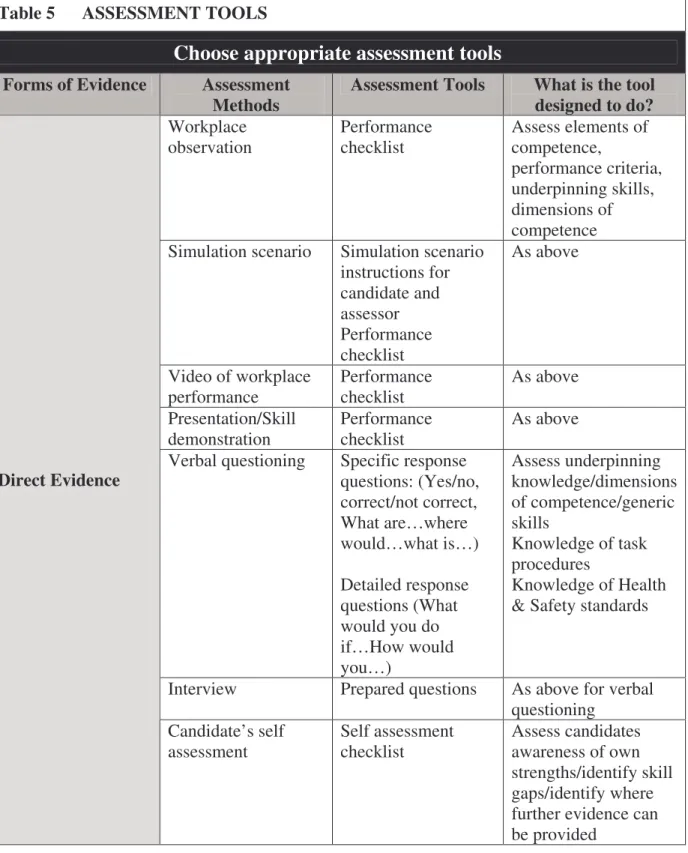
D 5 Assessment Tools 133
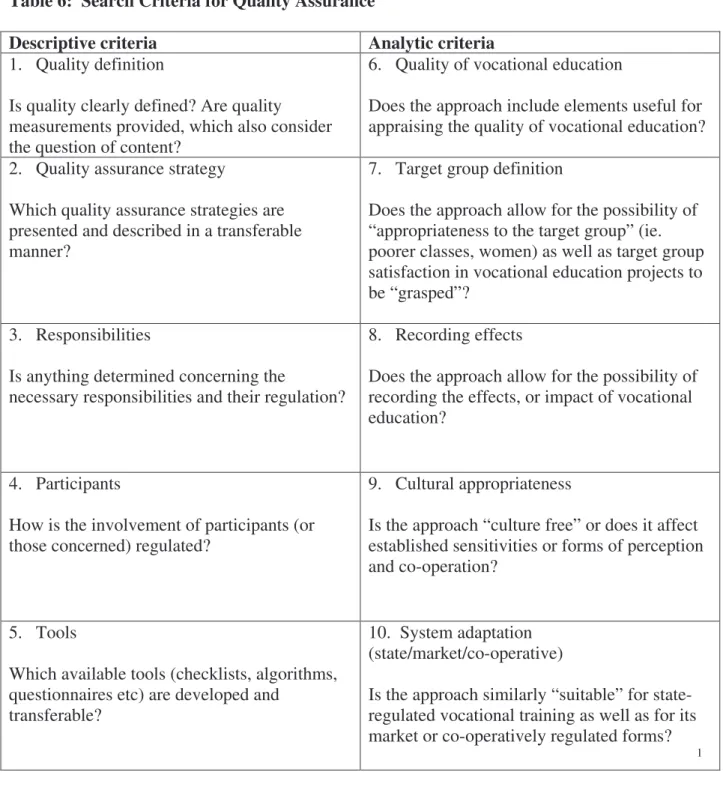
D 6 Search Criteria for Quality Assurance 156
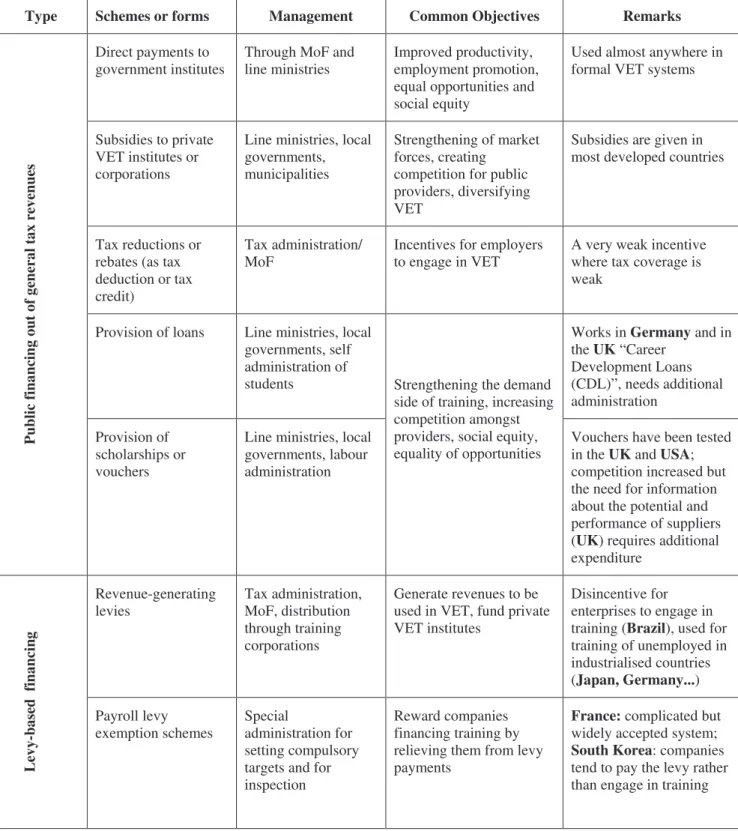
E 7 Synopsis of Funding Schemes/Funding Sources for VET 193 Addendum
1 8 Mayer Key Competencies 210
1 9 Summary of ACCI-BCA employability skills compared
with Mayer Key Competencies 212
1 10 Comparative table of generic employability skills by country 214 1 11 Summary of generic skills assessment models 217 1 12 Strategies used to judge employee’s skill level in specific areas 218
1 13 Employability Skills Framework 220
9 14 Three-phase eLearning delivery model 243
9 15 Delivery and Publishing of Data 245
9 16 List of inputs for development of eLearning infrastructure 248 9 17 List of inputs/outputs for development and delivery of DL
Resources using an eLearning model 249
Section Figure No Title Page
D 1 Recognition of Prior Learning/Recognition of Current
Competency – The Process 85
D 2 Recognition of Prior Learning/Recognition of Current
Competency Flowchart 86
D 3 Key Steps in delivering a Distance Learning program 100
D 4 A Competency-based assessment system 129
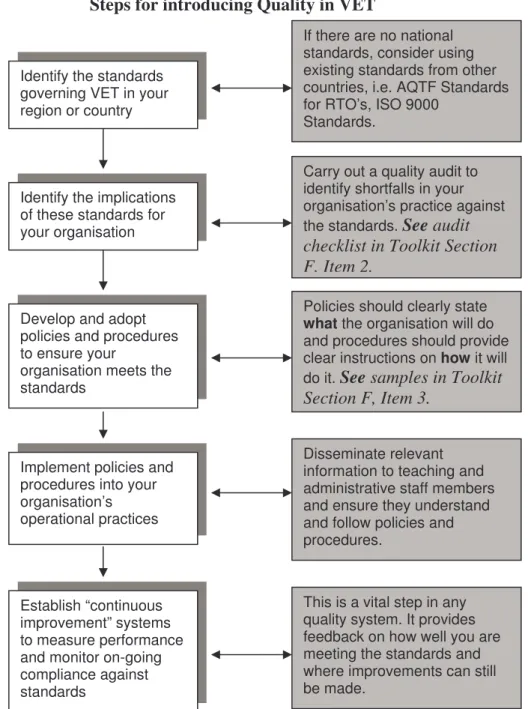
D 5 Steps for introducing Quality in VET 152
D 6 Four Step Training Evaluation 173
Addendum
Manual for Costing and Pricing VET Products
And Services - Part I
TOOLKIT - PART II
CONTENTS PAGE
Section
A
Financial Systems
4
B
Enrolments
57
C
Recognition of Prior Learning/
73
Recognition of Current Competency
D
Distance Learning
89
E
Assessment
100
F
Quality
120
G
Return on Training Investment
147
H Labour Market Analysis
154
I
Voucher Programs
164
J
Competitive Tendering
169
K
Generic Skills
176
Manual for Costing and Pricing VET Products
And Services - Part I
TOOLKIT – Part II
Section Box No Title Page
C 1 Case Study – RPL for a Room attendant/Cleaner 74
G 2 Cost Effectiveness – The Australian Example 148
G 3 Private Rate of Return 149
G 4 Case Study – Calculating The Private Rate of Return 150
G 5` Social Rate of Return 150
G 6 Case Study – Calculating The Social Rate of Return 151 J 7 Case Study – How are successful tenders selected? 175 Section Figure No Title
A 1 Steps in Calculating Training Room Rental Using
Depreciation Method 54
H 2 Labour Market Key Players 155
I 3 The Sequence of Main Steps in a Voucher Program 165
K 4 Clusters of Key Generic Skills 177
Section Table No Title
A 1 Training Room Rental Template Depreciation Method 55
A 2 Course Costing – Before and After 56
B 3 Determine if a Distance Learning Course is Right for you! 61
H 4 Sectoral Labour Market Analysis 163
K 5 Course Example: Priority Listing of Generic Skills 178
Manual for Costing and Pricing VET Products
And Services - Part I
The Manual
Part IThe Manual is divided into two parts.
The First Part focuses on providing a definition of VET and a background in VET in different countries, including factors that affect costing and pricing, planning issues and labour market influences.
It includes information on financial systems and costing of a range of VET services and products.
Also methods of financing these services and recent trends in VET delivery. Real life experiences and examples of good practise are included.
Part II
The Second Part includes the Toolkit, which includes: templates, spreadsheets, work sheets, schedules, summaries, and case studies.
These are intended as guides only that can be adjusted to suit individual institutions and their costs.
Due to the diversity of training institutions it is not possible to provide materials for every individual institution.
Manual for Costing and Pricing VET Products
And Services - Part I
FOREWORD
VET in The VET sector is and important component of the education system of
Society every country.
VET provides a key role in providing education and training for work, including self employment.
VET includes: pre-employment training, generic or employability skills, retraining unemployed people, upskilling existing workers skills, targeted equity training and fee for service or enterprise training.
Governments target equity and disadvantaged groups to enhance their chances of gaining employment.
Although VET systems vary from country to country from centralised to decentralised and dual systems, from supply to demand driven, all have similar objectives, training for work.
VET training institutions are faced with many obstacles and hindrances, both internal and external factors can affect their operations.
Some common problems include: inadequate funding, competition from other institutions, inappropriate facilities or lack of space, attracting and retaining staff, lack of knowledge and information, collecting fees from students, civil unrest and unsuitable financial systems to accurately cost and price services.
Rationale As training markets develop and funding/financing providers require for the increased accountability, it is essential that training organisations are able Manual to accurately cost and price their services.
The Objective The Manual will focus on providing information on VET systems around of the Manual the world with examples of good practice, and in particular the costing
and pricing of services and products.
The Manual will also include a section on financing VET operations.
How can it The Manual can be most effectively used by VET institutions that are be used able to implement financial management systems and supporting policies
to cost and price their services.
For institutions that must comply with the financial system of their parent or funding organisation, they must be able to develop financial systems external to this system.
Manual for Costing and Pricing VET Products
And Services - Part I
Practitioner To determine content for the Manual, input was sought from VET Input institutions, together with examples of “good practise”.
A total of 40 institutions in Asia, Africa, Europe, South America and Australia were surveyed. The author would like to thank these institutions for their contributions.
Who will use The Manual is intended for practitioners: VET Institution Managers, the Manual Financial Controllers and Course Co-ordinators
This includes: private, public and para public institutions. Small training providers with a few staff to large training institutions. Not all sections will be relevant for individual users.
The Manual and Toolkit are web-based, training institutions can download sections of the Manual that are useful to them at that time. Training institutions will be able to select which sections are of use at a particular time.
Manual For
VET Practitioners
Manual for Costing and Pricing VET Products
And Services - Part I
B VET Systems
1. Definition of VET
Vocational Education and Training is education and training for work.
“VET is taken to encompass all educational and instructional experiences – be they formal or informal, pre-employment related, off-the-job or on-the-job that are designed to directly enhance the skills, knowledge, competencies and capabilities of individuals, required in undertaking gainful employment, including self employment, and irrespective of whether these experiences are designed and provided by schools, public training institutions, or higher education institutions, by private training providers or by employers in industry”. 1
Increasingly generic or employability skills are being taught in VET to enhance trainees chances of gaining employment.
2. Functions of VET
“VET should deliver both foundation and specialist skills to private individuals enabling them to find employment or launch their own careers, to work productively and adapt to different technologies, tasks and conditions.” 2.
This would lead to improved personal and social productivity.
Governments often intervene in VET to ensure equitable access to vocational and educational training services. This intervention occurs in training markets that do not exist, or inhibit disadvantaged people from attending training.
(See section below on Labour Market Training)
3. Typical VET Services and Systems
“Vocational education and training systems are networks of organisations providing different training and education services to different national authorities.” 3.
In Developing Countries where there is often a shortage of resources, systems are usually centralised.
In most Developed Countries VET is decentralised between national, state, regional and community levels.
1. Maglen., L: “ The Economics of Vocational Education and Training in Australia: CEETS’s Stocktake. “ NCVER 585 2001 2. Gasskov, V: “ Managing Vocational Training Systems” , ILO, Geneva, 2000, Page 5
Manual for Costing and Pricing VET Products
And Services - Part I
The Manual will focus on three VET Services
i. Vocational Training, including pre-employment, basic education and generic skills; technical training
ii. Labour Market Training: for disadvantaged people iii. Enterprise and Fee for Service Training
i. VOCATIONAL TRAINING: PRE-EMPLOYMENT, TECHNICAL AND GENERIC SKILLS
Offers pre employment and technical instruction. Most courses are short (up to six months though some may be 12 months part time). They normally take place in vocational and technical schools and colleges. Distance learning, for mostly rural people can be delivered through a range of technologies. Mobile training can also be effective in taking the training to the learners.
General Education schools are increasingly getting involved in entry and low level VET programs for young people.
Vocational training can be financed by government, business and trainees or combinations of all three. In developing countries the majority of financing is likely to come from the central government.
The majority of training is time served with fixed course length with skills assessment based on national standards.
Flexible training has been introduced in some countries called Competency Based Training (CBT). This recognises that students learn at different speeds, progressing when they are assessed at being competent at a defined skill or knowledge. Theoretically this can shorten the length of training.
CBT has different costing pricing and financing mechanisms. Great Britain and Australia have introduced CBT.
For time served training the cost is often calculated on a cost per student per year for different industries.
4. Wheelan, L: “Global Trends and Local Bends, Australian VET Development”, Journal of Adult & Continuing Education Vol. 9 No.1. 2003 Page 3
Box 1
VET in Secondary Schools
In Australia VET courses are offered to students in years 11-12 (16-18 years) in business, clerical, hospitality, hairdressing at their Secondary school and in Technical Colleges.
Students complete modules, which can be articulated into VET institutions, thereby reducing the subjects and time needed to complete the course.
In 1999, 37% of senior students participated in VET. 86% of schools offered VET courses.
Manual for Costing and Pricing VET Products
And Services - Part I
What are Generic Skills?
The teaching of Generic Skills, sometimes called employability skills is gaining acceptance by VET institutions.
“The incorporation of generic employability skills into Training Packages and VET programs will provide enterprises with the skilled people they require to respond to the needs of the modern economy and help individuals meet the changing demands of the workplace.” 5.
Australian National Training Authority – Directory for Resource Allocation 2003.
Training Providers recognise that the teaching of generic skills enhances their graduates chances of finding employment.
Employers while often reluctant to teach these skills themselves value these skills and include them in their recruitment strategies.
VET institutions will need to resource the delivery of these skills and train their staff in delivery and assessment. Those skills must be supported by government and certified. Although Generic Skills have been taught for some time in VET institutions there is still debate over the definition , how they are taught, in what context and how they are assessed.
Common Elements include: basic skills (literacy), people related skills, conceptual/thinking skills, business skills, community skills, personal skills and attributes.
Generic Skills vary between countries, regions and occupations.
VET institutes need to identify and prioritise the Generic skills that are relevant for their courses.
See Manual Addendum 1 Generic Skills ii. LABOUR MARKET TRAINING
Labour Market Training is a government intervention aimed at providing equitable access to
disadvantaged groups eg. youth, women, disabled people, unemployed, caste, ethnic or
religious groups.
It covers a broad range of job related programs ranging from short entry level pre employment courses to longer skills based courses.
These courses are often administered by national governments and conducted by national, NGO and private training providers.
Governments often specify outcomes and targets with incentives offered for training providers eg. payments to providers whose graduates are employed for a specific period following the training.
Labour market programs align with labour market needs as much as possible at that time. 5. Australian National Training Authority (ANTA) – Directory for Resource Allocation, 2003. (Emphasis added)
Manual for Costing and Pricing VET Products
And Services - Part I
Labour market training could include: skills based training for the unemployed, retraining for retrenched workers, upgrading courses for employees.
iii. ENTERPRISE OR FEE FOR SERVICE TRAINING
“Covers instruction provided or financed by employers usually from small to medium sized enterprises, for their employees, either voluntarily or in compliance with regulations set by government.” 6.
Government financing of this training can be met through a variety of regulations eg. training levies on industry fixed at a percentage of payroll, fixing the minimum level of training expenditure and number of trainees.
VET institutions provide fee for service training for employers – usually short courses aimed at improving productivity and efficiency.
VET fee for service courses are also conducted for NGO’s and INGO’s often under contract and targeted at a specific group of people.
VET institutions often offer higher fee paying courses where there is a strong demand and a good opportunity for graduates to receive well paid employment.
It is essential that these courses are costed and priced to achieve targeted outcomes and quality training.
VET institutions often have different pricing structures for private and community training. Regardless of the funding for the training, institutions must know the full cost of the training and the break even point.
B. References
Maglen, L: “The Economics of Vocational Education and Training in Australia: CEET’s Stocktake”. NCVER 585 www.ncver.com.au 2001
Gasskov, V: “Managing Vocational Training Systems”, Geneva, ILO 2000
Wheelan, L: “Global Trends and Local Bends, Australian VET Development” – Journal of Adult and Continuing Education Vol. 9 No1. 2003
Australian National Training Authority – Directory for Resource Allocation 2003 www.anta.com.au
Manual For
VET Practitioners
Manual for Costing and Pricing VET Products
And Services - Part I
C
Financial Systems
What is in this section of the manual?
• Definition of Accounting
In this section we cover the major features of accounting and the role that accounting plays in the management of a training institution
• The Purpose of Costing
A short description of why we build models to cost the delivery of the various services we offer
• The Objective of Costing
This section covers the need to have a goal for the costing exercise
• Sample Chart of Accounts • Methods of Costing
Total Costing and Marginal Costing
• Indirect Costing
Purpose and objectives of indirect costing
• Depreciation
Description and methods of depreciation
• Financial Manual
Contains contents, sample templates and draft policies.
• Pricing Methods
This section covers common approaches to pricing.
• A Toolkit
comprising Item 1 Excel Documents Item 2 Survival Kit
Item 3 Template Chart of Accounts Item 4 Template Budget Variances Item 5 Template Fixed Asset Register Item 6 Template Costing Models Item 7 Template Cash Book
Item 8 Calculating Training Room Rental - Depreciation Model
Manual for Costing and Pricing VET Products
And Services - Part I
1. Definition of Accounting
Accounting is the recording of all transactions of a business, making informed decisions based upon this information and the subsequent production of reports for the managers of the institution on the various functions of the business.
Bookkeeping is the recording of the transactions.
Within the accounting system there are two main streams:
i. Financial accounting
ii. Management accounting.
i. Financial accounting is the recording and reporting of the training institution transactions for external users of that institution, with external users being the creditors of the
company, shareholders, prospective financial investors in the institution and general members of the community. External users are people that have an interest in the institution, however may not be directly employed by the institution.
ii. Management accounting is the recording and reporting of the training institution’s transactions for the efficient internal management of the institution, with cost accounting being a major part of the management accounting function. Management accounting is for the use of internal users, those directly employed or those directly responsible for the welfare of the training institution.
Cost accounting identifies the costs associated with a product, monitors and analyses these costs to ensure the delivery of an efficient and cost-effective product. The functions
associated with the cost accounting role therefore are the recording of the data, the analysis and most importantly the reporting of these findings. It is the reporting and subsequent decision making based on this reporting that is crucial in the development of any cost accounting role.
Why is Recording Important?
The recording of the data is the allocation of the revenue and costs across the various accounts within the accounting system. The recording of the data is a bookkeeping function, which is crucial to the process. Without the correct allocation of the costs the subsequent analysis of the costs will be incorrect resulting in poor decision making.
The cost analysis is the core of the cost accountant’s role. The analysis focuses on controlling the costs and making informed decisions on them. The cost accountant needs to work with the management of the training institution to provide correct data in order that sound strategic decisions can be made.
The reporting of the analysis is equally important to the recording and analysis of the cost base. The reporting needs to be in a format and fashion that the users of the reports can easily understand.
Manual for Costing and Pricing VET Products
And Services - Part I
The end users of the cost accountant’s reports may not be accountants and all effort has to be made to avoid jargon and technical terms that will diminish the understanding of the reports in the target audience.
The report should be in plain language and specifically written for its target audience.
2. The Purpose of Costing
Correct costing will provide an understanding of all the elements that make up the cost base of a training institution. The true purpose of cost reporting is to provide users with
information about the training institution, which is useful for making and evaluating decisions about the allocation of scarce resources. Once this understanding is achieved the strategic decision making will be enhanced, as all elements in the cost equation will be taken into account.
The following are examples of strategic decisions of training institutions that would be supported by costing:
“Decisions on the internal allocation of funds Pricing of individual courses
Determination of fees for students
Assessment of the economic viability of courses Decisions on the overall course program
Decisions on resource allocation
Justification of bids for external funding and projects.” 1
It is assumed that the training institution has the ability and independence to make these decisions. Frequently a number of these decisions are made at semi government or ministerial level. This lack of independence may inhibit the training institution’s ability to make these strategic decisions.
It has to be stressed that cost reporting is not an end in itself but rather a means of
communicating relevant and reliable information about the training institution to end users. Efficient allocation of scare resources will be enhanced if those that make the decisions have relevant and reliable information via the costing exercise.
It is acknowledged that training institutions are an integral part of the local community. The training institution provides services to the local community, may levy prices (fees) on the community and may invest resources in the local community.
As a result efficient resource allocation should not focus solely on the internal allocation of resources within the training institution, but also on the wider context of the resource
allocation within the community, and what resources of the community should be allocated to the training institution.
The community interests are best served by the training institutions where the scarce resources of the community are used efficiently and effectively by the training institution. Costing plays a crucial role both internally and externally in the allocation of these scarce resources.
1. Jägger, M: “Costing and Pricing Information Paper No 3”, KODIS Consult GmbH, Universitaetstr, 69 CH-8006 Zurich/Switzerland, 2003 Page. 5
Manual for Costing and Pricing VET Products
And Services - Part I
In this section we will focus on the internal costing of the training institution.
For costing information to be useful it needs to be relevant, reliable, understandable and the information provided needs to be material.
Relevance
For costing information to be relevant it needs to assist users in making and evaluating decisions on the allocation of scarce resources. This can be in the form of confirming or evaluating past decisions, assisting in the current decision making process or projecting into the future.
Reliable
With any decision making process the information needs to be reliable, free from both error and bias. There is risk associated with forecasting and cost predictions, however every effort should be made to minimise those risks as best as possible. It is unrealistic to assume that these risks can be eliminated when forecasting future events, however, any form of bias or error needs to be eliminated.
Understandable
The costing information needs to be understood by those making the decisions. If the information is not easily understood there is a strong chance that the decisions made on this data could be incorrect due to misunderstanding.
Material
To determine the materiality of information, you must ask the question, “if the information was excluded from the costing models would it impact on the reliability and relevance of the information upon which the decision making is being made?” If it does impact on the decision making process it is material, if not it is immaterial.
3. The Objective of Costing
It is essential from the outset to have a goal or an objective in costing. The cost objective is the information needs of the end user.
Possible cost objectives:
“Costs of a course or module Costs of a program
Costs of a project, service or product Costs of institutional activities Costs of an organisational unit
Calculation of indirect cost rates.” 2
This is by no means a complete list however it does highlight the fact that the cost objective needs to be defined prior to the commencement of the costing exercise.
Manual for Costing and Pricing VET Products
And Services - Part I
Take for example the cost objectives of say, costs of a course versus the costs of institutional activities. In this instance the information needs of the institution are far broader and more extensive than the needs of those developing a costing model for a course within the
institution. Not only will the scale of the exercise be different; the assumption underpinning the models will differ. This is simply as a result of the fact that the information needs of the end users will differ, that is the cost objectives will vary.
Prior to a cost objective being defined it is essential that the costs can be easily identified. The system that accounting uses to classify information is the chart of accounts.
4. Sample of Chart of Accounts
The chart of accounts is a descriptive classification of the accounting activities of an institution.
The chart of accounts is normally broken down to the following categories:
Assets Expenses
Liabilities Equity
Revenue
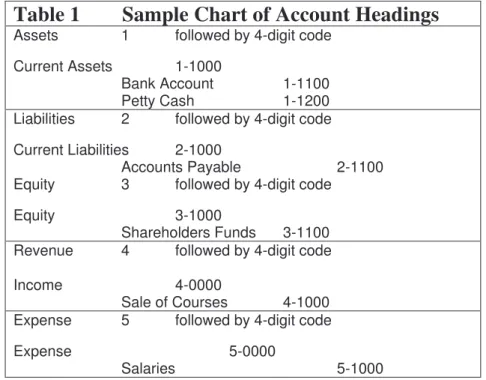
It is a matter of judgement as to what level of detail you require in the chart of accounts. A suggested format is as follows: (A full listing appears in the Toolkit.)
Table 1 Sample Chart of Account Headings
Assets 1 followed by 4-digit code
Current Assets 1-1000
Bank Account 1-1100
Petty Cash 1-1200
Liabilities 2 followed by 4-digit code Current Liabilities 2-1000
Accounts Payable 2-1100
Equity 3 followed by 4-digit code
Equity 3-1000
Shareholders Funds 3-1100
Revenue 4 followed by 4-digit code
Income 4-0000
Sale of Courses 4-1000
Expense 5 followed by 4-digit code
Expense 5-0000
Salaries 5-1000
Most small business off-the-shelf accounting software packages now come with an in-built chart of accounts.
Manual for Costing and Pricing VET Products
And Services - Part I
5. Methods: Total Costing and Marginal Costing
Two popular costing methods are: i. Total Costingii. Marginal Costing
i. Total Costing
Total Costing as the name implies takes all the costs associated with an activity into consideration. Total cost is the sum of the direct costs and the indirect costs.
Direct costs are those costs that can be directly attributable to an activity or product. Indirect costs are the costs that, by their nature, cannot be directly attributable to an activity.
It is suggested that those institutions that work on a cash based or payment based system will have difficulty implementing total costing in that not all the costs associated with the running of the training institution system will be captured in the organisation’s chart of accounts. The result being that costing has to be done external to the accounting system.
The advantage of full costing is that all costs associated with the cost objective are recognised and as such a solid platform is in place for any strategic decisions that need to be made. It is only where the full cost base of the institution is being recognised can the financial viability of the costing exercises be truly verified.
The disadvantage is that in the majority of public (government/semi government) training providers, with payment based accounting systems, costing has to be performed externally to the accounting system. This lowers the overall controls within the costing process and can diminish the quality of the data upon which the strategic decisions are being made.
ii. Marginal Costing
Marginal costing is a short-term concept and refers to the additional variable costs caused by an extra or new activity. For example, the decision to commence a new course will definitely require additional teaching resources and facilities to be provided whereas extra students in a class may not require additional resources depending on the number involved. Subject to class size it may be possible to absorb an extra one, two or three students without requiring additional teaching resources, however, beyond that it may be necessary to engage another teacher, provide additional accommodation and commence another class.
TIP
Please note that marginal and variable costs are used interchangeably. That is variable costs vary in direct proportion to the change in the activity.
An example here is when an additional subject is included in a training institute’s program. The costs associated with this are variable costs in that they are incurred outside of the normal program. The trainer’s wages and training material can all be viewed as marginal costs.
Manual for Costing and Pricing VET Products
And Services - Part I
Marginal Costing is a short-term concept for calculating costs outside the regular programs.
The major advantage of marginal costing is that it is more suitable to short term decision-making.
The disadvantage is that costing is a very complex process and the bookkeeping may result in the exclusion of some variable costs as an easy option. The calculation of some of the variable costs may be quite complex and as a matter of expediency these costs may be excluded from the exercise resulting in incorrect data being prepared, increasing the likelihood that incorrect short-term strategic decisions will follow.
As has been highlighted marginal costing is a tool to aid and assistance short-term decision making, frequently it is employed to assist long term planning and this is its major shortfall. The point of marginal costing is to cover the variable costs of the activity; as a result the fixed costs may be overlooked in any long-term projections. Strategic long-term decisions based upon this incomplete data will be bound to fail.
6. Indirect Costing
IntroductionIndirect costs are those costs that although not directly traceable to a product, a department or a process, are allocated to them on some equitable basis.
They are incurred either jointly for the benefit of more than one process or product or the cost is too small to be traced readily to a product or process.
What is in this section of the manual? The purpose of indirect costing
In this section the purpose of indirect costing is discussed The objectives of indirect costing
Here the need to discuss the goals and objectives of indirect costing highlighting the need to have these clearly defined prior to the commencement of any costing exercise
Methodology
There are numerous techniques available here, one example is used to clarify the costing model.
What is the purpose of indirect costing?
Indirect costing is an integral part of an overall costing model. The costing model is a key component in the development of a management information system that is concerned with the provision of financial and non financial information to the managers for the effective management of the training institution through planning, organising and control of the various activities.
Manual for Costing and Pricing VET Products
And Services - Part I
The management information system is geared to all levels of the training institution, with each level accessing relevant key data from the model. For a costing model to be effective it is necessary to identify all costs associated with the product, not only those costs that can be directly traced, but also those costs that form a part of the overheads that can not be directly attributable to a product. What is frequently overlooked when costing products is the administrative costs such as senior management, payroll department and the accounting department. These are all costs that need to be factored into a costing model to arrive at a correct costing base.
Once all costs have been identified the key feature is to allocate the indirect costs in an equitable manner so that the allocation process reflects the correct usage pattern of the resources of the entity.
Strategic decisions, supported by costing may include: Decisions on the internal allocation of funds Pricing of individual courses
Determination of fees for students and enrolment costs Assessment of economic viability of courses
Decisions on the overall course program
Decisions on resource allocation including: human, overheads, quality control and systems, consultancies, curriculum development
Justification of bids for external funding.
What are the objectives of indirect costing?
The objectives of the costing exercise need to be defined prior to the identification and
subsequent allocation of the indirect cost. For this to be successful you need to know not only the cost objectives but also the target audience.
Four key target members:
“Financier Buyer Provider
User.” 3
Each audience has a different perspective on the costing exercise and the model needs to take these variances into account.
The financier for example makes available the financial resources, the buyer orders and buys specific training courses, the provider offers training and the user participates in training. Consequently any costing exercise needs to be directed to the target audience to allow for informed decision making.
Once the target audience has been defined, it is necessary to define the objective of the costing exercise.
Manual for Costing and Pricing VET Products
And Services - Part I
These cost objectives could include the following: “Costs of a course or module
Costs of a program
Costs of a project, service or product Cost of institutional activities
Costs of an organisational unit.” 4
In all of the above examples there are direct and indirect costs Examples of indirect costs
The costing out of senior management time down to a subject level
The allocation of administration charges, payroll and human resource functions to particular products
Hand tools that are used in a number of courses and the subsequent allocation of the depreciation charges to these courses
Utility charges such as electricity and gas are costs that may be incurred at an institutional level and need to be allocated to lower levels in the organisational structure.
In all of these cases the costs cannot be directly traced to a product or are too small to be directly traced to a product or process.
A word of warning in that it may be possible to collect data at the lowest level required to carry out a comprehensive cost analysis, however it may be economically unsound to go down this route. As such a cost benefit analysis needs to be performed when formulating the cost objectives.
The data collection needs to be both efficient and effective. It can become a counter productive exercise to refine the data collection to such a degree that the energies of the institute are focused on the collection of the data rather than the analysis of the data collected.
Assumptions:
For the purposes of this section we will use the Costing of a Subject Within a Course as the example to explain indirect costs.
Subject is one subject in an overall program of a course comprising six subjects Training coordinator employed solely to run subject
Classroom is rented and shared between ten other courses Normal administration costs of running a course.
In this instance the salaries or wages of the training co-ordinator are directly traceable back to the subject as the person is employed solely to run this subject.
The classroom costs are substantial enough to be able to be traced back to the subject.
However other overhead costs incurred by the institution in the running of the overall courses may not be so easily traced back to the subject.
Manual for Costing and Pricing VET Products
And Services - Part I
Overhead costs such as postage and courier, cleaning and maintenance and stationery, which tend to be a high volume and low value expense, need to be allocated back to the cost of the subject.
These indirect costs have been incurred by the institution as a result of running the courses, and are an integral part of both the running of the institution and subsequently the courses and the individual subjects that make up the courses. To ascertain the true cost of running the subject these costs need to be allocated equitably.
The formula which develops from the above is: Total Cost = Direct Cost + Indirect Cost
To exclude indirect costs will result in the under statement of the overall cost base of the course and may have drastic implications regards pricing, funding decisions and the allocation of (generally) scarce resources.
Methodology
The process of identifying and subsequent allocation of the indirect costs is a science in itself and from the outset it needs to be stressed that this paper is looking at an overview of the various methodologies. The methodology suggested below is only one of many that may be utilised.
Cost Centres
One way of compartmentalising costs is to group all costs associated with a program or course and accumulate those costs under the one cost centre heading.
With the above example the program under which the course is run may be the cost centre or, depending on the sophistication of the systems in place to track the costs, the course itself may be the cost centre.
The natural flow is that the subject may be the cost centre, the course is department and the various courses make up the program and this may be the division.
The various divisions make up the overall cost base of the institution.
Organisational chart
Entity Institution
Division Program
Department Course
Cost Centre/ Profit Centre Subject
Cost Centres and Profit Centres
In a fee-based institution the costs associated with the subject may be referred to as a profit centre and the administration/management arm of the institution would be referred to as the cost centre. The fee based courses would be generating the profits of the organisation whilst the overheads associated with the overall running of the institution would be captured under a cost centre heading.
The expenses associated with the profit centres are direct costs in that they can easily be attributed back to the subject.
Manual for Costing and Pricing VET Products
And Services - Part I
The expenses associated with the cost centre are a mix of direct and indirect costs in that the indirect costs have been incurred either for the overall running of the institution or are of such a nature that they cannot be easily traced back to a profit centre.
How do you allocate Indirect Expenses?
There are a number of mechanisms that can be used in the allocation of the indirect expenses to a division, department or cost centre. The most obvious basis is that of usage. Printing and stationery charges may be allocated by usage. Telecommunication charges are another example whereby the cost may be allocated on a usage basis.
Another basis may be an activity charge whereby the expense is allocated by activity. An example here may be where the cost of the payroll department is allocated on the hours incurred by the teaching staff.
Capacity charges are yet another means of allocating indirect costs, occupancy costs is an example where the fixed costs need to be allocated across various courses. A suggested calculation would be that the administration and management departments occupancy costs are charged back to the course based on the relative share of the overall cost of the occupancy charge for the training institution.
Box 2
Case Study
Indirect Costs, Administration Department. The administration costs of the training institution are a fixed cost. The
administration department is geared to meet the demands of the training institute. Course Teaching hours per month Allocation
x 50 $1,111.00
y 75 $1,667.00
z 100 $2,222.00
Total 225 $5,000.00
Cost of the administration Department per month AUD$5,000.00
Under the fixed charge course x would be charged 50/225 of the $5,000.00 budget or $1,111.00.
The figures would not change over the period of the budget. The advantage here is that the amount charged to each course for non controllable fixed costs can be budgeted in advance.
Manual for Costing and Pricing VET Products
And Services - Part I
Recommendation
In allocating indirect costs the essential point is that a usage pattern or capacity index should be used that best correlates to the usage pattern of the product.
The worst case scenario is to choose an index that is inappropriate. An inappropriate allocation can lead to incorrect allocation, which in turn may severally impact the cost
analysis. A degree of precision and exactness may be assumed that does not exist, resulting in poor and at worst incorrect decision making.
The rule should be that the allocation process is based upon a system that is easily
recognisable or no allocation of the indirect charges should be made. The allocation has to be equitable and represent the usage pattern of the resources.
With the changing nature of the institution’s cost base, whatever allocation mechanism is developed it needs to be reviewed regularly.
Once an index or usage pattern has been developed for the allocation of indirect costs it is essential that over time this index is constantly reviewed (at least annually) and modified where appropriate.
The worst case is where an index or allocation method is developed and not modified to allow for the changing conditions of the institution.
Factors, which may influence which method to use, will be: Complexity of the cost base
Sophistication of the accounting system
Resources that can be allocated to the costing task.
Box 3
Case Study
Prepared by Nepal Training Institutions, VET Manual Workshop, Kathmandu, July 2005. A. Direct Costs
- Training Material
- Instructors’ Remuneration - Room Rent
- Hiring and Renting of Equipment - Promotional (media)
- Testing and Certification - Travel Costs (Mobile training) - Field Visits and Excursions
- Food and Refreshments for trainees - Tracer studies (in case the funding organisation requires it)
B. Indirect Costs*
- Staff/Management/Admin Cost - Utilities
- Depreciation of fixed assets used for the particular training (equipment, building
projectors, cars etc.)
- Repair and maintenance of tools and equipment
Manual for Costing and Pricing VET Products
And Services - Part I
Calculating Indirect Costs as a Percentage or Unit Cost.
Anecdotal evidence points to the fact that very few organisations have a satisfactory model for the calculation of indirect costs. Expediency generally results in a percentage method being used as the means of allocation. Even in the most sophisticated companies there is an imprecise science applied in the allocation of the indirect costs. The major restriction associated with unit costing is the amount of resources required to develop a satisfactory model. Hence the usage of a percentage to allocate the indirect charges.
It can only be stressed again that the best allocation method is the one that reflects the
allocation of the indirect costs in the most equitable manner. This will provide a solid basis in any costing exercise and will allow for sound decision making in the allocation of the
resources of the institution.
7. Depreciation
IntroductionDepreciation is applied to non current assets that have a limited useful life and a value excess of a specified amount. In Australia this is $1,000.00, however the threshold level will vary from region to region.
This limited useful life is sometimes referred to as the asset’s effective life. The run down in the effective life or useful life of an asset is a cost to the company and depreciation is the recognition of this cost.
The value of the asset, which is carried on the Balance Sheet, is decreased by the accumulated cost of that asset’s depreciation expense.
The actual expense to the company, depreciation expense, is reflected in the Profit and Loss report in the year that cost was incurred.
What is in this section of the manual?
Description of the major features that make up depreciation Outlined below are the key features that impact depreciation. Items covered are:
• Non Current Assets
• Effective life of an asset
• Cost of an asset
• Methodology
Manual for Costing and Pricing VET Products
And Services - Part I
What is a Non Current Asset?
An asset is defined as a future economic benefit controlled by the entity as a result of past transactions.
As per the Australian statement of accounting concepts there are three essential elements for an item to be classified as an asset.
1. There must be future economic benefits.
2. The entity must have control over the future economic benefit.
3. A past transaction must have occurred resulting in control of that asset.
Non-current assets are those assets that are held by the entity for twelve months or more. This is the accepted timeframe, however as explained below this can vary depending on the asset type.
What is the Effective Life of an Asset?
An effective life of an asset is generally expressed in terms of time. There are a number of factors that influence effective life, including:
the potential life of the asset given normal repairs and maintenance
the potential technical life of the asset whereby the process remains efficient the commercial life of the asset.
The end result of these factors is that each asset is useful to an entity for a limited period of time. This limitation can be as a result of technical obsolescence. Computers are a case in point, they have an effective life of three to seven years, in most countries.
Furthermore the limited life of an asset can be as a result of wear and tear on that asset. Automobiles and trucks are prime examples where over time wear and tear undermines their performance so that at some stage they become inefficient and need to be replaced.
As such motor vehicles may have an effective life of five to ten years.
Buildings also have an effective life. Normal wear and tear will result in the building over a period of say forty to fifty years needing to be replaced.
A further limitation may be as a result of commercial obsolescence. Market demand may no longer be there for a product and as a result those assets involved in the production of that item may become redundant.
The run down in the useful life of an asset is a cost to the company and that lost value of the asset is recorded as depreciation.
From the above two points emerge:
1. For depreciation to be applied to an asset the asset needs to have an effective life of greater than twelve months.
2. There needs to be some estimate of an effective or useful life of an asset when that asset was first acquired. eg tools may be depreciated over a number of courses.
Manual for Costing and Pricing VET Products
And Services - Part I
The effective life of a similar asset can vary from region to region given the above factors. What is important, is to choose the time frame that is most applicable to an asset, a
conservative rule is to choose the shortest time frame that incorporates all the above factors. What is the Cost of Items to be Depreciated?
Depreciation is typically applied to those items that have a value greater than AUD$300.00. In some regions this value may in fact increase to $1,000.00. When an item is purchased for under say $1,000.00 it is generally expensed directly to the Profit and Loss with the full $1,000.00 being recognised immediately as an expense item.
A major problem for some regions may be the calculation of the historical cost base. A case in point here is the costs associated with a building where a large number of the items employed in the construction are recycled or second hand items. Here it is not easy to identify the historical cost base. It is suggested that either an outside expert is called in to assist or a best guess based upon perceived market value is used.
What is Revaluation of Cost?
The above has all been based on the historical cost of the assets, however, it is not uncommon to view the cost of the assets in terms of current cost or replacement cost. The result here is that the cost base may be revalued upwards and as a result the amount of the depreciation going forward from the date of revaluation will require recalculation.
It is advisable to regularly review the effective life of an asset. The effective life of an asset is not a fixed item and a number of outside factors that may change over time can influence it. As mentioned previously technical obsolescence and market demand are just two of these factors.
As such the effective life should be regularly reviewed. What Methodology is used?
The most popular method of calculating the depreciation expense is the prime cost method. Prime Cost
The prime cost method is sometimes referred to as the straight-line method. As the name straight line implies a fixed amount is apportioned to each year that has benefited from the use of that asset.
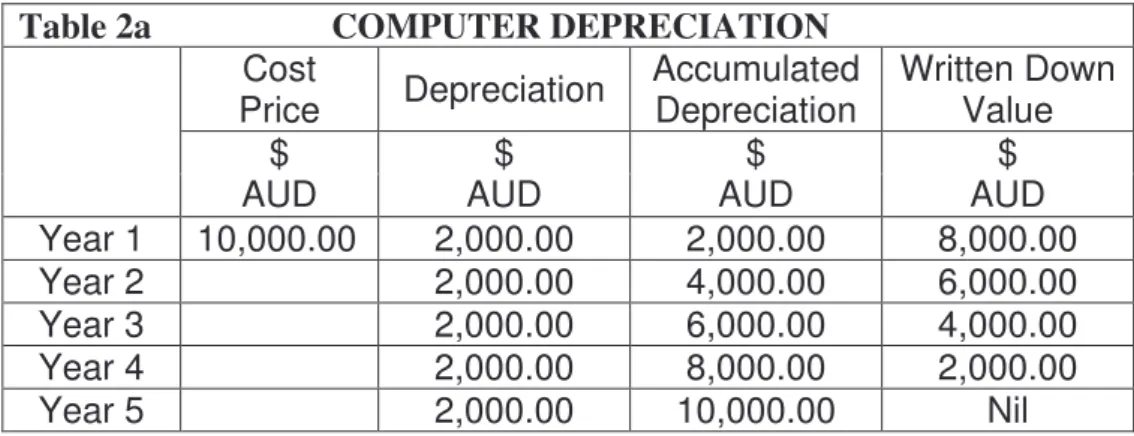
For example if a computer cost AUD$10,000.00 and it was decided that the useful life of that computer was five years, $2,000.00 would be applied to each year that the computer was providing benefit to the organisation.
Manual for Costing and Pricing VET Products
And Services - Part I
The following example works through a number of the issues discussed. Assumptions
Financial Year 01/01/XX to 31/12/XX
Purchase date of computer 01/01/XX
Cost Price AUD$10,000
Effective Life Five (5) years
Table 2a COMPUTER DEPRECIATION
Cost
Price Depreciation Accumulated Depreciation Written Down Value $
AUD AUD $ AUD $ AUD $
Year 1 10,000.00 2,000.00 2,000.00 8,000.00
Year 2 2,000.00 4,000.00 6,000.00
Year 3 2,000.00 6,000.00 4,000.00
Year 4 2,000.00 8,000.00 2,000.00
Year 5 2,000.00 10,000.00 Nil
This example highlights the fact that $2,000.00 of expense is being recognised in the profit and loss statement. This expense represents the run down in the value of the asset. The $2,000 would be classified as depreciation expense in the profit and loss statement for each relevant year. At the end of Year 3, $6,000.00 of expense has been recognised. On the balance sheet for year three the asset is recorded at cost, $10,000.00 and the summation of the individual years expense calculation is recorded as accumulated depreciation. The accumulated depreciation of $6,000.00, $2,000.00 times 3 years, offsets the historical cost of the asset, $10,000.00, resulting in a net value of $4,000.00 being recorded on the balance sheet as the written down value of the asset. This represents the remaining future benefit that this asset is to provide the company.
The accounting entries on a year to year basis are:
Debit Depreciation (Profit & Loss)
Credit Accumulated Depreciation (Balance Sheet)
The Balance Sheet representation for year three would be as follows:
Table 2b COMPUTER DEPRECIATION
Non Current assets
Computers-at cost AUD$10,000.00
Accumulated Depreciation AUD($6,000.00) Written Down Value of
Manual for Costing and Pricing VET Products
And Services - Part I
The written down value represents the future benefits that the asset will bring to the company over the remaining two years of its effective life.
The depreciation expense of $6,000.00 represents the cost or loss in value of the asset in the first three years of use.
Viewed differently the asset has provided $6,000.00 of benefits to the company.
Please note that depreciation and amortisation are used interchangeably in some publications. For ease of reference depreciation is used for physical assets whilst amortisation is applied to intangible assets such as goodwill.
There are numerous variations on the above scenario. In Australia, as a result of recent
changes to taxation law, diminishing value method is a popular way to calculate depreciation. This is where the straight-line method is multiplied by 150%. It is recommended that the training institutions check on the relevant tax laws of their country as this will change from country to country.
Formula: Cost Price/Effective Life x 150% (Countries need to consult their tax regulations)
What is Usage Pattern Depreciation?
The basis for all the above has been an effective life based upon time. It is possible to calculate depreciation on a usage pattern.
For example a manufacturing plant may be constructed in such a manner that its effective life is based upon the number of units it makes.
A machine that manufactures metal screws, for example, may have a life expectancy of 10 million metal screws.
In this instance rather than using a time frame of years it might be more appropriate to
depreciate the manufacturing plant by the number of metal screws produced each year. That is the basis is usage rather than time.
Example:
In all the above calculations the overall guiding principle should be to reflect in the books of the entity a true and fair value of the future benefits to the entity of the non current assets that they hold. That is select the method that is the most appropriate for the circumstances.
Table 3 MANUFACTURING PLANT DEPRECIATION
Asset
Total Plant Capacity Plant Cost
Depreciation Method
Manufacturing Plant – Sheet metal press 10 million metal presses
AUD$100,000.00 Usage
Cost Price Usage Pattern Depreciation Annual Accumulated Depreciation Written Down Value $
AUD AUD $ AUD $ AUD $ AUD $
Year 1 1,000,000.00 1,000,000.00 10,000.00 10,000.00 90,000.00
Year 2 3,000,000.00 30,000.00 40,000.00 60,000.00
Year 3 5,000,000.00 50,000.00 90,000.00 10,000.00
Manual for Costing and Pricing VET Products
And Services - Part I
How do you Depreciate Hand Tools?
A number of training institutions teaching technical skills may depreciate their hand tools over the length of a number of courses.
This is a slight variation to the usage pattern as discussed above. In this instance hand tools for example may be depreciated over the number of courses that the tools hold their effective life. This may result in the tools being depreciated in a time less than the normal definition of a non-current asset, that is less than twelve months.
It is feasible that tools may have an effective life of three or four courses and it is possible that the courses may be run under 12 months. In this instance it is quite acceptable to depreciate over the usage pattern of the number of courses.
It is stressed that the most appropriate method of depreciation is that which most reflects the effective life of the asset.
How do you Cost a Training Room?
For: Hiring a room to an outside organisation or for an institution costing the use of their own room.
Training Course Budgets when presented to funding agencies for financing should contain all direct and indirect costs, as these represent the full cost of the course.
The cost of providing the training room is an indirect cost that does not directly correlate to any specific activity or course, however, an appropriate cost for the use or “hire” of the room should be charged against each activity or course.
These costs can be calculated for: Privately owned institutions
Government or community owned institutions. There are two methods to calculate the cost:
i. Depreciation Method ii. Market Value Method. i. Depreciation Method
The value of the room could be calculated as a percentage of usage of the full-depreciated value of the building.
STEP 1
Determine the value of the building (replacement value of the building). This can be determined by:
Checking construction costs or
If these costs are not available, getting a builder or valuer to quote on the replacement cost of the building.