Abstract Volume
7
th
Swiss Geoscience Meeting
Neuchâtel, 20
th– 21
stNovember 2009
Sy m p o si u m 6 : D a rw in , E vo lu ti o n a n d P a la e o n to lo g
y
6. Darwin, Evolution and Palaeontology
Lionel Cavin
Schweizerische Paläontologische Gesellschaft (SPG/SPS), Kommission der Schweizerischen
Paläontologischen Abhandlungen (KSPA), Swiss Commission of Palaeontology Award
6.1 Becker D., Berger J.-P., Hiard F., Menkveld-Gfeller U., Mennecart B. & Scherler L.: Late Aquitanian mammals from the Engehalde locality (Bern, Switzerland) 6.2 Brühwiler T., Bucher H., Goudemand N., Ware D., Hermann E.: Smithian ammonoids (Early Triassic): explosive evolu-tionary radiation following the Permian/Triassic mass extinction 6.3 Buffetaut, E.: Darwinian dinosaurs : missing links or evolutionary failures ? 6.4 Girault F. E. & Thierstein H. R.: Diatom assemblage turnover in the NW-Pacific at the 2.73 Ma climate transition 6.5 Girault F. E., Weller A. F. & Thierstein H. R.: Neogene global cooling: diatom size variability in a changing ocean 6.6 Goudemand N., Orchard M., Tafforeau P., Urdy S., Brühwiler T., Bucher H., Brayard A., Galfetti T., Monnet C., Lebrun R. & Zollikofer C.: Paleobiology of Early Triassic conodonts: implications of newly discovered fused clusters imaged by X-ray synchrotron microtomography
6.7 Klug C., Kröger B., Kiessling W., Mullins G.L., Servais T., Frýda J., Korn D. & Turner S.: The Devonian Nekton Revolution 6.8 Klug C., Schulz H. & De Baets K.: Red trilobites with green eyes from the Devonian of Morocco 6.9 Klug C., Schweigert G., Fuchs D. & Dietl G.: First record of a belemnite preserved with beaks, arms and ink sac from the Nusplingen Lithographic Limestone (Kimmeridgian, SW Germany) 6.10 Lavoyer T., Bertrand Y. & Berger J.-P.: The borehole 01983X2854 (Preuschdorf, Upper Rhine Graben, Alsace, France) as a basis of a formal definition of the Upper Pechelbronn Beds (Rupelian) 6.11 Menncart B., Becker D. & Berger J.-P.: Determination of the paleodiet and the phylogeny of extinct ruminants using Relative Wrap Analysis on mandibles: case of Iberomeryx minor (Mammalia, Artiodactyla)
6.12 Monnet C., Hugo B., Guex J. & Wasmer M.: Macroevolutionary trends of Acrochordiceratidae Arthaber, 1911 (Ammonoidea, Middle Triassic) 6.13 Romano C. & Brinkmann W.: Reinvestigation of the basal ray-finned fish Birgeria stensioei from the Middle Triassic of Monte San Giorgio (Switzerland) and Besano (Italy) 6.14 Scherler, L. Tütken T., Becker D. & Berger J.-P.: Terrestrial palaeoclimatical and palaeoenvironmental reconstructions in Northwestern Switzerland: carbon and oxygen isotope compositions of Early Oligocene and Late Pleistocene verte-brate remains. 6.15 Urdy S., Goudemand N., Bucher H. & Monnet C.: How do recurrent patterns of covariation in molluscan shells connect to growth dynamics?
Sy m p o si u m 6 : D a rw in , E vo lu ti o n a n d P a la e o n to lo g y
6.1
Late Aquitanian mammals from the Engehalde locality (Bern, Switzerland)
Damien Becker1, Jean-Pierre Berger2, Florent Hiard2, Ursula Menkveld-Gfeller3, Bastien Mennecart2, & Laureline Scherler2,1
1Section d’archéologie et paléontologie, République et Canton du Jura, Office de la culture, Hôtel des Halles, Case postale 64, 2900
Porrentruy 2, Switzerland ([email protected])
2Département de Géosciences, Géologie et Paléontologie, Université de Fribourg, Chemin du Musée 6, 1700 Fribourg, Switzerland 3Natural History Museum Bern, Bernastrasse 15, 3005 Bern, Switzerland
Due to the construction of the Swiss national road from Bern to Worblaufen in 1850, the sandy and marly deposits of the Lower Freshwater Molasse (USM) were excavated in Engehalde. Some specimens of vertebrate fossils (turtles, ruminants, suids, and rhinocerotids) and shells of gastropods and bivalves were brought to light by Studer (1850). Then Stehlin (1914) reported the presence of Palaeochoerus typus, but the referred material was not found in the historical collection anymore.
The same author notified also two ruminants, Amphitragulus cf. elegans and Amphitragulus lemanense. However, as these two
taxa are considered synonyms, only Amphitragulus elegens is valid. Moreover, many specimens wrongly ascribed to Amphitragulus elegans or Amphitragulus lemanense in the literature have to be reported to the closer species Dremotherium
feignouxi. The re-mains of rhinocerotids were reviewed by Becker (2003) and ascribed to Diaceratherium lemanense: some of them display derived
morphological characters interpreted as probable intraspecific variations. These historic discoveries allow a first dating to the Aquitanian time.
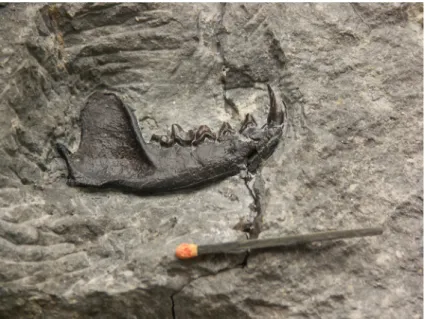
During the construction of the Neufeld tunnel (2006–2008), the ancient fossil locality of Engehalde was made accessible for a restricted time. The Natural History Museum Bern organized a new palaeontological excavation campaign. The discovered ma- terial did not contain new rhinocerotid remains, but yielded essentially specimens of rumiants, composed by teeth and post-cranial bones assigned to the “Dremotherium–like” group (probably Dremotherium feignouxi). The lower left jaw of a mustelid,
probably from the genus Palaeogale, Plesictis, or Plesiogale, was the highlight of the new discoveries (Fig. 1).
The washing and pi-cking of sediment samples allowed the sorting of charophytes from the group Stephanochara praeberdotensis as well as small
mammal remains with Prolagus sp., Eucricetodon infralactorensis, Peridyromys sp. and Cainotherium sp. (Menkveld-Gfeller & Becker
2008).
Figure 1. Lower left jaw of a mustelid-like predator (fossil length 6 cm)
These new data, in particular the occurence of Prolagus sp. and Eucricetodon infralactorensis, allow an improved dating of this locality to the late Aquitanian (European Mammal Reference Level MN2; Burkart Engesser, pers. com.). This biostratigraphical interpretation coincides with other well-dated localities reporting similar faunal composition, like the derived form of
Diaceratherium lemanense (Becker et al. 2009) and the representatives of the Amphitragulus elegans – Dremotherium feignouxi
group (Gentry et al. 1999). Regarding the palaeosynecology, the referred mammal association does not permit an accurate characterization of the environment of the Bern area during the late Aquitanian. However, the representatives of the
Amphitragulus elegans – Dremotherium feignouxi group could point to the existence of a wooded environment. Their association
with Diaceratherium lemanense underlines probably a bushland in a transitional zone between forest and grassland. Moreover,
the lithofacies of the trapping sediments (fluvial sands and floodplain marls) indicate an environment probably close to bodies of water or swamps.
Sy m p o si u m 6 : D a rw in , E vo lu ti o n a n d P a la e o n to lo g y
REFERENCES
Becker, D. 2003: Paléoécologie et paléoclimats de la Molasse du Jura (Oligo-Miocène): apport des Rhinocerotoidea (Mammalia) et des minéraux argileux. PhD Thesis, University of Fribourg, GeoFocus 9, 327 pp.
Menkveld-Gfeller, U. & Becker, D. 2008: Baustelle Zubringer Neufeld: eine neue alte Fossilfundstelle. Bulletin für angewandte Geologie 13, 107-112.
Becker, D., Bürgin, T., Oberli, U. & Scherler, L. 2009: A juvenile skull of Diaceratherium lemanense (Rhinocerotidae) from the Aquitanian of Eschenbach (eastern Switzerland). Neues Jahrbuch für Geologie und Paläontologie Abhandlungen 254, 5–39. Gentry, A.W., Rössner, G. E. & Heizmann, E.P.J. 1999: Suborder Ruminantia.
I
nR
össneR, G.e. & H
eIssIG, K. (e
ds.): T
HeM
IoceneL
andM
aMMaLsofe
uRope. V
eRLaGd
R. f
RIedRIcHp
feIL, M
üncHen, 225–258.
Studer, B. 1850: Über die Süsswassermolasse bei Bern. Mitteilungen der Naturforschenden Gesellschaft in Bern 178, 89–92.
6.2
Smithian ammonoids (Early Triassic): explosive evolutionary radiation
following the Permian/Triassic mass extinction1
Brühwiler Thomas1, Bucher Hugo1,2, Goudemand Nicolas1, Ware David1, Hermann Elke1
1Paläontologisches Institut und Museum der Universität Zürich, Karl Schmid-Strasse 4, 8006 Zürich ([email protected]) 2Department of Earth Sciences, ETH, Universitätsstrasse 16, 8092 Zürich
In the aftermath of the end-Permian mass extinction, ammonoids were among the fastest clades to recover: the recent analysis of a global diversity data set of ammonoid genera from the Late Carboniferous to the Late Triassic shows that Triassic ammonoids actually reached levels of diversity higher than in the Permian less than 2 million years after the PTB (Brayard et al., 2009). The evolution of Early Triassic ammonoids was not a smooth, nor gradual process. It is characterized by the following main features: (i) a very low diversity in the Griesbachian (early Induan), (ii) a moderate diversity increase in the Dienerian (late Induan), (iii) an explosive radiation in the early Smithian (early Olenekian), (iv) a late Smithian extinction event followed by a second explosive radiation in the early Spathian (late Olenekian) (Brayard et al., 2006, 2009). In order to better understand the Smithian ammonoid radiation we conducted extensive field studies in two classical regions for the Early Triassic, namely the Salt Range (Pakistan) and Spiti (Indian Himalayas). Smithian ammonoids from these re-gions have been known for more than a century, and these places are the type localities of many taxa (e.g. Waagen, 1895; Krafft & Diener, 1909). Additionally, we studied a section at Tulong (South Tibet) as well as extremely ammonoid-rich exotic blocks of Hallstatt Limestone in the Oman Mountains. Our abundant, bed-rock-controlled and well-preserved material enables us to revise many classical ammonoid taxa that were previously known only inadequately. Moreover, a large number of new taxa was found, which enables us to define one new family, 18 new genera and about 29 new species. A total of eight successive ammonoid associations can be correlated between our sections (Brühwiler et al., 2007). This high-resolution biochronological scheme for the Smithian of the Northern Indian Margin can be correlated with ammonoid successions from other regions such as South China (Brayard & Bucher, 2008). Due to the very high evolutionary rates of Early Triassic ammonoids (Brayard et al., 2009) the reconstruction of phylogenetic relationships among Smithian ammonoids is difficult. However, our well-constrained taxonomic and biochronologic data provide new insights on the evolution of several lineages. Furthermore, the ongoing comprehensive study of Dienerian am- monoid faunas from the Salt Range and from Spiti (Ware et al.) will help us to decifer the origin of some Smithian ammo-noids. 1This research is supported by the Swiss NSF project 200020-113554.
REFERENCES
Brayard, A. & Bucher, H. 2008: Smithian (Early Triassic) ammonoid faunas from northwestern Guangxi (South China): taxonomy and biochronology. Fossils and Strata, 55, 1-179.
Brayard, A., Bucher, H., Escarguel, G., Fluteau, F., Bourquin, S. & Galfetti, T. 2006: The Early Triassic ammonoid recovery: Paleoclimatic significance of diversity gradients. Palaeogeography, Palaeoclimatology, Palaeoecology, 239, 374–395. Brayard, A., Escarguel, G., Bucher, H., Monnet, C., Brühwiler, T., Goudemand, N., Galfetti, T. & Guex, J., 2009: Good Genes and Good Luck: Ammonoid Diversity and the End-Permian Mass Extinction. Science, 325, 1118-1121. Brühwiler, T., Bucher, H., Goudemand, N. & Brayard, A. 2007: Smithian (Early Triassic) ammonoid faunas of the Tethys: new preliminary results from Tibet, India, Pakistan and Oman. The global Triassic: New Mexico Museum of Natural History and Science Bulletin, 41. Krafft, A.v. & Diener, C., 1909: Lower Triassic cephalopoda from Spiti, Malla Johar, and Byans. Palaeontologia Indica, ser. 15, 6, 1-186. Waagen, W., 1895: Salt-Range fossils. Vol 2: Fossils from the Ceratite Formation. Palaeontologia Indica 13, 1-323.
Sy m p o si u m 6 : D a rw in , E vo lu ti o n a n d P a la e o n to lo g y
6.3
Darwinian dinosaurs : missing links or evolutionary failures ?
Eric Buffetaut
CNRS, UMR 8538, Laboratoire de Géologie de l’Ecole Normale Supérieure, 24 rue Lhomond, 75231 Paris Cedex 05, France ([email protected])
Charles Darwin did not often mention dinosaurs in his works. In the third edition of On the origin of species (1861, p. 346), he alluded to them in a chapter about extinction: “So little is this subject understood, that I have heard surprise repeatedly expressed at such great monsters as the Mastodon and the more ancient Dinosaurians having become extinct; as if mere bodily strength gave victory in the battle of life. Mere size, on the contrary, would in some cases determine quicker extermi-nation from the greater amount of requisite food”. Ten years later, in The descent of man, and selection in relation to sex (1871, p.
204), he emphasized their evolutionary significance: “Prof. Huxley has made the remarkable discovery, confirmed by Mr. Cope and others, that the old Dinosaurians are intermediate in many important respects between certain reptiles and cer-tain birds—the latter consisting of the ostrich-tribe (itself evidently a widely-diffused remnant of a larger group) and of the Archeopteryx, that strange Secondary bird having a long tail like that of the lizard”. Thus Darwin illustrated two views of dinosaurs that were to become both prevalent and competing until today: icons of ex-tinction, or missing links. The “missing link” interpretation predominated during the last part of the 19th century and the beginning of the 20th, when dinosaurs were widely considered as ancestral to birds, on the basis of osteological resemblance and the discovery of both Archaeopteryx and the “toothed birds”, Hesperornis and Ichthyornis, from the Late Cretaceous of the United States. According to this view, dinosaurs, as bird ancestors, had played an important part in the evolution of one of the most successful groups of living vertebrates. This interpretation fell out of favour during the mid-twentieth century, largely because of the influential book by Gerhard Heilmann, The origin of birds (1926), in which the purported absence of
clavicles in dinosaurs was used to demonstrate that they could not possibly have been ancestral to birds (which possess clavi-cles) – since “Dollo’s law” stipulates that once an organ has been lost in the course of evolution, it cannot reappear again. As dinosaurs could no longer be seen as ancestral to anything, they had to be considered as some kind of evolutionary dead end, and this interpretation prevailed until the 1970s. The image of the dinosaurs as too large, too slow and too stupid to have been able to survive became prevalent for a large part of the 20th century. This could be seen in terms of natural selec- tion, with large food requirements as a possible disadvantage, as already mentioned by Darwin in 1861, or in terms of non-Darwinian, orthogenetic evolution resulting in non-adaptive transformations detrimental to the organisms involved. The idea that dinosaurs were somehow “doomed” to extinction by rather obscure evolutionary mechanisms became popular for a long time. Things changed again in the 1970s when dinosaur biology was thoroughly reinterpreted and the image of sluggish, cold-blooded giants was challenged and a new view of dinosaurs as more active, possibly warm-blooded, animals gradually emerged. This went together with a reappraisal of dinosaur-bird relationships, based on new discoveries of small carnivo-rous dinosaurs and descriptions of new specimens of
Archaeopteryx, which resulted in a rebirth of the hypothesis of the di-nosaurian ancestry of birds. This was strengthened by the discovery of clavicles in many dinosaurs (thus eliminating Heilmann’s objection) and by that of the famous “feathered dinosaurs” from the Early Cretaceous of China, which provide extremely strong evidence in favour of a close phylogenetic relationship between small theropod dinosaurs and birds. In the 1980s, the question of dinosaur extinction also underwent a revival, within the larger framework of catastrophic events at the Cretaceous-Tertiary boundary. The discovery of the major asteroid impact that happened 65 million years ago led to a thorough reconsideration of the possible causes of terminal Cretaceous extinctions, including that of non-avian dinosaurs. Seen as part of major extinction event affecting many groups of organisms in various environments, in all like-lihood caused by the impact of an extra-terrestrial object, the disappearance of the dinosaurs could no longer be seen as the result of some mysterious inability to adapt to gradual environmental change. Although the details of dinosaur extinction at the end of the Cretaceous remain to be worked out, the reason for their disappearance is now much clearer than it was before the discovery of the end-Cretaceous impact – and Darwin’s original remark about the importance of food resources (or the lack thereof) takes on a new significance in view of current hypotheses about the collapse of food webs following the asteroid impact. Although the evolutionary significance of dinosaurs, both in terms of extinction and of intermediate forms, was apparent to Darwin, and to quite a few of his followers, including Huxley, in the 19th century, it was underrated during much of the 20th century. It is only since the 1990s that palaeontologists have recognised again that dinosaurs were not simply an extinct group of reptiles, but were in fact the source of one of the major groups of living vertebrates, viz. the birds, and that the demise of non-avian dinosaurs was the result of an exceptional global event, rather than the consequence of some kind of non-adaptive evolution. The example of dinosaurs illustrates well how the outdated concept of “evolutionary failures” has been superseded by a more truly Darwinian interpretation of the fossil record.
Sy m p o si u m 6 : D a rw in , E vo lu ti o n a n d P a la e o n to lo g y
REFERENCES
Darwin, C. 1861: On the origin of species by means of natural selection, or the preservation of favoured races in the struggle for life. 3rd edition. John Murray, London.
Darwin, C. 1871: The descent of man, and selection in relation to sex. John Murray, London.
Heilmann, G. 1926: The origin of birds. Witherby, London.
6.4
Diatom assemblage turnover in the NW-Pacific at the 2.73 Ma climate
transition
Girault France E. & Thierstein Hans R.
Geological Institute, ETH, Sonneggstrasse 5, CH-8092, Zurich ([email protected])
The North Pacific contains a critical diatom sedimentary record of the Cenozoic global cooling history. The most striking part of that record covers the ultimate closure of the Panama Seaway 2.73 Ma ago which was synchronous with the onset of Northern Hemisphere glaciations (NHG). These physical changes were concomitant with an abrupt change in the biological pump efficiency related to the onset of ocean surface water stratification. The ODP site 882 record (Leg 145) - with its well constrained Neogene paleoceanographic history around the 2.73 Ma transi-tion - provides an excellent basis to test patterns and potential controls of diatom size variability and species dominance. Frustule sizes of centric diatoms have been quantified to better understand the environmental response of these organisms to a drastic and permanent paleoceanographic and climatic change. Size and morphological characteristics of the centric diatom frustules (diameter >20 µm) were collected for a statistically representative number of specimens (i.e. 250-700) per sample using recently developed automated light microscopy and im-age analysis techniques.
6.5
Neogene global cooling: diatom size variability in a changing ocean
Girault France E.1, Weller Andrew F. 1,2 & Thierstein Hans R.
1 Geological Institute, ETH, Sonneggstrasse 5, CH-8092, Zurich ([email protected]) 2 Present address: Geosoft Australia Pty Ltd, 14/100 Railway Road, Subiaco WA 6008, Australia
Over the past 40 Ma, the development and stepwise expansion of the Antarctic ice-sheet, together with tectonic movements (e.g. closure of the Panama isthmus) have deeply modified the patterns of global circulation and chemical signature of the various water masses (e.g. redistribution of dissolved silica). These changes have also induced the development of oceanic boundaries (e.g. Polar front), directly affecting the evolution of planktic micro-organisms.
Using the widespread record of siliceous microfossils (Southern Ocean, Equatorial Pacific and North Pacific), we have as- sessed the impacts of these oceanographic reorganizations on diatoms, focusing on size and taxonomic changes and turno-vers among centric diatoms over the past 15 Ma. The ability of diatoms to adapt and survive in a changing ocean has probably been a key for their survival especially over the Neogene, when climatic and oceanographic changes have been the strongest. Similarly, size variability among this group tightly reflects their response to environmental perturbations as well as their taxonomic turnovers that have been driving diatom evolutionary patterns toward highly diverse and endemic communities prevailing in today’s oceans.
Sy m p o si u m 6 : D a rw in , E vo lu ti o n a n d P a la e o n to lo g y
6.6
Paleobiology of Early Triassic conodonts: implications of newly
discove-red fused clusters imaged by X-ray synchrotron microtomography
Goudemand Nicolas1, Orchard Michael2, Tafforeau Paul3, Urdy Séverine1, Brühwiler Thomas1, Bucher Hugo1, Brayard
Arnaud§, Galfetti Thomas1, Monnet Claude1, Lebrun Renaud§§ & Zollikofer Christoph§§
1Paläontologisches Institut und Museum, Universität Zurich, Karl Schmid-Str. 4, 8006 Zürich ([email protected]). 2Geological Survey of Canada, 101-605 Robson St., Vancouver,BC, V6B 5J3 Canada.
3European Synchrotron Radiation Facility, 6 rue Jules Horowitz, BP 220, 38043 Grenoble cedex, France.
§UMR-CNRS 5561 Biogéosciences, Université de Bourgogne, 6 Bd Gabriel, 21000 Dijon, France. §§Anthropologisches Institut und Museum, Universität Zürich, Winterthurerstrasse 190, 8057 Zürich
Several fused clusters of conodont elements of the Early Triassic genus Novispathodus were discovered in limestone beds at the Smithian-Spathian boundary (Luolou Formation., Galfetti et al., 2008) from several localities within the Guangxi province
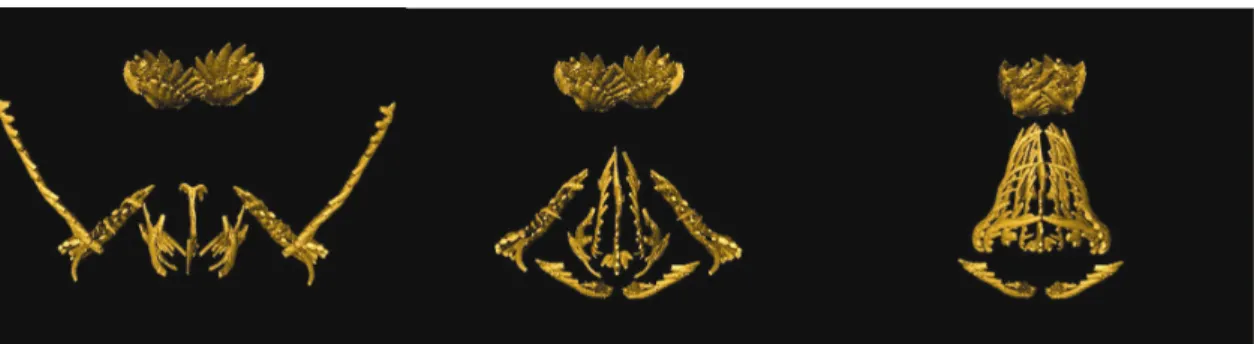
of South China. Conodont clusters are groups of morphologically different elements belonging to the same individual, which were somehow cemented together post-mortem. Such specimens of exceptional preservation are extremely rare in the Triassic and these are the first reported for the Early Triassic. Our fused clusters partially preserve the relative three-dimensional position and orientation of some ramiform, grasping elements. They are therefore extremely important for our understanding of the feeding apparatuses of conodonts. Because of the intricate geometry of the superposed elements, of their fragility and of their extreme rarity, it is usually tricky to study such specimens. We overcome these problems by performing a propagation phase contrast synchrotron microtom-ography (Tafforeau et al., 2006). A pink beam setup at 17.6 keV, which was very recently developed at the European Synchrotron Radiation Facility on beamline ID19, has been successfully tested on our conodonts. This new technique enables a submicron resolution (0.23µm) with a speed and an overall quality never reached before. Some fused clusters as well as co-occurring isolated elements from the same sample and pertaining to the same multi-element species were scanned using this tech-nique. Besides taxonomic revision of the Gondolelloidea superfamily (the most significant group of conodonts during Permian and Triassic times), this discovery led us to propose a new functional model. In our view, the best solution implies the presence of a presumably cartilaginous ‘copula’, upon which the conodont ele-ments are moving independently, more or less as do dental plates in extant lampreys, but not strictly as proposed by Purnell and Donoghue (1997). We suggest that during retraction towards the caudally located platform (cutting or grinding) ele- ments, the S0 element first has a closing, rotating movement, most probably synchronized with the closure of the M ele-ments, with which it would have performed a pinching, seizing function. This movement is then followed by a sub-straight, dorso-caudally directed translation, by which it would have torn off the prey’s ‘flesh’ and brought it towards the platform elements. The latter movement is accompanied by the closure of the other S elements, channelling the food in the appropri-ate direction. Considering that the presence of such ‘copula’ associated with tongue protractor and retractor muscles has been asserted only for extant cyclostomes (hagfishes and lampreys; Yalden, 1985; Donoghue et al., 2000), our new model may provide im-portant insights for deciphering the affinity of conodonts and for our general understanding of the origin of vertebrates. Acknowledgements This research is supported by the Swiss NSF project 200020-113554. We acknowledge the European Synchrotron Radiation for provision of synchrotron radiation facilities and for granting access to beamline ID19. Figure 1. Animated 3d reconstruction of the feeding apparatus of Novispathodus.
REFERENCES
Galfetti, T., Bucher, H., Martini, R., Hochuli, P.A., Weissert, H.,Crasquin-Soleau, S., Brayard, A., Goudemand, N., Brühwiler, T.& Guodun, Kuang 2008. Evolution of Early Triassic outer platform paleoenvironments in the Nanpangjiang BasinSy m p o si u m 6 : D a rw in , E vo lu ti o n a n d P a la e o n to lo g y (South China) and their significance for the biotic recovery. Sed. Geol. 204: 36-60.
Tafforeau, P., et al. 2006. Applications of X-ray synchrotron microtomography for non-destructive 3d studies of paleontological specimens. Appl. Phys. A 83: 195-202. Purnell, M. A.& Donoghue, P. C. J. 1997. Architecture and functional morphology of the skeletal apparatus of Ozarkodinid conodonts. Phil. Trans. R. Soc. Lond. B 352: 1545-64. Yalden, D. W. 1985. Feeding mechanisms as evidence of cyclostome monophyly. Zool. J. Linn. Soc. 84: 291-300. Donoghue, P. C. J., Forey, P. L.& Aldridge, R. J. 2000. Conodont affinity and chordate phylogeny. Biol. Rev. 75: 191-251.
6.7
The Devonian Nekton Revolution
Christian Klug
1, Björn Kröger
2, Wolfgang Kiessling
2, Gary L. Mullins
3, Thomas Servais
4, Jiří Frýda
5, Dieter Korn
2& Sue
Turner
61Paläontologisches Institut und Museum, Universität Zürich, Karl Schmid-Strasse 4, CH-8006 Zürich, Switzerland, ([email protected]) 2Museum für Naturkunde, Humboldt-Universität zu Berlin, Invalidenstraße 43, D-10115 Berlin, Germany
3Department of Geology, The University of Leicester, University Road, Leicester, LE1 7RH, United Kingdom
4Laboratoire de Paléontologie et Paléogéographie du Paléozoïque, UMR 8014 du CNRS, Université des Sciences et Technologies de Lille, SN5
Cité Scientifique, F-59655 Villeneuve d’Ascq, France
5Faculty of Environmental Science, Czech University of Life Sciences, Kamýcká 129, 165 21 Praha 6 Suchdol, Czech Republic 6Queensland Museum, 122 Gerler Rd., Hendra, Queensland 4011, Australia
Impressive discoveries of Neoproterozoic and Early Palaeozoic Fossillagerstaetten drew the attention on evolutionary and ecological processes of these timespans. It almost seemed that, except for some of the “Big Five”, nothing essential happened after the Ordovician. Such a scenario is certainly not true. Contrariwise, some major ecological fluctuations have been recorded from the Devonian, several of which have less promi-nent Silurian precursors. Famous examples are the radiation of land plants and jawed fish (both known already from the pre-Devonian). During the Devonian, several animal groups conquered the land (various arthropods and possibly tetrapods). Marine invertebrates show significant ecological and morphological changes: Important cephalopod groups such as bactri-toids as well as ammonoids evolved and reef growth increased until the Late Devonian crises. Both the global rise and fall of dacryoconarids occurred, graptolites became extinct, and various mollusc clades modified early ontogenetic strategies dur-ing the Devonian, documenting a planktonic turnover. In addition, there is a macroecological change in marine faunas from a demersal (swimming close to the sea-floor) and planktonic habit towards a more active nektonic habit. Various interpretations are at hand to explain this Devonian Nekton Revolution: (1) Demersal and nektonic modes of life were probably initially driven by competition in the diversity-saturated benthic habitats as well as (2) the availability of rich planktonic food resources (as reflected in evolutionary alterations in early ontogenetic stages of many mollusks). Escalatory feedbacks probably promoted the rapid evolution of nekton (jawed fish and some derived cephalopod groups in particular) in the Devonian, as suggested by the sequence and tempo of water-column occupation. Potentially, both these radiations and the Givetian to Famennian mass-extinctions were linked to a pronounced increase in nutrient input to sea surface waters during eutrophication episodes.
6.8
Red trilobites with green eyes from the Devonian of Morocco
Christian Klug1, Hartmut Schulz2 and Kenneth De Baets1
1Paläontologisches Institut und Museum der Universität Zürich, Karl Schmid-Str. 4, CH-8006 Zürich ([email protected]) 2Institut für Geowissenschaften, Eberhard-Karls-Universität Tübingen, Sigwartstr. 10, D-72076 Tübingen, Germany
Latest Emsian (Early Devonian) sediments at the famous mud-mound- and trilobite-locality Hamar Laghdad (Tafilalt, Morocco) yielded some well preserved, largely red-coloured remains of phacopid trilobites. Closer examination revealed that only the lenses of the eyes of these phacopids are usually greenish in colour. EDX-analyses showed that the lenses retained their original calcitic composition while most of the exoskeleton was silicified. The silicified parts contain elevated concen-trations of iron which causes the red colour.
Sy m p o si u m 6 : D a rw in , E vo lu ti o n a n d P a la e o n to lo g y Presumably, the primary porosity of most of the phacopid exoskeleton except the chitinous legs and the lenses was, because of the pore canals, higher than that of the lenses, facilitating the replacement of calcite by other minerals. Furthermore, the presence of organic components in the lenses in combination with a homogeneous distribution of the calcite crystals might have slightly increased the resistance of the lenses towards mineral replacement. The homogeneity of the calcite crystals of the lenses was needed for their optimal optical functionality. These factors probably account for the fact that the eyes reta-ined the calcite which is often greenish in brachiopod shells such as the thick-shelled Middle Devonian Devonogypa and Ivdelinia from the Maïder Basin while the rest of the trilobite exoskeleton is red. This differential replacement also explains why the lenses are slightly corroded while the rest of the exoskeleton is superficially well preserved. So far, this differential replacement of calcite is only known from the eyes of phacopids. Other trilobite taxa from the same strata and locality have holochroal eyes and thus much smaller lenses which were probably more rapidly replaced by silica. The greenish colour of the lenses might originate from impurities of iron and magnesium; the concentrations of the corresponding ions might have been too low to be detected with the EDX with certainty. Hamar Laghdad also yielded phacopid exoskeletons with less completely silicified exoskeletons which enabled a detailed reconstruction of the silicification process. Initially, only the outer surface of the exoskeleton and the vicinity of pore canals were silicified. In a second step, the bend in the growth lines of the interlensar sclera were silicified together with the re-maining exoskeleton except for the lenses, then the complete interlensar sclera and in the end also the lenses.
6.9
First record of a belemnite preserved with beaks, arms and ink sac from
the Nusplingen Lithographic Limestone (Kimmeridgian, SW Germany)
Christian Klug1, Günter Schweigert2, Dirk Fuchs3 and Gerd Dietl2
1Paläontologisches Institut und Museum, Karl Schmid-Str. 4, CH-8006 Zürich ([email protected]) 2Staatliches Museum für Naturkunde, Rosenstein 1, D-70191 Stuttgart, Germany
3Institut für Geowissenschaften, Freie Universität Berlin, Malteserstr. 74-100, D-12249 Berlin, Germany
A recent discovery of an unusually preserved belemnite from Nusplingen comprises the extraordinarily rare remains of beaks and nearly in situ arm-hooks as well as the ink sac and the incomplete phragmocone. So far, Hibolithes semisulcatus
(Münster, 1830) is the only larger belemnite known from the Nusplingen Lithographic Limestone (Upper Jurassic, Late Kimmeridgian, Beckeri Zone, Ulmense Subzone; SW Germany) which has the same phragmocone shape and size, thus we assign the new specimen to this taxon. The rostrum was probably lost due to a lethal predation attempt in which the prey was killed but not entirely eaten. For the first time, a specimen reveals details of the belemnite beak morphology, which we compare to the beaks of other Jurassic cephalopods. This specimen presently represents the only known rostrum-bearing belemnite of post-Toarcian age which has been preserved with non-mineralised body parts. As Hibolithes semisulcatus is known
to possess one pair of mega-onychites, the absence of those in the present specimen provides evidence of sexual dimorphism in Hibolithes semisulcatus. This phenomenon was previously presumed for all belemnites, but it is known only from Passaloteuthis
with certainty since the rostrum of the latter is unambiguously associated with an arm crown that occasionally includes one
pair of mega-onychites. The imperfect preservation of the belemnite beaks hampers a detailed comparison with other Recent and fossil coleoid beaks. Some morphological characters (low width of the outer lamella, double lateral lobes of the dark parts of rostrum and hood, possibly short internal lamella) of the lower beak of Hibolithes
more closely resemble Recent de-capods than Recent octopods. The upper beak of Hibolithes differs in the long, narrow and curved rostrum from those coleoid
beaks previously known from Nusplingen. The dark part of the lower beak also shows a unique outline with a short and pointed rostrum, an elongate posteroventral extension and two small rounded sinuses which pointed towards the wings (sometimes similarly developed in Recent Sepioteuthis). It appears likely that this beak form is quite characteristic and it
might reflect a special diet of the belemnites. Taking their probably high swimming velocity (fins, stream-lined body, and horizontal orientation of the longest body axis) with the arm hooks and the sharp beaks into account, it appears quite likely that belemnites were fast-swimming, effective, medium-sized predators. With the new discovery, Nusplingen now represents the only locality which has yielded complete beak apparatuses from all major Jurassic cephalopod groups.
Sy m p o si u m 6 : D a rw in , E vo lu ti o n a n d P a la e o n to lo g y
6.10
The borehole 01983X2854 (Preuschdorf, Upper Rhine Graben, Alsace,
France) as a basis of a formal definition of the Upper Pechelbronn Beds
(Rupelian)
Lavoyer Thibault, Yerly Bertrand & Berger Jean-Pierre
Département de Géosciences, Géologie et Paléontologie, Université de Fribourg, chemin du Musée 6, 1700 Fribourg, Switzerland
From the middle Eocene to Late Oligocene, an intense lacustrine, brackish and marine sedimentation, documented by salt depos-its and oil accumulation, took place in the Upper Rhine Graben (URG), especially in the Pechelbronn Beds (Lower-, Middle- and Upper). Although these layers were studied, in the past, for the oil industry (Schnaebele 1948) and are a lithostratigraphic unit used in maps and papers concerning the Paleogene of the URG, they have never been formally designated because they almost never crop out at the surface and drifting and drilling materials were often discarded. Nevertheless, the International Stratigraphic Guide (see Murphy and Salvador 1999), demands a type section for each formally named Formation. Several palaeogeographical reconstitutions and stratigraphic charts for the URG have been published (Berger et al. 2005 a & b). However, the Rupelian deposits were not well defined. This work presents the first step for a definition of a type section of a type section of the Upper Pechelbronn Beds, with the presentation of several lithofacies and paleontological data. The studied borehole, 01983X2854 (Preuschdorf, Alsace, France) is a complete cored drilling, about 220m in depth. It was originally made to evaluate a decontamination issue, but has also yielded micropaleontological and sedimentological data. It corresponds to the Upper Pechelbronn Beds with a small part of the Middle Pechelbronn Beds at the base. The high abundance of ostracods and gastropods in grey marls, corresponding to the 10 lower meters, indicate the top of the Middle Pechelbronn Beds with the Hydrobia Zone. These layers are covered by a succession of marls and sandstone, suggest-ing a different environment. The lower part of the borehole is consistent with the lithostratigraphic zonation defined by Schnaebele (1948) for his “normal facies” whereas the upper part corresponds to his “freshwater facies”.
The lower part of the borehole has yielded new paleontological data. Diatoms (Triceratium sp), charophytes (Chara spp., Rhabdochara sp.), foraminifers (Ammodiscus sp., Quinqueloculina sp., Flintina sp., Lenticulina spp., Dentalina sp., Subreophax elon-gates, Vaginulopsis spp.), bivalves, gastropods, bryozoans, ostracods (Grinioneis tribeli, Hazelina indigena, Hemicyprideis spp.,
Ilyocypris sp.), insects, echinoderms, fishes and mammals teeth are used as main indicators of biostratigraphy and palaeoecol-ogy. The fossil record emphasizes a complex alternation of freshwater, brackish and marine fauna along the whole studied section.
This study is financed by the SNF Project 200020-118025 “Paleontology and Stratigraphy of the Rhine graben during the Paleogene”, and includes parts of the Masters-thesis of B. Yerly “ The transition between the Middle and Upper Pechelbronn Beds in the drilling 1983X2854, Preuschdorf (Rupelian, Upper Rhine Graben, Alsace, France)” (in prep. 2009) and the PhD-thesis of T. Lavoyer “Paleontology and Stratigraphy of the Middle Upper Rhine Graben during the Paleogene: a key-study for the relationships between Rift system, Alpine Orogeny and Paleoclimate” (in progress).
We thank S. Spezzaferri (Uni. Fr., foraminifers), C. Pirkenseer (Uni. Leuven, ostracods) for fossils determination, P. Elsass (BRGM) and M. Kimmel (Geoderis) for providing access to the core drilling.
REFERENCES
Berger, J.-P. et al., 2005a. Paleogeography of the Upper Rhine Graben (URG) and the Swiss Molasse Basin (SMB) from Eocene to Pliocene. International Journal of Earth Sciences, 94(4): 697-710. Berger J.-P. et al., 2005b. Eocene-Pliocene time scale and stratigraphy of the Upper Rhine Graben (URG) and the Swiss Molasse Basin (SMB). International Journal of Earth Sciences, 94(4): 711-731. Murphy M.A. & Salvador A. 1999. International Stratigraphic Guide An abridged version. Episodes, Vol. 22, no. 4Schnaebele R., 1948. Monographie géologique du champ pétrolifère de Pechelbronn. – Mémoires du Service de la Carte géologique d’Alsace et de Lorraine, 7:254 S Strasbourg
Sy m p o si u m 6 : D a rw in , E vo lu ti o n a n d P a la e o n to lo g y
6.11
Determination of the paleodiet and the phylogeny of extinct ruminants
using Relative Wrap Analysis on mandibles: case of Iberomeryx minor
(Mammalia, Artiodactyla)
Bastien Mennecart1, Damien Becker2 & Jean-Pierre Berger1
1Department of Geosciences – Earth Sciences, ch. du Musée 6, Pérolles, 1700 Fribourg, Switzerland ([email protected]) 2Section d’archéologie et paléontologie, République et Canton du Jura, Office de la culture, Hôtel des Halles, Case postale 64, 2900
Porrentruy 2, Switzerland
The primitive ruminant Iberomeryx is essentially known by few dental remains and is still poorly documented. Its phylogeny and palaeobiology stays rather enigmatic. Only two species have been described: the type species I. parvus from the Benara
locality in Georgia (Gabounia 1966), and the West European species I. minor from Itardies, Mounayne, Raynal and Roqueprune
2 in Quercy (Sudre 1987), Montalban in Spain (Golpe-Posse 1974), and Lovagny, Soulce and Beuchille in the Swiss Molasse Basin (Becker et al. 2004). I. savagei from India had recently been placed in the new genus Nalameryx (Métais et al. 2009). All
these localities are dated to the Rupelian and correspond mainly to MP23 (European mammal biozone). Based on the short tooth-crown height and the bunoselenodont pattern of the molars, Sudre (1984) and Becker et al. (2004) proposed a folivore/ frugivore diet for Iberomeryx. Based on relative warp analysis (24 landmarks) of 84 extant and fossil ruminant mandibles from 24 genera and 32 species, this study proposes a preliminary discussion on the phylogeny and the diet of the genus Iberomeryx. The results permit to differentiate Pecora and Tragulina on the first axis thanks to the length of the diastema, the length of the premolars and the mandible ankle. As suggested by Sudre (1984), Iberomeryx is close to the extant Tragulina by the shape of its mandible. But, this latter is clearly different of those of the Tragulidae, the only extant family in Tragulina. This difference is essentially due to a stockier mandible (condylar process, mandible ramus and corpus mandibulae), and a deeper mandibular incisure.
Additionally, we observe no diastema and well bunodont teeth. Iberomeryx may be considered as a primitive Tragulidae, the only known from the Oligocene, based on the general shape of its mandible and its jaw teeth. Moreover, its diet could not be strictly frugivore, but it could possibly also exceptionally eat some meat matter such as small Hypertragulidae. This study is supported by the Section d'archéologie et paléontologie (Porrentruy), the University of Fribourg, and the Swiss National Foundation project (115995) on the large mammal evolution in the Swiss Molasse Basin during the Oligocene and Early Miocene.
REFERENCES
Becker, D., Lapaire, F., Picot, L., Engesser, B. & Berger, J.-P. 2004: Biostratigraphie et paléoécologie du gisement à vertébrés de La Beuchille (Oligocène, Jura, Suisse). Revue de Paléobiologie, Vol. spéc. 9, 179-191. Gabounia, L. 1966: Sur les Mammifères oligocènes du Caucase. Bulletin de la Société Géologique de France 7, 857-869. Golpe-Posse, J. 1974: Faunas de Yacimientos con Suiformes en el Terciario espanol. Publicaciones des Instituto Provincial de Paleontologia de Sabadell, Paleontologia y Evolucion 8, 1-87.Métais, G., Welcomme, J.-L- & Ducrocq, S. 2009: New lophiomericyd ruminants from the Oligocene of the Bugti Hills (Balochistan, Pakistan). Journal of Vertebrate Paleontology 29(1), 231-241.
Sudre, J. 1984: Cryptomeryx Schlosser, 1886, tragulidé de l'Oligocène d'Europe; relations du genre et considérations sur l'origine de ruminants. Palaeovertebrata 14, 1-31.
Sy m p o si u m 6 : D a rw in , E vo lu ti o n a n d P a la e o n to lo g y
6.12
Macroevolutionary trends of Acrochordiceratidae Arthaber, 1911
(Ammonoidea, Middle Triassic)
Monnet Claude1, Bucher Hugo1, Guex Jean2 & Wasmer Martin1
1Paläontologisches Institut und Museum, Universität Zürich, Karl Schmid Strasse 4, CH-8006 Zürich ([email protected], hugo.fr.
[email protected], [email protected])
2Institut de Géologie et Paléontologie, Université de Lausanne, BFSH-2, CH-1015 Lausanne ([email protected])
Directed evolution of life through millions of years, such as increasing complexity and increasing adult body size, is one of the most intriguing patterns displayed by fossil lineages. The general tendency for body size to increase during the evolution of a group of animals is known as Cope’s rule. Processes and causes of such macroevolutionary trends remain however to be clearly understood (Jablonski 2000). Among fossils, ammonoid shells (marine cephalopods) are well known to experience repetitive macroevolutionary trends of their adult size, geometry and ornamentation (Schindewolf 1940; Haas 1942; Bayer & McGhee 1984; Dommergues 1990; Guex 1992).
This study analyzes the evolutionary trends of the family Acrochordiceratidae Arthaber, 1911, which spanned the upper Early to lower Middle Triassic. Exceptionally large collections of this ammonoid family from North America enable quantitative and statistical analyses of its macroevolutionary trends. This study highlights that (1) the monophyletic clade of Acrochordiceratidae follows the classical evolute to involute evolutionary trend (i.e. increasing coiling of the shell); (2) the lineage also shows a seemingly stepwise increase of its shell adult size (shell diameter); (3) the clade also records increasing complexity of its suture line; and (4) the lineage is also characterized by a prominent increase of the intraspecific variation of its shell morphology, which follows the Buckman’s Law of Covariation. These macroevolutionary trends are statistically robust and seem more or less gradual. Furthermore, they can be considered as non-random with the sustained shift of the mean, the minimum and the maximum of studied shell characters. Such re-sult is usually interpreted as being the effect of a selection pressure on the entire lineage, which leads to infer the presence of one ecological niche common to all species of this mostly anagenetic lineage with moderate evolutionary rates. Increasing involution of ammonites is usually interpreted by increasing adaptation mostly in terms of improving hydrody-namics. However, this trend in ammonoid geometry can be explained as a case of Cope’s rule (increasing adult body size) instead of ad hoc functional explanations of coiling, because both shell diameter and shell involution are two possible paths for ammonoids to accommodate increasing body size.
REFERENCES
Bayer, U. & McGhee, G.R. 1984: Iterative evolution of Middle Jurassic ammonite faunas. Lethaia, 17, 1-16. Dommergues, J.L. 1990. Ammonoids. In: McNamara, K.J. (ed.), Evolutionary trends, Belhaven Press, London, 162-187. Guex, J. 1992: Origine des sauts évolutifs chez les ammonites. Bulletin de la Société Vaudoise de Sciences Naturelles, 82, 117-144. Haas, O. 1942: Recurrence of morphologic types and evolutionary cycles in Mesozoic ammonites. Journal of Paleontology, 16, 643-650. Jablonski, D. 2000. Micro- and macroevolution: scale and hierarchy in evolutionary biology and paleobiology. Paleobiology, 26 (suppl. 4), 15-52.Schindewolf, O.H. 1940. Konvergenz bei Korallen und Ammoniten. Fortschritte der Geologie und Palaeontologie, 12, 387-491.
Figure. Evolutionary trends represented by late immature shell geometry and suture line for Acrochordiceratidae during the Anisian (Middle Triassic). Global evolutionary trends affecting successive spectra of variants for Acrochordiceratidae are increasing adult shell size, increasing involution, increasing suture complexity, and increasing intraspecific variability. (Next Page)
Sy m p o si u m 6 : D a rw in , E vo lu ti o n a n d P a la e o n to lo g y
6.13
Reinvestigation of the basal ray-finned fish Birgeria stensioei from the
Middle Triassic of Monte San Giorgio (Switzerland) and Besano (Italy)
Romano Carlo1 & Brinkmann Winand1
1Paläontologisches Institut und Museum, Karl Schmid-Strasse 4, CH-8006 Zürich ([email protected]; [email protected])
The two earlier descriptions and a previous reconstruction of the Middle Triassic actinopterygian Birgeria stensioei aLdInGeR,
1931 from the Besano Formation of Monte San Giorgio (Canton Ticino, Switzerland) and Besano (Lombardy, Italy) relied eit-her on a few fragmentary remains or on a single individual only. Here we present the first study of B. stensioei that is based
on multiple specimens of this basal ray-finned fish. Sixty-seven specimens have been examined.
The reinvestigation of B. stensioei yielded new information at genus and species level. B. stensioei predominantly differs from the other species of the genus Birgeria sTensIö, 1919 in the arrangement of the bones of the dorsal fin base. While in the other
species usually two series of pterygiophores are present throughout the dorsal fin base, only one series of pterygiophores is developed in the anterior part of the dorsal fin root of B. stensioei. The caudal peduncle and the caudal fin lobes are more
slender and longer than illustrated in the previous reconstruction of B. stensioei (see
s
cHwaRz 1970). The morphology of thecaudal peduncle and fin as well as the aforementioned specialised dorsal fin root indicate that propulsion might have been more advanced in B. stensioei compared to the other species of the genus Birgeria. B. stensioei is furthermore distinguished
from most of the other species of Birgeria by the degree of ossification of the brain case and the palatoquadrate. As in many
other basal actinopterygians, a dermohyal is developed in B. stensioei and this bone is probably present in the other species
Sy m p o si u m 6 : D a rw in , E vo lu ti o n a n d P a la e o n to lo g y
6.14
Terrestrial palaeoclimatical and palaeoenvironmental reconstructions in
Northwestern Switzerland: carbon and oxygen isotope compositions of
Early Oligocene and Late Pleistocene vertebrate remains.
Scherler Laureline1,2, Tütken Thomas3, Becker Damien2 & Berger Jean-Pierre1
1Department of Geosciences, Institute of Geology, ch. du Musée 6, CH-1700 Fribourg ([email protected]) 2Section d'archéologie et paléontologie, Hôtel des Halles, CP64, CH-2900 Porrentruy
3Steinmann Institute, University of Bonn, Poppelsdorfer Schloss, D-53113 Bonn
Vertebrate remains from two Early Oligocene localities of the Delémont basin (Beuchille and Poillat) and from eight Late Pleistocene doline fillings of the Ajoie Region (Courtedoux-Vâ Tche Tchâ and Boncourt-Grand'Combe) have been excavated along the Transjurane highway (Canton Jura, Northwestern Switzerland). Teeth of large mammals and bones of aquatic rep-tiles have been analysed for their isotope compositions (δ18O
CO3, δ18OPO4, δ13C) in order to reconstruct the palaeoclimatical and
palaeoenvironmental conditions.
The two Early Oligocene localities of Beuchille and Poillat are located in the Jura Molasse ("Molasse alsacienne" Formation) of the Delémont basin (Northern Switzerland). The presence of the small mammal Blainvillimys avus and the ruminant Iberomeryx minor allows a datation to the mammal zones MP23-24, around 31.5 to 29.0 Ma (Becker et al. 2004). Eight samples of reptile bones (crocodiles and turtles) as well as four samples of sympatric primitive rhinocerotid teeth (Ronzotherium sp.) have been analysed. The reptile bones have low δ18O PO4 values (from 13.6‰ to 17.8‰) indicating freshwater environments (δ18O H2O calculated values averaging -6.15±1.03‰) which are supported by the palaeontological identifications of the turtle remains (Trionyx and Testudinidae: freshwater and terrestrial turtles, respectively). A similar δ18O H2O value of -6.18±1.5‰ is calculated from enamel δ18O PO4 values (18.3±1.3‰) of the rhinocerotid teeth, which presumably reflects the composition of meteoric water. Using a modern-day mean air temperature (MAT)-δ18O H2O relation for Switzerland a MAT of 18.0±2.5°C for the Early Oligocene could be calculated and was about 8-9°C warmer than today in the Canton Jura (Recent MAT of 8.7°C). This result is in agreement with the palaeotemperature of ~17°C reconstructed from fossil plant remains in the Early Oligocene of Central Europe by Mosbrugger et al. (2005). The eight Late Pleistocene doline fillings of Boncourt-Grand'Combe (GC) and Courtedoux-Vâ Tche Tchâ (VTA) are located in the Ajoie Region (Northwestern Switzerland) and correspond mainly to loessic and gravel deposits associated with fossil re-mains. Forty-six teeth of large mammals (Equus germanicus, Mammuthus primigenius, Coelodonta antiquitatis, Bison priscus) have
been analysed: eight samples from the GC doline filling and thirty-eight from the seven VTA doline fillings. The sedimenta-ry series bearing the mammal remains trapped within the GC doline have been dated by OSL (Optically Stimulated Luminescence) to an age of ~80 ka BP. The mammal remains preserved within the seven VTA dolines have all been discovered in the same sedimentary unit dated to the time interval 45-40 to 35 ka BP (latest Middle Pleniglacial) by OSL and radiocarbon (Becker et al. 2009). According to the enamel δ13C values, which are similar in both time periods, the large mammals lived in a C 3 plant-domina-ted environment as indicated by values ranging from -14.5‰ to -9.2‰ (O'Leary, 1981). The MAT calculated from the δ18O PO4 values of the large mammal assemblage from the GC doline averages 6.0±4.6°C. The MAT calculated for the large mammal assemblage of the younger VTA dolines averages 5.6±4.1°C, showing a quite similar climate. This latter result is concording with the quantified ecology study of the small mammal assemblages of these dolines, which indicates palaeotemperatures averaging 5°C (Oppliger, 2009). These palaeoclimatical values are about 3 to 4°C cooler than today in the Canton Jura. However, some variations in the δ18O PO4 values of the different studied species are observed, and particularly in the VTA do-lines: for example the equids show slightly lower δ18O PO4 values (13.09±0.8‰) than the bovids (14.6±1.1‰). The calculated MAT after specific calibrations can thus be very different, ranging from 2.2±2.8°C for the Equus remains to 8.8±3.5°C for the Bison remains, with a value of 5.8±3.3°C for the Coelodonta and 8.7±2.2°C for the Mammuthus. In order to understand this bias a precised sampling of teeth formed before and after the weaning of the foals has been done. It shows that the oxygen isotopic compositions are not affected by the nursing period whereas the carbon isotopes show slightly lower values. The differences in oxygen stable isotope compositions within these Late Pleistocene mammals could then been explained by the sampling method, the mammal physiology and/or ecology, or time averaging. The determination of a palaeotemperature should be more reliable during the Oligocene when the climate was much more stable than in the Pleistocene when brutal climatical changes occurred very frequently. We thank the Section d'archéologie et paléontologie du Jura, the University of Fribourg and the Swiss National Foundation (project 115995) for financial support.
Sy m p o si u m 6 : D a rw in , E vo lu ti o n a n d P a la e o n to lo g y
REFERENCES
Becker, D., Lapaire, F., Picot, L., Engesser, B. & Berger, J.-P. 2004: Biostratigraphie et paléoécologie du gisement à vertébrés de La Beuchille (Oligocène, Jura, Suisse). Revue de Paléobiologie, 9, 179-191. Becker, D., Aubry, D. & Detrey, J. 2009: Les dolines du Pléistocène supérieur de la combe de "Vâ Tche Tchâ" (Ajoie, Suisse): un piège à restes de mammifères et artéfacts lithiques. Quaternaire, 20, 2, 135-148. Mosbrugger, V., Utescher, T. and Dilcher, D. L. 2005: Cenozoic continental climatic evolution of Central Europe. PNAS, 102, 14964-14969. O'Leary, M. H. 1981: Carbon isotopes in photosynthesis. BioScience, 38, 328-336.Oppliger, J. 2009: La microfaune des dolines du Pléistocène supérieur de la combe de Vâ Tche Tchâ et de la région de Boncourt (Ajoie, Jura, Suisse). Unpublished report, 29pp.
6.15
How do recurrent patterns of covariation in molluscan shells connect to
growth dynamics?
Urdy Séverine1, Goudemand Nicolas1, Bucher Hugo1 and Monnet Claude1
1Paläontologisches Institut und Museum, Universität Zurich, Karl Schmid-Str. 4, 8006 Zürich ([email protected]).
The comparison of shell shape among and within different clades of molluscs can be informative with regards to the basic rules of accretionary growth. Indeed, patterns of variation of shell shape and its associated growth features (like growth halts) in ammonoids and gastropods suggest that common rules of accretionary growth underlie the morphogenesis of the shell and its evolution in both clades (e.g. Bucher, 1997; Checa & Jimenez-Jimenez, 1997; Checa et al. 2002). Moreover, in some phylogenetically distant ammonoids species, covariations among the intensity of ornamentation, the la- teral compression of the aperture and the degree of whorl overlap have been described (Buckman’s laws). It has been sugge-sted that simple growth rules could underlie these evolutionary recurrent patterns of covariation (Hammer & Bucher, 2005a). Similarly, shell characters covary with the spacing between growth halts during the ontogeny of some of these high-ly variable ammonoids species. One goal of this study is to explore whether a comparable pattern of covariation is to be found in gastropods as well. We also want to find out whether documentation of modes of growth in gastropods could support the view according to which some recurrent patterns of covariation could reflect basic constraints tied to accretionary growth. Another interest is the relati-onship among shape, growth rates and age, a point that is difficult, if not impossible to study on ammonoids. In this study, we investigate the ontogenetic patterns of covariation among aperture shape, intensity of ornamentation and spacing between growth halts in a population of gastropods (Hexaplex
trunculus, Muricidae) reared under controlled labora-tory conditions. All individuals originated from a single egg mass. We describe the growth dynamics of these individuals from the age of approximately 100 days to 550 days after hatching. This study highlights a covariation among growth rhythm, growth halts spacing, aperture allometry and intensity of orna-mentation: -Variation in shell shape is analysed by geometric morphometrics of landmarks located on the aperture. We document an ontogenetic allometry of aperture, which becomes relatively wider with size. This is consistent with results obtained using elliptic Fourier analysis of aperture contour and traditional biometrics. -Variation in the ‘strength of ornamentation’ is related to the mean spacing between growth halts: smoother snails tend to exhibit more closely spaced growth halts. This covariation, as put in evidence here in H. trunculus, seems analogous to that
observed in some highly variable ammonoids species (e.g. Gymnotoceras rotelliformis, Amaltheus margaritatus).
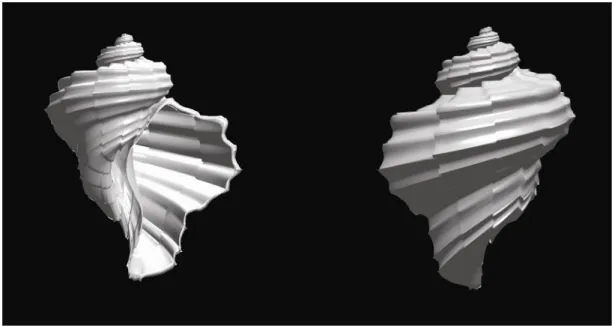
-The mean number of growth halts per month is related to the global shape of the growth curve and to the mean spacing between growth halts: the more frequent the growth ‘pulses’, the shorter the time spent on a growth halt (down to nearly continuous growth), the more linear the growth curve and the smaller the growth segments between successive growth halts. Additionally, we develop a growth vector model (Urdy et al., 2009) in order to simulate the formation of growth halts pheno- menologically (Fig.1). This model is able to account for some patterns of covariation among specimens. In particular, varia- tion in growth rhythm is regarded as critical in generating the observed covariation between growth halts spacing and or-namentation. Based on these simulations, we suggest that this covariation mainly results from simple scaling among the aperture dimensions and the lengths of shell segments between successive growth halts. Then, the important structuration of phenotypic variation in some ammonoids species could be a generic outcome of underlying variation in growth rhythm.
Sy m p o si u m 6 : D a rw in , E vo lu ti o n a n d P a la e o n to lo g y Figure 1: Example of a simulation of growth halts.
REFERENCES
Bucher, H. 1997: Caractères périodiques et mode de croissance des ammonites: comparaison avec les gastéropodes. Geobios Mémoire Spécial, 20, 85-99. Checa, A. G. & Jimenez-Jimenez, A. P. 1997: Regulation of spiral growth in planorbid gastropods. Lethaia 30(4), 257-269. Checa, A. G., Okamoto, T. & Keupp, H. 2002: Abnormalities as natural experiments: a morphogenetic model for coilingregulation in planispiral ammonites. Paleobiology 28(1), 127-138.
Hammer, O. & Bucher, H. 2005a: Buckman's first law of covariation: a case of proportionality. Lethaia 38, 67-72.
Urdy, S., Goudemand, N., Bucher, H. & Chirat, R. 2009: Allometries and the morphogenesis of the molluscan shell: a quantitative and theoretical model. Journal of Experimental Zoology, Part B (accepted).
Sy m p o si u m 6 : D a rw in , E vo lu ti o n a n d P a la e o n to lo g y