Dimers of the columnar mesomorphic
2-substituted
benzene-1,3,5,-tricarboxamide (BTA)
unit: study of the liquid crystallinity in
the bulk and of the self-assembly in
solution
Thèse soutenue le 1 juin 2015 pour l’obtention du titre de Docteur ès Sciences
par
Christian INVERNIZZI
Titulaire d’un Master Degree in Chemical Sciences
de Università degli Studi di Milano, Milan, Italie
Membres du jury:
Prof. Reinhard NEIER
(Directeur de thèse)
Prof. Robert DESCHENAUX
(Rapporteur interne)
Dr. Claudio DALVIT
(Rapporteur interne)
Rue Emile-Argand 11 2000 Neuchâtel - Suisse Tél: + 41 (0)32 718 2100 E-mail: [email protected]
IMPRIMATUR POUR THESE DE DOCTORAT
La Faculté des sciences de l'Université de Neuchâtel
autorise l'impression de la présente thèse soutenue par
Monsieur Christian INVERNIZZI
Titre:
“Dimers of the columnar mesomorphic
2-substituted benzene-1,3,5-tricarboxamide (BTA)
unit: study of the liquid crystallinity in the bulk and
of the self-assembly in solution”
sur le rapport des membres du jury composé comme suit:
- Prof. Reinhard Neier, directeur de thèse, Université de Neuchâtel
- Prof. Robert Deschenaux, Université de Neuchâtel
- Dr Claudio Dalvit, Université de Neuchâtel
- Prof. Cesare Gennari, Università degli Studi di Milano, Italie
Rue Emile-Argand 11 2000 Neuchâtel - Suisse Tél: + 41 (0)32 718 2100 E-mail: [email protected]
IMPRIMATUR POUR THESE DE DOCTORAT
La Faculté des sciences de l'Université de Neuchâtel
autorise l'impression de la présente thèse soutenue par
Monsieur Christian INVERNIZZI
Titre:
“Dimers of the columnar mesomorphic
2-substituted benzene-1,3,5-tricarboxamide (BTA)
unit: study of the liquid crystallinity in the bulk and
of the self-assembly in solution”
sur le rapport des membres du jury composé comme suit:
- Prof. Reinhard Neier, directeur de thèse, Université de Neuchâtel
- Prof. Robert Deschenaux, Université de Neuchâtel
- Dr Claudio Dalvit, Université de Neuchâtel
- Prof. Cesare Gennari, Università degli Studi di Milano, Italie
Acknowledgments
The work of this PhD project has been carried out from April 2010 until June 2015 at the Institut de Chimie
of the University of Neuchâtel under the supervision and in the laboratory of Professor Reinhard Neier. I
really would like to thank him for the great chance he gave me to work with him in his research group on a
such challenging project. I would like to thank him as well for the freedom and confidence that he has given
to me.
I would like to thank Professor Robert Deschenaux for have accepted to be part of the jury and corrected
my manuscript. Moreover I would like to thank him for the kind discussions spent with me.
I would like to thank Professor Cesare Gennari for have accepted to be part of the jury and corrected my
manuscript, and moreover for his passionate teaching of organic chemistry.
I address a special thanks to Dr. Claudio Davit for have accepted to be part of the jury and, especially, I
would like to thank him for all his teaching and the all discussions we had together.
During doctoral studies I had the opportunity to work with different apprentices that enormously
contributed to the development of this project. My thanks are addressed to Sebastien Mendes, Maude
Stein and Tracy Rosselet.
During the last five years I had the privilege to work in a very friendly and professional research group. I
would like to thank all the present and the former members of the Neier’s group. In particular I thanks the
Post-Doc I met during this time, especially for their teaching and advices. My thanks are addressed to Dr.
Frederic Bruyneel, Dr. Anca Pordea, Dr Damien Thevenet, Dr. Christophe Letondor, Dr. Maria Kolympadi
and Dr. Ana-Maria Buciumas.
My gratitude is also addressed to the PhD students that were with me in the lab: William Maupillier, Sara
Santi, Ewa Banach, Dr. Guillaume Journot, Dr. Christelle Schenk, Dr. Inga Kolod and Dr. Lucia Cerisoli.
I would like to thank all the Neuchâtel Platform of Analytical Chemistry (NPAC). In particular, I would like to
thank Dr. Claudio Dalvit for the NMR analyses, Dr. Armelle Vallat-Michel for the Mass analyses and
Professor Helen Stoeckli-Evans for the X-Ray diffractions. I also would like to thank Professor Robert
Deschenaux and his group, especially Dr. Sebastiano Guerra, Dr. Thi Luyen Vuong and Steeve Albert, for
having allowed me to use their instruments (DSC and polarized-light microscope) and their essential
assistance.
I would like to thank all the other members of the Institut de Chimie of the University of Neuchâtel for have
been spent unforgettable moments with me during these years.
I would like to thank all the founding agencies that supported my project, especially the Swiss National
Science Foundation (FNS), the University of Neuchâtel and the Canton of Neuchâtel.
I would like to thank all the friends I met during all these five years in Switzerland because they made my
stay in Switzerland an extraordinary experience. Thanks to all of you.
Finally, I would like to thank all my family for their support and encouragement during this doctoral
experience and during all the other moments of my life.
Acknowledgments
The work of this PhD project has been carried out from April 2010 until June 2015 at the Institut de Chimie
of the University of Neuchâtel under the supervision and in the laboratory of Professor Reinhard Neier. I
really would like to thank him for the great chance he gave me to work with him in his research group on a
such challenging project. I would like to thank him as well for the freedom and confidence that he has given
to me.
I would like to thank Professor Robert Deschenaux for have accepted to be part of the jury and corrected
my manuscript. Moreover I would like to thank him for the kind discussions spent with me.
I would like to thank Professor Cesare Gennari for have accepted to be part of the jury and corrected my
manuscript, and moreover for his passionate teaching of organic chemistry.
I address a special thanks to Dr. Claudio Davit for have accepted to be part of the jury and, especially, I
would like to thank him for all his teaching and the all discussions we had together.
During doctoral studies I had the opportunity to work with different apprentices that enormously
contributed to the development of this project. My thanks are addressed to Sebastien Mendes, Maude
Stein and Tracy Rosselet.
During the last five years I had the privilege to work in a very friendly and professional research group. I
would like to thank all the present and the former members of the Neier’s group. In particular I thanks the
Post-Doc I met during this time, especially for their teaching and advices. My thanks are addressed to Dr.
Frederic Bruyneel, Dr. Anca Pordea, Dr Damien Thevenet, Dr. Christophe Letondor, Dr. Maria Kolympadi
and Dr. Ana-Maria Buciumas.
My gratitude is also addressed to the PhD students that were with me in the lab: William Maupillier, Sara
Santi, Ewa Banach, Dr. Guillaume Journot, Dr. Christelle Schenk, Dr. Inga Kolod and Dr. Lucia Cerisoli.
I would like to thank all the Neuchâtel Platform of Analytical Chemistry (NPAC). In particular, I would like to
thank Dr. Claudio Dalvit for the NMR analyses, Dr. Armelle Vallat-Michel for the Mass analyses and
Professor Helen Stoeckli-Evans for the X-Ray diffractions. I also would like to thank Professor Robert
Deschenaux and his group, especially Dr. Sebastiano Guerra, Dr. Thi Luyen Vuong and Steeve Albert, for
having allowed me to use their instruments (DSC and polarized-light microscope) and their essential
assistance.
I would like to thank all the other members of the Institut de Chimie of the University of Neuchâtel for have
been spent unforgettable moments with me during these years.
I would like to thank all the founding agencies that supported my project, especially the Swiss National
Science Foundation (FNS), the University of Neuchâtel and the Canton of Neuchâtel.
I would like to thank all the friends I met during all these five years in Switzerland because they made my
stay in Switzerland an extraordinary experience. Thanks to all of you.
Finally, I would like to thank all my family for their support and encouragement during this doctoral
experience and during all the other moments of my life.
You are urgently warned against allowing yourself to be influenced in any way by theories or by other
preconceived notions in the observation of phenomena, the performance of analyses and other
determinations.
You are urgently warned against allowing yourself to be influenced in any way by theories or by other
preconceived notions in the observation of phenomena, the performance of analyses and other
determinations.
This manuscript has been written and edited according to the publication format. Each chapter has
its own reference list. However, for an easy reading, the compounds have been assigned a sequential
ordering.
Part of the figures and schemes reported in this manuscript have been directly extracted from the
referenced original work subjected to copyright. According to the “Statements on the fair use of
images for teaching, research and study” reported by the Visual Resources Association, US, all the
figures and other material subjected to copyright have been properly referenced and the sources
have been clearly indicated.
List of Abbreviations
M.p.
Melting Point
B.p.
Boiling Point
TLC
Thin Layer Chromatography
NMR
Nuclear Magnetic Resonance
DOSY
Diffusion-Ordered Spectroscopy
ppm
Part-per-million
R
fRetention Factor
HR-MS
High-Resolution Mass Spectroscopy
IR
Infrared
BTA
Benzene-1,3,5-tricarboxamide
ESI
Electron Spray ionization
aq.
Aqueous
MALDI
Matrix-assisted laser desorption/ionization
Col
Columnar Liquid Crystal
I
Isotropic Liquid
r.t.
Room Temperature
Key Words
Benzene-1,3,5-tricarboxyamides; Hydrogen Bonds; π-π stacking; columnar liquid crystals;
Self-Assembly; Structure-Properties Relationships; Dimers.
This manuscript has been written and edited according to the publication format. Each chapter has
its own reference list. However, for an easy reading, the compounds have been assigned a sequential
ordering.
Part of the figures and schemes reported in this manuscript have been directly extracted from the
referenced original work subjected to copyright. According to the “Statements on the fair use of
images for teaching, research and study” reported by the Visual Resources Association, US, all the
figures and other material subjected to copyright have been properly referenced and the sources
have been clearly indicated.
List of Abbreviations
M.p.
Melting Point
B.p.
Boiling Point
TLC
Thin Layer Chromatography
NMR
Nuclear Magnetic Resonance
DOSY
Diffusion-Ordered Spectroscopy
ppm
Part-per-million
R
fRetention Factor
HR-MS
High-Resolution Mass Spectroscopy
IR
Infrared
BTA
Benzene-1,3,5-tricarboxamide
ESI
Electron Spray ionization
aq.
Aqueous
MALDI
Matrix-assisted laser desorption/ionization
Col
Columnar Liquid Crystal
I
Isotropic Liquid
r.t.
Room Temperature
Key Words
Benzene-1,3,5-tricarboxyamides; Hydrogen Bonds; π-π stacking; columnar liquid crystals;
Self-Assembly; Structure-Properties Relationships; Dimers.
Summary
The self-assembly of N,N’,N’’-trialkylbenzene-1,3,5-tricarboxyamides (BTAs) has been reported to
lead to supramolecular columnar-stacked structures with attractive material properties. The
formation of the columnar liquid crystalline phases (mesophases) along a broad range of
temperature is one of the most interesting properties shown by BTAs. In this thesis, the formation of
dimeric structures from the BTA unit was carried out to investigate the stabilization effect on the
columnar supramolecular aggregation.
The first challenge concerned the functionalization of the BTA scaffold in order to introduce an
“anchoring site” and achieve the formation of dimers. In this context, in the literature, the
introduction of alkoxy groups has been demonstrated to reinforce the self-assembly process. For this
reason, we synthetized a mono-2-substituted BTA carrying a pentynyloxy group. We investigated the
aggregation process of the newly synthetized 2-substituted BTAs in the bulk and in solution by means
of DSC, POM, X-ray diffraction and concentration-induced
1H-NMR experiments. The presence of this
single substituent significantly influenced the self-assembly process. Moreover, those measurements
revealed that the self-assembly was impaired by H-bond accepting substituents and strengthened by
non-H-bonding substituents.
In the second part, the 2-substituted BTA derivative was employed in the construction of
covalently-connected dimers. The study of the self-assembly process of the dimers was carried out in solution
by employing concentration-induced NMR analyses. These measurements revealed the
enhancement of the association process upon dimerization. However, none of the dimeric structures
presented liquid crystallinity. Therefore, we synthetized a library of 2-substituted BTA dimers with
different aromatic linkers and modifications on the amide side-chains. Finally, we screened the ability
of these dimeric compounds to form mesophases with the goal of establishing an empirical
structure-properties relationship.
Summary
The self-assembly of N,N’,N’’-trialkylbenzene-1,3,5-tricarboxyamides (BTAs) has been reported to
lead to supramolecular columnar-stacked structures with attractive material properties. The
formation of the columnar liquid crystalline phases (mesophases) along a broad range of
temperature is one of the most interesting properties shown by BTAs. In this thesis, the formation of
dimeric structures from the BTA unit was carried out to investigate the stabilization effect on the
columnar supramolecular aggregation.
The first challenge concerned the functionalization of the BTA scaffold in order to introduce an
“anchoring site” and achieve the formation of dimers. In this context, in the literature, the
introduction of alkoxy groups has been demonstrated to reinforce the self-assembly process. For this
reason, we synthetized a mono-2-substituted BTA carrying a pentynyloxy group. We investigated the
aggregation process of the newly synthetized 2-substituted BTAs in the bulk and in solution by means
of DSC, POM, X-ray diffraction and concentration-induced
1H-NMR experiments. The presence of this
single substituent significantly influenced the self-assembly process. Moreover, those measurements
revealed that the self-assembly was impaired by H-bond accepting substituents and strengthened by
non-H-bonding substituents.
In the second part, the 2-substituted BTA derivative was employed in the construction of
covalently-connected dimers. The study of the self-assembly process of the dimers was carried out in solution
by employing concentration-induced NMR analyses. These measurements revealed the
enhancement of the association process upon dimerization. However, none of the dimeric structures
presented liquid crystallinity. Therefore, we synthetized a library of 2-substituted BTA dimers with
different aromatic linkers and modifications on the amide side-chains. Finally, we screened the ability
of these dimeric compounds to form mesophases with the goal of establishing an empirical
structure-properties relationship.
Table of Contents
Chapter 1: INTRODUCTION...
1
Trialkyl 1,3,5-benzene tricarboxyamides BTAs: A journey into the world of self-assembly……...
2
X-ray structure...
4
Mechanism of aggregation...
8
Cooperative aggregation...
9
Isodesmic aggregation...
12
Fully-substituted “crowded” arenes BTA...
14
Aggregation of N-centered BTA...
15
Applications...
16
Closing Remarks………..………
17
BTAs as building blocks forming columnar liquid crystals...
18
Generality and Classification of Columnar Liquid Crystals……….……….…….
18
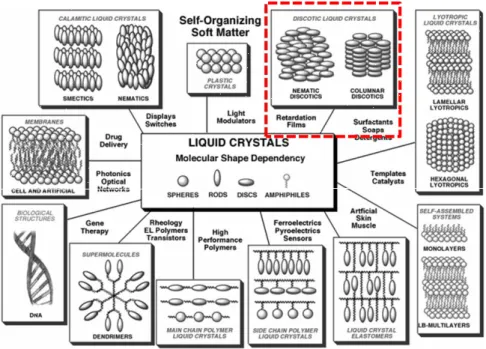
Discotic Liquid Crystals...
19
Characterization of the Liquid Crystalline Phase...
20
Polarized Light Microscope (POM) and Small Angle X-ray Scattering (SAXS)………
20
Differential Scanning Calorimetry (DSC)...
21
Importance of Columnar Discotic LC (DLC): organic semiconductors...
21
References...
24
Chapter 2: OBJECTIVES AND STRATEGY...
27
Predicted Changes in the Material Properties Induced by Dimerization………..….
29
Synthesis of the Dimers...
30
Strategy...
30
Choice of the Anchoring Site...
31
Reflexions on the Linker Length...
31
The Concept of Click Chemistry...
33
Introduction of the Concept of Click Reactions...
33
Copper Catalyzed Azido-Alkyne Cycloaddition CuAAC: an Efficient Example of the Click
Chemistry……….
34
References...
36
Chapter 3: BTA SYNTHESIS (MONOMER SYNTHESIS)...
37
Table of Contents
Chapter 1: INTRODUCTION...
1
Trialkyl 1,3,5-benzene tricarboxyamides BTAs: A journey into the world of self-assembly……...
2
X-ray structure...
4
Mechanism of aggregation...
8
Cooperative aggregation...
9
Isodesmic aggregation...
12
Fully-substituted “crowded” arenes BTA...
14
Aggregation of N-centered BTA...
15
Applications...
16
Closing Remarks………..………
17
BTAs as building blocks forming columnar liquid crystals...
18
Generality and Classification of Columnar Liquid Crystals……….……….…….
18
Discotic Liquid Crystals...
19
Characterization of the Liquid Crystalline Phase...
20
Polarized Light Microscope (POM) and Small Angle X-ray Scattering (SAXS)………
20
Differential Scanning Calorimetry (DSC)...
21
Importance of Columnar Discotic LC (DLC): organic semiconductors...
21
References...
24
Chapter 2: OBJECTIVES AND STRATEGY...
27
Predicted Changes in the Material Properties Induced by Dimerization………..….
29
Synthesis of the Dimers...
30
Strategy...
30
Choice of the Anchoring Site...
31
Reflexions on the Linker Length...
31
The Concept of Click Chemistry...
33
Introduction of the Concept of Click Reactions...
33
Copper Catalyzed Azido-Alkyne Cycloaddition CuAAC: an Efficient Example of the Click
Chemistry……….
34
References...
36
Chapter 3: BTA SYNTHESIS (MONOMER SYNTHESIS)...
37
N-centered BTAs... 38
C=O-centered BTAs...
39
BTA’s Aromatic Core Modifications………
40
Synthesis of Novel Functionalized BTA-Monomer(s)...
42
Synthesis of 2-substituted BTAs...
42
Aliphatic side chains...
43
2-Bromo BTA...
46
Concluding Remarks...
46
References...
47
Chapter 4: ASSOCIATION CONSTANT DETERMINATION BY SOLUTION NMR TECHNIQUES…….………
49
Nuclear Magnetic Resonance...
50
1
H-NMR...
51
Concentration-induced shift experiments...
51
Exchange rate...
51
Data fitting...
52
DOSY experiments...
54
References...
56
Chapter 5: SYNTHESIS AND NMR SPECTROSCOPIC STUDY OF THE SELF-AGGREGATION OF THE
2-SUBSTITUTED BENZENE-1,3,5-TRICARBOXYAMIDEs………
57
Chapter 6: BTA DIMERS (PART 1): A REVIEW ON BTA DIMERS AND THEIR MATERIAL PROPERTIES.
81
Literature overview on BTA dimers...
82
Small Library of BTA Dimers...
84
Synthesis of the linkers and the BTA Dimers...
84
Analyses of the Dimer’s Properties...
86
Analyses in the bulk...
86
Solution analyses...
87
Concentration-induced 1H-NMR experiments...
87
Aggregation analysis...
90
Concentration-induced DOSY experiments...
94
Concluding Remarks...
96
References...
97
Chapter 7: BTA DIMERS (PART 2): STRUCTURE-PROPERTIES RELATIONSHIPS………..
99
Linker Modifications... 101
Aromatic Linker (Employment of 1,4-bis(5-azidopent-1-yn-1-yl)-2,5-difluorobenzene)………. 101
Analyses in the bulk (POM and DSC)... 103
Solution analyses... 103
Flexible linker (Employment of 1,4-bis(2-azidoethoxy)benzene)... 106
Modification of the linker regiochemistry (Employment of bis(2-azidoethyl) terephthalate)... 108
Short alkyne derivative (Employment of 2-propargyloxy substituted BTA)……….. 110
2-propargyloxy BTA unit... 110
Synthesis of the dimer... 111
Analysis of the depropargylation mechanism... 111
Side Chain Modifications………. 114
Lipophilicity enhancement (Employment of BTA containing dodecyl-substituted alkyl side
chains)………
114
Introduction of long aliphatic side-chains in 2-pentynyloxy BTA derivatives……… 115
Synthesis of the dimers... 116
POM and DSC analysis... 116
Aromaticity enhancement (Employment of Gallic Acid Derivative as BTAs side chains)……….... 118
Synthesis of the gallic acid derivative... 119
Synthesis of the dimers……….. 121
References... 125
Chapter 8: CONCLUSION AND PERSPECTIVE...
127
Conclusion………..………..……. 127
Perspective.……….………. 128
Chapter 9: EXPERIMENTAL PART AND ADDITIONAL INFORMATION... 131
Experimental Part... 132
General Remarks……… 132
Safety information... 132
Glassware and heating system...……….. 132
Chromatography... 132
NMR spectroscopy... 132
Mass spectroscopy... 133
N-centered BTAs... 38
C=O-centered BTAs...
39
BTA’s Aromatic Core Modifications………
40
Synthesis of Novel Functionalized BTA-Monomer(s)...
42
Synthesis of 2-substituted BTAs...
42
Aliphatic side chains...
43
2-Bromo BTA...
46
Concluding Remarks...
46
References...
47
Chapter 4: ASSOCIATION CONSTANT DETERMINATION BY SOLUTION NMR TECHNIQUES…….………
49
Nuclear Magnetic Resonance...
50
1
H-NMR...
51
Concentration-induced shift experiments...
51
Exchange rate...
51
Data fitting...
52
DOSY experiments...
54
References...
56
Chapter 5: SYNTHESIS AND NMR SPECTROSCOPIC STUDY OF THE SELF-AGGREGATION OF THE
2-SUBSTITUTED BENZENE-1,3,5-TRICARBOXYAMIDEs………
57
Chapter 6: BTA DIMERS (PART 1): A REVIEW ON BTA DIMERS AND THEIR MATERIAL PROPERTIES.
81
Literature overview on BTA dimers...
82
Small Library of BTA Dimers...
84
Synthesis of the linkers and the BTA Dimers...
84
Analyses of the Dimer’s Properties...
86
Analyses in the bulk...
86
Solution analyses...
87
Concentration-induced 1H-NMR experiments...
87
Aggregation analysis...
90
Concentration-induced DOSY experiments...
94
Concluding Remarks...
96
References...
97
Chapter 7: BTA DIMERS (PART 2): STRUCTURE-PROPERTIES RELATIONSHIPS………..
99
Linker Modifications... 101
Aromatic Linker (Employment of 1,4-bis(5-azidopent-1-yn-1-yl)-2,5-difluorobenzene)………. 101
Analyses in the bulk (POM and DSC)... 103
Solution analyses... 103
Flexible linker (Employment of 1,4-bis(2-azidoethoxy)benzene)... 106
Modification of the linker regiochemistry (Employment of bis(2-azidoethyl) terephthalate)... 108
Short alkyne derivative (Employment of 2-propargyloxy substituted BTA)……….. 110
2-propargyloxy BTA unit... 110
Synthesis of the dimer... 111
Analysis of the depropargylation mechanism... 111
Side Chain Modifications………. 114
Lipophilicity enhancement (Employment of BTA containing dodecyl-substituted alkyl side
chains)………
114
Introduction of long aliphatic side-chains in 2-pentynyloxy BTA derivatives……… 115
Synthesis of the dimers... 116
POM and DSC analysis... 116
Aromaticity enhancement (Employment of Gallic Acid Derivative as BTAs side chains)……….... 118
Synthesis of the gallic acid derivative... 119
Synthesis of the dimers……….. 121
References... 125
Chapter 8: CONCLUSION AND PERSPECTIVE...
127
Conclusion………..………..……. 127
Perspective.……….………. 128
Chapter 9: EXPERIMENTAL PART AND ADDITIONAL INFORMATION... 131
Experimental Part... 132
General Remarks……… 132
Safety information... 132
Glassware and heating system...……….. 132
Chromatography... 132
NMR spectroscopy... 132
Mass spectroscopy... 133
Infrared spectroscopy... 133
130
131
131
131
131
131
131
132
132
DSC and POM analyses... 133
Melting points... 133
Chemicals... 133
Solvents... 134
Synthetic procedures………..…… 135
Synthesis of the aromatic linkers... 135
Synthesis of 2-substituted BTA derivatives... 142
Synthesis of the dimers... 150
Additional Information... 162
References... 169
Introduction
Table of Contents
Trialkyl benzene-1,3,5-tricarboxamides BTAs: A journey into the world of self-assembly. ... 2
X-ray structure ... 4
Mechanism of aggregation ... 8
Cooperative aggregation ... 9
Isodesmic aggregation ... 12
Fully-substituted “crowded” arenes BTA ... 14
Aggregation of N-centered BTA ... 15
Applications ... 16
Closing Remarks ... 17
BTAs as building blocks forming columnar liquid crystals ... 18
Generality and Classification of Columnar Liquid Crystals ... 18
Discotic Liquid Crystals ... 19
Characterization of the Liquid Crystalline Phase ... 20
Polarized Light Microscope (POM) and Small Angle X-ray Scattering (SAXS) ... 20
Differential Scanning Calorimetry (DSC) ... 21
Importance of Columnar Discotic LC (DLC): organic semiconductors ... 21
References ... 24
132
132
132
133
134
134
141
149
161
168
[53] [a] δ N-H ortho δt N-H ortho [b] χagg N-H ortho[c] χmon N-H orto[d] δ N-H para δt N-H para [e] χagg N-H para[f] χmon N-H para[g] δ C-H δt C-H[h] Linker [i] D [l] 188.5 9[m] 7.485 7.027 8.101 8.056 106.1 9 7.406 7.408 0.756 0.244 6.843 6.847 0.763 0.237 8.152 8.15 8.061 56.9 7.367 7.363 0.596 0.404 6.765 6.755 0.607 0.393 8.168 8.17 8.062 -9.40 28.45 7.303 7.307 0.333 0.667 6.627 6.638 0.331 0.669 8.203 8.20 8.062 14.22 5 7.264 7.264 0.173 0.827 6.549 6.548 0.175 0.825 8.223 8.22 8.063 7.112 7.243 7.240 0.087 0.913 6.505 6.499 0.087 0.913 8.235 8.24 8.063 -9.22 3.556 7.232 7.229 0.041 0.959 6.481 6.476 0.040 0.960 8.24 8.24 8.063 1.778 7.224 7.225 0.009 0.991 6.465 6.467 0.008 0.992 8.244 8.24 8.063 0.889 7.222 7.223 0.000 1.000 6.457 6.464 -0.008 1.008 8.246 8.24 8.063 0.444 7.221 7.222 -0.004 1.004 6.463 6.462 0.004 0.996 8.246 8.24 8.063 -9.12 δmon[n ] 7.222 6.461 8.245 δagg [o] 7.466 6.961 8.130 Kd[p] 44.992 44.117 38.386 p[q] 1.354 1.380 1.471
Table 8. Concentration-induced chemical shift variation of dimer 53 measured in CD2Cl2 at 295 K.[a] [mmo/L]. [b] Chemical
shift values calculated from the simulating equation for N-Hortho signal. [c] Aggregated species molar fraction calculated for
N-Hortho signals. [d] Monomer species molar fraction calculated for N-Hortho signals (1-χagg). [e] Chemical shift values
calculated from the simulating equation for N-Hpara signals. [f] Aggregated species molar fraction calculated for N-Hpara
signals. [g] Monomer species molar fraction calculated for N-H
para signals (1-χagg). [h] Chemical shift values calculated from
the simulating equation for C-H signals. [i] Measure chemical shift of the aromatic C-H protons of the linker unit. [l] Diffusion
coefficient measured as log(m2s-1). [m] This value was not taken into account on the fitting process due to an inconsistency
with the fitting process. The values of χ were extrapolated from the fitting curve.[n] The value refers to the extrapolated
chemical shift at the lowest concentration, where molecules are assumed to be fully monomer species. [o] The value refers
to the extrapolated chemical shift at the highest concentration, where molecules are assumed to be fully aggregate. [p]
Dissociation constant (mmol/L). [q] Slope factor of the fitting curve.
DSC and POM analyses... 133
Melting points... 133
Chemicals... 133
Solvents... 134
Synthetic procedures………..…… 135
Synthesis of the aromatic linkers... 135
Synthesis of 2-substituted BTA derivatives... 142
Synthesis of the dimers... 150
Additional Information... 162
References... 169
Introduction
Table of Contents
Trialkyl benzene-1,3,5-tricarboxamides BTAs: A journey into the world of self-assembly. ... 2
X-ray structure ... 4
Mechanism of aggregation ... 8
Cooperative aggregation ... 9
Isodesmic aggregation ... 12
Fully-substituted “crowded” arenes BTA ... 14
Aggregation of N-centered BTA ... 15
Applications ... 16
Closing Remarks ... 17
BTAs as building blocks forming columnar liquid crystals ... 18
Generality and Classification of Columnar Liquid Crystals ... 18
Discotic Liquid Crystals ... 19
Characterization of the Liquid Crystalline Phase ... 20
Polarized Light Microscope (POM) and Small Angle X-ray Scattering (SAXS) ... 20
Differential Scanning Calorimetry (DSC) ... 21
Importance of Columnar Discotic LC (DLC): organic semiconductors ... 21
[54] [a] δ N-H ortho δt N-H ortho [b] χagg N-H ortho[c] χmon N-H orto[d] δ N-H para δt N-H para [e] χagg N-H para[f] χmon N-H para[g] δ C-H δt C-H[h] Linker [i] D [l] 193.4 6 [m] 7.487 5.773 7.205 8.074 -9.53 92.06 2 7.367 7.367 0.862 0.138 6.773 6.773 0.784 0.216 8.205 8.20 8.074 25.79 7.304 7.304 0.495 0.505 6.612 6.612 0.415 0.585 8.232 8.23 8.073 -9.31 12.89 5 7.264 7.264 0.262 0.738 6.530 6.530 0.227 0.773 8.249 8.25 8.073 6.447 5 7.238 7.239 0.110 0.890 6.478 6.478 0.107 0.893 8.258 8.26 8.073 -9.30 3.223 75 7.228 7.227 0.052 0.948 6.450 6.452 0.043 0.957 8.264 8.26 8.073 1.611 8 7.222 7.222 0.017 0.983 6.442 6.440 0.025 0.975 8.265 8.26 8.073 0.806 7.220 7.220 0.005 0.995 6.435 6.435 0.008 0.992 8.266 8.27 8.073 0.403 7.219 7.219 0.000 1.000 6.432 6.433 0.002 0.998 8.267 8.27 8.073 -9.18 δmon[n ] 7.219 6.431 8.267 δagg [o] 7.391 6.867 8.194 Kd[p] 26.227 33.669 27.841 p[q] 1.458 1.284 1.427
Table 9. Concentration-induced chemical shift variation of dimer 54 measured in CD2Cl2 at 295 K.[a] [mmo/L]. [b] Chemical
shift values calculated from the simulating equation for N-Hortho signal. [c] Aggregated species molar fraction calculated for
N-Hortho signals. [d] Monomer species molar fraction calculated for N-Hortho signals (1-χagg). [e] Chemical shift values
calculated from the simulating equation for N-Hpara signals. [f] Aggregated species molar fraction calculated for N-Hpara
signals. [g] Monomer species molar fraction calculated for N-H
para signals (1-χagg). [h] Chemical shift values calculated from
the simulating equation for C-H signals. [i] Measure chemical shift of the aromatic C-H protons of the linker unit. [l] Diffusion
coefficient measured as log(m2s-1). [m] This value was not taken into account on the fitting process due to an inconsistency
with the fitting process. The values of χ were extrapolated from the fitting curve.[n] The value refers to the extrapolated
chemical shift at the lowest concentration, where molecules are assumed to be fully monomer species. [o] The value refers
to the extrapolated chemical shift at the highest concentration, where molecules are assumed to be fully aggregate. [p]
Dissociation constant (mmol/L). [q] Slope factor of the fitting curve.
Understanding the mechanisms that create molecular order from simple building-blocks is a
prerequisite for deepening our knowledge of fundamental processes in biological and material
sciences.
[1]The availability of new materials showing properties in a programmed fashion (e.g. charge
transporting materials, self-aggregating materials) could be exploited and utilized in a broad scope of
potential applications from photovoltaics to biomedical applications.
[2]Nowadays the majority of the synthetic organic materials that found industrial uses and large scale
applications are polymers. However, polymers are not good starting materials for creating ordered
structures due to lack of knowledge in their non-covalent aggregation mechanism. Therefore only
few examples of controlled supramolecular assembly of covalent polymers have been reported so
far.
[3]On the other hand the use of the self-assembly process leading to supramolecular (aggregated)
polymers could potentially solve the challenges in providing materials with controlled properties. The
self-assembly process occurs in natural biological systems (e.g. DNA, proteins) and it has already
been successfully used in abiotic artificial systems.
[4]Typically, the relatively small number of
interactions responsible for self-assembly is combined with the wealth of empirical data for the
creation of “designed” structures with predictable shapes and properties. “Our ability to predict the
structural features and the functional outcome of the assembled materials is still limited and most of
the learning is done in retrospect”.
[5]In-depth understanding of natural phenomena is the ultimate
goal of fundamental research. At the moment that the natural phenomenon is sufficiently mastered,
its exploitation in artificial applications on large scale will be possible. “An important prerequisite to
evolve from an academic curiosity into a viable platform for advanced, functional materials is the
synthetic accessibility of the supramolecular building blocks and an in-depth understanding of how
small changes in the molecular structure affect the aggregation properties”.
[6]The use of reversible non-covalent interactions toward the construction of supramolecular
architectures presents the advantages of reduced synthetic costs, high modifiability and rapid access
to new structures. Due to the pioneering work of the Nobel laureate Jean-Marie Lehn from the
University of Strasbourg, the understanding of supramolecular non-covalent interactions has
changed and evolved dramatically.
[7]Since then, a large variety of functionalized monomers have
been reported in the literature.
[8]Different types of intermolecular forces that bind monomers to
form supramolecular polymers have also been identified. These interactions are mostly based on π−π
stacking,
[9]H−bonds,
[10]metal-ligand interactions
[11]or a symbiotic combination of several different
interactions (e.g. H-bonds and π−π stacking).
Trialkyl benzene-1,3,5-tricarboxamides BTAs: A journey into the
world of self-assembly.
Trialkyl benzene-1,3,5-triacarboxamides (or more simply and commonly called BTAs) are a promising
class of organic compounds used in the preparation of highly organized supramolecular structures
(Scheme 1). Although BTAs were synthesized for the first time in 1915 by Curtius
[12]their application
in the field of supramolecular chemistry did not started until late 1980s. At that time the group of
Matsunaga discovered that BTAs form hexagonal columnar liquid crystalline phases (Col
h).
[13]It has
been shown that BTAs organize in columnar mesomorphic phases over a wide temperature range
when the three side chains R (Scheme 1) are composed of at least five carbon atoms (pentyl
group).
[10]Scheme 1. General structures of benzene triamide derivatives BTAs.
In the last decade, trialkyl benzene-1,3,5-triacarboxamides have become the subject of extensive
studies (Graph 1), mostly because of their potential technological applications (e.g. discotic liquid
crystals DLC, organogels, MRI contrasting agents).
[6]Graph 1. Number of publications per year presenting the concept of “Benzene-1,3,5-tricarboxamide”. The key word was
searched on the program Scifinder® chemical abstract on the 1st May 2015. A total of 92 publications were found.
The extensive use of BTAs in the design of materials for new applications became possible thanks to
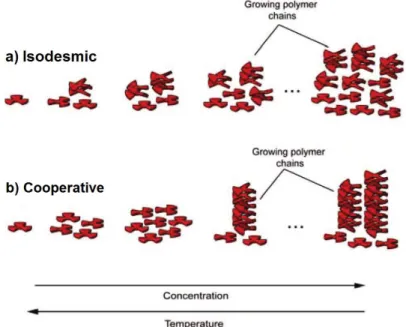
the understanding of the mechanism of BTAs self-aggregation that results in well-defined
supramolecular architectures.
[14]Figure 1. Schematic representation of C=O-centered BTAs columnar aggregation.
0 5 10 15 20 25 20 15 20 14 20 13 20 12 20 11 20 10 20 09 20 08 20 07 20 06 20 05 20 04 20 03 20 01 20 00 19 99 19 98 19 96
[53] [a] δ N-H ortho δt N-H ortho [b] χagg N-H ortho[c] χmon N-H orto[d] δ N-H para δt N-H para [e] χagg N-H para[f] χmon N-H para[g] δ C-H δt C-H[h] Linker [i] D [l] 188.5 9[m] 7.485 7.027 8.101 8.056 106.1 9 7.406 7.408 0.756 0.244 6.843 6.847 0.763 0.237 8.152 8.15 8.061 56.9 7.367 7.363 0.596 0.404 6.765 6.755 0.607 0.393 8.168 8.17 8.062 -9.40 28.45 7.303 7.307 0.333 0.667 6.627 6.638 0.331 0.669 8.203 8.20 8.062 14.22 5 7.264 7.264 0.173 0.827 6.549 6.548 0.175 0.825 8.223 8.22 8.063 7.112 7.243 7.240 0.087 0.913 6.505 6.499 0.087 0.913 8.235 8.24 8.063 -9.22 3.556 7.232 7.229 0.041 0.959 6.481 6.476 0.040 0.960 8.24 8.24 8.063 1.778 7.224 7.225 0.009 0.991 6.465 6.467 0.008 0.992 8.244 8.24 8.063 0.889 7.222 7.223 0.000 1.000 6.457 6.464 -0.008 1.008 8.246 8.24 8.063 0.444 7.221 7.222 -0.004 1.004 6.463 6.462 0.004 0.996 8.246 8.24 8.063 -9.12 δmon[n ] 7.222 6.461 8.245 δagg [o] 7.466 6.961 8.130 Kd[p] 44.992 44.117 38.386 p[q] 1.354 1.380 1.471
Table 8. Concentration-induced chemical shift variation of dimer 53 measured in CD2Cl2 at 295 K.[a] [mmo/L]. [b] Chemical
shift values calculated from the simulating equation for N-Hortho signal. [c] Aggregated species molar fraction calculated for
N-Hortho signals. [d] Monomer species molar fraction calculated for N-Hortho signals (1-χagg). [e] Chemical shift values
calculated from the simulating equation for N-Hpara signals. [f] Aggregated species molar fraction calculated for N-Hpara
signals. [g] Monomer species molar fraction calculated for N-H
para signals (1-χagg). [h] Chemical shift values calculated from
the simulating equation for C-H signals. [i] Measure chemical shift of the aromatic C-H protons of the linker unit. [l] Diffusion
coefficient measured as log(m2s-1). [m] This value was not taken into account on the fitting process due to an inconsistency
with the fitting process. The values of χ were extrapolated from the fitting curve.[n] The value refers to the extrapolated
chemical shift at the lowest concentration, where molecules are assumed to be fully monomer species. [o] The value refers
to the extrapolated chemical shift at the highest concentration, where molecules are assumed to be fully aggregate. [p]
Dissociation constant (mmol/L). [q] Slope factor of the fitting curve.
Understanding the mechanisms that create molecular order from simple building-blocks is a
prerequisite for deepening our knowledge of fundamental processes in biological and material
sciences.
[1]The availability of new materials showing properties in a programmed fashion (e.g. charge
transporting materials, self-aggregating materials) could be exploited and utilized in a broad scope of
potential applications from photovoltaics to biomedical applications.
[2]Nowadays the majority of the synthetic organic materials that found industrial uses and large scale
applications are polymers. However, polymers are not good starting materials for creating ordered
structures due to lack of knowledge in their non-covalent aggregation mechanism. Therefore only
few examples of controlled supramolecular assembly of covalent polymers have been reported so
far.
[3]On the other hand the use of the self-assembly process leading to supramolecular (aggregated)
polymers could potentially solve the challenges in providing materials with controlled properties. The
self-assembly process occurs in natural biological systems (e.g. DNA, proteins) and it has already
been successfully used in abiotic artificial systems.
[4]Typically, the relatively small number of
interactions responsible for self-assembly is combined with the wealth of empirical data for the
creation of “designed” structures with predictable shapes and properties. “Our ability to predict the
structural features and the functional outcome of the assembled materials is still limited and most of
the learning is done in retrospect”.
[5]In-depth understanding of natural phenomena is the ultimate
goal of fundamental research. At the moment that the natural phenomenon is sufficiently mastered,
its exploitation in artificial applications on large scale will be possible. “An important prerequisite to
evolve from an academic curiosity into a viable platform for advanced, functional materials is the
synthetic accessibility of the supramolecular building blocks and an in-depth understanding of how
small changes in the molecular structure affect the aggregation properties”.
[6]The use of reversible non-covalent interactions toward the construction of supramolecular
architectures presents the advantages of reduced synthetic costs, high modifiability and rapid access
to new structures. Due to the pioneering work of the Nobel laureate Jean-Marie Lehn from the
University of Strasbourg, the understanding of supramolecular non-covalent interactions has
changed and evolved dramatically.
[7]Since then, a large variety of functionalized monomers have
been reported in the literature.
[8]Different types of intermolecular forces that bind monomers to
form supramolecular polymers have also been identified. These interactions are mostly based on π−π
stacking,
[9]H−bonds,
[10]metal-ligand interactions
[11]or a symbiotic combination of several different
interactions (e.g. H-bonds and π−π stacking).
Trialkyl benzene-1,3,5-tricarboxamides BTAs: A journey into the
world of self-assembly.
Trialkyl benzene-1,3,5-triacarboxamides (or more simply and commonly called BTAs) are a promising
class of organic compounds used in the preparation of highly organized supramolecular structures
(Scheme 1). Although BTAs were synthesized for the first time in 1915 by Curtius
[12]their application
in the field of supramolecular chemistry did not started until late 1980s. At that time the group of
Matsunaga discovered that BTAs form hexagonal columnar liquid crystalline phases (Col
h).
[13]It has
been shown that BTAs organize in columnar mesomorphic phases over a wide temperature range
when the three side chains R (Scheme 1) are composed of at least five carbon atoms (pentyl
group).
[10]Scheme 1. General structures of benzene triamide derivatives BTAs.
In the last decade, trialkyl benzene-1,3,5-triacarboxamides have become the subject of extensive
studies (Graph 1), mostly because of their potential technological applications (e.g. discotic liquid
crystals DLC, organogels, MRI contrasting agents).
[6]Graph 1. Number of publications per year presenting the concept of “Benzene-1,3,5-tricarboxamide”. The key word was
searched on the program Scifinder® chemical abstract on the 1st May 2015. A total of 92 publications were found.
The extensive use of BTAs in the design of materials for new applications became possible thanks to
the understanding of the mechanism of BTAs self-aggregation that results in well-defined
supramolecular architectures.
[14]Figure 1. Schematic representation of C=O-centered BTAs columnar aggregation.
0 5 10 15 20 25 20 15 20 14 20 13 20 12 20 11 20 10 20 09 20 08 20 07 20 06 20 05 20 04 20 03 20 01 20 00 19 99 19 98 19 96
[54] [a] δ N-H ortho δt N-H ortho [b] χagg N-H ortho[c] χmon N-H orto[d] δ N-H para δt N-H para [e] χagg N-H para[f] χmon N-H para[g] δ C-H δt C-H[h] Linker [i] D [l] 193.4 6 [m] 7.487 5.773 7.205 8.074 -9.53 92.06 2 7.367 7.367 0.862 0.138 6.773 6.773 0.784 0.216 8.205 8.20 8.074 25.79 7.304 7.304 0.495 0.505 6.612 6.612 0.415 0.585 8.232 8.23 8.073 -9.31 12.89 5 7.264 7.264 0.262 0.738 6.530 6.530 0.227 0.773 8.249 8.25 8.073 6.447 5 7.238 7.239 0.110 0.890 6.478 6.478 0.107 0.893 8.258 8.26 8.073 -9.30 3.223 75 7.228 7.227 0.052 0.948 6.450 6.452 0.043 0.957 8.264 8.26 8.073 1.611 8 7.222 7.222 0.017 0.983 6.442 6.440 0.025 0.975 8.265 8.26 8.073 0.806 7.220 7.220 0.005 0.995 6.435 6.435 0.008 0.992 8.266 8.27 8.073 0.403 7.219 7.219 0.000 1.000 6.432 6.433 0.002 0.998 8.267 8.27 8.073 -9.18 δmon[n ] 7.219 6.431 8.267 δagg [o] 7.391 6.867 8.194 Kd[p] 26.227 33.669 27.841 p[q] 1.458 1.284 1.427
Table 9. Concentration-induced chemical shift variation of dimer 54 measured in CD2Cl2 at 295 K.[a] [mmo/L]. [b] Chemical
shift values calculated from the simulating equation for N-Hortho signal. [c] Aggregated species molar fraction calculated for
N-Hortho signals. [d] Monomer species molar fraction calculated for N-Hortho signals (1-χagg). [e] Chemical shift values
calculated from the simulating equation for N-Hpara signals. [f] Aggregated species molar fraction calculated for N-Hpara
signals. [g] Monomer species molar fraction calculated for N-H
para signals (1-χagg). [h] Chemical shift values calculated from
the simulating equation for C-H signals. [i] Measure chemical shift of the aromatic C-H protons of the linker unit. [l] Diffusion
coefficient measured as log(m2s-1). [m] This value was not taken into account on the fitting process due to an inconsistency
with the fitting process. The values of χ were extrapolated from the fitting curve.[n] The value refers to the extrapolated
chemical shift at the lowest concentration, where molecules are assumed to be fully monomer species. [o] The value refers
to the extrapolated chemical shift at the highest concentration, where molecules are assumed to be fully aggregate. [p]
Dissociation constant (mmol/L). [q] Slope factor of the fitting curve.
The skeleton of benzene-1,3,5-tricarboxamide is composed of a central C
3-symmetrically substituted
aromatic ring (discotic unit) functionalized by three amide groups (containing alkyl chains). The amide
groups can be connected to the aromatic ring in two different positions generating two distinct
isomers (Scheme 1). When the connection to the aromatic ring is made via the nitrogen atom,
N,N',N''-(benzene-1,3,5-triyl)-triamides, commonly called N-centered BTAs, are obtained. When the
connection is made via the carbonyl group however, N
1,N
3,N
5-(trisubstituted)
benzene-1,3,5-tricarboxamides, called centered BTAs, are formed. This study deals exclusively with
C=O-centered BTA derivatives, nonetheless for the sake of completeness, crystal structures, aggregation
mechanisms and major synthetic approaches of N-centered BTAs will be discussed as well. In a
simplified model, the aromatic rings are kept in place by a π−π stacking type of interactions. The
three amide groups stabilize the columnar intermolecular arrangement by forming H-bonds with
both neighbors (Figure 1). The process of aggregation was studied in the solid state, by means of
X-ray diffraction, and in solution using NMR and UV-spectroscopic techniques. The major results and
conclusions of the solid structure elucidation and of the analysis of the aggregation mechanism by
Meijer will be presented in this chapter.
X-ray structure
C=O-centered BTAs
More than hundred crystal structures of C=O-centered BTAs have been reported in the literature so
far. In this paragraph we focus the attention on the description of just a few BTA crystal structures to
explain the necessary parameters that enable columnar organization. In our approach we investigate
the influence of the intermolecular H-bonds on the conformation of amide group (N-H--O=C distance,
amide dihedral angle ϕ, aromatic inter-ring distance and interplanar dihedral angle). The goal of the
discussion is to highlight the important factors deduced from the analysis of simple model
compounds.
Generally N-alkyl benzamides are showing a coplanar conformation between the aromatic π-system
and the π-orbitals of the amide group, creating an optimal overlap (Scheme 2).
Scheme 2. Schematic representation of the benzamide torsion angle and the conjugation between the π-orbitals.
The planarity can be distorted by electronic effects or, especially, by the formation of strong H-bond
networks. Compiling the measured torsion angle of p-substituted N-methylbenzamide we found that
electron donating groups (e.g. -Me, -OMe and -OH) induce a small tilt (0°< ϕ <15°) from coplanarity
between the amide bond and the aromatic ring. On the other hand electron withdrawing groups like
-F or -CF
3,
consistently show a greater tilt (15°< ϕ <30°).
The second important observation is that H-bond distances reported for the interaction N-H--O=C are
between 1.58 to 2.05 Å.
[15]Since the publication of the pioneering work of Matsunaga, the columnar aggregation of BTA
molecules was proposed as model for the supramolecular structure. The occurrence of a helical
columnar aggregation was confirmed in 1999, by Lightfoot et al., when the X-ray structure of the
non-mesogenic N,N’,N’’-(2-methoxy)-ethyl-BTA 1 was reported (Figure 2).
[16]Typical distances
compatible with H-bonds were measured for the N-H--O=C bonds (2.196, 2.127 and 2.092 Å).
Surprisingly, very large torsion angles for the carbonyl groups with respect to the main aromatic
plane were measured (C
Ar-C
Ar-C=O 38°, 43° and 47°). The strong H-bond network twists the carbonyl
groups of 1 out of planarity. The large amide twist angle observed in 1 is the result of mutual
opposing effects: the conjugation between the aromatic ring and the amides favoring planarity and
the intermolecular H-bonds imposing a tilt of the amide groups. The fact that all the three amide
groups are tilted with roughly the same dihedral angle and that they orient towards the same
direction compared to the aromatic ring is due to the helicity and to the propeller-type columnar
organization (Figure 1 and 2).
Figure 2. X-ray structure of the propeller-type crystal packing of the model-BTA derivative 1 reported by Lightfoot et al. [16]
Hydrogen atoms have been omitted for the sake of clarity. Black dashed lines represent intermolecular H-bonds. The carbonyl groups are depicted in red and the N-H groups in blue in order to accentuate the helicity of the column (same sense of propagation). The figure illustrates the large twist angles of the three amides.
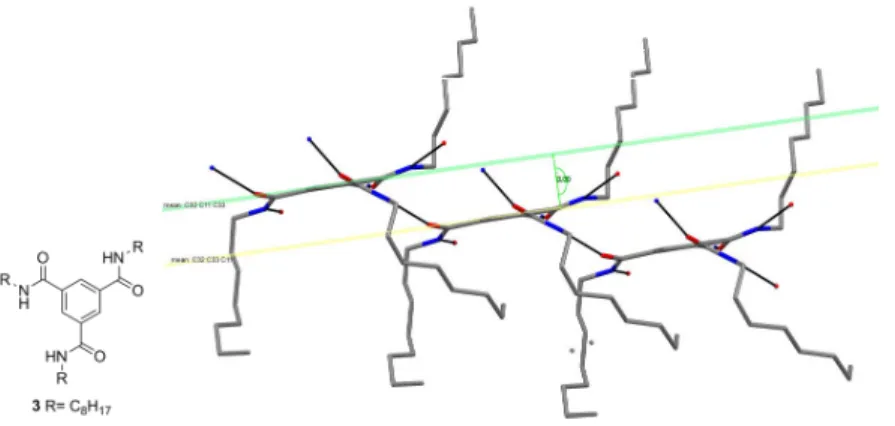
The aromatic rings are separated by a short centroid inter-ring distance of 3.62 Å and the measured
interplanar dihedral angle of 2.8° indicates good coplanarity between the aromatic rings. These two
observations are compatible with the occurrence of strong aromatic π−π stacking interactions.
[53] [a] δ N-H ortho δt N-H ortho [b] χagg N-H ortho[c] χmon N-H orto[d] δ N-H para δt N-H para [e] χagg N-H para[f] χmon N-H para[g] δ C-H δt C-H[h] Linker [i] D [l] 188.5 9[m] 7.485 7.027 8.101 8.056 106.1 9 7.406 7.408 0.756 0.244 6.843 6.847 0.763 0.237 8.152 8.15 8.061 56.9 7.367 7.363 0.596 0.404 6.765 6.755 0.607 0.393 8.168 8.17 8.062 -9.40 28.45 7.303 7.307 0.333 0.667 6.627 6.638 0.331 0.669 8.203 8.20 8.062 14.22 5 7.264 7.264 0.173 0.827 6.549 6.548 0.175 0.825 8.223 8.22 8.063 7.112 7.243 7.240 0.087 0.913 6.505 6.499 0.087 0.913 8.235 8.24 8.063 -9.22 3.556 7.232 7.229 0.041 0.959 6.481 6.476 0.040 0.960 8.24 8.24 8.063 1.778 7.224 7.225 0.009 0.991 6.465 6.467 0.008 0.992 8.244 8.24 8.063 0.889 7.222 7.223 0.000 1.000 6.457 6.464 -0.008 1.008 8.246 8.24 8.063 0.444 7.221 7.222 -0.004 1.004 6.463 6.462 0.004 0.996 8.246 8.24 8.063 -9.12 δmon[n ] 7.222 6.461 8.245 δagg [o] 7.466 6.961 8.130 Kd[p] 44.992 44.117 38.386 p[q] 1.354 1.380 1.471
Table 8. Concentration-induced chemical shift variation of dimer 53 measured in CD2Cl2 at 295 K.[a] [mmo/L]. [b] Chemical
shift values calculated from the simulating equation for N-Hortho signal. [c] Aggregated species molar fraction calculated for
N-Hortho signals. [d] Monomer species molar fraction calculated for N-Hortho signals (1-χagg). [e] Chemical shift values
calculated from the simulating equation for N-Hpara signals. [f] Aggregated species molar fraction calculated for N-Hpara
signals. [g] Monomer species molar fraction calculated for N-H
para signals (1-χagg). [h] Chemical shift values calculated from
the simulating equation for C-H signals. [i] Measure chemical shift of the aromatic C-H protons of the linker unit. [l] Diffusion
coefficient measured as log(m2s-1). [m] This value was not taken into account on the fitting process due to an inconsistency
with the fitting process. The values of χ were extrapolated from the fitting curve.[n] The value refers to the extrapolated
chemical shift at the lowest concentration, where molecules are assumed to be fully monomer species. [o] The value refers
to the extrapolated chemical shift at the highest concentration, where molecules are assumed to be fully aggregate. [p]
Dissociation constant (mmol/L). [q] Slope factor of the fitting curve.
The skeleton of benzene-1,3,5-tricarboxamide is composed of a central C
3-symmetrically substituted
aromatic ring (discotic unit) functionalized by three amide groups (containing alkyl chains). The amide
groups can be connected to the aromatic ring in two different positions generating two distinct
isomers (Scheme 1). When the connection to the aromatic ring is made via the nitrogen atom,
N,N',N''-(benzene-1,3,5-triyl)-triamides, commonly called N-centered BTAs, are obtained. When the
connection is made via the carbonyl group however, N
1,N
3,N
5-(trisubstituted)
benzene-1,3,5-tricarboxamides, called centered BTAs, are formed. This study deals exclusively with
C=O-centered BTA derivatives, nonetheless for the sake of completeness, crystal structures, aggregation
mechanisms and major synthetic approaches of N-centered BTAs will be discussed as well. In a
simplified model, the aromatic rings are kept in place by a π−π stacking type of interactions. The
three amide groups stabilize the columnar intermolecular arrangement by forming H-bonds with
both neighbors (Figure 1). The process of aggregation was studied in the solid state, by means of
X-ray diffraction, and in solution using NMR and UV-spectroscopic techniques. The major results and
conclusions of the solid structure elucidation and of the analysis of the aggregation mechanism by
Meijer will be presented in this chapter.
X-ray structure
C=O-centered BTAs
More than hundred crystal structures of C=O-centered BTAs have been reported in the literature so
far. In this paragraph we focus the attention on the description of just a few BTA crystal structures to
explain the necessary parameters that enable columnar organization. In our approach we investigate
the influence of the intermolecular H-bonds on the conformation of amide group (N-H--O=C distance,
amide dihedral angle ϕ, aromatic inter-ring distance and interplanar dihedral angle). The goal of the
discussion is to highlight the important factors deduced from the analysis of simple model
compounds.
Generally N-alkyl benzamides are showing a coplanar conformation between the aromatic π-system
and the π-orbitals of the amide group, creating an optimal overlap (Scheme 2).
Scheme 2. Schematic representation of the benzamide torsion angle and the conjugation between the π-orbitals.
The planarity can be distorted by electronic effects or, especially, by the formation of strong H-bond
networks. Compiling the measured torsion angle of p-substituted N-methylbenzamide we found that
electron donating groups (e.g. -Me, -OMe and -OH) induce a small tilt (0°< ϕ <15°) from coplanarity
between the amide bond and the aromatic ring. On the other hand electron withdrawing groups like
-F or -CF
3,
consistently show a greater tilt (15°< ϕ <30°).
The second important observation is that H-bond distances reported for the interaction N-H--O=C are
between 1.58 to 2.05 Å.
[15]Since the publication of the pioneering work of Matsunaga, the columnar aggregation of BTA
molecules was proposed as model for the supramolecular structure. The occurrence of a helical
columnar aggregation was confirmed in 1999, by Lightfoot et al., when the X-ray structure of the
non-mesogenic N,N’,N’’-(2-methoxy)-ethyl-BTA 1 was reported (Figure 2).
[16]Typical distances
compatible with H-bonds were measured for the N-H--O=C bonds (2.196, 2.127 and 2.092 Å).
Surprisingly, very large torsion angles for the carbonyl groups with respect to the main aromatic
plane were measured (C
Ar-C
Ar-C=O 38°, 43° and 47°). The strong H-bond network twists the carbonyl
groups of 1 out of planarity. The large amide twist angle observed in 1 is the result of mutual
opposing effects: the conjugation between the aromatic ring and the amides favoring planarity and
the intermolecular H-bonds imposing a tilt of the amide groups. The fact that all the three amide
groups are tilted with roughly the same dihedral angle and that they orient towards the same
direction compared to the aromatic ring is due to the helicity and to the propeller-type columnar
organization (Figure 1 and 2).
Figure 2. X-ray structure of the propeller-type crystal packing of the model-BTA derivative 1 reported by Lightfoot et al. [16]
Hydrogen atoms have been omitted for the sake of clarity. Black dashed lines represent intermolecular H-bonds. The carbonyl groups are depicted in red and the N-H groups in blue in order to accentuate the helicity of the column (same sense of propagation). The figure illustrates the large twist angles of the three amides.