no.
755
14- DEC 1 8 '74Center
for InformationSystems
Research
MassachusettsInstitute ofTechnology
AlfredP. Sloan SchoolofManagement
50 Memorial Drive
Michael J. Ginzberg
REPORT CISR-'I
SLOAN WP 753- 4
.(V\4\4-1975
2
M. 1. T. LiLJfCniilES
1. Introduction
Research on implementation in the past decade has been guided
almost exclusively by a single paradigm, the factor model. This
re-search generally starts with a group of variables or sets of variables
potentially relevant to implementation outcomes, and attempts to
de-termine the relative importance of these variables or sets of variables
to these outcomes (we use the term factor to refer to either a single
variable or a cluster of variables, as both tacks can found in
exist-ing factor research). The basis for deciding which variables to
in-clude in a factor study is complex, as there are a large number of
can-didates. Two major approaches to the selection of factors for studying
can be found in the literature: the inductive approach, which starts
with a source of data (e.g., ease observations) and extracts those
factors appearing to be important; and, the deductive approach, which
selects factors for study before data collection on the basis of past
research, literature review, expert opinion, etc. Certain other
varia-tions in research approach can be observed within the factor paradigm
-- focusing on one particular type of factor vs. looking at a range
of factors, examining a single project in depth vs. surveying multiple
projects and organizations -- but in all cases the underlying question
is, what factors are associated with implementation success.
Given the quantity of effort put into this single research
paradigm, we could expect to find some definitive answers to the
would suggest that this might be the case; we all know that top
manage-ment support and user involvement are critical to successful
implemen-tations. But, beyond this, what do we know about implementation; and,
how sure are we that this type of management support and user
involve-ment 2S_ important? Or, more critically, when are these factors
important?
In this paper, we will review a number of these factor
re-search efforts. We will consider the studies both individually and as
a group, attempting to find the general principles which have emerged
from this research paradigm. On the basis of our findings in
review-ing this research, we will draw some conclusions about the most
profita-ble avenues for further research on implementation.
2. Research Efforts Reviewed
2.1. Bases for selection.
The relatively small amount of research which has been
con-ducted on implementation precluded the need for elaborate sampling
procedures in selecting the studies to be considered in this review
effort. Clearly, the most important factor for a study's inclusion
was my knowing (or finding out) that it existed. While this may not
seem to be the most scientific basis for selection, the studies seem
to reflect the full i^ange of research on OR/MS activities. They can
be classified in terms of three important characterisitcs: 1) the
included here representative of factor research on implementation? and,
are they representative of research on implementation generally?
Turn-ing first to the settings included in the studies, we find a wide range
of coverage -- a substantial number of public and private organizations,
a variety of organization sizes, a number of cultures (U.S., Europe,
and Latin America), and a variety of project types. While no single
study covers the entire range, taken as a whole they seem to provide
an adequate representation of the non-military settings in which OR/MS
activity is taking place.
In considering the measurement methodology employed, two issues
are of relevance. First, what variables were selected for measurement
and what was the basis for their selection? And, second, how were they
actually measured? Keen (1974) suggests that factor studies typically
measure those variables which are most readily measurable, with little
regard for theoretical considerations in the selection of these
vari-ables. The fourteen studies included in our sample identify
approxi-mately 140 different factors, covering a wide range of the variables
potentially affecting implementation outcomes. We shall show later,
however, that the distribution of research effort among these factors
is far from balanced. The bases on which these factors were selected
for study is not immediately apparent; few authors state explicitly why
fourteen studies the factors examined were abstracted from the data
(normally interview or case observation based) after it was collected.
We will return to this question in a later section, but for now we can
state that there is no immediate grounds for dismissing Keen's
con-jecture. Turning to the question of measurement itself we find a
variety of techniques employed, ranging from introspection, through
case observation, to administration of questionnaires and the
examina-tion of company records. Thus, on the issue of the completeness of
coverage of measurement methodology in our sample of studies we can
conclude that the range has been adequately covered.
The third characteristic to be considered is that of the
de-pendent variable selected and the basis for its measurement. The
four-teen studies show considerable variety on this dimension, including
both "hard" -- e.g., percent of projects implemented, specific types
of system usage -- and "soft -- e.g., perceived project usefulness,
rank ordering of perceived achievement in computer use -- measures
of outcome. We will review these measures in more detail when we look
at the individual studies.
In general, we can assert that the sample of studies
con-sidered displays a considerable range on each of these three critical
dimensions, and that it is representative of the bulk of research on
MS/OR and computer application implementation. Certain studies which
could have been included in this sample were purposely excluded because
of cognitive style falls into this category, and we do not mean to deny
the relevance of this work. It does, however, represent only one among
the many issues potentially relevant to the implementation process, and
does not focus on the central question of the factor study: "What
variables are most relevant to implementation?"
The next section reviews briefly the fourteen studies we
have included in our sample. We will look at the issues of setting
and methodology, plus certain key points brought out by these studies.
Consideration of actual results will be left to a later section.
2.2. Once over lightly: highlights of the fourteen studies.
1. McKinsey & Co. (1968): "Unlocking the Computer's Profit
Potential"
While actually conducted later than some of the other studies
in the sample, this work is conceptually first, as it is largely an
update of an earlier McKinsey study (Garrity, 1963). The focus of this
study was on those factors which differentiated more successful
computer users from their less successful counterparts. The sample
included 36 companies in 13 industries, covering a wide range of sizes,
and located both in the U.S. and in Europe. Success was measured by
judgementally ranking the 36 companies on their overall achievement
success, from extensive interviews with both staff and line executives.
The McKinsey studies are notable both for being early in the history
of studying implementation and for their best known results, the
importance of top management support of and operating management
involvement in the application development process.
2, Evan & Black (1967): "Innovation in Business
Organiza-tions: Some Factors Associated with Success or Failure
of Stoff Proposals"
Evan and Black focus on innovation, "the implementation of
new procedures or ideas" (p. 519), and attempt to determine what
factors affect the likelihood that an innovative proposal submitted by
staff to line management will be implemented. The sample considered
in this study included 52 respondents in a smaller number of companies.
The respondents were either staff personnel or line managers, and
each reported on one successful and one unsuccessful proposal for
innovation (success being defined as the proposal's being "largely
accepted and implemented by management"). Data was collected with
self-reporting questionnaires asking closed-ended questions about
eleven pre-selected factors. The data was then analyzed using stepwise
discriminant analysis to select those factors (from among the eleven)
which best separated successful from unsuccessful proposals. Seven
3. Rubenstein et al . (1967): "Some Organizational Factors
Related to the Effectiveness of Management Science Groups
in Industry"
The third study considered is reported in Rubenstein et al.
(1967). While we have included only the results discussed in this
single paper, they are representative of other work reported by these
authors (e.g., Radnor et al., 1968 & 1970). This work is concerned
with finding the "necessary and sufficient conditions which permit the
integration, acceptance, and growth of [innovative] activities",
partic-ularly OR/MS, in organizations; that is, the factors contributing to
greater use of OR/MS. To operationalize this concept the authors
examine the extent to which proposals and programs of the organization's
OR/MS activity were being implemented. As no hard measure is specified,
we assume that it is the researcher's impression of how well these
processes were going that serves as the dependent variable. The
factors considered in this study were those appearing important to the
authors after some preliminary exploration. No mention is made of how
variables to be considered in these preliminary studies were selected.
*
We offer the suggestion that some of these factors were not adequately
tested; the specific items in the questionnaire well may not be
among the first researchers to suggest the potential importance of
contingencies; in particular, they argue for the importance of the
organization's stage in the life cycle of OR/MS activities as a
conditioning variable.
4. Harvey (1970): "Factors Making for Implementation
Success and Failure"
Harvey's study differs from the others in our sample in a
number of respects. First, it is not truly a research effort, but more
a case of group introspection to explain past successes and failures.
Second, and more important from our point of view, it occurred because
the author felt that the literature tended to rely too much on a
single explanation -- management support and participation -- for the
success or failure of OR/MS implementations, and that other factors
of at least equal importance should be explored. Thus, the sample
analyzed in this study consisted of 31 former clients of the author's
consulting firm; this, he claims, may have biasod the results, as all
of these companies "were looking for state-of-the-art solutions to
problems ..." (p. B313). The factors considered were those that the
author and his colleagues felt, based on their experience, were
import-ant. Each of the 31 companies in the sample was ranked by the
consultants on each factor. The dependent variable was simple: had
them. As the eleven factors selected for testing were in a sense
derived from the data used to test them, it is not surprising to find
that all eleven were found to correlate highly with implementation
success. We also should note that the factors which Harvey initially
argued should not be the sole explanations of success -- i.e., support
and involvement -- are not considered at all in his study.
5. Dickson A Powers (1971): "MIS Project Management: Myths,
Opinions, and Reality"
Dickson and Powers focused their attention on the
"organiza-tional and procedural factors" correlating with success in a certain
class of MIS projects. The study included two projects in each of ten
organizations in the flinneapol is/St. Paul area. The factors studied
were selected in a relatively complex fashion. First, a moderately
long list of potential factors (approximately 35) was generated by the
authors and their students. This list was then submitted to a large
panel of DP professionals (SMIS members) for their ratings of factor
importance. Their responses (approx. 140 returned questionnaires) were
used to compute average factor 'importance scores' and to develop
clusters of factors (using factor analysis). A subset of these items,
spanning the range of the a priori 'importance scores' and covering
all factor clusters, was selected for use in tin's study. Additional
items were included where data collection would be easy. Collecting
data for the study was accomplished by extensive interviewing of
separate indicators of success were employed as dependent variables
--actual vs. estimated development time, actual development cost vs.
budget, user satisfaction, and the impact of the project on computer
operations. One of the more interesting findings of this study was
the total lack of correlation among these four measures.
6. Vertinsky (1972): "OR/MS Implementation in Valle,
Colombia, S.A.: A Profile of a Developing Region"
This study widens considerably the coverage of settings in
our sample, as it looks at OR/MS activities in Colombia, South America.
The author is concerned chiefly with the correlates of implementation
and diffusion of OR/MS in developing regions. Selection of factors
for this study was based both on induction (those factors appearing
important in an earlier study) and on deduction (factors which
theoret-ically should be important in a developing country). Factor
measure-ment was accomplished through a mixture of interviews and questionnaires,
the respondents being Presidents or General Managers of the companies
under study. The dependent variable in this study appears to be the
researcher's assessment of whether the factor impacted the OR/MS
diffusion and implementation processes.
7. Drake (1973): The Administration of Transportation
Modeling Projects
Drake's work focuses on a specific type of project, the
application of OR/MS to transportation system modeling efforts. He
considerable detail) based in both the U.S. and Europe, and having both
private and governmental clients. The factors considered were designed
to test a series of hypotheses proposed by the author (the basis for
selecting these particular hypotheses appears to be Drake's own work
experience). Data were collected through a detailed questionnaire
administered by the researcher, and this data was supplemented by his
field observations. Drake's intention was to obtain responses from both
the model builder and the decision maker (model user), though in a
number of cases he was able to speak only to the user. The dependent
variable chosen was the decision maker's assessment of the project's
usefulness. This focus on the user's view of an implementation effort
is both rare and quite important; much of the literature is based on
the technician's view of the project, which can be quite different from
that of the user (see Dickson & Powers for a discussion of designer/
user differences in perception).
8. Lucas (1973): "Behavioral Factors in System
Implementa-tion"
Lucas' study differs from most of the others we will consider.
He looks at a single sales information system having numerous potential
users (salesmen) in a single company, and attempts to find those factors
which help differentiate users from non-users. Lucas makes the
argu-ment that for purposes of implementation a M.I.S. is equivalent to any
other MS/OR project; at a minimum, an information system is a simple
sophisticated models. This arqument, which wo largely accept, should
explain our rationale for includinq this (as well as some other) studies
in our sample. Lucas presents a simple descriptive model of factor
clusters purported to explain system use, and from this model derives
a number of factors to be tested. Factors as well as dependent
variables were measured with questionnaires and by examining company
records. Indices of six specific types of system usage served as the
dependent variables, and factor importance was assessed using stepwise
multiple regression to develop usage "prediction" equations. All factors
were found to be significant in at least one such equation, but the
particular factors included varied across equations; those dealing with
attitudes towards and perceptions of the computer system showed a
rela-tively consistent positive relationship with usage, with the results for
environmental and personal factors being considerably weaker and less
consistent.
9. Manley (1971): "Implementation Attitudes: A Model and a
Measurement Methodology"
Manley's work differs in a number of respects from all of the
other studies in our sample. First, it focuses neither on the model
builder nor the model use'-, but on the "client", defined as a person
impacted by the proposed innovation but having no de jure authority to
decide whether to accept .md use it or not. The clients in this case were
teachers in a public school system presented with a proposal for
"optimizing the computation of the supplemental pay for extra-curricular
an index predicting the level of client group support of or resistance
to the proposed project. This index was derived from the interaction of
the clients' assessment of the relative importance of five external
factors and their "attitude orientations" toward these factors. The
external factors considered were arrived at by boiling down a list of
factors culled from the literature to five generic factors. The
measurement of these factors represents the third, and probably the most,
unique aspect of this study. While being conducted in a real
organiza-tion with respondents who believed the proposal to be genuine, the study
was in fact a controlled experiment; factors were varied systematically
by giving different respondents different versions of the proposal. In
the experiment Manley tested two of the five external factors --
manage-ment support for the project and the amount of the client's time
required for implementation -- and found both to result in significant
differences in the client's "attitude orientations".
10. Gibson (1973): "A Methodology for Implementation Research"
Gibson offers the only example of a single case study that we
have included in our sample. His research was conducted in a New
England bank, and was concerned with an effort to implement a translator
model which would interface with a regional economic model being developed
concurrently. The factors considered in this research were arrived at
inductively, being those issues which seemed to have important impacts
on the progress of this implementation. Thus, selection of factors was
there was a fairly long history of "action research" by Gibson and his
colleagues at this site, adding credebility to the importance of these
factors in this setting. "Measuring" factors was accomplished primarily
through unstructured, periodic interviews with key personnel, but
supplemented with questionnaires to explore certain issues which arose.
This is the only study in our sample where the researchers acted as
participant observers and actually attempted to influence the
implement-ation process.
Including Gibson's study in our review of factor research might
seem inappropriate, but we have done so for two reasons -- first, the
results of the study are couched to an extent in terms of factors; and,
his work presents one extreme in methodology for studying implementation,
thus adding to the range of our sample. In fairness to the reader we
must admit that this is not really a factor study. And, in fairness to
Gibson we must point out that this work does not suffer from a number of
methodological problems which plague factor research and which we will
discuss later in this paper. Indeed, Gibson is one of a very few
researchers in this area sensitive to methodological issues.
n.
Smith et al . (1973): "Operations Research Effectiveness:An Empirical Study of Fourteen Project Groups"
Our next study also took place in a single organization, but it
looked at fourteen separate projects within this organization. Smith et
al . attempted to find the factors which contributed to the effectiveness
factors considered included a number of predefined items -- e.g., user
demographics -- plus those factors reported by team members to have been
important contributors to or detractors from their effort. Factors were
measured using a questionnaire administered by the researchers. Two
dependent variables were employed. For testing the predefined factors,
the average group effectiveness rating as reported by the team members
served as the dependent variable, while for the elicited factors, the
relative importance rating given that factor by the respondents was used.
12. Carter et al . (1973): "A Study of Critical Factors in
Management Information Systems for U.S. Air Force"
The research of Carter et al . is presented to us at a somewhat
earlier stage than the other studies we have considered. The long term
goals of this research are the identification of those factors critical
to MIS implementation success, the development of instruments to measure
the status of these factors, and, eventually, the development of a
model for predicting implementation success. The phase I results
presented relate primarily to the first of these three goals. An initial
set of interviews with systems and general management professionals was
used to generate a series of reconstructed implementation case histories.
The researchers "content analyzed" these interviews to abstract a list
of critical factors. A subset of this list was tested in a national
survey, in which respondents were asked to rank the relative importance
of the fourteen factors presented. Thus, at this stage of the research,
factor serves as the dependent variable. We should note that this
project is considerably more sophisticated, both in terms of scope and
method, than much of the other factor research; the full project involves
several recursive steps over a period of a few years.
13. Bean et al . (1973): "Structural and Behavioral Correlates
of the Implementation of Formal OR/MS Projects: Success
and Failure in U.S. Business Organizations"
This is the most ambitious study (at least in terms of sample
size) included in our sample. It was aimed primarily at the structural
and organizational factors affecting implementation. One hundred and
eight companies covering 12 industry sectors were explored, and
approx-imately 10-15 projects in each company were included in the sample.
Factors were pre-selected, and were measured through structured
inter-views with the head of the OR/MS activity in each company. Two dependent
variables were considered; the percentage of projects worked on which
were successfully implemented, and the OR/MS activity manager's overall
assessment of his group's success (an index composed of a number of his
responses). One particularly important finding of this study is the
effect of the OR/MS activity's "stage in the life cycle" on both which
factors are important and the overall level of OR/MS success.
14. Schultz & Slevin (1973): "Implementation and
Organiza-tional Validity: An Empirical Investigation"
The final study in our sample is a report of Schultz and
implementation. The authors contend that the relative lack of research
on implementation is due, at least in part, to a lack of research tools;
hence their effort to develop a tool that would be generally applicable
for such research. The instrument and this study focus on individual
attitudes as they relate to a particular model and its implementation.
An extensive list of potential variables was assembled from the
litera-ture, and a pilot version of the questionnaire was administered to a
class of M.B.A. students. The responses were factor analyzed, and a
modified questionnaire, based on these extracted factors was used in the
field test. This latter test involved 94 sales and marketing personnel
in a single company, responding to questions concerning a specific model
under development for their department. Questionnaire items were of
two types
—
semantic differential concept factors and specific items ina Likert-type format. Five of these latter items, dealing with
expecta-tions for the model's use and worth, served as dependent variables.
This section has reviewed the issues of setting, methodology,
and dependent variable in the fourteen studies that comprise our sample
of factor research. Table I provides a summary of this material. As can
be seen, the studies cover a wide range. Beyond the questions of setting
and method, the issue of focus has been raised. Some studies were
concerned with the factors affecting specific implementations, others
focused on factors influencing OR/MS group effectiveness, while still
<LI
D
3 C +-> s-o QJ +-> CO +-> en QJ j:3 IT3C o in 0}
D
3 4-> CO C s-3 o +J <+-o to 4-> -C CD f— -C en n: l-H (UAll of these are legitimate areas for implementation research; all are
representative of some part of the factor research that has been conducted
Thus, all were included in this review. In the next section we turn to
the results of these studies.
3. Results of the Factor Studies
3.1. A structure of implementation factors.
The fourteen studies we have reviewed present us with 140
separate, identifiable factors. Considering all of these factors on an
individual basis would be both time consuming and dull. Thus, we need
some sort of structure within which to organize these factors. In
reviewing the literature, and in attempting to think about the various
possible influences on implementation outcomes, we have found ten major
clusters of variables. These are:
1. Symptoms, actions, and specific behaviors -- identifiable
actions taken by the user, designer, or management which
either affect or are in some way symptomatic of the
implementation effort;
2. Internal ecology -- characteristics of the organization,
its structure, and the people who comprise it;
3. Model characteristics -- characteristics of the physical
and conceptual solutions to the problem;
4. Problem characteristics -- the nature of the problem and
5. Extra-organizational environment -- characteristics of the
external environment facing the organization;
6. Implementation process characteristics -- methods used to
move through the stages of system development,
cormuni-cation patterns, role structures, etc.;
7. Perceptions -- perceptions of tasks, goals, and the impact
of the proposed solution held by those involved in or
affected by the implementation effort;
8. Expressed attitudes -- attitudes of involved and effected
personnel towards technology, the problem, and one
another;
9. Underlying attitudes and motives -- more basic outlooks
and desires of involved and effected personnel; and
10. Organization history -- past actions of the organization
which can impact its current ability to deal with
innovation.
Each of these major clusters has been divided into sub-clusters based
on the particular factors explored in the fourteen studies of our sample
(see Appendix I). We make no claim for the completeness of the
sub-clusters; these are based solely on the 140 identified factors. We do
suggest, however, that the ten major grou|)s cover the range of potential
3.2. Summary of results.
Appendix I presents a matrix of the 140 factors, grouped in
accord with the structure we have presented above, showing the results
of the fourteen studies we have considered. Perhaps the most striking
characteristic of this matrix is its sparseness. Fully 102 (73%) of
the factors are reported in only one of the fourteen studies. An
additional 23 (16%) are reported in two studies, and 12 (9%) in three.
Of the remaining three factors, two -- "well defined measurable
objectives" and "complexity of techniques and models" -- are considered
in four of the research efforts reviewed, and the final one
--"management support" -- sees daylight five times. Thus, from the start
we must realize that we are not looking at issues widely tested in a
variety of settings.
Next, we note the concentration of both factors and
observa-tions in the first few of our ten factor groups. Fully 50% of the
factors and 58% of the factor observations fall into the first two
classes -- symptoms and actions, and characteristics of the internal
organizational environment. This translates to 28 of the 38 (or 74%)
factors with multiple observations falling into the first two classes,
with 87% (33) falling in the first four of ten groups. We will return
to this issue in the next section when we consider more carefully the
types of factors that have been studied.
We have already pointed to the very low degree of overlap
this lack of comparability is emphasized when we consider those factors
where multiple measures have been taken. In a significant proportion
of such cases there is a lack of concordance among the findings.
Consider, for example, the factor "well defined, measurable objectives
for the system" (I.
CIO).
Four studies included this factor; in threeit was found to be important, while in the fourth (Dickson & Powers) it
did not relate significantly to any of the four dependent variables.
Numerous similar examples can be found in the tables of Appendix I.
A partial explanation for this finding is the difference in
dependent variables among the studies. This can be seen most clearly
in the results of the Dickson & Powers and Bean et al . studies. In
both of these efforts multiple dependent variables were employed -- four
in the former and two in the latter -- and the authors report the
correlations of each dependent variable with the factors. Thirty
percent (12 out of 40) of the factors reported in the Bean et al. study
show different results depending on which dependent variable -- percent
of initiated projects actually implemented or overall rating of the OR/MS
group's success -- is used. Of course, the differences for any given
factor are only between significance in one direction and no significant
relationship. However, in the Dickson & Powers study the picture is
somewhat more depressing; no factor significantly related (at the 10%
level) to more than one of the dependent variables affects all of the
dependent variables it is significantly related to in the same direction.
a fairly convincing explanation for the apparent contradictions among
certain of the results, there are other potential explanations which we
should explore. One such possibility is a lack of validity in the
factor measures; i.e., the 'instruments' used do not measure what they
purport to. The results reported in the fourteen studies do not give
us much opportunity to test this hypothesis, but there is one indication
that this might be the caso. Schultz & Slevin use a combination of
semantic differential scali^s and Likert-type questions in their work,
and for a few factors theso two measures overlap. For one, "expected
changes in the communication system and interpersonal relations", the
results differ for the two ways of measuring the factor. While this is
hardly conclusive proof of poor instrument validity throughout the
factor studies, it does suggest that the problem may exist (particularly
when we consider that many studies relies on the researcher's
observa-tions for 'factor measurement', and that there is no evidence to suggest
*
that any instrument was ever used more than once).
The third potential explanation is the issue of contingency,
or lack of comparable conditions. Implicit in the factor approach is
the assumption that factors are universal -- management involvement is
always good, or the OR group's selecting the projects to be worked on is
always bad. We contend that this is an unwarranted assumption, that the
importance of a given factor will vary from situation to situation.
*
Keen (1974) takes a closer look at the instruments used in factor studies
Bean et al. present some evidence which supports this position. They
analyze their data both in aggregate and broken down to control for the
stage in the life cycle of the organization's OR/MS activity, and find
differences in factor significance across the stages. This is only one
of many possible contingencies, but it points up the need to identify
the relevant contingencies before accepting the results of a given study.
Finally, in considering explanations for particular results, we
should not ignore the possibility of spurious correlation or
non-correlation. Turning again to Bean et al., we observe a most unusual
finding: the performance of post implementation evaluations is
signifi-cantly positively related to the percent of initiated projects which are
implemented, but is unrelated to the overall rating of the OR/MS group's
success. It is indeed difficult to imagine why performing post project
audits should affect the rate at which projects are accepted. At best
we n)ight believe that such an administrative procedure is related to
other organizational practices which in turn im|iact implementation rate,
but accepting this result as it stands requires just too great a leap
of faith.
We can draw certain conclusions from our brief look at the
factor study results. Though many factors have been studied there are
few general guidelines emerging from this line of research. In part this
is due to a lack of replication of tests, and in part to the fact that
little of what has been reported prior to a given study seems to find its
use of different instruments and dependent variables in each study, and
by a failure to identify the contingencies that are important in any
given situation. All in all, we can judge this line of research as
having contributed less than it might have so far. We would also suggest
that the factor approach, lacking in theory, inter-study comparability
and to a great extent, direction, can never produce more than fragmented
findings of the type it has so far. Until there is an effort to build
"maps" which can integrate results by focusing on key contingencies, we
cannot progress in this line of research (see Keen, 1974, for further
comments on this issue).
4. A Deeper Look at the Factor Paradigm
4.1. Relationships among the factors.
In the previous section we presented ten groups into which we
classed the 140 factors. Now we will explore these classes more carefully,
attempting to uncover relationships which exist among the different
factor classes. We can think about factors as being arrayed along a
dimension of visibility to the outside observer. At one extreme would
be those factors which are totally overt, accessible to even the casual
observer; and, at the other extreme, those which are almost completely
hidden, inaccessible to all but those with a considerable knowledge of
the particular organization, its operations, and its background. We
suggest that the ten factor classes presented earlier form, roughly, such
are the first two classes -- symptoms, actions, and specific behaviors,
and characteristics of the internal organizational ecology; the factors
in these two groups being relatively easy to observe in most
organiza-tions. At the opposite extreme are categories IX and X -- underlying
attitudes and motivations, and aspects of the organization's history.
Clearly, these factors are largely hidden from all but the most
persistent and resourceful observers. In between are categories III
through VIII. These might be divided into two or three groups, but
it is not critical to do so for our purposes. We have arranged them
in an order we believe approximates the degree to which they are hidden
from the observer -- model characteristics being most overt and
expressed attitudes most covert.
Keeping this overt-hidden dimension in mind, lets look at the
factors from another angle. Implementation is a process of change.
As a process, it accepts certain inputs and produces certain outputs.
The critical output of such a change process is the desired change;
in the case of MS implementation, the model or system and the requisite
changes in behavior to operate with the new system. The inputs to the
process include the attitudes and actions of the individuals involved,
their perceptions, the problem they are addressing and the technology
they attack it with, and the environment in which they are operating.
In other words, many of the factors mentioned in the factor studies
are inputs to the implementation process. Others, particularly those
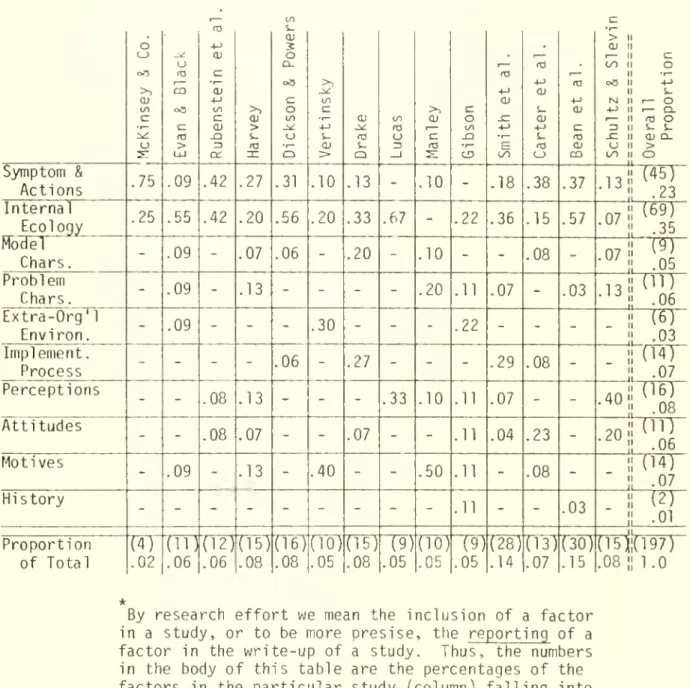
Table II
Table II (continued)
numbers in the final row and column represent,
respect-ively, the number of factors included in the study,
and the number of observations (i.e., inclusions in a
study) of the factors in that class.
VI (implementation process characteristics) are an indication of
the process that is taking place; they are symptoms of the on-going
process. We should note that neither of these types of factors truly
represents the actual process of change. On the one hand we have the
'fuel' for the process; on the other, certain side effects of its
occurring. But, the former group does not represent the cause of
change, nor the latter its output.
Returning now to our overt-hidden dimension, we can see how
the factors fit together. At the overt extreme of the spectrum we
have the bulk of the symptoms of change plus one type of input to
the process. The remainder of the inputs are arrayed along the scale
towards the hidden end.
When we look again at the fourteen studies we find a
disproportionate amount of research effort going into the overt end of
the scale (Table II). The first two factor classes represent a total
of 58% of the factor observations (23% and 35% respectively). None of
the remaining eight classes received more than 8% of the total factor
observations. Looking at the studies individually we see that all
addition, in all but three of the studies the class receiving the most
attention was one of the first two. No other factor class comes near
these first two in terms of attention received.
We have no a priori reason to believe that overt behaviors
or internal organizational ecology are more important than other
factors in determining implementation outcomes. In fact, a case can
be made which suggests just the opposite; attitudes, perceptions,
motives, and organizational history may well be the underlying
causes of some of the more overt factors, specific actions and behaviors
or the structuring of the internal organization, for example. Why,
then, do we find the preponderance of research effort being directed
towards the most overt factors? Perhaps the most plausible explanation
is that suggested by Keen. The more overt the factor, the easier it
is for a researcher to measure it. Having little or no theory to guide
them in their selection of factors, researchers have chosen those
factors which were most readily accessible.
4.2. Further work with the factor paradigm?
There has been a trend very recently in some circles to move
away from the factor approach to implementation research (Gibson, 1973,
Lucas & Plimpton, 1972, Sorensen & Zand, 1973, and Urban, 1974, are all
examples). The reason for this movement is a growing recognition of
some serious shortcomings of the factor paradigm. Most important among
factor studies, a failure to look at implementation as a process
extending over time, and a tendency to focus on a few variables one
at a time, thus ignoring other important variables and interactions
among variables.
We will turn now to one recent study which was undertaken to
meet the objections cited above (Miller, 1974). This study is an
extension of the work of Gibson and his colleagues, and took place at
the same field site. Thus, the author had a considerable amount of
backgroung knowledge, both substantive and methodological, to draw upon.
Miller suggests that in order to understand implementation it will be
necessary "to conduct longitudinal studies of the implementation
process in its manifold complexity as it unfolds and develops over
time" (p. 13). His aim is to understand the behaviors of managers and
model builders which together bring about the outcomes of an
implement-ation effort. To this end, he adopts a simple model for viewing such
behavior. The model proposes that three sub-systems (or variable
classes) determine behavior -- the individual, the social, and the
organizational sub-systems. For each of these sub-systems Miller
defines certain variables and measures assumed to be the right ones
for consideration in an attempt to understand implementation. Over a
relatively long period the researcher then observed an implementation
effort (the N.E. bank translator model mentioned in our discussion of
Gibson's work) and collected a considerable quantity of data, including
And, in qeneral , he found that these variables had some impact on the
implementation process.
Miller undertook this research effort in answer to certain
shortcomings he found in the factor approach, and in certain areas he
has successfully addressed problems which characterize previous factor
studies. He recognizes implementation as a process of change. Hence,
he has chosen a dependent variable more appropriate to such an effort
than the simple definitions of success frequently used in factor
studies; and, he has looked at the change effort over a sufficiently
long period of tine to get some real understanding of what is going
on. However, in many ways his work is really a factor study, and he'
falls into some of the traps of previous factor researchers.
By carefully examining the problems which Miller's work raises,
we can begin to understand why the factor paradigm is an inadequate
model for implementation research. First, consider the variables
studied in this effort. Table III presents these variables, where they
fit in the structure of factors presented earlier, and an indication
of whether or not they were included in one (or more) of the fourteen
studies we have reviewed. Three points are immeaiately apparent when
we look at the table. First, Miller's factors fall largely (five out
of seven) in a single factor class, the internal organizational
environment. Second, coverage is strongly biased towards the more
overt factors, with five factors in class II and one in class I. And,
Table III
Factors in Miller's Study of Implementation
Factor
1. cognitive style of users &
model builders
2. builder/user personality
style match
3. builder/user status or
rank differences
4. belief or ideological systems
of builder & user
5. builder & user task
environ-ments -- explicitness of task
definitions, constraints
suggests is that the number of potentially important factors is virtually
uncountable. So many variables could affect an implementation effort
that we could go on forever adding new factors to our list.
Turning to the issue of coverage of the range of factors, we
can see that Miller fell into the trap of most previous factor
research-ers. He opted to measure a certain subset of factors, and these were
concentrated at the overt end of the factor spectrum. True, he found
these seven variables to be significant, but he can say nothing about
the hundreds of factors he did not test. This, we believe, is one of
the major weaknesses of the factor paradigm; you can only get out what
you put in. And, this is true whether the factors to be measured are
picked at random, selected on the basis of ease of measurement, or
based on some theory of behavior. The initial selection determines
the maximum that you can learn. We will discuss this point further
in the next, and final, section of this paper.
5. Summary of Problems with the Factor Model
Factor studies of implementation have given us some useful
knowledge about implementation. They have shown that there are a myriad
of factors which can, and at least sometimes, do affect the progress
of an implementation effort. However, we contend that this approach
has a number of flaws serious enough to cause us to doubt its further
usefulness as a paradigm for research on implementation.
number of potentially relevant factors. The researcher, having only
a limited amount of time, must of necessity limit his investigation to
a small subset of these factors. In the absence of any well defined
theory of implementation, the selection of factors for consideration is
left largely to the individual researcher's biases; and, as we have seen,
such selection is not likely to provide a representative sample of
factors. We have also noted that the same result can obtain if we move
to the other extreme. Tightly defined theories of implementation
behavior are likely to focus on only a few factors. Thus, using such
theories as guides to the selection of factors for study yields the
same result as using no theory at all; careful attention to a small
number of factors at the expense of ignoring other, likely equally or
more important, factors. As we stated earlier, you can only find out
what you go in looking for.
The second major defficiency of the factor model as a research
vehicle is its inherently static view of the world. Typically, factors
are measured at a single point in time and the results are assumed to
capture the essence of that implementation effort. If we review the
factors listed in Appendix I, we find that all of them deal with either
inputs to the implementation process or side effects of the process.
None are truly concerned with the dynamics of the on-going process.
Yet, implementation is a process, taking place over a considerable span
of time, and any meaningful understanding of implementation must stem
Our third complaint concerns the implicit assumption of many
factor researchers that factors are absolutes -- a given condition is
always good or always bad. A more realistic view is one which considers
contingencies or factor interactions. The effect of a factor in a given
situation depends greatly on the other factors present in that situation.
There is no inherent reason (other than the complexity of analysis and
the need for larger quantities of data) why factor studies cannot consider
such interactions; few researchers, however, have done so.
The fourth, and final, fault we will raise is the failure to
focus on the management of the implementation process. The concern has
been with measuring, classifying conditions as favorable or unfavorable
to implementation outcomes. This orientation is understandable given
the static world view embodied in this paradigm and the nature of the
factors that have been considered. Practitioners, however, are more
interested in managing the process, making an implementation effort
successful, than in being able to explain why it failed.
In sum, we can state four necessary characteristics of an
improved implementation research methodology. First, it should be
grounded in a sort of "mid-range" theory; going neither to the extreme
of no theory at all, nor to the that of a theory so confining that much
important evidence is ignored. Next, it should focus on dynamics, the
process aspects of implementation. Third, it must recognize the
exist-ence of contingencies and interactions among factors, and it should
likely to arise in given situations. Finally, if it is to be of any
real use, it must be oriented towards the management of the process,
and must include appropriate control points for managers' and
practitioners' use.
*
See Keen (1974) for a more thorough discussion of the desiderata of a
References
1. Bean, Aldpn S. , Rodney D. Neal, Michael Radnor & David A. Tansik
(1973): "Structural and Behavioral Correlates of the
Imple-mentation of Formal OR/MS Projects: Success and Failure in
U.S. Business Organizations", paper presented to the Conference
on the Implementation of OR/MS Models, L). Pittsburgh.
2. Carter, D. M., Harry L. Gibson & Robert A. Rademacher (1973): "A
Study of Critical Factors in Management Information Systems
for U.S. Air Force", Colorado State University.
3. Dickson, Gary W. & Richard F. Powers (1971): "MIS Project Management:
Myths, Opinions, and Reality", University of Minnesota.
4. Doktor, Robert H. & William F. Hamilton (1973): "Cognitive Style
and the Acceptance of Management Science Recommendations",
Mgt. Sci. 19 #8, pp. 884-894.
5. Drake, John W. (1973): The Administration of Transportation Modeling
Projects, D. C. Heath, Lexington, Mass.
6. Evan, William M. & Guy Black (1967): "Innovation in Business
Organizations: Some Factors Associated with Success or Failure
of Staff Proposals", J. Bus. 40, pp. 519-530.
7. Garrity, John T. (1963): "Top Management and Computer Profits", HBR
41 #4 (July-August), pp. 6-12.
8. Gibson, Cyrus F. (1973): "A Methodology for Implementation Research",
paper presented to the Conference on the Implementation of OR/MS
Models, U. Pittsburgh.
9. Harvey, Allan (1970): "Factors Making for Implementation Success
and Failure", Mgt. Sci. 16 #6, pp. B312-B321.
10. Huysmans, J. H. B. M. (1970): The Implementation of Operations
Research, Wiloy-Interscience, New York.
11. Keen, P. G. W. (1974): "Towards a Behavioral Methodology for the
Study of OR/MS Implementation", Working Paper #701-74, Alfred
P. Sloan Schodl of Management, M.I.T.
12. Lucas, Henry C. (1973): "Behavioral Factors in System Implementation",
Research Paper- #188, Graduate School of Business, Stanford
13. & Rodney B. Plimpton (1972): "Technological Consulting in a
Grass Roots, Action Oriented Organization", Sloan Mgt. Rev.
J4 #1, pp. 17-36.
14. Manley, John H. (1973): "Implementation Attitudes: A Model and
a Measurement Methodology", paper presented to the Conference
on the Implementation of OR/MS Models, U. Pittsburgh.
15. McKinsey & Co. (1963): Unlocking the Computer's Profit Potential .
16. Miller, Richard D. (1974): "Multidimensional Processes of
Imple-menting Computer Based Models", unpublished D.B.A. thesis.
Harvard U., Graduate School of Business Administration.
17. Radnor, Michael, Albert H. Rubenstein & Alden S. Bean (1968):
"Interqration and Utilization of Management Science Activities
in Organizations", Operational Rsch. Qtly. 19 #2, pp. 117-141.
18. , & David A. Tansik (1970): "Implementation in
Opera-tions Research and R&D in Government and Business
Organiza-tion", Ops. Rsch. 18 #6, pp. 967-991.
19. Rubenstein, Albert H., Michael Radnor, Norman R. Baker, David R.
Heiman & John B. McColly (1967): "Some Organizational Factors
Related to the Effectiveness of Management Science Groups in
Industry", Mgt. Sci. 13 #8, pp. B508-B518.
20. Schultz, Randall L. & Dennis P. Slevin (1973): "Implementation and
Organizational Validity: An Empirical Investigation", Paper
#436, Krannert Graduate School of Industrial Administration,
Purdue U.
21. Smith, R. D. , J. Randall Brown, R. H. Culhan & R. D. Amspoker (1973):
"Operations Research Effectiveness: An Empirical Study of
Fourteen Project Groups", paper presented to the Conference
on the Implementation of OR/MS Models, U. Pittsburgh.
22. Sorensen, Richard E. & Dale E. Zand (1973): "Improving the
Imple-mentation of OR/MS Models by Applying the Lewin-Schein Theory
of Change", paper presented to the Conference on the
Implementation of OR/MS Models, U. Pittsburgh.
23. Urban, Glen L (1974): "A Model for Managing a Family-Planning
System", Ops. Rsch. 22 #2, pp. 205-233.
24. Vertinsky, Ilan (1972): "OR/MS Implementation in Valle, Colombia,
S. A.: A Profile of a Developing Region", Mgt. Sci. 18 #6,
Appendix I: Findings of the Factor Studies
Key
Since the studies vary in what they report, it is not possible
to adopt a uniform coding for all of the study results. Thus,
each of the studies is marked in the following table in the
manner which fits it most logically.
Where applicable factors are coded as follows:
+ -- significant (by whatever test was used in the particular
study) positive effect of the factor on the dependent
variable
- -- significant negative effect of the factor on the
dependent variable
-- no significant effect of the factor on the dependent
variable found
Exceptions to the above scheme are:
1. Rubenstein et al . -- a '•^' indicate? those variables
found to be favorable to implementation success.
2. Harvey -- a '
*^
' indicates those faclors suggested to be
important.
3. Dickson & Powers -- factors marked with the direction (+ or -)
for each of the dependent variables they were found to
affect significantly (T -- time, B -- budget, U -- user
satisfaction, C -- computer operations), or with a '0' if
no dependent variable was found to be significantly
affected.
4. Vertinsky -- a '
»^
' indicates those factors found to beimportant.
5. Lucas -- a ' »^^ ' indicates that the factor entered into at
least one of the 'prediction eq'iations' -- N_.J^ all
-41-6. Manley -- five external factors marked according to their
relative importance as determined by the study (1 = most
important); motivational factors (attitude orientations
towards the external factors) marked with a '»x '
7. Gibson -- a '
«^
' indicates those variables emerging as
important in the case studied.
8. Smith et al . -- quantitatively measured factors indicated
with the standard +,-, or 0; qualitatively assessed factors
marked for their relative (to one another) importance as
determined in the study (H = high, M = medium, L = low).
9. Carter et al . -- ranking of the relative importance assigned
the factors included in the nationwide study (H, M, or L).
10. Bean et al . -- marked as +,-, or for each dependent variable
separately: implementation rate/overall success.
11. Schultz & Slevin -- standard +,-, or marking except in
cases where the two ways of measuring a factor yielded
different results; then marked as semantic differential
finding/Likert factor finding.
N.B. factors included in the table are the concepts used
in the sematic differential instrument and the
derived factors composed of aggregates of items from
APPENDIX I
V EXTRA-ORGANIZATIONAL ENVIRONMENT
VII PERCEPTIONS
o
u
toz
i-i :^u
>
H
H
COW
Pis
w
3
o
p-z
O
CO COz
H
Piz
o
m
M
o
l-JH
H
w
H
H
>
w
COM
H
u
CO A TASK PERCEPTIONS1 Perceived task sophistication
MS team recognizes operational
reaHri
es ^ potential difficiilryExpected effect of model on mgr'
job pprfnrmanre ^ visibility
User's perception of computer
potenrial in rlerical ^ mgr task
Mgr's perception of task nature
e.g. rational, prngrammahle.
B GOALS AND PRIORITIES
Group member recognition of
project priority .
Mgt sees congruence b'^^ween
study f, organizational ohiec_tives
Model will make goals clearer,
more rnnpruenf f, attainable
Q Degree of product relevancy to
client's organlzatloq^l role
C OR/MS GROUP COMPETENCE
in
OR/MS group reputation for
^auc.f.p.a.s
D SYSTEMIC CHANGE
11 User expectation
of change in
executive decision making
12
Exnected chanees in communication
systems & interpers onal relatiois.
13 User expectation of effects on
relations w/others
+
lA Exepcted changes in structure
and coworkers
E THE MODEL/SOLUTION
15 User's perception
of output
qnal ity
MANAGEMENT ATTITUDES, CAPABILITIJES
AND nK.STRF.S
16 User's perception of degree of
APPl'NDIX 1
APPENDIX I
Date
Due
yO>\ ?> AV)SZ*'A^sA^
JUN
2 9 MAR.2
>5 tgg^ Lib-26-673 TDflD D 3 b?: fl71
HD28.M414 no.748- 74
Kearl, James R/Relationships between t
731615 0»BKS I 1llUlIlllll I lll<lllli 11 00037716
n
vi;l:[ihapies IIInilII 3 TDfiDDDM
^&3
Mm
MIT LIBRARIES 'l{||ll|l|ll| 3 TDflOQD3
7DE
=1Mfl ITLISRABIES """III!milliiiiiimillIII
3