Destroying Old Myths while Building Development: Lessons from the Sisal Region By
Marilia Castelo Magalhles Bachelor of Science in Economics (1999)
Master in Economic Management of the Environment (2001) University of Brasilia - Brazil
Submitted to the Department of Urban Studies and Planning in partial fulfillment of the requirements for the degree of
Master in City Planning at the
MASSACHUSETTS INSTITUTE OF TECHNOLOGY JUNE 2008
© 2008 Marilia C Magalhaes. All Rights Reserved
The author here by grants to MIT the permission to reproduce and to distribute publicly paper and electronic copies of the thesis document in whole or in part. Accepted by_ MASSACHusFTTS INSTITUTE OF TECHNOLOGY
JUN 2 5 2008
LIBRARIES
Department of Urban Studies and Planning (May 22, 2008)
Professor Judith Tendler Department of Urban Studies and Planning
Thesis Supervisor
Professor Langley Keyes Chair, MCP Committee Department of Urban Studies and Planning
Destroying Old Myths while Building Development:
Lessons from the Sisal Region
by
Marilia C. Magalhaies
Submitted to the Department of Urban Studies and Planning on May 22, 2008 in Partial Fulfillment of the Requirements for the
Degree of Master of City Planning
ABSTRACT
In 1996, the Brazilian Government implemented the Child Labor Eradication Program - PETI, a conditional cash transfer program aimed at reducing child labor by paying a stipend to families who send their working children to an extended day program. After 12 years, PETI has had its most successful implementation in a poor semi-arid region of Brazil, the Sisal Region. The existence of an associational structure in which the federal, state and local government joined efforts with local civil society institutions, mainly a NGO and local rural labor unions, enabled each institution to contribute to the project in the best way possible. As a result the Sisal Region considerably reduced child labor, provided high quality extended day programs and assisted the families involved in PETI with projects aimed at their economic independence.
Acknowledgments
I would like to thank Judith Tendler not only for being a wonderful and supportive advisor but also for providing the tools I needed to improve my analytical capabilities. I also thank Richard Locke, my reader, for his valuable comments and all the support. I am much in debt to Roberto Pires for his suggestions and comments since the beginning of my research. Special thanks also to Salo Coslovsky, Mansueto Almeida and Ricardo Abramovay for all the intellectual exchange which was really helpful for making this thesis.
I was fortunate to know Silvio Santana, Leticia Mendonqa and Celina Souza who opened doors for me by putting me in contact with essential people for my research. This thesis would not have been possible without the support of MOC's staff members who helped me setting my agenda in the Sisal Region and who so patiently answered all my questions. I want to thank Naidison Baptista, Vera Carneiro, Cleonice Oliveira, Celia Firmo, Josevonne Serafin and especially Ivan Fontes and Zhara Leite. Ivan and Zhara helped me get in touch with key people relevant for my research and also answered my numerous questions in person and by email. I also want to thank Weliton Branddo and Livia Ferreira for all their valuable support. Finally, I am grateful to the monitors, professors, and students for welcoming me to the Sisal Region. I learned a lot from them.
The support and friendship of Geraldo Souza, Rosaura Gazzola, Pedro and Junia Zuchi, Manuela Lopez, Miguel Paredes and Nice Oliveira were very important to me throughout the making of the thesis. I am also grateful to Chico Magalhdes and Dudu O. Verdadeiro who not only gave me emotional support but also helped me find data and get by in the Sisal Region.
I am thankful to Peggy Banks for all her support and for so patiently going over my thesis and giving me suggestions to improve my writing. I want to thank Pete Banks for his support, his help and especially for putting up with me when I was stressed. Finally I want to thank my amazing family: my mom, dad, brothers, Connie and Julia for always comforting me and making me feel safe.
Contents
1. Introduction ... 8
2. Background and Some Context ... 16
2.1. PETI -The Child Labor Eradication Program... ... 16
2.2. Variation in PETI's Implementation across Municipalities in Brazil ... ... 21
2.3. Bahia, the Semi-Arid Region and the Sisal Region ... ... 25
3. Taking the Best of Collaboration: Engaging Actors through What They Do Best...31
3.1. T he A ctors ... ... 32
3.2. History Matters - Long-term Relationships...42
4. Building Development through Coordination ... 45
4.1. Building on old efforts and projects ... ... 45
4.1.1. The Bode Escola Project (Goat School Project) ... ... 46
4.2. Looking out for New Responsibilities: Organizations Voluntarily Assuming New Roles ... 47
4.2.1. Recentralization of Activities from Municipalities to the State Level: The State taking an active role. 49 4.2.2. Filling the Gap: Civil Society Helping the Government to Make PETI Successful ... 55
4.3. A Virtuous Cycle -Creating Social Networks while Promoting Social Development ... 58
List of Tables
Table 1 - PETI's transfers to families and municipalities ... 17
Table 2 -Number of Children Working in the Years of 1996 and 2006...21
Table 3 -% Variation of Child Labor between 2001 and 2006 in the Northeast...22
Table 4 - Socio-Economic Indicators -Brazil, the Northeast Region and the Sisal Territory...28
Table 5 - Children Assisted by PETI - Brazil, Bahia and Sisal Territory -2008 ... 29
Table 6 - Some of the Major Programs that MOC has been involved in the Sisal Region ... 34
Table 7 - M unicipalities from the Sisal Territory ... ... 39
Table 8 - Differences across municipalities that impact PETI's implementation ... 40
Table 9 - A PA EB 's Producers ... ... 42
List of Graphs
Graph 1 - Main Causes of UJAs' Abandonment by Students per Municipality in Brazil ... 23List of Maps
M ap 1 - B razil and B ahia... ... 25M ap 2 - Territories of Identity of Bahia...27
List of Charts
Chart 1- Tasks by Organizations according to the Portaria (Order) no. 458, October 4, 2001 ... 19Chart 2 - Main Roles of Organization in PETI - Sisal Region ... 31
Acronyms
Amopeti -Association of Social Educators of PETI (Associaqdo dos Educadores Sociais do PETI) APAEB - Small Farmers Agricultural Association (Associagqo dos Pequenos Agricutores do Estado da Bahia)
BCC - Citizen Child Grant (Bolsa Crianqa Cidadi)
CAT - To know, to analyze and to transform (Conhecer, Analizar e Transformar) CGT - National Confederation of Workers (Confederaqdo Geral dos Trabalhadores)
COMPETI/BA - State Commission of Child Labor Eradication of Bahia (Comissdo Estadual de Erradica~qo do Trabalho Infantil da Bahia)
CONTAG - National Confederation of Agricultural Workers (Confederaqdo Nacional dos Trabalhadores da Agricultura)
CUT - Workers Confederation (Central Unica dos Trabalhadores)
DRT -State Office of Labor Inspection (Delegacia Regional do Trabalho) Eletrobris - Brazilian Eletric Company (Centrais E16tricas Brasileiras)
FAPEX -Research and Extension Support Foundation (Fundaqao de Apoio ' Pesquisa e ' Extensao) F.A.S.E - Social Assistance and Education Federation (Federagqo de Orgdos para Assistencia Social e Educacional)
FATRES - The Foundation to Support Rural Labor in the Sisal Region (Fundagqo de Apoio aos Trabalhadores Rurais e Agricultores Familiares da Regiao do Sisal e Semi-Arido da Bahia.
FNAS -Social Assistance National Fund (Fundo Nacional de Assistencia Social) HDI - Human Development Index
IBGE - Brazilian Institute of Geography and Statistics (Instituto Brasileiro de Geografia e Estatistica) ICCLE -The International Center on Child Labor and Education
ICMS -Taxes on Goods and Services (Impostos Sobre Circulagqo de Mercadorias e Prestagqo de Serviqos)
ILO - International Labor Organization
IPEC - Elimination of Child Labor Program (Programa Internacional para Erradicaqdo do Trabalho Infantil)
IRPAA - Regional Institute of Small Agriculture (Instituto Regional da Pequena Agropecuairia Apropriada)
MDA - Ministry of Agrarian Development (Ministerio do Desenvolvimento Agrario)
MDS - Ministry of Social Development (Ministdrio de Desenvolvimento Social e Combate a Fome) MEC -Ministry of Education (Ministerio da Educaqdo)
MOC - Community Organization Movement (Movimento de OrganizaCqo Comunitaria)
MPAS -Ministry of Social Insurance and Social Assistance (Ministerio da Previd~ncia e Assistencia Social)
PAF -The Agent Family Project - Projeto Agente de Familia PBF - Bolsa Familia Project (Projeto Bolsa Familia)
PETI - Child Labor Eradication Program (Programa de Erradicaqdo do Trabalho Infantil) REDA - Special Contracting Regime (Regime Especial de Direito Administrativo) SEAS -Social Assistance Department (Secretaria de Estado de Agqo Social)
SDT -Department of Territorial Development (Secretaria de Desenvolvimento Territorial)
Secad - Department of Continued Education, Literacy and Diversity (Secretaria de Educagqo Continuada, Alfabetismo e Diversidade).
SEDES/BA - Department of Social Development (Secretaria de Desenvolvimento Social e Combate a Pobreza do Estado da Bahia)
SERTA - Alternative Technology Service (Serviqo de Tecnologia Alternativa)
SETRAS -Department of Labor and Social Action of Bahia (Secretaria de Trabalho e Aqio Social do Estado da Bahia)
SNAS - The National Department of Social Assistance (Secretaria Nacional de Assistencia Social) STRAF -Local Union of Rural Workers and Family Farmers (Sindicato dos Trabalhadores Rurais e Agricultores Familiares
TCM -Municipal Accounting Office (Tribunal de Contas Municipal) TCU - General Accounting Office (Tribunal de Contas da Uniao)
UEFS - State University of Feira de Santana (Universidade Estadual de Feira de Santana) UFBA -Federal University of Bahia (Universidade Federal da Bahia)
UJA - Extended Day Program (Unidade da Jornada Ampliada) UNICEF - The United Nations Children's Fund
1. Introduction
In June of 2007, while doing fieldwork for my master's thesis, I interviewed a bright professor from the best university in the State of Bahia in Brazil. She was surprised when I told her that the semi-arid region in the Northeast of Brazil was an area where several successful socio-economic development projects have taken place. Her surprise was in part because she heard the following from technicians from the state institution that coordinates programs to fight rural poverty: "the semi-arid region is hopeless and only subsistence crops can come out of it."
Throughout my fieldwork I heard several similar statements that were unanimous in asserting that the semi-arid region was characterized only by clientelist practices, by na've peasants, by bad climate and poor soil and that no development whatsoever could happen there. It was clear to me that the semi-arid region of Brazil carried a negative stigma that reached all sectors of society and government. In fact the Northeast region as a whole carries that stigma. The belief that the
Northeast region is less developed and less participative because of the cultural values of its population is part of the common sense of the Brazilian social science (Avritzer, 2007). The more I got to know the semi-arid region of Brazil, the more I realized that many of those assertions were based on prejudice against the region. I met many people who showed that the semi-arid region is inhabited by hard working people who do not want to leave the region. I also learned about powerful initiatives that were successful not only at improving socio-economic conditions in semi-arid zones but also increasing the level of mobilization and political awareness of poor communities. The initiative that impressed me the most was the implementation of a federal program to eradicate child labor in the Sisal Region. The Sisal Region is located in the semi-arid
region of the State of Bahia. It is an impoverished area where small farmers plant sisal and extract its fiber to make carpets, twine and ropes, among other things. Not only was I impressed by the good outcomes generated by the project in the region but also because the Sisal Region is considered a national model within the program, which exists in the 27 States of Brazil.
The Child Labor Eradication Program (PETI) in the Sisal Region
The Child Labor Eradication Program (PETI) is a conditional cash transfer program aimed at reducing child labor by paying a stipend to families who send their working children to an extended day program. It was created in 1996 by the Federal Government through its then Social Assistance Department (SEAS) of the former Ministry of Social Insurance and Social Assistance (MPAS). Currently, the Ministry of Social Development (MDS) finances most of the program and the municipalities implement it with the technical support of the states. The Sisal Region is a national model because it is one of the only regions where PETI was implemented through solid collaboration between the three levels of government and civil society institutions. Thousands of children have stopped working under distressed and hazardous conditions in the sisal fields since the program was implemented. The region is also one of the few in which extended day programs of municipalities adopt a pedagogical approach oriented to local realities. Finally, the region also has projects to educate and economically assist parents of the children benefitted by PETI.
Recognition of the success of the program in the region comes from all sorts of organizations. In the 10 year anniversary edition of the International Program on the Elimination of Child Labor (IPEC), from the International Labor Office (ILO), the effort in the Sisal Region was among the
10 best practices aimed at eradicating child labor in Brazil1. The quote below is from that report (IPEC, 2003, p. 122):
"The numbers that translate into success...are impressive: more than 80 thousand children in the Sisal Region are away from hazardous, distressed, degrading work2. All of those children are attending school and the extended day program assiduously..."
A report by the International Center on Child Labor and Education (ICCLE) also differentiates PETI in Bahia, particularly in its Sisal Region, from other States.
"It is important to observe that MOC (a NGO that is a main actor in the implementation of PETI in the Sisal Region) and its methodology transformed the implementation of PETI in Bahia in comparison with the other 26 states where the program is in operation. PETI is concerned with 800,000 children in Brazil but in most parts of the country it plays a merely supportive role: the families don't know why they are receiving the money (the school grant) or who is giving them the help. They are not aware of the importance of education to their children as a fundamental tool to break the cycle of exclusion in which they are trapped. MOC is responsible for the significant difference in the way PETI is implemented in this region."
National institutions also recognize the good performance of PETI in Bahia and in the Sisal Region which can be seen in national evaluation reports by the General Accounting Office (TCU) and by the Ministry of Social Development (MDS), which coordinates the program at the national level (TCU, 2001; MDS, 2004).
An associational structure around PETI involving MDS, the State Government3, a local NGO called Community Organization Movement (MOC), local labor unions and the municipal
governments was essential to the positive outcomes of the program in the region. Some decisions and activities undertaken by those actors, which went above and beyond programmatic
1 Other examples are the efforts to end child labor in the coal sector in Mato Grosso do Sul, in the leather-shoes sector in Franca-SP and Novo Hamburgo-RS; the experience to end children prostitution in Mato Grosso and; the fight to end child labor in drug trade in Rio de Janeiro (IPEC, 2003).
2 There is not an official number of child labor in the Sisal Region. Reduction estimates vary from 35 thousand children to 80 thousand children.
3 First through SETRAS/BA -Department of Labor and Social Action of Bahia and then through SEDES/BA
requirements, made PETI in the Sisal Region an exemplary case in Brazil. First, Bahia is the only State in Brazil that is a co-financer of PETI along with the Federal Government. The State took over responsibility for tasks originally assigned to the municipalities, specifically the selection of families to participate in the program and the payment of wages and training of the program's monitors (educators). The State's participation in the program resulted in a partnership with MOC that is responsible for the monitors' training. Second, MOC and rural labor unions of the region
also took over responsibility for tasks originally assigned to the municipalities. With the financial help of public and private institutions such as Federal and State Agencies, UNICEF and the Pharmaceutical Company Pfizer, they created projects to assist not only the children but also their families.
Overcoming Problems of Decentralization
Much has been said about how some decentralized or participatory projects are negatively influenced by rural communities' imperfections such as elite capture. On one hand local
communities have the advantage of knowing local conditions better than centralized authority. On the other hand, those advantages can be outweighed by the lack of accountability of local leaders to the community (Platteau and Abraham, 2002). Those concerns are also present in the Sisal Regions4, however, PETI has suffered to a lesser degree from them. The associational structure created around PETI reduced the chance of municipalities to use the program for political reasons
4 CGU's (Federal Comptroller-General's Office) evaluation reports have shown several irregularities in social programs implemented by the region's local governments (CGU, 2005, 2006).
and for elite capture because of the financial re-centralization of activities formally assigned to the municipalities5
Furthermore, the participation of the State Government as well as of local institutions in the program made PETI in the Sisal Region be implemented through a mix of centralized and
decentralized actions. That mix of actions allowed actors to participate in the project according to their supposed comparative advantage: federal and state agencies and private companies financed the program; MOC trained and supervised monitors and; MOC and local rural labor unions implemented projects to assist the families.
Shared Costs, Multiplied Gains
An important incentive for increased support of State and municipalities to PETI was that they gained politically while sharing the costs of the program6.Municipalities did not have to worry about hiring, training or selecting families for the program, all tasks formally assigned to them. Because the Government of Bahia is the only one that co-finances PETI in Brazil, the Sisal Region PETI's case is often referred to as the Bahia PETI's case though most of the program's best performance is in the Sisal Region (those experiences will be detailed throughout the thesis). The satisfaction of the State Government with the Sisal Region experience made it hire MOC and other institutions such as IRPPA (Regional Institute for Small Agriculture) to train monitors of municipalities from other regions to work in extended day programs.
5 By financing hiring of monitors and selection of families, the State eliminated the risk of municipalities choosing monitors and families for political reasons.
Institutional Support/Capacity
Finally, a common problem in the implementation of decentralized social programs is the lack of local institutional support (Tendler, 2002; Platteau and Abraham, 2002). One of the main
advantages of the Sisal Region over others that received PETI was that, 40 years ago, MOC and priests from Liberation Theology started to build institutional capacity to improve political and socio-economic conditions of rural workers. In these 40 years, many new institutions were created in the region such as small farmers associations, credit unions7 and women and youth cooperatives. Also during the period, rural workers took control of all the region's rural labor unions previously controlled by local elites. Common groundwork of MOC, local labor unions and other local institutions during the last decades strengthened the social fabric of the region and attracted resources from the government, from ILO, UNICEF and private companies to develop projects to assist the families included in the program .
As a consequence of the institutional capacity of the Sisal Region to implement PETI, trust among actors was "built"9. This thesis agrees with Locke (2004) when he says that "societies with a previous history of civil and political conflict, underdevelopment, and exploitation have, over time and through the political construction of new coalitions and institutions, been able to
develop trust-like behavior." PETI in the Sisal Region is an example of Locke's building trust possibility. MOC knew that failure to cooperate would undermine the gains of PETI as stated by
one of its members:
7 Information about how credit unions were created in the Sisal Region can be found in Magalhaes and Abramovay (2007).
8 In Tendler's paper (1993) about Rural Development projects, one aspect that differentiated good projects from bad ones was their capacity to attract additional resources.
"MOC's enrollment in a program that eradicated child labor... that implied to work together with clientelist municipalities and with the State Government, which were not a social movement's
sympathizer, meant a conversion to different styles and methods of action...It found out the possibility of a dialogue while keeping its own principles and identities." (MOC, 2007b, p. 18).
In addition, municipalities and the State Government realized that it was in their self-interest'0 to have MOC as a partner. In the case of local rural labor unions, they collaborate with MOC, but their relationship with municipal governments varies from city to city. However, in most of them, they are main watchdogs of the program. In conclusion, as a result of PETI, a collaboration network was created among actors from different backgrounds, sectors and political leanings.
Chapter Descriptions
This thesis wants to join the efforts made by other authors (Tendler, 1993, 1997; Locke, 2004, Damiani, 1999; Schrank, 2005) who have shown cultural and social stigmas only contribute to perpetuate socio-economic inequalities among regions. As a result, these authors were able to show the real reasons for why and how development happens. In the first chapter, I will talk about how PETI was implemented in Brazil and in the Sisal Region. I will also provide some indicators that show variation in PETI's implementation across municipalities of Brazil. In the second chapter, I will describe how institutions responsible for the implementation of PETI in the region were engaged in the fight against child labor. In the third chapter, I will describe main findings related to the unique aspects of PETI in the Sisal Region. Finally, in my last chapter, I summarize findings and conclude.
10 Self-interest is one of Locke's ingredients to the building of trust along with government policy and self-governing mechanisms.
Methodology
In order to understand all nuances of the implementation of PETI in the region, I had 42
interviews with actors from state research institutions and universities, local labor unions, local cooperatives, NGOs, community radio, state and local governments, local educators, and local sisal industry. I was also lucky enough to participate in six meetings and workshops with
professionals from governmental and non-governmental institutions associated with the education sector. Finally, I made 12 visits to sisal fields, cooperative industries, extended day programs, private sisal industries and rural schools. Most of my comprehension of the Sisal Region came from my fieldwork. However, documents collected from all organizations that I visited, as well as internet research, were essential in giving me the background necessary to understand the context
2. Background and Some Context
In 1996, the former president of Brazil, Fernando Henrique Cardoso, made a formal commitment to eradicate child labor in Brazil. A document titled "Commitment Term" was the initial step of collaboration efforts between federal and state governments, civil society organizations, labor unions and the private sector to end child labor in Brazil (NEPP, 1999). In the same year, the Brazilian government through its Ministry of Social Insurance and Social Assistance (MPAS) created the Child Labor Eradication Program, commonly known as PETI.
2.1.PETI -The Child Labor Eradication Program
The Brazilian Government created PETI to eradicate child labor in dangerous, unhealthy and degrading activities in urban and rural zones (MDS, 2001). As a result of several denunciations by ILO, UNICEF, rural labor unions and NGOs, the first children who benefited from PETI worked in the coal kilns and in harvesting mate tea leaves in the State of Mato Grosso do Sul. In
1997, PETI was implemented in the sugar cane plantations of the State of Pernambuco and the sisal plantations of the State of Bahia. Nowadays, PETI is present in the 27 states of Brazil. By February 2008, 875,554 children were participating in the program in 3,381 municipalities throughout Brazil (61% of total municipalities of Brazil).
PETI's methodology involves the following three elements:
Bolsa Crianqa Cidadd - BCC (Citizen Child Grant), a stipend given every month by the Federal Government to families under the condition that their children do not work. Parents receive the money at banks or post offices by using a magnetic card. For each
child, the monthly stipend is R$ 40.00 ($ 23.70) in urban areas and R$ 25.00 ($ 14.80) in rural areas . Families can enroll more than one child in the program.
" Unidade da Jornada Ampliada - UJA (extended day program12). In order to receive BCC, students must attend UJAs a minimum of 85% of total school days. The idea is to occupy children the entire day so they do not go to work. Municipalities receive money through the National Social Assistance Fund (FNAS) to implement UJAs (see values on table 1), which includes the provision of material and food. The municipal governments are also responsible for hiring monitors (educators) to develop socio-educational activities for the students enrolled in UJAs. For monitors' salaries, municipal governments are allowed to use up to 30% of the money provided by FNAS.
" Projects involving PETI's families that relate to job creation, income stimulus and socio-educational activities.
Table 1 - PETI's transfers to families and municipalities13
$ Reais*** per month Urban Zone Rural Zone Families 40.00* ($ 23.7) 25.00 ($ 14.8) Municipalities 10.00/20.00** ($5.9/$11.8) 20.00 ($11.8)
*Except for urban municipalities with population lower than 250,000 inhabitants. In this case families receive 25.00 reais.
** According to MDS website (www.mds.gov.br), since june/2006, all municipalities in which beneficiaries are
registered in Cadastro Unico (Family Registry)14 receives R$ 20.00 ($ 11.8) per capita. ***In 05/12/2008, the exchange rate real/dollar was 1.69.
Source: MDS in www.mds.gov.br.
" In 05/12/2008, the exchange rate of the dollar to real was 1.69 (according to the Central Bank of Brazil's website).
12 Also known by after-school program.
13 In 2005, part of PETI's beneficiaries was transferred to the Brazil's largest social program called Bolsa Familia
(PBF). Families that received less than R$ 120 from the program migrated to Bolsa Familia, while the rest of the families remained in PETI. The Bolsa Familia Program transfers R$ 18 to R$ 112.00 (or the same amount received in PETI) to families. In order to be in the PBF, families need to make commitments related to health and education of the children. This aggregation of programs was made to increase the efficacy of social programs in Brazil and to avoid duplicity. It also had the goal of expanding PETI to all families that PBF benefits, as working children from those families now have to attend UJAs (provided that there are UJAs in their municipalities). As a result, the program now encompasses children that work in all activities (not necessarily distressed and harzardous ones).
14 In june/2007, The Federal Government through MDS implemented the Cadastro Unico to subsidize federal social
Several actors are involved in the execution of PETI. The National Department of Social
Assistance (SNAS) of the Ministry of Social Development (MDS) is the national coordinator. At the state and municipal levels, the coordinators are the departments in charge of their social assistance programs, the names of which differ depending on the state. At the state and local level, there are also the Commissions of Child Labor Eradication which are responsible for overseeing the implementation of PETI in the municipalities and for identifying child labor and irregularities in the program' .Those commissions should be composed of members of
governmental institutions that work in the areas of social assistance, labor, health and education; social assistance councils, defense of child rights councils, tutelary council, state office of labor inspections (DRT), labor and business unions, research institutions, non-governmental
organizations, and child labor eradication prevention institutes. As can be seen in Chart 1, the three levels of government are expected to participate in the program as well as civil society organizations through the Commissions.
15 Many federal programs require municipalities to create community councils in order to receive financial resources.
The 1988 Constitution has increased the possibility of grassroots movements to oversee public projects (Souza,
Chart 1- Tasks by Organizations according to the Portaria (Order) no. 458, October 4, 2001
Level National State Municipal
Attribution SNAS/MDS Department Commission of Department Commission of
of Social Child labor of Social Child Labor Assistance Eradication Assistance Eradication16
To establish and disseminate rules and norms X X (as a X (to suggest X (as a X (to suggest
complement) complementary complement) complementary
procedures) procedures)
To coordinate the program, X X X
To promote discussions to sensitize and mobilized society and government X X X X X
around child labor issues
To establish Plano Nacional de Aq6es Integradas (National Integrated Action X Plan)
To establish Plano Estadual de Aq6es Integradas (State Integrated Action Plan) X X
To establish Plano Municipal de Aq6es Integradas (Municipal Integrated X X
Action Plan)
To promote Pactos Estaduais pela ErradicaCqo do Trabalho Infantil (State Pacts X for Child Labor Eradication)
To create Pactos Estaduais pela Erradicaqdo do Trabalho Infantil (State Pacts X X
for Child Labor Eradication)
To encourage the expansion of the program in states that prioritize child labor X eradication in their social agendas
To monitor and provide assistance to states or municipalities to implement the X X
program
To co-finance Bolsa Crianqa-Cidadd (stipend) and Jornada Ampliada (extended X X X
day program)
To promote programs of job creation and income stimulus for PETI's families X
To coordinate and keep Sistema de Informaq3es Gerenciais (information X X X
system)
To evaluate the program annually and publicize the results X X
To establish criteria or mechanisms to identify target population X X
To create and support Comiss6es de Erradicaqio do Trabalho Infantil X X
(Commissions of Child Labor Eradication)
16 In Bahia, the State Government determined that municipalities should create the Grupo Gestor (management board) instead of municipal commissions. The
Grupo Gestor, which is constituted by government and civil society representatives (or should be), is the manager of PETI at the local level, assuming roles of the Municipal Departments of Social Assistance and the Municipal Councils of Social Assistance (SETRE, 2008).
Level National State Municipal
Attribution SNAS/MDS Department Commission of Department Commission of
of Social Child labor of Social Child Labor
Assistance Eradication Assistance Eradication
To define work activities to be prioritized and number of children that should be X X X X supported by each municipality and send it to SEAS (in the case of states) or the
State (in the case of municipalities). To validate registration of PETI's families
To decentralize management of the stipends to the municipalities if they have X
the apropriate technical-managerial expertise.
To make socio-economic assessments of target areas X
To execute or subsidize payments of stipends (Bolsa Crianga Cidadi) X X
To coordinate with governmental and nongovernmental institutions for X X
provision of logistic support
To recommend ways to sustain and monitor the program X X
To assist Comissions of Child Labor Eradication X
To report the existance of child labor X X X
To register families in PETI X X (to monitor this
activity)
To develop socio-educational activities with families X
To execute, directly or indirectly UJAs X
To assess the program each semester X
To promote or participate in inter-municipal meetings X (to X (to
promote) participate)
To help collect and compile information about child labor X X
To frequently publicize PETI's results. To formally adopt PETI's nomenclature X X
and logo in all documents/activities related to the program
To interact with governmental and non-governmental institutions to optimize X X
PETI's results.
To receive and submit to the appropriate institution complaints related to PETI's X X
implementation
To (control) monitor or encourage? students' attendance in UJAs X
To create an annual report of the program and to frequently publicize PETI's X
results in the municipalities
2.2.
Variation in PETI's Implementation across Municipalities in Brazil
The Brazilian Institute of Geography and Statistics (IBGE) shows that between 1996 (the year PETI started) and 2006, there was a reduction of 1,181,000 children, in the age range of 10 to 15 years old, in the Brazilian work force (IBGE/PNAD, 2007). Unfortunately, in 1996, IBGE did not collect data on child labor for the 5 to 9 year old age range (Table 2).
Table 2 -Number of Children Working in the Years of 1996 and 2006
Years 1996 2006
Total Agriculture Non- Total Agriculture
Non-Ages (1,000 people) % Agriculture % (1,000 people) % Agriculture %
5 to 9 years* - - - 237 75.6 24.4
10 to 15 years 3,662 53.1 46.9 2,481 51.3 48.7
Total** - 2,718
Source: IBGE/PNAD (2007)
* There is no available data for that age range in 1996
** Excluding rural population of the States of Rond6nia, Acre, Amazonas, Roraima, Para and Amapi
Child labor eradication in Brazil is, however, a work in progress. As table 2 shows, in 2006, there were still 2.7 million children between the ages of 5 and 15 working in Brazil. According to IBGE/PNAD (2006a), in 2006, 4.5% of all Brazilian children between the ages of 5 and 13 were working. Among 14 and 15 years old, 19% of children were working. In the Northeast Region, which accounts for around 50% of total child labor in Brazil for children in the ages of 5 to 14, the States of Piauf and Bahia have reduced child labor the most. On the other hand, some other States have indicated an increase in total child labor between 2001 and 2006 (Table 3).
Table 3 -% Variation of Child Labor between 2001 and 2006 in the Northeast* Only All agricultural activities activities Brazil - 10.0 -7.7 Northeast Region - 14.9 -14.5 Piaui -29.8 -26.7 Bahia -26.3 -25.5 Alagoas -21.8 -14.7 Maranhdo - 17.7 -17.8
Rio Grande do Norte -7.8 -19.4
Pernambuco -5.9 -14.5
Ceard - 3.7 16.7
Paraiba 3.1 -16.7
Sergipe 12.5 -10.0
Source: IBGE/PNAD (2006a) * Age range: 5 to 14 years old
Two factors might be causing variation in the reduction of child labor among the Brazilian States. First, as said before, the program is only present in around 60% of municipalities of Brazil. Second, PETI allows for substantial flexibility in its implementation by the municipalities. There are few official evaluation documents of PETI (MDS, 2004; SNAS/MDS, 2005). However, by looking at those documents it is clear that there is considerable variation on PETI's outcomes
across the country. For instance, in a survey by MDS in all States of Brazil, when asked about the
main reasons for why students stopped going to UJAs, 43% of municipalities' answers were related to the non provision of material and food, 36% to the lack of students' interest and 31% to the lack of transportation (MDS, 2004) 7
Other reasons for why children stop going to UJAs are to help their families with household services (49%) and to work (39%). However, as seen above, the rest of the reasons (lack of
17 In 2004, MDS published an assessment of the program in 1,603 municipalities all over Brazil, which represents
around 62% of total PETI municipalities. Among those municipalities 48% were in rural zones and 52% in urban zones. A total of 319,792 families and 500,663 children were interviewed (MDS, 2004).
transportation, interest, food and material) are directly related to how municipalities have been able to fulfill their role in the program. On the other hand, municipalities argue that the lack of financial resources is the main difficulty in running UJAs. For this and other reasons, by the time of the survey, only 52.8% of municipalities offered services to improve technical skills of the families, which is one of the pillars of the program. As a result of all problems, 69.49% of municipalities answered that child labor was not completely eradicated in their cities even after the implementation of PETI.
Graph 1 - Main Causes of UJAs' Abandonment by Students per Municipality in Brazil
"hin Causes of UIAs Abandonrrent by Students per IVlnicipality in
EBazil
49%
Source: MDS (2004).
The way that municipalities choose to hire and train monitors to teach in the UJAs is one of the aspects that have impacted the outcomes of the program. As said before, a maximum of 30% of funds transferred to municipalities can be allocated to pay monitors. The program does not orient municipal governments to pay and train monitors. The same survey by MDS shows that monitors are not being trained enough nationwide. The report says that 32% of monitors do not have any training. Also, while in around 11% of municipalities NGOs and the state government"1 hire
18 Only the Government of Bahia directly hires the monitors.
36%
To do Lack of To work Lack of Lack of
household rraterialifood students' transportation
services interest r-43%n ~FiO~ • .Jl JO I
I
I Fmonitors, in around 89% of municipalities of Brazil, monitors are directly hired by municipalities (10% of the cases monitors are interns). As a consequence, after municipal elections, mayors fire many monitors so they can hire their own constituencies.
The TCU has also evaluated PETI (2001, 2002). TCU's assessments show that there is no systematic way to select families to participate in the program. As a result, there is a risk that municipalities choose families for political reasons. The TCU evaluation (2001) shows that in
some municipalities, there are children who have never worked in dangerous activities. TCU (2002) also states that the majority of municipalities have not allocated resources to PETI (counterpart funds) as required by the law. Therefore, in many municipalities UJAs work in buildings without electricity, water or restrooms (TCU, 2001).
Those and other variations in the way that PETI was implemented in the municipalities generated very diverse outcomes. However, some regions, through the collaboration of several institutions were able not only to reduce child labor significantly, but also to provide better education for PETI's children and give socio-economic assistance to their families. One of these regions is the
Sisal Region. The same official reports, mentioned before, that presented the main problems of PETI nationwide also mentioned the program's implementation in Bahia and in the Sisal Region
as an example to be followed (TCU, 2001; MDS, 2004). Before talking about PETI, I will describe some of the environmental and socio-economic settings existent in that region.
2.3.Bahia, the Semi-Arid Region and the Sisal Region
This paper investigates PETI in the Sisal Region of Bahia, which is a semi-arid region19. Bahia is the fifth biggest state of Brazil with an area of 564,692.67 km2, which corresponds to 6,64% of Brazil's total area (map 1). It has 417 municipalities and around 70% of its area is within the semi-arid region. According to IBGE (2007), Bahia has 14,080,654 inhabitants which accounts for 7.65% of Brazil's population (183,987,291 inhabitants).
Map 1 - Brazil and Bahia
The Brazilian semi-arid region is characterized by high climate variability. Precipitation is highly concentrated in three months out of the year. Annual precipitation varies between 400 mm and
19 The sisal plant gives name to the region because the area is the largest sisal producer in the world. The sisal or
Agave sisalana Perrine is a plant extremely resistant to droughts and thermal stress. Sisal yields a stiff fiber that is
used to make ropes, yarns, rugs, carpets, matting, among other things. The plant of sisal adapts well to the semi-arid region as it has preferences for average temperatures between 200 and 280 C and annual rainfall average between 600
800 mm. Due to such concentrated precipitation, agriculture in the semi-arid region is a high risk activity. During the frequent droughts that affect the region, it is common that farmers lose their whole production (Magalhdes etal., 1988). Around 43% of the population of the Brazilian northeast live in its semi-arid region (MI, 2005).
As the Sisal Region is not an official nomenclature, it is difficult to establish precise limits to the area. Around 40 municipalities, which are historically sisal producers, are part of the region. Recently, the Department of Territorial Development (SDT) divided rural areas into "territories of identity"20. According to a socio-economic analyst from the Ministry of Agrarian Development
- MDA, the attempt to group municipalities around a territorial council, taking into consideration more than the predominant productive system, resulted in the creation of the Sisal Territory constituted by 20 municipalities21. Other sisal producers' municipalities in Bahia are part of three other territories: Bacia do Jacufpe, Piemonte da Diamantina and Piemonte Norte do Itapicuru (see map 2)22.Most of the Sisal Region became part of the "Sisal Territory". The joint efforts of
several institutions to make PETI successful in the region started in municipalities of the Sisal Territory and expanded to surrounding ones. Therefore, the examples used in this thesis will come mainly from that territory.
20 In 2003, the Ministry of Agrarian Development created the Department of Territorial Development, which is responsible for the promotion of rural territory development.
21 The division of areas into territories comes from the Brazilian government's conception of dividing rural areas by
"multidimensional criteria such as the environment, the economy, the society, the culture, politics, institutions and distinct social groups that interact through specific processes in which identity and social, cultural and territorial cohesion can be identified" (MDA, 2005, p. 7).
Map 2 - Ter
The Sisal Region is considered one of the poorest in Brazil with a per capita average income of half the minimum wage (MOC, 2007a). Table 4 shows that socio-economic indicators for the Sisal Territory are much lower than the average of Brazil's indicators. Its GNP per capita is only 21.5% of the Brazilian average GNP per capita and its HDI (Human Development Index) is much lower than the HDI of the Northeast region.
Table 4 - Socio-Economic Indicators -Brazil, the Northeast Region and the Sisal Territory
Population GNP per capita HDI
(2007) (2005)*** **(2000)
% of % of % of
Total Total Total
Brazil Brazil Brazil
Country: 183,987,291 100 R$11,658 100.0 0.766 5,564 100.00 Brazil ($ 6,898) Region: 51,534,406 28 R$ 5,498 47.2 0.676 1,787 32.12 Northeast ($3,253) State: State: 14,080,654 7.7 R$ 6,583 56.5 0.688 417 7.49 Bahia ($3,895) Territory: 569,033 0.3 R$ 2,505* 21.5 0.599* 20 0.36 Sisal ($1,482)
* Average of GNP per capita and HDI of municipalities in the Sisal Territory ** There are no more recent data for the Sisal municipalities
***In 05/12/2008, the exchange rate real/dollar was 1.69. Sources: IBGE, SEFAZ/BA, SEI/BA
The Sisal Territory has 81.5% of farms with less than 20 hectares (Dias et al., 2005). In 93% of properties, there is a predominance of family agriculture. As a result the area has around 10% of
all family farmers in Brazil (Carneiro, 2007). Among those ten percent, 68.5% are classified as having almost no income (Dias et al., 2005). In the Sisal Region, where many families do not have enough to even survive, exchanges of votes for food, clothes or even for a ride to the hospital are common23.Local corruption is an obstacle to the continuity of social programs financed by the federal and state government. In Brazil, if irregularities are found in any social program of a municipality, there is a suspension of federal transfers for all social programs for that municipality. However, despite problems with the public administration, local institutions
such as rural unions and the Community Organization Movement (MOC), which will be described in the next chapter, have been able to develop initiatives that have fostered socio-economic development. Those institutions were also able to help federal and state government projects, such as PETI, to perform well.
In the Sisal Region, PETI succeeded in taking children away from the sisal fields. Working in sisal fields is a very dangerous work even for adults. Usually, a group of six people works cutting off leaves in the sisal fields, one person transports the leaves to an engine where two people work at shredding the leaves so they can separate the fiber from the leaves. Accidents are very common in all stages of this process. Children used to hurt themselves with the knives they used to cut the leaves; some were blinded by the sharp tip of the leaves and many were bitten by snakes and other animals. In the engine, many people, including teenagers were mutilated. Even without the accidents, it is a very strenuous work where people work for 8 or 10 hours under the sun, without socializing, and hearing the annoying, loud noise that the engine makes.
Unfortunately, there is no recent data on child labor per municipality. However, it is clear that the region succeeded in substantially reducing child labor. As mentioned in the Introduction of this thesis, the International Labor Organization (ILO) estimated that 80.000 children stopped working in the Sisal Region. However, according to a UNICEF publication (2003), 60,000 children stopped working in the sisal fields. A more conservative estimate comes from local organizations such as MOC, which estimates that 35.000 stopped working with sisal. Currently, in the Sisal Territory, 21,545 children are included in PETI and not working anymore, which corresponds to 22.5% of all children assisted by PETI in Bahia (table 5).
Table 5 - Childre E Brazil Bahia Sisal Territory Children 875,554 95,736 21,545 % of Bahia 100 22.5 Source: MDS (direct communication)
The obstacles that the region faces such as poverty, inequality and corruption definitely shape how programs and policies impact each municipality in the region. However, overall PETI in the Sisal Region stands out for its good performance. In chapter 4, I will explain how PETI in the Sisal Region differentiates itself from the program in other regions. Before that, I will describe, in the next chapter, some of the main actors that contributed to the implementation of PETI in the region.
3. Taking the Best of Collaboration: Engaging Actors through What
They Do Best
In this chapter, I will describe the main actors that contribute to the implementation of PETI in the Sisal Region. The combined work of governmental institutions, non-profit institutions, private business and, international institutions seems to be one of the main strengths of the program in the region. In the chart below, there is a simplified summary of some of the main actors and their roles in PETI. The chart, however, does not show one of the most important elements of PETI in the region, which is the constant interaction and collaboration among institutions.
Chart 2 - Main Roles of Organization in PETI - Sisal Region
Institution Role
MOC - Community Organization * Monitors' training
Movement (NGO) * Creation of a pedagogical approach used in all UJAs of Sisal Region (CAT)
* Partnership with rural labor unions, the State and Federal Government to assist PETI's families with socio-economic projects
Local Rural Labor Unions of * Watchdogs of how municipalities have managed social Familiar Agriculture (STRAFs) programs' resources
* Uncovering of child labor and irregularities in the program
* Partnership with MOC to assist PETI's families with socio-economic projects
Outside Organizations: ILO, * Technical and financial support to execution of socio-Unicef, Pfizer Laboratory economic activities within PETI
Municipalities * Transfer of resources received by the Federal Government to UJAs (food, materials)
* Supplementation of financial resources to implement UJAs (provision of buildings, transportation, etc) State Government Co-financer of PETI:
* Hiring of all monitors of the State of Bahia
* Financing of survey made by the Federal University of Bahia (UFBA) to identify families with child labor in
the State of Bahia to be included in PETI
Small Farmer Association of * Use of its political and economically power to make Valente - APAEB small farmers stop hiring children
3.1. The Actors
MOC - Community Organization Movement
MOC or "Community Organization Movement" is a non-governmental organization that has worked in the Sisal Region for the past 40 years. MOC works with 60 municipalities of Bahia in
several programs, though much of its work is concentrated in the Territories of Sisal and Bacia do Jacuipe (MOC, 2007a). The NGO has had a leading role in the implementation of PETI in the region since its inception. MOC showed the federal government that the region had the institutional capacity to be one of the first regions in Brazil to benefit from PETI. Since then, MOC has been very active in communicating with government and non-governmental institutions
alike to improve PETI's implementation. The NGO has also designed a pedagogical approach adapted to local realities that UJAs from the region adopt (explained in the next chapter).
Furthermore, it has also implemented projects aimed at improving socio-economic conditions of the families assisted by PETI.
The ability of MOC to be an active participant in PETI's implementation as well as in
negotiations with different institutions is the result of 40 years of groundwork with communities in the Sisal Region. MOC was conceived in 1967 when its founder, Albertino Carneiro, at that time a priest, formed a group within the Catholic Church to develop community work in the city
of Feira de Santana (MOC, 2007b). Out of that group, Albertino Carneiro officially created MOC as a non profit entity in 1970. Its creation was right after the beginning of Medici's dictatorship in 1969 considered the worst in terms of torture in Brazil. During that time, any gathering of people, apart from military gatherings, was considered subversive and associated with communism. As a 32
result, many foreign priests from the Liberation Theology that supported MOC were either expelled or isolated by the military24 (MOC, 2007b).
One could wonder how an organization aimed at mobilizing poor communities was able to remain open during the Brazilian dictatorship. Four interesting facts helped MOC in this regard. First, the NGO was linked to the church in the beginning which considerably helped it. Not only was MOC partially protected from persecution because it was under the church umbrella but it also took advantage of the mobilizing capacity of the Catholic Church25
"The Feira de Santana Parish (Diocese), as opposed to many others, at the time, assumed a conservative position and had good relations with the military regime. Probably that contributed to avoid direct interventions of the militaries in the initial work. However, the good relationship was not enough to prevent Father Albertino Carneiro from, informally, being called more than once by the militaries, to give 'explanations' about the work" (MOC, 2007, p. 7).
Second, the founders of MOC were friends of a priest linked to the authoritarian regime. Therefore, at the same time that MOC's leaders were interrogated for hours or had their houses raided, their connections and political skills made them able to remain open. Third, the
organization was aware that it should not choose a political side. MOC declared itself as a-non political organization. Fourth, during the dictatorship, MOC was financially and technically supported by international and national organizations26. Therefore, the government could not reduce their aid to MOC because at that time there was none27
24 Isolation of progressive priest by the dictatorship happened all over Brazil (Houtzager, 2001).
25 During the dictatorship, the church shielded other groups, such as rural labor unions, from intervention and
harassment (Houtzager, 2001).
26 In the beginning of its works, MOC was helped by the NGO F.A.S.E (The Social Assistance and Education
Federation). F.A.S.E, which was linked to the Catholic Relief Service, not only provided technical support to MOC but helped it connect to other institutions for financial support.
27 With the arrival of democracy, the government became a main partner of MOC. According to a staff member of
MOC, during the dictatorship, 95% of MOC's financial sources were from international organizations. After the transition, 70% of its resources come from the government.
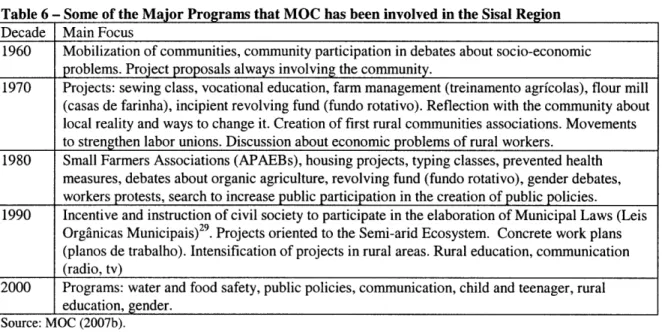
After the first phase of community organizing, MOC, which slowly distanced itself from the church, started to develop economic projects aimed at increasing the income of poor rural families. Table 6 shows the different stages of MOC's work in the region. In order to implement its projects, the NGO was able to attract many partners to work in projects designed to improve socio-economic conditions in the region. These include public partners (such as Eletrobrnis and Petrobrais), international (such as ILO and UNICEF), and private companies (Pfizer, Credicard and Omicron Electronics)28.MOC's ability to involve several actors is essential to the good performance of PETI in the region.
Table 6 - Some of the Major Programs that MOC has been involved in the Sisal Region
Decade Main Focus
1960 Mobilization of communities, community participation in debates about socio-economic problems. Project proposals always involving the community.
1970 Projects: sewing class, vocational education, farm management (treinamento agricolas), flour mill (casas de farinha), incipient revolving fund (fundo rotativo). Reflection with the community about local reality and ways to change it. Creation of first rural communities associations. Movements to strengthen labor unions. Discussion about economic problems of rural workers.
1980 Small Farmers Associations (APAEBs), housing projects, typing classes, prevented health measures, debates about organic agriculture, revolving fund (fundo rotativo), gender debates, workers protests, search to increase public participation in the creation of public policies.
1990 Incentive and instruction of civil society to participate in the elaboration of Municipal Laws (Leis Orgfnicas Municipais)29.Projects oriented to the Semi-arid Ecosystem. Concrete work plans (planos de trabalho). Intensification of projects in rural areas. Rural education, communication (radio, tv)
2000 Programs: water and food safety, public policies, communication, child and teenager, rural education, gender.
Source: MOC (2007b).
In the democratic regime, MOC's skills in negotiating with governments from different political parties has been essential in a region where most of the municipalities are linked to right wing political parties associated with traditional elites. In fact, MOC received criticisms for sitting at a table with right wing politicians. Some of the critics argue that MOC should directly confront the political power and the government instead of trying to negotiate. One criticism relating to
28 For a complete list of MOC's sources of financial resources, please see its Annual Reports at www.moc.org.br
29 Since the Constitution of 1988, municipalities have their own laws elaborated by their city councils (Souza, 2005).
leadership training aimed at increasing civil society participation in the law making is expressed as follows:
"There was even training for city council members, which was a conflictive strategy, as there were few representatives that could be trusted by the popular movement. People said that MOC was spending time training the enemies." (MOC, 2007b, p. 16)
On the other hand, there were times that local elites called MOC the "Movement of Communist Organization" (MOC, 2007b). In the beginning of its rural education program, some cities
retaliated against teachers that supported the NGO by sending them to work in distant rural areas. However, retaliation and resistance did not stop MOC from doing its work. PETI itself has made a significant impact in the relationship between MOC and the municipalities. In fact, the
partnership of MOC and local municipalities is the result of a maturing process by the institution. MOC's forty years of learning and working for change, in addition to its political skills and its flexibility to work with all sorts of actors have been essential to PETI's success in the region.
Local Rural Unions of Rural Workers and Family Farmers (STRAFs)
In Brazil, the labor union movement had a main role in bringing the problem of child labor to the attention of society and the government. The book Criancas de Fibras (Children of Fiber) by Huzak and Azevedo (1994) sponsored by the Abrinq Foundation in 1994, was one of the first works that raised the problem of child labor. In their description of children working in semi-slave conditions, local labor unions were the only entities that had statistics about child labor.
Elimination of Child Labor Program (IPEC-ILO) and labor union confederations (CUT, CGT, CONTAG), were adopted to fight child labor. In 1993, ILO and CONTAG (The National Confederation of Agricultural Workers) coordinated several meetings and a seminar in the sisal city of Retirolandia. At the municipal level, the rural labor union of Retirolandia was the first organization to raise the issue of child labor in the Sisal Region (NEPP, 1999). Since those meetings in 1993, MOC, ILO and local rural labor unions in the region became partners with the goal of ending child labor in the Sisal Region. However, collaboration between MOC and local labor unions did not start there but arose out of a prior history of solid partnership and common groundwork.
In the 1970s, local oligarchies organized rural labor unions in the Sisal Region in order to manipulate the population through the provision of low quality health services and to request public social benefits to the government3 0 (Codes Sisal, 2008). In the same decade, foreign
progressive priests and MOC started to foster social organization initiatives. In 1975, a rural worker was murdered over land conflicts on a farm in the village of Feira de Santana (MOC, 2007b). As a result, with the help of MOC, rural workers initiated efforts to get control of the labor unions3 1
The fight for the control of the local unions was, however, long and difficult. In the municipality of Serrinha, it took twelve years of struggle for rural workers to win union elections and expel local elites from the leadership of the rural labor union. In the municipality of Monte Santo, local
30 The control of labor unions by local elites was not uncommon in the rest of Brazil (Pinhanez, 1997).
31 In the process of increasing the political awareness of rural workers, MOC went into a partnership with the former
LBA - Brazilian Assistance Foundation (Legido Brasileira de Assistencia), a federal charity institution. LBA and MOC distributed milk to poor communities. MOC used the milk distribution to promote debates and discussions about the unions' situations, political and socio-economic reality and civil rights.
elites managed to expel the priest who was organizing rural workers. Now, local workers control all the rural labor unions of the region.
The relationship between STRAFs and the local government varies depending on the
municipality. In the municipality of Ititiba, for instance, the mayor has a good relationship with the local union. In other municipalities, there is animosity. In the municipality of Candeal where the rural labor union uncovered several irregularities by municipal government in social programs like PETI, rural workers suffered physical aggression and death threats. In fact, most of the time, STRAFs are the first to report irregularities in the management of PETI by the local governments.
Since 1996, the rural unions of the Sisal Region have also been supported by the creation of FATRES - The Foundation to Support Rural Labor in the Sisal Region located in the sisal city of Valente. FATRES aims its work at strengthening the institutional capacity of rural labor unions. It also works toward mobilizing and organizing unions in an effort to solve local political and socio-economic issues that the region faces such as child labor.
Through monitoring and uncovering irregularities in PETI's implementation, local rural labor unions have been the main watchdogs of PETI in the region. They have also helped to organize seminars and workshops about child labor and rural education programs. Some of them have also developed social and economic projects with families in an effort to reduce child labor in the region.
Outside Institutions
The support of international and national non-governmental institutions has been essential to the good performance of PETI in the region, details of which will be provided in the next chapter. From the beginning of PETI, ILO and UNICEF have been important actors, not only stimulating local initiatives, but also increasing awareness of the problem and giving financial and technical
support for the implementation of projects complementing PETI in the region.
Private sector actors are also partners of MOC in the implementation of socio-economic projects. As it will be seen in the next chapter, Pfizer helped MOC to implement an economic project with PETI's families called "The Cabra Escola Project" (She-Goat School Project). The financial
support of those institutions is essential for PETI's success in a region sorely in need of resources.
Municipalities
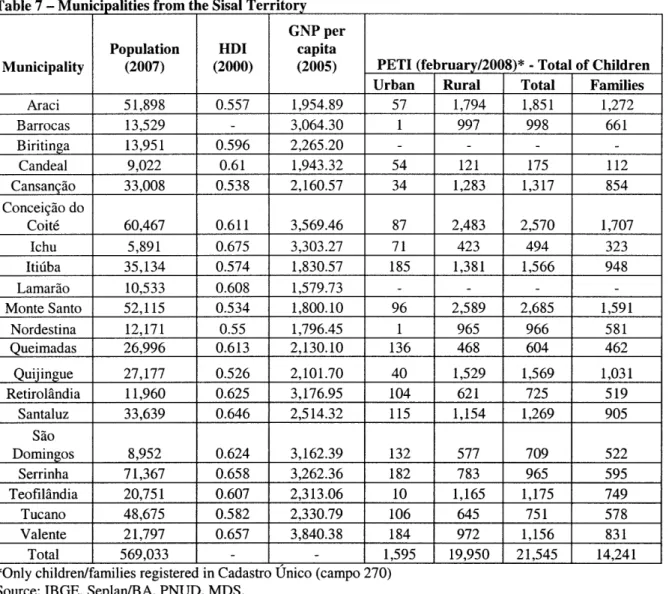
Not all municipalities in the Sisal Region have PETI, since the municipal government must ask MDS for the project. PETI is present in 18 municipalities of the Sisal Territory (table 7).