Development and quantitative analyses of a universal
rRNA-subtraction protocol for microbial metatranscriptomics
The MIT Faculty has made this article openly available. Please share
how this access benefits you. Your story matters.
Citation Koizumi, Yuichiro et al. “Effects of Solute and Vacancy Segregation on Antiphase Boundary Migration in Stoichiometric and Al-rich Fe3Al: A Phase-field Simulation Study.” Intermetallics 18.7 (2010): 1297–1302.
As Published http://dx.doi.org/10.1038/ismej.2010.18 Publisher Nature Publishing Group
Version Author's final manuscript
Citable link http://hdl.handle.net/1721.1/69861
Terms of Use Creative Commons Attribution-Noncommercial-Share Alike 3.0 Detailed Terms http://creativecommons.org/licenses/by-nc-sa/3.0/
Title: Development and quantitative analyses of a universal
rRNA-subtraction protocol for microbial metatranscriptomics
5
10
15
Contributors: Frank J. Stewart*1, Elizabeth A. Ottesen*1, and Edward F. DeLong♦1 Affiliations and footnotes:
*These authors contributed equally to this work.
♦ Corresponding author. Mailing address: Division of Biological Engineering &
20
Department of Civil and Environmental Engineering, Massachusetts Institute of Technology, Parsons Laboratory 48-427, 15 Vassar Street, Cambridge, MA
02139. Phone: (617) 253-5271. Email: [email protected]
1
Department of Civil and Environmental Engineering, Massachusetts Institute of 25
Technology, Parsons Laboratory 48, 15 Vassar Street, Cambridge, MA 02139.
30
Running title: Ribosomal RNA extraction for microbial metatranscriptomics 35
Abstract 40
Metatranscriptomes generated by pyrosequencing hold significant potential for describing functional processes in complex microbial communities. Meeting this potential requires protocols that maximize mRNA recovery by reducing the relative abundance of ribosomal RNA, as well as systematic comparisons to identify methodological artifacts and test for reproducibility across datasets. Here, we implement a protocol for subtractive hybridization of bacterial rRNA 45
(16S and 23S) that uses sample-specific probes and is applicable across diverse environmental samples. To test this method, rRNA-subtracted and unsubtracted transcriptomes were sequenced (454 FLX technology) from bacterioplankton communities at two depths in the oligotrophic open ocean, yielding 10 datasets representing ~350 Mbp. Subtractive hybridization reduced bacterial rRNA transcript abundance by 40 to 58%, increasing recovery of non-rRNA sequences up to 50
fourfold (from 12-20% of total sequences to 40-49%). In testing this method, we established criteria for detecting sequences replicated artificially via pyrosequencing errors and identified such replicates as a significant component (6 to 39%) of total pyrosequencing reads. Following replicate removal, statistical comparisons of reference genes (identified via BLASTX to NCBI-nr) between technical replicates and between rRNA-subtracted and unsubtracted samples showed 55
low levels of differential transcript abundance (< 0.2% of reference genes). However, gene overlap between datasets was remarkably low, with no two datasets (including duplicate runs from the same pyrosequencing library template) sharing greater than 17% of unique reference genes. These results indicate that pyrosequencing captures a small subset of total mRNA diversity and underscores the importance of reliable rRNA subtraction procedures to enhance 60
Keywords: functional genomics / gene expression / ribosomal RNA / Roche 454 pyrosequencing / RNA amplification / marine bacterioplankton
65
Introduction
Metatranscriptomic analysis using pyrosequencing is dramatically improving our understanding of gene expression in natural microbial communities (DeLong, 2009; Poretsky et
al., 2009; Shi et al., 2009). In these analyses, cDNA is synthesized from total RNA extracted
from an environmental sample and used directly for massively parallel shotgun sequencing. 70
Metatranscriptomes from functionally diverse habitats, including seawater and soil, can be sequenced using pyrosequencing methodologies (GS 20 or GS FLX systems, Roche 454 Life Sciences), yielding tens to hundreds of thousands of sequence fragments from the RNA pool (Frias-Lopez et al., 2008; Poretsky et al., 2009; Urich et al., 2008). Such analyses provide detailed information on the taxonomic and functional diversity in the transcriptionally active 75
community, as they simultaneously characterize both the ribosomal and messenger RNA components of the transcript pool. However, to advance the generic application and utility of pyrosequencing-based transcriptomics to microbial ecology studies, it is necessary to develop quality assurance and methodological troubleshooting techniques that both enhance current protocols and minimize bias in the interpretation of the read data.
80
It is not yet clear to what extent pyrosequencing methods capture the full breadth of expressed functional genes in microbial community transcriptomes. Indeed, pyrosequencing likely fails to capture many functionally important transcripts that occur at low frequencies. This is particularly true of datasets dominated by ribosomal RNA sequences (e.g., prokaryotic 5S, 16S and 23S rRNA, eukaryotic 18S and 28S). In the first study of a marine microbial
metatranscriptome sequenced using pyrosequencing (Roche GS 20 system), rRNA reads represented 53% of total sequences (Frias-Lopez et al., 2008). A similar study using the same technology reported rRNA contamination at 37% of total sequences (Poretsky et al., 2009), following the application of two commercial kits designed to enrich for mRNA (mRNA-ONLY™ Prokaryotic mRNA isolation kit, Epicentre; MICROBExpress™ Bacterial mRNA 90
enrichment kit, Ambion). Subsequent analyses of marine transcriptomes using the Roche GS FLX platform, which yields average read lengths (~200-250 bp) over twice those produced via the GS 20 technology, have shown rRNA abundances that often exceed 90% of total reads (DeLong lab, unpublished data; Hewson et al., 2009b; Hewson, pers. comm.). The increase in rRNA abundance observed with FLX-based technology relative to GS 20 is likely due to 95
differences in the pyrosequencing protocols themselves. For example, the FLX protocol includes a bead binding purification step that selects for longer transcripts, relative to GS20, which may increase the relative rRNA representation. As read lengths increase – the Roche GS FLX Titanium reagents now facilitate average read lengths greater than 400 bp – achieving adequate sequencing depth of non-rRNA reads, primarily mRNA, requires effective subtractive
100
procedures to minimize rRNA abundance. Ribosomal RNA subtraction becomes particularly relevant as metatranscriptomics moves from a purely descriptive phase to one in which the method is applied experimentally to track low frequency changes in gene expression, e.g., in response to environmental perturbations (Delong, 2009).
Here, we introduce a sample-specific method for the subtraction of rRNA from total 105
RNA. The method employs subtractive hybridization using antisense rRNA probes transcribed
in vitro from PCR products amplified from coupled DNA samples, thereby ensuring the
unsubtracted transcriptomes of open ocean bacterioplankton communities at two depths in the North Pacific Subtropical Gyre (Station ALOHA, North Pacific), demonstrating a substantial 110
reduction in the targeted RNA fraction (bacterial 16S and 23S rRNA). Our method can be generally extended to any microbial community sample, and can be easily expanded to target other rRNA transcripts, including those of archaea or eukaryotes.
The increasing use of pyrosequencing-based metagenomics and transcriptomics would also benefit from explicit quality control tests to determine the quantitative reproducibility of the 115
data generated and to ensure reasonable extrapolations of read abundance to in situ transcript abundance. Gomez-Alvarez et al. (2009) showed that metagenomic datasets generated using pyrosequencing contain significant numbers (11-35% of total reads) of sequencing artifacts in the form of replicate sequences. These artificial replicates, putatively generated during the emulsion PCR stage of pyrosequencing (Briggs et al., 2007; Gomez-Alvarez et al., 2009), can 120
erroneously increase the apparent abundance of transcripts from which these sequences derive. In order to address these and other concerns related to the reproducibility of expression profiles, we performed a set of technically replicated pyrosequencing-based transcriptomic analyses. These analyses determined criteria for replicate removal, underscored the potential for pyrosequencing artifacts (replicate reads) to confound interpretation of transcript diversity and 125
abundance, and highlighted the potentially limited extent to which standard sequencing depths reveal the diversity of total transcript pools.
Materials and Methods
Sample Collection
Planktonic microorganisms were sampled from the photic zone (25 m and 75 m) at Station ALOHA (22° 45'N, 158° 00'W) as part of the Hawaii Ocean Time-series (HOT) program (HOT-186 cruise, casts S2C27 and S2C30) in October 2006, as described in Shi et al. (2009). Replicate seawater samples (1.8-2.0 L) for RNA extraction were prefiltered through 1.6 um GF/A filters (47 mm dia., Whatman) and collected onto 0.22 um Durapore filters (25 mm dia., 135
Millipore) using a peristaltic pump. Filters were immediately transferred to microcentrifuge tubes containing 300 ul RNAlater® (Ambion) and frozen at -80C. Less than 20 min elapsed between sample collection (arrival on deck) and fixation in RNAlater®. Samples for DNA extraction were collected from the same water sample used for RNA collection as in Frias-Lopez
et al. (2008). For each sample, seawater (220 L) was prefiltered through a 1.6 um GF/A filter
140
(125 mm dia., Whatman) onto a 0.22 um Steripak-GP20 filter (Millipore). The filter units were filled with lysis buffer (50 mM Tris•HCl, 40 mM EDTA, and 0.75 M sucrose), capped, and frozen at -80°C until extraction.
RNA and DNA isolation
145
Total RNA was extracted from filters using a modification of the mirVanaTM miRNA
Isolation kit (Ambion) as described previously (Shi et al., 2009). Briefly, samples were thawed on ice, and the RNAlater® surrounding each filter was removed by pipetting and discarded. Filters were immersed in Lysis/Binding buffer (Ambion) and vortexed to lyse attached cells. Total RNA was then extracted from the lysate according to the manufacturer's protocol, 150
incubated (37 ºC for 30 min) with TURBO DNA-free™ to remove genomic DNA, and purified and concentrated using the RNeasy MinElute Cleanup kit (Qiagen). Genomic DNA was extracted from Steripak filters as described previously (Frias-Lopex et al., 2008).
rRNA subtraction
155
Subtractive hybridization using sample-specific biotinylated rRNA probes was used to remove bacterial 16S and 23S rRNA from total RNA samples (Figure 1 and 2). The probe synthesis reaction was adapted from an in situ hybridization method by DeLong et al. (1999) and combined with a subtractive hybridization protocol similar to that of Su and Sordillo (1998). Ribonucleotide probes targeting bacterial 16S and 23S rRNA genes were generated from 160
community DNA samples collected in tandem with each total RNA sample. Templates for probe generation were first prepared by PCR using universal primers flanking nearly the full length of the bacterial 16S gene and ~ 85% of the 23S rRNA gene, with reverse primers modified to contain the T7 RNA polymerase promoter sequence (Table 1; DeLong et al., 1999). PCR reactions (50 ul each) included 100 ng template DNA, 1 ul of Herculase® II Fusion DNA 165
Polymerase (Stratagene), 1X Herculase reaction buffer, 10 mM dNTP, and 10 uM each of forward and reverse primers. Reaction conditions were as follows: 2min at 92°C; 35 cycles of 20s at 95°C, 20s at 39°C (23S reactions) or 55°C (16S reactions), 75s (16S) or 90s (23S) at 72°C; 3min at 72°C. Resulting products were visualized via gel electrophoresis and purified via the
QIAquick PCR purification kit (Qiagen). The above rRNA probe generation step can also 170
potentially be modified by generating amplicons via reverse transcription (RT)-PCR, using RNA (rather than DNA) as starting template. We deliberately chose to amplify from the DNA pool, however, as RT-PCR is less efficient at longer sequence lengths, and we sought to maximize probe coverage along the length of all rRNA genes.
Biotinylated antisense rRNA probes were generated by in vitro transcription (IVT) with 175
was conducted using the MEGAscript® High Yield Transcription kit (Ambion), with the following modifications. Probes for 16S and 23S rRNA were generated separately in 20 ul reactions, each containing: 1X buffer, T7 RNA polymerase, SUPERase•InTM RNase inhibitor (10 U), ATP (7.5 mM), GTP (7.5 mM), CTP (5.625 mM), UTP (5.625 mM), biotin-11-CTP (1.875 180
mM, Roche), biotin-16-UTP (1.875 mM, Roche), and 16S/23S DNA template (250-500 ng). Reactions were run at 37°C for 4-5 h, then DNAse digested with TURBO™ DNAse (Ambion) for 15 min at 37°C. Products were purified using the MEGAclearTM kit (Ambion). Assuming the template amplicons used for IVT were ~50% GC, the biotin labeling density in the resulting 16S/23S probes was ~1 in 8 nucleotides.
185
Biotinylated rRNA probes were hybridized to complementary rRNA molecules in the total RNA sample. Hybridization reactions (50 ul), each containing formamide (20%), 1X SSC buffer (0.15 M sodium chloride, 0.015 M sodium citrate), SUPERase•InTM RNase inhibitor (20 U), template RNA (25 m ~600 ng; 75 m ~ 200 ng), and equal amounts of 16S and 23S rRNA probes at a final template-to-probe ratio of 1:2 (per probe), were denatured at 70°C for 5 min and 190
incubated at room temperature (RT) for 3 min. Biotinylated double-stranded rRNA was then removed from the sample by hybridization (10 min at RT) to streptavidin-coated magnetic beads (New England Biolabs; 50 ul aliquot, washed 3X in 1X SSC), followed by separation on a magnetic rack (2 min) and removal of the rRNA-subtracted supernatant via pipet. An additional 50 uL 1X SSC was applied to the beads for washing, separated as above, and pooled with the 195
original supernatant. The pooled products were purified via the RNeasy MinElute Cleanup kit (Qiagen). Subtraction efficiency was evaluated by monitoring the removal of 16S and 23S peaks from total RNA profiles using a 2100 Bioanalyzer and the RNA 6000 Pico chip kit (Agilent; Figure 2).
Minor updates to this protocol were implemented following characterization of the 200
Station ALOHA (HOT 186) samples. The fully optimized and updated protocol is included as a pdf file in the Supplemental Online Materials. In brief, 1) an initial wash with 0.1N NaOH was incorporated into the streptavidin bead preparation steps to ensure complete removal of RNases, 2) the denaturation/hybridization step was changed from 5 min at 70°C followed by 3 min at RT to 5 min at 70°C followed by a step-down procedure with 1 min each at 5°C intervals from 65°C 205
to 25°C, and 3) probes for Archaeal and Eukaryotic large and small subunit rRNA were incorporated into the protocol (see Supplementary text and Table S3 for primer design and sequences), and additional streptavidin-coupled beads were used to ensure complete removal of these additional probes.
210
RNA amplification and cDNA synthesis
rRNA-subtracted and unsubtracted total RNA (~35-80 ng) was amplified using the MessageAmp™ II-Bacteria kit (Ambion) as described previously (Frias-Lopez et al., 2008; Shi
et al., 2009). Briefly, total RNA was polyadenylated using Escherichia coli poly(A) polymerase.
Polyadenylated RNA was converted to double-stranded cDNA via reverse transcription primed 215
with an oligo(dT) primer containing a promoter sequence for T7 RNA polymerase and a recognition site for the restriction enzyme BpmI (T7-BpmI-(dT)16VN, Table 1). cDNA was then
transcribed in vitro at 37°C (25m for 7hr, 75m for 14 hr), yielding large quantities (10-100 ug) of single-stranded antisense RNA. Amplified RNA (~5-10 ug aliquot) was then converted to double-stranded cDNA using the SuperScript® III First-Strand Synthesis System (Invitrogen) 220
with priming via random hexamers for first-strand synthesis, and the SuperScript™ Double-Stranded cDNA synthesis kit (Invitrogen) for second-strand synthesis. cDNA was then purified
with the QIAquick PCR purification kit (Qiagen), digested with BpmI for 2-3 hrs at 37°C to remove poly(A) tails, and used directly for pyrosequencing
225
Pyrosequencing and technical replicates
Prior to sequencing, poly(A)-removed cDNA was purified via the AMPure® kit (Agencourt®). Purified cDNA was used for the generation of single-stranded DNA libraries and emulsion PCR according to established protocols (454 Life Sciences, Roche). Clonally amplified library fragments were then sequenced on a Genome Sequencer FLX System (Roche). 230
To produce a technically replicated transcriptomic analysis, equal aliquots of the HOT-186 75 m total RNA sample were separated and used independently for rRNA subtraction, RNA amplification, and pyrosequencing – see samples 75 m A and B, unsubtracted and rRNA-subtracted (Table 2). All sample processing parameters were kept consistent across replicates. 235
Data analysis
Ribosomal RNA-derived reads were identified using BLASTN to compare all reads against a rRNA database composed of both prokaryotic and eukaryotic small and large subunit rRNA nucleotide sequences (5S, 16S, 18S, 23S and 28S rRNA) from available microbial genomes and sequences in the ARB SILVA LSU and SSU databases (http://www.arb-silva.de). 240
Reads producing alignments with bit scores greater than 50 were identified as rRNA sequences and removed from pyrosequencing datasets.
Non-rRNA sequences were checked for replicate sequences using the open-source program CD-HIT (Li and Godzik, 2006) according to the protocol of Gomez-Alvarez et al. (2009). Replicates were defined as sequences sharing greater than 99% nucleotide identity, with 245
an allowable length difference of 1 bp, and a requirement that the first 3 bp of the replicate sequences be identical. This cutoff was chosen by comparison of multiple pyrosequencing runs prepared from a single pyrosequencing library (sample 75 m A, rRNA-subtracted), as a conservative measure that significantly reduced the size of sequence clusters appearing at high frequency in one sequencing run but at low frequency in repeat sequencing runs (Table S1; 250
Figure S2). Additional details on criteria for identifying replicates can be found in the Supplementary Online Material.
Non-rRNA sequence reads were compared to the National Center for Biotechnology Information non-redundant protein database (NCBI-nr, as of February 1, 2009) using BLASTX. Top BLASTX hits with e-values less than 1 x 10⁻⁵ were used for nr-protein designations. Reads 255
with multiple, equal hits were assigned to the reference protein (hit) with the highest number of previously assigned reads. The total number of reads assigned to each reference protein was tracked through all analyses for consistent assignment between pyrosequencing runs. Statistically significant differences (two-tailed P<0.05) in the expression levels (abundances) of nr-designated transcripts were determined in pairwise comparisons between datasets using the 260
method of Audic and Claverie (1997; AC test), which accounts for variation in database size and assumes a Poisson distribution for the number of transcripts representing a given gene. P-values were adjusted using a false discovery rate (FDR) correction to account for potential false positives due to multiple comparisons, as in Benjamini and Hochberg (1995).
Nucleotide sequence data generated during this study will be deposited in public 265
databases prior to publication and can be made available to reviewers upon request.
Pyrosequencing read statistics
A total of 1,786,949 sequence reads representing ~350 Mbp over 10 pyrosequencing runs 270
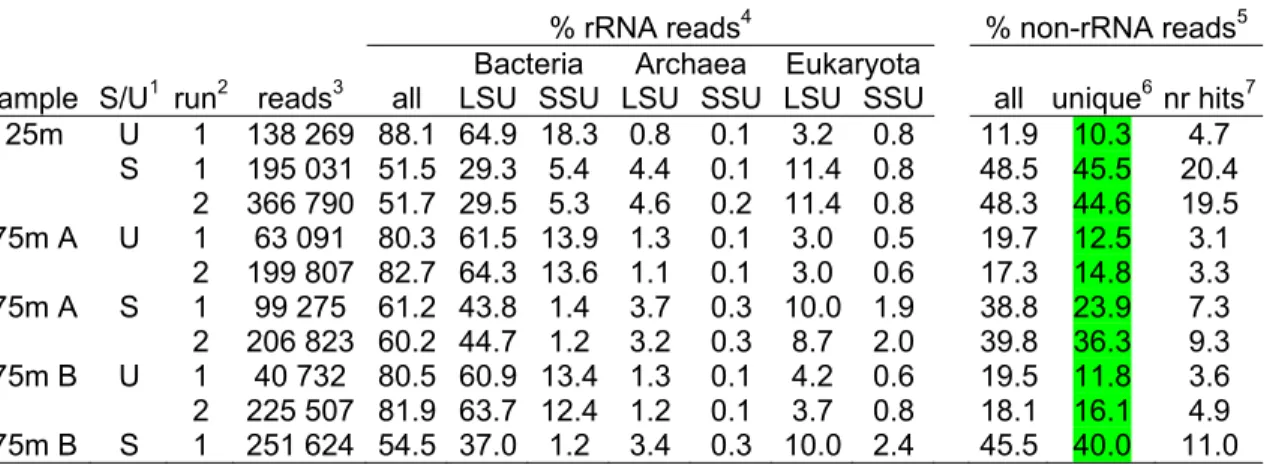
were generated from rRNA-subtracted and unsubtracted samples from depths of 25 and 75 m in the open ocean photic zone (Table 2). Reads with significant BLASTN hits (bit score > 50) to either prokaryotic or eukaryotic rRNA sequences represented 80 to 88% of total reads in unsubtracted samples. Of these, bacterial rRNA represented 74-83% of total reads (Table 2), with archaeal and eukaryotic rRNA representing 0.9-1.4% and 3.5-4.8%, respectively. The high 275
percentages of rRNA reads observed here are consistent with experimental evidence suggesting that rRNA accounts for ~80-90% of total RNA in a typical bacterium (Wendisch et al., 2001). Indeed, upon transitioning to the 454 GS FLX sequencing system, the percentage of rRNA observed in unsubtracted cDNA datasets derived from marine bacterioplankton has averaged 88% in our lab (range: 74-97%; n = 20 FLX cDNA datasets), underscoring the necessity for an 280
effective rRNA subtraction approach when using our linear amplification protocol.
rRNA subtraction
Subtractive hybridization to sample-specific rRNA probes lowered bacterial rRNA abundance by 40-58% relative to unsubtracted samples, reducing bacterial rRNA to 35-46% and 285
total rRNA to 52-61% of pyrosequencing reads (Table 2, Figure 2, Figure S3). In response, the fraction of non-rRNA reads in each dataset increased up to fourfold, raising the proportion of reads with significant BLASTX hits to NCBI-nr proteins from 3.1-4.9% in unsubtracted samples to 7.3-20.4% in subtracted samples (Table 2). Bacterial 16S rRNA showed a greater proportional decrease in abundance than 23S rRNA following rRNA subtraction (Table 2), 290
16S primers relative to the 23S primers, and to differences in the extent to which 16S and 23S primer sets span the full length of the target molecules (~95% of 16S rRNA, ~85% of 23S rRNA). Since our probe sets targeted only bacterial rRNA, the relative percentages of archaeal and eukaryotic rRNA reads increased approximately three to fivefold (to 3.5-4.8% and 10.7-295
12.2% of total reads, respectively; Table 2). However, among those reads not identified as bacterial rRNA, the percentage represented by archaeal and eukaryotic rRNA reads did not differ substantially between unsubtracted (25-29%; mean: 23.8%) and subtracted (20-29%; mean: 26.6%) samples, suggesting little non-specific probe binding but emphasizing the need to develop additional probe sets to target these rRNA fractions.
300
The subtraction of rRNA occurred non-uniformly along the length of rRNA transcripts. For example, among the rRNA reads remaining in the subtracted sample, the proportion mapping to the central region of the 23S rRNA (~bp 1000-2500) decreased relative to the unsubtracted sample, while the proportion mapping to the terminal region (~ bp 2500-2900) increased substantially (by ~50%; Figure S1). This pattern may be caused in part by the exclusion of the 305
terminal 400 bp of the ~2900 bp 23S rRNA gene by our probe set (Table 1), although a clear, but as of yet unexplained, bias toward 3’ 23S rRNA reads was also observed in the unsubtracted sample. A shift in the relative abundances of reads representing varying regions of the 16S rRNA was also apparent following subtraction, with a noticeable proportional increase in reads mapping to the 5’ 16S rRNA region (Figure S1). These patterns indicate differential subtraction 310
efficiencies along the rRNA transcripts, and therefore the potential that these molecules had been fragmented in the pre-subtracted samples.
After developing and testing the rRNA subtraction protocol described above, we have applied our method to a diverse range of samples and further optimized it to include primer sets
targeting both Archaeal and Eukaryotic rRNAs (see Table S3). Using this revised protocol, 315
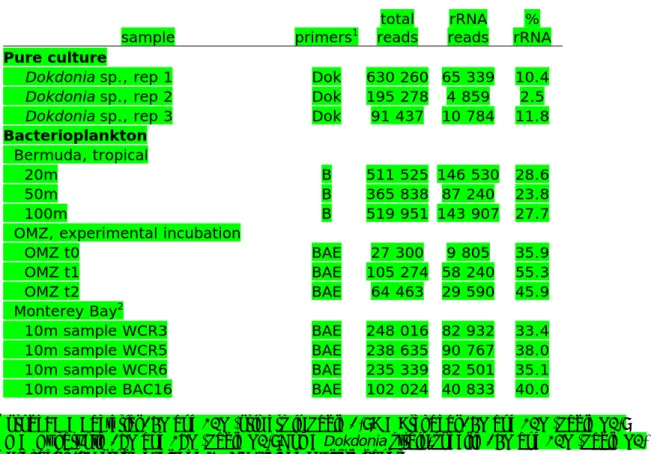
rRNA abundance in microbial community cDNAs has averaged 36% of total reads (range: 28-55%) across 10 different bacterioplankton samples from three distinct oceanic regions (Table 3; see Figure S3 for a representative total RNA profile following Domain-specific rRNA subtraction). We have also applied the method to a pure monoculture of actively growing
Dokdonia sp. using 16S and 23S rRNA probe sets that perfectly match this target species. For
320
this pure culture, our method successfully reduced rRNA to an average of 8% of the total cDNA reads (range: 3-11%; n = 3; see Table S3 for primers).
In addition to the method presented here, several commercial rRNA reduction protocols are also now available. One commonly used commercial product, the MICROBExpress™ Bacterial mRNA enrichment kit (Ambion), employs a subtractive hybridization to proprietary 325
oligonucleotide probes, followed by rRNA removal via bead-immobilized capture
oligonucleotides (in contrast to sample-specific, near full-length probes and biotin-streptavidin capture in our protocol). While the MICROBExpress™ kit has been shown to be compatible for rRNA subtraction from a variety of bacteria, the efficiency of rRNA removal using this method can vary widely for community RNA samples (e.g., Poretsky et al., 2005; McGrath et al., 2008; 330
Hewson et al., 2009a,b), as well as for single-species analyses (e.g., Yoder-Himes et al., 2009). Indeed, oligonucleotide capture probes used in this method are predicted to be sensitive to target sequence variability known to be present in microbial community rRNAs, and the manufacturers explicitly state that the commercial kit is only partially compatible, or even incompatible, with a variety of microorganisms, including all Archaea
335
(http://www.ambion.com/techlib/misc/microbe.html). Another commercial rRNA removal strategy, the mRNA-ONLY™ kit (Epicentre), uses specific exonucleases to selectively digest
rRNA, but not mRNA. A potential complication of the exonuclease method in the mRNA-ONLY™ protocol is its potential to catalyze secondary, non-5’ monophosphate RNAse activity that may degrade specific mRNA transcripts in addition to the rRNA (Epicentre website). In a 340
recent analysis of a microbial community associated with a Trichodesmium bloom, the mRNA-ONLY™ kit , used in conjunction with the MICROBExpress™ kit, was unable to reduce rRNA abundance below 94% of total FLX-based reads (Hewson et al., 2009b; Hewson, pers. comm.), again suggesting potentially high variability in commercially available protocols. Recognizing the potential limitations of these protocols is important in selecting or developing rRNA
345
subtraction methods for microbial transcriptome analyses.
Other alternatives to commercially available subtraction techniques have also been explored. Noting mixed results with the MICROBExpress™ method, McGrath et al. (2008) proposed physical removal of rRNA bands from RNA samples by agarose gel electrophoresis and extraction. While effective, this technique requires large starting concentrations of RNA and 350
may bias functional gene expression profiles by eliminating mRNA transcripts that co-migrate with the rRNA fraction. Gilbert et al. (2008) reported low rRNA representation in a metatranscriptomic survey following amplification of the cDNA via multiple displacement amplification (MDA) using the GenomiPHI™ V2 kit (GE Healthcare). However, this kit is optimized for amplification of genomic DNA, and has not been extensively tested for 355
reproducibility and bias when used for amplification of short cDNA fragments. Indeed, numerous studies have shown that even for single template genomic DNA, MDA using φ29 polymerase amplifies unevenly across different loci, suggesting that the reliability and utility of MDA for quantitative analyses is uncertain at best (Bergen et al., 2005; Ballantyne et al., 2007). Recently, Armour et al. (2009) proposed a novel rRNA depletion method based on the use of a 360
computationally defined subset of hexameric primers that exclude target rRNA sequences during cDNA synthesis from total RNA. While potentially effective in low-complexity samples or single-species monocultures, this method, as for most published rRNA subtraction procedures, is not easily extrapolated to complex metatranscriptomic samples with diverse rRNA pools. A definitive comparison of rRNA removal protocols from previously published metatranscriptomic 365
studies is not feasible, since prior studies did not include unsubtracted controls for comparison, utilized distinct cDNA synthesis and downstream pyrosequencing preparation protocols, and analyzed microbial communities with differing compositions.
The protocol we describe here offers some potential advantages over the existing rRNA-subtraction procedures noted above. The method can be easily tailored to synthesize sample- or 370
taxon-specific probes targeting either specific strains or a broad array of Archaeal, Bacterial, and Eukaryotic rRNAs. While we chose to target only Bacterial rRNA for the initial development of this method, the protocol can be expanded to include both Archaeal and Eukaryotic rRNA probe sets generated using the broad-specificity primers listed in Table S3. The method can also be applied to less complex, non-environmental samples (e.g., experimental cultures or consortia). If 375
necessary for such samples, taxon-specific primers can be used in place of universal primers for probe generation, as demonstrated for a Dokdonia culture analyzed in our lab (Table 3 and S3). When followed by a linear RNA amplification step, this subtractive protocol can be used with relatively small amounts of starting material; in our hands, subtraction of rRNA from as little as 20 ng total RNA has yielded amounts of mRNA-enriched template sufficient for amplification 380
and pyrosequencing. As the protocol implemented here biases the composition of any rRNA reads remaining after subtraction (as does any rRNA subtraction procedure), our method is specifically designed for maximizing coverage of the functional RNA pool, potentially
identifying unique or interesting transcripts that can inform or suggest more targeted gene-specific studies to follow.
385
Replicate reads
Sequencing artifacts in the form of replicated sequences are a common source of error in pyrosequencing datasets (Briggs et al., 2007; Gomez-Alvarez et al., 2009). Careful identification and removal of such sequences, which can account for more than 30% of 390
pyrosequencing reads (Gomez-Alvarez et al., 2009), is therefore essential for accurately extrapolating observed read abundance to in situ DNA or cDNA abundance. Replicates are hypothesized to originate during the emulsion PCR step of pyrosequencing. Incomplete emulsion can result in the attachment of a single PCR product to multiple beads (Briggs et al.,, 2007; Gomez-Alvarez et al.,, 2009), which upon sequencing results in an increase in the number 395
of observed occurrences of that sequence in the dataset. In an idealized case, sequences generated from identical, replicated template molecules would share start and stop sites, resulting in identical sequence along their full length. However, sequencing errors and quality trimming result in the generation of non-identical sequences of different lengths from identical template molecules. The challenge therefore is to differentiate imperfectly sequenced artificial replicates 400
from legitimate sequences derived from multiple, similar DNA fragments.
Gomez-Alvarez et al., (2009) calculated that, for the genomic DNA of an idealized microbial community, the probability of multiple reads starting at the same position in a randomly-sheared metagenome analysis is extremely low (~1 x 10⁻¹⁰). These authors therefore
identify artificial replicates as sequences (of potentially varying lengths) sharing greater than 405
definition is likely robust for microbial community DNA, but is perhaps overly conservative for microbial community transcriptomes. Unlike random genomic DNA fragments, transcripts have clearly defined start and stop sites and routinely occur in multiple copies per cell. As a result, criteria for identifying replicates from metatranscriptomes must, to the greatest extent possible, 410
distinguish artifacts from legitimate re-sampling of multiple transcripts originating from the same gene.
We analyzed pairs of sequencing runs (independent emulsion PCR and sequencing reactions generated from the same adaptor-ligated template library) to establish criteria for replicate removal from our transcriptomic libraries, identifying replicates as sequences differing 415
by no more than 1 bp in length, sharing 99% nucleotide identity, and having identical start sites (first 3 bp) (see Supplementary Online Text, Table S1, Figure S2). Using these criteria, re-sampled transcripts were rare (0.3-3.4% of sequences) compared to artificial replicate transcripts (6-39% of sequences). Though clusters of replicate reads were identified in all samples examined, the percentage of replicated reads to total reads (replicate frequency) varied greatly 420
among the 10 different pyrosequencing runs (Table 2). Substantial variation occurred even between multiple runs generated via independent emulsion PCR and sequencing reactions from the same template library. Notably, replicate frequency varied between runs from 9 to 38% and 14 to 36% in the rRNA-subtracted and unsubtracted 75 m A samples, respectively, and from 11 to 39% between runs of the unsubtracted 75 m B sample (Table 2). In each of these 425
comparisons, replicate frequency was negatively correlated with the number of total reads per run, suggesting a link between artifact generation and the efficiency of the emulsion PCR and pyrosequencing steps. This immediately suggested important criteria for quality control and assessment of individual sequencing runs.
The presence of these replicates can bias the apparent diversity of the transcript pool. For 430
example, prior to removal of replicate sequences the slopes of rarefaction curves describing the number of unique non-redundant (nr) peptide reference genes identified per dataset as a function of sequencing depth differed notably between repeated runs (1 and 2) of the subtracted 75 m A samples (Table 2; Figure 3). Removal of replicate sequences eliminated this discrepancy, yielding highly similar rarefaction curves. Together, these data indicate that artificial replicates 435
are a common and potentially biasing component of pyrosequencing-based transcriptomic datasets. However, effective criteria for replicate removal may vary among samples of differing taxonomic complexity and functional state. Though not yet routine in pyrosequencing-based analyses, systematic comparisons of technically repeated pyrosequencing runs may help delineate sample-specific criteria for replicate removal.
440
Statistical comparison of transcript abundances in technical replicates
Validation of rRNA subtraction and computational replicate removal methods required statistical determination of changes in transcript abundance with a high degree of taxonomic resolution. Statistical comparisons of metagenomic and transcriptomic profiles have largely 445
focused on gene clusters and functional groupings rather than individual genes (Rodriguez-Brito
et al., 2006; Frias-Lopez et al., 2008; Huson et al., 2009; Poretsky et al., 2009). However, this
approach potentially lacks the resolution to detect changes in expression of specific transcripts (e.g., due to the non-specific binding of rRNA probe to an mRNA transcript during subtractive hybridization). Here, to assess the impact of rRNA subtraction and replicate removal on 450
expression profiles, non-rRNA transcripts were mapped to specific protein sequences in the NCBI-nr database, and the relative abundances of transcripts matching single reference genes
were compared between datasets (Table 4, Figures 4 and 5). Dalevi et al. (2008) showed that a similar mapping approach accurately represented the functional and taxonomic characteristics of ~100 bp DNA fragments; we expect an even greater degree of assignment accuracy given our 455
longer average read length (> 200 bp). A statistical test from the expressed sequence tag literature was then applied to identify differentially represented reference genes (AC test; Audic and Claverie 1997), along with a false-discovery rate (FDR) minimizing test (Benjamini and Hochberg, 1995) to correct for the large number of comparisons (P<0.05). We used this test to examine the reproducibility of transcriptional profiles generated by pyrosequencing, and the 460
effect of rRNA subtraction on the abundance on non-rRNA transcripts.
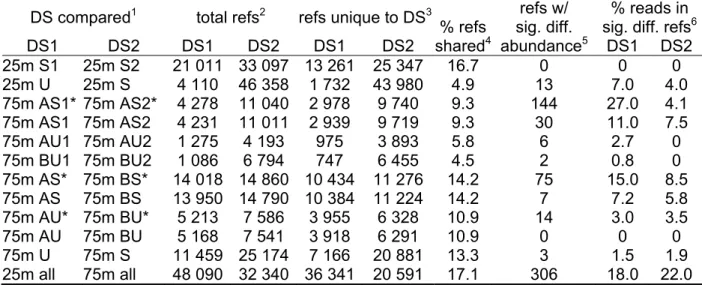
Removal of replicate sequences was key to the generation of reproducible transcriptional profiles (see starred datasets in Table 4). For example, the variation between rarefaction curves generated from the raw sequencing data from the rRNA-subtracted 75 m A sample (Figure 3) was also reflected in reference gene abundances; 144 genes were identified as ‘differentially 465
expressed’ between the two sequencing runs (Table 4). Removal of replicate sequences reduced this to just 30 references with significantly different abundances. The majority of these differences involved genes represented by very few (or zero) reads in one of the two datasets. Replicate removal may therefore have the most significant effect on apparent differences between low abundance transcripts, for which even small numbers of artificial replicates may 470
have a disproportionately large effect on apparent expression level.
A thorough analysis of the reproducibility of metatranscriptomic profiles must also take into account experimental variation, as the generation of transcriptomic libraries from extracted total RNA requires extensive processing steps, including linear amplification in our procedure, that might introduce variability into the observed transcriptional profile. In order to address this 475
issue, we subdivided the total RNA sample from 75 m to generate four samples (unsubtracted and rRNA-subtracted samples A and B) which were processed in parallel to examine the reproducibility of resultant transcriptomic datasets. For the unsubtracted 75 m sample, no nr reference genes were differentially expressed between replicates A and B (Table 4). For the rRNA-subtracted 75 m sample, following removal of replicate reads, only 0.03% (7 of 25,174) of 480
total identified references were differentially expressed (Table 4; Table S1). Of those genes represented by greater than 0.1% of the sequence reads in the subtracted 75 m A dataset (n = 42), only three varied in expression between replicates (Table 5, Figure 4). As observed in comparisons of replicate runs from a single template library, the majority of the significant differences between the full technical replicates involved relatively low abundance reference 485
genes having significantly higher representation in one of the two datasets (Table 5).
Statistical comparison of rRNA-subtracted and unsubtracted samples
Having established the reproducibility of transcriptional profiles generated during metatranscriptomic analyses, we examined bias potentially introduced during the removal of 490
rRNA by subtractive hybridization. Subtractive protocols have the potential to alter functional gene expression profiles if removal of non-rRNA transcripts occurs due to non-specific probe binding. In the 25 m sample, only 0.03% of total nr reference genes (13 of 48,090 total, which includes 2378 shared between datasets + 45,712 unique to either dataset) showed significantly different abundances between subtracted and unsubtracted samples (Table 4). Of these, five 495
were represented at abundances greater than 0.1% of total reads in the unsubtracted dataset (Figure 5). In the 75 m sample, only 0.01% (3 of 32,340) were differentially represented. These low levels of variation are within the range observed between replicate pyrosequencing runs
derived from independent emulsion PCR reactions using template from the same adapter-ligated library (0-0.2% of genes differentially expressed for comparisons 25 m S1 vs. S2, 75 m AS1 vs. 500
AS2, AU1 vs. AU2, BU1 vs. BU2, Table 4). This suggests that these differences are due to stochastic variation introduced during pyrosequencing, and that the subtractive hybridization protocol does not significantly alter the apparent expression profile generated from transcript libraries.
505
Conclusions
A distinguishing characteristic of community DNA and RNA sequencing efforts is the high complexity of the resulting sequence data. For example, in this study, pyrosequencing of a single sample of seawater collected at 25 m generated 266,859 unique non-rRNA sequences (including runs from both rRNA-subtracted and unsubtracted libraries), 117,809 (44%) of which 510
had significant hits to 48,090 unique nr reference proteins. An initial, half-plate run derived from the RNA-subtracted portion of the 25 m sample yielded 21,011 nr references, of which only 37% were recaptured in a second full-plate run, which contained nearly twice as many sequences. Sequencing depth can therefore clearly limit the analytical capability of metatranscriptomic analyses. Deeper sequencing not only increases the likelihood of sampling 515
novel transcripts but also facilitates statistically significant comparisons of transcripts appearing across multiple datasets (e.g., experimental treatments). This is particularly relevant for low-abundance transcripts that constitute the majority of diversity in the mRNA pool.
Though changes in the transcriptional profiles of highly expressed genes yield important insight into microbial communities (e.g., Frias-Lopez et al., 2008; Hewson et al., 2009b), the 520
functional transcripts increases the need to optimize message recovery. Ribosomal RNA represented 80 - 88% of sequences recovered from the ocean samples analyzed in this study. Given the mRNA transcript diversity encountered here, the presence of rRNA at such high proportions hinders the detection of potentially tens to hundreds of thousands of unique 525
functional transcripts via a standard 454 pyrosequencing run. Even incremental reductions in the rRNA pool can therefore substantially increase our knowledge of genes expressed at low frequency. When analyzing expression at such resolution, it becomes increasingly important to distinguish sequencing artifacts from genuine variation in transcript abundance. This analysis, along with other recent studies (e.g., Gomez-Alvarez et al., 2009), highlights the need for 530
meaningful criteria for identifying and removing artificially replicated sequences that confound statistical comparisons of expression. Comparisons between technically replicated libraries constitute an effective method for establishing such criteria and should become more commonplace in pyrosequencing-based analyses. Upon removal of sequencing artifacts, transcriptomic pyrosequencing datasets appear highly reproducible and, in conjunction with 535
rRNA-subtraction methods that maximize message recovery, can provide new insights into the diversity and dynamics of less abundant transcripts. This is particularly relevant as microbial metatranscriptomics is increasingly used to monitor community responses to experimentally-induced perturbations, some of which may elicit subtle, but important, functional changes in non-dominant community members.
540
Acknowledgements
We thank Yanmei Shi and the captain and crew of the R/V Kilo Moana for their help in collecting samples for this study, Jay McCarren and Asuncion Martinez for help with DNA
extractions, Rachel Barry for her tireless work in preparing samples for pyrosequencing, Tracy 545
Teal for providing scripts for use in identifying replicate pyrosequencing reads, Hiro Kimura for generously providing data on rRNA subtraction efficiency in Dokdonia, and Adrian Sharma for providing data on rRNA subtraction efficiency in marine bacterioplankton samples from
Bermuda. This work was supported by a gift from the Agouron Institute, and grants from the Gordon and Betty Moore Foundation (EFD), the Office of Science (BER) U. S. Department of 550
Energy, and NSF Science and Technology Center Award EF0424599. This work is a contribution of the Center for Microbial Oceanography: Research and Education (C-MORE)
References
Armour CD, Castle JC, Chen R, Babak T, Loerch P, Jackson S, Shah JK, Dey J, Rohl CA, Johnson JM, Raymond CK. (2009). Digital transcriptome profiling using selective 555
hexamer priming for cDNA synthesis. Nat Methods 6: 647-649.
Audic S, Claverie JM. (1997). The significance of digital gene expression profiles. Genome Res 7: 986-995.
Benjamini Y, Hochberg Y. (1995). Controlling the false discovery rate: a practical and powerful approach to multiple testing. J R Statist Soc B 57: 289-300.
560
Ballantyne KN, van Oorschot RAH, Muharam I, van Daal A, Mitchell RJ. (2007). Decreasing amplification bias associated with multiple displacement amplification and short tandem repeat genotyping. Anal Biochem 368: 222-229.
Bergen AW, Qi Y, Haque KA, Welch RA, Chanock SJ. (2005). Effects of DNA mass on multiple displacement whole genome amplification and genotyping performance. BMC 565
Biotechnol 5: 24.
Briggs AW, Stenzel U, Johnson PLF, Green RE, Kelso J, Prüfer K, Meyer M, Krause J, Ronan MT, Lachmann M, Pääbo S. (2009). Patterns of damage in genomic DNA sequences from a Neandertal. Proc Natl Acad Sci USA 104: 14616-14621.
Dalevi D, Ivanova NN, Mavromatis K, Hooper SD, Szeto E, Hugenholtz P, Kyrpides NC, and 570
Markowitz VM. (2008). Annotation of metagenome short reads using proxygenes.
Bioinformatics 24: i7-i13.
DeLong EF. (2009). The microbial ocean from genomes to biomes. Nature 459: 200-206. DeLong EF, Taylor LT, Marsh TL, Preston CM. (1999). Visualization and enumeration of
marine planktonic archaea and bacteria by using polyribonucleotide probes and 575
fluorescent in situ hybridization. Appl Environ Microbiol 65: 5554-5563.
Frias-Lopez J, Shi Y, Tyson GW, Coleman ML, Schuster SC, Chisholm SW, DeLong EF. (2008). Microbial community gene expression in ocean surface waters, Proc Natl Acad
Sci USA 105: 3805-3810.
Gilbert JA, Field D, Huang Y, Edwards R, Li W, Gilna P, Joint I. (2008). Detection of large 580
numbers of novel sequences in the metatranscriptomes of complex marine microbial communities. PLoS One 3:e3042.
Gomez-Alvarez V, Teal TK, Schmidt, TM. (2009). Systematic artifacts in metagenomes from complex microbial communities. ISME J 1-4.
Hewson I, Poretsky RS, Beinart RA, White AE, Shi T, Bench SR, Moisander PH, Paerl RW, 585
Trip HJ, Montoya JP, Moran MA, Zehr JP. (2009a). In situ transcriptomic analysis of the globally important keystone N2-fixing taxon Crocosphaera watsonii. ISME J 3:618-631.
Hewson I, Poretsky RS, Dyhrman ST, Zielinski B, White AE, Tripp HJ, Montoya JP, Zehr JP. (2009b). Microbial community gene expression within colonies of the diazotroph,
Trichodesmium, from the Southwest Pacific Ocean. ISME J 1-15
590
Hunt DE, Klepac-Ceraj V, Acinas SG, Gautier C, Bertilsson S, Polz MF. (2006). Evaluation of 23S rRNA PCR primers for use in phylogenetic studies of bacterial diversity. Appl.
Environ Microbiol 72: 2221-2225.
Huson DH, Richter DC, Mitra S, Auch AF, Schuster SC. (2009). Methods for comparative metagenomics. BMC Bioinformatics 10(Suppl 1): S12.
595
Li W, Godzik A. (2006). Cd-hit: a fast program for clustering and comparing large sets of protein or nucleotide sequences. Bioinformatics 22:1658-1659.
McGrath KC, Thomas-Hall SR, Cheng CT, Leo L, Alexa A, Schmidt S, Schenk PM. (2008). Isolation and analysis of mRNA from environmental microbial communities. J
Microbiol Meth 75: 172-176.
600
Poretsky RS, Bano N, Buchan A, LeCleir G, Kleikemper J, Pickering M, Pate WM, Moran MA, Hollibaugh JT. (2005). Analysis of microbial gene transcripts in environmental samples.
Appl Environ Microbiol 71: 4121-4126.
Poretsky RS, Hewson I, Sun S, Allen AE, Zehr JP, Moran MA. (2009). Comparative day/night metatranscriptomic analysis of microbial communities in the North Pacific subtropical 605
gyre. Environ Microbiol 11: 1359-1375.
Rodriguez-Brito B, Rohwer F, Edwards RA. (2006). An application of statistics to comparative metagenomics. BMC Bioinformatics 7: 162.
Shi Y, Tyson GW, DeLong EF. (2009). Metatranscriptomics reveals unique microbial small RNAs in the ocean's water column. Nature 459: 266–269.
610
Su C, Sordillo LM. (1998). A simple method to enrich mRNA from total prokaryotic RNA. Mol
Biotechnol 10: 83-85.
Urich T, Lamzen A, Qi J, Huson DH, Schleper C, Schuster SC. (2008). Simultaneous assessment of soil microbial community structure and function through analysis of the
metatranscriptome. PLoS One 3:e2527. 615
Wendisch VF, Zimmer DP, Khodursky A, Peter B, Cozzarelli, Kustu S. (2001). Isolation of
Escherichia coli mRNA and comparison using mRNA and total RNA on DNA
microarrays. Anal Biochem 290: 205-213.
Yoder-Himes DR, Chain PSG, Zhu Y, Wurtzel O, Rubin EM, Tiedje JM, Sorek R. (2009). Mapping the Burkholderia cenocepacia niche response via high-throughput sequencing. 620
Figure Legends 625
Figure 1. Flowchart of the metatranscriptomic sample processing pipeline, illustrating steps for the sample-specific subtraction of bacterial ribosomal RNA (16S and 23S) from total RNA in an environmental sample.
Figure 2. Size distribution of total RNA in unsubtracted and rRNA-subtracted portions of the 630
HOT-186 25 m sample.
Figure 3. Rarefaction curve for HOT-186 75 m sample AS. The number of unique nr reference genes identified via BLASTX (at e-values ≤ 1 x 10⁻⁵) is shown as a function of sequencing depth. Runs 1 and 2 represent multiple pyrosequencing runs from the same adapter-ligated sample 635
library, before and after removal of replicate sequences.
Figure 4. Relative abundance of NCBI-nr reference genes in rRNA-subtracted pyrosequencing 75 m A datasets. Reference genes representing > 0.1% of the 75 m A library are shown in descending order. Their abundance in a replicate library (75 m B rRNA-subtracted) is shown in 640
red. Reference genes with significantly different abundances are labeled with a FDR-corrected p-value.
Figure 5. Relative abundance of NCBI-nr reference genes in HOT-186 25 m pyrosequencing datasets with and without rRNA subtraction. Reference genes representing > 0.1% of the 645
from post-subtraction RNA is shown in red. Reference genes with significantly different abundances are labeled with a FDR-corrected p-value.
Table 1. Primers used for PCR to generate bacterial 16S and 23S rRNA probes and for reverse transcription of polyadenylated cDNA
locus primer sequence (5’ to 3’)
16S 27F AGAGTTTGATCCTGGCTCAG 1492R_T71 GCCAGTGAATTGTAATACGACTCACTATAGGGACGGCTACCTTGTTACGACTT 23S2 189F GAASTGAAACATCTHAGTA 2490R_T71 GCCAGTGAATTGTAATACGACTCACTATAGGGCGACATCGAGGTGCCAAA poly(A)3 T7-BpmI-(dT)16VN GCCAGTGAATTGTAATACGACTCACTATAGGGGCGACTGGAGTTTTTTTTTTTT TTTTVN
1 see DeLong et al. (1999) for design of primers appended with T7 promoters (underlined above) 2 23S primers are based on those of Hunt et al. (2006)
Table 2. Read numbers and statistics
% rRNA reads4 % non-rRNA reads5
Bacteria Archaea Eukaryota
sample S/U1 run2 reads3 all LSU SSU LSU SSU LSU SSU all unique6 nr hits7 25m U 1 138 269 88.1 64.9 18.3 0.8 0.1 3.2 0.8 11.9 10.3 4.7 S 1 195 031 51.5 29.3 5.4 4.4 0.1 11.4 0.8 48.5 45.5 20.4 2 366 790 51.7 29.5 5.3 4.6 0.2 11.4 0.8 48.3 44.6 19.5 75m A U 1 63 091 80.3 61.5 13.9 1.3 0.1 3.0 0.5 19.7 12.5 3.1 2 199 807 82.7 64.3 13.6 1.1 0.1 3.0 0.6 17.3 14.8 3.3 75m A S 1 99 275 61.2 43.8 1.4 3.7 0.3 10.0 1.9 38.8 23.9 7.3 2 206 823 60.2 44.7 1.2 3.2 0.3 8.7 2.0 39.8 36.3 9.3 75m B U 1 40 732 80.5 60.9 13.4 1.3 0.1 4.2 0.6 19.5 11.8 3.6 2 225 507 81.9 63.7 12.4 1.2 0.1 3.7 0.8 18.1 16.1 4.9 75m B S 1 251 624 54.5 37.0 1.2 3.4 0.3 10.0 2.4 45.5 40.0 11.0
1 S = bacterial rRNA subtracted via hybridization, U = rRNA unsubtracted from sample,
2 independent emulsion PCR reactions and pyrosequencing runs generated from the same library 3 total number of sequence reads per run
4 percentage of total pyrosequencing reads with significant (bit score > 50) BLASTN hits to prokaryotic
(Bacteria, Archaea) or eukaryotic small (SSU: 16S, 18S) and large (LSU: 5S, 23S, 28S) subunit rRNA
5 non-rRNA reads, as a percentage of total pyrosequencing reads 6 non-rRNA reads without replicates; see Methods for replicate criteria
7 non-replicate, non-rRNA reads with significant (e-value ≤ 1x10⁻⁵) BLASTX hits to proteins in the NCBI
Table 3. rRNA abundance in metatranscriptomic profiles of diverse samples following subtractive hybridization
sample primers1 reads total reads rRNA rRNA %
Pure culture
Dokdonia sp., rep 1 Dok 630 260 65 339 10.4
Dokdonia sp., rep 2 Dok 195 278 4 859 2.5
Dokdonia sp., rep 3 Dok 91 437 10 784 11.8
Bacterioplankton
Bermuda, tropical
20m B 511 525 146 530 28.6
50m B 365 838 87 240 23.8
100m B 519 951 143 907 27.7
OMZ, experimental incubation
OMZ t0 BAE 27 300 9 805 35.9 OMZ t1 BAE 105 274 58 240 55.3 OMZ t2 BAE 64 463 29 590 45.9 Monterey Bay2 10m sample WCR3 BAE 248 016 82 932 33.4 10m sample WCR5 BAE 238 635 90 767 38.0 10m sample WCR6 BAE 235 339 82 501 35.1 10m sample BAC16 BAE 102 024 40 833 40.0
1 probe: B = Bacterial 16S and 23S (primers in Table 1); A = Archaeal 16S and 23S (Table S3);
E = Eukaryotic 18S and 28S (Table S3); Dok = Dokdonia strain-specific 16S and 23S (Table S3)
Table 4. Dataset (DS) comparisons – non-rRNA sequences mapped to non-redundant (nr) NCBI reference sequences
DS compared1 total refs2 refs unique to DS3
% refs shared4 refs w/ sig. diff. abundance5 % reads in sig. diff. refs6
DS1 DS2 DS1 DS2 DS1 DS2 DS1 DS2 25m S1 25m S2 21 011 33 097 13 261 25 347 16.7 0 0 0 25m U 25m S 4 110 46 358 1 732 43 980 4.9 13 7.0 4.0 75m AS1* 75m AS2* 4 278 11 040 2 978 9 740 9.3 144 27.0 4.1 75m AS1 75m AS2 4 231 11 011 2 939 9 719 9.3 30 11.0 7.5 75m AU1 75m AU2 1 275 4 193 975 3 893 5.8 6 2.7 0 75m BU1 75m BU2 1 086 6 794 747 6 455 4.5 2 0.8 0 75m AS* 75m BS* 14 018 14 860 10 434 11 276 14.2 75 15.0 8.5 75m AS 75m BS 13 950 14 790 10 384 11 224 14.2 7 7.2 5.8 75m AU* 75m BU* 5 213 7 586 3 955 6 328 10.9 14 3.0 3.5 75m AU 75m BU 5 168 7 541 3 918 6 291 10.9 0 0 0 75m U 75m S 11 459 25 174 7 166 20 881 13.3 3 1.5 1.9 25m all 75m all 48 090 32 340 36 341 20 591 17.1 306 18.0 22.0 1 as listed in Table 2, where * represents dataset comparisons without removal of replicate sequences
and samples without a specified run number (i.e. 25m S) represent comprehensive datasets of all runs associated with that sample (i.e. 25m S1 and 25m S2 combined)
2 total number of reference genes identified via BLASTX of non-rRNA reads against the NCBI non-
redundant (nr) database (e-value ≤ 1x10⁻⁵)
3 reference genes present in only one dataset
4 distinct nr-reference genes shared between datasets, as a percentage of total distinct reference genes
identified via BLASTX of the two datasets under comparison
5 reference genes differing significantly in abundance (reads per reference) between datasets (P < 0.05) 6 percentage of total reads matching (via BLASTX) reference genes that differ significantly in abundance
Table 5. NCBI-nr reference genes differing significantly in abundance between technical replicates A and B of the rRNA-subtracted HOT-186 75 m sample
nr reference genes
percentage of
BLASTX hits1 P-value2 FDR3 75m A 75m B
EDZ60346: proteorhodopsin
[Candidatus Pelagibacter sp. HTCC7211] 0.125% 0.004% 4.6E-10 1.2E-05 ZP_01223243: flagellar protein
[marine gamma proteobacterium HTCC2207] 0.144% 0.025% 3.1E-07 2.6E-03 ZP_01612947: hypothetical protein ATW7_13848
[Alteromonadales bacterium TW-7] 0.091% 0.004% 2.2E-07 2.7E-03 ZP_01048944: RNA polymerase sigma-70 factor
[Cellulophaga sp. MED134] 0.072% ND 6.1E-07 3.9E-03 YP_001090510: ammonium transporter
[Prochlorococcus marinus str. MIT 9301] 6.591% 5.743% 2.6E-06 1.3E-02 YP_001483709 bacteriochlorophyll synthase
[Prochlorococcus marinus str. MIT 9215] 0.061% ND 5.3E-06 2.2E-02 YP_002126505: CN5-related N-acetyltransferase
[Alteromonas macleodii 'Deep ecotype'] 0.068% 0.004% 1.2E-05 4.4E-02 1 percentage of the total number of significant hits to nr (e-value ≤ 1x10⁻⁵) via BLASTX of non-rRNA reads 2 P-value as calculated in Audic and Claverie (1997) for pairwise tests of differential abundance