HAL Id: hal-02264136
https://hal.archives-ouvertes.fr/hal-02264136
Submitted on 30 Jul 2020
HAL is a multi-disciplinary open access
archive for the deposit and dissemination of
sci-entific research documents, whether they are
pub-lished or not. The documents may come from
teaching and research institutions in France or
abroad, or from public or private research centers.
L’archive ouverte pluridisciplinaire HAL, est
destinée au dépôt et à la diffusion de documents
scientifiques de niveau recherche, publiés ou non,
émanant des établissements d’enseignement et de
recherche français ou étrangers, des laboratoires
publics ou privés.
Improved isolation of archeomagnetic signals by
combined low temperature and alternating field
demagnetization
Graham Borradaile, France Lagroix, Dale Trimble
To cite this version:
Graham Borradaile, France Lagroix, Dale Trimble. Improved isolation of archeomagnetic signals by
combined low temperature and alternating field demagnetization. Geophysical Journal International,
Oxford University Press (OUP), 2001, 147 (1), pp.176-182. �10.1046/j.0956-540X.2001.01525.x�.
�hal-02264136�
Improved isolation of archeomagnetic signals by combined low
temperature and alternating field demagnetization
Graham J. Borradaile,
1France Lagroix
1and Dale Trimble
21
Geology Department, Lakehead University, Thunder Bay, Ontario P7B 5E1, Canada. E-mail: [email protected] 2
Heritage Lincolnshire, The Old School, Heckington, Lincolnshire NG34 9RW, UK
Accepted 2001 May 31. Received 2001 May 31; in original form 2000 January 31
S U M M A R Y
Conventional alternating field (AF) demagnetization of the magnetite-bearing claystone foundations of a Saxon or late medieval lime kiln in Lincolnshire, England fail to isolate stable characteristic remanences, or remanences compatible with possible contemporary geomagnetic field orientations. Consolidation of the material prevented thermal demag-netization. When low temperature demagnetization (LTD) precedes AF demagnetization, however, the vector plots show a stable characteristic (primary) component. Magnetic anisotropy measurements show that the LTD did not significantly disturb the mineral fabric of the claystone, that the mineral fabric did not deflect the palaeofield, and that AF demagnetization did not induce a field-impressed anisotropy during the experiments. Anisotropy of low-field magnetic susceptibility (AMS) is affected by all minerals, and therefore the anisotropy of the magnetite was isolated by measuring anisotropy of anhysteretic remanence (AARM); this is of more relevance in evaluating the potential for palaeofield deflection. Thus, we conclude that LTD preceding AF demagnetization is responsible for improving the isolation of a characteristic remanence, which then favours a late medieval age for the kiln foundation.
Key words: AARM, AF demagnetization, AMS, archeomagnetism, low temperature demagnetization, magnetic anisotropy.
I N T R O D U C T I O N
During the archeological investigation of a medieval horizon in Sleaford, Lincolnshire, we attempted to determine the age of the burned-clay foundation of a lime kiln by comparing its remanence with the secular variation curves for southern Britain (Batt 1997; Clark et al. 1988; Tarling 1983; Tarling et al. 1986). The lime kiln was located in the cemetery of a now abandoned church, Sleaford–St Giles. The kiln is stratified in a burial sequence ranging from pre-11th century (Anglo-Saxon) to the late medieval period (14th–15th century) (Trimble 1997). Thus, it may have been used during the construction of an early church associated with Anglo-Saxon burials (pre-11th century) or during documented late medieval repairs (14th–15th century). The claystones are unsuitable for thermal demagnetization, but similar materials we have studied in the region normally respond well to alternating field (AF) cleaning. The kiln’s initial, natural remanent magnetizations (NRMs) without any cleaning were incompatible with any valid geomagnetic field orientations (Fig. 1a), despite the fact that similar materials commonly have NRMs not too dissimilar in orientation from successfully isolated characteristic remanences. The untreated NRMs have declinations of 315ut11.9u and inclinations of
61ut11.9u (Fig. 1a). These declinations are inappropriate for the age ranges suggested from either archeological or historical evidence.
Two points are worth note here. First, whereas untreated NRMs are in general unreliable indicators of primary remanences, in this incompletely consolidated material there is normally an approximate correspondence of directions. Second, on a technical note, the statistical procedure for evaluating the remanence estimates a 95 per cent confidence limit about a mean orientation. Although the mean orientation is calculated as a vector sum and therefore does not assume any statistical model for the orientation distribution, the error does require an assumption. Traditionally, Fisher’s (1953) model, requiring a circularly symmetric unimodal cluster of orientations, is used; this gives the radius of the circular confidence cone as a95. It is
well known, however, that orientation distributions (of all kinds, even palaeomagnetic) possess orthorhombic symmetry in the general case. As such they tend to form elongate clusters or partial girdles lying along a great circle (Fisher et al. 1987; Mardia 1972). In this case, a Bingham-type model is required that accounts for the orthorhombic symmetry. This is available in the spin01 program package that we used, which controls the Molspin and Czech JR5a magnetometers as well as providing Geophys. J. Int. (2001) 147, 176–182
full data reduction. The algorithm is based on tabulated values from Mardia & Zemroch (1977). Consequently, the elliptical confidence cones assuming the more appropriate Bingham model are shown for comparison in all stereograms. In general, the Bingham confidence cone seems more conservative than the Fisher cone. Moreover, in our limited experience the Bingham cone seems very sensitive to departures from the Fisher end case; that is, it may seem to be too elliptical. As a point of particular relevance to this study, the reader should note that the Bingham confidence cone allows for greater latitude in possible declinations than the less appropriate Fisher cone.
The moist claystone samples were boxed in 2r2r2 cm cubes and refrigerated at 4uC until measured. Owing to the fragile and moist nature of the samples, we used static 3-axis alternating field demagnetization and a permutation of successive orientations that cancelled spurious gyromagnetic effects (e.g. Stephenson 1983). NRM intensities were sufficient to permit measurement in a 6 Hz low-speed spinner magnetometer (Molspin), thus preventing agitation of the samples.
A N A L Y S I S O F R E M A N E N C E
Thermal demagnetization is a logical choice for removing spurious remanences and isolating the characteristic signal expected due to historical heating. However, the incompletely consolidated claystones are unsuitable candidates for this method, so we used the alternating field (AF) method with an SI-4 demagnetizer with an anhysteretic-cancellation circuit and a peak AF field of 200 mT. A subset of eight cubic samples (Fig. 1b) was progressively demagnetized by alternating fields in 10–14 steps, to a peak field value of at least 60 mT, which we found satisfactory. Principal component analysis (Kirschvink 1980; Butler 1992) of the resulting vector plots yielded poorly stable end-vectors that are dispersed with a mean orientation that is too westerly and too shallow for any of the possible contemporary geomagnetic fields (Fig. 1b).
Following conventional wisdom, we assumed that the oldest remanence components would resist laboratory demag-netization the most. Contrary relations, for example chemical remagnetization that could add late-stage, fine-grained, coercive single-domain (SD) or less worrisome superparamagnetic mag-netite, are not suspected, although we did investigate the effects of colour (a potential proxy for ground-water oxidation changes) on hysteresis and susceptibility (Fig. 2). Hysteresis properties Figure 1. Archeological remanences from a medieval kiln at Sleaford–St Giles, Lincolnshire, England. (a) Natural remanent magnetizations (NRM); that is, raw magnetizations before any demagnetization procedures. (b) AF demagnetization alone yields scattered end-vectors from principal component analysis (PCA); they are incompatible with possible geomagnetic fields (see Figs 4b and c). (c) LTD followed by AF demagnetization yields PCA end-vectors that are more stable and a little better clustered. Each PCA vector is based on>10 points on a vector plot. All stereograms in this paper use an equal-area projection.
Figure 2. 3-D hysteresis plot for the archeological site. Bc=coercivity, Bcr=coercivity of remanence; Mr=zero-field remanence, Ms=saturation remanence. Planes separate fields of SD, PSD and MD behaviour for magnetite (Plot from Borradaile & Lagroix 2000 using MD/PSD/SD separation criteria of Dunlop & O¨ zdemir 1997).
Isolation of archeomagnetic signals 177
#2001 RAS, GJI 147, 176–182
indicate unequivocal pseudo-single-domain (PSD) behaviour. Individual samples are stable during AF demagnetization, requiring>60 mT to reduce the NRM to <5 per cent of its initial value. However, this conventional AF demagnetization failed to define well-clustered orientations of stable vector components (Fig. 1b).
The goal of stepwise demagnetization is to remove successively older components of magnetization, by escalating levels of a physical property that is a chronological marker for mag-netization. Successive unblocking temperatures relate most directly to the durability of a remanence, and that response is well known from the literature of thermal demagnetization (e.g. Ne´el 1949, 1955; Tarling 1983; Dunlop & O¨ zdemir 1997). On the other hand, remanence components removed by AF demagnetization are characterized by escalating coercivities, whose correspondence with age of remanence is not always as clear or straightforward. Near the Verwey transition (y120 K), magnetite shows changes in remanent magnetization, coercivity and susceptibility, and near this temperature the cubic lattice is sheared to monoclinic symmetry (Dunlop & O¨ zdemir 1997, p. 50ff, p. 284, p. 338). In zero-field, samples warmed through the isotropic point (120–135 K) demagnetize significantly. At the transition temperature, domain walls broaden, unpin and lose their remanence (Xu & Merrill 1989, 1992). The result is that multidomain (MD) and PSD grains lose remanence com-ponents associated with domain walls that may be spurious or of lesser historical significance. Thus, the post-LTD remanence is more like that of SD grains (Dunlop & O¨ zdemir 1997, p. 285). The association between coercivity and the remanence age is thus strengthened, and subsequent demagnetization removes magnetization components in a systematic, ascending chrono-logical order. Thus, low temperature demagnetization (LTD) pro-vides another demagnetization method. Although it is essentially a one-increment process that cannot provide a vector-plot on its own, this method has the following advantages: (1) it is less destructive than thermal or chemical demagnetization; (2) it appears to remove selectively trans-domain remanence com-ponents; (3) it may be used in conjunction with AF or thermal demagnetization, preferably preceding them; and (4) it is simple and inexpensive. We have found in other studies that LTD pro-vides a very simple, rapid technique for preliminary selection of samples from very large suites of specimens that prohibit AF or thermal treatment in every case.
We applied three cycles of LTD to our samples, cooling them in a bath of liquid nitrogen (77 K) and allowing them to warm through the crystallographic transition, in a magnetic shielded space (<0.5 nT), as the nitrogen boils away. In practice, in our study, only one low-temperature treatment seemed to be necessary to achieve optimal demagnetization for our material. However, in other studies three cycles were more successful. LTD treatment of 20 samples yielded scattered, anomalous, northwesterly directed declinations. Low-temperature cycling and re-measurement provided three clear benefits (Fig. 3). First, spurious samples with very low inclinations were immediately isolated. Second, the declination of the main cluster slewed northwards to a direction in better agreement with previous reports of the ancient field direction. Third, the group of steep remanences clustered more tightly, about a reasonable inclination. Subsequent stepwise AF demagnetization produced much more stable vectors than samples without prior LTD treat-ment (Fig. 4; 340/60; a95=6.0u according to the Fisher model;
radii of Bingham elliptical 95 per cent confidence cones are
29u and 7.5u). AF demagnetization used at least 12 increments, and principal component analysis defined stable vectors using 10 or more data points from the vector plots. The effect of LTD treatment preceding incremental AF demagnetization is to remove components that otherwise would curve or smear the characteristic remanence. Vector plots for samples that were incrementally AF demagnetized without pre-emptive LTD show curvature due to interference of the characteristic remanence with another signal (Figs 5a and c). When LTD precedes AF demagnetization, a very stable characteristic vector is defined (Figs 5b and d). This is due to the coercivity spectrum of one component overlapping that of another. Thus, the combination of vector components is inseparable by incremental AF demag-netization alone because one vector smears into the direction of the other (Dunlop 1979; Halls 1979; Hoffman & Day 1978). In our study, the primary TRM of archeological significance is overprinted by a spurious remanence with an overlapping coercivity spectrum that unfortunately bends the decay path on the vector plot when AF alone is used (e.g. Figs 5a and c). From this study, it appears that a single LTD treatment suffices to distinguish spurious samples and isolate the characteristic component in valid ones. However, in more coercive materials multiple LTD cycles are normally necessary to achieve the optimum effect (Borradaile 1994; Ozima et al. 1964).
The practical value of low temperature demagnetization in this archeomagnetic study is clear. However, to determine whether LTD affected the fabric of the clay, and whether the fabric of the clay was responsible for any palaeofield deflections, we investigated a subset of samples (Fig. 6).
S A M P L E A N I S O T R O P Y
Anisotropy of magnetic susceptibility (AMS) measured in a low field (50 nT) at 19 200 Hz by a Sapphire Instruments induction coil system defines a clear bedding-planar fabric, with minimum susceptibilities perpendicular to bedding (Fig. 6a). Tensor statistics define the tensor-means of principal directions, centred in the 95 per cent confidence ellipses (Jelinek 1978). The 95 per cent confidence cone about kMIN is tight, compatible
with a strong planar magnetic fabric, perhaps due to com-paction. Confidence cones for the maximum and intermediate susceptibilities are narrow but stretch almost completely around the perimeter of the stereonet, again favouring a compaction fabric.
AMS summarizes the induced magnetic response of all grains, which in our samples are chiefly the paramagnetic clays and the ferrimagnetic magnetite grains. The susceptibility con-tribution of magnetite is substantial because the samples’ mean susceptibilities (y3300 mSI) greatly exceed even the maximum theoretical susceptibility of mafic silicates (y2000 mSI), and clays rarely approach 1000 mSI (Borradaile & Werner 1994).
The subset of samples was then subjected to LTD and AF demagnetization to a peak field of 60 mT (AF60). This value
was pre-selected on the basis of pilot tests to yield the opti-mum characteristic archeomagnetic signal. Post-AF60 AMS
is less well defined, the elliptical cone of confidence for kMIN
approximately doubling in diameter. AF60increases the mean
susceptibility by 2 per cent, scatters principal susceptibility directions slightly (Fig. 6b), and changes the shape of the susceptibility ellipsoid (Fig. 6d), even inverting the AMS for one sample (kMIN<kMAXindicated by a star, Figs 6a, b and d)
(this is not a SD effect, i.e., Potter & Stephenson 1988).
178 G. J. Borradaile, F. Lagroix and D. Trimble
Figure 3. (a) Subset of 20 samples whose NRMs are poorly concentrated about a mean orientation that is incompatible with possible contemporary archeomagnetic field orientations for the site. (b) After a single cycle of cooling through the isotropic point for magnetite (120–135K) and warming back to laboratory temperature in zero field, spurious remanences of low inclination are isolated, and a main group of magnetizations with reasonable declination and inclination appears. (c) and (d) Subsequent cycles of low temperature demagnetization only slightly improve the concentration of the steep, archeologically feasible directions. Confidence cones for the Fisher (1953) model (circular albeit distorted due to spherical projection) and elliptical confidence cones based on the Bingham model (Fisher et al. 1987) are shown. We believe that the Bingham model is more appropriate for our orientation distributions, although the size of the cone seems too conservative.
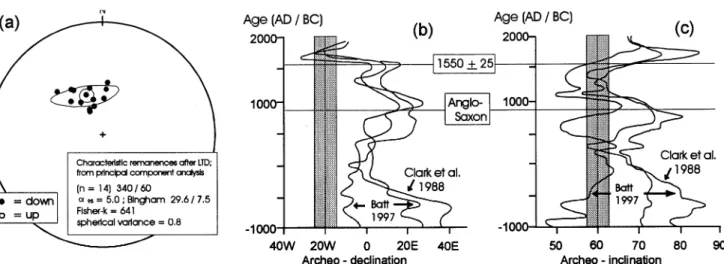
Figure 4. After low temperature demagnetization, the samples of Fig. 3 were progressively demagnetized by the alternating field method (AF) to peak fields of at least 60 mT in at least 18 increments. PCA (Kirschvink 1980) of their vector plots yielded the stable end-vectors shown. These were defined by at least 12 steps on the demagnetization plot. The value 340/60 (a95=5.0; Bingham cone radii 29.6u and 7.5u) is compatible with an age of AD 1550t25, compared with the calibration curves for southern Britain (Batt 1997; Clark et al. 1988). (Batt’s data are shown as the 95 per cent confidence bounds of her mean, which differs slightly from the mean shown for Clark et al. (1988) because she benefited from additional data and excluded lake sediment data that may have been subject to inclination-shallowing.)
Isolation of archeomagnetic signals 179
#2001 RAS, GJI 147, 176–182
The mean AMS-axes cones of confidence also lose their orthorhombic symmetry, possibly revealing multiple magnetite subfabrics (Borradaile 2001). Such field-impressed changes in susceptibility are believed to occur when AF provides sufficient energy to move domain walls (Potter & Stephenson 1990a,b) in PSD magnetite such as we describe (Fig. 2). The preservation of the bedding-parallel fabric assures us that the LTD did not significantly rearrange the microstructure of the claystone; indeed the improved coherency of archeomagnetic signals would not have occurred otherwise. The changes are more likely to be due to domain-wall rearrangements in the magnetite.
Although AMS is traditionally used to detect strong fabrics that might deflect and misrepresent palaeofields (Tarling 1983; Tarling & Dobson 1995), anisotropy of anhysteretic remanence (AARM) isolates the orientation distribution of the remanence-bearing magnetite grains (Fig. 6c) (Jackson 1991; Stephenson et al. 1986). Magnetite preferred orientations are inevitably much feebler than those of clay minerals, whose large aspect ratios readily permit compaction alignment. Thus, the large 95 per cent confidence cones for the mean ARM tensor-axes are not surprising (Fig. 6c). More interesting is the fact that the ARM lineation (maximum ARM axis) is subhorizontal
to the NW, perhaps explaining the deflection of NRMs (Fig. 1a) towards this direction, away from any expected historical geomagnetic field.
AF60 demagnetization increases the bulk susceptibility by
2 per cent and changes the shapes of AMS fabric ellipsoids, defined by symmetry (Tj=+1 oblate; Tj=x1 prolate) (Fig. 6d). Furthermore, the ARM fabric of magnetite grains revealed is much more anisotropic, and quite unrelated to the AMS fabric in either symmetry or relative intensity. Thus, AMS is of limited value as a precautionary technique to detect the potential for palaeofield deflection in these samples, and by logical extension it would seem more appropriate in general.
C O N C L U S I O N S
In the site studied, the poorly consolidated claystone foundation to a mediaeval kiln was unsuitable for thermal demagnetization, which would otherwise be the preferred treatment. However, the application of LTD followed by AF demagnetization successfully isolated stable characteristic (primary) end-vectors, whereas AF alone did not. The fact that the characteristic Figure 5. Vector plots for (a) a typical sample subject to AF demagnetization without previous LTD treatment, and (b) a typical sample subject to LTD followed by AF demagnetization. The latter is more successful in isolating a stable, linear characteristic component. Failure to apply LTD produces a smeared AF-demagnetization vector plot due to the overlap of coercivity spectra, which smears one component’s orientation into another (Dunlop 1979; Halls 1979; Hoffman & Day 1978. Archeologically significant signals (a) may reside in grains with a SD-type response, less stable signals residing in domain walls that are removed by LTD. (c) and (d) show 3-D vector plots which may clarify the relationships in conventional Zijderveld (1967) plots of the same data. The spin01 software provides interactive, rotatable 3-D vector plots, greatly expediting the recognition of stable components.
180 G. J. Borradaile, F. Lagroix and D. Trimble
components are more coherent than NRMs or components derived from AF demagnetization alone indicates that LTD is beneficial and responsible for isolating the characteristic components. It is believed that LTD has not damaged the clay fabric because the changes in AMS are negligible and, moreover, the coherency of the characteristic remanences would hardly be improved if LTD were damaging the fabric. For our samples, a single LTD treatment would have sufficed, but in other studies we found that three cycles may be necessary to achieve the full benefits. The spurious remanence
com-ponents that partly camouflaged the characteristic archeological remanence are believed to reside in domain walls in PSD magnetite (Dunlop & O¨ zdemir 1997; Ozdemir et al. 1993).
Although AMS is the traditional alarm for potential palaeofield deflection, it is the orientation distribution of remanence-bearing grains that is of prime concern. Consequently, anisotropy of anhysteretic remanence (AARM) is a more convincing indicator of fabric control on palaeofield deflection. Unfortunately, the measuring of AARM destroys the palaeo-magnetic signal, so it may only be done after demagnetization. Figure 6. Magnetic fabrics of a subset of eight kiln-clay samples from the archeological site. Dashed lines show 95 per cent confidence limits for mean-tensor’s axes. (a) Before either LTD or AF demagnetization the samples show a bedding-parallel compaction fabric with minimum susceptibility vertical, perpendicular to the stratification. There is no significant preferred orientation of maximum susceptibilities in the plane of horizontal stratification. (b) After LTD and AF demagnetization to a peak AF of 60 mT, principal susceptibilities are slightly scattered by the effect of ‘field-impressed’ anisotropy (Potter & Stephenson 1990a,b) on the magnetite, and the fabric for one sample is inverted (star). Bulk susceptibility increases by 2 per cent, from 3299 mSI in (a) to 3366 mSI in (b). High alternating fields may have rearranged walls in multidomain magnetite, thereby changing the low-field susceptibility and anisotropy of magnetite grains. However, excepting effects attributable to AF on magnetite, the AMS orientations are essentially unchanged, indicating that LTD has not substantially altered the fabric of the samples. (c) The preferred orientation of the magnetite grains is isolated by measuring anisotropy of anhysteretic remanence (AARM). The AARM orientation distribution is not so well defined as that of AMS, but reveals a feeble magnetic lineation inclined downwards to the northwest, approximately parallel to the untreated NRMs (Fig. 1a). This suggests that the intrinsic magnetite petrofabric may have slightly deflected the ancient geomagnetic field direction towards the northwest. (d) Fabric plot using Jelinek (1978) parameters for anisotropy; tie-lines connect the AMS before LTD and AF demagnetization with AMS and AARM after LTD and AF.
Isolation of archeomagnetic signals 181
#2001 RAS, GJI 147, 176–182
AMS, however, is a low-field method which may be performed before and after demagnetization. AMS showed us that the bedding-parallel fabric of the claystone was not substantially affected by LTD or AF demagnetization. However, AF demag-netization did change the AMS as a result of the high-field impression effect (Potter & Stephenson 1990a,b). For our samples, the NRMs and post-LTD, post-AF cleaned signals veer slightly northwestwards of the best possible valid archeo-declination. This deflection is towards the maximum of the ARM anisotropy, indicating that the magnetite fabric (not the entire AMS fabric) may have deflected the palaeofield slightly more westerly (cf. Figs 4a and 6c). The presence of adjacent structures may also refract the palaeofield, but it does not appear possible here in view of the low susceptibility of the building stones used and the absence of topographic relief (e.g. Abrahamsen 1986; Baag et al. 1995).
We infer an archeomagnetic field direction of 340/60 (a95=5u
according to the Fisher model, 95 per cent confidence radii of 29.6u and 7.5u) (Fig. 4a). Compared with the calibration curves for southern Britain (Batt 1997; Clark et al. 1988), an Anglo-Saxon, pre-11th century age is unacceptable. A medieval age is acceptable, with the best simultaneous satisfaction of declination and inclination values atyAD 1550t25.
The fact that ferromagnetic anisotropy of the samples, as revealed by AARM, may have deflected the palaeofield westwards makes this age even more acceptable.
A C K N O W L E D G M E N T S
This research was funded by grants from the National Sciences and Engineering Research Council of Canada (NSERC) to GJB.
R E F E R E N C E S
Abrahamsen, N., 1986. On shape anisotropy, refraction error, and possible refraction correction in paleomagnetism (Abstract), EOS, Trans. Am. geophys. Un., 67, 268.
Baag, C., Helsley, C.E., Shi-zhe Xu & Lienert, B.R., 1995. Deflection of paleomagnetic directions due to magnetization of the underlying terrain, J. geophys. Res., 100, 10 013–10 027.
Batt, C.M., 1997. The British archaeomagnetic curve: an objective treatment, Archaeometry, 39, 153–168.
Borradaile, G.J., 1994. Low-temperature demagnetisation and ice-pressure demagnetisation in magnetite and hematite, Geophys J. Int., 116, 571–584.
Borradaile, G.J., 2001. Magnetic fabrics and petrofabrics: their orientation distributions and anisotropies, J. Struc. Geol., in press. Borradaile, G.J. & Lagroix, F., 2000. Magnetic characterization using a
three-dimensional hysteresis projection, illustrated with a study of limestones, Geophys. J. Int., 141, 213–216.
Borradaile, G.J. & Werner, T., 1994. Magnetic anisotropy of some phyllosilicates, Tectonophysics, 235, 233–248.
Butler, R.F., 1992. Paleomagnetism, Blackwell, Oxford.
Clark, A.J., Tarling, D.H. & Noel, M., 1988. Developments in archeomagnetic dating in Britain, J. archeol. Sci., 15, 645–667. Dunlop, D.J., 1979. On the use of Zijderveld vector diagrams in
multicomponent paleomagnetic studies, Phys. Earth planet. Inter., 20, 12–24.
Dunlop, D.J. & O¨ zdemir, O¨., 1997. Rock Magnetism: Fundamentals and Frontiers, Cambridge Studies in Magnetism, Cambridge University Press, Cambridge.
Fisher, R.A., 1953. Dispersion on a sphere, Proc. R. Soc. Lond., A, 217, 295–305.
Fisher, N.I., Lewis, T. & Embleton, B.J.J., 1987. Statistical Analysis of Spherical Data, Cambridge University Press, Cambridge.
Halls, H.C., 1979. Separation of multicomponent NRM: combined use of difference and resultant magnetization vectors, Earth planet. Sci. Lett., 43, 303–308.
Hoffman, K.A. & Day, R., 1978. Separation of multi-component NRM: a general method, Earth planet. Sci. Lett., 40, 433–438. Jackson, M., 1991. Anisotropy of magnetic remanence: a brief review of
mineralogical sources, physical origins, and geological applications and comparison with susceptibility anisotropy, Pure appl. Geophys., 136, 1–28.
Jelinek, V., 1978. Statistical processing of anisotropy of magnetic susceptibility measured on groups of specimens, Studia Geoph. Geod., 22, 50–62.
Kirschvink, J.L., 1980. The least-squares line and plane and the analysis of paleomagnetic data, Geophys. J. R. astr. Soc., 62, 699–718. Mardia, K.V., 1972. Statistics of Directional Data, Academic Press,
London.
Mardia, K.V. & Zemroch, P.J., 1977. Table of maximum likelihood estimates for the Bingham distribution, J. statist. comput. Simul., 6, 29–34.
Ne´el, L., 1949. The´orie du traiˆnage magne´tique des ferromagne´tiques en grains fins avec applications aux terres cuites, Ann. Ge´ophys., 5, 99–136.
Ne´el, L., 1955. Some theoretical aspects of rock magnetism, Adv. Phys., 4, 191–243.
O¨ zdemir, O¨., Dunlop, D.J. & Moskowitz, B.M., 1993. The effect of oxidation on the Verwey transition in magnetite, J. geophys. Res., 98, 9551–9555.
Ozima, M., Ozima, M. & Akimoto, S., 1964. Low temperature characteristics of remanent magnetization of magnetite self-reversal and recovery phenomena of remanent magnetization, J. Geomag. Geoelectr., 16, 165–177.
Potter, D.K. & Stephenson, A., 1988. Single domain particles in rocks and magnetic fabric analysis, Geophys. Res. Lett., 15, 1097–1100. Potter, D.K. & Stephenson, A., 1990a. Field-impressed anisotropies of
magnetic susceptibility and remanence in minerals, J. geophys. Res., 95, 15573–15588.
Potter, D.K. & Stephenson, A., 1990b. Field-impressed magnetic anisotropy in rocks, Geophys Res. Lett., 17, 2437–2440.
Stephenson, A., 1983. Changes in direction of the remanence of rocks produced by stationary alternating field demagnetization, Geophys. J. R. astr. Soc., 73, 213–239.
Stephenson, A., Sadikun, S. & Potter, D.K., 1986. A theoretical and experimental comparison of the anisotropies of magnetic susceptibility and remanence in rocks and minerals, Geophys. J. R. astr. Soc., 84, 185–200.
Tarling, D.H., 1983. Paleomagnetism, Chapman & Hall, London. Tarling, D.H. & Dobson, M.J., 1995. Archeomagnetism: an error
assessment of fired material observations in the British directional database, J. Geomag. Geoelectr., 47, 5–18.
Tarling, D.H., Hammo, N.B. & Downey, W.S., 1986. The scatter of magnetic directions in archeomagnetic studies, Geophysics, 5, 634–639.
Trimble, G., 1997. Archeological investigations of a pipeline along St Giles Avenue, Sleaford, Lincolnshire, Archeological Project Services Report 16/97, Heritage Lincolnshire, Sleaford.
Xu, S. & Merrill, R.T., 1989. Microstress and microcoercivity in multidomain grains, J. geophys. Res., 94, 10 627–10 636.
Xu, S. & Merrill, R.T., 1992. Stress, grain size and magnetic stability of magnetite, J. geophys. Res., 97, 4321–4329.
Zijderveld, J.D.A., 1967. A.C. demagnetization of rocks: Analysis of results, in Methods in Paleomagnetism, pp 254–256, eds Collinson, D.W., Creer, K.M. & Runcorn, S.K., Elsevier, New York.
182 G. J. Borradaile, F. Lagroix and D. Trimble