Labyrinth Exploration, Emotional Reactivity, and
Conditioned Fear in Young Roman/Verh Inbred Rats
R. M. Escorihuela,
1A. Fernandez-Teruel,
1A. Tobena,
1W. Langhans,
2K. Battig,
3and P.
Driscoll
2,4An inbreeding program has been carried out with the Swiss sublines of Roman high-and low-avoidance rats since 1993. The present study reports the first experiments con-ducted with young animals of those inbred strains (RHA-I/Verh and RLA-I/Verh, re-spectively) from the sixth and seventh inbreeding generations. The results confirmed expected behavioral profiles. Compared to the RHA-I/Verh strain, RLA-I/Verh rats showed decreased entries into the illuminated central arena of an hexagonal tunnel maze, as well as decreased spontaneous locomotor activity and increased defecations, in two independent experiments. Young RLA-I/Verh females explored less than did their RHA-I/Verh counterparts during session 1 of a conditioned-fear experiment preceding shock administration, and in session 2 (conducted 24 h after the application of three footshocks), they showed greater conditioned behavioral inhibition (i.e., reduced amount of rearing), as well as higher defecation scores, than did RHA-I/Verh females.
KEY WORDS: Roman/Verh inbred strains; exploratory activity; emotionality; tunnel maze; con-ditioned fear.
INTRODUCTION
The Swiss sublines of Roman high-avoidance (RHA/Verh) and Roman low-avoidance (RLA/Verh) rats have demonstrated divergent behavioral pat-terns related to endogenous anxiety over many gen-erations, the latter being the more fearful of the two lines of rats (Driscoll and Battig, 1982; Ferre et al., 1995; Steimer et al., 1997b). These behavioral "hyperemotional" (RLA/Verh) and "hypoemo-tional" (RHA/Verh) phenotypes correspond to cer-tain neurochemical and neuroendocrinological data
1 Medical Psychology Unit, Department of Psychiatry, Toxi-cology and Forensic Medicine, School of Medicine, Auton-omous Univ of Barcelona, 08193-Bellaterra, Barcelona, Spain.
2 ETH-Zentrum, Animal Science Institute, Turnerstrasse 1, CH-8092 Zurich, Switzerland.
3 Karl Battig tragically and unexpectedly died on December 27, 1996.
4 To whom correspondence should be addressed. Telephone: +41 1 6325262. Fax: +41 1 6321069.
concerning physiological processes underlying fear and emotional reactivity (Aubry et al., 1995; Gentsch et al., 1982; Giorgi et al., 1994; Steimer
et al., 1997a,b; Walker et al., 1989).
Inbred Roman strains derived from those RHA/Verh and RLA/Verh outbred lines, therefore, could be a good animal model to investigate the molecular genetic basis of anxiety. With this in mind, an inbreeding program has been carried out since 1993 in order to produce inbred Roman strains (by brother X sister mating) useful for ge-netic analysis and for the identification of gege-netic loci related to behavioral traits of anxiety. We re-port here the first experiments done with young Ro-man inbred rats from the sixth and seventh generation in two behavioral tests of emotional-ity/anxiety: an hexagonal tunnel maze and a fear conditioning test.
In the first publication concerned with RHA/Verh and RLA/Verh rats, Battig et al. (1976)
573
described a tunnel maze consisting of a central hex-agonal arena and two concentric hexhex-agonal alleys, interconnected by radial alleys, which could be used to measure the suppression of spontaneous ac-tivity by situational fear or anxiety (Battig, 1983). In this regard, it has been shown that entries into the maze central arena (and also the total explored area) (a) are reduced when the arena is brightly illuminated (Martin et al., 1982; Nil and Battig, 1981), (b) can be increased by anxiolytic drugs or by infantile stimulation, especially in RLA/Verh rats (Fernandez-Teruel et al., 1991; Martin et al., 1982), and (c) are negatively correlated with def-ecation and activity during maze testing (Fernan-dez-Teruel et al., 1994). The RHA/Verh and RLA/Verh outbred lines have consistently been shown to differ in maze activity and exploration patterns, RHA/Verh rats being those which display increased activity and entries into the illuminated center as well as reduced defecations (Battig et al., 1976; Fernandez-Teruel et al., 1991, 1994; Martin
et al., 1982; Nil and Battig, 1981). Such
between-line differences already appear in postweaning (4-5-week-old) animals (Fernandez-Teruel et al.,
1991, 1994).
As for fear-conditioning, adult RLA/Verh rats have shown a more pronounced bradycardia in re-sponse to a conditioned emotional stressor (Rooz-endal et al., 1992), greater shock-induced suppression of drinking, and increased context-con-ditioned defecation and self-grooming (Imada, 1972; Ferre et al., 1995; Steimer et al., 1997a,b; Castanon and Mormede, 1994) than adult RHA/Verh rats. The fear-conditioning test used in the present study with young rats was the mea-surement of behavioral parameters prior to and fol-lowing exposure to footshocks in a shuttle box-type apparatus.
Two sets of postweaning animals from the sixth and seventh inbreeding generations were tested in a hexagonal tunnel maze (see Fernan-dez-Teruel et al., 1991) (experiments 1a and 1b) and young females from the seventh generation were also tested for fear-conditioning (experiment 2).
MATERIALS AND METHODS Animals
Male and/or female RHA-I/Verh and RLA-I/Verh rats were used. After weaning (postnatal day
22) animals were housed in groups of four to six same-sexed rats/cage. They were maintained with food and tap water available ad libitum, under con-ditions of controlled temperature (22 ± 2 D C) and a 12-h light-dark cycle (lights on 0700).
Experiments 1a and 1b: Labyrinth Testing
A hexagonal tunnel maze with concentric in-terconnected alleys was used [for further details and a plan of the maze see Fernandez-Teruel et al. (1991, 1994)]. A total of 42 infrared photocell units, which were interfaced to an IBM-XT per-sonal computer, was uniformly distributed within the maze alleys. Entry into and exit from the central arena (illuminated by a 60-W incandescent bulb suspended 28 cm above the center) could also be thus measured. The ceiling and side walls (9 cm high) were fitted together to form a unit that could be lifted from the floor to permit easy removal of a subject and subsequent cleaning. The maze con-tained no barriers, thus permitting the rats to am-bulate freely from one alley to another.
Behavioral testing, which was completely au-tomated, was carried out between 0830 and 1700. Each rat received a single 6-min test in the maze. At the conclusion of each test the floor of the maze was thoroughly wiped clean with a slightly damp cloth. The order of testing was arranged so that approximately equal numbers of rats from each group were tested during each portion of the light cycle. Before testing the animals were familiarized with the experimental room for at least 10 min, and they were weighed immediately before starting the test.
The parameters scored during maze testing were total activity (TA; number of photobeam in-terruptions during a test) and entries into the central illuminated arena (EC).
Experiment 1a. Male and female 4-week-old
rats from each inbred strain (sixth generation of inbreeding) were used. Each of the four experi-mental groups contained animals from at least six litters.
Experiment 1b. Male and female 6-week-old
rats from each inbred strain (seventh generation of inbreeding) were used. Each of the four experi-mental groups contained animals from nine litters. Defecations (during weighing + during maze test-ing) were also scored in this experiment.
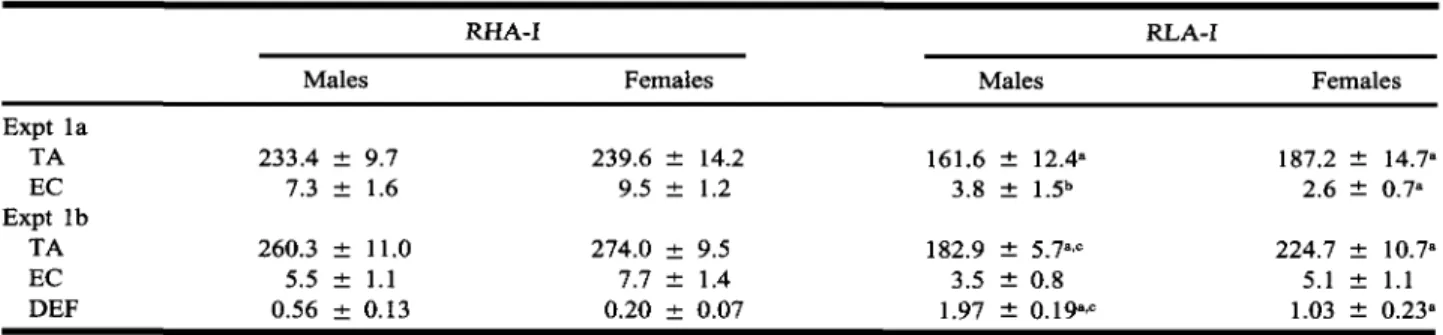
Table I. Mean ± SE Total Activity (TA), Entries into the Center (EC), and Defecations (DEF) in the Hexagonal Tunnel Labyrinth* Expt 1a TA EC Expt 1b TA EC DEF RHA-I Males 233.4 ± 9.7 7.3 ± 1.6 260.3 ± 11.0 5.5 ± 1.1 0.56 ± 0.13 Females 239.6 ± 14.2 9.5 ± 1.2 274.0 ± 9.5 7.7 ± 1.4 0.20 ± 0.07 RLA-I Males 161.6 ± 12.4a 3.8 ± 1.5b 182.9 ± 5.7a,c 3.5 ± 0.8 1.97 ± 0.19a,c Females 187.2 ± 14.7a 2.6 ± 0.73 224.7 ± 10.7a 5.1 ± 1.1 1.03 ± 0.23a * ap < .01 vs. the corresponding RHA group (same sex). bp < .05 (one tailed) vs. the corresponding RHA group (same sex). cp
< .01 vs. the corresponding female group (same strain). Duncan's t tests; n = 10/group in experiment 1a; n = 30/group in experiment 1b.
Experiment 2: Conditioned Fear
Sixteen 8-week old females from each inbred strain (seventh generation of inbreeding) were used. There were animals from at least six litters in each experimental group.
The shuttle box used for exploration testing was divided into two 27 X 27 X 27-cm compart-ments connected by an opening of 7 X 7 cm. The ceiling was transparent, and the box was uniformly illuminated by a 60-W incandescent bulb placed 40 cm above it. After weighing an animal, behavioral testing (session 1) started by placing the rat into one of the compartments of the shuttle box and allowing it to explore the box freely for 4 min. Crossings, rearings, and defecation were scored during that period. Immediately following this 4-min testing, the animals were confined to one of the compartments by closing the opening and eight rats from each strain received three footshocks (each of 0.5 mA, 3 s) at 30-s intervals (RHA-I/S and RLA-I/S groups). The remaining eight rats per strain were also confined to one of the compart-ments but footshocks were not administered (RHA-I/C and RLA-(RHA-I/C groups). Twenty-four hours after that procedure, all animals were again placed in the shuttle box for another 4 min, comparable to ses-sion 1 (sesses-sion 2). Testing was performed during the morning in a counterbalanced manner.
Statistical Analysis
Factorial analysis of variance (ANOVA), fol-lowed by Duncan's multiple-range test for com-parisons between groups, were applied to data from
experiments 1a and 1b. Crossings, rearings, and defecation (log transformed) from experiment 2 were analyzed by two-way ANOVA with repeated measures. Student's t tests were also used for com-parisons between pairs of groups.
RESULTS
The results from experiments 1a and 1b are shown in Table I. Both experiments showed higher exploratory activity [TA; F(1,39) = 12.4,p < .001, and F( 1,119) = 44.7,p < .001, experiments 1a and 1b, respectively] and more entries into the illumi-nated center [EC; F(1,39) = 15.4, p < .001, and F(1,119) = 4.33, p < .04, experiments 1a and 1b, respectively] in RHA-I than in RLA-I rats. There was also a tendency for females to be more active, although it was significant only in experiment 1b [Sex effect on TA, F(1,119) = 8.6, p < .01]. The analysis of defecations in experiment 1b showed Strain [F(1,119) = 44.2, p < .001] as well as Sex effects [F(1,119) = 15.0, p < .001], with RLA-I rats defecating more than RHA-I rats and females defecating less than males (see Table I and Dun-can's tests). No Strain X Sex interactions were found for any of the parameters studied.
Results from experiment 2 are shown in Fig. 1. Since there were no within-strain differences in any of the measures studied in session 1 (i.e., be-fore shock administration), results from this session were analyzed pooling the rats within each strain (thus n = 16/group). It was observed that RHA-I rats displayed more rearing behavior than RLA-I animals [t(30) = 4.35, p < .001] (Fig. 1B) in ses-sion 1, whereas there were no significant
differ-Fig. 1. Mean ± SE crossings (A), rearings (B), and defecations (C) in a fear-conditioning test. RHA-S and RLA-S are the groups of the corresponding strain receiving footshock immediately following session 1; RHA-C and RLA-C are the control nonshocked groups. (C) p < .05 vs. all groups; (*) p < .05 between the groups indicated (Duncan's test); (+) < .05 between the groups indicated (paired t test).
ences in crossings or in defecations (p = .1) between the two strains in the same session.
The two-way ANOVA analysis (Strain fac-tor—RHA-I, RLA-I; and shock factor—control, shocked) with repeated measures (sessions 1 and 2) revealed overall significant Strain X Session effects on crossings [F(1,28) = 16.51, p < .001] and rear-ings [F(1,28) = 13.61, p < .001], thus indicating that the reduction in those measures in session 2 was greater in the RLA-I strain. Overall significant Shock X Session effects on crossings and rearings were also found [F(1,28) = 11.73, p < .01, and F(1,28) = 10.12, p < .01, respectively]. A more detailed analysis suggested that the strongest be-havioral suppression in session 2 (i.e., conditioned-fear as a consequence of receiving shocks immediately after session 1) occurred in RLA-I rats. This was especially evident in the rearing measure, as the RLA-I/S was the only group show-ing a clear and significant between-session decrease in rearing behavior (paired t test, t = 3.27, p = .014), whereas the remaining groups increased rear-ing from session 1 to session 2 (Fig. 1B). Finally, RLA-I animals defecated more than RHA-I rats [overall significant Strain effect: F(1,28) = 4.14,p
= .05], and group comparisons in session 2 showed
that the only significant difference in that measure appeared between RLA-I/S and RHA-I/S groups (p
< .05, Duncan's test), with RLA-I/S rats showing
the highest defecation score.
It is worth mentioning here that the time spent self-grooming was different [as expected (see Ferre
et al., 1995; Steimer et al., 1997b)] between both
strains in session 1 (means ± SE: RHA-I, 12.9 ± 1.9; RLA-I, 31.4 ± 3.9; p < .05), but it was not differentially affected by shock, as observed by the scores obtained in session 2 (RHA-I/C, 15.4 ± 3.3; RHA-I/S, 15.1 ± 4.0; I/C, 29.0 ± 5.0; RLA-I/S, 27.4 ± 11.1).
DISCUSSION
The results from experiments 1a and 1b re-garding total activity, as well as emotionality (i.e., entries into the illuminated center and defecation) in the hexagonal tunnel maze closely resemble those obtained in previous experiments performed with RHA/Verh and RLA/Verh outbred rats of a similar age (Fernandez-Teruel et al., 1991, 1994). It can also be observed (Table I) that females of
both strains tended to be more active and to defe-cate less than males, results which are also in agreement with those found in the Roman/Verh outbred lines (Fernandez-Teruel et al., 1991, 1994). Thus, concerning labyrinth behavior, young Ro-man/Verh inbred rats show behavioral profiles very similar to what has typically been observed in the outbred parental lines.
In experiment 2, RHA-I/Verh rats reared much more than did RLA-I/Verh rats, whereas no differences in crossings between the two strains were found in session 1 (see Fig. 1B). It appears that RHA-I/Verh animals preferred to explore in vertical directions (rearing behavior) instead of moving from one side to the other of the apparatus (crossings), an effect that has already been ob-served several times when using shuttle boxes for measuring exploratory behavior (unpublished). With regard to defecation, the two strains did not differ in session 1 since only 6% (1/16) of RHA-I/Verh and 37% (6/16) of RLA-RHA-I/Verh animals def-ecated during that 4-min testing period. The possibility exists that a longer testing time would have revealed differences in defecation similar to those observed in other studies (e.g., Ferre et al.,
1995).
The exploratory pattern changed in session 2. Control (nonshocked) animals from both strains (RHA-I/C and RLA-I/C groups) differed in both rearings and crossings due to the fact that the RHA-I/C group showed increased exploratory behavior (i.e., both parameters) from session 1 to session 2, whereas RLA-I/C animals did not (see Figs. 1A and B). As habituation of exploratory behavior may be dependent upon spatial information storage, such differences in exploratory habituation patterns (i.e., between sessions) could be in line with pre-vious studies indicating that RHA/Verh rats are less efficient than RLA/Verh animals in several learning tasks (see Fernandez-Teruel et al., 1997; Nil and Battig, 1981). In session 2, those two nonshocked groups still presented no significant defecation scores.
After shock administration, however, young RHA-I/S rats decreased crossings and rearings compared to RHA-I/C rats (p < .05, Duncan's test), and the same was observed when comparing RLA-I/C and RLA-I/S groups (Figs. 1A and B). In addition to showing the lowest crossing and rearing scores, the RLA-I/S group showed the highest def-ecation scores in session 2, leading to significant
differences with respect to RHA-I/S animals. It ap-pears that the specific decrease in rearing behavior (Fig. 1B) and increase in defecation (Fig. 1C) shown by young RLA-I/S rats, from session 1 to session 2, is most likely attributable to a higher sensitivity to fear-conditioning in that strain. This is consistent with previous results reported with adult RLA/Verh outbred rats which indicated a higher context-conditioned fear (compared to the RHA/Verh line) in situations involving shock ad-ministration (Ferre et al., 1995; Roozendal et al.,
1992).
ACKNOWLEDGMENTS
This work received support from the FISSs (95/1779). R.M.E. was supported by a grant from the Autonomous Government of Catalonia (CIRIT, BE94-305).
REFERENCES
Aubry, J. M., Bartanusz, V., Driscoll, P., Schulz, P., Steimer, T., and Kiss, J. Z. (1995). Corticotropin-releasing factor and vasopressin mRNA levels in Roman high- and low-avoidance rats: Response to open-field exposure.
Neu-roendocrinology 61:89—97.
Battig, K. (1983). Spontaneous tunnel maze locomotion in rats. In Zbinden, G., et al. (eds.), Application of Behavioral
Pharmacology in Toxicology, Raven Press, New York,
pp. 15-26.
Battig, K., Driscoll, P., Schlatter, J., and Uster, H. J. (1976). Effects of nicotine on the exploratory locomotion patterns of female Roman high- and low-avoidance rats.
Phar-macol. Biochem. Behav. 4:435—439.
Castanon, N., and Mormede, P. (1994). Psychobiogenetics: Adapted tools for the study of the coupling between be-havioral and neuroendocrine traits of emotional reactivity.
Psychoneuroendocrinology 19:257-282.
Driscoll, P., and Battig, K. (1982). Behavioral, emotional and neurochemical profiles of rats selected for extreme differ-ences in active, two-way avoidance performance. In Lie-blich, I. (ed.), Genetics of the Brain, Elsevier, Amsterdam, pp. 95-123.
Fernandez-Teruel, A., Escorihuela, R. M., Driscoll, P., Tobena, A., and Battig, K. (1991). Infantile (handling) stimulation and behavior in young Roman high- and low-avoidance rats. Physiol. Behav. 50:563-565.
Fernandez-Teruel, A., Escorihuela, R. M., Driscoll, P., Tobena, A., and Battig, K. (1994). Evaluating activity and emo-tional reactivity in a hexagonal tunnel maze: Correlaemo-tional and factorial analysis from a study with the Roman/Verh rat lines. Behav. Genet. 24:419-425.
Fernandez-Teruel, A., Escorihuela, R. M., Castellano, B., Gon-zalez, B., and Tobena, A. (1997). Effects of early han-dling and enrichment on emotionally, novelty/reward seeking, and age-related cognitive and hippocampal im-pairments: Focus on the Roman rat lines. Behav. Genet. 27:513-526.
Ferre, P., Fernandez-Teruel, A., Escorihuela, R. M., Driscoll, P., Corda, M. G., Giorgi, O., and Tobena, A. (1995). Be-havior of the Roman/Verh high- and low-avoidance rat lines in anxiety tests: Relationship with defecation and self-grooming. Physiol. Behav. 58:1209-1213.
Gentsch, C., Lichtsteiner, M., Driscoll, P., and Feer, H. (1982). Differential hormonal and physiological responses to stress in Roman high- and low-avoidance rats. Physiol. Behav. 28:259-263.
Giorgi, O., Orlandi, M., Escorihuela, R. M., Driscoll, P., Lecca, D., and Corda, M. G. (1994). GABAergic and do-paminergic transmission in the brain of Roman high-avoidance and Roman low-high-avoidance rats. Brain Res. 638:133-138.
Imada, H. (1972) Emotional reactivity and conditionability in four strains of rats. J. Comp. Physiol. Psychol. 79:474-480. Martin, J. R., Oettinger, R., Driscoll, P., Buzzi, R., and Battig,
K. (1982). Effects of chlordiazepoxide and imipramine on maze patrolling within two different maze configurations by psychogenetically selected lines of rats. Psychophar-macology 78:58-62.
Nil, R., and Battig, K. (1981). Spontaneous maze ambulation and Hebb-Williams learning in Roman high-avoidance and Roman low-avoidance rats. Behav. Neur. Biol. 33: 465-475.
Roozendal, B., Wiersma, A., Driscoll, P., Koolhaas, J. M., and Bohus, B. (1992) Vasopressinergic modulation of stress responses in the central amygdala of the Roman high-avoidance and low-high-avoidance rat. Brain Res. 596:35—40. Steimer, T., La Fleur, S., and Schulz, P. (1997a). Neuroen-docrine correlates of emotional reactivity and coping in male rats from the Roman high-(RHA/Verh) and low-(RLA/Verh) avoidance lines. Behav. Genet. 27:503-512. Steimer, T., Driscoll, P., and Schulz, P. (1997b). Brain metab-olism of progesterone, coping behavior and emotional reactivity in male rats from two psychogenetically se-lected lines. J. Neuroendocrinol. 9:169-175.
Walker, C. D., Rivest, R. W., Meaney, M. J., and Aubert, M. L. (1989). Differential activation of the pituitary-adreno-cortical-axis after stress in the rat: Use of two genetically selected lines (Roman low- and high-avoidance rats) as a model. J. Endocrinol. 123:477-485.