Eur J Pediatr (2006) 165: 671–676 DOI 10.1007/s00431-006-0161-9
O R I G I N A L PA P E R
Ulrich Heininger . Kerstin Loos . Imke Lorenz . Wolfgang Rascher
Compliance with recommended immunizations in adolescents
Received: 7 December 2005 / Revised: 10 April 2006 / Accepted: 11 April 2006 / Published online: 18 May 2006
# Springer-Verlag 2006
Abstract Introduction: Little is known about the com-pleteness and timely administration of recommended standard immunizations in Germany. The goal of this study was to determine compliance with official standard immunization recommendations in adolescents attending secondary schools in the city of Erlangen, Germany. Methods: Adolescents who were attending 5th grade (at approximately 11 years of age), 8th grade (14 years), or 10th and 11th grade (16–17 years) classes at any of the 13 of 14 schools that had agreed to participate were eligible to be enrolled. Results: While coverage for the primary series of diphtheria, tetanus and poliomyelitis immunizations was satisfactory (98%), coverage for measles-mumps-rubella immunizations (dose 1: 89–96%; dose 2: 60–76%) and hepatitis B (doses 1–3: 61%) was suboptimal. Of note, 39% of students had not received any immunization against pertussis. Completion of immuniza-tion series generally was significantly delayed. Fur-thermore, rates for recommended booster doses in adoles-cence were disappointingly low with 21% for tetanus component vaccines and <10% for the fifth dose of pertussis. Conclusions: Significant immunization gaps for all recommended standard immunizations in adoles-cents were detected. This puts individuals at risk for serious vaccine-preventable diseases, contributes to sub-optimal herd immunity in the population under study leaving the potential for future epidemics, and impedes national and international targets of disease reduction or elimination.
Keywords Immunization . Coverage . Adolescents . Timely immunization . Pertussis
Abbreviations DTPa: Diphtheria, tetanus, acellular pertussis component vaccine . IPV: Inactivated
poliomyelitis vaccine . OPV: Oral poliomyelitis vaccine . Hib: Haemophilus influenzae type B vaccine . hep B: Hepatitis B vaccine . MMR: Measles, mumps, rubella vaccine . Td: Reduced diphtheria toxoid and tetanus toxoid vaccine . Tdpa: Td, plus reduced antigen acellular pertussis component vaccine
Introduction
Virtually all countries worldwide recommend specific immunizations for the general population [22]. Some countries regularly analyze compliance with recommended immunizations, and this is usually based on immunization coverage in young children [4, 8, 12–14, 16]. However, little is known about compliance with recommended standard or catch-up immunizations in adolescents, and data are frequently limited to specific immunizations such as those against hepatitis B [5,7,9]. Further, assessment of timely immunization has not been reported in adolescents so far.
Currently the recommendations for standard immuniza-tions for children and adolescents in Germany comprise vaccinations against 10 diseases: DTPa-IPV-hepB/Hib (at 2, 3, 4, and 11–14 months of age), MMR (11–14 and 15– 23 months), varicella (11 months of age onwards), Td (5– 6 years), and Tdpa-IPV (9–17 years) [17]. Over the last 15 years these recommendations, as issued by the German national advisory board for immunizations, the Ständige Impfkommission am Robert Koch-Institut (STIKO), have undergone several modifications which can be summarized as follows.
Immunization against Hib was introduced in spring of 1990. In 1991, a second dose of MMR was recommended at 5–6 years of age (later modified to the second year of life) and as a catch-up immunization for all older children This work contains data from the medical thesis of Kerstin Loos at
the Medical Faculty, University of Erlangen, Germany. U. Heininger (*)
University Children’s Hospital (UKBB), P.O. Box CH-4005 Basel, Switzerland e-mail: [email protected] Tel.: +41-61-6856565
Fax: +41-61-6856012
K. Loos . I. Lorenz . W. Rascher
University Hospital for Children and Adolescents, Erlangen, Germany
and adolescents. Also in 1991, universal pertussis im-munization was re-introduced after 25 years of cessation (in former West Germany) with three doses in the first year of life, a fourth dose in the second year of life, and catch-up immunizations to be performed in all unvacci-nated children (four doses) and adolescents (two instead of four doses from 14 years of age onwards). Further, a fifth dose of pertussis vaccine was introduced in July 2000 for those 9–17 years of age. Universal immunization against hepatitis B was introduced in children (2 months of age onwards) and adolescents (9–17 years) in 1995. Finally, varicella immunization has been recommended in infants 11 months of age and older (with catch-up immunization in unvaccinated older children and adolescents without a history of previous varicella) since July 2005.
The primary goal of this cross-sectional study was to assess the compliance with a fifth dose of pertussis vaccine in adolescents in Erlangen, Germany, more than 1 year after its introduction in the national immunization sched-ule. As secondary goals we were interested in immuniza-tion coverage with other standard immunizaimmuniza-tions in adolescents and how timely they were administered.
Methods
Study cohort and data collection
The study was planned in collaboration with the local Public Health Service; and the heads of all 14 secondary schools in Erlangen, Germany, were asked for their agreement after the design of the study had been explained in a letter in December 2001. All students attending 5th grade (at approximately 11 years of age), 8th grade
(14 years), or 10th and 11th grade (16–17 years) classes at any of the 13 schools that had agreed to participate were eligible to be enrolled. The students and their parents were informed by a letter about the purpose of the study in January 2002, and the students were asked to bring their immunization records to school on a pre-determined date (between January and March 2002) for inspection by one of us (KL) if they were willing to participate.
Definitions
In accordance with the German national immunization recommendations, age-appropriate immunization in study subjects was defined as follows:
– A primary series of three doses of DTP/DTPa combination vaccine and a fourth dose at least 6 months after the third dose (two plus one doses if DT only), followed by further doses of Td at 5–6 years of age, a Td combination vaccine from 9 years of age onwards, and one further dose of pertussis vaccine (either in combination with Td or as a monovalent vaccine) from 9 years of age onwards
– Four doses of OPV and/or IPV before the child’s second birthday and a fifth dose from 9 years of age onwards
– At least one dose of Hib vaccine after 12 months of age in adolescents who were <5 years old (upper limit for recommended immunization) in 1990 when this vac-cine was introduced, i.e. 5th and 8th grade students – Three doses of monovalent hepatitis B vaccine (0, 1,
6 month schedule)
– Two doses of MMR, at least 4 weeks apart
Reasons for Exclusion
Students eligible for participation: n=3079
(100%)
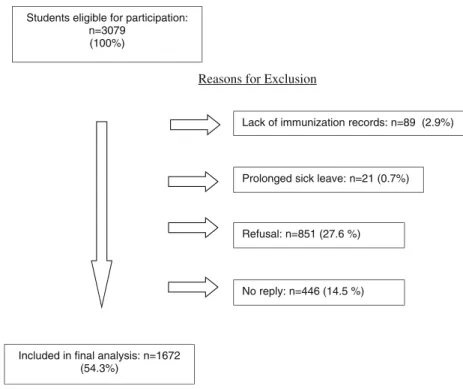
Lack of immunization records: n=89 (2.9%)
Prolonged sick leave: n=21 (0.7%)
Included in final analysis: n=1672 (54.3%)
Refusal: n=851 (27.6 %)
No reply: n=446 (14.5 %)
Statistical analysis
Statistical analyses were performed with SPSS version 11.0 (SPSS, Chicago, IL, United States).
Ethical approval
The study protocol was approved by the University of Erlangen Medical Faculty Ethical Committee.
Results
Study participants
There were 1,672 adolescents who participated in this study (Fig. 1), of whom 747 (44.7%), 646 (38.6%), and 279 (16.7%) were attending 5th grade, 8th grade, and 10th/11th grade classes, respectively. Participation rates decreased with increasing grade from 64.6 to 53.3 and 39.2% (P<0.001). Further, overall participation rate was higher in high schools (62.5%) compared to other second-ary schools (45.1%; P<0.001).
Immunization coverage
The great majority of adolescents had a documented primary series of immunizations against diphtheria [98.1%; 95% confidence interval (CI): 97.5–98.7], tetanus (98.5%; 95% CI: 97.9–99.1) and poliomyelitis (97.7%; 95%VB: 96.9–98.5). In contrast, only 650 (87.0%) of 747 5th grade students and 316 (48.9%) of 646 8th grade students had received age-appropriate numbers of Hib immunizations before 5 years of age.
With regards to further booster immunizations with tetanus component vaccines, 91.9% of students had received the recommended pre-school dose (Table 1). Administration of the adolescent booster, recommended between 9 and 17 years of age, was less complete although rates increased steadily from grade to grade. Similar findings were obtained for diphtheria and poliomyelitis immunizations (data not shown).
With regards to hepatitis B, only 1,014 (60.6%) of 1,672 students had been completely (≥three doses) immunized at
any age, and in a further 175 (10.5%) individuals, the series had been initiated with one or two doses but had not yet been completed.
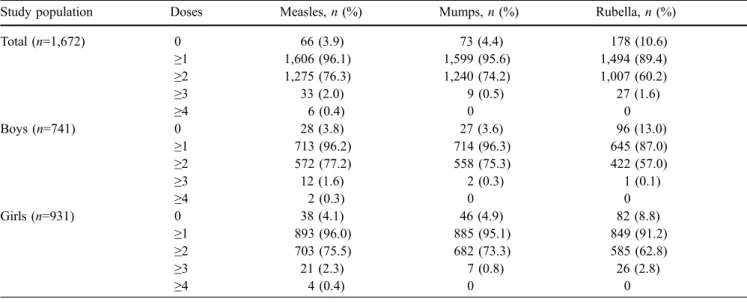
As can be seen in Table2, 95–96% of female and male adolescents had received at least one dose of measles and mumps vaccine and 75–78% had received at least two doses. In contrast, rates for rubella immunization were below 90% and approximately 60% for the first and second doses, respectively, in both females and males. However, coverage with one and two doses of rubella vaccine increased from 82.8 and 43.7% in 10th and 11th grade students to 91.8 and 65.5% in 5th grade students (P<0.001), respectively.
Pertussis immunization coverage and age when the first dose had been administered are presented in Table 3. Although 60.7% of students had received at least one dose (71.6% of 5th grade, 50.2% of 8th grade, and 56.7% of 10th/11th grade students), only a minority of students had received an age-appropriate number of doses. Of those with initiation of immunization before 1 year of age, only 123 (7.4%) had received the full series of five doses and, interestingly, 50 of these 123 students had received their fifth dose before 9 years of age, i.e. earlier than generally recommended (Fig. 2). Further, 24 (1.5%) students had received at least two doses (the recommended total number when administered as a primary series between 14 and 18 years of age) of monovalent acellular pertussis vaccine at 14 years of age or older. Still, overall less than 10% of adolescents were up-to-date regarding pertussis immuniza-tions, and the rate among the oldest students (10th and 11th grade) did not exceed 10% either. Approximately 40% of adolescents had never received any immunization against pertussis with a disproportionately higher percentage among 10th and 11th grade students compared to 5th grade students (28.4% versus 47.9%; P<0.001).
Timely administration of immunizations
Immunizations where significantly delayed when com-pared to officially recommended time points. By use of data for tetanus immunizations as an indicator of com-bination vaccines administered in the first year of life, only 60.3% of students had received a complete primary series by 6 months of age and 84.2% had received a booster dose in the second year of life. Further booster doses were
Table 1 Immunization coverage for tetanus pre-school and adolescent booster doses in 1,672 students
Study population Booster ≤6 years, n (%) 7–8 years, n (%) ≥9 years, n (%) Total, n (%)
Total (n=1,672) Pre-school booster 482 (28.8) 848 (50.7) 206 (12.3) 1,536 (91.9)
Adolescent booster 12 (0.7) 26 (1.6) 319 (19.1) 357 (21.4)
5th grade (n=747) Pre-school booster 242 (32.4) 356 (47.7) 66 (8.8) 664 (88.9)
Adolescent booster 7 (0.9) 11 (1.5) 26 (3.5) 44 (5.9)
8th grade (n=646) Pre-school booster 171 (26.5) 360 (55.7) 84 (13.0) 615 (95.2)
Adolescent booster 4 (0.6) 13 (2.0) 167 (25.9) 184 (28.5)
10th/11th grade (n=279) Pre-school booster 69 (24.7) 132 (47.3) 56 (20.1) 257 (92.1)
substantially delayed in the great majority of students, with less than a third having received the recommended pre-school booster before pre-school entry and merely a fifth having received the adolescent age booster. Even in 10th or 11th grade students, 16–17 years of age and therefore at the end of the recommended time window, less than 50% were up-to-date with their tetanus (and diphtheria) immunization schedule.
Since pertussis vaccinations in childhood are usually administered as part of DTP/DTPa and Tdpa combination
vaccines, delay of immunization for doses one through five followed the same pattern as described for tetanus vaccinations. Furthermore, recommended pertussis mono-valent catch-up immunizations in those students who had received DT combination vaccines in childhood were administered only in a small minority.
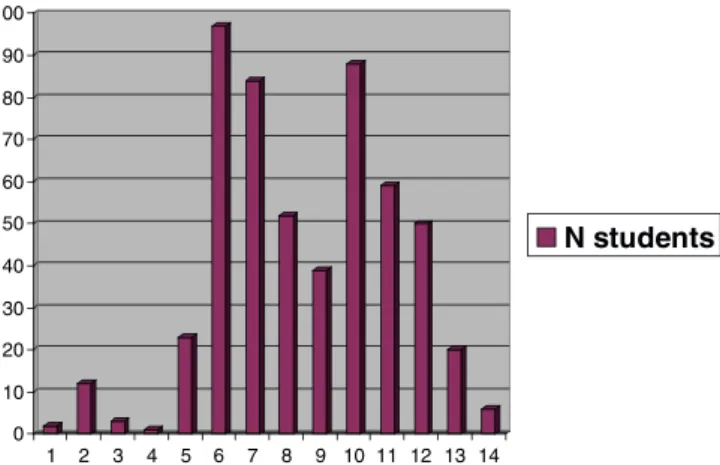
Administration of the second dose of MMR was scattered throughout pre-school and school age as is exemplified for measles vaccinations in 8th grade students in Fig.3. Two peaks of immunization around school entry (6–7 years of age) and transition to secondary school (10– 11 years of age) can be recognized, which coincide with scheduled“well-child visits” in private practices and public health service visits to schools, respectively.
Disease surveillance
According to the Protection Against Infectious Disease law (“Infektionsschutzgesetz”), introduced in Germany in 2001, reporting of several vaccine-preventable diseases is mandatory. Unfortunately, pertussis is not.
With regards to hepatitis B, the yearly incidence (per 100,000 inhabitants) in the city of Erlangen decreased from 1.9 in 2001 to 1.0 in 2005 and in Germany overall from 2.9 to 1.5 (http://www3.rki.de/SurvStat/QueryForm. aspx). With respect to measles, a disease that occurs Table 2 Immunization coverage for measles, mumps, and rubella vaccinations in 1,672 students by gender
Study population Doses Measles, n (%) Mumps, n (%) Rubella, n (%)
Total (n=1,672) 0 66 (3.9) 73 (4.4) 178 (10.6) ≥1 1,606 (96.1) 1,599 (95.6) 1,494 (89.4) ≥2 1,275 (76.3) 1,240 (74.2) 1,007 (60.2) ≥3 33 (2.0) 9 (0.5) 27 (1.6) ≥4 6 (0.4) 0 0 Boys (n=741) 0 28 (3.8) 27 (3.6) 96 (13.0) ≥1 713 (96.2) 714 (96.3) 645 (87.0) ≥2 572 (77.2) 558 (75.3) 422 (57.0) ≥3 12 (1.6) 2 (0.3) 1 (0.1) ≥4 2 (0.3) 0 0 Girls (n=931) 0 38 (4.1) 46 (4.9) 82 (8.8) ≥1 893 (96.0) 885 (95.1) 849 (91.2) ≥2 703 (75.5) 682 (73.3) 585 (62.8) ≥3 21 (2.3) 7 (0.8) 26 (2.8) ≥4 4 (0.4) 0 0
Table 3 Immunization coverage for pertussis vaccinations and age at first dose in 1,672 students
Total Doses <1 year, n (%) ≥1 year, n (%) ≥14 years, n (%) Total subjects, n (%)
0 – – – 657 (39.3) 1 25 (1.5) 18 (1.1) 0 43 (2.6) 2 19 (1.1) 28 (1.7) 23 (1.4) 70 (4.2) 3 84 (5.0) 23 (1.4) 1 (0.1) 108 (6.5) 4 590 (35.3) 81 (4.8) 0 671 (40.1) 5 123 (7.4) 0 0 123 (7.4) ≥1 841 (50.3) 150 (9.0) 24 (1.4) 1,015 (60.7) 0 5 10 15 20 3 4 5 6 7 8 9 10 11 12 13 14 15 16 17 N students
Fig. 2 Age when the fifth dose of pertussis component vaccine was administered in 123 8th grade students
endemically but also in epidemics in Germany, nationwide incidence rates were 7.3, 5.6, 0.9, 0.2, and 0.9 in the years 2001–2005. Similarly, the incidence in the city of Erlangen varied between 0 and 2.9 during the same period with no major outbreaks reported.
Discussion
Most population-based studies on immunization coverage have focused on infants and young children [4,8,12–14,
16] and on adults for specific vaccines such as those against influenza and pneumococcal disease [3]. In contrast, assessment of compliance with recommended immuniza-tions in adolescents has widely been neglected. In this regard, the major findings of our study are of concern. We noted substantial gaps in our study cohort for all standard immunizations recommended in Germany in adolescents 11–17 years of age. More than 10 years after re-introduction of pertussis immunization—with specific recommendations for catch-up vaccinations in older children and adolescents that could easily be implemented with the availability of a monovalent acellular pertussis vaccine at that time—approximately 40% of students were still unimmunized. Furthermore, less than 10% of those previously immunized had received a fifth dose of pertussis vaccine, which had been introduced more than a year before this study was conducted. Also, more than 50% of adolescents were underimmunized for tetanus and diph-theria booster doses. Of further concern, uptake of hepatitis B immunization, introduced in 1995 for infants and as-yet-unimmunized adolescents, was disappointingly low, which renders a substantial part of the population unprotected at an age when risk of acquisition of this devastating disease is particularly high [5,19]. Finally, coverage rates for the first and second dose of MMR did not meet the targets established by WHO [23].
Although reported incidences of measles and hepatitis B in our study area in recent years have been in the same range or even lower compared to the whole country, it is obvious from outbreak analyses of vaccine-preventable diseases that lack of immunization is a major risk factor for
epidemic and endemic disease [1, 10]. In light of this, recent reports of regional outbreaks of measles in Germany are not surprising [1] and should be expected in our study area sooner or later, too. Similarly, epidemics of mumps are eminent, and an increase in rubella embryopathy cases could be expected when these adolescents enter child-bearing age.
Immunizations in adolescents not only were incomplete but also were administered with significant delays. This further increases the risk for infections for the individual and also from a public health perspective [6].
Our study has some limitations. First, participation rate in this study was less than optimum and unevenly distributed among the different schools. Therefore, the true immunization coverage in our adolescent population is likely to be even lower than the current findings indicate. Second, this study was not designed to assess the reasons for underimmunization in adolescents. Probably, missed opportunities, ignorance regarding the need for catch-up and booster immunizations, and lack of recall systems are major factors involved [15,18], but further investigations are needed in order to design meaningful interventions. Third, accuracy of documented immunizations was not verified with the individuals’ health care providers and therefore some adolescents may have been misclassified as not immunized if some vaccinations were administered but were not documented in the vaccinee’s personal immuni-zation records. Fourth, this study was performed in 2002. Immunization rates may have improved since then and therefore the current situation might be better than the data we presented imply.
Since the elimination of poliomyelitis by mass immu-nization with OPV, no newly introduced immuimmu-nizations in the national vaccine program in Germany have been accompanied by official public information campaigns. Furthermore, over the last three decades, school-based health services have been downgraded merely to assess immunization rates in students of various ages (mainly pre-school and early pre-school age) and to submit written recommendations to parents on the need of catch-up immunizations for their children. Immunizations per se are usually not performed. Rather, administration of vaccines has been the domain of physicians in private practice whose task it is to inform and convince patients (or their parents) about necessary immunizations on an individual basis. The findings from this study indicate that, in the case of adolescents, this strategy so far has not been successful in the region under study. As an indication of potential improvement, we noted somewhat higher immunization rates in the youngest age group when compared to the mid-and late-adolescence age groups, mid-and a recent cohort analysis also indicates improved vaccination coverage with the introduction of multicomponent combination vaccines [13].
Still, achieving sufficient immunization coverage in adolescents apparently is a difficult challenge and clearly requires intensified efforts [15, 18]. In this regard, prep-arations recently discussed in the United States prior to the introduction of a pertussis booster dose in adolescents in 0 10 20 30 40 50 60 70 80 90 100 1 2 3 4 5 6 7 8 9 10 11 12 13 14 N students
Fig. 3 Age when second dose of measles component vaccine was administered in 536 8th grade students
October 2005 may serve as an example of how to try to optimize compliance with immunizations [11]. Raising the awareness of the benefits of immunizations by information campaigns, improving opportunities for adolescents to be immunized in health care settings (e.g. longer office hours, vaccination programs in schools, or immunizations in new settings such as emergency departments), reducing “out-of-pocket costs” (not an issue in Germany where standard immunizations are covered by health insurances), and installation of reminder systems (by phone, letter, postcard) have been identified as most promising strategies [2,20,
21]. These options should seriously be considered in Germany, too, if improvement of immunization coverage in adolescents is our goal.
Acknowledgements We are grateful to the participating students and their parents, to the heads of secondary schools for their support, and to Dr. P. Lederer, Public Health Service of the city of Erlangen, Germany, for assistance in preparing this investigation.
References
1. Arenz S, Schmitt HJ, Tischer A, von Kries R (2005) Effectiveness of measles vaccination after household exposure during a measles outbreak: a household contact study in Coburg, Bavaria. Pediatr Infect Dis J 24:697–699
2. Briss PA, Rodewald LE, Hinman AR, Shefer AM, Strikas RA, Bernier RR, Carande-Kulis VG, Yusuf HR, Ndiaye SM, Williams SM (2000) Reviews of evidence regarding interven-tions to improve vaccination coverage in children, adolescents, and adults. The Task Force on Community Preventive Services. Am J Prev Med 18(Suppl):97–140
3. Centers for Disease Control and Prevention (2003) Public health and aging: influenza vaccination coverage among adults aged≥50 years and pneumococcal vaccination coverage among adults aged ≥65 years-United States, 2002. MMWR Morb Mortal Wkly Rep 52:987–992
4. CDSC (2000) COVER programme: October to December 1999 vaccination coverage statistics for children up to 5 years of age in the United Kingdom. Commun Dis Rep CDR Wkly 10:109–110
5. Denis F (2004) Hepatitis B vaccination in France: vaccination coverage in 2002. Bull Acad Natl Med 188:115–123
6. Dombkowski KJ, Lantz PM, Freed GL (2004) Risk factors for delay in age-appropriate vaccination. Public Health Rep 119:144–155
7. Fogarty KJ, Massoudi MS, Gallo W, Averhoff FM, Yusuf H, Fishbein D (2004) Vaccine coverage levels after implementa-tion of a middle school vaccinaimplementa-tion requirement, Florida, 1997– 2000. Public Health Rep 119:163–169
8. Giorgi Rossi P, Faustini A, Spadea T, Perucci CA (2004) Choosing immunisation coverage indicators at the local level. Eur J Epidemiol 19:979–985. Erratum in: Eur J Epidemiol 2004;19:1141
9. Gonzalez IM, Averhoff FM, Massoudi MS, Yusuf H, DeStefano F, Kramarz P, Maher JE, Mullooly JP, Chun C, Davis RL, Black SB, Shinefield HR, Vaccine Safety Datalink Team (2002) Hepatitis B vaccination among adolescents in 3 large health maintenance organizations. Pediatrics 110: 929–934
10. Grimprel E, Baron S, Levy-Bruhl D, Garnier JM, N’jamkepo E, Guiso N, Begue P (1999) Influence of vaccination coverage on pertussis transmission in France. Lancet 354:1699–1700 11. Humiston SG, Rosenthal SL (2005) Challenges to vaccinating
adolescents: vaccine implementation issues. Pediatr Infect Dis J 24:S134–S140
12. Kalies H, von Kries R (2005) Durchimpfungsraten bei Kindern in Deutschland. Monatsschr Kinderheilkd 153:854–861 13. Kalies H, Grote V, Schmitt HJ, von Kries R (2005)
Immunisation status of children in Germany: temporal trends and regional differences. Eur J Pediatr 2005 Sep 14; [Epub ahead of print]
14. Luman ET, Barker LE, Shaw KM, McCauley MM, Buehler JW, Pickering LK (2005) Timeliness of childhood vaccinations in the United States: days undervaccinated and number of vaccines delayed. JAMA 293:1204–1211
15. Oster NV, McPhillips-Tangum CA, Averhoff F, Howell K (2005) Barriers to adolescent immunization: a survey of family physicians and pediatricians. J Am Board Fam Pract 18:13–19 16. Reiter S (2004) Vaccination coverage in Germany. Bundesge-sundheitsbl Gesundheitsforsch Gesundheitsschutz 47:1144–1150 17. Robert Koch-Institut (2005) Impfempfehlungen der Ständigen Impfkommission (STIKO) am Robert Koch-Institut. Stand: Juli 2005. Epidem Bull 30:257–272
18. Schaffer SJ, Humiston SG, Shone LP, Averhoff FM, Szilagyi PG (2001) Adolescent immunization practices: a national survey of US physicians. Arch Pediatr Adolesc Med 155: 566–571
19. Schmidt RM, Middleman AB (2001) The importance of hepatitis B vaccination among adolescents. J Adolesc Health 29:217–222
20. Szilagyi PG, Rodewald LE, Humiston SG, Raubertas RF, Cove LA, Doane CB, Lind PH, Tobin MS, Roghmann KJ, Hall CB (1993) Missed opportunities for childhood vaccinations in office practices and the effect on vaccination status. Pediatrics 91:1–7. Erratum in: Pediatrics 1993;91:545
21. Szilagyi PG, Rodewald LE (1996) Missed opportunities for immunizations: a review of the evidence. J Public Health Manag Pract 2:18–25
22. World Health Organization (2005) : http://www-nt.who.int/ vaccines/globalsummary/Immunization/CountryProfileSelect.cfm. Accessed December 5, 2005
23. World Health Organization (2005) Progress towards elimina-tion of measles and prevenelimina-tion of congenital rubella infecelimina-tion in the WHO European Region, 1990–2004. Wkly Epidemiol Rec 80:66–71