Migration and
the 2030 Agenda
for Sustainable
Development
Overseas Development Institute 203 Blackfriars Road London SE1 8NJ Tel. +44 (0) 20 7922 0300 Fax. +44 (0) 20 7922 0399 E-mail: [email protected] www.odi.org www.odi.org/facebook www.odi.org/twitter
Readers are encouraged to reproduce material from ODI Reports for their own publications, as long as they are not being sold commercially. As copyright holder, ODI requests due acknowledgement and a copy of the publication. For online use, we ask readers to link to the original resource on the ODI website. The views presented in this paper are those of the author(s) and do not necessarily represent the views of ODI.
© Overseas Development Institute 2017. This work is licensed under a Creative Commons Attribution-NonCommercial Licence (CC BY-NC 4.0).
Acknowledgements
Many thanks to Pietro Mona and colleagues at the Swiss Agency for Development and Cooperation (SDC) for funding this project, and advice and helpful discussions throughout. We acknowledge the inputs of Claire Melamed for initiating the project and contributing to the overall framing. Thanks to Helen Dempster and Hannah Caddick for editorial support, Amie Retallick for typesetting and Bond & Coyne for the graphics.
Foreword
Louise Arbour, UN Special Representative for International Migration
Migration is an overwhelmingly positive story. The web of interactions between host communities, migrants and those locations from which they travel is one of great economic, social and cultural richness.
Yet the full potential and nature of this relationship is not sufficiently understood. As migration emerges as a global issue requiring global solutions, there is a risk that development policies are only considered as tools to address the root causes of migration, or that aid is used to deter migration from low-income countries. Instead, it is important to consider how migration can facilitate development and improve opportunities for all.
I am therefore delighted to welcome this series of briefings which explore how migration can help achieve the Sustainable Development Goals (SDGs) from gender equality to urbanisation, climate change and poverty reduction. These briefings are essential reading for anyone tasked with implementing the 2030 Agenda for Sustainable Development, yet unsure about the how and whether migration can help achieve specific SDGs.
The evidence presented here clearly shows that migration will impact the achievement of all Goals, and that development will have an impact on future migration. It is crucial that we understand this interrelationship if we are to achieve our common goals of promoting safe, orderly and regular migration, and holistic sustainable development.
Contents
Foreword
1
Louise Arbour
Introduction
5
Marta Foresti and Jessica Hagen-Zanker
Poverty, migration and the 2030 Agenda for Sustainable Development
13
Jessica Hagen-Zanker, Hannah Postel and Elisa Mosler Vidal
Urbanisation, migration and the 2030 Agenda for Sustainable Development
31
Paula Lucci, Dina Mansour-Ille, Evan Easton-Calabria and Clare Cummings
Gender equality, migration and the 2030 Agenda for Sustainable Development
45
Tam O’Neil, Anjali Fleury and Marta Foresti
Education, migration and the 2030 Agenda for Sustainable Development
59
Susan Nicolai, Joseph Wales and Erica Aiazzi
Health, migration and the 2030 Agenda for Sustainable Development
75
Olivia Tulloch, Fortunate Machingura and Claire Melamed
Social protection, migration and the 2030 Agenda for Sustainable Development
87
Jessica Hagen-Zanker, Elisa Mosler Vidal and Georgina Sturge
Climate change, migration and the 2030 Agenda for Sustainable Development
103
Emily Wilkinson, Lisa Schipper, Catherine Simonet and Zaneta Kubik
Citizenship, migration and the 2030 Agenda for Sustainable Development
119
Introduction
Marta Foresti and Jessica Hagen-Zanker
1. The main focus of the project was on international labour migration, though the briefings also considered internal migration (notably the briefing on Urbanisation) and forced displacement (particularly the briefings on Climate change and Education).
1 Migration, development and the 2030
Agenda
Migration is one of the defining features of the 21st century. It contributes significantly to all aspects of economic and social development everywhere, and as such will be key to achieving the Sustainable Development Goals (SDGs). Different opportunities and levels of development in origin countries can drive migration. At the same time, migration can increase development and investment in origin countries, fill labour gaps in host countries and contribute to development along the journey (or, in so-called ‘transit countries’). It is a strong poverty reduction tool – not just for migrants themselves, but also for their families and their wider communities. But migration can also negatively impact development, and though the relationship between the two is increasingly recognised, it remains under-explored.
Migration can contribute to positive development outcomes and, ultimately, to realising the Goals of the 2030 Agenda for Sustainable Development (the ‘2030 Agenda’). To do this, it is essential to understand the impacts of migration on the achievement of all SDGs, and – equally – the impact this achievement will have on future migration patterns. As the details of the Global Compact for Migration (GCM) are being debated, it is more important than ever to understand these relationships and their implications for policy.
In a series of eight policy briefings, the Overseas Development Institute (ODI) analyses the interrelationship between migration1 and key development areas: gender,
health, urbanisation, climate change, social protection, education, citizenship and poverty. Each briefing explores how the links between migration and these different development areas affect the achievement of the SDGs, and offers pragmatic recommendations to incorporate migration into the 2030 Agenda and beyond to ensure it contributes to positive development outcomes.
1.1 Why the 2030 Agenda can be a useful policy
framework for migration
The 2030 Agenda is well placed to reflect and exploit the links between migration and development for three reasons. For migration, the 2030 Agenda and the SDGs represent an incredibly important step in development policy-making. The global Targets are the first to formally recognise migration in international development
frameworks and processes. This highlights the importance of migration as an issue, and cements it as a factor which can contribute to development and poverty reduction.
The multi-disciplinary and cross-sectoral nature of the 2030 Agenda is a useful platform to assess the impact of migration and human mobility on a range of development areas (Lönnback, 2014). This is not just important in terms of problem analysis – for instance, in considering the effects of migration across different dimensions of development – but also offers opportunities for finding policy solutions. The SDGs’ multi-disciplinary nature increases the potential for multi-stakeholder collaboration in labour mobility (Mosler Vidal, 2017).
Crucially, the 2030 Agenda is supported by the necessary political ‘traction’ in different member states and in the multilateral system. The impacts of migration can be felt at all stages of the journey – notably in both origin and host countries – and as such it interacts with different sectors, requiring coordination between multiple actors and enhanced coherence across policies. This kind of coordination is only possible with high-level buy-in, something the SDGs have already secured.
1.2 Migration in the 2030 Agenda
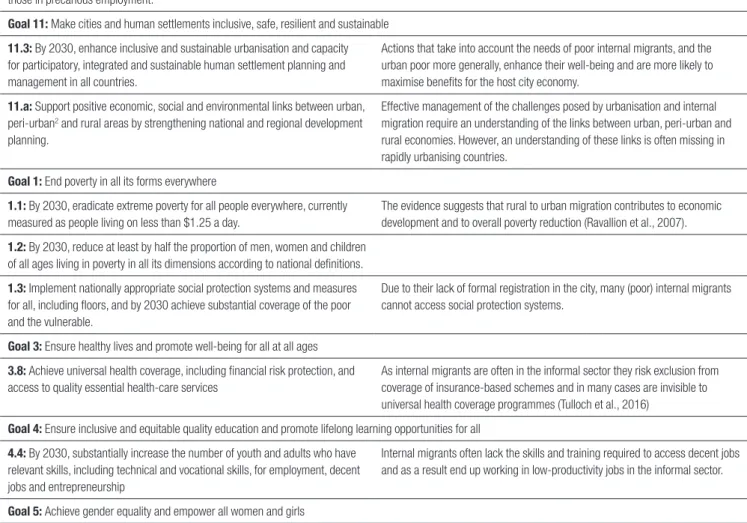
The 2030 Agenda does explicitly refer to migration, and recognises the economic value of migrants: migrant workers are expressly considered in SDG 8 on economic growth and decent work; issues of trafficking noted as part of SDG 16 on peaceful societies; SDG 10 calls for a reduction in the transaction costs of remittances; and migrant status is mentioned in SDG 17 as a factor for disaggregation during review and follow up (Table 1). Finally, Target 10.7 – the cornerstone of migration in the
2030 Agenda – calls for the facilitation of ‘safe, regular and responsible migration’ and the implementation of ‘well-managed migration policies’.
But while migration and remittances are covered by several Targets (Table 1), the relationship between migration and development does not feature elsewhere in the Goals, nor has it been consistently explored.
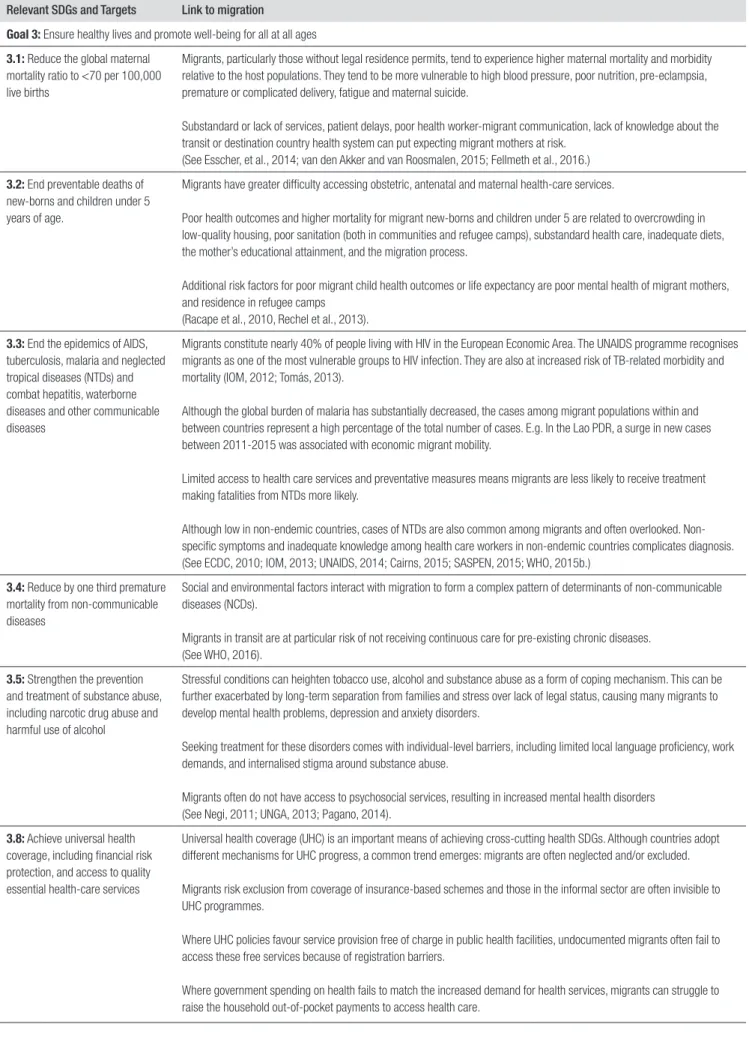
Migration is relevant to many of the other Goals. If countries are to achieve the SDGs, they need to consider the impact of migration at all levels and on all outcomes, beyond the migration-specific Targets. Our analysis, which has explored the links between migration and 13 of the 17 SDGs (Table 2), shows that migration is not a development ‘problem’ to be solved (as is the focus of SDG 10.7), but a mechanism that can contribute to the achievement of many of the Goals. To do this, governments must identify the linkages between migration and different Goals and Targets as shown in Table 2. Finally, countries must also recognise that migrants may be a particularly vulnerable group who should be considered under the general principle of ‘leaving no-one behind’.
2 Linking migration, development and the
2030 Agenda
Four main conclusions emerge from our analysis of the relationship between migration and different development areas:
1. Migration is a powerful poverty reduction tool,
which can contribute to the achievement of the SDGs
Labour migration can reduce poverty for migrants themselves, their families, and their origin and host countries. Migrants and their families benefit from increased income and knowledge, which allows them to spend more on basic needs, access education and health services, and make investments – directly impacting SDG 1, SDG 3 and SDG 4. For female migrants, increased economic resources can improve their autonomy andsocioeconomic status, impacting SDG 5. In origin countries, migration can lead to increased wages and greater economic growth through higher incomes, spending and investment of migrant households. In host countries, migrants can fill labour gaps and contribute to services and the fiscal balance, impacting on SDG 1, SDG 8 and SDG 9.
However, migration does not always achieve its full potential. Our analysis on migration and urbanisation finds that poor, urban migrants often work in the informal sector where the rewards of migration are lower (Lucci et al., 2016). In relation to poverty, our research reveals that the high costs involved in different stages of the migration process reduce financial payoffs, and that restrictions on mobility prevent those who would benefit the most from migrating in a regular and orderly way (Hagen-Zanker et al., 2017b). Large and unexpected migration flows can also disrupt education systems, disadvantage migrant and refugee children, and create tensions in host communities (Nicolai et al., 2017).
2. The specific risks and vulnerabilities of migrants
are often overlooked
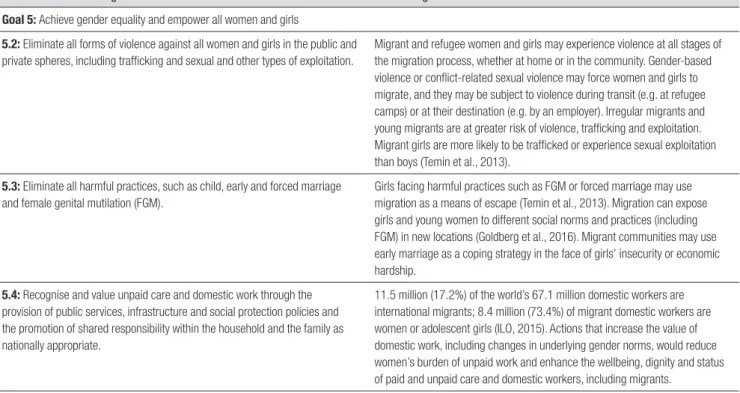
The risks and vulnerabilities of migrants throughout the migration process are often overlooked in development processes, the 2030 Agenda included. Migrants experience both migration-specific vulnerabilities – that is, experienced by migrants only – and migration-intensified vulnerabilities – when migration exacerbates a disadvantage that can be experienced by all (Sabates-Wheeler and Waite, 2003). For instance, a migration-specific vulnerability is that female migrants, working in less regulated and less visible sectors, are at greater risk of exploitation and abuse, including trafficking (O’Neil et al., 2016). Or that migration due to climate change can lead to further risk accumulation in cities (Wilkinson et al., 2016). An example of a migration-intensified vulnerability is that migrants are more likely to live in informal settlements, lacking access to health, education, water and social protection services (Hagen-Zanker et al., 2017a; Nicolai et al., 2017; Tulloch et al.,
8.8 Protect labour rights and promote safe and secure working environments for all workers, including migrant workers, in particular women migrants, and those in precarious employment.
10.7 Facilitate orderly, safe, regular and responsible migration and mobility of people, including through the implementation of planned and well-managed migration policies.
10.c By 2030, reduce to less than 3% the transaction costs of migrant remittances and eliminate remittance corridors with costs higher than 5%.
16.2 End abuse, exploitation, trafficking and all forms of violence against and torture of children.
17.18 By 2020, enhance capacity building support to developing countries, including for Least Developed Countries (LCDs) and Small Island Developing States (SIDS), to increase significantly the availability of high-quality, timely and reliable data disaggregated by income, gender, age, race, ethnicity, migratory status, disability, geographic location and other characteristics relevant in national contexts.
Table 1: The Targets that mention migration
2016). Beyond SDG 16.2 (trafficking) and 8.8 (labour rights and secure work environments), these risks and vulnerabilities are not considered in the 2030 Agenda.
3. The implementation of existing programmes of
support for migrants is often weak
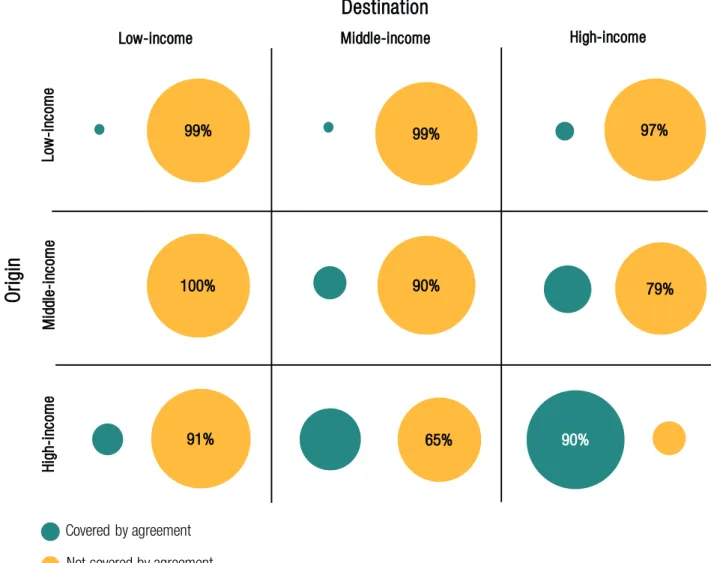
In principle, three quarters of the world’s migrants are entitled to some form of social protection through a multilateral, bilateral or unilateral agreement. But in practice, enforcement of these agreements is poor (Hagen-Zanker et al., 2017a). Access to basic services, such as health, education and social protection, is key for migrants’ livelihoods and development prospects. But while in some cases, migrants can access such services through existing or specifically designed programmes, the implementation of such programmes is often weak and levels of uptake low.
A number of factors contribute to this, including limited capacity in implementing institutions, funding gaps, a lack of political support and reluctance among migrants to participate. For instance, while migrants in Thailand are covered by the country’s universal health care scheme, uptake is low due to language and cultural barriers, fear of discrimination, fear of losing work due to absence and poor employer compliance with the scheme (Tulloch et al., 2016). Likewise, while often eligible for education, immigrant students tend to face greater difficulties than their host country peers in accessing education and achieving good learning outcomes (Nicolai et al., 2017).
4. There are major data gaps
Finally, data is often not disaggregated by migrant status or comparable across different groups and countries. As a result, we do not know the share of migrants actually able to participate in social protection programmes, access health services or attend school. The collection and monitoring of this disaggregated data, accompanied by migrant-specific indicators, is vital to understand the vulnerabilities and needs of migrants. Only then can governments and NGOs design migrant specific and sensitive support. Unfortunately, there are no internationally standardised approaches for collecting this data, and coordination of the data that different actors have already collected is limited. Within the 2030 Agenda, there are two Targets that could facilitate the implementation of coherent policies and programmes to support better coordination and data. Target 17.18 focuses on data and monitoring, crucially including a call for disaggregation of data by migrant status. Meanwhile, Target 16.6 calls for the development of effective, accountable and transparent institutions through which migrants could have recourse to hold governments, service providers and individuals to account.
3 Implications for migration and
development policies
Development policies and programmes can be part of a comprehensive strategy to better manage migration and make the most of its economic and social benefits. To do this, migration must be ‘mainstreamed’ in the implementation of the 2030 Agenda: the links, opportunities and challenges related to migration under specific Goals and Targets need to be identified and highlighted. Policy-makers need to consider, measure and take account of migration to harness its positive benefits and reduce potential challenges.
The multiple facets of the relationship between migration and development offer concrete policy entry points to help achieve the SDGs – including in specific sectors, such as health and education. For instance, the International Labour Organization’s (ILO) decent work agenda is highly relevant to migration. Any programming as part of this agenda should consider the specific vulnerabilities of migrants in the workplace (see Lucci et al., 2016) and the specific barriers migrants face in accessing work-place social protection schemes (see Hagen-Zanker et al., 2017a).
3.1 The Global Compact for Migration: a unique
moment of opportunity
The links between migration and development also have implications for migration policy and practice, particularly the Global Compact for Migration (GCM), which will be agreed by the UN member states in 2018. The GCM – an effort by states to work towards a common approach to address global migration – represents a unique moment of opportunity to put the nexus between migration and development on the global policy agenda. After years of debate that saw limited contact and collaboration between migration and development policy and practice communities, we are now at an important crossroads. Two years after the agreement of the SDGs and one year from the New York Declaration for Refugees and Migrants, the GCM is a chance to contribute to real progress. The SDGs should be a part of this (Foresti, 2017).
The SDGs provide a holistic and comprehensive framework to ground the migration-development nexus in the GCM. It will be important not to limit the focus to specific Targets on migration and remittances, but rather consider the role of human mobility to achieve all the Goals (ibid.). And, while the GCM framework and aspirations are global and grounded in international cooperation, actions need to be locally led and rooted in specific contexts, countries, regions and markets where particular development opportunities and challenges exist (ibid.).
3.2 The need for a new narrative
But how to do development is as important as what to do. There is the risk that viewing migration through a development lens may reinforce or replicate unhelpful dichotomies of donor and recipient or origin and host country. For example, the fact that in some host countries (especially in Europe) development aid is being used as part of a broader strategy to deter migration raises many concerns; not only it is ineffectual (there is no evidence that aid can affect migration patterns) but it also risks misinforming the public about the positive relationship between migration and development. Instead, the SDGs are an opportunity to frame migration and development relationships between countries as reciprocal and mutual, under a global framework.
The GCM consultation process also highlighted the need for a fresh narrative that goes beyond the negative connotations and perceptions that are present in both migration and development debates. A new vocabulary could help achieve this, and avoid replicating common misconceptions. We propose three new ways to talk about migration and development to move the debate along (Foresti, 2017): investment, innovation and inclusion. • Investment. Beyond aid or remittances alone, focus on
investing in future societies for all, in line with the ‘leave no one behind’ imperative. This includes harnessing the potential of diaspora, civil society innovators and entrepreneurs as private sectors and civil society.
• Innovation. Build and expand on the initiatives that already exist especially at local and country levels: diaspora bonds, global skills partnership, extension of rights for citizens on the move, financial inclusion through digital technology/mobile money, training and skills matching/investment etc.
• Inclusion. It is key for development and migration policies to be inclusive and not targeted at specific groups alone. They also need to explicitly aimed at expanding rights and opportunities. In practice, there is a need to broadening access to services, ensure portability of benefits and expand access to inclusive finance.
Moreover, while the 2030 Agenda provides a useful, broad policy framework with political traction, on its own it will not be enough to achieve change. We need to build coalitions and partnerships – between countries, cities, with development organisations and actors, with private sector – and to identify and work on realistic and politically viable objectives. Strategies should be flexible and modalities of intervention should adapt to specific needs and opportunities. It will be important to avoid ‘blueprint’ approaches and unrealistic promises if we are to make the most of bringing these two interlinked agendas together for concrete change.
Goal Target Link with migration Briefing
1.1 Migration is a powerful poverty reduction strategy, for migrants themselves and their families in origin countries. It has substantial positive impacts on income and other areas of human development.
Poverty Increased immigration does not lead to higher poverty rates in host countries; in fact, migrants often
add value to domestic economies.
Poverty Rural to urban migration contributes to economic development and to overall poverty reduction. Urbanisation Access to education for migrants can lead to rising incomes. Education
1.3 Labour migrants can be a particularly poor and vulnerable group, but often lack eligibility for legal social protection and/or are not effectively covered. Where migrants are covered, benefits are often non-portable, further reducing coverage amongst a group that is highly mobile.
Social Protection
1.4 Migration can help families in countries of origin to improve their wellbeing through increased income and consumption. Indirect effects include higher savings, investment and protection from shocks and stresses.
Poverty
1.5 The poor are the most vulnerable to climate change. They are likely to live in high-risk areas, have fewer means to prepare, and lack information to anticipate, and respond to, a disaster. Yet they are also the people who will find it hardest to migrate.
Climate change
1.a Labour migrants present an opportunity to increase the tax base, and a greater number of contributors to social insurance-type schemes leads to better risk pooling and financial sustainability.
Social Protection Remittances and other forms of diaspora financing can be mobilised to improve infrastructure,
services and development more generally.
Poverty
2.2 Migrants are a particularly vulnerable group but may not be reached by assistance programmes aimed at improving nutrition.
Health
3.1 Eligibility for health access is often tied to citizenship/permanent residency status, with only some countries opening up (emergency) health care to all, regardless of status.
Citizenship Migrants, particularly those without legal residence permits, sometimes experience higher maternal
mortality and morbidity relative to the host populations.
Health
3.8 As internal migrants are often in the informal sector they risk exclusion from coverage of insurance schemes and in many cases are not considered in universal health coverage programmes.
Health
4.1, 4.2, 4.5,
Migration helps improve education access and educational outcomes for families in origin countries, yet migrant children in host countries often suffer disadvantages in accessing quality education.
Education
4.1 Eligibility for primary and secondary school education can be tied to citizenship/permanent residency status, which means that migrant children can be prevented from accessing education, particularly children who are undocumented. Often this also includes second generation migrants.
Citizenship
4.4 Internal migrants often lack the skills and training required to access decent jobs and as a result end up working in low-productivity jobs in the informal sector.
Urbanisation
4.7 Education plays an important role in social integration, economic mobility and learning outcomes for migrant children.
Education
5.2 Migrant and refugee women and girls can experience violence at all stages of the migration process, especially during transit (e.g. at refugee camps) or at their destination (e.g. by an employer).
Gender
5.4 Many migrant domestic workers are female. Actions that increase the value of domestic work would reduce the burden of unpaid work and enhance the well-being, dignity and status of paid and unpaid care and domestic workers, including migrants.
Urbanisation
Goal Target Link with migration Briefing
6.1, 6.2
Large-scale movements of people could increase stress on fragile water supply systems. Health
8.5 Migration, in particular remittances, can lead to economic growth in origin countries. It can also lead to a reduction in unemployment and increase wages in countries of origin, also affecting poverty indirectly.
Poverty
Female migrants and refugees may be prevented from working, or may experience de-skilling or being confined to ‘feminine’ jobs, often paid or valued less than other work.
Gender
8.8 Low-skilled rural to urban migrants seeking better job opportunities in the city often end up working in precarious occupations in the informal economy.
Urbanisation Female migrants in stereotypically ‘feminine’ work (e.g. live-in care and domestic work) are frequently
isolated and therefore more vulnerable to exploitation, violence and abuse.
Gender
9.5 Migration leads to greater diversity in host countries, and this can foster innovation. Poverty In origin countries, migration can also foster innovation through social remittances, skills transfers and
return migration.
Poverty
10.1 Migration can reduce global inequalities, among countries and people, as people migrate from low- to high-income countries, and send remittances back home.
Poverty Whether migration reduces inequality within origin countries depends on where migrants sit on the
income distribution. In some contexts, migration can lead to higher inequality as the poorest are often unable to migrate. When the costs of migration are reduced, the potential to reduce inequality is also greater.
Poverty
10.2 Education can improve the social, economic and political inclusion of migrant children, particularly if they are better educated regarding their host country and able to speak the majority language.
Education
10.3 Removing legal barriers to accessing education – particularly for the children of irregular migrants and refugee children – would boost enrolment rates, as would ensuring that all people have a legal identity and the necessary paperwork to allow them to enrol in school.
Education
10.4 Social protection policies often do not guarantee equal access to all workers, which means that labour migrants have lower eligibility for and take-up of social protection. If vulnerable groups are unable to participate in social protection, inequalities widen.
Social Protection
11.3 Actions that take into account the needs of poor internal migrants, and the urban poor more generally, enhance their well-being and are more likely to maximise benefits of migration for the host city economy.
Urbanisation
13.1, 13.3
People affected by climate change will seek to diversify their livelihoods and rely on remittances from relatives elsewhere to cope with seasonal variation, extreme events and longer term trends. Adaptation policies can ensure income diversification into less climate vulnerable sectors.
Climate change
13.2 Not taking into account rural-to-urban migration patterns in the future could result in incomplete adaptation plans, which fail to protect important economic sectors from climate change impacts.
Climate change
13.3, 13.a
Better consideration of migration as a response to climate change – both extreme and slow-onset changes – and better financial planning are required to divert funds from adaptation to addressing a migration crisis.
Goal Target Link with migration Briefing
16.2 Attempts to eliminate child labour, exploitation and trafficking through financial support to families are all likely to boost education for migrant children by freeing them to receive an education that they would not otherwise be able to have.
Education
Irregular and young migrants are at greater risk of violence, trafficking and exploitation. Migrant girls are more likely to be trafficked or experience sexual exploitation than boys.
Gender When migrants, including second-generation migrants, cannot obtain citizenship or residency status,
they are more vulnerable to exploitation by traffickers.
Citizenship
16.7 Migration can contribute to making host countries more diverse and inclusive. Lack of citizenship or residency can prevent migrants from being full members of society, including access to services, and can lead to tensions and conflict.
Citizenship
17.8 Data on migration, particularly on internal migration, is very limited. Improving the evidence base is fundamental in order to better understand the scale and impact of internal migration, and design better policies.
Urbanisation
Data pertaining to migration background and education level should be collected together. This information should be used to support vulnerable groups, and not for reporting to security-related institutions.
Education
17.18 There are no international standardised approaches for monitoring variables relating to the health of migrants. Development of data collection, monitoring and surveillance mechanisms is needed to understand migrant health needs.
References
Foresti, M. (2017) Summary remarks. Fourth Thematic Consultation on Global Compact for Migration. Available at https://refugeesmigrants.un.org/sites/default/files/ts4_marta_foresti.pdf
Hagen-Zanker, J., Mosler Vidal, E., and Sturge, G. (2017a) Social protection, migration and the 2030 Agenda for
Sustainable Development. London: Overseas Development Institute.
Hagen-Zanker, J., Postel, H., and Mosler Vidal, E. (2017b) Poverty, migration and the 2030 Agenda for Sustainable
Development. London: Overseas Development Institute.
Lönnback, L. (2014) Integrating migration into the post-2015 United Nations Development Agenda. Bangkok and Washington, DC: International Organization for Migration and Migration Policy Institute.
Lucci, P., Mansour-Ille, D., Easton-Calabria, E., and Cummings, C. (2016) Sustainable cities: internal migration, jobs and
the 2030 Agenda for Sustainable Development. London: Overseas Development Institute.
Mosler Vidal, E. (2017) ‘The Sustainable Development Goals and labour mobility: A case study of Armenia’ in Gervais Appave, Neha Sinha (eds) Migration in the 2030 Agenda. Geneva: International Organization for Migration. Nicolai, S., Wales, J., and Aiazzi, E. (2017) Education, migration and the 2030 Agenda for Sustainable Development.
London: Overseas Development Institute.
O’Neil, T., Fleury, A., and Foresti, M. (2016) Women on the move: migration, gender equality and the 2030 Agenda for
Sustainable Development. London: Overseas Development Institute.
Sabates-Wheeler, R., and Waite, M. (2003) Migration and Social Protection: A Concept Paper. Sussex: University of Sussex.
Tulloch, O., Machingura, F., and Melamed, C. (2016) Health, migration and the 2030 Agenda for Sustainable
Development. London: Overseas Development Institute.
Wilkinson, E., Schipper, L., Simonet, C., and Kubik, Z. (2016) Climate change, migration and the 2030 Agenda for
• International labour migration can reduce poverty for migrants themselves, their families, and their host and origin countries. It is therefore crucial to achieving Sustainable Development Goal (SDG) 1. • Yet, migration does not always achieve its poverty reduction potential. This is due to the high costs
involved, poor conditions in host countries, and barriers to mobility.
• To reap the benefits, states should increase and diversify safe, regular and orderly migration pathways in line with demand for migrant labour, and make these easier to access.
• Remittances are a powerful poverty reduction instrument. They should be encouraged by origin countries and the private sector. Transfer costs should be lowered. States should also lower the costs and bureaucratic requirements for those wishing to migrate.
• Evidence is needed on the mechanisms through which migration impacts on poverty. Better longitudinal data would help understand these pathways and target policies effectively.
Key
messages
SDGs covered 1: No poverty
8: Decent work and economic growth
10: Reduced inequalities
Poverty, migration
and the 2030 Agenda for
Sustainable Development
1 Introduction
This briefing considers the extent to which international labour migration can reduce poverty, and the implications this has for the 2030 Agenda for Sustainable Development (2030 Agenda). Sustainable Development Goal (SDG) 1 calls for ‘ending poverty in all its forms everywhere’. Labour migration can help achieve this goal, having been described as ‘the most effective contribution we can make to improving the lives of the world’s working poor’ (Rodrik, 2007). In this briefing, we show that international labour migration is a powerful tool to reduce poverty, for migrants themselves, their families, and their host and origin countries.
In 2015, over 243 million people (3% of the global population) lived outside their country of origin. The growth of financial transfers made by these migrants (‘remittances’) has rapidly accelerated. Remittance flows to developing countries are now four times larger than official development assistance (ODA) (Global Knowledge Partnership on Migration and Development (KNOMAD), 2017) and are estimated to touch the lives of over one billion people. In certain settings, migration has been shown to be more effective at reducing poverty than other development programmes (Gibson and McKenzie, 2014).
Tackling the different facets of poverty is one of the key aims of the 2030 Agenda. Poverty is multidimensional; encompassing both monetary measures and other
dimensions such as living standards, health, and education access and quality (Alkire and Santos, 2010). Labour migration1 can reduce poverty for migrants themselves,
their families, and their host and origin countries.
Migrants and their families benefit from increased income and knowledge, which allows them to spend more on basic needs, access services, and make investments. In host countries, immigration can have positive economic effects through increased production and labour-market specialisation. In origin countries, migration can lead to higher economic growth through increased incomes and spending, investment by migrant households, and knowledge transfers. However, migration does not always achieve this potential, nor are the outcomes always beneficial, due to a number of barriers. These include the financial costs of migration itself, conditions in host countries, and barriers to mobility.
1. This briefing focuses on international labour migrants (or ‘migrant workers’), defined as individuals who moved from one country to another for the purpose of employment (International Organization for Migration (IOM), 2011). Where the briefing refers to other types of migrants, for example internal migrants, this will be stated explicitly. Most of the evidence focuses on migration to the global North, although we do also include examples of South-South migration.
2. In this briefing we include studies considering the income and welfare gains from migration, which are an indicator of its potential to reduce poverty. However, it should be kept in mind that they may not always translate into a reduction of poverty at the national level.
3. The impacts of migration are difficult to measure as migrants are not randomly selected but self-select into migration. Therefore migrant-sending households can have underlying differences to non-migrant-sending households (e.g. they may be wealthier or more willing to take risks), which means comparing them may capture differences in these underlying differences instead of migration effects (Démurger, 2015). This section only cites studies that account for selection bias; where this is not the case this will be stated.
The beginning of this briefing presents evidence
demonstrating the potential of migration to reduce poverty. Section 3 links this evidence to the 2030 Agenda, arguing that migration should be considered a means to meet the SDGs, especially Goals 1, 8 and 10, and their Targets, especially 1.1, 1.2, 1.4, 1.5, 1.a and 1.b. Section 4 considers why migration’s poverty reduction potential is not always met, and what to do about it. Section 5 concludes, and offers recommendations to boost this potential.
2 How can migration reduce poverty?
Migration can result in positive economic and social benefits, for migrants themselves, their families, and their host and origin countries. In particular, migration is a powerful poverty reduction tool, with the potential to substantially increase incomes for migrants and their families.22.1 Impacts on migrants and their families
Migration can reduce poverty of both migrants themselves and their families in countries of origin. It can do this through remittances, as well as other mechanisms, including knowledge and norm transfers, in-kind transfers (e.g. assets) and changing household dynamics.3 While
most studies focus on South-North migration, similar mechanisms hold for South-South movements; effects will of course vary based on context, but likely not enormously.
Labour migration can have a direct, immediate and substantial effect on the poverty of migrants themselves due to increases in income. A typical worker from an average developing country would earn 2.5-3 times their income if they moved to the United States (US) (Clemens et al., 2009). Migration resulted in a 263% income gain for Tongans in New Zealand (McKenzie et al., 2010; Box 4); and 1,400% for Haitians migrating temporarily to the US (Clemens and Postel, 2017; Box 1). Migration within the global South can also result in income gains of up to 60% (Ratha and Shaw, 2007). The families of the migrant can also experience gains in income, mainly through remittance receipts.
These income gains can lead to poverty reduction. For example, international migration reduced the level of poverty among migrant households in Ecuador by
between 17% and 21% (Bertoli and Marchetta, 2014).4
This is a substantial decrease, especially when compared to other development programmes – a rigorous review of cash transfers showed that impacts on poverty reduction range from four to nine percentage points (Bastagli et al., 2016). Remittances can also be seen as an informal insurance mechanism, helping households cope with economic shocks (Stark and Lucas, 1988; Yang, 2008) and preventing them from falling deeper into poverty. In addition, migrants and their families can become wealthier through the accumulation of assets and the ability to make more investments (Yang, 2008; de Brauw and Rozelle, 2008; Mansuri, 2007).
Migration can influence whether family members in origin countries work, and the type of work they do. The evidence is mixed and context-specific. In some cases, family members work less.5 This effect is often gendered;
labour-force participation tends to fall more for women in households that receive remittances (as Amuedo-Dorantes
4. See also Jimenez-Soto and Brown, 2012 for Tonga.
5. See Adams, 2011 for a review of evidence on this in various countries; Grigorian and Melkonyan, 2011 for Armenia; and Abdulloev et al., 2014 for Tajikistan.
6. See also Acosta, 2011 for El Salvador; Yang, 2008 for the Philippines; and Mansuri, 2006 for Pakistan.
7. For more information, see two other briefings in ODI’s Migration and the 2030 Agenda series: on health (Tulloch et al., 2016) and education (Nicolai et al., 2017).
8. However, there is also some evidence that the migration of parents or caregivers can have negative impacts on education and health of children and the
and Pozo, 2006 show for Mexico). Whether this results in an increase or decrease in poverty depends on how far remittances compensate for work-related income loss. Crucially, migration and remittances can reduce child labour, especially among poorer and low-skilled households (de Paoli and Mendola, 2017)6, which has
important implications for long-term poverty reduction. Access to education and health are also aspects of multidimensional poverty; moreover, they are important determinants of long-term poverty. Migration leads to improved health, education access and outcomes,7
particularly for children.8 Migration can also result in
‘social remittances’ or norm transfers (Levitt, 1998) that can have positive effects on individual and family wellbeing. For instance, Mexican women whose partners migrated internationally had lower smoking rates and healthier pregnancies than average through norm transfers (Frank, 2005). Having household members working in urban areas and abroad was associated with improved
Box 1: A pilot programme using labour mobility as a tool to reduce poverty
After an earthquake devastated Haiti in 2010, the Center for Global Development (CGD) proposed a novel way to help Haitians rebuild their livelihoods: help them migrate. This required opening new legal migration pathways between the US and Haiti, a process that culminated five years later when the US Department of State made Haitians eligible for temporary work visas. A pilot programme matching Haitian workers to US farms in need of agricultural labour soon followed: between 2015 and 2016, 68 workers arrived to work in the US.
The results of a small-sample survey assessing the programme’s impact showed the project differed from traditional development aid in three major ways: the size of the income gains; the direct benefit to poor families; and the mutual economic benefit to both countries. On average, one month of seasonal agricultural work by a male Haitian in the US raised his current wage by approximately 1,400% (Clemens and Postel, 2017). This led to a doubling of annual household income in Haiti, with 2-3 months of overseas work by one household member. Furthermore, all migrant households reported being able to invest in durable goods and livelihoods, including in farming tools and home construction. These gains are much larger than for other poverty-reduction policies, which at the high end have been measured at 20-30%.12 And in comparison to aid, where only a portion of total
project funding reaches the poor, income earned by Haitian seasonal workers in the US went directly to Haitian households.
The programme had effects beyond the household level: for every month of overseas work, approximately US$1,700 will eventually be spent in Haiti. These expenditures ripple through the Haitian economy, adding an estimated US$3,300 to Haiti’s GDP. Haitian agricultural work also adds value to the US economy by filling seasonal workforce needs. By supporting the productivity of US farms, one worker-month of Haitian agricultural labour adds approximately $4,000 to US GDP.
These results suggest unexplored potential for temporary labour mobility as a tool for development and poverty reduction. The programme described here faced substantial informational and bureaucratic barriers, but was able to operate without any changes to existing legislation in either country. If successfully scaled, 10,000 Haitians working in the US for three months a year would add approximately US$100 million annually to the Haitian economy.
knowledge of sexual health in rural Guatemalan women (Lindstrom and Muñoz-Franco, 2005). Again, this has important implications for long-term poverty and the 2030 Agenda more broadly, with migration enabling households to become healthier and better educated.9
2.2 Impacts on origin countries
The previous section discussed how migration has the potential to reduce poverty for individuals and households. These effects ripple through national economies in origin countries: raising incomes, protecting against exogenous shocks, and enabling increased economic activity (see also Boxes 1 and 4 for effects on national-level gross domestic product (GDP)). In fact, most of the benefits to national economies accrue through the aggregate effect of migration on individual households. Increases in income through remittances can result in reductions of poverty at the macro-level if poorer households become relatively better off: in other words, by changing national inequality distributions. This is not a given, however. It depends on how income is originally distributed and where migrants fall on this spectrum (McKenzie and Rapoport, 2007).
Most macro-level analyses investigating cross-country national-level poverty rates find that migration (often proxied by remittances) does cause a reduction in poverty. However, the size of this effect varies considerably by study and may be overstated in some cases due to methodological concerns. In one study of 10 Latin American countries, for every 10% increase in the ratio of remittances to GDP, poverty fell between 0.04% to 0.5% (Acosta et al., 2008).10
Other studies sum the benefits accrued by individual households to estimate the effects on national-level poverty.
11 This approach reflects the logic explained above, that
individual- and household-level poverty reduction from migration has national impacts in aggregate. For instance, a 10 percentage-point increase in international remittances in the Philippines caused a 2.8 percentage-point decline in the likelihood that a migrant household will be in poverty (Yang and Martinez, 2006). This benefit also spills over to non-migrant households in high-migration regions, where aggregate poverty rates fell by 0.7 percentage points. In Ecuador, one study found that migration reduced poverty incidence among migrant households by between 17.4% and 20.8% (Bertoli and Marchetta, 2014). Along similar lines, studies on internal migration in Vietnam and China have found a small yet significant effect on poverty rates
9. For examples of positive effects of migration on investment in education and access for families in countries of origin, see Organisation for Economic Cooperation and Development (OECD), 2017 and Ambler et al., 2015.
10. See also Anyanwu and Erhijakpor, 2010; Fajnzylber and Lopez, 2007; and Gupta et al., 2007. The most cited study in this research space is Adams and Page (2005), but it does not correct for migrant selection bias.
11. Interestingly, the most cited statistics in this area (five percentage points of poverty reduction in Ghana, six percentage points in Bangladesh, and 11 percentage points in Uganda) are untraceable to the original source or methodologically less rigorous (e.g. Lokshin et al, 2010; Adams and Cuecuecha, 2013), implying that the magnitude of poverty reduction effects may be overstated).
12. 38% to 41% for grants to start-up businesses (Blattman and Niehaus, 2014); 20% to 25% for anti-sweatshop activism in Indonesia (Harrison and Scorse, 2010); 10% to 30% for productive asset transfers for the ultra-poor (Banerjee et al., 2015).
(De Brauw and Harigaya, 2007 for Vietnam; Yang et al., 2005 for China).
Emigration can lead to increased wages for
non-emigrants in origin countries, particularly in the short-term, which can affect national poverty levels. However, this is mainly experienced by those with similar skills to emigrants; non-emigrants with complementary skills can experience a wage decline (Elsner, 2015).12
2.3 Impacts on host countries
Migration can also reduce poverty and increase growth in host countries; through increased productivity, new demand for and supply of goods and services, and more labour-intensive production. As described in Box 1, a programme of temporary agricultural work for Haitians added value to the US economy of around US$4,000 per worker-month. Under New Zealand’s Recognised Seasonal Employment programme, employers reported increased production through access to a more productive, stable workforce. Immigrants also add value to host countries through their skills and innovation, fostered by diversity; for example, the number of patents applied for by immigrants in the US is far greater than their share in the population (Hunt and Gauthier-Loiselle, 2010). The literature agrees that immigration may encourage natives to take up more highly skilled jobs to take advantage of skills complementarity; native workers in Denmark originally displaced by new refugee arrivals eventually earned 3% more through increased specialisation in more complex tasks (Foged and Peri, 2015).
3 Why migration matters for the 2030
Agenda
As shown, international labour migration is a powerful poverty reduction tool, for migrants themselves, their families, and their host and origin countries. Therefore, migration can be a vital weapon in the arsenal to fight poverty, affecting the implementation of SDG 1, as well as several other Targets and Goals (see Table 1). These Targets cannot be met successfully unless their links to migration are considered.
Targets 1.1 and 1.2 call for an end to poverty around the world. As we have seen, migration can be an effective instrument in reducing poverty. This is especially the case
regarding income, where the potential gains are very large for migrants and their families, leading to wider positive spillover effects. However, labour migrants themselves can be highly vulnerable and may need specific support.
Target 1.4 calls for greater access to economic resources, financial services and basic services. Labour migration can help families in origin countries invest in assets and access financial services. Migration can be a form of self-insurance; protecting migrant families experiencing shocks and stresses. This is relevant for Target 1.5 which calls for greater resilience and insurance for individuals and families.
Target 1a calls for better and smarter mobilisation of resources for development. We have seen that remittances dwarf aid. Remittances, and other forms of diaspora financing and investment, can be mobilised to improve infrastructure, services and development more generally at a community level (see Gelb, forthcoming). Migration should be included as a poverty reduction strategy in non-migration policy frameworks, as called for in Target 1b.
Migration also affects multidimensional poverty (SDGs 1, 3 and 4), economic growth and employment (SDG 8), and innovation (SDG 9), which can have indirect effects on poverty. Finally, it can lead to increases or decreases in inequality, relevant to SDG 10.
13. There may also be psychosocial costs of migration, however these are not discussed here. For an overview of migrant happiness and wellbeing, see IOM (2013) and Hendriks (2015).
14. Passport costs vary widely, costing as much as US$300; in at least 14 countries a passport costs more than 10% of average annual per-capita income (Gibson and McKenzie, 2011a).
4 Why migration’s poverty reduction
potential is not always met, and what to do
about it
The financial costs13 associated with the migration process
can reduce migration’s impact on poverty reduction. Further barriers include conditions in host countries, which can entrench poverty amongst migrants, and barriers to mobility, which often prevent those who would benefit the most from migrating from doing so.
4.1 The financial cost of migration can be high
Migration can incur high costs, even prior to departure. This includes the costs of procuring passports14, a visa,work permit and/or the recruitment process more generally. Migrants may secure the services of a travel agent, migrant broker or smuggler, and the costs of the journey itself can be high, especially if protracted and/or irregular. These costs can be excessive – low-skilled migrants often pay more than a year’s worth of future income (International Labour Organization (ILO), 2017; KNOMAD, 2017), reducing their ability to send remittances. Migration costs tend to be higher for the low-skilled (ILO, 2017; KNOMAD, 2017) and are more likely to prevent the poor from migrating. Migration costs also tend to be higher
Relevant SDGs and Targets Link to migration
Goal 1: End poverty in all its forms everywhere
1.1: By 2030, eradicate extreme poverty for all people everywhere, currently
measured as people living on less than $1.25 a day.
1.2: By 2030, reduce at least by half the proportion of men, women and
children of all ages living in poverty in all its dimensions according to national definitions.
Migration is a powerful poverty reduction strategy for migrants themselves and their families in origin countries. The benefits of migration are greater for those travelling through regular migration channels, with costs and risks higher for those migrants with irregular status (see Section 4). Furthermore, the poorest are often unable to benefit from migration, owing to the high costs involved. Labour migrants in host countries may need specific support as they often face unique poverty challenges, for instance because of discrimination and poor working and living conditions (see Lucci et al., 2016). Migrants often send a high share of their disposable income as remittances which can make them impoverished.
Increased immigration does not lead to higher poverty rates in host countries; in fact, migrants often add value to domestic economies.
1.4: By 2030, ensure that all men and women, in particular the poor and the
vulnerable, have equal rights to economic resources, as well as access to basic services, ownership and control over land and other forms of property, inheritance, natural resources, appropriate new technology and financial services, including microfinance.
Migration can help families in origin countries improve their wellbeing through increased income and consumption. Indirect effects include higher savings, investment and protection from shocks and stresses. Migration can lead to family members accessing and using financial services for the first time (Anzoategui et al., 2014). It can also improve their ability to invest in assets, including land ownership, and increase access to basic services like education and healthcare.
Relevant SDGs and Targets Link to migration
1.5: By 2030, build the resilience of the poor and those in vulnerable situations
and reduce their exposure and vulnerability to climate-related extreme events and other economic, social and environmental shocks and disasters.
Migration strengthens households’ resilience. It helps families in times of crisis by strengthening their ability to cope with economic risks and shocks, through informal insurance strategies. Remittances have also been shown to increase at times of national shocks and stresses (for instance in the Philippines after natural disasters).
1.a: Ensure significant mobilization of resources from a variety of sources,
including through enhanced development cooperation, in order to provide adequate and predictable means for developing countries, in particular least developed countries, to implement programmes and policies to end poverty in all its dimensions.
Remittances and other forms of diaspora financing can be mobilised to improve infrastructure, services and development more generally at community level (see Gelb, forthcoming). These have been shown to lead to poverty reduction on a national level as well. At the same time, remittances, as private funding, do not replace aid.
This is recognised in the Addis Ababa Action Agenda (June 2015), which states the ‘positive contribution of migrants for inclusive growth and sustainable development in countries of origin’ (United Nations (UN), 2015).
1.b: Create sound policy frameworks at the national, regional and international
levels, based on pro-poor and gender-sensitive development strategies, to support accelerated investment in poverty eradication actions.
Migration tends to be overlooked as a poverty reduction strategy in policy frameworks, with some policies in origin and host countries limiting mobility. Conditions in host countries can also reduce the poverty-reduction potential of migration. Sound policy frameworks should consider migration’s role in reducing poverty and strive for policy coherence across different sectors.
Other Goals
Goal 3: Ensure healthy lives and promote wellbeing for all at all ages. Migration improves healthcare access and health outcomes for families in origin countries. However, migrants in host countries often lack access to health services (see Tulloch et al., 2016).
Goal 4: Ensure inclusive and equitable quality education and promote lifelong
learning opportunities for all.
Migration helps improve education access and educational outcomes for families in origin countries. However, migrant children in host countries often suffer disadvantages in accessing quality education (see Nicolai et al., 2017).
Goal 8: Promote inclusive and sustainable economic growth, employment and
decent work for all.
Migration, as proxied by remittances, can lead to economic growth in origin countries. It can also lead to a reduction in unemployment and higher wages in origin countries (Mishra, 2014).
Labour migrants often face difficult working conditions (see Lucci et al., 2016), with stronger regulations and monitoring needed around working conditions and recruitment processes (see also Box 3) to achieve decent work for all migrants.
Goal 9: Build resilient infrastructure, promote inclusive and sustainable
industrialization and foster innovation.
Migration leads to greater diversity in host countries and this can foster innovation.
In origin countries, migration can also foster innovation through social remittances, skills transfers and return migration (Debnath, 2016). This has implications for long-term poverty reduction in these countries. In some contexts, outflows of the highly skilled could have negative impacts for origin countries in certain sectors (for example, shortages of healthcare workers, Mills et al., 2008). However, evidence that a so-called ‘brain drain’ harms development in origin countries is mixed once the net effects are considered. High-skilled migration often generates positive externalities such as increased investment in education, a more educated domestic workforce, and returnees bringing back skills acquired abroad (Adzei and Sakyi, 2014; Docquier and Rapoport, 2011).
Goal 10: Reduce inequality within and among countries. With people migrating from low- to high-income countries and sending remittances back home, migration can reduce global inequalities among countries, and among people (Milanovic, 2016).
Whether migration reduces inequality within origin countries depends on where migrants sit on the income distribution. In some contexts, migration can lead to higher inequality as the poorest are often unable to migrate. When the costs of migration are reduced, the potential to reduce inequality is also greater.
for migrants from more remote areas, who are also more likely to be poorer (Gibson and McKenzie, 2011). This relationship holds at the national level as well: countries with low GDP per capita have lower emigration rates (OECD, 2016), to some extent due to aspiring migrants being unable to finance migration.
Loans can facilitate the payment of pre-departure and recruitment costs. However, with imperfect credit markets in poorer areas, this can result in aspiring migrants borrowing high sums of money15 from informal
lenders, often at exorbitant interest rates. This places poor households in a risky situation, and raises the stakes for the migrant: an ‘unsuccessful’ migration, which produces low returns (and hence low remittances), makes it difficult for the household to meet loan repayments and eventually free itself from debt. The most vulnerable can get caught in debt-bondage when they are trapped in exploitative work situations after taking a loan to pay for recruitment costs and/or an advance (e.g. Zeitlyn et al., 2014 on India).
Studies have shown that migration becomes more pro-poor when costs decrease, e.g. through strengthened migration networks (McKenzie and Rapoport, 2007; Gibson and McKenzie, 2011). The policy discussions in this area have mostly focused on fair recruitment (see Box 3), but have also considered how to improve access to pre-departure migration loans. For instance, at the Global Forum on Migration and Development (GFMD) in 2009, bank-non-governmental organisation (NGO) partnerships were discussed, where banks would provide loans at reasonable interest rates, as well as transparent information about the migration process (Martin, 2009). In Bangladesh, the NGO BRAC has funded close to 200,000 migration loans, also providing additional pre-departure services such as contract reviews (BRAC, 2016). The policy recommendations of former UN Special Representative for Migration Peter Sutherland (the ‘Sutherland Report’) call for migrant welfare funds to issue such loans.
Finally, the cost of sending remittances back home can lower their potential for reducing poverty. Studies have shown that fees for migrants remitting to sub-Saharan Africa average 12% of the amount transmitted (Watkins and Quattri, 2014). These excess fees cost the African continent US$1.8 billion a year, which would cover the primary-school education of 14 million children in the region (ibid.). The need to reduce remittance fees is now firmly rooted in policy discussions, being an explicit target in the 2030 Agenda (see Target 10.C) as well as more specifically in the Addis Ababa Action Agenda and the ‘Sutherland Report’. Mobile remittances are seen as one way forward to reduce costs (Box 2).
15. For instance, one study shows that the average migration loan of migrants in Rolpa, Nepal, is 97% of average annual household expenditure (Hagen-Zanker et al., 2014).
16. More information on these can be found in other briefings in this series, including on living conditions of urban migrants (Lucci et al., 2016) and those displaced by climate change (Wilkinson et al., 2016), access to health services (Tulloch et al., 2016), and access to social protection (Hagen-Zanker et al., 2017).
4.2 Poor conditions in host countries can undercut
expected benefits from migration
Migration doesn’t always offer the rewards anticipated. Conditions in host countries can entrench poverty of migrants, including poor living conditions and limited access to services,16 low wages, and poor working
conditions.
Sometimes, wages paid by employers are lower than promised, or not paid at all (see Donini et al., 2013; Hagen-Zanker et al., 2014; Maher, 2009). Wages can be irregular, particularly for those in the informal economy, making it difficult for migrants to sustain themselves in the host community and send remittances back home. Female migrant workers are especially over-represented in lower-paid, irregular work (ILO, 2017; O’Neil et al., 2016). Furthermore, migrants may not be able to make full use of their education and skills as access to skills-recognition processes tend to be lacking, especially for low- and medium-skilled workers (ILO, 2017). This can lead to deskilling or ‘brain waste’ and migrant workers earning less than anticipated. Compared to natives, migrants face wage gaps that cannot be explained fully by differences
Box 2: Mobile remittances to reduce costs
One innovative way to reduce the cost of
remittances is to use mobile money-transfer options. A recent study on using mobile transfers found that it drastically reduces costs: using mobile transfers is on average more than 50% cheaper than using money-transfer operators (MTOs); in 45 country corridors surveyed, the average cost of sending US$200 using mobile money was 2.7%, compared to 6% with MTOs (GSMA, 2016).
Mobile remittances have the potential to be more inclusive than other transfer methods, as they allow smaller remittance values to be sent more cheaply, which is important for poorer migrants. The same study showed the average value of mobile money transfers was US$82, while across other channels this was approximately US$500 (ibid.). Moreover, mobile money can foster greater financial inclusion, by tapping into migrants’ ownership and usage of mobile phones to include them in digital financial services. Finally, the increasing use of mobile money fosters competition in the market, leading to greater transparency and further driving down transfer costs. This includes traditional MTOs, which tend to lower their fees when forced to compete against mobile-money competitors.
in education, work experience and language skills (ILO, 2015).
Second, migrants often experience poor working conditions, which can lead to lower earnings and adverse health outcomes. Migrant workers are more likely to hold jobs that are ‘dirty, dangerous and difficult’ (ILO, 2017). Migrant workers are much less likely to have ‘decent-work benefits’ such as a contract, occupational health and safety, and fundamental labour rights (Aleksynska et al., 2017).17 Migrant workers are at greater risk of being
victims of forced labour (ILO, 2017). They are also more likely to experience work-related accidents and diseases (Belin et al., 2011; ILO, 2017). This is especially relevant for those who are undocumented and/or working in the informal economy, who are also less likely to be protected through social-insurance schemes.18 As such, migrants may
lose extended periods of time to illness, can end up with disabilities that limit future earning potential or, in extreme cases, lose their lives. Box 3 gives examples of emerging best practices on how to combat poor working conditions using fair recruitment.
17. See also a review of working conditions for internal migrants in Lucci et al., 2016. 18. See Hagen-Zanker et al., 2017 for a review of social-protection coverage of migrants.
19. In total this represented approximately 630 million people who would like to migrate internationally, dwarfing the current estimated international-migrant stock of 244 million (United Nations Department of Economic and Social Affairs (UN DESA), 2015).
4.3 Barriers to mobility
So far, we have focused on the factors that limit the poverty reduction potential for those who are already on the move. What about those who would like to move, but are unable to do so? This ‘involuntary immobility’ (as coined by Carling, 2002) characterises many poor areas and origin countries. In a global survey, 14% of the world’s adults said they would like to move to another country.19
Of those surveyed, 33% were in sub-Saharan Africa, 21% in the Middle East and North Africa, and 20% in Latin America (Esipova et al., 2011). However less than half of these respondents had already started making preparations (ibid.). The evidence suggests that those who would benefit the most from migration are often unable to do so. Part of this can be explained by the debilitating costs of migration discussed above. However, there are also policy barriers that prevent people from migrating legally, which diminish the potential of migration to reduce poverty.
Box 3: Policy measures on fair recruitment
International labour standards apply to the recruitment of migrant workers. Effective implementation of fair recruitment measures involves extensive policy coordination amongst governments, labour recruiters and employers alike. The following are some emerging practices:
1. Some host countries state costs are to be paid by the employer, while origin countries may cap recruiter fees (ILO, 2017). Nepalese practice combines this; the ‘free visa, free ticket’ policy ensures migrants pay no more than NPR20,000 (US$184) to private employment agencies, and the employer pays for tickets and visas (von Rohland and Crozet, 2017).
2. To ensure workers are given clear, transparent contracts, standardised employment contracts can be attached to labour agreements between countries, as in the 2008 Sri Lanka-Qatar agreement (Wickramasekara, 2015), and registered with authorities in the host country, as in some Gulf countries (ILO, 2017).
3. Some countries such as Bangladesh and Ethiopia have joint liability provisions to ensure recruiters and employers can be held liable for workers’ rights violations during recruitment (ILO, 2017).
4. Private-sector initiatives play a growing role. The Consumer Goods Forum (CGF) recently introduced its Three Priority Industry Principles and guidance to tackle forced labour and abusive recruitment. More global companies are joining the Leadership Group, launched in 2016 under the Institute for Human Rights and Business (IHRB), to promote responsible recruitment and ethical supply chains (CGF, 2017; IHRB, 2016). 5. More companies are following due-diligence procedures in supply chains, for example, US government agencies
(United States Office of the Federal Register, 2012) and Colgate-Palmolive and Marks & Spencer’s (CGF, 2017). 6. Once migrants are abroad, some cities have taken the initiative to protect their employment rights. Barcelona’s
authorities help migrants with employment through its immigrant reception service, SAIER (Saier Servicio de Atención a Inmigrantes, Extranjeros y Refugiados), which supports migrants with job-seeking, training and education, and offers legal advice (Ajuntament de Barcelona, 2017). In the US, ‘sanctuary cities’ can help protect irregular labour migrants (Ridgley, 2008).