HAL Id: hal-02652244
https://hal.archives-ouvertes.fr/hal-02652244
Submitted on 2 Jun 2020HAL is a multi-disciplinary open access archive for the deposit and dissemination of sci-entific research documents, whether they are pub-lished or not. The documents may come from teaching and research institutions in France or abroad, or from public or private research centers.
L’archive ouverte pluridisciplinaire HAL, est destinée au dépôt et à la diffusion de documents scientifiques de niveau recherche, publiés ou non, émanant des établissements d’enseignement et de recherche français ou étrangers, des laboratoires publics ou privés.
Probabilistic Programming in neurolang: Bridging the
Gap Between Cognitive Science and Statistical Modeling
Valentin Iovene, Demian Wassermann
To cite this version:
Valentin Iovene, Demian Wassermann. Probabilistic Programming in neurolang: Bridging the Gap Between Cognitive Science and Statistical Modeling. 2020 OHBM - Annual Meeting of Organization for Human Brain Mapping, Jun 2020, Remote due to Covid-19, France. �hal-02652244�
Probabilistic Programming in neurolang: Bridging the
Gap Between Cognitive Science and Statistical Modeling
Valentin Iovene
Demian Wassermann
Universit Paris-Saclay, Inria, CEA, France
May 29, 2020
1
Introduction
Meta-analysis information often needs to be supplemented with neuroimaging or neuroanatom-ical data to build robust brain mapping models. To the best of our knowledge, a flexible tool for conducting this kind of analysis has yet to be proposed. We present neurolang: a convenient domain-specific language (DSL) for building rich brain mapping models. We demonstrate how this tool can be applied by combining meta-analysis data with atlas-based brain structures to construct anatomically-supported patterns of activation and reverse in-ference models.
Coordinate based meta-analysis (CBMA)tools, such as Neurosynth [Yarkoni et al.,2011], have become an integral part of brain mapping research. They proved very useful when combined with functional magnetic resonance imaging (fMRI) signals to derive activation patterns [e.g. Wager et al., 2013, Cole et al., 2012] or reveal meaningful cognitive processes through reverse inference [e.g. Smallwood and Schooler, 2015, Seghier, 2013, Chang et al.,
2013,Andrews-Hanna et al.,2014]. Sometimes, within the samefMRIstudy, someregions of interest (ROIs)are built from meta-analysis forward inference maps while others are obtained from neuroanatomical probabilistic maps. This is because some ROIs are better supported by past literature while some others are better supported by neuroanatomy. There seems to be a space for a tool to define models that easily combine both modalities.
2
Methods
Adopting a language-oriented programming approach, we design a declarative and probabilis-ticdomain-specific language (DSL)for formulating and testing sophisticated brain mapping hypotheses that benefit from mined meta-analysis and neuroanatomical data. A syntax close to natural language is translated to a set of Datalog rules that can also express probabilities. For example, ”v is sensory if v is auditory or v is sensory if v is visual” translates to the datalog rule set { sensory(v) :- visual(v), sensory(v) :- auditory(v) } while ”with probability p v is activated” translates to the ProbLog probabilistic fact ”p :: activated(v)”, where p
could be a learnable parameter within a statistical model. Internally, intermediate represen-tations based on established logic [Gallaire and Minker,1978] and probabilistic programming [BRny et al.,2017] research are orchestrated to provide fast bayesian inference and maintain theoretical properties of programs.
3
Results
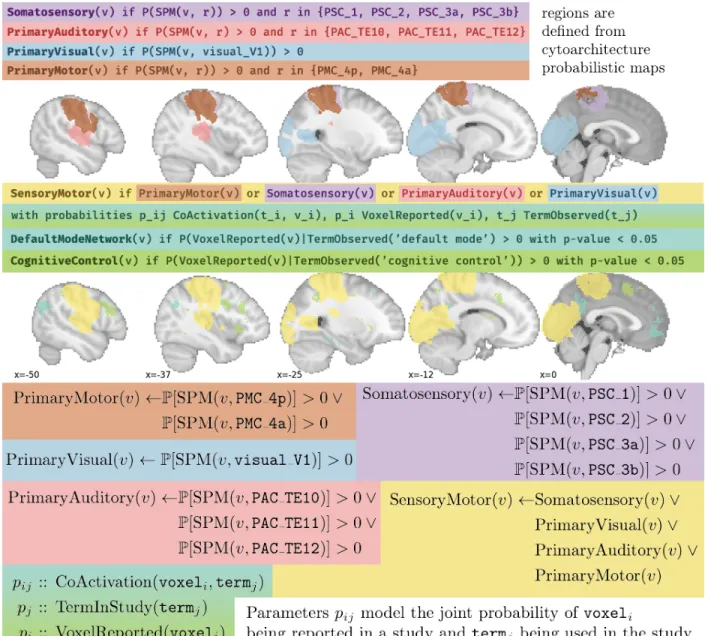
We present a real-world example originating from a study of the prefrontal cortex’s global connectivity [Cole et al., 2012] where ROIs are derived from both anatomical and meta-analysis data. The neurolang program in Figure 1 reconstructs these ROIs. A sensory motor ROI is derived by combining multiple cytoarchitecture probabilistic maps obtained using AFNI TT N27 CA EZ PMaps. Default mode network and cognitive control ROIsare both derived from a forward inference meta-analysis model. Parameters of the model are defined as ProbLog probabilistic facts and estimated from Neurosynth data via a technique called “Learning From Interpretations” [Gutmann et al., 2011]. ROIs can then be obtained by formulating and solving queries on a graphical model translation of the inferred program. The language allows for a compact representation of the logical rules used to define these brain regions using multiple modalities. While in this example each region is based on a single modality, one could think of a region defined through a mixture of anatomical and meta-analytical probabilistic maps.
4
Conclusions
We develop a flexible and intuitive tool for formulating brain mapping hypotheses involving both neuroanatomical data and meta-analysis data. We present two examples involving both modalities to obtain accurate ROIs or terms most likely to correspond to a particular pattern of activation. This approach could help bridging the gap between computational neuroanatomy and rich statistical modeling. We acknowledge the support of ERC Neurolang.
References
Tal Yarkoni, Russell A Poldrack, Thomas E Nichols, David C Van Essen, and Tor D Wager. Large-scale automated synthesis of human functional neuroimaging data. Nature Methods, 8(8):665–670, August 2011. ISSN 1548-7091, 1548-7105. doi: 10.1038/nmeth.1635.
Tor D. Wager, Lauren Y. Atlas, Martin A. Lindquist, Mathieu Roy, Choong-Wan Woo, and Ethan Kross. An fMRI-Based Neurologic Signature of Physical Pain. New England Journal of Medicine, 368(15):1388–1397, April 2013. ISSN 0028-4793, 1533-4406. doi: 10.1056/NEJMoa1204471.
M. W. Cole, T. Yarkoni, G. Repovs, A. Anticevic, and T. S. Braver. Global Connectivity of Prefrontal Cortex Predicts Cognitive Control and Intelligence. Journal of Neuroscience, 32(26):8988–8999, June 2012. ISSN 0270-6474, 1529-2401. doi: 10.1523/JNEUROSCI.
Figure 1: The program for constructing the sensory motor, default mode network and cogni-tive controlROIsis shown both in an intuitiveDSLand in its logic programming intermediate representation. Colors are used to relate each rule of the program with its associated ROI
in the brain plots. The construction of the sensory motor ROI is made iteratively by first constructing the somatosensory, primary auditory, primary visual and primary motor areas from the AFNI TT N27 CA EZ PMaps probabilistic maps and then combining them. The de-fault mode network and cognitive control ROIs are obtained by constructing a probabilistic model whose paramaters are fitted on Neurosynth meta-analysis data. The obtained param-eters are false discovery rate (FDR)-corrected for multiple comparisons using a whole-brain FDR threshold of 0.05, as in [Yarkoni et al., 2011].
Jonathan Smallwood and Jonathan W. Schooler. The Science of Mind Wandering: Empirically Navigating the Stream of Consciousness. Annual Review of Psychol-ogy, 66(1):487–518, January 2015. ISSN 0066-4308, 1545-2085. doi: 10.1146/ annurev-psych-010814-015331.
Mohamed L. Seghier. The Angular Gyrus: Multiple Functions and Multiple Subdivisions. The Neuroscientist, 19(1):43–61, February 2013. ISSN 1073-8584, 1089-4098. doi: 10. 1177/1073858412440596.
L. J. Chang, T. Yarkoni, M. W. Khaw, and A. G. Sanfey. Decoding the Role of the Insula in Human Cognition: Functional Parcellation and Large-Scale Reverse Inference. Cerebral Cortex, 23(3):739–749, March 2013. ISSN 1047-3211, 1460-2199. doi: 10.1093/cercor/ bhs065.
Jessica R. Andrews-Hanna, Jonathan Smallwood, and R. Nathan Spreng. The default net-work and self-generated thought: component processes, dynamic control, and clinical rel-evance: The brain’s default network. Annals of the New York Academy of Sciences, 1316 (1):29–52, May 2014. ISSN 00778923. doi: 10.1111/nyas.12360.
Herv Gallaire and Jack Minker, editors. Logic and data bases. Plenum Press, New York, 1978. ISBN 978-0-306-40060-5.
Vince BRny, Balder Ten Cate, Benny Kimelfeld, Dan Olteanu, and Zografoula Vagena. Declarative Probabilistic Programming with Datalog. ACM Transactions on Database Systems, 42(4):1–35, October 2017. ISSN 03625915. doi: 10.1145/3132700.
Bernd Gutmann, Ingo Thon, and Luc De Raedt. Learning the Parameters of Prob-abilistic Logic Programs from Interpretations. 6911:581–596, 2011. doi: 10.1007/ 978-3-642-23780-5 47.