HAL Id: hal-00265938
https://hal.archives-ouvertes.fr/hal-00265938
Submitted on 29 Mar 2020
HAL is a multi-disciplinary open access archive for the deposit and dissemination of sci-entific research documents, whether they are pub-lished or not. The documents may come from teaching and research institutions in France or abroad, or from public or private research centers.
L’archive ouverte pluridisciplinaire HAL, est destinée au dépôt et à la diffusion de documents scientifiques de niveau recherche, publiés ou non, émanant des établissements d’enseignement et de recherche français ou étrangers, des laboratoires publics ou privés.
Distributed under a Creative Commons Attribution| 4.0 International License
Mixing study of a jet in crossflow using accurate thermal
anemometry techniques
Jean-Paul Moro, P. Fougairolle, Yves Gagne
To cite this version:
Jean-Paul Moro, P. Fougairolle, Yves Gagne. Mixing study of a jet in crossflow using accurate thermal anemometry techniques. 11th E. T. C, 2007, Porto, Portugal. �10.1007/978-3-540-72604-3_143�. �hal-00265938�
Mixing study of a jet in crossflow using
accurate thermal anemometry techniques
Jean-Paul MOR01, Pierre FOUGAIROLLE1, and Yves GAGNE2 1
CEA Grenoble 17 rue des Martyrs- 38054 Grenoble Cedex 9, France [email protected] & [email protected]
2 Universite Joseph Fourier- BP 53- 38041 Grenoble Cedex 9, France
Yves.Gagne®hmg.inpg.fr
The objective of t his exp-erimental work is to focus on the turbulent mixing between a pipeflow exiting heated jet and a confined crossflow, with both kine-matic and passive scalar measurements in order to characterize its statistical properties (energy spectra, pdf, skewness, anisotropy ... ).
The experimental set-up consists of a grid-turbulence flow in a rectangu-lar wind tunnel (60x50cm2 in section and 5m long) in which emerges a per-pendicular rectangular pipefiow (8x5cm2 section, equivalent to an hydraulic diameter Dh= 6.2cm for a circular jet). Ranges of velocity are U=0-20m.s-1 and Uj=0-40m.s-1 for the crossfiow and the jet respectively. Measurements are performed with classical hot-wire anemometry and cold-wire thermometry but with a peculiar care in the apparatus construction. A unique and repro-ductible technique allows us to make probes with Wollaston wire of 500nm diameter, which can be used to measure velocity fluctuations as well as tem-perature ones. To avoid bad tuning effects, we have chosen a constant voltage anemometer home-made in CEA (SSTH/LIEX) on the basis of the method developed by Sarma [1] and Comte-Bellot & al. Our thermo-anemometers lead to a signal to noise ratio up to 1000 for the velocity and a sensitivity of 0.015 ° C for the temperature.
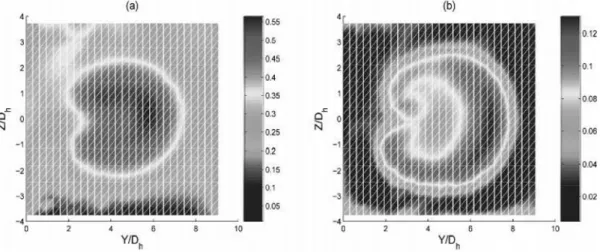
Temperature maps (in the scalar passive case, iJ.T = Tj - T=7.5 o C) with a momentum ratio r = Uj /U of 10, measured 3Dh downstream of the jet inlet, are displayed on figure 1. It reveals the global signature of the counter-rotating vortex pair (CVP) analogously to the round jet case (cf. Smith and Mungal [2] and Fric [3]).
Figure 2 shows mean temperature profiles measured in the crossfiow chan-nel at several sections downstream of t he jet inlet. We clearly observe that there is no self-similarity between these latters. That can be explained by the jet interaction with the opposite boundary wall since 8Dh· Even for distances under 5Dh, the shapes of the curves seem different.
c{' N
(a)
Experimental study of a jet in crossflow 451
(b)
F ig. 1. Temperature field (normalized by .t1T) interpolated on 29x24 measurement points in the section located at 3Dh downstream of the jet inlet. a) Average value b) rms
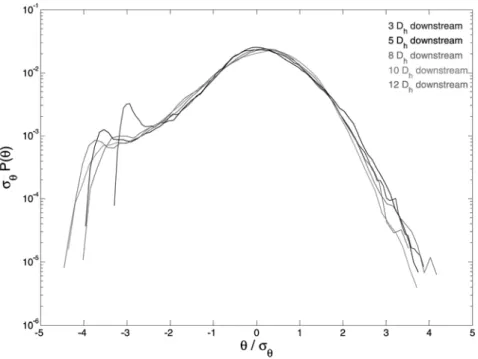
Figure 3 shows the temperature pdf locally obtained on the center of the jet hot spot in the same sections. Despite the lack of similarity at large scales, the statistics exhibit some common features ; particularly, they are skewed whatever the distance from the jet inlet.
0.3 0.25 3 Dh downstream 0.2: 5 D h downstream 8 Dh downstream 1- 1 0 Dh downs-tream <l 0.15 1 2 Dh downs-tream ~ 1-t:_ 0.1 0.05 0 -0.050 2 3 4 5 6 7 8 9 10 Y/Dh
Fig. 2. Normalized mean temperature profiles measured on the center of the jet inlet (Z/Dh = 0) at several sections downstream. Jet emerges from Y/Dh = 0 and the opposite wall is situated at Y / Dh = 9. 7.
452 Jean-Paul MORO, Pierre FOUGAIROLLE, and Yves GAGNE
The merging of the curves for hot fluctuations suggests a good mixing of these ones. On the other side, the quasi-exponential negative wings reveals the existence of "cold" fluid structures coming from the crossflow, which are not yet uniformly mixed. These wing become longer as the cold fluctutations diffuse. Such statistics correspond to the typical "ramp", characteristic of a temperature mixing signal.
Further investigations will explore statistical properties of the external side of this transversal hot jet, especially its interaction with the crossflow channel wall, and of its internal side which is mainly affected by the wake of the jet inlet. 10"1 3 Dh downstream 5 Dh downstream 8 Dh downstream 10"2 10 Dh downstrea 12 Dh downstream 10-3 $
cr
"' t:l 10 .. 10 .. 10 .. L---~--~--~--~----~--~---L--~----L_~ -5 -4 -3 -2 -1 0 2 3 4 5 e 1 a 9Fig. 3. Pdf of the temperature fluctuations() normalized by its standard deviation, measured in the center of the jet hot spot at several sections downstream of the jet inlet.
R eferences
1. G.R. Sarma: Review of scientific instruments Vol. 69 N • 6 (1998) 2. S.H. Smith, M.G. Mungal : J . Fluid Mech. 357, 83-122 (1998)
3. T.F. Fric : Structure in the near field of the transverse jet. PhD Thesis, Cali-fornia Institute of Technology (1990)