u
Digitized
by
the
Internet
Archive
in
2011
with
funding
from
Boston
Library
Consortium
Member
Libraries
i3i
Dewe
y
1415>3
Massachusetts
Institute
of
Technology
Department
of
Economics
Working
Paper
Series
A
DUAL
LIQUIDITY
MODEL
FOR
EMERGING
MARKETS
Ricardo
J.
Caballero
Arvind
Krishna
murthy
Working
Paper
02-03
June 2002
Room
E52-251
50
Memorial
Drive
Cambridge,
MA
02142
This
paper
can be downloaded
without
charge
from
the
Social
Science Research
Network
Paper
Collection at
http://papers.ssrn.com/abstract=
2971
7
iv\
Massachusetts
Institute
of
Technology
Department
of
Economics
Working
Paper
Series
A
DUAL
LIQUIDITY
MODEL
FOR
EMERGING
MARKETS
Ricardo
J.Caballero
Arvind
Krishnamurthy
WORKING
PAPER
02-03
January
2002
Room
E52-251
50
Memorial
Drive
Cambridge,
MA
02142
This
paper
can be
downloaded
without
charge
trom
the
Social
Science Research Network
Paper
Collection
at
http://papers.ssm.com/abstract=
XXXXX
MASSACHUSETTS INSI
OFTECHNOLOGY
MAR
7 2002
A
Dual
Liquidity
Model
for
Emerging
Markets
By
Ricardo
J.Caballero and Arvind
Krishnamurthy
1January
8, 2002The
last few years have seen a significant re-evaluation of themodels
used to analyzecrises inemergingmarkets. Recent
models
typically stress financial constraints or distortedfinancial incentives.
While
thiscertainlyrepresentsprogress, thesemodels
share aweakness with the earlier work: neither is uniquely about emerging markets. Adaptations of theMundell-Fleming
model
represent Argentina as aBelgium
with larger external shocks.Likewise, emerging
market models
of financial constraints are adaptations of developedeconomy
ones with tighter financial constraints.In our work,
we
have advocated amodel which
distinguishesbetween
the financialconstraints affecting borrowing
and
lendingamong
agents withinan
emerging economy,and
those affecting borrowing from foreign lenders (Caballeroand
Krishnamurthy
2001a,b, c). Financial claims
on
future flows that canbe
sold to foreignand
domestic lendersalikearelabeled international liquidity,while those that canbesoldsolelytootherdomestic
agents are labeled domestic liquidity.
Belgium
inourmodel
is a countrywhere
most
claimsare international liquidity, while Argentina is a country
where
most
claims are domesticliquidity.
The
dual liquiditymodel
offers a parsimonious description of the behavior of firms, governments,and
asset prices during financial crises. It also provides prescriptions for optimal policy responses to these crises. This paper presents a simple sketch ofour ideasin a
framework
akin to theMundell-Fleming
model.The
graphical analysis allows us topose a rich array of questions
and
illustrateshow
our answers differfrom
standard ones.The
welfare statementswe
make
below holdup
in specifications that are tighter than themodel
we
deploy (see Caballeroand Krishnamurthy
2001d).I
International
liquidity,
domestic
liquidity,
and
crises
Let us simplify matters at the outset
and assume
that all private investmentand
publicexpenditure has to be financed from abroad.
That
is,I
+
G
=
CF
where
/ is domestic investment,G
isgovernment
expenditures,and
CF
is net capital inflows.The
simplification highlights the impact ofexternal shockson
investment.Respectively:
MIT
andNBER;
Northwestern University. E-mails: [email protected],We
are grateful to GuidoLorenzoni andJaumeVenturafor theirThere
aretwo
central assumptions in ouranalysis.The
first one regulates the country'saccess to internationalfinancial markets,
and
thesecond one determines the functioning ofdomestic financial markets:
•
An
external crisis is a situationwhere
CF
is notenough
toimplement
the desiredlevelsofI
+
G.We
assume
that at thetimeof the crisis, claimson
some
specialfuturecash flows ("internationalliquidity") isallthat can besold to foreigners.
The
countryhas a stock of international liquidity given
by
IL,and
we
requirethat,CF
<
IL, sothat
I
+
G
<
IL.Loans
backedby
international liquidityare at the international dollar-rate oil*.
•
Not
all of the country's international liquidity is in thehands
ofthose that use it inreal investment.
The
latter need toborrow
some
ofthe international liquidityfrom
other domestic agents. Their domestic liquidity or net worth,
DL,
regulates theirborrowing
from
otherdomestic agents.DL
includes marketable domestic assets, such as real estateand
domestic financial assets.We
assume
thatDL
is a decreasingfunction ofip, the domestic peso-interest rate.
2,3
Let id denote the interest rate faced
by
a firmwhen
borrowing dollars (internationalliquidity)
from
otherdomestic agents.As we
will see,this ratewill generallybe higherthan
Zq during a crisis.
Under
these assumptions, firms' investment is a decreasing function ofidand
V
. Sincefirms need to
borrow
dollars to finance investment,and
id is the dollar-cost-of-capital, arise in id lowers investment. Tighter
monetary
policy—
that is, an increase inzp—
causesDL
to fall, constraining firms ability to borrow:Taking
ipand
G
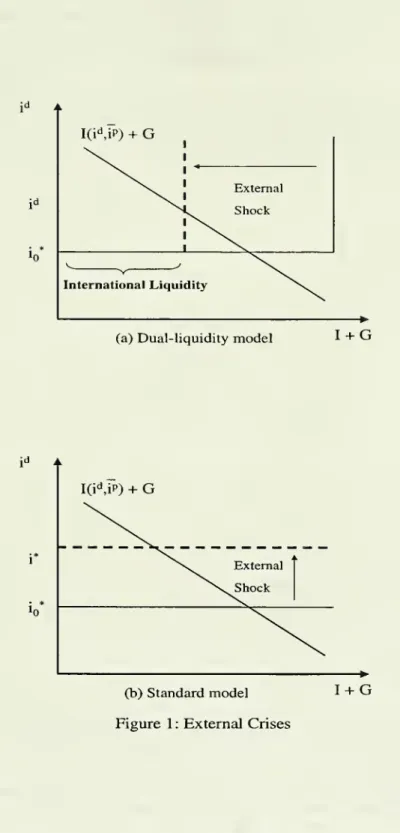
as given for now, Figure la illustrates ourmodeling
of crises.On
the horizontal axis is aggregate investment plus
government
expenditure.The
limitedinternationalliquidityofthe countryisrepresented
by
the reversed-Lshaped
supplycurve.A
crisis isan
eventwhen
the quantity of internationalliquidityislowrelativeto investmentneeds.
An
external shock decreases the available international liquidity,moving
supply tothedashed line
and
reducing aggregate investment.I(id,iP)
+
G
=
IL. (1) 2See Caballero and Krishnamurthy (2001d) fora modelconnecting domesticliquidity, monetary policy,
andinvestment.
3
Ben Bernanke and AlanBlinder (1988) alsooutline amodel in which there are twoformsofliquidity: bonds and bank-loans. Howeverin their case the twoliquiditiesare substitutes. In contrast, inour model
there isahierarchy: IL isultimatelywhatisneededfor investment, while
DL
servesonly toaggregate theIn this crisis equilibrium, domestic firms finance investment
by
selling their domesticallyliquid assets in exchange for international liquidity.
The
price ofthe limited internationalliquidity (id)risesaboveij$ toclearthemarket. Foreigninvestors
do
not arbitrage thediffer-enceofid
—
Iq because theyareunwilling toexchangeinternational liquidityfordomesticallyliquid assets.
In contrast, the lower panel represents astandard modeling ofcrises.
The
usualsmall-open-economy
assumptionmeans
that the supply of dollars is elastic at the internationalinterest rate.
The
externalshockisariseintheinterestrate (orriskpremium)
thatraisesidfrom
Iqto thedashed
line(i*). Since theinterest rateon borrowingdollars rises, investmentfalls.
While
foran appropriaterescalingthe externalshockleads tothesame
equilibriumlevelsofid
and
/ than in the dual liquidity economy, the fact that the supply of internationalfundsis inelastic at the equilibrium point inthe latter hasimportant ramificationsfor
what
follows.
II
Domestic
interest
parity
condition
Letus
now
seehow
idaffectsdomesticasset prices. Considerthemarginaldomesticinvestorinthecrisis equilibrium ofFigure lawith aunit of international liquidity (say, one dollar).
There
aretwo
options available to the agent.The
first is to lend this to a domestic firmand
earn interest at the rate ofid one period hence.The
second is to convert the dollar into pesos, at the exchange rate of eand
invest these pesos in a domesticbond
to earn interest ofip. Fixingthe future exchange rate ate,and
since the agentmust be
indifferentin equilibrium
between
thetwo
strategies,we
obtain adomestic interest parity condition:e
Rewriting
and
dropping the higher order term,we
arrive at:i
d
^i
p+
e, (2)
where
e=
e/e—
1, is the expected appreciation of the domestic currency.A
rise inid, asin the external shockofFigure la, causes theexchange rate to depreciate inorder to yield
an
expected appreciation. Alternatively, themonetary
authoritymay
defend the currencyby
raising thedomestic interest rate ofip.If
we
replace thedomesticbond
in the previousargument
with any (only) domesticallyliquid asset, then the rise in id will result in the dollar-price of that asset to fall.
The
model
thus provides a simple account ofthefall in domestic asset pricesand
exchangeratedepreciations
accompanying
external crises.It is also
worth
noting that the fall in domestic asset prices isdue
to an aggregateshortage of international liquidity, as
opposed
to aproblem
of domestic assets - i.e. theprice of real estate falls not because real estate will generate less revenues in the future,
id , I(idJp)
+
G
External id Shock ; * J v ^\.
•y ^v InternationalLiquidity(a)Dual-liquidity
model
I+
G
(b)Standard
model
I+
G
Ill
LM
curve
and
Equilibrium
The
peso-interest rate ip is determinedby
a (nearly) conventionalLM
curve,L(ip,I
+
G)
=
M,
(3)where
we
have used nominalmoney
stockon
the right-hand-side, asopposed
to^
or^.
Using realmoney
stock does lead tosome
interesting issueswhen
the centralbank
post-crisis inflation target is not credible (see Caballero
and
Krishnamurthy, 2001d). But, forpresent purposes, it onlycomplicates the analysis.
iP
M
International Liquidity Constraint I+
G
Figure 2:EquilibriumFigure 2 depicts the equilibrium of (1)
and
(3).The
curve IS' corresponds to a casewhere
international liquidity isnot scarce, while thedual liquiditymodel
is represented by75.
The
international liquidity is constrained in the verticalsegment
oftheIS
curve,and
I
+
G
is determinedby
IL
asopposed
to ip. Figure 2 along with Figure la describe theequilibrium of (I
+
G,id,ip).Combined
with (2), this also describes the exchange rate.IV
Monetary
policy
From
theIS' curvewe
notethestandard effectofmonetary
policyinmodels
with financialconstraints.
An
expansionin money, shiftsout theLM
curve, loweringip.The
latter raisesfirms' net
worth and
thereby relaxes their domestic financial constraintand
facilitatesinvestment.
In our modeling of crises (IS), this logic does not apply.
Monetary
policy hasno
contemporaneous
effecton
investment. This is becausewe
assumed
that at the aggregateIf
we
imagine an experimentwhere
we
increased theDL
of a single firm, holding allother firm's
DL
fixed, it willbe
true that this firm's investment will raise.The
firm willsell its extra
DL
forsome
IL
and
thereby increase its real investment. However, loweringiv has the effect ofincreasing all firm's
DL.
Since in aggregateIL
is fixed, this action willonlybid
up
the domestic price of international liquidity. It will shiftup
theI(i ,rP) curvein Figure la,
and
raise id.iP
International Liquidity
Constraint
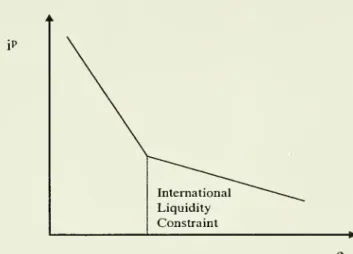
Figure 3: Interest
and
Exchange
RateFigure3illustratesthe
impact
ofmonetary
policyonexchange
rates inourmodel. First,from
(2), loweringip whileholdingid fixedleads tothestandardexchange
ratedepreciation.This is the first
segment
in thedownward-sloping
curve. However, in our model,when
IL
is constrained, lowering ip also causes id to rise. This shift in the domestic interest-parity
condition reinforces the
exchange
rate depreciation.Thus
thecurvebecomes
flatterat thispoint (the second segment). 4
These
last observations lead toan
insight regardingmonetary
policy: If ratherthan
expanding, the central
bank
tightensmonetary
policy during a crisis, it does not reduceinvestment further, but it does alleviate the exchange rate depreciation that a crisis-high
id
would
bring about. If themonetary
authority is at all concerned about meetingan
exchange
rate/inflation target, it will tend to tightenmonetary
policy duringacrisis.Thus
our
model
rationalizes "fear offloating" as apositivedescription of centralbanks
behavior inemerging
markets (see Guillermo Calvoand
Carmen
Reinhart, 2000).4
An
interesting detour isobtained ifwe write the international liquidity constraint asI+
G
=
IL(e).Thisis the casewheredevaluations
may
increaseexportsthatcountas internationalliquidity. Inthiscase,loosening monetary policy depreciates the exchange rate and increases output, via relaxing the external
constraint.
On
the other hand, onemay
also believe thatDL
is decreasing in e, perhaps because firm'shave asubstantial amountof dollar debt, sothat devaluations decrease their networth. Inthis case, the
opposite conclusion
may
obtainifthe decline inDL
is sharpenough sothat the countryendsup wasting aggregateinternational liquidity (seeCaballero and Krishnamurthy2001b).V
Fiscal
policy
The
model's implication for fiscal policy are alsoworth
highlighting. In the standardMundell-Fleming
setup, an expansionaryfiscal policy (right-shift inIS') raisesipand
intheprocess partially crowds out I.
The
rise in the peso-interest rate appreciates the exchangerate.
In the dual liquidity economy, fiscal policy
competes
with the private sector forinter-national liquidity,
and
sinceIL
is fixed it crowds out private investment one-for-one.An
expansionary fiscal policy has
no
effecton
the vertical part ofIS.The
competition forIL
raises id rather than ip.As
a result, the domestic interest parity condition shiftsfrom
the(new) kink to the right
and
causes a depreciation ofthe exchange rate (see Figure 4).iP
Figure4:
Expansionary
FiscalPolicyThe
differences areeven starkerin afixed exchange rate regime. Inthestandard model,fiscal policy is potent because it is reinforced
by
anendogenous
expansion inmonetary
policy:
The
rise in ip tends to appreciate the exchange rate,which
is offset onlyby
amonetary
expansion. In contrast, in the dual liquiditymodel
the exchange rate tends todepreciate as aresult ofthe fiscal expansion sinceid rises,
and
hencemonetary
policywillhaveto tighten topreservethe peg.
VI
Overborrowing
and
Ex-ante
Policy
Options
During
acrisis, the stock ofIL
fullydetermines investment. Let us imagine shifting priortothe crisis, to apoint in time
where
privateand
centralbank
actionsmay
influence thisstock.
We
will discusstwo
actions thatmay
affect IL: private external borrowing,and
centralbank
reserve accumulation. DefineILq
as the initial international liquidity,Do
asrateto one,
we
haveIL
=
ILq
-
D
+
R
-A
private agent contemplating takingonsome
external debtand
importinggoods
facesa tradeoff: Importing
goods
increasesconsumption
or investment today, but reducesIL
thatwould
otherwiserelax theaggregateinvestment constraintduringthecrisis.The
agentvalues thelatter benefit atid.
We
haveshown
elsewhere (see Caballeroand
Krishnamurthy,2001a) that
when
domestic financial markets are underdeveloped there is an externality-akin to a free-rider
problem - whereby
themarket
value of this benefit, id, is less than itssocial value. In this circumstance, the private sector overborrows
and
arrives at a crisiswith too little IL.
There
arethree basic instruments at the Central Bank's disposal to offsetthe tendencyofthe private sector. First, it can increase foreign reserves (Rq)
and
thereby increase IL.Our
model
provides a natural motivation forboth
centralized holding ofreserves, as wellholding
them
in theform
of international liquidity.One
concern here is that, insome
circumstances, increasing
Ro
may
in turn exacerbate the external overborrowingproblem
and
raiseDo
(see Caballeroand
Krishnamurthy
2001c). Second, it can tax capital inflowsand
directlyreduce Do, so as to increaseIL.Of
course, taxesmay
leadtootherdistortions.Third,
and
most
interestingly, it cancommit
to expandmonetary
policy during the crisis—
just the opposite as it will be inclined todo
during the crisis. Since loweringip duringthe crisis raises id, it increases the private sector's valuation of
IL
and
alters the privateReferences
[1] Bernanke,
Ben
and Alan
Blinder, "Credit,Money
and
AggregateDemand,"
American
Economic
Review,May
1988, 75(2), pp. 435-439.[2] Caballero, Ricardo
and
Arvind Krishnamurthy. "Internationaland Domestic
CollateralConstraints in a
Model
ofEmerging Market
Crises," JournalofMonetary
Economics.December
2001a, 48(3), pp. 513-548.[3] Caballero, Ricardo
and
Arvind Krishnamurthy, "Excessive Dollar Debt: FinancialDevelopment and
Underinsurance."Mimeo,
MIT,
2001b.[4] Caballero, Ricardo
and Arvind
Krishnamurthy. "International Liquidity Illusion:On
the Risks ofSterilization."
Mimeo,
MIT,
2001c.[5] Caballero, Ricardo
and
Arvind Krishnamurthy."A
Vertical Analysis ofCentralBank
Interventions
During
Crises."Mimeo, MIT.,
2001d.[6] Calvo, Guillermo,
and
Carmen
Reinhart. "Fear of Floating."Mimeo,
University ofDate
Due
^M/m
MIT LIBRARIES