Early-Transition-Metal-Mediated Activation
and Transformation of White Phosphorus
The MIT Faculty has made this article openly available. Please share how this access benefits you. Your story matters.
Citation Cossairt, Brandi M., Nicholas A. Piro, and Christopher C. Cummins. “Early-Transition-Metal-Mediated Activation and Transformation of White Phosphorus.” Chemical Reviews 110.7 (2010) : 4164-4177.
As Published http://dx.doi.org/10.1021/cr9003709
Publisher American Chemical Society
Version Author's final manuscript
Citable link http://hdl.handle.net/1721.1/65161
Terms of Use Article is made available in accordance with the publisher's policy and may be subject to US copyright law. Please refer to the publisher's site for terms of use.
Early-Transition-Metal Mediated Activation and
Transformation of White Phosphorus
Brandi M. Cossairt, Nicholas A. Piro, and Christopher C. Cummins
∗Department of Chemistry, Massachusetts Institute of Technology, 77 Massachusetts Avenue, Cambridge, MA 02139
E-mail: [email protected]
Contents
1 Introduction 2
2 P4Activation Leading to P1, P2, and P3Products 4
2.1 Terminal and Bridging P1Ligands from P4 . . . 4
2.2 Bridging P2Ligands from P4 . . . 7
2.3 Cyclo-P3Units derived from P4. . . 11
3 P4Activation Leading to P4Products 13
3.1 Coordination of P4Tetrahedra . . . 14
3.2 Rearranged P4Products . . . 16
4 P4Activation Leading to P≥5 Products 18
5 Functionalization and Transfer Methodologies 21
5.1 Functionalization and Subsequent Reactivity of Terminal Monophosphide and Bridg-ing Diphosphorus Complexes Derived from P4 . . . 22
5.2 Reactivity and Transfer Chemistry of the Cyclo-P3Functional Group . . . 25
5.3 Functionalization and Transfer Chemistry of Polyphosphorus Ligands (P≥4)
De-rived from P4 . . . 27
6 Concluding Remarks 28
6.1 Conclusions . . . 28
6.2 Future Prospects. . . 30
1
Introduction
Phosphorus-containing molecules are ubiquitous in the world around us and the synthetic and in-dustrial utilization of phosphorus has prospered for over a century.1,2 The industrial reduction of phosphate rock (apatite, Ca10(PO4)6(X)2, X = OH, F, Cl, or Br) to white phosphorus, P4, ex-ceeds 500,000 tons annually as P4 still represents the major commercial P-atom source for the production of organophosphorus compounds utilized by the food, detergent, specialty chemical, and pharmaceutical industries.3 The present day synthesis of organophosphorus compounds is a
multi-step process in which P4is first chlorinated to generate PCl3, which in turn is functionalized by reaction with an appropriate Grignard or organolithium reagent, or by treatment with a halo-genated organic compound and a powerful reducing agent.4,5 For example, the industrial method for triphenylphosphine preparation is based on the high temperature reaction of chlorobenzene with phosphorus trichloride in the presence of molten sodium.4,6From both a safety and a sustain-ability standpoint, the need for PCl3 as an intermediate for the production of organophosphorus
compounds is unpalatable and methods that circumvent its use are of great interest. This has pro-voked intensive investigations into the mild and controlled activation of P4, a clear objective being the development of catalytic methods for phosphorus incorporation into organic molecules.
Sustained interest in the chemistry of low-valent, early-transition-metal (ETM) complexes arises from their propensity to reductively activate a wide variety of small molecule substrates.7
A combination of coordinative unsaturation, inherent Lewis acidity, and availability of chemically accessible d electrons endows low-valent, ETM fragments with a rich reaction chemistry. The ability to apply the reductive power of such reactive metal systems is therefore of great interest for applications ranging from organic catalysis to dinitrogen fixation and it comes as no surprise that low-valent, ETM complexes have received considerable attention as agents for P4activation. The use of ETM complexes to study P4activation and functionalization is motivated by the wide array of P-containing ligands that can be obtained. P1 through P8ligands have been isolated and stud-ied from P4activation reactions of ETM complexes, and many of these metal-phosphorus systems have proven to be themselves reactive due to the hard-soft mismatch of ETM-phosphorus bonds. This bonding mismatch provides an underlying thermodynamic driving force by which assembled phosphorus ligands can be liberated from the metal center by exchange with preferred hard, anionic ligands, such as O2− and X− (X = Cl, Br, I).
The aim of this review is to highlight the wide array of results reported in the literature in the field of P4 activation and transformation with a particular emphasis on the special attributes of ETM utilization in such processes. For the purposes of this work we define “ETM” as any member of groups 3 through 7, and lanthanide and actinide metals are also included for comparison purposes. Sections two through four provide a general overview of the P4 activation chemistry of this group of elements organized in terms of the phosphorus products that result. Section five details the strategies by which ETM chemists have gone about transforming white phosphorus in the coordination sphere of a metal en route to the synthesis of main-group phosphorus-containing molecules.
2
P
4Activation Leading to P
1, P
2, and P
3Products
ETM-mediated degradation of the white phosphorus tetrahedron to small Pn units has been
ob-served frequently, and a variety of the possible P4 degradation products have been characterized. Typical products include those incorporating a terminal or bridging phosphide (P3−) ligand, bridg-ing diphosphide ligand (P24−), and cyclo-P3moieties serving either as terminal P33− ligands or as
a µ2: η3, η3bridge between two metal centers. Few mechanistic studies have been explicitly
car-ried out on these P4degradation reactions; mechanistic proposals have been put forward in various cases,8,9 but these are not included in the coverage of the present review. The focus herein is on synthetic, structural, and spectroscopic details.
2.1
Terminal and Bridging P
1Ligands from P
4There are few examples of monophosphorus ligands derived directly from activation of P4 that have been reported, and all of them involve group 6 metal complexes (Figure 1). The first terminal phosphide complex to be obtained from transition metal activation of P4was P≡Mo(N[tBu]Ar)3 (1; Ar = 3,5-C6H3Me2).10 Prior to this report and a concurrent report by Schrock and cowork-ers on the synthesis of P−−−Mo(Me3SiNCH2CH2)3N and P−−−W(Me3SiNCH2CH2)3N from reac-tion of the precursor chloro complexes and Li[P(H)Ph],11 the M≡P functional group was
vir-tually unknown.12,13 Compound 1 was synthesized by Cummins and coworkers by treatment of three-coordinate Mo(N[tBu]Ar)3 with 0.35 equiv of P4 at 25 ◦C in diethyl ether.10 Analogous terminal phosphide complexes, P≡Mo(N[tBu]Ph)3, 2, and P≡Mo(N[2Ad]Ar)3, 3, obtained from reaction of white phosphorus with Mo(N[tBu]Ph)3 and Mo(N[2Ad]Ar)3, respectively, have also been reported.14,15 Interestingly, reaction of Mo(H)(η2-Me2C=NAr)(N[iPr]Ar)2, a tautomer of
Mo(N[iPr]Ar)3, with P4 does not directly give the terminal P≡Mo(N[iPr]Ar)3, 4, but instead, the bridging (Ar[iPr]N)3Mo−−P−−Mo(N[iPr]Ar)3, 5, is obtained. This bimetallic complex is likely a result of quenching a transiently formed terminal phosphide complex with an additional equiv-alent of Mo(H)(η2-Me2C=NAr)(N[iPr]Ar)2.16 Complex 4, however, can be revealed by a
re-duction reaction of 5 to give the intact bimetallic complex monoanion followed by treatment with an equivalent of CO and 12-crown-4 with loss of the carbonyl anion salt [Na(12-crown-4)2][(OC)Mo(N[iPr]Ar)3].16Outside of the tris-anilide family of complexes, one other example of
terminal phosphide formation from P4 has been reported, and it too stems from a reactive three-coordinate molybdenum complex. Treatment of Mo(OSitBu3)3 with 0.35 equiv of P4 at 23 ◦C in diethyl ether results in clean formation of P≡Mo(OSitBu3)3, 6.17 Complexes 1, 2, 3, 4, and 6
each display a31P NMR resonance downfield of 1200 ppm. These signature low-field shifts are the result of a strong contribution from the paramagnetic shielding term, the origin of which is electronic circulations arising from field-induced mixing of the M–P σ bonding orbital with the M–P π∗ orbital.18 Structurally characterized molybdenum terminal phosphide complexes display very short Mo≡P interatomic distances, averaging 2.11 Å, in accord with the interpretation that they incorporate a triple-bond functional group (triple bond covalent radius for Mo is 1.13 Å and for P is 0.94 Å).19
In a reaction related to P4 activation by three-coordinate molybdenum, the dimethylamine adduct of the tungsten dimer W2(OCH2tBu)6 was treated with P4 in toluene at 75 ◦C with the stated goal of preparing the W≡P functional group. Obtained instead was the complex, (η3 -P3)W(OCH2tBu)3(HNMe2) (vide infra), together with the trimetallic monophosphide complex
W3-(µ3-P)(µ-OCH2tBu)3(OCH2tBu)6, 7.20,21 It was postulated that 7 was formed by trapping
of a sterically unprotected and highly reactive P≡W(OCH2tBu)3 intermediate by an equivalent of the starting material W2(OCH2tBu)6.21 The phosphide resonance in 7 differs markedly from those of the terminal molybdenum phosphide species, consisting of a singlet at 275 ppm flanked by tungsten satellites. In the single-crystal X-ray structure of 7, each tungsten atom resides in a square-pyramidal coordination geometry with the W–P bond occupying the axial site (W–P = 2.365(4) Å). The average W–W distance is 2.757(1) Å, and the angles within the distorted W3P tetrahedron are W–W–W = 60◦, W–P–W = 71.3(1)◦, and P–W–W = 54.3(1)◦(Figure 2).21
The observation of both bridging and terminal monophosphide ligands from P4 activation by ETM complexes highlights the importance of steric factors in moderating the reactivity of such
P Mo N NN Ar R R R Ar Ar P Mo OSitBu 3 OSitBu 3 tBu 3SiO P Mo N NN Ar Ar Ar Mo N N N Ar Ar Ar iPr iPr iPr iPr iPr iPr Ar = 3,5-C6H3Me2, R = tBu, 1, 78% Ar = Ph, R = tBu, 2, 79% Ar = 3,5-C6H3Me2, R = 2Ad, 3, 54% Ar = 3,5-C6H3Me2, R = iPr, 4, 84% 6, 65% 7, ~70% W P W W O OCH2tBu tBuH 2CO tBuH 2CO OCH2tBu OCH2tBu tBuH 2CO OCH2tBu tBuH 2CO CH2tBu Ar = 3,5-C6H3Me2, 5, 74%
Figure 1: Monophosphide ligands derived from P4activation; yields given where available.
P1 Mo1 P1 Mo1 Mo2 W1 W2 W3 P1 1 5 7
metal fragments towards P4and emphasizes the integral role of the ancillary ligands in P4activation chemistry. A thorough review of metal terminal phosphides originating from P4 and from other P-containing substrates has been provided by Scheer and coworkers.12,13
2.2
Bridging P
2Ligands from P
4The symmetrical degradation of the P4 tetrahedron to P2 units often results in diphosphorus lig-ands bridging two metal centers in a µ2: η2, η2coordination mode (Figure 3). Many of the reports
involving P2 ligands have been documented by Scherer and coworkers. The first
diphosphorus-containing metal complex was isolated and characterized in Scherer’s laboratories in 1984. Treat-ment of the molybdenum dimer [MoCp(CO)2]2 with P4in toluene at 110◦C for 8 h gives a
mix-ture of (η3-P3)Mo(CO)2Cp (vide infra) and Mo2(CO)4Cp2(µ2: η2, η2-P2), 8.22 This chemistry
was found also to be available with substituted cyclopentadienyl complexes of Mo, including those containing Cp*.23,24Compound 8 exhibits a side-on bound P2unit with a P–P interatomic distance of 2.079(2) Å and a short Mo–Mo distance of 3.022(1) Å. It is noteworthy that a common feature of bridging diphosphorus ligands is an incomplete reduction of the P–P multiple bonding character (relative to the free P2 molecule) as signified by P–P interatomic distances significantly shorter
than those for a typical P–P single bond, for which a typical example is the 2.21 Å P–P interatomic distance in P4.25 This type of transformation was extended to chromium by Goh and coworkers who discovered that treatment of the chromium dimer [CrCp(CO)3]2with P4for 3.5 h at 90◦C in
toluene results in a mixture of (η3-P3)Cr(CO)2Cp (vide infra) and Cr2(CO)4Cp2(µ2: η2, η2-P2),
9.26 Complex 9 exhibits a side-bound P2unit with a P–P interatomic distance of 2.060(1) Å and a Cr–Cr interatomic distance of 3.011(1) Å.
Since these initial reports, it has been found that a wide range of ETM carbonyl complexes sup-ported by cyclopentadienyl and substituted cyclopentadienyl ligands do indeed give rise to side-on coordinated diphosphorus ligands bridging two transition metal centers in a butterfly format. For example, [ReCp*(CO)2]2 reacts with P4 in toluene upon warming a chilled solution to 23 ◦C to
direct metal-metal interaction.27 If the reaction mixture leading to 10 is not cooled prior to
ad-dition of P4, then 10 is formed only in trace quantities with the dominant reaction product being the tetranuclear complex, [Re(CO)Cp*]4(P2), 11.28 This diphosphinidine complex exhibits an
un-usual P2 ligand stabilized as a formal 8 σ electron donor. The P–P interatomic distance in 11 is a lengthy 2.226(3) Å, suggesting a P–P bond order of one, as compared with the short 2.032(8) Å interphosphorus distance exhibited by 10. The finding of complex 11 illustrates the versatil-ity of the diphosphorus ligand in being able to stabilize coordination complex clusters having two or more metals. A further example reported by Scherer and coworkers involves the pho-tolytic reaction of Cp”Ta(CO)4 (Cp” = η5-1,3-C5H3tBu2) with P4 in toluene at 22◦C giving rise
to three products including Cp”(CO)2Ta(η4-P4) (vide infra), (Cp”(CO)Ta)2(µ2: η2, η2-P2)2, 12,
and (Cp”(CO)Ta)3(µ2: η2, η2-P2)2, 13, in low yield.29Complex 12 was structurally characterized
and found to contain short P–P interatomic distances (2.120(3) Å) in the coordinated diphosphorus ligands. No interaction between the two diphosphorus units was observed.
Cyclopentadienyl-supported ETM hydride complexes have also been shown to be viable re-action partners with P4 leading to coordinated parent diphosphene, HP=PH, ligands resulting from transfer of hydride from the metal center to phosphorus. An early example of this type of transformation was provided by Green and coworkers who showed that treatment of the di-hydride complex Cp2MoH2 with an excess of P4 in toluene at 90 ◦C leads to the red complex Cp2Mo(HP−−PH), 14.30 Subsequently, this compound was characterized crystallographically by Canillo et al.31These reports were followed much later by the report by Stephan and coworkers of
similar insertion behavior for the related trihydride complex Cp2TaH3. Specifically, it was found that treatment of Cp2TaH3 with white phosphorus overnight at 85◦C in toluene elicits formation of Cp2TaH(HP−−PH), 15.32
In addition to cyclopentadienyl-supported ETM complexes, the reactive niobaziridine hydride complex, Nb(H)(η2-tBu(H)C=NAr)(N[CH2tBu]Ar)2, has also been shown to give a coordinated
P2 ligand upon reaction with white phosphorus. Treatment of the niobaziridine hydride complex with P4in diethyl ether gives rise quantitatively to (µ2:η2,η2-P2)[Nb(N[CH2tBu]Ar)3]2, 16.33This
M OC OC P M P CO CO M = Mo, 8, 20% M = Cr, 9, 53% Re OC OC P Re P CO CO 11, 38% Mo P H PH P OSitBu 3 OSitBu 3 tBu 3SiO P OSitBu 3 tBu 3SiO tBu 3SiO M M M = Ta, 17, 77% M = Nb, 18, 70% Ar = 3,5-C6H3Me2, 16, 60% 14 15, 71% Ta P H PH H Ta OC Ta P P CO P P tBu tBu tBu tBu 12, 5-58% 10, 35% Re COCO Re OC OC Re OC OC Re CO CO P P Nb N N N Ar Ar Ar P P Nb N N N Ar Ar Ar CH2tBu tBuH 2C CH2tBu CH2tBu tBuH 2C tBuH 2C
Figure 3: Bridging and side-on bound diphosphorus ligands derived from P4 activation; yields given where available.
Mo1 P1 Mo2 P2 Nb1 P1 P2 Nb2
H atoms not shown on the P2H2 ligand
Mo1
P1 P2
14
8 16
reaction was found to be insensitive to the reaction conditions used, giving rise to 16 regardless of the P:Nb stoichiometry. The reaction can be viewed as a 2e per Nb reduction of the P4 tetrahe-dron and is reminiscent of the mild activation of P4 reported for the molybdenum(III) tris-amide system discussed above.10 Compound 16 displays the typical M2P2 butterfly geometry seen for coordinated diphosphorus units with a short P–P interatomic distance of 2.150(2) Å and no direct metal-metal interaction. The molecular structure of 16 is shown in Figure 4 along with examples of other molecular geometries for coordinated P2ligands.
Recently, two examples of a rare end-on coordination mode for a P4-derived diphosphorus lig-and have been observed by Wolczanski lig-and coworkers, these being demonstrated as a bridging component spanning a pair of three-coordinate niobium or tantalum metal fragments.34 Treatment
of Ta(OSitBu3)3with P4in toluene gives rise to (µ2:η1,η1-P2)(Ta(OSitBu3)3)2, 17. Interestingly,
reaction of the related PMe3-stabilized Nb(OSitBu3)3 with P4 gave different major products
de-pending upon the reaction conditions. When the reaction was run at 23 ◦C in toluene, the purple (µ2:η1,η1-P2)(Nb(OSitBu3)3)2, 18, could be isolated in 70% yield. However when the reaction
mixture was kept at −78◦C for 7 h prior to warming to room temperature, the red hexaphosphorus complex (µ2:η2,η2-P6)(Nb(OSitBu3)3)2could be isolated in good yield (vide infra). Complex 17
proved isomorphous to 18, with both species displaying an end-on zig-zag coordination mode for the M2P2 core. The P–P interatomic distances in 17 and 18 are slightly longer than those of the
P2 complexes discussed previously, at 2.171(2) and 2.143(1) Å, respectively; the structural fea-tures point to a diphosphinidene, i.e. M=P–P=M, Lewis picture for these systems that incorporates metal-phosphorus double bond character. It is presumed that the end-on coordination observed in 17 and 18 may be due to the steric pressure provided by the bulky OSitBu3 ligands surrounding
the metal centers. To date, simple 1:1 complexes of a transition metal with a P2 ligand have not
2.3
Cyclo-P
3Units derived from P
4The activation of P4 in the coordination sphere of a metal complex to give a triphosphorus unit has been observed frequently, often as a pathway that competes with formation of a monophos-phide complex.8 Triphosphorus ligands derived from P4 appear generally as cyclo-P3 units that bind to a metal in an η3 coordination mode. Sacconi and coworkers have provided the field with many examples of cyclo-P3 ligands crowning various transition metal centers, including the first structurally characterized example in both the terminal disposition (in a cobalt system) and as a symmetrical µ2: η3, η3 ligand connecting two nickel centers.35 Much of this seminal late-metal
work has been reviewed elsewhere.8,36–38
The earliest cyclo-P3complexes in an ETM context were isolated as coproducts of P4activation chemistry. For example, the complexes (η3-P3)Mo(CO)2Cp, 19, and (η3-P3)Cr(CO)2Cp, 20, were
isolated from product mixtures that resulted when the parent dimer complexes [Cp(CO)2Mo]2and [Cp(CO)3Cr]2 were treated with P4 in hot toluene solutions (Figure 5).22,26 Similarly, Chisholm et al. found that treatment of the dimethylamine adduct of the tungsten dimer W2(OCH2tBu)6led to a trimetallic monophosphide cluster together with the cyclo-P3complex (η3-P3)W(OCH2tBu)3,
21, as a minor product.20 M = Mo, 19, 2% M = Cr, 20, 40% Dipp = 2,6-iPr 2C6H3, 23, 45% 21, ~30% Cl Nb ODipp ODipp DippO P P P Mo N NN Ar Ar Ar iPr iPr iPr P P P M OC OC P P P Ar = 3,5-C6H3Me2, 22, 57% W OCH 2tBu OCH2tBu tBuH 2CO P P P N(H)Me2 tBu 24, 81% tBu P P P Th Th tBu tBu tBu tBu tBu tBu
Masked metal(III) (M = Cr, Mo, W) derivatives have been found to produce cyclo-P3 com-plexes upon activation of white phosphorus. For instance, Mo(H)(η2-Me2C=NAr)(N[iPr]Ar)2 (a
tautomer of Mo(N[iPr]Ar)3) reacts with P4 to provide the µ-phosphide complex 5 in high yield (vide supra); this is the main reaction channel when diethyl ether, in which P4is not very soluble,
is used as the solvent. However, upon adding a toluene solution of the molybdaziridine hydride complex Mo(H)(η2-Me2C=NAr)(N[iPr]Ar)2to a toluene solution containing excess P4, the
cyclo-P3complex (η3-P3)Mo(N[iPr]Ar)3, 22, is favored as the reaction product.9
A recent addition to the family of cyclo-P3 complexes derived from P4 is the anionic niobium complex, [(η3-P3)Nb(ODipp)3]1− (23, Dipp = 2,6-diisopropylphenyl, Figure 6). The complex
anion 23 forms upon reduction of Cl2Nb(ODipp)3 with an excess of 0.5% sodium amalgam in the presence of 1 equiv of P4in THF.39The negative charge associated with this cyclo-P3complex evidently imparts it with nucleophilic character at phosphorus and thus leads to enhanced reactivity as compared with neutral group 6 metal-P3complexes (vide infra).
Nb1 P1 P2 P3 Th1 P1 P2 P3 Th2 23 24 Cl1
Figure 6: Structural diversity in cyclo-P3ligands derived from P4activation.
There are several unifying features to the small family of ETM terminal cyclo-P3complexes. The 31P NMR resonance that is characteristic of cyclo-P3 complexes coordinated to transition metals is a singlet found between −180 and −220 ppm. Such a high-field shift is characteristic of polyphosphorus units with small endocyclic bond angles, as found in a P3ring.40Structurally, each of the above-mentioned cyclo-P3complexes displays a symmetrical P3unit that can reasonably be
viewed as a P33 – ligand. It should be noted that the P–P interatomic distances for structurally characterized P3complexes are not invariant. For instance, 20 and 21 both display somewhat short average P–P interatomic distances of 2.12 and 2.15 Å, respectively. The anionic complex 23, on the other hand, displays average P–P interatomic distances of 2.20 Å, which are much closer to those found for the P–P single bonds of P4 (2.21 Å),25 but this may be due to interaction of the P3ring with a sodium counter-cation in the solid state.39 Such ostensible elongation of the P–P distances
in a cyclo-P3 ring is also observed for bimetallic P3 complexes. Cyclo-P3 as a bridging ligand is rare within the ETM regime, though examples do exist. For example, treatment of Cp”2Th(η4
-C4H6) with P4 in the presence of 0.5 equiv of MgCl2(OEt2) in toluene at 100 ◦C for 20 h was
reported to give the asymmetric bimetallic complex Cp”2Th(µ2:η3,η3-P3)Th(Cl)Cp”2, 24 (Figure
6).41 The average P–P distance in 24 was found to be 2.185 Å.
3
P
4Activation Leading to P
4Products
There is wide interest in understanding the nature of the metal-P4interaction that precedes the P–P bond activation chemistry that is typically observed upon reaction of transition-metal complexes with white phosphorus.8,42,43 In most instances where P4 is observed to react with a transition metal complex, the integrity of the P4 tetrahedron is not maintained and fragmentation and/or ag-gregation processes transpire. In some cases, the four atoms of the P4tetrahedron are each incorpo-rated into the metal complex product affording derivatives containing tetraphosphabicyclobutane, tetraphosphabutadiene, or cyclo-P4 coordination. In contrast, there are relatively few known coor-dination compounds featuring an intact P4 tetrahedron. The earliest report of P4as a coordinated ligand on a transition metal was provided by Ginsberg and Lindsell in 1971 with the synthesis of (P4)Rh(PPh3)2Cl,44 though the mode of coordination was not initially ascertained due to the lack of crystallographic or conclusive NMR analysis. The latter data were not reported until 1986 and were suggestive of an open edge, where a tetraphosphabicyclobutane coordinates to a metal(III) center.44,45 Sacconi deserves credit for the first full characterization of an intact tetraphosphorus
ligand coordinated to a metal complex. His research group found that treatment of a nickel(0) complex, Ni(np3) (np3 = N(C2H4PPh2)3), with P4 in THF gave rise to the complex (P4)Ni(np3) with the P4unit bonded to the metal atom by an apical P atom in an η1fashion.46 Two years later Sacconi’s group provided the second well-characterized example of a tetrahedro tetraphosphorus ligand, this time on Pd and supported by the related triphos ligand (triphos = MeC(CH2PPh2)3).47 The chemical literature possessed these two as its only examples of an intact P4tetrahedron serving as a 2e ligand atop a transition metal complex for over twenty years despite a surge in the study of P4activation chemistry.
3.1
Coordination of P
4Tetrahedra
The first reports of the coordination of intact P4molecules to an ETM center came in 1998 from Scheer and coworkers. They found that the electronically and coordinatively unsaturated com-pounds M(CO)3(PR3)2(M = Mo, W; R =iPr, Cy), can serve as starting materials for coordination of the P4 tetrahedron.48,49 Slow addition of P4 to a toluene solution of M(CO)3(PCy3)2 at −78
◦C followed by warming to −20 ◦C gives orange M(CO)
3(PR3)2(η1-P4) (M = Mo, R = Cy, 25;
M = W, R = Cy 26; M = Mo, R = iPr 27, Figure 7). Complexes 25, 26, and 27 decompose
in solution above 0 ◦C, but are stable as solids under argon at ambient temperatures.49 Next, an example of an intact P4 tetrahedron coordinated to an ETM came from the group of Peruzzini and in that report an intact P4 ligand was observed as both a terminal and as a bridging entity.50 The complex (triphos)Re(CO)2(OTf), containing a weakly coordinated triflate ligand, was treated with a small excess of P4 at 35 ◦C and was found to give, after work-up, the mustard colored [(triphos)Re(CO)2(η1-P4)][OTf], 28, in good yield.50 Additionally, it was found that the “dis-tal” P3 face of the tetrahedro-P4ligand still maintained reactivity towards unsaturated transition-metal complexes and electrophiles. Accordingly it was revealed that treatment of 28 with an additional equivalent of (triphos)Re(CO)2(OTf) resulted in formation of the bimetallic complex, [((triphos)Re(CO)2)2(µ2:η1,η1-P4)][OTf]2, 29, which contains an intact P4tetrahedron and is the
M OC R3P CO PR3 CO P P P P M = Mo, R = Cy, 25, 62% M = W, R = Cy, 26, 65% M = Mo, R = iPr, 27, 58% 28, 76% 29, 90% M = Zr, R = tBu, 30, 100% M = Hf, R = tBu, 31, 100% M = Zr, R = Me, 32 M PP P P R R R R M = Nb, R = Me, 35, 3% M = V, R = Me, 36, 9% M = Ta, R = tBu, 37, 6-35% M P P P P OC OC R R M = W, 38, 67% M = Cr, 39 M P P P P OCOC COCO M(CO)5 M(CO)5 (OC)5M (OC)5M Mo P P PH P OC OC Cr(CO)5 (OC)5Cr (OC)5Cr (OC)5Cr tBu 40, 8% Zr P H P P H P Zr tBu tBu 33, 90% 34, 42% Zr PP P P P(SiMe3)2 P(SiMe3)2 P P P P Zr N N Si Si P P Ph Ph Si Si Zr N N Si P P Ph Ph Si Si 41, 48% Si Ar = 3,5-C6H3Me2, 42, 10% U N N N Ar Ar Ar tBu tBu tBu P P P P U N N N Ar Ar Ar tBu tBu tBu Re CO OC P P P P P P P PhPh Ph Ph Ph Ph + Re CO OC P P P P Re COCO P P P PhPh Ph Ph Ph Ph P P P Ph Ph Ph Ph Ph Ph + 2
3.2
Rearranged P
4Products
Rearranged P4 units have also been observed as ligands attached to early transition metals; these ligands can display various geometries including the tetraphosphabicyclobutane and the cyclo-P4 coordination modes. The reaction pathways that generate the various types of P4ligands have been speculated upon, but detailed mechanistic studies are essentially nonexistent.8
The structural motif involving the fewest bond cleavage events from intact P4is the tetraphos-phabicyclobutane geometry (butterfly geometry). Only three examples of ETM P4-butterfly com-plexes have been reported. Scherer and coworkers found that treatment of Cp2”M(CO)2 (M = Zr,
Hf; Cp” = η5-1,3-C5H3tBu2) with P4 in refluxing xylene resulted in oxidative addition of the P4 tetrahedron and clean formation of the air-stable complexes Cp2”M(κ2-P4) (M = Zr, 30; M = Hf,
31).51 More recently, Chirik et al. reported on formation of a similar Zr product, Cp*2Zr(κ2-P4)
(32), which they obtained by treatment of Cp2*Zr(H)2with P4in toluene at −35◦C.52Surprisingly, Chirik and coworkers also found that treatment of the related dihydride Cp*(η5-C5H4tBu)Zr(H)2
with P4 under the same reaction conditions did not lead to the tetraphosphabicyclobutane struc-ture, but instead to (Cp*(η5-C5H4tBu)Zr)2(µ2:η2,η2-P4H2), 33.52 The phosphorus core of 33 is
best viewed as a (P4H2)4−fragment resulting in two formally 16-electron Zr(IV) centers, and may be considered as a rare example of a hydrogenated P44− ligand (Figure 8). A related example of formation of a P4 chain with concomitant functionalization has been provided by Lappert and coworkers who found that treatment of Cp2Zr(P(SiMe3)2)2 with P4 in toluene at 20 ◦C results in P–P bond scission, phosphido-migration, and intramolecular rearrangement to yield the zir-cona(tetraphospha)bicyclo[2.1.0]pentane complex Cp2Zr(η1, η1)-P4(P(SiMe3)2)2, 34, where the
P(SiMe3)2units are bonded to the two peripheral P atoms.53
By 1989, of the possible cyclo-Px compounds isoelectronic to the carbocyclic π systems,
x= 3 − 6, only cyclo-P4 had not been reported. It was in that year that Scherer reported the photochemical synthesis of the first examples of cyclo-P4 ligands. Irradiation of Cp*Nb(CO)4
in the presence of P4 in hexane solution at room temperature gave rise to a mixture of products including Cp*(CO)2Nb(η4-P4) (35), (Cp*(CO)Nb(µ2:η2-P2))2, and (Cp*Nb)2(P6) (vide infra).54
W1 P1 P2 P3 P4 W2 W3 W4 W5 W1 P1 P2 P3 P4 P5 P6 P1 P2 P3 P4 Zr1 Zr2 26 33 39
Figure 8: Structural diversity in P4ligands derived from P4activation.
The phosphorus NMR spectrum of 35 at room temperature consists of a broad singlet; at 223 K, this resonance splits into the well-resolved signals of an AMX2spin system, suggestive of hindered rotation of the cyclo-P4ligand. The bonding in this system may be formally considered as a P42 – ring which consists of an allyl-like P3– monoanion and a phosphido-like anion. Alternative, more symmetric bonding descriptions for cyclo-P4 ligands include a neutral bis(diphosphene) ligand and a P44 – tetraphosphido ligand, but the bond lengths and NMR data for this particular compound are most consistent with the allyl-phosphido description. Similar reactions have been observed for vanadium to give Cp*(CO)2V(η4-P4) (36), and with tantalum to give Cp”(CO)2Ta(η4-P4)
(37).29,55
The photochemical reaction of P4with group 6 metal carbonyl complexes has also been used to access cyclo-P4 complexes. Dahl and coworkers discovered that irradiation of THF solutions of W(CO)6and P4gave rise to W(CO)4(η4-P4)(W(CO)5)4, 38, in 67% isolated yield.56 Similarly, Scheer et al. found that the photochemical reaction of (Cp’Mo(CO)3)2(Cp’ = η5-C5H4tBu) with
white phosphorus in the presence of Cr(CO)5(THF) leads to a mixture of Cr(CO)4(η4-P4)(Cr(CO)5)4
(39), Cp’Mo(CO)2(η3-P4)(Cr(CO)5)4(H) (40), and the diphosphorus complex (Cp’Mo(CO)2)2(µ4:η2
-P2)(Cr(CO)5)2.57A further example of cyclo-P4ligand formation has been provided by Fryzuk and
coworkers using a zirconium diamidodiphosphine macrocycle complex. They found that treatment of ZrCl2(P2N2) (P2N2= PhP(CH2SiMe2NSiMe2CH2)2PPh) with P4and 4 equiv of KC8in toluene gave rise to the D2d symmetric bridging cyclo-P4complex (Zr(P2N2))2(µ2:η4,η4-P4) (41).58 The
A further example of a cyclo-P4ligand is found sandwiched between two uranium metal cen-ters.59 It was found that treatment of (THF)U(N[tBu]Ar)3 with 0.5 equiv of P4 results in clean
formation of (µ2:η4,η4-P4)[U(N[tBu]Ar)3]2, 42, which displays a singlet in its phosphorus NMR
spectrum at 794 ppm.59 The square tetraphosphorus bridge in compound 42 represents the formal
two-electron reduction of P4with concomitant formation of two U(IV) fragments. Compound 42
crystallizes in the space group P1, and the two halves of the molecule are related by an inver-sion center located at the P4-square centroid. Density functional theory calculations show that the
HOMO-1 orbital in 42 has δ symmetry but there is minimal overlap between the bridging ligand and the two metal centers. As no other orbitals show appreciable overlap between the uranium centers, 42 is formulated as an ionic compound supported by a weak δ bond.59
4
P
4Activation Leading to P
≥5Products
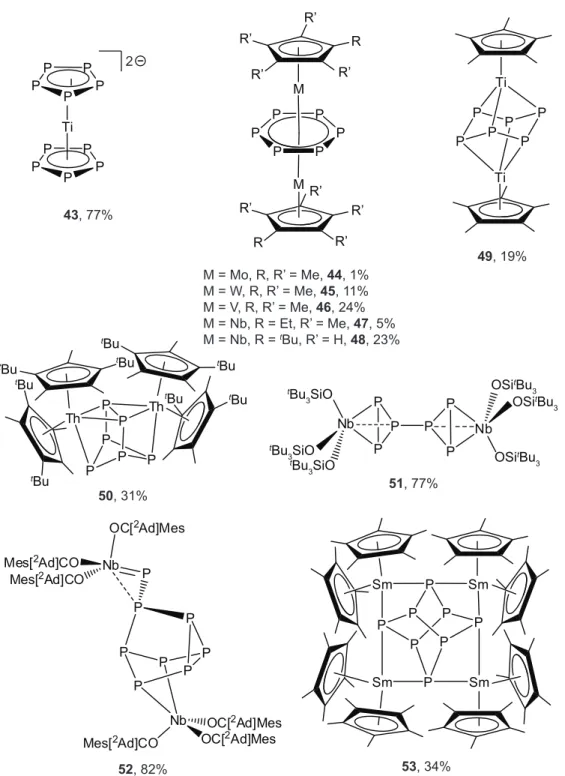
The divergent and fascinating reactivity of P4 with ETM systems is highlighted particularly well by the cases in which polyphosphorus ligands with greater than four P atoms are formed. Instances of such aggregation are common in P4activation chemistry and these reactions are important to de-veloping a thorough understanding of structure and bonding in phosphorus chemistry. Perhaps one of the most intriguing examples of P4activation by an ETM was provided by Ellis and coworkers in 2002. A highly reactive naphthalene-stabilized titanate complex was first formed by reduction of TiCl4(THF)2 with six equiv of potassium naphthalenide in THF at 260 ◦C, followed by addi-tion of 2 equiv of 18-crown-6. The complex so obtained was found to react with 2.5 equiv of P4 to give [K(18-crown-6)]2[Ti(η5-P5)2], 43, an all-inorganic analogue of the titanocene dianion
(Figure 9).60 Despite being isovalent with the group 6 metallocenes, 43 is both surprisingly air
and moisture stable and chemically inert. This decaphosphametallocene remains the only such molecule and is a prime example of the isolobal analogy between P atoms and CH fragments.61
Both monocyclic and bicyclic P6 ligands have been isolated when sandwiched between early transition metals. The first example of the cyclo-P6ligand was provided by Scherer and
cowork-P P P P P P P P Nb OC[2Ad]Mes Mes[2Ad]CO Mes[2Ad]CO Nb
Mes[2Ad]CO OC[OC[2Ad]Mes
2Ad]Mes 43, 77% Ti Ti P P P P P P 49, 19% 53, 34% 52, 82% M = Mo, R, R’ = Me, 44, 1% M = W, R, R’ = Me, 45, 11% M = V, R, R’ = Me, 46, 24% M = Nb, R = Et, R’ = Me, 47, 5% M = Nb, R = tBu, R’ = H, 48, 23% 50, 31% M M P P P P P P R R R’ R’ R’ R’ R’ R’ R’ R’ 51, 77% Ti P P P P P P P P P P 2 OSitBu 3 tBu 3SiO OSitBu 3 OSitBu 3 tBu 3SiO tBu 3SiO P P P Nb P P P Nb P P P P P P P P Sm Sm Sm Sm P P P P P P Th Th tBu tBu tBu tBu tBu tBu tBu tBu
ers while exploring the chemistry of [Cp*(CO)2Mo]2 with P4 as mentioned above. Treatment of
[Cp*(CO)2Mo]2with P4in xylene at 140◦C results in formation of a mixture of products
includ-ing the Cp* analogues of 8 and 19, as well as the triple-decker complex [Cp*Mo]2(µ2:η6,η6-P6),
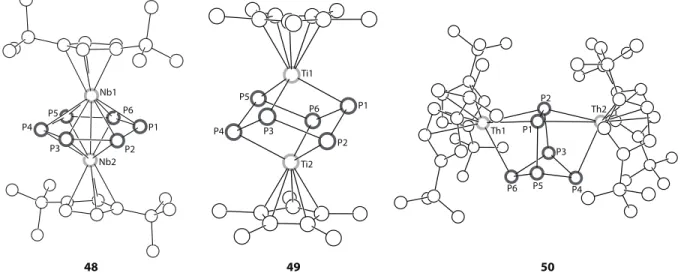
44.23 As the all-phosphorus analogue of benzene, cyclo-P6 has been stabilized by a variety of triple-decker complexes of early transition metals including those of W (45), V (46), Nb (47, 48), and Ti (49) by thermolysis of a half-sandwich precursor (usually a cyclopentadienyl/carbonyl com-plex) with P4in a hydrocarbon solvent.54,62–65Several of the P6triple-decker complexes adopt the expected D6h configuration with a planar P6unit, but in the case of 49 a distortion to a chair-like
cyclo-hexaphosphido form occurs, and the P6ligand binds in a µ2:η3,η3fashion as a P66 – ligand.
Ti1 P1 P2 P3 P4 P5 P6 Ti2 Th1 P1 Th2 P2 P3 P4 P5 P6 P1 P2 P3 P4 P5 P6 Nb1 Nb2 48 49 50
Figure 10: Structural diversity in P6ligands derived from P4activation.
Several different geometries can be obtained for P6ligands as illustrated by the activation of P4 by Cp”2Th(η4-C4H6) in toluene at 100 ◦C. The resultant (Cp”2Th)2(µ2:η3,η3-P6) complex (50)
contains a bicyclic P64 – ligand, which resembles a reduced hexaphosphabenzvalene ligand sand-wiched between two thorium metal centers (Figure 10).41 Yet another unique P6 ligand geometry has been provided by Wolczanski and coworkers who found that if a reaction mixture containing (tBu3SiO)3NbPMe3and P4was allowed to incubate at −78◦C for 7 h, followed by slow warming
to 23 ◦C, then the red P6-complex, ((tBu3SiO)3Nb)2(µ2:η2,η2-cP3-cP3), 51, could be isolated in
sig-nificantly shorter than the third (2.784(7) Å). The average P–P interatomic distance within each of thecP3rings is 2.172(2) Å. The twocP3rings are linked via a 2.217(7) Å diphosphorus bond, thus
the parameters may be best represented by considering the interaction as that of a niobium center interacting with a triphosphirene ring and benefiting from substantial backbonding.
Polyphosphorus ligands up through P12 have been isolated by activation of white phospho-rus by late transition-metal fragments, but ETM systems to date have given ligands containing only up to as many as eight phosphorus atoms.8 Two examples of P8 ligands have been iso-lated in multimetallic arrangements with early transition metals. Cossairt and Cummins found that when 2 equiv of P4 were combined with INb(OC[2Ad]Mes)3 in a weakly-coordinating sol-vent, a disproportionation reaction took place producing 0.5 equiv of I2Nb(OC[2Ad]Mes)3 and the octaphosphorus complex (Mes[2Ad]CO)3Nb−−P(P7)Nb(OC[2Ad]Mes)3, 52.66 The P8 core of 52 is closely related to that revealed by Wright and coworkers for the product of activation of P4by [(18-crown-6)K][Si(SiMe3)3].67 What distinguished the octaphosphorus cluster in 52 from other related structural motifs seen in polyphosphorus ligands derived from P4 was the fact that it incorporated a metal–phosphinidene bond, the reactivity of which was exploited, in one instance through phospha-Wittig chemistry.61 Another example of ostensible P4dimerization comes from the lab of Roesky and coworkers who found that diffusion of P4 vapor into a toluene solution of solvate-free permethyl samarocene, Cp*2Sm, over a period of several days resulted in the forma-tion of (Cp*2Sm)4P8 (53) as red crystals.68 Complex 53 can be described as containing a P84 –
ligand in a realgar-type homoatomic conformation supported by four Sm(III) metal centers and represents the first example of a lanthanide-supported polyphosphide.
5
Functionalization and Transfer Methodologies
Much of the reaction chemistry of molecules derived from P4 activation has remained confined to the protective coordination sphere of the metal complex; however, it is becoming increasingly evident that the transfer of such ligands is chemically feasible. While much research has been
targeted at the direct incorporation of N2-derived nitrogen atoms into main group molecules, the analogous chemistry with elemental phosphorus has been explored far less.69–74The incorporation of P4-derived phosphorus atoms into organic frameworks by P-atom transfer reactions mediated by transition-metal complexes could circumvent the need for PCl3as an intermediate in the synthesis of organophosphorus molecules and open up a wide variety of new methodologies for main-group molecule synthesis.75,76There are limited examples of such methods reported to date, however this reaction base is continually expanding. It is the goal of this section to review the functionalization and, where available, transfer chemistry of P4-derived phosphorus ligands from ETM platforms.
5.1
Functionalization and Subsequent Reactivity of Terminal
Monophos-phide and Bridging Diphosphorus Complexes Derived from P
4P Mo N N N Ar Ar Ar tBu O tBu tBu P Mo N NN Ar Ar Ar tBu tBu tBu O O P Mo N NN Ar Ar Ar tBu P tBu tBu SiiPr 3 CH2Cl2, acetone –78 °C iPr 3SiP=Nb(N[CH2tBu]Ar)3 –ONb(N[CH2tBu]Ar)3 C6H6 22 °C 57 58 Ar = 3,5-C6H3Me2, 1 Scheme 1
The reason for the late development of the M≡P functional group lies in the high reactivity of these triple bonds, which exhibit “side-on” as well as “end-on” reactivity.13Thus, before 1995,
highly reactive intermediates containing a metal-element triple bond were the subject of much speculation.12,13,20Unfortunately, the stable terminal phosphide ligands that have been isolated via P4activation chemistry have the common feature of kinetic stabilization by protection of the triple bond through the use of bulky organic substituents which shut down most “side-on” reactivity of the multiple bond.77 One exception to this has been the reaction of P−−−Mo(N[iPr]Ar)
3 with
AdC−−−P to afford the (cyclo-AdCP2)Mo(N[iPr]Ar)3complex, 54, that is the product of combining an M−−−P triple bond with a C−−−P triple bond.78 It has also been shown that the same P4-derived
terminal phosphide complex, 4, will undergo clean ligand exchange reactions with alcohols to afford alkoxy-supported terminal phosphide complexes.79 The fact that the Mo−−−P triple bond remains intact during these transformations is remarkable as the steric protection at the metal center is reduced greatly in the ensuing alkoxide complexes. In one example, alcoholysis of 4 with 1-adamantanol affords P−−−Mo(OAd)3, which itself undergoes “side-on” dimerization to afford a bridging P2complex augmented by a Mo–Mo bond. Such terminal phosphide dimerization with P– P bond formation and reduction of the metal oxidation state is reminiscent of similar dimerization pathways that have been observed for group 8 metal nitrido systems, leading to bridging dinitrogen complexes.80–82 The concept of using ligand susbstitution in a post-P4 activation step to open up new synthetic access to phosphide systems deserves more exploration.
The “end-on” reactivity of sterically protected terminal phosphides began to be demonstrated concomitant with their earliest isolation and structural characterization. The molybdenum complex 1 was shown early on to react with MesN3 as well as S8 and ethylene sulfide to afford the termi-nally functionalized complexes (EP)Mo(N[tBu]Ar)3(E = MesN, 55; S, 56).10In another oxidation of the terminal phosphide ligand, 1 was oxidized with a solution of dimethyldioxirane in acetone to the purple terminal PO complex (OP)Mo(N[tBu]Ar)3, 57 (Scheme 1).83Complex 57 is the only
documented example of a molecule that contains a terminal PO substituent, and the chemistry of the M=P=O functional group has been explored only to a limited extent. What is known is that the phosphoryl phosphorus in the PO complex is susceptible to nucleophilic attack. Complex 57 undergoes a facile reaction with Cp2ZrMe2 to afford Cp2ZrMeOP(Me)Mo(N[tBu]Ar)3, in which a Zr–O bond has been formed and a methyl group transferred to the P center.83 More recently,
Piro and Cummins reported that 57 undergoes an O-for-PSiR3 metathesis reaction with the nio-bium phosphinidene complex iPr3SiP=Nb(N[CH2tBu]Ar)3 to generate the oxoniobium complex
ONb(N[CH2tBu]Ar)3and the unusual diphosphenido complexiPr3SiP=PMo(N[tBu]Ar)3, 58, that
contains a “singly bent” diphosphenido moiety.84
The reactivity of the P2 functional group derived from P4 activation has been explored to a reasonable extent and has led to the synthesis of a variety of new molecules. For example,
Scherer and coworkers have discovered that treatment of the dirhenium-P2complex 10 with excess
W(CO)5(THF) leads to two new products (Scheme 2). The first isolated product is (Re(CO)2Cp*)2
-(P2W(CO)4), 59, the first example of the transformation of an M2P2 butterfly complex to a
com-plex with an M2P2 tetrahedrane framework. The second product of this reaction is a tetrametallic species, ((Re(CO)2Cp*)PW(CO)4)2(60), where the P–P bond has been broken with formation of
new W–P and W–W bonds.28 Complex 60 is notable for its downfield31P NMR chemical shift of 885 ppm as well as for its planar six-atom framework for the Re2P2W2core.
Re OC OC P Re P COCO Re OC OC Re P P OC W(CO)4 CO Re OC OC Re CO CO P W W P (CO)4 (CO)4 W(CO)5(THF) THF, 22 °C + 10 59 60 Scheme 2
Another striking example of the reactivity of P2units was demonstrated by Scheer and cowork-ers with 9. They discovered in their attempts to chlorinate the P–P bond in 9 that treatment with PCl5or PCl3 leads to formation of (η3)-P3Cr(CO)2Cp, 61, a cyclo-P3 complex of chromium and
the chlorinated byproduct (CpCr(µ-Cl)Cl)2(Scheme 3).85 This is a potentially useful example of
phosphorus ligand reactivity as it demonstrates a method for addition of a phosphorus atom to a P2 ligand. Furthermore, in this report the authors show that not only can PCl3 be used to make a P3 complex, but also that AsCl3 can be used instead, in which case the obtained product is (η3
-P2As)Cr(CO)2Cp, 62, the first example of a cyclo-P2As ligand complexed to a metal center.85
Another progression of reactions derived from a bridging P2 complex has stemmed from the diniobium complex 16. It was recognized that the P2 unit in 16 could be further reduced by two electrons to afford a mono-anionic terminal phosphide complex. Reduction of 16 with an excess of sodium amalgam produced yellow [Na][P−−−Nb(N[CH2tBu]Ar)
3] (63) in 65% yield (Scheme
Cr OC OC P Cr P CO CO 2 ECl3, CH2Cl2 22 °C –(CpCr(μ-Cl)Cl)2 Cr CO P E P CO E = As, P E = P, 61 E = As, 62 9 Scheme 3
P2 complex, making it readily accessible from P4 in a one-pot synthesis. The phosphorus NMR spectrum of 63 displays a resonance at δ = 1010 ppm that is diagnostic of early-transition-metal terminal phosphide complexes.
The terminal phosphide anion complex 63 has served as an entry to various phosphorus-element bond-forming reactions (Scheme 4). It was shown in 2004 that 63 gives rise to phos-phaalkynes upon treatment with acid chlorides in a reaction that proceeds through a meta-stable NbPCO metallacycle. The niobium co-product of this reaction, terminal oxo ONb(N[CH2tBu]Ar)3, may be recycled back to the P4-activating starting material. As such, this reaction progression forms a closed synthetic cycle for the formation of a C−−−P bond in only a few synthetic steps from P4.86 The anionic terminal phosphide complex 63 was also shown to add to Mes*N=PCl to afford a diphosphaazide complex, (η2-Mes*N=P=P)Nb(N[CH2tBu]Ar)3that loses the P2unit upon gentle thermolysis, or upon coordination of W(CO)5. Therefore, this molecule serves as a synthon for diphosphorus or the W(CO)5 complex of P2, allowing P2 to be transferred to a
variety of compounds including other terminal phosphide complexes which may themselves be derived from P4activation, organic dienes, and low-valent metal centers.78,87,88 In addition, reac-tions of 63 with main-group electrophiles have led to unusual phosphorus-containing ligands such as diorganophosphanylphosphinidenes and µ2:η3,η3-EP2(E = Ge, Sn, Pb) triangles.89,90
5.2
Reactivity and Transfer Chemistry of the Cyclo-P
3Functional Group
Functionalizations of cyclo-P3 complexes were first reported for the series (P3)M(triphos) (M = Co, Rh, Ir) and required the highly electrophilic reagents [Me3O][BF4] or MeOTf to afford the
Na/Hg THF, 22 °C P Nb N N N Ar Ar Ar CH2tBu tBuH 2C CH2tBu –ONb(N[CH2tBu]Ar)3 tBuC≡P ∆ –Mes*NNb(N[CH2tBu]Ar)3 –NaCl [P≡P] Ar = 3,5-C6H3Me2, 16 63 tBuC(O)Cl Mes*N=PCl –NaCl P Nb N NN Ar Ar Ar CH2tBu tBuH 2C CH2tBu P NMes* P Nb N N N Ar Ar Ar CH2tBu tBuH 2C CH2tBu O tBu P P 1,3-cyclohexadiene Nb N NN Ar Ar Ar P P Nb N N N Ar Ar Ar CH2tBu tBuH 2C CH2tBu CH2tBu tBuH 2C tBuH 2C Scheme 4
methylated species.91 It was shown by Piro and Cummins in 2008 that the anionic nature of
the cyclo-P3 complex [Na][W(CO)5P3Nb(N[CH2tBu]Ar)3], derived from P2W(CO)5 trapping by
63, imparts the molecule with greater nucleophilic character, allowing for functionalization using milder reagents to give a variety of products.78,92 Though this anionic cyclo-P3 complex was not obtained directly from P4activation, its reactivity provided inspiration for the study of the reaction chemistry of the anionic cyclo-P3 molecule 23 which was derived from P4 activation. Complex 23 was found to be capable of P33− transfer to appropriate E3+ sources and this methodology
provided the first selective synthesis of the tetraatomic interpnictide AsP3 by reaction of 23 with 1 equiv of AsCl3 with loss of NaCl and Cl2Nb(ODipp)3(THF) (Scheme 5).39 The chemistry of AsP3, which is synthetically available in two steps from P4, is now being studied in detail.39,93
Nb ODipp ODipp DippO P P P As AsCl3, THF –108 to 22 °C –NaCl –Cl2Nb(ODipp)3(THF) 23 P P P Scheme 5
5.3
Functionalization and Transfer Chemistry of Polyphosphorus Ligands
(P
≥4) Derived from P
4The chemistry of P4-derived polyphosphorus ligands (Pn, n≥4) in an ETM context has not been
explored extensively. The sole example of transformation and transfer of Pnligands (n≥4) from an
ETM is confined to the chemistry of 52. Notably, 52 was found to react with ketones (OCR2) in a
metathesis reaction to produce an equivalent of oxo ONb(OC[2Ad]Mes)3and phosphaalkene
com-plexes R2C=PP7Nb(OC[2Ad]Mes)3.94 In cases where the ketone substituents R = aryl, the
phos-phaalkene complexes obtained via that phospha-Wittig reactivity were unstable with respect to a rearrangement that provided a saturated P8cluster containing an internalized R2C unit (64, Scheme
6).94 It was further found that the R2CP8ligand could be transferred from the remaining niobium
metal center by treatment with an equivalent of pyridine-N-oxide, ONC5H5, leading to release of another oxo equivalent, ONb(OC[2Ad]Mes)3. In the presence of excess 1,3-cyclohexadiene the
organic product of Diels-Alder trapping of the liberated diphosphene unit, R2CP8(C6H8), 65, was formed, isolated, and subjected to structural characterization (Scheme 6).95
P P P P P P P P Nb OC[2Ad]Mes Mes[2Ad]CO Mes[2Ad]CO Nb
Mes[2Ad]CO OC[OC[2Ad]Mes
2Ad]Mes Nb P P P P P P P P OC[2Ad]Mes OC[2Ad]Mes OC[2Ad]Mes P P P P P P P P Ph2C=O Et2O, 22 °C –ONb(OC[2Ad]Mes) 3 ONC5H5 xs 1,3-cyclohexadiene Et2O, 22 °C –ONb(OC[2Ad]Mes) 3 64 65 52 Scheme 6
6
Concluding Remarks
6.1
Conclusions
The activation of elemental phosphorus by ETM complexes has developed into a rich field rife with impressive structural motifs and transformation methodologies. ETM systems have the ability to promote the formation of and to stabilize a wide range of phosphorus ligands that can themselves act as a foundation for the synthesis of new transition-metal and main-group molecules. Trans-formation of white phosphorus mediated by early transition metals has opened doors permitting access to the chemistry of intriguing phosphorus-containing molecules including an all-inorganic analogue of titanocene, the diatomic P2molecule, and the tetra-atomic AsP3molecule, in addition to a host of monocyclic and polycyclic phosphides that allow for further cementing of the diagonal relationship between the HC functional group on the one hand and a P atom on the other.61
ETM systems have a proven ability to reduce the P4 tetrahedron and stabilize reactive P–P bonds sufficiently to allow for further elaboration and manipulation while still maintaining the po-tential to transfer the newly built structures off of the transition metal foundation. These abilities ensure a prominent place for early transition metals in the future development of new P4 trans-formation methodologies. With more than 30 years of chemistry documented between P4 and
ETM complexes, a library of P-ligands has emerged and general reactivity motifs have been re-vealed. The three strategies most commonly employed for P4activation include treatment with a
low valent, sterically hindered ETM complex; photolysis or thermolysis in the presence of an ETM carbonyl complex; and in situ reduction of an ETM precursor in the presence of P4. Depending on
the electronic and steric properties of the ETM complex, P-ligands of different nuclearity can be obtained and we are beginning to understand the possible bonding motifs between phosphorus and ETM centers.
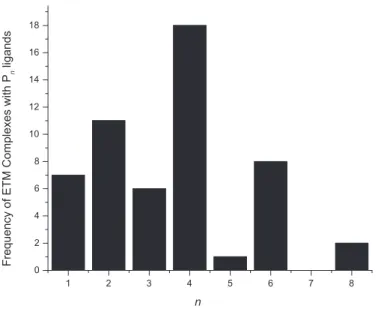
Careful study of the amassed library of information will now allow researchers to begin to pre-dict what type of phosphorus activation products might be obtained from a given reaction. Figure 11 shows the frequency of occurrence of a given Pn (n = 1 – 8) ligand derived from P4
activa-tion by an ETM complex versus n. Not surprisingly, formaactiva-tion of P4 ligands appears to be the
most common outcome of ETM white phosphorus activation. It can be seen from this plot that phosphorus ligands with even numbers of P-atoms occur more frequently than their odd numbered counterparts. This suggests that phosphorus degradation more often occurs in a symmetric fashion, leading to many isolated P2products. It is noteworthy, however, that nearly all of the P2complexes
are bimetallic species, while most of the P1 and P3 complexes are monometallic in nature. One
further observation is that Pnligands with n ≥ 5 occur far less frequently than ligands with n ≤ 4.
It is likely that these P4aggregation products are the result of kinetic trapping of highly reactive
P4 degradation products with themselves or with P4 and cannot really be rationally predicted or
anticipated. The relatively high frequency of P6 ligands represents an exception here and would
suggest that P2 trimerization or P2 trapping by P4 ligands is favorable. The data set here is
rea-sonably small so it remains difficult to be able to use such information in an explicitly predictive way, but it does shine light on general principles of P4 activation that are emerging and helps to
motivate researchers to continue to study P4 activation to help develop a greater understanding of
that process. 1 2 3 4 5 6 7 8 0 2 4 6 8 10 12 14 16 18
Frequency of ETM Complexes with P
n
ligands
n
Figure 11: Frequency of Pnligands formed from P4activation by ETM complexes as a function of
6.2
Future Prospects
Despite the resurgence of activity and growth in phosphorus activation and the chemistry promoted by it, there are still few processes capable of converting P4into organophosphorus molecules
di-rectly without going through PCl3as an intermediate, virtually no catalytic methods for the
func-tionalization of P4 have been documented, and consequently, no industrial scale processes for the
direct formation of P–C bonds are in use. Researchers in the field are beginning to develop methods of P–C bond formation from P4, but these initial investigations have only just begun to scratch the
surface of the potential goldmine of new methodologies left to be uncovered. Additionally, there has been little mechanistic work done to support the mass of synthetic research accomplished to date. Mechanistic investigations would greatly enhance our ability to predict the outcomes of and design new transformations in ETM P4activation chemistry. The significant recent advances in the
field of ETM P4 activation documented here show the breadth of chemistry that P4 can undergo
and the unrealized goals of phosphorus chemistry support the need for continued work in this area. It is hoped that this review will not only inspire future researchers to new chemical discoveries, but also drive others to employ molecular phosphorus as a synthon in their own research.
Acknowledgement
The authors thank NSF grant CHE-719157 for financial support of their research and Thermphos International for additional funding and support.
References
(1) Oelkers, E. H.; Valsami-Jones, E. Elements 2008, 4, 83–87. (2) Filippelli, G. M. Elements 2008, 4, 89–95.
(3) Emsley, J. The 13th Element: The Sordid Tale of Murder, Fire, and Phosphorus; John Wiley & Sons, Inc.: New York, 2000.
(4) Corbridge, D. Phosphorus: An Outline of its Chemistry, Biochemistry, and Technology, 5th ed.; Elsevier: New York, 1994.
(5) Engel, R. Synthesis of Carbon Phosphorus Bonds, 2nd ed.; CRC Press: Boca Raton, 2004. (6) Quin, L. D. A Guide to Organophosphorus Chemistry; Wiley: New York, 2000.
(7) Cummins, C. C. Prog. Inorg. Chem. 1998, 47, 685–847.
(8) Ehses, M.; Romerosa, A.; Peruzzini, M. In Metal-mediated degradation and reaggregation of white phosphorus; Springer: Berlin, 2002; Vol. 220, pp 107–140.
(9) Stephens, F. H.; Johnson, M. J. A.; Cummins, C. C.; Kryatova, O. P.; Kryatov, S. V.; Rybak-Akimova, E. V.; McDonough, J. E.; Hoff, C. D. J. Am. Chem. Soc. 2005, 127, 15191–15200. (10) Laplaza, C. E.; Davis, W. M.; Cummins, C. C. Angew. Chem., Int. Ed. Engl. 1995, 34, 2042–
2044.
(11) Zanetti, N. C.; Schrock, R. R.; Davis, W. M. Angew. Chem., Int. Ed. Engl. 1995, 34, 2044– 2046.
(12) Johnson, B. P.; Balázs, G.; Scheer, M. Coord. Chem. Rev. 2006, 250, 1178–1195.
(13) Johnson, B. P.; Balázs, G.; Scheer, M. In Complexes with a metal-phosphorus triple bond; Springer: Berlin, 2004; Vol. 232, pp 1–23.
(14) Johnson, M. J. A.; Mae Lee, P.; Odom, A. L.; Davis, W. M.; Cummins, C. C. Angew. Chem., Int. Ed. Engl.1997, 36, 87–91.
(15) Cherry, J. P. F.; Johnson, A. R.; Baraldo, L. M.; Tsai, Y. C.; Cummins, C. C.; Kryatov, S. V.; Rybak-Akimova, E. V.; Capps, K. B.; Hoff, C. D.; Haar, C. M.; Nolan, S. P. J. Am. Chem. Soc.2001, 123, 7271–7286.
(17) Kuiper, D. S.; Wolczanski, P. T.; Lobkovsky, E. B.; Cundari, T. R. J. Am. Chem. Soc. 2008, 130, 12931–12943.
(18) Wu, G.; Rovnyak, D.; Johnson, M. J. A.; Zanetti, N. C.; Musaev, D. G.; K., M.; Schrock, R. R.; Griffin, R. G.; Cummins, C. C. J. Am. Chem. Soc. 1996, 118, 10654–10655. (19) Pyykko, P.; Riedel, S.; Patzschke, M. Chem. Eur. J. 2005, 11, 3511–3520.
(20) Chisholm, M. H.; Huffman, J. C.; Pasterczyk, J. W. Inorg. Chim. Acta. 1987, 133, 17–18. (21) Chisholm, M. H.; Folting, K.; Pasterczyk, J. W. Inorg. Chem. 1988, 27, 3057–3058.
(22) Scherer, O. J.; Sitzmann, H.; Wolmershäuser, G. J. Organomet. Chem. 1984, 268, C9–C12. (23) Scherer, O. J.; Sitzmann, H.; Wolmershäuser, G. Angew. Chem., Int. Ed. Engl. 1985, 24,
351–353.
(24) Shi, Y.-C. J. Coord. Chem. 2004, 57, 393–400.
(25) Corbridge, D. E. C.; Lowe, E. J. Nature 1952, 4328, 629.
(26) Goh, L. Y.; Chu, C. K.; Wong, R. C. S.; Hambley, T. W. J. Chem. Soc., Dalton Trans. 1989, 1951–1956.
(27) Scherer, O. J.; Ehses, M.; Wolmershäuser, G. J. Organomet. Chem. 1997, 531, 217 – 221. (28) Scherer, O. J.; Ehses, M.; Wolmershäuser, G. Angew. Chem., Int. Ed. 1998, 37, 507–510. (29) Scherer, O. J.; Winter, R.; Wolmershäuser, G. Z. Anorg. Allg. Chem. 1993, 619, 827–835. (30) Green, J. C.; Green, M. L. H.; Morris, G. E. J. Chem. Soc., Chem. Commun. 1974, 212–213. (31) Cannillo, E.; Coda, A.; Prout, K.; Daran, J.-C. Acta Crystallogr., Sect. B: Struct. Crystallogr.
Cryst. Chem.1977, 33, 2608–2611.
(32) Etkin, N.; Benson, M. T.; Courtenay, S.; McGlinchey, M. J.; Bain, A. D.; Stephan, D. W. Organometallics1997, 16, 3504–3510.
(33) Figueroa, J. S.; Cummins, C. C. J. Am. Chem. Soc. 2003, 125, 4020–4021.
(34) Hulley, E. B.; Wolczanski, P. T.; Lobkovsky, E. B. Chem. Commun. 2009, 42, 6412–6414. (35) Di Vaira, M.; Ghilardi, C. A.; Midollini, S.; Sacconi, L. J. Am. Chem. Soc. 1978, 100, 2550–
2551.
(36) di Vaira, M.; Stoppioni, P.; Peruzzini, M. Polyhedron 1987, 6, 351 – 382. (37) Di Vaira, M.; Sacconi, L. Angew. Chem., Int. Ed. Engl. 1982, 21, 330–342. (38) Scherer, O. J. Acc. Chem. Res. 1999, 32, 751–762.
(39) Cossairt, B. M.; Diawara, M.-C.; Cummins, C. C. Science 2009, 323, 602.
(40) Phosphorus-31 NMR Spectroscopy in Spectrochemical Analysis; Verkade, J. G., Quin, L. D., Eds.; VCH Publishers, Inc.: Deerfield Beach, 1987; Vol. 8.
(41) Scherer, O. J.; Werner, B.; Heckmann, G.; Wolmershauser, G. Angew. Chem., Int. Ed. Engl. 1991, 30, 553–555.
(42) de los Rios, I.; Hamon, J. R.; Hamon, P.; Lapinte, C.; Toupet, L.; Romerosa, A.; Peruzzini, M. Angew. Chem., Int. Ed.2001, 40, 3910–3912.
(43) Yakhvarov, D.; Barbaro, P.; Gonsalvi, L.; Carpio, S. M.; Midollini, S.; Orlandini, A.; Pe-ruzzini, M.; Sinyashin, O.; Zanobini, F. Angew. Chem., Int. Ed. 2006, 45, 4182–4185.
(44) Ginsberg, A. P.; Lindsell, W. E. J. Am. Chem. Soc. 1971, 93, 2082–2084.
(45) Ginsberg, A. P.; Lindsell, W. E.; McCullough, K. J.; Sprinkle, C. R.; Welch, A. J. J. Am. Chem. Soc.1986, 108, 403–416.
(46) Dapporto, P.; Midollini, S.; Sacconi, L. Angew. Chem., Int. Ed. Engl. 1979, 18, 469. (47) Dapporto, P.; Sacconi, L.; Stoppioni, P.; Zanobini, F. Inorg. Chem. 1981, 20, 3834–3839.
(48) Wassermann, J.; Kubas, G. J.; Ryan, R. R. J. Am. Chem. Soc. 1986, 108, 2294–2301. (49) Gröer, T.; Baum, G.; Scheer, M. Organometallics 1998, 17, 5916–5919.
(50) Peruzzini, M.; Marvelli, L.; Romerosa, A.; Rossi, R.; Vizza, F.; Zanobini, F. Eur. J. Inorg. Chem.1999, 931–933.
(51) Scherer, O. J.; Swarowsky, M.; Swarowsky, H.; Wolmershäuser, G. Angew. Chem., Int. Ed. Engl.1988, 27, 694–695.
(52) Chirik, P. J.; Pool, J. A.; Lobkovsky, E. Angew. Chem., Int. Ed. 2002, 41, 3463–3465.
(53) Hey, E.; Lappert, M. F.; Atwood, J. L.; Bott, S. G. J. Chem. Soc. Chem. Commun. 1987, 597–598.
(54) Scherer, O. J.; Vondung, J.; Wolmershäuser, G. Angew. Chem., Int. Ed. Engl. 1989, 28, 1355– 1357.
(55) Herberhold, M.; Frohmader, G.; Milius, W. J. Organomet. Chem. 1996, 522, 185 – 196. (56) Barr, M. E.; Smith, S. K.; Spencer, B.; Dahl, L. F. Organometallics 1991, 10, 3983–3991. (57) Scheer, M.; Becker, U.; Magull, J. Polyhedron 1998, 17, 1983 – 1989.
(58) Seidel, W. W.; Summerscales, O. T.; Patrick, B. O.; Fryzuk, M. D. Angew. Chem., Int. Ed. 2009, 48, 115–117.
(59) Stephens, F. H. Ph.D. thesis, Massachusetts Institute of Technology, 2004.
(60) Urn˙ežius, E.; Brennessel, W. W.; Cramer, C. J.; Ellis, J. E.; Schleyer, P. v. R. Science 2002, 295, 832–834.
(61) Dillon, K.; Mathey, F.; Nixon, J. Phosphorus: The Carbon Copy: From Organophosphorus to Phospha-organic Chemistry, 1st ed.; Wiley: West Sussex, 1998.
(62) Scherer, O. J.; Schwalb, J.; Swarowsky, H.; Wolmershäuser, G.; Kaim, W.; Gross, R. Chem. Ber.1988, 121, 443–449.
(63) Herberhold, M.; Frohmader, G.; Milius, W. Phosphorus, Sulfur Silicon Relat. Elem. 1994, 93, 205–208.
(64) Reddy, A. C.; Jemmis, E. D.; Scherer, O. J.; Winter, R.; Heckmann, G.; Wolmershaeuser, G. Organometallics1992, 11, 3894–3900.
(65) Scherer, O. J.; Swarowsky, H.; Wolmershäuser, G.; Kaim, W.; Kohlmann, S. Angew. Chem., Int. Ed. Engl.1987, 26, 1153–1155.
(66) Cossairt, B. M.; Cummins, C. C. Angew. Chem., Int. Ed. 2008, 46, 169–172.
(67) Chan, W. T. K.; Garcia, F.; Hopkins, A. D.; Martin, L. C.; McPartlin, M.; Wright, D. S. Angew. Chem., Int. Ed.2007, 46, 3084–3086.
(68) Konchenko, S. N.; Pushkarevsky, N. A.; Gamer, M. T.; Koppe, R.; Schnockel, H.; Roesky, P. W. J. Am. Chem. Soc. 2009, 131, 5740–5741.
(69) van Tamelen, E. E.; Rudler, H. J. Am. Chem. Soc. 1970, 92, 5253–5254.
(70) Clough, C. R.; Greco, J. B.; Figueroa, J. S.; Diaconescu, P. L.; Davis, W. M.; Cummins, C. C. J. Am. Chem. Soc.2004, 126, 7742–7743.
(71) Figueroa, J. S.; Piro, N. A.; Clough, C. R.; Cummins, C. C. J. Am. Chem. Soc. 2006, 128, 940–950.
(72) Curley, J. J.; Sceats, E. L.; Cummins, C. C. J. Am. Chem. Soc. 2006, 128, 14036–14037. (73) Pool, J. A.; Lobkovsky, E.; Chirik, P. J. Nature 2004, 427, 527–530.
(74) Hanna, T. E.; Keresztes, I.; Lobkovsky, E.; Bernskoetter, W. H.; Chirik, P. J. Organometallics 2004, 23, 3448–3458.
(75) Peruzzini, M.; Gonsalvi, L.; Romerosa, A. Chem. Soc. Rev. 2005, 34, 1038–1047.
(76) Peruzzini, M.; Abdreimova, R. R.; Budnikova, Y.; Romerosa, A.; Scherer, O. J.; Sitzmann, H. J. Organomet. Chem.2004, 689, 4319–4331.
(77) Balázs, G.; Gregoriades, L. J.; Scheer, M. Organometallics 2007, 26, 3058–3075. (78) Piro, N. A.; Cummins, C. C. J. Am. Chem. Soc. 2008, 130, 9524–9535.
(79) Stephens, F. H.; Figueroa, J. S.; Diaconescu, P. L.; Cummins, C. C. J. Am. Chem. Soc. 2003, 125, 9264–9265.
(80) Betley, T. A.; Peters, J. C. J. Am. Chem. Soc. 2004, 126, 6252–6254.
(81) Man, W. L.; Tang, T. M.; Wong, T. W.; Lau, T. C.; Peng, S. M.; Wong, W. T. J. Am. Chem. Soc.2004, 126, 478–479.
(82) Ware, D. C.; Taube, H. Inorg. Chem. 1991, 30, 4605–4610.
(83) Johnson, M. J. A.; Odom, A. L.; Cummins, C. C. Chem. Commun. 1997, 1523–1524. (84) Piro, N. A.; Cummins, C. C. J. Am. Chem. Soc. 2009, 131, 8764–8765.
(85) Umbarkar, S.; Sekar, P.; Scheer, M. Dalton Trans. 2000, 1135–1137.
(86) Figueroa, J. S.; Cummins, C. C. J. Am. Chem. Soc. 2004, 126, 13916–13917. (87) Piro, N. A.; Cummins, C. C. Inorg. Chem. 2007, 46, 7387–7393.
(88) Piro, N. A.; Figueroa, J. S.; McKellar, J. T.; Cummins, C. C. Science 2006, 313, 1276–1279. (89) Figueroa, J. S.; Cummins, C. C. Angew. Chem., Int. Ed. 2004, 43, 984–988.
(90) Figueroa, J. S.; Cummins, C. C. Angew. Chem., Int. Ed. 2005, 44, 4592–4596.
(91) Capozzi, G.; Chiti, L.; Di Vaira, M.; Peruzzini, M.; Stoppioni, P. J. Chem. Soc., Chem. Com-mun.1986, 1799–1800.