1.
Economic Inclusivity through Networked SME Production: A Case Study in Kenya
by
Anna Waldman-Brown
S.B. Physics
S.B. Writing and Humanistic Studies Massachusetts Institute of Technology, 2011 Submitted to the Institute for Data, Systems, and Society in partial fulfillment of the requirements for the degree of
Master of Science in Technology and Policy
at theMassachusetts Institute of Technology
June 2018
© 2018 Massachusetts Institute of Technology. All rights reserved. Signature of author:
Anna Waldman-Brown Technology and Policy Program, Institute for Data, Systems, and Society May 16, 2018 Certified by:
Professor Fiona E. Murray William Porter Professor of Entrepreneurship Associate Dean of Innovation and Faculty Director, The Legatum Center Thesis Supervisor Certified by:
Georgina Campbell Flatter Executive Director, The Legatum Center Thesis Supervisor Accepted by:
W.A. Coolidge Professor Munther Dahleh Director, Institute for Data, Systems, and Society
2
Economic Inclusivity through Networked SME Production: A Case Study in Kenya
by
Anna Waldman-Brown
Submitted to the Institute for Data, Systems, and Society on May 16, 2018 in partial fulfillment of the requirements for the degree of Master of Science in Technology and Policy
Abstract
As global manufacturing systems shift towards flexible and small-batch production, product developers and policy-makers have an opportunity to encourage more inclusive industrialization strategies. It is hypothesized that networks of informal-sector producers can provide an effective and ethical model for production; yet, due to a lack of research into these possibilities, both product developers and policy-makers are unaware of the latent potential.
This thesis addresses the gap by analyzing a globally-competitive firm comprised of informal-sector producers, and making comparisons with other manufacturing models across both the developed and developing world. The author develops a categorization system for better understanding the costs and benefits of each model, and creates a framework to explain how new product developers evaluate key tradeoffs in making manufacturing decisions.
The author then explores the prospect of creating a “virtual factory” of distributed microfactories through a case study of the ethical jewelry producer Soko in Nairobi, Kenya. Soko coordinates brass, horn, and bone jewelry production across 2500 craft microfactories, and its wares are cost-competitive with mid-tier jewelry brands in major retail stores
worldwide. Soko’s overall effectiveness is analyzed through quantitative analysis of the company’s finances and impact reports, in-depth interviews with the company’s co-founder, and field research in Nairobi. The tradeoffs inherent in Soko’s production model are evaluated through the lens of the aforementioned decision-making framework. Key questions include, can artisanal microfactories compete with large-scale automation and industrialization? In what cases might smaller-scale production have an advantage over larger-scale models?
Under the right circumstances, the case of Soko proves that networked microfactory production can be both cost-competitive (especially when handmade qualities are accentuated) and ethical; Soko creates opportunities for advancement across its network of artisans, who maintain ownership over their means of production. It is concluded that systems such as Soko’s can provide a model for socially-inclusive production strategies that build upon informal
infrastructure. Even if Soko itself only impacts a small number of full-time artisans, a series of ethical, aggregating producers like Soko could collectively provide a larger-scale benefit.
3
Acknowledgements
I would first like to thank my advisors Georgina Campbell Flatter and Professor Fiona Murray for their endless support (and helpful life advice!) throughout my Master’s program. I’m especially grateful to my unofficial advisor Kipp Bradford for helping me understand the strange and exciting world of manufacturing, and to Soko co-founder Ella Peinovich for many hours of interviews– and for unprecedented access to the inner workings of Soko. Thank you to
Professor Suzanne Berger and Dr. Anjali Sastry for research discussions and guidance. I also appreciate our wonderful TPP administrators and faculty, particularly Dr. Frank Field, Barb DeLaBarre, and Ed Ballo, and Professors Ken Oye, Nick Ashford, and Noelle Selin.
Thank you to everyone who helped explore and narrow down our set of key production tradeoffs: Sorin Grama, Matt McCambridge, Harald Quintus-Bosz, Professor Stanley Gershwin, Angi Acocella, Ned Burnell, Paul Weaver, Luke Iseman, Charvi Shetty, Vrajesh Modi, and Grace Kane.
Thanks to everyone at Soko who shared your financial and impact reports, and answered our myriad questions during a particularly busy season: Finance Director Marylene Otieno, Social Responsibility Manager Judith Mwangangi, COO Kaye Matereke, and lead artisan Veronicah Rachiedo. Thank you to jewelry production experts Linus Drogs and John Croston for several incredibly helpful interviews, and to Sloan MBA students Kasmira Pawa and John Howard for support with our financial analysis and interviews. Thanks to all my classmates and Sloan students who read and discussed our Soko case study, coming up with all sorts of insights into Soko’s business and production model that I hadn’t considered.
I appreciate the incredible Legatum Center staff, who welcomed me in as one of their first RAs and supported all my research: Megan Mitchell, Reinaldo Normand, James Cooney, Ali Diallo, Julia Turnbull, Julie Park, Kavan O’Connor, and Anna Omura.
Thank you to everyone who generally helped me figure out my research, and provided intriguing academic paths to explore: Professor John Zysman, Dr. Hannah Stewart, Sherry Lassiter, Dr. Cindy Kohtala, Tomás Diez, Professor Peter Wells, Professor Peter Troxler, David Li, Sharon Ede, Professor Vladimir Bulovic, Professor Marty Culpepper, Professor Suomodip Sarkar, Madelynn Martiniere, Jake Read, Gary Wayne, Andreas Bastian, Donovan Guttieres, Alex van Grootel, Priyanka Chatterjee, Sherry Lassiter, Professor Neil Gershenfeld, Professor Joi Ito, Kate Mytty, and Danny Spitzberg. Also, thank you to my robust cohort of Facebook friends with excellent suggestions and arguments, and to everyone else I’ve forgotten to mention. It has been an honor to work with all of you! Finally, thank you to Mom, Dad, Albie, and the rest of my family for always supporting me.
4
Table of Contents
Chapter 1. Introduction……… 5
Motivation………. 5
Methodology……… 6
Chapter 2. Literature Review on Production Systems………. 7
Introduction………. 7
Typology……….. 8
Methodology and Conflicting Paradigms……….. 20
Chapter 3. Framework for Evaluating Production Tradeoffs and Effectiveness ………….. 23
Literature Review and Methodology ………..……….. 26
Production Tradeoffs………. 29
Chapter 4. Soko’s Virtual Factory……….. 46
Jewelry Industry Overview………. 46
Soko Case Study…….……… 52
Analyzing Soko’s Effectiveness………. 58
Application of Production Tradeoffs Framework………. 60
Chapter 5. Conclusions and Future Work………. 85
Summary of Frameworks ……… 85
Effective and Ethical Production? ………. 85
Role for Policy-Makers and Entrepreneurs……….. 86
Future Work………. 87
A New Model for Sustainable Development? ……… 87
5
Chapter 1. Introduction
While manufacturing jobs have historically been a stable route to social mobility, today’s under-educated workers may not be able to rely upon this strategy as technology and
globalization continue to advance. The global manufacturing value added as a percent of GDP has steadily decreased from 21.5% in 1995 to 16.6% in 2017 (World Bank 2017). The overall global percentage of employment in the industrial sector has remained relatively constant around 22% (World Bank 2017), though unethical working conditions such as forced labor, underpaid homeworkers, and dangerous factory conditions have posed a persistent challenge– especially as manufacturing profit margins have decreased. Low-skilled factory jobs are
increasingly being replaced by automation and part-time, contract jobs (the “precariat” or “gig economy”). Even middle-income countries such as China and India are no longer employing as many unskilled factory workers in the sorts of stable jobs that used to lead to class mobility.
Across sectors, 61% of the world’s employed population– two billion people worldwide– – make their living through the informal economy (ILO 2018). Informality is vaguely defined; characteristics include operating out of households rather than dedicated shops or facilities, a lack of connections to established businesses, a failure to go through official routes for legal registration, and a general avoidance of business taxes. Due to the lack of transparency among informal sector homeworkers and the prevalence of exploitative middlemen, homeworking is often treated as a problem in supply chains (Sommers 2018); firms strive to employ proper factories where they can visit and ensure ethical conditions, rather than hire networks of homeworkers who may be paid illegally low wages, work under dangerous conditions, or even be indentured laborers.
Still, the breadth and entrepreneurial creativity of the global informal sector present a major opportunity for inclusive production models. While larger enterprises tend to aggregate in urban centers, informal-sector jobs are prevalent in rural areas and could help to prevent unsustainable urban migration. Additionally, people who work from home– particularly women– can take care of their children, elderly relatives, and other household needs throughout the workday.
Even though the informal sector employs more than half the world’s workers, I have identified a lack of thoughtful research into its possibilities. Thus, my research addresses the following questions: How can manufacturers contract with existing cottage industries for large-scale production? Are informal-sector jobs ethical, and how do their working conditions compare to traditional manufacturing? What do ethical jobs even entail? Finally, what are the costs and benefits of creating an industrial-scale factory out of networked small producers? It is hypothesized that such networks (“Networked SME Production”) can indeed provide an
effective and socially-inclusive model for industrial production.
Motivation
The key motivation behind this work is the goal of sustainable development, defined by the United Nations as "meeting the needs of the present without compromising the ability of future generations to meet their own needs" (World Commission on Environment and
6 Development for the United Nations General Assembly 1987 quoted in Peinovich 2012).
Despite recent interest in the vaguely-defined fields of “social entrepreneurship” and “ethical production,” and a longstanding interest in the manufacturing sector more generally as a mechanism for social mobility (especially for women), there has been little modern research around the potential for harnessing the vast informal sector as a means of sustainable development. Current academic literature tends to focus on either high-tech facilities using high-tech networking capabilities (the German “Industrie 4.0”) or low-tech workshops without any modern networking capabilities (the roadside “informal sector” or “industrial slums” of emerging markets). As discussed in the next section, the growing body of literature around the “Maker Movement” tangentially addresses these questions, but rarely engages with questions of global competitiveness and overall scalability. This research attempts to address these gaps in current research, through an in-depth case study of the Nairobi- and SF-based jewelry company Soko’s informal sector-based production system. Through an analysis of Soko’s business model and manufacturing strategy, I endeavor to illustrate the strengths and challenges of Soko’s Networked SME Production using metrics defined by our tradeoff framework for production decisions.
My thesis begins with a literature review on contemporary manufacturing models; I evaluate production models across the developed and developing world, and propose a new framework for categorizing production distribution. Building upon managerial and sociological literature, with considerable help from my advisors and other mentors, I then explore the tradeoffs that play into manufacturers’ production decisions with a particular focus on ethical considerations around “good jobs.” In Chapter 3 I present a brief introduction to the complex world of modern jewelry manufacturing, before diving into a case study of the jewelry company Soko and a brief history of production decisions made by firm’s co-founders. I then examine how our manufacturing tradeoffs apply to Soko and explore the overall effectiveness of the firm, and finally draw conclusions on policy implications and overall lessons from Soko’s successes and challenges.
Methodology
This research employs a mixed methodology approach, combining quantitative data from Soko’s financial statements and impact reports with in-depth interviews and field research. My advisors and I developed a framework by which to evaluate manufacturing decisions and the ethical dimensions of production, through a literature review and extensive discussions with manufacturing experts. Guided by this manufacturing decisions framework, I spent around five hours over the course of 18 months interviewing Soko co-founder Ella Peinovich, through a mix of structured questions and conversation. These interviews were mostly qualitative, with a few numerical questions around numbers of artisans and financial success over time. My advisor Georgina Campbell Flatter and Megan Mitchell provided field-work to supplement this case study, visiting several Soko microfactories and holding discussions with a dozen artisans and Soko employees.
For my quantitative financial analysis, Soko staff Marylene Otieno, Judith Mwangangi, and Tirus Ndung’u granted me access to Soko’s 2017 profit and loss statements, the firm’s
7 quarterly impact reports from 2014-2016, and the year-end impact report from 2017 with results from several surveys of Soko’s artisanal network. I personally interviewed Mwangangi and Otieno for clarification on many of Soko’s numbers. I analyzed these statements with considerable support from Sloan MBA student researchers Kasmira Pawa and John Howard. For comparison Mass Production cases, I did online research into the modern jewelry industry and, thanks to John Howard, conducted quantitative interviews with Linus Drogs, founder and president of the jewelry company Au Enterprises, and John Croston, owner of Jewelers
Consulting Services with over 30 years of experience in production operations. These interviews focused on American and international jewelry production, and Drogs and Croston provided me with cost breakdowns of typical jewelry production methods.
For my final analysis, we had the opportunity to present our Soko case study across five MIT classes to undergraduates, MBA students, Sloan fellows, Legatum fellows, and D-Lab engineering students– thanks to Georgina Campbell Flatter, Sorin Grama, Professor Fiona Murray, and Dr. Anjali Sastry. We worked with students to explore and question Soko’s
business model, and to tease out insights around the broader effectiveness of Networked SME Production and its potential for sustainable development. This case study has also been
presented at Legatum event around the world.
Chapter 2. Literature Review on Production Systems
Introduction
Manufacturing has changed considerably over the course of human history– from the pre-industrial days of cottage industries and skilled artisanal production; to the division of labor typified by Adam Smith’s pin factory in the mid 18th century, in which unskilled workers
perform specialized, repetitive tasks along an assembly line; to factory mechanization
throughout the Industrial Revolution of 1760-1840; to the highly-standardized parts and tasks of Ford’s assembly line in 1920; to today’s predominant and highly varied model of “Post-Fordism” characterized by specialized, smaller-scale producers. Over the past few decades, there has been considerable enthusiasm across academia around new, less centralized manufacturing models characterized by Small and Medium Enterprises or SMEs: flexible specialization in Germany, Japan, and China (Piore and Sabel 1984); putting-out in Italian knitwear (Lazerson 1995); and digital fabrication and 3D printing worldwide (Gershenfeld 2008). Yet there has been little consensus on the vocabulary to describe these potential models, and even less agreement on the direction in which we are heading. Additionally, despite general shifts toward more flexible and less vertically-integrated production models, historical models such as craft production and Fordism have remained prevalent
internationally. This literature review attempts to categorize and compare various
manufacturing models, and to hopefully define some common vocabulary to facilitate future discussion.
8
Typology
Based on the literature review described below, I present five basic categories to describe the extreme bounds of manufacturing systems. My unit of analysis is the fully-assembled product described in the last column of Table 1 (a wax mold or complete necklace), rather than the production firms themselves; I define all my terms following the table below.
Table 1: Bounds of Production Systems
Scale of
production Batch Size Product Integration Production Distribution Example manufacturing for a necklace
Craft SME Local Small Varied Centralized Local artisan
(pg. 11)
Flexible
SME Varied Varied Varied Centralized Au Enterprises (pg. 13)
Specialized
SME Industrial Varied Components Centralized Wax mold-making company (pg. 14)
Networked Specialized or Flexible SMEs
Industrial Varied Components Distributed H&M’s 747 outsourced factories (pg. 15)
Networked
Craft SMEs Industrial Small Units Distributed or Decentralized Soko, Fabindia, subcontracted homeworkers (pg. 16)
Mass
Production Industrial Varied Units Centralized Fossil’s assembly factory (pg. 18)
Practically speaking, these categories are most useful as archetypes rather than pure
descriptors, since this typology of production presents more of a spectrum than a firm set of criteria. There is a long tail of manufacturers internationally (see Figure 1), and many fall somewhere between small-batch Small and Medium Enterprise (SME) Production and Mass Production. To demonstrate, here is a chart of the number of factories in the USA
(Manufacturing Census Data 2012) sorted by number of employees, a decent proxy for the overall size of a firm:
9
Figure 1: USA Factories by Employee Count (data from USA Manufacturing Census 2012)
Firms with fewer than 10 people on this chart are definitely craft producers, and firms with more than 500 people are certainly mass producers; those with employee counts in the middle could potentially go either way, which is why I will classify all factories with fewer than a few hundred employees as SMEs. I list four key types of SMEs, although many SMEs may fall into multiple categories:
• Craft SMEs: a subset of SME production, characterized by very few employees and a widely-variable “job shop” production workflow, which changes from one product to another. These typically employ low-tech equipment and significant manual labor, and may not be formally-registered businesses.
• Flexible SMEs: small and medium factories that likely follow a more organized production workflow, and can produce a variety of goods using modern, automated equipment such as digital fabrication.
• Specialized SMEs: small and medium factories that likely follow a more organized production workflow, and produce a narrow selection of specialty goods using modern equipment.
• Networked SMEs: a collection of SMEs that, in aggregate, can produce large volumes of goods. These SMEs can fall into any of the above categories, though I only include Networked Craft and Networked Flexible above.
Typology Criteria
I employ four sets of criteria to categorize manufacturing systems, as represented in the first row of Table 1:
• Scale of production: how many products are produced in total, across all the factories involved in production? This ranges from the “local” scale of producing just enough to
10 satisfy local demand, to the “industrial” scale of competing with other producers on a global level.
• Batch Size: how many components or units are produced in a single batch, in any one factory? Whether a production run counts as a “large” or “small” batch depends upon the industry; thousands of high-end wedding dresses might count as “large-batch” production in retail, whereas thousands of plastic necklaces are “small-batch” by mass-production jewelry standards.
• Product integration: are the majority of components involved in the final product manufactured and integrated all-at-once (unit-level), or are components mostly produced across a network of smaller firms and sent elsewhere for integration
(component-level)? A large factory that takes in beads, chains, and clasps as inputs from various suppliers and then sells necklaces as outputs follows a “component” integration model, whereas a network of hundreds of home-workers making their own beads and stringing together complete necklaces follows a “unit” model. Most products today involve some blend of these integration models.
• Production distribution: what distribution pattern best characterizes the flows of information and parts, and is there a hierarchy of production? Following Baran’s (1962) seminal paper on computing networks, I propose three basic models: centralized, decentralized, and distributed:
Figure 2: Distribution Models (Baran 1962)
o Centralized: This is the traditional Fordist model, in which all manufacturing takes place in a central location. It is rare, today, to see a completely centralized
production model. One could categorize the jewelry and watch producer Fossil as having a centralized factory for the bulk of its production and assembly, though many of Fossil’s components are produced in a decentralized manner through networks of Specialized SME contractors and sub-contractors. During the Industrial Revolution, giant and centralized textile mills performed all production stages from spinning cotton into threads to weaving threads into fabrics to cutting and sewing final garments; most of these stages now take place across smaller factories, although such vertically-integrated textile mills are still prevalent in India today (India Brand Equity Foundation 2018).
11 o Decentralized: This model employs more of a hierarchy than the Distributed model,
in which small factories manufacture some product for a larger firm or platform. Products may undergo additional assembly and/or processing in a centralized location. For example, a rural jewelry artisan might sell necklaces to a middleman, who takes them to a craft market in the city. Alternatively, a Networked SME Production might contract thousands of SMEs to manufacture jewelry to its own unique specifications. Flexible Specialization primarily follows this model, in which a company like H&M has separate microfactories producing jackets, glasses, shoes, or other items of apparel according to H&M’s requirements (H&M 2011). Some
microfactories work exclusively for one company, while others produce a panoply of parts for a wide variety of large firms (Piore and Sabel 1984).
o Distributed: This model allows the customer, who may be a consumer or another business, to purchase some product directly from the producer via a retail shop or web platform like Etsy. (While Etsy does act as a centralizing platform, Etsy artisans still sell and ship directly to consumers.) Most SME production follows either this model or the decentralized model. For example, local tailors across China make customized clothing for local customers on a just-in-time basis. There have been some attempts across the open-source hardware community to encourage fully-distributed Networked SME Production, with products designed to be fabricated locally and on-demand by local producers without any need for interaction with the original designers. Examples of distributed production at scale might include
purchasing sewing patterns to make clothes on one’s home sewing machine, or Ikea’s at-home furniture assembly model (although Ikea’s furniture parts are all mass-manufactured).
o Blended distribution: Often, a given product will utilize different distribution models for various steps. Zara’s clothing, for example, is designed at Zara headquarters in Spain and then manufactured in a decentralized network of factories over three continents. Some factories shipped fabrics back to Zara headquarters for assembly, while other fabrics are turned into clothing more locally and shipped directly to Zara stores worldwide (SCM Globe 2016). Using this typology, one could say that Zara employs a combination of Specialized SME Production and Mass Production in a distributed manner.
Types of Production
SME ProductionHumanity’s very first model for the production of goods was characterized by unit-level production in small batches across semi-specialized cottage industries, with these
microfactories generally located close to the point of final sale. The earliest fabrics date back to around 34,000 BC. Consider the thousands of independent wool spinners, weavers, cloth-dyers, and tailors who would combine forces to make clothes for their regions in pre-industrial times (before mechanical looms emerged in the 18th century). These microfactories produced small
12 batches of some complete unit, often using just-in-time production rather than stocking
inventory.
Most SMEs are owned by the head artisans or factory managers themselves, though some are part of a regional or even global franchise. (Examples to follow.) For many SMEs, it is typical for junior artisans (who are often relatives of the head artisans) to grow up to inherit the factory– or to start their own independent factory once they acquire the necessary skills and can secure financing to start their own business. It may be difficult for lower-tech SME producers to scale up into larger-scale production, as different tools and equipment may be required to process higher volumes.
Craft SME Production
Figure 3: Example of Craft SME Production – brass jewelry artisans using hand-tools in Nairobi (via Soko)
Internationally, the global craft sector– comprised almost exclusively of so-called “informal” enterprises– is the second largest source of jobs in emerging markets after agriculture (ILO 2016). I define “craft” enterprises as SMEs that retain traditional artisanal or handicraft methods of production, rather than employing automation or industrial-scale equipment. Craft SMEs tend to lack clear divisions of labor, and are run in a “job shop” style in which workers use whatever materials and equipment happen to be available– rather than the “flow shop” method of scheduling tasks and workflows in advance.
13
Figure 4: Definition of informal sector employment from ILO (2018)
Despite its predominance, few people actively choose to work in the informal sector– wages tend to be low, there are few influential unions or other workers’ organizations, and informal businesses are subject to exploitation, accidents, and unreliable supply chains. There are few mechanisms for legal protections or insuring one’s property. Due to the small scale of most informal firms and the general lack of literacy and education, informal workers have difficulty procuring loans and expanding their businesses– so most enterprises tend to focus only on local needs (ILO 2016). Such an environment leads to highly-variable profits and constant stress, and most informal workers must work several different jobs at the same time to make ends meet.
14 As a result, informal firms are only about 25% as productive as small formal firms overall (World Bank cited in Daniels 2010). Nonetheless, the informal sector provides many benefits such as flexible working hours, allowing women to look after their children during the workday, the provision of jobs outside of major urban areas, and very low capital expenses for building a workshop.
As mentioned, 61% of employed people globally work in the informal sector (ILO 2018). The Kenyan National Bureau of Statistics (2017) estimates that the informal sector accounted for 83% of Kenya’s employment in 2016, employing around 13.3 million people. Out of 832,900 new jobs created in Kenya in 2016, a full 747,300 of those jobs were created in the informal sector. That year, 2.7 million Kenyans worked in the informal manufacturing sector– including 0.5 million craftspeople (Kenya National Bureau of Statistics 2017). Across the entire African continent, 89.7% of employed women are in the informal sector as compared to 82.7% of men, though the ILO classifies women’s informal jobs as more “vulnerable” and lower-paid overall (ILO 2018).
Formal-sector examples of craft SME production include formalized artisanal shops (furniture, handicrafts, etc.) around the world, tailor-shops, and 3D print-shops. To avoid the hype surrounding on-demand digital fabrication shops and modern manufacturing
technologies, I will ignore the question of whether producers are using high-tech equipment and focus only on the factory organization question– in which the concept of local production using local 3D print-shops bears more similarities to ancient traditions of craftspeople in cottage workshops than to industrialized production. An extreme example of modern craft production is fully-distributed or personalized production, in which individuals make their own products at home or in neighborhood workshops; examples include personal 3D printers and sewing machines, and Ikea’s at-home furniture assembly.
Flexible SME Production
Figure 5: Jewelry production stages at Flexible SME Producer Au Enterprises: CAD modelling, preparing a set of 3D printed rings for casting, pouring wax into a mold, and taking a finished ring from the mold
Many craft producers have successfully scaled up into medium-sized manufacturers, with fabrication following more of an organized flow shop production model rather than a job shop. I refer to these semi-organized factories that use machine tools (rather than mostly manual labor) and standardized factory processes as Flexible SMEs. As evidenced from the diversity of tasks that take place at Au Enterprises (see Figure 5 above), flexible small factories tend to have a wide range of state-of-the-art tools and equipment, and they hire workers with
15 higher skill levels. While Craft SMEs tend to compete with other Craft SMEs due to a lack of rigorous quality standards and relatively high costs of production, Flexible SMEs often competitive with mass manufacturers on a local or industrial scale.
Specialized SME Production
Figure 6: Specialized factory in Guangdong producing wax molds for rings (photo by Eric Welch courtesy of Chow Tai Fook, Hsu et al. 2014)
Today’s predominant form of large-scale production is geographically distributed and “lean” or minimally vertically-integrated; instead of mass-manufacturing and assembling all components within one mega-factory, many large-scale manufacturers today purchase a majority of their specialized components from external SMEs, and then perform the assembly or integration either in-house or through SME contractors. Specialized SME Production provides the SMEs themselves with the advantage of being able to compete on choice and quality rather than just price, depending on the needs of their industrial contracts. Note that many modern companies use some hybrid of Networked Specialized SME Production and Mass Production, often for reasons of safeguarding sensitive IP, ensuring quality control, and/or the difficulty of sharing complex process knowledge.
The SMEs in this model tend to produce a small variety of highly specialized
components. Piore and Sabel (1984) call this model Flexible Specialization, whereas Fox and Alpetkin (2017) refer to it as Distributed Industrial. For machined parts such as electronics and automotive components, the SME producers are known as mittelstand in Germany and cellular
manufacturing firms in Japan. In Shenzhen, China, the shanzai microfactories that produce
small batches of electronics—including numerous knock-off smartphones and chips— are also more-or-less part of this trend. Contemporary fashion examples include H&M, which purchased both components of clothing and completed garments from 747 specialized, independent factories across Asia and Europe in 2011 (H&M 2011).
Distributed Manufacturing based on Desktop Manufacturing is a particular model of
16 components (ball bearings, camera shutters, etc.) and future nanotechnologies, involving
desktop-sized production units and digital fabrication technologies. They describe how this model could facilitate mass customization, decrease power and space requirements, and minimize the initial investment needed for production. WTEC (2005) details a similar model for nanoscale-fabrication.
Networked Flexible and Specialized SME Production
Figure 7: Diagram of hypothetical, multinational Networked SME Producer from Fraunhofer IWU (iMain 2013)
In networked production models, individual SMEs are somehow networked together to manufacture in bulk across the entire agglomeration of firms. My literature review identified several different models that can be classified as Networked SME Production outside of the craft sector: microfactory retailing (Wells and Nieuwenhuis 2004), moveable microfactories (Fox 2016), Fab Cities (Diez 2016), and smart microfactories. Flexible models involve more flexible small and medium manufacturing facilities, in which identical (or nearly-identical) entire units are produced across multiple factories, in a massively parallelized fashion; specialized models follow Piore and Sabel’s (1984) description of flexible specialization in which many smaller factories each make a single component, which are often integrated in a centralized location.
Examples of high-tech, Networked SME Production include franchised fast food chains such as McDonalds and the futuristic model described by Anderson (2012) that extends the notion of local copy-shops and print-shops into fully-fledged, neighborhood digital fabrication shops that can make a wide variety of physical products on-demand. This theoretical smart
microfactory concept allows for the manufacture of a wide variety of products across
networked, geographically-distributed microfactories through some match-making intermediary—which can be an online platform, a large firm, or merely word-of-mouth. Gershenfeld (2007) alludes to a world of Star Trek-style Replicators in the distant future. Anderson (2012) refers to this production model as “the factory in the cloud,” and the German government references this model in their discussions of Industrie 4.0. Berger (in Locke and Wellhausen 2014) describes a potential Smart Microfactory model as a “massively distributed, massively parallel” network of independent, contractor manufacturers. A large firm in this futuristic model “taps into a national network portal and places a computer-aided design (CAD) description of the part it desires, and the numbers it needs, on [a digital] portal… Meanwhile,
17 software systems from small manufacturers around the country prowl the portal looking for parts to bid on.” The Smart Microfactory model primarily has been imagined to use formal-sector firms employing advanced digital machinery. It provides both large firms and contracted SMEs with the advantage of agility and low startup costs, since large firms can test out new designs through their contractors without incurring significant startup costs—and anyone who is skilled in production can theoretically start their own cottage microfactory and start
accepting contracts. Another advantage is the fact that SMEs can operate locally from rural areas. The disadvantage, obviously, is the lack of economies of scale. Several startups are attempting to provide digital platforms to facilitate this type of redistributed production, including Fictiv, 3DHubs, and Shapeways which all connect people with local 3D printers or CNC machines to make one-off parts.
Putting out differs from the Smart Microfactory concept in its strong focus on asset-financing and support for SMEs, as well as its use of more rudimentary technologies such as manual tools and person-to-person networking rather than a focus on interconnected digital fabrication machines.
Networked Craft SMEs
Figure 8: Soko's coordinated network of diverse, on-demand SMEs
Putting out is a popular term for Networked SME Production in the garment industry
and informal industrial sector; this has been particularly well-researched among high-end Italian knitwear producers (Lazerson 1995). Under this model, a large manufacturer delegates work to numerous, often geographically-distributed craft workshops– which I will refer to as “microfactories” throughout this thesis. Although most decentralized production along these lines disappeared with the advent of the industrial revolution, select industries and regions have found putting out to be competitive with traditional mass-production. Lazerson (1995) describes the Italian knitwear industry as one case in which Networked SME Production actually provided higher profits for firms than traditional mass-manufacturing— and cites an OECD report (1983) that reaches the same conclusion. Many putting out knitwear firms closed down in the 2000s after the rise of fast fashion and highly-automated apparel factories, but the model still survives in parts of Italy and Eastern Europe today. By providing centralized asset-financing, quality control, and market awareness to disconnected craft producers who act as contractors, this model can theoretically solve the perpetual collective-action problem faced by microfactories who have little incentive or ability to formalize their businesses.
While putting out firms tend to be legally registered and SME owners often have some formal training, the term homeworking is often used in the supply chain literature to refer to
18 contracts made with informal sector firms. Homeworking is regularly used by the fashion
industry in emerging markets– including Soko in Kenya, the subject of the next section’s case study, and the $172M Networked SME Producer Fabindia. Founded in 1960, the fashion brand Fabindia started as a platform for bringing crafts made by the SMEs of rural India to
international markets. The company shifted towards the Indian market by opening a retail store in New Delhi in 1975, and eventually began hiring their own designers and contracting out to industrial factories for mass-production. Fabindia today leverages a network of over 55,000 craft producers across India for handloom fabric production, fabric printing and dying, and some sewing and other handiwork (Fabindia 2018). While some of Fabindia’s craft producers run their own small and medium factories, many artisans work out of their homes.
The Intermediate Technology movement (more commonly called Appropriate Technology today) was first proposed by Schumacher (1973), who built upon Mahatma Gandhi’s ideas to advocate for “human-centered” rather than purely profit-driven production and enterprise. This model considers low-tech, labor-intensive SMEs as local supplements to and/or replacements for global mass production. Intermediate technologies might include agricultural processing, artisanal production, repair, healthcare and other low-tech but critical forms of local production for local consumption. Schumacher (1973) proposed this concept to bridge the gap between high-tech modern and low-tech craft workplaces, and suggested building up thousands of cottage industries across rural regions of the world instead of focusing purely on urban mass production:
If we define the level of technology in terms of "equipment cost per workplace," we can call the indigenous technology of a typical developing country—symbolically speaking—a £1-technology, while that of the developed countries could be called a £1000-technology... If effective help is to be brought to those who need it most, a technology is required which would range in some intermediate position between the £1-technology and the £1000-technology (Schumacher 1973).
This model lacks the potential for industrial scale provided by Mass Production or even Networked SME Production. To achieve a larger scale, many Intermediate Technology practitioners hoped to create regional or even international knowledge-sharing of fully
decentralized Networked Craft SMEs– but Schumacher (1973) focused more on local production rather than exportation or competing internationally. The scale of this vision was never
achieved, especially as most developing countries abandoned their protectionist policies in the 1980s-90s in favor of cheap imports (Powell 1995). Since this model provided technological improvements that allowed rural areas to retain traditional modes of production rather than competing with the rest of the global economy, it could theoretically provide a sustainable model by limiting growth and increasing jobs. The question was, however, could these simple technologies provide the same quality of life as more traditional models of industrialization?
19 Mass Production
Figure 9: Assembly-line workers in a mass production jewelry factory in Hong Kong (from Hong Kong Galaxy Jewelry)
The standard vocabulary in manufacturing literature refers to the original mass-production manufacturing model as Fordism: a vertically-integrated mega-factory that processes raw materials, manufactures components, and assembles final products all under one roof (Janoski and Lepadatu 2014). Supply chain literature refers to a factory like the original Ford plant as both a Tier 1 and Tier 2 factory: after the mining/extraction and basic processing of Tier 3, a Fordist factory then processes raw materials and turns these into components (Tier 2) which are assembled into products (Tier 1). As long as a factory can achieve a continuous flow state of production, and can produce entire units to complete on a global scale, that factory can typically be classified as a Mass Producer.
Confusingly, mass production is increasingly employed for small batches of customized products, in addition to traditional large-batch production. A common oversight in the hype around mass customization, as enabled by 3D printing and other digital fabrication
technologies, is the techno-deterministic assumption that just because a technology can lead to more distributed production models, it will naturally produce such models. The digital
revolution provides a good counter-example: although major software companies could theoretically allow all their employees to work from home or from localized offices, in practice such companies have followed traditional practices of agglomerating their workforce regardless of the technological potential for distribution. Indeed, companies may find it more profitable and/or easier to continue their traditional high-volume manufacturing models than to shift to a more distributed SME paradigm. Consider the case of GE’s new mega-factory in Maharashtra, India: an agile factory employing modern digital fabrication technologies, allowing the company to rapidly produce small batches of customized products. Although the tools themselves would be equally productive if spread across a network of microfactories, GE has decades of expertise
20 and sunk-costs in high-volume production and complex supply chains; they had no particular incentive to decentralize their manufacturing and pursue an SME-based production model (Chatsko 2015).
Methodology and Conflicting Paradigms
Given the recent enthusiasm around distributed production, also referred to variously as redistributed, design global manufacture local, or distributed microproduction, my
typology emerged from an attempt to bridge discussions among those academics who focus primarily on ethics and sustainability, and those in the management sphere who are mostly concerned with scalability and competitiveness.
I did not conduct an exhaustive literature review. I identified 24 relevant papers
through the search terms “distributed” and “redistributed” manufacturing/production, and also selected a number of papers on “microfactories,” “SMEs,” and the “informal sector.” Many of the papers reviewed here were actually recommended by the authors directly, or cited in other papers (particularly Kohtala’s (2013) extensive distributed manufacturing literature review). I posit that some of the current confusion around classifying distributed production systems derives from the fact that researchers tend to approach the topic from two different paradigms, each with their own set of values, units of analysis, and basic vocabulary.
The first paradigm is purely capitalistic; it focuses on the firms in question and their potential for maximizing profits, rather than the nebulous potential for “democratization,” sustainable development, or other societal benefits. This approach tends to ignore social questions of equality and fairness in favor of firm competitiveness and technological considerations. The concept of consumer participation is irrelevant, so Apple’s network of specialized, contracted microfactories would be considered just as “distributed” as the hypothetical Fab City filled with locally-produced goods for local consumption.
The other paradigm I identified is essentially sociological, although some engineers and designers have also subscribed to its worldview. Academics in this mindset approach the topic from the perspective of society, focusing on the relative inclusivity of particular methods of manufacturing: who has access to and ownership over the means of design and production, both within and outside of the workplace? What degree of participation characterizes the relationship of a consumer– “customer, user, pro-sumer, or ‘maker’” in the words of Kohtala (2013)— to the final product?
The sociologist’s use of the term “distributed” does not refer to geographical
distribution (whereas the managerial paradigm uses this phrase primarily to describe factory location). The sociologist’s use of the term comes from a paper by Johansson et al (2004) on “distributed economies,” defined as the pursuit of competitive, experimental regional
development strategies combined with “a renewed balance between large- and small-scale and between resource flows that take place within and across regional boundaries.” Another key aspect of this worldview involves the so-called Maker Movement, or what Fox (2014) terms “Third Wave Do-It-Yourself”: a novel, high-tech production paradigm combining the “read-write functionality of Web 2.0 with computer-aided (CAD) design and additive manufacturing.”
21 This sociology paradigm tends to leave out the question of scalability and overall
competitiveness with mass-market production, electing to focus on “economies of scope, not of scale” (Commons Transition Primer 2017). This body of literature often references open-source organizations that pursue localized production, such as Local Motors, Wikifactory, OpenDesk, and the Global Village Construction Kit. Despite purportedly revolutionary invention and production systems, not one of these companies has built more than a few dozen final products. Instead, they emphasize user creation and customization as well as open-source licensing– focusing on economies of scope rather than scale.
The phrase Distributed Manufacturing (Bianchini and Maffei 2013; Johansson et al 2005; Kohtala 2014; Armes et al. 2015; Fox and Alptekin 2017) is tied to the distribution of socioeconomic benefits and distributed ownership models, rather than solely related to geographical distribution. Srai et al. (2016) define the main factors for Distributed
Manufacturing as “digitalization, personalization, localization, new enabling technologies and enhanced user and producer participation.” The main advantage of this model is argued to be the potential for social and environmental sustainability on a regional scale. The co-location of production with research and development could theoretically increase consumers’ creative engagement (thus decreased unnecessary consumption), as well as minimize supply chain risk. An RCA report (2015) defines Re-distributed Manufacturing in a similar vein: “technology, systems and strategies that change the economics and organizations of manufacturing, particularly with regard to location and scale.” I could not find a clear distinction between “Distributed” and “Re-distributed” manufacturing, although the “Distributed” literature seems to have a central focus on democratization and inclusivity, whereas these issues are implied rather than explicitly discussed throughout the “Re-distributed” literature. Many different types of small and medium-scale production– what the managerial paradigm refers to loosely as
Post-Fordism– could be classified under this category.
To confuse matters, some academics within the sociological paradigm use the term “manufacturing” to refer to anything from single-unit prototyping to craft production up to traditional mass production, sometimes encompassing the design phase. In this research, I use the term “manufacturing” only to refer to the physical manufacture of physical goods; design and prototyping are treated as separate phases of production.
Janoski and Lepadatu (2014) follow in the Marxist tradition of analyzing production based on the “divisions of labor” within firms. Since these labor questions are mostly independent of production distribution models (although they can be closely related), I will save the question of labor divisions and workplace wellbeing for the discussion of ethics in the next chapter.
22 Fox and Alptekin (2017) lay out an informative distribution chart under the sociological paradigm:
Figure 10: Distributions of Manufacturing Chart from Fox and Alpetkin (2017)
In this chart, the authors provide three varying degrees of the consumer-as-producer concept described above as Do-It-Yourself (DIY):
- 1st Wave DIY: people making simple goods for personal consumption using rudimentary tools
- 2nd Wave DIY: people purchasing factory-made kits for home assembly and occasional modification
- 3rd Wave DIY: people making advanced goods for personal consumption or for sales, using high-tech tools and digital connectivity
To evaluate the emerging model of industrial-scale artisanal production (which may or may not count as DIY, and may or may not lead to “distributed” socioeconomic benefits), I combined most of these “distributed” or “post-Fordist” models into SME Production. I then separated the notion of “industrial vs artisanal” scale into two distinct variables: “batch size” and “overall scale.” This allows for the investigation of the scalability and profitability demands of the managerial paradigm, while considering some of the ethical and sustainability concerns of the sociological paradigm. In my categorization, all forms of Craft Production and some forms of Specialized SME Production could be considered “re-distributed” or “distributed” production.
My classification deliberately left out the degree to which consumers are directly involved in the design and production process; both ownership over product design and the ability to capture an equitable fraction of production revenue seem to be mostly independent of the manufacturing model in question. The distributed garment manufacturer Fabindia, for example, sometimes adopts ideas from village artisans around fabric printing or other design elements, but the style of the final garment itself is determined by Fabindia’s professional designer team (Fabindia 2018). Specialized SME Production demonstrates a similarly nuanced relationship between the small factories producing components– who may have specific ideas
23 about the best designs for components like buttons or jewelry clasps– and the large fashion brands that source from these contracted producers.
To take another example, exploited garment homeworkers may own their sewing machines, but they are still illegally underpaid; their production model is geographically but not socioeconomically distributed.
Chapter 3. Framework for Evaluating Production
Tradeoffs and Effectiveness
How do new product developers make their manufacturing decisions, including both entrepreneurs and established companies with a new production line? Here, I use the term “producer” or “product developer” to refer to a company or individual that is responsible for the overall supply chain and production of some product or component, whether or not this entity performs any of the manufacturing steps. I use the term “manufacturer” to refer only to entities engaged in the physical manufacture of goods.
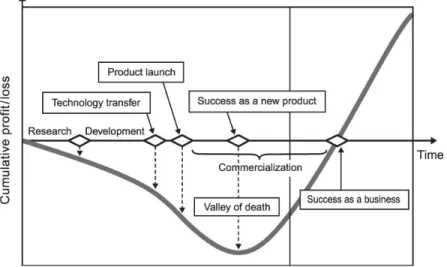
In order to support more equitable and socioeconomically distributed production systems, and to evaluate the different manufacturing models described previously, we must first develop a basic understanding of the rationale that goes into production choices. These early decisions often mean the difference between success and failure of a new product; a disproportionate number of hardware startups fail at the very point when they are about to properly start production. This drop-off between very small-batch production and
commercialization—when startups generally take on their most significant financial risks—is often dubbed the “valley of death”:
Figure 11: Valley of Death Chart from Osawa and Miyazaki (2011)
To both mitigate this risk and to support ethical decision-making, it is important to think clearly and critically about the underlying values within a firm that drive production choices. The key question here is how a firm evaluates whether a particular product or component is effective– in other words, what are the firm’s criteria for success? Different firms may value different tradeoffs more than others, and some firms may have situations in which certain
24 tradeoffs act as complements to reinforce one another. After performing a literature review, writing several production case studies, and conducting informal interviews with a variety of experienced manufacturers and product designers, I worked with a number of mentors (product developers, supply chain experts, and engineers from biomedical, electrical,
mechanical, aerospace, pharmaceutical, food production, and industrial sectors) to identify a set of six value tradeoffs that factor into how firms make production decisions:
Table 2: Production Tradeoffs Within Firms
In a business setting, the factors referred to in Table 2 can all be reduced to monetary values and compared through a cost-benefit analysis. The problem with this approach is that it washes over the nuances involved in making choices, and particularly obscures the last
question of ethics/sustainability. Ashford and Caldart (2008) highlight the difficulty of relying purely upon cost-benefit analyses to make policy decisions, and explain how the process of quantifying benefits and costs can become highly subjective and politicized. Thus, I consider all these factors separately in order to explore both the correlations amongst tradeoffs, and the effects that these factors have upon eventual production outcomes.
These value tradeoffs are distinct from (but closely enmeshed with) the exogenous factors that determine decision-making, such as the following:
• Consumer preferences • Product design requirements
• Technical constraints (manufacturing, distribution, etc.) • Sociopolitical environment
• Legal requirements • Competitive landscape
In Figure 12, we distinguish eight different stages of production that the production
Costs
OpEx: opportunity/time,
inventory, resources, labor
CapEx: construction, training, automation Level of Service Throughput, time to market, responsiveness, agility Competitive Advantage IP protections, location, product differentiation, vertical integration Scalability
Ability to profitably scale up production Quality Product, process, certifications, reliability, longevity Ethics
Social: Worker wellbeing,
societal wellbeing
Ecological: environmental
impact, resource depletion, materials reuse, disposal
25 tradeoffs in Table 2 and the exogenous factors might influence, although these production stages often blend into one another and rarely happen perfectly in sequence. A more vertically-integrated production system exercises tighter control over all aspects of production, whereas a decentralized system may involve multiple parties with different responsibilities.
Figure 12: Loose depiction of production stages
1. Design: from the initial conception of the product to the concrete plans for manufacture 2. Sourcing: obtaining the raw materials for production
3. Materials preparation: preparing the materials for production
4. Manufacturing: the physical manufacturing of all relevant components
5. Assembly and finishing: the stage in which different components are put together into the final product, and final finishing steps (polishing, grinding down seams, etc.) occur 6. Quality control: an inspection process at the end of manufacturing and at multiple
stages along the way, to ensure that the materials, components, and/or final product meet all relevant quality standards
7. Packaging: preparing the final product for shipping
8. Distribution: shipping the project out to the purchaser and/or end user
We also consider the set of eventual decisions that producers must make, keeping in mind the set of production tradeoffs. These decisions include:
• Components
o Can components be purchased off-the-shelf, or must they be newly manufactured?
o Are components different and/or customizable, or all homogenous? • Level of vertical integration (by component):
o Is production in-house or outsourced? o How many facilities are required? o Where are the suppliers or factories? o Who designs the product?
o Who sources materials?
o Who performs quality control? At what stage? • Batch size
26 o How much is produced now?
o How will this change over time? • Assembly and finishing
o Where and how does the final product get assembled? o How are relevant quality standards met?
Literature Review and Methodology
I started with a literature review, mostly of the management literature around manufacturing production choices. In the 1920s, German geographer and economist Alfred Weber was among the first to propose a mathematical “Theory of Location of Industries,” based on minimizing labor costs and transportation costs, including the regional price of material and the cost of reaching consumers. His key decision-making factors were “locational weight”, the labor coefficient, and the “form coefficient” (of the final product). These can all be geometrically optimized through pre-digital technologies such as the Varignon frame in Figure 13 to find the lowest-cost point at the intersection of various factors:
Figure 13: Geometric tool for optimizing location from Weber (1920)
For example, the left quadrilateral in Figure 14 shows how a firm that uses materials from deposits M1, M2, and M3 and sells its product at C would optimize its location in order to minimize costs: it could either split its production across P1 and P2, or produce at P. The triangle in Figure 14 expands this to a generalized solution involving even more material deposits:
27
Figure 14: Diagrams for determining factory location from Weber (1920)
While Weber’s theories were very influential throughout the early 20th century, these factors diminished in importance as large-scale shipping became cheaper, and the benefits of innovation clusters began to take precedence over transportation costs, such as electronics in Shenzhen or silicon wafers and later computer programming in California’s Silicon Valley. Recent surveys of manufacturers (Manyika et al. 2012, Sirkin et al. 2012) indicate that the minimization of cost is no longer the key component determining their localization decisions.
Beckman and Rosenfield (2007) provide industry decision-makers and consultants with detailed steps for how to manufacture new products, implicitly defining an effective business as one that can scale up its operations and dominate the market. The authors identify the number of facilities, the location of these facilities, and the “Make-Buy” tradeoff as key decisions to be made. At the heart of the location decision, according to Beckman and Rosenfield, is a trade-off between improved market access to customers, the amenability of local policies and customs, the ability to get rapid feedback in the case of production shifts, and access to local capabilities (labor, technologies, and suppliers). They argue that access to markets and capabilities is far more important than cost minimization in today’s market; otherwise, a producer may simply have a transitory advantage until the local region develops and/or local policies change.
Beckman and Rosenfield (2007) also detail a list of production tradeoffs, including the following:
• Batch size vs. diversity of products: depends upon the market
• In-house vs outsourced production: depends upon the relevant cost curves, and at what point the operating expenses can make up for the high capital expenditures of building a new factory
• Dimensions of “facility focus”
o Process-focused to satisfy the needs of a particular supply chain segment o Product-focused to satisfy the needs of a certain component or product o Market-focused to satisfy a particular local customer base
o Service-focused to satisfy the need for repair, customization, or other services o Unfocused/flexible facilities that attempt to meet a variety of the above foci I conducted dozens of personal interviews with entrepreneurs and established
producers, in which a majority of people identified “trustworthiness” as the single most important aspect in choosing their supplier or deciding where to build one’s own factory– although “trust” is of course difficult to quantify or evaluate. When possible, most producers
28 preferred to rely upon their existing networks and contacts rather than gamble on new
suppliers. Manufacturing decision-making seems to be an ongoing process of managing tradeoffs, rather than choosing one correct answer. A firm might even value certain tradeoffs differently from one component to another within the same product, resulting in a complex array of decision-making factors.
While product developers in established industries have complex mechanisms for calculating optimal supply chains and making make-buy decisions, entrepreneurs often lack the sector-specific expertise and personal connections to properly evaluate their decisions– and they frequently do not have the time to do proper research. Thus, entrepreneurs may end up going with the most convenient option, or following the advice of more experienced mentors in the field. Sorin Grama acknowledged that many of his important manufacturing decisions came down to a haphazard judgment made on incomplete information; his company Promethean initially tried to go with suppliers they knew and trusted but, failing that, they were forced to contract with any company they could find that seemed capable of doing the job. Kipp Bradford notes the wide range of Kickstarter product blogs that discuss manufacturing failures as though these entrepreneurs were all discovering the production process for the first time, even though many common mistakes would be entirely preventable if these product developers knew more about manufacturing from the outset.
In the venture capital-driven environment of Silicon Valley, startup incubators prioritize rapid scaling, and encourage hardware entrepreneurs to focus on their companies’ core
competencies (which do not usually include manufacturing expertise). Luke Iseman says the incubator Y-Combinator “treats hardware like software,” emphasizing that entrepreneurs should outsource both basic software development and most manufacturing to outside firms that specialize in these skills. This allows entrepreneurs to then spend their limited time capitalizing on their current expertise.
To narrow down all these considerations into a series of tradeoffs, I first discussed a basic set of tradeoffs with my advisors Fiona Murray and Georgina Campbell Flatter. Through extensive whiteboard brainstorming sessions with Kipp Bradford and Sorin Grama, we
developed a basic set of optimizable criteria. I also worked with Harald Quintus-Bosz and Angi Acocella to first figure out what to evaluate, and then to narrow our manufacturing decisions framework down to a final set of tradeoffs. Here is one of my whiteboard brainstorms with McCambridge and Bradford:
29
Figure 15: Brainstorming manufacturing decisions
We iterated upon this framework through discussions with a number of colleagues in the manufacturing space, and I drew upon modern conceptions of quality control, responsiveness, and speed from Professor Stanley Gershwin’s class 2.854 Introduction to Manufacturing Systems.
Production Tradeoffs
Costs
Overall cost is the most important criteria for an effective product run; most companies must be profitable if they want to survive. Nonetheless, minimizing costs is not always the most critical issue for a given component; high-end goods might prioritize quality, and some
consumers might happily pay a premium for ethical production. It is very important to consider time variance in this category, as some companies might have to minimize capital expenses whereas others might minimize operating expenses. For any given production run, there is likely a point at which the up-front costs of building a factory or installing robots will be more profitable overall than the continued overhead of outsourcing production, paying workers, or other high operating expenses.
Naturally, SMEs have lower capital costs and higher operating costs, while Mass
Production firms tend to have higher capital costs and lower operating costs due to economies of scale– although these calculations may only hold for large batches of product, as traditional Mass Production factories often have to pay higher costs to retool their equipment and change product lines. This comes down to the marginal cost of production.
30 Capital Costs
What does it cost to set up initial production? This may include purchasing land,
equipping the factory, building infrastructure, making molds, training workers for the first time, building automated systems, or other up-front costs. Are there significant opportunity costs– i.e., would time and money be better spent elsewhere? Depending on the sector, the long-term discount rate of capital might play a role in favoring higher operating expenses over spending more money up-front. On the other hand, a company that recently received a large influx of capital may favor holding onto physical assets such as a land and/or factory equipment. Operating Costs
What are the ongoing costs of day-to-day operations? These include labor, materials, rent, electricity, supplies, inventory costs, taxes, fines, the overhead involved in outsourcing production, and other continuing costs. The calculation of operating costs and the need to have relevant expertise is often a driving force in the make-buy decision of whether to contract with existing suppliers or to set up one’s own factory.
Scalability
What is the potential for an enterprise to scale up the production of a given product, and to break into new markets? This category is only vaguely defined, since “scalability” might depend not only on costs (both short and long-term) but also on the mission of the company itself and the willingness of the firm’s founders to grow at a given time. Perhaps a firm knows that scaling up a certain product would turn a profit, but it also poses a grave enough risk that the firm would rather focus its limited resources elsewhere.
Aulet and Murray (2013) use scalability as a core criteria in distinguishing between Innovation-Driven Enterprises (IDEs) and traditional SMEs. IDEs must constantly innovate in order to remain globally competitive, through continual process and product improvement; since SMEs need only compete with other local businesses in order to remain in business, they tend to remain local rather than scaling up and breaking into new markets. A local tailor is an SME, whereas a major fashion brand like Zara or H&M is an IDE. The benefit of Networked or Specialized SME Production over simple SME Production is the fact that an effective network can potentially grant individual SMEs an ability to scale through aggregation and connections to other firms– allowing these SME networks to collectively act as IDEs.
Products designed for scale often need to consider scalability from the initial design phases. Key scalability questions include:
• Are our suppliers and/or factories capable of increasing production using current techniques? If not, can we find new suppliers/factories or shift to new manufacturing techniques? Injection-molded parts, for example, are much easier to scale up than 3D printed or hand-crafted parts.
• Does scaling up production make sense from a cost-benefit standpoint? From a business strategy standpoint?