HAL Id: hal-00295997
https://hal.archives-ouvertes.fr/hal-00295997
Submitted on 4 Aug 2006
HAL is a multi-disciplinary open access
archive for the deposit and dissemination of
sci-entific research documents, whether they are
pub-lished or not. The documents may come from
teaching and research institutions in France or
abroad, or from public or private research centers.
L’archive ouverte pluridisciplinaire HAL, est
destinée au dépôt et à la diffusion de documents
scientifiques de niveau recherche, publiés ou non,
émanant des établissements d’enseignement et de
recherche français ou étrangers, des laboratoires
publics ou privés.
implications for cirrus cloud formation
M. R. Beaver, M. J. Elrod, R. M. Garland, M. A. Tolbert
To cite this version:
M. R. Beaver, M. J. Elrod, R. M. Garland, M. A. Tolbert. Ice nucleation in sulfuric acid/organic
aerosols: implications for cirrus cloud formation. Atmospheric Chemistry and Physics, European
Geosciences Union, 2006, 6 (11), pp.3231-3242. �hal-00295997�
www.atmos-chem-phys.net/6/3231/2006/ © Author(s) 2006. This work is licensed under a Creative Commons License.
Chemistry
and Physics
Ice nucleation in sulfuric acid/organic aerosols: implications for
cirrus cloud formation
M. R. Beaver1, M. J. Elrod2, R. M. Garland1, and M. A. Tolbert1
1Department of Chemistry and Biochemistry and CIRES, University of Colorado, Boulder, Colorado, 80309, USA 2Department of Chemistry and Biochemistry, Oberlin College, Oberlin, Ohio, 44074, USA
Received: 18 January 2006 – Published in Atmos. Chem. Phys. Discuss.: 28 March 2006 Revised: 21 June 2006 – Accepted: 1 August 2006 – Published: 4 August 2006
Abstract. Using an aerosol flow tube apparatus, we have
studied the effects of aliphatic aldehydes (C3to C10)and ke-tones (C3and C9)on ice nucleation in sulfuric acid aerosols. Mixed aerosols were prepared by combining an organic va-por flow with a flow of sulfuric acid aerosols over a small mixing time (∼60 s) at room temperature. No acid-catalyzed reactions were observed under these conditions, and physical uptake was responsible for the organic content of the sulfuric acid aerosols. In these experiments, aerosol organic content, determined by a Mie scattering analysis, was found to vary with the partial pressure of organic, the flow tube tempera-ture, and the identity of the organic compound. The physical properties of the organic compounds (primarily the solubil-ity and melting point) were found to play a dominant role in determining the inferred mode of nucleation (homogenous or heterogeneous) and the specific freezing temperatures ob-served. Overall, very soluble, low-melting organics, such as acetone and propanal, caused a decrease in aerosol ice nu-cleation temperatures when compared with aqueous sulfuric acid aerosol. In contrast, sulfuric acid particles exposed to organic compounds of eight carbons and greater, of much lower solubility and higher melting temperatures, nucleate ice at temperatures above aqueous sulfuric acid aerosols. Or-ganic compounds of intermediate carbon chain length, C4 -C7, (of intermediate solubility and melting temperatures) nu-cleated ice at the same temperature as aqueous sulfuric acid aerosols. Interpretations and implications of these results for cirrus cloud formation are discussed.
Correspondence to: M. A. Tolbert
1 Introduction
Cirrus clouds, composed of water ice, form in the upper tro-posphere and are generally thought to have an overall warm-ing effect at the Earth’s surface. Since the occurrence of cirrus has increased beyond that attributable to aviation ef-fects over the last few decades (Fahey and Schumann, 1999), changes in other anthropogenically produced aerosols could be another factor responsible for this increase. A more com-plete understanding of the critical factors involved in ice nu-cleation is needed to better model cirrus formation in the up-per troposphere and its impact on climate. Sulfate aerosols, ubiquitous throughout the upper troposphere, are known to be important in the formation of cirrus clouds. Several labo-ratory studies, using a variety of techniques, have established homogeneous ice nucleation conditions for aqueous sulfuric acid and ammonium sulfate aerosols over the tropospheri-cally relevant concentration range (0–50 wt%) (Bertram et al., 1996; Bertram et al., 2000; Hung et al., 2002; Koop et al., 1998; Chen et al., 2000; Cziczo and Abbatt, 2001; Prenni et al., 2001b). There is much less data available for ice nu-cleation from other inorganic and organic species. However, based on physical data of melting and freezing temperatures of inorganic and organic compounds, Koop et al. (2000) have proposed a model which posits that aerosol water activity is the controlling factor in determining ice nucleation tempera-tures in the atmosphere.
It is currently known that organic compounds can con-stitute a significant mass fraction of individual upper tro-pospheric aerosols (Murphy et al., 1998). It has also re-cently been observed that atmospheric particles with high organic content are not as efficient at ice nucleation (De-Mott et al., 2003; Cziczo et al., 2004). The effects that or-ganic compounds have on the ability of particles to nucleate ice has only recently begun to be studied in the laboratory. Prenni et al. (2001a) found pure dicarboxylic acids were not
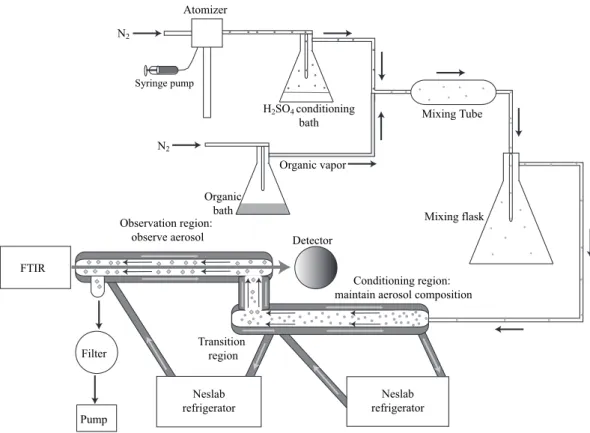
Neslab refrigerator FTIR Detector Filter Pump Conditioning region: maintain aerosol composition Observation region: observe aerosol Neslab refrigerator Transition region Syringe pump Atomizer H2SO4 conditioning bath Organic bath Organic vapor Mixing Tube Mixing flask N2 N2
Fig. 1. Experimental setup for aerosol generation and measuring ice nucleation in mixed organic/sulfuric acid particles.
as efficient ice nuclei as sulfate particles of the same size. Wise et al. (2004) found that, in general, for internally mixed ammonium sulfate/dicarboxylic acid particles, the water ac-tivity of the aerosol could be used to predict ice nucleation conditions, in agreement with the Koop et al. (2000) model. A recent modeling study has investigated the role of dicar-boxylic acids in atmospheric ice formation and found that changes in water uptake can affect the size of particles con-taining organics and thus can explain the observations that organic containing particles are less efficient at ice nucleation (K¨archer and Koop, 2005).
While ice nucleation has mainly been studied for mix-tures of dicarboxylic acids with ammonium sulfate, other carbonyl-containing compounds, such as aldehydes and ke-tones, have been investigated at warmer temperatures to probe acid-catalyzed reactions with sulfuric acid (Iraci and Tolbert, 1997; Jang et al., 2002; Nozi`ere and Riemer, 2003; Michelsen et al., 2004; Garland et al., 2006; Liggio et al., 2005; Nozi`ere and Esteve, 2005; Zhao et al., 2005). An important characteristic of these acid-catalyzed reactions is the ability to form products of lower vapor pressure and sol-ubility as well as higher melting points than the initial re-actant compounds. The atmospheric presence of these car-bonyl compounds is due to both primary emission from bio-genic and anthropobio-genic sources, and from photo-oxidation of other volatile organic compounds (VOCs). The series of aliphatic aldehydes, from C3-C10, have been measured
in ambient Los Angeles air samples at levels ranging from 0.41 to 1.09 ppb, with nonanal (C9)being the most abun-dant (Grosjean et al., 1996). Ketones such as acetone and 2-butanone were observed at similar levels in the same study. While laboratory studies have provided evidence for possi-ble reaction of these carbonyl compounds with concentrated sulfuric acid at room temperature, there is no data available for ice nucleation when these compounds interact with dilute sulfuric acid aerosols at low temperature.
If the water equilibrium is maintained in sulfuric acid aerosols with significant organic content in the atmosphere, the Koop et al. (2000) water activity model predicts that the ice nucleation temperatures for these complex particles would be unchanged from the aqueous sulfuric acid aerosol case. The Koop et al. (2000) model is also potentially appli-cable even if aerosols are not in equilibrium with atmospheric water vapor, as long as the aerosol organic content can be determined and related to aerosol water activity. However, field measurements have indicated that mixed organic/sulfate aerosol might be less efficient at ice nucleation (DeMott et al., 2003; Cziczo et al., 2004). One possible explanation for this observation is that the presence of organic com-pounds modifies the water uptake properties of the aerosol, and serves to sever the equilibrium between aerosol water content and atmospheric water vapor.
Given these possibilities and observations, a series of the straight-chain aliphatic C3-C10 aldehydes, as well as two
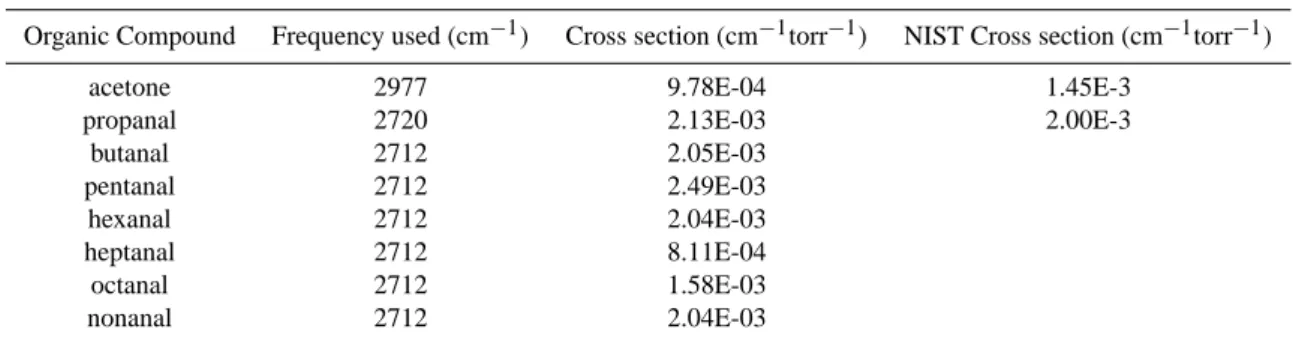
Table 1. Measured infrared absorption cross-sections for organic compounds used in this study. The frequency of measurement is also
provided. Cross sections for 2-nonanone and decanal could not be determined due to vapor pressure limitations. Infrared absorption cross-sections calculated from NIST data are also shown where available (Thermodynamics Source Database, 2005).
Organic Compound Frequency used (cm−1) Cross section (cm−1torr−1) NIST Cross section (cm−1torr−1)
acetone 2977 9.78E-04 1.45E-3
propanal 2720 2.13E-03 2.00E-3
butanal 2712 2.05E-03 pentanal 2712 2.49E-03 hexanal 2712 2.04E-03 heptanal 2712 8.11E-04 octanal 2712 1.58E-03 nonanal 2712 2.04E-03
ketones, acetone and 2-nonanone, were added to a single composition sulfuric acid aerosol of tropospheric relevance (15 wt% H2SO4)to determine the effects on ice nucleation. The findings of the present work indicate that the physical properties of the organics contained in the aerosol may play a key role in determining atmospheric ice nucleation mecha-nisms and temperatures.
2 Experimental
2.1 Ice nucleation
The experimental apparatus used for measuring ice nucle-ation from mixed carbonyl and sulfuric acid particles is shown in Fig. 1. Submicrometer sulfuric acid aerosols were generated using an atomizer (TSI Model 3076) with a Har-vard apparatus syringe pump. A 30 wt% sulfuric acid so-lution, prepared with distilled, deionized water, was fed at 0.3 mL/min through the atomizer with pre-purified (PP)-N2 as the carrier gas. After atomization, the sulfuric acid aerosols were conditioned by passing through a sulfuric acid conditioning bath, which had the effect of adding water to the particles to achieve the desired 15 wt% composition. A flow of organic vapor was merged with the aerosol flow by passing PP-N2through a reservoir of organic liquid.
The partial pressure of the organic vapor was controlled by holding the organic reservoir at fixed temperatures rang-ing from −78◦C to +24◦C. In order to quantify the amount of organic to which the sulfuric acid aerosols were exposed, the actual partial pressures of organics were measured in the flow tubes using the infrared absorbance of the organic in the absence of aerosols. Based on a calculation involving aerosol concentration, aerosol growth, and partial pressure of organic, the partial pressure in the absence of and in the presence of aerosols was estimated to be the same, and was used as such throughout this study. Although some infrared absorption cross-sections were available in the literature, in-frared absorption cross-sections were separately determined
for most compounds in the present study and used to cal-culate partial pressures. An infrared gas cell, with a path-length of 8.25 cm, was filled with the organic compound of interest to pressures ranging from 0.5 to 10.0 torr, mea-sured with a baratron capacitance manometer. All spec-tra collected were referenced to the background spectrum of the empty gas cell. The absorbance peak height of the aldehydic carbon-hydrogen stretch around 2712 cm−1 was used to determine the cross-sections for aldehydes while the aliphatic carbon-hydrogen stretch at 2977 cm−1was used for acetone. Measured infrared absorption cross-sections are listed in Table 1. The NIST database reference spectra were used to calculate cross-sections of 2.00×10⁻³cm−1torr−1 and 1.45×10⁻³cm−1torr−1 for propanal and acetone, respectively (Thermodynamics Source Database, 2005). Our measured values of 2.13×10⁻³cm−1torr−1 and 9.78×10⁻⁴cm−1torr−1 for propanal and acetone, respec-tively, agree reasonably well with the NIST database. Cross-sections could not be determined experimentally for 2-nonanone or decanal due to vapor pressure limitations.
The particles and organic vapor were allowed to mix for approximately one minute before entering the aerosol flow tubes. After the mixing period, the organic/sulfuric acid par-ticles entered the temperature-controlled flow tube appara-tus similar to that used by Prenni et al. (2001b) and Wise et al. (2004). The aerosol passes through three tubes, with inner diameters of 4 cm that are cooled with recirculated methanol from Neslab refrigerators. The first in the series of flow tubes (90 cm) was held at a constant temperature of −19.0◦C (±1.5◦C) for all experiments. This
condition-ing tube served to set and maintain the sulfate to water ratio of the aerosols and to precool the aerosols. Fourier trans-form infrared (FTIR) spectroscopy was used to observe the aerosols in the third tube (80 cm). The temperature in this observation region was varied over the range necessary to observe ice nucleation, from −30◦C to −75◦C. A transition tube (∼75 cm) was used between the first and third regions, each end cooled to the temperature of the closest tube, in
order to ensure time for the aerosol to reach the observation tube temperature before detection with FTIR spectroscopy. Flow tube temperatures were measured with thermocouples placed in the aerosol flow. The thermocouples were periodi-cally calibrated against a reference temperature to ensure ac-curate temperature measurements. Although standard error for thermocouples is ±1.0◦C, we never observed deviation greater than ±0.6◦C from a reference temperature measure-ment, even at the coldest temperatures used.
The aerosol composition in the observation region was de-termined using FTIR spectroscopy. The water to sulfate ratio was determined using FTIR spectral calibrations of the ratio of the OH peak (3650–2409 cm−1)to the sulfate peak (1470– 820 cm−1) (Anthony et al., 1995; Bertram et al., 1996). The FTIR spectral calibrations were used to verify the wa-ter to sulfate ratio remained constant afwa-ter the addition of the organic compounds. The organic content of sulfuric acid aerosols was determined using a Mie scattering analysis, as contributions from gas phase organics contribute to the or-ganic absorbance bands. This process will be described in detail in the next experimental section.
In a typical ice nucleation experiment, the initial obser-vation tube temperature is set well above the temperature at which the aerosol should nucleate ice. At this tempera-ture, the aerosol composition is verified as described above. Near the freezing point, the temperature of the observation region is decreased in ∼1.5◦C increments. The phase of the aerosol is monitored at each temperature using FTIR spec-troscopy. Several distinct spectral changes occur near the freezing point including shifts of the -OH stretch, centered at ∼3300 cm−1, to lower frequencies and the H
2O librational band at ∼800 cm−1 to higher frequencies. Each collected spectrum is subtracted from the previous, warmer spectrum. A modified version of the Hung et al. (2002) formalism is used to quantify ice nucleation temperatures. Instead of the 690–880 cm−1 region used by both Wise et al. (2004) and Hung et al. (2002) for ammonium sulfate, a combination of the variance of both the OH stretch and H2O libration re-gions from (3700–3200 cm−1and 940–660 cm−1)was used to determine ice nucleation temperatures. The product of the variance of the two spectra in these spectral regions was used in order to give them equal weighting. This product was normalized by the change in temperature and then plotted as a function of the temperature of the observation region. The onset freezing temperature was defined when qualita-tive changes, due to ice nucleation, were observed in both spectral regions. The peaks of these variances are defined as the ice nucleation temperatures in this study. Therefore, onset nucleation temperatures were on average, 1.5–3.0◦C warmer than those reported throughout. Although the organ-ics used in this study do contain some absorption features in these spectral areas, no interference with the variance anal-ysis was observed. Steps of 1.5◦C were taken to construct the variance plots because 1.5◦C was empirically observed to be the approximate uncertainty in the determination of the
freezing temperature, which may be caused by slightly vary-ing aerosol composition. Sulfuric acid aerosol composition was checked, using the infrared calibrations, at the end of most experiments to ensure that a relatively constant base aerosol composition was present throughout the ice nucle-ation experiment. Organic compounds used in this study were acetone, propanal, butanal, pentanal, hexanal, heptanal, octanal, nonanal, 2-nonanone, and decanal. All chemicals were purchased from Sigma-Aldrich and were of greater than 95% purity. All experiments were conducted using 15 wt% (±2 wt%) sulfuric acid composition as the precursor aqueous sulfuric acid aerosol.
2.2 Organic content from Mie scattering analysis
In order to quantify the amount of organic incorporated into the sulfuric acid particles, a Mie scattering analysis was per-formed to determine aerosol diameter before and after or-ganic addition. A Fortran program adapted from Bohren and Huffman (1983) was used to calculate extinction spectra to fit experimental spectra collected at Tobs∼−49◦C. This tem-perature limit was imposed by the ice nucleation temtem-perature for sulfuric acid at this composition, as the scattering analysis is valid for unfrozen aerosol only. All calculations were per-formed assuming spherical particles with a log-normal size distribution and a geometric standard deviation (GSD) of 2.0. The optical constants for sulfuric acid were taken from the work of Myhre et al. (2003) who parameterized them over the concentration range from 12–81 wt% H2SO4 and tem-perature range from 300–220 K. Due to the absence of optical constants data for the organic compounds at the temperatures used in this study, optical properties of sulfuric acid were as-sumed in this analysis. To most accurately fit the measured spectra, only the region where scattering features dominate the extinction was used, therefore values at wavenumbers below 2000 cm−1 were excluded. Extinction values in the region from 3000 to 2700 cm−1were also eliminated due to interferences from organic CH stretches, when present. The region above 3500 cm−1was weighted more heavily than the remaining portions of the spectrum because the extinction is totally due to scattering in this region. To determine if a dis-tribution of pure organic particles was present in these ex-periments, investigative experiments were performed where the organic compounds were flowed through the low temper-ature flow tubes in the absence of sulfuric acid aerosols, and FTIR spectra were collected. Under these conditions, the IR spectra indicated no nucleation of organic particles, i.e. no Mie scattering was observed in the 5000 to 3500 cm−1 region. These spectra were also identical to reference gas phase spectra.
The results from this scattering analysis were used to de-termine aerosol organic molality (m = moles solute/kg of solution). The difference in aqueous sulfuric acid aerosol mean diameters, before and after organic addition, was con-verted to an aerosol volume change. The increase in aerosol
diameter was assumed to be due only to the incorporation of organic into the aerosol. This volume increase, along with the molecular weight of the organic compound, was used to calculate moles of organic, in order to calculate organic aerosol molaltiy. Then, the total aerosol volume with an esti-mate of aerosol density based on sulfuric acid, water, and the organic compound densities, were combined with moles of organic to calculate the aerosol organic molarity (M = moles solute/L of solution).
3 Results and discussion
3.1 Scattering results
In evaluation of the Mie scattering analysis, the choice of the geometric standard deviation (GSD) has a strong effect on the calculated aerosol diameter, the value of the GSD has no effect on the calculated relative aerosol diameters for two dif-ferent aerosol distributions. An investigation of the effects of GSD on percent organic is summarized in Table 2. The GSD input to the Mie scattering analysis was varied over the range of 1.4 to 2.6. Fits to spectra of sulfuric acid aerosol both be-fore and after the exposure to 0.13 torr acetone were obtained with the Mie scattering analysis. It can be seen that while the absolute diameters varied widely over the range of GSD, the percent organic remained essentially unchanged. Therefore, since our analysis depends only on changes in aerosol diame-ter, the choice of GSD has no effect on the calculated results. The Mie scattering analysis used above assumes a normal distribution. However, if the distributions are not log-normal, the calculated relative aerosol diameters might be in error. An alternative Mie scattering analysis (Zasetsky et al., 2004), one not assuming a log-normal aerosol size distribu-tion, was also used to analyze a portion of the data. From the tests with this method, it was found that the aerosol distri-butions were indeed log-normal. Therefore, the log-normal distribution is a reasonable assumption in this case, and the simpler scattering analysis model of Bohren and Huffman (1983) was used. Overall, in the spectral regions (i.e. the scattering region) used to determine mean aerosol diameter, there is good agreement between the observed and calculated spectra, and the differences in the two spectra are due to the absorption component of the optical constants. This agree-ment is retained even upon addition of the organic to sulfuric acid aerosols. The variation in diameter of the sulfuric acid aerosol among experiments, before the addition of organic, determined by examining the Mie scattering fits, is 5.0%. In order to determine the uncertainty in the diameters cal-culated by the Mie scattering analysis, the RMS errors from calculated spectra over a range of diameters close to the best-fit diameter were compared. Then, a RMS error difference of 50% was chosen as an unacceptable fit. This difference translated into an approximate 5.0 nm uncertainty in diam-eter. This uncertainty was propagated through the percent
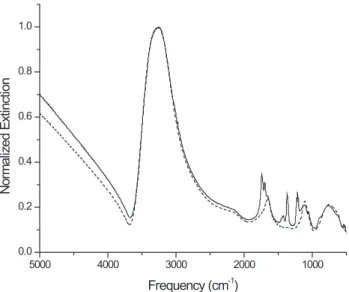
5000 4000 3000 2000 1000 0.0 0.2 0.4 0.6 0.8 1.0 N or m al iz ed E xt inct ion Frequency (cm-1)
Fig. 2. Infrared extinction spectra for increasing partial pressure
exposure to acetone. 15 wt% H2SO4 aerosol exposed to 0 Torr
(dashed) and 0.435 Torr (solid). The spectra are normalized to max-imum extinction. The region above 3500 cm−1increases in slope with increasing exposure to acetone.
organic and organic molality calculations. However, the ac-curacy of this method is limited by the assumption that the addition of organic compounds does not significantly modify the optical constants of the aerosol.
Figure 2 shows the increase in the slope of the normalized extinction spectra above 3500 cm−1 upon exposure of sul-furic acid aerosols to increasing partial pressures of acetone. Also, absorption features due to acetone are observed to grow in between 1000 and 2000 cm−1. The increase in slope cor-responds to an aerosol size increase caused by increasing the partial pressure exposure of organic vapor. For exam-ple, using the procedure discussed above to obtain the or-ganic molality from the diameter difference determined from the scattering observed in the dashed spectrum (no acetone) when compared to the scattering observed in the solid spec-trum (0.435 torr acetone) leads to the result that the acetone-exposed aerosol is 5.1 m in acetone, which corresponds to approximately a 30 nm increase in diameter. To determine if the organic uptake was due to acid-catalyzed chemistry, con-trol experiments were performed with aqueous ammonium sulfate (∼30 wt%) as the base aerosol. A qualitatively sim-ilar diameter increase was observed, leading to the conclu-sion that the uptake of the organic is due purely to physi-cal processes (the solubilities of organics in the dilute sul-furic acid and ammonium sulfate aerosols are probably near their pure water values). This result is at odds with the pos-sibility that acid-catalyzed reactions on the time-scale (one minute) and at the temperature conditions (room tempera-ture mixing) of these experiments are responsible for the or-ganic uptake. Also, spectral changes that would be indicative
Table 2. Investigation of the effect of geometric standard deviation (GSD) on calculated diameters (D) and % organic calculated using Mie
scattering calculations. Fits to spectra of sulfuric acid aerosol both before and after exposure to 0.13 torr acetone were obtained with the Mie scattering analysis. RMS errors are the difference between the experimental spectrum and the calculated fit.
GSD 2.6 2.2 2.0 1.8 1.6 1.4 D (H2SO4, nm) 120.8 210.2 278.2 401.8 569.0 794.9 RMS error (final) 0.0192 0.0192 0.0192 0.0192 0.0192 0.0193 D (H2SO4with acetone, nm) 129.0 224.5 297.5 429.3 607.8 848.1 RMS error (final) 0.0151 0.0151 0.0151 0.0151 0.0150 0.0151 % organic 17.9 18.0 18.2 18.0 18.0 17.7 0.0 0.1 0.2 0.3 0.4 0.5 0.6 0.7 0.8 0 10 20 30 40 50 60 70 80 90 % or gani c
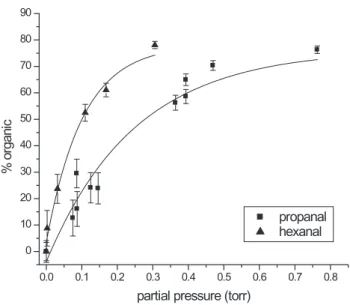
partial pressure (torr)
propanal hexanal
Fig. 3. Dependence of organic uptake (organic content) on organic
and partial pressure exposure. Percentage organic determined from Mie scattering analysis, and error bars reflect the uncertainty in this calculation. The curves shown are non-linear fits to the data.
of these acid-catalyzed reactions (i.e. carbonyl stretch shift) were absent. In addition, ongoing bulk kinetics experiments in our laboratory indicate that the one-minute timescale in the present experiments is much too short for acid-catalyzed reactions to occur on 15 wt% sulfuric acid aerosols at room temperature.
The dependence of organic uptake on the identity of the or-ganic compound and partial pressure exposure can be seen in Fig. 3. The lower vapor pressure organic, hexanal, achieves higher uptake at lower partial pressure exposures when com-pared to an organic of higher vapor pressure, propanal. Per-centage organic was determined from Mie scattering analy-sis, and error bars reflect the uncertainty in this calculation. The curves shown are non-linear fits to the data. It has been assumed that the addition of organic compounds does not sig-nificantly modify the optical constants of the aerosol. The error generated by this assumption is not included in the er-ror bars. It can also be seen that the aerosols approach 100%
organic composition at increased organic exposures. Experi-ments were also performed to observe the organic uptake de-pendence on observation tube temperature. A consistent size increase was observed to occur with decreasing tube temper-ature. Therefore, water activity was not fixed in the experi-ments described in this paper, as it changed with observation temperature, unlike the experiments by Wise et al. (2004) on non-volatile dicarboxylic acids. Also as a result, organic content determinations reported herein must be considered as lower limits as all measurements were made at temperatures above the freezing point of the particles.
3.2 Ice nucleation
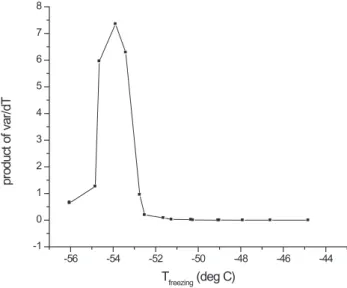
The ice nucleation temperature for pure 15 wt% H2SO4 aerosol was first measured and compared with previous re-sults. Previous studies have investigated the homogeneous nucleation of 15 wt% sulfuric acid using a variety of tech-niques including low temperature flow tubes with FTIR spec-troscopy (Bertram et al., 1996; Cziczo and Abbatt, 2001; Prenni et al., 2001b), optical microscopy (Koop et al., 1998), and a continuous flow diffusion chamber (Chen et al., 2000). There remains some spread across the ice nucleation re-sults for this composition using these various techniques. The freezing variance plot we obtain for 15 wt% H2SO4is shown in Fig. 4 with a freezing temperature of −54.0◦C. Of the previous studies that observed sulfuric acid aerosol ice nucleation temperatures, the result from this set of ex-periments agrees within error with results from a flow tube study (Prenni et al., 2001b), an optical method (Koop et al., 1998), and a study using the continuous flow diffusion chamber (Chen et al., 2000). These studies report freezing temperatures of −53.0◦C for 15 wt% H2SO4aerosol. The Koop et al. (2000) water activity model predicts a freezing temperature of −52.0◦C. Therefore, our results, within error (±1.5◦C), are in agreement with current literature values for sulfuric acid aerosol, as well as the Koop et al. (2000) model. All subsequent ice nucleation results should be viewed as a change from the 15 wt% sulfuric acid aerosol ice nucleation result of −54.0◦C.
-56 -54 -52 -50 -48 -46 -44 -1 0 1 2 3 4 5 6 7 8 pr oduct of var /dT Tfreezing (deg C)
Fig. 4. A variance plot for 15 wt% H2SO4 aerosol.
Tfreezing=−54.0◦C. Error in Tfreezingwas found to be ±1.5◦C due
to slight variations in aerosol concentration.
An extensive ice nucleation study of sulfuric acid aerosols as a function of partial pressure exposure of propanal was conducted, and the results are shown in Fig. 5. In gen-eral, there are two regimes into which these results can be divided. At propanal partial pressures less than 0.15 torr, the freezing temperature linearly decreased with increasing propanal pressure, while above 0.15 torr, the freezing tem-perature remained constant. A linear fit is shown for the data below 0.15 torr. These results can be explained by the ex-istence of a single-phase aerosol at partial pressures below 0.15 torr, where propanal is soluble in the aqueous sulfuric acid aerosol. Therefore, as the partial pressure increases, the molality increases, while the water activity decreases, qual-itatively adhering to the Koop et al. (2000) water activity model for homogeneous ice nucleation. The interpretation of the plateauing of the ice nucleation temperatures at about 0.15 torr is that the aerosol apparently reaches the propanal solubility limit. Therefore, any additional propanal added is not soluble and forms an organic phase on the mixed sul-furic acid/propanal aerosol core, and the propanal molality and water activity of the inner aqueous aerosol remains con-stant. This was tested to partial pressure exposures as high as 1.0 torr. Beyond these exposure levels, quantitative ice nucle-ation determinnucle-ation became increasingly difficult due to the strong propanal absorption features in the infrared extinction spectra.
From these results, if the 0.15 torr propanal-exposed aerosols are taken as the case where the propanal is dissolved up to its solubility limit, then the results from the Mie scatter-ing analysis indicate that the propanal content of the aerosols, at −49◦C is 25%, by volume (4.0 M and 230 g/L). The bulk, room temperature, solubility of propanal in water, as shown
0.0 0.2 0.4 0.6 0.8 1.0 -64 -62 -60 -58 -56 -54 -52 Tfre e zi n g (d e g C )
propanal partial pressure (torr)
Fig. 5. Freezing temperatures (◦C) as a function of propanal partial pressure (Torr). A single-phase aerosol is proposed for exposures
<0.15 Torr, a linear fit to this portion of data is shown. At partial pressures above this value, a two-phase aerosol is thought to exist, saturated in propanal. 0.0 0.1 0.2 0.3 0.4 0.5 -74 -72 -70 -68 -66 -64 -62 -60 -58 -56 -54 -52 -50 Tfr eez in g (d e g C )
acetone partial pressure (torr)
Fig. 6. Freezing temperatures (◦C) as a function of acetone partial pressure (torr). A single-phase aqueous aerosol exists at all partial pressures exposure for which ice nucleation temperature could be determined. A linear fit to the data is shown. Error bars are ±1.5◦C.
in Table 3 is 306 g/L, which corresponds to 38% by volume (5.3 M). Despite the differences in temperature, this compar-ison is useful to relate the solubility limit determined by the Mie scattering analysis to that known from bulk measure-ments.
A similar study of the effect of partial pressure expo-sure on ice nucleation was also conducted for sulfuric acid aerosols exposed to acetone. Figure 6 shows a plot for ace-tone similar to that shown in Fig. 5 for propanal, though
Table 3. Physical properties of organic compounds used in this study. Data compiled from Hazardous Substances Data Bank (2005) and
Thermodynamics Source Database (2005).
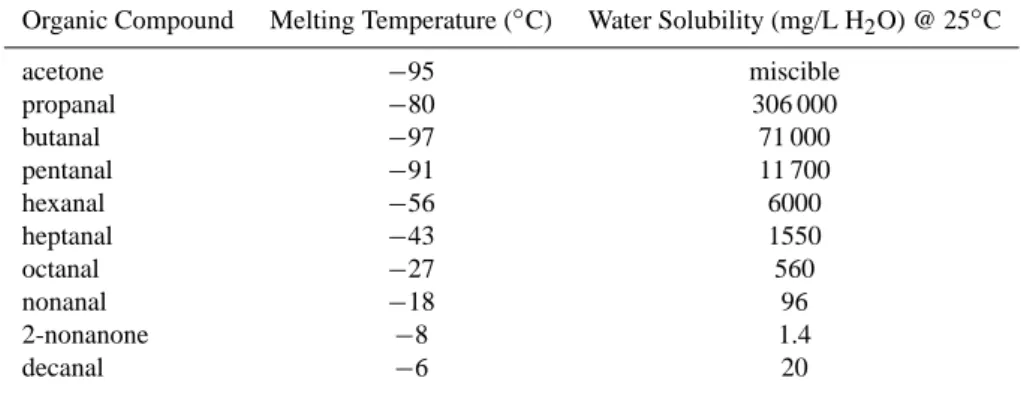
Organic Compound Melting Temperature (◦C) Water Solubility (mg/L H2O) @ 25◦C
acetone −95 miscible propanal −80 306 000 butanal −97 71 000 pentanal −91 11 700 hexanal −56 6000 heptanal −43 1550 octanal −27 560 nonanal −18 96 2-nonanone −8 1.4 decanal −6 20 0 1 2 3 4 5 6 -74 -72 -70 -68 -66 -64 -62 -60 -58 -56 -54 -52 -50 Tfre e zi n g ( d eg C ) m (acetone)
Fig. 7. Freezing temperatures (◦C) as a function of acetone molal-ity. Molality is determined from aerosol size increase as determined by a Mie scattering analysis of infrared extinction spectra. A linear fit to the data is shown. Temperature error bars are ±1.5◦C, and molality error bars reflect the uncertainty in the Mie scattering cal-culation of aerosol diameter.
over a smaller range of partial pressures. In contrast to the propanal case, it can be seen that increasing amounts of ace-tone cause a decrease in freezing temperatures over the en-tire range studied. The increased solubility of acetone (as compared to propanal) in sulfuric acid aerosol is the likely cause of the difference. As a result, ice nucleation temper-atures could not be measured at any partial pressure expo-sures higher than 0.45 torr (−71.5◦C) due to flow tube cool-ing system limitations. As more acetone is taken up by the particles, the molality increases while the water activity de-creases, again qualitatively adhering to the Koop et al. (2000) water activity theory for homogeneous ice nucleation. In ad-dition, because acetone is more soluble in 15 wt% sulfuric
acid than is propanal, the ice nucleation depression is more pronounced.
Figure 7 shows the same aerosol ice nucleation tempera-ture data as in Fig. 6, but is plotted against aerosol acetone molality. Aerosol acetone molality was determined from the aerosol size increase determined from a Mie scattering anal-ysis of aerosol infrared extinction spectra. In order to quan-tify the decrease in temperature with aerosol acetone mo-lality, an analysis involving the empirical parameter, λ, was used (Rasmussen and MacKenzie, 1972; Prenni et al., 2001b; DeMott, 2002). The parameter λ is the ratio of the depres-sion of the ice nucleation temperatures of solute-containing droplets to bulk solute-containing solutions each relative to pure water (i.e., λ would be equal to unity in the absence of increased supercooling effects over those of water). Accord-ing to Eq. (1), the product of lambda, λ, and the meltAccord-ing tem-perature depression, 1Tm, equals the freezing temperature
depression, 1Tf (Rasmussen and MacKenzie, 1972; Prenni
et al., 2001b; DeMott, 2002). Then, Eq. (2) is the empiri-cal equation for bulk melting point depression due to solute addition (Atkins, 1997).
1Tf =λ · 1Tm (1)
1Tm=Kf ·m (2)
This equation relates the bulk melting temperature de-pression, 1Tm, to the product of Kf, the solvent freezing
point depression constant, and m, molality. In this analysis method, the observed freezing (nucleation) point depression can be related to solute molality, m, according to Eqs. (1) and (2) where Kf is the freezing point depression constant for, in
this case, 15 wt% H2SO4and 1Tf and 1Tmare the freezing
and melting temperature depressions, respectively.
The literature values reported for λ range from 1.4 to 2.2 for various salt solutions, with a typical value of 1.7 (DeMott, 2002). Using 1.7 for λ and Kffor water, 1.86◦C/m, the slope
2 3 4 5 6 7 8 9 10 11 -76 -72 -68 -64 -60 -56 -52 -48 -44 -40 -36 Tfreezing(15 wt% H2SO4) aldehydes ketones Tfr eez in g ( deg C ) # Carbons
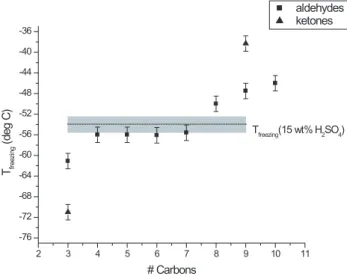
Fig. 8. Freezing temperatures (◦C) as a function of organic carbon chain length. Results, except for acetone, are shown for aqueous aerosols saturated with organic. The arrow indicates the possible further decrease in ice nucleation temperature for the saturated ace-tone/aqueous sulfuric acid aerosol. The water activity of particles with C4and longer compounds are likely of constant water activity,
though a direct measure of the water activity of the particles was not possible. Error bars on individual data points and the 15 wt% H2SO4freezing result (shaded box) are ±1.5◦C.
around −3.2◦C/m. The fit to the data from these experiments gives a line with a slope of −3.5◦C/m. Alternatively, using the experimental slope and Kf for water, a value of 1.9 is
determined for λ, which is well within the typical range. Un-fortunately, melting point as a function of solution molality data is not available for these solutions, which is necessary to calculate water activity values. Therefore, a direct compar-ison to Koop et al. (2000) model predictions is not possible in this case. Despite this, using the empirical relationships described above, the experimental results can be fit.
Because the partial pressure of the organics is measured and the aerosol molarity is determined using the Mie scatter-ing analysis, it is possible to carry out a Henry’s law analysis to determine the solubilities of these gases in 15 wt% H2SO4. Henry’s law is used, in the dilute solution limit, to define the solubility or concentration at equilibrium, of a gas, A, in aqueous solutions, [A](aq), as related to the partial pressure of the gas above the solution, pA, according to Eq. (3).
[A](aq)=HApA (3)
Henry’s law solubilities, H, of 22 000 M/atm and 6600 M/atm were determined for propanal and acetone, respectively, at −50.0◦C in 15 wt% sulfuric acid aerosols. No literature Henry’s law values exist for propanal in sulfuric acid, while effective Henry’s law solubilites for acetone exist in the literature for 40 wt%<H2SO4wt% <50 wt% solutions at around −50◦C (Kane et al., 1999; Klassen et al., 1999; Imamura and Akiyoshi, 2000). These
Table 4. Ice nucleation results versus organic compound added to
15 wt% sulfuric acid aerosols. Ice nucleation was observed for 15 wt% sulfuric acid aerosol at −54.0◦C. Partial pressures of or-ganic compounds used were determined using the measured ab-sorption cross-sections. Partial pressure data are not available for 2-nonanone and decanal due to the low vapor pressures of these compounds.
Organic added Partial Pressure Exposure (torr) Tf (◦C)
acetone 0.35 −71.0 propanal 0.98 −61.1 butanal 0.28 −56.0 pentanal 0.25 −56.0 hexanal 0.34 −56.1 heptanal 0.39 −55.6 octanal 0.15 −50.0 nonanal 0.02 −47.5 2-nonanone * −38.3 decanal * −46.0
values range from 13 800 M/atm to 21 000 M/atm with errors ranging from 33% to 50%. Also, no reaction is observed in this acetone/dilute sulfuric acid aerosol system, which may also reconcile the lower Henry’s law constant for acetone observed here when compared with the Henry’s law constant derived from a system in which acetone is reactive (40–50 wt% sulfuric acid) (Kane et al., 1999; Klassen et al., 1999; Imamura and Akiyoshi, 2000). These Henry’s law results apply in the dilute solution regime, and cannot, necessarily, be compared with bulk solubility data.
Results from the three carbon organics, propanal and ace-tone, demonstrate the depression of ice nucleation tempera-tures due to solubility effects. To further investigate the ef-fects of organics with different physical properties, the effect of increasing carbon chain length was also explored. Re-sults from these experiments are summarized in Fig. 8 and Table 4. All ice nucleation results, with the exception of acetone for which only an upper limit was established, are shown for aqueous sulfuric acid aerosols saturated with the organic (i.e. in the plateau region of Fig. 3). For the organics from butanal (C4)to heptanal (C7), ice nucleation temper-atures are, within error, essentially the same as for 15 wt% H2SO4 aerosols. In contrast, the compounds from octanal (C8)to decanal (C10)exhibited freezing temperatures higher than that observed for 15 wt% H2SO4 aerosols. The water activity of particles with C4and longer compounds are likely equal to the value for pure sulfuric acid particles, though a direct measure of the water activity of the particles was not possible.
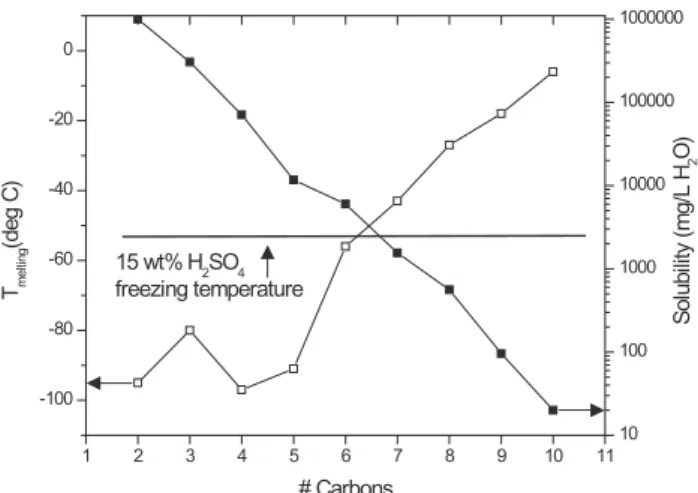
The physical properties of the organic compounds used in these studies are shown in Fig. 9 and Table 3 and are use-ful to consider when interpreting these results (Hazardous Substances Data Bank, 2005; Thermodynamics Source
1 2 3 4 5 6 7 8 9 10 11 -100 -80 -60 -40 -20 0 # Carbons Tme lti n g (deg C ) 10 100 1000 10000 100000 1000000 15 wt% H2SO4 freezing temperature S o lu b ilit y ( m g /L H 2 O)
Fig. 9. Melting points (open squares) and solubilities (filled squares) of aldehyde compounds used in this study. Data compiled from Hazardous Substances Data Bank (2005) and Thermodynam-ics Source Database (2005).
Database, 2005). The difference in the ice nucleation re-sults for acetone and propanal were discussed in the previ-ous section as resulting from the difference in the solubility of the two compounds. In both cases, the high solubility of acetone and propanal likely results in a decrease in water ac-tivity. On the other hand, the ice nucleation results for the C8to C10 compounds can be explained by both differences in the solubilities and melting points of these organic com-pounds. As can be seen in Fig. 9, these compounds have drastically lower water solubilities and higher melting points than the organic compounds discussed earlier. It is a com-bination of these physical properties that we believe explain the apparent increase in ice nucleation temperatures over the sulfuric acid base case. Since these longer chain compounds are not very soluble, virtually no decrease in water activity should occur and the aerosol might be expected to nucleate ice at the same temperature as 15 wt% sulfuric acid. How-ever, a coating of these low solubility organic compounds likely forms on the aqueous sulfuric acid aerosols. Unlike the shorter chain compounds, octanal, nonanal, 2-nonanone, and decanal have melting points all above −25◦C. As a re-sult, the coating formed on the aerosols freezes at tempera-tures warmer than the inner aqueous sulfuric acid core (as is dictated by the water activity). Therefore, we believe that ice is heterogeneously nucleated by the frozen organic phase in these cases. The ice nucleation temperatures we find are not the same as the bulk organic melting temperatures, which is likely due to supercooling of the organic phase. Unfor-tunately, supercooling effects are not well known for these organic compounds, and it is not possible to compare the ob-served supercooling in our mixed aerosols to supercooling in the pure organic compounds.
The addition of the C4to C7compounds to aqueous sulfu-ric acid aerosols causes no change in ice nucleation
temper-ature, relative to the sulfuric acid aerosol base case. Based on solubility properties, these compounds are much less sol-uble than the C3carbonyl compounds, and likely not solu-ble enough to decrease the water activity of the sulfuric acid core, and, like the C8to C10compounds, are likely to form a coating on the surface of the aerosol. However, the freezing temperatures of these intermediate chain length aldehydes are apparently too low, due to the lower melting points and some supercooling effects, to induce a heterogeneous freez-ing mechanism. As a result, the sulfuric acid core determines the ice nucleation temperature in these aerosols.
Because the time scale for the previously described ex-periments was much too short to observe acid-catalyzed re-actions, an alternative set of experiments was performed in which a bulk solution of sulfuric acid was reacted with bu-tanal for an extended period of time (∼7 days) before being atomized and used for ice nucleation experiments. Acid-catalyzed reaction products were verified using 1H-NMR analysis similar to that described by Garland et al. (2006). Although it was not possible to determine the organic com-position of the aerosols in these experiments, the water to sulfate ratio was fortuitously similar to the previous experi-ments. Therefore, the ice nucleation results could be com-pared to the ice nucleation temperature of −54◦C for the base case of 15 wt% sulfuric acid. Interestingly, these butanal bulk-reacted aerosols nucleated ice at −51◦C. This is ∼3◦C warmer than the result observed for the gas addition of bu-tanal, C4, to aqueous sulfuric acid aerosols, while only ∼1◦C cooler than that observed for gaseous addition of octanal, C8, which would be expected to have similar physical properties to 2-ethyl-2-hexenal, the aldol condensation reaction prod-uct of butanal. While preliminary, these experiments seem to indicate that acid-catalyzed reactions can indeed result in a change in the mode of ice nucleation for the case of butanal and lead to an increase in ice nucleation temperature.
4 Implications and conclusions
Acid-catalyzed reactions could play an important role in de-termining which ice nucleation mode might be operative in mixed organic/inorganic aerosols in the atmosphere. In these reactions, shorter chain organic molecules react to create molecules of at least the sum of the carbon chain length. As can be see from Fig. 9, a doubling in carbon chain length from C4to C8, increases melting temperature by 70◦C and decreases solubility by a factor of 100. From the inter-pretation of the present experiments, aqueous sulfuric acid aerosols exposed to butanal nucleated ice by a homogeneous mechanism, while octanal-exposed sulfuric acid aerosols nu-cleate ice via a heterogeneous mechanism. Therefore, acid-catalyzed reactions on sulfuric acid aerosols could play a role in transforming organic compounds from those that likely depress or have no effect on ice nucleation temperatures to those that actually elevate the ice nucleation temperatures
through heterogeneous nucleation. However, if no reaction transforms the shorter carbon chain organic compounds to larger organic compounds, the solubility limit will likely not be reached for the shorter carbon chain, highly soluble or-ganic species in the atmosphere (Marcolli et al., 2004).
The present work has shown that addition of organic com-pounds to 15 wt% sulfuric acid aerosol can lead to a depres-sion, no change, or even an elevation in the ice nucleation temperature. It has been shown that the physical properties of the organic compounds, in particular the solubility and melt-ing point, can be used to interpret the observed ice nucleation temperature. For example, very soluble organic compounds can decrease the water activity of atmospheric aerosols un-der non-equilibrium conditions (i.e. rapid cooling plumes; K¨archer and Koop, 2005), and lead to a decrease in ice nu-cleation temperatures. At some concentration, a solubility limit will be reached and a second organic phase will begin to form on the aqueous aerosol. If the freezing temperature of the organic phase is lower than that of the mixed aerosol core, then the organic phase is seen to have no effect on the ice nucleation temperatures. However based on this inter-pretation, if the freezing temperature of the organic phase is higher than that of the aerosol core, a heterogeneous nu-cleation mode can occur and higher ice nunu-cleation tempera-tures will be observed. In general, longer chain organic com-pounds will induce heterogeneous ice nucleation due to their high melting temperatures. Therefore, knowing the chem-ical speciation of the organics present in upper tropospheric aerosols is valuable information when predicting their effects on ice nucleation in dilute sulfuric acid aerosols.
Acknowledgements. The authors would like to acknowledge
A. Y. Zasetsky for access to the Mie scattering computer program. The authors also acknowledge M. E. Wise for helpful discussions. MJE acknowledges the American Chemical Society Petroleum Research Fund and the Mellon Foundation for sabbatical sup-port. MRB acknowledges the EPA STAR fellowship program (FP-91654601) for financial support. The research described in this paper has been funded in part by the United States Environmental Protection Agency (EPA) under the Science to Achieve Results (STAR) Graduate Fellowship Program. EPA has not officially endorsed this publication and the views expressed herein may not reflect the views of the EPA. The authors also acknowledge DOE under grant no. DE-FG03-01ER63096 and NSF under grant no. ATM-0137261 for funding.
Edited by: J. Abbatt
References
Anthony, S. E., Tisdale, R. T., Disselkamp, R. S., and Tolbert, M. A.: FTIR studies of low temperature sulfuric acid aerosols, Geo-phys. Res. Lett., 22, 1105–1108, 1995.
Atkins, P.: Physical Chemistry, W.H. Freeman and Company, New York, 1997.
Bertram, A. K., Koop, T., Molina, L. T., and Molina, M. T.: Ice formation in (NH4)2SO4-H2O Particles, J. Phys. Chem. A., 104,
584–588, 2000.
Bertram, A. K., Patterson, D. D., and Sloan, J. J.: Mechanisms and temperatures for the freezing of sulfuric acid aerosols measured by FTIR extinction spectroscopy, J. Phys. Chem., 100, 2376– 2383, 1996.
Bohren, C. F. and Huffman, D. R.: Absorption and Scattering of Light by Small Particles, John Wiley & Sons, New York, 1983. Chen, Y., DeMott, P. J., Kreidenweis, S. M., Rogers, D. C., and
Sherman, D. E.: Ice formation by sulfate and sulfuric acid aerosol particles under upper-tropospheric conditions, J. Atmos. Sci., 57, 3752–3766, 2000.
Cziczo, D. J. and Abbatt, J. P. D.: Ice nucleation in NH4HSO4,
NH4NO3, and H2SO4aqueous particles: Implications for cirrus
cloud formation, Geophys. Res. Lett., 28, 963–966, 2001. Cziczo, D. J., DeMott, P. J., Brooks, S. D., Prenni, A. J.,
Thom-son, D. S., Baumgardner, D., WilThom-son, J. C., Kreidenweis, S. M., and Murphy, D. M.: Observations of organic species and atmospheric ice formation, Geophys. Res. Lett., 31, L12116, doi:10.1029/2004GL019822, 2004.
DeMott, P. J.: Laboratory studies of cirrus cloud processes, in: Cir-rus, edited by: Lynch, D. K., Sassen, K., Starr, D. O. C., and Stephens, G., Oxford Univ. Press, 102–135, 2002.
DeMott, P. J., Cziczo, D. J., Prenni, A. J., Murphy, D. M., Krei-denweis, S. M., Thomson, D. S., Borys, R., and Rogers, D. C.: Measurements of the concentration and composition of nuclei for cirrus formation, Proc. Natl. Acad. Sci. USA., 100, 14 655– 14 660, 2003.
Fahey, D. W. and Schumann, U.: Aviation-produced aerosols and cloudiness, in: Aviation and the Global Atmosphere, edited by: Penner, J. E., Lister, D. H., Griggs, D. J., Dokken, D. J., and McFarland, M., Camgridge University Press, 373, 1999. Garland, R. M., Elrod, M. J., Kincaid, K., Beaver, M. R., Jimenez,
J. L., and Tolbert, M. A.: Acid-catalyzed reactions of hexanal on sulfuric acid particles: Identification of reaction products, At-mos. Environ., in press, 2006.
Grosjean, E., Grosjean, D., Fraser, M. P., and Cass, G. R.: Air qual-ity model evaluation data for organics. 2. C1-C14 carbonyls in
Los Angeles air, Environ. Sci. Technol., 30, 2687–2703, 1996. Hazardous Substances Data Bank, National Library of Medicine,
updated on 14 February 2003, http://toxnet.nlm.nih.gov/cgi-bin/ sis/htmlgen?HSDB, 2004.
Hung, H.-M., Malinowski, A., and Martin, S. T.: Ice nucleation ki-netics of aerosols containing aqueous and solid ammonium sul-fate particles, J. Phys. Chem. A, 106, 293–306, 2002.
Imamura, T. and Akiyoshi, H.: Uptake of actone into sulfuric acid solutions, Geophys. Res. Lett., 27, 1419–1422, 2000.
Iraci, L. T. and Tolbert, M. A.: Heterogeneous interaction of formaldehyde with cold sulfuric acid: Implications for the up-per troposphere and lower stratosphere, J. Geophys. Res., 102, 16 099–16 107, 1997.
Jang, M., Czoschke, N. M., Lee, S., and Kamens, R. M.: Heteroge-neous atmospheric aerosol production by acid-catalyzed particle-phase reactions, 298, 814–817, 2002.
Kane, S. M., Timonen, R. S., and Leu, M.-T.: Heterogeneous chem-istry of acetone in sulfuric acid solutions: Implications for the Upper Troposphere, J. Phys. Chem. A, 103, 9259–9265, 1999.
K¨archer, B. and Koop, T.: The role of organic aerosols in homoge-neous ice formation, Atmos. Chem. Phys., 5, 703–714, 2005, http://www.atmos-chem-phys.net/5/703/2005/.
Klassen, J. K., Lynton, J., Golden, D. M., and Williams, L. R.: Sol-ubility of acetone in low-temperature (210–240 K) sulfuric acid solutions, J. Geophys. Res., 104, 26 355–26 361, 1999.
Koop, T., Luo, B., Tsias, A., and Peter, T.: Water activity as the de-terminant for homogeneous ice nucleation in aqueous solutions, 406, 611–614, 2000.
Koop, T., Ng, H. P., Molina, L. T., and Molina, M. J.: A new optical technique to study aerosol phase transitions: The nucleation of ice from H2SO4aerosols, J. Phys. Chem. A, 102, 8924–8931, 1998.
Liggio, J., Li, S. M., and McLaren, R.: Heterogeneous reactions of glyoxal on particulate matter: identification of acetals and sulfate esters, Environ. Sci. Technol., 39, 1532–1541, 2005.
Marcolli, C, Luo, B., and Peter, T.: Mixing of the organic aerosol fractions: Liquids as the thermodynamically stable phase, J. Phys. Chem. A, 108, 2216–2224, 2004.
Michelsen, R. R., Ashbourn, S. F. M., and Iraci, L. T.: Dissolution, speciation, and reaction of acetaldehyde in cold sulfuric acid, J. Geophys. Res., 109, D23205, doi:10.1029/2004JD005041, 2004. Murphy, D. M., Thomson, D. S., and Mahoney, M. J.: In situ mea-surements of organics, meteoritic material, mercury, and other el-ements in aerosols at 5 to 19 kilometers, 282, 1664–1669, 1998. Myhre, C. E. L., Christensen, D. H., Nicolaisen, F. M., and Nielsen, C. J.: Spectroscopic study of aqueous H2SO4at different
tem-peratures and compositions: variations in dissociation and opti-cal properties, J. Phys. Chem. A, 107, 1979–1991, 2003. Nozi`ere, B. and Esteve, W.: Organic reactions increasing the
ab-sorption index of atmospheric sulfuric acid aerosols, Geophys. Res. Lett., 32, L03812, doi:10.1029/2004GL021942, 2005.
Nozi`ere, B. and Riemer, D. D.: The chemical processing of gas-phase carbonyl compounds by sulfuric acid aerosols: 2,4-pentanedione, Atmos. Environ., 37, 841–851, 2003.
Prenni, A. J., DeMott, P. J., Kreidenweis, S. M., Sherman, D. E., Russell, L. M., and Ming, Y.: The effects of low molecular weight dicarboxylic acids on cloud formation, J. Phys. Chem. A, 105, 11 240–11 248, 2001a.
Prenni, A. J., Wise, M. E., Brooks, S. D., and Tolbert, M. A.: Ice nucleation in sulfuric acid and ammonium sulfate particles, J. Geophys. Res., 106, 3037–3044, 2001b.
Rasmussen. D. H. and MacKenzie, A. P.: Effect of solute on ice-solution interfacial free energy; calculation from measured ho-mogeneous nucleation temperatures, in: Water Structure at the Water-Polymer Interface, edited by: Jellinek, H. H. G., Plenum Press, 126–145, 1972.
Thermodynamics Source Database, National Institute of Standards and Technology, updated on 2005 June, http://webbook.nist.gov, 2005.
Wise, M. E., Garland, R. M., and Tolbert, M. A.: Ice nucleation in internally mixed ammonium sulfate/dicarboxylic acid particles, J. Geophys. Res., 109, D19203, doi:10.1029/2003JD004313, 2004.
Zasetsky, A. Y., Khalizov, A. F., and Sloan, J. J.: Characterization of atmospheric aerosols from infrared measurements: simulations, testing, and applications, Appl. Opt., 43, 5503–5511, 2004. Zhao, J., Levitt, N. P., and Zhang, R.: Heterogeneous chemistry
of octanal and 2,4-hexadienal with sulfuric acid, Geophys. Res. Lett., 32, L09802, doi:10.1029/2004GL022200, 2005.