HAL Id: hal-00377397
https://hal.archives-ouvertes.fr/hal-00377397v2
Submitted on 27 Jul 2009
HAL is a multi-disciplinary open access
archive for the deposit and dissemination of
sci-entific research documents, whether they are
pub-lished or not. The documents may come from
teaching and research institutions in France or
abroad, or from public or private research centers.
L’archive ouverte pluridisciplinaire HAL, est
destinée au dépôt et à la diffusion de documents
scientifiques de niveau recherche, publiés ou non,
émanant des établissements d’enseignement et de
recherche français ou étrangers, des laboratoires
publics ou privés.
Enhancing the area of a Raman atom interferometer
using a versatile double-diffraction technique
Thomas Lévèque, Alexandre Gauguet, Franck Michaud, Franck Pereira dos
Santos, Arnaud Landragin
To cite this version:
Thomas Lévèque, Alexandre Gauguet, Franck Michaud, Franck Pereira dos Santos, Arnaud
Landra-gin. Enhancing the area of a Raman atom interferometer using a versatile double-diffraction
tech-nique. Physical Review Letters, American Physical Society, 2009, 103 (8), pp.080405.
�10.1103/Phys-RevLett.103.080405�. �hal-00377397v2�
double-diffraction technique
T. L´ev`eque, A. Gauguet∗, F. Michaud, F. Pereira Dos Santos, and A. Landragin† LNE-SYRTE, UMR 8630 CNRS, UPMC, Observatoire de Paris,
61 avenue de l’Observatoire, 75014 Paris, FRANCE (Dated: July 27, 2009)
In this paper we demonstrate a new scheme for Raman transitions which realize a symmetric momentum-space splitting of 4¯hk, deflecting the atomic wave-packets into the same internal state. Combining the advantages of Raman and Bragg diffraction, we achieve a three pulse state labelled interferometer, intrinsically insensitive to the main systematics and applicable to all kind of atomic sources. This splitting scheme can be extended to 4N ¯hk momentum transfer by a multipulse sequence and is implemented on a 8¯hk interferometer. We demonstrate the area enhancement by measuring inertial forces.
PACS numbers: 03.75.Dg, 06.30.Gv, 37.25.+k, 67.85.-d
Atom interferometers are of interest for precision mea-surements of fundamental constants [1, 2, 3, 4] and for inertial measurements [5, 6]. The sensitivity of these ap-paratus is closely related to the ability to diffract the atomic wave-packet in a coherent way. The angular split-ting of this process determines the enclosed area of the interferometer and so its sensitivity. Many techniques have been implemented to coherently separate atomic waves and increase the angular deflection using material gratings [7], magneto-optical beam-splitters [8, 9] or mo-mentum transfer by adiabatic passage [10]. For precision measurements, the use of two photon transitions are the most frequently used since they guarantee the control of the momentum transfer during the diffraction process.
Matter-wave gratings made of a near resonant stand-ing light wave, permit the diffraction of the atoms along several coherent paths, separated by 2¯hk, in Kapitza-Dirac or Bragg regime. As in this kind of interferome-ter [11, 12, 13] atoms always travel in the same ininterferome-ternal state, the output phase-shift is intrinsically insensitive to many systematics such as the AC Stark shift and tem-poral fluctuations of the Zeeman effect. These methods require the use of highly collimated atomic sources for detection on the external degree of freedom or careful analysis for multiple path fringe pattern [13]. Alterna-tively, stimulated Raman transitions [14], which split a wave packet into two distinct internal states, are well adapted for use with non-collimated atomic sources such as optical molasses. In addition, they allow to realize interferometers which benefit from an internal state la-beling [15] for the output phase measurement, as popu-lations of the output ports can be detected using a state selective technique.
Many improvements have been made to increase the
∗Present address: Department of Physics, Durham University,
Rochester Building, South Road, Durham DH1 3LE, England
momentum-space splitting of Bragg [12, 16, 17, 18, 19, 20] and Raman [21] based interferometers. Recent works have also permitted an enhancement in the momentum space splitting by using conventional Raman and Bragg schemes coupled to Bloch oscillations [22, 23, 24, 25].
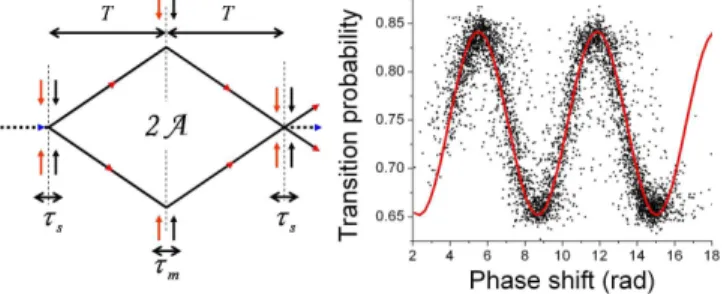
Here, we demonstrate a new scheme based on Ra-man transitions, which achieves a symmetric momentum-space splitting of 4¯hk (Fig. 1). It combines the advan-tages of these two methods. First, starting with atoms from an optical molasses, we realize an interferometer where partial wave packets propagate along its two arms in the same internal state. Second, the measurement of the output phase shift can still be realized thanks to the state labeling. The area of the interferometer is then in-creased by a factor of two compared to the traditional π/2-π-π/2 three pulse configuration. This scheme can be easily extended to perform a 4N ¯hk momentum split-ting thanks to a multipulse sequence technique. As an example, we utilize a 8¯hk interferometer for inertial mea-surements.
FIG. 1: Left: Scheme of the 4¯hkinterferometer realized using three double-diffraction pulses of duration τs, τm, τs. Dotted
and solid lines respectively represent wave packets in the state |gi and |ei. Right: Interferometer signal for the source S1 as
a function of the phase-shift calculated from the tiltmeter signal.
In our apparatus, described in [26], 107
Caesium atoms are loaded from a vapor into two independent
magneto-2 optical traps. Two Caesium clouds are then launched at a
temperature of 1.2 µK into two opposite parabolic trajec-tories using moving molasses at velocity v = 2.4 m.s−1,
oriented at an angle of 8◦ with respect to the vertical
direction. At the apex of their trajectory the atoms in-teract with horizontal Raman laser pulses which act on the matter-wave as beam splitters or mirrors, and gener-ate an interferometer with 2T = 60 ms of total inter-action time. The use of two atomic sources (S1 and S2)
launched along opposite directions allows discrimination between the acceleration and rotation [6].
Raman transitions are implemented in a retroreflected geometry. The two laser beams of parallel polarizations at λ = 852 nm are guided to the setup through the same polarizing fiber. The beams pass through the vac-uum chamber and are reflected by a mirror, crossing a quarter-wave plate twice. The wave plate is set in such a way that the reflected lasers have orthogonal linear po-larization compared to the incident ones. As a result, counterpropagating Raman transitions are allowed while copropagating Raman transitions are forbidden. This commonly used geometry limits the impact of wave-front aberrations and provides a simple way to implement the k reversal technique [27]. In fact, in this scheme, atoms interact with four laser waves which drive Raman tran-sitions with effective wave vectors ±keff = ±(k1− k2).
Atoms are initially prepared in the ground state |6S1/2, F = 3, mF = 0i, which is written as |gi. Our
four laser design, efficiently couples this initial state to the excited state |6S1/2, F = 4, mF = 0i by transferring a
2¯hk momentum along two opposite directions. The state |g, pi is then coupled to the two states |e, p + 2¯hki and |e, p − 2¯hki where p is the initial momentum state of the atom [26]. Due to the Doppler shift ωD= (p · kef f)/M ,
employing a retroreflected configuration only allows the deflection of matter-waves in one momentum state or the other [5, 26, 29, 30]. In our new method, we take ad-vantage of a null Doppler shift to simultaneously couple the atoms in the two symmetric momentum states. This double-diffraction scheme results in a momentum split-ting of 4¯hk with the same internal state |ei in the two paths.
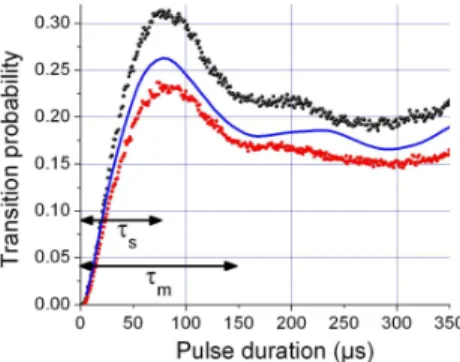
First, we investigate the efficiency of this beam split-ter scheme by comparing experimental results and nu-merical simulations of the evolution of the atomic states, when interacting with the four laser waves. The Fig. 2 shows the measurement of the transition probability from the ground state |gi to the excited state |ei obtained for the atomic clouds as a function of pulse duration. The effective Rabi frequency, defined as usual [28], is Ωef f = 2.77 × 10⁴ rad.s−1. Experimental data are
in good agreement with the results of a numerical cal-culation, displayed as a thick line, in which the basis states are restricted to five momentum states, adding the |g, p ± 4¯hki detuned states to the three previous ones, |gi and |e, p ± 2¯hki. We verified that the population in
the higher momentum states are negligible taking into account our experimental parameters. We consider the case in which the frequency difference between the lasers is set to δω1= (ωe− ωg) + ωRwhere ωR= (¯hkef f
2
)/2M is the recoil frequency. By extension of the calculation presented in [28], we solve the Schr¨odinger equation and calculate the evolution of the populations. The calcula-tion takes into account the Doppler shift linked to the ve-locity dispersion of the atoms and the spatial dependance of Ωef f due to the expansion of the atomic clouds in the
gaussian profile of the Raman beam. In order to keep only the atoms in the two symmetric states |e, p ± 2¯hki, a pushing beam is implemented after the Raman pulse so as to remove remaining atoms in the ground state |gi. In addition, using this scheme, we have verified on the experiment that the beam splitter also realizes a veloc-ity selection of the input momentum state (5.9 mm.s−1
FWHM).
FIG. 2: Rabi oscillation profiles obtained for the two atomic sources S1and S2 at the apex of their trajectory (dots). The
curve is the result of a numerical simulation.
Using this double-diffraction scheme, we realize an in-terferometer with a three pulse sequence (Fig. 1). The first pulse of duration τs= π/√2Ωef f splits the input
state |g, pi into |e, p ± 2¯hki symmetrically. The second pulse of duration τm=√2π/Ωef f acts as a mirror by
coupling each path to its opposite momentum state. Fi-nally, matter-waves are recombined thanks to a third pulse, of duration τs, to form a symmetric
interferom-eter in which the matter-waves propagate in the same internal state |ei. A pushing beam is implemented af-ter each of the two first Raman pulses so as to suppress spurious interferometers. An important feature of this Raman transition scheme is the use of state labeling at the output of the interferometer even if the matter-waves travel in the same internal state. The output phase-shift can thus easily be measured thanks to a fluores-cence technique. The output atomic phase-shift of our device is sensitive to acceleration a and rotation Ω as ∆Φ = 2 keff · (a − 2(v × Ω))T2 [26], increasing the
sen-sitivity of the traditional π/2-π-π/2 three pulse geometry by a factor of two.
principle, insensitive to the main systematic effects: AC Stark shift, temporal fluctuations of the Zeeman effect and magnetic field gradient along the direction of propa-gation of the atomic cloud. Moreover, the interferometer phase does not depend on the laser phase difference as its influence is identical over the two paths.
In order to scan the phase, a controlled acceleration phase shift is induced on the interferometer. This is simply achieved by tilting the apparatus (±50µrad) to get a small projection of the gravity along the axis of the light-pulses. The inclination is measured thanks to a calibrated tiltmeter (Applied Geomechanics 701-2A). In Fig. 1 is displayed the transition probability as a function of the phase shift deduced from the tilt measurement. We observed a contrast of 20% identical for the two atomic sources, attributed to inhomogeneity of the Raman in-tensity over the atomic cloud.
Using horizontal Raman beams makes the interferome-ter sensitive to the vertical component of the Earth rota-tion rate ΩE
z=5.49 × 10⁻⁵ rad.s−1 at the latitude of
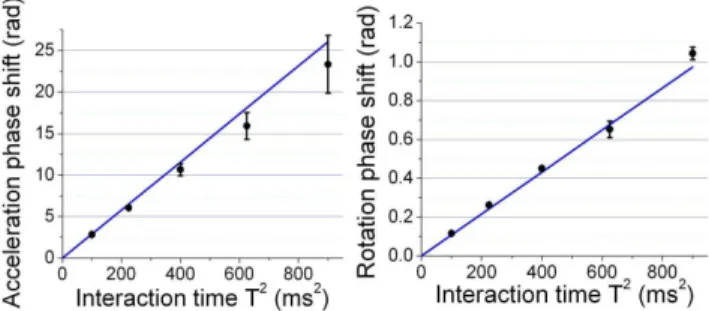
Ob-servatoire de Paris. The quadratic scaling of the rotation and acceleration phase shifts with the interaction time T is verified from T = 10 to 30 ms (Fig. 3). The fits of experimental phase shifts give measurements of the scale factors compatible with the expected values, respectively to 3% and 4% for acceleration and rotation. We deduce a rotation rate of Ωz=5.75 × 10⁻⁵ rad.s−1 in agreement
with the expected projection of the Earth’s rotation rate within the error bar.
FIG. 3: Quadratic scaling of the acceleration phase shift in-duced by the projection of g for an angle of 100 µrad with re-spect to the horizontal plane (Left) and of the rotation phase-shift induces by the vertical component of the rotation rate ΩE
z (Right) as a function of the interaction time T2. The
mea-surements (dots) are compared with the expected behaviors (lines).
The double-diffraction scheme can be extended to higher momentum space splitting thanks to the retrore-flected configuration. After splitting the atoms into the two symmetric states |e, p ± 2¯hki with the first pulse, a second pulse can be implemented to efficiently couple these two resulting states to the next momentum states |g, p ± 4¯hki. The Raman frequency difference of the sec-ond pulse has to be changed to δω2= (ωe− ωg) − 3ωR
in order to fulfill the resonance condition between the
momentum states and the two pairs of Raman lasers. This scheme can be extended to a N pulse sequence to reach up to 4N ¯hk momentum space splitting. In order to conserve the resonance condition, Raman frequency difference of the ith pulse has to be changed and set to
δωi= (ωe− ωg) + (−1)i−1(2i − 1)ωR. Following this
ar-gument, symmetric Raman transitions are suitable to re-alize a large area interferometer with 4N ¯hk momentum space splitting.
Here, we demonstrate an interferometer realized with N = 2, reaching a 8¯hk momentum space splitting be-tween the two paths, using seven Raman pulses. In this configuration (Fig. 4), the first atomic beam splitter is composed of two light-pulses respectively set with de-tunings δω1 and δω2. In this manner, matter-waves are
coupled from the state |g, pi to |g, p ± 4¯hki. The mirror is realized by three successive pulses at δω2, δω1, δω2 in
order to deflect the atoms in their opposite momentum-state. Finally, the two interferometric paths are re-combined with the symmetric δω2, δω1 light-pulse
se-quence. The durations of the seven pulses are respec-tively τs, τπ, τπ, τm, τπ, τπ, τs, where τπ = π/Ωef f. In
addition, four pushing pulses are applied to blow away residual atoms remaining in the internal state |gi.
FIG. 4: Recoil diagram for the 8¯hkinterferometer reaching a total area enhanced by a factor of α. Dotted lines represent wave packets in the |gi hyperfine ground state while solid lines depict the |ei ground state. Colored surface represents the area enhancement compared with the corresponding three pulses configuration.
The total interaction time of this interferometer is 2T = 60 ms. Atoms propagates in the states |g, p ± 4¯hki during 2δt = 40 ms with a delay of (T − δt)/2. The inter-ferometric area increases by a factor of α = 2(1 + δt/T ) compared with the π/2 − π − π/2 configuration. The sensitivity to inertial effects is then proportionally en-hanced up to ∆Φ = α keff · (a − 2(v × Ω))T
2
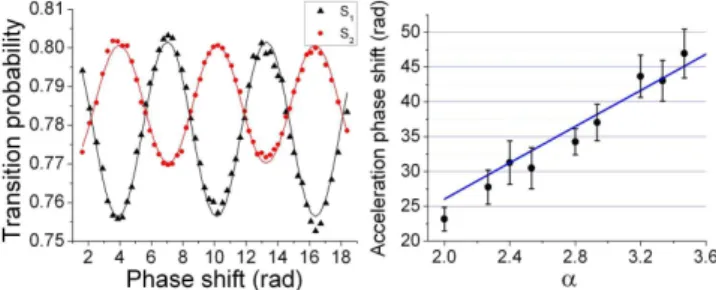
. As be-fore, this phase is scanned by tilting the interferometer. In Fig. 5 we show the fringe patterns of the two sources, obtained with the 8¯hk interferometer. The phase shift between the two interferometers corresponds to the rota-tion phase-shift induced by the vertical component of the Earth rotation rate ΩE
accel-4 eration phase-shift with α was investigated by changing
δt. Figure 5 displays the result of the measurement for δt = 0 to 20 ms which shows a good agreement with the expected slope within 2%. This corresponds to an enhanced sensitivity of a factor of 3.46 compared to the usual π/2 − π − π/2 configuration.
FIG. 5: Left: Fringe patterns averaged over 450 samples. Right: Linear scaling of the acceleration phase-shift induced by the projection of g for an angle of 100 µrad with respect to the horizontal plane as a function of the area enhancement factor α. The measurement (dots) is compared with the ex-pected values (line).
With respect to the 4¯hk case of a three pulse interfer-ometer, the atoms do not remain into the same internal state all along the two paths. Nevertheless, as the inter-nal state changes at the same time for the two partial wave packets, the enhanced interferometer remains in-sensitive to the same systematics as in the Bragg case.
To conclude, we demonstrated a new method of achiev-ing symmetric Raman transitions with 4¯hk momentum-space splitting, deflecting the atoms into the same in-ternal state. Using this double-diffraction technique, we have realized an interferometer of increased area which has been tested by performing acceleration and rotation measurements. The splitting scheme has been extended to reach a 8¯hk interferometric geometry in a seven pulse configuration, opening the way for enhanced 4N ¯hk path separation geometry.
This scheme provides a simple way to increase the sen-sitivity of the apparatus without any significant changes in the experimental setup thanks to the retroreflected Raman configuration. In particular, it does not require extra laser power compared to standard Raman transi-tion based interferometers, in contrast with other meth-ods. Furthermore, as matter-waves are symmetrically driven in the same ground state, interferometers are in-trinsically insensitive to the AC Stark shift, the Zeeman effect and Raman laser phase-noise. The enhanced area geometry thus combines the advantages of Raman and Bragg based interferometers. Moreover, the principle of the double-diffraction can be extended to the case of a non-zero Doppler shift, providing that the two opposite Raman transitions remain resonant simultaneously. This general case require at least three different laser frequen-cies.
Finally, this work provides insight into space-atom in-terferometer design [29]. Indeed, for inertial sensors in zero-gravity environments, Doppler effect can not be used to select one or the other effective Raman transitions in the current retroreflected configuration needed for ac-curacy [30]. The symmetric Raman diffraction offers a promising solution to circumvent this constraint.
We would like to thank the Institut Francilien pour la Recherche sur les Atomes Froids (IFRAF) and the Eu-ropean Union (FINAQS STREP/NEST project contract no 012986 and EuroQUASAR/IQS project) for financial support. T.L. thanks the DGA for supporting his work. We also thank P. Bouyer for careful reading.
[1] A. Wicht et al., Physica Scripta 102 82-88 (2002). [2] P. Clad´e et al., Phys. Rev. Lett. 96 033001 (2006). [3] J. B. Fixler et al., Science 315, 74-77 (2007).
[4] G. Lamporesi et al., Phys. Rev. Lett. 100 050801 (2008). [5] A. Peters, K.Y. Chung, and S. Chu, Metrologia 38 25-61
(2001).
[6] T.L. Gustavson, A. Landragin, and M.A. Kasevich, Clas-sical and Quantum Gravity 17 2385 (2000).
[7] D.W. Keith et al., Phys. Rev. Lett. 66 2693 (1991). [8] T. Pfau et al., Phys. Rev. Lett. 71 3427 (1993). [9] T. Schumm et al., Nat. Phys. 1 57 (2005).
[10] M. Weitz, B.C. Young, and S. Chu, Phys. Rev. Lett. 73 2563 (1994).
[11] E.M. Rasel et al., Phys. Rev. Lett. 75 2633 (1995). [12] D.M. Giltner, R.W. McGowan, and S.A. Lee, Phys. Rev.
Lett. 75 2638 (1995).
[13] S. B. Cahn et al., Phys. Rev. Lett. 79, 784 (1997). [14] M. Kasevich, and S. Chu, Phys. Rev. Lett. 67 181 (1991). [15] Ch. J. Bord´e, Phys. Lett. A 140 10-12 (1989).
[16] A. Miffre et al., Eur. Phys. J. D 33 99 (2005).
[17] A.E.A. Koolen et al., Phys. Rev. A 65 041601(R) (2002). [18] Y.J. Wang et al., Phys. Rev. Lett. 94 090405 (2005). [19] S. Gupta et al., Phys. Rev. Lett. 89 140401 (2002). [20] H. M¨uller et al., Phys. Rev. Lett. 100 180405 (2008). [21] J.M. McGuirk, M.J. Snadden, and M.A. Kasevich, Phys.
Rev. Lett. 85 4498 (2000).
[22] P. Clad´e et al., Phys. Rev. Lett. 102, 240402 (2009). [23] H. M¨uller et al., Phys. Rev. Lett. 102, 240403 (2009). [24] B. Dubetsky and P. R. Berman, Phys. Rev. A 66 045402
(2002).
[25] T. Salger et al., Phys. Rev. A 79 011605(R) (2009). [26] B. Canuel et al., Phys. Rev. Lett. 97 010402 (2006). [27] D. S. Durfee, Y. K. Shaham, and M. A. Kasevich, Phys.
Rev. Lett. 97 240801 (2006).
[28] K. Moler et al., Phys. Rev. A 45 342 (1992).
[29] See, for instance, Quantum Mechanics for Space Applica-tion: From Quantum Optics to Atom Optics and General Relativity, edited by P. Bouyer and A. Bresson, special issue of Appl. Phys. B: Lasers Opt. 84 2006.
[30] A. Landragin, and F. Pereira Dos Santos, in, Atom Optics and Space Physics, Proceedings of the Interna-tional School of Physics Enrico Fermi Course CLXVIII, Varenna, 2007, edited by E. Arimondo, W. Ertmer, E. M. Rasel, and W.P. Schleich (IOS Press, Amsterdam, 2009).