Digitized
by
the
Internet
Archive
in
2011
with
funding
from
Boston
Library
Consortium
Member
Libraries
HB31 .M415
mi^iBi'f
working paper
department
of
economics
AGGREGATE
INVESTMENT
RicardoJ.Caballero No. 97-20 October, 1997massachusetts
institute
of
technology
50 memorial
drive
Cambridge, mass.
02139
JAN
19
1998WORKING
PAPER
DEPARTMENT
OF
ECONOMICS
AGGREGATE
INVESTMENT
RicardoJ.Caballero No. 97-20 October, 1997MASSACHUSEHS
INSTITUTE
OF
TECHNOLOGY
50
MEMORIAL
DRIVE
CAMBRIDGE,
MASS.
02139
Aggregate Investment
Ricardo
J.Caballero*
MIT
and
NBER
First Draft:
February
15,1997
This
Draft:October
8,1997
Abstract
The
90s have witnessed a revival in economists' interest and hopeofexplaining aggregateand microeconomic investment behavior.
New
theories, better econometric procedures, andmore detailed panel data
sets are behind this movement.
Much
ofthe progresshas occurred at the levelofmicroeconomictheories andevidence; however, progressinaggregationandgeneralequilibriumaspects oftheinvestmentproblem
also has been significant.
The
concept ofsunk costs is at the center ofmodern theories.The
implications ofthese costs for investment gowell beyond the neoclassical response to theirreversible-technological
frictiontheyrepresent, fortheycanalsolead tofirstorderinefficiencies
when
interacting withinformational and contractual problems.1
Introduction
Aggregate investment is an important topic. Countries
and
firms are oftenjudged
by
theirperformance alongthisdimension, sinceinvestment isviewedas providing
hope
for future prosperity. It is not surprising, therefore, thatmuch
hasbeenwrittenabout investment. It isevenlesssurprisingthatmany
*Prepared for the Handbook
ofMacroeconomics edited by John Taylor and Michael Woodford. I
am
grateful to Andrew Abel, Steve Bergantino, Olivier Blanchard, JasonCummins, Esther Dufflo, Eduardo Engel, Austan Goolsbee, Luigi Guiso, Kevin Hassett,
Glenn Hubbard,John Leahy,KennethWest,andMichaelWoodfordfor manyuseful com-ments. Ithank the
NSF
for financialsupport.surveys,
and
surveys of surveys, already exist.^ Rather than surveying thesurveys of surveys, as one
would
expect from ahandbook
chapter, I havechosen to focus
most
ofmy
discussion on that which is relatively new.The
cost of this, of coiirse, is thatmost
of the theories I will discuss have notyet passed the test of time
and
are often only half the distance toward fulldevelopment.
Most, but not all, of the subjects I plan to discuss relate directly to
in-vestment in equipment
and
structures. Investingmeans
trading the presentfor the future; as is the case, for example,
when
a firm purchasesequip-ment, builds structures, trains its workers, restructures production, spends
resources
on
R&D,
hoards labor during a recession; orwhen
a worker leavesa job to search for another one, invests in
human
capital; orwhen
a countryundergoes a structviral adjustment, a trade liberalization or a fiscal reform.
The
more
theoretical sections ofthis survey applytomost
oftheseexamples.Further, except for specific empirical results, a large part of the discussion
about equipment
and
structures also applies to other forms of investment.The
style ofthis review article is mostly empirical in early sectionsand
mostly theoretical in later ones. This ordering is highly correlated with the chronology of researchon
investment. It follows that Iam
implicitly askingfor
more
empiricalwork on
the newest theories.The
layout of the chapter is as follows. Section 2 is rather traditional in content. It describes the basic investment theoryand
findings, taking the view that the pre 90's empirical literaturewas
in disarray with respectto finding a role for the cost of capital in investment equations. During
the 90's, however,
we
have learned from long run relationshipsand
"natural experiments" that the cost of capital does indeed have significant effectson
investment, although it is probably not themost
important explanatory variable. Neither, I should add, is measured q.Section 3 describes
what
has been wellknown
but largely ignored until recently: that microeconomic investment islumpy and
mostly sunk. It turnsout that changes in the degree of coordination of
lumpy
actions play animportantrole inshaping the
dynamic
behaviorofaggregate investment.The
old conceptofpent-up
demand
isback. This sectioncontains amore
detailed description of modelsand
techniques than the others. It also attempts to clarify several misconceptions about the implications ofthese models.^See, forexample, Chirinko(1993), HassettandHubbard (1996b), forexcellentsurveys
Section 4is aboutequilibriuminteractions
and
scrapping. It describesthe consequences offree entry and different assumptions about the elasticity ofthe supply of capital for equilibrium investment
and
scrapping. Vintageand
putty-claymodelsarebriefly mentioned as a naturalenvironment inwhich to
addresstheeconomicobsolescenceissue. This conceptisparticularly relevant for understanding capital accumulation during episodes ofrapid growth
and
after substantial shocks to the price ofintermediate inputs.
Section 5 discusses inefficient investment.
The
first part of the section dealswithinformational problems. Discontinuousactiondueto irreversibilityand
fixed costs arecompounded
by the presence of private informationand
create a powerful dragon investment. Inactionis a natural information trap,
small information flows lead naturally to further inaction,
and
the feedbackprocess goes on. Aggregate investment will appear too sluggish given the
ex-post information of an econometrician,
and
it will probably be too slowin responding to
new
conditions relative to firstand
second best scenarios.The
second part ofthis section describeshow
the sunk nature ofinvest-ment,
when
combined
with contractual incompleteness, can lead tounder-investment and, through general equilibrium, to a series of distortions in
the scrapping margin and in theresponse ofinvestment to aggregateshocks.
Financial constraints are discussed within this context.
The
concept of ra-tioning, the efl"ects of underinvestment on complementary factors (and vice versa)and
the relation between excessive capital/labor substitutionand
in-vestment are also part of this section.
The
issue of property rightsand
investment also flts very naturally here.
Section 6 concludes.
2
Basic
Investment
Theory
and
Findings
2.1
Pre
90's:Dismay
Since very early on, economists have attempted to explain investment
be-havior iising both scale
and
relative price variables, and since very early on,the former have been
more
successftil than the latter.One
ofthe first "theories" ofinvestment wasthe accelerator model (Clark1917). Scarcely atheory, the accelerator
model
is derivedby invertingasim-ple fixed proportion productionfunction
and
takingfirst differences. Unablegrowth, this
model
was soon transformed into the flexible acceleratormodel
(Clark 1944,
Koyck
1954):h
=
J2f3rAK:_,, (1)T=0
where
/ denotes investment, the /5r's are distributed lag parameters,and
K*
is the desired, as opposed to actual, level of capital. In the simple fixedproportions world,
K*
can bewritten as alinear functionofthe output level,Y:
K*
=
aY.where
a
is a parameter.The
absence of prices (the cost of capital, in particular) from the righthand
side ofthe flexible accelerator equation has earned it disrespect despite its empirical success. Jorgenson's (1963) neoclassical theory of investmentintended to
remedy
this situation. Starting from the optimization problemof a perfectly competitive firm facing no adjustment costs, myopic
expec-tations,
and
constant returns Cobb-Douglas technology, Jorgenson obtained the standard static first order condition:K
=
aY/Ck,
where
Ck stands for the cost of capitaland
a
isnow
the share of capital ina simple Cobb-Douglas production function.
As
with the accelerator model,this
model was
unableto accountfor theserial correlationofinvestment,and
so gave
way
to the flexible neoclassical model of Halland
Jorgenson (1967),where
K*
=
aY/Ck,
(2)was
now
used in (1).Soon
itwas
shown, however, that by constraining the coefficient of thecost of capital to bethe
same
as the coefficient ofoutput,thismodel
imposedrather than found a role for the cost of capital in the investment function.
Eisner (1969) estimated a modified Hall
and
Jorgensonmodel
which allowedfor different coefficients
on
outputand
the cost of capitaland
found noin-dependent role for the cost ofcapital.
The
cost ofcapital's riseand
fall from gracewas
not anunknown
experi-ence, however. Severaldecades before, authorssuch asTinbergen (1939)and
Meyer and
Kiih (1957)had
pointed out thedominance
ofhquidity variablesover interest rates for short run investment.^
None
of these are full theories of investment, rather they are theories conditional on the level of output."^The
famous q-theory of Tobin (1969)and
Brainardand
Tobin (1968) went one step further.They
argued that investment should be an increasing function of the ratio ofthe value ofthefirm to the cost of purchasing the firm's equipment
and
structures in their respective markets. This ratio,known
as average q,^ summarizesmost
infor-mation about future actions
and
shocksthat are of relevance for investment.^Indeed, average q would laterbe
shown
to be a sufficient statistic forinvest-ment
in a wide variety of scenarios. Thus, thenew
canonical investmentequation became:
I
=
1(1,where
7
is a strictly positive parameter.The
elegant theoretical contributions ofAbel (1979)and
Hayashi (1982)connected the existing theories and partial theories.
They
showed
that theneoclassical
model
with convex adjustment costs yields a 9-model. This q,known
as marginal q, should be interpreted as the marginal value of aninstalled rmit of capital, which corresponds to the
shadow
value of a unit of capital in the firm's optimization problem. Further, Hayashishowed
that(for price taking firms)
when
the production functionand
adjustment costfunctionarelinearly
homogeneous
in capitaland
labor, marginaland
averageq are equal. This isanimportantresult from anempiricalstandpoint because marginal q is unobservable to the econometrician whereas average q is, in principle, observable to the econometrician.*^
^See Chirinko (1993) for amore thoroughreview ofthe history ofthe debate over the
roleof the cost ofcapital, profits andoutput in investment decisions.
'Thingsare even worseforthebcisicfrictionlessneoclassical model; it is iUdefined asa fullmodelbecausefirmleveloutput is not determinedunderconstant returnsand perfect
competition.
''itis alsooften referred to as Tobin's q. ^This includes theoptimalpath ofoutput.
^Ihavemixedfeelings aboutthisequivalence result,however. Not aboutitstheoretical derivation, which is elegant and useful; rather about its abuse in empirical work. Too
often, it is used tojustify substituting average for marginal q on the right hand side of
investment equations, even though theassumptions required for the equivalencebetween the two are not nearly satisfied in the industry or firms studied (e.g. Compustat). This does not meanthat average q should notbe used, butit saysthat weshould not pretend thatthefoundationforitsuseisbeyondthebasic intuitionprovidedby Tobin (1969), and
Soon, however, the g-model, along with
expanded and
ad-hoc "flexible-g"models (i.e. with additional lags of q
on
the righthand
side), joined models basedon
the cost of capital in their lackofempirical success. Scale variablessuch as cash-flows always
seemed
to mattermore
in investment equationsthan q which, in principle, should have been a sufficient statistic.^
Figure 2.1 below, which reproduces figures 1
and
3 in Hassettand
Hub-bard (1996b), helps us imderstand the statistical reasons for the problem.The
bottom
lineis clear: Inaggregate U.S. data (whichis probably represen-tative ofmany
otherdatasets for this purpose) the unconditional correlationbetweencost of capital
and
investment islow,and
sois that between averageq
and
investment.On
the other hand, cash flowsand
sales's growth closelytrack aggregate investment.
The
80's discontent withrespect to investment equations is probablywellcaptured in Blanchard's (1986) discussion of Shapiro's (1986) investment
paper at Brookings: "... it is well
known
that to get the user cost to appearat all in the investment equation, one has to display
more
than the usualamount
of econometric ingenuity, resortingmost
of the time to choosing aspecification that simplyforces the effect to be there....'"
(my
emphasis).Today, the first emphasized statement still holds, but the second one
probably does not. This takes
me
to the next subsection.2.2
"Econometrics":
Cost
of
capital
and
qmatter
Econometric "ingenuity" eventually pays off, although this oftenmeans
iso-lating that part of the relationship which conforms with the theory, rather
than explaining a substantial fraction ofthe
movements
ofthe lefthand
side variable, or even relating a significant fraction of the volatility of the righthand
side variables to that ofthe lefthand
side variable. Inmy
view, this isthe typeofpayoffobtained fromthe recent incarnations ofthe "traditional"
fine. Still, it is progress.
Going
from less tomore
ambitious, there are two generic developmentsI wish to discuss. First, ignoring high
and
medium
frequency variations,we
have
come
to the realization that the low frequency aspects ofthe data arethat the additional propertiesthat hold for marginal q are tobe expectedfrom average q (e.g. sufhciency).
^Fazzarietal. (1988) started alargeUteraturedocumentingtheroleof thesevariables,
evenafterconditioningfor averageq. Iwill retinrntotheinterpetation oftheseregressions later inthe survey.
Vi
o
03 0) (30 (U «-i &0 tiO<
10 a. =3 o •a c nO
O) o s to 04 O 5 fM o I 1 1 1 1 O 1 ^ (M r» ^ O-^___ov
eo CT. °'^ biX. . 2^ ^S^ m' "c v.__ • 5 3 "" N \. = o ;.:.:o:.::.:.x.:.;:.:^^:::•: :•;•.:;•:::•:•:.. _ r'-s _ k t Ji—* ~ \ ^-V
y
-y
"'^^ ^ j^ A r t \ ' .r
^
J, S ) V X^
\ >y y -_ •S-Wl-iSfKwfSiS^:::::::^^ ;:::::::x:::::::::::::::::::4 :';-:vX->:-:*V;':':':-y^:|)^-iir\T?!T:*^^^^^ :-:-:':-:':-:":':-:v:':':':i / A. •^^ \ •• / — Mfi-^if^viii^^r^^MiSiimmA SSiSiJSSHSi Sir' s -—-^/ f** X. -> >v^ . s\
-s \ V \ '"v^ > *~r"^^S
1 1 ^-"V/
\ T •'••••••'••••' ' • r < ' ' (U3
00 c '5 c 0)a
(0 c E Q. "3 cr lU o M *^ C (0 c1
0)Q
n c 0) E n T3 c 3sssas.o.
2SS
S.| ' ' ' r,' 1 1-a
i^~~~
>
" o. ^^^ /^ -%. ^"^ ^ > • }r^m;f:>-i'-~---A
u- 1 -UJ -3 J-^C<i
.--- 5 -tt^—
—
:; ——«,^lil|i||
^
-^^^tL-'ii;--'''''""'"--"'^
<y
-''-' <-:; r 1 "^M> 5 ^.^^—
5 X,\
S / 1 -2 -—-^ 1 ,--;-i----.i-:..:i>r*SSiWF
Q000
H4''
1 1 i^^
-3 • ^ ll ^^
" ^"^ DQ. ^^"^ 1-./^
-"^.wTT, :^:.:.:.:.>:.::.:v;.:-s;ssS¥;i:2Mmmm.
•:•:•:•:•::::•:::::: 5^^.^.:.:.:.:.:.: ._—pCT .^^;
, >-^^-v .liii^
Sfcs»
^
K
\ 5^
2> I 1^
c^>
-.» -4i- -J* ^2? _ 1-C'^
mpw''
~ ? I .SJ
' \ \ e o« - f fi. J s I iri •" - ? f J t - Inot inconsistent with theories that assign an important role to the cost of capital in determining the rate of capital accumulation. Second, there are distinctive episodes duringwhich changesinthecost of capitalaresufficiently
dramaticthat it
becomes
possible to demonstratethe importance ofthe cost of capital at higher frequencies as well.Other recent developments within the traditional line include the use
of Euler equation procedures. In
my
view,and
unlike the case in basicfi-nance
and
consumptionapplications, theseproceduresareaformofmorphine
rather than a remedy: their lack ofstatistical power allows us to sometimes
not seethe problem. Since
my
goal is to discuss progress, I will skip resultsobtained with these procedures.^
2.2.1
Long-run
Many
oftheproblems withinvestment equationshaveto do withthe presenceof
complex and
not well understooddynamic
issues (moreon this inthe nextsections).
From
early on, researchers have found it tiseful to think aboutinvestment in
two
steps: first, derivesome
simple expression for a "target"stock of capital, which I have called
K*
here;and
second,model
dynamicsas a, possibly complex, function of contemporaneous
and
lagged changes inK*. It seems sensible, therefore, to start by asking whether the first step
resembles
what
we
expect before going into the difficult issues oftiming.Taking logs on each side of (2), disregarding constants,
and
relaxing theunit elasticity constraint
on
the cost ofcapital, yields:k*
-y =
-yck, (3)where
lower caseletters denote logarithmsand 7
is the parameterofinterest.This expression cannot be estimated, of coiirse, becaiise k* is not ob-served. There is a simple argument based on cointegration, or a close small
sample "cousin," which allows iis to get aroimd this observability problem,
however.
The
whole purpose of deriving k* is to thenmodel
k as trying tokeep pace with it. Thus, differences between these
two
variables should onlybe transitory (up to constants). If k*
and
k are sufficiently volatile (ide-allywithunit roots, in largesamples), thenwe
can "ignore" the discrepancybetweenthese two variables in estimating 7. Let
k
=
k*+
e,*See Oliner, Rudebusch and Sichel (1995) for adamaging evaluationofthe statistical properties oftheseprocedures.
with e a stationary residual that captiores transitory discrepancies between
the
two
variables due to adjustment costs. Substituting this expression into(3) yields an equation that can be estimated:
k
-
y=
jck+
e. (4)Estimating this equation by
OLS
(the simplest of the cointegrationproce-dures) yields, for aggregate U.S. data, an estimate of
7
of-0.4; significantly different from zero.''We
can do better, however. In any small sample, the cointegrationar-gument
will not take its full bite, and the estimates of7
will be affectedby
the correlation between regressors
and
e. Caballero (1994a) argues that this is particularly seriousand
systematic in models with slow adjustment (e.g.due to adjustment costs).
The
intuition behind thisidea is simple.A
partialadjustment
mechanism
implies that, in any finite sample, the variance ofK/Y
ought tobe less thanthe variance oiK*/Y,
whichmeans
the lefthand
side of (4) ought to be less volatile than the right
hand
side of (3), or 7Cfc.^°However, by thenormal equations of
OLS,
theestimated counterparts of'yckand
e on the righthand
side of (4)must
be orthogonal, so that the varianceoffc
—
y is greater than the variance of70^, which is equal to the variance ofthe estimated k*
—
y. Since this inequality is in contradiction withwhat
isimplied by adjustment cost mechanisms,
we
conclude that the estimate of7
is biased toward zero.Using
Monte
Carlosimulations, Ishowed
inthat paper that thisbias can be substantial,and
then proceeded to correct it using Stockand
Watson's (1993) procediire. I obtained an estimate of7 close to minus one, very near the neoclassical benchmark.^^
^This estimateof7wasobtained usingU.S. quarterlyNIPAdatafortheperiod 1957:1-87:4. Capital corresponds to equipment capital and cost of capital is constructed as in
Auerbach and Hassett (1992).
^"Note thatifadjustmentcostsarenon-convexit ispossible, atthemicroeconomiclevel, and in a sufHciently short sample, to have these relative volatilities reversed. This is not an issue for the aggregate data results discussed here. See the next section for more on
non-convex adjustment cost models.
^^SimilarestimateswereobtainedbyBertolaandCaballero (1994) and Caballero,Engel and Haltiwanger (1995) withdifferent datasets.
2.2.2
Short-run
Demonstrating a relationship between capital accumulation
and
the cost of capital at higher frequencies has required two changes in approach: first, achange in emphasis from aggregate to microeconomic data;
and
second, the use ofnatural experiments, such as periods oftax reform, which present the econometrician withmore
accurate measures of (often substantial) changesin the cost of capital
and
q. Measures of q, for example, are not onlyvery-noisy because of the substitution of average q for marginal g, but also
be-cause there
may
be substantial "non-fundamental"movements
in the valueof firms,
making
average q mismeasured as well. However, there are certainepisodes (e.g., periods oftax reform)
when
themovements
in q are likely tobe large, in a predictable direction,
and
for the "right reasons".As
withcointegration, during those episodes problems with the residual canbe
more
or less disregarded.
The movement
from aggregate to microeconomic data,by
itself, has notdone
much
to improve affairs. Although microeconomic data has improvedprecision, coefficients
on
the cost of capitaland
q in investment equationshave remained embarrassingly small.
Combined
with the use of naturalex-periments, however, emphasis on microeconomic data has
had
much
higherpayoffs.
The
work
ofCummins,
Hassettand
Hubbard
(1994, 1996) is salient in this regard.They
isolateperiods withimportant tax reformsand
findthat the coefficienton
qismuch
larger inthoseepisodes.Most
recently, using firmlevel datafor 14 developed countries, they find that while usingstandard
in-strumental variable procedures yields coefficients
on
qwhich range from0.03 to 0.1,when
contemporaneous tax reforms are includedamong
theinstru-ments, the estimates
jump
to a range between 0.09 to 0.8, withmedian and
mean
not very far from 0.5. In the U.S., for example, the estimate of thecoefficient
on
qjumps
from 0.048 to 0.65.^^Although these empirical results represent significant progress, there is still plenty of
work
needed to retrace the steps back to the aggregateand
we
must
not forget that a substantialcomponent
ofthe variation inaggre-gate
and
microeconomic investment remains unexplained.The
next sectionsdescribe progress
on
both fronts. 123
Lumpy
and
Irreversible
Investment
Investment is a flow variable,
and
as such it is very sensitive to obstacles.Investmentisthe by-productofthe process by whichthecapitalstock catches
up
with its desired level; but there aremany
paths leading the former to thelatter. Inthissection I begindiscussing
some
of theseobstacles, emphasizingthose that have
had
prominence in the recent literature.3.1
Plant
/Firm
Level
The
most
basic form offriction occurs at the level of microeconomic units,and
goes under the general heading ofadjustment costs.3.1.1
Microeconomic
Adjustment:
ChctracterizationThere are essentially three basic types of adjustments observed at the
es-tablishment level: (a) ongoing frictionless flow (maintenance); (6) gradual
adjustments (e.g. refinements and training dependent improvements); (c)
major
and
infrequent adjustments.^^The
structural literature of the 80'sand
before, based explicitly orim-plicitly on convex adjustment cost models (the quadratic adjustment cost
model, in particular) dealt with (a) and (6).
The
implicit "hope"was
thatthe smoothness brought about by aggregation would
make
disregarding theimportance of infrequent adjustments for individual units, unimportant for
aggregate
phenomena.
Instead, the ideawas
to derive aggregate investment equations as coming from thesolution tothe optimization problem ofaficti-tious agent facing adjustment costs which only ledto
smooth
adjustments oftype (a)
and
(6).Many
authors disagreed withthisstrategy (e.g. Rothschild1971); but for
most
the relative simplicity of the quadraticmodel was
tooenticing to resist.
A
combination offactors eventually led economists to revisitand
reeval-uate
some
of the shortcuts which were in widespread use by the end ofthe80s.^^ First, there was frustration with the disappointing empirical results
described above. Second, techniques which could handle models of
lumpy
^^Which may, inturn, have a time to build aspect.
^^Cronologies are never exact, of course. For example, Nickell had already discussed
irreversibleinvestment and many ofits implications in 1978; but the mode did not move
until muchlater.
investment
became
part of themodern
economist's tool kit.And
third,mi-croeconomic data
made
the obvious evenmore
apparent: microeconomicinvestment is extremely lumpy,
and
this lumpiness is unlikely to fully "washout" at the aggregate level.
The
work
ofDoms
and
Dunne
(1993) was instrumental in stressing thelast point.
They
documented
investment patterns of 12,000 plants in U.S.manufacturing over the 17 year period, 1972-89. Their findings are many, of
which I have chosen to emphasize those that are
most
closely related to thepurpose ofthis survey.
For each establishment,
Doms
and
Dunne
constructed a series of the proportion ofthe total equipment investment ofthe establishment (over the 17-yearperiod)made
ineachyear.They
foundthaton average thelargestin-vestment episodeaccoimts for
more
than25 percentofthe 17 year investmentofan establishment
and
thatmore
than halfofthe establishments exhibitedcapital growth close to 50 percent in a single year.
They
also note that thesecond largest investment spike often
came
next to the largest investmentspike (right before or right after) suggesting that both spikes correspond to
a single investment episode.^^
Combining
the two primary spikes, they findthat nearly 40 percent of the sample investment of the
median
establish-ment
probably corresponds to a single investment episode.^^ Moreover, thisis likelyto be a lower
bound on
the Imnpiness ofinvestment sincethesenum-bers correspond to establishments that remained in the sample during the
entire 17 year period.
Adding
entryand
exit would undoubtedlymake
theevidence on microeconomic lumpiness even
more
apparent.As
forevidenceon
themacroeconomic
relevance ofmicroeconomiclumpi-ness,
Doms
and
Dunne
offer several hints. First, usingdataon about 360,000 establishmentsfor Censusyears 77and
87, theydocument
that about 18 per-cent of aggregate investment is accounted for by the top 100 projects.As
^^Aninvestment projectmaynotbefully counted withinoneyear sincenot allprojects starton January1, andcertainlymaytakemorethana few daystoimplement. Oneshould
not confuse "time to build" with the standard convex adjustment costs. Timeto buildis
the optimalscheduhngofa givenlumpy project, while inthe standardconvex adjustment
costs model the firm changes this project continuously and smoothly (see Caballero and
Leahy 1996).
^^Cooper, HaltiwangerandPower(1994) goonestep furtherincharacterizing infrequent
lumpiness. Using a data set similar to that of
Doms
and Dunne, they show that theprobability ofafirm experiencing amajorinvestment spike isincreasing inthe time since
the last major spike. This feature ofthedatais highly consistentwith theimplications of
the models reviewed later in this section.
a metric, only 6 percent of
employment
is in the top 100 employers,and
less than 10 percent of production occurs in the top 100 producers.
More
importantly, they
show
that thetimeseries correlationbetween aggregatein-vestment
and
a Herfindahl index ofmicroeconomic investments is very high (close to 0.45).They
also constructed a series with thenumber
of firmsun-dergoing their primary investment spike during each year.
They
show
thatthis measure, rather than the average size of these spikes, closely tracked aggregate investment.^^
The
subsections that follow describemodels which arebroadly consistentwith these findings,
and
reviews structural evidence based on these models which lends further support to the view that microeconomic lumpiness isvery important for aggregate investment dynamics.
3.1.2
"Representative"
problem
There is by
now
a vast literature (and surveys of it) describingmicroeco-nomic
models able to capture the essence of thelumpy
and discontinuousadjustment highlighted bythe evidence described above. Rather than giving
a thorough presentation ofthe canonical model, I refer the interested reader
to one ofthese surveys.^^ Instead, I will only sketch the problem, mostly to characterize the nature of the solution and to develop notation which will
prove useful later.
Let actions
and
realizations ofshocks evolve in discrete time, with timeintervals, A^. Havingoptimized overallinputs butcapital during the period,
a firm with stock of capital
K
and facing conditions 9, has a flow ofprofitsnet of rental cost ofcapital:
U{K,
6)At
=
{K'^e-rK)At
<
7
<
1, (5)where
K
is the firm's stock of capital; ^ is a profitability index thatcom-bines
demand,
productivityand
wage
shocks; r is the discoimt rate;and
7
represents the elasticity of gross profits with respect to capital. It is lessthan one as long as the firm exhibits
some
degree of decreasing returns ormarket power, which I assume to be the case. For convenience, capital does not depreciate.
'^Where aggregate investment corresponds to the investment ofall the establishments
in their sample.
'^Dixit (1993) providesanexcellent discussion ofthebasicproblemand the
mathemat-ical techniquesneeded to solve it.
It will also facilitate things to
assume
that increments in the logarithm of 6 are i.i.d.,and
thattimeand
the samplepaths of ^ are "almost" continuous(i.e.
At
is smalland
changes in the value of 9 over an interval of timeAi
are small). Imake
these assumptions so I can, informally, use all the conve-nience ofIto'slemma
and Brownian
motions. I choose to depart from strictcontinuous time,
on
the other hand, because discrete time will allowme
topresent this section in a
more
unified manner.As
in the previous section,we
can findan
expression for the staticopti-mum
ofthe stock of capital, or "desired" capital:/!:*
=
argmax^n(/C,^)
=
(7^/r)^.
(6) It is apparent fromthis expression that
K*
inherits the stochastic properties of 6, so it also follows a geometricrandom
walk. Moreover, the measure of capital "imbalance:"also inherits the geometric
random
walk process, for any givenK.
Substi-tuting this expression into (5)
and
using (6) to solve for 6 yields:I[{Z,K*)^-{Z'' --iZ)K*
0<7<1,
(7)In order to generate infrequent actions, the cost of adjusting the stock
of capital
must
increase sharply around the point of no adjustment.A
costproportional to the size of adjustment is
enough
to do so.Lumpiness
re-quires a little more, for there
must
be an advantagein bunching adjustment;increasing returns in the adjustment technology is the standard recipe, of
which afixed cost is the simplest. Let C{rj,
K*)
denotethe cost ofadjusting the capital stock by K*ri:C(r,,K-)
=
it.K^m-[^l^_f^
llll
(8)where
theK*
term
ensures that the relative importance ofadjustment costsremains
unchanged
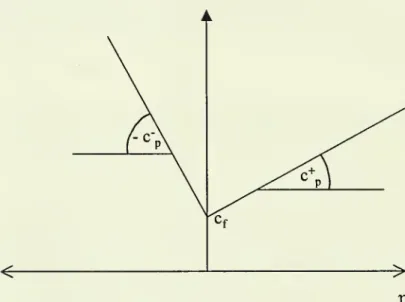
overtime.^^ Figure3.1 illustratesan exampleofC(.,)/K*.
^^Thisgoalwould alsobeaccomplishedby K,butK*
yieldsslighltysimplermathemat-ical expressions at a low cost interras ofsubstantive issues.
Also, Ihave allowed proportional costs to differwith respect toupward and downward
adjustraents inorder to talklater aboutthe irreversible investmentcase; for thispurpose, Icouldhave doneit equally wellthrough asymmetricfixedcosts. Allowingfor bothforms
ofasymmetries simultaneoulsy is atrivial but uninteresting extension.
Figure
3.1Adjustment
Costs
i
The
problem of the firm can be characterized in terms oftwo
functions ofZ
and
K*:V{Z,K*)
and
V{Z,K*).
The
functionV{Z,K*)
representsthe value of a firm with imbalance
Z
and
desired capitalK*
if it does notadjiost in this period,
and
V{Z,
K*)
is the value ofthe firm which can choosewhether or not to adjust. Thus,
V{Zt,
Kl)
=
U{Zt,K:)At
+
(1-
rAt)Et [k(Z,^a.,K^^m)]
, (9)and:
V{Zt,K:)
=
ma^!^V{Zt,K:),max{V{Z,
+
ri,K:)-C{rj,K:)}y
(10)The
nature of the solution of this problem isnow
intuitive. Given thefunction
V{Z,K*),
equation (10) providesmost
ofwhat
is needed tocharac-terize the solution. First, since
C
is positive even for small adjustments, it isapparent that
when
Z
is near that value for whichV{Z,K*)
is maximized,the first term
on
the righthand
side of (10) is larger than the second term; that is, thereis arange ofinaction. Second, sinceboth adjustment costsand
the profit function are
homogeneous
ofdegreeone with respect toK*
, so areV
and
V. Thus, it is possible to fully characterize the solution in the spaceof imbalances, Z.
Among
other things, this implies that the range of inac-tion described before, is fixed in the space of Z. LetL
denote theminimum
value of
Z
for which there is no investment,and
U
themaximum
value forwhich there is no disinvestment; thus the range ofinaction is (L, U). Third,
conditional on adjustment, changes
must
not only be largeenough
tojustify incurring the fixed cost, but also the (invariant) target pointsmust
satisfy:vz{i)
=
c; (11)and
Vz{u)
=
-c;, (12)where Vz
is the derivative ofV
with respect to Z, while Iand
u
denotethe target points from the left
and
right of the inaction range, respectively.These
first order conditions areknown
as "smooth pasting conditions,"and
simplysay that, conditionalon
adjustment taking place, itmust
ceasewhen
the value of an extra unit of investment (or disinvestment) is equal to the additional cost incurred
by
that action.There are two additional
smooth
pasting conditions:Vz{L)
=
4
(13)and
Vz{U)
=
-c;, (14)whichensure no expected advantage from delayingor advancing adjustment by one
Ai
around the trigger points.These
smooth
pastingconditions areenoughtofindthe optimal (L,l,u,U)rule, given the value function. In order to find the latter, however,
we
needto go back to equation (9). Standard steps reduce this equation, in the
in-terior ofthe inaction range, to a second order differential equation.
The
two
boundary
conditions required to findV
are obtained from equalizing thetwo termson
the righthand
side of (10):V{L,
K*)
=
V{1,K*)
-
[cf+
c;{l-
L))K\
(15)and
V{U,
K*)
=
V{u,K*)
-
(cf+
c;{U
-
u))K\
(16)which simply say that since the investment rule (optimal or not!) dictates
that once a trigger point is reached, adjustment
must
occur at once, the only diff'erence in the value ofbeing at trigger and target pointsmust
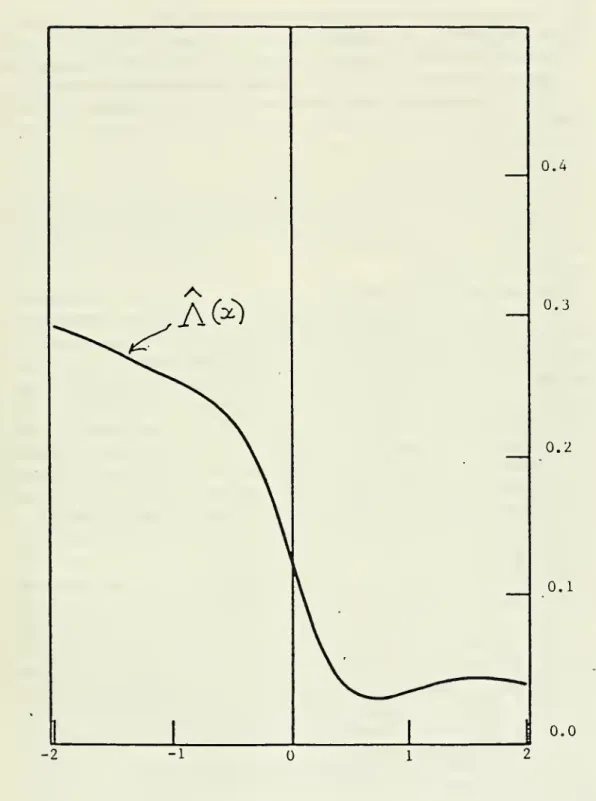
betheadjustment cost of
moving
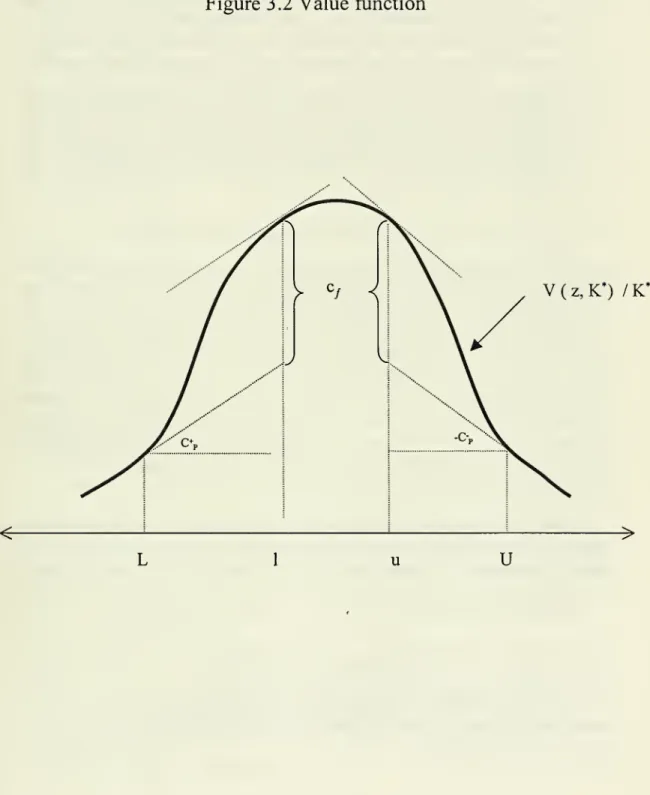
from the former to the latter.Figure 3.2 illustrates the value function.
Smooth
pasting says that the tangents atL
and
I have slope c^, while those atU
and
u
have slope —c~.Value matching says that the value fimction evaluated at the target minus
the value function evaluated at the trigger point is equal to the variable cost
paid at adjustment plus the fixed cost (all these normalized by
K*
in thefigure).
There are a few particular cases which are worth highlighting because
they appear often in the literature:
1. Ifthere is no variable cost ofinvestment, oncethe adjustment decision
has been talcen, adjustment firomboth sides is complete sincethe
mar-ginal cost of adjustment is zero. Thus, the (L,Z,u,U) rule reduces to
an (L,c,U) rule, where c is the
common
target for investment as well as disinvestment,and
is that value which maximizesV{Z,K*)
for any^"Notethat ingeneral
c^l.
That is, the optimaldynamictarget isgenerally differentfromthe static one.
Figure
3.2Value
function*\ /T.r*
V
(z,K') /K
2. If there are variable costs but no fixed cost, there is no reason for
adjustment to be lumpy, for there are no increasing returns in the
adjustment technology.^^
Once
the boundaries of the inaction range,L
and
[/, are reached, the firm adjusts justenough
to avoid crossing outside the inaction range; that isL
and
U
become
reflecting barriers.3. Ifthere is a large (not necessarily infinite) cost to disinvestment, then
investment becomes irreversible. In the absence of investment costs,
the investment rule reduces to a single reflecting barrier L, which is to
the left ofone (reluctance to invest). This is the standard irreversible
investment case.
3.1.3
A
detour:Q-Theory and
Infrequent
Investment.
One
ofthemain
manifestationsoftheempiricalfailureofpreviousinvestmenttheories, has been the difficultyinfinding either a significant
and
sizablerole for g, or evidence that it is a sufficient statistic for investment.Do
the theories studied in this section help explain these empiricalfail-ures? I see two reasons to believe so.
The
first one is rather negative.Q-theory is no longer robust in our setting, so there are
many
scenarios wherewe
should not expect it to work.The
second one ismore
positive. In thesubclass of models where it does work, the functional form relating q and
investment is likely to be highly non-linear, thus quite different from the
standard linear regressions leading to the rejection of Q-theory.
On
the fragility ofmarginal q.It is apparent from the lack of global concavity ofthe value function in figure 3.2, that traditional g-theory is not likely to
work
in the presence ofjumps. Caballero
and Leahy
(1996) develop the argument in detail, which Isummarize
below.The
value ofthe firm is equal toK
-\-V^ thus marginal q is:^^g^(Z)
=
H-V^^
=
l+
^.
(17)^^And we have already assumed that shocks are "small" in any given At.
^^Recall that
V
was defined as thepresent value ofprofits net ofadjustment costs andinterest payments on capital.
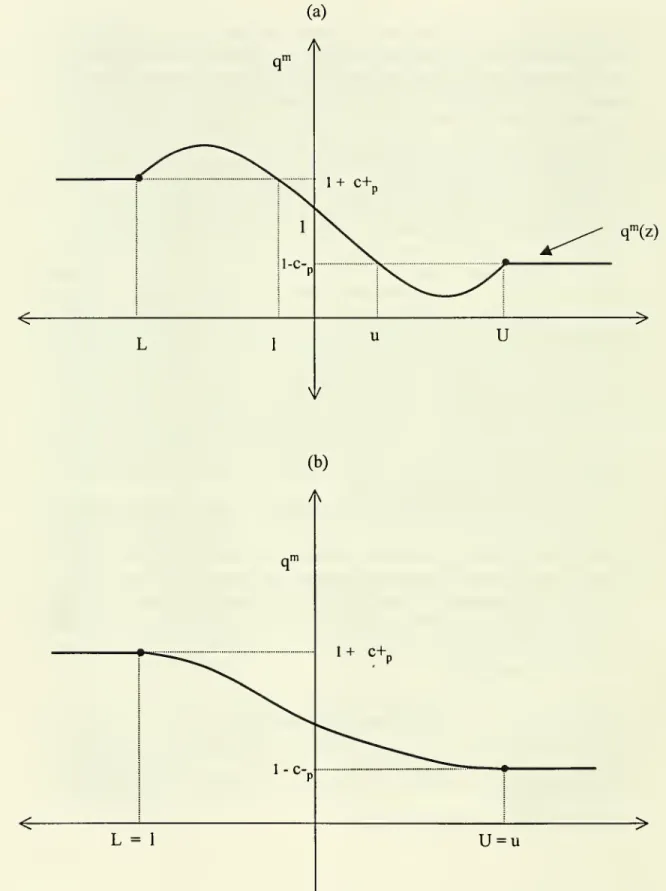
Figure 3.3a plots
g^
against the imbalance measureZ?^
Smooth
pastingimplies that
q^
must
be thesame
at triggerand
target points (becauseVz
must
be thesame
at triggerand
target points); ifthere arejumps, these are points very far apart in state space.Two
points with thesame
value ofq^
lead to very different levels ofinvestment (zeroand
large). Moreover, sincethe value function
becomes
linear outside the inaction range, all points out-side the inaction range (on thesame
side) have thesame
g^,and
allofthem
lead to different levels ofinvestment. It is apparent, therefore, that the func-tionmapping
q^
into investment no longer exists. Worse, in between triggerand
target points, the relationbetweenq^
and
Z
is not even monotonic.What
is happening? Marginal q is the expected present value of themarginal profitability of capital. Far from an adjustment point, it behaves as usual with respect to the state of the firm: if conditions improve, future
marginalprofitabilityof capitalrises,
and
so doesq^
. Closetothe investmentpoint,
on
the other hand, the eff'ect of a change in the state ofthe firm over theprobability ofalargeamount
ofinvestment inthe near futuredominates.An
abrupt increase in the stock of capital brings about an abrupt decline inthe marginal profitability of capital as long as the profit function is concave with respect to capital.^^ Thus, an
improvement
in the state of the firmmalces it very likely that it invests in the near future, reducing the expected marginal profitability of capital in the near future, thus lowering the value
of
an
extra unit of installed capital.Caballero
and
Leahy
(1996)show
that addingaconvex adjustmentcosttothe problem does not change the basic intuition ofthe
mechanism
describedabove.
They
also show,somewhat
paradoxically, that average 5, which isoften thought of as a convenient albeit inappropriate proxy for marginal g,
tiirns out to be a
good
predictor ofinvestment even in the presence of fixed costs, although it is no longer a sufficient statistic, except for very specialassumptions about the stochastic nature ofdriving forces.
When
does Q-theory work?The
failure of g-theory described above is rooted in the presence ofin-creasing returns in the adjustment cost function (8). This featm-e of the
adjustment technology is responsible for the loss of global concavity of the
^"'See,forexample,Dbcit (1993) foracharacterization ofthe (L,Z,u,U)solutioninterms
ofasimilar diagram. ^^Which
I taketo bethe standardcase.
Figure
3.3Marginal q
q'"(z)
value function, which is behind the non-monotonicity ofmarginal q?^
Monotonicity of
q^
insidetheinactionrange isrecoveredby dropping thefixed cost from (8), as
was
donein cases 2and
3 in section 3.1.2. Figure 3.3bportrays this scenario. Adjustment at the trigger points no longer involves large projects, thus proximity to these triggers no longer signal the sharp
changes in futiire marginal profitability of capital which were responsible for
the "anomalous" behavior ofq^'^}^ There is still the issue that in the (very) rare event that a firm finds itself outside the inaction range it will adjust
immediately to the trigger, at a constant marginal cost, so different levels of
investment are consistent withthe
same
value ofq^. This is easily remedied by adding a convexcomponent
to the adjustment cost function:^^C{r],K*)
=
{AKj^O}K*{cp\T]\
+
Cg\vf} /?>
1. (18)This is essentially
what
Abel and Eberly (1994) do.^^ Absent the advantageoflumping adjustment brought aboutbythepresence offixed costs, standard
g-theory is recovered whenever the firm invests. Provided adjustment takes
place, the firmequalizes themarginal benefit ofadjustment
and
the marginalcost of investing, which is
now
an increasing function ofadjustment:q''
=
l+
sgn{rj){cp+
Pc,\rjf-'),
for T] y^ 0.
By
setting r] to zero,we
can obtain the boundaries of inaction ing''^-space. Indeed, investment will not occur if
1
-
Cp< q^ <
1+
Cp.Abel
and
Eberly (1994) go further, andshow
that their insight is robustto the presence of/Zou;-fixed costs.
That
is, fixed costs which are multipliedby
At; ifadjiistment occured instantaneoulsy, the firm effectivelywould
pay nofixed cost. Because oftheconvex adjustment component, thefirm chooses not to adjust instantaneouslyand
pays the fixed costs instead. In a sense,^^Indeed, value functions for (5,s) models are often only i<'-concave.
^^Ofcourse, once at the trigger, large projects may result from the accumulated and
—
more or less—
continuous response to a sequence of shocks with the same sign. But this does not give rise to a sharp change in profitability since investment occurs only inresponse and tooffset new, as opposed toaccumulated, changes inprofitabihty. ^'^Which, atthe same time, makes transitions intothe inactionrange lessrare.
^*Needless to say, it is trivial to add asymmtries to the adjustmentcost function. But
that is beside the point ofthis section.
the endogenous adjustment decisions
and
the fact that the fixed cost goesto zero as adjustment speeds up, ensures that the fixed cost remains rela-tively "small,"
and
so do investment projects.^^ It is important to realizethat their paper "unifies" ^'-theory with irreversible investment
and
regula-tion (i.e. infrequentbut infinitesimal adjustments) problems, but it does not unify it with the standard (5, s) hterature onlumpy
adjustment, which is, unfortunately, theway
many
have interpreted their results.Barnett
and
Sakellaris (1995) study a panel of U.S. firms searching forevidence on a reduced sensitivity of investment to changes in q
when
thelatter is close to one (the "inaction" range).
They
find theopposite; in their panel, afirm's investment seems to bemore
rather than less responsive to qwhen
q is closeto one. Abel and Eberly (1996), however,show
that allowingfor unobservedheterogeneityintheinactionrangerelevant fordifferenttypes
of investments could explain the negative Barnett-Sakellaris finding.
Taking stock.
One
may
be inclinedtoconclude fromthissectionthat beforegoingahead with g-theory one should check whether investment literally exhibitsjumps
or not. This is not the lessonI draw, however.
For once, this is not right. It is not difficult to
add
a time to build mech-anism such that alumpy
project isdecomposed
into a fairlysmooth
flow,without alteringthe argument of
why
marginal qfails inthe presenceof fixed costs.But
more
importantly, I suspect themain
lesson is one of modesty. Idoubt that researchers will often find the required data and/or patience to
determine whether onescenario or the other holds. Inthis case,
we
might as well acknowledge that therelationship between marginal qand
investment isnot robust,
and
that averageqis unlikely tobe asufficientstatistic forinvest-ment.
Of
course it is important to include variables that captureknowledgeof the future
on
the righthand
side ofinvestment equations, butwe
should avoid reading "toomuch"
from these regressions.^^Alternatively, if one assumes perfect competition and constant returns to scale, the
profit function becomes linear with respect to capital (ifthe other factors ofproduction canbeadjustedat will),sochangesininvestmentdo notfeed backinto q. Inthis extreme
case, the modified (i.e. with an inaction range) g-theoryworks well even inthe presence
of traditional fixedcosts.
3.1.4
Another
detour: SeveraJmisconceptions
about
irreversibleinvestment.
As
I mentioned before,when
describing the special case of irreversiblein-vestment, the regulation barrier, L, is to the left of one.
That
is, investmentoccurs only
when
the stock of capital is substantially below the frictionlessstock of capital. Alternatively, investment occurs
when
the marginal prof-itability of capital is substantially above the cost of capital. This is thefamous
"reluctance to invest" result.There are several misconceptions about the implications of this
"reluc-tance" result. I will mention three of them. It is often said that, (a)
re-luctance implies that, in the presence ofirreversibility, the firm accumulates
less capital; (6) since reluctance rises with uncertainty (the regulation point
moves
further to theleft),more
uncertaintyimplies less capital;and
(c)stan-dard present value techniques are inappropriate because reluctance reflects
the value of the "option to wait" for
more
information before irreversiblysinking resources
and
this is not taken into account by the standardformu-lae.
In orderto
show
the fallacious nature ofthe first statement, it is useful togo back to our canonical problem
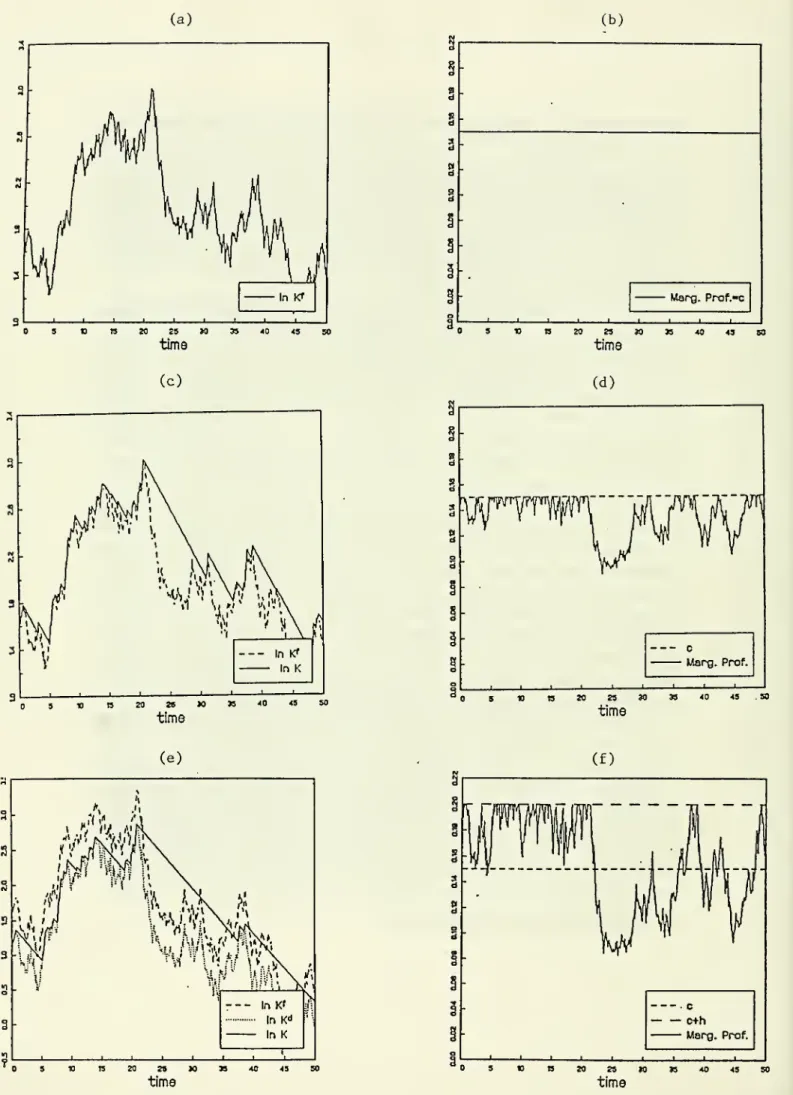
and
simulate the path ofthe (log of) stockof capital of a firm facing no irreversibility constraint. Panel (a) in figure 3.4 does so for a
random
realization ofthe path of 6. Panel (b) in the figureshows the corresponding path ofthe marginal profitability of capital, which
is equal to the constant
—
frictionless—
cost of capital, r.^'^Imagine
now
imposing an irreversibility constrainton
the firm, butas-sume
that the firm does not modify its "frictionless" investment rule when-ever it can invest. This is portrayed in panel (c) of the figure.The
solidand
dashed lines represent the actualand
frictionless stocks of capital,re-spectively. It is apparent that the firm would, on average, have too
much
capital, for itwould
have thesame
stock of capital ingood
times, but toomuch
inbad
times.The
counterpart ofthis is in panel (d), which shows thaton
average the marginal profitability of capital is below the cost of capital.Reluctance to invest in
good
times is an optimal response attempting to offset the natural tendency to over-accumulate capital inducedby
theirreversibility constraint. Panel (e) illustrates this point.
The
solidand
dashed lines represent the
same
variables as in panel (c), while the dottedfine illustrates the target stock of capital
when
the firm behaves optimally.'"These figures axe from Caballero (1993a).
Figure 3.4:
Reluctance
and
ItsCounterpart
(a) (b) -1 1 1 1 r time time (c) (d) 40 4S SO time time (e) 40 43 so time timeThe
counterpart ofthe negativevalue of ln{K'^/K^) is a positive constant hin the marginal profitability of capital required for investment to take place
(panel f). Itis apparent thatwhether the stockof capitalis onaverage higher or lower than without the irreversibility constraint is unclear; the firm has too little capital during
good
times but toomuch
during verybad
times.A
precise answer depends onthings about whichwe
know
little,and
whichmay
turn out to yield only second order effects.'^^
It is
now
easy to see the fallacious nature ofthe second statement.More
uncertainty raises reluctance precisely because it raises the need to reduce
the extent of excessive capital during the
now
deeper recessions.Without
raising reluctance, an increase in uncertainty would raise the average stock
of capital in the presence of irreversibility constraints. This occurs because
there
would
now
be greater capital accumulation during extremelygood
times which
would
not be offset by large disinvestment during extremelybad
times.^^The
third misunderstanding is of a different nature. Inmy
view, it isthe result of insightful but, unfortunately, abused language. First,
what
is right: there is nothing mysterious about irreversibility constraints as amathematical problem.
Dynamic
programing works, in thesame
way
it doeswith other,
more
traditional, adjustment frictions. Thismeans
that present value formulae, using the correct calculation offuture marginal profitability of capitalalsowork.Of
coursesuch calculationsmust
be performed along the optimal investment path, constraints included!What
is wrong: thestandard analysismust
be modified to consider the value ofthe "option to wait."As we
have seen, there is no need to do so. However, onemay
choose to follow an alternative path, in which one starts by evaluatingthe futuremar-ginal profitability of capital without considering the effect offuture optimal investment decisions
on
marginal profitability. This "mistake" can then be^^See Bertola (1992), Caballero (1993a), Bertolaand Caballero (1994) for early discus-sions ofthis issueand oftherelateduncertainty-investment misconception. Morerecently,
Abel and Eberly (1996b) have formalized theseclaims and made them moreprecise. ''^This does not mean that one cannot construct scenarios where an increase in
uncer-tainty reduces investment. For example, if there is an increase in perceived future
un-certainty, the investment threshold may jump today
—
i.e., before the variance ofshocks does—
resulting inan unambiguous decline in investment.Also, oneshould not confuse changes in uncertaintywith changes in the probability of
abadevent. Thelatter linksincreases inuncertaintyto a reduction inexpectedvalue, an
entirely different and more straightforward effect on investment. One can find traces of this confusionin the (informal) credibility literature.
"corrected" with a term that has an option representation. This alternative
way
of doing things is akin to the arbitrage approach in finance,and
itwas
nicely portrayed in Pindyck (1988).The
confusion arises, inmy
view, from mixingthe language in the two approaches.^'^A
related claim exists for a once and for all project (as opposed toincre-mental investment). It issaid that thesimple positive net present value rule
used in business schools to decide whether a project should be implemented
does not hold because it does not consider the option to wait
and
decidetomorrow,
when
more
information is available. Since I have never taught atabusiness school I cannot argue directly against that claim. However, ifthe issue is whether to invest today or tomorrow, the right criterion has never
been invest if
NPV
is positive—
at least that iswhat
we
teach economicsundergraduates. This is a case ofmutually exclusive projects, thus the right criterion has always been to
compare
their net present value and take thatwith the highest
NPV,
provided it is positive. If investment is irreversible,the project invest tomorrow has a lower
bound
at zero (because investmentwill not occur if
NPV
looks negative tomorrow), which the project investtoday does not. Thus, other things equal, irreversibility necessarily
makes
investing
tomorrow
more
attractive than investing today.3.1.5
Adjustment
hazard
At
a qualitative level, the {L,l,u,U) models described above capture wellthe nonlinear nature of microeconomic adjustment. Maintenance
expendi-tures aside, investment is mostly sporadic
and
oftenlumpy; scarcelyreactingto small changes in the environment but abruptly undoing accumulated
im-balances
when
theybecome
sufficiently large, and with possibly significantasymmetries between investment
and
disinvestment.At
an empirical level, however, these characterizations aretoo stark. Forreasons,
some
of whichwe
vmderstandand
most of whichwe
do not, firmsrespond differently to similar imbalances'over time
and
across firms.Ca-ballero
and
Engel (1994) propose a probabilistic instead of a deterministicadjustment rule. Rather than having aclear demarcationbetween regions of
adjustment
and
inaction, theymodel
a situation where large imbalances are ^^See Bertola (1988) for one of the first discussions of this issue in the economicslit-erature. There is also a related discussion in applied mathematics; see, for example, El Karoui andKaratzas (1991). Abel etal. (1996) haverecently revisited andexpanded the
discussionon the relationbetweenthe two approaches.
more
likely to trigger adjustment than small ones."''*There are
many
formal motivations for such an assumption.A
particu-larly simple one, pursued by Caballeroand
Engel (1994), is toassume
thatCf in the adjustment cost function (8) is an i.i.d.
random
variable, bothacross firms
and
time. Althoughtechnicallymore
complex, the nature oftheproblem is not too different from that of the simpler (L,/,u, U) model. Let
uj denote the
random
fixed cost,and
G{ijj) its time invariant distribution. It is possible to characterize the problem ofthe firm in terms oftwo
functionssimilar to those used before:
V{Z,
K*) and V{Z,
K*,uj), the value of a firmwith imbalance Z, desired capital K*,
and
realization of fixed adjustmentcost u). In particular,
V{Z,
K*)
is the value ofthe firm provided it does not adjust, whileV{Z,
K*
,u) is the value ofthe firmwhen
itis left freeto choosewhether or not to adjust. Thus,
V{Zt,
Kl)
=
U{Zt,K:)At
+
(1-
rAi)E, [^(Z,+At, i^;+A„u;t+At,)] , (19)V{Zt,K:,u)=m8.x{v{Zt,K;),ma.x{V{Z,
+
T^,K:)-C{ri,K;,c,t)}]. (20)Not
surprisingly, the nature ofthe solution is not too different from thatof the {L,l,u,U) case. Indeed, conditional
on
u
it is an {L,l,u,U) rule,although there are additional intertemporal considerations, since the firm
weighs the likelihood of drawing higher or lower adjustment costs in the
future.
Without
conditioning on cu, it is a probabilistic rule in the space ofimbalances.
In order to simplifythe exposition, I will suppress the proportional costs.
Thus, conditional on adjustment, the target point is the
same
regardless of whether the firm is adding or substracting to its stock of capital (i.e.I
=
u
=
c). Moreover, letme
define anew
imbalance index centered aroundzero:
a;
=
ln(Z/c).The
probability ofadjustmentriseswiththe absolute value ofx becausethereare
more
realizations of adjustment costs whichjustify adjustment. This isthe sense in which the {S,s) natiire ofthe simpler models is preserved. Let
^^Another advantage ofthis approach
is that it nests linear models as the probability ofadjustment becomes independent ofZ.
A(a;) denote the function describing the probabihty of adjustment given x,
and
call it the adjustment hazard function (see Caballeroand
Engel(1994)).Given an imbalance x, it is no longer possible to say with certainty
whether or not the firm will adjust, but the expected investment by the firm is given by:
E
Ilit/Ku\x]=
(e-^-
l) A{x)«
-xA{x), (21)whichissimply theproductoftheadjustment if itoccurs,
and
theprobabilitythat adjustment occurs."^'* Aggregation is
now
only a step away.3.2
Aggregation
Unlike microeconomic data, aggregate investment series look fairly smooth. Large microeconomic adjustments are far from being perfectly synchronized.
The
question arises, and this was the maintained hypothesis during the 80s, as to whether aggregation eliminates all traces oflumpy
microeconomicad-justment.
The
answer is a clear no.Doms
and Dunne's evidenceon
the role ofsynchronization ofprimaryspikes in accounting for aggregate investment,and
on the high time series correlation between aggregate investmentand
a Herfindahlindexofmicroeconomicinvestments, aswellasthemore
structural empirical evidencereviewed in the next section, support this conclusion.With
the setup at hand, aggregation proceeds in two easy steps.To
simplify things further, I will define the aggregate as the behavior of the
average, rather than the weighted average."^^
Both
steps rely on having a largenumber
ofestablishments, so that lawsof large
numbers
can be applied. In the first step, one takes as the average investment rate (i.e. theratioofinvestmenttocapital) ofestablishmentswithmore
or less thesame
imbalance ofcapital, x, the conditional expectation of this ratio given in equation (21):ih/KtY
=
-xA{x), (22)where
the superscript x denotes the aggregate for plants with imbalance x. ^^Caballeroand Engel (1994)refertoA(a;) as the "effectivehazard" to capture the idea that,through a normalization,it alsocaptures scenarioswhereadjustment, ifitoccurs, isonly afraction oftheimbalance x.
^^Using microeconomic data, Caballero, Engel and Haltiwanger (1995) show that in
U.S. manufacturing this approximationis. See the (1997) version ofCaballero and Engel
(1994) for adetailed discussion of the issue.
The
second step just requires averaging across all x. Let f{x,t) denotethe cross sectional density of establishments' capital imbalances just before
investment takes place at timet.
Then
the aggregate investment rate at timet, {It/Kt^, is:
{It/Ktf
=
-
y
xA{x)f{x,t)dx. (23)This is an interesting equation, with
macroeconomic
data on the leftand
microeconomic data on the right
hand
side.An
example serves to illustrate this aspect ofthe investment equation: Ifthe adjustmenthazard is quadraticK{x)
=
Ao+
Xix+
\2X^,equation (23) reduces to:
ih/K,)^
=
-AoXf
'-
AiXP
- A2Xf
\ (24)where Xt \Xt
and
X}
denote, respectively, the first, secondand
thirdmoments
ofthe distribution ofestablishments' imbalances.IfAi
=
A2=
0, themodel
only has aggregate variables, bothon
the rightand
lefthand
side. Indeed this case corresponds to the celebrated partialadjustment model,
and
it also coincides with the equation obtained from aquadratic adjustment cost
model
with a representative agent (e.g.Rotem-berg (1987)
and
Caballeroand
Engel(1994)). If either Ai or A2 is differentfromzero, however, information about the cross sectional distribution of
im-balances is needed
on
the righthand
side. All the microeconomic modelsdiscussed in this section yield situations where higher
moments
ofthe cross sectional distribution play a role.3.3
Empirical
Evidence
There
aretwo
polarempirical strategies usedto estimate (23), with acontin-uum
ofpossibilities in between.At
one extreme, one can use microeconomic data to construct all the elementson
the righthand
side; in particular one canconstructthe pathofthecross sectional distributionand
estimatethead-justment hazard as an accounting identity, or estimate a parametric version of it.
At
the other extreme, one can attempt to learn about the adjustment hazard from aggregate data only, by puttingenough
structureon
the sto-chastic processes faced by firms andby
starting with a guess on the initialcross sectional distribution.