Approximation Algorithms for Distributed and
Selfish Agents
by
Vahab S. Mirrokni
B.S., Sharif University of Technology, 2001
Submitted to the Department of Mathematics
in partial fulfillment of the requirements for the degree of
DOCTOR OF PHILOSOPHY
at the
MASSACHUSETTS INSTITUTE OF TECHNOLO
Tlinp 90nn.
©
Vahab S. Mirrokni, 2005. All rights reserved.
The author hereby grants to MIT permission to reproduce and
distribute publicly paper and electronic copies of this thesis document
in whole or in part.
OK)
/A
1
Author
...
....
.
Department of Mathematics
d3
April 25, 2005
C ertified by ...
_.7--Michel X. Goemans
Professor of Applied Mathematics
"2 . ...
Thesis Supervisor
Accepted by ...
A ccep ted
by
...
...
Rodolfo Ruben Rosales
Chairman, Applied Mathematics C,ommittee
Accepted
by ... ...
...
Pavel I. Etingof
Chairman, Department Committee on Graduate Students
-,XJl
Sh
.5.1
5U
4
Approximation Algorithms for Distributed and Selfish
Agents
by
Vahab S. Mirrokni
Submitted to the Department of Mathematics
on April 25, 2005, in partial fulfillment of the requirements for the degree of
DOCTOR OF PHILOSOPHY
Abstract
Many real-world systems involve distributed and selfish agents who optimize their own objective function. In these systems, we need to design efficient mechanisms so that system-wide objective is optimized despite agents acting in their own self interest. In this thesis, we develop approximation algorithms and decentralized mechanisms for various combinatorial optimization problems in such systems.
First, we investigate the distributed caching and a general set of assignment
prob-lems. We develop an almost tight LP-based 1- - -approximation algorithm and
a local search - -approximation algorithm for these problems. We also design effi-cient decentralized mechanisms for these problems and study the convergence of the corresponding games.
In the following chapters, we study the speed of convergence to high quality solu-tions on (random) best-response paths of players. First, we study the average social value on best response paths in basic-utility, market sharing, and cut games. Then, we introduce the sink equilibrium as a new equilibrium concept. We argue that, un-like Nash equilibria, the selfish behavior of players converges to sink equilibria and all strategic games have a sink equilibrium. To illustrate the use of this new concept, we study the social value of sink equilibria in weighted selfish routing (or weighted congestion) games and valid-utility (or submodular-utility) games. In these games, we bound the average social value on random best-response paths for sink equilibria..
Finally, we study cross-monotonic cost sharings and group-strategyproof mech-anisms. We study the limitations imposed by the cross-monotonicity property on cost-sharing schemes for several combinatorial optimization games including set cover and metric facility location. We develop a novel technique based on the probabilistic method for proving upper bounds on the budget-balance factor of cross-monotonic cost sharing schemes, deriving tight or nearly-tight bounds for these games. At the end, we extend some of these results to group-strategyproof mechanisms.
Thesis Supervisor: Michel X. Goemans Title: Professor of Applied Mathematics
Acknowledgments
This thesis and the growth in my knowledge owe a great deal to many teachers, colleagues, and friends. I would like to use this opportunity to thank them all, for their enthusiasm, encouragement and support, without which I could not have written
this thesis.
First and foremost, I would like to thank my advisor, Michel Goemans. I ben-efited enormously from his insightful comments on my research and his perspective in combinatorial optimization. I am grateful to him for giving me the freedom in pursuing my broad interest in algorithm design, and helping me to clarify my ideas and explanation; and for his careful reading of this thesis. I am also grateful to David Karger for his support as an informal advisor. David's persistence in tackling prob-lems and his enthusiasm in doing research will always be. an inspiration for me. I would also like to thank the other members. of my thesis committee, Lisa Fleischer, Daniel Kleitman, and Andreas Schulz, for taking the time and effort to read my thesis and giving me very useful comments.
Before coming to MIT, I had the good fortune to go to Shahid Soltani high school and Sharif university of technology in Iran. I am indebted to my high school teachers
(and in particular, S. Fazli) for their encouragement that forms my interest in science. At Sharif university, I was lucky to work with many excellent advisors and students. I would like to thank S. Akbari, M. Ghodsi, M. Jamzad, and E. Mahmoodian for all their support and advice to build my career.
During my years at MIT, I visited Bell-Laboratories, IBM T. J. Watson research center and Microsoft Research several times. I have found, in these visits, many ex-citing problems and fantastic collaborators. I would like to thank Li E. Li, Bruce Shepherd and Marina Thottan of Bell-Labs; Lisa Fleischer, Tracey Kimbrel, Baruch Scheiber, and Maxim Sviridenko of IBM T.J Watson Research; and finally Victor Bahl, Christian Borgs, Jennifer Chayes, Kamal Jain and Lili Qiu of Microsoft Re-search.
at MIT is one of the most exciting environments in the world for doing research in computer science. I have been fortunate to work with several faculty members in the theory of computation group. I thank Nancy Lynch for her support and encour-agement to continue working on power optimization in wireless networks. I thank Piotr Indyk for sharing his ideas and co-authoring a paper on approximate nearest neighbors with me. I am very grateful to Mike Sipser and Daniel Spielman for their support as academic advisors when I entered MIT. At CSAIL, I have had the chance to talk to several brilliant students in the TOC group -in particular Amit, Bobby, Brian, David, Eddie, Fumei, Jan, Maria, Mihai, Mohammad, MohammadTaghi, Nick, Nicole, Reina and Tasos. I also thank Linda Okun of the math department and the staff at CSAIL for their administrative support.
In my four years at MIT I have learned a lot, not only in computer science, but also in many aspects of life. All of this was nqt possible without the support and sympathy of many of my beloved friends whom I owe a lot. Sepaas to (besides the ones in CSAIL) Ali, Eaman, Fardad, Mana, Mehdi, Mohammad, MoharnmadTaghi, Mohsen, Mobsen, Nicole, Reza, and Saeed and others whose names are missed here. I thank them for their support and friendship.
I spent my years at MIT missing my brothers Vahid, Hadi and Mahdi, and my undergraduate friends. During this time, we have been trying to keep in touch and informed from each others' needs and success.
Finally and most importantly, I would like to thank my dear parents. I owe so much to them that cannot think of a proper way of thanking them. They have been supportive of me throughout my life and I see all my achievements a result of their efforts. This thesis is dedicated to them. Madar va pedare aziz, az zahamaate shomaa
Credits. Chapter 2 is based on a joint work with Fleischer, Goemans, and Sviri-denko [23] and a joint work with Goemans, Li, and Thottan [29]. Chapter 3 is based a joint work with Vetta [58] and a joint work with Sidiropolous [56]. Chapter 4 is based on a joint work with Vetta [59]. Chapter 5 is based on a joint work with Immorlica
and Mahdian [41].
Related Work. The thesis originally contained another chapter on power
optimiza-tion for connectivity problems. I have removed this chapter based on a suggesoptimiza-tion from the thesis committee (since that chapter was not closely related to the other topics of this thesis). In the removed chapter, we developed localized, distributed, and centralized approximation algorithms for power optimization in fault-tolerant network design in wireless multi-hop networks. In a given edge-weighted graph G, the power of each node is the maximum weight of an edge adjacent to this node. The power of the graph is the sum of powers of the nodes of this graph. We extended the (localized) cone-base topology control algorithm and achieve a localized algorithm to find the k-connected subgraph in unit disk graphs. We also designed distributed and centralized O(k)-approximation algorithms for geometric graphs. Finally, the main result of this chapter was a min(4k, O(log4(n)))-approximation algorithm for the minimum power k-connected subgraph problem for most edge-weighted graphs. That chapter was based on a joint work with Bahramgiri and Hajiaghayi [5], a joint work with Hajiaghayi and Immorlica [35], and a joint work with Hajiaghayi, Kortsarz, and Nutov [37].
Among my recent papers, there are two other papers whose topics are closely related to the topic of this thesis. One paper in on spectrum sharing games [38] and is a joint work with Halpern, Halldorson, and Li. In this paper, we model the problem of spectrum sharing in wireless networks as a graph coloring problem in a game theoretic setting. We then study the performance and convergence in the resulting game. The other paper is on efficient cell-breathing in wireless LAN [4] and is a joint work with Bahl, Hajiaghayi, Qiu and Saberi. In this paper, we develop a distributed algorithm for power assignment of access points in a wireless local area network. Assuming that clients are selfish and go to the access point with the
maximum power strength, we find a power assignment such that when each client gets connected to his favorite access point, none of the access points is overloaded. We use linear-programming duality to prove that if there is enough capacity in the network, there exists an efficient power assignment that satisfies all the clients.
During my years at MIT, I have worked on several other problems in network optimization and algorithm design whose topic is not closely related to this thesis. Among them are stochastic optimization [39, 42], approximate nearest neighbors and locally sensitive hashing [11], facility location problems with general cost function [36], cycle covers with short cycles [40], and other work in network optimization [19, 57,
54, 6].
My recent collaborators are Victor Bahl, Mohsen Bahramgiri, Randeep Bahtia, Mayur Datar, Joan Feigenbaum, Lisa Fleischer, MohammadTaghi Hajiaghayi, Mag-nus Halldorson, Joseph Halpern, Michel Goemans, Nicole Immorlica., Piotr Indyk, Kamal Jain, Tacy Kimbrel, David Karger, Guy; Kortsarz, Li E. Li. Mohammad Mahdian, Maria Minkoff, Seffi Naor, Zeev Nutov, ILili Qiu, Amin Saberi, Rahul Sami, Baruch Scheiber, Anastasios Sidiropoulos, Andreas Schulz, Maxim Sviridenko, Marina Thottan, Adrian Vetta. I thank all of them for sharing their valuable time and insights with me.
Contents
1 Introduction
1.1 Results and the Structure of the Thesis ... 1.2 Preliminaries ...
2 General Assignment and the Distributed Caching Problems
2.1 Introduction.
2.2 LP-Based Approximation Algorithms . . . 2.2.1 Separable Assignment Problems 2.2.2 Approximation Algorithms for DCP 2.3 Local Search Algorithms ...
2.4 k-median with hard capacities ... 2.5 A Hardness Result ...
2.6 Decentralized Mechanisms.
2.6.1 CaplBDC Game: Price of Anarchy 2.6.2 DCP Games: Pure Nash Equilibria 2.6.3 CapDC Game: Poor Convergence to 2.6.4
2.6.5
and GAP
Equilibria Market Sharing Game: Price of Anarchy.
Market Sharing Game: Finding a Nash Equilibrium 2.7 Conclusions and Open Problems ...
3 Convergence in Potential Games
3.1 Preliminaries.
3.2 The Max-Cut Game: Convergence ...
17 18 22 31 31 36 37 41 42 46 48 52 54 58 61 64 68 71 73 74 77
3.2.1 Fast Convergence on Random Walks 3.2.2 Poor Deterministic Convergence . . . 3.2.3 Mildly Greedy Players ...
3.2.4 Unweighted Graphs ... Basic-utility Games: Convergence ... Market Sharing Games: Convergence .... Conclusion and Open Problems ...
4 Sink Equilibria and Convergence
4.1 Sink Equilibria.
4.2 Price of Sinking vs. Price of Anarchy ... 4.3 Price of Sinking and Convergence ...
4.3.1 Unsplittable Selfish Routing and Weighted 4.3.2 Valid-Utility Games.
4.4 A Hardness Result .. ...
Congestion . . . Games ....
Congestion Games
5 Cross-Monotonic Cost Sharing Methods and Group-Strategyproof
Mechanisms 121
5.1 Preliminaries ... 122
5.2 Upper bounds for cross-monotonic cost sharing schemes ... 127
5.2.1 A simple example: the edge cover game ... 128
5.2.2 The vertex cover game .. . . . .. 132
5.2.3 The metric facility location game ... 135
5.2.4 Other combinatorial optimization problems ... 138
5.3 Group-strategyproof mechanisms . ... 140 5.4 Conclusion ... 150 153 6 Open Problems 3.3 3.4 3.5 . . . 79 . . . 80 . . . 83 . . . .. . .. . . 84 ... ...86 ... ...89 . . . 92 95 96 99 102 103 115 118
List of Figures
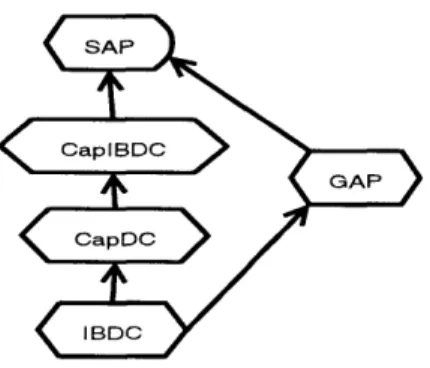
2-1 Assignment Problems. There is an arrow from problem A to problem B, if A is a special case of B ... 33 2-2 Different classes of Games. There is an arrow from game A to game
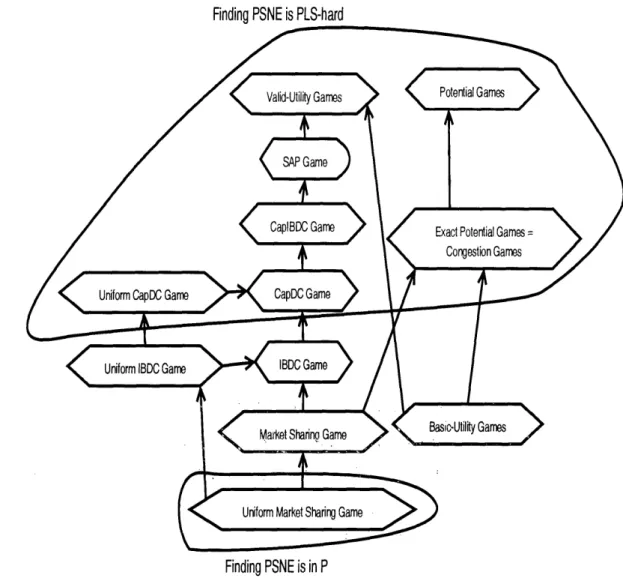
B, if A is a special case of B ... 55 3-1 A path of length n on which k rounds of best responses of vertices
result in a cut of value Q(k) of the maximum cut. The numbers on edges are the weight of the edges. ... . . 81 3-2 The cut (Ti, i) along the walk of the proof of Theorem 3.2.4 after
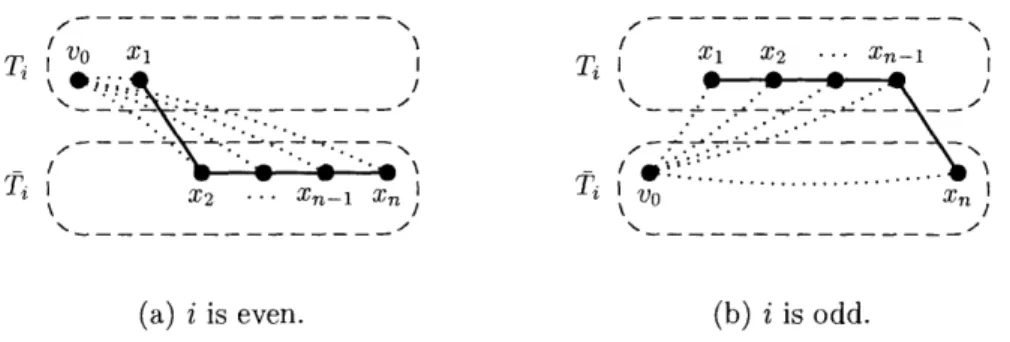
playing Qi and Ri. ... ... 83 3-3 An unweighted graph G on which k rounds of best responses of vertices
result in a cut of value Q( ) of the maximum cut. The graph consists of t layers; layer i consist of i vertices, and all vertices of layer i are connected to vertices of layer i + 1. ... 86 4-1 A weighted unsplittable selfish routing game without PSNE. Vertices
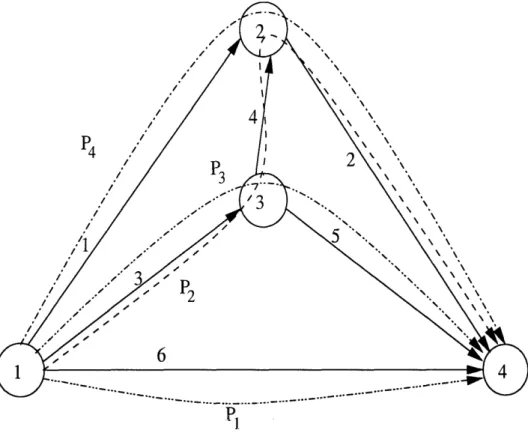
are labeled from 1 to 4. Arcs are labeled from 1 to 6. Four paths
(P1, P2, P3, P4) are highlighted from vertex 1 to vertex 4. Two players
with traffic loads 1 and 2 send traffic from vertex 1 to vertex 4. . . . 105
5-1 The structure S in the vertex cover game ... 133 5-2 Upper bound for facility location game ... 136 5-3 The graph G for the maximum flow game ... 139
List of Tables
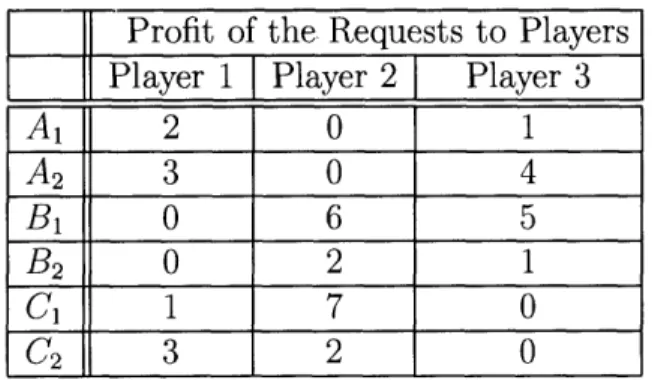
2.1 The profit of request and available bandwidth for cache locations in the IBDC game without pure Nash equilibria. ... 58 2.2 The profit of the requests for the example of the CapDC game with a
cycle of strict best responses ... 60 2.3 A cycle of size 6 of best-responses in the uniform CapDC game. Each
column represents the vector of request types that the players provide. The numbers in parenthesis in each column are the payoffs of players. The arrow.(-+) indicates that a player plays his best response and changes his strategy to the request type in the next column. ... 61 4.1 The table corresponding to the weighted unsplittable selfish routing
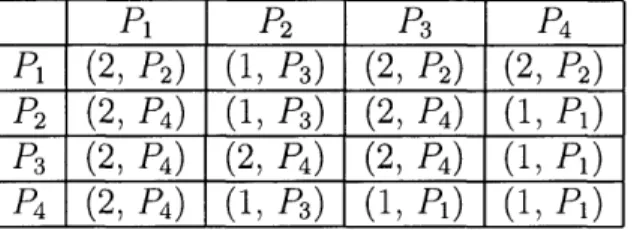
game without PSNE. Rows correspond to the strategy of the first player. Columns correspond to the strategy of the second player. The pair (i, P) in a cell of the table indicates that player i's best response in this strategy profile is P. ... 106 5.1 The budget-balanced group-strategyproof mechanism without free rider. 143
Chapter 1
Introduction
Over the past fifty years, computer scientists have been trying to overcome different computational constraints in developing efficient algorithms. The main features tra-ditionally characterizing efficient algorithms are their running time and space com-plexity. 'However, real-world systems require other important features such as the ability to run as a mechanism in the presence of selfish agents and the ability to run as a decentralized algbrithm in a distributed setting. Complexity theory has taught us that designing efficient algorithms'with these features is hard. Thus, it sometimes becomes necessary to settle for approximate solutions. In this thesis, we focus on de-veloping approximation algorithms for various combinatorial optimization problems with these features.
With the Internet developing as the single most important arena for resource shar-ing among parties with diverse and selfish interests, traditional algorithmic and dis-tributed systems approaches are insufficient. The Internet embodies a new paradigm in which distributed computation is performed by self-interested agents. Unable to control the algorithms and strategies employed by distributed users, we must instead design incentives to promote effective system-wide coordination. The goal of mecha-nism design is to implement some rules so that a system-wide objective is optimized despite agents acting in their own self interest. In this thesis, we consider various distributed settings in the Internet and wireless networks and design efficient ap-proximation algorithms and decentralized mechanisms with a provable performance
guarantee in terms of a desired objective function. In this chapter, we first give an overview of the results throughout the thesis. Then, we define some preliminaries that we need throughout the thesis. We suggest unfamiliar readers to first read Section 1.2 to learn the definitions.
1.1 Results and the Structure of the Thesis
The thesis is organized in six chapters. In this part of the introduction, we survey the main results of the other chapters (sometimes with informal definitions). Some formal preliminaries are also given at the end of the introduction in Section 1.2. Each chapter also contains an introduction and a set of preliminaries with formal definitions. We emphasize that in order to understand the details of the results of each chapter, the reader may need to read the formal definitions in the corresponding chapter.
In Chapter 2, we address the content distribution in service provider networks and design approximation algorithms and decentralized mechanisms for a distributed
caching problem and a general set of assignment problems called the separable assign-ment problems (SAP). Here, we give an informal definition of the distributed caching
problem1. A service provider has a limited set of file caches. Each cache location has a storage capacity and a bandwidth limit. There are a set of requests, each of a particular file type, and a particular bandwidth. Given a set of requests for file types, where each file type has a size, the job of the service provider is to decide 1) which file
types to store at each cache location, subject to storage capacity; and 2) which subset of requests to answer, subject to file selection at the cache, and available bandwidth. While the storage space for a particular type in a cache location is independent of the number of requests for that type, the bandwidth required to serve requests of the same type is the sum of bandwidth requirements for the individual requests. For each potential assignment of cache to request, there is an associated profit: the profit of assigning a request to a cache depends on the connection cost for the request to the cache. The goal is to maximize the profit of providing requests. DCP is a special case
of a general class of assignment problems called the separable assignment problems. In a separable assignment problem, we are given a set of n bins and a set of m items, and a value fij for assigning item j to bin i. We are also given a separate packing constraint for each bin i, i.e., a lower-ideal family Zi of feasible subsets of items for bin
i. The goal in the SAP is to find an assignment of items to bins with the maximum
aggregate value. We call this separate packing constraint for each bin, the single-bin
subproblem.
In an instance of the single-bin subproblem, we are given a bin i, a set of items with value vj for each item j, and a packing constraint for bin i, i.e., a lower-ideal family i of feasible subsets of items that can be packed in bin i. A -approximation algorithm for 3 < 1 for the single-bin subproblem is an algorithm that outputs a feasible subset of items whose value is at least p times the value of the feasible packing of items in bin i with the maximum value.
Separable assignment problems include the distributed caching problems and the well-known maximum generalized assignment problem (GAP): Given a set of bins and a set of items that'have a different size and value for each bin, pack a maximum-valued subset of items into the bins.
Given a -approximation algorithm for the single-bin subproblem, we design a polynomial-time LP-based ((1- 1)/) - 6-approximation algorithm and a local search combinatorial p+1/i -5-approximation algorithm for SAP, for any > 0. This gives a (- - c)-approximation algorithm and a local search - c-approximation
algo-rithm for GAP and DCP, for any > 0, as the single-bin subproblem for GAP and DCP admit a PTAS. This result is an improvement over the best previously known approximation algorithm for GAP (an LP-based -approximation) by Shmoys and Tardos [82] and Chekuri and Khanna [10]. Our algorithm is based on rounding a new linear programming relaxation, with a provably better integrality gap.
At the end of Chapter 2, we also design decentralized mechanisms for the DCP (that can be generalized for problems in SAP). In this part, we assume that caches are selfish entities that want to maximize their own reward. This setting is particularly justified in the context of 3G cellular networks. We define the following rewarding
mechanism for the distributed caching problem: Let cache locations decide on the set of file types and files that they can provide based on their constraints. We assume that the profit of each file request goes to the cache location that has the least connection cost to this file request and can provide it and prove that the price of anarchy of a (mixed) Nash equilibrium of the corresponding games is at most 2. We also study the convergence in the general DCP games and the complexity of finding Nash equilibria in these games. We show that pure Nash equilibria may not exist in this game. We prove existence of exponentially long best-response walks to equilibria using a reduction from a PLS-complete problem.
In Chapters 3 and 4, we study convergence in competitive games. We study the speed of convergence to approximate solutions in general classes of games including the cut games, basic-utility games, market sharing games, selfish routing games, and a general set of submodular-utility games (called the valid-utility games). We in-vestigate the social value of states after a nunmber of,best responses of players as a measure of the cost of the lack of coordination in such games. ThIis work deviates from other attempts to study the outcome of the selfish behavior of players in non-cooperative games in that we dispense with the insistence upon only evaluating Nash equilibria. Our basic model uses the underlying best-response graph induced by the selfish behavior of the players. In this model, we study the expected social value after a random sequence of best responses or the value of the social function after multiple rounds of best response behavior.
In Chapter 3, we study the speed of convergence in several subclasses of the potential games, i.e., games in which selfish behavior of players converge to a pure Nash equilibrium 2. First, we study the convergence in the cut game. We prove fast convergence to constant-factor approximate solutions on random best-response walks in these games. Then we exhibit exponentially long fair best-response walks with poor social value in this game. In addition, we suggest a way to modify the game to enforce fast convergence to constant-factor solutions after one round of best responses of players in any order. In basic-utility games, we prove fast convergence to
approximate solutions after a polynomial-size random best-response walk. Finally, we prove that in market sharing games, after just one round of iterative selfish behavior, the social value is within (o) of the optimal social value.
In Chapter 4, we study convergence in games with cycles of best responses. In these games, a sequence of best responses may converge to a sink equilibrium. A sink equilibrium is a set of strategy profiles or a set of states that is closed under the best responses of players. We introduce this new equilibrium concept and define it formally and study the social value of sink equilibria in comparison to the opt-mail social value. In particular, we measure the social value of states after a random sequence of best responses of players and bound the expected social value of states in sink equilibria 3. We study a weighted unsplittable selfish routing game and bound the expected social value of states in any sink equilibrium of this game. An implication of our result is that in weighted selfish routing games, if the delay functions of edges of the network are bounded-degree polynomial functions and we let players play their best responses in a;random order, after a polynomial number of best-response moves, the total delay of players is a constant-factor approximation of the total delay of the optimal routing. This is in contrast to the negative result of Fabrikant et al. [15] that shows the existence of exponential best-response walks to Nash equilibria. Thus, even though the convergence to pure Nash equilibria might be poor, the convergence to approximately good solutions is fast. Finally, in Chapter 4, we show that even though the price of anarchy for Nash equilibria in valid-utility games is , players may converge to a set of states with social value of that of the optimum. This shows that even in games with small price of anarchy for mixed Nash equilibria, selfish behavior of players may converge to a set of states with poor social value. In addition, using a reduction from a PLS-complete problem, we show existence of states that are exponentially far from any sink equilibrium in valid-utility games.
In Chapter 5, we study cross-monotone cost sharings and group-strategyproof mechanisms4. A cost sharing scheme is a set of rules defining how to share the
3
For the formal definitions, see Chapter 4.
4
cost of a service (often computed by solving a combinatorial optimization problem) amongst serviced customers. A cost sharing scheme is cross-monotonic if it satisfies the property that everyone is better off when the set of people who receive the service expands. A main application of cross-monotonic cost sharing schemes is in the design group-strategyproof mechanisms, i.e., mechanisms that are truthful for any coalition of players. An example of the use of cost sharings in mechanism design is in sharing the cost of multicast transmissions [44, 21]. We study the limitations imposed by the cross-monotonicity property on cost-sharing schemes for several combinatorial opti-mization games including edge cover, vertex cover, set cover, metric facility location, maximum flow, arborescence packing, and maximum matching. We develop a novel technique based on the probabilistic method for proving upper bounds on the
budget-balance factor of cross-monotonic cost sharing schemes, deriving tight or nearly-tight bounds for each game that we study.
For the set cover garre, that generalizes many of the above games, we show that no cross-monotonic cost sharing scheme can recover more than an O( fraction of the total cost, and thus we can not hope to use a set-cover cost sharing scheme as a black box for the cost sharing schemes of covering games. For the vertex cover game, we show no cross-monotonic cost sharing scheme can recover more than a
O(n-1/3), demonstrating that cross-monotonicity is strictly harder to achieve than
the core property (vertex cover games have a solution in the core that is 1/2-budget balanced). For the facility location game, we show that there is no cross-monotonic cost sharing scheme that recovers more than a third of the total cost. This result together with a recent 1/3-budget-balanced cross-monotonic cost sharing scheme of
Pal and Tardos [69] closes the gap for the facility location game.
1.2 Preliminaries
An a-approximation algorithm A for a maximization (minimization) problem is a polynomial-time algorithm that for every instance of the problem computes a solution whose cost is at least (at most) times the cost of the optimal solution on that
instance. We say that is the approximation factor or the approximation ratio of algorithm A. In particular, a > 1 for minimization problems and a < 1 for maximization problems.
Now, we define game theoretic notations that we need in this thesis. For a more complete description of these concepts, we refer to the text books [68] and [25].
Strategic Game. A strategic game is defined as a tuple (U, {Fili U}, {ai()li C U}) where (i) U is the set of n players or agents, (ii) Fi is a family of
feasible (pure) strategies or actions for player i and (iii) ai : IEUFi - R+ U {O} is the (private) payoff or utility function for agent i, given the set of strategies of all players.
P'layer i's strategy is denoted by si Fi. A strategy profile or a (strategy) state,
denoted by S = (Si, 2.. ., s), is a vector of strategies of players. i corresponds to a null or empty strategy for player i. Also let S s := (l,..., si_-1, si+1, k),
i.e., the strategy profile obtained from S if agent i changes its strategy from si to
s/. The vector of strategies of players except player i is denoted by by S-i
(s1,... ,si_1, ,si+1,... ,Sn). Also let F := liYvUFi be the set of all possible
strat-egy profiles.
Non-cooperative Game. In a non-cooperative game, it is assumed that each agent
wishes to maximize its own payoff. In other words, agents are selfish and given the strategy profile for other players, they play a strategy that maximizes their own utility
function. For a strategy profile S = (sl, 2,..., sn), an improvement move of player i
is a strategy si such that
ai(SEs'i)
> Ci(S). For a strategy profileS
= (si, 2,. .,s),a strict improvement move of player i is a strategy s such that ai(S ® s) > cai(S). Also, for a strategy profile S = (sl, s2,...,sn) a best response of player i in S is a
strategy s Fi such that for any strategy si C Fi, ai(S ® s) > i(S ® si). Note
that a best response is an improvement move.
(Pure) Nash equilibria. A pure strategy Nash equilibrium (PSNE) of a strategic
game is a strategy profile in which each player plays his best response. More formally,
S = (, 2,. . , s,) is a pure strategy Nash equilibrium (PSNE) if for all i U and
for any strategy sC
e
Fi, ai(S) > ai(Se
s).distribution ri : Fi - IWR+ U {0} over pure strategies where ESFi lri(Si) = 1. A mixed strategy profile, denoted by P = (7r, 7r 2,... , rn), is a vector of mixed strategies of all
players. For a mixed strategy profile P the probability of realizing a pure strategy pro-file S = (sl,..., s,) is pP(sl,.. ., s?) := IiEuTri(si). The expected payoff of player i in
the mixed strategy profile P is i (P) := Es1cF1,...,snGFn pP(Sl,..., Sn)ai(s1, 2,... Sn).
Similar to the above definition of pure Nash equilibrium, we can define a mixed Nash equilibrium. A mixed strategy Nash equilibrium is a mixed strategy profile in which each player does not have an incentive to play a different mixed strategy and improve her expected payoff. Nash [64] proved that any non-cooperative strategic game pos-sesses a mixed Nash equilibrium. We denote Nash equilibrium by NE and the pure strategy Nash equilibrium by PSNE.
State Graph. In order to model the selfish behavior of players, we use the underlying
state graph. Each vertex in the state graph represents a strategy profile or a state
S = (s1, 2 ... s n). The, arcs in the state graph correspond to best-response moves
by the players. Formally, the state graph, ) = (, E), of a strategic game g, is an arc-labeled directed graph, where the vertex set F. correspondis to the set of strategy profiles or states in 9, and there is an arc from state S to state S' with label i if the only difference between S and S' is in the strategy of player i; and player i plays his best response or one of his best responses in strategy profile S5 .
Best-Response Walk. Observe that the state graph will contain loops. A
best-response walk is a directed walk in the state graph. We say that a player i plays in
the best-response walk 7', if at least one of the edges of P is labeled i.
Social Value. The social (utility) function or social value, denoted by : EuFi
R, is defined for all strategy profiles in a strategic game. The optimal strategy profile is the strategy profile that optimizes the social value. The optimal strategy profile is called the optimal solution. Also, the social value of the optimal solution, denoted by OPT, is the optimum. Also let y,(S) := y(S d s') - -'(S), i.e., the increase in the
5In the definition of the best-response moves and the state graph, we only consider the myopic best responses. Other models can be considering nonmyopic players who can predict the responses of other players and play a strategy that gives more payoff in the long-term and not only at the
social value if player i plays s. The expected social value of a mixed Nash equilibrium
= (iT.. ..( ,rn.) iS
y(P)
,):=
SF...slF
P (S1,.. Sn)Y(Sl,.
,S).
Price of Anarchy. The major tool for analyzing the lack of coordination for some
games is the notion of the price of anarchy in a game [53, 70]. Given a strategic game,
g(U, {Fili e U}, {c()i E U}), and a maximization social function y: iuFi -- I,
the price of anarchy, denoted by poa(g, y), is the worst ratio between the optimum and the social value of a pure Nash equilibrium [70]6. Formally, if gf is the set of all pure Nash equilibria, then poa(g,,y) := PT Similarly, if P is the set of
all mixed Nash equilibria, the price of anarchy for mixed Nash equilibria is equal to
OmiPT() Also, the price of anarchy for a minimization social function y is defined
rninpe-P Y( P) '
as maxpep Y(P)
OPT
Submodular Set Functions. A function f of the form 2 -, I + U {0} is called a set function on the ground set V. A set function f : 2V - R+ U {0} is submodular if
for any two sets A, B
C
V, f(A) -f(B) > f(An
B) + f(A U B). A set functionf,
is non-decreasing if f(X) < f(Y) for any X C Y C V.
Valid-Utility Game. One class of games that we consider in different chapters of
this thesis is the class of valid-utility games introduced by Vetta [87]. We will use the definition of these games in Chapters 2, 3 and 4. Here, we describe an abstract definition of these games and refer the reader to the paper by Vetta [87] and Goemans et al. [29] for several examples of these games. In these games, for each player i, there exists a ground set V1. Note that Vi's may intersect. We denote by V the union of ground sets of all players, i.e., V = UiuvVi7. The feasible strategy set Fi of player i is a subset of the power set of V1, 2i that contains the empty set 0 which corresponds to having no action. Thus, the strategy si of player i is a subset of Vi (si C Vi). In order to define these games, we need the following definitions.
Given a vector S = (s ,..., sn), where si is a subset of the ground set V (si C Vi), the
set 'Hs = {(i, j) : i U, j si} is called the pair set for vector S. Note that S may or
6In this thesis, we use the term, price of anarchy, for pure Nash equilibria. For mixed Nash equilibria, we use the term, price of anarchy for mixed Nash equilibria. In some other places, the price of anarchy is defined for mixed Nash equilibria.
7We can define the valid-utility games by setting all ground sets Vi = V. But for later convenience,
may not be a feasible strategy profile. Given a function f : · iEvu2v - R+ U {O}, the
corresponding set function fS of f is a set function of the form 2 - R+U {O} where
-I = {(i,j) : i E U,j V} and f(7s) = f(S). In other words, for a set A C R,
fS(A) = f((al, a2,..., a)) if ai = {j (i,j) E A} Here, we assume that the social
function y is of the form ieU2v -- R+ U {O} instead of the form IIiuF -- R+ U {O}. Let (U, {Fili c U}, {ai()li U}) be a non-cooperative strategic game where Fi C 2v is a family of feasible strategies for player i. Let V = UiGuVi and let the¼
social function be y : Hiu 2 v R+ U {O}. is a valid-utility game if it satisfies the following properties:
1) Submodular and Non-decreasing Social Function: -y, the corresponding set
function of y over the set N = {(i,j) : i E U,j E V}, is submodular and non-decreasing.
2) Vickrey Condition: The payoff of a player is at least the difference in the social
function when the player participates versus when :it does not participate, i.e.,
ai(S) > '(S ®
0i).
In basic-utility games, this is an equality, i.e., Ci(S) ,s (S D i).3) Cake Condition: For any strategy profile, the sum of the payoffs of players
should be less than or equal to the social function for that strategy profile, i.e., for any strategy profile S, Eiu cai(S) < (S).
This framework encompasses a wide range of games including the facility location games, the traffic routing games, auctions [87], market sharing games (described in Chapter 2), and distributed caching games (described in Chapter 2). Vetta [87] proved that the price of anarchy for mixed Nash equilibria in valid-utility games is at most 2. While proving theorems about valid-utility and basic-utility games, we use the following notation: for two vectors S = (s ,..., s ) and S' = (si,.. ., s), we define S U S' := (sl U s1,..., sn U s). Also we define S U s := (s, s2,.., si-1, Si U
Sir Si+1, · · · Sn).
Potential Game. Potential games are games in which any sequence of strict
potential games, there is no cycle of strict improvement moves of players. This is equivalent to the existence of a potential function pot : liUVFi - R+ U {0 with an upper bound that is strictly increasing after any strict improvement move. Exact
potential games are a subclass of potential games for which there exists a potential
function such that in any strict improvement move, the increase in the payoff of a player is equal to the increase in the potential function.
Congestion Game. Consider a set U of n players and a set V of elements; these
elements are called factors in the original work of Rosenthal [76]. Let Fi C 2V be
a family of subsets of elements. For each element f V, let cf N -- R+ U {0} be a congestion function. A strategic game
g(U,
{Fili U}, {ci()li C U}) is calleda congestion game if F C 2V, and for a strategy profile, S = (sl,..., sr), ai(S) =
LEfsi
Cf (nf (S)) where nf (S) is the number of players that contains f in their strategy.Rosenthal [76] proved that congestion games are exact potential games. For the sake of completeness, we show the potential function for this game. The potential function is pot(S) = f EfI(S ) cf(t). Let i be a player who changes his strategy from si
in S to s and increases his payoff. The change in the potential function is equal to
pot(SDs'i)-pot(S)
= EZfsi
cf(Ssi)-Efesis, i cf(S)--
Li(Ssi)-a
i(S).Thus,
if player i increases his payoff by changing his strategy, the potential function also increases by the same value. This shows that congestion games are exact potential games. Monderer and Shapley [60] proved that congestion games are equivalent to the class of exact potential games.
In the formulation of congestion games, instead of a congestion function, we may consider a delay function, If : N -- R+ U {0} for each element. In this case, given a
strategy S = (sI,.. ., s) of players, the delay of player i is li(S) = Efs,, If(nf(S))
where nf(S) is the number of players who has f in their strategy. The goal of each player is to minimize his delay (instead of maximizing his payoff). By setting
cf(x) = -If(x) and ai(S) = -li(S), we can show that these two formulations of
congestion games are equivalent in that we can find a one-to-one correspondence O between the vertices of the state graphs of these two games such that if there exists an edge from S to S' with label i in the state graph of the first game, then there exists
an edge between vertices V(u) and ~b(v) with the same label i. One of the well-known congestion games is the selfish routing game [78]. In this game8, the elements of the game are edges of a directed network. Each player i wants to route a unit amount of flow from a source si to a destination, ti. The set of feasible strategies of a player is the set of directed paths from si to ti. The delay of an edge is a function of the total number of players that use this edge in their path. The delay of a player is the sum of the delay of the edges on its path.
Local Search Problems and the Class PLS. The class of Polynomial Local Search
problems (PLS) is introduced by Johnson, Papadimitriou, and Yannakakis [47]. A local search problem is denoted by L and is given by a set of instances I(L). Each instance I E I(L) is given by a tuple I = (i,y: i - R+ U {O},N : FI - 2'I )
where (i) FI is the set of feasible solutions to instance I, (ii) (F) is the value of solution F E I, and (iii) N- Fi - 2 is a neighborhood function, that is, for any feasible solution F FI, it gives a set of feasible solutions that are in the neighborhood of F (in other words, this set of feasible solutions can be reached from F only by one local operation). The local search problem is to find a local
optimal solution for any given instance of L, that is, given an instance I GE (L), a feasible solution F
CE
F such that no feasible solution in the neighborhood of F has value more than y(F). The global optimization problem is to find a feasible solution F G Fi with the maximum value y(F) for any given instance I of L. Alocal search problem L is in class PLS if for any instance I E I(L), (i) a feasible solution in FI is polynomially computable, (ii) for any solution F GE F, y(F) can
be computed in polynomial time, and (iii) a polynomial function is given that for any solution F CE F either determines that F is a local optimal solution, or returns F' E NI(F) with y(F') > y(F). Therefore, for any local search problem in PLS, given
any instance I and any feasible solution F E F1, it can be checked in polynomial
time if F is a local optimal solution or not, and if it is not, a solution F' in the neighborhood of F (F' N(F)) can be found such that y(F') > 7y(F). Many
well-sIn fact, we describe the atomic version of the selfish routing game in which there are finite
number of players. The other variant of the selfish routing game is the nonatomic variant in which
known local search problems are in PLS; For example, the Max-SAT problem with the flip neighborhood, and the Max-Cut problem with the swapping neighborhood. The Max-Cut local search problem with swapping neighborhood is as follows: Given an edge-weighted graph G and a cut, the local operations are to switch one node from one side of the cut to the other side. The class PLS has its own type of reduction and its own complete problems. Formally, a local search problem L in PLS is
PLS-complete, if using a polynomial-time algorithm to find a local optimal solution of any
instance of L, we can design a polynomial-time algorithm to find the local optimal of any problem in PLS. Johnson, Papadimitriou, and Yannakakis [47] introduced this class of problems and proved that the Max-SAT problem with flip neighborhood is
PLS-complete. They also introduced the concept of the PLS reduction by which one can prove that a local search problem L' is PLS-complete by reducing a PLS-complete problem to L'. It is not known if PLS-complete problems are hard to solve or not. In fact, Johnson et al. [47] proved that if a problem in PLS is NP-Hard, then NP= co-NP. As a result, it seems unlikely that these problems are NP-Hard, even though no polynomial-time algorithm is known for them. A problem A is PLS-hard if when we can solve A in polynomial time, then we can solve any instance of a PLS-complete problem in polynomial time. In other words, if we can solve a PLS-hard problem in polynomial time then we can solve any PLS problem in polynomial time.
Given any instance of a local search problem, the neighborhood search algorithm to find the local optimal solution is the algorithm that starts from a given solution of this instance, and does the following until it finds a local optimal solution: at each step, it finds a feasible solution in the neighborhood of the current solution with a better value, and moves to this solution. Papadimitriou et al. [71] and Schaffer and Yannakakis [79] have shown that for several PLS-complete problems, the neighbor-hood search algorithm takes exponential time. In fact, they proved that for some PLS-complete local search problems such as the Max-2SAT with flip neighborhood, and the Max-Cut problem with swap neighborhood, there are solutions that are ex-ponentially far from any local optimal solution, i.e., it takes exponential number of local improvements to get to a local optimal solution.
Here, we formally define the PLS reduction. A PLS reduction from L to L' is given by a pair (, M) where (i) R : (L) - I(L') is a polynomial-time computable function that maps any instance of L to an instance of L', and (ii) M is a polynomial-time computable function that maps any pair (F', I), where I is an instance of L and F' E YF(I) is a solution of T(I), to a feasible solution F of I, and (iii) for any
instance I of L and for any local optimal solution F' E F(,) of R(I), M(F', I) is a local optimal of the instance I of L.
Chapter 2
General Assignment and the
Distributed Caching Problems
2.1 Introduction
'The growth of the Internet, the World Wide Web and wide-area wireless networks allow increasing number of users to access vast amount of information in different geographic areas. Content delivery is one of the most important tasks of a service provider in these systems. It is well known that content delivery can be done by caching popular items in cache locations close to the users. In this chapter, we address this issue by formalizing different variants of distributed caching problems as a set of assignment problems and develop approximation algorithms and decentralized mechanisms for these problems. The general distributed caching problem that we formalize here is denoted by CaplBDC:
CaplBDC: Let U be a set of n cache locations with given available capacities Ai and given available bandwidths Bi for each cache location i. There are k request types; 1 each request type t has a size at (1 < t < k). Let H be a set of m requests with a reward Rj, a required bandwidth bj, a request type tj for each request j, and a connection cost cij for each cache location i to each request j. The profit of providing request j by cache location i is fij = Rj -cij. A cache location i can service a set of
requests Si, if it satisfies the bandwidth constraint: Zjes bj < Bi, and the capacity
constraint: Et{tjljES) at < Ai (this means that the sum of the sizes of the request
types of the requests in cache location i should be less than or equal to the available capacity of cache location i). We say that a set Si of requests is feasible for cache location i if it satisfies both bandwidth and capacity constraints for bin i. The goal of the CapIBDC problem is to find a feasible assignment of requests to cache locations to maximize the total profit; i.e., the total reward of requests that are provided minus the connection costs of these requests.
We also consider the following special cases of the CaplBDC problem:
CapDC: The CapDC problem is a special case of CaplBDC problem without band-width constraint. In other words, in the CapDC problem we assume that for each
cache location i, Bi is sufficiently large.
IBDC: The IBDC problem is a special case of CaplBDC problem without capacity. constraint. In other words, in the IBDC problemn ;we assuine that for e.h cache location i, Ai is sufficiently arge. From this definition, one can see that IBDC is a special case of CapDC where there exists exactiy one request of each request type, the available capacity of cache locations in CapDC is equal to the available bandwidth of cache locations in IBDC, and the size of request types in CapDC corresponds to the bandwidth requirement of requests in IBDC.
uniform CapDC: The uniform CapDC problem is a special case of the CapDC problem where the size of all request types is the same, i.e., at = a for all 1 < t < k.
uniform IBDC: The uniform IBDC problem is a special case of the IBDC problem
where the bandwidth requirement of all requests is the same, i.e., bj = b for all j H.
We refer to all variants of the distributed caching problems as DCP.
In this chapter, we develop approximation algorithms and decentralized mech-anisms for DCP, and a general class of assignment problems, called the separable
assignment problems (SAP):
SAP: In a separable assignment problem, we are given a set U of n bins and a set H of m items, and a value fij for assigning item j to bin i. We are also given
a, separate packing constraint for each bin i, i.e., a lower-ideal' family it of feasible subsets of items for bin i. We call this separate packing constraint for each bin, the
single-bin subproblem. The goal is to find an assignment of items to bins with the
maximum aggregate value.
Separable assignment problems include all variants of the distributed caching prob-lems described above. To see this we note that the family of feasible subsets of requests for a cache location i in the CaplBDC problem is all subsets of requests that satisfy two packing constraints: the capacity constraint and the bandwidth constraint. Thus, it is clear that the family of feasible subsets for a cache location is lower-ideal. Moreover, the profit of each request j to each cache location i is fij = Rj - cij and corresponds to the value of item j to bin i in SAP. It follows that CaplBDC, and thus all
vari-ants of DCP are special cases of SAP. SAP also includes the well-known maximum
generalized assignment problem (GAP):
GAP: Given a set of bins and a set of items that have a (possibly) different size and value for each bin, pack a maximum-valued subset of items into the bins.
Picture 2-1 depicts the problems that we consider and their relation to each other.
Figure 2-1: Assignment Problems. There is an arrow from problem A to problem B, if A is a special case of B.
We design LP-based and local search approximation algorithms for SAP. Our results depend on an algorithm to solve the single-bin subproblem in SAP. In an instance of the single-bin subproblem, we are given a bin i, a set of items with value
2
A family I C 2H of subsets of a set H is lower-ideal, if 0 C H, and for each two subsets S and
vj for each item j, and a packing constraint for bin i, i.e., a lower-ideal family i of
feasible subsets of items that can be packed in bin i. A /3-approximation algorithm for/3 < 1 for the single-bin subproblem is an algorithm that outputs a subset of items
S
CE
2i such that for any other subset S' C 2i of items, jEs v _ > P Ej es' vj.In Section 2.2, given a -approximation algorithm for the single-bin subprob-lem, we design a polynomial-time LP-rounding based ((1 - )/3 - 6)-approximation
algorithm 3. In Section 2.3, given a /3-approximation algorithm for the single-bin sub-problem, we design a simple, polynomial-time local search (- )-approximation algorithm 4. For GAP and all variants of DCP, there exists an approximation scheme for the single-bin subproblem, thus we obtain an LP-based algorithm with (1 - -)
approximation and a local search algorithm with - approximation guarantee. To
complement these results, in Section 2.5, we show that SAP and DCP cannot be ap-proximated within a factor better than 1 - I unless NPC DTIME(n°(l°gl°gn)), even if there exists a polynomial-time exact algorithm for the single-bir subproblem.
We generalize the local search algorithm to yield an approximation algorithm for the maximization version of the k-median problem with hard capacity constraints
(KMed):
KMed: Given a set U of n bins, a set H of m items with a value fij for each item
j and each bin i, and also a single-bin subproblem for each bin i, i.e., a lower-ideal
family i of subsets for bin i, choose at most K bins and pack a set of items in each selected bin to maximize the total value packed.
In Section 2.4, for any > 0, given a -approximation algorithm for the single-bin subproblem, we design an ( - - )-approximation algorithm for KMed. If the single-bin subproblem is a knapsack problem, this yields a ( - c)-approximation
algorithm.
We discuss decentralized mechanisms for all variants of the distributed caching problem in Section 2.6. For the decentralized mechanisms, we may assume that
3We can set to be exponentially small, i.e., 6 = 1 for any constant c > 0. Throughout the
chapter, we say "for any 6 > 0" to illustrate this.
4For the local search algorithm, we can set to be exponentially small, i.e., e = for any
caches are selfish entities that want to maximize their own reward. This setting is particularly justified in the context of 3G cellular networks [29] and this is formalized in Goemans, Li, Mirrokni, and Thottan [29]. In this setting, resident subscribers are cache locations that can provide content to clients. Clients ask for different requests and the service provider wants to cache these requests at resident subscribers to pro-vide them in a distributed manner. This helps the service propro-vider to use the capacity of the wireless network instead of relying solely on its own bandwidth. Goemans et al. [29] formalize the protocol and the system architecture of such mechanisms. In Section 2.6, we suggest a mechanism to induce selfish cache locations to serve the set of requests with a good performance guarantee. All mechanisms extend to all separable assignment problems, but we state the results for the distributed caching problems since the main motivation of this setting comes from this problem.
Previous Work. For the special case of GAP, Shmoys and Tardos [82] present an LP-rounding -approximation algorithm for the minimization problem. Chekuri and Khanna [10] observed that a L-approximation for GAP is implicit in the paper by Shmoys and Tardos [82]. Their method is based on an LP formulation with an integrality gap of at least 2. Thus the LP we introduce here is provably stronger. Chekuri and Khanna [10] develop PTAS's for a special case of this problem called the multiple knapsack problem. In this problem, each item has the same size and the same profit for all cache locations. They also classify the APX-hard special cases of
GAP.
Nemhauser, Fisher, and Wolsey, previously look at maximizing submodular func-tions with and without cardinality constraints [65, 66]. They give a greedy algorithm with approximation guarantee of 1- 1 for maximizing submodular functions, and I-approximate local search algorithm for maximizing submodular functions with car-dinality constraint. The latter paper actually looks more generally at restrictions to matroids. These results do not extend to handle knapsack constraints, since feasible sets for knapsack do not form a matroid. Sviridenko shows that the greedy algorithm gives a 1 - -approximation for maximizing a submodular function subject to one
knapsack constraint [85], but does not consider assignment type problems with sets of packing constraints. Indeed the simple greedy algorithm does worse than 1 - e even for the multiple knapsack problem. Using LP techniques [1, 83], approxima-tion algorithms with the guarantee of 1 - for some maximum coverage problems
e
are known. These techniques are different from ours and cannot handle SAP as the packing constraints in SAP are more general.
Gomes, Regis, and Shmoys [33] use a exponential-size LP and a rounding scheme similar to the one we use here but to obtain a 1 - -approximation algorithm to solve the partial Latin square extension problem. In particular, their LP does not capture knapsack packing constraints.
Baeve and Rajaraman [3] study a problem of data placement in networks. They formalize a minimization version of our problem in which they need to place ob-jects in caches to minimize the total connection costs. They give a constant-factor approximation for this problem, which is iproied to fac'or 1.0 by Swainy [86]. ia the conclusion of [3], they suggest considering the problem with bandwidth as an important extension.
2.2 LP-Based Approximation Algorithms
In this section, for any > 0, we give a ((1 - ) - )-approximation for SAP and its variants where 3 is the approximation factor of the algorithm for the single-bin subproblem. The general approach is to formulate an (exponential-size) integer program, solve the linear program relaxation approximately, round the solution to the linear program, and prove that the rounded solution has this guarantee. There are two main issues here: proving the quality of the rounded solution, and obtaining a good solution to the large linear program in polynomial time. We first discuss the approach in the context of SAP and then discuss some extensions.
2.2.1 Separable Assignment Problems
Formulation. We give an exponential-size integer programming formulation for
SAP. Let i, for i U be the set of all feasible assignments of items to bin i; these are the feasible solutions to the single-bin subproblem for bin i. For a set S i,
let Xs be the indicator variable that indicates if we choose S as the subset of items for bin i. The first constraint is that we cannot assign more than one set to a bin
i, thus for all i U, sezl Xs = 1. Moreover, we cannot assign each item to more
than one bin: Ei,sezi:jcs Xs < 1. Our objective is to find an assignment of items
to bins to maximize the sum of profits, i.e., i, fXi where fs
= j fij. By
relaxing the 0-1 variables to nonnegative real variables, we obtain the following linear programming relaxation:
max
EiEusel
fXi
(2.1)
s.t.
iG,sEzi:jsXI <
1 Vj C H
Zssz~ Xs = 1 Vi U
Xis > 0 i c U,S G Si
Let LP(SAP) denote the objective function value of this LP.
Rounding the Fractional Solution. Given a solution to the linear program (2.1),
independently for each bin i, assign set S to i with probability Xs. In the resulting solution, some item j may be contained in the sets assigned to more than one bin. In this case, item j is assigned to the bin among these bins with the maximum fij-value. Note that the resulting assignment after this step is feasible, since the family i for each bin i is lower-ideal.
Theorem 2.2.1 The expected value of the rounded solution is at least least (1
-l)LP(SAP).
Proof. For item j, sort the bins i for which Yi = ESZI:jES Xis is nonzero in the non-increasing order of fij. Without loss of generality assume that these bins are
1,2,...,1 and fl > f2j... > fj > O. With probability Y the set that is assigned
to bin 1 contains j, thus item j is assigned to bin 1. In this case, the value of item
j is flj. With probability (1 - Y1)Y2, bin 1 does not have item j in its subset and
bin 2 has item j in its set. In this case, the value of item j is f2j. Proceeding similarly, we obtain that the expected value for request j in the rounded solution is
fljY + f2j(1 - Y1)Y2 + ...
+
fij(Hil(l - Yi))Y1. The contribution of item j in thevalue of the fractional solution is l<i<l fijYi. This in conjunction with Lemma 2.2.2 below yields the result. E]
Lemma 2.2.2 fjY
1+ f2j ( -Y)Y
2+... + ftj(fl
(
-Y))Y
1>
(
-)
l<i<l fj
whenever Yi > O for all i and
Ei
Yi < 1 and fij > f2j > ... > fj > OProof. From the arithmetic/geometric mean inequality, one can derive (see Lemma
3.1 in [31]):
k k-1 k
1-( (1-
Yi))
= Y
+ (1
- Y)Y2 ++
(H(1
Yi))Yk
> (1-)
Yi,
i=l i=l i=l
for any k. Multiplying this inequality by fkj
summing over k, we derive the lemma.
- fk+l,j >
0
where f+l,j = 0 and DSolving the LP. The number of variables in the linear program (2.1) is exponential.
To solve this LP, we first solve its dual (2.2) given below. min
Eieu
i + EjEH )s.t. + EiGs A > fs
Aj > 0
(2.2)
Vi G U, VS cG i