Dispersion of Agglomeration through Transport Infrastructure
By Wanli Fang
Bachelor of Engineering, Peking University (2005) Master of Science, Peking University (2007)
Submitted to the Department of Urban Studies and Planning
ARCHNEs
in Partial Fulfillment of the Requirements for the Degree ofMASSACHUSETTS INST!1VTE
OFTECHNOLOGY Doctor of Philosophy in
Urban and Regional Planning
JUN 2 0 2013
at the
LIBRARIES
MASSACHUSETTS INSTITUTE OF TECHNOLOGY June 2013
© 2013 Wanli Fang. All Rights Reserved.
The author hereby grants to MIT the permission to reproduce and to distribute publicly paper and electronic copies of the thesis document in whole or in part.
Author
Department of Urban Studies and Planning May 23, 2013 Certified by
Karen R. Polenske Peter de Florez Professor of Regional Political Economy Department of Urban Studies and Planning Dissertation Supervisor
Accepted by
Professor JoAnn Carmin Chair, Ph.D. Committee Department of Urban Studies and Planning
Dispersion of Agglomeration through Transport Infrastructure
ABSTRACT
My dissertation aims to assess transport infrastructure's influence on the productivity, scale and
distribution of urban economic activities through changing intercity accessibility. Standard project-level cost-benefit analysis fails to capture the economy-wide impacts in justifying investments in the transport sector. I propose a research framework that: (1) synthesizes the
spatial emphasis of the New Economic Geography theories with the temporal perspective of the growth theories; (2) extends the scope of agglomeration effects by highlighting a city's access to external resources as a partial substitute for its own endowment; and (3) bridges the spatial discontinuity between regional and urban studies by introducing intercity accessibility as a determinant of intra-city land uses. I apply the proposed framework to study the spatial economic
impacts of China's high-speed rail system at network, corridor, and node (city) levels. The GIS-based spatial analyses of the network accessibility measured by three alternative indicators consistently illustrate that, the extensive transport investments during 2001-2010 have reduced the disparities in accessibility among cities in China, with the coefficient of variation dropping by nearly 50%. Differently, estimations from the panel data models shed light on the complexity in the relationship between accessibility and economic activities, which consists of both generative and redistributive components and simultaneously leads to convergent and divergent economic outcomes. Yet, empirical evidence denies the saturation effects of
accessibility. Extended estimations using different instrument variables (IV) partially relieve the concerns on endogeneity issues. Further analyses of a particular transport corridor reveal that, with HSR, the regional urban hierarchy is evolving towards a more interwoven structure, with major cities reaching for overlapped hinterlands. HSR's short-run influences on the location choice of economic activities vary in terms of spatial coverage and are not necessarily restricted to cities with direct HSR access. The city-level comparative case studies indicate that HSR stations introduce external demand for urbanization, leading to new development once matching land supply exists. A cluster analysis of ten demand-supply-related factors generates three prototypes of station-area development. For each type, public and private sectors have adopted different institutional arrangements, yet common challenges exist in preventing speculative investments and matching the development portfolio with the composition of actual needs. The findings lead to important policy implications for decision-makers in China. First, China has not exhausted the agglomeration benefits dispersing through transport infrastructure given the remarkable regional disparities. From an economic development perspective, HSR lines connecting coastal megacities with lagging inland cities are effective in reducing disparities in accessibility and should be encouraged. Second, for the appraisal of major transport projects including HSR, it is reasonable to extend the standard CBA to include the generative benefits; to evaluate the impacts on regional disparities based on redistributive effects; and to avoid
overbuilding through identification of saturation effects. Third, HSR has the potential to reshape the path of urbanization. The evolution of the urban hierarchy towards a more interwoven structure may eventually raise the need for adapting administrative arrangements to fit the actual economic interaction. As to urban configuration, HSR stations may catalyze compact
urbanization around transit facilities. However, local governments should avoid using HSR stations as a vehicle for excessive generation of land concession revenues.
DISSERTATION COMMITTEE
Karen R. Polenske (Chair)
Peter de Florez Professor of Regional Political Economy
Department of Urban Studies and Planning, MIT
William C. Wheaton
Professor of Economics
Department of Economics and Center for Real Estate, MIT
Yu-Hung Hong
Ph.D., Founder and Executive Director
Land Governance Laboratory
EXTERNAL READERS
Ying Jin
Ph.D., University Lecturer
Robinson College, Cambridge University, the U.K.
Jinhua Zhao
Assistant Professor of Urban Planning and Civil Engineering
University of British Columbia, Canada
ACKNOWLEDGEMENTS
My deepest gratitude goes to Professor Karen R. Polenske. To me, Karen is an admirable adviser and an amiable family member. She taught me the core quality necessary to survive in the academic world--the ability to think independently and critically. She guided me through every key step of the Ph.D. program, pulling me out of intellectual difficulties many times.
I sincerely thank Professor William C. Wheaton, who encouraged me to think like an economist. An urban planner by training, I am attracted to and enlightened by the rigorousness of economic theories and methods. It is Professor Wheaton who opened the door to that magic world for me. I am truly grateful to Dr. Yu-Hung Hong for the hands-on advice in my dissertation writing, from building the framework to sharpening the arguments. His hearty support went far beyond this, even at the cost of his own inconvenience.
I express my deep appreciation to Professor Ying Jin at Cambridge University, the U.K., and Professor Jinhua Zhao at University of British Columbia, Canada, for their inspiring comments on my research. I thank Professor Hongliang Zhang and Dr. David Block-Schachter for assisting me in the techniques of econometric modeling. I thank Xiaohu Dong for his kindly help on coding and data mining. I thank Professor Frank Levy, Professor Joe Ferreira and Professor Johan Carmin for teaching me the methods of research design and building my analytic capacity. I thank Ms. Sandra Wellford for her guidance on fulfilling the requirements of the PhD program. I thank Ms. Pamela Siska for her enormous help in reviewing the writing of my dissertation. I thank my dearest girls, Yang Chen, Yuan Xiao, Yue Hou, Jingsi Xu, Shan Jiang, Xin Li, Zhengzhen Tan, Feifei Zhao and Lulu Xue, for the joyful moments we shared and for the moral support during my hard times. I thank my officemates Feng Fu, Hongtao Liu and Liyan Xu for the enlightening conversations on my research topic.
I owe many thanks to Mr. John Scales for offering me the opportunity to work with the World Bank. I particularly thank Dr. Zhi Liu for guiding me through the early stage of my career development. I extend my appreciation to Mr. Richard G. Bullock, Mr. Binyam Reja and Mr. Gerald P. Ollivier for their kindly guidance and support for my work. I thank the team of young professionals, Li Qu, Yi Yang, Shuai Ren, Xi Zhao, Hongye Fan, Nanyan Zhou, Runze Yu and Andrew Salzberg for the enjoyable experience of working together.
The years I spent at Peking University are equally unforgettable. I sincerely thank Professor Kongjian Yu, Professor Dihua Li and Professor Tiyan Shen--without their support I could not have obtained the opportunity to start my academic endeavor at MIT.
Special gratitude I give to Quentin Feng Li, for the love, tolerance, encouragement, and the beautiful memories.
To my parents
FANG Zaichao, CHENG Caiyun
CONTENT
CHAPTER I 1.1 1.2 1.3 1.4 CHAPTER II 2.1 2.1.1 2.1.2 2.1.3 2.2 2.2.1 2.2.2 2.2.3 2.3 CHAPTER III 3.1 3.1.1 3.1.2 3.1.3 3.2 3.2.1 3.2.23.3
3.3.1
3.3.2
3.4
3.4.1
3.4.2
3.4.3
3.5 3.5.1 3.5.23.5.3
3.6
CHAPTER IV 4.14.2
INTRODUCTION ... 15Problem statem ent...
16
Research Questions and Hypotheses ...
19
Research significance and contributions...
21
Structure of the dissertation...
23
AN INTEGRATED RESEARCH FRAMEW ORK... 25
Theoretical foundations ... 25
N ew Econom ic Geography (N EG) theory... 25
U rban econom ics theory ... 27
Endogenous growth theory ... 29
Existing analytical tools... 30
Econom etric m odels... 30
Spatial analysis... 31
Transport m odels... 32
An integrated m ulti-scale research fram ew ork... 32
EVOLUTION OF INTERCITY ACCESSIBILITY PATTERNS ... 36
Expansion of the national transport network ... 36
China's national railw ay system before H SR ... 37
China's H SR revolution ... 38
Development of civil aviation and expressway system... 39
Relevant studies on intercity accessibility ... 42
A ccessibility studies on Trans-Euro H SR network... 42
Studies on China's intercity accessibility ... 44
M ethodology... 45
A ccessibility indicators... 46
Identify urban hierarchy... 49
Param eterization and data... 51
Travel tim e m atrices by rail... 51
Travel tim e m atrices by air ... 53
Travel tim e m atrices by expressw ay... 54
Results of analyses... 55
A ccessibility m easured by econom ic potential... 56
A ccessibility m easured by daily econom ic potential... 59
A ccessibility m easured by W ATT... 61
Sum m ary... 62
ELASTICITY OF ECONOMIC PERFORMANCE TO ACCESSIBILITY... 65
Multiple dimensions of transport infrastructure's economic impacts... 66
Em pirical studies under the N EG fram ework... 67 9
4.3
M ethodology...
. .. 71
4.3.1
Conceptual fram ew ork...
71
4.3.2
Panel data m odels and estim ators ...
73
4.4
Param eters and data ...
75
4.4.1
Econom ic perform ance indicators ...
75
4.4.2
D escriptive statistics ...
78
4.5
Estim ation results...
79
4.5.1
Choice of estim ator...
80
4.5.2
Fixed-effect estim ation ...
81
4.5.3
Testing regional and city size effects ...
84
4.5.4 Testing saturation effects ... 92
4.5.5 Extended analyses with IV s... 94
4.5.6 Extended analyses with additional explanatory variables ... 98
4.6 Sum m ary... 101
CHAPTER V THE CHANNELIZING EFFECTS ALONG AN HSR CORRIDOR ... 105
5.1 Choice of the W uhan-Guangzhou HSR ... 105
5.2 Relevant studies on the corridor-level effects... 107
5.2.1 Interm odal com petition and m arket share... 107
5.2.2 H SR 's im pacts on econom ic activities... 109
5.3 M ethodology and Data...110
5.4 Results of analyses...112
5.4.1 Shift in travel patterns...112
5.4.2 Relocation of econom ic activities: short-run observations...118
5.5
Sum m ary...
.
.... 128
CHAPTER VI HSR STATION AS AN ENGINE OF URBAN DEVELOPMENT... 132
6.1 M otivation of research ... 133
6.2 Relevant studies on urban development around HSR stations ... 134
6.3 Conceptual m odels... 138
6.3.1 The node-place value m odel... 138
6.3.2 The dem and-supply m odel... 140
6.4 Influential factors and prototypes of station area development ... 143
6.5 Case studies... ... ... 147
6.5.1 Changsha South: an emerging sub-center of business and trading... 147
6.5.2 Xianning North: the backyard of the adjacent megacity ... 155
6.5.3 Chenzhou West: The transport hub and urban gateway... 161
6.6 Sum m ary... ... 167
CHAPTER V IICONCLUSION ...---... 174
7.1 Findings...-...--.. 174
7.1.1 From transport investment to accessibility improvement... 174
7.1.2 From accessibility improvement to economic performance ... 175
7.2 Policy im plications... 180
7.2.1 Revisiting the investment-led economic growth mode... 180
7.2.2 Including wider economic impacts in transport project appraisal ... 183
7.2.3 Reshaping the path of urbanization... 184
7.3 Lim itations and Future research... 187
7.4 Concluding rem arks... 189
References... 191
A PPENDIX A M APS ... 201
APPENDIX B ESTIMATION RESULTS ... 218
LIST OF FIGURES
Figure II-1 The impact of HSR station on rent gradient... 28
Figure 11-2 Relationship between transport infrastructure investment and economic performance ... 34
Figure 111-1 Number of airports and passengers by air (2001-2010)...40
Figure 111-2 Length of China's expressway 1989-2010 ... 41
Figure 111-3 The hierarchical economic linkages among different tiers of cities ... 50
Figure 111-4 Distribution curves of economic potential 2001 and 2010...62
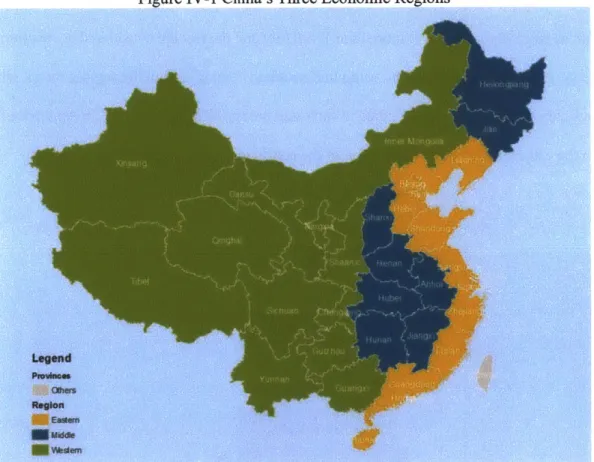
Figure IV- 1 China's Three Econom ic Regions ... 85
Figure IV-2 D istribution of city size...86
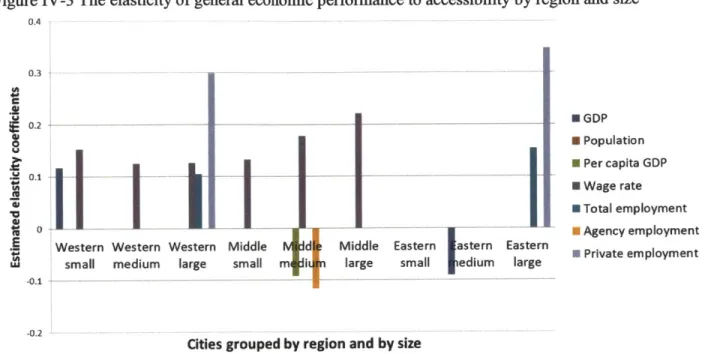
Figure IV-3 The elasticity of general economic performance to accessibility by region and size...88
Figure IV-4 Inter-provincial migration in China (1990-2005)...88
Figure IV-5 The elasticity of sectoral economic performance to accessibility by region and size ... 90
Figure IV-6 Elasticity of general economic performance to accessibility by accessibility levels...93
Figure IV-7 Elasticity of sectoral economic performance to accessibility by accessibility levels...94
Figure V-1 The Wuhan-Guangzhou HSR line on the map of China...106
Figure V-2 Total number of railway passengers in the Wuhan-Guangzhou corridor 2001-20 10... 112
Figure V-3 Completed real estate investment in HSR cities vs. Non-HSR cities (2001-20 10)...119
Figure V4 Real estate investment in the 10 cities on Wuhan-Guangzhou HSR ... 120
Figure V-5 Location of market expansion of five top real estate developers... 122
Figure V-6 Number of tourists (left) and tourism revenue (right) in the HSR cities ... 124
Figure VI-1 Differences between affected zones of railway stations and subway stations...138
Figure V I-2 The "node-place value" m odel...139
Figure VI-3 The demand for urban development and availability of land within a city...141
Figure VI4 Demand surplus (left: Shanghai) and supply surplus (right: Yangquan)...142
Figure VI-5 Location of Changsha South station in the city...148
Figure VI-6 Land use plan for the HSR fortune Town at Changsha South Station ... 150
Figure VI-7 Xinhuadu Wanjiacheng (left) and Evergrande Lvzhou right)...152
Figure VI-8 The government-led mode of HSR station area development...154
Figure VI-9 The Site plan for One Future project at the Xianning North station...159
Figure VI-10 The all-round developer mode of station area development ... 160
Figure VI-1 1 Land-use plan for the HSR fortune Town at Chenzhou West Station ... 164
Figure VI-12 Parking lot for private car (left) and waiting area of taxi (right) at Chenzhou West...165
Figure VI-13 Site plan of Chenzhou Huasheng Century New Town (*A11t9ZV$)) ... 166
Figure VI-14 Demand for land use generated by different groups of HSR passengers...171
Figure VI-15 Percentage of passenger by purpose of trip on Wuhan-Guangzhou HSR ... 172
Figure VII-1 Contributions of investment, export and consumption to China's GDP growth...181
Figure VII-2 Urban hiearchy: Christaller model vs. Pred model...186
Figure A-1 Proposed High-Speed Passenger-dedicated Lines in P.R. China (2008 version)...201
Figure A-2 China's Railway N etwork 2001...202
Figure A-3 China's Railway Network 2010...203
Figure A-4 All-mode economic potential of cities in China 2001 vs. 2010...204
Figure A-5 Railway-based economic potential of cities in China 2001 vs. 2010 ... 205
Figure A-6 Changes in all-mode economic potential of cities in China 2001- 2010 ... 206
Figure A-7 Relative changes in rail-based economic potential of cities in China 2001- 2010 ... 207
Figure A-8 Difference in all-mode economic potential with vs. without HSR in 2010 ... 208
Figure A-9 All-mode daily economic potential of cities in China 2001 vs. 2010...209
Figure A-10 Railway-based daily economic potential of cities in China 2001 vs. 2010 ... 210
Figure A-11 Changes in daily all-mode economic potential of cities in China 2001- 2010 ... 211
Figure A-12 Changes in rail-based daily economic potential of cities in China 2001- 2010...212
Figure A-13 WATT by all modes(top) and by railway(down) in 200 1(left) vs. 2010(right)...213
Figure A-14 Changes in all-mode WATT 2001-2010 ... 214
Figure A-15 Changes in railway-based WATT 2001-2010 ... 215
Figure A-16 China's major railways and highways in 1920s ... 216
Figure A -17 Elevation of Cities in China...217
LIST OF TABLES
Table 11-1 Research focus and method of multi-level analyses ... 33
Table III-1 Six "speed up" campaigns in China's railway system 1997-2007...37
Table 111-2 A ccessibility Indicators...47
Table 111-3 Features in the 2010 railway timetable database ... 52
Table 111-4 Features in the 2010 airline timetable database ... 53
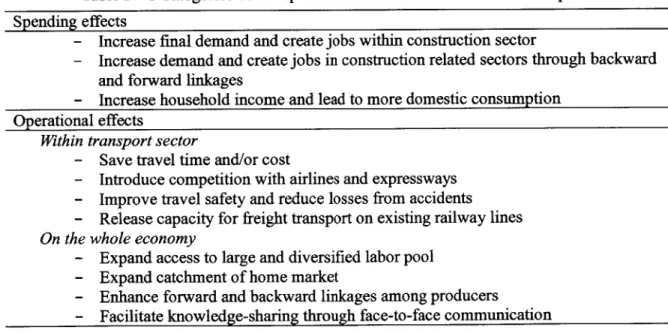
Table IV-I Categories of transport infrastructure's socio-economic impacts ... 66
Table IV-2 List of economic performance indicators...76
Table IV-3 Cities group by region and size... 87
Table IV-4 List of additional explanatory variables... 99
Table V-I Competition between HSR and airlines in Wuhan-Guangzhou transport corridor ... 113
Table V-2 Number of passengers by bus from and to Guangzhou 2009 and 2010 ... 114
Table V-3 Intercity railway passenger flows in Wuhan-Guangzhou corridor 2010(Unit: thousand)... 115
Table V4 Change in intercity railway passenger flows 2009-20 10... 116
Table V-5 Reduction in travel time by rail after the opening Wuhan-Guangzhou HSR ... 116
Table V-6 Change in railway service frequency after the opening of Wuhan-Guangzhou HSR... 116
Table V-7 Annualized changes in intercity railway passenger flows 2001-2009... 117
Table V-8 Growth rate of number of tourist and tourism revenue in HSR and Non-HSR cities ... 123
Table VI-lTypes of TODs and demands on land use...137
Table VI-2 Influential factors of station area development... 143
Table VI-3 Fundraising and investment promotion events held for the HSR New Town...151
Table B-I Sum m ary statistics of variables...218
Table B-2 Estimated coefficients of pooled OLS, fixed-effect and random-effect models ... 219
Table B-3 The elasticity of general economic performance to accessibility...220
Table B4 The Elasticity of sectoral economic performance to accessibility ... 220
Table B-5 The elasticity of general economic performance to accessibility by region...220
Table B-6 The elasticity of sector-specific economic performance to accessibility by region ... 221
Table B-7 The elasticity of general economic performance to accessibility by city size...221
Table B-8 The elasticity of sectoral economic performance to accessibility by city size ... 221
Table B-9 The elasticity of general economic performance to accessibility by size and region...222
Table B-10 The elasticity of sectoral economic performance to accessibility by region and size...223
Table B-I1 The elasticity of general economic performance to accessibility by accessibility level...224
Table B-12The elasticity of sectoral economic performance to accessibility by accessibility group ... 224
Table B-13 The elasticity of economic performance to accessibility from pooled OLS-IV models ... 225
Table B-14 Elasticity of GDP to accessibility controlling for capital and labor inputs ... 226
Table B-15 Elasticity of tourism revenue to accessibility controlling for number of hotels...227
Table B-16 Elasticity of number of tourists to accessibility controlling for number of hotels ... 227
Table B- 17 Elasticity of wage rate to accessibility controlling for industrial composition ... 228
Table B-18 Elasticity of FDI to accessibility controlling for GDP and total employment ... 228
Chapter I INTRODUCTION
Exploring the relationship between transport investments and economic development has
a long tradition. Recent progress in transport technology, particularly the construction of the
high-speed rail (HSR) system in China at an unprecedented scale, has again raised wide research
enthusiasm among scholars and policy-makers in this domain. As part of the continuous efforts
to extend the theoretical horizon and enrich the empirical evidence under this topic, I examine
how transport infrastructure influence urban economic performance through changing intercity
accessibility and factor mobility. The purpose of my research is to develop an integrated analytic
framework to assess transport infrastructures' influences on urban economic activities, which is
currently missing from the standard project-level cost-benefit analyses. I applied this framework
to analyze the spatial-economic influence of China's HSR system. I choose China as the case for
three reasons: (1) China has dedicated huge amount of fiscal resources to constructing the most
ambitious HSR network in the world, and (2) China has social economic features that differ from
the mature economies, and (3) the rapidness of changes in China enables my analyses over
relatively short observation period.
HSRs are usually passenger-dedicated lines, with direct impacts on the time and costs of
passenger travel. The measurement of accessibility in this research, therefore, is based on
passenger's mobility, without taking into account freight transport. The basic spatial unit of
analyses is the urbanized areas of the prefecture-and-above level cities in China, at a total
number of 287. I treated these urban areas as nodes linked by the transport routes and highlighted
the physical connections between cities rather than within them. I explored how transport
infrastructures influences the productivity of urban economies, migration in domestic labor
market, location choice of economic activities, and the conversion of land uses. I assume that the
wider economic impacts associated with improved accessibility could be reflected by the growth
rate of urban economy, wage rate, employment, land development and the output of
travel-dependent service sectors. I also examined how cities' endogenous features interact with
their access to external economic resources and jointly determine the realization of HSR's
specific impacts on urban economic performance.
In Section 1.1, I introduce the socio-economic background and the pending policy
inquiries that motivated my research. Section 1.2 contains research questions and hypotheses
based on existing theories and my field observations. I then discuss the intellectual contributions
and innovative perspectives of my research in Section 1.3, and conclude with an illustration of
the overall structure of my research in Section 1.4.
1.1
Problem statement
Several pending policy inquiries motivated my research. First, analysts have been
questioning the validity and efficiency of transport infrastructures as a major policy tool to
stimulate economic growth. Second, the standard project-level cost-benefit analysis fails to
capture transport infrastructures' spillover effects on the rest of the economy. Third, there has
been huge ambiguity in the claimed wider economic impacts associated with transport
infrastructures, and systematic estimation seldom exists. The recent development of HSR in
China has made these unaddressed issues even more urgent for policy makers than before.
High-speed rail (HSR) has various definitions under different criteria, and in this research,
I use the broader definition of HSR by the International Union of Railways (UIC), which refers
to railway lines that support average traveling speed at 200 km per hour or above, including both
upgraded mixed-use lines and brand new passenger-dedicated lines.
HSR has a long tradition in Japan and European countries. In 1964, the Tokaido
Shinkansen in Japan between Tokyo and Shin-Osaka marked the modem era of high-speed trains.
In the subsequent decades, high-speed trains emerged in developed European countries, such as
France, Germany, Spain, and the United Kingdom. Only in recent years has the HSR caught
global attention. An important context is the global economic downturn since 2008. Nations
across continents have initiated infrastructure investment as a major component of the economic
stimulus packages, and HSR is one of the candidates on the investment list. On February 8, 2011,
the Obama administration of the United States unveiled a plan to spend $53 billion over the next
six years to develop a high-speed passenger rail system that would link the nation's larger cities
(WhiteHouse 2011). Meanwhile, for the first time, systematic planning, construction, and
operation of HSR is taking place in developing countries. Mainland China has made
eye-catching achievements in terms of total amount of investment, length of HSR lines, speed of
construction, and geographical coverage of services.
I find huge ambiguity in the claimed wider economic benefits of HSR investment and the
inadequacy in existing analytic tools to estimate such benefits. HSR investment triggers broad
policy discussions because it cost billions of dollars to build, and it takes up a huge proportion of
public resources. However, policy-makers sometimes make rush decisions to allocate public
funds to HSR projects without careful assessment of the long-run impacts on economic
development. In China, there has not been any publically released document assessing the wider
economic impacts of the national railway development plan. Moreover, local authorities tend to
have unfounded optimism that HSR will become a magic engine that will automatically boost
economic growth.
Scholars have questioned China's HSR investment for lack ofjustification and warned
the government about the enormous financial risks of such investment (Zhao 2009). Currently,
project-level cost-benefit analysis (CBA) still dominates the assessment of the feasibility of HSR
projects, but there is increasing desire among policy-makers to account for the less tangible
wider economic benefits in financial analysis. Due to the asymmetry between costs and benefits,
it is improper to apply the standard CBA framework to HSR projects ---they incur huge amounts
of construction and maintenance costs, but a significant proportion of benefits go beyond the
project's scope, which have not been effectively estimated. Expect for a few busy corridors that
may generate sufficient financial return to make the investment worthwhile, CBA on HSR
projects often yields negative estimated return rates. Therefore, in feasibility studies,
policy-makers turn to wider socio-economic benefits to justify the use of public funds. To extend
the traditional CBA framework by including wider economic benefits of HSR, one precondition
is systematic estimation of the indirect benefits. For large scale of transport investment like HSR,
it is reasonable and necessary to consider the wider economic impacts. Yet this part of indirect
benefits, are less visible and hard to estimate compared to the costs and project-level benefits,
even though they definitely exist. The reliance on ambiguous wider economic benefits is
potentially problematic, that is, once the benefits are subject to manipulation, they can help any
unqualified project pass the feasibility study standard. Therefore, it becomes a very important
and urgent task to estimate the magnitude and nature of the claimed wider economic benefits.
In practice, due to the complexity of quantifying HSR's wider economic benefits,
development authorities usually emphasize the immediate job-creation effects and increase in
domestic consumption during the construction period of HSR (Ma 2009; Tang 2009; Wu 2009;
Zhang 2009). The short-term impacts may be significant but not sustainable. In contrast, the
long-term impacts of HSR on economic performances are seldom discussed. In addition,
policy-makers and analysts in China usually have approached the economic benefits of HSR in a
qualitative way (Zhang 2009; MOR 2010), while few properly designed quantitative empirical studies exist. The lack of quantitative research in this field is partly caused by the complexity of intertwined direct and indirect impacts associated with HSR investment, and the difficulty to attribute enhanced economic performances to transport improvement. Another reason is the absence of a holistic perspective among analysts, who usually emphasize the travel time savings along a specific transport corridor after the operation of a single HSR line, ignoring the network feature of the transport system and the spillover effects of transport investment.
In response to these pending policy inquiries, I propose an analytic framework for
systematic estimation of the wider economic impacts associated with major transport investment, using China's HSR as a specific case. The findings will lead to a careful reflection on the
investment-led growth mode in China; a methodological improvement that integrates the wider economic impacts of transport infrastructures in project appraisal; and an alternative vision of urbanization for China in the coming decades.
1.2 Research Questions and Hypotheses
The purpose of my research is to develop an integrated analytic framework to estimate the potential contribution of transport infrastructure investment to urban economic performance, and apply this framework to assess the wider economic impacts of China's HSR development plan. Specifically, I use intercity accessibility as a key intermediary variable, and examine how HSR influences urban economic performance through changing the interregional flows of production factors such as capital and labor, that highly depend on accessibility.
A basic hypothesis of this dissertation is that: an important mechanism for intercity
transport infrastructures to influence urban economic performance is changing a city's access to external production factors, such as capital, labor and knowledge. In other words, in a globalized
economic setting, a city derives agglomeration effects not only from the clustering of its own
resource endowment but also from its access to external production factors through transport
infrastructure. Even though economic theories predict the existence of transport infrastructure's
influence on urban economic performance, the nature, magnitude and distribution of such
influence remain unexplored. These features of transport-related economic impacts depend not
only on the scope of analyses, but also on the indicators used to represent different aspects of
urban economic performance. Therefore, I break down the basic assumption into several testable
sub-hypotheses below.
First, transport investments during 2001-20 10 have led to a convergence in accessibility
among regions in China. HSR's impacts on intercity accessibility patterns concentrate in lower
tier cities. Yet, HSR's contribution to accessibility improvement is conditional, depending on the
composition of the cities on the routes and existing conditions of transport facilities.
Second, the influence of intercity accessibility on urban economic performance may
consist of both generative and redistributive components, and could encounter saturation effects
as economic heterogeneity among cities decreases with market integration. Improved
accessibility may lead to divergence or convergence of economic performance among cities.
Third, the introduction of HSR may shift travel patterns among cities and lead to
restructuring of the regional urban hierarchy. HSR's impacts on different aspects of economic
performance may vary in terms of time horizon and spatial coverage. The magnitude of HSR's
impact also depends on a city's intrinsic features, such as size and location on the routes.
Fourth, HSR station could bring an external driving force to urban development. The
potential for new development is determined by the possibility of matching demand for
development with supply of land near the station. In addition, joint effort of both public and
private sectors is indispensable to materialize this development.
The proving or disproving of these four hypotheses sheds light on the features of the wider economic impacts associated with transport infrastructure investment in general and with HSR in particular. An in-depth understanding of these features assists rational decision-making of public investment in the transport sector.
1.3 Research significance and contributions
The targeted audience of my research includes the following: (1) policy-makers in line ministries of the central government who develop long-term plans for national transport
infrastructure development; (2) municipal government officials who are eager to take advantage of HSR's potential stimulating effects on local economies; (3) private sector investors, especially multi-branch firms and developers facing location choices among cities. The findings from my study will contribute to a deepened understanding of the economy-wide, long-term impacts of HSR investment, and substantiate the analytical foundation of decision-making on major transport infrastructure development.
My research contributes to the existing literature in the following aspects:
First, I introduce a spatial dimension to the endogenous growth theory. The classical endogenous growth theory explains the dynamics of economic activities in the context of a closed economy, where the output of an economic entity is determined by the level of production factors at the home locality. I extend the endogenous growth model by introducing the
interaction among different economic entities in an open economic setting. The access to external resources, measured by an accessibility indicator, enters the production function by improving the total factor productivity and altering the effective inputs of labor and capital.
Second, I extend the scope of agglomeration effects in the New Economic Geography
(NEG) theory. The NEG theory predicts increasing return to scale, which refers to the
agglomeration effects at urban localities due to the dense concentration of production factors.
However, development in transport infrastructure has led to dispersion of such agglomeration
effects. The prosperity of an urban economy is jointly determined by a city's own endowment as
well as its access to external resources through transport infrastructure, with the latter being
partially substitutable for the former. I extend the scope of agglomeration effects by emphasizing
the growing importance of access to external resources in the globalization era.
Third, my research also bridges the spatial discontinuity between regional and urban
studies by proposing a multi-scale research framework at network, corridor and node (city) levels.
While numerous studies have examined the interaction of transport improvement and economic
performances along specific HSR lines (Hensher 1997; Gutierrez 2001; Arter 2009; Cascetta,
Papola et al. 2011) or around HSR stations(Amano 1990; Bertolini and Spit 1998; Pol 2007),
there is much less research that provides a comprehensive picture of the HSR network and its
broader impacts on economic development. A small literature on network effects is about the
Trans-European Network (TEN)
,
which is the only HSR network
in
operation (Vickerman 1995;
Gutierrez, Gonzilez et al. 1996; Carsten SchUrmann 2001). The main focus of their studies is to
examine how the HSR network changes the center-periphery pattern within and among European
countries. My study goes one step further to relate the change in accessibility to urban economic
performance. Banister(2007) pointed out that scale is an important factor to consider when
assessing the economic impacts of HSR, and proposed a composite three level analytical
framework. My study extends this research by including the productivity benefits due to the
overall improvement in network accessibility, which is not reflected in corridor and node level
analyses.
Finally, my research is a pilot study on transport investment's impacts on economic development using empirical evidence of China. The existing literature has a spatial focus on the developed economies. China is an emerging economy with large regional disparities in economic performance, and the HSR network has been built at unprecedented speed and scale. This
provides a unique opportunity to extend this well-established research topic. It is reasonable to expect that the influence of HSR on China's economy will show different patterns compared to the mature economies. For a long time, quantitative empirical study was unimaginable in a Chinese context due to low availability and/or poor quality of data. Policy-makers and analysts in China mostly approached the economic benefits of HSR in a qualitative manner (Zhang 2009; MOR 2010). Recent improvement in the spatial coverage and quality of social-economic
statistics makes my research possible. Among the very few studies on the railway network in China, Wang and Jin(2009)'s paper showed how the railway system and intercity accessibility evolved during the 20th century. Their paper is very informative regarding the history of China's railway system, but does not cover the HSR revolution during the past decade (2001-2010). This is exactly the time horizon of my study. Scholars also started to estimate the impacts of HSR network on China's urban system using econometric models (Yeh 2011). However, the prediction from existing studies is weakened by using two-period data of beginning and ending years, a small sample of cities and arbitrarily estimated intercity travel time. My research uses annual statistics for 287 cities during 2001-2010, together with travel time extracted from real timetables.
1.4 Structure of the dissertation
The remaining parts of my dissertation proceed as follows: In Chapter III explain the construction of my research framework by integrating relevant theories and analytical tools, with
a diagram showing the multiple mechanisms through which transport infrastructure investments
may influence economic performance. Chapter III and Chapter IV are network level analyses, in
which I put HSR in the context of the multi-modal national transport system and examine the
general features of the synergy between transport infrastructure and economic performance. In
Chapter III I analyze and visualize the evolution of intercity accessibility patterns in China
during 2001-20 10, with special emphasis on the role of HSR in reshaping accessibility. In
Chapter IV, I report the results from a series of panel data models assessing the influence of
accessibility improvement on various aspects of urban economic performance. I replicate the
econometric modeling using different sub-samples to illustrate how the accessibility elasticity
varies across regions, by city size and across different accessibility levels. In Chapter V and
Chapter VI, I examine a particular HSR corridor between Wuhan and Guangzhou and cities
along this route, aiming to identify the features of economic influences that distinguish HSR
from other types of regional transport infrastructures. Chapter V focuses on HSR's channelizing
effects on intercity travel patterns and the short-run location choice of economic activities, while
Chapter VI is dedicated to the relationship between HSR station and urban land development.
Chapter VII concludes with summary of findings, policy implications and discussions on
limitations of my study and opportunities for future research.
Chapter
II AN INTEGRATED RESEARCH FRAMEWORKIn this chapter, I develop the research framework to conduct my study of HSR's impacts on intercity accessibility and urban economic performance. Section 2.1 is an introduction to the theories underlying my study. In Section 2.2 I review existing analytic tools that have been developed in different disciplines to explore the synergy between transport infrastructure investment and economic growth, with discussion of the strengths and limitations of each analytical tool. In Section 2.3 I propose an integrated multi-scale research framework that takes advantage of both quantitative and qualitative approaches, and covers the full spatial horizon from the intercity transport network to a specific HSR corridor and cities connected by the HSR. 2.1 Theoretical foundations
The current research is built upon three schools of theories: (1) New Economic Geography (NEG) theory, (2) urban economics theory and (3) endogenous growth theory. I
synthesize the spatial emphasis of the New Economic Geography theory with the temporal perspective of the growth theories. Along the spatial dimension, I bridge the inter-city scale of analyses in NEG theory with the intra-city scale of study in urban economics theory. Revisiting these theories gives a comprehensive theoretical framework to conduct the proposed multi-scale
analysis.
2.1.1 New Economic Geography (NEG) theory
NEG theory aims to explain the distribution of economic activities over space, assuming
increasing returns to scale, imperfect competition and the influence of transport costs. The founders of NEG theory, Krugman and Fujita (1991a, 1991b), proposed a Core-Periphery model by applying the monopolistic competition paradigm in spatial analysis. The Core-Periphery
model has become a frequently used analytic tool in recent empirical studies (Mayer 2004; Fujita
and Mori 2005; Henderson 2005; Pfliger and Sudekum 2006).
NEG theory emphasizes the importance of the broadly defined transport costs as barriers
to economic activities, including the difficulties
in
exchanging goods, people, and ideas. The
motivation to avoid transport cost leads to clustering of economic activities to take advantage of
agglomeration economies. Agglomeration economies are the benefits obtained from production
agents and consumers being close to each other at certain locations. The argument for
agglomeration economies is based on Marshall's (1890) three-pillar doctrine: input sharing, labor
pooling, and knowledge spillovers (Duranton and Puga 2004). The initial Krugman model
highlights the agglomeration benefits due to reduced costs of freight delivery while touching
little upon the costs of human travel. This might be a proper treatment in an economy dominated
by agriculture or manufacturing, as the shipment of raw materials and final products is the major
concern of production. However, for a service-based economy, the mobility of people is of
greater importance and deserves more attention. In contrast to a constant decline in the cost of
freight shipping, the cost of moving people over space remains high because time is a major
input into human travel, and the value of time continues to rise as people become more
productive (Glaeser and Kohlhase 2003). HSR provides a new technological option that reduces
travel time and lowers the cost of passenger transport. This study focuses on the labor pooling
and knowledge spillover mechanisms of agglomeration effects, both of which are strongly
related to the mobility of passengers.
NEG theory predicts a non-linear relationship between transport costs and agglomeration.
As transport cost decreases, economic activities may follow a pattern of dispersion,
concentration and re-dispersion (Holl 2004). According to Graham (2007), transport investment
can render a large amount of activity more accessible by reducing travel time or cost, thus giving
rise to positive agglomeration benefits. However, unless travel becomes absolutely costless, reducing transport cost does not diminish the advantages of agglomeration. Instead, improved accessibility will flatten the spatial decline of agglomeration benefits and change the ways that economic activities occur. In the specific case of HSR, the imperfectly competitive labor market benefits from three possible changes: (1) increasing participation rates, (2) longer working hours, and (3) improved matching between laborers and jobs (DFT 2005). For knowledge sharing, HSR facilitates face-to-face communication, which is still considered to be essential to foster
innovation and spread knowledge, particularly the tacit proportion. Tacit knowledge is not as easy to obtain as the codified components of knowledge, even in the era of advanced information technology (Cowan, David et al. 2000; Jensen, Johnson et al. 2007).
Analysts commonly use NEG theory to explain international trade or economic interaction among regions, treating cities as abstract points in space (Krugman 1991 a). In addition, NEG theorists cover the mobile production factors (capital, labor and knowledge) but do not discuss the impact of transport cost on the immobile factor---land. At the local level, I need an alternative theoretic framework to explore the relationship between transport costs and economic activities.
2.1.2 Urban economics theory
Urban economics theory focuses on the spatial dimension of economic motivations underlying the formation, functioning and development of cities. A major theoretical inquiry concerns the interaction between land use and transport costs. Alonso (1964) and Muth (1969) constructed the land-rent gradient to explain how land values that are related to transport costs determine the patterns of land use and urban form. Each type of urban activity has its own bid-rent function and the combination of various bid-rent functions defines the rent gradient. In a
typical monocentric model, jobs are expected to concentrate in the Central Business District
(CBD). Distance (or in a more precise term, transport cost) from any location to the CBD,
determines not only the current land values that lead to assignment of land to different urban uses,
but also the expected location values of land that influence the desire for development and
redevelopment over time. In the Alonso model, the driving force for urban land development
stems internally from the CBD.
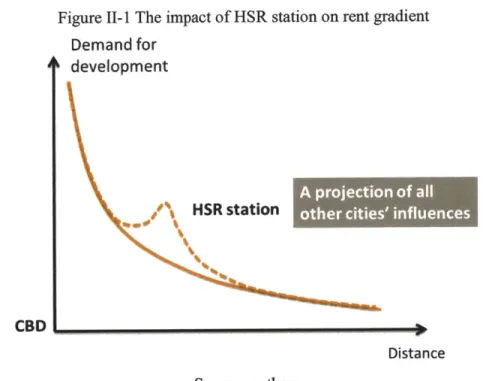
However, HSR stations could also generate demand for land development in their
proximity due to convenient access to external production factors. HSR stations distort the
smooth downward sloping shape of a rent gradient (Figure II-1).
Figure II-I The impact of HSR station on rent gradient
Demand for
+
development
HSR station
A projection of allother cities' influencesCBD
L
Distance
Source: author
This is particularly true for medium and small cities within commuting distance of a megacity. The HSR stations may turn a periphery location into a gateway of the home city. Such a gateway location, once combined with favorable policy and matching investment, will foster the formation of sub-centers and reshape the configuration of the city. This study extends the
explanatory power of the Alonso model by introducing an external driving force on urban land
development that is associated with the HSR stations. The external stimulus of land development, which concentrates around the HSR station areas, overlaps with that from the existing CBD and may change the monocentric urban form to a polycentric one (Wheaton 1974).
2.1.3 Endogenous growth theory
Krugman and Alonso's models shed light on the spatial interaction between transport costs and economic activities, while growth theories highlight the dynamics of economic activities over time. The evolution of economic growth theory is subject to shifting paradigms. The neoclassical school of grow theory, represented by the Solow-Swan model, assumes that capital and labor are the two major endogenous contributors to economic growth, while technology is exogenously determined (Solow 1956; Swan 1956). I adopt the perspectives of endogenous growth model, which has been developed by Romer (1987) and Lucas (1988). The endogenous growth model treats technology as determined by the accumulation of human capital and physical capital within the economy and considers the expansion of the knowledge base as the original driving force of economic growth. The expansion of knowledge leads to continuous improvement in total factor productivity and non-diminishing return to scale.
Yet the standard endogenous growth model does not include the location of production and consumption, and the discussion on growth is conducted in the context of independent, close economic entities. If we apply the argument of endogenous growth theory to a multi-regional situation, transport cost and accessibility will become influential factors in determining the size and evolution of the local knowledge base. At any location of economic activities, the
accumulation of knowledge not only depends on the stock of local human capital, but also relies on the interaction with other economies. This is particularly the case for economic localities at lower tiers of urban hierarchy. Therefore, I extend the endogenous growth model by including
accessibility, which represents generalized transport costs, as an explanatory factor.
2.2
Existing analytical tools
Economists, geographers and transport experts have developed a rich set of analytic tools
to explore the shared research interest on the contribution of transport infrastructure investment
to economic development. Each method has its own advantages and limitations.
2.2.1
Econometric models
Economists normally treat transport infrastructure as accumulation of public capital stock
and estimate the impacts of public infrastructure spending on private sector productivity.
Aschauer (1989) and Munnell (1990) conducted pilot studies in the U.S. context using
econometric models. They estimated the elasticity of productivity against public infrastructure
investment using time series data from the 1940s to 1980s, with the estimated elasticity falling in
the range from 0.34 to 0.41. Later on, Canning (1999) used panel data and obtained a much
smaller estimated elasticity, which fell in the range of 0.03 to 0.11. The shrinkage in the
estimated elasticity is the result of eliminating time-invariant factors that are specific to
economic entities.
There are several caveats regarding the classical econometric analyses. First, these
analyses relate the input (capital stock) rather than the output (transport costs) of transport
investment to economic performance, but in reality more investment does not necessarily
guarantee lower transport costs or better service. The same amount of investment in the transport
sector could generate totally different outcomes. In addition, classic econometric models do not
explicitly consider the spatial interaction among regions, which is exactly a key function of
transport infrastructure as compared to other types of public investment. One exception is the
multi-regional input-output model (Polenske 1970). Although the multi-regional input-output
model accounts for spatial interaction properly, such analysis is hardly possible to conduct with disaggregated spatial units due to the absence of proper data sets. This research measures the outcome of transport infrastructure investment by accessibility indicators and accounts for spatial interaction among different economic entities, for which purpose I need to draw lessons from spatial analysis.
2.2.2 Spatial analysis
Unlike the economists, geographers emphasize the spatial distribution and interaction of economic activities using gravity models (Curry 1972; MacLean 1974; Erlander 1980; Porojan
2001). The key underlying assumption of gravity models is that the economic interaction, in
terms of trade, migration, or capital flows, is proportional to the scale of economic activities at different locations, and inversely proportional to the distance between locations. The
development of geographical information system (GIS) tools has facilitated spatial analysis on the spillover effects of transport infrastructure with extensive datasets (Gutidrrez,
Condego-Melhorado et al. 2010). In recent years, the integration of GIS-based spatial analysis and classic econometric models has led to a wealth of empirical studies under the category of "spatial econometrics"(Anselin, Florax et al. 2004; Arbia 2006).
However, most empirical studies built on traditional gravity models do not explicitly account for transport costs. Instead, researchers use Euclidian distance as a proxy for the spatial friction among different locations. This treatment is valid in a cross-sectional analysis, but becomes problematic when considering time series. Euclidian distances are fixed and could not reflect the change in spatial friction among locations due to transport infrastructure investment.
My research belongs to the generally type of spatial econometric analysis and I enhance the
gravity-type models by replacing distance with real travel time among different locations. To
achieve this goal, I integrate analytic tools from transport discipline.
2.2.3 Transport models
Transport experts have developed various models to forecast travel demand and simulate
the productivity enhancement within the transport sector. Often using discrete choice behavioral
models, they identify and calibrate factors that influence intermodal choices, such as, the travel
time by mode, service frequency, fare and level of comfort, etc. (Ben-Akiva and Lerman 1985;
Lee and Boyce 2004). The behavioral models have been widely applied to forecast the shifted
and induced demand in passenger travel along HSR corridors (Hensher 1997; Chang and Chang
2004; Lee and Chang 2006; Couto and Graham 2008). This school of empirical studies focuses
on the direct impacts of transport improvement without considering the wider economic impacts
beyond the transport sector. My study relies on the estimations of transport models to improve
the measurement of accessibility and therefore to integrate the analyses within and beyond the
transport sector.
2.3
An integrated multi-scale research framework
Transport infrastructure's impacts on economic performance consist of many aspects,
with variation in magnitude at different spatial levels, so I propose a multi-scale analytic
framework to provide a comprehensive picture. I develop this analytic framework by
synthesizing New Economic Geography (NEG) theory, urban economics theory and endogenous
growth theory. Methodologically, I integrate analytic tools that have been developed by
economists, geographers and transport experts to examine the synergy between transport
infrastructure investment and economic development. This multi-scale framework covers the
national inter-city transport network, a regional HSR corridor and cities as nodes on the transport
network.
I use quantitative approaches for network analysis. At this level, I conduct a panorama
analysis of prefecture-and-above level cities on the national transport network of China, examining the change in intercity accessibility over the last decade by GIS spatial analysis and estimating the elasticity of urban economic performance to accessibility with econometric models. I put HSR into the context of the overall expansion of intercity transport network, and identify the role that HSR has been played in changing accessibility. The change in urban economic performance is not particularly attributable to HSR development but as a result of improved multi-modal accessibility among rail, road and air travel options. At the corridor level,
I use comparative statics to show changes in regional travel patterns and HSR's channelizing
effects on economic activities. The economic impacts assessed are directly linked to the construction and operation of the HSR line. I compare the passenger flow patterns and urban economic activities for cities along the Wuhan-Guangzhou HSR in the pre- and post-HSR
settings. I examine whether HSR cities outperform non-HSR competitors within the same region. At the city level, I conduct comparative case studies to identify the conditions for HSR station to become an engine of urban development. Cluster analysis based on key influential factors
generates the prototypes of cases that I choose. I rely on field observation, document review, and interviews with stakeholders to obtain information for the case studies. Table 11-1 below
summarizes research focuses and methods of proposed analyses at different spatial levels. Table II-1 Research focus and method of multi-level analyses
Spatial level Research focus Method
Network - Patterns and evolution of intercity GIS-based spatial analysis accessibility
- Elasticity of urban economic Econometric modeling with panel performances to accessibility data
Corridor - Shift in travel patterns Comparative statics of before- and
- Relocation of economic activities after HSR period
Note (City) - Urban land development in HSR Cluster analysis and comparative
station area case studies
The relationship between transport infrastructure and economic development could be explored from various perspectives. Banister and Berechman (2001) proposed a scheme to illustrate the underlying mechanisms that shape the interaction between transport infrastructure, location choice and economic growth. I modify Banister's scheme to incorporate the key arguments of NEG theory, urban economic theory and endogenous growth theory (Figure 11-2).
Figure 11-2 Relationship between transport infrastructure investment and economic performance
Investment (Construction Transport (Generated
multiplier Period) infrastructure demand)
(Operational Period)
Transport (Accessibility Economy-wide sector impacts change) impacts
Time/cost Travel Modal Relocation of
saving volume split production factors
(Induced
impacts)
Capital Market Labor Knowledge
flows integration migration spillover
Utility Land Output and Wage and
gains values consumption Enployment
o) Economic __ _ _ _ _ _ _ _ _ _ _|
--- __---__--_--_---
>
performance(Spending effects)
Source: Banister and Berechman (2001), author revision
The construction of transport infrastructure stimulates amplified investment in related industrial sectors through forward and backward linkages, and such spending effects are often assessed with input-output models. Economic growth generates extra demand for transport and could, in turn, trigger new investment in transport facilities. I do not explicitly discuss these two effects that are represented by dash lines and arrows. Instead, my study focuses on the
economy-wide impacts of transport infrastructure during the operation period, backed by the prediction of agglomeration effects in NEG theory.
The agglomeration effects occur when improved accessibility promotes relocation of production factors (i.e., capital, labor and knowledge) and integration of market, which
eventually show up in a series of urban economic performances indicators (listed in the shaded boxes). I extend the standard endogenous growth model by hypothesize that the access to
external production factors is partially substitutable to a city's own resource endowment. At the network level, I highlight accessibility's influences on mobile production factors, using spatial
analysis tools and econometric models. The corridor analysis illustrates HSR's specific
influences on time and costs savings, travel volume and modal split within the transport sector, and the consequential impacts on relocation of economic activities. The node/city level analyses assesse HSR's impacts on the immobile factor--land, assuming that HSR stations may bring external driving force of urban development. This analysis expands the explanatory power of the classical rent gradient model in urban economic theory.
Chapter III EVOLUTION OF INTERCITY AccEssIBILITY PATTERNS
The purpose of this chapter is to provide a comprehensive picture of the evolution of intercity accessibility patterns during 2001-2010 in China. I illustrate the impacts of accumulated transport infrastructure investment on accessibility, particularly the operation of HSRs since
2007. It is the first study of this kind in China that covers all 287 prefecture-and-above level
cities using real travel time. My analysis provides detailed description of the key explanatory variable--intercity accessibility--of the econometric models in Chapter IV. It also helps to
identify the corridor and cities that experienced the most significant improvement in accessibility, which I choose for my case studies in Chapter V and Chapter VI.
I start with a brief review of the development of China's national transport network during 2001-2010. In Section 3.1, I document the development of railway system before and after the introduction of HSR. I also show the development of civil aviation and expressways during the same time period, which jointly contribute to the improvement of intercity
accessibility in China. In Section 3.2, I selectively review literature on the trans-national HSR network in European countries, where empirical evidence abounds, as well as relevant studies on
the relationship between transport investment and accessibility improvement in a Chinese context. In Section 3.3, I explain the indicators I use to measure accessibility and the
identification of urban hierarchy to simply the calculation of travel cost matrices. Section 3.4 contains technical details about data mining and calibration of accessibility indicators. I report findings from the spatial analyses on China's intercity accessibility patterns in Section 3.5 and summarize in Section 3.6.
3.1 Expansion of the national transport network
In the past decade, China has experienced fundamental changes in the national transport