MASSACHUSETTS INSTITUTE OF TECHNOLOGY
February 1995
@
Massachusetts Institute of Technology 1995. All rights reserved.
Author
Department of Urban (tudies and Planning
October 25, 1994
Certified by...
Lawrence Vale
Assistant Professor
Thesis Supervisor
Accepted by.
Chairman,
Langley Keyes
Magte in,.City Planning Committee
Black and White Simulacra: Charleston's "Cabbage Row"
by
Charlotte Lindiwe Emoungu
Submitted to the Department of Urban Studies and Planning on October 25, 1994, in partial fulfillment of the
requirements for the degree of Master in City Planning
Abstract
"The Insider's Guide to Greater Charleston," one of the most widely accesible tourist guidebooks of architecturally restored Charleston, South Carolina distinguishes sites of African-American history from sites of general interest. "Cabbage Row," or 89-91 Church St., Charleston is noted by 'The Guide' as a site of African-American history.
Of particular interest is the tour guide's descriptive passage of Cabbage Row which
states: "anyone familiar with the opera [Porgy and Bess] and its stage settings will see that this place ... could easily have been the original scene [my emphasis]."
Curiously, this site of African-American history refers to a fictional work. Further-more, this thesis claims that this site is intertextual. It is both a site of African-American and 'general' history. This thesis asserts, then, that the visual authenticity of this site (in both its African American and "general" historical senses), is mediated by the fictional representation of race as exemplified by the novel Porgy and the opera Porgy and Bess.
Thesis Supervisor: Lawrence Vale Title: Assistant Professor
Contents
1 Introduction
1.1 Charleston... . . . . . . . . . ..
1.2 B ackground . . . .
1.3 Working Hypothesis and Site-Specific Case Study Methodology
1.3.1 Sites of 'African-American' Histor . . . ..
12
. . . 18
. . . 19
1.3.2 Theoretical Approach . . . .
2 Charleston's Slave History
2.1 The Vesey Conspiracy . . . .
2.1.1 The Stereotype
2.2 Antebellum Charleston
2.3 Charleston in the 1920's and 30's
. . . . 26
. . . . 3 6
. . . . 3 9
3.2.1 Nostalgia
4 Black and White Simulacra
4.1 The Allegorical Representation of Slavery . . . .
4.1.1 Race and Allegoric Trauma . . . .
4.1.2 Black and White Charleston: Historic Simulacra .
4.1.3 Catfish Row Reconsidered . . . ...
5 Epilogue: The Search for the Hanging Tree
5.0.4 The "Real" Black History of Charleston . . . ....
5.0.5 The Search for the Hanging Tree . . . .
Bibliography
. . . . 58
. . . . 63 . . . . 64
List of Figures
1-1 Charleston after the fire of 1861. . . . ... 1-2 Map of present day Charleston's historic district. . . 1-3 The Slave Mart Museum. 6 Chalmers St., Charleston
1-4 "Slave Row" at Boone Hall Plantation . . . .
1-5 The Battery . . . .
16
20
1-6 Cabbage Row . . . . 23 1-7 Cabbage Row c. 1925-35 . . . . 25
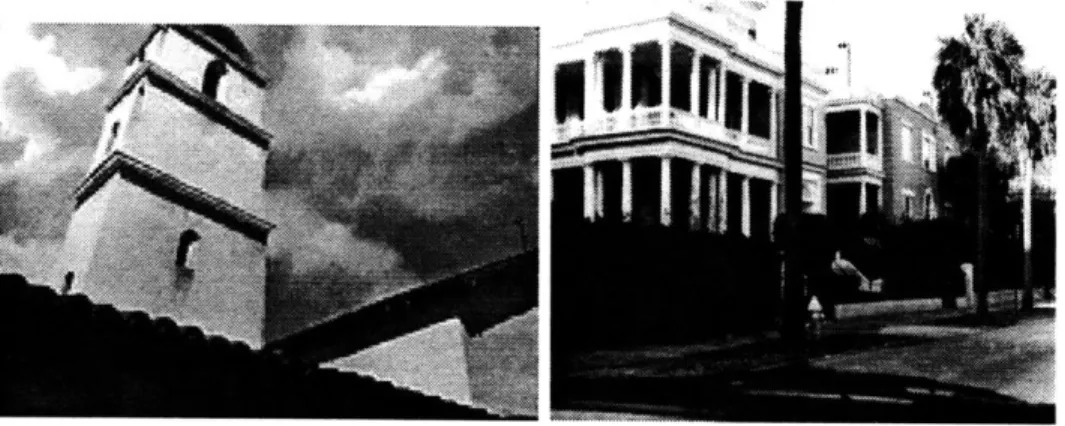
3-1 Left. The Mission, "exactly as it was." Right. Charleston (1994),
"exactly as it was." . . . . 50 3-2 The tree rings of a redwood chart history. . . . . 51 3-3 Judy. The definitive simulacrum. . . . . 52
3-5 Scotty examines a bra designed by Mitch. . . . . 54
4-1 An early photo of a typical Charleston alley c. the turn of the twentieth century . . . . . . . . . 65
4-2 The "old, new" Charleston: a predominantly black neighborhood be-fore the visitors center. Left. Chipped paint on a house (left-side of photo) exemplifies the lack of restoration . . . . 65
4-3 The "new, old" Charleston: a predominantly white historic district. M eeting St., various views. . . . . 66
4-4 Top Row. Scenes from Porgy and Bess, the "original scene" as referred to in the tourist literature. Middle Row, right. Bottom Row. represent views of the restored Cabbage Row. Dark archway in bottom row photograph corresponds to gated archway in the photograph depicting "Porgy" M iddle Row, left. . . . . 67
LIST OF FIGURES
"The Insider's Guide to Greater Charleston," one of the most widely accesible tourist guidebooks of architecturally restored Charleston, South Carolina distinguishes sites of African-American history from sites of general interest. "Cabbage Row," or 89-91 Church St., Charleston is noted by 'The Guide' as a site of African-American history.
Of particular interest is the tour guide's descriptive passage of Cabbage Row which
states: "anyone familiar with the opera
[Porgy
and Bess] and its stage settings will see that this place ... could easily have been the original scene [my emphasis]."Curiously, this site of African-American history refers to a fictional work. Further-more, this thesis claims that this site is intertextual. It is both a site of African-American and 'general' history. This thesis asserts, then, that the visual authenticity of this site (in both its African American and "general" historical senses), is mediated
by the fictional representation of race as exemplified by the novel Porgy and the opera Porgy and Bess.
The expression, or more aptly the "rest," implies a before and an after. The moment of its utterance is the coincidence of the cultural superiority of hindsight, and the privileged experience of an originary moment. In fact the expression inaugurates history itself, that peculiar mystification of retrospection. The immediacy of this originary moment-of the beginning of the rest-is occasioned by nostalgic desire. Consider this origin of history. Consider the origin of this place: Charleston, South Carolina. The Charleston of today is the restoration of the following burnt city as Kenneth Severens recounts in his book Charleston Antebellum Architecture and Civic Destiny:
A Charlestonian on military duty observed the fire from Fort Sumter: "I
CHAPTER 1. INTRODUCTION
Severens describes the impression of another viewer who took a stroll through the city after the fire:
With the moonlight streaming through the windows [of the Circular Congregational Church] and the monuments gleaming beyond, the effect was beautiful and reminded us of the Coliseum. While the front view with the row of [Corinthian] columns standing as if to guard the sanctuary, brought the ruins of the old Grecian temples vividly before us, as did the broken arches of the [South Carolina] Institute Hall. The Cathedral [of St. John and St. Finbar] is also very beautiful, the walls all standing and the spires all along the side reminded me of the statues on the Vatican while the [diocesan office] was that of some old Gothic minister-indeed everything is so transformed by the work of a single night that it seems as if we were carried centuries back and stood among the ruins of some anczent city.
Nevertheless, the devastation of Charleston's fire of 1861 was resonant with the losses Charleston endured during the Civil War. Various other Charlestonians stated:
... "Our city has received a terrible blow, which it will take the work of
years to repair." The anniversary of secession [of the Southern states from the Union during the Civil War] passed without joyous celebration, since
"...A dire calamity has laid in ashes a large portion of our beautiful city,
CHAPTER 1. INTRODUCTION
Perhaps the most desperate response was the one ... recorded a month
later: "A member of the legislature declared exultingly in the House that he was glad of the fire, as it would make it easier to burn the rest of the town if the Yankees were likely to become masters of it." Charleston did not have to wait for the Union occupation of 1865; by the end of 1861 it had already experienced a crushing defeat.'
... and so was the traumatic origin of this historic place, historic now after a fire.
This is the origin of the restored Charleston of today, saturated with the desire of nostalgia and longing. The contemporary restoration of Charleston attempts to evoke the jouissance of the Charleston just prior to its burning. The passage above also exemplifies a relation between race, historicity, and the historic imaginary (the imaginary image evoked by the likeness of the restoration). The imfamy of blackness occupies the same originary moment with the rapture of nostalgia, as well as the mythic imaginary of historic authenticity and resemblance.
1.1
Charleston
In the spring of 1670, during the reign of King Charles II of England, Charleston was founded by the Lords and Proprietors of Carolina.2 Charleston, an Atlantic coastal town, rests at the base of a peninsula between the Ashley and Cooper Rivers.
The institution of slavery has existed in Charleston, since the late seventeenth century, when the city was known as Charles Town, up until its abolition in 1865 at the end
'Kenneth Severens, Charleston Antebellum Architecture and Civic Destiny (Knoxville: University of Tennessee Press. 1988), pp. 263-4.
2
Samuel Galliard Stoney, This is Charleston: An Architectural Survey of a Unique American
In December of 1737, an immigrant, Samuel Dyssli wrote to his relatives in Switzer-land that "Carolina looks more like a Negro Country than like a Country settled by white people."6 In the early-to-mid eighteenth century, Charles Townians were appre-hensive about the number of blacks slaves that populated the city and countryside.
There was widespread fear of slave insurrections.
Rumors of slave plots sent periodic scares through Charles Town until the American Civil War. Some of the conspiracies were more imagined than real: garbled stories reported second or third hand, which reached whites nervous enough already over the lowcountry's black majority, or deliberate tales started
by whites to justify making examples of blacks as a warning to slaves who might
nurture thoughts of rebellion.7
Throughout the decade 1739-1749, "calamities and misfortunes"8 beset Charles Town.
On Sept 9, 1739, Charles Town experienced what was then the worst and "bloodiest
3
Walter Fraser, Jr., Charleston! Charleston! (Columbia, University of South Carolina Press), p. 15. 4ibid., p. 16. 5 ibid. 6 ibid. pp. 51-2. 7ibid., p. 54. 8 ibid., p. 66.
CHAPTER 1. INTRODUCTION
slave revolt in Colonial America."9 The slaves allegedly had a plan to capture the city of Charles Town, and perhaps would have succeeded were it not for an informant.10
In the summer of 1740, a year after the enactment of a more restrictive slave law. Charles Town experienced another fire. Many buildings perished during this fire, but the fear of slave incendiarism persisted. In 1741, a mulatto slave was caught trying to burn down a house on Union St." Though she was "arrested, tried, and convicted within forty-eight hours,"" she was pardoned when she named an accomplice, a slave named Boatswain.'3 "At his trial, [he] confessed that he .. 'looked upon every white
man he should meet as his declared enemy'."1 4 He was burned alive.15
In 1752, a hurricane hit Charles Town, and raged for several hours. Several people noted that the hurricane was the worst to have struck Carolina.16 In the years prior to the American Revolution, Charles Town was at the center of heavy slave trading. Slaves from Angola and Gambia were imported and sold at premium prices. In 1765, another rumor of a slave rebellion and planned massacre "rippled across Charles Town."17 This rebellion was supposed to have happened Christmas Eve. However, Henry Laurens, a Charlestonian, observed that the rumor resulted from some slaves shouting "Liberty!" in the streets "in imitation of 'their betters' who had done so" earlier. 18 9ibid., p. 66 10ibid. "ibid., p. 71. '2ibid. "ibid. 14ibid. 5 ibid. 16ibid.. p. 83. 17ibid., p. 113. 18ibid., p. 113.
canes attest. From the end of the revolutionary war until the end of the American Civil War, Charleston was to experience more fires, hurricanes, epidemics, and fear of slave conspiracies. The most notable of these kinds of disasters were, as we shall see, the Vesey Conspiracy of 1828 and the fire of 1861. The fire of 1861 destroyed the last of pre-Civil War Charleston. During the twentieth century, Charlestonians began to meticulously restore their city. In 1931, Charleston became the first city in America to have an historic district.
Today, Charleston's historic district extends from 375 Meeting St., Charleston's Vis-itor Center, to the Battery, a wooded park on the tip of Charleston's peninsula.
1.2
Background
When I began this thesis project, I wanted to investigate what I thought I had seen in a slide presentation: a slave auction block which had been restored in Charleston,
19ibid. p. 157.
2 0ibid.
2 1
CHAPTER 1. INTRODUCTION 16
Was the restoration intended as a multiculturalist gesture of critical reflection upon an institution of slavery? Did the irony of its restoration reflect a deliberate cynicism? Or was its restoration ironic at all? Indeed, the choice of restoration versus preservation was to me a scandalous one.
Restoration eliminates any trace of time. Preservation, as its name implies, preserves indexical traces of time, of the past from which the preserved object derives, and from which it has decayed. Furthermore restoration is controversially distressed when its object is slavery. Why restore a built relic of slavery? Why eliminate what is widely regarded as a period of redemption between the end of the American Civil War and the era of Civil Rights?, unless the restoration of the block was a more subtly sophisticated critical gesture. Could it have been? Did the restoration wage the critique that the racist ideology that informed slavery was "still with us"? Or was the block blithely and unabashedly restored as an uncritical valorization of the Old South? Or did the block defensively counter the impulse to censor references to slavery and affirm its status as a reminder of that 'peculiar institution'2 2?
CHAPTER 1. INTRODUCTION
Upon further reflection I began to realize, during the preliminary phases of my thesis preparation, that I was intrigued not so much by the block itself, as by the conspicuous absence on the top of it. I began to think also that the restoration of the block., as opposed to its preservation both enabled and dramatized this absence; and that this absence took the shape of a horrible body, a body that has long since been gratefully relegated to the pages of history. And the fact that this lurid voyeurism was so intimately grounded in historic restoration-this particular mode of architectural visuality-suggested to me a relation between the image of this historically restored city monument, and race.
1.3
Working Hypothesis and Site-Specific Case Study
Methodology
I took a research trip to Charleston in January of 1994. I went looking for this slave
block and any other restored monuments of slave history. I thought of Charleston as a bizarre concoction of noveau sensitivity (e.g. the use of the palatable "African-American" in tourist literature to distinguish racial history of architectural sites) and an uncritical, reminiscent look at the Old South. I wondered, then, if 'African-American' signified a departure from a discourse of the stereotype, or whether its usage signified a newer incarnation of the stereotype in an altered ideological con-text. In terms of this bizarre concoction of "political correctness" and an uncritical valorization of the Old South, what could a history of slavery, as produced within the tourist literature,2 3 mean?
2 3
By tourist literature I mean the most ubiquitous literature accessible, that which thousands of tourists peruse and buy upon visiting Charleston (i.e. material which may be purchased in an
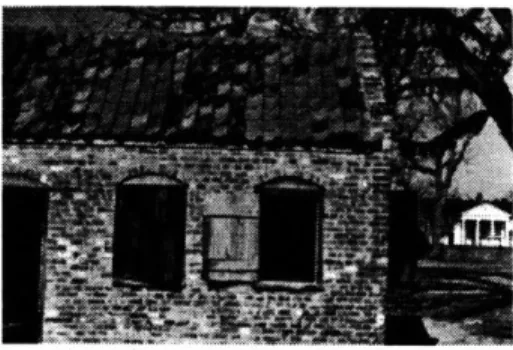
Figure 1-3: The Slave Mart Museum. 6 Chalmers St., Charleston
1.3.1
Sites of 'African-American' History
The Slave Mart Museum The Slave Mart Museum at 6 Chalmers St. used to be a place where slaves were auctioned off. It sits between a fire station and an old, non-descript house. The Slave Mart Museum is so named because it used to be a museum of 'African- American' slave history. The "Insider's Guide to Greater Charleston" describes the site as such: "[d]uring slavery, Charleston passed an ordinance which said all slave sales had to be held in licensed market buildings. One of these buildings still exists on the downtown cobblestone street called Chalmers (between Church and State)." For many years, it was a museum for black folk art and open to the public. The building has been vacant for several years."" The museum is now closed. As I peered through the window of the building, I noticed that it was completely unfurnished. I notice on the outside said that it was closed. I later inquired as the to status of the museum at the Charleston Visitor's Center. I was told that one could see airport tourist shop).
"I wonder if the pun was intended.
CHAPTER 1. INTRODUCTION
Figure 1-4: "Slave Row" at Boone Hall Plantation
the inside of the building upon taking a special, privately managed 'African-American' tour of Charleston.
The Slave Houses at Boone Hall Plantation While not inside the historic district, the Slave Houses at Boone Hall Plantation are featured by the "The Insider's Guide" as a site of 'African American' slave history. The tourist literature makes a consistent distinction between the plantation itself (a site of "general history") and the slave houses (a site of African-American history). The slave houses often occupy a com-pletely different section in most of the tourist literature than Charleston's 'history proper': a further corroboration of the distinction of histories that we have established as exemplary of postmodernism. This distinction is also reminiscent of the hierarchi-cal distinctions made in the Columbian Exposition. Although contemporary tourist literature does not formulate a 'value judgement' with regard to racial/historical dif-ference, there is arguably a hierarchical distinction implied by the designation 'African American' as opposed to 'history proper' in Charleston's tourist literature.
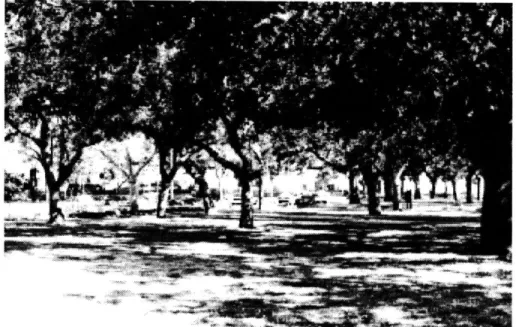
Figure 1-5: The Battery
An otherwise comprehensive tour of the plantation explains that most of the slave records, logs, books, etc. were burned and/or otherwise permanently lost. Slave Row, as it's called, is a row of nine remaining slave cabins. The row extends along the quarter-mile lane from the edge of the plantation grounds to the plantation mansion. These cabins housed skilled slaves (e.g. carpenters, blacksmiths, etc..), and so were closer to the owner's mansion than the cabins occupied by unskilled field hands. As I peered through the window of these cabins, they were completely unfurnished. Interestingly, these cabins were preserved as opposed to restored as was the plantation owner's mansion. The plantation owner's mansion was completely restored on the inside as well as on the outside. Indoor furnishings date from the spectrum of periods through the plantation's history of ownership.
CHAPTER 1 INTRODUCTION
The Hanging Tree This tree was the place in which they traditionally hung out-law slaves. Prompted by a pamphlet2" advertising an African-American tour of Charleston, I searched Charleston and particularly the area of the batter (a park area by the sea) for this tree. I initially asked the tour guides at the Visitors' Center where the tree was. None of them knew the exact whereabouts of the tree. I note here that I asked all of the tour guides present at the visitors' center on that particu-lar day at that particuparticu-lar hour as they were gathered outside of the center with their respective tour groups preparing to embark on tours. I asked another tour guide once on the battery (see Fig.-1-5). He redirected me to a fork in the middle of Avery St. There was an unlabeled tree at this fork. It was very young (hardly 10 ft. tall), and so could not possibly have been the tree from which slaves were hung. No one I asked could confirm the whereabouts of this tree.
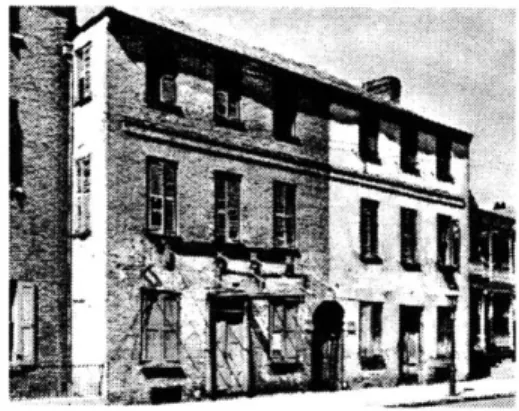
Cabbage, or "Catfish" Row The buildings at 89-91 Church St., or the area of Charleston known as Catfish Row (see Fig.-1-6), are today a site of African American history in the restored Charleston. According to the tourist literature, this place was the inspi-rational setting of the book Porgy (the story of a tragic romance between a legendary local beggar, Porgy, and a woman Bess), written by Dubose Heyward, and later the Girshwin opera/adaptation Porgy and Bess. A passage in the "African American"' history section of The "Insider's Guide" describes the site as follows:
CABBAGE ROW
26
This pamphlet certainly deserves an analysis of its own were it not for its non-status as a pamphlet per se: that is the "pamphlet" I refer to was merely a trifold xerox advertising AFrican American sites: a hanging tree, a bus tour to see them. Sadly, the bus tour never made itself available.
2
Furthermore, despite my most rigorous attempts to locate in the tourist center, various libraries, etc., no information as to the whereabouts of this tree exists in accessible tourist literature.
Figure 1-6: Cabbage Row.
89-91 Church St., Charleston
This downtown area was claimed as the inspirational setting for Dubose Heyward's 1925 book, Porgy, and George and Ira Gershwin's beloved folk opera Porgy and Bess (which premiered in 1935). "Cabbage Row," the scene of the story, got its name from the vegetables regularly sold by area black residents from their carts and window sills here. Today, this section houses quaint little shops, but anyone familiar with the opera and its stage settings will see that this
(place and the alleys around and behind it) could easily have been the original scene. Was there ever a real Porgy? Was the story based on truth? Many
Charlestonians recall a poor, crippled man who lived here (in the early 1920's) and who used a small goat cart to get around. The other details of the story are hard to pin down on any one individual. But Charleston certainly had enclaves of black families who struggled against very difficult times. And their saga of survival and social interdependence was (and is) inspiring. Charleston clearly has hurricanes-and in those days storms struck with little warning. And surely then, as now, the ugly specter of drugs and violence influenced these people's
CHAPTER 1. INTRODUCTION
lives and loves dramatically [my emphasis].28
In the mid-to-late forties, Samuel Galliard Stoney, a Charleston preservationist., de-scribed the site as such:
If you will pass up Church St., you will find in the block north of Tradd on either side of the Heyward House two other representative Charleston build-ings. Both are composites of residences and business establishments. The more northerly of these, once a lively negro "alley" still keeps its old contemptuous nickname of "Cabbage Row," which Dubose Heyward transposed into "Catfish Row" when he transposed a simulacrum of the building to the water front to house "Porgy" in his celebrated novel. ...Church Street is peculiary rich in his-tory. However, it is only one of any number of such regions that you find all about Charleston illustrating various periods of history [my emphasis].29
This simulacrum of Catfish Row, portrayed by Dubose Heyward in his novel Porgy, is suggestively recalled in the descriptive passage in the tourist guide: "...anvone familiar with the opera and its stage settings will see that this place ... could easily have been the original scene." I place these sentences in this particular order deliberately. in order to dramatize the vertigo of history enacted by this particular site. While the authors of the passage presumably designate the "original scene" as the "Catfish Row" of 1925, that upon which the novel was based, the difference between this site of 'African-American' history and the 'general' history of Charleston-proper relativizes the time of the original referent. In other words, the restored buildings today are, in the generalized historical sense, undoubtedly based on their imagined appearance during late-eighteenth century and antebellum Charleston. In the text of 'African
28 The Insider's Guide to Greater Charleston, African-American Heritage, pp. 345- 346.
29
Samuel Gaillard Stoney, This is Charleston: Survey of the Architectural Heritage of a Unique
Figure 1-7: Cabbage Row c. 1925-35.
[13]
American' history, the restored buildings' original were the buildings as they appeared in 1925. the year in which the novel took place (see Fig.-1-7).
The original scene? Which original scene? The 'original scene' could refer to the original Cabbage Row of 1925 (the year in which the novel Porgy was written, or it could refer to the block of buildings during antebellum Charleston prior to the burning of Charleston, or it could refer to any number of times upon which the restored scene could have been based. It should be noted that although there have been many adaptations of the opera Porgy and Bess, the tourist literature simply suggests that if you have seen the opera without specifying which particular version, and/or if you have read the book, you may imagine what this site must have looked like. Therefore, I claim that a more general consideration of race (which is certainly thematically common to every single adaptation of the opera) and its stereotypical and fictional representation is relevant here.
CHAPTER 1. INTRODUCTION
1.3.2
Theoretical Approach
Furthermore, the distinction of a site of African American history which is ultimately fictional is particularly intriguing. Certainly, 'The Guide's' conflation of a fictional text with the "these people's" experiences defies the factual primacy of history. More-over, both the fact that the novel itself was written by a white man, and the fact that the opera was conceived by two white men defy the notion of an African American experience originating from an African American author. Indeed, as I attempt to reach back behind the facade of "Cabbage Row" and retrieve the authentic African American, I come up short. When I attempt to verify the cultural, linguistic, ethnic purity of this experience, I come up with virtually nothing that is not always already mediated by its white counterpart.
When I refer to the absence of African American historic sites, I am referring to the lack of unmediated (in the sense explained above) African American historical sites. Two histories cohabit "Cabbage Row." The site documents two experiences. There are two historical texts architecturally interwoven. Some of the placards on the buildings of Cabbage Row indicate historical events of general significance (e.g. architectural style, from what period the building dates). Other placards just say "Porgy," "Bess," "Catfish Row." This double racial signification, white and black, corroborates the claim that this particular site of African American history is always already mediated by its racial counterpart. And vice versa. The tourist guidebook invites us to remember, for an instant, the settings of Porgy and Bess such that we may remember what the site looked like both in the novel and the opera, at the time of the novel's conception, and I will argue, prior to the novel. The instant of fictional, stereotypic representation of the African American in the instance of Porgy
examine the simulacrum and its implications with regard to the notion of "origin." Joel Fineman's "The Structure of Allegorical Desire" puts for the structure of the allegory. Its citation here corroborates the relationship between the literarv structure of the allegory and the visual structure of the simulacrum.
The thesis is segmented into five chapters, the first of which establishes theoretical and empirical background.
" Chapter two chronicles Charleston's history of slavery from the Vesev
Conspir-acy through its abolition at the end of the American Civil War. This chapter establishes the allegorical similarity of Porgy with the Vesey conspiracy. This allegorical similarity is, moreover, a function of the stereotype.
" Chapter three introduces the concept of the simulacrum and the allegory. Alfred
Hitchcock's 1958 film Vertigo is used to illustrate the concept of the simulacrum specifically as it relates to historic restoration and the stereotype. Joel Fine-man's "Structure of Allegorical Desire" is also introduced to verify the structural similarity of the simulacrum and allegory.
CHAPTER 1. INTRODUCTION 28
9 Chapter four formally analyzes today's Cabbage (or is it "Catish?") Row in
terms of the simulacrum, and asserts (a) that the representation of the African-American is one of absence and allegorical displacement, and that the parallax figure of the stereotype (i.e. the settings of the opera Porgy and Bess) facilitates the historic authenticity of Charleston's restoration.
9 Chapter five, the epilogue examines the notion of Charleston's "real"
African-American history, as opposed to the falsity of mis- and underrepresentation within Charleston's restored architectural schema.
... On Friday 29 of the unfortunate creatures
are to be hung-it is most horrible-it makes my blood curdle when I think of it but they are guilty most certainly.... Your Affcly-Anna.
- Anna Hayes Johnson, daughter of United States Supreme Court Justice William Johnson-who on June 21 had questioned whether the conspiracy was as extensive as the court maintained-in a letter of correspondence to her cousin Betsy (1822).1
The "bloody sacrifice" of which he so insolently speaks might have been prevented by a few peace offerings of such lambs as he and his faction can produce.
- Charleston City Gazette, August 16, 1822.2 'As quoted in Robert S. Starobin, Denmark Vesey (Englewood Cliffs, N.J., Prentice-Hall, Inc.,
1970), p. 62. 2
CHARLESTON'S SLAVE HISTORY
We are happy to state that the tranquility of the city is now restored.
Charleston Courier, August 12, 1822.3
... [T]he females were to be reserved
for worse than death.
- Correspondence of John Potter, a Charleston Financial agent to
Langdon Cheves, a South Carolinian residing in Philadelphia (1822).4
2.1
The Vesey Conspiracy
In 1822, Denmark Vesey, a freed slave, and nine others were sentenced and executed for plotting a Slave insurrection in Charleston, S.C. The following is a brief summary of Vesey's life prior and up through the conspiracy:
As Denmark Vesey has occupied so large a place in the conspiracy, a brief notice of him will, perhaps be not devoid of interest. ... During the revolu-tionary war, Captain Vesey, now an old resident of [Charleston], commanded a ship that traded between St. Thomas and Cape Francais (San Domingo).
...In 1781, he took on board at St. Thomas 390 slaves and sailed for the Cape: on the passage, he and his officers were struck with the beauty, alertness and intelligence of a boy about 14 years of age, whom they made a pet of,
by taking him into the cabin, changing his apparel, and calling him by way
of Telemarque (which appellation has since, by gradual corruption, among the negroes, been changed to Denmark, or sometimes Telmak.) On the arrival however, ...Vesey had no use for the boy, sold him among his other slaves, and returned to St. Thomas. On his next voyage to the Cape, he was surprised to learn from his consignee that Telemarque would be returned to his hands, ...unsound and subject to epileptic fits. According to the custom of trade in 3ibid. p. 88.
4
ibid, p. 71. CH APTER 2.
displayed the haughty and capricious cruelty of an Eastern Bashaw. He had
nearly effected his escape, after information had been lodged against him. For three days the town was searched for him with out success. As early as Monday, the 17th [of June], he had concealed himself.
It was not the night of the 22nd of June, during a perfect tempest, that he was found secreted in the house of one of his wives. ...If the party [of arresting officers] had been one moment later, he would, in all probability have effected
his escape [my emphases] ...
The court transcripts document the trial proceedings in great detail and include practically every word uttered by the informants, witnesses, and defendants. I here quote part of these proceedings at length:
... On Tuesday, the 18th of June, the Intendant of Charleston, informed the
authors, that there were several colored persons, in confinement, charged with an attempt "to excite an insurrection among the blacks against the whites," and requested them to take the necessary steps to organize a Court for the trial of those criminals.
...Before the Court proceeded to any trial, they were engaged some time, in examining all the testimony they could obtain, in order to ascertain how means, of the existence of a plot, they laid down the rules and principles on which the trials should be conducted. ...The Court, on mature deliberation, determined that the public generally, or in other words those, who had no particular interest in the slaves accused, should not be present at their trials[.]
CHAPTER 2. CHARLESTON'S SLAVE HISTORY
... Among other reasons, which induced this course, were the following;
be-cause several witnesses had volunteered their testimony, under a solemn pledge of secrecy, and because the further detection of the plot, would be greatly im-peded, if not entirely stopped, by the accused being apprised of the information against them, and being thus enabled to effect their escape before they could be apprehended.
... Every possible care was taken by the Court throughout the trials, to
prevent collusion between the witnesses, or either of them knowing what the others had testified to. Those in prison were confined in different rooms, or when, from their being wanted in Court it was necessary to bring them in the room adjoining that in which the Court was sitting, they were put together in one room, a confidential non-commissioned officer of the City Guard was placed in the room with them to prevent their communicating together. They were brought in and examined separately, none of them knowing against whom they were called, until they entered the Court Room; and the evidence given in the one room could not be heard in the next. Those who were not arrested, as they could not know who were to be the witnesses against a particular individual, or what individual was to be tried, could not well collude together.6
I quote these two passages at such length in order to give the reader the some idea of the "feeling" of the proceedings. The feeling of hysteria as conveyed in the four citations at the beginning of the chapter is exemplary of the mood of the South with regard to slavery in the early-to-mid nineteenth century.
There was significant early-to-mid nineteenth century congressional activity concern-ing slavery. Ever since 1787 Constitutional Convention's electoral provision countconcern-ing each slave as three-fifths of a man7
the ever-increasing territory of the United States went through geopolitical shift and reorganizations. Until 1860, the predominance of slaves in the South afforded the Southern States an electoral overrepresentation in Congress and on the Supreme Court. Many of the Manifest Destiny territory gains
6
Starobin, "The Official Report of the Trials of Sundry Negroes, Charged with an Attempt to Raise an Insurrection in the State of South Carolina," pp. 14-15.
7 James M. McPherson,
Ordeal by Fire: The Civil War and Reconstruction (New York: Knopf,
the regulation of slavery? Most Southerners adamantly reserved the right of the states to regulate the institution; and, gripped by a fear of slave insurrection, maintained strict legislative and judicial measures to control such things as freed black emigration to and from the Southern states.
At the time of the Vesey conspiracy, 1822, the Missouri compromise and the Federal regulation of slavery was still a hotly debated issue, perhaps made hotter by the ap-parent lack of accurate communication between Washington and the South. Frequent miscommunication and a lack of sophisticated communications systems fed the fire of many rumors of slave insurrection which circulated about the South. In 1822, Sen. Rufus King of New York denounced slavery in the U.S. Senate. News of the senator's denunciation of slavery traveled throughout the South, and was cumulatively altered and speculatively changed rumor. This rumor apparently spread like brushfire, for the alleged Vesey conspirators were motivated to "mediatate murder" (as quoted New York Newspaper.) because they thought that congress had "made them free," and that the Charleston legislature refused to enact this congressional decree.The Vesey conspiracy was one such event that was shrouded in secrecy. There was a great deal
8McPherson, p.
2
9
CHAPTER 2. CHARLESTON'S SLAVE HISTORY
of controversy over the alleged conspiracy, particularly the extent of its credibility. Some questioned the validity of the Court proceedings, and wished to verify whether or not there was an alleged conspiracy at all. One such person, Supreme Court Asso-ciate Justice and Charlestonian William Johnson, doubted the "extensiveness of the plot" and "..warned against mass hysteria."" Johnson wrote an anonymous editorial to the Charleston Courier soon after the Vesey trials. He illustrate his skepticism with this anecdote I quote at length:
The following anecdote may be relied on as a simple narrative of facts, which actually occurred within the recollection of thousands. In the year 1810 or 1811, [Georgia and South Carolina] were thrown into great alarm by a letter transmitted from [the governor of North Carolina] to [the governor of Georgia], and then [to the governor of South Carolina]. The sufferings of the inhabitants, particularly the females, from apprehensions painfully excited, induced a gen-tleman of this city, then a resident near Augusta to call on the Governor, ... and request a sight of the letter. At the first glance of the eye he pronounced it a hoax: for it bore the date of the 1st of April. And had been picked up in one of the country towns in North Carolina, where it had in fact been dropped
by some thoughtless schoolboys. On the face of it also it bore such evidence of
its origin, as must have struck any observer whose vision was not distorted by alarm. For it was dated Augusta, signed "Your loving brother Captain Jack." But it was in vain that these suggestions were made. The Governor of Georgia could not brook the mortifying discovery of his having been duped, and the
whole country, on the designated night was ... agitated...
.. The trumpeter of the Augusta Cavalry resided in the opposite district of Edgefield, and orders had been issued to him to attend the company that night. By some accident these orders did not reach him. ... [H]e halted at Moore's mills,
on Chever's creek, in South Carolina. Here he and a companion were shown into a garrett, where they [got drunk], when the continual passing and repassing of the mounted militia drew their attention. ...[T]he half-intoxicated bugleman resolved to try the effect of a blast of his music upon the fears of a party just gone by. The effect was electrical.
...[T]he detachments galloped in all directions in search of the offender, and returned with a poor half-witted negro. It was in vain that he denied it: he was first whipped severely to extort a confession, and then, with his eyes bound, l0Starobin, p. 67.
... The owner of one of the worthiest men in all that country, thunderstruck at
the sentence, entreated a more deliberate hearing; but not being listened to ... pressed the injustice and precipitation of the sentence, ...but in vain. The
presiding magistrate actually conceived his dignity attacked[.]
...Billy was hung amidst crowds of execrating spectators;-and such ap-peared to be the popular demand for a victim, that it is not certain a pardon could have saved him.'1
I quote this anecdote at such length, again to fully indulge and impress upon the reader the hysteria of the times. An alleged April Fool's joke resulted in the hanging of a valuable slave. Furthermore, the irony of similarity between this anecdote and the Vesey trial could not be more apparent. A valuable tradesman is put to death
by public fear of the threat slaves posed to freed Southerners. Denmark Vesey, a
freed, skilled carpenter was put to death for ostensibly similar reasons. Though Billy was accused of blowing a horn he could not possibly have blown, Vesey perhaps blew his own ideological horn too loudly for the Southern ear. Indeed, the coercion of evidence in this anecdotal case casts reasonable doubt upon the credibility of the evidence presented in the Vesey trial, virtually all of which was entirely circumstantial. Nonetheless, circumstantial or not, several thousand slaves and free blacks were hung "Associate Supreme Court Justice William Johnson, "The Melancholy Effect of Popular Excite-ment," Charleston Courier, June 21, 1822. As quoted in Starobin, pp. 67-70.
CHAPTER 2. CHARLESTON'S SLAVE HISTORY 36 by virtue of public suspicion. As it was virtually impossible to verify the credibility
of allegation in these cases, lynched bodies are the only tangible detritus, material evidence of innuendo, rumor, allegation and/or real plot. The Vesey conspiracy. though probably 'real,' is full of such ambiguity. I should also note that this conspiracy bears no unique significance to the further history of Charleston that we consider here.
I am not trying to make a unique teleological link between this conspiracy, opposed to
any other. Rather the conspiracy and trial anecdotally and allegorically (if we consider it an allegory of other such conspiracies and trials) illustrate the fear of insurrection. as well as perhaps the desire for insurrection, as it occurred in Charleston. the site of our inquiry, and allegorically exhibit the stereotype.
2.1.1
The Stereotype
During the time of the Vesey conspiracy, congress and the states established geo-graphic zones of permissible corporeal ownership. Rapidly shifting electoral demo-graphics prompted the slave-heavy South to acquire more territory to keep pace with the population growth in the North.1 2 Such demographic shifts determined the
elec-toral significance of the "three-fifths" clause in the Constitution in each election year. However, by this time, Southern political hegemony began to wane. These legisla-tive and geopolitical movements reflected strategies of containment; of slavery, by the Federal government, and of freedom, on the part of the South. The quantity con-tained, moreover, was race. Furthermore, such legal maneuverings of containment in the South could hardly quell the psycho-trauma brought on not only by the fear of
populace, as it was an enactment of the ritual of jurisprudence. The repetition of this ambivalence, whether in the form of hostility or didacticism, was exhibited in the many trials within the trial (the Trial of Rolla, the Trial of Peter, the Trial of Jesse, the Trial of Denmark Vesey, the Trial of Monday, the Trial of Gullah Jack, the Trial of Harry, the Trial of Mingo, the Trial of Jack, the Trial of Smart, the Trial of Bacchus) through the executions of each of the conspirators (save two whose sentences were commuted to lifetime banishment from the United States).
The stereotype requires, for its successful signification, a continual and repetitive chain of other stereotypes. The process by which the metaphoric 'masking' is inscribed on a lack which much then be concealed gives the stereo-type both its fixity and its phantasmatic quality-the same old stories of the Negro's animality, the Coolie's inscrutability or the stupidity of the Irish must be told (compulsively) again and afresh, and a differently gratifying and terri-fying each time. 14
Moreover, the fear of insurrection exceeded each hung body, and the temporary sat-13"And the black population of more than 50 percent made the city much smaller when considered for the purposes of ... theatrical audiences. Charleston may not have had more than the capacity of the Broad Street Theatre". Severens, P. 47.
14
Homi Bhabha, "The Other Question: Stereotype, Discrimination, and the Discourse of
CHAPTER 2. CHARLESTON'S SLAVE HISTORY 38
isfaction of execution was undoubtedly tempered with the frustration of an ever per-sistent fear which did not go along with the deceased, to be finally contained.
What is this stereotype? What is this beast that plagued the minds of so many Southerners? The stereotype is both excessively individual (i.e. an individual may radically personify a stereotype) and individually excessive in the sense that it exceeds the individual. Homi Bhabha, perhaps the most illustrious poststructuralist, post-colonialist theoretician of the racial stereotype accounts for such post-colonialist hysteria with regard to the stereotype:
The stereotype ... is an 'impossible object'. For that very reason, the exer-tions of the 'official knowledges' of colonialism-pseudo-scientific, typological,
legal administrative. eugenicist-are imbricated at the point of their production
of meaning and power with the fantasy that dramatizes the impossible desire for a pure, undifferentiated origin [which may also be read an undifferentiated, or continuous history, my emphasis].15
Bhabha instead insists upon the stereotype as a psychological quantity with only one relation: the colonizer. The relationship between colonizer and stereotype is one of intensely fetishistic desire. Thus, according to Bhabha, Southerner's were not con-cerned with blacks per se, but rather their psychological manifestation in the
stereo-"Homi Bhabha, "The Other Question: Stereotype, Discrimination, and the Discourse of Colo-nialism," The Location of Culture (New York: Routledge, 1993), p. 81. Note: the 'undifferentiated origin' referred to here references the Lacanian formula of the Subject. In that formula, the subject is the effect of language. It is always already "split" in what Lacan calls the field of the Other, the Symbolic field of language. The subject unknowingly denies is implication in the field of the Other and insists instead upon its knowing, rational autonomy; insists, in other words, on an
undiffer-entiated state of coherence, which is to say an originary state prior to language. Lacan of course
maintains that there is no such state. This non-conscious split of the subject, also referred to as the scotoma, or the blind spot of the subject., is the differentiation that Bhabha claims colonial subject seeks to disavow. The Lacanian implications are obviously much beyond the scope of this paper, as they are surely barely comprehensible here. I include them, nonetheless, to clarify the reference of the phrase "undifferentiated origin" to Lacanian psychoanalytic theory.
set free by Congressional decree in 1822, or the fear that blacks would metaphorically take a match to gunpowder by sacking the Arsenal (Charleston's armory) and with the arms occupy the rest of the city.
2.2
Antebellum Charleston
In the winter of 1825-26, "..a rash of incendiarism, blamed on blacks, swept through the city. Racial tension not only diverted funds from "progressive building projects;" it could lead also to the destruction of existing structures."1 6 Charleston was rebuilt
again, and by 1854 Charles Fraser, "Charleston's preeminent antebellum chronicler"'7 commented upon the appearance of the city stating: "whatever there is now [1854] of the modern appearance in our buildings, is chiefly owing to the desolating fires that have so often visited our city."'8 Fraser's commentary came in 1854, during the period historically referred to as the antebellum, or pre-Civil War South.
16Severens, p. 65. 7ibid.,, p. 25. 18ibid., p. 65.
CHAPTER 2. CHARLESTON'S SLAVE HISTORY
The antebellum South was characterized by social opulence, by fear of slave insurrec-tion, and dogged anti-Federalism. It is from this antebellum South that the seeds of the Confederacy grew.
In 1838, Charleston experienced another fire, and the following summer yellow fever.1 9 "It seemed that Charleston was living up to its reputation as a 'city of disasters'.2 In 1849, 13 inmates, slaves, escaped from the Charleston workhouse. Nearly all were caught the next day, tried, and hung. Those at large again caused hysteria among an increasingly white working-class Charleston. A mob had to be called off.21
In the 1850's, however, Charleston experienced the culmination of public health and economic improvements that had been made over prior decades. Lavish parties were held on the gentrified South side of the city.
In February [1851] Mrs. Charles Alton gave what may have been the most splendid ball the city ever knew. Approximately 200 guests used 18 dozen plates, 14 dozen knives, 28 dozen spoons, 6 dozen champagne glasses, and consumed 4 turkeys, 4 hams, 50 partridges, 12 pheasants, 22 ducks, 10 quarts of oysters, 4 pyramids of crystallized fruit and coconut, and "immense quantities" of bonbons, cakes, creams, and jellies.22
This incredible party typified Charleston's ante-bellum "golden era," before the Civil War, when the South, holding fast to slavery, indulged unsurpassed hedonism. Also in the 1850's, Charleston's white population increased,23 as did Northern anti-slavery
19Fraser, pp. 216-17.
2 ibid.
21Fraser, pp. 227-28. 22
Note: This book recounts the history of Charleston from its founding to the present, so when the author qualifies this as the most splendid ball the city ever knew, he undoubtedly is referring to Charleston up until 1851, and in all probability the whole history of the city. Fraser, p. 231.
23
On December 11, 1861, at the outset of the Civil War, Charleston experienced the most devastating fire in all its history.
2.3
Charleston in the 1920's and 30's
After the devastation of the fire of 1861, Union occupation and Civil War defeat, a number of natural disasters including a hurricane in 1911, Charleston regained an historic composure. Miss Susan Pringle Frost, a real-estate broker, was the founder of Charleston's modern-day preservation movement.2 7 In April of 1920, she and a number of other Charlestonian social elites founded what was then known as the Charleston Society for the Preservation of Old Dwellings, and what is now known as the Charleston Historic Preservation Society.
Also in the 1920's, Charleston experienced a literary renaissance. Many works of
24ibid. 2 1ibid, p. 241 261ibid. p. 244. 27Fraser, p. 366.
CHAPTER 2. CHARLESTON'S SLAVE HISTORY
literature yearned nostalgically for 'a golden past' which had been lost to Civil War defeat. Prior to the Civil War, Charleston had never known itself to be without slavery. Now, Charleston was never to have slavery again. This historic rupture inaugurated history itself in Charleston, as Charleston was to become "America's most historic city." 28
In the 1930's, a series of essays entitled The Carolina Low Country yearned for the
grace of the antebellum South, ... a harmonious and hierarchical society of pure.
self-sacrificing women... brilliant cavalier... and grateful, docile slaves."29 This nostalgia typified the literary and cultural resurgence of the 20's and 30's. In 1931, the Preser-vation Society secured a 24 square block area of Charleston as America's first urban historic district. The first of its kind, the Zoning Ordinance was hailed by many as an advancement of urban and architectural planning. The Charleston Evening Post in an editorial of the ordinance commented, "[i]t is a very difficult thing to order
sat-isfactorily the growth of an old city, ...[however, the City Council] ..has most happily
disposed of much of this difficultly by following in the main the life lines of the com-munity, recognizing established characteristics and instituting what might be almost called influences rather than regulations for the future to bring about a correction of departure from the true form of the community rather than to change it in any essential element."30
Now, preservationists could adopt district-wide architectural and building codes to restore buildings deemed historically significant. Several hundred homes and other built institutions were chosen and gradually restored throughout the rest of the
cen-28
Fraser.
29Fraser, p. 372.
3
In 1925, nearly a century after the Vesey Conspiracy, Dubose Heyward wrote the celebrated novel Porgy, the story of an old, black beggar who lived on "Catfish Row" off of Charleston's Church St. In 1935, George and Ira Gershwin adapted the story as the opera Porgy and Bess. As we have seen, the setting of the novel has been regarded as a "simulacrum" of the site at 89-91 Church St. In the novel, Catfish Row, actually an enclosed courtyard, was an enclave of poor blacks. Although right around the corner from Meeting St., Charleston's main thoroughfare, Catfish Row was an ethereal world of fiction, the make-believe place of the novel, a world apart from the city proper. It was also, in literature reviews, championed as the authentic setting of the authentic Southern Negro. During the Harlem Renaissance, several
New York Times book reviews praising the novel claimed that "...the author has
penetrated rather deeply into some of the recesses of the negro consciousness..."3 2
and that the "novel [deals] felicitously with the indolent, casual, swarming life of the negro quarter of a Southern city, [and] lifts its subjects to the level of art and yields
3 1
"Cabbage Row is typically a tenement according to the usage of the time when it was built, a commercial venture on the part of an individual who might never have lived it it himself." Stoney,
p. 27.
32
C. H. Gaines, North American Review (New York, New York: North American Review Corp.,
CHAPTER 2. CHARLESTON'S SLAVE HISTORY
the true national effect of tragedy."33
All of the negroes in the novel achieve this status of vivid authenticity, the epic
charisma of their tragic lot. The novel's villain, Crown, is dauntingly virile, as po-tently "bestial'"3' as an animal. "He was a stevadore, had the body of a gladiator, and
a bad name."" Among the many women he ensnares and discards is Bess, a whore and "happy dus'[t]" junkie. During a period of Crown's absence, Bess falls in love with Porgy, and temporarily alleviates her 'life of sin'. However, on a church retreat on one of the islands off the Charleston peninsula, Crown finds Bess and tries to coerce her to stay with him, instead of returning on the boat. Later, amid a horrible
tempest, Crown returns to win Bess back from Porgy the benevolent, happy-go-lucky crippled beggar, and favorite of the local whites. Thinking of Porgy as hardly a man, and certainly no match for him, Crown unwittingly meets his death at the hands of Porgy. Death having captured Crown left no one between Porgy and Bess: and, elated at the prospect of 'his Bess', Porgy is finally crushed when he finds that Bess has gone to "Noo Yo'k" with Sporting Life, the crafty gambler and drug dealer that had unfortunately crept his way back into Bess' life.
I am struck by two observations concerning the novel's historical occurrence, and the
story of the novel itself. With regard to the novel itself, Porgy is undoubtedly a beau-tifully tragic love story between Porgy and Bess, its main protagonists. Nonetheless, the allegorical similarity between its antagonist, Crown, and Denmark Vesey is ap-parent. The allegorical relationship between Crown and Vesey, furthermore, invites skepticism of the judicial monopoly of fact, truth and reality; and scrutiny of the distinction between fact and fiction, between Vesey and Crown. A capital offender is
33
Lloyd Morris, New York Times, 1925.
"Dubose Heyward, Porgy (New York: George H. Doran Company, 1925), p. 16.
3
really about the body or the experience of that body, or whether this authenticity is an excess of the body, an excess of fact and fiction, a phantasmatic quality that achieves it greatest 'realism' through elusion. I am thinking precisely of the stereotype, and of its theoretically oppositional relation to the 'real' experience of blacks. Denmark Vesey was. I will venture to say, all too 'real' to whites and blacks-as were Crown, Porgy and the rest of the characters-to the readers of Porgy and the audiences of Porgy and Bess. To what extent is the privileged knowledge-experience of blacks 'real' in the sense that it is strictly outside of and opposed to what are considered hegemonic, racist discourses of the stereotype, that "fake," notorious character (assault), and highly fetishistic "white" impression of the "black" ?
The black per se, that black who is overlooked by the racist hegemony of the stereo-type, has been referred to in historical discourse as "the pleb". "The 'pleb' as she or he was embodied in workers, students, immigrants, all those made poor, sorry, worthless, or marginal by the society in place, was conceived as endowed with 'the immediacy of
knowledge ... which springs from the realities of suffering and resistance'. "36 Michel
36It should be noted here that Andre Glucksman is credited with the conceptual innovation of
the "pleb". Peter Dews, "The Nouvelle Philosophie and Foucault," Economy and Society 8, no. 2 (May 1979), p. 134, as cited in Joan Copjec, "Introduction," Read My Desire: Lacan Against the
CHAPTER 2. CHARLESTON'S SLAVE HISTORY
Foucault is assuredly convinced that the "pleb" does not exist, but that there is "plebness" .3 The contemporary 'African American' is undoubtedly a "pleb" in this Dewsian sense in so far as it opposes the stereotype-as-racist-reduction. Foucault denies the "pleb," he nonetheless insists that there is "plebness," a seemingly elusive, abstract quality. If so, if there is this "plebness," where throughout Charleston's contemporary restoration, does it reside? Is it the same as authenticity?, or is au-thenticity a stereotypical quanitity?
The allegorical relation of the novel to slavery is also significant because of slavery's abolition in 1865. Prior to the fire of 1861. and the abolition of slavery in 1865, Charleston had never known a time without slaverv. As of 1865, Charleston was never to know slavery again. The allegorical representation of Porgy, in addition to being stereotypical, indicates a displacement of the representation of slavery, from fact (as in the court transcripts of Vesey trial) to one of allegorical fiction.
The significance of this development in light of the nostalgia and historicizing founda-tions of the 1920's indicates that the allegorical representation is related to the nostal-gic mourning of a lost era. Especially in terms of the image of the city of Charleston, the fire of 1861, in conjunction with the abolition of slavery, killed something, made a taboo of the institution, and prompted its displaced, allegorical representation within a highly picturesque, utopian, nostalgic, historic imaginary.
In the following chapters, we will examine the structure of allegorical desire, which is to say, we will account for the nostalgia engendered by the structure of the allegory. For this, we will use Joel Fineman's model of the allegory as put forth in his work "The Structure of Allegorical Desire." We will also introduce the simulacrum, in "Meaghan Morris and Paul Patton, ed., "Powers and Strategies," in Michel Foucault: Power,