
Publisher’s version / Version de l'éditeur:
Proceedings of the 2012 COMSOL Conference, 2012-10-05
READ THESE TERMS AND CONDITIONS CAREFULLY BEFORE USING THIS WEBSITE. https://nrc-publications.canada.ca/eng/copyright
Vous avez des questions? Nous pouvons vous aider. Pour communiquer directement avec un auteur, consultez la première page de la revue dans laquelle son article a été publié afin de trouver ses coordonnées. Si vous n’arrivez pas à les repérer, communiquez avec nous à [email protected].
Questions? Contact the NRC Publications Archive team at
[email protected]. If you wish to email the authors directly, please see the first page of the publication for their contact information.
NRC Publications Archive
Archives des publications du CNRC
This publication could be one of several versions: author’s original, accepted manuscript or the publisher’s version. / La version de cette publication peut être l’une des suivantes : la version prépublication de l’auteur, la version acceptée du manuscrit ou la version de l’éditeur.
Access and use of this website and the material on it are subject to the Terms and Conditions set forth at
Gravitational collapse of rectangular granular piles
Babaei, M. H.; Dabros, T.; Savage, S. B.
https://publications-cnrc.canada.ca/fra/droits
L’accès à ce site Web et l’utilisation de son contenu sont assujettis aux conditions présentées dans le site LISEZ CES CONDITIONS ATTENTIVEMENT AVANT D’UTILISER CE SITE WEB.
NRC Publications Record / Notice d'Archives des publications de CNRC:
https://nrc-publications.canada.ca/eng/view/object/?id=20ce5354-886a-45ef-88f5-a23877256ecc https://publications-cnrc.canada.ca/fra/voir/objet/?id=20ce5354-886a-45ef-88f5-a23877256eccGravitational Collapse of Rectangular Granular Piles
M.H. Babaei
*1, T. Dabros
2, and S.B. Savage
31
Ocean, Coastal, and River Engineering, National Research Council of Canada, Ottawa, Ontario,
Canada,
2Natural Resources Canada, CanmetENERGY, Devon, Alberta, Canada,
3
Department of Civil Engineering & Applied Mechanics, McGill University, Montreal, Quebec,
Canada
*Corresponding author: Building M-32, 1200 Montreal Road, Ottawa, Ontario, K1A 0R6 Canada, [email protected]
Abstract: In this study, the dam-break type
two-dimensional gravitational collapse of rectangular granular piles in air was numerically studied. The frictional behavior of the material was based on the von Mises model with the Mohr-Coulomb yield surface leading to pressure and strain-rate-dependence of shear viscosity. The governing equations of the problem were solved using the COMSOL two-phase flow CFD Module with the level-set method used for accurate tracking of interfaces. This model successfully captured the stable heaps formed at the end of the collapse. The evolutions of shape and velocity field for collapsing piles of two different initial pile orientations (aspect ratios) were investigated. The comparison of the final shapes of the collapsed piles was in accordance with the experimental measurements available in the literature.
Keywords: gravitational collapse, granular pile,
two-phase flow, von Mises yield function, Mohr-Coulomb yield surface, CFD
1. Introduction
Granular materials are manipulated in many diverse industries, such as the pharmaceutical, agricultural, petroleum, and mining sectors. In addition, several processes in geophysical settings, including landslides and avalanches, also involve the flow of granular materials down a slope. Therefore, the study of granular material flow is of great importance, as it is central to a wide variety of geophysical and industrial processes.
Current literature on the collapse of granular material includes experimentation, as well as mathematical and numerical modeling. Experimental studies have mainly focused on the effects of different geometric and material parameters, such as initial shape, grain size,
material friction characteristics, and initial packing concentration, on collapse dynamics and the final shape of slumps [1-4]. There are also mathematical models that predict the collapse of granular materials, and different rheological models have been proposed that predict the flow and difficult-to-capture stable heaps formed at the end of the collapse [5-7]. Depth-averaged approximations and shallow-water equations are frequently employed by researchers to simplify the governing equations and numerical solutions. In the present study, we numerically investigated a scenario where the collapse of rectangular granular piles occurred following a dam-break. The flow of this material was studied using modified von Mises plasticity models with the Mohr-Coulomb yield surface to account for the internal angle of friction of the bulk granular material. In this material, the constitutive relations then have a dynamic shear viscosity expressed as a function of strain-rate and pressure.
In general, the two-dimensional form of the Navier-Stokes equations is considered without the above-mentioned simplifying assumptions. This model is capable of predicting different collapse stages for different initial geometries, including the initial stages of collapse for tall, thin piles, when the flow is highly influenced by the gravity. Although the governing equations of the problem are not restricted to being solved by a specific solver or method, we chose the finite-element COMSOL CFD module in a two-phase flow context, where one phase was the granular material and the other phase was the surrounding air. The interface between the granular material and the air was tracked by the level-set method provided by the program.
Two piles with different initial geometries, one being tall and thin and the other one short and thick, were considered. Time-dependent
velocity field and slump shape were investigated for each case. The results of the final profile for each case were compared with the experimental works of Balmforth and Kerswell [1], and close agreements were observed.
2. Problem Definition
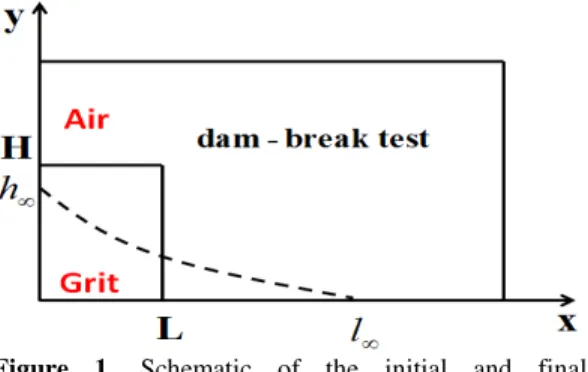
As seen in Figure 1, the initial height and length of the granular pile are HandL, respectively. The granular material, whose properties are described later in the paper, is grit surrounded by air. The pile is initially leaning against the left-hand side vertical wall (y axis) and is in contact with the horizontal base (x axis
). The other two sides of the pile are free and in contact with the air.
The two-dimensional collapse of the pile was investigated, and the final height and length (final runout) of the slump at the end of the collapse were h∞and l∞.
Figure 1. Schematic of the initial and final
configurations of the bulk granular material.
3. Rheology of the Granular Material
The approach chosen here to model the flow of the granular material has similarities to procedures found in [8-10]. The material was isotropic with an associated flow rule that followed the von Mises plasticity potential with the Mohr-Coulomb yield surface. The detailed derivation and formulas for the constitutive relations, not sought here, can be found in [11].
It can be shown that the above-mentioned granular material will have a dynamic shear viscosity,η, according to the following equation:
( )
0.5 2 sin 2 p Iφ
η
= (1)in which p,
φ
, and I2are pressure, internalangle of friction, and the second invariant of the deviatoric strain-rate tensor, respectively. For an incompressible flow in a two-dimensional case
2 I is:
(
)
( )
( )
(
)
2 2 2 2 2 2 2 , , , , 0.5 eps 0.5 0.5 0.25 eps xx yy xy x y y x I u v u v = ∈ + ∈ + ∈ + = + + + + (2)where ∈ is the strain-rate tensor, and ij uand v are velocity vector components in x and y directions, respectively. The symbol eps is a small quantity corresponding to the floating point relative accuracy in COMSOL, and is introduced in Equation (2) to avoid a zero value in the denominator.
4. Governing Equations and Solution
Procedure
The governing equations of a continuum in the context of fluid mechanics are continuity and momentum conservations given respectively by the following equations:
(
)
(
)
(
)
(
)
, 0 t T p ρ ρ η ρ ρ + ⋅ ∇ = ∇ ⋅ − + ∇ + ∇ + + = ∇ ⋅ + + ∇ ⋅ = u u u I u u g F g F u (3)whereu, , , , superscript , , , , and ∇ I T g t
ρ
Fare the velocity vector, stress tensor, del operator, unit matrix, matrix transpose, gravitational acceleration vector, time, density, and other body forces, respectively. Equation 3 applies to incompressible flows.
To account for the presence of two phases, the level-set phase-tracking scheme was employed. This method is available in the COMSOL two-phase flow CFD module. The level-set function,ϕ, was chosen to theoretically have three constant values, unity in one phase, zero in the other phase, and half on the interface of the two phases.
The equation governing the movement of the interface is:
(
)
,t ls 1 ϕ ϕ ϕ γ ϕ ϕ ϕ ϕ ∇ + ⋅ ∇ = ∇ ⋅ ∈ ∇ − − ∇ u (4)in which the right-hand side is added for stability of the numerical solution, is the mathematical norm, γis a reinitialization parameter, and ∈ls is a parameter controlling the interface thickness. The values of the two parameters, which must be tuned for each problem, are given later in the paper. For detailed information on the level-set method see [12, 13].
Equation (3) is then simultaneously solved with Equation (4) for a fixed grid by the FEM COMSOL solver. Note that the density and the viscosity in the momentum conservation equation is replaced with
ρ
=ρ
c+(
ρ
d−ρ ϕ
c)
andη η
= c+(
η
d−η ϕ
c)
, respectively. The subscripts cand ddenote the continuous phase (air), and the dispersed phase (grit). The density of the two phases and the shear viscosity of the air are taken to be constant.5. Notes on the Model Implementation in
COMSOL
In this section, the model implementation is explained in more detail.
5.1 Initial and Boundary Conditions
It is known that velocities at walls in contact with granular material flow do not completely vanish [14, 15]. This so-called “partial slip” can be modeled by introducing a slip length at the walls. Typically, granular shear layers can be up to about 8~10 particle diameters. In the present study, the slip length is two particle diameters thick. For grit with a mean grain diameter size of 1 mm, this length is 2 mm.
The right-hand side vertical wall in contact with air is modeled as a “no-slip” wall, while the top wall is a “slip” wall. The initial conditions for velocity and pressure fields are zero.
5.2 Dynamic Shear Viscosity of the Granular Material
The viscosity of the granular material follows Equation (1). However, to avoid numerical instabilities, two constant numerical values, α
and
β
, were introduced to the equation:(
)
0.5 2 sin 2 d p Iφ
η
α
β
= + + (5)The values for αand
β
are given later in the paper.To successfully solve the problem, the gravity was modeled to gradually increase from zero to 9.81 m/s2in the short period of time of about 0.01 seconds.
It is noteworthy to mention that although the modeled granular material is cohesionless, a very small surface tension of value 2 10 N/m× −5 is considered in COMSOL for solution stability.
6. Results
The results for the collapse of two piles of different initial geometries are given in this section. Pile sizes, material properties, and numerical parameters needed for the computations are given in Table 1 and Table 2.
CASE I:
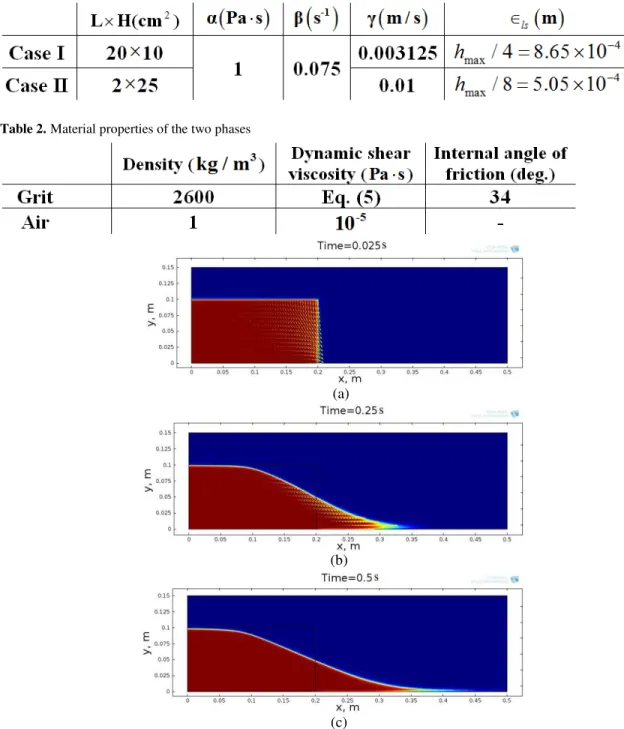
Figures 2a-c illustrate three snapshots of the collapse of the short, thick pile, which represents case I.
The collapse starts with the failure of the right-top region of the pile. As seen in Figure 2a, in the early stages of the collapse, the grains both fall and move horizontally (although in the top portion of the pile the horizontal component is smaller than the vertical). Note a trapezoid-like “dead zone” over which there is little or no velocity vector distribution. This zone, which has the least involvement in the collapse, has been experimentally observed in [2, 3].
As the collapse continues, grit comes in contact with the base when it loses momentum. There is, however, a flowing region moving above the layer in contact with base, as shown in Figure 2b. Because of interparticle friction, the velocity and thickness of the flowing layer decrease over time until the collapse eventually ends and stable heaps are formed, as illustrated in Figure 2c.
Table 1. Initial geometries of the investigated piles and numerical parameters needed for computations. hmaxis the maximum size of elements in each case.
Table 2. Material properties of the two phases
(a)
(b)
(c)
Figure 2. Slump shape and velocity field for the thick-short pile, case I, at three different time instances (a),t=0.025 s , (b) t=0.25 s, and (c) when the collapse endst=0.5 s.φis 34 degrees.
Figure 3 compares the final profile of the collapsed pile for three different internal angles of friction with that of Balmforth & Kerswell [1] reported for an experiment in a wide slot. As can be seen, the present results can closely predict the final runout (l∞), the final height (h∞), and the profile away from the fractured part of the
slump before which the surface is horizontal. As the internal angle of friction is increased, the present result approaches the experimental surface at the fractured areas. Note that the internal angle of friction reported for grit in [1] has a large scatter of 36.5 4.5± degrees.
Figure 3. Comparison of the final surface profiles for case I for different internal angles of friction with the
experimental work of Balmforth & Kerswell [1].
CASE II:
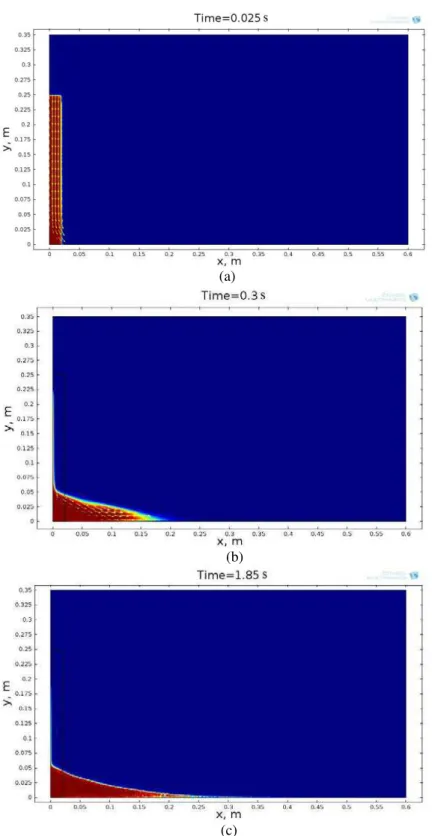
Figures 4a-c illustrate three snapshots of the collapse of the tall, thin pile, representing case II. The collapse scenario is similar to the collapse of case I except in the early stages. As seen in Figure 4a, the early stages of the collapse are highly influenced by gravity when a large top portion of the pile is vertically moving downwards. Similar to case I, there is a region in the pile that does not contribute to the collapse. This dead zone for case II resembles a triangle.
Figure 4b depicts an instant when the top portion of the pile has completely fallen and the slump is extending in the horizontal direction, while the thickness of the flowing region is decreasing. The collapse eventually stops, as shown in Figure 4c.
Fig. 5d compares the final free surface profiles for three different internal angles of friction with that of reported by Balmforth & Kerswell [1] for an experiment in a wide slot. As expected, an increase in the friction angle reduces the final runout while increasing the final height. Whenφ=34 the final runout is accurately predicted while the final height is about 6% underestimated. Conversely, when
38.75
φ= , the final height is very close to the
experimental measurements but the final runout is about 13% underestimated. It can then be concluded that an angle of friction within the range of 34 <φ<38.75 can be chosen to minimize the difference between the final values of runout and height with those of the experiment.
Balmforth & Kerswell [1] have reported volume expansions observed during the experiments. The small difference between the present results and the experimental measurements might then be attributed to the incompressibility assumption made in the present study.
7. Conclusions
The gravitational collapse of granular piles was modeled based on Mohr-Coulomb von Mises plasticity. The governing equations of the two-phase flow problem were solved using the COMSOL CFD module. The results for evolutions of the velocity field and slump shape for two grit piles of different initial shapes were presented. The final free surface profiles for each of the two cases were compared to the experimental measurements available in the literature, and close agreements were achieved.
(a)
(b)
(c)
Figure 4. Slump shape and velocity field for the tall-thin pile, case II, at three different time instances (a),t=0.025 s, (b) t=0.3 s, and (c) when the collapse endst=1.85 s.φis 34 degrees.
Figure 5. Comparison of the final surface profiles for case II for different internal angles of friction with the experimental work of Balmforth & Kerswell [1].
8. References
1. Balmforth, N.J., Kerswell, R.R., Granular collapse in two dimensions, J. Fluid Mech., 538, 399-428 (2005)
2. Lube, G., Huppert, H.E., Sparks, R.S.J., Freundt, A., Collapses of two-dimensional granular columns, Phys. Rev. E, 72, 041301 (2005)
3. Lajeunesse, E., Monnier, J.B., Homsy, G.M., Granular slumping on a horizontal surface, Phys. Fluids, 17, 103302 (2005)
4. Thompson, E.L., Huppert, H.E., Granular column collapses: Further experimental results, J. Fluid Mech., 575, 117-186 (2007)
5. Kerswell, R.R., Dam break with Coulomb friction: A model for granular slumping?, Phys. Fluids, 17, 057101 (2005)
6. Mangeney-Castelnau, A., Bouchut, F., Vilotte, J.P., Lajeunesse, E., Aubertin, A., Pirulli, M., On the use of Saint-Venant equations for simulating the spreading of a granular step, Phys. Rev. E,
71, 051302 (2005)
7. Staron, L., Hinch, J., Study of the collapse of granular columns using DEM numerical simulation, J. Fluid Mech., 545, 1-27 (2005) 8. Jaeger, J.C., Elasticity, fracture and flow, 3rd Edition, Chapman & Hall, London (1987) 9. Pitman, E.B., Schaeffer, D.G., Stability of time dependent compressible granular flow in two dimensions, Comm. Pure & Appl. Math,
XL, 421–447 (1987)
10. Srivastava, A., Sundaresan, S., Analysis of a frictional-kinetic model for gas-particle flow, Powder Tech., 129, 72–85 (2003)
11. Babaei, M.H., Dabros, T., Savage, S.B., Collapse of rectangular granular blocks, Proceedings of the Twenty-second International Offshore and Polar Engineering Conference, 418-424 (2012)
12. Sussman, M., Smereka, P., Osher, S., A level set approach for computing solutions to incompressible two-phase flow, J. Comput. Phys., 114 , 146-159 (1994)
13. Sethian, J., Level set methods and fast marching methods, Cambridge University Press, Cambridge (1999)
14. Savage, S.B., Dai, R., Studies of granular shear flows, Wall slip velocities, ‘layering’ and self-diffusion, Mech. Mater., 16, 225-238 (1993) 15. Artoni, R., Santomaso, A., Canu, P., Simulation of dense granular flows: Dynamics of wall stress in silos, Chem. Eng. Sci., 64, 4040-4050 (2009)
9. Acknowledgements
The authors are grateful to the Panel on Energy Research and Development of the Canadian government for financial support of this project. S.B. Savage was supported in part by an NSERC Discovery Grant. The authors thank Dr. M. Sayed from the Canadian Hydraulics Centre for his constructive comments and discussions. We are greatly indebted to Dr. Kelie Reece (Oxford Editing) for a very careful and detailed review of the manuscript.
![Figure 3. Comparison of the final surface profiles for case I for different internal angles of friction with the experimental work of Balmforth & Kerswell [1]](https://thumb-eu.123doks.com/thumbv2/123doknet/14117403.467145/6.918.303.626.144.403/comparison-profiles-different-internal-friction-experimental-balmforth-kerswell.webp)
![Figure 5. Comparison of the final surface profiles for case II for different internal angles of friction with the experimental work of Balmforth & Kerswell [1]](https://thumb-eu.123doks.com/thumbv2/123doknet/14117403.467145/8.918.313.625.143.407/comparison-profiles-different-internal-friction-experimental-balmforth-kerswell.webp)
