Automatic Layout of Structured Hierarchical Reports
The MIT Faculty has made this article openly available.
Please share
how this access benefits you. Your story matters.
Citation
Bakke, Eirik, David R. Karger, and Robert C. Miller. “Automatic
Layout of Structured Hierarchical Reports.” IEEE Trans. Visual.
Comput. Graphics 19, no. 12 (2013): 2586–2595.
As Published
http://dx.doi.org/10.1109/tvcg.2013.137
Publisher
Institute of Electrical and Electronics Engineers (IEEE)
Version
Author's final manuscript
Citable link
http://hdl.handle.net/1721.1/87067
Terms of Use
Creative Commons Attribution-Noncommercial-Share Alike
1077-2626/13/$31.00 © 2013 IEEE Published by the IEEE Computer Society
Accepted for publication by IEEE. ©2013 IEEE. Personal use of this material is permitted. Permission from IEEE must be obtained for all other uses, in any current or future media, including reprinting/ republishing this material for advertising or promotional purposes, creating new collective works, for resale or redistribution to servers or lists, or reuse of any copyrighted component of this work in other works.
Automatic Layout of Structured Hierarchical Reports
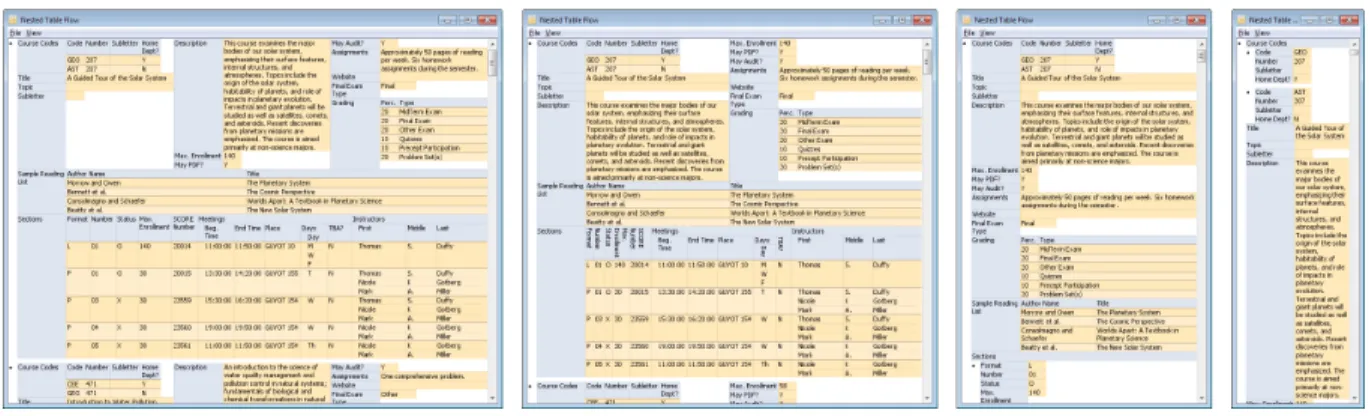
Eirik Bakke, David R. Karger, and Robert C. MillerFig. 1. Interactive adaptation of the layout of the data to be displayed, based on the available horizontal width of an on-screen window.
Abstract—Domain-specific database applications tend to contain a sizable number of table-, form-, and report-style views that must
each be designed and maintained by a software developer. A significant part of this job is the necessary tweaking of low-level presentation details such as label placements, text field dimensions, list or table styles, and so on. In this paper, we present a horizontally constrained layout management algorithm that automates the display of structured hierarchical data using the traditional visual idioms of hand-designed database UIs: tables, multi-column forms, and outline-style indented lists. We compare our system with pure outline and nested table layouts with respect to space efficiency and readability, the latter with an online user study on 27 subjects. Our layouts are 3.9 and 1.6 times more compact on average than outline layouts and horizontally unconstrained table layouts, respectively, and are as readable as table layouts even for large datasets.
Index Terms—Hierarchy data, tabular data, nested relations, layout management
1 INTRODUCTION
An important class of visualizations in everyday business use consists of the table-, form-, and report-style views found in most graphical relational database applications [2]. The data being displayed is typ-ically structured, meaning that each value has an associated type and label in a schema. Furthermore, the data frequently needs to be pre-sented in a hierarchical manner, because of the need to visualize one-to-many relationships between entities in the database. For instance, when users request “a list of employees, grouped by department” or “all information about a customer, including associated support tick-ets and a list of open orders,” what is being displayed is a structured hierarchical view of the underlying relational data.
Unlike other kinds of office productivity software, database appli-cations tend to be tailored for specific target domains such as payroll, customer relationship management (CRM), or inventory tracking, or even more specific subdomains such as hotel reservation systems, in-ventory management for the offshore industry, or bug tracking sys-tems for software developers [1]. The domain-specific nature of these systems makes them costly to develop and maintain, and there is sel-dom an opportunity to hire a graphic designer every time a new form needs to be created or an existing one updated. Yet, the software de-veloper must invariably define the details of the view’s visual layout: the location of labels, the dimensions of text fields, the width of table
• Eirik Bakke is at the MIT Computer Science and Artificial Intelligence Laboratory (CSAIL). E-mail: [email protected].
• David R. Karger is at MIT CSAIL. E-mail: [email protected]. • Robert C. Miller is at MIT CSAIL. E-mail: [email protected].
Manuscript received 31 March 2013; accepted 1 August 2013; posted online 13 October 2013; mailed on 4 October 2013.
For information on obtaining reprints of this article, please send e-mail to: [email protected].
columns, the organization of form fields into columns on a page, and so on. Since each database application can contain a sizable number of views—say, one table view and one form view per major (non-weak) entity type in the database schema, plus any special-purpose report views—maintaining the detailed visual layouts of each view is a sig-nificant development burden, and can lead to poor user interfaces.
The problem we approach in this paper is as follows: How can the visualizations required of typical domain-specific database applica-tions be generalized in such a way as to eliminate the need for manual tweaking of low-level visual details?A general-purpose visualization system for nested relations data would be of direct utility to any one of many [15, 29, 27, 28, 16, 2] previously proposed database user inter-faces based on structured hierarchical views. To scope our problem, we limit ourselves to the task of displaying simple textual data that has been pre-organized to conform to some hierarchical but non-recursive schema. This includes the documents of most data interchange formats based on XML and JSON, as well as the output of any object-relational or relational-to-XML mapping system that uses a finite number of standard SQL queries to produce its output, e.g. SilkRoute [8]. An equivalent data model is the nested relational model; see Levene [18] for an extensive bibliography.
We present a layout management algorithm that automates the dis-play of structured hierarchical data using visual idioms seen in tradi-tional hand-designed database UIs: tables, multi-column forms, and outline-style indented lists. The system gathers simple statistics about fields in the input schema, and uses these to make layout decisions which are then applied uniformly across tuples in each input subre-lation. We compare our hybrid layout system with pure outline and nested table layouts with respect to space efficiency and readability, the latter with an online user study on 27 subjects. Our layouts are 3.9 and 1.6 times more compact on average than outline layouts and hori-zontally unconstrained table layouts, respectively, and are as readable as table layouts even for large datasets.
2 RELATEDWORK
Tree Visualization. While our layout algorithm assumes the presence of a schema along with its hierarchical input data, it is always possible to derive a valid schema from the input data itself, and our system supports the visualization of any tree-structured input data in XML or JSON form, without further annotation. Our visual layouts make the most sense in cases where the schema can correctly be assumed to be non-recursive, which was the case for 9 out of 10 example datasets in the XML corpus we used for our user study. Thus, our system falls into the tree visualization category of information visualization research. Most differences arise from our assumption of a different variation of the tree-structured input data model than is typically seen in other tree visualization systems. Analogous data model specialization is seen for instance in Robertson’s polyarchies [23]. While our system does not perform any kind of aggregation on input data, but merely displays every piece of data in full, the same is true of many standard kinds of tree visualizations.
Academic research on visualizations for tree-structured data has been surveyed by Shneiderman [24] and, recently, Graham and Kennedy [11]. In our case, we are dealing with the subproblem of single treevisualization, with the additional constraint that we are working with structured data only, i.e. data that conforms naturally to some schema. In Graham’s taxonomy, the visualizations produced by our system form a hybrid between the nested and indented list rep-resentations. While nested tables, an important base case in our layout system, organize data in a grid of rows and columns, they do not fall into the matrix representation category, but rather among the nested representations, since data leaf nodes are always contained within the visual boundaries of their parent nodes.
The study by Chimera and Shneiderman [6] compared three varia-tions of the outline-style indented list view; two of these were interac-tive. Their results suggest that future versions of our system should include collapsible nodes in indented lists. Ziemkiewicz et al.[31] compare four different classes of tree visualizations, including three nested variants. None of the layouts tested include tables or hybrids between tables and indented list representations. Ghoniem et al. [10] provide a taxonomy of readability tasks on graphs and present a study comparing node-link and matrix representations.
Treemap [14] is maybe the most well-known nested or Venn Diagram-style tree representation. Treemaps fit an arbitrarily sized tree into a viewport of pre-defined dimensions, by making subsequent levels smaller and smaller. The relative size of siblings is determined by some semantically significant weight associated with each node in the tree, such as disk space consumed in a map of a file system hier-archy. In contrast, our own system allocates to leaf nodes whatever visual space is necessary to display the contained primitive text values at a constant font size. This is a requirement from the perspective of our target applications. Our system does, however, constrain layout dimensions in the horizontal direction, so that only vertical scrolling is needed if the layout can not fit in the desired viewport. In treemaps, siblings are arbitrarily stacked vertically or horizontally at every other step in the recursion. In our own system, tuples are always stacked vertically. Fields are stacked either horizontally, when contained in a nested table, or vertically, when part of an outline view. This en-sures one kind of visual consistency while still allowing the widths of layouts to be constrained.
FISH [20] is a variation of the Treemap concept. In this system, styling attributes can be used to configure various node presentation details, including the choice to stack siblings either vertically or hor-izontally. Such styling must be applied to each individual data node, unlike in our own system, where styling is applied to schema nodes only. Strip Treemap [3] optimizes the presentation of a treemap by sizing rectangles such that they can be stacked in contiguous “strips” without broken horizontal lines. Like Treemap, and unlike our own system, both FISH and Strip Treemap assume that all data must fit into a viewport of predetermined size both in the horizontal and verti-cal direction.
Elastic Hierarchies [30] and EncCon [21] both combine node-link representations with some other representation in order to
visual-ize tree-structured data. Node-link representations are typically less space-efficient than nested or indented representations, and seldom ap-pear in traditional database GUIs, our target application. Thus, we did not use them ourselves. EncCon uses node-link representations in ev-ery level of the tree, but maintains an invisible Treemap-like layout to determine a favorable positioning for each node. In Elastic Hier-archies, subsequent levels may use either Treemaps or node-link rep-resentations, determined interactively. The Elastic Hierarchies paper also has a relevant discussion of the design space of hybrid tree lay-outs, but does not consider nested tabular layouts. Neither does Gra-ham and Kennedy’s survey. This is likely because tabular layouts ap-ply only to structured data, where series of children in a tree all can be expected to have the same substructure. Systems that solve the more general problem of dealing with semi-structured (schema-free) data will not naturally be able to take advantage of tabular layouts.
XML Visualization. VisualXML and XMLAD [7], like Elastic Hierarchies and EncCon, use node-link representations as part of their interface, but are geared towards XML visualization. The XMLAD system does indeed use tabular representations as part of the output layout, but does not support nested tables. Thus, only the bottom log-ical relations in the data may be displayed as tables. Similarly, the VisualXML system uses outline or list-style representations for the bottom relation level of each subtree. Again, both XMLAD and Vi-sualXML use a node-link representation for all higher levels. This is in contrast with our own system, which uses a column-enabled, in-dented list for a variable number of top levels in the tree, followed by nested tables for a variable number of bottom levels. Furthermore, our algorithm makes these layout decisions automatically, except where manually overridden.
Tree Rewriting provides a visual language “very similar to the lambda calculus in simplicity and expressive power” [13]. While such systems are general enough to produce just about any layout from a set of input data, a user must manually specify how these layouts are to be constructed. Unlike our system, neither is able to produce a default layout subject to a constraint such as available page width. Further-more, no mechanism is available to help ensure the careful alignment of column fields that is required in order to produce tabular or nested tabular sublayouts.
A relevant class of commercial systems consists of report genera-tortools such as Crystal Reports1and Altova XML-Spy/StyleVision2. An extensive survey is provided by Kr´ol [17]. These systems let the user build output layouts analogous to those produced by our own sys-tem, using a variety of input data sources. The layout building process is manual. Altova’s “Grid View” is similar to a nested table view, but with single-level column headings repeated for every subrelation. Navigation requires heavy use of both vertical and horizontal scroll-bars as well as manual collapsing and expanding of data nodes. Altova does combine vertical arrangements of tuple fields in an outline-style sub-view with the use of nested tables, but is unable to render subrela-tions as indented lists.
UI Generation. Supple [9] generates widget-based user interfaces for devices of various sizes and contexts using a cost optimization algorithm, but does not deal with table layouts or other layouts that take advantage of repeated structure in data that adheres to a schema. The Right/Bottom strategy [4] defines heuristics for widget place-ment in dialog boxes, but similarly does not deal with structured re-lational data. Database application builder tools such as FileMaker3 and Microsoft Access4 include wizards to help with the creation of new forms, but are only able to layout out a single level of fields au-tomatically, and can not use statistics about the data in each field to make structural layout decisions.
Tabular Systems. Show Me [19] is an autostyling system for Tableau, an interactive visualization system. Since Tableau operates on tabular input data and produces Pivot-table or cross-tab-based
out-1http://crystalreports.com
2http://www.altova.com/xml-editor 3http://www.filemaker.com
GEO 207
AST 207 A Guided Tour of the Solar System This course examines the major bodies of our solar system, emphasizing their surface features, internal structures, and atmospheres. Topics include the origin of the solar system, habitability of planets, and role of impacts in planetary evolution. Terrestrial and giant planets will be studied as well as satellites, comets, and asteroids. Recent discoveries from planetary missions are emphasized. The course is aimed primarily at non-science majors. 140 Y Final MidTerm Exam 20 Quizzes 10 Final Exam 20 Precept Participation 10 Other Exam 20 Problem Set (s) 20
Morrow and Owen The Planetary System Bennett et al. The Cosmic Perspective Consolmagno and
Schaefer Worlds Apart: A Textbook in Planetary Science Beatty et al. The New Solar System
L 01 11:00:00 11:50:00 GUYOT 10 M W F
Thomas S. Duffy
P 01 13:30:00 14:20:00 GUYOT 155 T Thomas S. Duffy Nicole K Gotberg Mark A. Miller P 03 15:30:00 16:20:00 GUYOT 154 W Thomas S. Duffy Nicole K Gotberg Mark A. Miller P 04 19:00:00 19:50:00 GUYOT 154 W Nicole K Gotberg
Mark A. Miller P 05 11:00:00 11:50:00 GUYOT 154 Th Nicole K Gotberg
Mark A. Miller CEE 471
GEO 471 Introduction to Water Pollution Technology An introduction to the science of water quality management and pollution control in natural systems; fundamentals of biological and chemical transformations in natural waters; indentification of sources of pollution; water and wastewater treatment methods; fundamentals of water quality modeling.
58 Y Other Design Project(s) 33 Quizzes 66 Other (See Instructor) 1 Tchobanoglous & Schroeder Water Quality Eckenfelder Principles of Water Quality
Management Metcalf & Eddy Wastewater Engineering Sawyer & McCarty Chemistry for Environmental
Engineers
L 01 09:30:00 10:50:00 FRIEN 008 T
Th PeterJeffery R.Scott JaffePaull
GEO 206 History of the Earth This course examines about 15 seminal events in natural history, and how those events shaped the modern environment. The first section covers the origin of the Universe, chemical elements, and solar system. After a discussion of the structure and dynamics of the Earth, we next examine the origin of life, evolution of eukaryotic cells and multicellularity, the evolution of vertebrates (amphibians, dinosaurs, and mammals), and mass extinctions. The final section discusses the origin of man, the ice ages, and global change. 206a: 3 lectures; 206b: three lectures, 1 three-hour laboratory.
40 N
courseinfo.princeton.edu/courses/geo206a-geo206b_F2000/index.html Final Other ExamTerm Paper 50 (s) 20 Quizzes 10 Papers 20
Kump, Kasting and
Crane Earth System Science L 01 10:00:00 10:50:00 GUYOT 220 MW F
Michael Leslie Bender
GEO 206 History of the Earth This course examines about 15 seminal events in natural history, and how those events shaped the modern environment. The first section covers the origin of the Universe, chemical elements, and solar system. After a discussion of the structure and dynamics of the Earth, we next examine the origin of life, evolution of eukaryotic cells and multicellularity, the evolution of vertebrates (amphibians, dinosaurs, and mammals), and mass extinctions. The final section discusses the origin of man, the ice ages, and global change. 206a: 3 lectures; 206b: three lectures, 1 three-hour laboratory.
40 N
courseinfo.princeton.edu/courses/GEO206a-GEO206b_F2000/index.html Final Lab ReportsOther Exam 2050 Papers 20 Quizzes 10
Kump, Kasting and
Crane Earth System Science B 01 13:30:00 16:20:00 GUYOT 178 F MichaelSarah LeslieA BenderJohnston Brian Gertsch L 01 10:00:00 10:50:00 GUYOT 220 M
W F
Michael Leslie Bender
B 02 13:30:00 16:20:00 GUYOT 178 Th Michael Leslie Bender Sarah A Johnston Brian Gertsch GEO 235
CEE 235 The Physical Earth An introduction to geology and geological processes. Topics include the physical processes occurring within the earth, including plate tectonics, formation of minerals and rocks, earth structure, earthquakes, faults, and mountain building, as well as the physical processes that transform the earth's surface, including weathering and erosion, flooding, landslides and the development of landscape. Recommended for those interested in majoring in the Geosciences.
40 Y Final Lab Reports 40 MidTerm Exam 30 Final Exam 30
Press, Siever,
Grotzinger, Jordan Understanding Earth L 01 11:00:00 12:20:00 GUYOT 220 TTh Nadine McQuarrie B 01 13:30:00 16:20:00 GUYOT 178 M Laurel Pringle Goodell
Nadine McQuarrie Yue Tian
GEO 425 MAE 425
Introduction to Physical Oceanography The study of the oceans as a major influence on the atmosphere and the world environment. The contrasts between the properties of the upper and deep oceans; the effects of stratification; the effect of rotation; the wind-driven gyres; the thermohaline circulation.
30 N Final MidTerm Exam 20 Final Exam 40 Problem Set (s) 40
Pond & Pickard Introductory Dynamical Oceanography, 2nd ed. Pickard & Emery Descriptive Physical
Oceanography: An Introduction Open University Course
Team Ocean Circulation (2001) Open University Course
Team Waves, tides, and Shallow-Water Processes
L 01 10:00:00 10:50:00 GUYOT 154 M W F
Anand Gnanadesikan
GEO 505 Fundamentals of the Geosciences I A year-long survey, in sequence, of fundamental papers in the geosciences. Topics in 505 (Fall) include the origin and interior of the Earth, plate tectonics, geodynamics, the history of life on Earth, the composition of the Earth, its oceans and atmospheres, past climate. Topics in 506 (Spring) include present and future climate, biogeochemical processes in the ocean, geochemical cycles, orogenies, thermochronology, rock fracture and seismicity. A core course for all beginning graduate students in the geosciences.
30 N Final S 01 09:00:00 09:50:00 GUYOT 154 M
14:00:00 16:50:00 GUYOT 154 F JorgeGerta Louis SarmientoKeller Lincoln Steffens Hollister Thomas S. Duffy Nadine McQuarrie Samuel George
H. Philander
GEO 540 Topics in Deformation of the Upper
Crust The major deformation processes of the upper crust, above and near the brittle-plastic transition: fault related folding, critical-taper wedge mechanics, detachment faulting, state of stress in crust, faulting. Topics change from year to year. Overview lectures by the instructor, student presentations based on readings from scientific literature and case studies.
30 Y Other L 01 01:30:00 03:20:00 GUYOT 154 M
12:30:00 13:20:00 GUYOT 154 Th John Suppe
ENV 524
GEO 524 Environmental Issues Seminar: The Food Industry and The Environment Current problems in environmental sciences. Element cycles; geochemistry-biotic interactions, human impacts on the environment. A new topic is chosen every semester. Recent topics have included: the global carbon cycle, alternative energies, biodiversity, genetically modified organisms, population and the environment, media and the environment, restoration ecology, the humanities and the environment and architecture, urban planning and the environment, and world oil and the Middle East.
30 Y Other S 01 18:00:00 20:50:00 GUYOT 154 Th Francois M. M. Morel
GEO 331
CHM 331 Introduction to Environmental Geochemistry: Chemistry of the Natural Systems
Covers topics including origin of elements; formation of the Earth; evolution of the atmosphere and oceans; atomic theory and chemical bonding; crystal chemistry and ionic substitution in crystals; reaction equilibria and kinetics in aqueous and biological systems; chemistry of high temperature melts and crystallization process; and chemistry of the atmosphere, soil, marine, and riverine environments. The biogeochemistry of contaminants and their influence on the environment will also be discussed
20 Y Final MidTerm Exam 30 Problem Set (s) 30 Final Exam 30 Quizzes 10
Broecker How to build a habitable planet Berner & Berner Global Environment Gunter Faure Principles and Applications of
Inorganic Chemistry
L 01 11:00:00 12:20:00 GUYOT 220 M
W Satish Chandra Babu Myneni
GEO 399
ENV 399 Environmental Decision Making Use of scientific arguments in concert with engineering, economic, political, and social considerations to develop environmental policies. Class format consists of exercises based on actual case studies related to international agreements, environmental regulations, climate change, natural hazards, arms control negotiations, and national security.
20 N Final Oral Presentation (s) 10 Final Exam 30 Precept Participation 20 Papers 40
S 01 13:30:00 16:20:00 GUYOT 155 M Gregory E. van der Vink
GEO 427 Introduction to Terrestrial and
Planetary Atmospheres This course provides a broad introduction to atmospheric science. Topics covered include atmospheric thermodyanmics, aerosols and clouds, radiative transfer, surface and top-of-atmosphere energy balances, and the hydrological cycle. Elementary principles of atmospheric dynamics and global circulation will be presented.
20 Y Other Wallace & Hobbs Atmospheric Science: An Introductory Survey Holton An Introduction to Dynamic
Meteorology Houghton The Physics of Atmospheres Hartmann Global Physical Climatology Rogers & Yau A Short Course in Cloud Physics
L 01 08:30:00 09:50:00 GUYOT 154 T
Th Samuel George H. Philander
GEO 418
CHM 418 Environmental Aqueous Geochemistry Application of quantitative chemical principles to the study of natural waters. Includes equilibrium computations, carbonate system, gas exchange, precipitation/dissolution of minerals, coordination of trace metals, redox reactions in water and sediments.
20 Y Final Final Exam 30 Problem Set (s) 30 MidTerm Exam 40
Morel, F.M.M. & Hering,
J.G. Principles and Applications of Aquatic Chemistry, 2nd Edition (1993) John
Wiley & Sons, NY
C 01 08:30:00 09:50:00 GUYOT 220 T
Th FrancoisEric M. M.Stephan EglestonMorel
GEO 420 Topics in Earth Science Although the Milankovitch forcing (modest variations in the distribution of sunlight) has been relatively constant over the past several million years, Earth's response started amplifying around 3 million years ago (Ma), culminating in dramatic oscillations between prolonged Ice Ages and brief interglacial periods such as the present one. Recent observational and theoretical results, especially concerning the tropics, provide valuable clues to this puzzle whose solution is of direct relevance to global warming issues. This seminar will review recent developments.
20 Y Other Papers 50 Oral Presentation (s) 50 Trends Rhythms&Aberrations in Global Climate, J. Zachos Science, 292; 686-693, (2001)
The Pliocene Paradox, A. Federov, P. Dekens etc. Science, 312; 1485-1489 (2006) Obliquity Pacing of Glacial Cycles,P. Huybers/C. Wunsch Nature, 434; 491-494 (2005)
High Latitude Influence on Eastern Equatorial... Z. Liu
Nature, 427; 720-723 (2004)
Role of Tropics in Changing the Response, S.G.Philander
Paleoceanography, 18(2), 1045 (2003)
S 01 13:30:00 16:20:00 GUYOT 154 T Samuel George H. Philander
GEO 558 Seismology Seminar: Finite Frequency
Tomography A full treatment of seismic tomography with an emphasis on finite-frequency interpretations 20 N Other Other (See Instructor) 100 be distributed in class)Guust Nolet (preprint to A Breviary for Seismic Tomography S 01 09:00:00 10:30:00 GUYOT 21915:45:00 17:15:00 GUYOT 155 WW Guust Nolet GEO 255
CHM 255 EEB 255 AST 255
Life in the Universe This course introduces students to a new field, Astrobiology, where scientists trained in biology, chemistry, astronomy and geology combine their skills to discover life's origins and to seek extraterrestrial life. Topics include: the origin of life on Earth, the prospects of life beneath the surfaces of Mars and Europa, a moon of Jupiter; extra-solar planets nearby that offer targets for NASA space telescopes searching for life. Students will experience first hand the diverse techniques used to study extremophiles in hot springs and on future Mars missions during a mandatory fall-break trip to Yellowstone Park.
18 Y www.deepbio.princeton.edu or http://blackboard.
princeton.edu Take-Home Problem Set(s) 25 Take Home Final Exam 35 Other (See Instructor) 25 Oral Presentation (s) 15
J. Lunine Astrobiology: A Multidisciplinary Approach R.B. Smith and L.J.
Siegel Windows into the Earth Kathy B. Sheehan Seen and Unseen Discovering
the microbes of Yellowstone
L 01 13:30:00 14:50:00 GUYOT 220 T
Th GerardLaura Charles DismukesFaye Landweber Danielle M. Schmitt Tullis C. Onstott Edwin Lewis Turner Brian Gertsch
GEO 314 Igneous and Metamorphic Geology Interpretation of earth history based on the rock record. Two-one and a half hour lectures, one three-hour laboratory, several one-day field trips, and an eight-day trip during fall break
14 N Other Lab Reports 20 Other (See Instructor) 40 Paper In Lieu of Final 40
Best Igneous and Metamorphic Petrology Smith and Pun How Does Earth Work
B 01 13:30:00 16:20:00 GUYOT 16 W Lincoln Steffens Hollister B 02 13:30:00 16:20:00 GUYOT 16 T Lincoln Steffens Hollister L 01 19:30:00 20:50:00 GUYOT 16 T
W Lincoln Steffens Hollister GEO 499 Investigating Natural Hazards We evaluate our vulnerability to natural hazards and
the impact of disasters to the United States and the developing world. In particular, we explore what constitutes a natural disaster & predict the future humanitarian, economic, & political impact of such events given changes in sea level, climate variations, & demographic trends. Students will work in teams to assess risk and to develop economically realistic & scientifically sound policy recommendations. The results of the class will be submitted for publication, and the class will present their analysis to the appropriate policy-makers and/or business leaders.
12 N Other Papers 50
Precept Participation 50
S 01 19:30:00 22:20:00 GUYOT 155 M Peter John DiFiore Gregory E. van der Vink
AOS 527
GEO 527 Atmospheric Radiative Transfer Structure and composition of terrestrial atmospheres. Fundamental aspects of electromagnetic radiation. Absorption and emission by atmospheric gases. Optical extinction of particles. Roles of atmospheric species in Earth's radiative energy balance. Perturbation of climate due to natural and antropogenic causes. Satellite observations of climate system.
10 Y Other L 01 09:00:00 10:20:00 GUYOT 155 Th
T Venkatachalam Ramaswamy
GEO 539 Topics in Paleoecology, Paleoclimatology, and Paleoceanography
The application of the fossil record to specific geological problems in depositional environments and the paleoclimatic and paleoceanographic history of the oceans are studied.
5 Y Other S 01 10:00:00 13:00:00 GUYOT 16 T Gerta Keller Course ListingsDep
t.
Nu
m
ber
Title Description EnrolMax.
lment
M
ay
Audi
t?
Website Final Exam
Type GradingTitle Perc. Sample Reading ListAuthor Name Title SectionsFormatNum ber MeetingsBeg.
Time End Time Place DaysDay Instructors
First MiddleLast
GEO 207
AST 207 A Guided Tour of the Solar System This course examines the major bodies of our solar system, emphasizing their surface features, internal structures, and atmospheres. Topics include the origin of the solar system, habitability of planets, and role of impacts in planetary evolution. Terrestrial and giant planets will be studied as well as satellites, comets, and asteroids. Recent discoveries from planetary missions are emphasized. The course is aimed primarily at non-science majors. 140 Y Final MidTerm Exam 20 Quizzes 10 Final Exam 20 Precept Participation 10 Other Exam 20 Problem Set (s) 20
Morrow and Owen The Planetary System Bennett et al. The Cosmic Perspective Consolmagno and
Schaefer Worlds Apart: A Textbook in Planetary Science Beatty et al. The New Solar System
L 01 11:00:00 11:50:00 GUYOT 10 M W F
Thomas S. Duffy
P 01 13:30:00 14:20:00 GUYOT 155 T Thomas S. Duffy
Nicole K Gotberg
Mark A. Miller
P 03 15:30:00 16:20:00 GUYOT 154 W Thomas S. Duffy
Nicole K Gotberg
Mark A. Miller
P 04 19:00:00 19:50:00 GUYOT 154 W Nicole K Gotberg
Mark A. Miller
P 05 11:00:00 11:50:00 GUYOT 154 Th Nicole K Gotberg
Mark A. Miller
CEE 471
GEO 471 Introduction to Water Pollution Technology An introduction to the science of water quality management and pollution control in natural systems; fundamentals of biological and chemical transformations in natural waters; indentification of sources of pollution; water and wastewater treatment methods; fundamentals of water quality modeling.
58 Y Other Design Project(s) 33 Quizzes 66 Other (See Instructor) 1 Tchobanoglous &
Schroeder Water Quality Eckenfelder Principles of Water Quality
Management Metcalf & Eddy Wastewater Engineering Sawyer & McCarty Chemistry for Environmental
Engineers
L 01 09:30:00 10:50:00 FRIEN 008 T
Th PeterJeffery R.Scott JaffePaull
GEO 206 History of the Earth This course examines about 15 seminal events in natural history, and how those events shaped the modern environment. The first section covers the origin of the Universe, chemical elements, and solar system. After a discussion of the structure and dynamics of the Earth, we next examine the origin of life, evolution of eukaryotic cells and multicellularity, the evolution of vertebrates (amphibians, dinosaurs, and mammals), and mass extinctions. The final section discusses the origin of man, the ice ages, and global change. 206a: 3 lectures; 206b: three lectures, 1 three-hour laboratory.
40 N
courseinfo.princeton.edu/courses/geo206a-geo206b_F2000/index.html Final Other ExamTerm Paper 50
(s) 20
Quizzes 10
Papers 20
Kump, Kasting and
Crane Earth System Science L 01 10:00:00 10:50:00 GUYOT 220 MW
F
Michael Leslie Bender
GEO 206 History of the Earth This course examines about 15 seminal events in natural history, and how those events shaped the modern environment. The first section covers the origin of the Universe, chemical elements, and solar system. After a discussion of the structure and dynamics of the Earth, we next examine the origin of life, evolution of eukaryotic cells and multicellularity, the evolution of vertebrates (amphibians, dinosaurs, and mammals), and mass extinctions. The final section discusses the origin of man, the ice ages, and global change. 206a: 3 lectures; 206b: three lectures, 1 three-hour laboratory.
40 N
courseinfo.princeton.edu/courses/GEO206a-GEO206b_F2000/index.html Final Lab ReportsOther Exam 2050
Papers 20
Quizzes 10
Kump, Kasting and
Crane Earth System Science B 01 13:30:00 16:20:00 GUYOT 178 F MichaelSarah LeslieA BenderJohnston
Brian Gertsch
L 01 10:00:00 10:50:00 GUYOT 220 M W F
Michael Leslie Bender B 02 13:30:00 16:20:00 GUYOT 178 Th Michael Leslie Bender
Sarah A Johnston
Brian Gertsch
GEO 235 CEE 235
The Physical Earth An introduction to geology and geological processes. Topics include the physical processes occurring within the earth, including plate tectonics, formation of minerals and rocks, earth structure, earthquakes, faults, and mountain building, as well as the physical processes that transform the earth's surface, including weathering and erosion, flooding, landslides and the development of landscape. Recommended for those interested in majoring in the Geosciences.
40 Y Final Lab Reports 40
MidTerm
Exam 30
Final Exam 30
Press, Siever,
Grotzinger, Jordan Understanding Earth L 01 11:00:00 12:20:00 GUYOT 220 TTh
Nadine McQuarrie
B 01 13:30:00 16:20:00 GUYOT 178 M Laurel Pringle Goodell
Nadine McQuarrie
Yue Tian
GEO 425
MAE 425 Introduction to Physical Oceanography The study of the oceans as a major influence on the atmosphere and the world environment. The contrasts between the properties of the upper and deep oceans; the effects of stratification; the effect of rotation; the wind-driven gyres; the thermohaline circulation.
30 N Final MidTerm
Exam 20
Final Exam 40 Problem Set
(s) 40
Pond & Pickard Introductory Dynamical Oceanography, 2nd ed. Pickard & Emery Descriptive Physical
Oceanography: An Introduction Open University Course
Team Ocean Circulation (2001)
Open University Course
Team Waves, tides, and Shallow-Water Processes
L 01 10:00:00 10:50:00 GUYOT 154 M W F
Anand Gnanadesikan
GEO 505 Fundamentals of the Geosciences I A year-long survey, in sequence, of fundamental papers in the geosciences. Topics in 505 (Fall) include the origin and interior of the Earth, plate tectonics, geodynamics, the history of life on Earth, the composition of the Earth, its oceans and atmospheres, past climate. Topics in 506 (Spring) include present and future climate, biogeochemical processes in the ocean, geochemical cycles, orogenies,
thermochronology, rock fracture and seismicity. A core course for all beginning graduate students in the geosciences.
30 N Final S 01 09:00:00 09:50:00 GUYOT 154 M
14:00:00 16:50:00 GUYOT 154 F
Jorge Louis Sarmiento
Gerta Keller
Lincoln Steffens Hollister
Thomas S. Duffy
Nadine McQuarrie
Samuel George
H. Philander
GEO 540 Topics in Deformation of the Upper
Crust The major deformation processes of the upper crust, above and near the brittle-plastic transition: fault related folding, critical-taper wedge mechanics, detachment faulting, state of stress in crust, faulting. Topics change from year to year. Overview lectures by the instructor, student presentations based on readings from scientific literature and case studies.
30 Y Other L 01 01:30:00 03:20:00 GUYOT 154 M
12:30:00 13:20:00 GUYOT 154 Th
John Suppe
ENV 524
GEO 524 Environmental Issues Seminar: The Food Industry and The Environment Current problems in environmental sciences. Element cycles; geochemistry-biotic interactions, human impacts on the environment. A new topic is chosen every semester. Recent topics have included: the global carbon cycle, alternative energies, biodiversity, genetically modified organisms, population and the environment, media and the environment, restoration ecology, the humanities and the environment and architecture, urban planning and the environment, and world oil and the Middle East.
30 Y Other S 01 18:00:00 20:50:00 GUYOT 154 Th Francois M. M. Morel
GEO 331 CHM 331
Introduction to Environmental Geochemistry: Chemistry of the Natural Systems
Covers topics including origin of elements; formation of the Earth; evolution of the atmosphere and oceans; atomic theory and chemical bonding; crystal chemistry and ionic substitution in crystals; reaction equilibria and kinetics in aqueous and biological systems; chemistry of high temperature melts and crystallization process; and chemistry of the atmosphere, soil, marine, and riverine environments. The biogeochemistry of contaminants and their influence on the environment will also be discussed
20 Y Final MidTerm Exam 30 Problem Set (s) 30 Final Exam 30 Quizzes 10
Broecker How to build a habitable planet Berner & Berner Global Environment Gunter Faure Principles and Applications of
Inorganic Chemistry L 01 11:00:00 12:20:00 GUYOT 220 M W Satish Chandra Babu Myneni GEO 399
ENV 399 Environmental Decision Making Use of scientific arguments in concert with engineering, economic, political, and social considerations to develop environmental policies. Class format consists of exercises based on actual case studies related to international agreements, environmental regulations, climate change, natural hazards, arms control negotiations, and national security.
20 N Final Oral Presentation (s) 10 Final Exam 30 Precept Participation 20 Papers 40
S 01 13:30:00 16:20:00 GUYOT 155 M Gregory E. van der Vink
GEO 427 Introduction to Terrestrial and
Planetary Atmospheres This course provides a broad introduction to atmospheric science. Topics covered include atmospheric thermodyanmics, aerosols and clouds, radiative transfer, surface and top-of-atmosphere energy balances, and the hydrological cycle. Elementary principles of atmospheric dynamics and global circulation will be presented.
20 Y Other Wallace & Hobbs Atmospheric Science: An
Introductory Survey Holton An Introduction to Dynamic
Meteorology
Houghton The Physics of Atmospheres Hartmann Global Physical Climatology Rogers & Yau A Short Course in Cloud Physics
L 01 08:30:00 09:50:00 GUYOT 154 T
Th Samuel George H. Philander
GEO 418 CHM 418
Environmental Aqueous Geochemistry Application of quantitative chemical principles to the study of natural waters. Includes equilibrium computations, carbonate system, gas exchange, precipitation/dissolution of minerals, coordination of trace metals, redox reactions in water and sediments.
20 Y Final Final Exam 30
Problem Set
(s) 30
MidTerm
Exam 40
Morel, F.M.M. & Hering,
J.G. Principles and Applications of Aquatic Chemistry, 2nd Edition (1993) John
Wiley & Sons, NY
C 01 08:30:00 09:50:00 GUYOT 220 T Th
Francois M. M. Morel Eric Stephan Egleston
GEO 420 Topics in Earth Science Although the Milankovitch forcing (modest variations in the distribution of sunlight) has been relatively constant over the past several million years, Earth's response started amplifying around 3 million years ago (Ma), culminating in dramatic oscillations between prolonged Ice Ages and brief interglacial periods such as the present one. Recent observational and theoretical results, especially concerning the tropics, provide valuable clues to this puzzle whose solution is of direct relevance to global warming issues. This seminar will review recent developments.
20 Y Other Papers 50 Oral Presentation (s) 50 Trends Rhythms&Aberrations in Global Climate, J. Zachos Science, 292; 686-693, (2001)
The Pliocene Paradox, A. Federov, P. Dekens etc. Science, 312; 1485-1489 (2006) Obliquity Pacing of Glacial Cycles,P. Huybers/C. Wunsch Nature, 434; 491-494 (2005) High Latitude Influence
on Eastern Equatorial... Z. Liu
Nature, 427; 720-723 (2004) Role of Tropics in
Changing the Response, S.G.Philander
Paleoceanography, 18(2), 1045 (2003)
S 01 13:30:00 16:20:00 GUYOT 154 T Samuel George H. Philander
GEO 558 Seismology Seminar: Finite Frequency
Tomography A full treatment of seismic tomography with an emphasis on finite-frequency interpretations 20 N Other Other (See Instructor) 100 be distributed in class)Guust Nolet (preprint to A Breviary for Seismic Tomography S 01 09:00:00 10:30:00 GUYOT 21915:45:00 17:15:00 GUYOT 155 WW Guust Nolet GEO 255
CHM 255 EEB 255 AST 255
Life in the Universe This course introduces students to a new field, Astrobiology, where scientists trained in biology, chemistry, astronomy and geology combine their skills to discover life's origins and to seek extraterrestrial life. Topics include: the origin of life on Earth, the prospects of life beneath the surfaces of Mars and Europa, a moon of Jupiter; extra-solar planets nearby that offer targets for NASA space telescopes searching for life. Students will experience first hand the diverse techniques used to study extremophiles in hot springs and on future Mars missions during a mandatory fall-break trip to Yellowstone Park.
18 Y www.deepbio.princeton.edu or http://blackboard.
princeton.edu Take-Home Problem Set(s) 25
Take Home Final Exam 35 Other (See Instructor) 25 Oral Presentation (s) 15
J. Lunine Astrobiology: A Multidisciplinary Approach
R.B. Smith and L.J.
Siegel Windows into the Earth Kathy B. Sheehan Seen and Unseen Discovering
the microbes of Yellowstone
L 01 13:30:00 14:50:00 GUYOT 220 T
Th GerardLaura Charles DismukesFaye Landweber
Danielle M. Schmitt
Tullis C. Onstott
Edwin Lewis Turner
Brian Gertsch
GEO 314 Igneous and Metamorphic Geology Interpretation of earth history based on the rock record. Two-one and a half hour lectures, one three-hour laboratory, several one-day field trips, and an eight-day trip during fall break
14 N Other Lab Reports 20
Other (See Instructor) 40 Paper In Lieu of Final 40
Best Igneous and Metamorphic
Petrology Smith and Pun How Does Earth Work
B 01 13:30:00 16:20:00 GUYOT 16 W Lincoln Steffens Hollister B 02 13:30:00 16:20:00 GUYOT 16 T Lincoln Steffens Hollister L 01 19:30:00 20:50:00 GUYOT 16 T
W Lincoln Steffens Hollister GEO 499 Investigating Natural Hazards We evaluate our vulnerability to natural hazards and
the impact of disasters to the United States and the developing world. In particular, we explore what constitutes a natural disaster & predict the future humanitarian, economic, & political impact of such events given changes in sea level, climate variations, & demographic trends. Students will work in teams to assess risk and to develop economically realistic & scientifically sound policy recommendations. The results of the class will be submitted for publication, and the class will present their analysis to the appropriate policy-makers and/or business leaders.
12 N Other Papers 50
Precept Participation 50
S 01 19:30:00 22:20:00 GUYOT 155 M Peter John DiFiore
Gregory E. van der Vink
AOS 527 GEO 527
Atmospheric Radiative Transfer Structure and composition of terrestrial atmospheres. Fundamental aspects of electromagnetic radiation. Absorption and emission by atmospheric gases. Optical extinction of particles. Roles of atmospheric species in Earth's radiative energy balance. Perturbation of climate due to natural and antropogenic causes. Satellite observations of climate system.
10 Y Other L 01 09:00:00 10:20:00 GUYOT 155 Th
T
Venkatachalam Ramaswamy
GEO 539 Topics in Paleoecology, Paleoclimatology, and Paleoceanography
The application of the fossil record to specific geological problems in depositional environments and the paleoclimatic and paleoceanographic history of the oceans are studied.
5 Y Other S 01 10:00:00 13:00:00 GUYOT 16 T Gerta Keller
Course ListingsDep
t.
Nu
m
ber
Title Description Enrol Max.
lment
M
ay
Audi
t?
Website Final Exam
Type GradingTitle Perc.
Sample Reading List
Author Name Title
SectionsFormat Nu
m
ber MeetingsBeg.
Time End Time Place DaysDay
Instructors
First Middle Last
Tuple
Primitive Values
Relation Value Label for Relation Field
Label for Primitive Field
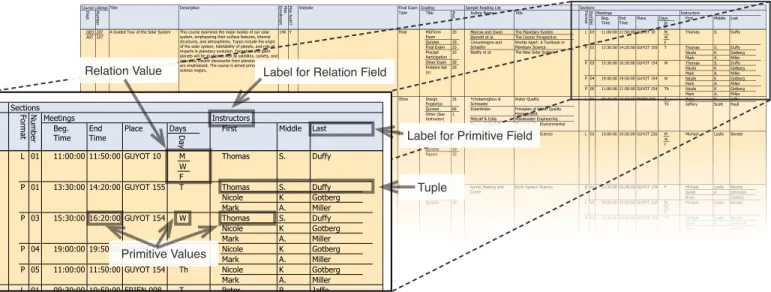
Fig. 2. The nested table layout is the most common way to visualize a nested relation, and is supported as a special case in our algorithm. Here, we show nested relational data generated from an academic course catalog in nested table style, with one of the nested columns enlarged to show terminology. Nested table layouts stack tuples in the vertical direction and the fields of each tuple in the horizontal direction, with all field labels collected in a header on top.
puts, it does not fall into the tree-structured data visualization category. Nested table layouts are used in Related Worksheets [2] and in ap-plications produced with AppForge [28] or App2You [16]. These sys-tems do not allow the nested table layouts to be re-styled as indented lists or deferred to lower layers of the tree-structure. They can not automatically constrain the width of the layout to the available page width.
FOCUS [25], TableLens [22], and the system by Tajima and Ohnishi [26] deal with the problem of displaying large, mostly flat tables. The latter system includes a “Record” viewing mode that re-sembles a single-level form view. While all of these systems support certain cases involving values spanning multiple cells, they do not op-erate on structured hierarchical data in general. Chi’s visualization spreadsheets [5] combine a table layout at the outer level with cells containing plotted 3D graphics, but require the user to define each vi-sualization using commands, and are primarily focused on numerical data.
Text Layout Systems. Text document layout systems, like the one described by Jacobs et al. [12], deal with the problem of rendering a given amount of text with a given font size on a set of dimensionally constrained pages. They are otherwise different from our own system, since they operate on a very different class of input data.
3 LAYOUTALGORITHM
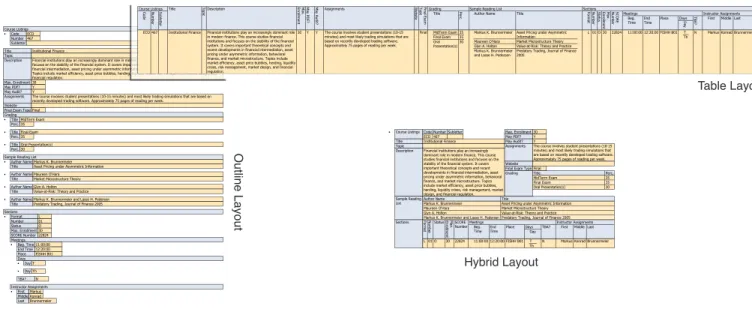
We now describe our layout algorithm. For the purposes of exhibition, we start by discussing basic nested table and outline layouts, then dis-cuss hybrid table/outline layouts, and finally show the complete steps to produce the layouts automatically.
The purpose of the algorithm is to produce a compact but read-able view of tree-structured input data that conforms to a non-recursive schema, or, more precisely, nested relational data. Whenever possible, the regularity of the input data’s schema should be used to maximize the readability of the data. For instance, tabular data should be ren-dered as a table, with proper column headings describing the name of fields in the schema. We may not require user input informing layout decisions beyond what can be derived from the data itself.
3.1 Nested Relations and Nested Table Layouts
Our algorithm operates on tree-structured data conforming to a non-recursive schema. We have chosen the nested relational model as the concrete data model for our implementation, since it tends to lead to
simple tree traversal code. It is equally feasible to use a different tree-structured data model such as that of XML, and in connection with the user study, we did write a routine for importing arbitrary XML documents.
The terminology of the nested relational model is as follows: A valueis either a primitive or a relation, where a relation is defined as a set of tuples, each containing a set of fields identified by labels, each containing a value, recursively. The schema of a value either defines the value to be a primitive, or defines the value to be a relation, with schemas further specified for each of the latter’s fields, recursively.
Nested relational data is most commonly illustrated in a nested ta-blelayout. An annotated example of such a layout is shown in Fig-ure 2; it renders data about the first few courses in an academic course catalog. A nested table layout consists of a header area (shown in blue) and a content area (shown in beige). The header area reflects the schema structure of the displayed nested relation, with simple la-bels for columns containing primitive fields and recursive lala-bels for columns containing relation fields. Columns containing relation fields may recursively contain columns for either primitive or relation sub-fields. In the content area, tuples in the rendered relation are stacked vertically with row separators between them. Each tuple renders its primitive values as simple strings and its relation values recursively as the content area of another nested table.
3.2 Outline Layouts
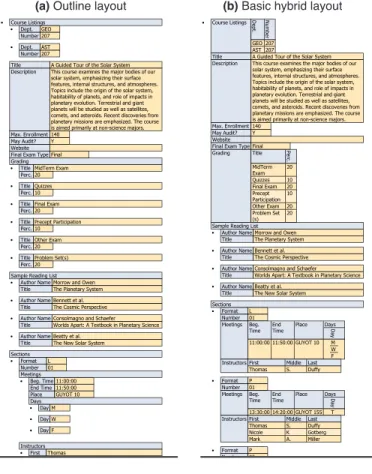
Nested table layouts, like the one previously seen, can quickly become extremely wide if many fields are to be displayed. For on-screen inter-faces, the need for horizontal scrolling is undesirable, and for printing on paper, pagination in the horizontal direction is awkward. As an-other basic alternative to the nested table layout, we consider the out-linelayout, which is common among XML editing tools. Figure 3(a) shows the same data as before rendered using such a layout.
In an outline layout, tuples are stacked vertically in an indented bullet list fashion; we show one bullet per tuple. Unlike the nested table layout, which puts the fields of each tuple next to each other on a row, the outline layout stacks the tuple fields vertically as well. Thus, having more fields in a schema makes the layout taller, not wider. In a tuple in an outline layout, primitive fields are rendered as strings with their respective schema labels to the left, whereas relation fields are rendered recursively with their schema labels above, extended to the full width of the layout area. The color scheme is the same (blue and beige) for labels and values in an outline layout as for the header and