People’s Democratic Republic of Algeria
Ministry of Higher Education and Scientific Research
University of 08 Mai 1945 / Guelma ةملاق /1945 يام08 ةعماج Faculty of Letters and Languages تاغللاو بادلآا ةيلك Department of Letters and English Language ةيزيلجنلاا ةغللا و بادلآا مسق
Option: Linguistics
A Dissertation Submitted to the Department of Letters and English Language in Partial Fulfillment of the Requirements for Master’s Degree in Language and Culture
Submitted by: Supervised by:
Mr. Mohammed AIDAOUI Mrs. Mounya ABDAOUI Mr. Mohammed Abdelhadi BOUZA
Board of Examiners
Chairwoman: Mrs. Amina BOUDRAA (MAB) University of 8 Mai 1945, Guelma Supervisor: Mrs. Mounya ABDAOUI (MCB) University of 8 Mai 1945, Guelma Examiner: Ms. Naziha BENKAMOUCHE (MAA) University of 8 Mai 1945, Guelma
2019-2020
Investigating Secondary School Teachers Achievement of the Learning Objectives through Project-Based Learning
Dedication I dedicate this work
To the heaven whose prayers and blessings are enlightening us, To my ultimate source of inspiration,
To my power in our weakness To my light in the darkness
my beloved Mother. To my father,
I would like to thank you a lot for every support that you gave me And i would like to say that; you are raised a real man that I'm sure you’ll be so
proud of if God willing day after day To my sisters
To my brothers To my family To my friends
To everyone who believed in me
To my relatives who motivated me along the period of writing this dissertation.
Dedication
I would like to dedicate this work to my wonderful parents.
Thank you for your unconditional and never-ending love. To my brothers and sisters.
To my lovely friends for their love and support and the nice moments we spent together.
To all my relatives who motivated me along the period of writing this dissertation. To all my teachers for their love and support that have always given.
Acknowledgements
In the Name of Allah, the most Merciful, the most Compassionate, first of all, we would like to thank the most Graceful and Compassionate Allah the Almighty, the Sustainer of the entire world, for giving us strength and capacity to accomplish this work. We would like to express our respect and gratitude to our supervisor Mrs. Mounya ABDAOUI for her guidance, precious advice, and persistent assistance. Thanks are also directed to the jury members, Mrs. Naziha BENKAMOUCHE and Mrs. Amina BOUDRA for accepting to review and assess this dissertation. We also thank the Algerian secondary school teachers who took part in questionnaire.
Abstract
The current research investigates secondary school teachers’ achievement of the learning objectives through Project-Based Learning. It explores the effectiveness of projects in Foreign Language Learning. To reach this aim we hypothesized that teachers who follow Project-Based Learning would rarely achieve the learning objectives. To test the hypothesis, high school teachers of English in the whole country (Algeria) were chosen as a sample for the current study. Hence, an online questionnaire was administered due to the covid-19 pandemic. This tool provided us with different views and experiences in relation to the topic. The findings showed that the hypothesis was confirmed since Project-Based Learning could rarely lead to learning objectives’ achievement. Consequently, Project-Based Learning is not successful. Hence, it should be adjusted according to pupils’ needs and competence.
List of Tables
Table 1.1. Goals and Objectives Broad Statements: General Projected Intentions…….8
Table 1.2. Basic Data on the Three Phases of Project-Based Learning Methodology Application………..22
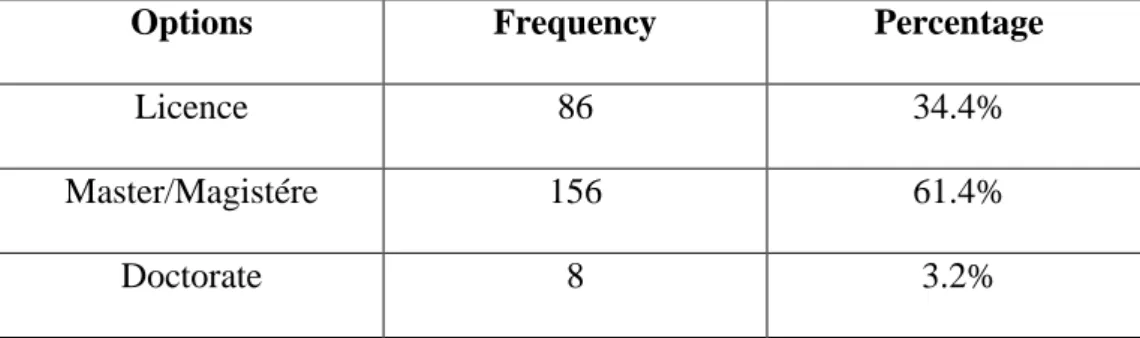
Table 3.1. Teachers’ Qualifications………42
Table 3.2. Secondary School Location………...43
Table 3.3. Years of Teaching English………...44
Table 3.4. Level of Teaching English………...44
Table 3.5. Writing the objectives for each lesson or unit………...45
Table 3.6. Teachers' ability to achieve the learning objectives for each unit………...45
Table 3.7. Causes behind non-achievement of the learning objectives for each unit….46 Table 3.8. The importance of students’ learning experiences in facilitating the achievement of learning objectives………....……...47
Table 3.9. The influence of teacher’s effective assessment of pupils’ performance on the achievement of learning objectives………..…...48
Table 3.10. The of importance of teachers’ method in the achievement of learning objectives………....………...48
Table 3.11. The most effective way in achieving the learning objectives………..49
Table 3.12. The importance of Project-Based in EFL teaching and learning…...……..50
Table 3.13. Individual versus group-work projects………...50
Table 3.14. Pupils’ perception of the projects’ difficulty…………...…….51
Table 3.15. Teachers’ satisfaction about their experience using Project Based Learning………....………...52
Table 3.17.Percentage of the success of Project-Based Learning...53
Table 3.18. The positive influence of using Project-Based Learning on learners' academic achievement...54
Table 3.19. The role of teacher's verbal and written feedback inside the classroom in enhancing the use of Project Based Learning...55
Table 3.20. Teachers' achievement of the learning objectives as manifested through pupils’ unit projects………....56
Table 3.21. Pupils’ achievement of the learning objectives………...56
Table 3.22. Reasons behind some pupils’ bad projects………...57
Table 3.23. Doing the projects for the sake of marks………...58
Table 3.24. The most effective solutions to overcome the difficulties in Project-Based Learning implementation………...59
List of Figures
Figure 1.1.Application of Learning Objectives………...17 Figure 2.1.The Seven Steps of PBL Model………...26 Figure 2.2. Stare’ s Organizational System………...27
List of Abbreviations PBL: Project-Based Learning
Table of Contents Dedication………...………...i Dedication………... ii Acknowledgements………...iii Abstract………..…...iv List of Tables………....v List of Figures………..…...vii List of Abbreviations………..……...viii Table of Contents………...ix General Introduction………...….1
1. Statement of the Problem………...…...1
2. Aims of the study………..……2
3. Research Hypothesis……….………..…..2
4. Research Methodology and Design……….……….2
4.1. Research Method………...2
4.2. Population of the Study………...….3
4.3. Data Gathering Tools………...3
5. Structure of the Dissertation……….……3
CHAPTER ONE: Learning Objectives...…...…..5
Introduction………...5
1.1. Definition of Learning Objectives………...5
1.2. The Difference between Goals, Objectives, and Learning Outcomes…..………...7
1.3. Types of Learning Objectives ………...10
1.3.1. Cognitive Objectives………...10
1.3.3. Psychomotor Objectives………...12
1.4. Bloom’s Taxonomy of Educational Objectives…………...12
1.5. The Revised Version of Bloom’s Taxonomy ………...13
1.6. Achievement of the Learning Objectives ………...14
1.6.1. Obstacles of Learning Objectives ………...16
1.7. The Importance of Learning Objectives………...17
1.7.1. The Benefits of Learning Objectives on Students………...18
1.7.2. The Benefits of Learning Objectives on Instructors………...18
Conclusion………...19
CHAPTER TWO: Project-Based Learning………...20
Introduction………...20
2.1. Historical Background of Project-Based Learning………...20
2.2.Definition of Project-Based Learning………...23
2.3.Design of Project-Based Learning………...24
2.4. Challenges of Project-Based Learning………...27
2.5. Advantages and Disadvantages of Project-Based Learning………...30
2.6. Teachers’ Role in Project-Based Learning………...33
2.7. Teachers’ Views about Project-Based Learning………...33
2.8. The Competency-Based Approach and Project-Based Learning………...34
2.8.1. Definition of the Competency-Based Approach………...34
2.8.2. The Competency-Based Approach in Relation to Project-Based Learning…...35
2.9. Achievement of the Learning Objectives through Project-Based Learning…...36
Conclusion ………...38
CHAPTER THREE: FIELD INVESTIGATION………...40
3.1. Teachers’ Questionnaire………...40
3.1.1. Aims of Teachers’ Questionnaire………...40
3.1.2. Population of the Study………...40
3.1.3. Description of Teachers’ Questionnaire………...41
3.1.4. Administration of Teachers’ Questionnaire...42
3.1.5. Data Analysis and Interpretation of Results from Teachers 'Questionnaire………...42
3.1.6. Summary of Results from Teachers’ Conclusion……….60
Conclusion………..62
General Conclusion………...63
1.Concluding Remarks………63
2. Pedagogical Implications and Research Perspectives………64
3. Research Recommendations and Limitations ………65
References………...66
Appendix A: Teachers 'Questionnaire………...75
General Introduction
In recent years, the field of foreign language teaching has witnessed innovative developments to improve learners’ outcomes. Within this scope, there was a radical shift from the traditional methods of teaching to more appropriate ones in order to fulfill teachers’ and students’ objectives. Through objectives’ specification, teachers are able to discover what students need to understand and what they are expected to achieve at the end of the course. Besides, it helped them identify an accurate description of the desired lesson structure and tasks. Teachers should set objectives because it leads to an effective, strategic, and sequenced teaching and learning process. In order to achieve those objectives, Project-Based Learning (PBL) is broadly utilized in schools and other instructive settings where pupils are required to achieve projects related to the units of the textbook.
2. Statement of the problem
Achievement of the learning objectives is very important; however, in the secondary schools, it is observed that many teachers cannot achieve the learning objectives in the teaching of English through the use of Project-Based Learning. What is more, some pupils do not do their projects at all, and even if they do them, they will not do them effectively. Other pupils steal the project or copy-paste it from their classmates. Only few good and excellent pupils could do it perfectly. Hence, our research addresses the following question:
1. Could teachers achieve the learning objectives through Project-Based Learning? Other questions also could be raised in relation to this topic:
2. Could all learners achieve the learning objectives through Project-Based Learning?
3. Are all the learners able to achieve the project? 4. Do learners prefer individual or group-work projects? 3. Aims of the Study
Project-based learning is well known and widely used, and it remains a
challenging issue to apply effectively this approach to practical settings for improving
the learning performance of students. For that reason the aims of this study are:
1. Investigating teachers’ achievement of the learning objectives through Project-Based
Learning.
2. Exploring whether project-based learning is successful or not.
4. Research Hypothesis
Projects are a very important component in curriculum design. They facilitate the process of assessing the achievement of the learning objectives. Neglecting such step may cause both teachers and students’ deviation from the desired goal of the course. Therefore, we hypothesize that:
H1: If teachers follow Project-Based Learning, they would rarely achieve the learning objectives.
The null hypothesis entails that Project-Based Learning could lead to objectives’ achievement, it is hypothesized that:
H0: If teachers follow Project-Based Learning, they would achieve the learning objectives.
5. Research Methodology and Design 5.1. Research Method
To examine secondary school teachers’ achievement of the learning objectives through project-based learning, the quantitative descriptive method was used. It aimed at testing the hypothesis through conducting teachers’ questionnaire. This tool provided
us with different views about the topic. Consequently, the intended aims of the research could be achieved.
5.2. Population of the Study
Our sample was selected randomly since the teachers’ questionnaire was administered online. Our target population was teachers of English in the Algerian secondary schools. The reason behind choosing teachers of English in Secondary Schools as a population of the study is that they usually face difficulties with pupils’ projects as many of them do not usually do the project effectively. Ultimately, the teachers should raise pupils’ consciousness towards the role of Project-Based Learning in achieving the learning objectives and knowing pupils’ weaknesses and strengths. 5.3. Data Gathering Tools
To test the hypothesis, the teachers’ questionnaire was administered online to provide us with rich information about the importance of Project-Based Learning as well as its effect on achieving the learning objectives. This tool will provide an in-depth knowledge and valuable insight which will allow us to know whether the research matches up with its goals. Two-hundred fifty teachers participated indirectly in this research by answering the questionnaires’ questions.
6. Structure of the Dissertation
Our dissertation is divided into three main chapters. The first chapter holds the title “Learning Objectives”. It deals with the definition, the importance, types, and obstacles of learning objectives and how to achieve them. The second chapter is entitled “Project-Based Learning”. It covers the definition, overview, types, approaches, and modes of criticism for Project-Based learning. Chapter three is “Field Investigation”. It highlights the description and aims of the teacher’s questionnaire.
Then, it analyzes and interprets the results got from the questionnaire in accordance with the research questions and hypotheses.
Chapter One Learning Objectives Introduction
Today teaching is all about improving learning. Teaching and learning co-exist harmoniously in an environment to produce a difference in learners' performance. In other words, these two processes are inseparable. The process of teaching drifted from teacher-centered to learner-centered, it means that it is not about the teacher's talk, yet it is about the students' contribution and self-reliance. Learning here in a way reduces the burden on the teacher while attempting to activate the learner's cognition towards given information, but without ignoring the role of teachers' feedback and assessment on students' work. Hence, this chapter is devoted to learning objectives as well as how to achieve them. It starts with the definition of learning objectives and its importance without neglecting the types. Then, it moves to how to achieve them. Besides, it attempts to investigate the obstacles that a learner might face or deal with that should be taken into consideration when learning.
1.1. Definition of Learning Objectives
According to the University of New South Wales (Australia),learning objectives are both concise and precise statements about how the learner will be capable of executing an activity. Moreover, Bingham (1999) explained that objectives are what students are assumed to understand by the end of the task and the time set for it. However, learning objectives in different situations are the academic aims that teachers set for all the students (Adam, 2004). Thus, they must be defined and easy to evaluate. From the early definitions, we can notice that learning objectives focus on how the learner obtains information from a course; meanwhile, According to Jenkins and Unwin (2001) learning objectives are statements expecting a result from a student after the
process of learning is done. However, they are student-centered, meaning that they provide attention to how the learner acquires the information rather than how the teacher outlines it. Also, they concentrate on the results of the learning and how they will be behaving after grasping that data (Kennedy, Hyland, & Ryan. 2006. p. 5). Moreover, Battersby (1999) advised teachers to “think first about what is essential that students know or be able to do after the course or program – what students need to know and could make powerful use of to enhance their lives and more effectively contribute to society.” We believe that such reflection will lead instructors to focus on a broad synthesis of abilities that combine knowledge, skills and values into a whole that reflects how people really use knowledge (p. 1). Learning objectives need to be precise, measured, and not vague. Hence, they are written based on Bloom’s Taxonomy, which explains the method of learning and, therefore, has proved to be a successful tool to enhance learning (Mahajan, & Sarjit Singh, 2017. p. 66). However, to plan a lesson or an activity, teachers should first apply learning objectives to choose the most reliable data needed as well as the tools required to develop it. Second, this process will show if the learner can understand what he is studying, this evaluation takes place at the level of exams or quizzes, Gosling and Moon (2001) believed that it is merely impossible to track students' progress towards a certain task at a specific time (as cited in Kennedy, Hyland, & Ryan, 2006, p. 5). Khan, Hande, Bedi, and Singh (2012) argued that objectives acknowledged in terms of what students are assumed to perform in the end of task (p. 46).Aziza, Yusof, and Yatima (2012) noted that learning objectives are the description of main goals and anticipations from different teaching tasks and assessments (p. 24). So, even tasks and assessments have their specific objectives and goals. Therefore, teachers should focus on objectives’ specification to enhance students’ performance.
1.2. The Difference between Objectives, Goals, and Learning Outcomes
The American Association of Law Libraries stated that “learning outcomes are statements that specify what learners will know or be able to do as a result of a learning activity. Outcomes are usually expressed as knowledge, skills or attitudes”. According to Melton, the term “learning outcome” is simply an alternative name for “objective”. The terms have in fact often been used interchangeably. (1997, as cited in Harden, 2002, p. 151). This means that the two terms “learning outcome” and “learning objective” are used to denote the same meaning. Adam believed that learning outcomes encompass statement in written form expecting a result from a student after the process of learning is done (2004, as cited in Mahajan & Singh, 2017, p. 65). Moreover, Guide argued that learning outcomes are written representation that includes a variety of information, and comprehensions that expected from the learner to achieve at the end of the course or unit (2005, as cited in Mahajan & Singh, 2017, p. 65).
It is also useful to differentiate between a goal and an objective. Collins (2007) thought that despite that the two terms goals and objectives are used interchangeably, they somehow differ when they are used in the process of teaching and learning. Starting with goal which is so general aspect that encompasses several learning objectives. Whereas, learning objective is so precise statement that includes expectations about learners' achievements at the end of the lessons (p. 1512). Khan, Hande, Bedi, and Singh (2012) discussed goals and objectives' main differences in the following table:
Table 1.1
Goals and Objectives Broad Statements: General Projected Intentions
Goals Objectives
Broad statements, general projected intentions
Specific, precise, targets within the general goal
Longer time-frame targets set for a short term
Intangible Tangible
Abstract, vague Concrete
Hard to measure Measurable, observable
Note. Adapted from: Khan, Hande, Bedi, & Singh, 2012,p. 46.
Khan, Hande, Bedi, and Singh (2012) proposed that goals are general, abstract and ambiguous statements as result, they are hard to measure, and they take a long period of time. By the opposite, objectives are specific, concrete, and clear statements, so they can be measured and observed. Goals help define the overall for both concepts and methods during any plan. Also, they set the general aims and objectives of the lesson, but in a way, goals are hard to be measured sometimes because they are vague and abstract.
Goals work as a booster for both employers and learners' motivation. It helps them in setting their priorities to complete a task successfully (O’Neill, 2018). Moreover, Latham and Locke (2002,) said that “the object or aim of an action, for example, to attain a specific standard of proficiency, usually within a specified time limit” (p. 705) this means that the desired skill the teacher wishes to achieve during the learning
process, for example a literature teacher seeks to teach his students how to differentiate between what is a rhythm and what is a meter in a poem (as cited in Houston, 2020). Goals can also be defined as: “outcome statements that define what an organization is trying to accomplish both programmatically and organizationally.” A time frame should be followed usually it takes five years for a goal to be attained. These clear statements do not outline how things go; rather they describe how the results will be (Felincio, 2012).
Goals are first, broad in nature meaning that, they follow a nonstop action during a specific set to be accomplished, second, they are valuable for setting a general direction or vision, they are similar to a purpose. When the purpose is known, the goal is reachable. Moreover, goals are difficult to measure meaning that they are a broad set of desires that are not precisely sufficient to be measured, also they are abstract ideas, meaning that they are short more concise, and direct. They are on the long term, they take more years than the objective to be achieved some says that five years is enough for a goal but it is linked to the type of goals that needs to be reached, last but not least goals are the end result (Felincio, 2012).In other words, goals are related to an association or an individual to complete the task needed, while objectives are tools to establish a particular goal. Consequently, goals are more necessary than objectives (Felincio, 2012).
However, objectives are precise actions set to accomplish a goal. In other words, they can be more attained than a goal does. However, they are abstract, and time-bound, meaning that unlike the goals, they are restricted with a deadline. So, in other words, objectives should be "SMART." First, Specific, objectives should be clear and not vague. Also, they need to be Measurable; it needs to determine both the quantity and quality. Concrete behaviors and results should be the main focus. Next, objectives
should be Attainable, tries to reach a challenging purpose but not impossible to accomplish. Furthermore, they should be Relevant, that is an essential element for a good objective, and one of the most important points is the Time-bound, to motivate both the learner and the teacher to finish the task on time (Felincio, 2012).
Meanwhile, Morrison explained that objectives can be achieved in short time also based on facts not ideas like the goals. In other words, a goal is where you want to be (results) while objectives are the tools that help to reach the goal. He added that objectives give the learner a glimpse of what they should accomplish. In addition to this, it helps the instructors to encourage learners what they should do. Last but not least, objectives function as an evaluation tool they helps both teachers and learners to know what is being evaluated (as cited in Mackimm & Swanwick, 2009, p. 2).
As Pablo Picasso once said “our goals can only be reached through a vehicle of a plan, in which we must fervently believe, and upon which we must vigorously act. There is no other route to success”. This means that both goals and objectives should exist in harmony because they complete each other (as cited in Houston, 2020).
1.3. Types of Learning Objectives
Scholars have classified learning objectives into three main types, and this classification is based on the behavior performed by learners. The first type is the cognitive objectives which are related to creating new knowledge. The second one is the affective objectives that are related to feelings and emotions. The third and last one is psychomotor objectives that show physical and manual skills (Bannister. p. 3).
1.3.1. Cognitive Objectives
Cognitive theories center on the conceptualization of students’ learning forms and address the issues of how information is gotten, organized, stored, and recovered by the mind. As Jonassen indicated “learning is concerned not so much with what learners do
but with what they know and how they come to acquire it” (1991). Moreover; Knowledge acquisition is depicted as a mental movement that involves inner coding and organizing by the learner. The learner is seen as a dynamic member within the learning process(Song & Thompson, 2011,p. 51).
Bloom et al. (1956) stated that ‟the cognitive domain, includes objectives which deal with the recall or recognition of knowledge and the development of intellectual abilities and skills” (Bloom et al., 1956. p. 7).This means that cognitive learning objectives try to stimulate students’ cognitive skills mainly the recognition and the retrieval of the information. Thus, this type of objectives aims to enhance students’ intellectual processes. Also, the cognitive domain contains learning abilities related to mental (thinking) processes. Learning processes within the cognitive domain incorporates a progression of capacities including preparing information, developing understanding, applying information, solving problems, and conducting research. Additionally, there are six levels of cognitive complexity: knowledge, comprehension, application, analysis, synthesis, evaluation (Hoque, 2016, p. 46).
1.3.2. Affective Objectives
According to Bloom (1956), the affective domain of educational objectives “includes objectives which describe changes in interests, attitudes and values, and the development of appreciations and adequate adjustment” (p. 7). This indicates that the affective educational objectives have to do with the students’ psychological factors that influence the process of learning and teaching. Besides, the affective domain includes our feelings, emotions, and attitudes. This domain includes the way in which we deal with things emotionally, such as feelings, values, appreciation, enthusiasms, motivations, and attitudes. Furthermore, this domain is categorized into five sub-domains, which include: receiving the information, responding to it, valuing and
evaluating the received knowledge, organizing the information, and characterizing it (Hoque, 2016, p. 49).
Furthermore, Bloom (1956) revealed that: “objectives in this domain are not stated very precisely; and, in fact, teachers do not appear to be very clear about the learning experiences which are appropriate to these objectives. It is difficult to describe the behaviors appropriate to these objectives since the internal or covert feelings and emotions are as significant for this domain as are the overt behavioral manifestations” (p. 7).
1.3.3. Psychomotor Objectives
The psychomotor domain includes physical movement, coordination, and utilization of the motor-skill areas. Improvement of these skills requires practice and is measured in terms of speed, precision, distance, strategies, or strategies in execution (Clark, 1999). Moreover, Sottilareand LaViola (2016.p.186) asserted that ‟learning in psychomotor domains is measured by examining the relationship between the learner’s cognitive functions and their physical skills (e.g., coordination, strength, or speed)”. Also, Simpson (1972) identified psychomotor behaviors which include perceptions (awareness), sets (readiness), guided responses (attempts), mechanisms (basic proficiency), complex overt responses (expert proficiency), adaptation (adaptive proficiency), and origination (creative proficiency)”(as cited in Sottilare & LaViola, 2016.p. 186).
1.4. Bloom’s Taxonomy of Educational Objectives
Bloom’s taxonomy was created in the early 1940s under the leadership of the educational psychologist Benjamin Bloom. Bloom and his partners classified various forms and levels of learning based on mental forms that students involve in while they
learn (Darwazeh& Branch, 2015, p. 220). As evidence in a memorandum from 1971, Bloom viewed his original effort to be a starting point, in which he said:
Ideally each major field should have its own taxonomy in its own language – more detailed, closer to the special language and thinking of its experts, reflecting its own appropriate sub-division and levels of education, with possible new categories, combinations of categories and omitting categories as appropriate. (Darwazeh & Branch, 2015, p. 220)
This implies that the taxonomy can be modified by adding new categories or omitting them according to a specific field of education. Furthermore, Bloom’s taxonomy is made of six classes: knowledge, comprehension, application, analysis, synthesis, and evaluation. They are ordered hierarchically from the lower level to the higher level. Hence, they clarify learning from low order to high order (Pintrich, 2002. pp. 212-213).
1.5. The Revised Version of Bloom’s Taxonomy
Bloom’s taxonomy gained quick popularity; however, after nearly six decades of utilizing Bloom’s original taxonomy, few educators started to wonder whether the taxonomy was still valid to this age that characterized a lot of research and studies on mental skills and human thinking and learning. One of those educators was Lorin Anderson, a previous understudy of Benjamin Bloom (Darwazeh & Branch, 2015, p. 220). Moreover, Anderson and Krathwohl (2001) revised Bloom’s taxonomy to be more adaptive to our modern age by proposing another taxonomy that will meet educational modules designers, instructors, and students' needs better than Bloom’s one (Darwazeh & Branch, 2015, p. 220).
The revision was a kind of reformation and modernization of the original taxonomy, which aims to simplify its language and make it more practical and relevant for the 21st century teachers and students (Darwazah, 2017, p. 15). The most noticeable difference between the Revised Taxonomy and the Original Taxonomy is the change in terminology. Bloom’s six main classes were renamed from a noun form to a verb form and the two last categories were exchanged. This change in terminology is basically made to reflect the cognitive skills through which a certain concept is processed (Krathwhol, 2002, p. 310). Another change included in the Revised Taxonomy is the shift from one to two dimensions. According to Krathwhol (2002), the learning objectives are written using a noun that reflects the intended knowledge and a verb that represents the function of this knowledge unlike the Original Taxonomy which focuses only on the knowledge (p. 213). Furthermore, the category of knowledge was given more emphasis in the Revised Taxonomy. While knowledge in the Original Taxonomy was divided into three main types, in the Revised Taxonomy one type was added. Hence, knowledge in Revised Taxonomy includes factual knowledge, conceptual knowledge, procedural knowledge, and meta cognitive knowledge (Krathwhol, p. 214). Accordingly, the Revised Taxonomy made changes on three main levels: terminology, structure, and emphasis.
1.6. Achievement of the Learning Objectives
Cown stated that learning objectives set the focus on the learner and the learning processes rather than the instructor and his teaching methods (2004). She believed that learning objectives and the project’s goals are equivalent and that they are statements explaining what is expected from the learner to do upon completion of the learning activity. The learning activity could be in the form of a course or group work or essays (Cown 2004).
When writing objectives, first, the teacher should follow some steps: First, begin every objective with an action verb because it eases his work when trying to measure the learner's development in any subject or module, besides if they had reached the objective that was set in the first place or not. Furthermore, Bloom's taxonomy can be used to identify verbs to describe participants’ learning. Examples of learning objectives might include: Knowledge, Comprehension, Application, it is composed of describe, explain, identify, locate, and recognize. While, for application verbs such as chooses, demonstrates, implement, perform, must be taken into consideration when writing the objective. Also, when analyzing a certain objective, verbs like, categorize, compare, differentiate should not be forgetting. Last but not least, evaluation, we can find verbs like assess, critique, evaluate, rank, rate, are most present. Finally, when Synthesis or creating the lesson plan these verbs, construct, design, formulate, organize, synthesize needs to take place at the level of this process (Erasmusnet). Second; learning objectives should be measurable because learning objectives should control the set of feedbacks, they cannot be vague. Also, they are measurable statements that point to a clear assessment that will be checked to see the progress of the students and if they have mastered that skill or not. For example teaching students what is the difference between a rhythm and a meter as the previous example, then giving them a poem than needs to take out rhythms and meter from that poem (Cown 2004).Third, stating what the student will be able to do, not to focus on what to teach or how to teach. The core is how the learner will be able to perform in exams. Besides, following Bloom’s taxonomy models that are good to make sure the objectives are achievable for the students at all levels. These models are knowledge, comprehension, application, analysis, synthesis, and evaluation(Cown 2004).
According to Bloom’s taxonomy, introducing common ideas and precise skills should appear at the beginning. Later you should check students' capacity in remembering information and understanding it. Next, there must be an analysis of how ideas and skills associate so the student will be able to generate individual ideas and think more abstractly. Finally, students' knowledge must be tested in real situations, re-shape the information, utilize the data differently, Then, judging the information value. Taxonomies can be helpful in a way to gain knowledge for the types of learning objectives to examine and in verifying objectives collection (Astin, Alexander, et. Al. p.2).
1.6.1. Obstacles of Learning Objectives
The most common problem with learning objectives is that they start with verbs that are not measurable. In order to be able to evaluate a learning objective, they must indicate learning tasks that can be observed and not exercises or states that are inner to students’ minds. Primer in his article stated that the common problems as associated with learning outcomes are: first, too vague objectives. Second, toospecific: tooparticularresultsutilizelanguagethatistoo prescriptive and describe actions that will be achievable at the end of a specific lecture. Third, Ambiguous words and phrases are used: Unclear words include “understand,” “demonstrate,” “knowledge of,” etc. These are not action verbs. They are vague terms since they are not totally understood, and might be interpreted differently. Also, the problem of using too many learning outcomes and too many verbs in one learning outcome can be confusing. Another problem is the use of non-realistic learning objectives, this happens when they are not realizable due to limitations of time and/or resources.
Moreover, the use of learning outcomes that describe the subject content: This happens when the learning result addresses the delivery of content only (i.e., what the teacher intends to provide). Another problem is that learning objectives are not able to be assessed: This happens when the learning result portrays an objective that can't be estimated with an evaluation instrument. Finally, the problem of incomplete objectives means that most learning results are lost the basis or standard for competent performance (2009, n.pag).
1.7. The Importance of Learning Objectives
Learning objectives attempt to enhance pedagogical lessons. Thus, they are significant because they show what will be accomplished during a course. Yet, the teacher must write down his objectives to know if something is missing in his lesson plan, and to check the progress of lesson and see if the goal was reached or not (Mahajan, Sarjit Singh, 2017. p. 65).
According to Fink (2003), learning objectives help students understand what they should do. Students will be able to recognize and adjust the critical ideas needed to be successful in a course, via clear learning expectations. The following diagram will demonstrate how learning objectives are applied within a course development (Fink, 2003):
Figure 1.1.Application of Learning Objectives Learning Objectives
Learning Activities Evaluation and Assessment Adapted from: Fink (as cited in Bass, 2003, p. 2).
The diagram proves that learning objectives, learning activities, evaluation, and assessment are related when it comes to creating a successful lesson. Favoring one or two of these elements over the others may damage the course and effect student's learning process. These elements must be adjusted to meet learners' performances (as cited in Bass, 2003. p. 2).
1.7.1. The Benefits of Learning Objectives on Students
The learning objectives will describe what students should be ready to do. For example, by the end of the oral class, students will be able to: understand simple dialogues, short stories, or any other form of ordinary talk. Also, they will be able to generate simple lines like reports, diaries, and letters. Moreover, they will be competent in using proper verbal and nonverbal communication in their daily activities. Second, learning objectives will show students what is necessary. So, the students will learn that depending on rules to generate a certain vocabulary is better than memorizing a conversation (Zhou. 2018).
Furthermore, learning objectives should be applied to supervise students’ work during the course to evaluate their learning development. Best learning objectives provide guidance to students when preparing for evaluations, and they are most influential when in action and measure (Zhou. 2018).
1.7.2. The Benefits of Learning Objectives on Instructors
Learning objectives benefit the teachers in many ways. First, it helps them choose and design course content, define the types of evaluations and the tools used to develop for a course. So, as an instructor, when you write and evaluate the learning objectives in a course, you can recognize the sorts of materials and topics that will fit the learning outcomes most efficiently. With specific and actionable learning goals, the capacity to filter texts or activities that do not fit into the course takes place immediately.
Second, learning objectives can work as both a guider and a helper in designing course plan. For example, the addition of group projects in the classroom may be prompted by an educational objective such as “develop leadership, communication, conflict resolution skills” or “strategize and plan how to tackle complex problems and distribute work” ( Zhou. 2018).
Conclusion
Learning objectives function as a guide for both the teacher and the student. They can facilitate immediate institutional decisions when designing the course and when presenting it, and they reveal to learners the appropriate data that will be gained by the end of the course. Student-centered objectives need to be: dynamic, visible, and particular to help in establishing a successful lesson when writing them.
Actually, there may be a specification of learning objectives; but they are not suitable to learners’ level or the syllabus. The fit between these can be realized by important techniques such as Bloom’s taxonomy. Hence, educational objectives should be in accordance with such taxonomy since it provides frameworks for students’ performance and assessment.
Chapter Two Project-Based Learning Introduction
Project-Based Learning is a strategy that supports students’ understanding, and autonomy. With current movement in education, Project-Based learning is needed because of its advantages. Yet, teachers face many obstacles when attempting to use this method in education especially in high school, and it brings numerous challenges. Therefore, the effective use of Project-Based Learning is the attempt of many teachers. Thus, the current chapter deals with the historical background of Project-Based Learning, its definition, its main challenges, advantages and disadvantages, its main steps, teachers’ role and views of Project Based Learning, and competency based learning in relation to Project-Based Learning.
2.1. Historical Background of Project-Based Learning
Project-Based Learning (PBL)is an important aspect in education, it comprises a huge history of development. Knoll in his research argued that the use of PBL in education first appeared in Italy in the end of 16th century as a movement of education in the field of architecture and engineering. Also, he added that Project-Based education approach be applied in other fields rather than achievement like school industry, agriculture, education, science, law, medicine, engineering, journalism, and foreign language (1997, as cited in Tasci, 2014, pp. 771-772).
Douglas and Stack found that in the end of 1890 John Dewey initiated the idea of Project-Based Learning by suggesting its use as a method of education (2010, as cited in Habok & Nagy, 2016, p. 113). Habok and Nagy (2016) argued that this conception of Dewey is based on children and it has more authenticity in real setting like school
atmosphere. In the beginning of 1900, Kilpatrick made an improvement of Project-Based Learning, and this led to its application in schools (p. 113).
Ríos, Cazorla, Díaz-Puente, and Yagüe (2010) discussed the three phases of Project-Based Learning methodology application in the following Table: the first phase between 1987-1995 that deals with Projects 5th year, and agricultural, economics specialties. The second phase between 1996-2003 that includes projects of 5th year and 4th year, as well as student specializations in agricultural, economics, territorial, planning, environment, and rural Engineering. The third phase between 2004 – present; this phase is like the latter one it includes Projects of 5th year and 4th year in addition to student specializations in agricultural, economics, territorial, planning, environment, and rural Engineering (p. 1372).
Table 2. 1
Basic Data on the Three Phases of Project-Based Learning Methodology Application 1st Phase
(1987-1995)
2nd Phase (1996-2003)
3rd Phase 2004 – present Study Plan ETSI
Agronomists UPM 1974 1996 1996 and EHEA Courses Projects (common core 5th year) Projects (4th year) Projects in Integrated Rural Development (5th year) Projects (4th year)
Projects in Integrated Rural Development (5th year)
Project-based learning course
5th year 4th and 5th year 4th and 5th year Student specializations Agricultural Economics Agricultural Economics Territorial Planning Environment Rural Engineering
Agricultural Economics Territorial Planning
Environment Rural Engineering Engineering Projects
Economics, Sociology and Agrarian Policy
Urbanism and Territorial Planning Areas of knowledge Engineering projects Engineering Projects Economics, Sociology and Agrarian Policy Urbanism and Territorial Planning Engineering Projects
Economics, Sociology and Agrarian Policy
Urbanism and Territorial Planning
Client Dirección General de Agricultura (Community of Madrid) Dirección General de Agricultura y Desarrollo Rural (Community of Madrid)
Dirección General de Agricultura y Desarrollo Rural (Community of Madrid)
Competences Personal techniques
Personal techniques
Personal contextual techniques Client annual
economic Resources
600 euros 6000 euros 7000 euros
Project-based learning Approach
Yes Yes Yes, adapted to IPMA competences
in the office of Projects Award to Final
Project
No Yes Yes
2.2. Definition of Project-Based Learning
Project-Based Learning is a new approach in educational process. For the definition of PBL, Lequtke and Thomas (1991) stated that Project-Based Learning (PBL) is “a learner and task-centered mode of teaching and learning which results from a joint process of discussion between all participants” (as cited in Du &Han, 2016, p.1080). This means that Project-Based Learning is a technique of education based on autonomous learning, different classroom communications, students’ interactions, and different activities. In addition, Katz and Chard considered it as:
[A] very effective approach that allows the students to throw out opinions about the topics covering fields of interest, to ask questions, to estimate, to develop theories, to use different tools, to use the skills acquired in the text of a real and meaningful life that allows learners to solve problems and answer questions in a creative way in the classroom and outside”. (2000, p. 1080)
Larmer, Mergendoller, and Boss predicted that PBL is a method full of instruction created to develop education in the late of 19th century, and it is characterized by students’ autonomy (2015, as cited in MacMath, Sivia, &Britton, 2017, p. 176). Interestingly, this definition focuses on how Project-Based Learning allows students or participants to evolve their own opinions by asking, and answering the questions that they were asked to do by their teachers.
According to Moursund, Project-Based Learning is kind of tasks that could be done individually or in collaboration between different learners‚ they are asked to produce, perform, and present on the available time (2007, as cited in Musa, Mufti, Abdul Latiff, & Mohamed Amin, 2011, p. 188). Moreover, Arcidiacono, Yang, Trewn, and Bucciarelli (2016) defined Project-Based Learning as a constructive pedagogy that
is characterized by some principles like: first, developing leaners’ abilities of critical thinking and problem-solving; second, increasing learners’ centeredness; third, supporting authentic activities, fourth, encouraging teachers’ role as monitor and guide; fifth, enhancing comprehensions; sixth and last, promoting group works (p.166). The same point was declared by Moss and Van Duzer (1998), they considered Project-Based Learning as an educational method which characterizes education through providing students with solvable troubles or items to design (as cited in Du &Han, 2016, p.1080).
From all the previous definitions, we can conclude that Project-Based Learning is a relatively new learning approach that encourages students' centeredness, learning autonomy, critical thinking, authenticity, teachers’ monitoring, collaboration, interaction, and students’ achievement and self-reliance.
2.3. Design of Project-Based Learning
Like any other approaches, Project-Based Learning holds different steps. Many researchers suggested different steps of Project-Based Learning. Keser, and Karahoca specified eleven stages of Project-Based Learning. The first step is clarifying the main goals of Project-Based Learning in that it concentrates specifically on the learning objectives that teacher want to achieve through the use of Project-Based Learning. The second step is defining the problem by explaining the project for students. The third Specifying the result report's preferences that is teacher explaining the reason behind choosing the report. The forth step is giving an explanation of the evacuation metrics in student's projects. The fifth step is team management by organizing students into groups. The sixth step is sub-problems and data collecting process identification by explaining the procedure of gathering information. The seventh step is Shedding light on the kind of working schedule that is teacher specifying the plan for his students by
explaining the period of working and the deadline to submit the project. The eighth step is clarifying points of control that include teachers 'conditions, policies, and rules that student must respect. The ninth step is data-collection in which students start working and gathering information. The tenth step is data organization and giving a report by managing and summarizing the information into one organized work. The eleventh step is project results’ presentation by which students are asked to explain the woke inside the class (2010, p. 5746).
Thi Van Lam summarized nine steps to better Project-Based Learning. Firstly, a shared agreement between students and teachers about the project theme that is to say the teacher gives his students freedom for discussing their preferences of different topics of the project. Secondly, a shared decision between students and teachers about the project outcomes that is teacher discusses with his students the different aims of the project. Thirdly, a shared organization of the project by which the teacher makes students free to choose their group, or to work individually. Fourthly, teachers prepare the students to gather the information by giving them advice about the impotence of reliability of data. Fifthly, preparing students to analyze the data by explaining to them the way of using, organizing and summarizing information. Sixthly, students start compiling, and analyzing data that is to say students start working on the project by collecting and repot information. Seventhly, teachers start preparing students for demanding language of the final activity which means reminding student to organize the final presentation. Eighthly, Students start presenting the final activity that is to say explaining and performing the project inside the classroom. Ninthly, teachers give an evaluation to the project by giving students comments, and final marks (2011, pp. 143-144).
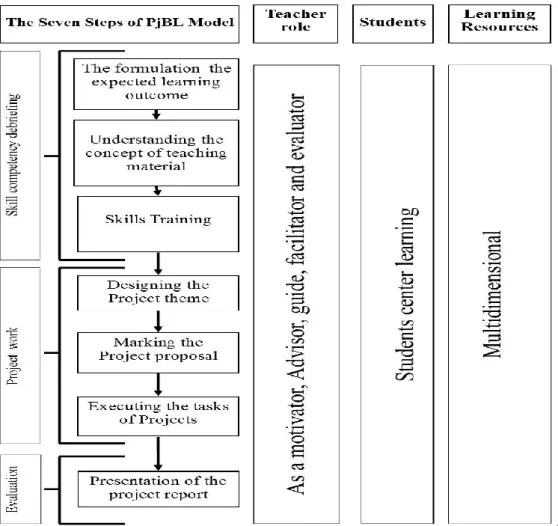
Similarly, Habok and Nagy (2016) suggested that the process of PBL starting from deciding the kind of the topic for organizing students, accomplishing the activity, collecting data, and finally presenting the final product and evaluating (p.4).In his turn, Jalinus, Nabawi, and Mardin (2017) discussed the seven steps of Project-Based Learning as presented in the following figure:
Figure 2.1.The Seven Steps of PBL Model
A Adapted from: Jalinus, Nabawi, & Mardin, 2017, p. 252.
According to Jalinus, Nabawi, and Mardin (2017) there are seven steps of Project-Based Learning model. The first step to do is teachers give information about learning outcomes. Then, teachers comprehend the tools of teaching. After that, teachers
exercise some skills. Then, teachers organize project theme. Moreover, teachers design a suggestion for the project. Finally, present the report of the project(p. 252).
2.4. Challenges of Project-Based Learning
Although Project-Based Learning is an inclusive approach to classroom teaching and learning, it faced different obstacles that affected its role negatively. Many educators and researchers agreed upon the fact that Project-Based Learning is considered as big challenge to many teachers and learners. One of the challenges that affected Project-Based Learning are the factors that influence its success. According to Khalid and Rahman (2019) there are two kind of factors that affect projects’ design at both the internal and external level. Firstly, the internal factors include the project itself and all its parts. Secondly, the external factors are the most significant factors, they include all outsider features like climate, unexpected circumstances, financial states, and different modification in the system of politics (p. 246).
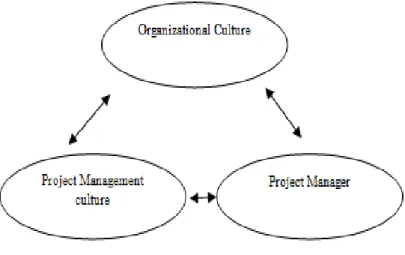
In addition to that, Stare argued the factors that curb the success of projects by affecting its outcomes and performance are associated with the organization system which encompasses three main features: first, “the organizational factors” that include plan, method, formation, cultural differences and different behaviors. Second, “project manager’s characteristics” that cover all the abilities that decide the achievement of the project like different qualifications, controlling, and motivating skills. Third, “project management culture” which is also essential in the achievement of the project (1999, as cited in Alqahtani, Chinyio, Mushatat, & Oloke, 2015, pp. 670-672). The following figure clearly illustrates the organizational system:
Figure 2.2.Stare’ Organizational System
Adapted from: Alqahtani, Chinyio, Mushatat, and Oloke, 2015, p. 670.
According to Harmer and Stokes (2014, pp. 21−25), Project-Based Learning has two kinds of challenges: the former is related to learners while the latter is related to the academic staff. The first kind include four elements: group work, preference for traditional teaching styles, assessment, and weight of work. Firstly, group work is considered as the most important challenge. Many researchers found in their studies that group work represents the most difficult element for learners while working on their project. Secondly, “preference for traditional teaching styles” by learners because the new teaching approaches are unknown for the learners and lead to many challenges in learning and organization. Danford (2006) stressed this fact by describing learners’ preferences for traditional styles as:
[A]completely new environment with a spectrum of unknown challenges. There are pressures from many sides: peers, trans-disciplinary partners, the project leaders, the tutor and the learning
goals. The students perceive themselves as being in the middle of these pressures (as cited as cited in Harmer & Stokes, 2014, p. 22).
The third element is “assessment” which is considered as one challenge for the students for the reason that assessing different groups while each group has a distinct lesson with its own unique style and method which may lead to invalid evaluation. Also, students have some ambiguity about many kind of unclear assessments, and sometimes they have lower motivation about their achievements. The fourth element is “weight of work” since it is often noticed that many learners are lazy in doing their workload in Project-Based Learning, and they ask for more time to complete their projects (2014, p. 22).
The second kind of challenges which is related to the academic staff encompasses two elements: the first one is the “new role of facilitator for the tutor” since it is a challenge for teachers to move from the role of giving lessons and information, to the new role of guiding and organizing students. The second element is “time and resources needed for Project-Based Learning”. In this respect, researchers argued that time and resources for Project-Based Learning are considered as one of the challenges‚ because the amount of time that is needed for creating and for organizing Project-Based Learning is different from one institution to another. Also, the resources needed for Project-Based Learning materials and equipments are not enough (2014, p. 23).
MacMath, Sivia, and Britton (2017) found that challenges related to Project-Based Learning implementation fall into three broad categories: “teacher beliefs, teacher practice, and context”. The first one is teachers’ beliefs since teachers recognize their role, evaluation, and ideas during the process of teaching and learning. Second, teachers’ practices comprise planning, interacting, facilitating, using technology, and assessing. Finally, context that incorporates all the outsider factors that teachers cannot
control like school culture and school policies (pp. 177-178). Furthermore, Balan, Yuen and Mehrtash (2019) found out that the instructor or the teacher will face some of the challenges if they apply PBL, and that could be summarized as the following:
-The instructor should provide their students with different sources of learning related to the chosen projects.
-When the teachers ask from their students to work as a group, here it will get the instructors into real challenges.
-The teachers will face a challenge of time, i.e, sometimes they should guide their students separately about different projects at the same time.
-The instructors should have a good experience to know how to deal with high level of subjects.
-A teacher should take in his mind that s/he should guide and help their students inside and outside of the classroom (p. 346).
2.5. Advantages and Disadvantages of Project-Based Learning
As long as Project Based Learning is one of the teaching methods, it has both advantages and disadvantages. The Teacher’s Guide of first-year scientific stream in the secondary school (1AS) explained that “the projects boost the learners’ sense of achievement resulting in an increasing sense of responsibility, esteem, self-confidence, and autonomy in learning” (2003, p. 21). Therefore, projects offer students a feeling of accomplishment leading to a growing sense of obligation, self-confidentiality, self-respect, and flexibility in education.
Additionally, Minerich (2001) stated that “the project opens a door, allowing students to interact with their topic on a level that pushes their comprehension and involvement deeper. It may encourage students to become more fully cognizant of their own belief system” (as cited in Kavlu, 2017, p. 69). This implies that the Project-Based Learning
enables participants to connect more closely with their subject at a degree that increases their understanding and engagement. Besides, Indrawan, Jalinus, and Syahril (2018) mentioned that Project-Based Learning has positive impact on learner's achievements with its reliable activities, authentic interactions -different questions and answers- that help to build strong competences, understanding, cognition, and the ability to collaborate in group work (p. 1016). Indrawan et al. found that Project-Based Learning helps the learners to understand how to categorize organism. Also, with its students’ centeredness in learning, it helps to enhance academic presentations (p.28). Tascia (2014) noted that Project-Based Learning became a technique and one of learning procedures because it helps in achieving learning outcomes by enhancing the development of education in that it incorporates the process of understanding, performance, and educational attainment (p. 774).
What is more, Ciftcia (2015) noted that Project-Based Learning has a positive impact on academic performance since it creates an authentic atmosphere inside the classroom that leads the learners to acquire different competences, deep awareness, self-confidence, self-autonomy, sense of collaboration, and good accomplishment in school and in their real life (p. 1020). MacMath, Sivia, and Britton (2017) argued that Project-Based Learning is beneficial for students because it develops their cognitive learning skills and intra-personal competences. Furthermore, Liebtag and Ark mentioned five reasons behind the necessity of training teachers to apply Project-Based Learning. These reasons could be recapitulated as follows: first, not only students need a preparation for PBL, but also teachers need some training to apply PBL because without teachers’ proficiency in PBL, students will not be able to apply it correctly to achieve different competences like interaction, and group work. Second, many traditional methods are no more effective, hence many new methods developed, and
Project-Based Learning is one kind of them. Third, new kills and tasks are needed to be applied by both teachers, and students. Fourth, PBL is considered as a main proficiency in teaching. Fifth and last, flexibility, organization of work is considered as the main feature of Project-Based Learning (Liebtag & Ark, 2016, p. 3).Harmer and Stokes(2014) in their studies insisted that the main benefits of Project-Based Learning are: motivating students and making them enjoy learning, as well as developing interaction and acquisition of knowledge (p. 13).
Musa, Mufi, Abdul Latiff, and Mohamed Amin (2010) argued that Project-Based Learning is useful for students to acquire a new language through developing collaboration, authenticity, reliability, organization, motivation, responsibility, and understanding(p. 188). Similarly, Lam (2011) confirmed that Project-Based Learning is very important in learning a second language by helping students to be autonomous learners, developing their abilities, increasing their interaction, engaging them in reliable tasks, enhancing their motivation, encouraging collaboration, and mounting their critical thinking as well as their abilities of problem solving (p. 142).
However, Project-Based Learning has some disadvantages. Efstratia argued that PBL has some problems of implementation which include:“laziness and discouragements of teachers, restricted time, syllabus, and the length of the project, difficulties in evaluating students and lack of time for enhancing learning” (2014, p. 1258).Likewise, Ladewski, et al. indicated that “the implementation of Project-Based Learning can conflict with deep-seated beliefs on the part of a teacher” (1991, as cited in Aldabbus, 2018, p. 73). This entails that many teachers have different view about the implication of Project-Based Learning. Similarly, Marx et al. argued that the weakness of Project-Based Learning are time consuming, teachers lack of monitoring proficiency,
and students lack of interaction and technological competences (1991, as cited in Aldabbus, 2018, p. 74).
2.6. Teachers’ Role in Project-Based Learning
As long as the process of Project-Based Learning includes teachers as a main part in its process, it is clear that teachers have an important role in Project-Based Learning. Habók and Nagy (2016) deduced that teachers’ role changed from being a source of information in the traditional method to become a controller, motivator, and facilitator in the new method of Project-Based Learning (p. 13). Similarly, Larmer et al. concluded that in Project-Based Learning teachers instead of being a source of information, they took on the role of observer, guider, and facilitator (2015, as cited in Habók, and Nagy, 2016, p. 367).
2.7. Teachers’ Views about Project-Based Learning
Teachers have different views about PBL effectiveness in education. Goldstein (2016) concluded that Project-Based Learning depends on teachers' proficiency in planning, and assessing. He added that many researchers in Singapore argued that future teachers encouraged this new method of Project-Based Learning, they found entertainment in guiding, giving instructions, interacting, collaborating, and creating friendly classroom (p.2). Habok and Nagy (2016) said that teachers, in contrast to traditional methods of learning, consider the new method of Project-Based Learning as an opportunity to develop knowledge, learning competences, different roles, and to make social transformations. They added that this method is significant if learners master the practical competences. Finally, they insured ensured that Project-Based Learning should not be just as simple task, instead it is important to become a fundamental part of the curriculum (p. 2).
In addition, Elmiati, Yelliza, and Theresia argued that teachers’ perception about Project-Based Learning on English textbook in high school in which teachers necessitate the importance of Project-Based Learning development with the availability of adequate means (p. 6).Baysura, Altun, Yucel-Toy (2015) concluded that teachers candidates believed that they would face many difficulties in putting Project-Based Learning into practice because they did not have enough information, training, competences, and experiences (p. 27).
2.8. The Competency-Based Approach and Project-Based Learning 2.8.1. Definition of the Competency-Based Approach
Müller-Frommeyer, Aymans, Bargmann, Kauffeld, Herrmann (2017) defined competences as implying a set of capacities, skillfulness, and information in different positions (p. 308). Azimov et al. highlighted the difference between the two terms competence, and competency. The first term is defined as set of knowledge, proficiencies obtained throughout different experiences. Whereas, competency is referred to as a possession of individual character that enable the acquisition of information, the development of skillfulness, and capabilities in carrying out different tasks (2009, as cited in Makulovaet al.,2015, p. 184).Markus et al. stressed that competency definitions consist of three interrelated ingredients: first, educational principles that holds understanding, skillfulness, and conducts; second, behavioral components that includes personality taints, society regulations, and competences; third, organizational competencies for competitive benefits (2005, as cited in Brilingaite, Bukauskas & Juskeviciene, 2018, p. 25). Also, Weinert identify the term “competence” asslightly specialized system of aptitude, abilities or skill necessary for achievement of a specific goal. It can concern both the individual abilities and the distribution of abilities within a social group or establishment” (2001, as cited in