Parasitology (1972), 64, 217-227 2 1 7 With 1 text-figure
Printed in Great Britain
Theeffects of drugs on
worm expulsion in the Nippostrongylus brasiliensis infected
rat: a discussion of the interpretation of drug action
BY R. KELLER*
Immunobiology Research Group University of Zurich
AND BRIDGET M. OGILVIE
National Institute for Medical Research Mill Hill, London (Received 25 June 1971)
The immunity induced expulsion of adult Nippostrongylus brasiliensis from the intestine of rats involves at least two separate steps. The worms are damaged by antibodies in the first step, but antibody action alone cannot expel them and a further step expels the damaged worms (Ogilvie & Hockley, 1968; Jones & Ogilvie,
1971). There is some evidence which suggests that the release of amines (probably from mast cells by an anaphylactic reaction) is involved in expulsion of damaged worms (reviewed by Ogilvie & Jones, 1971), but recent work indicates that pro-tective antibodies, reaginic antibodies and a functional amine release system can be present without the worms being expelled. This situation occurs in lactating female rats which will expel their worms only when given cells from immune, non-lactating donors (Connan, 1970; Dineen & Kelly, 1971). Therefore, either amine release is not involved in worm expulsion or it is triggered only by sensitized lymphocytes. If this is the case, then worm expulsion is a three-step reaction: antibody action; a triggering action related to lymphocytes; amine release. The present work which examines the effect of various drugs on the expulsion of damaged worms suggests that drugs which affect cellular release mechanisms in general, prevent worm expulsion. If this is correct, then drugs which affect worm expulsion may do so not by their effect on amines, but by affecting the release of effector substances from lymphocytes; worm expulsion will be a two step mechan-ism in which lymphocytes expel worms once they are damaged by antibodies.
MATERIALS AND METHODS Rats and parasites
Male colony-bred Osborne-Mendel rats weighing 180 -200 g were used for worm infection. Methods for maintenance and recovery of N. brasiliensis and for count-ing eggs in rat faeces were as described earlier (Keller, 1970a).
Transfer of 'normal' and 'damaged' worms. Adult worms from donor rats were
recovered on day 6 ('normal' worms) or day 11 ('damaged' worms) after an initial
218 B. KELLER AND BRIDGET M. OGILVIE
infection, and 300 worms of either type were injected into the small intestine of recipient rats as described by Ogilvie & Hockley (1968). Six days later, the number of the worms still present in the small intestine was assessed.
Worm counts. Adult worms present in the intestine of each rat were harvested
by a modified Baermann technique as described by Ogilvie (1965a), and counted.
Drugs
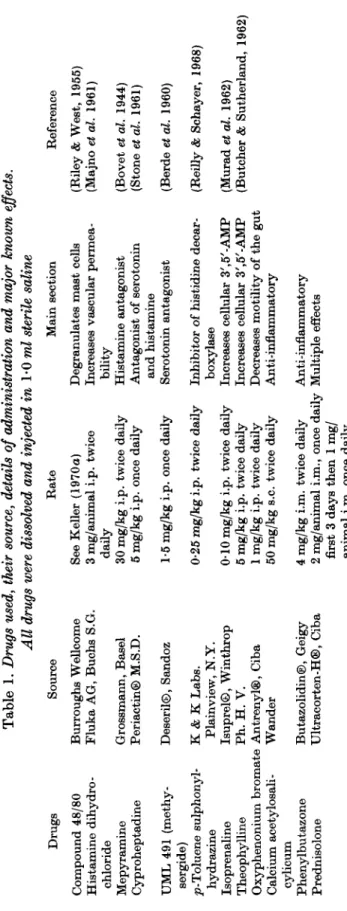
The drugs used and all details concerned with them are given in Table 1.
Experimental plan
Infections were established either by transplanting worms from donor rats into the intestine of recipients, or by infecting with larvae.
Expulsion of damaged and normal adult worms. Groups consisting of 15 to 20 rats
were infected on day 0 by transferring worms directly into the intestine. Two groups, one infected with normal worms, one with damaged worms, were not given any treatment and served as controls. The remaining groups were infected with damaged worms and treated with various drugs either once or twice a day as summarized in Table 1, from day — 3 to day 5. On day 6, the worms were recovered and counted.
Expulsion of worms from rats infected with 4000 larvae. All rats except worm free
controls were infected with 4000 larvae s.c. on day 0. Each group consisted of 15 rats and group faecal egg counts were done every day from day 6 to 21. Compound 48/80, histamine, cyproheptadine and saline were injected from day 8 to day 20 after infection, as summarized in Table 1. On day 21, the rats were killed, individual sera collected and the homologous passive cutaneous anaphylaxis titre (PCA) was determined as outlined previously (Keller, 1970a; Keller & Jones, 1971). At the same time, all the worms were counted, fixed in 70 % ethanol, embedded in para-ffin wax and sections 5 /tm thick were cut and stained with haematoxylin and eosin.
RESULTS
The effect of drugs on worm expulsion
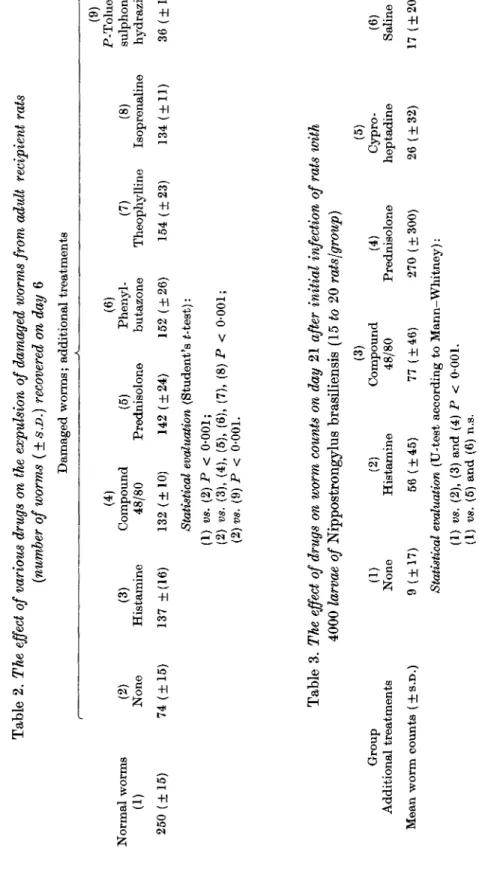
Rats were infected by transferring worms damaged by immunity directly into their intestines from donor rats. These rats were treated with various drugs, using doses and dosage routines outlined in Table 1. All drug treatments were well withstood by the rats and no significant weight changes were observed. The results of these experiments are shown in Table 2. The chronic administration of histamine, compound 48/80, prednisolone, phenylbutazone, theophylline or iso-prenaline significantly inhibited the expulsion of damaged worms from rats. In contrast, the expulsion of damaged worms from rats was accelerated by treatment with the histidine decarboxylase inhibitor, ^-toluene sulphonylhydrazine. The following drugs had no effect on the rate of worm expulsion: mepyramine, UML 419, salicyalte, oxyphenonium bromate or saline.
Tabl e 1 . Drugs used, their source, details of administration and major known effects. All drugs were dissolved and injected in 1-0 ml sterile saline Drug s Compoun d 48/8 0 Histamin e dihydro -chlorid e Mepyramin e Cyproheptadin e UM L 49 1 (methy -sergide ) p-Toluen e sulphonyl -hydrazin e Isoprenalin e Theophyllin e Oxyphenoniu m bromat e Calciu m aoetylosali -cylicu m Phenylbutazon e Prednisolon e Sourc e Burrough s Wellcom e Fluk a AG , Buch s S.G . Grossmann , Base l Periactin ® M.S.D . Deseril© , Sando z K & K Labs . Plainview , N.Y . Isuprel® , Winthro p Ph . H . V . Antrenyl® , Cib a Wande r Butazolidin® , Geig y Ultracorten-H® , Cib a Rat e Se e Kelle r (1970a ) 3 mg/anima l i.p . twic e dail y 30 mg/k g i.p . twic e dail y 5 mg/k g i.p . onc e dail y 1-5 mg/k g i.p . onc e dail y 0-2 5 mg/k g i.p . twic e dail y 0-1 0 mg/k g i.p . twic e dail y 5 mg/k g i.p . twic e dail y 1 mg/k g i.p . twic e dail y 50 mg/k g s.c . twic e dail y Mai n sectio n Degranulate s mas t cell s Increase s vascula r permea -bilit y Histamin e antagonis t Antagonis t o f serotoni n an d histamin e Serotoni n antagonis t Inhibito r o f histidin e decar -boxylas e Increase s cellula r 3',5'-AM P Increase s cellula r 3',5'-AM P Decrease s motilit y o f th e gu t Ant i -inflammator y 4 mg/k g i.m . twic e dail y Anti-inflammator y 2 mg/anima l i.m. , onc e dail y Multipl e effect s first 3 day s the n 1 mg / anima l i.m . onc e dail y Referenc e (Rile y & West , 1955 ) (Majn o et al. 1961 ) (Bove t et al. 1944 ) (Ston e et al. 1961 ) (Berd e et al. 1960 ) (Reill y & Schayer , 1968 ) (Mura d et al. 1962 ) (Butche r & Sutherland , 1962 ) b o I— I
Tabl e 2 . The effect of various drugs on the expulsion of damaged worms from adult recipient rats (number of worms ( + S.D.) recovered on day 6 Damage d worms ; additiona l treatment s
8
Norma l worm s (1 ) 25 0 (±15 ) (2 ) Non e (3 ) Histamin e 74 (±15 ) 13 7 ±(16 ) (4 ) Compoun d 48/8 0 (5 ) Prednisolon e (6 ) Phenyl -butazon e 13 2 (±10 ) 14 2 (±24 ) 15 2 ( + 26 ) Statistical evaluation (Student' s £-test) : (1 ) vs. (2) P < 0-001 ; (2 ) vs. (3) , (4) , (5) , (6) , (7) , (8 ) P < 0-001 ; (2 ) vs. (9 ) P < 0-001 . (7 ) Theophyllin e 15 4 (±23 ) (8 ) Isoprenalin e 13 4 (±11 ) P-Toluene -sulphonyl -hydrazin e 36 (±11 )o
W
M o & Tabl e 3 . The effect of drugs on worm counts on day 2 1 after initial infection of rats with 400 0 larvae of Nippostrongylu s brasiliensi s (1 5 to 2 0 ratsjgroup) Grou p Additiona l treatment s Mea n wor m count s ( ± S.D. ) (1 ) Non e (2 ) Histamin e (3 ) Compoun d 48/8 0 (4 ) Prednisolon e 9 (±17 ) 5 6 (±45 ) 7 7 (±46 ) 27 0 (±300 ) Statistical evaluation (U-tes t accordin g t o Mann-Whitney) : (1 ) vs. (2) , (3 ) an d (4 ) P < 0-001 . (1 ) vs. (5 ) an d (6 ) n.s . (5 ) Cypro -heptadin e 26 ( ± 32 ) (6 ) Salin e 17 (±20 ) OEffect of drugs on worm expulsion
221
was also assessed in rats infected with larvae, and drugs behaved similarly in both systems. In rats infected with larvae, expulsion of adult worms was delayed following treatment with histamine, compound 48/80, and prednisolone but saline and cypropheptadine had no effect (Table 3).1:500 r • • 1:250 1:100 1:50 1:10 -1:1
Fig. 1. Individual 72 h PCA titres of sera collected on day 21 after a primary infection with 4000 JV. brasiliensis larvae. Additional treatments: 1, none (controls); 2, saline; 3, compound 48/80; 4, histamine; 5, cyproheptadine; 6, prednisolone (same animals as in Table 3).
Experiments to investigate the effect of compound 48/80 and histamine on worm expulsion
(a) Effect on antibody production
When the worms were collected from the rats in the experiment summarized in Table 3, individual serum samples were also collected from each rat. The indivi-dual 72 h PCA titres of the sera were assessed and the mean values for each experi-mental group are shown in Fig. 1. This experiment (which has been repeated several times) shows that the PCA titre of serum from rats treated with 48/80 is reduced, but no other treatments significantly or repeatedly affected the PCA titre. To test whether traces of compound 48/80 might be present in these sera and thus be responsible for the low PCA titres, the sera were tested for their capacity to release histamine from isolated rat peritoneal mast cells, but no histamine release was ever detected in this test.
Tabl e 4 . Histamine content [fiQ base) of pieces of the small intestine in untreated controls, in 4:8/80-treated controls and in worm-infected rats sacrificed 9-1 6 days after an initial infection with 400 0 larvae of Nippostrongylu s brasiliensi s Rat s treate d wit h compoun d 48/8 0 Distance s fro m th e pylori c sphincte r (cm ) 1 4 8 12 16 2 0 2 4 2 8 32 38 4 2 46 50 5 4 5 8 62 66 7 0 74 7 8 Control s i X 3-6 9 31 7 30 4 3-3 1 3-3 9 3-5 1 3-4 5 3-9 5 3-8 0 3-2 1 3-2 6 2-9 4 30 1 2-9 5 30 3 3-5 3 4-1 5 3-8 8 30 2 2-7 5 > s 0-8 9 0-7 1 0-6 0 1-0 4 11 7 1-0 7 1-1 5 1-1 4 1-4 2 0-9 6 0-9 8 0-7 6 0-6 0 0-6 9 1-0 7 0-9 4 1-8 1 1-4 6 1-5 9 1-4 5 /- Norma l c X 5-5 6 4-6 5 5-4 6 4-6 5 5-6 5 5-7 4 5-4 9 5-5 8 5-4 8 4-4 9 50 4 4-5 9 3-8 3 4-3 0 4-6 5 5-7 1 6-6 3 6-0 1 6-5 1 6-6 9 rat s s 1-4 9 1-8 1 21 5 1-4 3 1-8 4 2-4 9 1-9 2 2-2 0 1-9 3 1-4 1 1-4 6 0-8 9 0-6 6 0-6 5 0-8 4 0-8 7 1-8 2 2-3 1 2-6 9 3-5 6 t Da y A ( X 4-8 1 4-2 0 3-03 " 1-7 2 11 1 10 4 1-3 4 1-8 0 2-7 5 2-9 0 2-7 3 2-62 . 3-6 5 3-5 1 3-7 7 4-5 5 4-9 8 5-7 2 6-2 1 6-7 9 9 s 2-5 2 2-5 6 1-4 5 1-3 1 0-8 9 0-3 8 0-9 7 1-2 1 1-9 1 1-8 2 1-2 4 1-5 1 1-8 1 1-2 3 1-7 6 2-3 9 2-3 2 21 4 1-8 9 1-6 7 Da y A f X 3-38 ' 2-6 9 2-0 5 1-2 2 0-7 3 0-5 7 0-5 7 0-6 2 0-9 5 1-4 1 1-7 5 2-0 7 2-3 3 2-5 7 2-6 1 3-0 5 3-4 8 3-2 5 3-5 0 4-8 5 Worm-infecte d rat s A 1 2 s 1-1 2 0-9 1 1-1 0 0-9 1 0-7 4 0-6 1 0-5 8 0-6 3 0-7 3 1-0 7 1-2 4 1-2 7 11 5 1-2 4 11 5 1-0 8 0-7 7 1-0 4 11 3 1-2 4 Da y i X 4-56 " 4-2 0 3-8 6 3-2 4 2-5 7 1-8 9 2-1 9 1-6 8 21 1 2-6 8 3-0 8 2-8 4 3-6 7 4-0 3 4-5 9 5-4 7 6-3 7 6-3 0 7-0 5 6-2 8 1 3 a 2-9 3 1-3 2 1-3 6 2-5 4 2-0 6 1-7 6 2-0 0 1-8 8 1-3 2 1-8 4 1-3 9 1-2 9 1-0 0 0-9 4 0-2 4 0-7 3 0-5 4 1-3 2 1-3 0 1-8 8 Da y A ( X 6-4 2 5-4 4 50 3 4-5 5 3-8 8 2-8 9 1-4 1 1-4 0 1-8 7 2-4 8 31 3 31 6 3-8 6 3-8 8 4-3 1 5-0 8 4-8 6 5-0 0 4-3 2 3-5 6 1 4 s 213 1-64 1-36 1-81 1-51 203 1-34 1-45 1-39 51-3 0-95 1-38 104 1-39 21-2 1-14 1-64 1-93 1-34 0-97 Da y A X 5-5 5 4-4 1 4-7 6 3-9 3 3-1 4 2-6 2 2-3 1 2-4 1 3-0 3 3-6 9 3-2 4 3-8 8 4-0 0 3-3 3 4-3 3 4-7 9 4-0 0 3-5 9 3-4 4 3-2 6 1 6 s 1-53 1-48 1-47 2-04 211 2-18 1-07 0-70 1-27 31-2 1-04 103 0-98 1-47 11-6 1-32 117 1-49 1-35 1-42
w
I— I oo
op
x — mea n value ; s = standar d deviation , ] regio n wher e worm s wer e located .Effect of drugs on worm expulsion 223
The worms obtained from the rats in this experiment were examined histo-logically for signs of immune damage (Ogilvie & Hockley, 1968; Jones & Ogilvie, 1971). All worms showed characteristic structural changes, indicating that protec-tive antibodies were present in all rats whether or not they were treated with drugs.
(b) Intestinal histamine levels in rats treated with compound 48/80
Histamine levels throughout the length of the small intestine in normal rats which were not infected or drug treated and in uninfected and infected rats treated with compound 48/80 was determined, using the methods given in detail in Keller (1971). Worm infected, drug treated rats were killed on days 9, 12, 13, 14 and 16 and the infected regions of the intestine noted. The results are shown in Table 4.
In uninfected control rats, chronic treatment with compound 48/80 resulted in a marked rise of intestinal histamine levels. In the nematode-infected rats treated with compound 48/80, a similar increase in intestinal histamine occurred but in the regions, in which the main worm burden was located, histamine levels were lower, as has previously been known in infected rats not treated with
com-pound 48/80 (Keller, 1971).
DISCUSSION
Chronic administration of compound 48/80 prevented worm expulsion, confirm-ing earlier observations (Keller, 1970&). Administration of compound 48/80 was shown to increase gut histamine levels (Table 4), and histidine decarboxylase activity is increased by this treatment (Schayer, Rothschild & Bizony, 1959). Administration of histamine also prevented worm expulsion, and conversely treatment with the histidine decarboxylase inhibitor, ^-toluene sulphonyl-hydrazine, accelerated worm expulsion. The most logical interpretation of these results is that a high level of gut histamine enables worms to resist the action of immunity and conversely, that severe reduction of histidine decarboxylase re-duces histamine levels and makes the worms more susceptible to expulsion. Although these results are open to the same criticisms which are discussed later, they nevertheless, make it most unlikely that release of histamine from mast cells is responsible for worm expulsion.
Murray, Miller, Sanford & Jarrett (1971) have demonstrated a correlation be-tween 5-hydroxytryptamine levels and worm expulsion in this infection. In our hands, administration of drugs whose major action is on this compound, had no effect on worm expulsion. These results may be attributable to technical factors such as route and/or frequency of administration, but it is nontheless surprising that a drug such as cyproheptadine which has potent antihistamine and antisero-tonin properties (Stone, Wenger, Ludden, Stavorski & Ross 1961), did not affect worm expulsion or egg production. Prednisolone prevented worm expulsion which was to be expected as it has already been shown that prednisolone has a profound inhibitory effect on immunity to this parasite (Ogilvie, 19656).
224 R. K E L L E R AND BRIDGET M. OGILVIE
Worm expulsion was also slowed by drugs which increase the cellular level of cyclic 3',5'-adenosine monophosphate such as isoprenaline (Murad, Chi, Rail & Sutherland, 1962) or theophyUine (Butcher & Sutherland, 1962). Catecholamines and methylxanthines have been shown to prevent antigen-induced release of histamine from human lung (Assem & Schild, 1969), from leukocytes (Lichten-stein & Margolis, 1968), basophils (Ishizaka, Ishizaka & Lichten(Lichten-stein, 1971) and rat mast cells (Keller, 1970 c). Therefore, although the present results suggest that cyclic 3',5'-AMP is in some way involved in worm expulsion, its role is prob-ably not simply in amine release. No effects on worm expulsion were detected after the administration of drugs which decrease the motility of the gut (oxyphenonium bromate) or suppress various signs and symptoms of inflammation, such as sali-cylate.
It has been demonstrated that sensitized lymphocytes are necessary for worm ex-pulsion from rats (Dineen & Kelly, 1971), but it seems unnecessary to postulate that the lymphocytes act by releasing amines. There is already evidence that lymphocyte function is affected by drugs. The work of Dineen & Kelly (1971) has shown that in lactating animals lymphocytes cannot function in worm rejection presumably because of hormonal effects on the lymphocytes. The same authors have shown that promethazine treatment inhibits lymphocyte action as well as worm rejection (Kelly & Dineen, 1971). No other work has been done to investigate the action of amine inhibiting drugs on lymphocyte function, but the available evidence warns that drugs may well affect release mechanisms of lymphocytes as well as amine-releasing cells. Again, in the present report it has been shown that compound 48/80 treatment reduces circulating reagin titres. These and other results (Falke & Netter, 1969) suggest that side effects of drugs may well be more relevant than their main action in the interpretation of these experiments.
The invasion of the lamina propria by mast cells in parasitized tissues is one of the main reasons for suggesting that amine release is involved in worm expulsion (Murray, Miller & Jarrett, 1968; Keller, 1971). It is well known that when mast cells are degranulated by substances like compound 48/80, there is an enormous proliferation of mast cell precursors (Riley & West, 1955; Roth, Noltenius & Oehlert, 1963). Mast cell infiltration of parasitized sites may be completely un-related to the immunological response of the host and could equally well be explained as the inevitable consequence of a local release of the mast cell degranu-lating substances known to be produced by nematodes (Uvnas & Wold, 1967; Keller, 1970 c).
There are several reasons why the experimental approach used both in the present paper and by others investigating amine function in worm expulsion is not in itself sufficient to conclude that amines are involved in worm expulsion. First, drugs may have their action by interfering with mechanisms other than those being investigated. Examples of this are given above. Secondly, drugs which inhibit amines do not consistently affect worm expulsion. This inconsistency might be ex-plained by faults in administration of drugs resulting in failure of drug action at the parasitized site, but equally likely is the suggestion that inhibitory drugs affect mechanisms not involving amines. Thirdly, effective drugs are all given over a
Effect of drugs on worm expulsion 225
prolonged period of time and at high dose levels. Fourthly, with the exception of the present report, drugs known to affect release mechanisms in general (Stormor-ken, 1969) have not been investigated, i.e. experiments have been biased towards obtaining an effect on amines, and effects on the release of other pharmacologically active substances have not been considered. Finally, it is by no means unlikely that the release mechanisms being affected are those of the parasite as well as of the host. For all these reasons, we feel that continuous high level drug treatment is an intrinsically unsatisfactory approach to the study of the nature of the ex-pulsion mechanism. The exact nature of the exex-pulsion mechanism will only be demonstrated finally when the lesion induced in the worm to make it leave the gut is demonstrated by studying the worms themselves.In conclusion, it is suggested that drugs which are thought to prevent worm expulsion by acting on amines probably have their effect by acting on cellular release mechanisms generally. It is possible that inhibition of the release of effector substances from lymphocytes is the major effect of drugs and that worm expulsion involves only two steps: (antibody action followed by lymphocyte action) and that amine release has no role in worm expulsion.
SUMMARY
In rats treated with compound 48/80 or histamine, worm expulsion was in-hibited. Treatment with a histidine decarboxylase inhibitor accelerated worm expulsion. Treatment with compound 48/80 elevates histamine and histidine decarboxylase levels and reduces circulating reagin titres. These results show that histamine is not responsible for worm expulsion.
Compounds such as isoprenaline and theophylline which increase cellular levels of cyclic 3',5-AMP, prevented worm expulsion.
It is concluded that the evidence that amines are involved in worm expulsion needs reassessing and that cellular release mechanisms in general may be affected by drugs thought to act solely on amine release. In particular, the release of effector substances from sensitized lymphocytes on contact with antigen may be affected by these treatments.
The skilful technical assistance of Miss R. Keist and Miss I. Beeger is gratefully acknowledged. We thank Mr H. Berchtold, Biostatistisches Zentrum der Univer-sitat Zurich, for the statistical evaluation of the data.
REFERENCES
ASSEM, E. S. K. & SCHILD, H. O. (1969). Inhibition by sympathico mimetic amines of hista-mine release induced by antigen in passively sensitized human lung. Nature, London 224, 1028-9.
BERDE, B., DOEPFNER, W. & CERLETTI, A. (1960). Ueber die Wirkungsdauer einiger Sero-toninantogonisten. Helvetica physiologica et pharmacologica Acta 18, 537-44.
BOVET, D., HORCLOIS, R. & WAI/THERT, F. (1944). Proprietes antihistaminiques de la N-p-methoxybenzyl-N-dimethylaminoethyl a. amino-pyridine. Comptes Rendus des Seances de
226 R. KELLER AND BRIDGET M. OGILVIE
BUTCHER, B. W. & SUTHERLAND, E. W. (1962). Adenosine 3',5'-phosphate in biological
materials. I. Purification and properties of cyclic 3',5'-nucleotide phosphodiesterase and use of this enzyme to characterize adenosine 3',5'-phosphate in human urine. Journal of
Biological Chemistry 237, 1244-50.
CONNAN, R. M. (1970). The effect of host lactation on the self-cure of Nippostrongylus
brasi-liensis in rats. Parasitology 61, 27-33.
DINEEN, J. K. & KELLY, J. D. (1971). The suppression of rejection of Nippostrongylus
brasiliensis in lactating rats: the nature of the immunological defect. Immunology (in the
Press).
-FALKE, D. & NETTER, K. J. (1969). Die Hemmung der Riesenzellbildung durch das sogen-annte Compound 48/80 nach der Infektion mit dem Herpesvirus hominis. I. Die Wirkung auf die Virussynthese. Archivfiir die gesamte Virusforschung 28, 308-24.
ISHIZAKA, T., ISHIZAKA, K. & LICHTENSTEIN, L. M. (1971). Antibody-induced hiatamine release and degranulation of human basophil leukocytes. Federation Proceedings 30, 654.
JONES, V. E. & OGiLvrE, B. M. (1971). Protective immunity to Nippostrongylus brasiliensis: the sequence of events which expels worms from the rat intestine. Immunology, 20, 549-61.
KELLER, R. (1970a). Immune reactions to Nippostrongylus brasiliensis in the rat. I.
Charac-teristics of primary and secondary immune response in vivo. International Archives of
Allergy and Applied Immunology 37, 197-215.
KELLER, R. (19706). On the mechanism of expulsion of helminths. Clinical and experimental
Immunology 6, 207-10.
KELLER, R. (1970C). Unpublished data.
KELLER, R. (1971). Nippostrongylus brasiliensis in the rat: Failure to relate intestinal
hista-mine and mast cell levels with worm expulsion. Parasitology 63, 473—81.
KELLER, R. & JONES, V. E. (1971). Immunological analysis of the primary and secondary
reagin response to Nippostrongylus brasiliensis in the rat. Immunology 21, 565-74.
KELLY, J. D. & DINEEK, J. K. (1971). The suppression of rejection of Nippostrongylus
brasi-liensis in the rat by promethazine hydrochloride: the site of immunological impairment.
Submitted to Immunology.
LICHTENSTEIN, L. M. & MABGOLIS, S. (1968). Histamine release in vitro: Inhibition by cate-cholamines and methylxanthines. Science 161, 902-3.
MAJNO, G., PALADE, G. E. & SCHOEIX, G. I. (1961). Studies on inflammation. II. The site of action of histamine and serotonin along the vascular tree: a topographic study. Journal of
Biophysical and Biochemical Cytology 11, 607-26.
MURAD, F., Cm, Y.-M., RALL, W. T. & SUTHERLAND, E. W. (1962). Adenylcyclase. III. The effect of catecholamines and choline esters on the formation of adenosine 3',5'-phosphate by preparations from cardiac muscle and liver. Journal of Biological Chemistry 237, 1233-8.
MURRAY, M., MILLEB, H. R. P. & JARRETT, W. F. A. (1968). The globule leukocyte and its derivation from the subepithelial mast cell. Laboratory Investigation 19, 222-34.
MURRAY, M., MILLER, H. R. P., SAOTORD, J. & JARRETT, W. F. H. (1971). 5-Hydroxytrypta-mine in intestinal immunological reactions. Its relationship to mast cell activity and worm expulsion in rats infected with Nippostrongylus brasiliensis. International Archives of
Allergy and Applied Immunology 40, 236-47.
OGILVIE, B. M. (1965a). Role of adult worms in immunity of rats to Nippostrongylus
brasilien-sis. Parasitology 55, 325-35.
OGILVIE, B. M. (19656). Use of cortisone derivatives to inhibit resistance to Nippostrongylus
brasiliensis and to study the fate of parasites in resistant hosts. Parasitology 55, 723-30.
OGILVIE, B.M. &HOCKLEY, D. J. (1968). Effects of immunity on Nippostrongylus brasiliensis adult worms: reversible and irreversible changes in infectivity, reproduction, and mor-phology. Journal of Parasitology 54, 1073-84.
OGILVIE, B. M. & JONES, V. E. (1971). Nippostrongylus brasiliensis in the rat. A review of
mmunity and the host/parasite relationship. Experimental Parasitology 29, 138-77.
REELLY, M. A. & SCHAYER, R. W. (1968). Further studies on the histidine-histamine
relation-ship in vivo: effects of endotoxin and of histidine decarboxylase inhibitors. British Journal
of Pharmacology 34, 551-63.
RILEY, J. F. & WEST, G. B. (1955). Tissue mast cells. Studies with a histamine -liberator of low toxicity (compound 48/80). Journal of Pathology and Bacteriology 69, 269-82.
Effect of drugs on worm expulsion 227
ROTH, E., NOLTENIUS, H. & OBHLBBT, W. (1963). Autoradiographische Untersuchungen zur DNS-Neubildung und zum Sulfateinbau in Gewebemastzellen. Frankfurter Zeitschrift fiirPathologie 73,40-51.
SCHAYEB, R. W., ROTHSCHILD, Z. & BIZONY, P. (1959). Increase in histidine decarboxylase activity of rat skin following treatment with compound 48/80. American Journal of
Physio-logy 196, 295-8.
STONE, C. A., WENGEB, H. C, LUDDEN, C. T., STAVOBSKI, J. M. & Ross, C. A. (1961). Anti-serotonin-antihistaminic properties of cyproheptadine. Journal of Pharmacology and
ex-perimental Therapeutics 131, 73-84.
STOBMOBKEN, H. (1969). The release reaction of secretion. Scandinavian Journal of
Haema-tology, Supplement 9, 3-24.
UVNAS, B. & WOLD, J. K. (1967). Isolation of a mast cell degranulating polypeptide from