A design approach to team coordination
Hazbi AVDIJI & Stéphanie MISSONIER
Faculté des Hautes Etudes Commerciales (HEC), Université de Lausanne
Team coordination over long time scales has been analyzed through two dominant perspectives: the contingency approach and the discursive approach. While they produced extensive theoretical contributions, these two perspectives are not well-suited to understand team coordination in changing and uncertain situations such as innovation projects. In this paper, we propose a design approach to coordination, which we define as the joint inquiry and construction by teams of their common ground. We instantiated our conceptual model into a tool called the Team Alignment Map, which allows team members to design their interdependencies. We evaluated the effectiveness of the tool within 22 innovation projects in two different settings. Our findings suggest that the tool facilitated the creation of shared understanding between team members, and allowed them to coordinate flexibly and welcome the shifting requirements of their projects. These findings suggest that conceptualizing coordination as a design process is well-suited to innovation projects.
1. Motivation
Coordination is a topic that has received extensive attention by scholars as it plays a pervasive role in our everyday lives. Academic developments on coordination have had two distinct units of analysis: real-time coordination in the here-and-now of face-to-face encounters (e.g. when two or more people coordinate to move a desk outside a room), coordination across time and space, especially in organizational settings (e.g. when work teams hold a meeting for a web development project to coordinate everyone's individual contributions). In this paper, we focus on team coordination across space and time.
In such settings, team coordination is the process through which a group of individuals form action plans to integrate and align their contributions, knowledge, and objectives (Rico, Sánchez-Manzanares, Gil & Gibson 2008). Team coordination is one of the main and enduring issues in innovation projects such as the development of new products or software (Espinosa, Kraut, Slaughter, Lerch & Herbsleb 2002). Such projects stress the need for effective coordination as they are characterized by shifting or uncertain requirements, low visibility over the future course of action, and partial knowledge being spread across participants (Edmondson & Harvey 2017). The complexity of innovation projects cannot be addressed by single individuals. Therefore, they require the collaboration of multiple individuals with diverse roles, resources, and domains of expertise.
As innovation projects usually last from several weeks to several years, they are structured around an extensive number of recurrent project meetings during
which team members integrate everyone's previous contributions (i.e. what actions everyone has performed until the meeting), monitor the situation, and plan the actions that everyone must perform until the next meeting. Team members can also rely on additional coordination devices such as objects (e.g. PowerPoint presentations or contracts) or conventions (e.g. organizational hierarchies) to align their interdependent individual contributions (Klein, Feltovich, Bradshaw & Woods 2005; Tylén, Philipsen & Weed 2009).
Scholars have produced an extensive number of studies to analyze what makes team coordination effective, producing two dominant theoretical perspectives (Avdiji, Missonier & Mastrogiacomo 2015; Zackrison, Seibold & Rice 2015). The first is the contingency approach, which is concerned with finding the coordination devices for individuals to manage specific types of interdependencies (Espinosa, Lerch, Kraut, Salas & Fiore 2004; Okhuysen & Bechky 2009). This approach was initiated by Malone & Crowston (1990), who considered that coordination is effective when there is a match between the situation individuals face and the coordination devices they use. For example, when the activity of one participant depends on the output of the activity of another, the authors suggest that ordering activities sequentially will allow for effective coordination. However, as projects are prone to emerging requirements, continuous change and low visibility (Henderson & Clark 1990), it is difficult for individuals to identify and manage interdependencies between participants and use the right coordination devices (Sosa, Eppinger & Rowles 2004). In sum, this approach fails to address the complexity and the need for flexible interpredictions during innovation projects.
The second theoretical perspective is the discursive approach. This approach stresses that managing innovation projects is about performing non-recurrent activities, i.e. activities that have very little or no routine aspects or in which routines change. In such cases, teams need to resort to discursive coordination because dependencies between participants can no longer be managed in a predictable and programmed way (Bechky & Okhuysen 2011). Most studies on the coordinative power of language have focused on the here-and-now of simple interactions (often) between two individuals (e.g., Clark & Brennan 1991; Gardner & Levy 2010). Other studies have underlined the importance of communication for high-level team coordination (Bechky & Okhuysen 2011; Minssen 2006; Wittenbaum & Stasser 1998), but they do not explain what makes communication in teams effective. In fact, discursive coordination is not innate and is difficult to ensure for activities involving multiple participants across time and space (Minssen 2006; Sewell 1998). Very often people are not able to create a shared understanding during their conversation because of their different representations, language, and responsibilities (Kleinsmann & Valkenburg 2008). This difficulty increases as the requirements and goals of the joint activity continuously change and are difficult to predict, as is characteristic of innovation projects (Badke-Schaub, Neumann, Lauche & Mohammed 2007).
Therefore, communication in teams still often leads to ineffective coordination, i.e. participants experience coordination breakdowns, misunderstandings, perception gaps, and wrong predictions, mainly due to the team's inability to create shared understanding (Bittner & Leimeister 2014; Mastrogiacomo, Missonier & Bonazzi 2014). As noted by Zackrison and colleagues (2015), most communication researchers have focused on coordinating language, interpersonal interactions, and social ties (e.g., Fusaroli & Tylén 2012; Pearce & Pearce 2000).
We assume that a design approach to coordination can overcome the limitations (i.e. lack of interpredection flexibility and shared understanding) of both the contingency and the discursive approach in innovation projects. Such an approach would be more effective than traditional accounts to encompass the increasingly important characteristics of innovation projects. For these reasons, we seek in this paper to answer the following question: How can a design
approach to team coordination be effective in innovation projects?
For that, we develop a conceptual model based on Clark (1996)'s psycholinguistic theory on joint activities and Dewey (1927, 1929)'s concept of joint inquiry, which has recently been applied to design thinking (Steen 2013). We instantiate the conceptual model into a tool that teams use to design their coordination through discussions during team meetings.
2. Conceptual model for the design approach
To derive our design approach to team discursive coordination, we turn to two theories that have been used in teamwork. Psycholinguist Herbert Clark (1996) has described how people use language to coordinate in joint activities. His approach specifies the cognitive conditions necessary for effective coordination. For two or more individuals to coordinate on a joint project, they must have common ground on four requirements (Mastrogiacomo, Missonier & Bonazzi 2014): joint objectives, joint commitments, joint resources, and joint risks. In this paper, we propose to complement Clarks' approach with Dewey's (1927, 1929) process of inquiry, which is particularly relevant in co-design and design thinking (Steen 2013). Dewey proposed inquiry as a process that starts from a problematic situation, in which actors combine doing and thinking to move to the resolution of the problem. When problems have shifting or uncertain requirements and the future course of actions required by individuals is difficult to foresee (low visibility), actors proceed iteratively through exploration and evaluation. They discuss to define the problem and evaluate possible solutions. This process of exploration and evaluation has recently been outlined as important for innovation projects, through the creation of shared and visual problem spaces where individuals can proceed iteratively by prototyping, trying out and selecting alternative solutions (Avdiji, Elikan, Missonier & Pigneur 2018; Osterwalder & Pigneur 2013).
Our conceptual model addresses coordination specifically for the challenges of innovation projects: Clark's theory of common ground on the four requirements addresses the distributed and partial knowledge characteristic (shared understanding), while Dewey's iterative process of exploration and evaluation addresses the need to cope with shifting requirements and low visibility over the course of action (need for interprediction flexibility).
3. Methodology
Our methodology is based on Hevner, March, Park, and Ram's (2004) approach to design science research (DSR). In DSR, researchers design an artifact to solve an organizational problem faced by practitioners. To do so, researchers draw from sound theoretical knowledge or feedback from the practitioners.
Research setting
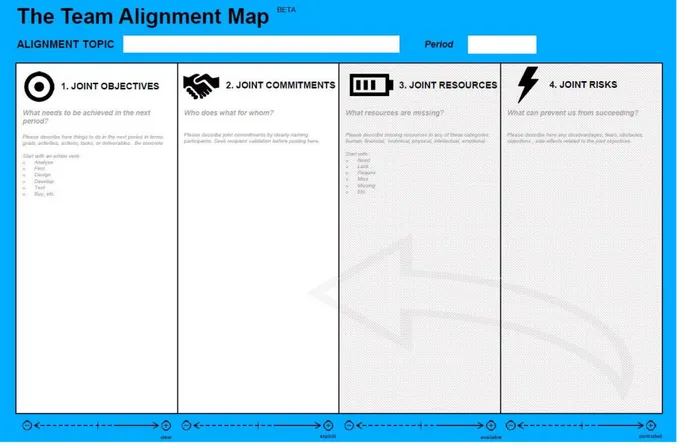
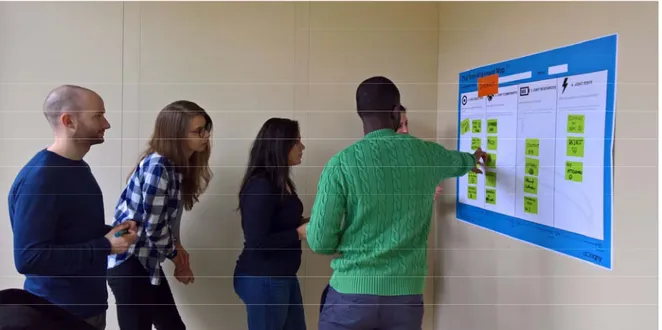
We instantiated our conceptual model into the Team Alignment Map (Figure 1): a collective tool that we developed to support team members when discussing and organizing their joint activity during innovation projects. It is in the form of a F4 World format print poster that is placed against a wall of the project meeting room (Figure 2). The Map contains four columns that depict the requirements of common ground according to Clark (1996). The standard and promoted use of the Team Alignment Map recommends that all participants to the joint project be present and follow a procedure that we drew from Dewey's joint inquiry.
Participants fill in the four columns of the map from the left to the right to define each requirement. Using sticky notes, participants write down how they consider the joint objectives of the joint project should answer the question: what are we supposed to achieve together? They then aggregate all their answers by presenting each sticky note in order to discuss, explore, and define the problem collectively. They negotiate the joint objectives and remove, amend, or add sticky notes as they see fit. They can thus proceed through trial-and-error and prototyping to explore and evaluate alternative solutions as they see fit. Once they agree on the joint objectives, they define the joint commitments answering the question: who is doing what for whom? Participants write what joint objectives they commit to individually. Every joint objective should correspond with at least one commitment. Again, participants discuss and negotiate the commitments as they see fit. They do so iteratively for the joint resources (what resources are we missing?) and the joint risks (what might prevent us from succeeding?).
Figure 2. The Team Alignment Map in use
We tested the usability and utility of the Team Alignment Map in two settings: a hospitality management school (HMS) and an innovation company (IC). Both contexts were chosen as they had contacted us to help them solve coordination problems for their innovation projects. In the HMS, 24 teams of 6 students were mandated and financially supported by external clients ranging from local businesses to international companies. Examples of projects include creating a new branding strategy, elaborating proofs of concept for new services, and developing business plans for new ventures. The innovation company (IC) is mandated by clients to support them in developing new business opportunities and redesign their organizations and business models. Our analysis includes 10 teams of 5 to 10 individuals working on four different projects. Examples of such
projects include developing new products, and testing and validating a new product for a competitive advantage.
Data collection and analysis
Qualitative data analysis is well-suited to analyze complex social processes and phenomena, and perform exploratory research as our research question calls for (Eisenhardt & Graebner 2007). Interview remained the chief source of data collection in agreement with Walsham's (1995: 78) observation that "it is through this method that the researcher can best access the interpretations that participants have regarding the actions and events which have or are taking place, and the views and aspirations of themselves and other participants". We evaluated the Team Alignment Map through semi-structured interviews with users from both cases. We analyzed whether the Team Alignment Map supported teams in coordinating effectively. For that, we inquired on two propositions drawn from the characteristics and challenges of innovation projects, as mentioned earlier: (Proposition 1) to what extent it supported individuals in creating shared understanding, (Proposition 2) increased the team's visibility of their future course of action (flexibility).
The data was analyzed using qualitative methods (Flick 2007; Yin 2013). We conducted thematic analysis (Fereday & Muir-Cochrane 2006) in which we both coded the data based on categories relating to the functions of the tool (e.g. support shared understanding, visual support). These categories served only as a foundation for the iterative process which involved going back and forth between the data and the categories. For the purpose of this study, we focused on the codes that pertained to shared understanding and flexibility.
4. Findings
In this section, we report excerpts from the main categories that emerged in our data analysis (Table 1). We chose excerpts from both cases but due to space constraints, we cannot outline all the supporting claims for our propositions and focus on the quotes that can be understood easily without contextual information.
For 33 out of 34 respondents, the Map supported their team in creating a shared understanding on the joint activity (Proposition 1). Shared understanding was supported by three functions of the tool: its ability to help team members clarify and make explicit the content of the four domains, it made thoughts tangible as they were written on sticky notes so that teams did not merely rely on mental representations, and the creation of shared expectations on the project often through social commitments to what they put on the sticky notes. The shared visualization of the Map improved the team members' ability to reach shared
understanding at the end of team meetings. Team members' understanding and intentions for future contributions were aligned.
Table 1. Propositions and excerpts from interviews
Proposition Functions of the
TAM Supporting excerpts P1: The Team Alignment Map supports individuals in creating shared understanding. Clarifies and makes explicit the four domains (joint objectives, joint
commitments, joint resources, joint risks)
"Basically, the way I looked at [the tool] was "here are our goals, here are our commitments, here are the resources and here are the risks" and just having an open conversation with the company and the team about each of those and making sure that we were all aligned on what those were." IC Team 1 "[The tool] helped us avoid misunderstandings. Without it, we would have had problems communicating effectively." HMS Team 18
Makes thoughts tangible
"I definitely like using the tool to make my way of thinking and my way of seeing the project explicit." IC Team 6
"It is easier to think about our activity when it is physically there." HMS Team 9
Creates shared expectations
"[The tool is] really helpful because we can get to a next level of clarity and expectations and, you know, does and don'ts and what makes sense and what doesn't make sense." IC Team 5
"I found it super helpful […] for everyone to be on the same page."
P2: The Team Alignment Map increases the team's visibility over their future course of action.
Allows for the team to adapt to changing situations
"Because we might find out later that something I committed to might be pointless or it's just a waste of time for me to even be doing it in the first place. But if I commit to it, I feel like I have to do it, you know? So I think that, that's where going back and revisiting it would be really really helpful." IC Team 2 "It was easy to see the full picture and realize that we needed to add this objective to that and change that one
commitment." HMS Team 8 Facilitates the
monitoring of progress
"Because what helps is the visual representation of having that discussion at the end of the workshop and it's a grounding force in order to say "okay where are we now compared to where we were when we started this workshop or when we first started this process? What has changed? What is the team alignment map looking like?" IC Team 3 "And that's cool cause you can go back to it at the end of the project and be like "alright, let's look at this" and you know, do we make it to what we want it to? What we originally set out to do?" IC Team 12
Also, 22 out of 34 respondents outlined the prototyping affordance of the tool (Proposition 2). Sticky notes could easily be removed, displaced, added to explore and evaluate alternative solutions. The shared visualization also helped team members monitor the progress they had made since the previous meeting and change their action plans accordingly. The Map thus addressed the need for flexibility on interpredictions that is required during innovation projects, as requirements and contingencies can change rapidly.
5. Conclusion
Our findings indicate that the Team Alignment Map supports team coordination during innovation projects by facilitating the creation of shared understanding between participants and allowing them to define and adapt their future course of action. Our study thus suggests that the design approach derived from Clark's (1996) and Dewey's (1927; 1929) theories provides an interesting approach to team coordination that is particularly well-suited for innovation projects. We conceive coordination as an activity in which the team constructs (designs) its joint activity collectively and iteratively. Participants try out and negotiate a variety of combinations of the four requirements, and agree on the one they see fit.
Our approach complements the dominant perspectives on coordination in two ways. Firstly, as outlined before, studies in the discursive approach have failed to provide concrete and actionable guidance on how teams should coordinate. Our approach structures the content (the four columns) and the process (forward and backward pass) of coordinative conversations. Secondly, the contingency approach is not suited for innovation projects, as requirements and situations change frequently, which leaves practitioners with a difficulty in constantly updating the match between new situations and the right coordination devices. Our approach supports flexible interpredictability through one main coordination device in the form of a physical coordination problem space (i.e., Team Alignment Map).
We suggest that further research is required to assess our findings, as our approach is nascent. Future studies should make use of direct observation of team meetings, as we mainly relied on interviews and thematic coding. Such observations could allow for the identification of conversational strategies and behaviors specific to the design approach of coordination. In general, we invite communication scholars to address coordination at the level of teams, as most developments focus on real-time and micro-level coordination (Zackrison, Seibold & Rice 2015). We believe that pragmatics can make a great contribution to the analysis of team conversations and the development of actionable and practical guidance that organizational and management scholars have had difficulties to provide.
BIBLIOGRAPHY
Avdiji, H., Missonier, S. & Mastrogiacomo, S. (2015): Understanding IS team coordination in real time: A process approach to coordination. Proceedings of the Thirty-Sixth International Conference on Information Systems.
Avdiji, H., Elikan, D., Missonier, S. & Pigneur, Y. (2018): Designing tools for collectively solving ill-structured problems. Proceedings of the 51st Hawaii International Conference on System
Sciences.
Badke-Schaub, P., Neumann, A., Lauche, K. & Mohammed, S. (2007): Mental models in design teams: A valid approach to performance in design collaboration?.CoDesign, 3(1), 5-20.
Bechky, B., Okhuysen, G. (2011): Expecting the unexpected? How SWAT officers and film crews handle surprises. Academy of Management Journal, 52(2), 239-261.
Bittner, E. & Leimeister J. (2014): Creating shared understanding in heterogeneous work groups: Why it matters and how to achieve it. Journal of Management Information Systems, 31(1), 111-143. Clark, H. (1996): Using language. Cambridge, MA (Cambridge University Press).
Clark, H., Brennan, S. (1991): Grounding in communication. Perspectives on social shared cognition, 127-149.
Dewey, J. (1927): The public and its problems. Denver, CO (Alan Swallow). Dewey, J. (1929): Experience and nature. La Salle, IL (Open Court).
Edmondson, A. & Harvey J.-F. (2017): Cross-boundary teaming for innovation: Integrating research on teams and knowledge in organizations. Human Resource Management Review, in press. Eisenhardt, K. & Graebner M. (2007): Theory building from cases: Opportunities and challenges.
Academy of Management Journal, 50(1), 25-32.
Espinosa, A., Lerch, J., Kraut, R. E., Salas, E. & Fiore, S. (2001): Explicit vs. implicit coordination mechanisms and tasks dependencies: One-size does not fit all. Team cognition: Understanding the factors that drive process and performance, 107-129.
Espinosa, J. A., Kraut, R., Slaughter, S., Lerch, J. & Herbsleb, J. (2002): Shared mental models, familiarity and coordination: A multi-method study of distributed software teams. Proceedings of the Twenty-Third International Conference on Information Systems, 425-433.
Fereday, J. & Muir-Cochrane, E. (2006): Demonstrating rigor using thematic analysis: A hybrid approach of inductive and deductive coding and theme development. International Journal of Qualitative Methods, 5(1), 93-104.
Flick, U. (2007). The Sage quality research kit. Los Angeles (SAGE Publications).
Fusaroli, R. & Tylén, K. (2012): Carving language for social coordination: A dynamic approach. Interactional studies, 12, 103-124.
Gardner, R. & Levy, M. (2010): The coordination of talk and action in the collaborative construction of a multimodal text. Journal of Pragmatics, 42(8), 189-203.
Henderson, R. & Clark, K. (1990): Architectural innovation: The reconfiguration of existing product technologies and the failure of established firms. Administrative Science Quarterly, 35(1), 9-30. Hevner, A., March, S., Park, J. & Ram, S. (2004): Design science in information systems research. MIS
Quarterly, 28(1), 75-105.
Klein, G., Feltovich, P. Bradshaw, J. & Woods, D. (2005): Common ground and coordination in joint activity. Organizational simulation, 139-184.
Kleinsmann, M. & Valkenburg, R. (2008): Barriers and enablers for creating shared understanding in co-design projects. Design Studies, 29(4), 369-386.
Kraut, R. & Streeter, L. (1995): Coordination in software development. Communications of the ACM, 38(3), 69-81.
Malone, T. & Crowston, K. (1990): What is coordination theory and how can it help design cooperative work systems? Proceedings of the 1990 ACM Conference on Computer-Supported Cooperative Work, 357-370.
March, J. & Simon, H. (1958): Organizations. New York (Wiley).
Minssen, H. (2006): Challenges of teamwork in production: Demands of communication. Organization Studies, 27(1), 103-124.
Niedderer, K. (2007): Designing mindful interaction: The category of performative object. Design Issues, 23(1), 3-17.
Okhuysen, G. & Bechky, B. (2009): Coordination in organizations: An integrative perspective. Academy of Management Annals, 3(1), 463-502.
Osterwalder, A. & Pigneur, Y. (2013): Designing business models and similar strategic objects: The contributions of IS. Journal of the Association for Information Systems, 14, 237-244.
Pearce, W. & Pearce, K. (2000): Extending the theory of coordinated management of meaning (CMM) through a community dialogue process. Communication Theory, 10, 405-423.
Rico, R., Sánchez-Manzanares, M., Gil, F. & Gibson, C. (2008): Team implicit coordination processes: A team knowledge-based approach. Academy of Management Review, 33(1), 163-184.
Sewell, G. (1998): The discipline of teams: The control of team-based industrial work through electronic and peer surveillance. Administrative Science Quarterly, 43(2), 397-428.
Sosa, M. Eppinger, S. & Rowles C. (2004): The misalignment of product architecture and organizational structure in complex product development. Management Science, 50(12), 1674-1689.
Steen, M. (2013): Co-design as a process of joint inquiry and imagination. Design Issues, 29(2), 16-28. Tannenbaum, S., Mathieu, J., Salas, E. & Cohen, D. (2012): Teams are changing: Are research and
practice evolving fast enough?. Industrial and Organizational Psychology, 5, 2-24.
Tylén, K., Philipsen, J. & Weed, E. (2009): Taking the language stance in a material world: a comprehension study. Pragmatics and Cognition, 17(3), 573-595.
Walsham, G. (1995): Interpretive case studies in IS research: Nature and method. European Journal of Information Systems, 4(2), 74-92.
Wittenbaum, G. M. & Staser, G. (1998): The reevaluation of information during group discussions. Group Processes & Intergroupe Relations, 1(1), 21-34.
Yin, R. (2013): Case study research: Design and Methods. Thousand Oaks (SAGE Publications). Zackrison, E., Seibold, D. & Rice, R. (2015): Organizational coordination and communication: A critical
review and integrative model. Annals of the International Communication Association, 39(1), 195-233.