RESEARCH OUTPUTS / RÉSULTATS DE RECHERCHE
Author(s) - Auteur(s) :
Publication date - Date de publication :
Permanent link - Permalien :
Rights / License - Licence de droit d’auteur :
Bibliothèque Universitaire Moretus Plantin
Institutional Repository - Research Portal
Dépôt Institutionnel - Portail de la Recherche
researchportal.unamur.be
University of Namur
Business-to-Business data sharing
Martens, Bertin; DE STREEL, Alexandre; Tombal, Thomas; Graef, Inge; Duch-Brown, Néstor
Publication date:
2020
Document Version
Publisher's PDF, also known as Version of record
Link to publication
Citation for pulished version (HARVARD):
Martens, B, DE STREEL, A, Tombal, T, Graef, I & Duch-Brown, N 2020, Business-to-Business data sharing: an
economic and legal analysis. European Commission, Seville.
General rights
Copyright and moral rights for the publications made accessible in the public portal are retained by the authors and/or other copyright owners and it is a condition of accessing publications that users recognise and abide by the legal requirements associated with these rights. • Users may download and print one copy of any publication from the public portal for the purpose of private study or research. • You may not further distribute the material or use it for any profit-making activity or commercial gain
• You may freely distribute the URL identifying the publication in the public portal ?
Take down policy
If you believe that this document breaches copyright please contact us providing details, and we will remove access to the work immediately and investigate your claim.
JRC Digital Economy Working Paper 2020-05
Business-to-Business data sharing:
An economic and legal analysis
Bertin Martens Alexandre de Streel Inge Graef Thomas Tombal Néstor Duch-Brown 2020
This publication is a Technical report by the Joint Research Centre (JRC), the European Commission’s science and knowledge service. It aims to provide evidence-based scientific support to the European policymaking process. The scientific output expressed does not imply a policy position of the European Commission. Neither the European Commission nor any person acting on behalf of the Commission is responsible for the use that might be made of this publication. For information on the methodology and quality underlying the data used in this publication for which the source is neither Eurostat nor other Commission services, users should contact the referenced source. The designations employed and the presentation of material on the maps do not imply the expression of any opinion whatsoever on the part of the European Union concerning the legal status of any country, territory, city or area or of its authorities, or concerning the delimitation of its frontiers or boundaries.
Contact information Name: Bertin Martens
Address: Inca Garcilaso 3, 41092 Seville (Spain) Email: [email protected]
EU Science Hub https://ec.europa.eu/jrc JRC121336
Seville: European Commission, 2020 © European Union, 2020
The reuse policy of the European Commission is implemented by the Commission Decision 2011/833/EU of 12 December 2011 on the reuse of Commission documents (OJ L 330, 14.12.2011, p. 39). Except otherwise noted, the reuse of this document is authorised under the Creative Commons Attribution 4.0 International (CC BY 4.0) licence (https://creativecommons.org/licenses/by/4.0/). This means that reuse is allowed provided appropriate credit is given and any changes are indicated. For any use or reproduction of photos or other material that is not owned by the EU, permission must be sought directly from the copyright holders.
All content © European Union, 2020.
How to cite this report: Bertin Martens, Alexandre de Streel, Inge Graef, Thomas Tombal, Néstor Duch-Brown, Business to business data sharing: an economic and legal analysis, Digital Economy Working Paper 2020-05, European Commission, Seville, 2020, JRC121336.
3
Contents
Executive summary ... 4
Introduction ... 10
1. The economic characteristics of data and data markets ... 12
1.1. The economic characteristics of data ... 12
1.2. The interaction between data collection, use and services markets ... 16
2. Private markets for B2B data sharing and market failures ... 19
2.1. Monopolistic data markets ... 19
(a) The substitution effect in secondary services markets ... 20
(b) Vertical integration ... 21
(c) The need for complementary inputs ... 22
(d) Economies of scope in data aggregation ... 23
2.2. Other causes of data market failures ... 25
(a) Externalities ... 25
(b) Incomplete contracts, risks, transaction costs and missing data markets... 25
(c) Asymmetric and imperfect information ... 27
3. Third-party intermediaries to reduce market failures ... 28
3.1. Reducing risk ... 29
3.2. Transaction costs and standardisation... 29
3.3. Internalisation and redistribution of externalities ... 32
3.4. The role of third-party intermediaries ... 33
4. Competition Law and Regulation to remedy market failures... 35
4.1. Ex post Competition enforcement ... 35
4.2. Ex ante regulation ... 38
(a) Data portability rights for the data subject ... 40
(b) Mandatory data access right for other parties ... 45
5. Conclusions ... 49
4
Executive summary
The European Commission announced in its Data Strategy (2020) its intentions to propose an enabling legislative framework for the governance of common European data spaces, to review and operationalise data portability, to prioritise standardisation activities and foster data interoperability and to clarify usage rights for co-generated IoT data. This Strategy starts from the premise that there is not enough data sharing and that much data remain locked up and are not available for innovative re-use. The Commission will also consider the adoption of a New Competition Tool as well as the adoption of ex ante regulation for large online gatekeeping platforms as part of the announced Digital Services Act Package1. In this context, the goal of this report is to
examine the obstacles to Business-to-Business (B2B) data sharing: what keeps businesses from sharing or trading more of their data with other businesses and what can be done about it? For this purpose, this report uses the well-known tools of legal and economic thinking about market failures.
The economic characteristics of data
A key economic characteristic of data is non-rivalry: many parties can use the same dataset for a variety of purposes without functional loss to the original data collector. Non-rivalry is the fundamental driver of economic welfare gains in data sharing or re-use: if one firm collects data that can be used for many purposes, society would benefit if other firms could access and use these data. An economic interpretation of non-rivalry revolves around economies of scope that occur when the same product is re-used for another purpose. A second source of economic efficiency gains in the use of data comes from economies of scope in data aggregation. When two datasets are complementary, more insights and economic value can be extracted from merging them, compared to keeping them in separate data silos. Economies of scope should be distinguished from economies of scale in data. Both contribute to improving the prediction accuracy of datasets.
Privacy and commercial confidentiality are important for the autonomy of private decision-making by firms and individuals and for extracting private value from these decisions. Hence, this points at the importance of exclusive data access and control. Data are not excludable by nature. They require technical and/or legal protection to create exclusive access for one party. From an economic perspective, data sellers should have exclusive control over their data. Uncontrolled access will drive prices down to the marginal cost of reproduction, often close to zero. Since the law provides few means for firms to assert exclusive control rights over data, firms often resort to de facto exclusivity by means of contractual or technical protection measures.
Data market failures
Data may have social value that exceeds their private value. Data collected from one group of persons may have predictive value for the behaviour of another group.
1 This paper does not prejudge the on-going debate on these policy tools. It is based on currently available information in the published Inception Impact Assessments for these policy instruments. No decisions have been taken by the European Commission on how they will ultimately look like.
5
Aggregated datasets may have more value than segmented sets. This implies an inherent market failure in exclusive private control over data and the need to find data governance arrangements that find a balance between sharing and exclusivity. While economies of scope in data re-use constitute an argument in favour of wider access and diffusion of data, economies of scope in aggregation underpin the economic benefits of data concentration in large pools. It constitutes an incentive for digital data firms to expand their activities to other data-related services markets and build conglomerates. It may strengthen their market power because it increases entry barriers for new firms and diminishes incentives for innovation. The impact of economies of scope in data aggregation on society is ambiguous. Policy makers need to trade off the social welfare from increased productivity and innovation against the anti-competitive market concentration forces at work.
Apart from the benefits there is also a cost to data sharing and re-use. Private firms may incur costs when they share data with parties that can harm their interests. They take data sharing decisions in function of the expected benefits and costs. The question for policy makers is whether these private data sharing incentives and decisions maximise the welfare of society as a whole. A market failure occurs when the private value of data remains below its social value. Bridging that gap may require policy intervention. Reducing the market power of data holders and facilitating more data sharing can be part of the solutions.
Thus, data sharing is not an objective in its own right. It is a means to achieve higher social welfare. Exclusively private data use may lead to underutilisation of data. Other parties could make good use of the data but have no access. Fully shared common data pools are subject to overutilization. When data are freely available to all, there is no incentive anymore to invest in data. Intermediate semi-commons data governance solutions are more likely to be optimal. Governance regimes, whether private or public, can be costly to manage however. Whether they are worth the cost depends on the added-value generated by the governance agreement.
While exclusive access and monopolistic market positions are necessary to extract value from data, they are frequently a source of market failure. Monopolistic data markets occur when a firm collects data for which there are no close substitutes. Whether the firm will allow re-use of the data, inside the firm or by another firm, depends on the relationship between the markets for primary and secondary use. (i) If the secondary use competes with the first use, for instance for the production of a very similar service, it may refuse re-use. (ii) If the secondary service is a complement or neutral with respect to the first, the firm has an incentive however to promote re-use, either in-house or by another firm. In the latter case it would result in data sharing. However, in practice, it is not always a priori clear whether data can be used to produce a complementary or a substitute service. This uncertainty may create obstacles for data sharing. Still, the monopolistic data firm can charge a monopoly price to access the data and apply price discrimination between re-users to maximise his profits. The firm may foreclose the market and have an exclusive deal with one firm to re-use the data, or buy up the other firm (vertical integration) to produce the second service in-house.
Besides monopolistic market positions, there are other causes of market failure. Coordination problems may be an obstacle to re-use. Re-use of the data for the production of another service may require complementary inputs that the data-holding firm does not have. It requires cooperation with another firm to procure such
6
complementary input. (i) If the latter is available in a competitive market there is no problem. (ii) If both the data and the complementary inputs are sold by monopolistic firms, an anti-commons coordination problem occurs that requires negotiations between the two parties. This may reduce data sharing. Unequal bargaining power between the parties may facilitate data sharing but generate equity concerns. Third party intermediaries may help to overcome coordination obstacles. If the complementary input is another monopolistic dataset, economies of scope in data aggregation may occur if the two monopolistic firms agree on data sharing conditions.
High transaction costs in concluding data sharing agreement may be another obstacle. Indeed, data sharing contracts are necessarily incomplete and can lead to privacy and security risks and unforeseen outcomes between the contracting parties or with third parties. In the absence of ownership rights on data, bilateral data contracts cannot be enforced against third parties. Data may spill into the public domain or end up in the hands of parties that can cause harm to the original data holder. Such externalities result in misalignment of incentives between data collectors and re-users.
Imperfect and asymmetric information between individuals or small firms and large data collectors, which are almost natural states in a data-abundant digital world, distort efficient decision making. Re-allocation of data access rights may affect market outcomes. Externalities may reduce the value of data protection. Data collected on the behaviour of one set of agents has predictive value for the behaviour of others. This reduces the marginal value of a single person’s or firm’s dataset and diminishes incentives for privacy protection.
Market-based solutions for data sharing
Solving market failures does not always require mandatory behaviours. Third-parties may act as intermediaries and apply new technologies and ways of organising markets in order to overcome market failures and enable transactions that were previously not feasible. They can be private, public or community organisations that are neutral with respect to data uses or they can be active stakeholder in the added-value generated by the data. The European Commission’s Data Strategy (2020) calls them “common data spaces”. From an economic perspective, they can reduce ex-ante transaction costs and ex-post contractual risks, overcome coordination problems, act as commitment devices and facilitate self-regulation between private agents, and set interoperability standards. Risk reduction is required when none of the participants in a data pool wants other parties to have access to their primary data but still wants to benefit from the value of the pooled data. Data trusts and industrial data platforms fit this profile. The intermediary should be neutral and have no stake in the data or the outcomes of the analysis. Overcoming pre-contractual transaction costs requires a more active intermediary who has a stake in reaching B2B data deals between providers and re-users but has no stake in the contents of the data transfer. Third-party operated B2B data sharing platforms may be more successful in closed groups with known participants than in open-ended groups of users. Re-use may have negative externality effects on the data supplier, or they may miss opportunities.
Intermediary platforms may also reduce transaction costs because they can contribute to standardisation and interoperability of the datasets that are exchanged. Voluntary standard setting works when the participants have an incentive to contribute to a standard. Standards may fail to emerge when stakeholders have conflicting interests.
7
The absence of standards may also create entrepreneurial opportunities for firms that offer private solutions to overcome data market fragmentation and interoperability problems. Strong intermediary market players may impose market-driven standards. Data holders and re-users may not be able to reach an agreement when they fail to capture (and monetise) the gains from data sharing or do not agree on the distribution of the gains. Third-party intermediaries may help to overcome these hurdles by offering a business model that can capture and monetise the externalities, and by setting up a redistribution mechanism. These intermediaries usually become non-neutral and more active third parties that have a stake in the value of the pooled data. They may put data input providers in a weak bargaining position because they cannot realise the economies of scope from data aggregation on their own. In some cases, the benefits of data pooling constitute non-excludable public goods, for example pooling of health data to improve public health services. This positive externality is difficult to monetise for an individual health service provider who therefore has no financial incentive to participate in a health data pool. Government intervention may be required to overcome this market failure.
Compulsory data portability and access to increase data sharing
When market-based solution, possible nudged by the State, do not solve market failures, a more active intervention from the State imposing data portability and access may needed provided the risks of regulatory failures are limited. Such intervention may take place ex-post with competition law or ex-ante with regulation.
Ex-post competition enforcement: If data market failures occur only occasionally, competition authorities may be well-placed to address the problem ex-post and on a case-by-case basis. There are two possible scenarios: mandating access to data where a dominant firm refuses to do so and correcting discriminatory prices or unfair conditions for access to data held by a dominant firm.
First, the so-called essential facilities doctrine is relevant in the case of refusal of access to data as a form of abuse of dominance under Article 102 TFEU. There are some restrictions however. A first condition is that the data should be indispensable for the production of the alternative service. However, in some cases non-rivalry and wide availability of close substitute data may render a dataset non-indispensable. Second, access to data for the purpose of producing a service in a market where the dominant firm is not yet active itself, falls outside the scope of the essential facilities doctrine as currently interpreted in decisions and case law. Yet, these are precisely the scenarios that are to be expected in data markets. It may be necessary to adapt these conditions to the characteristics of data to enable effective enforcement of data access under competition law.
Second, market failures may also originate when a dominant firm gives access to data. Self-preferential access to data may distort downstream services markets. Data pricing conditions may be unfair and require redress, for instance through the intervention of a neutral third-party intermediary who decides on a fair price. Unfair price discrimination may increase social welfare but raise equity concerns in society.
Once a case has clarified the circumstances under which a refusal to share data amounts to abuse under Article 102 TFEU, this may set a precedent to which market players in other sectors adapt their behaviour as well. However, competition interventions take
8
time and the harm may be done before the case can be resolved. This is especially true in “winner takes all” markets, where it becomes difficult to contest the incumbent’s position once the market has tipped in its favour. Moreover, the design and the monitoring of data access remedies are very complex and require an effective governance framework. Thus, legislators may decide to set up ex ante regulation for data sharing.
Hybrid and ex-ante regulatory intervention: When market failures occur on a wider scale and on a regular basis, it might be necessary for legislators to set ex-ante mandatory rules that reduce the exclusive control of data holders. The envisaged New Competition Tool would enable a hybrid form of intervention (a mix between ex post competition enforcement and ex ante regulation), allowing competition authorities to impose remedies, including data access remedies, to address structural competition problems in a market without the need to establish a violation of the competition rules. The envisaged regulatory instrument for large online gatekeeper platforms would enable ex ante regulatory intervention in data markets. Legislators can impose obligations on data holders and assign legally binding access rights to stakeholders in the data market, ranging from full and exclusive ownership rights to data, to more specific and limited rights, such as access and portability rights. The choice of the parties to which these specific rights are allocated affects economic outcomes, both in upstream data markets and in downstream services markets.
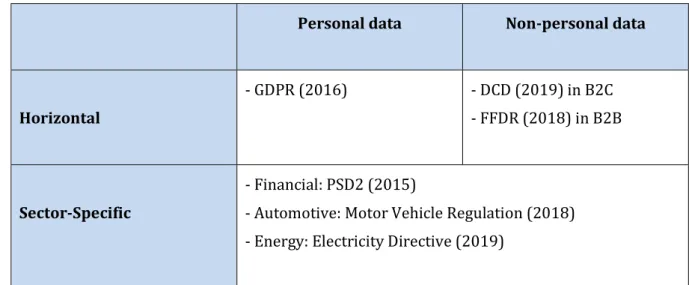
The EU already has several legislations in place. The EU GDPR allocates specific rights to personal data subjects. There are no legally defined rights for non-personal data. The Database Directive, the Platform-to-Business Regulation, the Free-Flow of Data Regulation, may play a role in B2B data sharing. Consumer law, in particular the Digital Content Directive also plays an increasingly important role in allocating data rights to consumers. Besides the horizontal regulatory tools, there are sector-specific tools such as the Second Payment Services Directive, the Motor Vehicle Regulation and the Electricity Directive that affect data sharing in these sectors.
There are two basic scenarios. (i) When data originators have strong incentives to share data with alternative service providers, legislators may grant portability rights to the data originator to access and transfer data collected by a data holder. (ii) When data originators have no strong incentives, regulators can grant specific data access rights directly to data seekers.
With regard the first scenario, portability rights exist only for personal data under Article 20 of the GDPR. The data subject has an inalienable right to ask the data processor to retrieve his personal data or to transfer them to a third party. This creates a roundabout B2C2B channel to overcome obstacles to direct B2B data sharing in the case of personal data. It can be seen as a tool to facilitate switching and competition, and as a fundamental right to empower the data subject at the same time. However, there are limitations. It applies only to personal data actively provided or observed by the data subject. Data inferred or derived by the data controller are not covered by portability rights though they can constitute valuable personal data. Moreover, portability is not (yet) sufficiently operational. It defines minimal interoperability requirements but was not designed for real time access and process interoperability. It is difficult to apply in B2B data sharing settings where time is a critical factor. Additional interventions where the necessary infrastructure and interoperability requirements are mandated would be necessary to achieve real-time access.
9
There are no legal provisions for portability for non-personal machine data in IoT settings. There is no law that establishes an unequivocal legal link between the machine or party that collects the data and the party that would have the right to access the data. Machine data are often co-generated; several parties can claim access rights. The idea to introduce data ownership rights for non-personal data as a way to establish exclusive rights has somewhat faded and is now replaced by access rights. However, re-labelling the problem does not change the nature of the issue: how to identify the parties that could claim control and access rights among several claimants. The allocation of rights that maximises social welfare may be perceived as unfair and raise equity concerns for disadvantaged parties.
Portability has several economic effects. It may increase the volume of B2B data sharing and reduce the market power of a data holder. Re-users that want to collect data via portability incur costs to incentivise portability rights holders to initiate a data porting request with their data holder. As a result, economies of scope in data aggregation are often weaker for re-users than for the original data holder. That may reduce the efficiency of re-use-based services and put them at a competitive disadvantage compared to the original data holder. Conversely, data portability may strengthen economies of scope in data aggregation when a major market player manages to leverage portability rights to collect data from smaller and fragmented service providers and aggregate them in a larger data pool that generates efficiencies in service production compared to the original holders of fragmented datasets. In such cases data aggregation may lead to increased market concentration and efficiency losses because of reduced competition.
With regard the second scenario, B2B data access differs from portability because the data originator or holder has no role to play in the data sharing decisions. Sharing can be initiated by a designated access rights holder. The problem is to identify these rights holders in complex machine data and IoT settings with several stakeholders. For non-personal machine-generated data there is not always an obvious “natural” party that can claim data access rights. The machine manufacturer is in a privileged position to design the machine in such a way that he has exclusive control over the data. In that case, it may be better to shift access rights away from machine owners/operators and data originators and assign them directly to specific groups of data re-users.
This raises questions about the decision criteria to grant such rights. Maximizing social welfare for society as a whole, and the failure of the market to do so, is a good starting point. For example, when data pooling is unlikely to be produced by the market because data holders have no incentives to contribute to this pool unless they can directly benefit from the insights and services produced by the pooled data. Yet, there may be winners and losers from data pooling. This complicates social welfare considerations with static equity and welfare-redistribution questions and with dynamic innovation questions.
10
Introduction
The digital transformation generates ever larger volumes of data. Data are not only collected, they are also shared and traded between parties. As shown by Everis (2018) and IDC and Lisbon Council (2019), markets for data are growing rapidly in many domains, from advertising to financial markets, maps and navigation services and many other applications. The potential benefits of data sharing and re-use in many applications are acknowledged (Ctrl-Shift, 2018; Fingleton and ODI, 2019; Kramer, Schnurr and Broughton-Micova, 2020; OECD, 2015 and 2019). Firms are encouraged to engage in data sharing, making their data available to other users. Yet, while data sharing can stimulate innovation and ensure a level playing field in competition between firms, it can also entail commercial risks and might weaken firms’ incentives to collect data. Finding an appropriate balance between opening access to data and keeping them private for firms and individuals is one of the most important and complex tasks for modern digital societies (Palfrey and Grasser, 2012). Data sharing is not a policy objective in itself but a tool to promote economic and social welfare for societies.
The European Commission’s Data Strategy (2020, p 7) starts from the premise that there is not enough data sharing and much data remain locked up and are not available for innovative re-use. It identifies several obstacles to data sharing, including legal fragmentation between EU member states, lack of trust and imbalances in market power between businesses, lack of data interoperability and common storage spaces, and tools for empowering individuals to exercise their data rights. The Strategy seeks to promote business-to-business (B2B) and business-to-government (B2G) data sharing with a wide range of legislative and other initiatives, including standards to promote interoperability, the creation of data pools, improving portability rights and even changes in competition tools with respect to data. It acknowledges the need to protect and empower individuals and firms to exercise their data rights.
The purpose of this report is to inform the Data Strategy with an examination of the causes of obstacles to data sharing. What keeps businesses from sharing or trading more of their data with other businesses or governments? For this purpose, this report uses the well-known tools of legal and economic thinking about market failures. Data markets, and related data-driven services markets, fail when they underperform and do not produce the social welfare for all that they could potentially produce because the behaviour and incentives of private operators locks markets into an inefficient situation. According to the European Commission Better Regulation Guidelines (2017b), public policy intervention may be justified when there are market failures, regulatory failures, equity concerns or behavioural biases that result in inefficient outcomes that are not in the public interest and hold back the overall welfare of society. Policy interventions can take various forms, including the use of competition enforcement tools to create a level playing field in data-driven markets and regulatory initiatives that facilitate data sharing, or make it mandatory.
Of course, there might be other justifications for intervention in data markets than market failures. Data interventions can be justified from a fundamental rights perspective, as in the case of rights for data subjects in the EU General Data Protection Regulation (GDPR). As we focus on B2B data sharing, we are dealing either with non-personal data or anonymized non-personal data, or data subjects have given their consent for
11
further sharing. While consented data retain some inalienable fundamental rights characteristics, non-personal machine data have no fundamental rights attached. Market failures and fundamental rights can however interact. For example, the Data Strategy mentions the promotion of user empowerment and self-determination by means of personal data portability, a personal data right defined in the GDPR. The portability right can affect market outcomes, as we will argue in this report.
This paper is structured as follows. Section 1 discusses the specific economic characteristics of data that make data sharing an attractive economic proposition. We also discuss the interaction between data markets and markets for ordinary goods and services. Section 2 explores different causes of data market failures in B2B data interactions between two or more firms. Section 3 examines how some types of data market failures may be overcome with third-party intermediaries, data pooling and other technological solutions. Section 4 shifts to data market failures that require government intervention by means of competition instruments and regulatory policy. Finally, Section 5 summarises the findings and suggests some ways forwards for policy makers to decide on the most appropriate actions to take, depending on the type and source of market failures in data markets and data-driven services markets.
12
1. The economic characteristics of data and data markets
1.1. The economic characteristics of data
Before we dive into data markets and sharing, it is important to explain a few key economic characteristics of data that set them apart from ordinary goods and services. A crucial economic characteristic of data is non-rivalry2: many parties can use the
same dataset for a variety of purposes without functional loss to the original data collector (OECD, 2016; Jones and Tonetti, 2019). Rival goods can only be used by one party at the time. For example, a car is a rival physical good and can only be used by one driver at the time. If a car would be non-rival, all drivers could use the same car at the same time to drive to different destinations. The welfare gains would be enormous: it would suffice to invest in the production of a single car to cater to the needs of all drivers. Non-rivalry is the fundamental driver of economic welfare gains in data sharing or re-use: if one firm collects data that can be used for many purposes3, society would
benefit if other firms could access and use these data. It would result in cost savings for society (no need to re-collect the same data by other means, even if feasible). It would enable the production of new and innovative data services that the original data collector had not envisaged. The primary data collection effort is a sunk cost that can be amortised across a large number of uses, rather than remaining confined to a single user.
An economic interpretation of the benefits of non-rivalry at the firm level revolves around the concept of economies of scope that occur in joint production and (re-)use of the same product or asset to produce several outputs (Teece, 1980, 1982; Panzar and Willig, 1981). For example, a car manufacturer can re-use the same chassis and engines to produce different car models. In this case the advantages of re-use pertain to the fixed cost of creating the design for a chassis or engine. Re-use of the same non-rival design entails zero marginal re-design costs. However, there is a positive marginal cost for the production of additional rival chassis and engines. More generally, non-rival immaterial products, such as proprietary knowledge and digital data, have quasi-zero marginal re-use costs because it does not involve re-producing a physical good, only copying an electronic data file.
Besides re-use, there is a second source of economic efficiency gains in the use of data: economies of scope in data aggregation. When two datasets are complementary, more insights and economic value can be extracted from merging them, compared to keeping them in separate data silos. This insight can be traced to the economics of learning and division of labour. Rosen (1983) observed that when a person has a choice between learning two skills, specialisation in one skill is always beneficial when the costs of learning both skills are entirely separable. However, when learning costs are not separable and learning one skill decreases the cost of learning another, then there are
2 Kramer, Senellart and De Streel (2020) distinguish between the non-rival nature of data and rivalry in the means of data collection because key data-collecting services (such as search, or social networking) are highly concentrated around a few firms. These data are not ubiquitously available. Both perceptions provide economic arguments for data sharing.
3 To the extent that a single dataset can be used for several purposes, data could be considered as a general-purpose
technology. However, this re-purposing may not reach the same degree of pervasiveness and cross-sectoral applications as envisaged by Bresnahan and Trajtenberg (1995).
13
economies of scope in learning both skills, provided that the benefits from interaction exceed the additional learning costs. Similarly, when two datasets are complementary and not entirely separable, applying data analytics (i.e., learning techniques) to the merged set will yield more insights and be more productive than applying it to each set separately, especially when the marginal cost of applying analytics to an extended dataset is small. For example, a targeted advertising service is likely to become more efficient in terms of click-through rates and revenue when it has access to consumer data that combine a variety of sources including web browsing, financial transaction data, mobility data and social media messages. Targeted advertising strategies can be derived from each of these datasets separately but the combined dataset will yield more insights into consumer preferences.
The benefits of economies of scope in data sharing and re-use by other firms may also have a cost side. Palfrey and Grasser (2012) warned that all digital data can, in principle, be made interoperable and shareable to the benefit of society. However, firms and persons may also suffer from sharing. Neither firms nor individuals want their private data to be widely available. Privacy and commercial confidentiality are important for the autonomy of private decision-making and for extracting private value from these decisions. While non-rival data can be shared without functional losses, sharing may entail economic losses for the original data holder. Firms and persons will trade off the benefits they expect to receive from sharing (trading) their data against the costs they may incur from doing so. Benefits will stimulate private markets for data sharing while costs will put a limit on data transactions.
The question for policy makers is whether these private markets maximise the joint social welfare of data originators, holders and users. If not, then there is a market failure that may require policy intervention. Policy intervention should not seek to maximize data sharing because data sharing is not an objective in its own right. It is a means to achieve higher social welfare in society. From a market failure perspective, policy makers should only intervene when the market is not delivering a social welfare-maximizing volume of data sharing, considering both the costs and benefits of data sharing.
Economies of scope should be distinguished from economies of scale in data.4 A useful
way to illustrate this is to consider a dataset as a two-dimensional spreadsheet, with the number of columns representing the number of variables and the number of rows the number of observations on these variables. Statistical analysis can be applied to the dataset, for example to use them for prediction purposes. Economies of scale refer to increased prediction accuracy due to an increase in the number of rows. Economies of scope refer to increased prediction accuracy due to an increase in the number of columns or explanatory variables. Adding more columns (variables) is not helpful when they are highly correlated or when they are not related at all.
Ordinary goods are excludable by nature. If one person has it, another cannot have it at the same time. Data are not excludable by nature because they are non-rival. Two persons can have the same data at the same time. In order to sell data, a data holder must have exclusive control of the data. If more parties hold the same dataset,
14
competition will drive prices down to their marginal cost of reproduction, often close to zero. Excludability can be achieved by technical means. The de facto data holder can apply technical protection measures to ensure his exclusive control and access to the data. Excludability can also be achieved by legal means. The data holder can negotiate a bilateral contract with a buyer or user that specifies data access and use conditions. Contracts can be enforced in courts. In some cases, the law grants erga omnes exclusive rights. For example, the EU General Data Protection Regulation (GDPR)5 grants natural
persons some exclusive rights to their personal data. The EU Database Directive6 grants
a conditional sui generis right to makers of databases. These exclusive rights strengthen the economic position of the rights holders in data markets – very similar to the position of IP rights holders in patent and copyright markets. The law can also grant a set of defensive rights, notably if data can be considered as “trade secrets”, as defined in the EU Trade Secrets Directive7.
Data are usually not a final consumer product. They are an intermediary input into the production of a service. For example, unless they are aviation aficionados, consumers do not search for flight schedules on Google or Skyscanner because they enjoy looking at these schedules but because they want to buy an air transport service. Consequently, data sharing implies a relationship between an upstream data holder and a downstream data-driven service producer who trade or share data between them – unless the two roles are combined in a single firm.
Data sharing is a label that may cover different economic modalities: sharing for free, trading for a monetary compensation or in exchange for other data, direct sharing of a dataset or indirect sharing of a data-based service only. The latter implies that there is no exchange of data between two parties; there is only an exchange of a service based on data. For example, online advertising platforms like Google do not deliver detailed consumer data to the advertiser but only an advertising service, based on broad targeting criteria. Data have no value on their own. They only become valuable to the extent that parties can use them to leverage their position in data-driven services markets.
A peculiar characteristic of data is their social value. Economies of scope in aggregation are a first source of social dimension value. Two owners of separate but complementary datasets can only achieve a higher value from their data if they collaborate and pool the two sets. A second source of social value comes from economies of scale. Once a sufficiently large sample of behavioural observations has been compiled to produce robust predictions, that can be used to predict the behaviour of agents outside the sample8. These social externalities imply an inherent market failure in exclusive private
control over data. The party that does provide the data is not necessarily the party that is affected by their use. The de facto exclusive data holder is not necessarily the party that maximizes benefits from the data. An intermediary agent may be required to realize
5 Regulation 2016/679 of the European Parliament and of the Council of 27 April 2016 on the protection of natural
persons with regard to the processing of personal data and on the free movement of such data (General Data Protection Regulation) [2016] OJ L 119/1.
6 Directive 96/9 of the European Parliament and of the Council of 11 March 1996 on the legal protection of databases
[1996] OJ L 77/20.
7 Directive 2016/943 of the European Parliament and of the Council of 8 June 2016 on the protection of undisclosed
know-how and business information (trade secrets) against their unlawful acquisition, use and disclosure [2016] OJ L 157/1.
15
the social externalities from data pooling and turn them into benefits that pay for the coordination costs and incentivise individuals to participate in the pool.
The social value of data brings us to online digital platforms as intermediaries that can realize the benefits from economies of scale and scope in data aggregation. Data played no role in the first generation of economic models of platforms or multi-sided markets9 that were extension of the economics of infrastructure networks. Recent
platform models have broadened the definition of platforms to firms that bring economic agents together and actively promote social externalities between them10. They focus on
data-driven network effects in platforms that increase the social value of data11. For
example, platforms can create a searchable catalogue of products or a directory of users as a first step in generating that social value. For more efficient matching in complex search engines, platforms collect detailed data on buyer preferences and product characteristics. For example, Netflix can improve its film title search engine when it learns more about user preferences and film characteristics12. Platforms are in a unique
position as third-party data aggregators to realize economies of scale and scope in data aggregation across many users. Individual users cannot realize these social benefits on their own.
The social value of data raises the question which welfare measure should we use to assess if there is a gap between private and social welfare? The mainstream view in competition law is to use consumer welfare as the reference point.13 Overall however,
economics normally uses a wider social welfare measure that comprises of consumer and producer welfare, or the combined welfare of all stakeholder groups in society. Some competition lawyers would accept this wider view. These two measures can easily lead to contradictory conclusions, for example when price discrimination shifts consumer surplus to producers or between consumer groups. Social welfare measures also have their problems14. Classic economics rejects the comparison of welfare gains and losses
between groups or individuals because consumer welfare is assumed not to be quantifiable. Alternative approaches accept quantification but open the door to measures of welfare improvement whereby some parties gain and others lose15. This raises equity
concerns.
Another discrepancy in welfare measures may occur when we compare static competition scenarios with a dynamic innovation scenario. Static scenarios examine the welfare and re-distribution effects of a given market structure and pricing strategy, for a given technology. Dynamic scenarios include the impact of future
9 Caillaud and Jullien (2003); Parker and Van Alstyne (2005); Rochet and Tirole (2003); Rochet and Tirole (2006). 10 Franck and Peitz (2019). This definition does avoid the problem of setting a minimum number of market sides; one
is enough.
11 Data-driven network effects were first analysed by Prüfer and Schotmüller (2017). 12 Iansati and Lakhani (2020: ch. 6).
13 See Motta (2004).
14 The notion of social welfare can of course be stretched beyond traditional market failures in economics and include
broader societal issues such as equity and income distribution, the protection of vulnerable groups and minorities, and the protection of cultures and political systems. For example, the protection of liberal democracies against fake news and online disinformation or the right to self-determination of citizens in the presence of artificial intelligence.
15 Economics distinguishes between strictly Pareto-improving welfare measures whereby no agent loses welfare. A
less stringent welfare improvement criterion is the Kaldor-Hicks criterion whereby agents that lose some welfare could by hypothetically compensated by the gains that other agents make. It does not imply that the compensation payments will actually be made.
16
innovations on the longer-term welfare of citizens. This is especially important when re-use and aggregation of datasets can trigger significant innovations.
1.2. The interaction between data collection, use and services markets
Competition lawyers and economists always ask: what is the relevant market? Since data derive their value from use in services markets, we have to look at least at two markets: data collection and use markets. Firms collect data in a primary market. Data originators require incentives in order to share their data with a collecting firm. That firm stores and processes the data for onward direct or indirect sales to data-using firms in a secondary market. That, in turn, will affect dynamics in data-driven services markets16.
These markets interact. The willingness of data originators to share data with collectors will not only depend on sharing conditions in the primary market but also on subsequent use of the data by the collecting firm in the secondary market. For example, the willingness of consumers to share their data with a website will depend on the quality of services offered by that website to the consumer as well as on how the website will subsequently use the data for advertising or other purposes.
Some recent data economics papers have started to look at this two-sided dimension of data markets. Jones and Tonetti (2019) use a theoretical macro-economic growth model to illustrate the social welfare gains from data sharing. Firms use data to increase the efficiency of production and, because of non-rivalry in the use of data, to increase the variety of goods and services in the economy. Access to a larger data pool will boost the productivity of firms and the number of innovations17, and thereby
contribute to economic growth and consumer welfare. However, individuals may reduce the amount of data that they share because of privacy concerns. Similarly, firms consider the impact of sharing their data on competition and innovation – the emergence of close substitute products – in their markets. Data hoarding increases the private welfare of persons and firms but slows down innovation and economic growth.
Jones and Tonetti (2019) consider several policy scenarios: the optimal degree of sharing determined by a benevolent social planner, private sharing decisions by persons and firms that get ownership or control rights over secondary use of their data in order to alleviate their concerns, and completely outlawing data sharing. (i) If firms own the decision rights they will be more willing to selectively share the data they hold. However, the volume of data they receive from consumers is substantially diminished because consumers fear for their privacy since they have no rights to control the use of their personal data in this scenario. (ii) If consumers have control rights they share a larger volume of data because they feel more in control. This boosts economic growth. They show that allocating data control rights to private persons is superior to allocating these rights to firms that trade data.
16 Of course, there can be vertical integration between these markets. A firm may collect consumer data as a
by-product of its ordinary transactions and use the data in another service market in which it is active.
17 This is an endogenous growth model. Product variety is the result of increased growth and investment that follow
in the wake of data availability. It is not directly the result of increased data availability and the innovation that this might produce.
17
Acemoglu et al (2019) argue that externalities in personal data collection create a market failure and diminish the value of personal data in the primary market. In the age of artificial intelligence and machine learning, data collected on the behaviour of one set of consumers has predictive value for the behaviour of other consumers (Agarwal et al., 2018). This is essentially an “economies of scope in data aggregation” argument. Once a firm has accumulated a critical mass of consumer data, the additional insights obtained from adding another consumer’s personal data are small, compared to what can be learned from data already collected about persons with a similar profile. This reduces the marginal value of a single person’s dataset and diminishes incentives for consumers to protect their privacy. That, in turn, increases the supply and decreases the market value of personal data.
This could explain the privacy paradox (Acquisti et al, 2016): consumers value their privacy but do not invest in protecting it because they understand the low value-added of their personal data and the futility of these efforts in the presence of strong spill-overs from other consumers’ data. Consumers may not be that sophisticated in their thinking and still invest in privacy protection. However, that investment in itself may have a signal value that can be exploited against their interests (Dengler and Prüfer, 2018). Moreover, re-use of personal data has ambiguous effects on consumer welfare. It can increase personal welfare when the data are re-used, for example, by search engines to reduce search costs and provide better search results that are more in line with consumer preferences. It may reduce welfare when data are re-used for targeted advertising that aims to be more persuasive than informative and drives consumers away from their original preferences.
While none of these papers presents a two-sided or multi-sided market model for data, the multi-sided nature of data markets is implicitly or explicitly present in all these models. We therefore conclude from these papers that conditions in the primary data collection market have an important effect on the availability of data in the secondary market for data re-use, and on data-driven services markets. Conversely, re-use conditions will affect the operations of the primary data collection market. Data re-use in the secondary firm-to-firm or business-to-business (B2B) market can therefore not be considered in isolation from the primary market. The above-discussed papers focus on the allocation of data ownership and control rights to firms and natural persons. However, in practice, there are no legal ownership rights on data18, in the EU or elsewhere (Duch-Brown et al., 2017). The EU GDPR
grants natural persons some inalienable control rights over their personal data. However, it does not recognize tradable ownership rights in personal data19 because data
protection is a non-alienable human right. This sparked a debate on the need to introduce such ownership rights, at least for non-personal data (European Commission, 2017a). This idea has gained very little policy traction so far, mainly because of complications regarding the allocation of such rights. Should data originators, collectors or processors have such rights? Recent policy reports have shifted the debate to access
18 Apart from a limited ownership right on databases, recognised in the EU Database Directive. In addition, data can be
protected by copyright and/or as a trade secret if it meets the relevant conditions.
19 Though the EU Digital Services Content Directive has taken some steps towards recognizing that personal data can
be tradable: Directive 2019/770 of the European Parliament and of the Council of 20 May 2019 on certain aspects concerning contracts for the supply of digital content and digital services [2019] OJ L 136/1.
18
rights to existing datasets (European Commission 2018a; Drexl, 2018). However, the focus on access rights does not fundamentally change the debate. The question still remains who should have such rights, and under what conditions?
The EU GDPR allocates personal data rights to the data subject, a natural person who is the source of the data. In the case of non-personal machine data generated in industrial processes where many parties intervene, the allocation of rights is not self-evident and may trigger substantial shifts in added value in the production process. In Internet-of-things settings, machine data often end up under the de facto exclusive control of one party because sensors and machines are designed to achieve that outcome.
In the next section, we explore these questions from the perspective of market failures as a benchmark for possible intervention in private data markets.
19
2. Private markets for B2B data sharing and market failures
In this section we focus on B2B data sharing or the market for data re-use and aggregation.20 We consider the primary data collection market as exogenous and
examine possible market failures in the secondary B2B market that might justify a policy intervention. A number of recent competition and data policy reports (Crémer et al, 2019; Furman et al, 2019; Scott-Morton et al, 2019) discuss market failure in secondary data markets from the perspective of monopolistic behaviour and competition policy. Most of that debate is situated in the context of very large online platforms having a strong position in data markets and related data-driven services markets. They may leverage data-driven network effects (Prüfer and Schottmüller, 2017) and economies of scope in re-use to strengthen their position in adjacent markets or exclude others from entering the market. Here we will also start from monopolistic data markets and competition-related market failures (Section 2.1). However, we expand the debate and look at other causes of market failures too including externalities, lack of incentives for the production of non-excludable (public) goods, missing markets, and imperfect and asymmetric information (Section 2.2).
2.1. Monopolistic data markets
We start from the perspective of a private firm (Firm 1) that collects a relatively scarce dataset (D1) for which there are no close substitutes. The firm consequently benefits from a monopolistic market position. We assume that Firm 1 uses D1 for the production of a service S1 so that the production of D1 and S1 are vertically integrated21. D1 may be
collected independently of S1, or it may be a by-product of producing S1. For instance, consumer data collected while providing an e-commerce or social media service22. We
assume that D1 can be re-used to produce another service S2 by Firm 1 or by another Firm 2 (economies of scope in re-use), or a service S3 that requires aggregation of D1 with another dataset D2 owned by Firm 2 (economies of scope in aggregation). In order for society to realize the social welfare gains from the potential economies of scope that D1 could generate, S2 has to be produced by either Firm 1 or Firm 2, and the production of S3 requires coordination or collective action between Firm 1 and Firm 2.
We examine the obstacles that might impede the realization of these economies of scope. We start from the incentives that Firm 1 faces to maximize profits from D1, in three steps:
20 See also tow studies done for the European Commission on issues raised in practice by data sharing: Deloitte et al.
(2018) and VVA (2017).
21 D1 and S1 can also be carried out by two firms. That does not fundamentally change the reasoning in this section. 22 The "by-product" assumption is often invoked to justify open and free access to Firm 1's dataset D1 (OECD, 2016;
European Commission, 2018), the argument being that it would not have any negative economic impact on F1; sales revenue of S1 would continue. This assumption ignores that F1 would no longer have revenue from selling D1 to other firms. It also ignores that D1 sales revenue may have an incentive effect on collecting more data, for instance by lowering the price of S1, especially in a two-sided market setting. Access to D1 by other firms may reveal F1's commercial strategies that could be used by other firms to leverage their market share in S1. It assumes that costs are separable and identifiable for main and by-products. This is not necessarily the case. Granting mandatory free access rights to D1 eliminates F1's data monopoly rent and dissipates it towards downstream data users. This is sometimes justified as a measure to promote data-driven innovation. It re-allocates rents from static monopolistic equilibrium to dynamic innovation equilibrium.
20
The impact of the substitution effect between S1 and S2 on the re-use of D1;
Data trade or vertical integration between Firm 1 and Firm 2 for the production of S2; The internalisation of externalities from aggregation of D1 and D2, or the benefits
from coordination between Firm 1 and Firm 2.
(a) The substitution effect in secondary services markets
A first question is whether Firm 1, that produces S1, has an incentive to also produce S2 or not. The definition of non-rivalry suggests that the original use is not affected by re-use for another purpose. While re-use may not functionally affect original use for S1, it may however have an economic impact on the original data collector23. The
second use can complement, substitute or be neutral with respect to the first.
If S2 is a competing substitute for S124, Firm 1 will try to prevent the production
of S2 because it undermines the market for its own service S1 (Zhu et al., 2008, Jones and Tonetti, 2019)25. For example, car manufacturers will be reluctant to share car
maintenance data with independent maintenance service providers that compete with their own network of official dealers (Martens and Müller-Langer, 2020). Another example of competing services is data collected by taxis and public transport service providers to manage their user services that could be accessed by competing mobility service providers such as e-scooter and ride hailing apps, for instance in the context of urban mobility services platforms. They could be used for commercial strategies that seek to reduce the number of customers and revenue of the original data collectors (Carballa-Smichowski, 2018)26.
If S2 is a complement to S1, Firm 1 has an incentive to facilitate the production of S2 because it will increase the sales of S1. For example, car insurance and navigation services complement car sales. Car manufacturers have an incentive to use data to reduce the costs and improve the quality of these aftermarket services because that increases car sales.
23 In that sense, data are club goods: more users of the data may initially increase the value but too much use may
negatively affect the value. While they are non-rival, economic value maximisation requires some degree of excludability. Unlimited sharing of non-rival data is not optimal (Bergemann and Bonatti, 2018; Palfrey and Grasser, 2012).
24 Two services are substitutes when a decrease in the price of one decreases demand for the other. They are
complements when a decrease in the price of one increases demand for the other.
25 In the context of the EU database directive and its possible equivalent into US legislation, Zhu et al. (2008) present
an economic model that explains the conditions that should be attached to re-use of a database. They discuss three factors that have played an important role: substantial expenditure for the creation of an original database, the extent of functional equivalence between the reused data and the original, and injury for the original creator. They translate this into an economic model with three key variables: fixed investment costs for the creator, substitutability versus complementarity between the original and reused data, and impact on the revenue of the creator and re-user. If the re-use is a complement rather than a substitute to the original, the two parties will not compete in the same market and revenue for the creator will not be affected.
26 This is a standard trade-off in vertical foreclosure settings. Upstream monopolists that aim to foreclose a
downstream market need to take into account possible positive or negative effects on their upstream market. Potential participants in such data sharing platforms need to consider the balance between positive market expansion and negative competition effects. The data supplier will have an incentive to refuse data supply unless he receives sufficient compensation for potential revenue losses. Both sides may find it individually optimal to only partly meet the demands of the other side. This may result in an overall suboptimal outcome that reduces the functionality of the mobility service and the social welfare benefits from data.
21
Alternatively, S2 can be neutral with respect to S1, neither a complement nor a substitute. For example, mobility data generated by mobile phone service operators can be used to enhance city traffic management, a service that does not compete nor complement the original use. Selling mobility data for traffic management generates purely additional revenue for mobile phone operators.
In conclusion, economies of scope in re-use may not be realised if S1 and S2 are close substitutes. This may entail welfare losses for society, especially when substitutes would increase competition in downstream service markets. Examples include data-driven competition in car maintenance, in payment services and in energy distribution markets.
(b) Vertical integration
A second question for Firm 1 is whether to produce S2 in-house or sell access to D1 to Firm 2 to produce S2. This is a vertical integration question. The answer depends on which option is the most profitable for Firm 1. Since the marginal cost of re-using D1 for the production of S2 is close to zero, profitability will be determined by the monopoly price that Firm 1 can extract from Firm 2 for access to D1. (i) If Firm 2 can obtain a substitute dataset D2 for the production of S2, pricing of D1 would have to consider the cost of alternative D2. D2 may be an imperfect substitute that produces a lower quality service S2 that fetches a lower market price. For example, producers of car insurance and navigation services can switch to alternative providers of car navigation data, such as mobile phone operators, to produce a competing service S2. Still, the car manufacturer may decide that his own service S1 can compete with S2 and that this option is more profitable than selling the dataset D1. Market conditions in the data input market as well as the services market will affect pricing strategies for Firm 1's dataset D1. (ii) If there is no alternative dataset D2, Firm 1 has a monopoly on an "essential facility" for the production of S2 and may price D1 in a monopolistic way. This can lead to market distortions discussed extensively in recent competition policy reports (Crémer et al, 2019; Furman et al, 2019; Scott-Morton et al, 2019)27.
A profit-maximizing Firm 1 will ration data sales in order to maximize the scarcity value of his data. (i) If price discrimination between buyers is not possible, Firm 1 may sign an exclusive deal with Firm 2 and foreclose the market for other firms that wish to access D1 (Montes et al, 2017). This reduces competition in the market for S1 and reduces economies of scope in the re-use of D1. It leads to social deadweight losses in both data and services markets. (ii) If price discrimination is feasible, Firm 1 may extract all surplus from downstream users of D1, possibly leading to equity concerns in the distribution of welfare. There is a growing volume of economic research on a variety of data sales and price discrimination strategies to maximize revenue for a monopolistic data holder (Bergemann and Bonatti, 2018).
In an extreme case of foreclosure, Firm 1 merges with Firm 2 to produce a joint service S2, rather than trade the data. This changes the way in which Firm 1 monetizes the value of D1, from a sales contract to in-house processing in the merged