Peoples’ Democratic Republic of Algeria
Ministry of Higher Education and Scientific Research University ‘Frères Mentouri’, Constantine Faculty of Letters and Languages Department of Foreign Languages
The Effectiveness of Cognitive Vocabulary Strategy Instruction in
Raising Learners’ Metacognitive Awareness for Lexis Learning.
The Case Study of Second Year Students at the University of
“Frères Mentouri” Constantine
Thesis Submitted in Candidacy for the Degree of LMD Doctorate in “Didactique des Langues Etrangères”
By: Dib Nawal Supervisor: Prof. Abderrahim Farida
Board of Examiners:
Chairman: Prof. Belouahem Riad, University “Fréres Mentouri”, Constantine
Supervisor: Prof. Abderrahim Fraida, University “Fréres Mentouri”, Constantine Examiner: Prof. Ouskourt Mouhamed, University “El Amir Abdelkader”, Constantine Examiner: Prof. Nemouchi Abdelhak, University “Larbi Ben M’hidi”, Oum El Bouaghi Examiner: Dr. Merrouche Sarah, University “Larbi Ben M’hidi”, Oum El Bouaghi Examiner: Dr. Chelli Madjida, University “Fréres Mentouri”, Constantine
i DEDICATION
This study is dedicated to:
The soul of Prof. Laraba Samir
My pride in life, my parents Mourad and Habiba, for boosting my self-esteem to do my best until the end. You hold a special place in my heart.
My baby girl Naya, for providing the indispensable study breaks and the welcome disturbances I needed along the way
My precious sisters Malika and Amira, for having faith in me from the beginning, and for always being the rock I lean on in my life
My eminent fans, my nephews Malik, Noham, and my niece Melaise for looking at me as their hero
Last but not least, my husband Djaber for whispering the special encouraging words when I was slipping into a dark place.
ii
ACKNOWLEDGEMENTS
I would like to express my gratefulness to Prof. Laaraba Samir may he rest in peace and may his family find soothe knowing that he is now home. Words cannot express how agonized I am only picturing my Viva without his presence. I felt thriving and accomplished because of his support and confidence in me. He was certainly a special person and I am a better person for having known him.
There is not enough space to acknowledge all the sacrifice, motivation, guidance, and above all the time Prof. Abderahim Farida has offered me. Not only have I enjoyed working with her; I have also gained experience on how to become a future supervisor. I would like to thank her for agreeing to put me under her wing. If the world can have more people like her, indeed it would be a much better place.
I would like to extend my appreciation and gratitude to Prof. Belouahem Riad, Prof. Ouskourt Mohamed, Prof. Nemouchi Abdelhak, Dr. Merrouche Sarah, and Dr. Chelli Madjida. The members of the board of examiners for the time they dedicated for reading this study.
I want to give a special thank to Prof, Megharbi Nacer my spiritual father, for all the support and help he has provided. I would like to thank all the teachers and the students who participated in the completion of this work. These participants were highly motivated and cooperative in carrying out this research.
iii Abstract
Teaching and learning a foreign language deals straightforwardly with vocabulary for the reason that, the latter is associated to all the language skills: speaking, writing, reading, and listening. As soon as the students are confronted with English input they should provide an English output that has to do with words. When the vocabulary store is weak the students’ attempts to use the language will decrease. This paper reports on a study that investigates the value of learning vocabulary and the importance of intentionally instructing learners the techniques of vocabulary learning strategies. It examines a causal relationship between the direct instruction of vocabulary learning strategies and its impact on improving learners metacognitive strategies towards learning and retaining vocabulary. Our field work consists of a questionnaire designed in accordance and in reliance with Schmidt’s inventory of vocabulary learning strategies. After gathering preliminary data from the questionnaire analysis; a test is designed to serve the aim of spotting the vocabulary learning strategies frequency use, and sum of strategies displayed. The test guides the construction of a step by step procedure to teach more elaborate strategies and enable learners become autonomous. In between the questionnaires and the test there is an instructional phase with the aim of teaching students vocabulary learning strategies through the use of cognitive strategy instruction. The results obtained have demonstrated an increase of the experimental performance. We have observed a considerable leap in the level of the experimental group participants. Without a doubt, cognitive vocabulary strategy instruction has confirmed its significance and positive impact on learners’ metacognitive awareness in learning vocabulary. Consequently, based on the findings of our research, some pedagogical implications are recommended to make vocabulary teaching and learning an easier task.
Key Words: Cognition, Metacognition, Vocabulary teaching, Vocabulary Learning, Vocabulary Learning Strategies, Cognitive Strategy Instruction
iv List of Abbreviations
CG: Control Group
CSI: Cognitive Strategy Instruction EXP. G: Experimental Group L2: Second Language
LLS : Language learning Strategies MM : Mind map
OE: Oral Expression
VLS: vocabulary learning strategies WE: Written Expression
v
List of Tables
Table 2.1: Wholist learners………..33
Table 2.2: Analytic Learners………...34
Table 2.3: Defining language learning strategies………...…….38
Table 3.1: Effective Vocabulary Instruction………...……55
Table 3.2: A comparison of teaching strategies and learning strategies……….……….…59
Table 4.1: Teaching Experience……….……….….71
Table 4.2: Teaching Courses……….………...72
Table 4.3: Most Difficult Aspect for Teaching…………..……….….73
Table 4.4: Most Difficult Skill for Teaching………..……….74
Table 4.5: Vocabulary Importance………..……….………75
Table 4.6: Vocabulary as a Part of Everyday Teaching……….…....……..76
Table 4.7: Personal Knowledge for Vocabulary Teaching……….……….77
Table 4.8: Self-Efficiency in Vocabulary Teaching………...………..77
Table 4.9: Vocabulary Teaching Approach………...………..78
Table 4.10: New Words Teaching Strategy….……..………..80
Table 4.11: Extra Vocabulary Recall………...………81
Table 4.12: Teachers’ Vocabulary Learning Strategies knowledge………..……….82
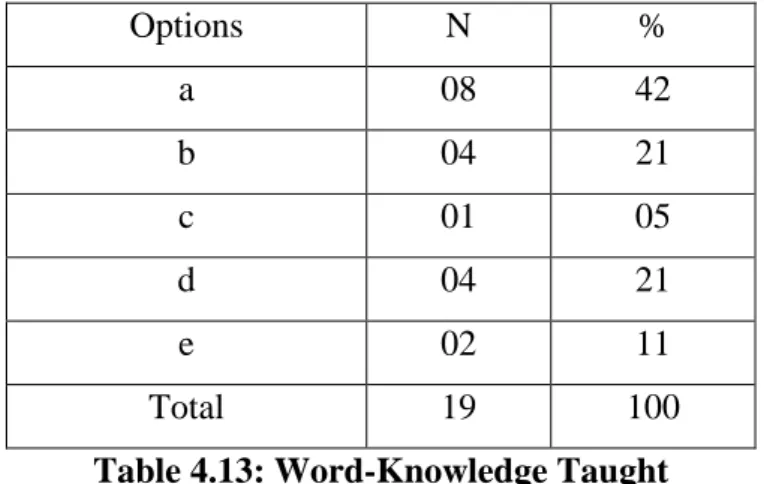
Table 4.13: Word-Knowledge Taught…………...………..83
Table 4.14: Useful Vocabulary Learning Strategies………83
Table 4.15: Class-Time Devoted for Vocabulary Learning Strategies………..……..84
Table 4.16: Designed Vocabulary Learning Strategies Activities……….………..85
Table 4.17: Level of Proficiency………….……….87
Table 4.18: Perception of English………..………..88
Table 4.19: Perception of English Language learning……….89
Table 4.20: Words that are Similar in Sound or Spelling……….………...90
vi
Table 4.22: Connect a Word with its Coordinates………...91
Table 4.23: Capture an Unfamiliar Word and Sort out Meaning from Context………..92
Table 4.24: When I cannot understand the meaning of a word I highlight it to check it later………...93
Table 4.25: I always keep a dictionary nearby to check up words………...…………...94
Table4.26: Recognize Meaning of a Word through Roots and Affixations………...95
Table 4.27: When I am confused about a word, I analyze its parts of speech………….…...96
Table 4.28: I study a word through drawing a picture rather than a definition……….. 97
Table 4.29: I pay attention to the unfamiliar word link it to an image that resembles it (for example:peculiar/particular)………..…98
Table 4.30: In my mind, I organize what I read, saw or heard to get an idea of the word to remember it………98
Table 4.31: After checking the words up I write them down on my vocabulary notebook………..99
Table 4.32: I seek practicing the newly learned words by verbal or written repetition to memorize them……… 100
Table 4.33: I seek practicing the new words through repeating verbally/writing/idioms collocations………....101
Table 4.34: I always skip words I don’t know, and don’t check them up later………101
Table 4.35: I overview my vocabulary tank by trying to replace one word instead of another………...102
Table 4.36: I always test my vocabulary repertoire……….……...103
Table 4.37: I always evaluate my progress in learning vocabulary…………..………104
Table 5.1: Word Definition Matching-Mate………...………..113
vii
Table 5.3: Word Definition Matching-Creep………...114
Table 5.4: Word Definition Matching-Flat……….….115
Table 5.5: Word Definition Matching-Over reacted………...115
Table 5.6: Word Definition Matching-Parlour………..……..116
Table 5.7: Word Definition: Job………..………118
Table 5.8: Word Definition: Hovering………....118
Table 5.9: Word Definition: The Joke in the Flat………..….119
Table 5.10: Word Families: Wet……….120
Table 5.11: Word Families: Dry……….120-
Table 5.12: Word Families: Warm……….120
Table 5.13: Word Families: Cool………121
Table 5.14: Word Families: Rainy………..121
Table 5.15: Word Families: Dark……….………...121
Table 5.16: Word Families: Living room………...122
Table 5.17: Word Families: House………...………..123
Table 5.18: Word Families: Wedding………...……….123
Table 5.19: Word Families: War………...……….124
Table 5.20: Word Families: Sleep………..………124
Table 5.21: Word Families: Shoe………..……….124
Table 5.22: Word Families: Book………..………124
Table 5.23: Word Families: Face………..……….125
Table 5.24: Word Families: Telephone…………...………...125
Table 5.25: Word Families: Office………..………..125
Table 5.26: Synonyms: Untidy/Vacant……….………126
Table 5.27: Synonyms: Wrong/Funny………..……….127
Table 5.28: Synonyms: Purchase/Answer………...127
Table 5.29: Synonyms: Wrong/Untidy……….127
Table 5.30: Synonyms: Good-looking………..128
viii
Table 5.32: Synonyms: Terrible………...129
Table 5.33: Synonyms: Peculiar………...129
Table 5.34: Synonyms: Remember………...130
Table 5.35: Synonyms: Sufficient………130
Table 5.36: Synonyms: Frightened………...130
Table 5.37: Synonyms: Very funny………..130
Table 5.38: Antonyms: Sad/Cheerful………...132
Table 5.39: Antonyms: Straight/Crooked………....132
Table 5.40: Antonyms: Allow/Refuse……..………...132
Table 5.41: Antonyms: Past/Future…………...………..133
Table 5.42: Antonyms: Safe/Dangerous………...………...133
Table 5.43: Contextual Clues: Lost………..………...135
Table 5.44: Contextual Clues: Lady TV………….………136
Table 5.45: Contextual Clues: Bomber……….………..136
Table 5.46 : Contextual Clues: Axe Lady……….………..137
Table 5.47: Contextual Clues: Robot Friend………..……….137
Table 5.48: Texts: Hell/Held………138
Table 5.49: Texts: Gin/Gun……….139
Table 5.50: Texts: Sank/Sang………..139
Table 5.51: Texts: Witch/Watch………..139
Table 5.52: Texts: Noses/Roses………...………139
Table 5.53: Word Definition Matching-Mate……….142
Table 5.54: Word Definition Matching-Intense………...………...142
Table 5.55: Word Definition Matching-Creep……….…………...143
Table 5.56: Word Definition Matching-Flat……….………...144
Table 5.57: Word Definition Matching-Over reacted………..………...144
Table 5.58: Word Definition Matching-Parlour………..145
Table 5.59: Word Definition: Job………....147
ix
Table 5.61: Word Definition: The Joke in the Flat……….………....147
Table 5.62: Word Definition: I’m sorry...148
Table 5.63: Word Families: Wet………..…………..149
Table 5.64: Word Families: Dry……….149
Table 5.65: Word Families: Warm………..149
Table 5.66: Word Families: Cool………150
Table 5.67: Word Families: Rainy………..150
Table 5.68: Word Families: Dark………150
Table 5.69: Word Families: Living room………151
Table 5.70: Word Families: House……….152
Table 5.71: Word Families: Wedding………152
Table 5.72: Word Families: War………153
Table 5.73: Word Families: Sleep………..153
Table 5.74: Word Families: Shoe………...153
Table 5.75: Word Families: Book………..153
Table 5.76: Word Families: Face………...154
Table 5.77: Word Families: Telephone………..154
Table 5.78: Word Families: Office………154
Table 5.79: Synonyms: Untidy/Vacant………..155
Table 5.80: Synonyms: Wages/A piece………..156
Table 5.81: Synonyms: Wrong/Funny………156
Table 5.82: Synonyms: A fantasy/A response………156
Table 5.83: Synonyms: An answer/a daydream……….156
Table 5.84: Synonyms: Purchase/Answer………..157
Table 5.85: Synonyms: Wrong/Untidy………..157
Table 5.86: Synonyms: Good-looking………...158
Table 5.87: Synonyms: Disappeared………..158
Table 5.88: Synonyms: Bought………..159
x
Table 5.90: Synonyms: Peculiar……….159
Table 5.91: Synonyms: Sufficient………..160
Table 5.92: Synonyms: Frightened………160
Table 5.93: Synonyms: Very funny……….160
Table 5.94: Antonyms: Sad/Cheerful………...161
Table 5.95: Antonyms: Straight/Crooked………162
Table 5.96: Antonyms: Allow/Refuse………..162
Table 5.97: Antonyms: Part/Whole………..162
Table 5.98: Contextual Clues: Lost………..164
Table 5.99:Contextual Clues: Lady TV………165
Table 5.100: Contextual Clues: Bomber………...165
Table 5.101: Contextual Clues: Axe Lady………166
Table 5.102: Contextual Clues: Robot Friend………...166
Table 5.103: Texts: Hell/Held………167
Table 5.104: Texts: Fat/Flat………...168
Table 5.105: Texts: Gin/Gun………..168
Table 5.106: Texts: Witch/Watch………...168
Table 5.107: Texts: Noses/Roses………168
Table 5.108: Word Definition Matching-Official………...175
Table 5.109: Word Definition Matching-Stable……….176
Table 5.110: Word Definition Matching-Dealership………..176
Table 5.111: Word Definition Matching-Sign-up………...177
Table 5.112: Word Definition Matching-Iffy……….177
Table 5.113: Word Definition: Knack……….180
Table 5.114: Word Families: Collar………181
Table 5.115: Word Families: Offside……….182
Table 5.116: Word Families: Pillow………...182
Table 5.117: Word Families: Mammals………...……...183
xi
Table 5.119: Word Families: Aquatic Reptiles………183
Table 5.120: Word Families: Bed………184
Table 5.121: Word Families: Sewing………...184
Table 5.122: Word Families: Train……….185
Table 5.123: Word Families: Car………185
Table 5.124: Word Families: Cat………185
Table 5.125: Word Families: Seaside……….185
Table 5.126: Word Families: Funeral……….186
Table 5.127: Word Families: Bird………..186
Table 5.128: Word Families: Tennis………...186
Table 5.129: Word Families: Jacket………...186
Table 5.130: Synonyms: Unused/Genuine……….187
Table 5.131: Synonyms: Real/Odd………187
Table 5.132: Synonyms: Often/Rarely………...188
Table 5.133: Synonyms: Agree/Imitate………..188
Table 5.134: Synonyms: Cautious/Busy……….188
Table 5.135: Synonyms: Insane………..189
Table 5.136: Synonyms: Deliberate………189
Table 5.137: Synonyms: Disgusting………189
Table 5.138: Synonyms: Mean………190
Table 5.139: Synonyms: Hungry……….190
Table 5.140: Synonyms: Ridiculous………190
Table 5.141: Synonyms: Talkative………...190
Table 5.142: Synonyms: Thoughtful...……….191
Table 5.143: Synonyms: Peculiar……….191
Table 5.144: Antonyms: Easy/Difficult………...192
Table 5.145: Antonyms: Unusual/Ordinary……….192
Table 5.146: Antonyms: Skinny/Fat………192
xii
Table 5.148: Antonyms: Serious/Silly………..193
Table 5.149: Antonyms: Graceful/Awkward………...193
Table 5.150: Contextual Clues: Quick-tempered………..195
Table 5.151: Contextual Clues: Lost………196
Table 5.152: Contextual Clues: Lady TV………196
Table 5.153: Contextual Clues: Ball……….197
Table 5.154: Contextual Clues: Axe Lady………197
Table 5.155: Contextual Clues: Robot Friend………..198
Table 5.156: Texts: Crows/Rows………..199
Table 5.157: Texts: Wife/Wire………..199
Table 5.158: Texts: Daring/Darling………...199
Table 5.159: Texts: Heard/Head………199
Table 5.160: Texts: Polite/Police………200
Table 5.161: Texts: God/Good………..200
Table 5.162: Word Definition Matching-Official………..202
Table 5.163: Word Definition Matching-Stable………203
Table 5.164: Word Definition Matching-Dealership……….203
Table 5.165: Word Definition Matching-Sign-up………..204
Table 5.166: Word Definition Matching-Iffy………204
Table 5.167: Word Definition: Knack………208
Table 5.168: Word Families: Collar………...209
Table 5.169: Word Families: Offside………210
Table 5.170: Word Families: Pillow………..210
Table 5.171: Word Families: Mammals……….211
Table 5.172: Word Families: Aquatic Animals………..211
Table 5.173: Word Families: Aquatic Reptiles………..212
Table 5.174: Word Families: Bed………..212
Table 5.175: Word Families: Sewing………213
xiii
Table 5.177: Word Families: Car………..213
Table 5.178: Word Families: Cat………..213
Table 5.179: Word Families: Seaside………...214
Table 5.180: Word Families: Funeral………...214
Table 5.181: Word Families: Bird………214
Table 5.182: Word Families: Tennis……….214
Table 5.183: Word Families: Jacket……….215
Table 5.184: Synonyms: Unused/Genuine………...215
Table 5.185: Synonyms: Real/Odd………..216
Table 5.186: Synonyms: Agree/Imitate………...216
Table 5.187: Synonyms: Insane………...217
Table 5.188: Synonyms: Deliberate……….217
Table 5.189: Synonyms: Disgusting………217
Table 5.190: Synonyms: Mean………218
Table 5.191: Synonyms: Hungry……….218
Table 5.192: Synonyms: Talkative………..218
Table 5.193: Synonyms: Thoughtful………...219
Table 5.194: Synonyms: Peculiar………219
Table 5.195: Antonyms: Unusual/Ordinary………220
Table 5.196: Antonyms: Skinny/Fat………...220
Table 5.197: Antonyms: Stale/Fresh………...220
Table 5.198: Antonyms: Graceful/Awkward……….221
Table 5.199: Contextual Clues: Quick-tempered………...223
Table 5.200: Contextual Clues: Lost………..224
Table 5.201: Contextual Clues: Lady TV………..224
Table 5.202: Contextual Clues: Ball………..225
Table 5.203: Contextual Clues: Axe Lady………225
Table 5.204: Contextual Clues: Robot Friend………...226
xiv
Table 5.206: Texts: Wife/Wire………..227
Table 5.207: Texts: Daring/Darling………..227
Table 5.208: Texts: Heard/Head………..227
Table 5.209: Texts: God/Good………227
Table 5.210: Students’ Grades of the Pre-Test and the Post-Test………...235
xv List of Figures
Figure 1.1: Computers and Human Mind Information Processing ………12
Figure 1.2: Stages of Information Processing System………17
Figure 1.3: Process Model for Schema………...21
Figure 1.4: Schema of the concept “Egg”………..23
Figure 1.5: Components of the Concept of Metacognition……….………...25
Figure 3.1: A Standard Mind Map……….62
Figure 3.2: Mind map on “Mind Maps”………65
Figure 3.3: mind mapping word classes………66
Figure 5.1: Analyze and Compare means………231
Figure 5.2: Define Groups………...232
xvi CONTENTS
General Introduction………...1
1.1.Statement of the Problem………..1
1.2.Aims of the study………...1
1.3.Research Questions and Hypotheses………...2
1.4.Structure of the Study………....3
Chapter One : Cognition/Metacognition………...6
Introduction…………...………...6
1.1. Cognition and Metacognition…...………...6
1.2. Cognitive Monitoring : Boers, Bergestra, and Kostnos (2012)……...…………...8
1.2.1. Metacognitive Knowledge...………....8
1.2.2. Metacognitive Experiences………...10
1.3.Information Processing Theory of Learning………...………11
1.3.1. The Origin Of Information Processing Theory………...………...11
1.3.2. Principle of Information Processing Theory………...12
1.3.3. The Stage Model of Information Processing Theory………...14
1.3.1.1. The Sensory Memory………...14
1.3.1.2. The Short Term Memory or the Working Memory………...15
1.3.1.3.The Long-term Memory………16
1.4. Memory: the Multiple System Model………...18
xvii
1.4.2. Non- declarative Memory………19
1.5. Schema………20
1.6. Metacognition and Learning………...24
1.6.1. Importance of Metacognition in Learning………...24
1.6.2. Teachers’ Implementation of Metacognition in Learning………...27
Conclusion………...28
Chapter Two: Vocabulary Learning Strategies………...29
Introduction……….…..29
2.1. Learning Styles………...29
2.1.1. Sensory Preferances……….29
2.1.2. Personality Types………31
2.2. Learning Strategies………....35
2.2.1. Definition of Learning Strategies………...35
2.2.2. Taxonomies of Language Learning Strategies………...38
2.2.2.1. Rubin (1981)………...39
2.2.2.2. O’malley (1987)………...39
2.2.2.3. Oxford (1990)………...40
2.2.2.4. Stern (1992)………..43
2.3. Vocabulary Learning Strategies……….44
2.3.1. Definition of Vocabulary Learning Strategies………...44
2.3.2. Taxonomies of Vocabulary Learning Strategies………...45
2.3.2.1. Gu and Johnson (1996)………45
2.3.2.2. Shmitt (1997)………...47
2.3.2.3. Nation (2001)………...48
xviii
Conclusion………....50
Chapter Three: Cognitive Vocabulary Strategy Instruction………...51
Introduction………...51
3.1. Teaching Vocabulary………...51
3.1.1. Importance of Vocabulary Teaching………..……….……51
3.1.2. Incidental Vocabulary Learning and Direct Vocabulary Instruction………...………..53
3.2. Cognitive Strategy Instruction………...………55
3.2.1. The Significance of Cognitive Strategy Instruction………...………..……..56
3.2.2. The Process of Cognitive Strategy Instruction………...57
3.2.3. Mind Map as an Instance of Cognitive Strategy Instruction………..………61
3.2.3.1. Definition of Mind Mapping………...………...61
3.2.3.2. Guidelines to Introduce Mind Mapping………...64
3.2.3.3. Mind Mapping in Foreign Language Teaching………..67
Conclusion………..….68
Chapter Four: The Teachers’ and the Students’ Attitudes towards Cognitive Strategy………..…...70
Instruction………...….70
Introduction……….…....70
4.1. The Teachers’ Questionnaire………70
4.1.1. Description of the Teachers’ Questionnaire………..70
4.1.2. Analysis and Interpretation of the Results of the Teachers’ Questionnaire………..71
4.2.The Students’ Questionnaire………..…...86
4.2.1. Description of the Students’ Questionnaire………..86
4.2.2. Analysis and Interpretation of the Students’ Questionnaire………...87
4.3. Overall Analysis of the Results of the Teachers’ and the Students’ Questionnaire………...105
Conclusion………108
Chapter Five: The Students’ Use of Vocabulary Learning Strategies through Cognitive Strategy Instruction………110
xix
Introduction………..110
5.1. The Pre-test………....110
5.1.1. Description of the Pre-test………...110
5.1.2. Analysis and Interpretation of the Pre-test………..111
5.1.2.1. The Control Group………...111
5.1.2.2. The Experimental Group………..140
5.2. Instruction of Vocabulary Learning Strategies through Cognitive Strategy Instruction………...169
5.3. The Post-test………...173
5.3.1. Analysis and Interpretation of the Results of the Post-test………..173
5.3.1.1. The Control Group………...173
5.3.1.2. The Experimental Group………..200
5.4. Overall Analysis of the Results of the Pre-test and Post-test……….228
5.4.1. Comparison between the Results of the Pre-test and Post-test………..………….228
5.4.2. Statistical Analysis of the Results………...……230
5.4.3. Answers to the Reserch Questions……….…….237
Conclusion………..…..240
Chapter Six: Pedagogical Implications……….241
Introduction………...…...241
6.1. The Significance of Metacognition in Education………..241
6.2. The Importance of Vocabulary Learning Strategies in Expanding Learners’ vocabulary Repertoire………...242
6.3. The Significance of Cognitive Strategy Instruction……….……243
6.4. Limitation of the Study and Suggestions for Further Research………...245
Conclusion………..245
General Conclusion……….……..247
References……….……….250 Appendices
xx Appendix I: The Teachers’ Questionnaire
Appendix II: The Students’ Questionnaire Appendix III: The Pre –Test
Appendix IV: The Lesson Plans Appendix V: The Post -Test
General Introduction
1. Statement of the Problem 2. Aims of the Study
3. Research Questions and Hypotheses 4. Means of Research
1 1. Statement of the Problem
To express oneself, people need a mass of words to label entities, verbalize actions and express thoughts. Nevertheless, possessing a good vocabulary repertoire is not an easy task. In the process of learning a language, although vocabulary is considered as an essential element for a smooth communication, students struggle in understanding or memorizing it. English learners need a lexical repertoire to express themselves, and when the latter is weak communication is going to get difficult. The long-established method of teaching vocabulary might be the cause of this phenomenon, for the reason that teachers provide vocabulary explanations through translation and repetitive practices for a better retention. these ways are not effective for all students.
As far as my personal experience goes, as I was a university student, it seemed that I was doing a lot of efforts to learn and store new words which I forgot very quickly. Concerning my humble teaching experience, it is presumed that the students as well are suffering from the same problem which is vocabulary learning. Conversing in the classroom is considered as a burden because they lack vocabulary knowledge to convey their intended meaning. University learners are lost because of the huge amount of words they are encountered with but cannot learn.
2. Aims of the Study
We assume that instead of just stockpiling new items, students need to learn certain vocabulary strategies to enrich their lexical pool. In this research, it is presumed that teachers hold responsibility of teaching students how to learn and how to retain lexical items; therefore, how to control their own learning. That is why, we attempt to detail an increasingly debatable and up-to-date topic the direct instruction approach to vocabulary learning strategies.
2
We first intend to explore the place of vocabulary in the course of teaching. Second, our study highlights the ways teachers approach the task of intentionally and cognitively lingering on vocabulary items, as well as attempting to expose the degree of awareness learners have about their own learning processes. It also sets to account for the place of vocabulary learning strategies in expanding learners’ lexis repertoire. This study sets out to:
Highlight the methods of intentionally and cognitively teaching English foreign learners vocabulary learning strategies. It also explores the impact of these methods on how learners will hold the responsibility for expanding their vocabulary repertoire. Last but not least, it investigates the role, importance and effect of cognitive vocabulary strategy instruction and up to which degree this approach proves to be effective.
3. Research Questions and Hypotheses
Our study will be guided by the following questions:
• Does cognitive strategy instruction of vocabulary learning strategies raise learners’ metacognitive awareness in learning and expanding vocabulary or should vocabulary be left for incidental learning?
• If the cognitive strategy instruction of vocabulary learning strategies proves to be the way, then to what extent it is effective for learners expanding their vocabulary repertoire?
In the light of the previous research questions we put forward the following hypotheses:
• If teachers employ cognitive vocabulary strategy instruction this would raise learners’ metacognitive awareness in learning vocabulary.
3
• If the cognitive vocabulary strategy instruction is applied, learners would manifest considerable improvement in expanding their vocabulary store for a long-term retention of vocabulary items.
4. Means of Research
To conduct our study, we constructed two tools of research: a teachers’ and a students’ questionnaire plus a students’ test. The teachers’ questionnaire aims at unveiling the teachers’ attitudes about vocabulary teaching, their approach to fulfill this task and what ways they deploy to teach vocabulary learning strategies. As for the Students’ questionnaire, it serves as the first tool of research to gather preliminary data, study the subjects’ backgrounds about the ways they approach learning and how they strategize in vocabulary learning. Concerning this questionnaire, we relied on Oxford’s (1990) checklist and Schmidt’s (1997) taxonomy of vocabulary learning strategies.
The students’ test is designed to explore learners’ use of vocabulary learning strategies. What concerns the inventory of vocabulary learning strategies designed to the experiment group, we intended to conduct our main study in the training of various types of vocabulary learning strategies in a natural classroom environment. We mainly aim to see the effect of cognitive vocabulary strategy instruction on the learners’ second language vocabulary retention and their attempts to expand their strategies for vocabulary learning. A post-test has been designed and administered to mark the impact of cognitive vocabulary strategy instruction on the performance of learners in strategizing in their self-regulating learning of vocabulary.
5. Structure of the Thesis
Our study is composed of five chapters. In chapter one, “Theories of Cognitiond/Metacognition”, we explore the perceptible fine line between cognition and
4
metacognition. We survey the different ideas and structures of the theories pertaining to both cognition and metacognition. This chapter seeks out the notions of cognition and metacognition, their evolution and relation to each other throughout research. We supply the necessary theoretical background to associate the importance of learners’ awareness of their learning process with maximizing their outcome from learning.
In the second chapter, “Vocabulary Learning Strategies”, we provide an overview of learning styles. Then, we get a closer look at language learning strategies and the taxonomies associated to them. We also tackle vocabulary learning strategies, the different taxonomies related to them, and the factors influencing their effectiveness.
In chapter three, “Cognitive Vocabulary Instruction”, we seek to join up our theoretical framework on the effect of learners’ cognition of their learning process and its contribution to their learning outcomes with relevance to vocabulary. We present a literature of pros and cons of different approaches of vocabulary instruction including cognitive strategy instruction. Since mind mapping is one instance of cognitive strategy instruction, this chapter sheds light on the efficiency of the latter in foreign language teaching.
Concerning the field work, in Chapter Four, “The Teachers’ and The Students’ Attitudes towards Cognitive Strategy Instruction”, it demonstrates the results and analysis obtained from both the teachers’ and the students’ questionnaires. Moreover, it offers a detailed description of the teachers’ and students’ sample. In this chapter, we uncover the teachers’ attitudes towards teaching vocabulary in general and vocabulary learning strategies specifically. The results obtained from the analysis of this questionnaire show whether teachers are aware of the vocabulary learning strategies positive impact on the development of the vocabulary learning process. In addition to that, the findings unveil hindrances teachers encounter during the teaching process. Concerning the students, we check the way they tackle vocabulary learning and their awareness of vocabulary leaning strategies.
5
. In Chapter Five, “The Students’ Use of Cognitive Vocabulary Strategy”, we report the findings from both the pre and the post tests of both control and experimental groups. We provide the description of the students’ test and the instruction we followed to present the vocabulary learning strategies. The results obtained from the questionnaires’ analysis in Chapter Four with the ones gathered from the pre test will lay the ground for the administration of the research treatment
Concerning Chapter Six, “Pedagogical Implications”, it includes the theoretical and empirical implications of our work, in addition to some recommendations and a summary of the main findings concerning our study in relation to the research questions.
Chapter One
Theories of Cognition/ Metacognition
Introduction
1.1.Cognition and Metacognition
1.2.Cognitive Monitoring: Boers, Bergestra and Kostnos (2012) 1.2.1. Metacognitive Knowledge
1.2.2. Metacognitive Experiences 1.3.Information Processing Theory of Learning
1.3.1. The Origin of Information Processing Theory 1.3.2. Principles of Information Processing Theory
1.3.3. The Stage Model of Information Processing Theory 1.3.3.1.The Sensory Memory
1.3.3.2.The Working Memory 1.3.3.3.The Long-Term Memory 1.4.Memory: The Multiple System Model
1.4.1. Declarative Memory
1.4.2. Non-Declarative Memory 1.5.Schema
1.6.Metacognition and Learning
1.6.1. Importance of Metacognition in Learning
1.6.2. Teachers’ Implementation of Metacognition in Learning Conclusion
6 Introduction
Teaching learners how to become independent from teachers and direct their own learning is one of the most important aims of education. These aims can be achieved through metacognition; however, one cannot deal with the latter without going through cognition. That is why, learners need to be aware of how information is processed to reflect on their own learning processes
1.1. Cognition and Metacognition
As it has been stated by Gama (2004), distinguishing metacognition from cognition is commonly complicated to be done. It is frequently tricky to differentiate between what is meta and what is cognitive; this fact is a further major difficulty with the notion of metacognition. Though the following illustrations will probably look understandable, because of the exchangeability of cognitive and metacognitive purposes not everything is straightforward (Gama, 2004: 11):
the skill needed to read a text differs from the skill of monitoring one’s understanding of the text. The first is an example of cognitive skill, the second of a metacognitive skill. The knowledge of computer programming is cognitive, the knowledge that you are better at reading than at implementing software is of metacognitive nature. These examples may seem clear, but not everything is so clear cut. Because of the interchangeability of cognitive and metacognitive functions, a particular activity can be seen as the strategy itself (e.g. looking for the main points in a text one is studying from), or as a monitoring function (which is a metacognitive activity), or even a reflection of the knowledge (also metacognitive) that it is an appropriate strategy to employ in a given situation.
Cognition was taken from Latin philosophers as ‘cognito’ which means knowledge (Pawlik and D’ydewalle, 2006). It is defined as “the mental process by which external or internal input is transformed, reduced, elaborated, stored, recovered, and used. As such, it involves a variety of functions such as perception, attention, memory coding, retention, recall,
7
decision making, reasoning, problem-solving, imaging, planning and executing actions.” (Pawlik and D’ydewalle, 2006: 3). On the other hand, Naznean (2009) stated that, the consciousness people have of their own cognitive developments is what we call metacognition, and this is what The Merriam-Webster online dictionary defines as “awareness analysis of one’s own learning or thinking processes” (cited in Naznean, 2009: 756)
Students construct knowledge by means of cognitive strategies, and they direct, control, and assess their knowledge via metacognitive strategies. Students develop into more self-directed learners and obtain self-assurance as they turn to be more proficient at employing metacognitive strategies and thus genuine knowledge takes place in consequence of this “thinking about thinking” (Scanlon, 2010).
Bruning, Shraw, and Norby (2010: 12) provide a perceptible fine line between metacognition and cognition by stating that: “Having knowledge is only part of effective learning. It also is important to use one’s knowledge strategically and to understand the strengths and limitations of one’s knowledge.” According to Lai (2011), when learners can regain and arrange a strategy that they have been tutored in a specific problem situation in a resembling but new situation, then we are talking about metacognition. The two terms are not detached but metacognition is a compartment of cognition. In other words, whenever we deal with the wide concept of cognition, metacognition is standing there (Carson, 2012). To differentiate between the two, Carson (2012: 27) stated that: “there is a general agreement that metacognition is second-order cognition, in which there is knowledge and awareness, monitoring and control of the flow of information occurring in cognitive processing.”
So, the term Cognition is acknowledged to be the range of approaches people reflect about what they are “seeing, hearing, studying, and learning, and the more specific things they do are often referred to as cognitive processes” (Nietfeld, 2016: 20). The specific skills
8
engaged in scrutinizing knowledge, transforming and directing it independently is what expresses the term metacognition. Metacognition is the process where people lead their own knowledge. It includes consciousness of the way we acquire information, an assessment of our learning necessities, procreating strategies fitting these necessities and so applying the strategies (Tam, 2016).
1.2. Cognitive Monitoring : Boers, Bergestra and Kostnos (2012)
Iwai (2011) affirmed that people use the following two elements to supervise their cognitive development : mtacognitive knowledge and metacognitive experiences. Since ‘metacognition is the knowledge about cognition’ Boer, Bergstra, and Kostnos (2012) assumed that to examine cognitive activities someone has to deal with the activities and contacts between metacognitive knowledge including its subdivisions (person knowledge/ task knowledge/ strategy knowledge) and metacognitive experiences.
1.2.1 Metacognitive Knowledge
According to Thamraska (2005), the awareness about the features that are in charge of cognitive knowledge refers to Metacognitive knowledge. Metacognitive knowledge consists of understanding the two levels (general and particular) someone’s mind works in (Louca, 2008). He explained that “The processes of planning, monitoring, and regulating thoughts are generally known as executive processes, which involve the interaction of two levels: At one level is the creative, associative, wandering mind and above it is the executive, trying to keep it on task.” (Louca, 2008: 2).
Scanlon (2010: 1) added that “metacognitive knowledge refers to what individuals know about themselves as cognitive processors, about different approaches that can be used
9
for learning and problem solving, and about the demands of a particular learn-ing task”. The internal and external features that possibly will act together to influence cognition should be taken into account when dealing with metacognitive knowledge which is described as the understanding of the individual’s cognitive strong points and restraints (Lai, 2011). That is why, students who do not differentiate between what and when use learning strategies are said to be deficient in metacognitive knowledge because the latter is a precondition for autonomous use of learning strategies (Boer et al., 2012). Pariz, Parviz, and Majid (2014: 38) claimed that “metacognitive knowledge refers to the part of one’s acquired word knowledge that has to do with cognition or perhaps better, psychological matters”. Knowledge of person variables, task variables; and strategy variables are the sub categories of Metacognitive knowledge
Person knowledge is the conviction someone has about himself and others’ thinking process. For example, you may believe that you are at your best by doing than by listening to courses, so it is how you view yourself as a thinker (Thamraska, 2005). Scanlon (2010) added that, while learning and processing information and you are capable of distinguishing your own strong and weak points, then you are dealing with the ‘person variable’. Lai (2011: 5) reported that person knowledge “includes anything one believes about the nature of human beings as cognitive processors”. In other words it is this awareness that someone has about his/her own way of tackling a cognitive activity. In sum, it is a person’s consciousness of what they are capable of (Iwai, 2011).
As said by Thamraska (2005), task knowledge includes every piece of information about any task on hand. For the reason that those facts will help in the running of the task, and granting how successful it might be. Louca (2008) added that, a task variable has to do with the importance of knowing the nature of information met, as it displays the restraints how the proposed task should be managed. For instance, knowledge about the fact that
10
reading a passage from a novel will take less time to examine, understand and recollect than a technical article with the same length (Scanlon, 2010). On the whole, Lai (2011: 6) stated that task knowledge ‘includes knowledge about the demands of different task’.
On the word of Thamraska (2005), strategy knowledge consists of the restricted knowledge about the time and place it is suitable to use both cognitive and metacognitive strategies. Scanlon (2010) inserted that you are dealing with strategy knowledge when you want to effectively carry out a task by applying specific strategies in a stretchy mode. Scanlon (2010: 1) summed up an example of all three variables saying that: “I know that I (person variable) have difficulty with word problems (task variable), so I will answer the computational problems first and save the word problems for last (strategy variable).”
1.2.2. Metacognitive Experiences
Thamraska (2005: 1) described metacognitive experiences as: “monitoring phenomena, which can control cognitive activities, and ensure that a cognitive goal has been achieved. These processes help to regulate and manage learning, and consist of planning and monitoring cognitive activities, as well as checking the outcomes of those activities.” Preparing, supervising, and comprehension strategies are some examples of the regulations learners add to their learning development and we refer to this as metacognitive experiences (Scanlon, 2010).
Iwai (2011) stated as an example when learners are aware of any cognitive or emotional experiences like letdown, accomplishment, doubt, or approval about things, thus; we are dealing with metacognitive experiences. In another situation, dealing with the metacognitive aspect is when you realize you are unable to answer questions about a concept of a passage because of a lack of comprehension after reading, and then you decide to reread in order to understand better. By doing the former processes you are adjusting and taking control of your learning process and thus you are engaged in metacognitive experiences.
11
Iwai (2011, 151), summed up the different views about metacognitive experiences as “any conscious cognitive or affective experiences that accompany and pertain to any intellectual enterprise.” Boer, et al. (2012) attested that, the latter is indeed the awareness an individual has about the metacognitive knowledge.
1.3 Information Processing Theory of Learning
As it has been initially stated by Flavel (1979), people’s awareness of their “cognitive activities” in the learning course is called metacognition. The term metacognition should not be confused with the one of learning; it is the planned and conscious control of the learning process (Louca, 2003). That is why, someone has to know how learning takes place so that it can be controlled and monitored. The latter can be achieved by undertaking information processing theory.
1.3.1. The Origin of Information Processing Theory
Information processing has emerged and exists since World War II epoch, when developed technologies like television, telephone, and computers had a huge impact in the war sweat and changed the labeling of passing on information to “communication channels”, “coding information”, and “dual processing” all over the world. Psychologists had to adapt to such a change by developing a new method to analyze how people transfer information. This method was to let go of the traditional theories in support of the cognitive ones by marking the parallelism between the computer and the human being way of processing information and thus information processing emerged.
Since then psychologists started to question if learners gather, transform and stock new information like a computer (Mahoney, 1988). As it has been confirmed by Sammons (2015: 1) who stated that:
This is useful because minds and computers have some attractive similarities: both have inputs, outputs, memory stores and a limited capacity for how much
12
information they can process at any time. Just as a computer’s behavior is determined by what information it is given and how it has been programmed, so a person’s behavior is determined by (1) the information available in their environment; (2) the ways they have learned to manipulate (process) information; and (3) the capacities for information processing inherent in the types of brain people have.
In the following figure we will present the main similarities between the human mind and computers
Figure 1.1: Computers and Human Mind Information Processing
(The McGraw-Hill Companies, Inc., 2007: 3) 1.3.2. Principles of Information Processing Theory
Cognitive psychologists have somehow a unified conformity concerning fundamental principles of information processing theory. First of all, they are in agreement with the fact
13
that there are restraints with regard to the quantity and speed of the new information being ‘encoded, stored and retrieved’. In other ways, they are in agreement on what they call the ‘assumption of a limited capacity’. Another principle is this existing power whenever there is a triggering stimuli. However, there is a sort of argument about in what manner and in which place the commands function (lutz and Huitt, 2003).
Currently, it is presumed that the nervous system (the brain and the spinal cord) include diverse structures that symbolize its performance. Information-processing model deals with how the information moves in the learners’ central nervous system through these hypothetically diverse ‘internal structures. Because until now, it is assumed that there is no particular evidence to their position in the brain (Yahaya, 2008). Instructors aware of the basics of information processing theory tend to pick precise learning strategies that help in perking up both maintenance and retrieval of learning. For the reason that, according to information processing model learning takes place by the collection of information and its arrangement into mental representation (Kandarkis and Poulos, 2008).
Information processing theory has become one of the most prominent psychological theories that serve to describe the process of learning. According to cognitive psychologists, learning can be defined as a change in a person’s mental structures that creates the capacity to demonstrate different behaviors. Information Processing Theory looks closely at how, independent of the context, stimulation from the environment goes through the processes of attention, perception, and storage throughout a series of distinct memory stores (Moos, 2016). Another assumption is the bipartisan motion of information processing: bottom-up processing and top-down processing. In other words, bottom-up processing refers to the gathering of information by means of the senses. Top-down processing is that information laying in memory as we build significance and relations about our environment (Suthers, 2016).
14
1.3.3. The Stage Model of Information Processing Theory
The Stage Model of Information Processing Theory is the commonly used model of information processing. There are two fundamental basics about this theory: it considers learning and memory as non continuous, and the new information being absorbed is directed before it is stored in memory. Lutz and Huitt (2003) identified three phases of memory: the sensory memory, the short-term or the working memory, and the long-term memory.
1.3.3.1. The Sensory Memory
Lutz and Huitt (2003) explained that, the preliminary phase is called the sensory memory through which the perception of the stimuli occurs. The sensory memory is directly related and influenced by attention which is also associated with understanding the development of information processing. However Braver (2006) stated that, the information received is just stored not coded. It is also put forward that not all perceived information can be recalled; only the one shifted to a higher level into memory can. That is why though the process of reception is constant, not all the sensed stimuli can be processed and be part of someone’s memory store.
Kandarkis and Poulos (2008) asserted that if we do not vigorously comprehend and concentrate with the information it will die away rapidly in a unit of time. During this phase, we are asked to ponder by selection to the most momentous constituents in view of the fact that sensory stimuli is being poured in. At this stage, concentration is vital for the reason that it decides on the information which turns out to be accessible to memory. Indeed, attention is the process of selecting the most significant elements of the sensory stimuli.
Karpicke and Lehman (2014) affirmed that a lot of us fail to recall simple everyday incidents like “Where did I put my glasses?” or “Tell me again the name of the new teaching assistant!” and we relate this forgetting to poor memory or progress in age. As a matter of fact, this is an outcome of a breakdown in the process of attention due to distraction when the
15
event was happening; and thus, it will lead to unsuccessful encoding of the information. For instance, the cause of the distraction of the former example may be because you were trying to remember the name of the teacher and may be you were also distracted when they told you the name of the new teacher because you were stressed with exams.
Nietfeld (2016) attested that the sensory register is a memory constituent that encompasses a large capacity to embrace the information received (input) but a very short life of just a few seconds. The information is received through your senses i.e. anything you hear, see, or smell etc. Any received information in the sensory register will fade away if it is not attended. This is what makes the weight of attention, since it picks the information which becomes accessible to memory. Suthers (2016) stated that it is vital that the information is attended at this early phase in order to be transferred to the next one.
1.3.3.2. The Short Term Memory or the Working Memory
Lutz and Huitt (2003) said that so that the information is not lost, the learner should move it to the working memory. As the new information is being absorbed the working memory is being vigorously processed that is why this part of memory is considered active or conscious. According to Nietfeld (2016: 26) “Working memoryis the component of memory where attended-to information stays for a short while so that we can make better sense of it. It is also where much of our thinking, or cognitive processing, occurs. It is where we think about the content of a lecture, understand a textbook passage, or solve a problem. Basically, this is the component that does most of the mental work of the memory system—hence its name working memory. Accordingly, it is sometimes called short-term memory”
Nietfeld (2016) confirmed that, rehearsal is an efficient method used for processing information in short- term memory. He suggested the following example, you check your phone repertoire to call a friend (we deduce that the number is in your working memory because it got your attention), but you find out that someone else is using the phone and you
16
do not have a pen to write it down so you keep on repeating it to yourself so that it stays in your memory until you call your friend; this is called rehearsal. Yet, as soon as you stop repeating the number it may vanish because you need more compound elaboration to transmit the information to long-term memory. According to Moos (2016), hence learners need to make associations between the new information and prior stored knowledge to ensure retention. It is assumed that the working memory can be enhanced through time and experience as students learn more, and accordingly more precise acuity of the information will take place.
1.3.3.3. The Long-Term Memory
Lutz and Huitt (2003) argued that long-term memory and short-term memory must have an active communication to facilitate integrating new information into the memory system. Long-term memory is a stable system where information is motionless and unexploited until you retrieve it into working memory. Moos (2016) stated that when learners knowingly think about their knowledge before encoding it again into long-term memory they are making use of metacognition. The latter allows the knowledge to be more tangible and thus understanding the content is improved. As it is presented in the following figure:
17
Figure 1.2: Stages of Information Processing System (Moos, 2016: 3)
According to Kandarakis and Poulos (2008) in terms of information processing model, learning represents the process of gathering information, and organizing it into mental schemata. As it is stated in Learning and Memory Handout (2014: 2), the information processing system spots how the new information is encoded (locate information in memory), stored (seize the encoded information in memory), and retrieved (place, take out, and employ information stored in memory). So, one has to understand what schemata and memory is exactly.
18 1.4. Memory: The Multiple System Model
Memory recalls stored knowledge and renews information of past experiences whenever a change occurs. It is up to date with present experiences, and even future ones have their share because it constructs upcoming memories (Squire, 1992).Lutz and Huitt (2003) argued that there is a touchable structure that permits the way in of the stimuli into memory. Since it is founded on the principle that memory is a many-sided structure of associations and depictions that cover a lifetime’s accretion of insights. May and Einstein (2013) affirmed that, the memory system includes various memory compounds that can work separately and does not depend on one ‘neuro anatomical circuit’. It is divided into declarative and non declarative memory and both subdivided into other systems.
1.4.1. Declarative Memory
Whether it is called explicit, relational, or declarative memory we are tackling this sort of memory which “depends on the integrity of brain structures and connections in the medial temporal lobe and the diencephalon that have been associated with memory functions and that, when dam-aged, cause amnesia” (Squire, 1992: 1). In addition, Declarative memory is characterized as being rapid and available to conscious recall. A specific characteristic of working memory is when the information is removed effortlessly, a new information start the process after a cognitive task has been achieved (Squire, 1992). Braver (2006: 240) stated that it is considered as “a mental blackboard—that is, as a workspace that provides a temporary holding store so that relevant information is highly accessible and available for inspection and computation.”. According to May and Einstein (2013), declarative memory is a deliberately controlled memory system with pliancy. Though it is decreased with age, mnemonic strategies can be utilized to revoke knowledge. May and Einstein (2013) assumed that through working memory earlier learned information can be handled and then retrieved to be taught and connected with new information. It generally holds up from 2 to 18 seconds, and used for
19
mental computation like ‘figuring a tip’ or maintaining information temporarily such as ‘dialing a phone number’. Declarative memory is divided into Episodic Memory and Semantic Memory.
Tulving and Donaldson (1972) stated that the episodic memory system is rather at risk of information change and loss. Information is retrieved and scrutinized to operate as a special input to episodic memory and consequently the contents of the episodic memory store will change because during the process of encoding it is periodically impacted by information in semantic memory. Yet, the semantic and episodic systems may function separately from one another. According to Martin-ordas and Call (2013), episodic memory is the memory of events because it conserves chronological information and sequential-spatial connections between these dated episodes and the already existing ones in the episodic memory store. It also preserves diverse features of this information and passes it on to other systems responsible for its conversion into conscious action.
Tulving and Donaldson (1972) argued that semantic memory is particular to language learning as it is considered a mental glossary of words, spoken representations, notions, and formulas to control the relationships between them. Indeed, any performance of retrieval within the semantic system comprises an input into episodic memory. Martin-ordas and Call (2013) added that unlike the episodic memory, semantic memory is less vulnerable to information change and loss. As a main difference between episodic and semantic memory the former records perceptible properties of inputs, whereas the latter registers referents of input signals. So, our record of all the knowledge about the world is our semantic memory. 1.4.1.1.Non Declarative Memory
As stated by Squire (1992), non declarative memory consists of information attained during skill learning and any knowledge expressed through doing something rather than just recalling information. Even the change that occurs in our behavior because of experience we
20
do not pay attention to it. May and Einstein (2013: 7) defined non declarative memory as: “a memory system that influences our current perceptions and behavior without our knowledge, awareness, or intention. Non declarative memory is not used intentionally and involves no effort. Examples of non declarative memory include riding a bike, driving a stick-shift car, using the same verbal patterns as friends (for example saying “like” repeatedly)”. Non declarative Memory is alienated into Priming and Classical Conditioning.
May and Einstein (2013) affirmed that priming is the mechanical process –gained through experience- that augments the pace and precision of a response. One main aim of priming is making the process of retrieval more resourceful and well-organized through activating association between memories. One instance of priming is the flow of the word ‘nurse’ when you have just read the word ‘doctor’.
On the other hand May and Einstein (2003) stated that considering Pavlov’s classic experiment with dogs to exemplify classical conditioning which he has later generalized with humans. Pavlov conditioned his dog to the sound of the bell ringing to associate it with food. Whenever he offered his dog food he rang the bell; consequently the dog linked the sound with eating and salivated with every sound of bell. Hence, classical conditioning is a memory system of connections between two incentives.
1.5. Schema
Barlett (1932) was the first to introduce the term ‘schema’ in psychology defining it as “an active organization of past reactions of past experiences, which must always be supposed to be operation in any well-adapted organic response” (Cited in Brewer and Nakamura, 2007:3) as it is explained in the Figure 1.3 (Axelrod, 1973: 1251).
21 Enter 1 2 Yes No 3 7 3 7 Yes 4 No 8 Yes 4 Yes 8 5 6 9 5 6 10 Fail Exit with old succeed
Interpretation
Fail 11&& 11 Exit without interpretation
Exit with old interpretation Succeed
Exit without I J Exit with new interpretation
Figure 1.3: Process Model for Schema (Axelrod, 1973: 1252)
Receive a message : Source name
Partial specification of a case type
Is there already an interpretation of this case?
Is there any old uninterpreted information on this case? Does the new information fit any
of the old specifications sufficiently well
Combine the old one and new information
Affix blame by comparing source credibility to interpretation confidence.
Blame old interpretation: downgrade old source’s credibility, cancel previous interpretation
Satisfy: seek a schema which provide a satisfying fit to the partial specification of the case Blame new
message:
downgrade source
Downgrade source credibility
Specify; Modify and extend specification using the selected schema, upgrade accessibility of the schema, upgrade source credibility, upgrade confidence in the interpretation
22
Axelrod (1973) explained that schema is the process of attempting to fit a new information on hand into the same prototype used for interpreting past information about the same situation. However, a distortion might occur if the new information does not fit as it should be
Derry (1996) stated that information that fits into a student’s existing schema is more easily understood learned and retained than information that does not. According to Wills and Ellis (2008), the teacher’s task is to ensure that the students have prior knowledge related to the concept and to provide a means for helping the students make connections between prior knowledge and new concepts. Graphic organizers make it easier to link new information to existing knowledge and help students build the schema they need to understand new concepts. If prior knowledge is activated, the schema will be able to provide a framework to which new information can be attached and learning and comprehension will be improved.
Then other definitions started to make surface as Wills and Ellis (2008) claimed that schema is responsible for the organization of information in a long-term memory. Schema can illustrate how particular information is systematized and stored in memory so that it can be retrieved and applied when it is required.. Because the ally of schema theory assume that memory is a cluster of a complex cognitive constructs called schemata (plural of schema) whose work is to smooth the progress of a mental procedure given that, a comprehensive clarification about the relationship linking entities, situations, and acts is designated through schemata (information stashed into units of knowledge).
Moreover, Wills and Ellis (2008) added that the better understood, learned, and memorized information is the one that corresponds into a student’s existing schema. Prior knowledge has to be activated so that schema will be able to provide a structure to which new information is anchored to and therefore learning will progress. For that reason, the teacher’s
23
duty is to facilitate the process of making connections between prior knowledge and new notions. Indeed, Graphic organizers are said to be helpful tools for easing the link between new information and existing knowledge; thus, help students build the schema they need to understand new concepts.
According to Davis (2013) every schema holds a subschema, and both are implanted in other schemata as it is shown in the Figure 1.4 about a person’s schema of ‘egg’.
Figure 1.4: Schema of the concept “Egg”.