HAL Id: tel-03150590
https://tel.archives-ouvertes.fr/tel-03150590
Submitted on 23 Feb 2021HAL is a multi-disciplinary open access
archive for the deposit and dissemination of sci-entific research documents, whether they are pub-lished or not. The documents may come from teaching and research institutions in France or abroad, or from public or private research centers.
L’archive ouverte pluridisciplinaire HAL, est destinée au dépôt et à la diffusion de documents scientifiques de niveau recherche, publiés ou non, émanant des établissements d’enseignement et de recherche français ou étrangers, des laboratoires publics ou privés.
Tompoariniaina Nampoina Andriamilanto
To cite this version:
Tompoariniaina Nampoina Andriamilanto. Leveraging browser fingerprinting for web authentication. Systems and Control [cs.SY]. Université Rennes 1, 2020. English. �NNT : 2020REN1S045�. �tel-03150590�
L’UNIVERSITÉ DE RENNES 1
ÉCOLEDOCTORALE NO601
Mathématiques et Sciences et Technologies de l’Information et de la Communication Spécialité : Informatique
Par
Tompoariniaina Nampoina ANDRIAMILANTO
Leveraging Browser Fingerprinting for Web Authentication
Thèse présentée et soutenue à Rennes, le 17/12/2020 Unité de recherche : IRISA, IRT b<>com
Rapporteurs avant soutenance :
Arnaud LEGOUT Chargé de recherche (HDR), INRIA Sophia Antipolis
Luc BOUGANIM Directeur de recherche, INRIA Saclay Île de France
Composition du Jury :
Président : Gildas AVOINE Professeur, INSA Rennes
Rapporteurs : Arnaud LEGOUT Chargé de recherche (HDR), INRIA Sophia Antipolis
Luc BOUGANIM Directeur de recherche, INRIA Saclay Île de France
Examinateurs : Sonia BEN MOKHTAR Directeur de recherche CNRS, laboratoire LIRIS Lyon
Pierre LAPERDRIX Chargé de recherche CNRS, laboratoire CRISTAL Lille
Clémentine MAURICE Chargée de recherche CNRS, laboratoire IRISA Rennes
Dir. de thèse : David GROSS-AMBLARD Professeur, Université de Rennes 1
Encadr. de thèse : Tristan ALLARD Maître de conférences, Université de Rennes 1
Invité(s) :
Dir. de thèse : Benoît BAUDRY Professeur, KTH Royal Institute of Technology
Many people have contributed in one way or another to my PhD studies. I take this section to thank them.
First and foremost, I would like to thank my thesis supervisors, Tristan Allard and Gaëtan Le Guelvouit, for the three enjoyable years spent learning and working alongside them. I would also like to thank my thesis directors, Benoît Baudry and David Gross-Amblard, for trusting me to carry out this thesis work.
Second, I would like to thank the members of my thesis jury : Gildas Avoine for chairing the jury ; Arnaud Legout and Luc Bouganim for reviewing the ma-nuscript ; Clémentine Maurice, Pierre Laperdrix, and Sonia Ben Mokhtar for their participation in the jury ; all the members of the jury for their interest in my works. I spent these three years of PhD studies between the Institute of Research and Technology b<>com and the IRISA laboratory, in both of which I was surrounded by warm people. I would like to thank the members of the Trust and Security team of the IRT b<>com for the good atmosphere that reigned. I enjoyed the discussions over a cup of coffee with Arnault Besnard and David Liouville, the lunchtime board game sessions with Valérie Denis, and Alexandre Garel for introducing me to the domain of machine learning. I would also like to thank the members of the DRUID team of the IRISA laboratory, notably Joris Duguéperoux, Louis Béziaud, Antonin Voyez, and Javier Rojas Balderrama for the interesting discussions during the lunchtime coffees and their reviews of our works.
Next, I would like to thank my friends for their support throughout my thesis studies. In particular, Malo and Christophe with whom I shared this three years adventure, and Evan for the warm exchanges over a sandwich, a tea, or a beer. Finally, I would like to thank my family, near or far away, for their encouragement and their confidence in my ability to succeed this thesis.
Contexte
Depuis la genèse du World Wide Web à la fin des années quatre-vingt, les tech-nologies qui l’entourent n’ont cessé de se développer. Il est aujourd’hui possible d’écouter de la musique, de jouer à des jeux-vidéos, de regarder des vidéos en di-rect ou en différé, et tout ceci au travers d’un simple navigateur web. En parallèle du développement des technologies web, les services qui s’y reposent se sont aussi développés. Il est désormais possible de réaliser des démarches administratives en ligne, mais aussi des transactions bancaires ou des visioconférences. Malgré le fait que les sites web soient accessibles publiquement, certains services ne devraient êtres accessibles que par des utilisateurs désignés. Par exemple, seul le propriétaire d’un compte bancaire devrait être autorisé à y effectuer des opérations en ligne. Se pose alors le problème de l’authentification, qui consiste à ce que le gestionnaire du site web, aussi appelé le vérifieur, vérifie qu’un utilisateur soit bien le détenteur d’un compte. Pour ce faire, le vérifieur demande des éléments que seul le détenteur du compte devrait être capable de fournir, éléments que nous appelons des fac-teurs d’authentification. Le facteur d’authentification couramment utilisé par les sites web est le mot de passe, grâce à sa facilité d’utilisation et de déploiement. Cependant, les mots de passe souffrent de multiples faiblesses. Par exemple, les utilisateurs ont tendance à utiliser les mêmes mots de passe, facilitant alors la tâche aux pirates qui réalisent des attaques par dictionnaires. Ces attaques consistent à déduire quels sont les mots de passe les plus courants, et à les présenter pour es-sayer d’accéder de manière frauduleuse à un compte. Cette déduction peut se faire à travers les mots de passe qui ont fuités ou été volés lors d’attaques informatiques.
À cause des faiblesses des mots de passe, les vérifieurs intègrent désormais de l’authentification multi-facteur. Cela consiste à utiliser plusieurs facteurs d’authen-tification, de sorte que chaque facteur ajoute une barrière de sécurité supplémen-taire. Cependant, le gain en sécurité des facteurs additionnels vient au prix d’une perte de facilité d’utilisation ou de déploiement. Les utilisateurs doivent se sou-venir d’une information supplémentaire, avoir un objet sur eux, ou effectuer une action. Les vérifieurs doivent déployer des logiciels ou du matériel supplémentaires, les maintenir, et apprendre aux utilisateurs à s’en servir. Selon des estimations réa-lisées en 2015 et en 2018, moins de dix pour cent des utilisateurs s’authentifient auprès des sites web à l’aide de plusieurs facteurs d’authentification.
Le développement des technologies web a aussi mené à une diversité des confi-gurations de navigateurs web et à une grande quantité d’information communiquée par ceux-ci. Effectivement, les utilisateurs ont aujourd’hui le choix entre différents systèmes d’exploitation et modèles de navigateur. Ces logiciels étant mis à jour ré-gulièrement, ils existent alors sous différentes versions. Les navigateurs fournissent un accès à des informations concernant l’appareil, le système d’exploitation, le modèle de navigateur, et leurs versions respectives. En 2010, Peter Eckersley a lancé une expérimentation via le site Panopticlick afin de vérifier si, à partir des informations communiquées par les navigateurs, ceux-ci ne seraient pas reconnais-sables. Parmi les 470, 161 navigateurs qui font partie de l’expérimentation, 83.6% étaient reconnaissables de manière unique à partir des 8 attributs collectés. La technique utilisée est alors appelée browser fingerprinting, ou prise d’empreinte de navigateur en français, et consiste à collecter des attributs auprès d’un navigateur afin de constituer une empreinte de celui-ci. Les empreintes de navigateur ont été utilisées à des fins de pistage web. En suivant un utilisateur au fil de sa navigation via l’empreinte de son navigateur, les agences publicitaires peuvent lui proposer des publicités ciblées. Mais cette empreinte peut aussi servir de facteur d’authenti-fication supplémentaire à bas coût : l’utilisateur n’a rien à retenir, rien à installer, et aucune action supplémentaire à effectuer. Il suffit de vérifier que l’empreinte de son navigateur soit suffisamment ressemblante à l’empreinte enregistrée pour le compte demandé, ce qui peut être fait de manière transparente.
Adéquation des Empreintes de Navigateur pour
l’Authentification Web
La plupart des études sur l’utilisation des empreintes de navigateur à des fins d’au-thentification se concentrent sur la conception du mécanisme d’aud’au-thentification. De plus, les études empiriques sur les empreintes de navigateur se concentrent sur son utilisation pour du pistage web, ignorant alors des propriétés primordiales pour l’authentification comme leur efficacité à reconnaître un navigateur. Enfin, la capacité des empreintes à distinguer les navigateurs sur une grande population et en utilisant un grand nombre d’attributs est, à notre connaissance, encore mécon-nue. Les études empiriques portent soit sur une population large mais en utilisant moins de trente attributs, sous-estimant alors la distinguabilité des empreintes, soit sur une faible population en utilisant une centaine d’attributs.
Au travers de cette thèse, nous proposons la première étude empirique à large-échelle des propriétés des empreintes de navigateur utilisées à des fins d’authen-tification web. Nous nous reposons sur l’analyse de quatre jeux de données, dont un constitué de 4, 145, 408 empreintes composées de 216 attributs initiaux et de 46 attributs déduits. Nous faisons le lien entre les empreintes digitales distinguant les êtres humains et celles des navigateurs distinguant ces derniers, et évaluons les empreintes de navigateur selon des propriétés de facteurs d’authentification biomé-triques. Celles-ci comprennent la distinguabilité des empreintes, leur stabilité, leur temps de collecte, leur taille en mémoire, l’efficacité d’un mécanisme de vérification d’empreintes, la perte d’efficacité au fil du temps ou en fonction de populations de navigateurs, et l’acceptabilité de la part des utilisateurs. Afin de comprendre les résultats obtenus au sujet des empreintes, nous discutons aussi de l’apport des at-tributs à chaque propriété, des corrélations observées entre atat-tributs, et présentons en annexe la liste exhaustive des attributs utilisés. En considérant nos attributs et populations de navigateurs, nous atteignons un haut niveau de distinguabilité et de stabilité. Ce niveau de distinguabilité et de stabilité permet d’obtenir une haute précision en simulant un mécanisme simple de comparaison d’empreintes : nous obtenons un taux d’erreur égal compris entre 0.61% et 4.30%. Un jeu de données provenant de machines standardisées d’une université sort du lot et présente une forte baisse de la distinguabilité, de la stabilité, et de la précision.
Méthode de Sélection d’Attributs
Des centaines d’attributs sont à disposition des vérifieurs pour concevoir leur sonde de prise d’empreinte de navigateur. L’ajout d’un attribut peut améliorer la recon-naissance des navigateurs en apportant une information supplémentaire pouvant distinguer deux navigateurs différents. Cependant, l’ajout d’un attribut a aussi un coût d’utilisation : les empreintes requièrent un espace de stockage plus grand, un temps de collecte plus long, et peuvent êtres plus difficiles à reconnaître si l’at-tribut en question est instable. Dû aux corrélations survenant entre les atl’at-tributs, les sélectionner un par un serait peu efficace. De plus, l’apport d’un attribut dé-pend de ceux déjà sélectionnés. Par exemple, certains attributs sont collectés en parallèle, le temps requis pour les collecter n’est donc pas la somme de leur temps de collecte individuel mais le temps de collecte du plus lent. Explorer toutes les possibilités est aussi à proscrire puisque le nombre de possibilités croit de manière exponentielle en fonction du nombre d’attributs.
Au travers de cette thèse, nous proposons une méthode de sélection d’attributs tels qu’ils satisfassent un niveau de sécurité et réduisent les contraintes d’utilisa-tion. Le niveau de sécurité est mesuré selon la proportion d’utilisateurs usurpés étant donnés les attributs utilisés, une population de navigateurs, et un attaquant modélisé. Nous considérons l’attaquant qui connaît la distribution exacte des em-preintes des utilisateurs à protéger et qui est capable de présenter un nombre limité d’empreintes contrefaites. Les contraintes sur l’utilisation sont mesurées selon le temps de collecte des empreintes, leur taille, et leur instabilité. Nous comparons notre méthode avec les méthodes courantes de sélection d’attributs reposant sur l’entropie et l’entropie conditionnelle. Nous exécutons les méthodes sur des échan-tillons de deux jeux de données, avec plusieurs niveaux de sécurité souhaités, et plusieurs attaquants en fonction du nombre d’empreintes qu’ils puissent présenter. Comparé à l’utilisation de tous nos attributs et en moyenne, les attributs sélec-tionnés par notre méthode génèrent des empreintes qui sont de 12 à 1663 fois plus petites, de 9 à 32330 fois plus rapide à collecter, et avec 4 à 30 fois moins d’at-tributs changeants entre deux observations. Notre objectif de réduction du coût d’utilisation des attributs est atteint en utilisant notre méthode. Nous obtenons un coût jusqu’à trois ordres de grandeur plus bas comparé aux méthodes usuelles.
Web authentication is the verification that a user claiming an account legitimately owns this account. It widely relies on passwords, but several authentication factors were proposed such that each factor provides an additional security barrier. Brow-ser fingerprinting notably came out as a promising candidate. It is the collection of attributes from a web browser to build its fingerprint which is potentially unique. In this thesis, we provide two contributions to the field of browser fingerprinting for web authentication :
1. We investigate the adequacy of browser fingerprints for web authentication. We make the link between the browser fingerprints that distinguish browsers, and the biometric fingerprints that distinguish Humans, to evaluate brow-ser fingerprints according to properties inspired by biometric authentication factors. We assess these properties on four real-life browser fingerprint data-sets, which include one of nearly two million browsers. To comprehend the properties of the fingerprints, we enrich our results with the contribution of the attributes to the properties and the correlations between them.
2. We propose FPSelect, an attribute selection framework to find the attribute set that satisfies a security requirement and reduces the usability cost. The security is measured as the proportion of impersonated users given a finger-printing probe, a user population, and a modeled attacker. The usability is quantified by the collection time of the browser fingerprints, their size, and their instability. We compare our framework with common baselines, based on two real-life fingerprint datasets, and find out that it selects attribute sets of lower usability cost in our experimental settings.
Acknowledgements iii
Résumé en français v
Abstract ix
Contents xi
List of Figures xvii
List of Tables xxiii
List of Algorithms xxvii
1 Introduction 1
1.1 Motivations . . . 3
1.1.1 Adequacy of Browser Fingerprints for Authentication . . . . 3
1.1.2 Selection of Browser Fingerprinting Attributes . . . 4
1.2 Contributions . . . 5
1.2.1 Assessing the Adequacy of Browser Fingerprints for Web
Authentication . . . 5
1.2.2 Attribute Selection according to a Security and Usability
Trade-off . . . 6
1.3 Scientific Publications . . . 7
1.4 Outline of the Thesis . . . 8
2 Background and Context 11
2.1 Web Authentication. . . 12
2.1.1 Definitions . . . 13
2.1.2 Wide Usage and Flaws of Passwords . . . 16
2.1.3 Multi-Factor Authentication . . . 20
2.1.4 Evaluation of Authentication Schemes . . . 24
2.1.5 Evaluation of Biometric Authentication Schemes . . . 24
2.1.6 Robustness of Authentication Schemes against Attacks . . . 27
2.2 Browser Fingerprinting . . . 29
2.2.1 Discovery of Browser Fingerprinting. . . 30
2.2.2 Browser Fingerprinting Attributes . . . 32
2.2.3 Usages of Browser Fingerprints . . . 38
2.3 Authentication by Browser Fingerprinting . . . 40
2.3.1 Analysis of Browser Fingerprints for Identification . . . 41
2.3.2 Browser Fingerprinting into Authentication Mechanisms . . 42
2.3.3 Adequacy of Browser Fingerprints for Authentication . . . . 44
2.3.4 Selection of Attributes . . . 46
2.3.5 Challenge-response Mechanisms . . . 48
2.4 Conclusion . . . 49
3 Experiments and Survey 53 3.1 Browser Fingerprinting Probe . . . 54
3.1.1 JavaScript Attributes . . . 54
3.1.2 Dynamic Attributes. . . 55
3.1.3 HTTP Headers . . . 57
3.1.4 Error and Inaccessibility Handling. . . 57
3.2 Browser Fingerprinting Experiments . . . 57
3.2.1 General Audience Experiment . . . 60
3.2.2 Intranet Experiment . . . 62
3.2.3 University Experiment . . . 63
3.2.4 Enrolled Experiment . . . 65
3.2.5 Comparison with Previous Large-Scale Studies . . . 66
3.3.1 Dataset Cleaning . . . 68
3.3.2 Unique IDs Resynchronization . . . 68
3.3.3 Deduplication . . . 68
3.3.4 Extracted attributes . . . 69
3.4 Acceptability Survey . . . 70
3.4.1 Respondents Population . . . 70
3.4.2 Respondents Authentication Habits . . . 71
3.5 Conclusion . . . 79
4 Browser Fingerprints for Authentication 81 4.1 Authentication Factor Properties . . . 82
4.1.1 Studied Properties . . . 83
4.1.2 Distinctiveness . . . 84
4.1.3 Stability . . . 86
4.1.4 Performance . . . 87
4.1.5 Acceptability . . . 89
4.2 Evaluation of Browser Fingerprints Properties . . . 89
4.2.1 Distinctiveness . . . 89
4.2.2 Stability . . . 95
4.2.3 Collection Time . . . 99
4.2.4 Fingerprint Size . . . 102
4.2.5 Accuracy of the Simple Verification Mechanism . . . 104
4.2.6 Acceptability . . . 111
4.2.7 Conclusion. . . 114
4.3 Attribute-wise Analysis . . . 116
4.3.1 Attributes Distinct Values . . . 117
4.3.2 Attributes Distinctiveness . . . 120
4.3.3 Attributes Sameness Rate . . . 126
4.3.4 Attributes Collection Time . . . 131
4.3.5 Attributes Size . . . 138
4.3.6 Correlation between the Attributes . . . 142
4.3.7 Focus on the Dynamic Attributes . . . 149
5 Attribute Selection Framework 157
5.1 Problem Statement . . . 160
5.1.1 Authentication Mechanism . . . 160
5.1.2 Attack Model . . . 161
5.1.3 Attribute Selection Problem . . . 163
5.2 Attribute Selection Framework . . . 165
5.2.1 Similarity to the Knapsack Problem . . . 165
5.2.2 Lattice Model and Resolution Algorithm . . . 167
5.2.3 Illustrative Sensitivity and Usability Cost Measures . . . 171
5.3 Experimental Validation . . . 175
5.3.1 Instantiation of the Experiments . . . 175
5.3.2 Attribute Selection Framework Results . . . 178
5.4 Conclusion . . . 190
6 Conclusion 193 6.1 Contributions . . . 195
6.1.1 Assessing the Adequacy of Browser Fingerprints for Web Authentication . . . 195
6.1.2 Attribute Selection according to a Security and Usability Trade-off . . . 197
6.2 Future Works . . . 198
6.2.1 Extension of FPSelect to Attackers having Targeted Knowl-edge . . . 198
6.2.2 Challenge-Response Mechanisms and Dynamic Attributes. . 199
6.2.3 Web Environment Components Impacting Attributes . . . . 199
6.2.4 Matching Function based on Fingerprints Evolution . . . 200
6.3 Perspectives on Browser Fingerprinting for Authentication . . . 201
A Browser Fingerprinting Attributes 203 A.1 JavaScript Properties . . . 203
A.2 HTTP Headers . . . 204
A.3 Enumeration or Presence of Browser Components . . . 206
A.3.2 Support of Codecs . . . 206
A.3.3 List of Video Codecs . . . 206
A.3.4 List of Audio Codecs . . . 207
A.3.5 List of Fonts . . . 207
A.4 Extension Detection . . . 207
A.4.1 Detection of Ad Blockers . . . 208
A.5 Size and Color of Web Page Elements . . . 208
A.5.1 Bounding Boxes . . . 208
A.5.2 Width and Position of a Created div Element . . . 209
A.5.3 Colors of Layout Components . . . 209
A.6 WebGL Properties . . . 210
A.7 WebRTC Fingerprinting . . . 210
A.8 HTML5 Canvases . . . 211
A.9 Audio Fingerprinting . . . 211
A.9.1 Simple Process . . . 212
A.9.2 Advanced Process . . . 213
B Updates of the Fingerprinting Probe 215 B.1 For the Intranet Experiment . . . 215
B.1.1 Attributes Removed . . . 216
B.1.2 Attributes Added . . . 216
B.1.3 Instability Fix of our Custom HTML5 canvas . . . 217
B.2 For the Enrolled Experiment . . . 217
B.2.1 Attributes Removed . . . 217
B.2.2 Attributes Added . . . 218
B.2.3 Instability Fix of our Custom HTML5 canvas . . . 218
B.3 For the University Experiment . . . 219
C Browser Classification Keywords 221 C.1 Robot Keywords . . . 221
C.2 Device Type . . . 221
D Advanced Verification Mechanism 225
D.1 Attributes Matching . . . 225
D.2 Comparison to the Simple Verification Mechanism . . . 228
D.3 Accuracy for the General Audience Dataset. . . 229
D.4 Accuracy for the Intranet Dataset . . . 229
D.5 Accuracy for the University Dataset . . . 230
D.6 Accuracy for the Enrolled Dataset . . . 232
E Acceptability Survey 233 E.1 Questions and Possible Answers . . . 233
E.2 Description of the Test Authentication Mechanism . . . 237
F Test Authentication Mechanism 239 F.1 Enrollment . . . 239
F.2 Authentication . . . 240
F.3 Account Recovery and Multi-browser Support . . . 240
F.3.1 Password Recovery . . . 240
F.3.2 Browser Fingerprint Recovery and Multi-browser . . . 241
G Demonstrations of Measures Monotony 243 G.1 Monotony of the Illustrative Sensitivity . . . 243
G.2 Monotony of the Illustrative Usability Cost . . . 244
H Explanations to the Experimenters 247 H.1 Intranet Experiment . . . 247
H.2 University Experiment . . . 249
H.3 Enrolled Experiment . . . 251
H.3.1 Informational page . . . 251
H.3.2 Terms and conditions of use . . . 253
I Attributes List and Properties 265
Bibliography 281
2.1 Web authentication process between the verifier’s web platform and
a user. . . 15
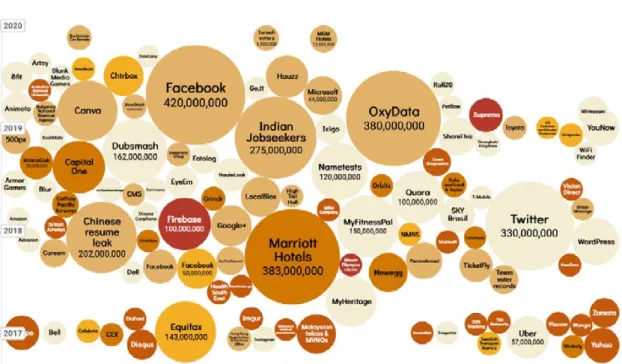
2.2 Data breaches that occurred over the last three years that were
recorded by informationisbeautiful.net at the date of the 1st April
2020. The warmer the color is, the more sensitive is the data. . . . 19
2.3 Example of an HTML5 canvas that displays overlapping texts,
rect-angles, emojis, curves, ellipses, and a shading. . . 34
2.4 Example of a two-dimensional WebGL canvas that displays a
suc-cession of connected triangles. . . 35
3.1 The gender reported by the respondents. . . 71
3.2 The age reported by the respondents. . . 71
3.3 The number of people in the household reported by the respondents. 72
3.4 The level of technical skill reported by the respondents. . . 72
3.5 The socio-professional categories of the respondents. . . 72
3.6 The type of the devices that the respondents use. Mobile phone
does not include the smartphones. . . 73
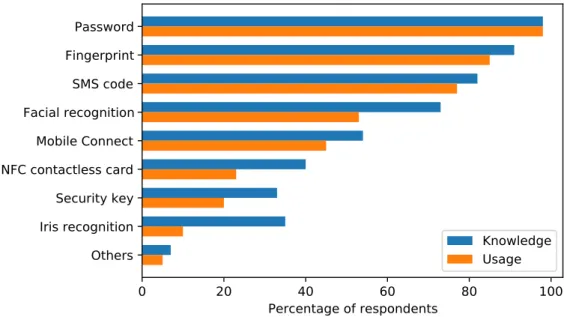
3.7 The authentication methods that the respondents know and use.
Fingerprint here refers to the biometric fingerprints. . . 73
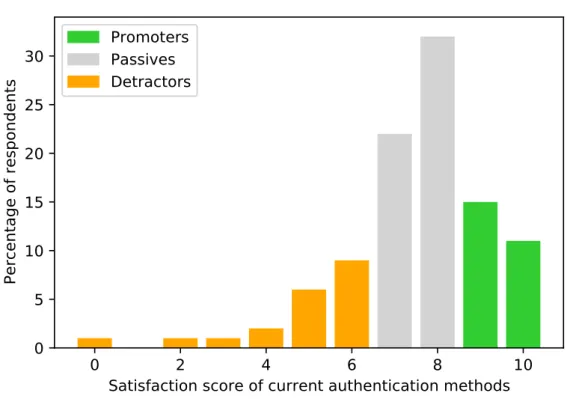
3.8 The satisfaction of the respondents with the current
authentica-tion methods. The scores are divided between the detractors, the passives, and the promoters according to the Net Promoter Score
methodology. . . 75
3.9 The reasons reported by the 261 unsatisfied respondents (20% of the respondents) about why they are dissatisfied with the current
authentication methods. . . 76
3.10 The difficulties regarding the current authentication methods that the 489 respondents (38% of the respondents) have already
encoun-tered. . . 77
3.11 The ways the respondents retrieve their passwords. . . 78
4.1 Anonymity set sizes and frequency of browser arrivals through the
time-partitioned datasets obtained for each of the four datasets. The new browsers of the general audience dataset are displayed in
hundreds of thousands. . . 90
4.2 Unicity rate for the overall, the mobile, and the desktop browsers,
through the time-partitioned datasets obtained from the general
audience and enrolled datasets. . . 90
4.3 Average similarity between the pairs of consecutive fingerprints as
a function of the time difference, together with the number of
com-pared pairs. . . 96
4.4 Cumulative distribution of the collection time of the fingerprints in
seconds. . . 100
4.5 Cumulative distribution of the fingerprint size in bytes. . . 103
4.6 The number of identical attributes between the same-browser
com-parisons and the different-browsers comcom-parisons. The figures on the left start from the lowest observed value, and those on the right start from the value for which 0.5% of the same-browser comparisons are
below (20% for the university dataset). . . 106
4.7 False match rate (FMR) and false non-match rate (FNMR) given
the required number of identical attributes, averaged among the
month samples. . . 107
4.8 Interest of the respondents in the authentication mechanism
4.9 The advantages of the authentication mechanism that are perceived by the 1, 035 respondents that are interested, according to its
de-scription. . . 113
4.10 The weaknesses of the authentication mechanism that are perceived by the 250 respondents that are not interested, according to its
description. . . 113
4.11 The satisfaction of the respondents with their experience on the test authentication mechanism. The scores are divided between the detractors, the passives, and the promoters according to the Net
Promoter Score methodology. . . 114
4.12 Cumulative distribution of the number of distinct values of the
at-tributes in logarithmic scale. . . 117
4.13 Cumulative distribution of the normalized entropy, and of the en-tropy in bits, among the attributes. The dashed gray line is the
entropy of the most entropic attribute. . . 120
4.14 Cumulative distribution of the sameness rate of the attributes among
the consecutive fingerprints. . . 127
4.15 Median collection time of the attributes that have a median collec-tion time higher than 5ms, ranked from the slowest to the fastest
to collect for the overall browsers. . . 132
4.16 Median size of the attributes that weigh more than 100 bytes, ranked
from the heaviest to the lightest. . . 138
4.17 Minimum, average, and maximum normalized conditional entropy of an attribute when the value of another attribute is known, ordered
by the average normalized conditional entropy. . . 143
5.1 Example of a web authentication mechanism based on browser
5.2 Example of an attacker instantiated with his knowledge of a prob-ability mass function (PMF) over the fingerprints F , and a web platform protecting a user population U with their fingerprint. We consider a limit of two submissions and a strict comparison between
the fingerprints. The attack dictionary is composed of f1 and f2,
resulting in the shown impersonated users. . . 161
5.3 Example of a lattice of attribute sets, with their cost c, their
sensi-tivity s, and their efficiency e. The blue node satisfies the sensisensi-tivity, the white nodes do not, and the green node with a diamond sat-isfies the sensitivity and minimizes the cost. The red line is the
satisfiability frontier. . . 167
5.4 Cost of the attribute sets found by the ASF with 1 explored path
(ASF-1), the ASF with 3 explored paths (ASF-3), the entropy, and the conditional entropy. The gray horizontal line is the cost when
considering all the candidate attributes. . . 180
5.5 Number of explored attribute sets by the attribute selection
meth-ods. . . 183
5.6 The proportion of impersonated users when considering the
candi-date attributes, and as a function of the number of submissions.
The sensitivity thresholds α are displayed. . . . 184
A.1 HTML5 canvas inspired by the AmIUnique [127] study in PNG
format. . . 211
A.2 HTML5 canvas similar to the Morellian [124] study in PNG format. 211
A.3 Architecture of the network of AudioNode objects for the simple
audio fingerprinting method. . . 212
A.4 Architecture of the network of AudioNode objects for the simple
D.1 The number of matching attributes between the same-browser com-parisons and the different-browsers comcom-parisons for the four datasets. The figure on the left starts from the lowest observed value, and the figure on the right starts from the value for which 0.5% of the same-browser comparisons are below (20% for the university dataset).
. . . 226
D.2 False match rate (FMR) and false non-match rate (FNMR) given the required number of matching attributes, averaged among the
month samples for the four datasets. . . 227
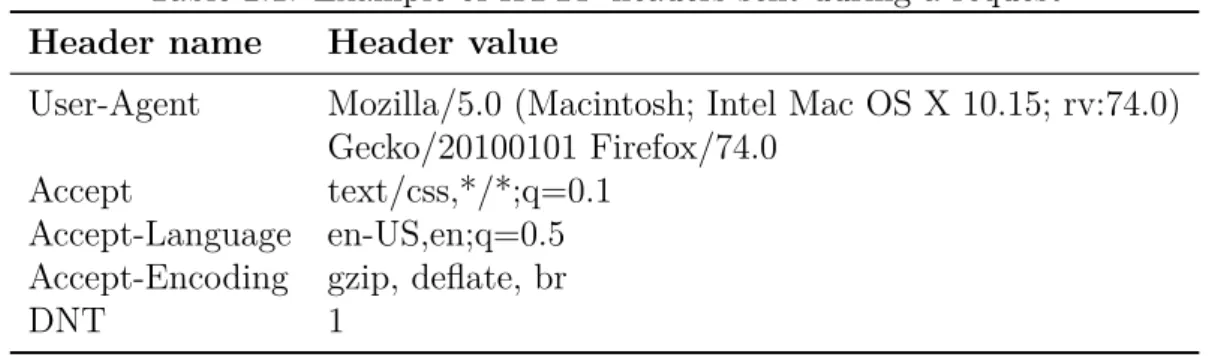
2.1 Example of HTTP headers sent during a request . . . 33
2.2 Usages of browser fingerprinting, classified between the usages to
recognize a browser in the crowd, and the ones to recognize the
type of browser. . . 38
3.1 Comparison between the browser fingerprint datasets obtained from
the four experiments, and the large-scale datasets of previous stud-ies. Previous studies include the studies Panopticlick (PTC) [56], AmIUnique (AIU) [127], Hiding in the Crowd (HitC) [81], and Long-Term Observation (LTO) [178]. The returning browsers are the browsers from which multiple fingerprints have been collected. The unicity is the proportion of the fingerprints that were observed for a single browser only. The attributes comprise the derived attributes. The number of fingerprints and of distinct fingerprints are obtained after dataset preprocessing. As the LTO study tests various at-tribute sets, we present the ranges of the results obtained by their attribute selection method. - denotes missing information, and * denotes deduced information. The proportion of mobile and desktop fingerprints do not sum to 1.0 as other device types were observed
(e.g., tablets, TVs, video game consoles). . . 58
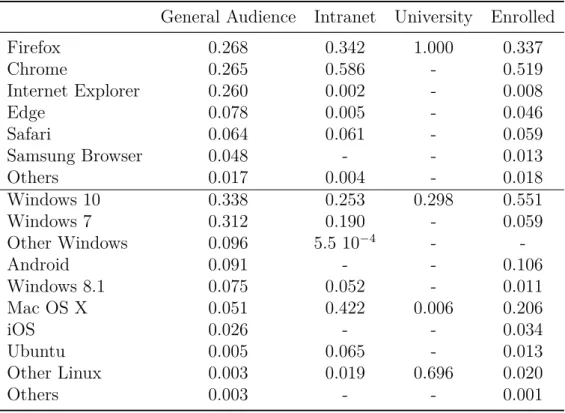
3.2 The share of browser and operating system families among the
browser populations of the four experiments. The categories are ordered from the most common to the least for the general
audi-ence dataset. . . 59
3.3 The number of initial raw entries, together with the number of en-tries having a bad format, coming from robots, having the cookies disabled, or having a duplicated fingerprint, which are filtered out. The proportion of browsers observed with an interleaved fingerprint
is also shown. . . 70
4.1 Comparison of the normalized entropy between the studies
Panop-ticlick (PTC) [56], AmIUnique (AIU) [127], Hiding in the Crowd (HitC) [81], and our four datasets. The attributes are ranked from the most to the least distinctive for the general audience dataset. We provide the normalized entropy equivalent to 1 bit of entropy
for comparison. . . 121
4.2 The minimum normalized conditional entropy (MNCE) of the
at-tributes that have a MNCE higher than the equivalent of a con-ditional entropy of 1 bit, for the general audience, intranet, and enrolled datasets. W refers to the window object, and N to the navigator object. - denotes an attribute that is not included in, or
that do not have a MNCE sufficiently high for, a given dataset. . . 144
4.3 The minimum normalized conditional entropy and the minimum
conditional entropy in bits of the attributes that have a non-null MNCE for the university dataset. A refers to an initialized audio context, N to the navigator object, WG to an initialized WebGL
context, and S to the screen object. . . 148
4.4 The dynamic attributes included in the four datasets. - denotes a
non-included attribute. * indicates that the attribute is generated
using randomized instructions, hence is always unique. . . 149
5.1 Example of fingerprints shared by users. . . 164
5.2 Example of the execution of Algorithm 1 on the lattice of Figure 5.3,
with the sensitivity threshold α = 0.15 and the number of explored
paths k = 2. Stage i is the state at the end of the i-th while loop. 171
5.3 The cost of the candidate attributes, together with the maximum,
the average, and the minimum cost of a single attribute for each
5.4 The attributes selected by the attribute selection framework for each experimentation setup of the general audience dataset. We denote
k the number of explored paths, β the number of fingerprint
sub-missions, and α the sensitivity threshold. . . . 186
5.5 The attributes selected by the attribute selection framework for each
experimentation setup of the enrolled dataset. We denote k the number of explored paths, β the number of fingerprint submissions,
and α the sensitivity threshold. . . . 187
A.1 The HTTP headers that are stored into a dedicated attribute, and
the headers that are ignored, for each experiment. . . 205
A.2 Extensions detected by the changes they bring to the page content. 208
A.3 Extensions detected by the availability of their web accessible
re-source. C stands for chrome, and R stands for rere-source. . . 209
A.4 Properties of the div element measured for the attributes related
to the bounding boxes. . . 210
C.1 The keywords and the exact userAgent values that we consider as indicating a robot browser. The long values are cut at a blank space
and displayed with indentations. . . 222
C.2 The keywords that we consider as indicating each device type. . . . 223
C.3 The keywords that we consider as indicating each browser family. . 223
C.4 The keywords that we consider as indicating each operating system
family. . . 223
D.1 Comparison between the simple verification mechanism that uses identical attributes and the advanced verification mechanism that
uses matching attributes for the general audience dataset.. . . 230
D.2 Comparison between the simple verification mechanism that uses identical attributes and the advanced verification mechanism that
uses matching attributes for the intranet dataset. . . 231
D.3 Comparison between the simple verification mechanism that uses identical attributes and the advanced verification mechanism that
D.4 Comparison between the simple verification mechanism that uses identical attributes and the advanced verification mechanism that
uses matching attributes for the enrolled dataset. . . 232
I.1 The attributes of the general audience dataset, together with their
distinct values, their normalized entropy, their minimum normalized conditional entropy (MNCE), their stability, their median size, and their median collection time. The attributes from which we derive
the extracted ones are ignored for the MNCE. . . 267
I.2 The additional attributes of the intranet dataset, together with their
distinct values, their normalized entropy, their minimum normalized conditional entropy (MNCE), their stability, their median size, and
their median collection time. . . 278
I.3 The additional attributes of the enrolled dataset, together with their
distinct values, their normalized entropy, their minimum normalized conditional entropy (MNCE), their stability, their median size, and
1 Greedy algorithm to find good solutions to the Attribute Selection
Problem. . . 169
2 Illustrative sensitivity measure. . . 173
Introduction
Since the genesis of the World Wide Web – or web for short – at the end of the eighties, the technologies surrounding the web never stopped developing. It is now
possible to hold video conferences [222], play video games1, or manipulate
three-dimensional scenes [221] using a common web browser. As the functionalities of the web technologies evolve, a large variety of services become accessible on the web. Examples are the social networks that help people connect each other, the government websites that help citizens perform administrative procedures, or the bank websites that help their clients execute financial transactions. Although websites are usually publicly accessible, some services should be only accessible by designated users. For example, the owner of a bank account should be the only user that is authorized to perform transactions on her account. Therefore, website owners have to verify that a user legitimately owns the account for which he wants to perform an operation before authorizing him to do so. The problem that the website owner has to solve is the authentication. It consists for the website owner, called the verifier, to check that the user owns the claimed account.
To authenticate a user, the verifier asks him to provide pieces of evidence – called authentication factors – that only the account owner should be able to present. The most used authentication factor on the web is currently the pass-word thanks to its ease of use and deployment [28]. However, passpass-words have been shown to suffer from severe security flaws when used without any additional
au-1http://xproger.info/projects/OpenLara
thentication factor. Real-life users indeed use common passwords [94], which paves the way to brute-force or guessing attacks [28]. Moreover, they tend to use similar passwords across different websites [44], which increases the impact of successful attacks. Phishing attacks are also a major threat to the use of passwords. Over the course of a year, Thomas et al. [210] achieved to retrieve 12.4 million credentials stolen by phishing kits. These flaws bring the need for supplementary security lay-ers, primarily through multi-factor authentication [30] such that each additional factor provides an additional security barrier. However, this usually comes at the cost of usability (i.e., users have to remember, possess, or do something) and deployability (i.e., verifiers have to deploy dedicated hardware or software, teach users how to use them, and maintain the deployed solution). According to
previ-ous estimations [173, 149], the usage rate of multi-factor authentication is below
10%.
In the meantime, browser fingerprinting gains more and more attention. It is the collection of attributes from a web browser to build its fingerprint, which is potentially unique. In his thesis, Mayer [145] is the first to ask if "with all the customizations now available [...] are any two web browsing environments iden-tical?" By collecting four attributes from 1, 328 web browsers, he observes that 96.23% of them show a unique combination of these four attributes. Shortly af-ter, Eckersley [56] published the results from the Panopticlick website [72] which invited users to provide their browser fingerprint. Among the 470, 161 collected fingerprints composed of 8 attributes, 83.6% were observed for a single browser. This result showed the effectiveness of browser fingerprints to recognize browsers, and lead the way of the research on browser fingerprinting. Since the discovery of the technique, a plethora of attributes have been reported. They started from the information provided by common JavaScript objects and HTTP headers [145, 56, 127], to images drawn by the browser [153, 36], to the installed fonts inferred by the size of text boxes [65], to the technical information of a real-time
commu-nication [66], to the installed browser extensions [205, 199], and to audio signals
manipulated in the browser [179]. The first studies on browser fingerprinting focus on the threat posed by browser fingerprinting to the privacy of web users, whether
it is about its effectiveness [56, 25, 228, 2, 96, 127], its use on the web [3, 57,64],
to being widely used for web tracking purposes (raising legal, ethical, and tech-nical issues), browser fingerprinting is also used for web authentication. Verifiers typically include browser fingerprints as a supplementary factor that is verified at login. Browser fingerprints are indeed a promising candidate as an additional web authentication factor thanks to their distinctive power, their frictionless deploy-ment (e.g., no additional software or hardware to install), and their usability (no secret to remember, no additional object to possess, and no supplementary action to carry out). As a result, companies like MicroFocus [70] or SecureAuth [196] include this technique into their authentication mechanisms.
1.1
Motivations
1.1.1
Adequacy of Browser Fingerprints for
Authentica-tion
To the best of our knowledge, no large-scale study rigorously evaluates the ad-equacy of browser fingerprints as an additional web authentication factor. On the one hand, most works about the use of browser fingerprints for
authentica-tion concentrate on the design of the authenticaauthentica-tion mechanism [212, 177, 79,
203, 124, 184]. On the other hand, the large-scale empirical studies on browser
fingerprints focus on their effectiveness as a web tracking tool [56, 127, 81, 178].
Such a mismatch between the understanding of browser fingerprints for authenti-cation – currently poor – and their ongoing adoption in real-life is a serious harm to the security of web users. The lack of documentation from the existing au-thentication tools (e.g., about the used attributes, about the distinctiveness and the stability of the resulting fingerprints) only adds up to the current state of ignorance, all this whereas security-by-obscurity directly contradicts the most fun-damental security principles. Moreover, the distinctiveness of browser fingerprints that can be achieved when considering a wide-surface of fingerprinting attributes on a large population is, to the best of our knowledge, unknown. On the one hand, the studies that analyze browser fingerprints in a large-scale (more than
100, 000 fingerprints) consider fewer than thirty attributes [56, 127,214,81]. This
33.6% of unique fingerprints) as it increases the chances for browsers to share the same fingerprint. All this whereas more than a hundred attributes are accessi-ble. On the other hand, the studies that consider more than fifty attributes either
work on less than two thousand users [111, 178], or do not analyze the resulting
fingerprints at all [64]. The current knowledge about the hundreds of accessible attributes (e.g., their stability, their collection time, their correlation) is, to the best of our knowledge, also incomplete. Indeed, previous studies consider few
at-tributes [56,153,65,36,127,199,81,179] or focus on a single aspect of them (e.g.,
their stability [214]). Furthermore, to the best of our knowledge, only Blake et al. [24] studied two browser populations, but not according to the same properties as the second population only gets the stability of their fingerprints studied. The properties of the browser fingerprints that are collected during an experiment vary according to the attributes that are used, but also according to the studied browser population. To the best of our knowledge, no study compares the properties of browser fingerprints collected from various browser populations.
1.1.2
Selection of Browser Fingerprinting Attributes
The verifiers are given a large choice of attributes2 to build their browser
finger-printing probe, and face the problem of which attributes to use. On the one hand, the addition of an attribute to the probe can strengthen the distinctiveness of browsers, which helps to distinguish a legitimate user from an impostor. On the other hand, each addition comes with a usability cost that may render the probe impractical in an online authentication context. Indeed, each attribute consumes storage space (up to hundreds of kilobytes [36]), collection time (up to several
min-utes [152,155,157,191,193,179]), and can increase the instability of the generated
fingerprints [214]. Moreover, some attributes are strongly correlated together, and including them only increases the usability cost without increasing the distinctive-ness. Due to these correlations, picking attributes one by one independently may
2Most attributes are properties accessed through the browser that are limited by its func-tionalities. Other attributes are items which presence are checked (e.g., the fonts [83], the extensions [199]) or the computation of specific instructions (e.g., the canvas [36]). These are limited by the available items or instructions, which can be large (e.g., more than 2154 for the canvas [124]).
lead to poor distinctiveness and usability. Previous works cope with the problem of
attribute selection by considering the well-known attributes [56,127,81], removing
the attributes of the lowest entropy [214], picking iteratively the attribute of the
highest weight (typically the entropy) until a threshold is reached [146,111,65,24,
91,208], or evaluating every possible set [69]. The entropy measures the skewness of the distribution of fingerprints or attribute values. As pointed out by Acar [4], it does not take the worst cases into account (i.e., the most common values that attackers can submit similarly to dictionary attacks on passwords [28]). Moreover, fingerprints cannot be compared identically like passwords due to their evolution through time. The impersonators do not need to find the exact fingerprint of a victim, but one that is similar enough to deceive the verification mechanism. The problem could be solved by exploring exhaustively the space of the possible at-tribute sets, evaluating the distinctiveness and the usability cost of each set. This is, however, infeasible as the number of attribute sets grows exponentially with
the number of attributes3.
1.2
Contributions
1.2.1
Assessing the Adequacy of Browser Fingerprints for
Web Authentication
We conduct the first large-scale data-centric empirical study of the fundamental properties of browser fingerprints when used as an additional web authentication factor. We base our findings on the analysis of our four fingerprint datasets, that include a dataset of 4, 145, 408 fingerprints composed of 216 attributes plus 46 extracted attributes. In particular, this dataset includes nine dynamic attributes of three types, which values depend on instructions provided by the verifier: five HTML5 canvases [36], three audio fingerprinting methods [179], and a WebGL canvas [153]. The dynamic attributes are used within state-of-the-art web
authen-tication mechanisms to mitigate replay attacks [184,124]. Each dynamic attribute
has been studied singularly, but their fundamental properties have not yet been
studied simultaneously on the same browser population. To the best of our knowl-edge, no related work considers several datasets of this scale, in terms of both fingerprints and attributes, together with various dynamic attributes. We formal-ize, and assess on our datasets, the properties necessary for paving the way to elaborate browser fingerprinting authentication mechanisms. We make the link between the browser fingerprints that distinguish browsers, and the biological fin-gerprints that distinguish Humans, to evaluate browser finfin-gerprints according to
properties inspired by biometric authentication factors [139, 231, 75]. The
prop-erties aim at characterizing the adequacy and the practicability of browser finger-prints, independently of their use within future authentication mechanisms. In particular, we measure the size of the browser anonymity sets through time, the proportion of identical attributes between two observations of the fingerprint of a browser, the collection time of the fingerprints, their size, the loss of effective-ness between device types, and the accuracy of a simple illustrative verification mechanism. To comprehend the obtained results on the complete fingerprints, we include an in-depth study of the contribution of the attributes to the fingerprint properties. Moreover, we discuss the correlation between the attributes, make a focus on the contribution of the dynamic attributes, and provide the exhaustive list of the attributes together with their properties. To the best of our knowledge, no previous work analyzed browser fingerprinting attributes at this scale, in terms of the number of attributes, of the number of fingerprints, and of the variety of properties (e.g., stability, collection time). We also present the results of a survey about the authentication habits of users and the acceptability of an authentication mechanism relying on browser fingerprinting.
1.2.2
Attribute Selection according to a Security and
Us-ability Trade-off
We place ourselves in the context of a verifier that aims to protect the users of her web platform using a browser fingerprinting based authentication mechanism. The verifier stores the fingerprint of the usual browser of each user. On each login, the fingerprint of the browser of the user is matched against the fingerprint that is stored for this user. The attacker tries to impersonate the users by submitting
specially crafted fingerprints. The aim of the verifier is to limit the reach of the at-tacker, also called sensitivity, which is measured as the proportion of impersonated users. We propose the FPSelect framework to help verifiers choose the attributes to include in their fingerprinting probe such that (1) the sensitivity against pow-erful attackers knowing the fingerprint distribution of the protected users (i.e., the worst-case distribution for the verifier) is bounded and the bound is set by the verifier, and (2) the usability cost of collecting, storing, and using these attributes is close to being minimal. FPSelect is parameterized with the sensitivity require-ment, the number of submissions that the attacker is deemed able to execute, and a representative sample of the fingerprints of the users. To design and evaluate the FPSelect framework, we perform the following steps. We formalize the attribute selection problem that a verifier has to solve to dimension her probe, and show that this problem is NP-hard because it is a generalization of the Knapsack Problem. We define the model of the dictionary attacker, whose adversarial power depends on the knowledge of a fingerprint distribution and the number of fingerprint that he is able to submit. We propose an illustrative measure to quantify the sensi-tivity of a probe given a browser population and the number of fingerprints that the attacker is able to submit. We propose an illustrative measure of the usability cost that combines the size of the generated fingerprints, their collection time, and their instability. We propose a heuristic algorithm for selecting an attribute set that satisfies a higher bound on the sensitivity and reduces the usability cost. We express this as a search problem in the lattice of the power set of the candidate attributes. This heuristic is inspired by the Beam Search algorithm [103] and is part of the Forward Selection algorithms [194]. We evaluate the FPSelect frame-work on two real-life fingerprint datasets, and compare it with common attribute selection methods based on the entropy and the conditional entropy. We show experimentally that FPSelect finds attribute sets that have a lower usability cost compared to both the candidate attributes and the baselines.
1.3
Scientific Publications
During this thesis, we published the papers that are listed below, from which parts of this thesis were adapted.
[13] Nampoina Andriamilanto, Tristan Allard, and Gaëtan Le Guelvouit. “FPSelect: Low-Cost Browser Fingerprints for Mitigating Dictionary At-tacks against Web Authentication Mechanisms". In: Annual Computer Se-curity Applications Conference (ACSAC). ISBN: 978-1-4503-8858-0. DOI:
10.1145/3427228.3427297. URL:
https://hal.archives-ouvertes.fr/hal-02965948/document.
[12] Nampoina Andriamilanto, Tristan Allard, and Gaëtan Le Guelvouit. “Guess Who? Large-Scale Data-Centric Study of the Adequacy of Browser Fingerprints for Web Authentication". In: Innovative Mobile and Internet Services in Ubiquitous Computing (IMIS). Ed. by L. Barolli, A. Poniszewska-Maranda, and H. Park. 2021, pp. 161-172. ISBN: 978-3-030-50399-4. DOI:
10.1007/978-3-030-50399-4_16. URL: https://hal.archives-ouvertes.
fr/hal-02611624/document.
[15] Nampoina Andriamilanto, Gaëtan Le Guelvouit, and Tristan Allard. “Browser Fingerprinting for Web Authentication, A Large-scale Empirical
Analysis". In: Rendez-Vous de la Recherche et de l’Enseignement de la
Sécurité des Systèmes d’Information (RESSI). National conference without proceedings. 2019.
1.4
Outline of the Thesis
The remainder of this thesis is organized as follows.
• In Chapter 2, we present the current state of web authentication where the
usage of passwords is prevalent but flawed. We categorize the authentica-tion methods that can supplement passwords, and remark that their usage rate is limited due to usability and deployability costs. Then, we present the browser fingerprinting technique, and the related works on its usage for authentication. Finally, we position our contributions in the research axis of browser fingerprinting for authentication. We notably make the link between biometric authentication methods and browser fingerprinting.
• In Chapter3, we present the four experiments that we performed. They are the collection of browser fingerprints from four browser populations. The populations are the browsers that visited one of the most visited French website, those visiting the internal website of a company, the standardized browsers of a university, and the browsers that participated in the test of an authentication platform relying on browser fingerprints. As irrelevant data appear in the collected datasets, we describe the preprocessing steps performed to obtain the working datasets. We also introduce the survey about the acceptability of browser fingerprinting for authentication that we performed, by discussing respondent population and their current authenti-cation habits.
• In Chapter 4, we present our contribution about the adequacy of browser
fingerprinting for web authentication. It takes the form of the first large-scale data-centric empirical study of the properties of browser fingerprints when used as an additional web authentication factor. We base our findings on the analysis of our four fingerprint datasets. We make the link between browser fingerprints and biometric authentication factors, and analyze the former according to properties inspired by the latter. We complement our results with the study of the contribution of the attributes to the properties of the fingerprints.
• In Chapter 5, we present our contribution to the methods for selecting the
attributes to use: the FPSelect framework. This framework helps the veri-fier select the attributes to include in his fingerprinting probe according to a trade-off between the security and the usability of the generated finger-prints. The security captures the robustness against a modeled attacker, who leverages external knowledge to present specifically crafted fingerprints to impersonate users. The usability is quantified according to the collection time, the size, and the instability of the generated fingerprints. The frame-work frame-works by modeling the set of possibilities as a lattice, and by exploring a parameterized number of paths in this lattice. We experimentally show that the framework performs better than the common baselines.
• Finally, Chapter 6 concludes this thesis, and discusses future works and perspectives on browser fingerprinting for web authentication.
Background and Context
In this chapter, we begin by presenting the current state of web authentication
and by defining the terms related to authentication. We show that the most
used web authentication method is the password, and argue that it suffers from several flaws. We classify the other authentication methods that can supplement passwords to mitigate these flaws, and remark that their usage rate is estimated as low. Indeed, each of these methods comes with a usability cost or a deployability cost that can prevent people from implementing or using them. We present the related works that propose frameworks to evaluate and compare authentication methods. Among these methods, we focus on the biometric methods as they have the particularity of being inexact (e.g., a digital fingerprint is not matched exactly like passwords as changes can occur through time). One important property of authentication methods is their robustness against attacks. Hence, we highlight the common attacks that can be executed on authentication methods.
Second, we focus on a promising candidate: browser fingerprinting. It aims at distinguishing browsers based on attributes that can be collected transparently from the browser. We present the history of browser fingerprinting, the attributes discovered through time, and the usual measures of distinctiveness and stability to evaluate them. We provide the known usages of browser fingerprinting, and ac-knowledge that it is mainly used for web tracking purposes. Although browser fin-gerprinting is mainly used for identification, we are interested in its contribution to web authentication. We provide related works on the usages for both identification
and authentication. The related works on the latter propose to include the browser fingerprint as additional verified information in authentication mechanisms, study the adequacy of browser fingerprints for authentication, propose methods to reduce the number of collected attributes, and design challenge-response mechanisms that leverage the dynamic attributes to thwart replay attacks. We position our contri-butions in relation to the research axis of browser fingerprinting for authentication. We notably make the link between biometric authentication factors and browser fingerprints to evaluate the latter according to properties inspired by the former. Indeed, they both consist into extracting features (e.g., a digital fingerprint, a browser fingerprint) from a unique entity (i.e., a person, a browser) to authenti-cate the entity. Imperfections can occur as we manipulate digital representation of the features (e.g., two persons or two browsers can share the same fingerprint). Some evaluated properties capture the severity of these imperfections.
This chapter is organized as follows. First, Section2.1presents the current state
of web authentication, the wide usage of passwords, and the candidate authenti-cation factors to supplement them. Then, we present the browser fingerprinting
technique in Section 2.2, the known attributes, and its various uses. Section 2.3
focuses on browser fingerprinting for authentication, for which we provide related
works, and in which we position of our contributions. Finally, Section 2.4
con-cludes.
2.1
Web Authentication
In this section, we begin by defining the terms of authentication, user authentica-tion, and web authentication. Then, we present the current state of web authen-tication that widely relies on passwords. Third, we present the several flaws that passwords suffer from, which lead to the use of additional authentication factors. We argue that the factors proposed can decrease the usability or the deployabil-ity of the authentication mechanism. To comprehend how authentication factors affect a mechanism, previous works have proposed frameworks to evaluate them. Fourth, we present an overview of these frameworks, and focus on the desirable properties of biometric factors. The biometric factors interest us, as the scheme that integrate them have to cope with imperfections. For example, the same
nu-merical representation of the biometric factor – called the biometric template – can be shared by two persons, and the biometric template of a person can evolve through time.
2.1.1
Definitions
User Authentication
According to the Merriam-Webster online dictionary1, authentication is the “act,
process, or method of showing something to be real, true, or genuine”. In computer science, the term usually refers to the verification of the identity of a user. It consists into a user claiming an identity (e.g., a bank account, a student account) to a verifier (e.g., a bank, a university). The claiming user is called the claimant for simplicity. To prove that the claimed identity belongs to the claimant, the claimant presents credentials that are proofs that the identity belongs to him (e.g., a password, a student card). The verifier compares the provided credentials with the credentials associated to the claimed identity. If the verifier deems the credentials genuine, he grants the claimed identity to the claimant. Otherwise, the verifier does not grant the identity, and can take restrictive measures towards this user as it can be an attempt of fraudulent access. User authentication is the process of verifying that the claimed identity belongs to the claimant.
Authentication Factor, Scheme, and Mechanism
The credentials are more specifically called authentication factors. An authenti-cation factor is a piece of evidence that the claimant present to the verifier, to support his claim that the identity belongs to him. Examples of authentication factors are passwords, phone numbers, and fingerprints.
An authentication scheme is the set of processes that are needed to verify an authentication factor. The same authentication factor can be used by multiple authentication schemes. For example, several authentication schemes that use the fingerprint authentication factor have been proposed [118]. They typically differ on the quantization of the fingerprints and on the parameters used (e.g., the threshold
on the matching score, the parameters of the machine learning model).
An authentication mechanism is the complete system that integrates one or several authentication schemes and manages their combination. The verifier de-signs the authentication mechanism that she implements in her web platform. For example, she implements a mechanism that relies on a password and on a digital fingerprint, which only asks for the fingerprint if the password is correct, and which verifies the fingerprint according to a given fingerprint verification mechanism.
Difference with Identification and Authorization
As authentication is sometimes mistaken with identification or authorization, we highlight here the differences between these terms.
Identification is, according to the Cambridge online dictionary2, the “act of
recognizing and naming someone or something”. User authentication refers to the verification that the identity claimed by a user legitimately belongs to her, answering the question “is this user who she claims to be?”. User identification consists into the retrieval of the identity of a user, answering the question “who is this user?”. Authentication is a one-to-one matching, as the verifier receives a claimed identity, and compares the information of the claimed identity with the information provided by the claimant. Identification is a one-to-many matching, as the verifier searches for the identity which matches with the information of the user to identify. We stress that authentication factors can also be used for identification (e.g., facial or fingerprint recognition).
Authorization occurs after the claimed identity is granted to the claimant. It consists into the verification that the identity is authorized to execute actions (e.g., access, modification) on resources (e.g., files, information), answering the question “is this identity authorized to do this action on this resource?”.
Enrollment, Verification, and Recovery
An authentication mechanism is composed of three separate stages. The initial stage is the enrollment, which is the association of the authentication factors to an identity. For example, a user that enters his chosen password at the creation of
http://example.com
Get login page Login page Authentication factors Access granted / denied
Account database
User Web browser
Verifier's web platform
Figure 2.1: Web authentication process between the verifier’s web platform and a user.
his account, or a bank that binds a set of security codes to a customer’s account before sending them to him. After linking the authentication factors to an identity, users can claim this identity by presenting the factors (e.g., entering the password). This stage is called the verification, as the verifier checks the presented factors. Finally, the recovery is a stage during which users use another set of factors, due to the inability to use one or many primary authentication factors. It occurs when users are unable to present one of the required factor, e.g., when they forget their password or lose their physical token.
Web Authentication
In this thesis, we focus on the authentication of a user in a web context, that we call web authentication for simplicity. The verifier controls a website that
contains resources that are private to specific users. A user navigates to the
verifier’s website using a standard web browser, and claims an identity to the verifier. The identity is typically identified by a username, an email, or a phone number [180]. The claimant also provides authentication factors as proofs that the identity belongs to him. If the authentication factors are deemed genuine by the verifier, the verifier grants the identity to the claimant, and the claimant can
access the resources that are private to this identity. Figure 2.1 depicts a web
authentication process between the verifier’s web platform and a user.
A concrete example is a bank that controls a banking site, and that only authorizes the owner of a bank account to carry out operations on it. The users identify themselves on the banking site using their customer number, and provide a password as credential. The bank compares the submitted password with that of the claimed account, and grants the identity of the claimed account to the user
only if the passwords match. Otherwise, the bank does not grant the identity to the user, prevents any authentication attempt for a given amount of time, and notifies the account owner about the failed attempt.
2.1.2
Wide Usage and Flaws of Passwords
Nowadays, the authentication factor most implemented by verifiers is the pass-word [27, 180]. This is mostly due to its ease of use, its ease of deployment, and the familiarity of users to it. Indeed, passwords are strings of characters that are chosen by users, and submitted to the verifier through a simple form on his website on each authentication. On the other side, verifiers only have to process a strict comparison between the submitted password and the password stored for the claimed account. Although passwords are widely used, they are known to suffer from several flaws. We describe these flaws in this section.
Password Guessability
Passwords are chosen by human users and are not randomly picked in the space of possibilities. They are usually composed of common words (e.g., common names) or common sequences of digits (e.g., dates, zip codes). This makes them easier for an attacker to guess, either through an offline guessing attack, or to a lesser extent, through an online guessing attack. We describe below these two types of guessing attack.
An offline guessing attack [223] consists into getting couples of identifier and password hash, and retrieving the plain text of the hashed passwords. This is done by hashing selected plain texts, and comparing the obtained hash with the hashes to retrieve. This attack is then limited by the computational power of the attacker. An online guessing attack [220] consists into submitting couples of identifier and password directly to the authentication service of the website. This is done by submitting the most probable passwords given the knowledge of the attacker about the victims’ password. This attack is then limited by the capacity of the verifier to limit the authentication attempts to a given identity. To execute both of these guessing attacks, attackers need to find the passwords to try. They can do this by brute force attacks, or more efficiently by dictionary attacks. We