HAL Id: tel-00939073
https://tel.archives-ouvertes.fr/tel-00939073
Submitted on 30 Jan 2014HAL is a multi-disciplinary open access archive for the deposit and dissemination of sci-entific research documents, whether they are pub-lished or not. The documents may come from teaching and research institutions in France or abroad, or from public or private research centers.
L’archive ouverte pluridisciplinaire HAL, est destinée au dépôt et à la diffusion de documents scientifiques de niveau recherche, publiés ou non, émanant des établissements d’enseignement et de recherche français ou étrangers, des laboratoires publics ou privés.
Daniel Wesierski
To cite this version:
Daniel Wesierski. Visual tracking of articulated and flexible objects. Other [cs.OH]. Institut National des Télécommunications, 2013. English. �NNT : 2013TELE0007�. �tel-00939073�
DOCTORANT EN CO-ACCREDITATION
TELECOM SUDPARIS ET L’UNIVERSITE EVRY VAL D’ESSONNE
Sp´ecialit´e: Informatique
´
Ecole doctorale : Sciences et Ing´enierie Pr´esent´ee par
Daniel
Wesierski
Pour obtenir le grade de
DOCTEUR DE TELECOM SUDPARIS
Visual tracking of articulated and flexible objects
Soutenue le 25 mars 2013 devant le jury compos´e de:
Fr´ed´eric Jurie Professeur `a l’Universit´e de Caen Rapporteur
R´emi Ronfard Charg´e de Recherche de 1`ere classe HDR `a l’INRIA et au LJK Rapporteur
Catherine Achard Maˆıtre de Conf´erences HDR `a l’UPMC Examinatrice
Malik Mallem Professeur `a l’Universit´e d’´Evry-Val-d’Essonne Examinateur
Bernadette Dorizzi Professeur `a T´el´ecom SudParis Directrice de th`ese
Patrick Horain Ing´enieur d’´Etude `a T´el´ecom SudParis, Docteur ing´enieur Encadrant
Contents
Abstract vii Acknowledgments ix 1 Introduction 1 1.1 Problem formulation . . . 2 1.2 Challenges . . . 3 1.3 Contributions . . . 71.3.1 Tracking objects of various shapes and motions . . . 7
1.3.2 Efficient convolution routine for Haar-like features . . . 8
1.4 Organization of the thesis . . . 9
1.5 Publications . . . 10
2 State of the art 11 2.1 Image Fundamentals . . . 11
2.1.1 Feature primitives . . . 12
2.1.2 Feature transforms . . . 13
2.2 Tracking in low dimensions . . . 16
2.2.1 Basic idea behind tracking. . . 16
2.2.2 Gradient-based tracking methods . . . 18
2.2.3 Fast motion . . . 20
2.2.4 Appearance change. . . 22
2.2.4.1 Stability vs plasticity dilemma . . . 23
2.2.4.2 On-line learning . . . 24
2.2.5 Summary . . . 25
2.3 Tracking in higher dimensions . . . 27
2.3.1 Models of objects . . . 27
2.3.1.1 Shape and appearance. . . 28
2.3.1.2 Complex Motion . . . 30
2.3.2 Model matching algorithms . . . 31
2.3.2.1 Local methods . . . 32
2.3.2.2 Semi-global methods. . . 33
2.3.2.3 Global methods . . . 34
2.3.3 Summary . . . 35
3 Tracking objects with global spatio-temporal constraints 37 3.1 Background . . . 39
3.2 Chain-graph models . . . 41
3.2.1 Appearance term . . . 42
3.2.2 Spatial term . . . 42
3.2.3 Temporal term . . . 44
3.3 Model-based object categories . . . 46
3.4 Tracking algorithm . . . 48 3.4.1 Initialization . . . 48 3.4.2 Matching . . . 48 3.4.3 Update . . . 50 3.5 Experiments. . . 53 3.5.1 Implementation details. . . 53 3.5.2 Qualitative Analysis . . . 54 3.5.3 Quantitative Analysis . . . 55
3.6 Conclusions and Discussion . . . 60
4 Model configurations for tracking various objects 63 4.1 Introduction. . . 64
4.2 Tracking straight objects. . . 65
Contents v
4.4 Tracking heavily deformable objects . . . 78
4.5 Conclusions . . . 86
5 Efficient Convolution of Haar-like Features 87 5.1 Motivation . . . 88
5.2 Parsing Haar-like features . . . 90
5.2.1 Background . . . 91
5.2.2 Problem formulation . . . 93
5.2.2.1 Model . . . 93
5.2.2.2 Example . . . 96
5.2.3 Proposed parsing algorithm . . . 97
5.2.3.1 Decomposing features into smaller kernels. . . 99
5.2.3.2 Ensembles of trees . . . 100
5.2.3.3 Choosing the best ensemble. . . 102
5.2.3.4 Implementation: B -channel buffer . . . 103
5.3 Experiments. . . 104
5.4 Conclusions and Discussion . . . 107
6 Conclusions 109 6.1 Contributions of the thesis. . . 109
6.2 Potential of the tracking approach . . . 110
6.3 Limitations of the approach . . . 111
6.4 Future work . . . 112
List of figures 115
List of tables 119
Abstract
Humans can visually track objects mostly effortlessly. However, it is hard for a computer to track a fast moving object under varying illumination and occlusions, in clutter, and with varying appearance in camera projective space due to its relaxed rigidity or change in viewpoint. Since a generic, precise, robust, and fast tracker could trigger many applications, object tracking has been a fundamental problem of practical importance since the beginnings of computer vision.
The first contribution of the thesis is a computationally efficient approach to tracking objects of various shapes and motions. It describes a unifying tracking system that can be configured to track the pose of a deformable object in a low or high-dimensional state-space. The object is decomposed into a chained assem-bly of segments of multiple parts that are arranged under a hierarchy of tailored spatio-temporal constraints. The robustness and generality of the approach is widely demonstrated on tracking various flexible and articulated objects.
Haar-like features are widely used in tracking. The second contribution of the thesis is a parser of ensembles of Haar-like features to compute them efficiently. The features are decomposed into simpler kernels, possibly shared by subsets of features, thus forming multi-pass convolutions. Discovering and aligning these kernels within and between passes allows forming recursive trees of kernels that require fewer mem-ory operations than the classic computation, thereby producing the same result but more efficiently. The approach is validated experimentally on popular examples of Haar-like features.
Acknowledgments
Foremost, I would like to thank my supervisor, Patrick Horain, who has been guiding me from the very first day of the thesis. He has always had time for me and my thinking benefited much from discussions with him on computer vision. Our interaction have progressed my skills considerably.
My sincere thanks go to my thesis director, Berndatte Dorizzi, and to J´erˆome Boudy coordinating my work along the ambitious roadmap of the EU-funded Com-panionAble project. Their cheerfulness and readiness to help in all matters have been very impressing to me. Moreover, it was a big fun to interact with the Com-panionAble “crew” during our project meetings across whole Europe. In particular, I would like to thank the Technical University of Ilmenau for inviting me for a short stay at their robotics lab - it was a great, interesting experience.
Nice atmosphere at the department have also embraced me thanks to Badr-Eddine Benkelfat and his kind leadership as well as to Patricia Fixot and her smile, openness, and patience of the Super Souris power, who always helped me with administrative work. My friends at the lab, Maher, David, Manoj, Daria, Sesh, J´erˆome, Paulo, Toufik, and Mohammed, merit my special thanks, too. I have shared interesting work and great time and jokes with them.
At all times, my fianc´ee, Aneczka, has been beside me with love, support, and encouragement. Her unmatchable positive attitude to life has been brightening my path throughout this intensive period of the thesis.
Finally, I wish to thank my parents, for everything, and dedicate this thesis to them.
- Chapter
1
-Introduction
Object tracking has been a challenging task of practical importance since the be-ginnings of computer vision. Precise, robust, and fast trackers could stir robotics, surveillance, gaming, augmented reality, and human-machine interaction (Fig.1.1).
This dissertation focuses on robust and fast tracking of objects that can vary in shape and motion dramatically. In particular, the goal is to track rigid and deformable objects of various shapes in the spatio-temporal domain, which can shift, rotate, change scale, and deform by flexing, articulating, and vibrating.
Inspired by the human visual system, our ultimate goal is to build a generic tracker of objects of various shapes and motions. Then, the tracker could aid in solving computer vision tasks such as object and action recognition, so enabling computers to answer basic and important questions: What objects are there? What are they doing? and more generally: What is happening in the scene?
Figure 1.1: Visual object tracking plays a central role in various, important applica-tions, with examples (in clockwise order) including (i) a surgeon with access to smart visual feedback, who could perform complex remote surgeries on humans and animals like sewing and knot tying aided by suture tracking; (ii) objects pasted into a 3D scene through roto-scoping, an interactive tracking technique that requires fast and generic tracking of object mattes; (iii) recognizing and tracking plastic bags by an autonomous vehicle that is able to discern them from children in the street (due to Sebastian Thrun@CVPR’12); (iv) 3D print-ing that requires precise and fast 3D model acquisition, e.g. from a series of images; (v) smart homes with static and mobile devices that could monitor and assist elderly to help them live safely, independently, and in dignity (e.g., EU-funded CompanionAble project); (vi) a gesture control interface, one of the earliest potential applications of computer vision, to facilitate control over static and mobile devices.
§ 1.1 Problem formulation
Object tracking can be defined as estimating object trajectory in some state-space over time. The state-space of the object can be a hidden space, which may not be measured directly by means of a single camera. Examples of state-spaces typically are object location, scale, orientation, or deformations, which constitute object pose. The evolution of object trajectory can be viewed as a statistical process, which is generated by some underlying dynamic system defined in a state-space. Statistical approaches to the problem of visual object tracking first specify the random variables of the system, which are divided into these that the system can observe and those that the system cannot observe. Then, the system has to infer these hidden variables based on the observed ones.
1.2. Challenges 3
This is known as an inverse problem. It was discovered by Viktor Ambartsumian in 1929, who studied the Sturm-Liouville problem for describing the motion of a vibrating string1. Its main property is that it cannot be solved unless there are some premises, or else assumptions, about it. Such prior knowledge reduces the variability of the problem by regularizing it with constraints. One would then be inclined to say that the behavior of the system is more regular and, therefore, more predictable and easier to infer.
§ 1.2 Challenges
Object tracking is an easy-to-state problem and is easy to solve for the human visual system. Based on image observations, typically a tracking system seeks to recover location and scale of the object, but sometimes also its orientation or deformation. However, it is amazingly hard for a computer to track an object that can:
• move fast and abruptly, leading to relatively large, hard-to-predict displace-ments and blur in the image (Fig.1.3)
• be partially or fully occluded by other objects (Fig.1.4)
• deform in constrained (Fig.1.5), semi-constrained (Fig.1.6), or unconstrained fashion (Fig.1.2)
• change its illumination and its pose against camera viewpoint
• look similar to its moving surrounding, causing ambiguities in appearance These phenomena influence acutely the appearance of the object. Likewise, am-biguities arising from the cluttered surroundings of the object effectively compromise the discriminability of the learned appearance. Therefore, the hardness of the prob-lem grows enormously when these phenomena cumulate and happen simultaneously. For instance, will the tracker make good, robust decisions when its target object is next to an alike object and has changed its appearance suddenly while its neighbor has not?
Figure 1.2: Sequence (from movie American Beauty) showing unconstrained deformation of a plastic bag. A plastic bag has no rigid parts and can take endless forms.
1.2. Challenges 5
Figure 1.3: Sequence [Santner et al., 2010] showing fast motion. As the object moves fast between consecutive frames, blur artifacts become apparent.
Figure 1.4: Sequence [Santner et al.,2010] showing a bottle which is partially and fully oc-cluded by other bottles. During partial occlusion, the appearance of the target bottle changes.
Figure 1.5: Sequence (from YouTube) showing constrained deformation of human lips. The lips can take many forms of shape during a regular conversation.
Figure 1.6: Sequence [Godec et al.,2011] showing semi-constrained deformation. Human body deforms heavily but the deformations are constrained by its skeleton.
1.3. Contributions 7
The computational efficiency has to be addressed often in the design process as well. This is critical especially when another system accompanies a tracker, such as an object and action recognizer, in a time-bound application. Hence, in practice, a developer has to meet a reasonable trade-off between the robustness, precision, and processing speed.
Ideally, tracking systems should be engineered to solve “everything at once”. Such a unified design requires a deep understanding of the synergy of the three axes of:
• image appearance,
• geometrical configuration,
• and their joint evolution over time.
This suggests that elaborating object representations should better encompass all these factors.
§ 1.3 Contributions
This thesis describes two contributions to the field of computer vision.
1.3.1 Tracking objects of various shapes and motions
The first contribution is a versatile representation for tracking a variety of rigid and deformable objects in various motions. Rigid and deformable objects are represented as chained segments of parts.
We wish to track objects by estimating their location, scale, in-plane orientation, articulations and confined deformations in the image, while being computationally efficient. Hence, we structure our model in the following way. We first split a segment into parts that are described simply with color histograms, so achieving invariance to orientation and scale change of the segment. Then, we link the parts into an attributed chain graph whose edges are labeled with distances between parts and their angular displacements w.r.t. the global orientation of the segment. Distances
control the stretching and shrinking of the segment, while the angular displacements control its bending. In this way, this graphical model captures the spatial coherency of the segment.
By linking segment parts in a chain graph, we enable efficient inference using dynamic programming. The model can represent objects of various geometrical shapes and track them stably and efficiently. In this way, further contributions upon the previous works are (i) to part-based object tracking, (ii) by exploiting temporal information effectively, (iii) thus demonstrating that our single model can be easily reconfigured from one object to another.
Finally, the proposed system can be implemented efficiently. The tracking algo-rithm scales linearly with the number of parts of the object and its video processing rate can exceed 100 fps. Tracking in the image plane does not require camera calibration. It also does not require background subtraction and can cope with a changing background.
1.3.2 Efficient convolution routine for Haar-like features
The second contribution is a formalism for parsing ensembles of Haar-like features (EHLFs), which are ubiquitous in computer vision. Individual HLFs are classically computed in one pass over integral image by reading the values at feature corners. Due to the overall simplicity of this approach, little work has been done on efficiently computing ensembles of Haar-like features.
Our primary observation is that EHLFs can be decomposed into simpler kernels, possibly shared by subsets of the features, thus forming multipass convolutions. Discovering and aligning these kernels within and between passes allows forming recursive trees of kernels that reuse the responses computed in the previous passes. Next, in order to speed-up a data-bound computation such as convolution with HLFs, where arithmetic operations have a negligible cost, it is mandatory to reduce the data transfer between the processor and the memory. This requires a cache-friendly implementation for which we propose a circular N -channel buffer.
Combining these concepts together, the parsing procedure is designed to reduce the memory read-write count of the convolution with the trees of kernels. The trees
1.4. Organization of the thesis 9
require less memory operations to produce the same result which leads to a more efficient convolution routine.
The approach allows predicting with high accuracy the potential theoretic speed-up over the classic computation, which is validated experimentally on two popular examples of ensembles of Haar-like features.
§ 1.4 Organization of the thesis
Chapter 2 is a review of the previous works on object tracking which are broadly divided into low- and high-dimensional tracking.
Chapter 3 introduces a deformable parts model by specifying its appearance, spatial, and temporal attributes. It is demonstrated how the model can represent objects with various shapes and motions by splitting them into a chained constel-lation of parts. In particular, objects are assigned to three categories using specific model configuration: (i) straight objects, where locations of their parts are approx-imated by a straight line, (ii) planar objects, where the locations admit a planar layout, and (iii) articulated objects, which are compositions of the objects from the first two categories. Next, the chapter describes an efficient tracking framework which employs the model. Finally, the tracker is evaluated on a popular benchmark for tracking rigid objects.
Then, chapter4presents several instances from the above three object categories together with their particular model configurations and applications.
In chapter 5we describe the procedure for parsing Haar-like features into recur-sive convolution trees of simpler kernels. First, the steps of the parser, decomposi-tion, permutadecomposi-tion, and alignment, are explained. Their costs defined by the number of inputs and outputs are given. The described parsing procedure combines these steps to reduce the number of memory accesses. Finally, a technique is developed to efficiently implement the trees using a circular N -channel buffer. Performance gains are presented on two examples of ensembles of Haar-like features.
To conclude, the thesis is summarized in chapter 6, followed by a discussion on potential future work.
§ 1.5 Publications
Part of the work on object tracking from chapter 3 and chapter 4 was presented at ICIP’12 [Wesierski et al.,2012a]. The work on the Haar-like features parser was published in CVPR’12 [Wesierski et al., 2012b]. The work, which was published in EMMCVPR’11 [Jezierska et al., 2011], described an image denoising algorithm based on a two-move graph cuts framework and is out of scope of the thesis.
- Chapter
2
-State of the art
Research on visual object tracking spans several last decades, so the volume of pub-lished results is large. In this chapter we synthesize influential concepts in object tracking. The gradual development of the domain and the motivations behind indi-vidual approaches are presented. Hence, the chapter begins by studying the basic cases and continues by enriching them with more complex challenges.
The first section reviews the image fundamentals together with representations of signals extracted from the images. Then, tracking methods are categorized by the challenges they address and are arranged chronologically. It is shown how the tracking schemes have evolved and progressed over the years.
Several important tracking domains are not described, such as multiple-object tracking, and the recently emerging fields of context-based tracking and tracking for re-identification, which are out of scope of the thesis.
§ 2.1 Image Fundamentals
An image of an object is more than a plain matrix of pixels. One seeks to recover its salient characteristics that can help recognize objects over time. These relevant characteristics may include color, texture, and optical flow, and refer to object fea-tures such as keypoints, contours, surfaces, and their motion. Hence, image patches can be represented by these features and tracked.
2.1.1 Feature primitives
Image patches can be described with raw pixels, color and texture representations, and optical flow that results from object motion between consecutive frames, as depicted in Fig. 2.1.
Raw pixels: An image patch is a contiguous, usually rectangular region in a gray or color image, which contains raw pixels, representing light intensity. This representation can be used for global template tracking.
Color: Many color representations have been used for tracking, among which RGB, HSV, Luv, and Lab are the popular ones. Although one representation has its merits over the other, they all exhibit sensitivity to change of illumination, as reported in [Yilmaz et al.,2006].
Texture: Broadly, an image patch contains a regular or an irregular spatial pattern of pixels, which can be described as a texture. In this regard, blobs, corners, and edges, which are very characteristic to a human observer, are examples of tex-tures exploited by tracking methods. Unlike color representations, texture gradients are little sensitive to illumination changes.
Optical flow: Optical flow is a two-dimensional motion field which captures the displacements of object edges and surfaces between two successive frames. Its computation is expensive, so it is estimated either sparsely [Lucas and Kanade,1981] or densely on Graphics Processing Units (GPUs) [Werlberger et al.,2009].
(a) (b) (c) (d) (e)
Figure 2.1: Image primitives. (a) Raw pixels. (b) Color: here RGB space. (c) Spatially regular texture. (d) Spatially irregular texture. (e)Optical flow.
2.1. Image Fundamentals 13
2.1.2 Feature transforms
Tracking methods often use feature transforms, which map raw pixels into other feature representations in order to build-in invariance to changes of e.g. scale, ori-entation, illumination, blur, or local deformations of the object. In this section, we briefly review several common feature transforms.
Color histograms: A simple and popular feature transform of an image patch is a color histogram, which represents the patch by a bag-of-pixels model. From a statistical point of view, it approximates the color probability density. Their limited estimation capabilities [Scott, 1992] notwithstanding, this thesis shows that color histogram strikes a good balance between efficacy and fast computation.
Apart from its remarkable simplicity, color histogram has a series of other ad-vantages. It can be normalized to achieve invariance to scale changes, if needed. Next, it is invariant to permutations of pixels. This means the pixels can evolve freely within the patch during tracking, implicating not only invariance to rotation but also certain robustness to local deformations, which happen especially for non-rigid objects. Also, color histogram varies only slowly when the object/camera pose changes [Shapiro and Stockman,2001]. On the other hand though, this means that it loses the position of pixels in the patch and so ignores the properties of patch’s texture. Therefore, the patches shown in Fig. 2.2 share the same color histogram, but this representation then allows to track objects such as the one shown in Fig.2.3.
Figure 2.2: The left color patch of an object deforms gradually into the other patches. The middle patch could belong to the same moving object as it is only a slight deformation of the first patch. The right patch is an extreme deformation of the previous patches. It is unlikely to belong to the object as it has a very different texture pattern. Since all three patches yield the same color histogram, it is histogram’s ad-vantage to support slight deformations, while it is usually its disadad-vantage to support extreme deformations.
Figure 2.3: Transformers sequence [Kwon and Lee, 2009], in which our tracker follows the location and orientation of the robot transforming into a car. The tracker uses color histograms, which can be thought of as bags-of-pixels. Since these repre-sentations lose the spatial layout of their components, the approach can track even such objects which undergo extreme shape deformations.
A straightforward computation of color histograms is relatively inexpensive. However, even more efficient strategies [Porikli, 2005], [Berger et al.,2012] can be applied in specific scenarios, as exposed in [Berger et al.,2012].
Gradient features: Texture of object surface can be represented with Ga-bor [Daugmann, 1985] or steerable [Freeman and Adelson, 1991] filters. Since the spatial appearance of the surface is likely to be deformed during motion, it is com-mon to track local features such as blobs and corners which are less sensitive to object motion. The features can be described with SIFT [Lowe, 1999] or its faster approximation SURF [Bay et al., 2006]. Both are scale invariant, although SIFT may suffer from blur artifacts [Gu et al., 2010]. Moreover, a rotation invariant generalization of SIFT is RIFT descriptor, proposed in [Lazebnik et al.,2005].
2.1. Image Fundamentals 15
Figure 2.4: Examples of double-differentiated Haar-like features, which approxi-mate image edges and bars. As their kernels are sparse matrices, they can be con-volved efficiently with integral image to produce the same result but faster than their non-differentiated counterparts convolved with the original image. Moreover, most kernels of Haar-like features are separable. Hence, this property is exploited in the thesis to create even more efficient, recursive convolutions with integral image.
Edges are an important cue for tracking, as well. The Canny edge detec-tor [Canny, 1986] finds binary edges under an optimal search criterion. More re-cently, Histograms of Oriented Gradients (HOG) [Dalal and Triggs, 2005] at edges have become popular for object recognition. HOG can be regarded as a feature transform leading to a laxer representation of the edges than the one obtained with the Canny edge detector. The transform is not orientation invariant, as opposed to color histogram or RIFT. However, it can capture effectively the object shape because it describes object contours and is tolerant to their local deformations.
Haar-like features: HLFs have become very popular in computer vision during the last decade. They are reminiscent of Haar wavelets and can be thought of as simple, coarse image templates. When combined, they can capture effectively sparse, local image structure, e.g. for face detection [Viola and Jones,2001]. They can be smoothing filters and approximations of the first- and second-order image derivatives [Burt,1981], [Heckbert,1986], [Bay et al.,2006], denoting edges and bars, respectively. HLFs are used frequently in vision, e.g. for pedestrian detection [Viola et al., 2003] in spatio-temporal domain, for image descriptors [Dalal and Triggs,
2005], [Bay et al., 2006], for human limb tracking [Ramanan et al., 2007], for side face detection [Li et al., 2002] capturing spatial relations between patches, or for matching templates in Haar wavelet basis [Tang et al.,2007], [Ouyang et al.,2010].
Modern trackers make a great use of Haar-like features. Their double differenti-ated forms, with examples shown in Fig. 2.4, can be computed very rapidly [Viola and Jones, 2001] using integral image [Crow, 1984]. This thesis proposes an even more efficient recursive convolution scheme for these image representations.
§ 2.2 Tracking in low dimensions
This section describes approaches to tracking objects in low-dimensional state spaces, which estimate 2D location and occasionally the scale and orientation of the tracked object. We explain here their main concepts and overview the challenges they face. Potential applications span, among others, image stabilization, autonomous naviga-tion, and surveillance.
2.2.1 Basic idea behind tracking
In a simple form, the problem of tracking is as follows: given the initial appearance of an object within its bounding box, find this object in a video sequence.
Further assuming that the background is stationary allows invoking background subtraction techniques to segment out the moving object. In real cases, this tech-nique is always challenged by varying illumination, foreground occluding similar background, or moving nuance objects. Hence, adaptive background subtraction techniques have been proposed [Stauffer and Grimson,1999], [Zivkovic,2004], [ Bar-nich and Van Droogenbroeck,2011], though they still struggle with subtracting the background in the general case.
Alternatively, if the object is much different from a moving background (e.g. one of the balls well contrasted on a billiard table), one can resort to template matching techniques, which track the shifting object by detecting it in each frame. This tracking-by-detection scheme works in four steps by: (i) scanning a window template across the whole image, (ii) extracting the candidate template of the same size at each pixel location, (iii) using an objective function, like sum-of-squared difference (SSD) or correlation, to score the match between the target and candidate templates, and finally (iv) picking the new object’s location yielding the best matching score.
2.2. Tracking in low dimensions 17
(a) (b)
(c) (d)
(e) (f)
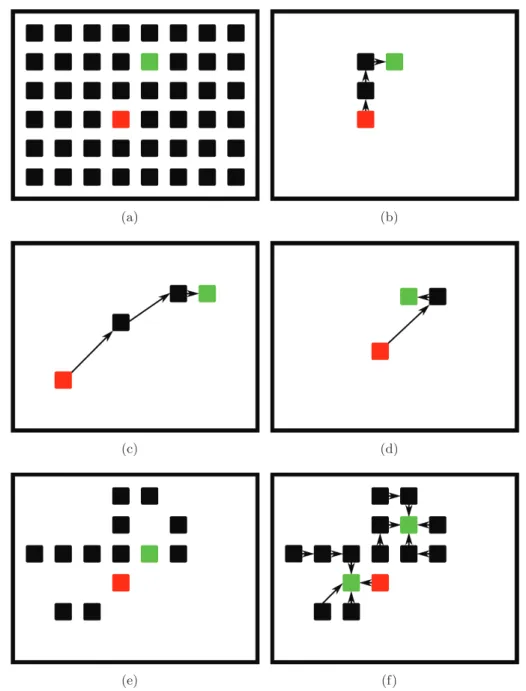
Figure 2.5: Tracking approaches with low-dimensional state space, which is defined as object location in the image plane. The locations, estimated in the previous frame and in the current frame, are red and green squares, respectively. They denote shift motion of the object. (a) Template matching searches for the object over the entire image plane irrespectively of its previous location but is relatively expensive in computation. (b) If the object moves slowly, gradient-based methods initialize their search at the previous location and converge rapidly to current, true location only in few steps. The steps of convergence are marked with arrows and black squares. (c) A hierarchical search allows for tracking objects that move fast by running the gradient-based search procedure from lowest to highest level of image pyramid. (d) Alternatively, Kalman filter first predicts the current location. It uses a motion model to make a smart guess, which is then corrected by image observation. (e) Single prediction is often risky in visual tracking because of hard-to-define trustworthy motion models and background clutter. At increased computational cost, particle filter makes multiple predictions of locations, i.e. particles, which are sampled from the motion model. (f) Since the number of particles is limited, the approximate locations can be refined with gradient-based search, initialized at each particle, to converge to local modes of the probabilistic distribution of locations. Here, one of the two modes can be chosen which has higher likelihood. This procedure can increase the precision of tracking and reduce the number of particles.
Template matching trackers feel quite comfortable in such scenarios. However, there is no free lunch. Since they scan the entire image to search for the object, as shown in Fig.2.5(a), such a brute-force approach largely compromises the computa-tional resources of the computer. In addition, it is hardly applicable to objects that undergo transformations more complex than shift [Jurie and Dhome,2002].
If the inter-frame displacement of the object is small, other tracking schemes can be considered. By matching the template implicitly, iterative, gradient-based methods converge to the true object location within reduced number of steps.
2.2.2 Gradient-based tracking methods
The tracking methods, which optimize a continuous objective function by computing its gradient, are called gradient-based methods. They converge to the true object location in a few steps, as shown in Fig.2.5(b). In order to design a gradient-based tracking algorithm, several issues have to be considered. Firstly, a representation of the appearance of the object has to be chosen, which will implicate a feature vector in a feature space. Secondly, a differentiable objective function has to be specified, which will measure the similarity between the known object feature and the feature extracted at a chosen location in the image plane. Finally, a gradient-based search technique has to be proposed, which will optimize the given objective function by searching iteratively for the best object location. In the following, we discuss two pervasive methods and their modifications, which address these design choices.
Lucas-Kanade trackers: Gradient-based tracking dates back to the seminal work of [Lucas and Kanade,1981]. Given a template patch of the target object, one seeks to recover the parameters of the warping function of the image patch, which model the shift motion of the object. Starting from its location in the previous frame, the template is iteratively aligned with subsequent candidate patches. Hence, instead of matching the template to a patch at every location, the patches are extracted iteratively at subsequent locations that are determined by the updated warp parameters.
The parameters were found by the gradient-descent procedure minimizing the SSD function of the template and the warped image patch. The intensity landscape
2.2. Tracking in low dimensions 19
of the warped patch is generally nonlinear so it was linearized with the first-order Taylor expansion. The convergence was guaranteed by computing the magnitude of change of the parameters between two consecutive iterations.
Originally proposed to estimate optical flow, the tracker has had many successors. We refer the reader to [Baker and Matthews,2004] for an overview with rich technical details, but briefly, the warping parameters were extended to recover affine object motion [Bergen et al., 1992], [Tomasi and Shi, 1994]. Since the original method required Jacobian and Hessian matrix that are relatively costly to obtain, [Shum and Szeliski,2000] updated the warping function instead of its parameters such that the Jacobian matrix could be precomputed to gain speed. Second-order approximation of the objective function [Benhimane and Malis, 2004] did not require computing the Hessian, thus increasing the numerical stability of the algorithm.
Mean-shift trackers: Another seminal gradient-based tracking method was proposed in [Comaniciu et al., 2000]. Unlike [Lucas and Kanade, 1981], who rep-resented the object simply as a patch of pixels, here the object patch was trans-formed into a color histogram to better handle non-rigid objects. The histogram was weighted by an Epanechnikov kernel1, laid over the patch, to robustify this rep-resentation. The kernel preserved spatial appearance to some extent and gave more importance to pixels closer to the object’s center, as the peripheral pixels might belong to background.
The target template was matched with a candidate template under the Bhat-tacharyya distance function. The function was approximated by the first-order Tay-lor expansion around the sought after template and was optimized by shifting the kernel, and thus the object template, in the direction of the ascending gradient over weighted pixels. The algorithm required only several iterations to converge to the true location instead of evaluating a candidate template at each pixel, which speeded-up tracking. Additionally, the scale of the target was found by picking the best score of one of three kernels. They were obtained by rescaling the bandwidth of the current kernel with ×0.9, ×1.0, ×1.1 and mean-shifted independently.
1Note that the single kernel did not estimate but weighted the density, in this case. This is in contrast to kernel density estimation methods, where the probabilistic density function is represented nonparametrically by a set of accumulated kernels anchored at data points.
By observing in [Hager et al.,2004] that Bhattacharyya and SSD measures are related, the SSD objective function was minimized by a gradient-descent algorithm. The authors hinted at the singularity issue of the kernel modulated histogram, which is insensitive to some particular motions of the object. To alleviate this problem, ob-ject representation was augmented with a stack of kernels. It was argued in [Collins,
2003] that the originally proposed approach to update the scale of the target had a tendency to shrink the kernel, lacking de facto the expansion power. Therefore, the Epanechnikov kernel was replaced by a Difference-of-Gaussians kernel to correct the scale update mechanism. In [Zivkovic and Kr¨ose, 2004], the authors developed an EM-like algorithm to update scale as well as the orientation of the kernel by esti-mating the covariance matrix of the weighted pixel locations. Second-order Taylor expansion was proposed in [Xiao and Li,2008], which improved the precision of the object localization at slightly increased computational cost. And recently in [ Le-ichter,2012], the histogram was smoothed with a uniform convolution kernel. This improved the inexact estimation of the density function resulting from histogram discretization and color drifts between nearby histogram bins, effectively leading to a more robust tracker.
2.2.3 Fast motion
Gradient-based tracking is a well justified approach given the object shifts rather slowly. Occasionally though, the object might shift between two consecutive frames rapidly. If the magnitude of the displacement of its location between the frames is greater than the local image area over which the gradient is computed, the object may escape from the tracker’s potential reach. This is a well-known shortcoming of gradient-based trackers. Thus, we discuss here several categories of trackers that can cope with fast motion.
Hierarchical based tracking: Without departing far from the gradient-based tracking, the principle ideas behind the image pyramid framework stand at-tractive to alleviate the problem of fast motions [Anandan, 1989], [Bergen et al.,
1992]. Namely, instead of starting the convergence solely from the previous loca-tion and scale of the original image, a hierarchical algorithm starts at the lowest
2.2. Tracking in low dimensions 21
level of the pyramid of rescaled images. The found location at the lowest level of the pyramid initializes the convergence procedure at the next level. The procedure is re-peated recursively up to the finest level to localize the object, as shown in Fig.2.5(c). This hierarchical algorithm was integrated into Lucas-Kanade [Bouguet,2000] and mean-shift [Li et al.,2010] trackers.
Prediction-based tracking: Alternatively, the rapidly changing object loca-tion can be first predicted and then corrected. A one-shot predicloca-tion with subsequent correction can be accomplished by a Kalman filter [McLauchlan et al.,1997], [Boykov and Huttenlocher,2000]. It is a Bayesian filter, which maximizes the posterior dis-tribution over the object state by recursively inferring on the first-order Hidden Markov Model (HMM). The filter can predict and correct for rapidly moving ob-jects, as shown in Fig. 2.5(d), using a linear motion model of e.g. high speed and acceleration and a linear appearance model, respectively. If the object moves non-linearly, its motion can be described with a nonlinear model, which is then linearized under Extended Kalman Filter [Rosales and Sclaroff,1999] with the first-order Tay-lor expansion. However, verification of only a single hypothesis of object’s location narrows the utility of the Kalman filter. In visual object tracking, objects may move not only fast and nonlinearly but also may look similar to the background, an effect known as clutter.
Particle filter extends the Kalman filter within the HMM setting. Instead of keeping only a single, most likely hypothesis, it updates multiple, more and less likely hypotheses, as shown for hypothesized locations in Fig.2.5(e). Should the object be in clutter, the particle filter accounts for thus arising multimodal distribution simply by predicting multiple locations of objects represented by e.g. contours [Isard and Blake, 1998] or colors [Nummiaro et al., 2002], [P´erez et al., 2002]. This luxury of multiple hypotheses comes at the cost of increased computational cost, as the candidate appearances are evaluated at each hypothesized location. Provided that the number of particles is rather small (e.g. several hundred), this is not grave considering the computational power of modern computers. Nevertheless, while Kalman filters estimate the best state exactly under a given model, such a coarse partitioning of the underlying distribution function of the particle filter yields only
approximative state estimates.
Hybrid tracking: A way to increase the precision of a particle filter and to reduce the number of particles is to refine the approximate estimation of the filter with a gradient-ascent procedure, like mean-shift. The procedure climbs up the dense particle clouds seeking for the modes of the posterior distribution that correspond to more precise hypotheses, as shown for locations in Fig.2.5(f). Namely, each particle is an initialization for the gradient-based procedure. The particle is pushed in the direction of the ascending gradient of the posterior and locked on one of the modes after convergence [Chang and Ansari,2003], [Maggio and Cavallaro,2005].
Next section reviews tracking systems in cases where objects not only move fast but also change their appearance during motion. Hence, the reviewed methods attempt to learn the new appearance while tracking the target object.
2.2.4 Appearance change
An appearance model of an object determines the representation of the object in the image. The object can be described by surface texture, contours, and color within a bounding box. However, the appearance model is challenged inevitably by occlusions, changes of illumination and of camera/object pose, object’s spatial deformations, as well as blur caused by fast motions. Therefore, important aspects to be addressed are that of (i) what should be observed in the image and (ii) how this observation should be updated while preferably (iii) not compromising the speed of the tracker much.
When camera acquires an image of a moving object and its surrounding scene, the above artifacts are likely to be present simultaneously. Therefore, it is likely they will influence to a large extent the appearance of the object’s template, specified by an external user in the first frame. This calls for an automatic update mechanism of the appearance model over time. Because of the above noise effects though, it is a complex decision problem.
2.2. Tracking in low dimensions 23
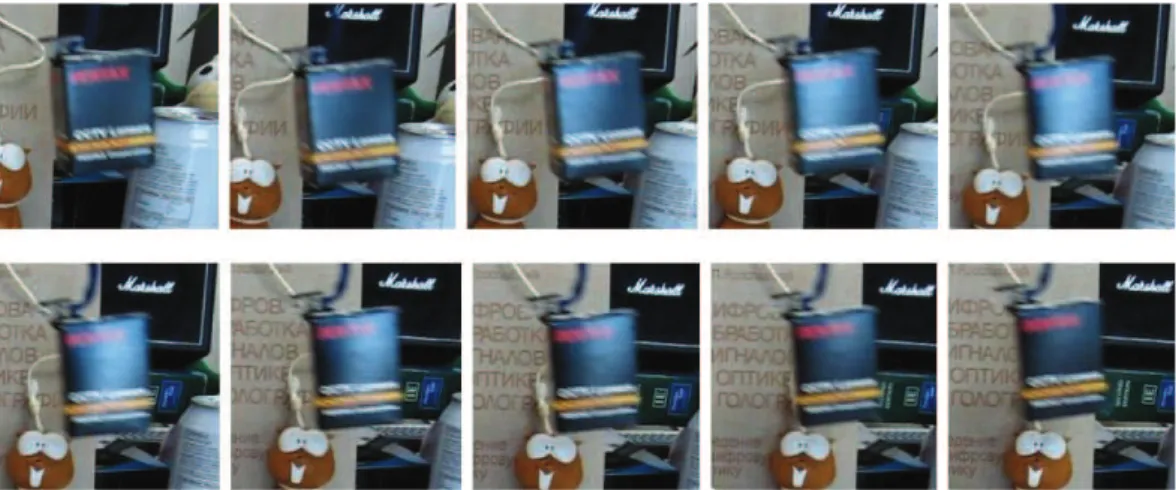
Figure 2.6: A sequence of consecutive frames showing an external light source flashing over the surface of the black box. The light changes object appearance in a fraction of a second. Due to [Santner et al.,2010].
2.2.4.1 Stability vs plasticity dilemma
A straightforward appearance update mechanism would replace the old template with the best one in each new frame. If an extra light source flashes over the object surface though (Fig. 2.6), the tracker learns this noisy observation instead of the true, new appearance of the object. Thus, such a blind, local updating degrades the appearance model by accumulating the erroneous observations. The tracker is likely to drift and may be unable to recover.
On the other hand, if the template is not updated at all, the tracker will not learn the incident noise. Provided that the object keeps its original appearance with only occasional changes, the tracker will be globally more stable, and it may lose track only sporadically. This marriage to the global template might lead to a happy-end, unless at one point the object appearance changes enough so that the template better matches the background clutter than the object.
To update or not to update leads to a well known stability-plasticity dilemma [Grossberg, 1987], making the design of a robust appearance model challenging. Researchers have developed numerous clever and complex decision systems that address this problem. The systems can decide when and how to learn the appearance of the object on-line in order to track objects stably despite noisy observations and flexibly in the presence of varying object appearance.
2.2.4.2 On-line learning
Humans can track objects which they have never seen before. Along these lines, semi-supervised learning has become the mainstream approach for on-line appearance learning. The problem is to design a feature selection mechanism which, initialized with a single bounding-box in the first frame, can bootstrap good features over time. The algorithm has to choose and classify these features of the object, which are most characteristic or which best discriminate it from the background. Trackers use boosting procedures of AdaBoost [Freund and Schapire,1995] and Multiple Instance Learning (MIL) [Dietterich et al.,1997]. Recently, random forests [Breiman,2001] have become popular as well, as they are less sensitive than boosting algorithms to noisy training examples, can be learned faster during on-line tracking, and can be easily parallelized on GPUs [Santner et al.,2010].
An early procedure for on-line learning was proposed in [Oza, 2001]. A tracker detected a new example of an object in each new frame with a set of predefined weak classifiers. It used the new example to retrain its classifiers with AdaBoost. Then, the learning task was transformed in [Grabner and Bischof, 2006] from updating the weights of classifiers to updating the weights of selectors, which chose the best positive features from their feature pools. This allowed to build reliably on-line appearance templates of the tracked object. Additionally, the pool was augmented with negative examples, chosen from the background of the object, to select these good features that discriminated the foreground from the background the most. As an alternative, in [Grabner et al., 2008] a pool of classifiers was chosen only in the first frame to increase the stability of tracking. AdaBoost was integrated into a particle filter tracker of object location and scale in [Klein and Cremers,2011], where the bounding-box of the object was partitioned rigidly into four adjacent regions. Each region had its own pool of Haar-like features to better preserve spatial layout of object’s appearance. Multiple Instance Learning [Babenko et al., 2009] selected the Haar-like features from the pool more flexibly by grouping them into positive and negative bags, instead of treating them as separate entities.
2.2. Tracking in low dimensions 25
training examples specified by an external user. In [Saffari et al.,2009], they were trained on-line yielding the on-line random forest (ORF) tracker that reported im-provement in stability and resistance to occlusions over the on-line boosting of [ Grab-ner and Bischof,2006]. PROST [Santner et al.,2010] proposed to integrate simple template matching with the mean-shift clustered dense optical flow. The template tracker was responsible for stable tracking across the whole sequence, whereas the optic flow/mean-shift tracker reacted to local, most apparent shift. As both, the local and the global trackers had the same priority, the appearance of the main ORF tracker was updated when its output bounding-box overlapped with the one having higher score. A Tracking-Learning-Detection (TLD) approach [Kalal et al.,
2012] estimated location and scale of objects over long video sequences. The tracker demonstrated robustness against object’s fast motion and disappearance for longer periods. Locally, the TLD ran a Median-Flow tracker to estimate location and scale. It combined a pyramid Lukas-Kanade approach to estimate sparse optical flow, fol-lowed by a median filter to choose the most reliable flows. The tracker was then combined with a detector that was trained on-line using random forests. The forests were trained with positive and negative examples. The former were synthesized by applying affine warping to the current object appearance, and the latter were chosen around the object. In effect, the system could track rigid objects, while the performance of the tracker degraded for deformable objects whose templates warp in non-affine manner.
2.2.5 Summary
This section reviewed some popular trackers which output a low-dimensional ob-ject pose in the form of location, scale, and orientation. The gradient-based and prediction-based trackers seek to limit the search over the state space in order to gain on the processing speed. However, this might lead to problems when objects move fast and change their appearance.
The recent methods which learn the appearance on-line have advanced the field considerably. Building on the concepts of the previous approaches and using power-ful machine learning techniques, they are more robust to fast motions and changing
appearance under real conditions. They often work in real-time, owing in part to the increasing computational power of modern computers and efficient designs of mechanisms which capture object appearance.
These contributions yield impressive results in tracking rigid objects. However, it remains open how these low-dimensional, on-line appearance learning approaches scale into higher dimensional state spaces. Such spaces can represent geometrical configurations of objects that e.g. articulate and flex. Possibly, these types of objects may require a part-based approach [Babenko et al.,2011].
Likewise, the rigid objects are observed only after being projected from the 3D scene onto a 2D image. Therefore, are the rigid objects also rigid in the image? Since they are represented by data drawn from some distribution underlying the image formation process, their rigidity is compromised by the projection and distortion effects arising from the object/camera interaction. It is therefore interesting to relax the assumption of inherent rigidity and treat this entity statistically.
In view of this, the model for object tracking developed in this thesis casts a rigid object as a collection of local parts and links them with soft geometrical constrains to exploit rigidity in a soft fashion. This deformable part model has the state space of increased dimensionality that results in the increased computational cost. Nevertheless, the complexity of the tracking algorithm scales linearly with the number of object parts and the tracker can yield real-time performance.
The appearance of each part is not updated which stands in contrast to the state-of-the-art trackers that update it on-line. It is motivated by a premise that if, say, a part changes its appearance, other parts might not. The ensemble of parts will likely attract this part to enforce spatial rigidity, imposed by spatial constraints. We show that this approach of representing the appearance locally with spatial coherence leads to a tracker with competitive qualitative and quantitative results.
Finally, such a soft, part-based model of rigid objects extends comfortably into representations for articulated and flexible objects. Since these representations are defined over high-dimensional state spaces, the state of the art in this domain is reviewed in the next section.
2.3. Tracking in higher dimensions 27
§ 2.3 Tracking in higher dimensions
Tracking an object in higher dimensional state spaces refers to the recovery of unob-servable configuration of the pose of deformable objects. In Computer Vision, most notable examples are the recovery of pose of moving articulated objects like skele-tons of mammals or human hands, and the recovery of flexing human facial muscles. Moreover, tracking of objects in higher dimensions usually assumes the state space of fixed dimensionality. Thus, the space dimension is not updated during tracking.
Apart from varying illumination, (self-)occlusions, and camera/object 3D pose change, deforming object pose affects object’s appearance as well. The approaches, which track objects in low-dimensional state spaces, strive to be robust against de-formations of a given object, and thus attempt to filter them out [Kwon and Lee,
2009], [Cehovin et al., 2011], [Godec et al., 2011]. In this regard, the trackers de-scribed in this section are principally different, as they seek to explain the appearance change of the object with its estimated deformation.
The approaches tracking objects in higher dimensional state spaces:
• model object shape, appearance, and motion; • learn the parameters of their models;
• reduce the dimensionality of their models; • match their models to track the object.
In the following, we discuss common modeling concepts. Then, we proceed with reviewing tracking methods, which differ in the manner of matching their particular object models to image observations.
2.3.1 Models of objects
Tracking articulated and flexible objects is governed by a model of object appear-ance and shape. Sometimes, motion is also modeled depending on a particular application, e.g. for motion animation and synthesis or for action recognition.
2.3.1.1 Shape and appearance
Shape of an object is represented locally by a meshed constellation of object ”parts”2.
One of the earliest and prominent models of object shape was the Active Contours (AC) [Kass et al.,1987], also known as Snakes. Having a physical interpretation, the model was formulated in terms of an energy function. It included the external force, which pulled the contour to the image observations, and the internal force, which aimed at preserving the smoothness of the contour. The features were gradient-based and locally constrained. Hence, since cluttered backgrounds could deform Snakes into shapes that mismatched the true object contours [Sclaroff and Isidoro, 2003], they were extended into models with region-based support [Ronfard, 1994], [Zhu and Yuille,1996].
Active Shape Models (ASM) [Cootes and Taylor, 1992] could estimate object pose, scale, and flexibility. They were trained on a set of images containing an-notated landmark locations on the object edges. The landmarks formed a point cloud in a high-dimensional state space of object shape, captured conveniently with a covariance matrix. These ‘Smart Snakes’ thus gained greater control than original Snakes over flexing shape of the object, though they could only be applied to a trained object category. The dimensionality of this space was reduced with Princi-pal Component Analysis (PCA). The princiPrinci-pal components denoted the canonical set of a flexing shape. In order to track the pose of flexible objects, the set was augmented by global, rigid transformation of the object and formalized as the Point Distibution Model (PDM) [Cootes et al.,1991], [Cootes et al.,1992].
Since the appearance model of ASM was matched only to local landmark lo-cations, Active Appearance Model (AAM) [Cootes et al., 2001] represented object appearance with global textures. It improved upon the ASM as it converged faster and more robustly to the true solution [Romdhani, 2005]. The direct relation be-tween the sampled global textures and corresponding flexing shape was learned in a regression manner. Building on AAMs, an object was represented with a planar, flexible mesh of parts in [Masson et al., 2005]. The mesh deformation parameters
2In addition to the term of a part, one can also use other, equivalent terms such as a landmark, a keypoint, a control point.
2.3. Tracking in higher dimensions 29
were obtained by PCA on a series of images taken at different viewpoints of the object. The appearance of the object was split into local patches. Each patch had an assigned tracker, regressed on the front-view image. A similar approach to AAM was proposed in [Sclaroff and Isidoro,2003], where Active Blobs of a given elastic object were trained with a one-shot annotation. Namely, object’s texture was ac-quired only from the initial frame of the video sequence. The boundary of the mesh was specified by segmentation and the potential flexing of the mesh was simulated with Finite Elements method.
Another well established, deformable part model representing an object as a constellation of parts, is the Pictorial Structures (PS) [Fischler and Elschlager,
1973], [Felzenszwalb and Huttenlocher, 2005]. Unlike PDM, which represents the object shape fully with a dense covariance matrix, the probabilistic graphical model of the PS is usually represented by a tree-graph structure. It yields a sparse co-variance matrix but enables efficient matching. In particular, a star-graph was used for human pose estimation in still images [Ronfard et al., 2002], [Ramanan,
2006], [Eichner and Ferrari, 2009], [Andriluka et al., 2009], [Sapp et al., 2010] and in video sequences [Ramanan et al., 2007], [Andriluka et al., 2008], or for object detection [Felzenszwalb et al., 2010]. It has been extended to other tree graph topologies, for example to capture proxemics in photographs [Yang et al.,2012], to detect faces from different viewpoints [Zhu and Ramanan,2012], and to capture full human pose [Yang and Ramanan,2011]. Complete graph was used to detect general articulated structures in [Kumar et al., 2004b].
As the model proposed in the thesis uses the PS formulation, it is here briefly reviewed. A PS comprises an assembly of K parts arranged in a deformable ge-ometrical configuration. It can be viewed as a graph G = (V, E), whose nodes V indicate parts, and edges E indicate connections between them. The edges thus de-fine a particular shape configuration of a given object that models the dependence between the parts. A window containing a part (i.e. a bounding box) may be for instance a rectangle (e.g., for articulated models of human body parts [Felzenszwalb and Huttenlocher,2005]) or a square (e.g., for iconic models of facial or body land-marks [Yang and Ramanan,2011], [Zhu and Ramanan,2012], [Yang et al., 2012]).
Typically, the state space of object parts O = {pi}Ki=1 is defined by location (xi, yi)
of the window center in the image I, and also its local orientation θi. It can also
be extended by scale s, which is a single global variable, shared by all windows. Given the image observation I, the posterior defines the probability map over the configuration of parts O as:
P (O|I) ∝ K Y i=1 P (I|pi) Y (i,j)∈E P (pi, pj) (2.1)
The appearance term P (I|pi) for part pi models the likelihood of observing a
chosen image feature (e.g., a color or gradient histogram, filter banks) over the state space of pi. The prior term P (pi, pj) corresponds to a pairwise kinematic potential
between two given parts pi and pj and can be thought of as a spring between the
parts capturing their allowable deformation in the image plane.
2.3.1.2 Complex Motion
Objects often move in complex, dynamic fashion, thereby their motion is gener-ally difficult to model [Soatto and Yezzi,2002] and estimate [Tomasi et al., 2003]. This is especially the case in high-dimensional state spaces that imply exponentially many degrees of freedom for object motion. For particular objects though, like hu-mans, motion is a strong cue simplifying the problem of tracking in the presence of occlusions [Andriluka et al., 2008] and pose ambiguities [Urtasun et al., 2006] arising from the use of a single camera. Since the motion models are learned off-line from temporal data, they usually apply to specific motion styles [Urtasun et al.,
2006], [Vondrak et al.,2008], [Brubaker et al.,2010] but can then be used in recog-nizing activities [Weinland et al.,2011].
Other approaches restrict their models to general motions simply by penalizing large displacements in location between two consecutive frames [Sidenbladh et al.,
2000], [Ramanan et al.,2007], [Park and Ramanan,2011]. In other words, fast mo-tions are considered unlikely. In this thesis, a general motion model is also proposed to enable tracking of a handful of objects having various motion styles, like artic-ulation and vibration. Therefore, the proposed approach is freed from an off-line
2.3. Tracking in higher dimensions 31
trained motion model that would be dedicated only to tracking a particular category of objects.
Specifically, the proposed motion model exploits the global orientation of each segment of the object from the previous frame of the sequence. As a result, the model penalizes fast rotation of the object, which is assumed to be rare, thereby favoring shift motion, which is assumed to be the dominant motion style. Hence, slow and fast shift motions are treated equally under the proposed model. The effect of this simple model on the fast rotary motion is analyzed in chapter4.
2.3.2 Model matching algorithms
Tracking an object in higher dimensional state spaces is accomplished by matching3
the model to each new image frame. However, matching a model is not straightfor-ward because it is faced with the following challenge: how to design an algorithm which can match the appearance model of the object to the image efficiently and op-timally, such that the object shape preserves modeled spatial coherency of the meshed constellation of object parts over time.
Theoretically, a straightforward and exact approach would be to enumerate all possible configurations in the state space. Even though this might be feasible when the dimension of the state space is small, it hardly scales to higher dimensions, in which the number of necessary enumerations grows exponentially. This curse-of-dimensionality effect renders such an approach infeasible in practice. Hence, many approximative matching techniques have been proposed to stay computationally attractive. They whether:
• limit their search space or
• sacrifice the accuracy of their models.
The algorithms search locally, semi-globally, and globally. They likewise relax the requirement for the full preservation of the spatial coherency of object parts, which compromises the optimality of the solution. Here, they are categorized by the volume of the state space they explore to find the best match.
3An equivalent term is model fitting. Similarly, if the model is statistical, such as in Bayes formulation, then one speaks of model inference.
2.3.2.1 Local methods
In Active Contours, a smooth template contour was matched to the nearby im-age contour by applying a gradient-based procedure. The geometrical constraints of the contours were hard coded, so in [Amini et al., 1990] the contour was rep-resented by a chain graph which allowed for encoding soft constraints. Instead of the gradient-based search though, the best contour configuration in a given itera-tion was found with dynamic programming (DP), and the contour converged to the true configuration also in the iterative fashion. Even though the efficiency of DP decreases quadratically with the number of states (here the grid of pixel locations), the method was fast as the size of the local grid was small in each iteration.
Matching Active Shape Models allowed tracking flexing shape of e.g. a human face. Applied gradient-based procedure iteratively searched for parameters of the rigid transformation and of the best linear composition of the canonical shapes. Ac-tive Appearance Model was matched by searching over the shape and appearance parameters. Matching Constrained Local Model (CLM) [Cristinacce and Cootes,
2006] involved two-step iterative procedure, where a set of templates was matched under PDM as a regularization factor. In each iteration, the local templates of facial landmarks were matched independently within local neighborhoods of the current locations to generate response maps. The PDM was then fitted to these responses us-ing simplex optimization to find the best match. In [Saragih et al.,2011], the authors argued that even though this simplex optimizer was more robust against measure-ment noise than classic gradient descent, it might be slow for high-dimensional state spaces. Therefore, they proposed to mean-shift [Fukunaga and Hostetler,1975] the shape model to the maxima of the response map of each individual landmark, while regularizing each mean-shift step with the full shape PDM.
In [Fan et al.,2007], single kernel based mean-shift tracking [Comaniciu et al.,
2000] was extended into the collaboration scheme of multiple kernels to track de-formable objects, e.g. a magazine cover or articulating human arms. It mean-shifted kernel modulated color histograms of parts jointly to follow object deformations. The kernels were constrained chain-wise by distances to follow in-plane arm
articu-2.3. Tracking in higher dimensions 33
lation. Also, they were mean-shifted jointly to follow deformation of the magazine cover. In the latter case, the kernels were guided through the subspace over possible displacements, obtained by PCA on the batch of initial images, which corresponded to low-dimensional, affine transformation. The global affine motion was replaced by local affine motions in [Martinez and Binefa, 2008]. The ensemble of kernels was split into local triplets to better cope with object/camera pose changes. The method was applied to track rigid objects like cars and subregions of faces which undergo in-and out-of-plane rotation. The authors pointed out that generally small inter-frame displacements of the kernels were assumed, a well known shortcoming of local search methods.
2.3.2.2 Semi-global methods
Particle filtering (PF) is a prominent semi-global technique for model matching. Despite its approximative nature, it searches over a larger state space, which is its main advantage over the local search methods. Certainly, this comes at an increased computational cost4. In the theoretical case of infinite number of samples, it would be a global matching method, though such a scenario is computationally infeasible on existing computer architectures.
The trackers integrating the PF usually sample from the motion or spatial model. CONDENSATION tracker [Isard and Blake, 1998] extended the single hypothesis snake tracking. By sampling multiple contours from the motion model, the tracker achieved higher robustness against clutter. The dimensionality of the contours was reduced by representing their motion as affine, leading to a facilitated sampling. Individual object parts were pushed with independent PFs through the model of dynamics in [Mauthner et al.,2008], [Chang et al.,2009]. They were later assembled using spatial constraints to maintain spatial coherency of the object.
Instead of sampling particles for each part from the motion model, other schemes sample the parts jointly from the full spatial model of the object [Sudderth et al.,
2003], [Isard,2003]. Apart from their complexity, they are relatively slow though [Hua and Wu, 2006]. Since PF can be trapped in local maxima due to insufficient
num-4However, it might be overcome because each particle can be matched to the image independently of other particles lending itself to GPU implementation.
ber of particles in the high-dimensional state space, one can propose clever ways of resampling. Methods include scaling the covariance to smooth the density [ Smin-chisescu and Triggs, 2001], using annealing to gradually react to tight peaks in density [Deutscher et al.,2000], or using Rao-Blackwellization to reduce the dimen-sionality of the state space [Schindler and Dellaert, 2005]. Alternatively, by taking advantage of the problem domain to track 3D poses of humans, [Sminchisescu and Triggs, 2003], [Gomez J´auregui et al.,2010] use inverse kinematics to better guide the particles during sampling, thus efficiently coping with 3D ambiguities arising from monocular vision.
2.3.2.3 Global methods
Global search methods typically apply the framework of Pictorial Structures yielding state-of-the-art results in object detection. Apart from works on object detection mentioned earlier, the PS has been employed to track objects by detecting them over the whole state space from frame-to-frame [Gu and Tomasi,2011] or in a batch of frames [Kumar et al.,2004a], [Ramanan et al.,2007], [Andriluka et al.,2008].
Provided the graphical structure is a tree, a PS was matched to the image using dynamic programming in quadratic time in [Fischler and Elschlager, 1973]. Pro-vided further that the costs on the spatial links in the tree graph had a particular form, [Felzenszwalb and Huttenlocher, 2000] propose to use Generalized Distance Transform [Felzenszwalb and Huttenlocher,2004.] to reduce the complexity of model matching from quadratic to linear time. Unlike PF, it renders an optimal solution for the whole search space instead of only its approximation. Also, its inference complexity scales linearly with the number of parts, instead of exponentially at the cost of weakening the full shape model to only a tree. However, [Zhu and Ramanan,
2012] showed this might not be a grave shortcoming when applied to the detection, deformation and pose estimation of such complex objects as faces.
Variants of matching the PS to the image include the best, maximum a pos-teriori configuration LM AP, or efficient sampling [Felzenszwalb and Huttenlocher, 2005] and maximal N-best configurations [Park and Ramanan,2011] for higher level processing. It is tractable when the graph’s structure E is a tree as standard
dy-2.3. Tracking in higher dimensions 35
namic programming routines can then be invoked. If the graph has a star structure, a more efficient, branch-and-bound matching technique can be applied [Kokkinos,
2011]. Alternatively, one can use a coarse-to-fine matching strategy [Ferrari et al.,
2008], [Pedersoli et al.,2011].
2.3.3 Summary
This section highlighted model-based approaches to tracking objects by searching over high-dimensional state spaces. The dimensionality of the state space remains fixed throughout the sequence as it directly corresponds to semantic object configu-ration. By representing an image entity of a given object as a meshed constellation of parts, the reviewed models explain deformation of object contours, surfaces, and poses.
The described model matching algorithms can be categorized as local, semi-global, and global. Local methods can match the model relatively fast while fully preserving the configuration constraints. However, they can get trapped in a local optimum of the state space as their search space is small.
Sampling schemes are usually integrated into the PF framework. They explore the state space with multiple state hypotheses that can also be generated from the full configuration model. To render the matching feasible, they are forced to keep the number of particles low, implying a semi-global search. Thus, they are only approximative and scale poorly with the increasing dimensionality of the state space, thereby risking to get trapped in local optima as well.
In this thesis, the proposed model is integrated into the PS framework to yield a stable and efficient tracking of simple as well as more complex objects that are split into a chained assembly of parts. For instance, a short rigid bottle is described in a lower dimensional state space with several parts while a long vibrating guitar string or a long, deformable surgical suture are described in a state space of much higher dimensionality as they are composed of tens of parts. The PF scales exponentially with the increasing dimensionality and thus would hardly generalize to follow closely the latter, elongated objects. On the contrary, the proposed PS-based method scales linearly and can find globally optimal object configuration under a given model.
This comes generally at the cost of the approximative model of object structure, derived here as a chain graph, as object parts can admit planar layout, however, it is particularly well justified for tracking the elongated objects. The PS-based method is described in the next chapter.

![Figure 1.3: Sequence [Santner et al., 2010] showing fast motion. As the object moves fast between consecutive frames, blur artifacts become apparent.](https://thumb-eu.123doks.com/thumbv2/123doknet/14536699.724180/16.892.163.733.129.509/figure-sequence-santner-showing-motion-consecutive-artifacts-apparent.webp)
![Figure 1.6: Sequence [Godec et al., 2011] showing semi-constrained deformation. Human body deforms heavily but the deformations are constrained by its skeleton.](https://thumb-eu.123doks.com/thumbv2/123doknet/14536699.724180/17.892.153.740.681.1087/figure-sequence-showing-constrained-deformation-deformations-constrained-skeleton.webp)
![Figure 2.3: Transformers sequence [Kwon and Lee, 2009], in which our tracker follows the location and orientation of the robot transforming into a car](https://thumb-eu.123doks.com/thumbv2/123doknet/14536699.724180/25.892.165.726.133.605/figure-transformers-sequence-tracker-follows-location-orientation-transforming.webp)