HAL Id: tel-01829574
https://tel.archives-ouvertes.fr/tel-01829574
Submitted on 4 Jul 2018
HAL is a multi-disciplinary open access archive for the deposit and dissemination of sci-entific research documents, whether they are pub-lished or not. The documents may come from teaching and research institutions in France or abroad, or from public or private research centers.
L’archive ouverte pluridisciplinaire HAL, est destinée au dépôt et à la diffusion de documents scientifiques de niveau recherche, publiés ou non, émanant des établissements d’enseignement et de recherche français ou étrangers, des laboratoires publics ou privés.
safety and security
Houssein Abdo
To cite this version:
Houssein Abdo. Dealing with uncertainty in risk analysis : combining safety and security. Automatic. Université Grenoble Alpes, 2017. English. �NNT : 2017GREAT113�. �tel-01829574�
THÈSE
Pour obtenir le grade de
DOCTEUR DE LA COMMUNAUTE UNIVERSITE
GRENOBLE ALPES
Spécialité : Automatique productive
Arrêté ministériel : 25 mai 2016
Présentée par
Houssein ABDO
Thèse dirigée par Jean-Marie FLAUS, Professeur, G-SCOP, et codirigée par François MASSE, Ingénieur, INERIS
financée par l’INERIS (Institut national de l'environnement industriel et des risques)
préparée au sein du Laboratoire G-SCOP dans l'École Doctorale EEATS
Dealing with uncertainties in
risk analysis: combining
safety and cybersecurity
Thèse soutenue publiquement le 12 Décembre 2017, devant le jury composé de :
M. Emmanuel GARBOLINO
Maître de conférences, HDR, CRC, MINES ParisTech, Rapporteur M. Laurent PERRIN
Professeur, Université de Lorraine ENSIC, Rapporteur M. Jean BIGEON
Directeur de recherches, CNRS, Examinateur M. Jean DEZERT
Maître de recherches, Office National d’Etudes et de Recherches Aérospatiales, Examinateur
M. Youssef LAAROUCHI
Ingénieur de recherches, Électricité de France - EDF, Examinateur Mme. Maria DI MASCOLO
Directrice de recherches, CNRS, Présidente M. François MASSE
bining safety and cybersecurity Thèse de doctorat, 12 Décembre 2017
À ma famille, À mes amis,
À mes rencontres de la vie, d’aujourd’hui et d’hier, À tous ceux qui m’aiment,
Acknowledgments/Remerciements
Cette thèse est l’aboutissement de plusieurs années de travail et n’aurait jamais pu voir le jour sans le soutien et l’aide de nombreuses personnes qui m’ont accompagnée tout au long de cette épopée ! Je tiens donc ici à les remercier et leur témoigner de ma reconnaissance.
Je voudrais tout d’abord exprimer mes plus profonds remerciements à mon directeur de thèse, Jean-Marie FLAUS, pour toute sa disponibilité, sa gentillesse et ses directives si précieuses. Merci pour sa patience, ses nombreux conseils, ses idées, ses nombreuses relectures, et surtout pour m’avoir fait confiance dans cette aventure. Un grand merci pour cet encadrement de qualité intellectuellement et humainement.
Je tiens également à remercier chaleureusement à mon encadrant, François MASSE, pour ses idées et sa collaboration dans la réalisation de la thèse. Merci à L’INERIS pour financier cette thèse. Merci a tout les membres de l’INERIS pour ces collaborations, je remercie particulièrement Franck PRATS, Sylvain CHAUMETTE et Valérie DE DIA-NOUS.
Mes remerciements les plus sincères aux membres du jury : Maria Di-MASCOLO, qui m’a fait l’honneur de présider le jury ; Emmanuel GARBOLINO et Laurent PERRIN, qui ont accepté d’être rapporteurs de ce mémoire, merci pour leurs conseils et améliorations qu’ils ont suggérées, ainsi que Jean BIGEON, Jean DEZERT, Youssef LAAROUCHI d’avoir examiné ma thèse.
Je remercie aussi tous les enseignants et les chercheurs du laboratoire G-SCOP. Ces années à G-SCOP m’ont donné l’occasion de passer de l’autre côté du miroir en travaillant avec ceux qui étaient auparavant mes enseignants.
Je souhaite aussi saluer l’ensemble des ingénieurs, stagiaires et doctorants du labo-ratoire G-SCOP, sans qui ces quelques années auraient paru bien plus mornes. Je pense spécialement à Mohamad, François-Xavier, Tian, Kléber, Mohamad-Houssein, Abdullah,
Enfin, je remercie mes parents Ali et Mariam pour m’avoir soutenu durant toutes mes études, mes soeurs Khouloud et Zeina, mes fréres Haydar et Hassan, qui ont largement contribué à l’aboutissement de ce projet de thèse.
Une page se tourne, une autre s’ouvre, merci à tous ceux et celles qui y ont contribué et m’ont amené à faire les bons choix.
Contents
List of Figures xi List of Tables xv Résumé 1 Abstract 3 1 Introduction 7 1.1 Background . . . 81.2 Motivations and objectives . . . 10
1.3 Contributions and Methodology . . . 12
1.4 Thesis outline . . . 14
2 Context & problematic 17 2.1 Introduction . . . 19
2.2 Understanding hazard analysis for critical facilities in France - The INERIS methodology . . . 20
2.2.1 Representation of risk scenarios . . . 21
2.2.2 Probability analysis using bow-tie based on the interval semi-quantitative approach . . . 23
2.2.2.1 characterizing input data . . . 24
2.2.2.2 propagating input data . . . 26
2.2.2.3 Final probability . . . 27
2.2.3 Severity analysis . . . 28
2.3 Introducing uncertainty in industrial risk analysis: the different sources of
uncertainty . . . 31
2.3.1 Parameter uncertainty . . . 31
2.3.1.1 Types of parameter uncertainty . . . 32
2.3.1.2 Causes of parameter uncertainty . . . 32
2.3.2 Model uncertainty . . . 36
2.3.3 Completeness uncertainty . . . 36
2.4 Why uncertainty represents a major problem and should be considered? . . 37
2.4.1 Red-River flood - Why risk analysts should be explicit about un-certainty? . . . 37
2.4.2 The ASSURANCE benchmark project: Assessment of Uncertainties in Risk Analysis of Chemical Establishments . . . 39
2.5 Addressing uncertainty during risk assessment . . . 41
2.5.1 Steps to address parameter uncertainty . . . 41
2.5.2 Addressing completeness uncertainty . . . 41
2.6 Where uncertainties affect the INERIS risk assessment process . . . 42
2.6.1 Uncertainty in likelihood analysis: drawbacks of the interval semi-quantitative approach . . . 43
2.6.2 Uncertainty in effect analysis . . . 44
2.6.3 Completeness uncertainty in the risk identification process: No-considering of cyber-security threats . . . 47
2.7 Conclusion . . . 48
3 Literature review 51 3.1 State of art on approaches for parameter uncertainty analysis . . . 53
3.1.1 Interval analysis . . . 53
3.1.2 Probabilistic approach . . . 54
3.1.3 Fuzzy approach . . . 55
3.1.4 Evidence approach . . . 58
3.1.4.1 Independent input parameters . . . 59
3.1.4.2 Dependent input parameters . . . 60
3.1.4.3 Why evidence theory is the best to treat ignorance . . . . 62
3.2 Industrial Automation and Control System - IACS . . . 63
3.3 Cyber-security for industrial control systems . . . 64
3.4 The security risk analysis process for industrial control systems . . . 66
3.5 A review of cyber-security risk analysis approaches for Industrial Control Systems . . . 66
Contents
3.5.1.1 Attack trees for assessing vulnerabilities in SCADA [28] . 68
3.5.1.2 Through the Description of Attacks: a Multidimensional
View [67] . . . 69
3.5.1.3 Attack countermeasure trees (ACT): towards unifying the
constructs of attack and defense trees [135] . . . 69
3.5.2 Security Modeling with BDMP: From Theory to Implementation
[126] . . . 70
3.5.3 Evaluating the risk of cyber attacks on SCADA systems via Petri
net analysis with application to hazardous liquid loading operations [80] . . . 71
3.5.4 Network Vulnerability Assessment using Bayesian Networks [108] . 72
3.5.5 Discussion . . . 72
3.6 Existing Approaches that combine safety and security for industrial control
systems . . . 74
3.6.1 Integrating cyber attacks within fault trees [68] . . . 74
3.6.2 Modeling safety and security inter-dependencies with BDMP (Boolean
logic driven Markov processes) [125] . . . 75
3.6.3 Studying interrelationships of safety and security for software
assur-ance in cyber-physical systems: Approach based on Bayesian belief
networks [98] . . . 75
3.6.4 Modeling and analysis of safety-critical cyber physical systems using
state/event fault trees [134] . . . 76
3.6.5 Discussion . . . 76
3.7 Conclusion . . . 78
4 Treatment of uncertainty in probability analysis: a fuzzy semi-quantitative
approach 81
4.1 Introduction . . . 83
4.2 Proposed methodology: fuzzy semi-quantitative approach . . . 84
4.2.1 Characterizing inputs for probability analysis using the fuzzy
semi-quantitative approach . . . 84
4.2.1.1 Define basic event frequencies using a fuzzy scale . . . 84
4.2.1.2 Define secondary events probability of occurrence using a
fuzzy scale . . . 86
4.2.1.3 Define risk barriers confidence levels using a fuzzy scale . . 87
4.2.2 Representing (fuzzifiying) input data based on the proposed fuzzy
scales . . . 87
4.2.3.1 Treatment of OR gate . . . 89
4.2.3.2 Treatment of AND gate . . . 90
4.2.3.3 Treatment of secondary events . . . 90
4.2.3.4 Treatment of security barriers . . . 91
4.2.4 Decision making under fuzzy environment . . . 92
4.2.5 Handling the existing limitations of the interval approach . . . 93
4.3 Case study . . . 95
4.4 Conclusion . . . 97
5 Treatment of aleatory and epistemic uncertainties in analyzing the effect of risks 101 5.1 Introduction . . . 104
5.2 A new uncertainty analysis approach with randomness and fuzzy theory to deal with variability and imprecision . . . 105
5.2.1 Introduction . . . 105
5.2.2 Problem statement . . . 105
5.2.3 Proposed fuzzy-probabilistic approach . . . 107
5.2.3.1 Difference between probability and possibility . . . 107
5.2.3.2 Why a different new hybrid approach is needed . . . 108
5.2.4 Uncertainty representation . . . 110
5.2.5 Uncertainty propagation . . . 111
5.2.5.1 Monte Carlo to propagate Random Variables . . . 112
5.2.5.2 Monte Carlo to propagate uncertainty described by fuzzy numbers . . . 112
5.2.5.3 2D Monte Carlo to propagate Fuzzy Random Variables . . 113
5.2.6 Case study - Application of the proposed hybrid approach to effect analysis with considering of parameter uncertainties . . . 116
5.2.7 Description . . . 116
5.2.7.1 Reactor model . . . 117
5.2.7.2 Computation of exposed area . . . 118
5.2.7.3 Uncertainty modeling . . . 119
5.2.7.4 Simulation conditions . . . 120
5.3 Comparison of the proposed hybrid approach with the existing approaches: applying uncertainty analysis to a Loss Of Containment scenario . . . 131
5.3.1 Models used in the analysis . . . 132
5.3.2 Calculation of the concentration without considering uncertainty . . 133
5.3.3 Uncertainty modeling . . . 135
Contents
5.3.5 Uncertainty analysis using the fuzzy approach . . . 136
5.3.6 Uncertainty analysis using the probabilistic approach . . . 139
5.3.7 Uncertainty analysis using Evidence theory . . . 140
5.3.8 Uncertainty analysis using the probabilistic-fuzzy approach . . . 142
5.3.9 Comparison of all approaches . . . 144
5.4 A global approach to treat all types and causes of uncertainty in effect analysis: the ALI-Aggregated Likelihood Index . . . 148
5.4.1 Uncertainty representation: characterizing each uncertain parame-ter based on the available information . . . 149
5.4.1.1 Evidence theory with fuzzy focal elements . . . 150
5.4.1.2 Construction of the Fuzzy belief and plausibility for a BOE with fuzzy focal elements . . . 151
5.4.2 Uncertainty propagation . . . 151
5.4.3 Decision Making under uncertain environment . . . 153
5.4.4 Case study - Applying of the developed approach to a loss of con-tainment scenario . . . 154
5.4.4.1 Introducing fuzzy logic to analyze parameter uncertainty in calculating σy and σz . . . 154
5.4.4.2 Calculation of the concentration based on the proposed approach . . . 156
5.4.4.3 Comparing the proposed approach with the pure proba-bilistic approach . . . 157
5.5 Conclusion . . . 159
6 Handling one aspect of completeness uncertainty: introducing cyber-security within industrial risk analysis 171 6.1 Introduction . . . 174
6.2 Global definition of industrial risk . . . 174
6.2.1 Definition of risks related to safety . . . 175
6.2.2 Definition of risks related to security . . . 175
6.2.3 Definition of risks related to safety and security . . . 175
6.3 Methodology for combined safety/security risk analysis . . . 176
6.3.1 Introduction behind the global idea . . . 176
6.3.2 Step-1: representation of a risk scenario . . . 178
6.3.2.1 Security risk analysis using a new extended Attack Tree . 178 6.3.2.2 Combined ATBT analysis . . . 181
6.3.3 Step-2: likelihood evaluation . . . 182
6.3.3.2 Characterizing likelihoods of occurrence of input events . . 184
6.3.3.3 Calculating the likelihoods of MCs . . . 186
6.4 Case study . . . 188
6.4.1 Description . . . 188
6.4.2 Application . . . 189
6.4.2.1 Step-1: Constructing ATBT for safety/security analysis . . 189
6.4.2.2 Step-2: Likelihood evaluation . . . 190
6.4.3 Discussion and improvement . . . 191
6.5 Modeling Stuxnet using the ATBT . . . 192
6.6 Limitations and future work . . . 195
6.7 Conclusion . . . 196
Global conclusion and perspectives 207 Bibliography 213 Annexe A: Publications list 227 H Journal articles . . . 227
I International conferences . . . 227
J National conferences . . . 228
List of Figures
1.1 Toulouse chemical factory explosion consequences. . . 8
1.2 Research overview and main questions. . . 11
1.3 The research methodology this work provides. . . 13
1.4 The most suitable theories to represent uncertain input parameters
re-garding the causes of parameter uncertainty that affect each parameter. . 14
2.1 The hazard analysis process for high hazard critical facilities. . . 21
2.2 Elements of a “Bow-Tie” diagram. . . 23
2.3 Types of parameter uncertainty. . . 33
2.4 Uncertainty in using expert elicitation to characterizing likelihood of
inputs. . . 34
2.5 Classification of parameter uncertainty. . . 35
2.6 Examples of known and unkown causes of the completeness uncertainty. 38
2.7 Grand Forks after levee over-topped. . . 39
2.8 Variation of results for the consequence assessment of the reference
sce-narios. . . 40
2.9 Steps to address parameter uncertainty during risk assessment. . . 42
2.10 Where uncertainties affect the risk assessment process. . . 43
2.11 Limitations presented in the traditional semi-quantitative approach. . . . 44
2.12 Parameter uncertainty in effect analysis. . . 46
3.1 Monte Carlo propagation of probability distributions. . . 56
3.2 Triangular possibility distribution on the interval [4, 8], where the most
possible value equals 6. . . 57
3.3 The triangular distributions of X1, X2 and Y = X1 + X2 are shown in
3.4 Upper and lower CDFs of X, i.e. P lX(−∞, x) and BelX(−∞, x) in the
top left; upper and lower CDFs of Y, i.e. P lY(−∞, y) and BelY(−∞, y)
in the top right; upper and lower CDFs of Z = X + Y , i.e. P lZ(−∞, z)
and BelX(−∞, z) in the bottom middle. . . . 61
3.5 Propagation of uncertainty represented in terms of bodies of evidences when input parameters are considered to be independent (left) and de-pendent (right). . . 61
3.6 Body of evidence for the output Z = X + Y when total uncertainty between X and Y is considered. . . 62
3.7 Components and architecture of IAS. . . 64
3.8 Attack tree structure using an example as developed by [140]. . . 67
3.9 Attack tree example for the MODBUS-based SCADA system given in [28]. 68 3.10 Example of the attack tree proposed in [67]. . . 70
3.11 ATC with one attack and multiple pairs of detection and mitigation events [135]. . . 71
3.12 A Simple Example of Bayesian Attack Graph [108]. . . 72
4.1 Framework for estimating the probability of accidents in Bow-Tie anal-ysis based on the fuzzy semi-quantitative approach. . . 85
4.2 Mapping event frequencies on fuzzy scale. . . 86
4.3 Fuzzy frequency class F X. . . . 87
4.4 Mapping probability of secondary events on fuzzy scale. . . 87
4.5 Mapping confidence levels on fuzzy scale. . . 88
4.6 OR gate example. . . 89
4.7 AND gate example. . . 90
4.8 Consideration of an ES within the fuzzy semi quantitative approach. . . 91
4.9 Consideration of a security barrier within the fuzzy semi quantitative approach. . . 92
4.10 Decision making under fuzzy environment. . . 93
4.11 How the fuzzy semi-quantitative approach deals with the limitations mentioned in Section 2.6.1. . . 94
4.12 A deviation will not lead to different result that affects the decision. . . . 94
4.13 The bow-tie diagram of the LOC scenario under study. . . 99
5.1 Uncertainty presented in the analysis and its effects. . . 106
5.2 Two bottles of liquid with their uncertainty representations. . . 108
5.3 Addition of A and B with the consideration of uncertainty. . . 109
Contents
5.5 Representation and propagation of uncertainty. . . 112
5.6 Use of Monte Carlo to estimate the output probability distribution. . . . 112
5.7 Use of Monte Carlo to estimate the fuzzy result. . . 113
5.8 Use of a 2D Monte Carlo simulation to handle aleatory, epistemic and mixed uncertainties in risk assessment for dynamic systems. . . 115
5.9 Modeling simulations of the system using fuzzy input. . . 116
5.10 Polymerization reactor with its cooling unit and bursting disk. . . 117
5.11 Simulation under normal conditions with normal numbers. . . 122
5.12 Simulation under abnormal conditions with normal numbers. . . 123
5.13 CDF of mass released after consideration of aleatory uncertainty. . . 124
5.14 Masses released after the simulations. . . 126
5.15 CDF of results after taking into consideration all uncertainty types. . . . 128
5.16 Triangular fuzzy number of the response time. . . 128
5.17 Estimation of the fuzzy mass released for T T F = 752.5 and different reponse times. . . 129
5.18 Loss of containment scenario . . . 131
5.19 Uncertain and precise input parameters used to calculate the concentra-tion at a specific end-point . . . 135
5.20 Fuzzy concentration at grid point C(500, 0, 0) . . . 137
5.21 Cumulative necessity function (CNF), and cumulative possibility func-tion (CPoF) at grid point C(500, 0, 0) . . . 138
5.22 How distribution shapes can contribute to decision making. . . 139
5.23 The pdf for the concentration at grid point C(500, 0, 0) using the Monte Carlo simulation . . . 141
5.24 The CDF for the concentration at grid point C(500, 0, 0) . . . 142
5.25 The CBF and CPF for the concentration at grid point C(500, 0, 0) . . . 143
5.26 Difference between the fuzzy approach and the evidence approach based on total dependence . . . 144
5.27 Lower, most likely and upper distributions for the concentration at grid point C(500, 0, 0) . . . 145
5.28 Comparison of the results generated from the different approaches. . . . 146
5.29 Summary of the characteristics of the approaches highlighted in this comparison . . . 147
5.30 The ALI framework to deal with uncertainties . . . 162
5.31 Flow chart for representing parameter uncertainty based on the available information . . . 163
5.33 Representing and propagating of uncertainty within the ALI methodology165
5.34 Decision tree for selecting the more appropriate uncertainty propagation
technique regarding the risk model and uncertain input data . . . 166
5.35 Aggregating the likelihood in a single likelihood index . . . 167
5.36 Uncertain and precise input parameters used to calculate the concentra-tion at a specific end-point . . . 167
5.37 The proposed fuzzy scales for the wind speed and the day time isolation 168 5.38 The ALI distribution for the concentration at grid point C(500, 0, 0) using the 2-stages MC simulation . . . 168
5.39 The cumulative ALI distribution vs the cumulative pure probabilistic distribution for the concentration at grid point C(500, 0, 0) . . . 169
6.1 Global definition of risk. . . 177
6.2 Framework of the proposed approach for safety/security risk analysis. . . 179
6.3 How attackers exploit system vulnerabilities in order to cause damages. . 181
6.4 Example of the structure of the proposed attack tree. . . 182
6.5 The different form of a security basic event. . . 182
6.6 Modeling WannaCry ransomware attack using the proposed AT. . . 183
6.7 Example of how we attach an AT to its corresponding event in BT. . . . 183
6.8 Characterizing the likelihood of security basic events. . . 198
6.9 Example of how calculating the likelihood of an MC. . . 199
6.10 The chemical reactor with its control system structure. . . 199
6.11 Combined ATBT of the scenario under study. . . 200
6.12 AT for the goal: gain unauthorized access to SCADA. . . 201
6.13 Calculating the likelihood of MC number 19. . . 202
6.14 The top objective of Stuxnet. . . 203
6.15 Attack tree of the “spreading of Stuxnet". . . 204
6.16 Attack tree of “Stuxnet self installation". . . 205
List of Tables
2.1 Abbreviations, significations and definitions of elements listed in the
Bow-Tie diagram. . . 24
2.2 Determining the frequency classes based on the semi-quantitative approach. 25
2.3 Representative values of the probability of failure of ESs. . . 25
2.4 Confidence Level: probability of failure on demand. . . 26
2.5 Probability of occurrence scale extracted from the French ministerial
order of 29/09/2005 related to the evaluation of risk. . . 27
2.6 Transforming of frequency classes into probability levels. . . 27
2.7 French end-point values for the intensity of thermal radiation, toxic and
over-pressure effects. . . 28
2.8 French scale for the classification of the severity of a potential accident. . 29
2.9 French risk matrix. . . 30
2.10 Deviation between frequencies of the top events of the common scenarios
analyzed by the partners (events per year). . . 40
2.11 Difference between safety and security. . . 48
3.1 Body of evidence for the output Z = X + Y obtained by means of the
Cartesian product. . . 60
3.2 Description of events used for representing an attack scenario. . . 69
3.3 List of approaches combining safety and security for ICS. . . 73
4.1 Estimated results obtained using quantitative, interval semi-quantitative
and fuzzy semi quantitative approaches. . . 97
5.1 Model equations and output variable description for the system. . . 119
5.3 Fuzzy numbers for uncertain parameters. . . 120
5.4 Fuzzy distance and fuzzy mass released for the simulations. . . 125
5.5 Results for fixed fuzzy time response (4.5, 6.2, 10.3) . . . 129
5.6 Result at failure time(752.5) . . . 130
5.7 Result at time of failure equal to 752.5. . . 130
5.8 Pasquill stability classes . . . 133
5.9 Briggs’ Fitting Constants for σy and σz . . . 134
5.10 Input values used to calculate the concentration at a grid point without considering uncertainty . . . 134
5.11 Types of uncertainty and sources of information about the uncertain parameters . . . 135
5.12 Uncertain variables represented as intervals . . . 136
5.13 Uncertain variables specified as triangular fuzzy numbers . . . 137
5.14 Uncertain variables represented using probability distributions. . . 140
5.15 Uncertain variables specified as spaces of evidence . . . 141
5.16 Uncertain variables represented using probability distributions . . . 143
5.17 90% confidence intervals for each of the approaches used. . . 146
5.18 Determining the stability class based on the proposed fuzzy scale . . . . 155
5.19 Example of determining the stability classes based on the fuzzy scheme . 156 5.20 Uncertain variables represented using either probability distributions, fuzzy numbers, FRV and body of evidence . . . 157
5.21 Uncertain variables represented using probability distributions, Fuzzy numbers and FRVs . . . 158
5.22 Uncertain variables represented using probability distributions . . . 158
5.23 90% confidence intervals for the ALI-approach vs the pure probabilistic approach. . . 159
6.1 Description of events used for representing an attack scenario. . . 180
6.2 Qualitative scale to characterize the frequency of input safety events. . . 185
6.3 Qualitative scale to characterize the likelihood of input security events. . 186
6.4 Analysis scale - Overall likelihood. . . 187
6.5 The identified MCs for the scenario under study. . . 192
6.6 The re-identified MCs after the added improvement. . . 193
Résumé
L’analyse des risques est un élément essentiel pour la prise de décision réglementaire liée aux industries à haut risques. Une analyse systématique des risques se compose de trois étapes: (i) l’identification des scénarios indésirables de risque. (ii) l’estimation de la probabilité d’occurrence des scénarios des risques. (iii) le calcul d’effet des conséquences des scénarios de risque identifiés. L’analyse de la vraisemblance et de la gravité s’effectue à l’aide de modèles qui dépendent de plusieurs paramètres d’entrée.
Cependant, la fiabilité de l’analyse de risque est limitée grâce à diverses sources d’incertitude. L’incertitude des paramètres, du modèle et d’incomplétude sont les princi-pales sources d’incertitude. L’incertitude de paramètres découle de l’incapacité de définir des valeurs exactes à certains paramètres d’entrée utilisés pour l’analyse de la proba-bilité et de l’effet. L’incertitude de l’incomplétude provient de ne pas tenir compte de l’ensemble des contributions au risque dans le processus d’identification (certains événe-ments initiateurs sont ignorés). L’incertitude du modèle n’est pas prise en compte dans ce travail.
L’INERIS (Institut national de l’environnement industriel et des risques) a développé une approche semi-quantitative d’intervalle pour l’évaluation de la probabilité des risques qui utilise des informations quantitatives si disponibles ou des informations qualitatives, sinon. Cependant, cette approche semi-quantitative d’intervalle présente certains incon-vénients en raison de l’incertitude des paramètres.
L’information concernant les paramètres d’entrée des modèles d’effets est souvent in-complète, vague, imprécise ou subjective. En outre, certains paramètres peuvent être de nature aléatoire et ont des valeurs différentes. Cela conduit à deux différents types d’incertitude des paramètres. L’incertitude aléatoire dû à la variabilité naturelle. L’autre est l’incertitude épistémique, causée par le manque d’informations, par exemple, une im-précision de mesure.
incomplète. Juste les scénarios liés à la sûreté causés par des événements accidentels sont pris en compte durant l’analyse. L’introduction de systèmes connectés et de technolo-gies numériques dans l’Industrie crée de nouvelles menaces de cyber-sécurité qui peuvent entraîner des accidents de sûreté indésirables. Ces événements liés à la cyber-sécurité doivent être pris en compte lors de l’analyse des risques industriels.
Cette recherche vise à développer des méthodologies d’analyse d’incertitude pour traiter l’incertitude dans le processus d’analyse de risque de l’INERIS. En d’autres ter-mes, analyser l’incertitude dans l’analyse de la probabilité, l’analyse des effets et l’étape d’identification. Dans ce travail, nous traitons les limites de l’approche semi-quantitative d’intervalle en introduisant la notion de nombres flous au lieu d’intervalles. Les nombres flous sont utilisés pour traiter l’incertitude dans les données d’entrée.
Une méthodologie hybride qui traite chaque cause de l’incertitude des paramètres dans l’analyse des effets avec la bonne théorie est développée. La théorie de la prob-abilité est utilisée pour représenter la variprob-abilité, les nombres flous sont utilisés pour représenter l’imprécision et la théorie d’évidence est utilisée pour représenter l’ignorance, l’incomplétude ou le manque de consensus.
Une nouvelle méthodologie d’identification des risques qui considère la sûreté et la sécurité ensemble lors de l’analyse des risques industriels est développée. Cette approche combine Noeud-Papillon (BT), utilisé pour l’analyse de sûreté, avec une nouvelle version étendue de l’arbre d’attaque (AT), introduite pour l’analyse de cybersécurité des sys-tèmes de contrôle industriel. L’utilisation combinée d’AT-BT fournit une représentation exhaustive des scénarios de risque en termes de sûreté et de sécurité.
Abstract
The French ministerial order of 29/09/2005 imposes the assessment of risks of critical facilities with toxic, flammable, explosive or mixtures substances to prevent the occurrence of undesirable accidents and protect the surroundings people and the environment. The outcomes of risk calculations are used for permit granting and for land-use planning. A systematic risk analysis is made up of three steps: (i) identifying the undesirable risk scenarios that can lead to major accidents. A risk scenario is characterized by referencing to the potential event with its causes and consequences. (ii) Estimating the likelihood of occurrence of risk scenarios. (iii) Calculating the severity of consequences of the identified risk scenarios. Likelihood and severity analysis are carried out with the help of models that depend on several number of input parameters.
However, the trustworthiness of risk analysis is limited when inaccuracies in the re-sults can occur, and are due to various sources of uncertainty. Parameter, model and completeness uncertainties are the main sources of uncertainty that affect an assessment. Parameter Uncertainty arises from the inability to set exact values for certain input pa-rameters used for likelihood and severity analysis. Model uncertainty stems from the fact that risk models used for severity analysis are representations of reality and based on simple mathematical equations. Completeness uncertainty originates from not con-sidering all contributions to risk in the identification process (some initiating events are ignored). In this study parameter and completeness uncertainties are addressed. Model uncertainty is difficult to quantify and it can be mitigated by validating the risk models against experiments.
Likelihood analysis can be qualitative or quantitative depending on the types of inputs data. Input data for likelihood analysis are either derived from databases (based on the data collected at the time of on-site investigations or similar facilities) or expert judgments if the former is not available. Qualitative analysis is subjective and not precise, while
developed an interval semi-quantitative approach that uses both quantitative information if available or qualitative information if not. However, this interval semi-quantitative approach has some drawbacks due to parameter uncertainty and in some cases can lead to likelihood underestimation.
Models used for severity analysis are complex and depend on a large number of input parameters. However, Inability in determining precise values for models’ input param-eters may be faced due to time and financial constraints. Information regarding model parameters is often incomplete, vague, imprecise or subjective. Moreover, some of the pa-rameters may be random in nature and have different values. This leads to two different types of parameter uncertainty that need to be accounted for an accurate risk analysis and effective decision-making. Aleatoric uncertainty arises from randomness due to natural variability resulting from the variation of a value in time. Or epistemic uncertainty caused by the lack of information resulting, for example, from measurement errors, subjectivity expert judgment or incompleteness.
Moreover, in today’s risk analysis methodologies, the identification step is incomplete where only safety related scenarios caused by accidental events (component failures, hu-man errors, etc.) are considered. The introduction of connected systems and digital technology in process industries creates new cyber-security threats that can lead to unde-sirable safety accidents. These cyber-security related events should be considered during industrial risk analysis. Safety and security are assessed separately when they should not be. This is because a security threat can lead to the same dangerous phenomenon as a safety incident. Thus, a new risk identification methodology that deal with complete-ness uncertainty by considering safety and security together during risk analysis is an important need.
This research aims to develop uncertainty analysis methodologies to evaluate industrial risks for critical facilities under parameter uncertainty. And proposing a modeling tool to complete the risk analysis process by introducing cyber-security related risks into the identification step. The research has the following specific objectives:
— To deal with parameter uncertainty during risk analysis, and provide a guidance for risk assessors and decision makers on how the best to handle parameter uncertainty and taking decisions in an uncertain universe.
X To develop a methodology for likelihood analysis, update the interval semi-quantitative in order to remove the existing drawbacks, and to deal with pa-rameter uncertainty that affect the input data;
X To develop an uncertainty analysis methodology that separately handle aleatory and epistemic uncertainty in effect analysis using the best suitable
represen-tation and propagation theories regarding the causes of uncertainty and based on the only available information;
— To develop a risk identification methodology and risk modeling technique to in-troduce cyber-security related threats in industrial risk analysis for an exhaustive representation of risk scenarios;
— To demonstrate the applicability and effectiveness of the developed methodologies and the utility of the tool by applying them on real case studies.
In this work, we propose a fuzzy semi-quantitative approach to deal with parameter uncertainty in the likelihood analysis step. We handle the limits of the interval semi-quantitative approach by introducing the concept of fuzzy numbers instead of intervals. Fuzzy numbers are used to represent subjectivity in expert judgments and covers uncer-tainty in the quantitative data if this data exists. This proposed fuzzy-based methodology contributes to a simpler and effective alternative to the quantitative approach and more precise to the qualitative approach while keeping the virtue of being based on real accident frequency data if presented, and with the consideration of uncertainty.
A hybrid methodology to treat the two types of uncertainty separately in severity analysis is proposed. Probability theory is used to represent variability, fuzzy numbers are used to represent imprecision and evidence theory is used to represent vagueness, incompleteness and the lack of consensus. The represented parameters are propagated using MC simulation and/or fuzzy and evidence calculus depending on the type of the risk model. A comparison between the proposed methodology and the existing ones is performed to validate the effectiveness and preciseness of the method. Then guidelines for choosing the best approach to represent uncertain parameters based on the only available information is provided. And we proved that the use of an inappropriate approach in an inappropriate place may lead to under or overestimation of risk and subsequently to a bad decision.
A new risk identification methodology that considers safety and security together during industrial risk analysis is developed. This approach combines Bow-Tie Analysis (BTA), commonly used for safety analysis, with a new extended version of Attack Tree Analysis (ATA), introduced for security analysis of industrial control systems. The com-bined use of AT-BT provides an exhaustive representation of risk scenarios in terms of safety and security.
This research develops an approach for evaluating the likelihood level of safety/security risk scenarios based on two-term likelihood parts, one for safety and one for security. Two-term likelihood parts are used because safety and security events are different in nature. This differentiation helps in identifying the sequences of events (minimal cut sets) that are purely related to safety, security or to both. The resulting output of different types
1
Introduction
Summary: This chapter presents the overall context of the
thesis. In the first place, we present the motivations and objectives of conducting this work. Secondly, the main contributions of the thesis are highlighted. The chapter ends by outlining the structure of the thesis.
Summary
1.1 Background . . . . 8 1.2 Motivations and objectives . . . . 10 1.3 Contributions and Methodology . . . . 12 1.4 Thesis outline . . . . 14
1.1
Background
Disaster and major industrial accidents (explosion, dispersion, etc.) in critical facilities classified SEVESO pose a significant threat to humans and the environment. Managing risks linked to these facilities is of crucial importance to minimize and prevent the asso-ciated hazards by implementing the right measures to ensure appropriate preparedness and that risks are managed according to defined acceptance criteria.
In 1990, the French Government established the INERIS institute as the National competence center for Industrial Safety and Environmental Protection. INERIS has de-veloped expertise in the areas of chronic and hazardous risks. After the major accident of Toulouse and the related consequences as presented in Figure 1.1, the French ministerial laws paid more attention on industrial major risks and encourage the use of probabilistic analysis in all regulatory matters. INERIS and based on its expertise has developed a systematic probabilistic analysis methodology to analyze risks in order to protect people and the environment from major accidents. This methodology is made up of three steps: 1. risk identification: explore how an undesirable hazard can be developed starting
from causes and ending with the consequences;
2. likelihood analysis: estimate the likelihood of identified risk scenarios;
3. severity analysis: calculate the impact of identified risk scenarios on surrounding environments in terms of people.
Figure 1.1– Toulouse chemical factory explosion consequences.
However, due to the uncertainty involved, the credibility of risk analysis results is still a major issue. Addressing uncertainty during risk analysis has become an important part
1.1 Background for a health risk analysis. International regulatory guides and risk management standards recognize the importance of the identification and treatment of uncertainty that are part of the risk analysis. The international standardization ISO-31000 defines risk as the effect of uncertainty on objectives. Regulatory commissions further note in their policy statements that the "treatment of uncertainty is an important issue for effective decision-makings". These references provide guidance on this subject to varying degrees. However, they do not provide explicit methodologies on the treatment of uncertainty regarding the sources and causes of this uncertainty. Most risk analysis studies struggle with how addressing uncertainty and yet uncertainty is not systematically treated. An important aspect in obtaining meaningful risk analysis is knowing what are the sources of uncertainty, the causes of these sources and the impact of these uncertainties on the analysis predictions. Capturing uncertainty regarding its sources and causes is vital in order to perform a sound uncertainty assessment.
Uncertainty in risk analysis has different sources, it can be either parameter, model or completeness. Parameter uncertainty is generated from the inability of giving precise val-ues to some input parameters. Parameter uncertainty can be aleatoric caused by natural variability (randomness associated with the parameters of the model), or epistemic due to lack of information caused from imprecision, subjectivity, etc. The impact of parameter uncertainty is gained through quantification. Model uncertainty is due to assumptions and simplifications made during building risk models. Completeness uncertainty is caused from omitting some risk contributors intentionally or not. The causes of completeness un-certainty are characterized in terms of how they affect the assessment (e.g., introduction of a new type of initiating events, changes in the likelihood representation of events due to the introduction of initiating events, etc.).
In risk analysis, confidence in the information used for likelihood and severity analyses is an important issue. Uncertainty can occur in the input parameters of the likelihood or effect mathematical models (the frequency of occurrence value of an initiating event for example). This parameter uncertainty can result in risk under or overestimation and then to a inappropriate decision. Consequently, most of today’s risk analysis only con-sider safety related risk causes generated from accidental component failures and human errors. However, introducing technology and connected systems into critical facilities has generated new type of risk causes that are related to cyber-security. Security threats that may lead to major accidents are not yet considered during industrial risk management. This result in completeness uncertainty that should be addressed (cyber-security related risk are omitted). Thus, initiation of work to modify the analysis to be up-to-date and meet the today’s safety needs is necessary. For these reasons, this work aims to analyze: — parameter uncertainty in quantifying the likelihood and severity of the identified
risk scenarios;
— the effect of neglecting or not considering exhaustively all kind of risk scenarios. The methodology for treatment of uncertainties in this study is intended to provide a reasonable process to support the decision making. It should be noted that the treatment of uncertainty methodology contained in this report can be followed to treat uncertainty in any field.
The following chapter will give a background to the motivation behind the research, as well as the gap that presented the research opportunity. It then highlights the key contributions, and follows up with an overview of the thesis outline.
1.2
Motivations and objectives
The output of risk analysis used for decision making may be inaccurate due to param-eter uncertainty that affect the inputs used for conducting the analysis. Assess paramparam-eter uncertainty is inevitable to conduct a valuable risk analysis and make the right decision. Addressing parameter uncertainty is achieved by: (i) representing the uncertain input data, and (ii) propagating these uncertain data after being represented through the risk model to obtain representations of uncertainty for the outputs.
However, existing risk analysis frameworks developed for decision making do not ad-dress parameter uncertainty correctly in a proper way. Existing approaches to adad-dress parameter uncertainty are either probabilistic, no probabilistic or a mix of both. As we mentioned before, parameter uncertainty can be aleatory or epistemic. The litera-ture review on uncertainty modeling acknowledge a hybrid or mix (probabilistic non-probabilistic) approach to address these two types of parameter uncertainty separately in a single framework. However, several hybrid approaches have been proposed by sev-eral authors in the literature, but these mixed approaches suffer from some limitations regarding the mathematical theories used for representing of available data as well as the propagation of these data after being represented. In addition, there is no guideline to se-lect a proper parameter uncertainty analysis techniques according to the types and causes of parameter uncertainty, and in respecting to models used in the analysis for propagation of represented uncertain data.
On the other hand, today critical facilities replace mechanical devices and closed sys-tems by digital devices and interconnect syssys-tems. The introduction of technology and connected systems by embedding sensing, computing, and communication into critical facilities creates new and challenging threats to safety that are related to cyber-security. These threats may lead to major accidents that affect human lives and the environment. Yet, cyber-security related threats are not considered during industrial risk analysis.
1.2 Motivations and objectives Safety and security are assessed separately when they should not be. Security experts interest only on CIA (confidentiality, integrity and availability) when analyzing security for critical facilities. Likewise, many risk assessors, do not automatically think about how a hacker might exploit plant designs to harm people or cause physical damage (so-called adversarial thinking). For these reasons, risk analysis for critical facilities requires expansive thinking about security that affect safety. Research that bridges this divide for a complete risk analysis is necessary as critical facility becomes increasingly dependent on cyber-control systems. Thus, finding ways how safety and security measures can be leveraged together to improve the overall security and safety of such systems and facilities would be valuable.
This thesis is motivated by the need to study the unreliable treatment of parameter uncertainty on the risk analysis results, and the impact of no-considering cyber-security. Diagram 1.2 shows how this research approached key questions regarding quantifying parameter uncertainty and not considering cyber-security during industrial risk analysis.
RESEARCH DOMAIN
RISK EVALUATION
Main questions Main questions
Parameter uncertainty Completeness uncertainty
Q.U.1- What are the types and causes of uncertainty that affect the
result of a risk analysis? Q.U.2- How these types can be represented regarding the causes of
uncertainty and based on the available information?
Q.S.1- How cyber-security risks that may lead to major accident can be
introduced and modeled within a safety risk scenario? Q.S.2– How security-related events
can be represented?
Q.S.4- How the risk level is determined after cyber security
related risks being introduced? Q.S.5- How decision can be made
considering safety and security together?
Q.S.3– How probability analysis can be performed? and how security related events can be characterized
in terms of frequency? Q.U.3- How uncertainty can be
propagated through the probability and effect models?
Q.U.5- How decision can be made in an uncertain universe? Q.U.4- How risk level can be determined regarding uncertainty?
Detailed risk analysis
LIKELIHOOD ANALYSIS
SEVERITY ANALYSIS: Based on effect analysis
and the number of affected people RISK REPRESENTATION Preparation for detailed risk
analysis
Figure 1.2– Research overview and main questions.
The objective of this thesis is to provide technical guidance for establishing the level of confidence that can be placed in a decision based on the analysis of risk by: (i) providing a guideline on modeling and quantifying data uncertainty to help risk assessors choose the most accurate and suitable representation of the available data, (i) developing a risk evaluation method that can analyze and demonstrate causal relationships in high safety/security risk scenarios. Achieving these goals will provide an exhaustive and global industrial safety/security risk analysis framework that consider uncertainties for more
effective decision-making.
The specific aims of this research include:
— assessing data or parameter uncertainty during likelihood and effect analyses X examine the causes of parameter uncertainty in both likelihood and severity
analyses;
X review the mathematical representations of uncertain knowledge presented in the literature;
X propose robust approaches to handle parameter uncertainty in likelihood and effect analyses by providing the most suitable representation to each cause of parameter uncertainty.
— Handling completeness uncertainty by considering cyber-security during risk anal-ysis
X propose a new global definition of risk that covers safety and security;
X develop an identification and representation method of a safety/security risk scenario;
X develop a likelihood analysis methodology to quantify the likelihood a safe-ty/security risk scenario with the consideration of the difference in frequency of occurrence between safety and security related events;
X provide a global safety/security likelihood levels to be used for decision making. — provides guidance on how to treat uncertainties associated with industrial risk anal-ysis used for decision making. Perform uncertainty analyses on real case studies to understand the impact of the uncertainties on the risk analysis results, and to provide examples that help risk assessors in analyzing risks under uncertain envi-ronment.
1.3
Contributions and Methodology
In this work, a global industrial risk analysis methodology that address parameter and completeness uncertainties is developed. Diagram 1.3 shows the proposed hierarchy to answer the key research questions and achieve the objectives. The diagram shows at a macro level how parameter uncertainty is treated, and how cyber-security related risks are introduced (completeness uncertainty). Taken together, the proposed methodology allow us to answer the oriented questions posed in the previous section as depicted in Diagram 1.3.
To provide a sound parameter uncertainty assessment, in this study, the most com-monly used approaches to deal with parameter uncertainty: interval analysis, fuzzy theory,
1.3 Contributions and Methodology
Proposed methodology and conducted work
Handling parameter uncertainty Handling completeness uncertainty
A.U.1 – Study and discover the types of uncertainties that may affect the
inputs for probability and effect analyses
A.U.2 – Represent variability using probability theory and epistemic uncertainty using either fuzzy or evidence theory depending on the
causes of uncertainty
A.S.1 – Combine attack trees used for security analysis within bow-tie
trees used for safety analysis A.S.2 – A security event is represented in terms of double:
vulnerabilities and attacks
A.S.2 – The likelihood level in represented in terms of couple (security, safety), which is translated
on a global likelihood level A.S.2 – Minimal cut sets are determined to help taking the right
decision
A.S.2 – A new method to quantify the probability of a security event is
introduced regarding the exploitability level and the difficult
of conducting the attach A.U.3 – Propagating input data after
being represented using MC or/and fuzzy calculus or/and depending on
the risk model A.U.3 and A.U.4 – A guideline on how probability and effect levels can be determined and how decision can
be made is provided RISK EVALUATION
Detailed risk analysis
PROBABILITY ANALYSIS
SEVERITY ANALYSIS: Based on effect analysis
and the number of affected people RISK REPRESENTATION Preparation for detailed risk
analysis
Figure 1.3– The research methodology this work provides.
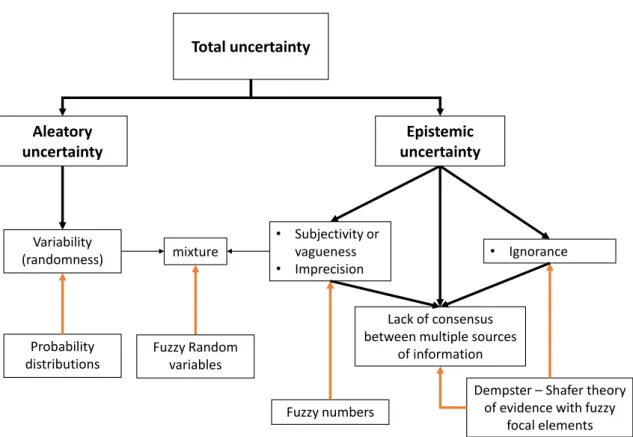
probability theory, evidence theory, and the mixed probabilistic-fuzzy approach are re-viewed. The drawbacks of these approaches in dealing with certain causes of parameter uncertainty are identified. Then, an uncertainty analysis guidance is concluded to help risk assessors in determining the best representation method for the input parameters re-garding the type of available information (cause of parameter uncertainty) as presented in Figure 1.4. Based on this guideline, new uncertainty analysis methodology is developed. In this methodology, randomness (probability theory), possibility (fuzzy numbers) and be-lief (evidence theory) are combined to treat the different causes of parameter uncertainty separately with the right mathematical theory. Coupled with completeness uncertainty, a new definition of risk is introduced where a risk scenario now covers safety and security sequences of events. The bow-tie analysis used to model safety related risks scenarios is combined with an extended version of the attack tree analysis that is introduced for security analysis to result in a cyber-bow-tie analysis. In sum, we are able to logically support answers to the following key questions:
1. How parameter uncertainty can be best addressed and based on the available infor-mation?
2. How safety and security related risk that can lead to major accidents can be analyzed together?
3. How should risk management efforts be allocated by implementing safety and secu-rity measures that work together so as to more effectively mitigate the probability and impacts of accidents?
Variability (randomness) • Subjectivity or vagueness • Imprecision • Ignorance Total uncertainty Aleatory uncertainty Epistemic uncertainty Probability distributions Fuzzy numbers
Dempster – Shafer theory of evidence with fuzzy
focal elements Fuzzy Random
variables mixture
Lack of consensus between multiple sources
of information
Figure 1.4 – The most suitable theories to represent uncertain input parameters regarding the causes of parameter uncertainty that affect each parameter.
1.4
Thesis outline
Chapter 1 is an introductory chapter on motivation behind the research, its approach, analysis contributions, and an outline for the following thesis.
Chapter 2 precises the context of the study. risk analysis for critical facilities is
detailed. Then, the major problem (uncertainty) from what today’s industrial risk analysis methodologies suffer is highlighted. The main sources of uncertainty: (i) completeness, (ii) model and (iii) parameter uncertainties that might affect an assessment are exhibited. The causes of each source of uncertainty are discussed. Then, an overview on the steps behind dealing with the presented uncertainty sources is presented. At the end, we identify at which stages and where these uncertainties affect the risk analysis process.
Chapter 3 presents a state of the art review on two major fields: (i) literature review on parameter uncertainty analysis and representing, propagating of uncertain knowledge. These most common approaches used to characterize parameter uncertainty in model inputs obtained from different sources, such as statistical data and expert judgments are detailed. An overview on interval analysis, fuzzy theory, probability theory, evidence theory, and the mixed probabilistic-fuzzy approach is given. (ii) cyber-security for critical
1.4 Thesis outline facilities and industrial control system. This in order to treat the know completeness uncertainty. The definition of security related risks is provided, and an exhaustive review on the different threats and vulnerabilities on control systems are highlighted. This review will pave the way to handle the known completeness uncertainty by introducing cyber-security within industrial risk analysis.
In Chapter 4, we propose a new fuzzy semi-quantitative methodology to handle param-eter uncertainty during likelihood analysis. A semi-quantitative approach was proposed by the INERIS for likelihood analysis as an alternative to the drawbacks existed in the pure quantitative or qualitative approach. This semi-quantitative approach uses interval analysis to characterize input parameters. However, interval analysis may lead to likeli-hood underestimation in some cases due to parameter uncertainty. Thus, fuzzy theory is introduced as an alternative to interval theory to deal with parameter uncertainty due to imprecision of recorded data and subjectivity of expert elicitation. The qualitative approach proposed in chapter 4 for safety/security likelihood analysis using ATBT is replaced by the fuzzy semi-quantitative to dispose the shortcomings of the qualitative approach. The application of the proposed approach is demonstrated using a case study that cover safety and security.
In Chapter 5, we take a deeper look at parameter uncertainty that affects the ef-fect analysis of risk scenarios. A fuzzy-probabilistic approach is proposed to deal with two causes of parameter uncertainty: imprecision and randomness. Then a comparison between the proposed approach and the existing approaches for uncertainty analysis is done by the application of these approaches to a loss of containment scenario (LOC), representing one of the most likely situations to occur in industry. The overall aim is to compare the different approaches, and to identify which mathematical theories should be used to represent uncertainty regarding the available information. Indeed, the existing uncertainty quantification approaches can lead to different representations of uncertainty in the outputs and hence to different decisions. We prove that the use of an inappropriate approach in an inappropriate place may lead to under or overestimation of risk and sub-sequently to a bad decision. Based on this comparison, a global methodology that mixes probability theory, fuzzy numbers and Dempster-Shafer theory of evidence is proposed to treat each cause of parameter uncertainty with the best suitable theory.
Chapter 6 addresses one aspect of completeness uncertainty which is known. A new methodology to introduce cyber-security related risks within industrial risk analysis is proposed. This approach combines Bow-Tie Analysis, commonly used for safety analysis, with a new extended version of Attack Tree Analysis, introduced for security analysis of industrial control systems. The combined use of bow-tie and attack tree provides an exhaustive representation of risk scenarios in terms of safety and security. The difference
in nature between safety and security initiating event causes some obstacles for likelihood analysis. For these reasons, we propose an approach for evaluating the safety/security likelihood level based on two-term likelihood parts, one for safety and one for security. The likelihood analysis approach presented in this chapter is qualitative. The aim is to show how can separately characterize safety and security events in order to evaluate safe-ty/security scenarios in terms of likelihood. The shortcomings of this approach are listed and discussed. The end of this chapter, the application of this approach is demonstrated using the case study of a risk scenario in a chemical facility.
The end of this document is a summary of the initial objectives, the proposed method-ologies and main contributions, the key findings and lessons of the thesis with conclusions and proposes work for future research.
2
Context & problematic
Summary: In this chapter, we present the context of the
risk analysis process used by the INERIS. The different steps the INERIS follows to analyze riks for critical facilities are detailed (Section 2.2).
Moreover, the major problem that faces the risk analysis pre-diction is introduced. The different sources, types and causes of uncertainties are presented (Section 2.3). Why uncertainty should be considered during risk analysis (Section 2.4) and the different steps to deal with these uncertainties are discussed (Section 2.5). Then, where these uncertainties affect the INERIS’s risk analysis process is discovered (Section 2.6).
Summary
2.1 Introduction . . . . 19 2.2 Understanding hazard analysis for critical facilities in France - The
INERIS methodology . . . . 20 2.2.1 Representation of risk scenarios . . . 21 2.2.2 Probability analysis using bow-tie based on the interval semi-quantitative
approach . . . 23 2.2.3 Severity analysis . . . 28 2.2.4 Decision-Risk matrix . . . 29 2.3 Introducing uncertainty in industrial risk analysis: the different sources
of uncertainty . . . . 31 2.3.1 Parameter uncertainty . . . 31 2.3.2 Model uncertainty . . . 36 2.3.3 Completeness uncertainty . . . 36 2.4 Why uncertainty represents a major problem and should be considered? 37 2.4.1 Red-River flood - Why risk analysts should be explicit about uncertainty? 37
2.4.2 The ASSURANCE benchmark project: Assessment of Uncertainties in Risk Analysis of Chemical Establishments . . . 39 2.5 Addressing uncertainty during risk assessment . . . . 41 2.5.1 Steps to address parameter uncertainty . . . 41 2.5.2 Addressing completeness uncertainty . . . 41 2.6 Where uncertainties affect the INERIS risk assessment process . . . 42
2.6.1 Uncertainty in likelihood analysis: drawbacks of the interval semi-quantitative approach . . . 43 2.6.2 Uncertainty in effect analysis . . . 44 2.6.3 Completeness uncertainty in the risk identification process: No-considering
of cyber-security threats . . . 47 2.7 Conclusion . . . . 48
2.1 Introduction
2.1
Introduction
The French regulation introduces the obligation for SEVESO critical facilities to carry out a compulsory hazard analysis and to update it every five years. The hazard analy-sis has to identify all known and possible major accident scenarios, together with their prevention and mitigation barriers. This analysis must present the probability and the possible consequences of each identified major accident. The INERIS provides this service by a team of risk experts that follow a systematic methodology based on the INERIS ex-pertise. In the current Chapter, the INERIS risk analysis methodology used for SEVESO critical facilities is described as presented in Section 2.2.
In Section 2.3, the major problem of the hazard analysis process (uncertainty) is
presented. The different sources of uncertainty: parameter, model and completeness
uncertainties are detailed.
— parameter uncertainty: relates to the uncertainty in the computation of the input parameter values for conducting the assessment such as initiating event frequencies, etc,.
— model uncertainty: relates to the uncertainty in the assumptions made in order to build the models used in the assessment.
— completeness uncertainty: relates to contributions to risk that have been excluded from the assessment intentionally or not.
To illustrate the effects of uncertainties and why uncertainties should be considered during risk assessment, two different illustrative examples are given in Section 2.4. The first example is a real major accident that happened from not being open about uncer-tainty. The second example is about conclusions extracted from the European benchmark study ASSURANCE on the effect of uncertainty on the risk analysis prediction.
Uncertainties affect the risk assessment process at different phases. Section 2.6 identi-fies the sources of uncertainty that affect each phase in the INERIS risk analysis process. Parameter uncertainty affects likelihood analysis due to some limits in the interval semi-quantitative approach. The effect analysis step suffers from parameter uncertainty due to the lack of information regarding values of some input parameters and the natural variability of others. Completeness uncertainty affects the identification phase as well as the likelihood analysis phase due to non-consideration of cyber-security related threats.
2.2
Understanding hazard analysis for critical
facili-ties in France - The INERIS methodology
In the French regulatory framework industrial activities are classified according to their potential hazard. For high hazard facilities (also called ‘AS’ or ‘Upper tier Seveso establishments’), a hazard analysis is compulsory. Hazard analysis aims to demonstrate the public safety and it represents a tool for the inspection by the authorities. The results of the hazard analysis are used for the permit to operate and definition of the requirements for risk reduction on site.
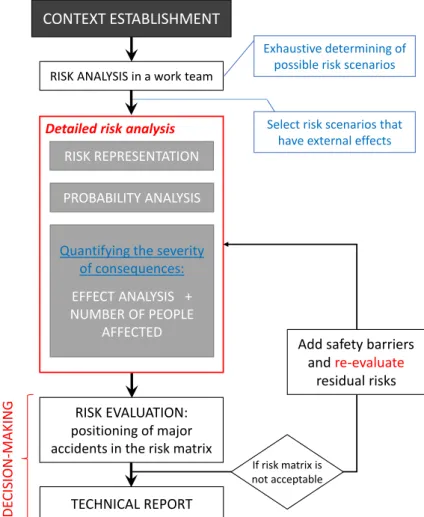
In this section, we will present the different steps of conducting a systematic hazard analysis of high hazard facilities. Figure 2.1 presents the steps for assessing risks of critical industries in France as proposed by the INERIS [90].
— context establishment: aims to define the objectives of the risk management (what should be protected) and the decision criteria (when a risk is acceptable and when it is not);
— risk analysis: this step is the most substantial part of the hazard analysis process for decision making. It aims to analyze in details risk scenarios that may have effects outside the facility being studied. It involves the identification of mechanisms that lead to failure of equipment and loss of containment (central events), and the identification of consequence effects that may follow the loss of containment. In the INERIS method, the working group identifies the central events to be used in the risk analysis. INERIS then aims to find an exhaustive list of causes for the central events defined. The main sub-steps of this step are as follows:
X risk identification: risk identification is the step of modeling risk scenarios (undesirable events) that could potentially harm people and the environment. A risk scenario is modeled as a sequence of events starting from the causes of the undesirable event ending by the related consequences (dangerous phenomena). This step is detailed in Section 2.2.1.
X likelihood analysis: aims to calculate the probability of occurrence of the iden-tified risk scenarios. More details are given in Section 2.2.2.
X severity analysis: combination of dangerous phenomena effect intensity and the vulnerability of people potentially exposed at a given point. This step is more detailed in Section 2.2.3.
— decision making: the results of likelihood and severity analyses are mapped in a risk matrix to give a level of risk to each risk scenario. This matrix allows the authorities to assess the acceptability of risks generated by a facility in a given environment.
2.2 Understanding hazard analysis for critical facilities in France - The INERIS methodology If the risk matrix is acceptable, the facility is considered to be compatible with its environment and a permit to operate will be given. If not, unacceptable risks should be treated and residual risks are then evaluated. Or the permission is withdrew or refused. More details on conducting this step are given in Section 2.2.4.
CONTEXT ESTABLISHMENT
RISK ANALYSIS in a work team
RISK EVALUATION:
positioning of major accidents in the risk matrix Detailed risk analysis
PROBABILITY ANALYSIS
Quantifying the severity of consequences: EFFECT ANALYSIS + NUMBER OF PEOPLE AFFECTED TECHNICAL REPORT DE CISI ON -MAKING
Add safety barriers and re-evaluate
residual risks
If risk matrix is not acceptable
Exhaustive determining of possible risk scenarios
Select risk scenarios that have external effects
RISK REPRESENTATION
Figure 2.1 –The hazard analysis process for high hazard critical facilities.
Risk analysis is the most critical step in the hazard study process. This step represents a challenging problem due to uncertainty. In order to highlight this problem, the rest of this section details the different steps of a detailed risk analysis. The representation of risk scenarios, likelihood analysis and severity analysis are presented.
2.2.1
Representation of risk scenarios
This step aims to model each risk scenario from its root causes via central event
to related consequences. In the methodology used by INERIS, the representation of
accident scenarios is usually realized through a modeling methodology such as bow-tie analysis. Bow-tie analysis is a very prominent method to identify and model risk scenarios
[55]. It presents a combination between fault tree analysis (FTA) and event tree analysis (ETA). FTA and ETA respectively describe the relationship between the undesirable event (the main event of a risk scenario), its causes and its consequences for a systematic representation of hazard ([136]; [53]).
To identify and represent risk scenarios, a working group will be created. It could, for example, consist of the plant safety manager, several operators and risk experts. This working group will identify the following elements of each accident scenario:
— The undesirable central event (UCE) or main event to be considered;
— The initiating events (root causes) lying underneath the undesirable central event. Typical root causes are seal failure, operator errors, falling objects, etc.;
— The secondary events such as ignition after the UCE;
— The consequence events (dangerous phenomena) and the associated major accidents of the central events;
— The safety barriers which may prevent the occurrence of the accident. Preven-tion (before the central event) and protecPreven-tion (after the central event) barriers are considered if they meet the following requirements:
X independence regarding the occurrence of the event they prevent; X effectiveness;
X response time adapted to the kinetic of the accident they prevent; X maintainable;
X testable.
When a mitigation barrier is identified in an accident scenario, both the scenario describing the consequences following the function and the malfunction of the safety barrier need to be taken into account.
These risk contributors are then connected together to construct the bow-tie. Figure 2.2 presents a schematic diagram of the bow-tie analysis and how the risk contributors listed below are connected using AND or OR gates. If any of the root causes can cause the intermediate event, an OR operator is used. If multiple root causes are required for the occurrence of the intermediate event, an AND operator is used. The definition of each term is detailed in Table 2.1.
Once the identification process is realized, the scenarios’ likelihoods can be calculated. Bow-tie analysis and in addition of being a tool for representing a risk scenario, it implicitly provides a likelihood analysis methodology. This methodology aims to propagate the frequency or probability of initiating events after being characterized through the bow-tie in order to calculate the probability of dangerous phenomena.

![Figure 3.8 – Attack tree structure using an example as developed by [140].](https://thumb-eu.123doks.com/thumbv2/123doknet/14492553.717894/88.892.235.710.722.1000/figure-attack-tree-structure-using-example-developed.webp)