RESEARCH OUTPUTS / RÉSULTATS DE RECHERCHE
Author(s) - Auteur(s) :
Publication date - Date de publication :
Permanent link - Permalien :
Rights / License - Licence de droit d’auteur :
Bibliothèque Universitaire Moretus Plantin
Institutional Repository - Research Portal
Dépôt Institutionnel - Portail de la Recherche
researchportal.unamur.be
University of Namur
Engaging Children in the Smart City
Simonofski, Anthony; Dumas, Bruno; Clarinval, Antoine
DOI:
10.1145/3340435.3342719
Publication date:
2019
Document Version
Publisher's PDF, also known as Version of record
Link to publication
Citation for pulished version (HARVARD):
Simonofski, A, Dumas, B & Clarinval, A 2019, 'Engaging Children in the Smart City: a Participatory Design
Workshop', Paper presented at 1st International Workshop on Education through Advanced Software
Engineering and Artificial Intelligence, Tallin, Estonia, 26/08/19 - 26/08/19 pp. 1-4.
https://doi.org/10.1145/3340435.3342719
General rights
Copyright and moral rights for the publications made accessible in the public portal are retained by the authors and/or other copyright owners and it is a condition of accessing publications that users recognise and abide by the legal requirements associated with these rights. • Users may download and print one copy of any publication from the public portal for the purpose of private study or research. • You may not further distribute the material or use it for any profit-making activity or commercial gain
• You may freely distribute the URL identifying the publication in the public portal ?
Take down policy
If you believe that this document breaches copyright please contact us providing details, and we will remove access to the work immediately and investigate your claim.
Engaging Children in the Smart City: A Participatory Design
Workshop
Anthony Simonofski
University of Namur Namur, Belgium [email protected]Bruno Dumas
University of Namur Namur, Belgium [email protected]Antoine Clarinval
University of Namur Namur, Belgium [email protected]ABSTRACT
Nowadays, smart city is a term recurring in many political dis-courses and in literature. Indeed, smart cities provide innovative solutions to solve urban issues. However, this concept and its impli-cations remain obscure to the larger public. In order to help younger citizens understand what lies behind the smart city, we developed a workshop aiming at introducing the concept of smart city in all its complexity. We present here the results of the first in-school session of the workshop. It shows promising results on the engagement of children as well as an evolution in their understanding of the smart city.
CCS CONCEPTS
• Social and professional topics → K-12 education; User char-acteristics; • Human-centered computing → Participatory de-sign.
KEYWORDS
Participatory design, Engagement, Children, K-12, Smart City
ACM Reference Format:
Anthony Simonofski, Bruno Dumas, and Antoine Clarinval. 2019. Engag-ing Children in the Smart City: A Participatory Design Workshop. In Proceedings of the 1st ACM SIGSOFT International Workshop on Education through Advanced Software Engineering and Artificial Intelligence (EASEAI ’19), August 26, 2019, Tallinn, Estonia. ACM, New York, NY, USA,4pages.
https://doi.org/10.1145/3340435.3342719
1
INTRODUCTION
Giffinger [4] defines the concept of smart city as “the search and identification of intelligent solutions which allow modern cities to enhance the quality of the services provided to citizens”. In his definition, Giffinger distinguishes six smart city dimensions represented in Figure1. In a seminal paper, Hollands [9] underlines the importance of the role of citizens to participate in the design of the smart city. Indeed, he states that the smart city won’t reach its goal if the citizens are not involved in its design. In that, information and communication technologies (ICT) come as a means to achieve
Permission to make digital or hard copies of all or part of this work for personal or classroom use is granted without fee provided that copies are not made or distributed for profit or commercial advantage and that copies bear this notice and the full citation on the first page. Copyrights for components of this work owned by others than ACM must be honored. Abstracting with credit is permitted. To copy otherwise, or republish, to post on servers or to redistribute to lists, requires prior specific permission and/or a fee. Request permissions from [email protected].
EASEAI ’19, August 26, 2019, Tallinn, Estonia © 2019 Association for Computing Machinery. ACM ISBN 978-1-4503-6852-0/19/08...$15.00
https://doi.org/10.1145/3340435.3342719
Figure 1: The six smart city dimensions inspired by [4].
the development of citizen-driven solutions meeting the needs of the citizens [11].
Since the involvement of all-age citizens is critical to the success of a smart city [6], it is essential that the larger public understands this concept. However, the many different definitions of a smart city [2] and the frequent use of alternative adjectives (e.g. “intelli-gent” or “digital”) in numerous news and political discourses make smart city a fuzzy concept to grasp for citizens, and that also in-cludes children. Indeed, this younger sub-group of the citizenry is considered as essential to consider in the participation process but is often trivialized by decision-makers [5]. An important driver to invest in child participation is children’s rights, as advocated by the United Nations through their convention on the Rights of the Child. [1] exposes several benefits of children participation such as skills development, preparation for adult participation, formation of children communities, and increased commitment to children’s rights from the organizations that enable this participation.
The digital education of children has to be taken into account to enable them to grasp the concept of smart city. In the Belgian context where digital education is largely absent [8], it is difficult for children to conceive how information and communication tech-nologies can improve their city. While Belgian education is being reformed, a digital education is planned for 5-15 year-old children, as one possible topic among others in a polytechnic course. This paper explores a workshop that could be used in this course to develop both children’s digital skills and their understanding of the
EASEAI ’19, August 26, 2019, Tallinn, Estonia A. Simonofski et al.
smart city. In its remaining, we describe the workshop in detail and report on its first session in a Belgian secondary school.
2
WORKSHOP PROPOSAL: FOUR HOURS FOR
DISCOVERING SMART CITIES
In order to develop the workshop, we relied on participatory de-sign principles. This approach is especially valuable and useful when it comes to involving children in design processes [3,7]. Fur-thermore, we relied on the three-step future workshop process as developed by [10] that enables non-experts to imagine solutions to solve complex issues such as spatial planning.
The workshop is divided into three parts: (1) a theoretical intro-duction of the smart city concept, (2) the realization of a city model with the children, and (3) the identification and resolution of urban issues on the model, with or without technology.
2.1
Theoretical introduction of the smart city
A visual support in the form of a poster representing the six smart city dimensions (Figure1) is displayed. Children are provided with examples of solutions and are asked to link them with the dimen-sion(s) they think match best. Examples of solutions include provid-ing online administrative services to citizens so that they don’t wait long at the city hall. In this step, the workshop facilitator(s) should ensure that the children understand the example correctly and provide additional explanations on each example when necessary.
2.2
Realization of a model with the children
A city model in the form of a 2D paper plan with an empty map printed is presented to children. They are then divided into four groups of even size. Each group is given a box holding 15 build-ings from the board game Democracity1. Sufficient variety in the
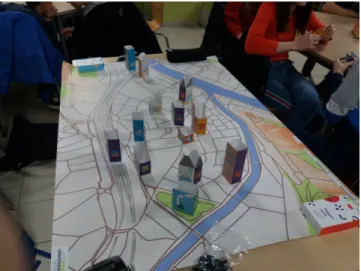
buildings functions is ensured beforehand, for each box. Then, each group simulates urban planning decisions by selecting three build-ings to place on the city model and presents their choice to the class. Groups can subsequently change their selected buildings according to others’ choices and place them on the city model (Figure2), while motivating the chosen location. Once each group has placed their buildings, they can propose one modification to the city model: adding a building, moving a building, etc. Children are then asked to list ways of deciding if a given proposal should be accepted or rejected. The pros and cons of each are subsequently discussed. In this step, the workshop facilitator(s) should act as moderator(s) in the discussion to ensure that all children can give their opinion easily.
2.3
Identification and resolution of issues
From the city model built during the previous step, children reflect on the urban issues that may result from the building configuration (identification). The identified issues are represented on the city model (e.g. toy cars aligned to represent congestion, checkers piled to represent garbage overflowing from bins). Then, children reflect together on several possible solutions. One solution chosen by children is implemented using programmable devices suitable for novice programmers such as Makeblock or micro:bit (resolution)
1https://www.belvue.be/en/node/85
Figure 2: Students building a city model during the work-shop.
Table 1: Decision-making processes listed by the children Decision process Votes Elected officials voting 0
Citizens voting 0 Shared decision (officials and citizens) 10
Only children voting 2 Petition 1 Internet voting (website and public display) 11
Blank vote 1 Total 25
and is integrated into the city model for assessment. In this step, the workshop facilitator(s) should provide children with the necessary background about the programmable devices to allow children to develop the chosen solution.
3
METHODOLOGY
We conducted a first in-school session aiming to inform future work-shop designs by answering the following research question: How can a participatory design workshop impact the understand-ing of the smart city concept of 12-14 year-old children?. In this section, we detail how we recruited the participating children as well as the data collection process.
3.1
Selection and Participation of Children
Participation in the pilot study was offered to 25 12-14 year-old children in a local school, as a matter of convenience. The work-shop was held during school hours, as a part of the “Education par la Technologie” course. All children returned an information and consent form for the study, in addition to the authorization and consent form to use photograph or image proposed by the school.
The sample does not accurately represent the 12-14 year-old population: children are all coming from a geographically restricted area. However, the urban character of this area is interesting in the context of this pilot study. The gender ratio is also to be emphasized: girls represent more than 40% of the sample. This aspect is not insignificant considering the efforts put in place to attract girls in IT jobs.
3.2
Data Collection
Before the workshop, the students were asked to complete a pretest questionnaire. After the workshop, they were asked to complete a post-test questionnaire. The post-test was identical to the pretest, with additional questions. Due to absentees, 21 of the 25 students attended the whole workshop, resulting in 21 collected pairs of pre and post-tests. In this paper, we discuss the findings extracted from the following question: “What is a smart city?”. By comparing the evolution in their responses, we will analyze how the children’s understanding changed after the workshop.
However, we won’t expand on the findings from all questions asked due to space restrictions. Other questions in the pretest fo-cused on the pros and cons of a group discussion and on the iden-tification of technology in pictures. On top of these questions, in the post-test, children were asked to describe the ideal smart city project to be implemented in their city and ways to collect the opinion of the population about it.
4
RESULTS AND DISCUSSION
The workshop was organized over four hours split into two-hour sessions. The first session was dedicated to the first and second steps of the workshop. During the next session, which took place seven days later, the third step was conducted.
During the first step of the workshop (approximately 30 minutes), we observed that students were able to link the provided examples with the smart city dimensions fairly accurately. The economy and governance dimensions were however underrepresented. One explanation is that these dimensions concern aspects that children encounter less in their everyday life. On the contrary, the living and environment dimensions were over-represented. One explanation is that the living dimension is inherently broader that the others. As for the environment dimension, it is also recurrent in the smart city definitions in the pretests. We believe that the prominence of environment concerns is due to the numerous news on climate mobilization at the time of the workshop.
In the second step (approximately 1 hour 30) , the students suc-cessively placed three buildings per group and then one building per group. Every group chose to add a building to the model. Figure3
shows the buildings chosen by the students and their location. We observed that although some buildings were placed somehow arbi-trarily, others were placed anticipating potential issues. An example is the placement of the public transport facility nearby the train station by group 2. They placed it there to ease the access to public transports for people arriving in the city from the train station, and said they wanted to allow workers to reach the multinational corporation placed by group 1 in the periphery easily. Another example is the placement of the police station at the middle of the model to allow fast interventions anywhere. After the city model
Figure 3: City model completed by children. The buildings placed are numbered from 1 to 16. Buildings from 1 to 12 correspond to the 3 buildings initially placed for each group. Buildings from 13 to 16 are those placed in the model modi-fication round. The buildings are as follows: (1) train station, (2) public transport, (3) mall, (4) pharmacy, (5) high school, (6) park, (7) parliament, (8) cultural centre, (9) police sta-tion, (10) primary school, (11) sports hall, (12) multinational corporation, (13) fire station, (14) cafe, (15) university, and (16) hospital. The purple dot at the center of the map cor-responds to the location of the school where the workshop was conducted.
was completed, discussions emerged about the misplacement of the mall, as it would cause congestion when placed in the city center. All students agreed to move it elsewhere, but were divided as for its new location. Students were thus asked to list decision processes to solve such an issue and to vote for their preferred one. Table1lists the six decision-making processes thus obtained and the number of votes each received. We were surprised by the maturity of the students’ reflection at this point. They considered issues such as ensuring the representativeness of voters. They suggested public displays as a way to consult senior citizens who cannot use a com-puter or don’t own one. The decision process that received the most votes is the online voting. Therefore, we decided to implement a voting system using micro:bit in the last step of the workshop. A one-week break between the second and third step allowed us to focus on the voting system development.
In the third step of the workshop (approximately 2 hours), stu-dents worked in groups of two with the micro:bit to implement a voting system that allows consulting citizens on a possible reloca-tion of the mall. The system takes the form of a single micro:bit that can be interacted with through its buttons to cast a vote in favor, against, or blank. The micro:bit would then display a smiley as visual feedback that the vote was cast, and send the vote through radio to a centralized vote counter. Figure4ashows a representa-tion of the micro:bit running the voting system. Figure4bshows the code handling the in favor vote. The code is composed of one main block capturing the button press, as well as two nested blocks handling the visual feedback display and the sending of the vote
EASEAI ’19, August 26, 2019, Tallinn, Estonia A. Simonofski et al.
(a) Representation of the voting system developed with the micro:bit.
(b) Code handling the in fa-vor vote.
Figure 4: Voting system developed by the children.
Figure 5: Cardboard box holding three micro:bits, one per voting option (in favor, blank, against).
to the centralized counter respectively. Due to the limited time available and to the fact that most students knew neither program-ming concepts nor the micro:bit, the centralized vote counter was developed beforehand and brought to the workshop. It is repre-sented in Figure5as a cardboard box holding one micro:bit per voting option. Once every children had successfully implemented the voting system, they discussed the real-life limitations of such a voting system deployed in a city. Issues such as vote privacy and the possibility of voting multiple times were raised.
Thanks to the insights gathered from the pretests and the post-tests filled by the 21 children, we were able to analyze the evolution of their understanding of the smart city concept. The most striking evolution resides in the “problem solving” approach that children adopted. Indeed, in the pretests, only three children noted that the smart city must be implemented to solve citizens’ daily issues. At this point, the predominant definition of a smart city was a city that contains technology, but without specifying any purpose for tech-nology use in the definition. In the post-tests, this number increased to ten children mentioning that the smart city must “answer the questions of citizens”, “use technology appropriately” or “improve the quality of life of citizens”.
5
CONCLUSION AND FUTURE WORK
The goal pursued by the workshop was to determine whether it could impact the children’s understanding of the smart city con-cept. The proposed workshop succeeded. Prior to the four-hour workshop, their understanding was strongly focused on technology implementation, without specifying objectives. At the end of the workshop, a strong technological orientation was still present, but it was used for an explicit purpose to solve issues and improve the life of citizens. In addition, the enthusiasm expressed by chil-dren and the maturity of their thinking shows that they are an audience worth considering when it comes to citizen participation. This further encourages us to carry on our efforts toward children engagement in smart city contexts.
However, the workshop presented in this article is still at an early stage. In the future, we plan to conduct additional workshops to validate these preliminary conclusions and measure other aspects such as factors influencing the engagement of children. At the time of writing this paper, a dozen workshops are planned in the following months.
ACKNOWLEDGMENTS
The authors acknowledge the European Regional Development Fund (ERDF) and the Belgian Federal Science Policy Office (BELSPO) for their support. The research pertaining to these results received financial aid from the ERDF for the Wal-e-Cities project and the Federal Science Policy according to the agreement of subsidy no. [BR/154/A4/FLEXPUB].
The authors also thank Damien, the class teacher, who kindly agreed to hold the workshop in his class and provided precious help during the session.
REFERENCES
[1] Louise Chawla. 2001. Evaluating children’s participation: seeking areas of con-sensus. PLA notes 42, 9 (2001), 13.
[2] Hafedh Chourabi, Taewoo Nam, Shawn Walker, J Ramon Gil-Garcia, Sehl Mellouli, Karine Nahon, Theresa A Pardo, and Hans Jochen Scholl. 2012. Understand-ing smart cities: An integrative framework. In 2012 45th Hawaii international conference on system sciences. IEEE, 2289–2297.
[3] Jerry Alan Fails, Mona Leigh Guha, Allison Druin, et al. 2013. Methods and techniques for involving children in the design of new technology for children. Foundations and Trends® in Human–Computer Interaction 6, 2 (2013), 85–166. [4] Rudolf Giffinger, Christian Fertner, Hans Kramar, Evert Meijers, et al. 2007.
City-ranking of European medium-sized cities. Cent. Reg. Sci. Vienna UT (2007), 1–12.
[5] Roger A Hart et al. 1992. Children’s participation: From tokenism to citizenship. Technical Report.
[6] Sabine Hennig. 2014. Smart Cities Need Smart Citizens, but What About Smart Children?. In REAL CORP 2014–PLAN IT SMART! Clever Solutions for Smart Cities. Proceedings of 19th International Conference on Urban Planning, Regional Development and Information Society. CORP–Competence Center of Urban and Regional Planning, 553–561.
[7] Sabine Hennig and Robert Vogler. 2016. User-Centred Map Applications Through Participatory Design: Experiences Gained During the âĂŸYouthMap 5020âĂŹPro-ject. The Cartographic Journal 53, 3 (2016), 213–229.
[8] Julie Henry and Noémie Joris. 2016. Informatics at secondary schools in the french-speaking region of belgium: myth or reality. ISSEP 2016 13 (2016). [9] Robert G Hollands. 2008. Will the real smart city please stand up? Intelligent,
progressive or entrepreneurial? City 12, 3 (2008), 303–320.
[10] Robert Jungk and Norbert Müllert. 1987. Future Workshops: How to create desirable futures. Inst. for Social Inventions.
[11] Anthony Simonofski, Estefanía Serral Asensio, Johannes De Smedt, and Monique Snoeck. 2018. Hearing the Voice of Citizens in Smart City Design: The CitiVoice Framework. Business & Information Systems Engineering (2018), 1–14.
![Figure 1: The six smart city dimensions inspired by [4].](https://thumb-eu.123doks.com/thumbv2/123doknet/14497476.718597/2.918.521.794.290.559/figure-smart-city-dimensions-inspired.webp)