HAL Id: hal-03175829
https://hal.archives-ouvertes.fr/hal-03175829
Submitted on 21 Mar 2021
HAL is a multi-disciplinary open access archive for the deposit and dissemination of sci-entific research documents, whether they are pub-lished or not. The documents may come from teaching and research institutions in France or abroad, or from public or private research centers.
L’archive ouverte pluridisciplinaire HAL, est destinée au dépôt et à la diffusion de documents scientifiques de niveau recherche, publiés ou non, émanant des établissements d’enseignement et de recherche français ou étrangers, des laboratoires publics ou privés.
language ? Proposal for a conceptual interface to
communicate thought
Michael Zock, Ruslan Mitkov
To cite this version:
Michael Zock, Ruslan Mitkov. How to ask a foreigner questions without knowing his language ? Proposal for a conceptual interface to communicate thought. Natural Language Processing Pacific RIM Symposium, 1991, Singapore, Singapore. �hal-03175829�
How to ask a foreigner questions without knowing his language ?
Proposal for a conceptual interface to communicate thought.
Michael Zock & Ruslan Mitkov LIMSI, B. P. 133, 91403 Orsay, France
Abstract: While much work has been devoted on how to answer questions, little work has been done on how to ask them. We shall discuss in this paper an extension of a system that tries to take into account the following two facts : (a) people learning a natural language usually know what they want to say (content), what they do not know is how to say it, (b) languages learnt in a natural
setting are a byproduct of learning facts abouth the world rather than a matter learnt for its own sake.
SWIM is an exploratory environment for students learning French. The student asks the questions and the system answers them. This kind of approach raises an interesting problem, namely, how to ask questions in a language one doesn't speak yet ? While at present the system allows only for a limited range of questions, we shall discuss later in this paper an extension that should allow for an
open ended dialogue on various topics (history of France, sport events, etc.). In order to achieve this
goal, the system must be equipped with the following components : a database, a reasoning component, a generator for the output, and a conceptual interface for the input (what to say). We shall discuss in this paper a small part of the latter: how to ask (generate) questions. By providing the student with such an interface and a database, we hope to enable him to learn a language by learning facts about the world.
Key words: natural language generation, computer-assisted language learning, natural learning
environment, conceptual interface, question taxonomy 1 Introduction
We shall be concerned here with the learning of a foreign language. More precisely, we are interested in assisting the student in the task of communicating thought. If we want to mimick natural learning by computer, we have to provide the student with an interface that allows him to engage in dialogue as freely as people do in man-to-man communication.
Natural learning, as opposed to institutional learning is characterized by the fact that the learner asks
questions rather than simply answers them. The problem is, how to ask someone a question in a language one doesn't speak yet. While the problem of conceptual input has been discussed at a more general level elsewhere (Zock, 1992), we will restrict our discussion here to the problem of asking questions. Although much work has been devoted on how to answer questions, little work has been done on how to ask them (but see, Kiefer, 1983; Groenendijk & Stockhof, 1984; Sarantinos & Johnson, 1992). 1
Obviously, there are several ways to ask a question: (a) by means of a natural language (source or target language); (b) by using a sublanguage (restricted set of structures in a natural lan-guage);(c) by using an icon language; (d) by using a metalanguage.
We shall be concerned here only with the last way. In order to help the user in determining a specific question, we have to provide him with an interface that allows him to tell the system what it is that he wants some information about : actors or objects (who, to whom, by whom, etc.) time, space, color,
shape or size, etc. Abstract labels such as space, color, shape and size shall help the user to
discriminate, let us say time-questions (when), from questions concerning space, speed, or size. As this work is an extension of the conceptual interface of an existing system, SWIM, 2 let us start by
providing a short description of it.
2 Goals of the system
The major goal of the system here described is to provide a "natural" environment 3 for learning in
an intelligent and meaningful way to produce sentences in French. In order to achieve this goal several subgoals have to be attained, most prominently, the student should be maximally integrated into the process, that is that he should be active rather than reactive (talk only when being asked), as he usually knows best what his needs are. In consequence, the student should be encouraged to ask questions rather than simply answer them. The system allows the student to ask the following questions :
(1) How does one say < idea > ?
(2) Can one say < linguistic form > ? (3) How should one say < idea > ?
(4) Why does one say < form-1 > and not < form-2 >? (5) What would happen if < conceptual modification > ? (6) What would happen if < syntactic modification > ? (7) What would happen if < word y > instead of < word x >? (8) What is the difference between < form x > and < form y > ?
The first communication-mode (how does one say <idea>?) raises an interesting problem : how to control conceptual input, that is, how to tell the computer what one wants to say (message) since one doesn’t know yet how to say it in this particular language. The fundamental question here is in what terms to code and communicate thought. Should one use words, 4 images, or abstract categories
(primitives, metalanguage), or a hybrid form of knowledge representation ?
3 Description of the system
The dialogue is initiated by having the user specify the language in which he wants to communicate his thoughts, and the communication mode. Let us assume that the chosen language was English and
2 SWIM is an acronym for See What I Mean ? It has been conceived by M. Zock and implemented by A. Laroui in
LeLisp on a MacIntosh.
3 A computerized learning environment is said to be natural, if new knowledge can be acquired as a by product of
another goal directed activity. We walk to get somewhere, not to learn to walk. We learn languages to communicate, not to learn grammar. Natural learning is typically empirical (hypothesis testing) and unsystematic : we observe or produce certain changes and draw conclusions on the basis of the regularities between a set of covariations of the input(message) and the output (linguistic forms).
that the communication mode was “How does one say <idea> ?”. In that case the system traverses, the tree in Figure 1 top to bottom left to right.
Communication Mode Verb Tense polarity Predicate declaration question order list of
verbs positivenegative past
present future
Noun Number Determiner
list of nouns
singular
plural indefinitedefinite Argument
IDEA
Proposition
Figure 1: A primitive interface to communicate thought
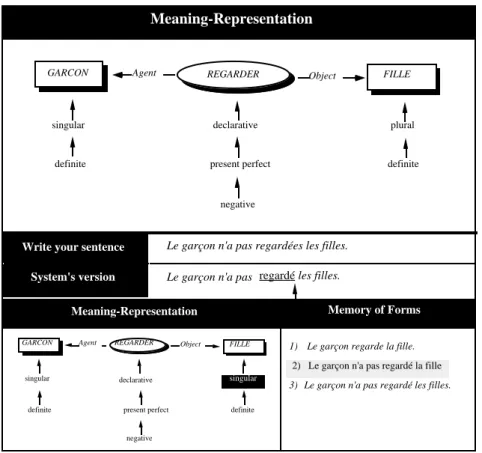
Obviously, the student doesn’t see the tree. He is given a menu from which he has to choose. By choosing (clicking) specific values from a set of attributes, the user tells the system what he wants to say. As the dialogue develops, the system builds the underlying meaning in the form of conceptual graphs. It then invites the user to try to express this meaning, after which it will output its own form.
Agent Object
definite
declarative singular
negative
present perfect definite
GARCON REGARDER FILLE
plural
Le garçon n'a pas les filles.
1) Le garçon regarde la fille.
3) Le garçon n'a pas regardé les filles.
Write your sentence
System's version
Memory of Forms Meaning-Representation
regardé
Le garçon n'a pas regardées les filles.
Object declarative present perfect Agent definite singular definite singular REGARDER GARCON FILLE negative Meaning-Representation
2) Le garçon n'a pas regardé la fille
Figure 2: An interface to learn empirically about the meaning-form relationship
As one can see from Figure 2, the screen is divided into five parts. The large window at the top represents the underlying meaning of the message a student is trying to convey. The next two
windows contain respectively the user’s attempt to express this meaning and the system’s version. Possible mismatches between these two versions are highlighted on the screen. This allows the system to draw the student’s attention to errors. Actually, by looking at Figure 1 you can see that the student made a mistake in the verb agreement "regardé". Finally, the two windows at the bottom represent, from left to right, a snapshot of the system’s memory of meaning and the user’s memory
of form. The former is a device to display, hence to recall the underlying conceptual representation
of a specific sentence chosen from the memory of form window, whereas the latter is an incrementally built database (trace) of all the sentences encountered so far.
The idea behind this separation is to allow the user to make a contrastive analysis of meaning and form between two sentences. Choosing a sentence in the memory of form window gives a representation of the sentence's meaning in the memory of meaning window. By comparing the surface form and the underlying meaning of two sentences, the user can appreciate the relationship between meaning and form. The critical feature, the one that is responsible for the difference of form, is highlighted by the system. In our example it is the value "singular". Past this point, the user has various options : either he continues in the basic communi-cation mode (How does one say
<idea> ?), or he changes the kind of question he wants to ask. Let us suppose that he wants to build a completely different sentence. In this case he could either go through the whole routine, which is quite cumbersome, or he could perform the conceptual changes directely on the graph. Obviously, this latter method is much faster.5
Actually, everything you see on the graph, except deep-case relations, is considered by the system as a variable whose value may be changed directely by the user. In order to do so, he clicks on any of the shown attributes (verb, tense, mode, etc.) and chooses a new value. For example, if he clicks on the verb “regarder” (to watch) the system answers by displaying a list of candidates from which we must choose. By clicking on the feature “present”, the system shows different values ( present, past, future, etc.) of the variable “tense”, etc. Everytime the system is given some piece of information it will change the meaning representation accordingly and, if asked, output the corresponding form. For example, if one started from sentence (a) asking the system to change the number of the direct object from "singular" to "plural" it would produce (b). If one asked to change the tense from “past” to “present perfect”, it would produce (c), etc. (see figure 2)
(a) Le garçon regardait la fille (the boy watched the girl ) (b) Le garçon regardait les fille s (the boy watched the girl s ) (c) Le garçon a regardé les filles (the boy has watched the girls)
5 Actually, that is one of the major advantages of abstract representations compared to, let us say, icons. Another
advantage is that this kind of representation shows on-line how conceptual or pragmatic choices affect the intermediate structure, hence more or less directly the final form. In consequence, by displaying on-line the way how the intermediate structure changes after each choice, we have a means of moving from a black box to a glass box. The former only shows how changes of the input (conceptual choices) are reflected in the output, whereas the latter also shows how discourse choices (topicalisation, word choice, etc.) affect the intermediate levels.
As one can see, this method allows for local as well as for global changes. Actually, the dialogue described corresponds to the communication mode 5. If one changes only one value each time, asking the system to tell right away how this meaning change is reflected in form, one can very quickly build and explore a large search space. Actually, this kind of dialogue between man and machine is much faster and less tedious than it would be between a student and a teacher. The change of meaning and the system’s generation of the corresponding form take about a second, even for an untrained user.
Another communication mode the system allows for is called: What would happen if <syntactic modification>?. This mode allows the user to perform certain transformations such as passive voice or pronominalization. In the latter case, the system will ask the user to specify which element he wants pronominalized (the boy, the girl, or both). Assume that, starting from the conceptual structure underlying sentence (a), the user wants to pronominalize respectively the agent, the object, and finally both arguments. In these cases he would get the following :
Il regarde la fille. (he watches the girl) Le garçon la regarde. (the boy watches her)
Il la regarde. (he watches her)
By exploring and contrasting the different possibilities, the user is meant to learn how variations of meaning are reflected in form.
4 Discussion
The system's weakest point is its conceptual component : one can only talk about a very limited range of facts. Furthermore, the conceptual interface is a surface rather than a deep-structure component : it already contains the lexical items and it knows which syntactic categories to use, i.e., the program thinks in terms of the target language.
In the remainder of this paper we will mainly be concerned with the first point: the problem of coverage. In order to enhance this part we intend to add to the system a knowledge base (on sports, or history, etc.) and modify the interface so as to allow for various kinds of questions concerning the information contained in the base. In order to do so we need a typology on questions.
5 A Possible Solution
Although a lot of work has been done in the area of question answering 6 (see figure 3), little is
known about how to ask them.
6 For surveys, see Paris (1985), Allen (1987, chapter 16); Webber (1987). A lot of research concerning the
appropriateness of an answer has been done in the context of expert systems. The problem adressed there was, what kind of information should be given in order to answer a question usefully. For a discussion of some of these issues, see McKeown & Swartout (1988); Moore & Swartout, (1988); Paris, (1990).
BASEBALL (Green et al., 1963) SYNTHEX (Simmons et al., 1966) SHRDLU (Winograd, 1972) LUNAR (Woods et al., 1972) LUIGI (Scragg, 1975) GUS (Bobrow et al. 1977) LIFER (Hendrix, 1977) PLANES (Waltz, 1978) QUALM (Lehnert, 1978)
BLAH (Weiner, 1980)
HAM-RPM (v.Hahn et al, 1980) OSKAR (Allen & Perrault, 1980) CO-OP (Kaplan, 1983)
XPLAIN (Swartout, 1983) TEXT (McKeown, 1982, 1986) TAILOR (Paris, 1988,1989) ROMPER (McCoy, 1989) EES (Moore & Swartout, 1990)
Figure 3
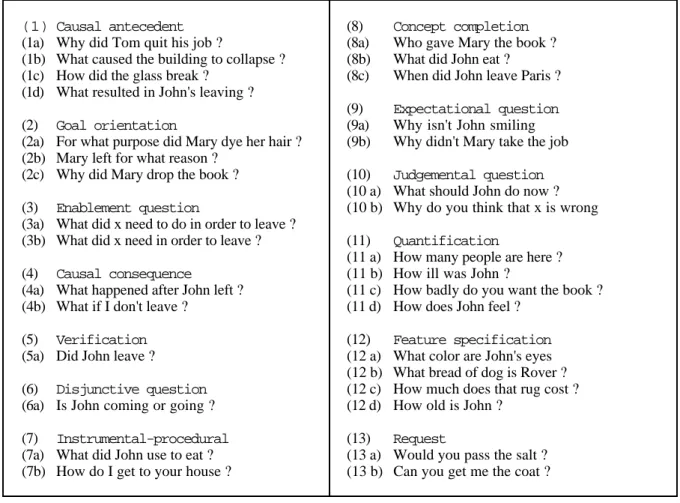
Probably the best known work is W. Lehnert's system QUALM (Lehnert, 1977). She introduced thirteen types of questions :
(1) Causal antecedent (1a) Why did Tom quit his job ?
(1b) What caused the building to collapse ? (1c) How did the glass break ?
(1d) What resulted in John's leaving ? (2) Goal orientation
(2a) For what purpose did Mary dye her hair ? (2b) Mary left for what reason ?
(2c) Why did Mary drop the book ? (3) Enablement question
(3a) What did x need to do in order to leave ? (3b) What did x need in order to leave ? (4) Causal consequence
(4a) What happened after John left ? (4b) What if I don't leave ?
(5) Verification (5a) Did John leave ?
(6) Disjunctive question (6a) Is John coming or going ? (7) Instrumental-procedural (7a) What did John use to eat ? (7b) How do I get to your house ?
(8) Concept completion (8a) Who gave Mary the book ? (8b) What did John eat ?
(8c) When did John leave Paris ? (9) Expectational question (9a) Why isn't John smiling (9b) Why didn't Mary take the job (10) Judgemental question (10 a) What should John do now ? (10 b) Why do you think that x is wrong (11) Quantification
(11 a) How many people are here ? (11 b) How ill was John ?
(11 c) How badly do you want the book ? (11 d) How does John feel ?
(12) Feature specification (12 a) What color are John's eyes (12 b) What bread of dog is Rover ? (12 c) How much does that rug cost ? (12 d) How old is John ?
(13) Request
(13 a) Would you pass the salt ? (13 b) Can you get me the coat ?
Figure 4: Lehnert's question typology
One of the main contributions of Lehnert's work is that she spelled out the kind of search-strategies (where to look for in the data base) that are needed in order to answer a question in an optimal way. For example, enablement questions require an examination of events causally related to the conceptual event in question, causal antecedent questions require knowledge of causal responsibility,
procedural specification questions require retrieval of instructional information, etc. Unfortunatley,
Lehnert's approach has several shortcomings. The criticisms one can adress at her work concern granularity, completeness, correctness of analysis and metalanguage :
1° Many question categories are too coarse grained. For example, categories like time or quantity, clearly need refinement, taking into account distinctions such as
duration (how long), frequency (how often), starting point, end point (until
when), etc.
2° Some classifications are clearly questionable. For example, Lehnert considers the following questions as belonging to different categories:
(a) How did you manage to see John ? (b) How did John find his lost book ? (c) How can we eat tonight ?
According to her, they do not belong to what she calls Instrumental/Procedural
questions. Whereas we feel that all these questions ask for information concerning
the method used in order to achieve a given state of affairs. Hence these questions do belong to the same category (method questions). Furthermore, we believe that various questions are grouped in the wrong category. For example question (8c) pertains to time, question (lld) asks for feature specification, whereas the questions (12c) and (12d) are questions about numerical values, hence, they should appear in the category of quantification.
3° Her definition of concept-completion questions ( wh-questions) is also problematic. Defining this category as questions that ask for the completion of a specific event is meaningless, because practically all questions, except yes-no questions, ask for completion.
4° Finally, her metalanguage is sometimes too exotic in order be accessible to the naive language user.
5° Last but not least, Lehnert's system can not be used for our purpose, as it was designed for answering questions, not for asking them.
Our goal in this paper is not to specify how to answer a question, but how to ask it. To this end we need to make a taxonomy of questions. It should be noted however, that this taxonomy is only a first attempt and should not be taken as a complete or definite account of questions.
6 A first sketch of a question taxonomy
Questions can be about many things. One can ask questions about the truth-value of a statement (yes/no questions), or ask for the meaning of a given term (request for definition). One may query information concerning the roles played by individuals in a given scenario (Who did <action>?), or ask for information concerning quantity, quality or degree of a given object. One may wish to know which objects satisfy a given state of affairs (which-questions), or one may ask questions about
time, space, manner, about the reasons or motivations for a relationship holding between two states
of affairs, etc. Questions can thus refer to entire clauses (yes-no questions) or to a specific element of a clause: discourse objects (who, what) or to the actions, processes, events these objects are
involved in. They can also refer to modifiers (typically adjectives or adverbes), to specific set
elements (which), to circumstantials (space & time) and to interclausal relationships (why).
Obviously, questions can be classified according to various points of view: pragmatic-functional (speech-act), linguistic (yes/no questions, wh-questions, tag questions, etc.), conceptual (object of the question: actors, space, time, etc.). We shall be concerned here mainly with the conceptual classification. Actually, we shall deal here only with direct questions whose scope is a single argument (wh-question) not the entire clause as this would be the case of yes/no questions.
One reason why a linguistic classification is not adequate for our purpose is that linguistic classifications tend to be done on the basis of surface forms (distinguishing, let us say, how questions, from what questions, etc.). The problem with this approach is that question markers are highly ambiguous. For instance the question marker how, may be used to ask for quantitative information concerning size, distance, frequency, etc.
How are you ? (state)
How did you get here, by train or by bus ? (means of transportation)
How did you solve this problem ? (method)
How did you sleep ? (manner)
How do you want me to paint this room, (value of an attribute) pink or white ?
«Where» may be used to query information concerning origin, direction, location, etc. «Why » may
be used to ask for reasons, causes, purposes or motivations, etc.
In this paper we begin with the assumption that the user of the system knows what his question is about (motivation). The problem to be solved is to find the surface form, that is, the question marker and the corresponding sentence structure. In order to do so we associate each question type with a sentence template, composed of the question marker and the corresponding syntactic form.
Question concerning Sentence template Example
Attribute Who <num.value> <function> <country> ? Who was the first king of France ?
Quantity How <number> <object> do you have ? How many children do you have ?
Reason Why <aux> <person> <action> <object>? Why did John sell his car ?
Agency Who <action> <object> ?< Who bought this house ?
Degree How <attribute> is <object> ? How old are you ?
Identity What <name> <person> ? What is your name ?
We shall now provide a first sketch of our question taxonomy. According to the object of the question (actors, attributes of the actors, quantity, etc.) we will talk about role-questions, feature specification questions, degree questions, etc.
6.1 Role-questions : The form of the question marker depends on the role played by the object
The corresponding forms are thus inflected or not (who vs. whom) and preceded by a preposition (to, for, by, etc.).
<Agent-Object> Who killed <person> ? What did you see ?
<Co-agent> Who do you work with?
<Beneficiary - Destination> To whom did she send this letter? For whom do you work?
<Source> From whom did you borrow this money?
<Means - Instruments> What did <person> use to eat this with? (fork/chopsticks)
<Instrumentality> What shall I eat this with? (with a fork or with chopsticks )
<Possessor> / <relationship> Whose book is on the table? Whose son won the price ?
6.2 Event questions may refer either to the entire event (a), or to the action (b). (a) What happened ?
(b) What did he do ?
6.3 Feature specifications questions ask for specifications along a given dimension (color,
size, shape, moral judgements, etc.). These kind of questions are often introduced by what or how. <identity-name> What's your name ?
<origin> What's his nationality ? Where does he come from ? <time> What's the time now in <country> ?
<age> How old is <person>? What is his age ? <size> How <size> is <person>?
<color> What color are her eyes ? Which color ? What kind of color ? <price> How much does this car cost ? What's the price of this car ?
6.4 Degree questions.The answer to a degree question can be more or less precise, that is, it can
either be a numerical value, or a hedge adverb like "quite, very, much", etc. <speed> How fast does he run ?
<age> How old is he ?
Degree questions, as opposed to feature specification questions, suppose that the value of a given
attribute is known ( for example: blue, if the question had been: «What color are his eyes ?»). The underlying meaning of this kind of question is to provide information concerning the degree along a given scale (color, size, temperature, age, etc.). Degree questions can also be interpreted as feature
specification questions. For example, a question like «How old is he ?» could be answered precisely
by giving a numerical value like «32», or more vaguely, by using a hedge like «quite, pretty, very, etc.».
6.5 Manner questions, as opposed to feature specification questions, qualify actions, e.g. «how
<action> ?» as opposed to «how <state> <object>?», or «how <value-attribute> <object> ?» How did you sleep ?
How did he perform ?
6.6 Set specification questions suppose that there are several objects of the same kind, out of
which we have to choose the one(s) that has (have) the feature(s) ascribed. Who is the most intelligent student ?
Which country do you live in ?
6.7 Quanticative questions : Objects can be quantified in an objective (absolute, relative) or
subjective way with regard to some reference point (size, degree, moral/esthetical value) <length> How long is this?
<frequency> How often does this happen? <distance> How far is Istanbul from here? <intelligence> How intelligent is John? <emotional state> How much do you love her ?
6.8 Space questions. With regard to space one has to distinguish between positions, direction, containment, etc. In many languages other than English one has also to distinguish between the source and the destination.
<place> Where do you live? <direction-destination> Where are you going to ? <source-origin> Where do you come from ? <containment> What do you keep the butter in ?
6.9 Time questions. With regard to time one has to distinguish, among other things, between duration, frequency, perspective (beginning vs. end)
<point> When / at what time did you arrive ? <unit of time> What day is today ? What time is it ? <frequency> How often do you train ?
<duration> (For) How long do you work ?
<past-now> Since when ? For how many <units of time> did you work ? <end point> Until when will this last?
6.10 Motivational questions ask information about reasons, causes, motivations and conventions (rules). We shall distinguish causes from motivations in the sense that the former are
located in the past, while the latter are more like goals, being located in the future. <reason-cause> Why did she leave her job ?
<reason-motivation> What do you need this for ? <reason-convention> Why does one say such and such ?
6.11 Hypothesis questions: These kind of questions concern possible consequences of an
action.
<hypothesis-consequence> What would happen if <action> ?
6.12 Conditional questions request the conditions under which a certain action should be
performed.
When should I <perform action> ? When shall I take these drugs ?
6.13 Method questions ask about the procedure used to solve a problem. How did you solve the problem ?
How did she cook this dish ?
6.14 Structure & functioning questions ask for information concerning the structure
How is this system organized ? How does the television set function ? 7 Conclusion
We have presented a system under development whose goal is to assist people in learning a language. In the second part of the paper we have discussed a possible extension based on a question taxonomy that should allow people to interact freely with a database. In doing so we will hopefully meet the student's interests and our initial goal, namely, to help the student learn a language by learning facts about the world. This classification is by no means complete nor necessarily correct in all its details. However, it is meant to give the reader an idea of the direction of our current research efforts. Obviously, more work is needed.
REFERENCES
Allen, J. & Perrault, C. (1980) Analyzing Intention in utterances. Artificial Intelligence 15, 1, 143-178
Allen, J. (1987) Natural Language Understanding, The Benjamins/Cummings Publishing Company, Menlo Park, California
Bobrow, D., Kaplan, R., Kay,M., Norman,D. Thompson, H. & Winograd, T. (1977)GUS, a frame-driven dialog
system. Artificial Intelligence, 8 (2)
Green, B., Wolf, A. Chomsky, C. & Laughery, K.(1966)BASEBALL: An automatic question answerer. In, Feigenbaum, E. & Feldman, J. (Ed.) Computers and Thought, McGraw Hill, New York
Groenendijk, J. & M.Stockhof (1984) Studies on the semantics of questions and the pragmatics of answers. PhD dissertation, University of Amsterdam
Hahn,W.v., Hoeppner,W., A.Jameson & W.Wahlster (1980)The Anatomy of the Natural Language Dialogue System
HAM-RPM. In: Bolc (Ed.) Natural Communication with Computers, Carl Hanser Verlag, München
Hendrix, G.(1977) Human engineering for Applied Natural Language Processing. Proceedings of IJCAI-77, Cambridge, Mass
Kaplan, J. (1982) Cooperative Responses from a portable natural language database query system. In, M. Brady (Ed.), Computational models of of discourse, MIT Press, Cambridge Mass, pp. 167-208
Kiefer, F. (Ed.) (1983) Questions and answers, D. Reidel
Lehnert, W. (1977) Human and computational question answering. Cognitive Science, 1, (1), 47-63 Lehnert, W. (1979) The process of question answering. Lawrence Erlbaum Associates
Mc Coy, K. (1989) Generating Context Sensitive Responses to Object Related Misconceptions, Artificial Intelligence, 41, 157-195
Mc Keown, K. (1982) Generating Natural Language Text in Response to Questions about Data-Base Structure, PhD Dissertation, University of Pennsylvania, TR MS-CIS-82-5
Mc Keown, K. (1986) Text Generation: Using Discourse Strategies and Focus Constraints to Generate Natural
Language Text,Cambridge University Press, London
Mc Keown, K. & W. Swartout (1988) Language Generation and Explanation. In Zock & Sabah (Eds.) Advances in Natural Language Generation: an Interdisciplinary Perspective, co-edition Pinter, London, Ablex, Norwood, N.J.
Moore, J. & Swartout, W. (1990) A Reactive Approach to Explanation. In Paris, C., Swartout, W. & W. Mann (Eds.) Natural Language Generation in Artificial Intelligence and Computational Linguistics, Kluwer, Academic Publisher
Moore, J . & Paris, C. (1989) Planning Text for Advisory Dialogues, Proceedings the the 27th ACL, Vancouver Paris, C. (1985) Towards more Graceful Interaction: A Survey of Question-Answering Programs, TR Columbia
University, CUCS 209-85
Paris, C. (1988) Tailoring Object Descriptions to a User’s Level of Expertise, Computational Linguis-tics, vol. 14, number 3
Paris,C. (1989) The Use of Explicit User Models in a Generation System for Tailoring Answers to the User’s Level of
Expertise,. In: Kobsa, A.& W.Wahlster,W (Eds.), User Models in Dialog Systems, Springer Verlag, Berlin
Paris, C. (1990) Generation and Explanation: building an explanation facility for the explainable expert systems
framework.In Paris, C., Swartout, W. & W. Mann (Eds.) Natural Language Generation in Artificial
Intelligence and Computational Linguistics, Kluwer, Academic Publisher
Sarantinos, E. & P. Johnson (1992) Explanation dialogues: a theory of how experts provide explanations to novices
and partial experts. Artificial Intelligence
Scragg (1975) Answering questions about processes. In D.A. Norman & D.E. Rumelahrt (Eds.), Explorations in cognition. San Francisco: Freeman
Simmons, R., Burger, J.F. & Long, B. (1966) An approach towards answering questions from text. Proceedings of the Fall Joint Computer Conference, AFIPS Press, Montvale, N.J.
Waltz,D.(1978) An English language question answering system for a large relational data base. CACM 21, 526-539 Webber, B. (1987) Question Answering. In, S. Shapiro (ed.), Encyclopedia of Artificial Intelligence, 814-822, New
York: Wiley
Weiner, J. (1980) Blah: a System which Explains its Reasoning, Artificial Intelligence 15 Winograd, T. (1972) Understanding natural language. New York: Academic Press
Woods,W., Kaplan, R.M. & B. Nash-Webber (1972) The lunar sciences natural language information system: Final report. BBN Report No. 2378, Bolt Beranek & Newman Inc., Cambridge, Mass.
Zock, M. (1992) SWIM or SINK : the Problem of Communicating Thought, in : Swartz, M.& M. Yazdani (Eds.). Intelligent Tutoring Systems for Foreign Language Learning: The The Bridge to International Communication. Springer Verlag, Berlin