HAL Id: ensl-00321073
https://hal-ens-lyon.archives-ouvertes.fr/ensl-00321073
Preprint submitted on 12 Sep 2008
HAL is a multi-disciplinary open access
archive for the deposit and dissemination of
sci-entific research documents, whether they are
pub-lished or not. The documents may come from
teaching and research institutions in France or
abroad, or from public or private research centers.
L’archive ouverte pluridisciplinaire HAL, est
destinée au dépôt et à la diffusion de documents
scientifiques de niveau recherche, publiés ou non,
émanant des établissements d’enseignement et de
recherche français ou étrangers, des laboratoires
publics ou privés.
A new model for conference submissions
Patrick Flandrin
To cite this version:
(will be inserted by the editor)
A new model for conference submissions
Patrick FlandrinUniversit´e de Lyon, ´Ecole Normale Sup´erieure de Lyon
Laboratoire de Physique (UMR 5672 CNRS) & IXXI Complex Systems Institute 46, All´ee d’Italie, 69364 Lyon Cedex 07, France
Received: date / Revised version: date
Abstract. Electronic submission to a conference is a process that is known to evolve nonlinearly in time, with a dramatic increase when approaching the deadline. A model has recently been proposed by Alfi et
al. (Nature Physics, 2007) for such a process, and the question of its universality has been raised. This
problem is revisited here from a data analysis and modeling point of view, on the basis of a larger data set. A new model is proposed that better describes the complete evolution of the process (including saturation) and allows for a running prediction of the total number of submissions.
PACS. PACS-89.75.Fb Structures and organization in complex systems – PACS-89.20.Hh World Wide Web, Internet
1 Introduction
For anyone who ever organized a conference, it is well-known that most of the electronic submissions are to be expected during the very last days (or even hours) be-fore the deadline. This folklore observation has recently received a more quantitative attention [1], ending up even-tually with a possible model (referred to in the following as “APP”, for Alfi-Parisi-Pietronero) for the submission process prior the deadline and suggesting its possible uni-versality. The analysis proposed in [1] was based on a very simple assumption (the probability of submission was as-sumed to be inversely proportional to the lasting time be-fore the deadline) and it resulted in a model that fitted remarkably well the analyzed experimental data. At this point, two remarks can however be made:
1. The first one is related to the APP model itself which, strictly speaking, predicts a finite time singularity in the form of a logarithmic divergence when approaching the deadline (see Sect. 3.1 below), a property that has to be regularized in some way since, in practice, the total number of submissions has always to be finite. As a corollary, the prediction of this number is not easy, and the rule of thumb proposed in [1]—i.e., extending the initial linear increase of the early submissions and multiply by three the intersect at the deadline—was seemingly ad hoc and not a direct by-product of the model.
2. The second remark concerns the supporting data which essentially consisted in only one major conference and one more local workshop. Whereas the proposed
mod-Correspondence to: [email protected]
eling was clearly relevant for such data, it is obvi-ous that more examples would be needed for assessing some form of universality in the reported behaviour. Moreover, it is likely that the results might also de-pend on the type of conference considered and/or on the concerned scientific community.
In order to address those issues, another (somehow larger) set of data is envisioned here. This data set is first described in Sect. 2, whereas a visual inspection of the corresponding time series will suggest a refined model (as compared to the APP one) that is discussed in Sect. 3, in both terms of fit and prediction of the total num-ber of submissions. Finally, interpretation issues and still open questions about universality will then be addressed in Sect. 4.
2 Data
The data set considered in this paper consists in the times-tamps of electronic submissions to six conferences that play a major role in the signal and image processing (SIP) community:
– Three of them are organized at a national level (the GRETSI symposia which are, every two years and un-der the auspices of the GRETSI association [2], the largest French-speaking event);
– One at the European level (the European Signal Pro-cessing Conference EUSIPCO that takes place every year and is organized by the EURASIP association [3]); – Two at a worldwide level (a more specialized bien-nal workshop: the IEEE Statistical Sigbien-nal Processing Workshop SSP, and a very big annual convention: the
2 Patrick Flandrin: A new model for conference submissions Table 1. Actual numbers of submissions of the considered
conferences, estimated parameters of the proposed model and predicted total number of submissions (see Sect. 3.2). In some cases, the initial deadline has been officially extended and re-sults corresponding to both deadlines are reported.
conf. G-03 G-05 G-07 E-04 S-05 I-06
# subm. 423 462 481 876 438 3903 β 2.6 2.5 1.6 1.6 1.3 1.7 2 - - 1 1.3 -t∗(days) 0.25 -0.1 -2 2 1 -0.4 -1 - - -0.2 -1.5 -1 week pred. 410 451 487 894 456 4078
IEEE International Conference on Acoustics, Speech and Signal Processing ICASSP, which is by far the most largely attended conference in the field, both events being organized by the IEEE-SP Society [4]). More precisely, locations and dates of the conferences analyzed here are as follows:
– GRETSI-03, Paris (F), Sept. 8-11, 2003
– GRETSI-05, Louvain-la-Neuve (B), Sept. 6-9, 2005 – GRETSI-07, Troyes (F), Sept. 11-14, 2007
– EUSIPCO-4-03, Vienna (A), Sept. 6-10, 2004 – SSP-05, Bordeaux (F), July 17-20, 2005 – ICASSP-06, Toulouse (F), May 14-19, 2006
Details of the corresponding total numbers of submis-sions are given in Table 1.
In all cases, the data have been recorded from the opening of the submission websites to their closing, this latter taking always place later than the deadline initially announced. Timestamps are given in UNIX time and thus known with a precision of one second, but their analysis has been carried out with no noticeable difference either on the basis of all timestamps with their actual time loca-tions or on a smaller subset corresponding to the situation of submissions at regularly spaced intervals (typically one day). For a sake of simplicity and readability, the results reported here will correspond to such uniformly sampled time series, with about fifty samples in each case, corre-sponding to a submission period that is generally of the order of two months.
In terms of specificity, all the chosen events can be con-sidered as attended by essentially the same (SIP) scientific community, which certainly differs from that attending the conference StatPhys 23 considered in [1]. Moreover, whereas submission to StatPhys meetings consists in send-ing a short abstract only, submission to those SIP confer-ences implies the sending of a much more complete mate-rial, namely the full paper (4 or 5 pages, double column) in the case of ICASSP or EUSIPCO, and an extended sum-mary (3 or 5 pages, single column) for GRETSI or SSP. This is likely to impact on the timing of submissions, with a tendency to skew the distribution towards shorter time distances from the deadline.
While diverse in size, the considered conferences can however be viewed as representative of a common
situa-!!"" !#$ !#" !%$ !%" !&$ !&" !$ " $ &" "'& "'% "'# "'! "'$ "'( "') "'* "'+ & ,-./ 0123-4567,89:3:4-;5<78/:=35//510/ 8 8 >?@ABC!") >?@ABC!"$ >?@ABC!"# BBD!"$ CEFBBD!"( @GBCDEH!"!
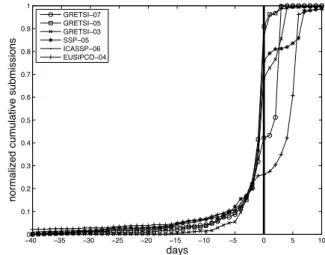
Fig. 1. Cumulative number of submissions as a function of time. All data have been renormalized by their corresponding total number of submissions so as to saturate at unity, and shifted relatively to a deadline arbitrarily fixed at T = 0 so as to superimpose in the regime prior the first announced dead-line. Variations after T = 0 correspond to extended deadlines.
tion in terms of field, community and style, and the anal-ysis of the different submission histories reveals indeed striking resemblances. This is reported in Fig. 1 where, af-ter a renormalization by the total number of submissions (and some possible deadline shift that will be commented later), all data points are found to fairly well superimpose on a common curve prior the deadline, here referred as time T = 0 (an even better superimposition could be ob-tained by adjusting a scale factor on the time axis as pro-posed in Sect. 3.2, but this has not been done here). The dissimilarities occurring after T = 0 are due to deadline extensions (3 days or 1 week, announced just before the initial deadline), and it striking to observe that, when tak-ing into account the correspondtak-ing shifts, the same type of behaviour is recovered.
In short, the submission process can be depicted by a nonlinear evolution that is highly accelerated when ap-proaching the deadline and slowly relaxed for late submis-sions (when still accepted).
3 Models
3.1 APP
Up to the saturation effect, evolutions such as those in Fig. 1 were supposed to be captured by the APP model. Indeed, this latter assumes that the “probability” of sub-mission at time t is inversely proportional to the remaining
time up to the deadline t∗, thus reading:
p(t) = C t∗− t
, (1)
where C is some constant related to the total number of submissions.
!!"" !#$ !#" !%$ !%" !$ " $ "&% "&# "&! "&' "&$ "&( "&) "&* "&+ % ,-./ 0123-4567,89:3:4-;5<78/:=35//510/ 8 8 >?@AAB!"( @BB @BB8C&8:;54& 07C831,74
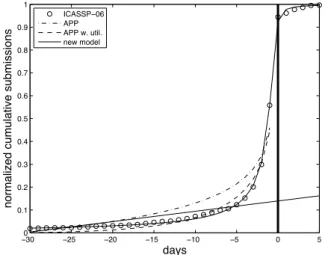
Fig. 2. Data and optimal least-squares model fits in the case of ICASSP-06. The new model, (fitted for all times, including after the deadline referred to as T = 0 (thick line)) is compared to the APP model which holds prior the deadline only, with and without an exponential utility function (whose fitted time scale happens to be of about 14 days). The thin straight line corresponds to the extension of a linear fit on the early part of the APP model, its intersect at T = 0 corresponding, when multiplied by 3, to the APP rule of thumb for the prediction of the total number of submissions.
It thus follows that the number of cumulative submis-sions N(t) at time t is expected to be of the form
N (t) = ! t 0 p(s) ds = C log " t∗ t∗− t # , (2)
predicting a logarithmic divergence at t = t∗.
Even if ignoring the necessary regularization of this di-vergence, such a model does not account properly for the present data, as evidenced in Fig. 2 where a fit according to eq. (2) cannot adequately reproduce the global evolu-tion from early submissions to late ones (ICASSP-06 has been chosen as an example because it corresponds to the largest data set, but a similar behaviour is observed with the other conferences). Moreover, applying the APP rule of thumb for prediction would lead in all cases to a to-tal number of submissions that is largely under-estimated (e.g., by a factor of almost 3 in the case of ICASSP-06).
As suggested in [1] for payments as opposed to regis-trations, an exponential “utility function” could be added to the model in order to take into account a “pressure” to postpone the submission. While certainly improving the situation in terms of fit prior the deadline (see Fig. 2), this however does not solve the divergence issue when
ap-proaching t∗ nor it offers an easy way of making
predic-tions about the total number of submissions. 3.2 An empirical model
All those observations prompt to look for some more ef-fective model, capable of reproducing at once the global
behaviour, including the saturation. The main characteris-tics that is looked for is therefore some nonlinear, sigmoid-type evolution, as commonly observed in many growth phenomena. Warped sigmoid-based models (such as, e.g., those derived from the Richards growth equation [5]) turn however not to be adapted whereas better candidates (see, e.g., [6]) suffer for not having any analytic expression for the integrated growth equation. From a pragmatic point of view, a very simple and convenient model for the cumu-lative number of submissions N(t) as a function of time t turns out to be:
N (t) = 1 − exp{tan−1[β(t∗− t)] − π/2}
1 − exp{−π} Ntot, (3)
where Ntotstands for the total number of submissions and
β is some time scale factor.
3.3 Fit
As evidenced in Fig. 2, fitting (in a least-squares sense) the model of eq. (3) to the largest data set (ICASSP-06) is very satisfactory.
In terms of modeling, one could think of the actual deadline T = 0 as a fixed quantity, but it is in fact more natural to consider it as a free parameter. This allows for an increased flexibility that may take into account pos-sible deadline extensions as well as (personal) “targeted” deadlines that may differ from the actual one. Fitting this way the proposed model (3) with 2 degrees of freedom
(the scale factor β and the effective deadline t∗, the total
number of submissions Ntot being assumed to be known)
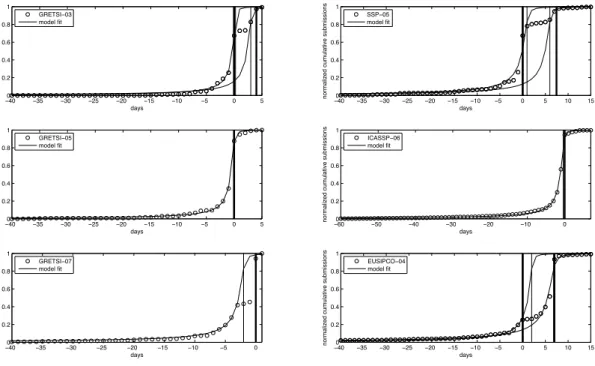
to the whole data set corroborates the results obtained in Fig. 2 for ICASSP-06. This is evidenced in Fig. 3, with the corresponding numerical values of the estimated scale
factors β and effective deadlines t∗ reported in Table 1
(in the three cases where the initial deadline has been officially extended, two models have been adjusted, with an estimated deadline fitted in the vicinity of each actual one).
One can remark that the values of the scale factor β have some variability, ranging from 1 to 2.6. However, in the case of SSP-05, it is interesting to point that the same value (β = 1.3) is obtained whatever the considered dead-line (initial or extended), supporting the interpretation that the one week deadline extension resulted mostly in a pause of the same amount of time in the submission process. Similar (even if less striking) observations can be made for the two other conferences (GRETSI-03 and EUSIPCO-04) whose deadline has been extended with an official announcement.
3.4 Prediction
In practice, the total number of submissions Ntot is of
course one extra degree of freedom in any model. In this re-spect, (3) is of particular relevance in the prediction prob-lem for which, given the knowledge of past submissions
4 Patrick Flandrin: A new model for conference submissions !!"" !#$ !#" !%$ !%" !&$ !&" !$ " "'% "'! "'( "') & *+,-./01+2345*678182+93:56-8;13--3/.- 6 6 !!"" !#$ !#" !%$ !%" !&$ !&" !$ " $ "'% "'! "'( "') & *+,-./01+2345*678182+93:56-8;13--3/.- 6 6 !!"" !#$ !#" !%$ !%" !&$ !&" !$ " $ "'% "'! "'( "') & *+,-./01+2345*678182+93:56-8;13--3/.- 6 6
!!"" !#$ !#" !%$ !%" !&$ !&" !$ " $ &" &$ "'% "'! "'( "') & *+,-./01+2345*678182+93:56-8;13--3/.- 6 6 !("" !$" !!" !#" !%" !&" " "'% "'! "'( "') & *+,-./01+2345*678182+93:56-8;13--3/.- 6 6
!!"" !#$ !#" !%$ !%" !&$ !&" !$ " $ &" &$ "'% "'! "'( "') & *+,-./01+2345*678182+93:56-8;13--3/.- 6 6 <=>?@A!"B 1/*526C39 <=>?@A!"$ 1/*526C39 <=>?@A!"# 1/*526C39 @@D!"$ 1/*526C39 AEF@@D!"( 1/*526C39 >G@ADEH!"! 1/*526C39
Fig. 3. Data and optimal least-squares model fits for all conferences. Actual (resp. fitted) deadlines are plotted as thick (resp. thin) vertical lines. In three cases (GRETSI-03, SSP-05 and EUSIPCO-04), the initial deadline has been officially extended, with an announcement a couple of days prior the initial deadline here referred to as T = 0. In those cases, two models have been adjusted, with an estimated deadline fitted in the vicinity of each actual one. The corresponding values of the fitted parameters are reported in Table 1.
from the opening time of submissions t0until the current
time t, i.e., {N(s), t0 ≤ s ≤ t}, the corresponding model
fit ˆNopt(t) permits a running average prediction Npred(t)
according to Npred(t) = 1 t− ts+ 1 t $ s=ts ˆ Nopt(s), (4)
with ts the initial starting time used for the first
estima-tion of ˆNopt(t).
Such predictions are plotted in Fig. 4, based on initial
estimates starting in each case at ts= t0/2. What can be
learned from those curves is that a pretty fair prediction (see Table 1) is possible about one week prior the official deadline, a period of time at which no more that about 10% of the papers are submitted.
Since all predictions have been made under the as-sumption that the effective deadline should lie in the vicin-ity of the actual first one (no deadline extension taken into account at this point), a companion outcome of the analysis is that extending the deadline does not really in-crease the total number of submissions, but rather shifts the usual rush of late ones, as already suggested by Figs. 1 and 3. !!" !!# !" # #$" #$% #$& #$' #$( ! !$! !$) *+,- ./01+2345*6705*3895*6-:;13--3/.-6 6 <=>?@A!#&6BC'!D <=>?@A!#"6BC%)D <=>?@A!#E6BC)ED @@F!#"6BCE'D AGH@@F!#%6BE(#ED >I@AFGJ!#C6B'&%D
Fig. 4. Running predictions of the total number of submis-sions. Results are plotted as a function of time prior the official deadline (vertical line at T = 0), after a normalization by the actual total numbers of submissions recalled in the box.
4 Conclusion
A new model has been proposed for the time history of conference submissions. It differs from the first (APP) model proposed in [1] in the sense that it includes ex-plicitly a saturation that better describes the observed
evolutions and makes easier a quantitative prediction of the total number of submissions.
From the point of view of conference organizers, the two lessons learned from the conducted analysis are that: 1. They don’t have to worry too early about a small num-ber of submissions since, on the average, half of them will be done during the last day (given the model,
Ntot/2 is attained at time t∗− 1.31/β, and β is
typi-cally in between 1 and 3), and a reasonable prediction can be made one week earlier.
2. There is no real point in extending the deadline (at least in terms of number of submissions), unless it is believed that offering more time will end up with bet-ter written papers.
While the APP model was clearly relevant for the data considered in [1], the new model turned out to be much better suited to the new data set analyzed here. It is sug-gested that this is basically due to the different natures of the considered conferences and of the corresponding scien-tific communities, but this in turn prompts to reconsider from a more critical perspective the issue of universality in people’s reaction to a deadline.
More fundamentally, the proposed model is essentially
ad hoc, thus calling for a more constructive approach that
would derive it (or another one, with similar description and prediction power) from well-established basic princi-ples.
Thanks to GRETSI, EURASIP and CMS for accessing the data.
References
1. A. Alfi, G. Parisi and L. Pietronero, Nature Physics 3 (2007) 746.
2. www.gretsi.fr 3. www.eurasip.org
4. www.signalprocessingsociety.org
5. F.J. Richards, J. Exp. Botany 10 (1959) 290–300. 6. C.P.D. Birch, Ann. Botany 83 (1999) 713–723.