HAL Id: tel-03164744
https://tel.archives-ouvertes.fr/tel-03164744
Submitted on 10 Mar 2021
HAL is a multi-disciplinary open access
archive for the deposit and dissemination of
sci-entific research documents, whether they are
pub-lished or not. The documents may come from
teaching and research institutions in France or
abroad, or from public or private research centers.
L’archive ouverte pluridisciplinaire HAL, est
destinée au dépôt et à la diffusion de documents
scientifiques de niveau recherche, publiés ou non,
émanant des établissements d’enseignement et de
recherche français ou étrangers, des laboratoires
publics ou privés.
Challenges of native android applications : obfuscation
and vulnerabilities
Pierre Graux
To cite this version:
Pierre Graux. Challenges of native android applications : obfuscation and vulnerabilities.
Cryptogra-phy and Security [cs.CR]. Université Rennes 1, 2020. English. �NNT : 2020REN1S047�. �tel-03164744�
T
HÈSE DE DOCTORAT DE
L’UNIVERSITE DE RENNES 1
COMUE
UNIVERSITE
BRETAGNE
LOIRE
ECOLE
DOCTORALE
N° 601
Mathématiques et Sciences et Technologies
de l’Information et de la Communication
Spécialité : Informatique
Par
Pierre Graux
Challenges of Native Android Applications:
Obfuscation and Vulnerabilities
Thèse présentée et soutenue à Lieu, le 10 décembre 2020
Unité de recherche : IRISA
Thèse N° :
Rapporteurs avant soutenance :
Guillaume Bonfante Maître de Conférences HDR, Université de Lorraine
Christian Rossow Professor, Saarland University
Composition du Jury :
Examinateurs : Marie-Laure Potet Professeur des Universités, Grenoble INP
Erven Rohou Directeur de Recherche, Inria
Sarah Zennou Research engineer, Airbus
Dir. de thèse : Valérie Viet Triem Tong Professeur, CentraleSupelec
Co-dir. de thèse : Jean-François Lalande Professeur des Universités, CentraleSupélec
Abstract
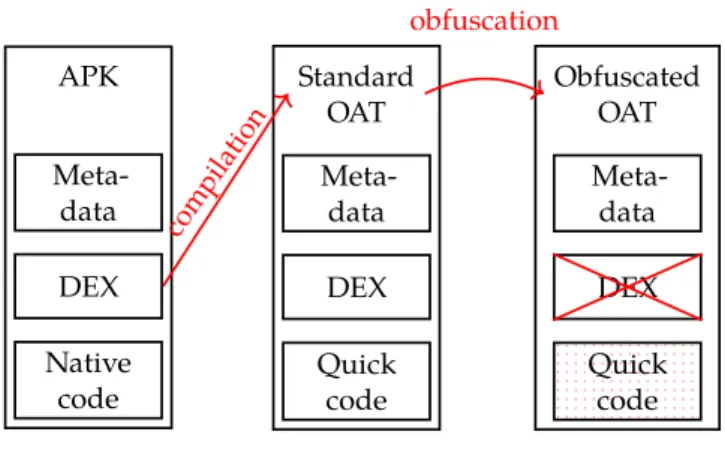
Android is the most used operating system and thus, ensuring security for its applications is an essential task. Securing an application consists in preventing potential attackers to divert the normal behavior of the targeted application. In particular, the attacker may take advantage of vulnerabilities left by the developer in the code and also tries to steal intellectual property of existing applications. To slow down the work of attackers who try to reverse the logic of a released application, developers are incited to track potential vulnerabilities and to introduce countermeasures in the code. Among the possible countermeasures, the obfuscation of the code is a technique that hides the real intent of the developer by making the code unavailable to an adversary using a reverse engineering tool. Mobile applications are complex entities that can be made of both bytecode and assembly code. This creates new opportunities to enhance obfuscation techniques, and also makes deobfuscation a more difficult challenge.
Obfuscating and deobfuscating programs have already been widely studied by the research community, especially for desktop architecture. For mobile devices, ten years after the first release of Android, researchers have mainly worked on the deobfuscation of the intermediate language, named Dalvik bytecode, executed by the embedded virtual machine. Nevertheless, with the growing amount of malware and applications carrying sensitive information, attackers want to hide their intents and developers want to protect their intellectual property and the integrity of their application. Thus, a new generation of obfuscation methods based on native code has appeared. Studying the consequences of mobile native code has not – so far – received the same amount of attention as desktop programs even though more than one third of the available applications embed assembly code.
This thesis presents the impact of native code on both reverse-engineering and vulnerability finding applied to Android applications. First, by listing the possible interferences between assembly and bytecode, we highlight new obfuscation techniques and software vulnerabilities. Then, we propose new analysis techniques combining static and dynamic analysis blocks, such as taint tracking or system monitoring, to observe the code behaviors that have been obfuscated or to reveal new vulnerabilities. These two objectives have led us to develop two new tools. The first one spots a specific vulnerability that comes from inconsistently mixing native and Java data. The second one extracts the object level behavior of an application, regardless of whether this application contains native code, embedded for obfuscation purposes. Finally, we implemented these new methods and conducted experimental evaluations. In particular, we automatically found a vulnerability in the Android SSL library and we analyzed several Android firmware to detect usage of a specific class of obfuscation.
Publications
[1] Pierre Graux, Jean-François Lalande, and Valérie Viet Triem Tong. ‘Etat de l’Art des Techniques d’Unpacking pour les Applications Android’. In: Rendez-Vous de la Recherche et de l’Enseignement de la
Sécurité des Systèmes d’Information. La Bresse, France, May 2018.
[2] Jean-François Lalande, Valérie Viet Triem Tong, Mourad Leslous, and Pierre Graux. ‘Challenges for reliable and large scale evaluation of android malware analysis’. In: 2018 International Conference on
High Performance Computing & Simulation. Orléans, France: IEEE, July 2018, pp. 1068–1070.
[3] Pierre Graux, Jean-François Lalande, and Valérie Viet Triem Tong. ‘Obfuscated Android Application Development’. In: 3rd Central European Cybersecurity Conference. Munich, Germany: ACM, Nov. 2019, pp. 1–6.
[4] Valérie Viet Triem Tong, Cédric Herzog, Tomàs Concepción Miranda, Pierre Graux, Jean-François Lalande, and Pierre Wilke. ‘Isolating Malicious Code in Android Malware in the Wild’. In: 14th
International Conference on Malicious and Unwanted Software. Nantucket, MA, USA: IEEE, Oct. 2019.
[5] Jean-François Lalande, Valérie Viet Triem Tong, Pierre Graux, Guillaume Hiet, Wojciech Mazurczyk, Habiba Chaoui, and Pascal Berthomé. ‘Teaching android mobile security’. In: 50th ACM Technical
Symposium on Computer Science Education. Minneapolis MN, USA: ACM, Feb. 2019, pp. 232–238.
[6] Jean-François Lalande, Pierre Graux, and Tomás Concepción Miranda. ‘Orchestrating Android Malware Experiments’. In: 27th IEEE International Symposium on the Modeling, Analysis, and Simulation
of Computer and Telecommunication Systems. Rennes, France: IEEE, Oct. 2019, pp. 1–2.
[7] Pierre Graux, Jean-François Lalande, Pierre Wilke, and Valérie Viet Triem Tong. ‘Abusing Android Runtime for Application Obfuscation’. In: Workshop on Software Attacks and Defenses. Genova, Italy: IEEE, Sept. 2020, pp. 616–624.
[8] Pierre Graux, Jean-François Lalande, Valérie Viet Triem Tong, and Pierre Wilke. ‘Preventing Serializa-tion Vulnerabilities through Transient Field DetecSerializa-tion’. In: 36th ACM/SIGAPP Symposium On Applied
Acknowledgments - Remerciements
First and foremost, I would like to thank a lot Valérie Viet Triem Tong, Jean-François Lalande and Pierre Wilke, who have advised this thesis. They were always available to give great advises. I can measure the luck to have them as advisors. They taught me to look at problems as a researcher and no longer as an engineer. I would like to give a special thank to Marie-Laure Potet, who helped me when looking for a thesis and drove me to find the CIDRE team. I made my first step in the research world with her, I wouldn’t have carried this thesis without her help. I am glad she accepted to examine it and I hope it will fulfill her expectations. I would like also to thank Christian Rossow and Guillaume Bonfante, who have accepted to review my thesis and helped me to improve it, and Erven Rohou and Sarah Zennou, who have followed my work annually during each Comité de Suivi Individuel (CSI) where they gave me useful and relevant advises. By giving me part of their time they have allowed me to expose my ideas to benevolent external point of views.
Last but not least, I would like to thank all my relatives, my friends and my colleagues. Despite giving technical advises, they gave me moral support, necessary to conduct research work which can, sometimes, be frustrating.
Contents
Abstract iii
Publications v
Acknowledgments - Remerciements vii
Contents ix Glossary xvii Acronyms xviii
Prologue
1
1 Introduction 3 1.1 Problem statement . . . 31.1.1 Android core security features . . . 3
1.1.2 Challenges in analyzing native applications . . . 5
1.2 Contributions . . . 6
1.3 Outline . . . 7
2 Analyzing native Android applications: state of the art 9 2.1 Research goals . . . 9
2.2 Android application datasets . . . 12
2.3 Analysis techniques . . . 14
2.3.1 System side-effects . . . 15
2.3.2 Application metadata . . . 15
2.3.3 Bytecode level . . . 15
2.3.4 Framework, runtime and system level . . . 16
2.4 Challenges implied by native applications . . . 17
2.5 Conclusion . . . 18
Security issues introduced by native interferences in Java Android applications
21
3 Security issues introduced by interferences in Java code 23 3.1 Modification of the Java bytecode by the native code . . . 243.1.1 Full unpacking . . . 25
3.1.2 Unpacked bytecode hiding . . . 25
3.1.3 Partial unpacking . . . 25
3.1.4 Android framework bypassing . . . 26
3.2 Replacement of the Java bytecode by native code . . . 26
3.2.1 Bytecode compiler used . . . 26
3.2.2 Types of bytecode modifications . . . 27
3.2.2.1 Removing the bytecode . . . 28
3.2.2.2 Replacing the bytecode . . . 28
3.2.2.3 Modifying the bytecode . . . 28
3.3 Conclusion . . . 29
4 Security issues introduced by interferences in Java data 31 4.1 Injection of native data in Java data . . . 32
4.1.1 CVE-2015-3837: Example of a vulnerable transient field in an open source cryptography library . . . 33
4.1.2 Formal definition of problematic transient fields . . . 35
4.2 Modification of Java data by native code . . . 36
4.2.1 Legitimate implementation: DirectByteBuffer . . . 36
4.2.2 Naive implementation: memory lookup . . . 37
4.2.3 Advanced implementation: reflection . . . 38
4.3 Conclusion . . . 40
Detection of native interferences in Java Android applications
41
5 Static detection of native interferences in Java code 45 5.1 Detecting native interferences in DEX files . . . 455.2 Detecting native interferences in OAT files . . . 46
5.2.1 Detecting removed bytecode . . . 47
5.2.2 Detecting nopped bytecode . . . 47
5.2.3 Detecting replaced bytecode . . . 49
5.2.3.1 Future work on detecting BFO usage . . . 50
5.3 Conclusion . . . 51
6 Detection of native interferences in Java data 53 6.1 Taint-analysis across native and Java interface . . . 54
6.2 Analyzing dataflow between native and Java at the source code level . . . 54
6.2.1 Statically detecting reference fields in source code . . . 55
6.2.1.1 Reference field patterns in source code . . . 55
6.2.1.2 Static patterns detection using taint analysis . . . 57
6.2.1.3 Static analysis limitations . . . 58
6.2.2 Analysis architecture . . . 58
6.2.3 Validation of the detection method . . . 59
6.2.3.1 Constructive validation of the patterns . . . 61
6.2.3.2 Catching known errors . . . 61
6.2.3.3 Checking a large open-source application . . . 62
6.2.3.4 Analysis time . . . 62
6.3 Monitoring the interface between Java and native code at the execution time . . . 63
6.4 Conclusion . . . 65
Reverse-engineering of multi-language Android applications
67
7 OATs’inside: Retrieving behavior of multi-language applications 71 7.1 Adapting instrumentation system to multi-language applications . . . 717.2 OATs’insidearchitecture . . . 74
7.2.1 Runner module . . . 75
7.2.2 CFG creator module . . . 79
7.2.3 Memory Dumper module . . . 81
7.2.4 Concolic analyzer module . . . 81
7.3 OATs’insideoutput on obfuscated application . . . 85
7.3.1 Obfuscated application presentation . . . 85
7.3.2 OATs’insideoutput on the application . . . 86
7.3.3 Final words on OATs’inside output . . . . 89
7.4 Performance overhead . . . 89
7.5 OATs’insidestealthiness . . . 91
7.6 Conclusion . . . 91
8 OATs’inside: implementation challenges and solutions 93 8.1 Runner and Memory Dumper modules:libartmodifications . . . 93
8.1.1 Analysis initialization . . . 94
8.1.2 Communication channel . . . 94
8.1.3 Methods white-listing . . . 95
8.1.4 Garbage Collector internal structures browsing and resolution caching . . . 95
8.1.5 Signal handlers management . . . 96
8.1.6 Single-stepping and atomic instructions management . . . 96
8.1.7 Multi-thread management . . . 97
8.2 CFG Creator module: NetworkX implementation . . . 98
8.3 Conclusion . . . 101
Epilogue
103
9 Conclusion 105 9.1 Thesis contribution summary . . . 1059.2 Perspectives for future work . . . 106
Appendices
109
A List of tested firmwares 111 B Java behavior unit tests 113 B.1 unobfuscated unit tests . . . 113B.2 Obfuscated unit tests . . . 117
C Concolic analysis functioning proof 123 Résumé substantiel en français 129 1 Introduction . . . 129
1.1 Sécurité du système Android . . . 129
1.2 Applications natives et sécurité . . . 130
1.3 Contributions . . . 130
2 Problèmes de sécurité induits par les interférences natives dans les applications Android Java 131 2.1 Problèmes portant sur le bytecode . . . 131
2.2 Problèmes portant sur les données du bytecode . . . 132
3 Détection des interférences natives dans les applications Android Java . . . 132
3.1 Détection des interférences sur bytecode . . . 132
3.2 Détection des interférences sur les données du bytecode . . . 133
4 OATs’inside: rétro-ingénierie des applications Android natives . . . 134
5 Travaux futurs . . . 135
List of Figures
1.1 Exploitable window . . . 5
2.1 Ratio of recognized malware by at least x antivirus . . . 14
2.2 Classical representation of Android system architecture . . . 16
3.1 Packing technique . . . 24
3.2 Bytecode Free OAT technique . . . 27
3.3 Bytecode modification example . . . 29
3.4 Classification of Bytecode Free OAT (BFO) sub-techniques . . . 29
4.1 Address space of processes serializing X509 Certificate . . . 33
4.2 Set view of targeted problem . . . 35
4.3 Direct Heap Access (DHA) technique . . . 36
4.4 Memory layout of Java objects in Android . . . 39
5.1 Bytecode entropy for methods of AOSP Android 7.0 APKs . . . 48
6.1 Set view of targeted problem, Reminder of Figure4.2Section4.1 . . . 55
6.2 Architecture overview . . . 55
6.3 Reference fields in Android application source code . . . 56
6.4 Representation of reference flow tracking . . . 56
6.5 OpenSSLX509CertificateJava analysis output . . . 62
7.1 OATs’inside architecture . . . . 75
7.2 Expected output forSimpleTestPIN.test. . . 76
7.3 Runtime patch architecture . . . 77
7.4 Method invocation hooking process . . . 78
7.5 Object-level control flow graph ofSimpleTestPIN.test . . . 80
7.6 Object-level control flow graph ofSimpleTestPIN.test . . . 83
7.7 Extract of MainActivity$1.onClick olCFG . . . 87
7.8 SimpleTestPIN.set_pinolCFG . . . 88
7.9 SimpleTestPIN.testolCFG . . . 88
7.10SimpleTestPIN.set_pinolCFG after symbolic analysis . . . . 88
7.11 SimpleTestPIN.testolCFG after symbolic analysis . . . . 89
7.12 Runner module overhead with No. of actions . . . 91
B.1 Non obfuscatedtestConditionObjectEqmethod . . . 121
B.2 ObfuscatedtestConditionObjectEqmethod . . . 122
1 Bytecode Free OAT . . . 131
2 Direct Heap Access (DHA) . . . 132
3 Représentation du suivi des flux de références mémoires . . . 134
List of Tables
1.1 Number of CVE containing the keyword Android . . . 3
1.2 Extract of security additions in Android system . . . 4
4.1 Interferences between native code and Java code, in an Android application . . . 43
5.1 Packer detection for various datasets . . . 46
5.2 Packer detection evolution inside AndroZoo . . . 46
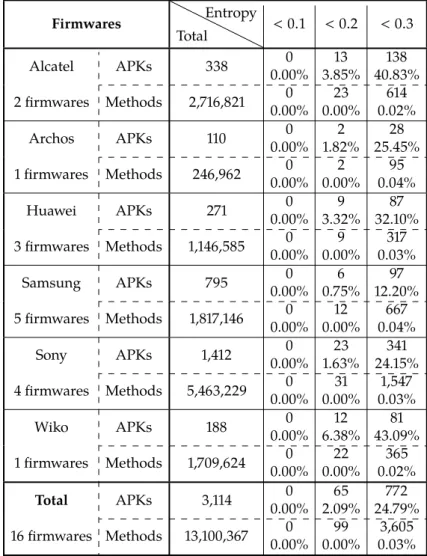
5.3 Nopped methods in firmware dataset . . . 49
5.4 Difference percentage for one firmware . . . 50
6.1 Sources and sinks for detecting reference field patterns . . . 56
6.2 Flows reported for Telegram . . . 60
6.3 Analysis time . . . 63
6.4 Number of Direct Heap Accesses (DHAs) detected . . . 64
6.5 Classes and libraries detected to be using DHA . . . 64
7.1 State-of-the-art solutions against native obfuscations . . . 72
7.2 Monitoring of object actions for different types of executed code . . . 76
7.3 OATs’inside against native obfuscations . . . . 83
7.4 Time overhead and number of actions/events . . . 90
7.5 Dump size depending on the APK size . . . 90
A.1 List of tested firmwares . . . 111
1 Nombre de CVE contenant le mot-clef “Android” . . . 129
2 Détection de packing dans plusieurs datasets . . . . 133
3 Détection de packing selon les années . . . . 133
4 Nombre de DHAs détectés . . . 133
List of Listings
4.1 conscrypt/src/main/java/org/conscrypt/OpenSSLX509Certificate.java . . . 344.2 conscrypt/src/main/native/org_conscrypt_NativeCrypto.cpp . . . 34
4.3 boringssl/src/crypto/asn1/tasn_fre.c . . . 34
4.4 boringssl/src/include/openssl/x509.h . . . 35
4.5 DHA usingDirectByteBuffer. . . 37
4.6 RetrievingDirectByteBufferaddress without JNI . . . 37
4.7 DHA using memory lookup . . . 38
4.8 Retrieving field offset . . . 39
4.9 DHA using reflection . . . 39
5.1 Example of false positive for nopped bytecode search . . . 48
7.2 Runner module output onSimpleTestPIN . . . 79
7.3 Concolic Analyzer module output onSimpleTestPIN.test. . . 84
7.4 Unobfuscated activity code . . . 85
7.5 SimpleTestPIN unobfuscated Java code . . . 86
7.6 SimpleTestPIN unobfuscated C++ code . . . 86
7.7 List of executed method . . . 86
B.1 JNI test cases helpers . . . 113
B.2 Java method test cases . . . 114
B.3 JNI method test cases . . . 114
B.4 Java allocation test cases . . . 114
B.5 JNI allocation test cases . . . 115
B.6 Java access test cases . . . 115
B.7 JNI access test cases . . . 115
B.8 Java operations test cases . . . 115
B.9 JNI operations test cases . . . 116
B.10 Java condition test cases . . . 116
B.11 JNI condition test cases . . . 117
B.12 Java typing test cases . . . 117
B.13 JNI typing test cases . . . 117
B.14 Java exception test cases . . . 118
B.15 JNI exception test cases . . . 118
B.20 Application compilation command . . . 118
B.21 Obfuscator-LLVM command line . . . 118
B.16 monitor test cases . . . 118
B.17 JNI exception test cases . . . 119
B.18 DEX file location . . . 119
B.19 Packer decode method . . . 120
B.22 Example of DHA unit test . . . 121
List of Algorithms
6.1 C/C++ analyzer taint management . . . 608.1 Create an iCFG and separate events between methods. . . 98
8.2 Create olCFG for a given method. . . 100
8.3 Remove useless blank nodes from an olCFG. . . 101
Glossary
Allocator
Mechanism in charge of reserving and freeing memory areas.4.0.0,7.2.1 AOSP
Stands for Android Open Source Project, open source code of Android.2.3.4,3.1.0,4.2.3,5.2.0,5.2.2,
7.4.0,7.6.0,8.1.0,8.3.0,9.2.0,0.0 Bytecode Free OAT
Android obfuscation technique which consists in deleting bytecode from OAT files.3.2.1,3.2.2,3.3.0,
4.2.0,5.0.0,5.2.0,5.2.1,5.2.3,5.3.0,6.4.0,7.1.0,7.2.0,7.2.5,7.3.0,7.3.3,9.1.0,B.0.0,B.2.0,0.0 Common Vulnerabilities and Exposures
System that list publicly known compter security vulnerabilties and exposures. By extension, a publicly known compter security vulnerabiltie or exposure.1.1.1,4.1.1,6.2.0,0.0
Concolic Analysis
Symbolic analysis that relies on values obtained during a classical execution called concrete execution.
7.2.0,C.0.0
Concrete (value/execution)
Execution, or values obtained during this execution, that is used during a concolic analysis.2.3.3,7.2.4,
C.0.0
Control Flow Graph
Graph that represents how the different instructions of code can be chained. Nodes are instructions and two nodes are connected by a directed edge if the destination node can be executed after the source node.1.3.0,2.1.0,7.2.0,7.2.2,7.2.4,7.2.5,8.2.0,9.1.0,B.2.0
Dataflow
Dependency between the variables of a code.2.3.3,6.0.0,6.2.0 DEX
Stands for Dalvik EXecutable, file format used to store Dalvik bytecode.2.3.3,3.1.0–3.1.4,3.2.1,3.2.2,
4.3.0,5.0.0,5.1.0,5.2.0,5.2.3,5.3.0,7.1.0,7.2.1,7.2.5,7.4.0,B.0.0,B.1.0,B.2.0,2.1,0.0 Direct Heap Access
Android obfuscation technique which consists in modifying Java values using native code without the help of Java Native Interface (JNI).4.2.0–4.2.3,4.3.0,6.0.0,6.3.0,6.4.0,7.1.0,7.2.1,7.2.5,7.3.0,7.3.1,7.3.3,
9.1.0,B.0.0,B.2.0,0.0 Dynamic Analysis
Analysis that do run the analysed code.3.2.0,6.0.0,7.2.0,7.2.4 Firmware
Set of files installed on a smartphone by the smartphone constructor. It includes, among other, the Android system and the defaults application.2.2.0,3.2.1,5.2.0–5.2.3,5.3.0,9.1.0,A.0.0,0.0
Heap
Memory area where allocated entities are stored including objects.4.1.1,4.2.0–4.2.3,6.1.0,6.3.0,6.4.0,
7.1.0,7.2.1,7.3.2,7.4.0,8.1.3,8.1.4,8.1.6,8.1.7,B.1.0,B.2.0 Manifest
File that describes an application. It contains, among other, requiered permissions or activities and services classes name.2.1.0,2.3.2,5.1.0
Nopping
Replacing instrucions by No-OPerations, that is by instructions that have no special effects.3.2.2,5.2.2,
5.3.0,9.1.0 OAT
Unknown acronym, file format used to store compiled Dalvik bytecode.2.4.0,3.2.1,3.2.2,4.3.0,5.0.0,
Packer
Tool that ciphers all or part of a program code without modifying its overall behavior.3.1.0–3.1.2,3.1.4,
5.0.0,5.1.0,6.4.0,0.0 Runtime
Android library in charge of runtime the applications.1.1.1,2.1.0,2.3.3,2.3.4,2.4.0,3.2.0,4.0.0,4.2.0,
4.2.3,5.0.0,6.0.0,6.3.0,7.0.0,7.1.0,7.2.0,7.2.1,7.2.5,7.4.0,8.0.0,8.1.0–8.1.2,8.1.4,8.3.0,0.0 Serialization
Process of converting an object into a stream of bytes.4.1.0,4.1.2,6.2.3,0.0 Stack
Memory area where variables and parameters may be stored.7.1.0,7.2.2,7.2.5,7.3.3,8.1.3,B.1.0 Static Analysis
Analysis that does not run the analysed code.2.1.0,2.3.0,2.3.3,2.4.0,6.2.1,7.0.0,7.1.0,7.2.5,9.1.0 Symbolic Analysis
Analysis that consists in observing the execution of a code by replacing value by abstract values called symbols and evaluating the code instructions in the abstract value space.1.2.0,7.0.0,7.1.0,7.2.4,7.3.2,
9.1.0,C.0.0,0.0 Taint Analysis
Analysis that consists in checking if some values, generated by expressions called sources, can reach expressions called sinks.2.3.3,2.3.4,2.4.0,4.1.2,6.1.0,6.2.1,6.2.2
Transient
Java field keyword that indicates that the qualified field is not pat of the serialization process.4.1.0–4.1.2,
6.0.0,6.2.0,6.2.1,6.2.3 Unpacker
Tool that reverses the obfuscation made by a packer.3.1.0–3.1.4
Acronyms
ABI Application Binary Interface.
AIDL Android Interface Definition Language.
AOSP Android Open Source Project.
AOTC Ahead Of Time Compilation.
ASLR Address Space Layout Randomization.
AST Abstract Syntax Tree.
BFO Bytecode Free OAT.
CFG Control Flow Graph.
CVE Common Vulnerabilities and Exposures.
DEX Dalvik EXecutable.
DHA Direct Heap Access.
GC Garbage Collector.
IPC Inter-Process Communication.
JGRE Java Global Reference Exhaustion.
JIT Just In Time.
JNI Java Native Interface.
MMU Memory Management Unit.
NDK Native Development Kit.
PIE Position Independent Executable.
SLOC Single Line Of Code.
1: Common Vulnerabilities and Expo-sures, publicly known vulnerabilities 2: https://zerodium.com/program. html
3: Address Space Layout Randomization 4: Position-Independent Executable
Introduction
1
1.1 Problem statement
1.1.1 Android core security features
Android is the prevalent operating system for modern smartphones. Due to the tremendous number of users, Android has attracted lots of malicious activities [9]
[9]: Mohamed and Patel (2015), ‘Android vs iOS security: A comparative study’ . As shown in Table1.1, since the release of the
first version of Android, vulnerabilities are searched and found in this system. More than six thousand CVEs1contain the keyword “Android”.
Very critical vulnerabilities, such as Full Chain with Persistence (FCP) zero click, can be sold for more than $2,500,0002.
< 2010 2010 2011 2012 2013 2014 2015 2016 2017 2018 2019 2020
18 23 89 169 123 1686 422 872 1191 457 771 528
Source:https://cve.mitre.org/cgi-bin/cvekey.cgi?keyword=Android
Table 1.1:Number of CVE containing the
keyword Android
Because of the increasing number of Android users, and the increas-ing number of applications handlincreas-ing sensitive information, Google has brought a lot of attention to securing the Android platform. Indeed, they have adopted a security-oriented architecture for running Android appli-cations that mainly relies on two core features: application sandboxing and permission management. Each application is run by a dedicated Unix user, allowing application isolation using tried-and-tested kernel mechanisms. Additionally, applications cannot access device features without owning specific capabilities called permissions. These permis-sions are reviewed and granted by the user himself. For example, an application will be able to send SMSs only if it has been granted the
SEND_SMSpermission. Furthermore, each new version of Android comes
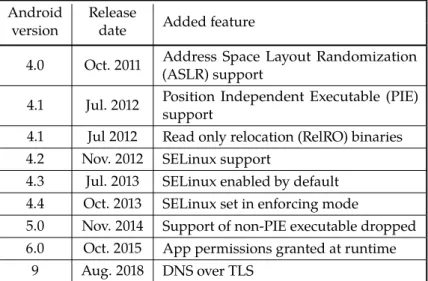
with specific security features. Table1.2shows an excerpt of security features added in each new Android version. In this table, we can see that features target all aspects of security. For example, hardening techniques such as ASLR3or PIE4have been added to the system. The operating
sys-tem constrains the accesses to resources using SELinux mandatory access control. Network communications such as DNS queries are ciphered. However, securing the whole Android system is not enough. Indeed, applications installed by the user are potentially malicious or vulnerable. An application is considered vulnerable if it can be diverted into per-forming malicious operations. Since Android is a system built for mobile
platforms, these operations can differ from desktop ones [10,11] [10]: Faruki, Bharmal, Laxmi, Ganmoor, Gaur, Conti, and Rajarajan (2014), ‘An-droid security: a survey of issues, malware penetration, and defenses’
[11]: Sadeghi, Bagheri, Garcia, and Malek (2016), ‘A taxonomy and qualitative com-parison of program analysis techniques for security assessment of android software’ . We can
cite as notable malicious operations:
I Premium SMS services: an application can send SMS to premium services, i. e. services that include fees.
I Privilege escalation: an application can exploit system vulnerabili-ties to perform actions while not being granted the corresponding permission.
4 1 Introduction
Table 1.2:Extract of security additions in
Android system Android
version
Release
date Added feature
4.0 Oct. 2011 Address Space Layout Randomization
(ASLR) support
4.1 Jul. 2012 Position Independent Executable (PIE) support
4.1 Jul 2012 Read only relocation (RelRO) binaries
4.2 Nov. 2012 SELinux support
4.3 Jul. 2013 SELinux enabled by default 4.4 Oct. 2013 SELinux set in enforcing mode
5.0 Nov. 2014 Support of non-PIE executable dropped 6.0 Oct. 2015 App permissions granted at runtime
9 Aug. 2018 DNS over TLS
Source:https://en.wikipedia.org/wiki/Android_version_history
I Permission leakage, colluding applications: an application can perform privileged operations when requested by other applica-tions and omit to check requester permissions. If the omission is intentional, the application is colluding.
I Privacy leakage: an application can steal users’ private data such as SMS contents or contact list, or spy on the user by, for example, recording the microphone.
I Ransomware: an application can make smartphone data, such as pictures or contacts, unavailable by ciphering them and ask money from user in exchange for the stolen data.
I Application cloning: an application can copy the code of another and replace the Google Ads ID of the real owner of the application by its own in order to steal its wages.
I Aggressive advertisement: an application can display numerous advertisements by, for example, modifying the smartphone back-ground or spawning pop-up windows.
I Botnet: an application can participate to massive network attacks. I Denial of Service: an application can stress resources such as the
CPU or the battery of the smartphone to make it unusable. Unfortunately, relying on application isolation and permission restriction to keep the user safe is not enough. Indeed, the permission system is misunderstood and harmful permissions may be granted to malicious applications [12,13]
[12]: Felt, Ha, Egelman, Haney, Chin, and Wagner (2012), ‘Android permissions: User attention, comprehension, and behavior’ [13]: Benton, Camp, and Garg (2013), ‘Study-ing the effectiveness of android applica-tion permissions requests’
. For example, in 2014, a fake copy of the eagerly awaited video game Pokémon Go has been created and distributed to countries where the official game was not released yet. The fake version, which contained a malware called Droidjack, was installed by users impatient to play the game and willing to grant any permission asked by the application.
The security mechanisms provided by Android cannot prevent this type of attack. Malicious or vulnerable application will eventually be installed on some users’ smartphone. To minimize the impact of this phenomenon, this thesis tackles the two following problems:
I Detecting malicious or vulnerable applications in order to remove them from the Google Play store.
1.1 Problem statement 5
5: http://googlemobile.blogspot. com/2012/02/android-and-security. html
6: Formerly Android market
7: https://www.blog. google/products/android/ google-play-protect/ 8: https://research.checkpoint.com/2020/google- play-store-played-again-tekya-clicker- hides-in-24-childrens-games-and-32-utility-apps/ Time New obfuscation technique New detection technique t1 t2
Safe Exploitable Safe
Figure 1.1:Exploitable window
I Understanding the behavior of such applications in order to evalu-ate the damage after a compromision.
Of course, Google already started, since 2012, to set up an automatic service, called bouncer,5to address the malicious application detection problem. Since thebouncerarchitecture is not public, we have no clue on how and if the vulnerability detection problem is addressed. This service scans applications available on the Google Play store6, the Android application official repository, in order to find malicious and unsafe applications. When detected, applications are removed from the store, therefore preventing users from installing them. Improving on the
bouncerservice, Google released Google Play Protect7in 2017. In addition
to the features provided by bouncer, this new service offers the possibility to scan applications offline, i. e. observe the behavior of applications while they are running directly on the users’ smartphone.
Despite all these efforts, some malicious applications still find their way to the Google Play store,8and vulnerabilities are still found in Android applications, as shown in Table1.1.
We believe that one of the reasons that malicious and vulnerable applications can still bypass analysis systems is the usage of native code inside applications. This thesis focuses on this specific problem. The following section explains why the presence of native code makes code analysis more difficult for malicious or vulnerable application detection.
1.1.2 Challenges in analyzing native applications
Problems involved in malware and vulnerability detection, such as determining if a given program is equivalent to an other, are undecidable in the general case [14]
[14]: Selçuk, Orhan, and Batur (2017), ‘Un-decidable problems in malware analysis’ . Thus, countermeasures such as the bouncer or
Google Play Protect can only partially solve these problems. This keeps the door open for malicious applications to hide from program analysis. Similarly, perfect obfuscation techniques do not exist [15]
[15]: Beaucamps and Filiol (2007), ‘On the possibility of practically obfuscating pro-grams towards a unified perspective of code protection’
, i. e. obfuscators always leave information about the behavior of the original program. Consequently, the race between malicious applications and analysis services takes the form of a cat and mouse game: malicious applications hide their intent using new techniques, analysis services adapt their detection, and so on. Unfortunately, as shown in Figure1.1, this race is in favor of malicious applications since malware can take advantage of the time that separate the usage of a new technique and its detection (t2− t1).
Thus, computer security researchers should focus on reducing this time by:
I developing more general analysis (increasing t1): this makes the
creation of new obfuscation techniques harder.
I predicting future obfuscation techniques (decreasing t2): this allows
to faster adapt detection technique.
It is worth noting that this assessment also applies to new vulnerabilities exploitation and detection.
6 1 Introduction
9:https://developer.android.com/ training/articles/perf-jni
In this context, Android security researchers have shown that native applications are more and more present in Google Play store and that state-of-the-art tools should improve their analysis on this kind of appli-cations [16–18]
[16]: Afonso, Geus, Bianchi, Fratantonio, Kruegel, Vigna, Doupé, and Polino (2016), ‘Going Native: Using a Large-Scale Analy-sis of Android Apps to Create a Practical Native-Code Sandboxing Policy’ [17]: Tam, Feizollah, Anuar, Salleh, and Cavallaro (2017), ‘The evolution of android malware and android analysis techniques’ [18]: Sadeghi, Bagheri, Garcia, and Malek (2017), ‘A taxonomy and qualitative com-parison of program analysis techniques for security assessment of android software’
.
Applications are traditionally written in Java or Kotlin, compiled into bytecode and run by a Virtual Machine. This machine enforces the correct execution of this bytecode as expected by the developer and is the privileged interface for observing an execution. A native application is an application that contains both Dalvik bytecode and assembly code. Due to optimization purposes, Android supports applications that embed assembly code obtained from, for example, C or C++ source code. The usage of native code opens two new challenges:
I Native code usage allows to highly obfuscate applications. Indeed, the cat and mouse game for obfuscating and desobfuscating as-sembly code is a well studied area since the seventies, that is way older than Android. Thus, the attacker can easily adapt advanced assembly obfuscation techniques and bypass analysis tools. I Native code usage may introduce vulnerabilities in applications.
The languages in which native code is typically written (C or C++) are known to be error-prone. That is to say, it is easy for developers using these languages to leave security vulnerabilities in their programs. Indeed, contrary to Java/Kotlin, these languages do not implement security mechanisms such as strong type verification or security context execution. Then, allowing native code inside Android applications drastically increases the attack surface for malicious intents. Additionally, tips and best practices given by Google for native Android application development9, are not
enforced when the applications are running. Native code and bytecode run in the same context and the same address space[19,
20] [19]: Sun and Tan (2014), ‘Nativeguard:
Pro-tecting android applications from third-party native libraries’
[20]: Athanasopoulos, Kemerlis, Portoka-lidis, and Keromytis (2016), ‘NaClDroid: Native Code Isolation for Android Appli-cations’
, which allows native code to interfere with bytecode.
In this thesis, we mimic the cat and mouse game by building obfuscation techniques and exploiting vulnerable applications and in a second time, proposing associated detection techniques and analysis tools. We limit our study to the challenges linked to the usage of native code inside Android applications.
1.2 Contributions
[1]: Graux, Lalande, and Viet Triem Tong (2018), ‘Etat de l’Art des Techniques d’Unpacking pour les Applications Android’
[2]: Lalande, Viet Triem Tong, Leslous, and
Graux(2018), ‘Challenges for reliable and
large scale evaluation of android malware analysis’
[3]: Graux, Lalande, and Viet Triem Tong (2019), ‘Obfuscated Android Application Development’
[7]: Graux, Lalande, Wilke, and Viet Triem Tong (2020), ‘Abusing Android Runtime for Application Obfuscation’
[8]: Graux, Lalande, Tong, and Wilke (2021), ‘Preventing Serialization Vulnerabilities
through Transient Field Detection’
The contributions of this thesis are the following:
1. We propose two new obfuscation methods of the java bytecode, one targeting the code and the other targeting the data [1,3,7]. 2. We conducted two experimental studies of the usage of these
obfuscation methods in the wild [2,7].
3. We developed an analysis framework, named OATs’inside, which combines dynamic and symbolic analysis to retrieve the behavior of obfuscated Android applications.
4. We designed and implemented a new detection method of applica-tion vulnerabilities due to forgottentransientkeyword [8].
1.3 Outline 7
1.3 Outline
This dissertation is divided in five parts. The first part contains this introduction and Chapter2, that gives the necessary background about Android native and non-native application analysis techniques. In order to describe the contributions of this thesis we reflect the cat and mouse game by dividing the manuscript in two supplementary parts. Chapters 3and4explore attackers’ possibilities. They describe how native code can lead to security issues, i. e. code obfuscation or vulnerable code. These security issues are split on whether they impact Java code (Chapter3), or the Java data (Chapter4). In addition to already known issues, we introduce new obfuscation techniques.
The next two chapters, Chapters5and6, tackle these security issues by proposing detection methods and measuring their presence in the wild. These two chapters are also divided into code and data issues.
The last two chapters before concluding, Chapters7 and 8, present
OATs’inside, a new Android analysis tool and the technical challenges
involved in its implementation. OATs’inside is a stealth analysis framework that recovers object-level CFGs of Android applications despite all known obfuscation techniques.
Finally, Chapter9summarizes the contributions of this thesis and gives perspectives for future work.
Analyzing native Android
applications: state of the art
2
This chapter reviews the contributions related to the security analy-sis of Android applications. We will focus on approaches that output qualitative and detailed information about the analyzed application. During this review, we will recall the technical notions about the Android architecture.
At the end of the chapter, we focus on the impact of native code on the challenges introduced in Chapter2.1, i. e. obfuscation of applications and vulnerabilities in applications.
We will make a review of the articles of the state-of-the-art that tries to solve the aforementioned challenges. More thorough comparisons with our work will be given later in the appropriate chapters of this manuscript.
Section2.1presents goals that researchers follow when analyzing Android applications. Then, Section2.2details the datasets available for evaluating analysis methods. Section2.3reviews the techniques that are used to achieve the previously described goals. Finally, Section2.4highlights the challenges that native code raises for using these techniques.
2.1 Research goals
Android applications analyses take an APK file as input. An APK file is an archive that contains three types of files:
I metadata: aManifestfile that declares the permissions, the services and the activities of the application.
I code: files that contain Dalvik bytecode, usually obtained from the compilation of Java or Kotlin source code.
I resources: additional files such as pictures, fonts, or sounds. APK files can be processed in various ways: static approaches that only look at the file itself, or dynamic ones that observe its execution. Independently of the method used, security researchers have different common goals in mind:
I Detecting malicious applications: decide whether a given applica-tion is malicious or benign.
I Studying code protection: find new obfuscation techniques and associated countermeasures.
I Exposing vulnerable applications: spot security vulnerabilities inside applications.
10 2 Analyzing native Android applications: state of the art
1: This runtime is described in Section2.4
Detecting malicious applications Malicious application detection can be declined in different annex problems. While some researchers focus on deciding the maliciousness of an application [21–26], others try to classify malicious applications into families [27–33]. The definition of what a family is depends on the context. For example, family can desig-nate the malicious operation performed such as ransomware, Remote Access Tool (RAT), adware. It can also designate different versions of the same malware. Some also try to identify clones and repackaged applications. Here the goal is to detect when an attacker has introduced his code inside an other application. These goals are often treated using artificial intelligence and machine learning algorithms that uses APK characteristics and artifacts obtained at execution time.
The problem of detecting malicious applications is outside of the scope of this thesis: as stated in Chapter , we focus on studying code protection and exposing vulnerable applications. Thus, we will not describe the entirety of works related to this problem. Nevertheless, we highlight DroidClone [30] which focuses on a problem close to this thesis: de-tection of native Android malware specifically. DroidClone provides a mechanism to build malware signatures. It operates on assembly code but handles both native code and bytecode by compiling the bytecode using the compiler provided by the ART runtime1. This idea is an elegant
way to handle bytecode and assembly code simultaneously. We used a similar approach to propose a new obfuscation method in Chapter3.
Studying code protection Studying code protection consists in two opposite goals that both need to be explored. One may want to make the analysis of an application more difficult. This process is called obfuscation. At first sight, it could be surprising that some security researchers try to invent new obfuscation techniques or improve existing ones since they are used by malicious applications to circumvent analysis tools. However, benign applications can legitimately use obfuscation, for example, to protect their intellectual property or to avoid being repackaged. Additionally, as mentioned in Chapter2.1, determining what kinds of obfuscations malware will potentially use in the future allows to develop countermeasures and tackle malicious application faster.
On the contrary, some researchers try to break obfuscation. Breaking an obfuscation technique can itself be divided in different goal varia-tions discussed hereinafter. It can consist in detecting the usage of the obfuscation, retrieving the original code, or getting information about the real application behavior while being agnostic about the targeted obfuscation.
Detection techniques are useful to determine if a specific obfuscation technique is used by applications in the wild. It can be used as a first step, to determine if a deobfuscation technique, potentially resource-consuming, should be launched. Most of the time detection techniques try to spot artifacts that reveal traces of the usage of a known obfuscation technique. Consequently, unknown obfuscation methods are not detected since their artifacts are also unknown.
When a tool tries to analyze an obfuscated application, it may fail, for example if an obfuscation technique ciphers the code, therefore making
2.1 Research goals 11
it unavailable for static analysis. Facing this problem, the first solution is to retrieve the original code of the application in order to work as if the application had never been obfuscated. This process is called
deobfuscation.
Since deobfuscation is the principal threat of obfuscation, sophisticated techniques aim at preventing it. In some cases, such as the usage of packers or reflection methods, the obfuscation cannot be fully reverted. Then, analysis tools need, in order to work properly, to determine information that is relevant for their goal but invariant with the obfuscation. For example, malicious application detection can be conducted over network communications [34] or system calls patterns [35].
Discussions about code obfuscation in the specific context of native applications are developed in Sections3.1and5.1.
Exposing vulnerable applications Exposing vulnerable applications consists in determining if a given application is vulnerable to security attacks. This goal seems to be inherently malicious. But, this is also legitimately used by developers or companies that want to check, before using it, that an external library or an application is safe. It is also used by developers to check their own application and, if a vulnerability is found, patch their application.
First, security researchers can manually look for vulnerabilities and highlight new problematic issues. For example, Peles and Hay [36] showed that a missingtransientkeyword in a Java field can lead to severe exploits if such a field contains a native address. This approach is precisely described in Section4.1because a solution of this problem is one contribution of this thesis.
Then, for particularly widespread vulnerabilities, researchers design methods targeting them. This can be done by statically analyzing the bytecode. Lu et al. [37] and Zhang and Yin [38] looked for component hijacking vulnerabilities and Sounthiraraj et al. [39] for SSL man-in-the-middle vulnerabilities. Gu et al. [40] found JNI Global References exhaustion (JGRE) by statically analyzing native code and bytecode. These solutions have a high accuracy for detecting the considered vulnerability but keep bounded to this specific vulnerability.
Some researchers adopt a more generic approach. They do not search for a specific vulnerability but have designed methods that can work for different ones. For example, Qian et al. [41] transform the bytecode of an application into an annotated CFG and translate vulnerabilities into graph-traversal properties. Dhaya and Poongodi [42] built a machine learning system that translates application code into N-grams and au-tomatically learns to recognize vulnerable applications. However, these approaches [41,42] do not evaluate their detection ratio but only report vulnerabilities found in application datasets. While these approaches are useful in the wild, they cannot prove that a given application is safe. Some researchers focus on generic dynamic approaches. Sounthiraraj et al. [39] run the application and redirect external SSL connections to a crafted server that attempts to perform man-in-the-middle attacks. Yang et al. [43] and Sasnauskas and Regehr [44] developed an Intent fuzzer. A fuzzer is a tool that consists in generating invalid and faulty
12 2 Analyzing native Android applications: state of the art
2: Android Interface Definition Language
3: Inter-Process Communication
inputs and pass them to a system under attack. This approach is well suited for Android. Indeed, in Android, applications communicate with each other using Intents. Intents are Java objects that are sent trough the binder, the Android IPC mechanism. In order to work properly, the binder requires applications to declare, in an AIDL2file, the types of Intents they are willing to receive. This file is stored in the APK archive and fuzzers exploit this AIDL file to generate inputs that are not rejected by the application, revealing vulnerabilities. Similarly to the preceding generic approach, the accuracy detection is difficult to evaluate.
Finally, researchers develop solutions to improve and facilitate the cor-rection of vulnerabilities. For example, Zhang and Yin [38] automatically propose a patch for vulnerable bytecode and [45] developed a system to patch the Android system when manufacturers do not update properly the system.
In this thesis, we have studied a specific vulnerability involving native code introduced by Peles and Hay [36] for which we have built a dedicated method.
The implementation of some of the solutions presented above introduces additional challenges. First, dynamic systems that emulate Android are not transparent. This means that malicious applications can detect that they are being analyzed, and then choose to behave differently. This is called emulation system evasion [46,47]. Another challenge, extensively studied in Android, is the problem of code coverage [48–52]. The Android application architecture is very modular and event-driven. Applications are composed of multiple activities and services, that can be triggered using various ways such as user interaction and IPCs3. These services and activities constitute multiple entry-points of the Android application, in contrast with classic desktop executables that only have one single entry-point. This is problematic when a dynamic system wants to stimulate the execution to cover as much code as possible. For example, Abraham et al. [49] propose to explore exhaustively the graphical interface of applications under analysis.
These challenges have not been faced during this thesis and thus, these solutions are not further described.
2.2 Android application datasets
As in any research field, the Android security community needs datasets to evaluate their methods and produce easily reproducible experiments. Thus, various datasets exist [53]:
I Google Play store: official Android application repository. It con-tains more than two million applications. However, this dataset is not suitable for scientific experiments since it highly dynamic: applications are added, removed or updated frequently. It not easily retrievable: Google does not provide an API to download applications. Finally, applications are not labeled as goodware or malware since malware are removed from the store.
2.2 Android application datasets 13
4: https://www.virustotal.com
5: https://contagiominidump. blogspot.com/
6: https://koodous.com/
7: Arbitrarily set to 27 in the graph.
8: See Chapter3.2.2.1 I Genome [54]: ground-truth dataset of more than 1,200 malware
samples. This dataset is qualified as ground-truth, meaning that every application has been manually verified to be malicious. Unfor-tunately, the service is no longer maintained by the authors. Copies of this dataset are still available but it is no longer representative of malware in the wild [55].
I Drebin [56]: a dataset of 123,453 applications and 5,560 malware. Malware have been detected using VirusTotal4, an online malware
detection service. This dataset is largely used as a detection bench-mark in the research community, such that at the time of writing, it has been cited more than two thousands times. However, similarly to the Genome dataset, it is getting old and not representative. For example, it contains only very few native applications.
I AndroZoo [57]: a dataset of more than 13 million applications. The authors are continuously downloading new samples from various stores, including the Google Play store. Samples come with metadata such as size, checksum and retrieve date. Additionally, they also tag if the application is malicious using VirusTotal. I AMD [58]: a ground-truth dataset of 24,553 malware classified
among different families.
I GM19 [4]: contains two balanced sets of 5,000 goodware (GOOD) and 5,000 malware (MAL) with an homogeneous distribution of dates (2015-2018) and APK size to avoid statistical biases.
I Contagio mobile5: web repository containing 252 malicious
appli-cations.
I Koodous6: web repository containing 19 million malware out of 66 million applications.
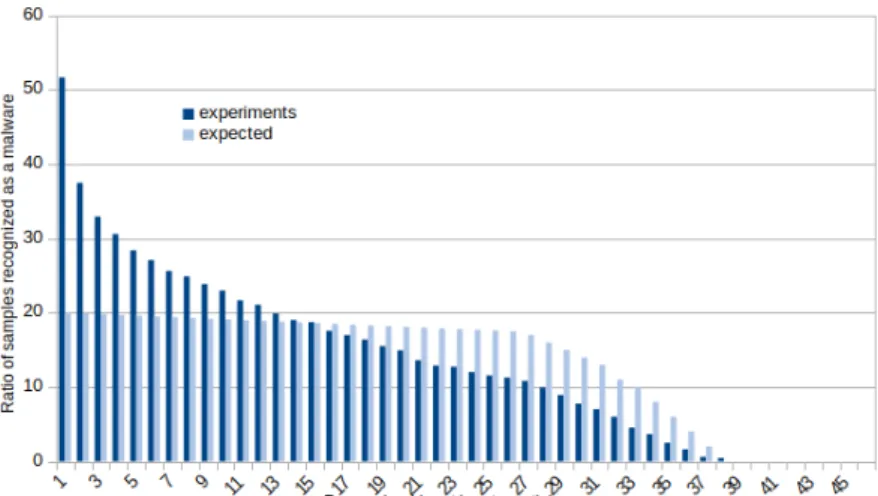
It is worth noting that Drebin, AndroZoo and GM19 datasets use Virus-Total, an online detection service which aggregates the results of around 50 antivirus, to classify applications between goodware and malware. However, we believe that this approach is not reliable. In [2], we collected 2,000 malware samples by downloading each day 20 recent samples from the Koodous repository and 30 random samples from the AndroZoo repository. As shown in Figure2.1, 48% of samples are not recognized by any antivirus used by VirusTotal. Figure2.1shows that there is no obvi-ous threshold to decide that a sample has been recognized by enough antiviruses to classify it as a malware. We were expecting a drop of detection for a certain number of antiviruses7, as represented by the light blue curve. Additionally, these results may change with time, as the pool of antiviruses used by VirusTotal frequently updates their signature database. From this experiment, we conclude that using VirusTotal as an oracle for confirming that a sample is malicious is not reliable, especially for recent samples.
All the aforementioned datasets are used to test malicious detection techniques. For obfuscation studies of this thesis, as we do not attempt to detect malicious applications, we only use datasets to detect the presence of obfuscation techniques in the wild and thus, focus on recent datasets: AndroZoo, AMD and GM19.
Also, we have not found any dataset of firmware applications, that is applications pre-compiled and installed on the smartphone by the manufacturer or the firmware vendor. Since we have developed an obfuscation technique specifically for this kind of applications8, we have
14 2 Analyzing native Android applications: state of the art
Figure 2.1:Ratio of recognized malware
by at least x antivirus
9: Alcatel, Archos, Huawei, Samsung, Sony, Wiko
constructed one for our experiments. We have downloaded 17 firmwares from six different brands9. All the firmwares run Android 7.0 or 7.1.
For each firmware, all compiled applications have been extracted. The complete list of firmware is available in AppendixA.
For the detection of vulnerable applications, we found only one dataset named Ghera [59]. It is an open source repository of vulnerable and safe applications. For each vulnerable application, details about the vulnerabilities present in the application are provided. Unfortunately, this dataset does not contain samples for the vulnerability we have studied in this thesis: missingtransientkeyword.
2.3 Analysis techniques
To achieve their goals (detecting malicious applications, studying code protection and exposing vulnerable applications), researchers rely on several techniques, used as building blocks that can be tuned and com-bined together to tackle specific problems. This section reviews these different techniques. Classically, techniques are separated between static, that study the data and the code of the applications, and dynamic ones, that observe executions of the applications.
However, these two sets of techniques are not disjoint. For example, symbolic execution is a static technique since it does not execute the application. Nevertheless it attempts to mimic a possible set of executions. On the other side, some dynamic techniques, such as fuzzing, rely on a preliminary static analysis phase used to configure the subsequent dynamic phase.
In this section, we have chosen to present techniques from high-level to low-level. Indeed, this thesis deals with applications composed of Java and assembly code, that are languages of completely different levels. Such a classification is relevant in this context.
2.3 Analysis techniques 15
10: Description shown in the Google Play store and written by the application devel-oper.
11: Dalvik EXecutables
12: Just-In-Time
2.3.1 System side-effects
We consider as high level techniques, the ones that work with artifacts left by the execution of the analyzed application rather that the application itself. For example, Shao et al. [60] observe the network communications to detect unsafe applications that accept remote commands without any preliminary authentication phase. Bhatia et al. [61] analyze memory snapshots and reconstruct a timeline composed of, for example, activities and services that have been launched. These approaches are too high-level for handling specifically native code.
2.3.2 Application metadata
Looking at techniques getting closer to the application and the system, researchers can work on the application metadata. Metadata about Android applications is stored in the APK archive inside a file called Manifest. This file contains:
I The list of permissions required by the application.
I The list of activities: classes that represent an interface window. I The list of services: classes that are launched in the background. I The list of receivers: classes that are able to receive messages sent
by other application or by the system.
Metadata-based techniques can work on permissions and API calls [62] or permissions and application description10[63]. Actually, all the informa-tion stored in theManifestcan be used to achieve malicious detection [64]. Again, such approaches cannot be of interest for native code.
2.3.3 Bytecode level
Techniques can look at the application bytecode. This bytecode is stored inside the APK archive as DEX11 files. New DEX files can be loaded during the execution by the bytecode itself. That means static analysis cannot, in the general case, cover all the code. This bytecode is named Dalvik bytecode, after the name of the virtual machine that interprets or JIT-compiles12it: the Dalvik VM. This bytecode is a register-based version of the Java bytecode. Bytecode level analysis techniques are widely used by researchers because the bytecode is clearly the place where the behavior of the application is described.
In order to analyze application bytecode, solutions can use bytecode simplification techniques before conducting their analysis. This allows to reduce the amount of resources needed to process an application. For example, SAAF [65] proposes to compute slices of the bytecode according the dataflow of this instruction. An instruction is part of a slice if, given a value (variable, object field, ...), this instruction participates to the computation of this value. Similarly, Harvester [66] slices the program according to the dataflow of a given value. Then, it executes the obtained slice and logs, at runtime, the value.
To simplify their analysis, tools can also use Intermediate Representation (IR) such as Jimple [67]. An Intermediate Representation (IR) is a language that abstract lower-level languages. It is used to make writing optimization
16 2 Analyzing native Android applications: state of the art
Figure 2.2:Classical representation of
An-droid system architecture
Applications:
∗Pre-installed apps, user-installed apps Framework:
Activity Manager, Package Manager, Content Providers, ... Libraries:
libc, SSL, OpenGL,∗Vendors libs, ...
Runtime: Core libs, Dalvik VM Linux Kernel:
Memory manager, Proccess scheduler,∗Drivers, ...
∗: modified by vendors
AOSP
13: International Mobile Equipment Iden-tity, number that identify uniquely a mo-bile device
14: Android Open Source Project:https: //source.android.com/
rules easier. For example, AppSealer [38] uses program slicing according to dataflow performed over Jimple, rather than on the bytecode, to search for component hijacking vulnerabilities.
Taint analysis is a common analysis conducted on application bytecode. In particular, we have used the taint analyzer provided by FlowDroid [68] to perform the analysis conducted in Section6.2. A taint analysis consists in identifying, for a given list of sources, all the sinks that can receive a taint. Usually, in bytecode analysis, sources and sinks are calls to framework methods and taints are the return values of the sources. It allows to represent, for example, the leakage of the IMEI13 using the
getImeimethod as a source and methods such asSocket.writeUTFor
File.writeas sinks. In this case, the taint is the IMEI number.
An other common analysis technique is symbolic execution [69–71]. It consists in following the program instructions and recording, for each value, the constraints that are applied. This is midway between the static and the dynamic execution: the code is run “symbolically” using abstract values instead of concrete ones. In particular, it is used to compute all the possible values that a variable can contain during an execution or to determine if a given instruction could be reach during an execution.
2.3.4 Framework, runtime and system level
Analyzing only the bytecode of an application does not allow to easily manipulate the application behavior. Indeed, for introducing or modify-ing a specific behavior into an Android application, one has to translate this behavior into bytecode and inject this bytecode in the application itself.
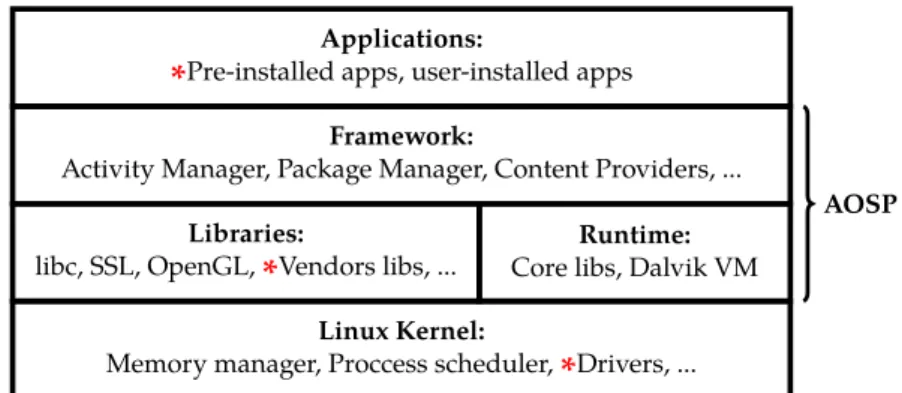
To overcome this limitation, some techniques propose to modify the framework, the runtime or the system. As shown in Figure2.2, applica-tions rely on these three elements to be executed. Thus, by modifying these low-level architecture elements, solutions can manipulate and instrument applications freely. These elements can be modified by re-searchers since they are open-source: the system is a Linux kernel and AOSP14provides the source code of the framework, the libraries and
the runtime. However, Android systems installed on smartphones are customized by the smartphone provider (also called vendor) in order to
2.4 Challenges implied by native applications 17
15: “.so” extension
16: Android 5.0 "Lollipop" 17: Just In Time
18: Android 7.0 "Nougat"
19: We could not find an official definition for this acronym.
20: This denomination comes from the Android source code.
provide a functional device. This limits the portability of the techniques’ implementations.
Thus, numerous framework, runtime or system level techniques have been proposed. For example, AndroBlare [72,73] enhances the system using Linux modules to hook system calls and perform taint analysis. TaintDroid [74] modifies the Dalvik Virtual Machine (DVM) interpreter to manage taints. CopperDroid [75] runs Android inside the QEMU [76] emulator and introspects this emulator to reconstruct the behavior of the application such as activity launching and SMS sending.
These kinds of contributions are very tuned and propose a complete overview. Thus, most of them handle native code, which is the subject of the following section.
2.4 Challenges implied by native applications
The Android runtime allows applications to embed native libraries using the classical shared object file format15 and to call native code from Java code. Such applications are called native applications. The communication between Java and native code is realized through a dedicated interface called the Java Native Interface (JNI). This interface allows not only to call native functions from the Java world, but also gives native code the opportunity to access Java objects and fields. Since 2014, the usage of native Android applications is rising. Indeed, researchers have started reporting usage of obfuscation techniques de-signed for assembly code [77]. More recently, Afonso et al. [16] performed a large-scale analysis to evaluate the usage of native code in a dataset of 1.2 million Android applications, and showed that more than one third of these applications potentially used native code.
Additionally, Android released a new runtime called ART in 201416. This runtime no longer interprets or JIT17compiles the bytecode of applications but instead compiles the bytecode into assembly before the execution. This is called AOTC for Ahead Of Time Compilation. Two years later18,
Android has reintegrated the interpreter and the JIT compiler on top of the AOTC-compilation. Since then, Android applications are not fully compiled. A method is compiled only when it is frequently executed. The resulting assembly is stored using a new file format called OAT19.
For the sake of clarity, when the differentiation between assembly codes stored in shared objects and OATs file is needed, the assembly code from OAT is namedquick_code20.
The usage of native obfuscation techniques and the compilation of application bytecode have increased the needs for adapting solutions to the assembly world. As discussing in details all the contributions of the literature would be technically difficult at this stage of the manuscript, we propose to briefly categorize the different objectives of authors. Then, later in the manuscript, we point out the limitations of each approach for the specific problem we solve. Globally, the research community has:
I Studied new obfuscations: Researchers have developed solutions to tackle the new rising obfuscation technique called packing [78–
18 2 Analyzing native Android applications: state of the art
80]. This technique consists in ciphering the bytecode to make it un-available for static analysis. The various deobfuscation techniques are detailed in Section3.1and the associated detection methods are presented in Section5.1. In Section3.2, we proposed new na-tive obfuscation techniques and associated detection techniques in Section5.2.
I Exposed new vulnerabilities: New vulnerabilities targeting An-droid applications have been discovered [36,40]. In Section4.1, we precisely describe the vulnerability proposed by Peles and Hay [36]: a field that stores a native address can be exploited if it is not declaredtransient. We propose, in Section6.2, a solution to the unresolved problem of detecting such vulnerable fields.
I Ported taint analysis across the Java Native Interface: Many works [81–84] aimed at tracking the information flow during the ex-ecution of a native Android application. For example, NDroid [81] propagates taints generated by TaintDroid [74] by hooking the Android framework methods that call native code and all JNI entry points. All proposed solutions rely on JNI to perform their analysis which, as stated in Section4.2, it is possible to bypass. Also, as discussed in Section6.1, they cannot achieve taint analysis that requires the type of assembly values.
I Improved instrumentation systems:Several works have presented generic framework solutions [85–88] where the analyst can insert some hooking code to audit native code actions. These frameworks can be used to observe, for example, virtual method calls [85] (vtable hooking) and library calls [86] (PLT hooking). While these solutions bridge the gap between native code and bytecode analysis, we show in Section7.1that they are not resilient to all native obfuscations. We propose a new approach in Section7.
While numerous articles focus on solving specific challenges implied by native applications, no systematic studies about the impact of native code on the security of Android applications in its entirety has been conducted. This is one of the contributions of this thesis.
2.5 Conclusion
We discussed the different global goals of researchers when dealing with Android security. We focused our research efforts on code protection ensured by obfuscation techniques and the research of vulnerabilities. The chapter summarized the state of the art for these two problems and we identified that the introduction of native code in applications brings new challenges. The precise discussion of the articles that are close to our contributions are discussed in the relevant chapter. We also summarized the analysis building blocks that are classically used when analyzing statically and dynamically applications. Some of them will be reused in our contributions.
As new challenges that the thesis address are brought by the interaction between the native and bytecode codes, we conduce a systematic review of all interferences between native and bytecode worlds, both at code and data level, respectively in Chapter3and4. We demonstrate that these interferences help the developer to create new obfuscation techniques, but
2.5 Conclusion 19
in the meantime, can introduce vulnerabilities. Then, the next part of the manuscript gives solutions to detect these interferences in Chapter5and6. Finally, in the last part, we describe in Chapter7a generic analysis solution for obfuscated applications and gives insight on its implementation in Chapter8.