HAL Id: tel-01238817
https://hal.inria.fr/tel-01238817
Submitted on 8 Dec 2015
HAL is a multi-disciplinary open access
archive for the deposit and dissemination of
sci-entific research documents, whether they are
pub-lished or not. The documents may come from
teaching and research institutions in France or
abroad, or from public or private research centers.
L’archive ouverte pluridisciplinaire HAL, est
destinée au dépôt et à la diffusion de documents
scientifiques de niveau recherche, publiés ou non,
émanant des établissements d’enseignement et de
recherche français ou étrangers, des laboratoires
publics ou privés.
Distributed under a Creative Commons Attribution - NoDerivatives| 4.0 International
License
Benoit Combemale
To cite this version:
Benoit Combemale. Towards Language-Oriented Modeling. Software Engineering [cs.SE]. Université
de Rennes 1, 2015. �tel-01238817�
HABILITATION À DIRIGER DES RECHERCHES
UNIVERSITÉ DE RENNES 1
sous le sceau de l’Université Européenne de Bretagne
Mention : Informatique
École doctorale Matisse
présentée par
Benoit C
OMBEMALE
préparée à l’unité de recherche IRISA – UMR6074
Institut de Recherche en Informatique et Système Aléatoires / ESIR
Towards
Language-Oriented Modeling
HDR soutenue à Rennes
le 4 décembre 2015
devant le jury composé de :
Franck B
ARBIERProfessor, University of Pau, France/ Rapporteur
Lionel B
RIANDProfessor, University of Luxembourg/Rapporteur
Betty H.C. C
HENGProfessor, Michigan State University, USA/ Rapporteur
Oscar N
IERSTRASZProfessor, University of Bern, Switzerland/ Rapporteur
J
OERGK
IENZLEProfessor, McGill University, Canada/ Examinateur
P
ETERD. M
OSSESProfessor, Swansea University, United Kingdom/ Examinateur
B
ENOITB
AUDRYResearch Scientist, INRIA, France/ Examinateur
J
EAN-M
ARCJ
ÉZÉQUELdegree after the PhD. This degree is required to officially supervise PhD students, to apply for full professorship, and more generally to run an independent research activity. The manuscript of an HDR is supposed to overview the research activities of the candidate, and demonstrate a clear vision leading to consistent contributions. In that sense, it is not meant to be a fully polished, self contained document like a PhD thesis.
This document constitutes the manuscript of my HDR. I overview a decade of research work in the fields of model driven engineering (MDE) and software language engineering (SLE). The contributions are organized so as to highlight the vision as well as the scientific method. Of course, these contributions would not have been achieved alone. This document also aims to present the complementarity of the research work conducted with the various students I have been pleased to supervise, as well as the place of the various collaborations with researchers and practitioners, in the elaboration of the resulting vision I defend in this document.
This document is meant to be first dedicated to the referees of my HDR who evaluate and report on my research activities, the breakthroughs addressed, and the resulting contributions. This document also offers a brief overview of the state of the art in the fields of MDE and SLE. Finally, this document would be also of interest for everyone willing to learn how to turn domain knowledge into added value and coordinated DSMLs.
Contents 1
1 Introduction 5
1.1 Context . . . 5
1.1.1 Application Context . . . 5
1.1.2 Scientific Context. . . 6
1.2 Objectives and Challenges . . . 8
1.3 Overview of the Contributions . . . 9
1.4 Scientific and Technological Breakthroughs . . . 10
1.5 Research Methods . . . 11
1.6 Supervision . . . 11
1.7 Grants, Contracts and Projects . . . 12
1.8 Organization of the document . . . 13
2 Metamodeling in the Small: Facing the Development of DSMLs 15 2.1 Mashup of (Domain-Specific) Meta-Languages. . . 16
2.1.1 Concern #1: Abstract Syntax Definition. . . 17
2.1.2 Concern #2: Static Semantics Definition . . . 17
2.1.3 Concern #3: Behavioral Semantics Definition . . . 18
2.1.4 Composition Operators for the Mashup of Meta-Languages . . . 19
2.1.5 Evaluation of the Mashup From the Language Engineer Viewpoint . . . . 19
2.1.5.1 Are concerns designed in different modules?. . . 20
2.1.5.2 Are concerns designed using appropriate meta-languages? . . . . 21
2.2 Efficient Structural Model Checking . . . 23
2.2.1 Approach Overview . . . 24
2.2.2 Evaluation Results . . . 25
2.3 The xDSML Pattern: A Metamodeling Pattern for Model Execution . . . 25
2.3.1 Motivation . . . 26
2.3.2 Structure . . . 27
2.3.3 Participants. . . 28
2.3.4 Consequences . . . 29
2.3.4.1 Definition of the Semantics . . . 30
2.3.4.2 Definition of the Execution-Related Tools . . . 31
2.4 Weaving Concurrency in Modeling Languages . . . 32
2.4.1 Reifying Concurrency in xDSMLs. . . 32
2.4.1.1 Background Knowledge . . . 32
2.4.1.2 Language Units Identification. . . 33
2.4.1.3 Reifying Language Units Coordination . . . 35
2.4.2 moccml: a Meta-Language for the Concurrency Concern in xDSMLs . . 37
2.4.2.1 moccml Overview . . . 37
2.4.2.2 moccml Syntax . . . 38
2.4.2.3 moccml Semantics . . . 40
2.4.3 Model Execution and Analysis . . . 41
2.5 Execution Trace Management and Omniscient Debugging . . . 41
2.6 Wrap-up: Design and Implementation of the UML Activity Diagram Language . 44 2.6.1 Overview of the solution . . . 44
2.6.2 Operational Semantics . . . 46
2.6.3 Language Assembling . . . 48
2.6.4 Trace Management . . . 48
2.6.5 Animation Facilities . . . 48
2.6.6 Explicit and Formal Concurrency Model . . . 48
2.6.7 Evaluation of the solution . . . 49
2.6.7.1 Correctness . . . 49
2.6.7.2 Understandability and Conciseness. . . 49
2.6.7.3 Performance . . . 50
3 Metamodeling in the Large: Facing the Multiplication of DSMLs 51 3.1 Reuse of Modeling Languages: Facing the Multiplication of Application Domains 52 3.1.1 Model Typing as Structural Language Interface . . . 52
3.1.1.1 Model Typing . . . 52
3.1.1.2 Model Subtyping Relations . . . 55
3.1.1.3 Definition of Subtyping Relations for Model Types. . . 58
3.1.1.4 Contract-aware MOF Class Matching . . . 59
3.1.1.5 Putting Subtyping Relations to Work . . . 62
3.1.1.6 A Foundational Framework to Classify Existing Approaches . . 63
3.1.2 Melange: A Meta Language for Language Reuse . . . 65
3.1.2.1 Approach Overview . . . 65
3.1.2.2 Language Definition . . . 67
3.1.2.3 Operators for Language Assembly . . . 69
3.1.2.4 Operators for Language Customization . . . 69
3.1.2.5 Specification of Melange. . . 72
3.1.2.6 Case Study . . . 76
3.1.2.7 Related Work . . . 79
3.1.3 Variability Management in Language Family . . . 80
3.1.3.1 Approach Overview . . . 81
3.1.3.2 Case study: A family of DSMLs for Finite State Machines . . . 83
3.2 Globalization of Modeling Languages: Facing the Multiplication of Stakeholders. 83 3.2.1 The Grand Challenge . . . 83
3.2.1.1 Globalized DSML Challenge: Looking Ahead . . . 84
3.2.1.2 On the Globalization of Modeling Languages . . . 85
3.2.2 Event Scheduling as Behavioral Language Interface. . . 86
3.2.3 B-COoL: a Meta Language for Behavioral Coordination of Modeling Languages. . . 88
3.2.3.1 B-COoL Overview . . . 88
3.2.3.2 Abstract Syntax of B-COoL . . . 90
3.2.3.3 B-COoL library . . . 91
3.2.3.4 Concrete Syntax . . . 92
4 Conclusion 95
4.1 Overall scientific vision and major achievements. . . 95
4.2 Technological outcomes . . . 96
4.2.1 The Melange Language Workbench. . . 96
4.2.2 The GEMOC Studio . . . 96
4.3 The GEMOC Initiative . . . 97
5 Perspectives 99 5.1 Dynamically Adaptable Software Languages . . . 99
5.1.1 Metamorphic DSLs. . . 99
5.1.1.1 Ongoing Work . . . 102
5.1.1.2 Vision . . . 102
5.1.1.3 Challenges . . . 104
5.1.2 Approximate Software Languages. . . 104
5.2 Modeling for Sustainability . . . 105
5.2.1 Problem Statement. . . 106
5.2.2 Vision and Challenges . . . 107
5.2.2.1 Model and Data Fusion . . . 108
5.2.2.2 Personalizing Sustainability . . . 109
5.2.2.3 Feedback to the Engineering Models . . . 109
5.2.2.4 Additional Socio-Technical Concerns. . . 110
Bibliography 111
Introduction
After a brief introduction to the application and scientific context of my research work (Section1.1), this first chapter introduces the overall objectives and challenges addressed in the contributions presented in this habilitation (Section 1.2). Then I present an overview of my contributions (Section
1.3) and the scientific and technological breakthroughs achieved (Section
1.4). Section1.5describes the research methods followed during my research activities. Since the contributions are the result of a collaborative effort, I list in Section 1.6the various collaborations with students, researchers and software engineers who contributed to the results, and Section1.7presents the research grants, industrial contracts and collaborative projects which supported the overall research activities. Finally, Section1.8 describes the organization of this document.
Contents
1.1 Context . . . 5
1.1.1 Application Context . . . 5
1.1.2 Scientific Context . . . 6
1.2 Objectives and Challenges . . . 8
1.3 Overview of the Contributions . . . 9
1.4 Scientific and Technological Breakthroughs . . . 10
1.5 Research Methods . . . 11
1.6 Supervision . . . 11
1.7 Grants, Contracts and Projects. . . 12
1.8 Organization of the document . . . 13
1.1
Context
1.1.1
Application Context
Software is increasingly pervasive in, among others, cyber-physical systems, systems of systems, and in the Internet of things. It supports numerous aspects of our daily lives (from online tax payments to smart orchestrated airplane controls, to autonomic cars and smart cities). For
increasingly broad and diverse application domains, the engineering of complex software-intensive systems involves:
• Multiple stakeholders, each with a specific domain expertise in a particular engineering area (e.g., hardware, mechanical, civil, electrical);
• Some forms of domain-specific modeling supporting expert analysis, design and early validation & verification processes;
• Software as the integration layer among all those domains and areas of expertise. These characteristics have major impacts on software development processes:
• The involvement of multiple stakeholders in the development process requires separating concerns so that each stakeholder can focus on her tasks, without losing the big picture. • Each of these domain specific concerns must be addressed with dedicated tools and methods to leverage the expertise of domain experts. Building such specific tools is still difficult and costly.
• At some point, these concerns must be integrated, whether at the binary level (e.g., components on automotive platforms), the framework level (e.g., OSGi), the programming language level (Aspect weaver in e.g. AspectJ), the model level, or a combination of these techniques.
Simulation and analysis based on the composition of early, concern-specific models are becoming an important technique for product quality and development efficiency. Scaling up the definition of domain-specific tools and methods, as well as the various integration techniques to face the increasing complexity of software-intensive systems are still daunting challenges by themselves.
1.1.2
Scientific Context
Model-Driven Engineering (MDE) aims at reducing the accidental complexity associated with developing complex software-intensive systems [166]. A primary source of accidental complexity is the large gap between the high-level concepts used by domain experts to express their problem statements and the low-level abstractions provided by general-purpose programming languages [79]. Manually bridging this gap, particularly in the presence of changing requirements, is costly in terms of both time and effort. MDE approaches address this problem through the use of modeling techniques that support separation of concerns and automated generation of major system artifacts (e.g., test cases, implementations) from models. In MDE, a model describes an aspect of a system and is typically created for specific development purposes. Separation of concerns is supported through the use of different modeling languages, each providing constructs based on abstractions that are specific to an aspect of a system. For example, Generalized Stochastic Petri Nets can be used to create performance models [9], while the notation provided by the Simulink1 tool is adapted to simulation models. MDE technologies also provide support for manipulating models; for example, there exists tool support for querying, transforming, merging, and analyzing (including executing) models. As such, modeling languages are "the heart and soul" of MDE.
Incorporating domain-specific concepts and best practices development experience into modeling languages can significantly improve software and systems engineer productivity and
system quality. To address this challenge, the modeling community is starting a technology revolution in software development, and the shape of this revolution is becoming more and more clear. Little, domain-specific modeling languages (DSMLs) are increasingly being developed to continuously leverage business or technical domain expertise of various stakeholders, and then used as formalisations of the domains to define relationships among them and support the required integration activities. A DSML provides a bridge between the (problem) space in which domain experts work and the implementation (solution) space. DSMLs are usually small and simple languages, focused on a particular problem or aspect of a (software) system. Domains in which DSMLs have been developed and used include those for automotive, avionics, and cyber-physical systems. Hutchinson et al. recently provided some indications that DSMLs can pave the way for wider industrial adoption of MDE [204]. This leads to a language-oriented modeling2which emerges in various guises (e.g., metamodeling, model transformation, generative programming, compilers, etc.), and in various shapes (from API or fluent API, to internal or external DSMLs).
Although there are many examples of the use of DSMLs to overcome the semantic gap between problem space and solution space, it has only been recently recognized that the development of a DSML is itself a significant software engineering task. Indeed, many DSMLs were designed in an ad-hoc way and without proper language engineering principles with clearly identified phases (e.g., decision, analysis, design, implementation, deployment, maintenance, evolution and adaptation) and artefacts. The development of DSMLs conceptually follows a unified partially ordered process: identification of the abstract syntax (i.e., the concepts and structures that constitute a DSML of interest); specification of the concrete syntax (i.e., the symbols and notations to be used by stakeholders); mappings from abstract to concrete syntax; specification of the semantics (which captures the meaning of the concepts and structures in the DSML, e.g., using mathematics, simulation, transformation); elaboration of an integrated development environment that allows stakeholders to write models in the DSML, check that models are well-formed, and support simulation, code generation, etc. While conceptually all approaches for DSML development generally follow this process, in practice they all use different techniques and technologies, all resulting from specific foundations. In the modeling community, metamodeling foundations have been defined in the last two decades. The core idea is that the very same notion of model is used to formalize models. We call such a special kind of model a metamodel. This vision has led to work, starting in the late nineties, on language workbenches that support the development of DSMLs and associated tools (e.g., model editors and code generators) [66].
Research on systematic development of DSMLs has produced a technology base that is robust enough to support the integration of DSML development processes into large-scale industrial system development environments. Current DSML workbenches support the development of DSMLs to create models that play pivotal roles in different development phases. Workbenches such as Microsoft’s DSL tools3, MetaCase’s MetaEdit+4, JetBrains’s MPS5, Eclipse Modeling Framework (EMF)6, MontiCore7 and the Generic Modeling Environment (GME)8 support the specification of the abstract syntax, concrete syntax and the static and dynamic semantics of a DSML. These workbenches address the needs of DSML developers in a variety of application domains.
While DSMLs have been found useful for structuring development processes and providing
2By analogy with Language-Oriented Programming [202]
3Cf.http://www.microsoft.com/en-us/download/details.aspx?id=2379 4Cf.http://www.metacase.com/fr/mwb/ 5Cf. https://www.jetbrains.com/mps 6Cf.http://www.eclipse.org/modeling/emf 7Cf.http://www.monticore.de 8Cf.http://www.isis.vanderbilt.edu/projects/gme/
MDE SLE
Figure 1.1: Research Domains
abstractions to stakeholders [97], their ultimate value has been severely limited by their user-understanding ambiguity, the cost of tooling and the tendency to create rigidity, immobility and paralysis (the evolution of such languages is costly and error-prone). The development of DSMLs is a challenging task also due to the specialized knowledge it requires. A language engineer must own not only quite solid modeling skills but also the technical expertise for conducting the definition of specific artifacts such as grammars, metamodels, compilers, and interpreters. “Software languages are software too" [73] and, consequently, languages development inherits all the complexity of general software development; concerns such as maintainability, re-usability, evolution, user experience are recurring requirements in the daily work of language engineers. As a result, there is room for application of software engineering techniques that facilitate the DSML construction process. This results in the emergence of what we know as Software Language Engineering (SLE) that is defined as the application of systematic, disciplined, and measurable approaches to the development, use, deployment, and maintenance of software languages [110].
The research work presented in this document are situated in the context of metamodeling, and aims to cross-fertilize MDE and SLE (cf. Figure1.1). Complementarily, the research work leverages on background in language design and implementation, typing, software reuse, software product line, validation & verification techniques, and concurrency.
1.2
Objectives and Challenges
The adoption of DSML has major consequences on the industrial development processes. This breakdowns the development process into two complementary stages (see Figure 1.2): the development, adaptation or evolution by language engineers of one or several DSMLs, each capitalizing the knowledge of a given domain, and the use of such DSMLs by language users to develop the different system concerns.
Figure1.2depicts the two interdependent processes that continuously drive each other’s. The main objective of the language engineering process is to produce a DSML which tackles a specific concern encountered by systems engineers in the development of a complex software-intensive system, together with its tooling. In particular, we focus in this habilitation on the tooling required for early validation and verification of the system design. Once an appropriate DSML is made available to systems engineers, it is used to express the solution to this specific concern in the final system. However, by definition, DSMLs are bounded to evolve with the domain they abstract. Consequently, systems engineers need to be well aware of end users’ expectations in order to report their new requirements to the language engineers. A new evolved DSML is then produced by the language engineers, which is in turn used by systems engineers and so on and so forth. It is worthwhile to note that, although this is unlikely in large companies, these roles can be alternatively played by the same people in smaller organizations.
To support such a language-oriented modeling, it is worthwhile to provide tools and methods which help language engineer to give value in the DSMLs by leveraging on the knowledge of the language users about the domains and their integration altogether.
Systems engineers A B C language engineering process Experts Language Engineers Application Final users systems engineering process Experts Language Users Application Final system Tools & Methods
Engineers DSML DSML Tools Leverage on domain specific experience Development of a system in the context of a given domain
Figure 1.2: A big picture of Language-Oriented Modeling
This appealing vision raises many challenges. MDE encompasses the identification of added-value domain knowledge, and SLE covers the technical activities to develop DSMLs, but the interplay between both it is still challenging: how to turn application-level and business knowledge into added-value DSMLs, and then to scale-up with their multiplication due to the various stakeholders and application domains of interest? In a context where DSML development and evolution become daily activities for various software and systems engineers, it is now crucial to bridge the gap between MDE and SLE. The challenge is twofold: to leverage on domain knowledge in DSML specifications while making them reusable and customizable for other contexts; and to support the separation of concerns through the use of multiple DSMLs while ensuring their correct integration and consistency.
1.3
Overview of the Contributions
The development of new DSMLs as well as the evolution of existing ones become daily activities for various software and systems engineers. To support those activities, I first present foundational concepts and engineering facilities which help to capture the core domain knowledge into the various heterogeneous concerns of DSMLs (aka. metamodeling in the small, see left part of Figure 1.3), with a particular focus on executable DSMLs to automate the development of dynamic V&V tools.
As a major consequence of the adoption of MDE and SLE in industrial processes, there is a growing number of DSMLs to address the increasing number of application domains of interest, and the various stakeholders involved in each application domain. To address this challenge, I introduce relevant language interfaces atop a DSML implementation, and the associated composition operators to reuse and integrate multiple DSMLs (aka. metamodeling in the large, see right part of Figure1.3).
The research work9 aims to place DSMLs as a key pivot for the socio-technical coordination
9A seminar has been recently organized about the various activities about SLE for MDE I am involving in
the DiverSE team: http://people.irisa.fr/Benoit.Combemale/sleseminar2015. All the slides are available
? ? Increasing number of application domains ? Increasing number of Stakeholders ? Increasing diversity of
Domain Specific Knowledge ?
Definition of relevant DSML interfaces to supports reuse and globalization Tools and methods to
mashup domain-specific design choices
Figure 1.3: Challenges to support a Language-Oriented Modeling
in the development of complex software-intensive systems. The social coordination refers to the elicitation of the domains of expertise, as well as their social translucence over the various stakeholders which involve in the development processes. The technical coordination refers to the coordination of the various heterogeneous artefacts build by the stakeholders. Their coordination must be supported in various way for analysis, deployment, execution, etc.
1.4
Scientific and Technological Breakthroughs
In these research activities I explore various breakthroughs in terms of modularity and reusability of DSMLs. Based on model typing, I introduce new metamodeling foundations on top of the existing foundations. In particular, I propose a clear separation between the implementation of a language and its structural interface. This interface is then used to type the models, but also to define subtyping relations between them to ensure a safe substitutability of the corresponding language implementations. Inspired by software product lines, I also propose a complete approach and the corresponding facilities to define language families and manage syntactic and semantic variation points. From such a family, one can configure a particular DSML and then derive its complete implementation.
To ease the development of V&V tools for each DSML, we propose original patterns and a methodology for implementing executable DSMLs as well as generative and generic tools which automate the development of V&V tools (e.g., model checker, omniscient debugger). I also propose an original approach which bridges the gap between the concurrency theory and the algorithm theory, to integrate a formal concurrency model into the execution semantics of DSMLs. This concurrency model reflects the concurrency constraints in a particular application domain or for the deployment on specific modern platforms. Generic simulation and analysis tools are provided to reason over such a concurrency model.
Finally, I define an explicit behavioral language interface extracted from the concurrency model, used to define coordination patterns between heterogeneous executable DSMLs. Such
patterns are later used to automatically generate the coordination between specific conforming models.
All the contributions have been implemented in software platforms – the language workbench Melange and the GEMOC studio – and experienced in real-world case studies to assess their validity. In this context, I also founded the GEMOC initiative, an attempt to federate the community – both from industry and academia – on the grand challenge of the globalization of modeling languages.
1.5
Research Methods
The research work reported in this document is a combination of foundations and engineering facilities. As such, I also followed a combination of scientific methods and validation techniques as relevant as for each kind of research work.
I combine both deductive and analytical methods. While conceptual models are founded in well-defined theories (e.g., typing, substitutability, concurrency theory, etc.), engineering facilities are motivated and tailored with regard to real-world case studies and empirical observations. Consequently, the research results are experienced by, as appropriate, formal, empirical and experimental validations.
An important effort in my research work lies in the consolidation of the results in concrete and integrated tools. In particular, the research activities result in both the Melange language workbench, and the GEMOC studio. These two software environments make the research results concrete, and allowed the realization of concrete experimentations on real-world case studies. Though, they contribute to the dissemination of the underlying concepts and principles.
Finally, my research activities are strongly grounded in many collaborations. Most of the results are acknowledged to the various Master and PhD students, software engineers and post-doctoral researchers that I have been pleased to supervise (cf. Section1.6). Also, the vision I developed has been motivated and experienced on case studies provided by industrial partners which are essential to keep focus and problem-driven the research activities (cf. Section 1.7). Finally, most of the ideas result from various discussions and collaborations with colleagues around the world, either within collaborative projects or through informal discussions in scientific events (visits of universities, workshops, seminars and conferences). I also enjoyed to involve in the organization of many scientific events, and to act as a founding member of the GEMOC initiative that aims to federate the community – both in academia and industry – on the chalenge of the globalization of modeling languages. All these community building activities reflect my way to conduct the research activities as a collaborative and dynamic process.
1.6
Supervision
The work presented here and the emergence of the overall vision result from collaborations I have had with many researchers all over the world, my colleagues in the DiverSE team, as well as students I supervised during their Masters and PhD thesis, and software engineers I worked with on specific projects.
Table 1.1 gives the list of PhD I co-supervised: it provides the amount of co-supervision work I took care of, the period, the defense date, the funding, and the topic. In addition to the PhD students I officially supervised at University of Rennes 1, France, I also enjoyed to closely work with various other PhD students in their research projects. This is particularly the case for Thomas Degueule (Univ. Rennes 1), Moussa Amrani (Univ. Luxembourg), Mounira
Name Rate(%) Period Defense Funding Topic
Clément Guy 80 2010-2013 10/12/13 MESR Grant Model Typing Emmanuelle Rouillé 40 2010-2014 16/04/14 CIFRE, Sodifrance Software Process Erwan Bousse 80 2012-2015 03/12/15 MESR Grant Trace Management David M. Acuña 80 2013-2016 Project VaryMDE DSL Variability Marcelino R. Cancio 50 2015-2018 Project Clarity DSL Adaptation
Table 1.1: PhD co-supervision from 2009 to 2015
Kezadri (Univ. Toulouse), Florent Latombe (Univ. Toulouse), Mattias Vara (Univ. Nice Sophia Antipolis) and Peter Wuliang Sun (Colorado State University, USA).
Also, I have been pleased to work with several post-doctoral researchers in the DiverSE team who contributed to both the research work and the supervision of the students. José A. Gailndo worked on variability in modeling languages, and Cédric Bouhours worked on model typing.
The research work presented in this thesis would not have been done without extensive engineering efforts to both experiment and validate the scientific contributions. Moreover, an additional engineering effort has been put in research platforms with long term support and evolution to disseminate worldwide the research results. This engineering effort results in two platforms that will be presented in this document, namely Melange and the GEMOC studio. To support this engineering effort, I have been pleased to work with various software engineers, including Didier Vojtisek who is research engineer at Inria and helped me a lot during the realization of the vision presented in this thesis, as well as various software engineers founding with projects, including François Tanguy and Dorian Leroy on the GEMOC studio and Fabien Coulon on Melange.
1.7
Grants, Contracts and Projects
The research work presented in this document has been supported by various research grants, bilateral contracts with industry, as well as international and national collaborative projects. They provided the necessary funding to realize the research work, including the research staff (internships, PhD students, post-doctoral researchers and software engineers) and scientific environment. These collaborations also provided great opportunities to motivate, challenge, experiment, validate and transfert our solutions in industrial settings.
Among others, the FUI project TOPCASED10 (2005-2009) and the ITEA2 OPEES11 (2009-2012) initially supported the development of the research work related to the execution semantics of modeling languages for early validation and verification. Then, the EU FP7 Marie Curie ITN (Initial Training Network) RELATE12 (2011-2014), the CNRS PICS project MBSAR13 (2013-2015, PI), and the Inria-Thales bilateral contract VaryMDE14(2011-2015, co-PI) supported
the research work related to the reuse and variability management of modeling languages. While the former activities are currently developed in the context of the ANR project GEMOC15(2012-2016, scientific coordinator) to support the coordination of execution semantics,
10TOPCASED (Toolkit in OPen source for Critical Applications & SystEms Development ). Cf. http:
//topcased.org
11OPEES (Open Platform for the Engineering of Embedded Systems). Cf.http://opees.org
12RELATE. Cf.
http://www.relate-itn.eu/
13MBSAR (Model-Based Security Analysis at Runtime). Cf. http://gemoc.org/mbsar
14VaryMDE (Variability in Model Driven Engineering). Cf.http://varymde.gforge.inria.fr/
the latter is currently investigated through the LEOC project CLARITY16 (2014-2017) with industrial partners such as Thales, Airbus and Areva, and the Inria-DGA bilateral contract FPML17 (2014-2018, co-PI). I am the French representative in the management committee of
the COST Action MPM4CPS18.
The complete list of grants, contracts and projects is available at http://people.irisa. fr/Benoit.Combemale/projects.
1.8
Organization of the document
In the rest of this document I first present our contributions to face the development of added-value DSMLs (Chapter 2), and then our contributions to face the multiplication of DSMLs in industrial development processes (Chapter3).
The message of Chapter2is twofold. First, we claim that language engineering techniques for designing and implementing disposable DSMLs are close to maturity. However, some challenges to help language engineers to properly leverage on their own application-level knowledge still need to be addressed. Hopefully, decades of research in software engineering already paved the way and software language engineering should leverage these facilities in order to tackle these challenges.
Second, we claim that the common view on software language design should fundamentally evolve. Rather than abstract syntax trees, metamodels, type checkers, parsers, code generators, compilers..., we need to model and represent a software language as the composition of a set of language design decisions, concerning, among others, the existing language-units solutions, variation points, features and usage scenarios that are needed to satisfy the requirements. Once we are able to represent software languages, in several phases of the lifecycle, in terms of the aforementioned concepts, changing and evolving software languages as well as developing the tooling is considerably simplified.
Chapter 3 investigates how to scale up with multiple DSMLs. First we investigate the multiplication of application domains in which DSMLs are used. While each domain requires some specificities and customizations, we observe that recurrent paradigms, patterns, model transformations would benefit to be reused from one domain to another. Then, we investigate the multiplication of stakeholders in the development processes of complex software-intensive systems. In particular, we explore how DSMLs can play a pivotal role in the socio-coordination of the various stakeholders. This requires the support of the coordinated use of various DSMLs. This leads to the concept of the globalization of DSMLs, that is, the use of multiple DSMLs to support coordinated development of diverse aspects of a system. For both the reuse and the globalization of DSMLs, we leverage on the contributions of the previous chapter to define relevant DSMLs interfaces, and the required composition operators between them.
Chapter 4 concludes this document with a wrap-up of the research activities conducted during the last decade and the main outcomes. Finally, Chapter5 introduces a broader vision that pushes forward the use of DSMLs, with long term perspectives related to the adaptability and globalization of DSMLs.
16CLARITY (éCosytème pour la pLAte-foRme d’Ingénierie sysTème melodY). Cf.http://www.clarity-se.
org
17FPML (Domain-Specific Metamodeling for Policy Filtering).
18MPM4CPS (Multi-Paradigm Modelling for Cyber-Physical Systems). Cf. http://www.cost.eu/COST_
Metamodeling in the Small: Facing
the Development of DSMLs
In this chapter, I present an overview of my contributions to help language engineers developing application-level DSMLs that provide business added value and support early validation and verification of the conforming models. I present foundational concepts and engineering facilities which help to capture the core domain knowledge into the various heterogeneous concerns of DSMLs, as well as to check and automate some activities of the DSML development.
I first present a modular approach to implement DSMLs (Section2.1) which comes with one dedicated meta-language per language concern and a specific composition operators which ensure a statically checked consistency between the various concerns. This approach also leverages the modularity of the DSML specification to provide efficient structural model checking (Section
2.2), based on model and metamodel slicing to properly scope the actual analysis. Then I present a metamodeling pattern which provides guidelines to design and relate the various concerns of executable DSMLs (Section2.3), which is further refined to introduce formal and explicit concurrency model in the execution semantics of DSMLs (Section2.4). The DSML concerns are supported by generic and generative approaches to automate the development of advanced language tooling based on execution traces (Section2.5), such as omniscient debugging. Finally, Section 2.6offers a wrap-up of the overall approach by presenting a step-by-step implementation of the UML Activity Diagram language, and describing the resulting environnement for model edition, execution, debug and animation.
Contents
2.1 Mashup of (Domain-Specific) Meta-Languages . . . 16
2.1.1 Concern #1: Abstract Syntax Definition . . . 17
2.1.2 Concern #2: Static Semantics Definition . . . 17
2.1.3 Concern #3: Behavioral Semantics Definition . . . 18
2.1.4 Composition Operators for the Mashup of Meta-Languages . . . . 19
2.1.5 Evaluation of the Mashup From the Language Engineer Viewpoint 19
2.2 Efficient Structural Model Checking . . . 23
2.2.1 Approach Overview . . . 24
2.2.2 Evaluation Results . . . 25
2.3 The xDSML Pattern: A Metamodeling Pattern for Model Execution. . . . 25
2.3.1 Motivation. . . 26
2.3.2 Structure . . . 27
2.3.3 Participants . . . 28
2.3.4 Consequences . . . 29
2.4 Weaving Concurrency in Modeling Languages . . . 32
2.4.1 Reifying Concurrency in xDSMLs . . . 32
2.4.2 moccml: a Meta-Language for the Concurrency Concern in xDSMLs 37
2.4.3 Model Execution and Analysis. . . 41
2.5 Execution Trace Management and Omniscient Debugging . . . 41
2.6 Wrap-up: Design and Implementation of the UML Activity Diagram Language 44
2.6.1 Overview of the solution . . . 44
2.6.2 Operational Semantics . . . 46
2.6.3 Language Assembling. . . 48
2.6.4 Trace Management . . . 48
2.6.5 Animation Facilities . . . 48
2.6.6 Explicit and Formal Concurrency Model . . . 48
2.6.7 Evaluation of the solution . . . 49
2.1
Mashup of (Domain-Specific) Meta-Languages
The content of this section is an adapted excerpt from the following publication:
Jean-Marc Jézéquel, Benoit Combemale, Olivier Barais, Martin Monperrus, and François Fouquet. Mashup of metalanguages and its implementation in the Kermeta language work-bench. International Journal on Software and Systems Modeling (SoSyM), 14(2):905–920, 2015. [102]
In the model-driven terminology, DSMLs are generally defined using metamodels and consequently, DSML "programs" are generally referred to as "models". For instance, a model-driven development process may use a DSML to simulate the system in prototyping phases, another DSML to define its software architecture, and yet another one to specify the set of valid inputs so as to allow test-case generation. The goal of using multiple DSMLs is to improve various aspects of software: such as improving consistency with requirements, reducing development costs or reducing the number of bugs [166].
However, model-driven development is no silver bullet. One of its drawbacks is that industry, instead of relying on a small number of general-purpose languages, now needs many modeling environments of production-level quality. In other terms, language design and implementation goes far beyond an activity for a few experts only and becomes a challenging task for thousands of software or systems engineers and domain experts, which we call language engineers [97].
Language engineers who are responsible for designing and implementing a tool-supported DSML can of course use general-purpose programming languages such as Java. However, implementing a DSML and its respective tooling is complex. It requires orchestrating various heterogeneous concerns, as different as the definitions of abstract and concrete syntaxes, static
semantics (including the well-formedness rules), behavioral semantics, as well as extra-functional issues such as compile-time or run-time performance, memory footprint, etc.
This is why researchers and practitioners proposed language workbenches [85,78,135, 197]. A language workbench provides language engineers with languages, libraries or tools to ease the design and implementation of DSMLs. Centaur [17] is an early contribution in this field, more recent approaches include Metacase’s MetaEdit+ [187], Microsoft’s DSL Tools [42], Clark et al.’s Xactium [30], Krahn et al’s Monticore [115] Kats and Visser’s Spoofax [106] and Jetbrain’s MPS [199].
In this section, we present the Kermeta language workbench designed for specifying and designing DSMLs [102]. In a nutshell, the Kermeta workbench involves one different meta-language per DSML implementation concern: one meta-meta-language for the abstract syntax1 (aligned with EMOF [150], cf. Section2.1.1); one for the static semantics (aligned with OCL [153], cf. Section2.1.2) and one for the behavioral semantics (The Kermeta Action Language that extends Xtend, cf. Section2.1.3)2. The Kermeta workbench uses an original modular compilation scheme to compose the three different meta-languages responsible for mashing-up the different DSML concerns into a standalone implementation (cf. Section2.1.4). Throughout the section, we illustrate all these features by presenting the implementation of fUML [155]. Finally, we evaluate the use of the Kermeta language workbench from the end user point of view (here, the language engineer) on the basis of this case study (cf. Section2.1.5).
2.1.1
Concern #1: Abstract Syntax Definition
First of all, to build a DSML in Kermeta, one defines its abstract syntax (i.e., the metamodel), which specifies the domain concepts and their relations. The abstract syntax is expressed in an object-oriented manner, using the OMG meta-language EMOF (Essential Meta Object Facility) [150]. EMOF provides the following language constructs for specifying a DSML metamodel: package, classes, properties, multiple inheritance and different kinds of associations between classes. The semantics of these core object-oriented constructs is close to a standard object model that is shared by various languages (e.g., Java, C#, Eiffel). We chose EMOF for the abstract syntax because it is a de facto standard allowing interoperability with other tools.
In practice, we use in Kermeta the de facto standard implementation Ecore provided by the Eclipse Modeling Framework (EMF) [182], and aligned with the standard EMOF.
Figure2.1shows the excerpt of the fUML metamodel, and depicts those concepts as a class diagram. In our Kermeta-based fUML design, we reuse the abstract syntax standardized and provided by the OMG. In practice, OMG provides the fUML metamodel in terms of EMOF and we automatically translate it into an Ecore-based metamodel. Since the abstract syntax is expressed as an object-oriented metamodel, a concrete fUML model (equivalent to a DSML progam) is composed of instances of the metamodel classes.
2.1.2
Concern #2: Static Semantics Definition
The static semantics of a DSML is the union of the well-formed rules on top of the abstract syntax (as invariants of domain classes) and the axiomatic semantics (as pre- and post conditions on operations of metamodel classes). The static semantics is used to statically filter incorrect DSML models before actually running them. It is also used to check parts of the correctness of
1We will also use the term “metamodel” to refer to it. This is one definition in the community. For some
researchers, “metamodel” sometimes referred to abstract syntax plus static semantics.
2The concrete syntax is achieved thanks to a full compatibility with all EMF-based tools for concrete syntax,
such as the de facto standards Xtext (seehttp://www.eclipse.org/Xtext) and Sirius (seehttp://www.eclipse.
node 0..* 0..* edge 1 source 0..* outgoing target 1 incoming 0..* Activity name : EString << abstract >> ActivityNode name : EString << abstract >> ActivityEdge ObjectNode << abstract >> ControlNode << abstract >> ExecutableNode ControlFlow ObjectFlow
InitialNode ForkNode << abstract >>
Action
FinalNode JoinNode CreateObjectAction
Figure 2.1: Excerpt of the fUML Metamodel
a DSML model’s execution either at design-time using model-checking or theorem proving, or at run-time using assertions, depending on the execution domain of the DSML. Kermeta uses a dedicated active annotation (@Invariant) within Xtend to express the static semantics, directly woven into the metamodel using the active annotation @Aspect. The syntax of Xtend is close to the OMG Object Constraint Language (OCL) [153], and Kermeta statically checks that the invariant is side effect free.
As an example, the additional constraint fUML_is_class, defined in Listing 2.1, is applied over the specific action CreateObjectAction, and tells us that it can only be linked to an instance of Class (i.e. one can not create, say activities at run-time).
Listing 2.1: Weaving the Static Semantics of fUML into the Standard Metamodel
1@Aspect(className= C r e a t e O b j e c t A c t i o n ) 2 c l a s s C r e a t e O b j e c t A c t i o n A s p e c t { 3 // The g i v e n c l a s s i f i e r m u s t be a c l a s s . 4 @Invariant 5 def boolean f U M L _ i s _ c l a s s () { _ s e l f . c l a s s i f i e r i n s t a n c e o f C l a s s } 6 }
In the Kermeta workbench, the abstract syntax and the static semantics are conceptually and physically (at the file level) defined in two different modules. Consequently, it is possible to define different semantic variants for the same domain, i.e. to have a single Ecore metamodel shared by different static semantics, e.g., to cope with language variants.
2.1.3
Concern #3: Behavioral Semantics Definition
EMOF does not include concepts for the definition of the behavioral semantics and OCL is a side-effect free language. To define the behavioral semantics of a DSML, we have created the
Kermeta Action Language, an extension of the action language Xtend that is used to express the behavioral semantics of a DSML. The extension provided to Xtend is inspired of the facilities of the initial in-house Kermeta action language [147]. It can be used to define either a translational semantics or an operational semantics of DSMLs. A translational semantics would result in a compiler while an operational semantics would result in an interpreter [33]. In this section, for sake of clarity, we will only present operational semantics. However, the language is exactly the same in both cases.
Xtend is imperative, statically typed, and includes classical control structures such as blocks, conditionals, loops and exceptions. Xtend also implements traditional object-oriented mechanisms for handling multiple inheritance and generics. Xtend also provides a powerful extension mechanism through the use of active annotations. Using this mechanism, the Kermeta action language complements Xtend with annotations for all EMOF constructs that must have a semantics at run-time such as containment and associations. First, if a reference is part of a bidirectional association, the assignment operator semantics handles both ends of the association at the same time. Second, if a reference is part of a containment association, the assignment operator semantics unbinds existing references if any, so that one object is part of another one. Finally, for multiple inheritance, Kermeta borrows the semantics from the Eiffel programming language [140].
Using the Kermeta action language, an operational semantics is expressed as methods of the classes of the abstract syntax [147]. Listing2.2 is an excerpt of the operational semantics of fUML. Using the @Aspect annotation, a method “execute” is added to the metamodel class “Activity”. The body of the method imperatively describes what is the effect of executing an activity. In this case, it consists of i) creating an activity node activation group and activating all the activity nodes in the activity, and ii) copying the values on the tokens offered by the output parameter nodes to the corresponding output parameter.
2.1.4
Composition Operators for the Mashup of Meta-Languages
As introduced above, mashing-up all DSML concerns in the Kermeta workbench is achieved through the annotation @Aspect.
In Kermeta, all pieces of static and behavioral semantics are encapsulated in metamodel classes. For instance, in Listing 2.2, the behavioral semantics is expressed in the metamodel classes “Activity”. The @Aspect annotation enables language engineers to relate the language concerns (abstract syntax, static semantics, behavioral semantics) together. It allows language engineers to reopen a previously created class to add some new pieces of information such as new methods, new properties or new constraints. It is inspired from open-classes [32].
2.1.5
Evaluation of the Mashup From the Language Engineer
View-point
With the Kermeta-based design of fUML, all fUML concerns (abstract syntax, statics semantics and behavioral semantics) are separated in different units and the fUML runtime environment is the result of the mashup. In other terms, the Kermeta-based design clearly separates the three concerns of DSML implementation, and thus loyally reflects the structure of the specification.
For us, the driving motivation of having three different modules for implementing a DSML is: 1) allowing that each part of a DSML is done by different stakeholders (e.g., the abstract syntax by the standardization body and the compiler by the tool vendors), possibly in parallel; 2) supporting different variation points (either syntactic or semantic). The main con is that there is one language engineer, responsible for the meta-language integration, who must understand the different modules.
Listing 2.2: Operational semantics of fUML Activity with Kermeta 1@Aspect(className= A c t i v i t y ) 2 c l a s s A c t i v i t y A s p e c t i n h e r i t s E x e c u t a b l e A s p e c t { 3 // the s e m a n t i c s of e x e c u t i n g an a c t i v i t y 4 def void e x e c u t e ( r u n n a b l e : R u n n a b l e ) 5 // C r e a t i o n of an a c t i v i t y n o d e a c t i v a t i o n g r o u p 6 r u n n a b l e . e x e c u t e () 7 var g r o u p : A c t i v i t y N o d e A c t i v a t i o n G r o u p i n i t A c t i v i t y N o d e A c t i v a t i o n G r o u p 8 .new() 9 g r o u p . e x e c u t i o n := r u n n a b l e 10 r u n n a b l e . g r o u p := g r o u p 11
12 // A c t i v a t i o n of all the a c t i v i t y n o d e s in the a c t i v i t y
13 r u n n a b l e . g r o u p . a c t i v a t e ( se l f . node , 14 s e l f . e d g e ) 15 var o u t p u t N o d e A c t i v a t i o n s : 16 O r d e r e d S e t < A c t i v i t y P a r a m e t e r N o d e > 17 i n i t r u n n a b l e . g r o u p . 18 f u m l G e t O u t p u t P a r a m e t e r N o d e A c t i v a t i o n s () 19 20 // C o p y the v a l u e s on the t o k e n s o f f e r e d by o u t p u t p a r a m e t e r n o d e s to the c o r r e s p o n d i n g o u t p u t p a r a m e t e r s 21 o u t p u t N o d e A c t i v a t i o n s . e a c h { o u t p u t N o d e A c t i v a t i o n | 22 var p a r a m e t e r V a l u e : P a r a m e t e r V a l u e i n i t P a r a m e t e r V a l u e .new() 23 p a r a m e t e r V a l u e . p a r a m e t e r := ( o u t p u t N o d e A c t i v a t i o n . a s T y p e ( A c t i v i t y P a r a m e t e r N o d e ) ) . p a r a m e t e r
24 var t o k e n s : Set < Token > i n i t o u t p u t N o d e A c t i v a t i o n . 25 f u m l G e t T o k e n s () 26 t o k e n s . e a c h { t o k e n | 27 var v a l : V a l u e i n i t ( t o k e n . a s T y p e ( O b j e c t T o k e n ) ) .v a l 28 i f (v a l != void) t h e n 29 p a r a m e t e r V a l u e . v a l u e s . add (v a l) 30 end 31 } 32 r u n n a b l e . f u m l S e t P a r a m e t e r V a l u e ( p a r a m e t e r V a l u e ) 33 } 34 }
Jezequel et al. [101] presented a reference manual on how to design and implement a DSML with the Kermeta language workbench. Beyond how to, we present in the rest of this section the advantages of our approach from the viewpoint of the language engineer (who plays the role of the end-user in our context).
2.1.5.1 Are concerns designed in different modules?
Our mashup approach provides two dimensions of modularity: • modularity of domain concepts (metamodel concepts)
• modularity of language engineering concerns (parsing, static semantics, interpretation, compilation, etc.)
The first one of course does not bring anything new with respect to a Java based approach (e.g. the fUML reference implementation): this is just the usual class-based modularity found in OO languages, including MOF. Still it is very helpful when one wants to slightly change an existing concept, or even add or remove one into the meta-model.
So the originality of our approach lies in the modularity of language engineering concerns. It is accepted that the design of a modeling language deals at least with [91]: the abstract syntax (called a metamodel in the MDE terminology), the set of constraints on the abstract syntax (called static semantics), and the behavioral semantics. Using our approach, all these concerns
are implemented in different modules:
• the abstract syntax is defined as an EMOF metamodel [150]. Technically speaking, it is completely defined in an Ecore file (e.g. fuml-metamodel.ecore). Please refer to [182] for more details about this file format. This module is standalone and does not depend from others modules.
• the static semantics is defined in a module dedicated to invariants, pre- and postconditions. When using OCL, this means creating a file, say fuml.ocl. This module imports the language metamodel (the Ecore file aforementioned) and has no other dependencies. • the behavioral semantics (also known as execution semantics) is defined in a dedicated
module using the Kermeta language, say fuml.xtend.
There is an exact one-to-one mapping between the abstract concerns of language design and the concrete design modules. The design of the modules are clearly layered so that there are no more spurious design dependencies than logical dependencies.
This architecture also enables language engineer to get rid of certain heavyweight design patterns, such as the design pattern Visitor which is often used to inject the semantics. Not using such patterns has two advantages. First, the DSML design is easier to understand and maintain. Second, at run-time, our DSML architecture requires less communication between objects (delegates and proxy calls), which contributes to a better efficiency. We refer the reader to [102] for a detailed evaluation of the approach.
2.1.5.2 Are concerns designed using appropriate meta-languages?
The research on aspect-oriented software development has shown [175] that not all languages are equal in term of implementing aspects. Certain concerns are well-suited to be implemented using domain-specific languages, sometimes called domain-specific aspect languages.
Using our approach, all concerns are designed using meta-DSMLs. The abstract syntax is designed using Ecore, the static semantics is designed using OCL and the operational semantics is designed using the Kermeta language (based on Xtend). Let us now review the advantages of certain particular meta-DSMLs for the related concerns.
• Metamodeling with EMOF: We argue that EMOF is especially appropriate to design DSML metamodels:
– it is based on object-oriented modeling. Thus, any engineer who is fluent with object-oriented thinking is able to intuitively design a language metamodel with EMOF.
– it is the result of years of discussion between DSML experts: it contains a lot of con-structs that are known to be useful for metamodeling (e.g., association, containment and multiple inheritance).
– the tool-support for EMOF is good: there are several vendors and mature tools; it is possible to express EMOF metamodels using different textual and graphical editors. • Static Semantics with OCL: OCL is well-suited for defining a DSML static semantics
for the same reasons as those presented in the previous paragraph (maturity and tool support). Furthermore, since OCL is side-effect free, it is impossible for language engineers to accidentally introduce some pieces of behavioral semantics in the static semantics definition. In other words, the DSML design itself participates to ensuring the separation of concerns. On the contrary, using Java/AspectJ or another general-purpose programming language for expressing the static semantics would open the door to concern tangling. • Operational Semantics with the Kermeta Language: As already stated, Kermeta is a
workbench as well as a language. As a language (Kermeta Language), it has been specifically designed to express the operational semantics of languages. Let us now review a couple of examples that show the power of the Kermeta language with this respect.
– Manipulating collections of objects: The operational semantics of DSMLs often deals with manipulating collections of objects. For instance a DSML for state machines would at some point traverse all transitions starting from a given state. Kermeta includes useful functions based on lambda expressions to manipulate collections: e.g. collect, select or reject (similar functions can be found in OCL and in some general purpose languages such as Smalltalk). Those constructions give a natural way to navigate through models compared to iteration over Java collections.
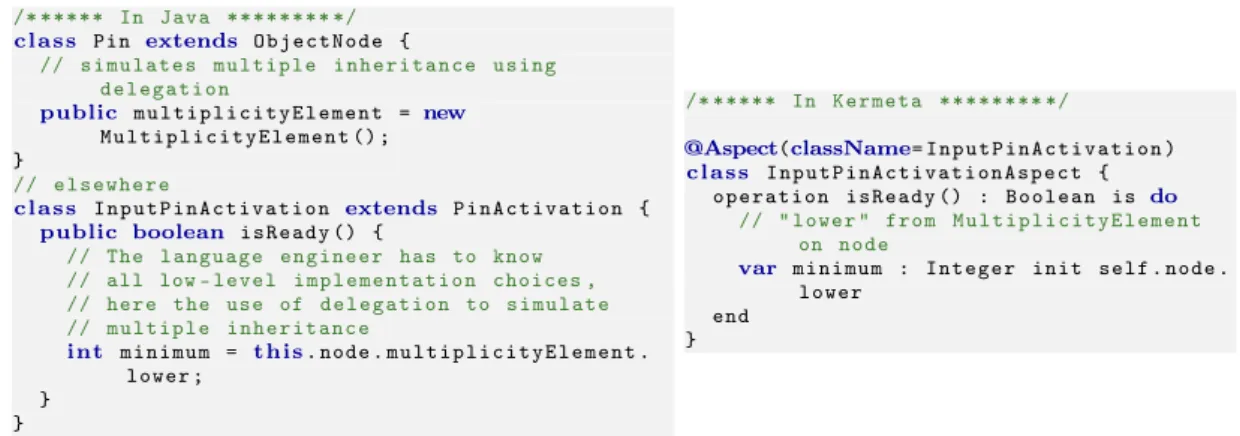
– Manipulating metamodel concepts within the operational semantics: When imple-menting a behavioral semantics, one often manipulates concepts of the metamodel. If the language used to implement operational semantics does not natively support metamodeling concepts, the operational semantics is bloated with workarounds to approximate the metamodeling concepts. For example, Figure2.2represents an ex-cerpt of the fUML implementation where the Pin class inherits from both ObjectNode and MutiplicityElement, and isReady is a method of Pin that expresses a piece of operational semantics. Let us compare how to handle two excerpts of this method in Java and Kermeta.
This listing emphasizes one important characteristics of our approach. The Kermeta language enables direct manipulation of the concepts of the language without having to use special wrapper methods. For instance, on the right-hand side listing, lower directly refers to the field lower of the metamodel class MutiplicityElement. On the contrary, in Java, the language engineer always has to master the simulation of the semantics of multiple inheritance, association, containment, etc. In other words, our approach lowers the representational gap between the code of the operational semantics and the metamodel concepts (i.e. of the abstract syntax). Also, writing the operational semantics with the Kermeta language avoids bloating (code generation, annotations, etc.) due to embedding the semantics of the metamodeling language (EMOF) into a programming language that does not support it by default (e.g., Java).
Instead, the Kermeta language relies on the extension mechanism provided by Xtend, namely active annotation, to extend it with MDE-specific facilities and semantics.
/* * * * * * In J a v a * * * * * * * * */ c l a s s Pin extends O b j e c t N o d e { // s i m u l a t e s m u l t i p l e i n h e r i t a n c e u s i n g d e l e g a t i o n public m u l t i p l i c i t y E l e m e n t = new M u l t i p l i c i t y E l e m e n t () ; } // e l s e w h e r e c l a s s I n p u t P i n A c t i v a t i o n extends P i n A c t i v a t i o n { public boolean i s R e a d y () { // The l a n g u a g e e n g i n e e r has to k n o w // all low - l e v e l i m p l e m e n t a t i o n choices , // h e r e the use of d e l e g a t i o n to s i m u l a t e // m u l t i p l e i n h e r i t a n c e int m i n i m u m = t h i s. n o d e . m u l t i p l i c i t y E l e m e n t . l o w e r ; } } /* * * * * * In K e r m e t a * * * * * * * * */ @Aspect(className= I n p u t P i n A c t i v a t i o n ) c l a s s I n p u t P i n A c t i v a t i o n A s p e c t { o p e r a t i o n i s R e a d y () : B o o l e a n is do // " l o w e r " f r o m M u l t i p l i c i t y E l e m e n t on n o d e var m i n i m u m : I n t e g e r i n i t s e l f . n o d e . l o w e r end }
Figure 2.2: Comparison of the Java Implementation against the Kermeta Implementation.
2.2
Efficient Structural Model Checking
The content of this section is an adapted excerpt from the following publication:
Wuliang Sun, Benoit Combemale, Robert B. France, Arnaud Blouin, Benoit Baudry, and Indrakshi Ray. Using Slicing to Improve the Performance of Model Invariant Checking. Journal of Object Technology (JOT), page 28, 2015. [184]
In MDD, models must conform to the formedness rules of the metamodel. Such well-formedness rules can be thought of as invariants of the metamodel. One needs to check the models to ensure that the invariants of the metamodel are satisfied using automated tools such as Eclipse OCL3, so that the developers can identify potential problems during design time before they are used to generate code. However, the existing tools are inefficient for invariant checking on large models. For example, checking model instances consisting of hundreds of thousands of elements against a metamodel that includes 345 elements would take more than two hours [184]. Thus, there is a need for techniques that support invariant checking for large models and metamodels.
Slicing techniques [203] produce reduced forms of artifacts that can be used to support, for example, analysis of artifact properties. Slicing techniques have been proposed for different software artifacts, including programs (e.g., see [82, 203]), and models (e.g., see [5, 16, 68,
103, 114]). In the MDD area, model slicing techniques have been used to support a variety
of modeling tasks, including model comprehension [5, 16, 114], analysis [100, 120, 121], and verification [68,172,173].
In model slicing techniques, slicing criteria are input data used to determine the elements that are included in slices. Model slicing techniques typically proceed in two steps: (1) The dependency between model elements of interest (e.g., elements satisfying a slicing criterion) and the rest of the model is analyzed using heuristics related to a model’s properties (e.g., the structure of a model); and (2) a fragment of the model consisting only of elements satisfying a slicing criterion, is extracted from the model.
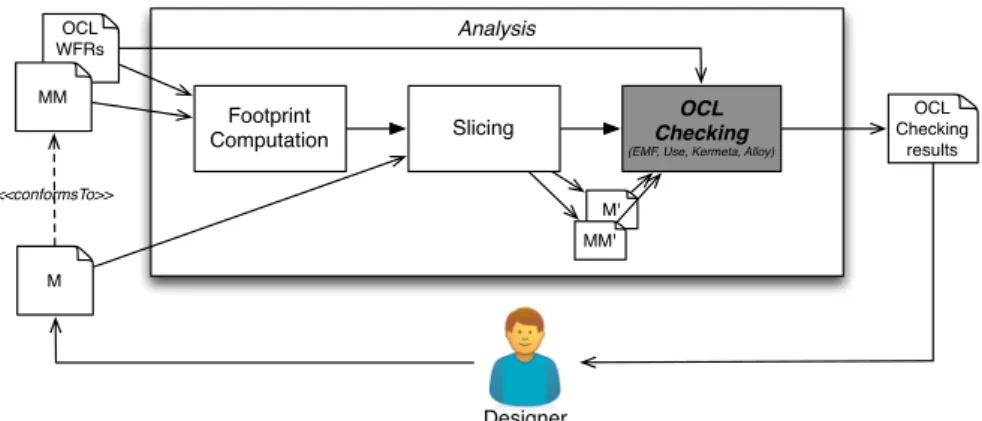
We introduce the model slicing technique to the invariant analysis process [184]. The approach aims to improve the size of the model that can be checked using invariant checking tools. The approach is not intended to improve the existing invariant checking algorithms. Instead, the approach aims to rely on the modular approach introduce in the previous section to reduce the size of the checking inputs to make the analysis more efficient. It means our approach
Analysis M OCL WFRs MM OCL Checking
(EMF, Use, Kermeta, Alloy) Slicing Footprint Computation OCL Checking results M' MM' Designer <<conformsTo>>
Figure 2.3: Approach overview
preprocesses the input of the invariant checking process, and thus is agnostic to the checking technologies the software developers are working with.
We have developed a framework that provides: (1) an implementation of the model slicing technique; (2) an implementation for checking models against invariants defined in the meta-models. The framework was implemented using Java and the Eclipse Modeling Framework (EMF) [182]. Even though the evaluation framework builds upon Java and Eclipse, the slicing technique is not bound to a particular technological space, and it can be implemented using any language and framework. We have evaluated our technique to check whether (1) the slicing improves the efficiency of the invariant checking, and (2) the invariant checking results for the sliced models are the same as the unsliced models. We have evaluated our approach with the Java metamodel and 73 models produced by reverse engineering Eclipse plugins. The evaluation we performed provides evidence that the proposed slicing technique can significantly reduce the time to perform the invariant checking while preserving the checking results. We also show that the invariant checking approach described in the paper can offer similar performance gains on small manually built models (e.g. hundreds of elements).
2.2.1
Approach Overview
Figure2.3shows an overview of the proposed invariant analysis approach (we refer the reader to [184] for all the details about the approach). The input of the checking includes a metamodel (MM), a model (M), and one or many OCL invariants (Well-Formedness Rules). First, the approach computes a footprint of the OCL invariants on the metamodel. A footprint refers to part of a metamodel that contains all elements that affect the outcome of an operation [100]. In this paper a footprint refers to all metamodel elements that are directly referenced by the input OCL invariants. Second, the footprint serves as slicing criterion, and is used to generate a sliced metamodel (MM’) from the input metamodel. The sliced metamodel (MM’) includes (1) all the metamodel elements from the footprint, and (2) all the subclasses of the classes in the footprint. Third, the sliced metamodel (MM’) is used to generate a sliced model (M’) from the input model. The sliced model (M’) contains only model elements that are instances of metamodel elements in MM’. Finally, the sliced metamodel and model with the invariants are fed into the tools for invariant checking.
2.2.2
Evaluation Results
We conducted an evaluation which aims to answer the following research questions [184]: • RQ1: Can the slicing technique significantly improve the efficiency of the invariant checking?
Our experiments revealed that the proposed slicing technique can significantly reduce the time to perform the invariant checking, achieving checking speedup ranging from 1.5 to 36.0.
• RQ2: Is the slicing technique ensured to preserve the invariant checking results? We show that checking an invariant in the sliced model is equivalent to checking it in the unsliced model, and the proposed sliced models are sufficient to the invariant checking.
2.3
The xDSML Pattern:
A Metamodeling Pattern for
Model Execution
The content of this section is an adapted excerpt from the following publications: Benoit Combemale, Xavier Crégut, and Marc Pantel. A Design Pattern to Build Exe-cutable DSMLs and associated V&V tools. In 19th Asia-Pacific Software Engineering Con-ference (APSEC 2012), Hong Kong, December 2012. IEEE. [35]
Benoit Combemale, Xavier Crégut, Pierre-Loïc Garoche, and Xavier Thirioux. Essay on Semantics Definition in MDE. An Instrumented Approach for Model Verification. Journal of Software (JSW), 4(9):943–958, November 2009. [33]
Model executability is now a key concern in MDE, especially to support early validation and verification (V&V) in the development process, such as debugging [43], model checking [33] and runtime verification [126].
Recently, several ways have been explored to implement the execution semantics of DSML. Basically, they map the abstract syntax, defined by the metamodel, to a semantic domain [91]. Most proposals translate models into an existing semantic domain in order to reuse available tools (e.g., simulators or model-checkers). Such a semantics, called translational semantics, is used for instance by the group pUML in order to formalize some UML diagrams [29]. Even if more expressive languages like Maude [161] or FIACRE [15] may be used to ease the writing of the translation between the DSML high level concepts and the formal language low level ones, this approach may require complex transformations to implement the semantic mapping. Furthermore, execution results are only obtained in the target domain. Getting back the results in the source language is difficult and usually requires to extend its abstract syntax in order to model these results.
Other approaches propose to weave executability into metamodels using an action language (e.g., Kermeta [147], xOCL [31] or even Java with the EMF API). Similarly, in-place model transformations, including graph transformations [163], were widely investigated to give a declarative specification of the execution semantics. For example, Markovic et al. use QVT [152] to express rewriting rules that gradually compute the values of an OCL expression [130]. Kuske et al. [118] have used graph transformation to define the executable semantics for some UML diagrams. These approaches allow a more intuitive definition of executable DSMLs. The semantic domain is an extension of the abstract syntax, and the semantic mapping is defined using an action language. Thus, the language engineer has only to deal with concepts of the DSML and not with another language and an explicit mapping. Nevertheless, such approaches require to implement for each DSML all the execution-based tools.