Academic Year : 2013-2014
Ministry of Higher Education and Scientific Research
Abou Bekr Belkaid University of Tlemcen Faculty of Letters and Foreign Languages
Department of Foreign Languages Section of English
Dissertation Submitted as a partial fulfillment in Candidacy for the Degree of Magister in ‘Language Contact and Sociolinguistic Variation’.
Presented by: Supervised by: ZEMRI Amel Pr. SERIR Ilhem
Board of Examiners
Dr. BELMEKKI Amine [MC 'A'] Chairman Tlemcen University Pr. SERIR Ilhem [ Pr] Supervisor Tlemcen University Dr. BENYELLES Radia [MC 'A'] Examiner Tlemcen University Dr. HADJOUI Ghouti [MC 'A'] Examiner Tlemcen University Dr. ZIDANE Rahmouna [MC 'A'] Examiner Tlemcen University
Aspects of Language Contact Outcomes in Algerian
i
I owe a unique debt of gratitude to my supervisor Pr. Serir Ilhem who directed this investigation and who has generously specified her time and proficiency to better my work. I am very appreciative for her precious observations and the valued pieces of advice that she has offered, for her back-up, support and more than ever warmth and kindness because she has really cared for me as her daughter.
Special thanks go for the head of the discipline Dr. Dendane Zoubir who provided the opportunity for us to be titled as researchers with the help of Dr. Negadi and Pr .Serir whom I thank a lot. I would like also to express my thanks to my friend Ghounane Nadia for proof reading, as well as, Dr. Frid Dawdi for his generous assistance along with all my teachers of English.
Many thanks go for the committee members for reading and examining my modest work. My appreciation goes to Dr. Belmekki for taking the chair of the defense, to my dearest Pr. Serir, to Dr.Benyelles, Dr. Hadjoui and Dr. Zidane for bettering my work by their comments and criticism.
For my classmates, I cry the good times we spent all together and I wish them all the best in their carriers and private lives.
ii
I humbly dedicate my fruit of success to …
My beloved parents,
My husband and son,
My brother and sister,
My grandmother and mother in Law,
My brother in law, his spouse and sisters in law,
My family and all my friends.
Belattar – Zemri Amel.
Dedications
iii
Abstract
The use of languages such as Arabic, French, English or Arabic /French code switching is a strategy used by the Algerian copywriters in the domain of advertising. The present study looks at the linguistic properties of advertising codes in terms of Arabic / French bilingualism, code switching as well as the diglossic situation in print Algerian context. The examination of advertising language is not an easy task; it is a communicating channel between the operators and people .Thus, in this context, it would not be wrong to say that advertising imposes itself upon the audiences. Hence, to collect reliable data, the investigation was based upon two newspapers printed in Arabic (Echorouk and Alkhaber) and others are printed in French (Le Quotidien and Alwatan). Thus, eliciting tools were used for data collection such as questionnaires, photo-elicitation, note taking and observation. Furthermore, both quantitative and qualitative methods serve the phase of data collection along with checking the attitudes towards the language of printed advertising. The sampling is varied according to age, gender and educational background.
iv
Acknowledgements ………...i
Dedications ………...ii
Abstract ……….……...iii
Table of contents………..……..iv
List of Abbreviations and Acronyms ……….….viii
List of Tables and Figures ………....…….…..viii
List of Graphics ……….……….………...….………...ix
Phonetic Symbols ………..………...x
General Introduction ……….……….……..1
Chapter One: Language Contact and Advertising. 1.1 Introduction ………3
1.2. Sociolinguistics ……….…....3
1.3. Languages in Contact ………...4
1.3.1Terminologies ………..…4
1.3.1.1. Language Contact and Linguistic Borrowings….……..5
1.3.1.2. Multilingualism /Bilingualism………..…5
1.3.1.3. Code Switching / Diglossia………6
1.4. The Markedness Model ………...7
1.5. Language Variety ……….………..…..8
v
1.8. The Aim behind Examining Advertisements……….13
1. 9. The Objectives of Advertising ……….14
1.10. Types of Advertisement………...15
1.11. Verbal Vs Non-Verbal Advertising ………..…16
1.12. Functions of Advertising………....17
1.13. Advertising Components……….17
1.14. The Audience ……….19
1.15. Some Literary Features of Advertising……….20
1.16. International Advertising ……….….21
1.16.1. The Social Function of International Advertising……….22
1.17. Conclusion……….…………....24
Chapter Two: Advertising Language in Algerian Society. 2.1. Introduction ………25
2.2. What is Newspaper? ………25
2.3. Journalistic Register in Algerian Printed Media……….26
2.4. Communication Process in Print Advertising Texts ………..29
2.5. The Linguistic Properties of Written Texts ……….……31
2.6. Fundamental varieties of Texts Qualities ………...32
2.7. Text and Context in Advertising ………34
2.8. Coherence and Cohesion ………35
2.9. Features of Advertising Texts ………36
2.9.1. Types of Sentences ………....…36
2.9.2. Catchy Sounds ……….………..37
2.9.3. Approbatory diction………...……….37
2.9.4. Jargon ……….37
2.10. Major non-linguistic Features in Advertising ……….37
vi
2.11.2. Gender Roles ……….41
2.11.2.1. Gender Severance at Work ….……….41
2.11.3. Socialization ……….…….41
2.11.3.1. Etiquette ………..42
2.12. Algeria and Advertising language……….42
2.13. Some Figures of Speech from Algerian Publicity ……….………44
2.14. Code Switching in Algerian Advertisements ………45
2.15. Code-Switched Advertisements Targeting Bilingual Clients ……46
2.16. Is Advertising Language an Accepted Tongue? ...47
2.17. The Notion of Style in Advertising ……….…..48
2.18. The Social Responsibility of Publicity ………..49
2.19. The Social Aspect of Advertising ………50
2. 20. Gender in Advertising ……….51
2.21. Children and Advertising ………52
2.22. Conclusion ………52
Chapter Three: Data Interpretation and Final Conclusions. 3.1. Introduction ……….53
3.2. The Research Design ………..………53
3.3. Methods of Data Collection ………...53
3.4. Questionnaires Description ………54
3.4.1. Adult Questionnaire’s Objectives ……….54
3.4.2. Children Questionnaire’s Objectives ………..55
3.5. Questionnaires’ Analysis ………56
3.5.1 Adults’ Questionnaire ………..………56
3.5.2. Questionnaire for Children……….61
vii 3.8. Recommendations………73 General Conclusion………..75 Bibliography ………..77 Appendices Appendix A (Advertisements) ………..………..81 Appendix B (Questionnaires) ………..………...97
viii AA : Algerian Arabic
Ad or Adv : Advertisement H : High Variety
L : Low Variety
MSA : Modern Standard Arabic
List of Tables and Figures.
Table 4.1. The Social Aspect of Advertising ……….………...…50
Table 5.1. Adults’ Questionnaire ……….…..56
Table 5.2. Children’s Questionnaire ……….…..61
Table 5.3. Global Attitudes toward Advertising ………..…..67
ix
List of Graphics
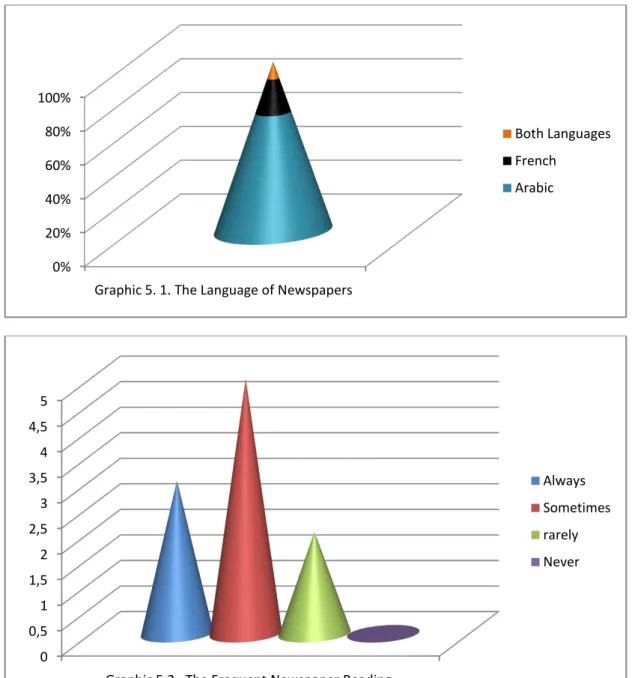
Graphic 5.1. The Language of Newspapers……….….63
Graphic 5.2. The Frequent Newspaper Reading ……….………63
Graphic 5.3. Advertising Interest ………64
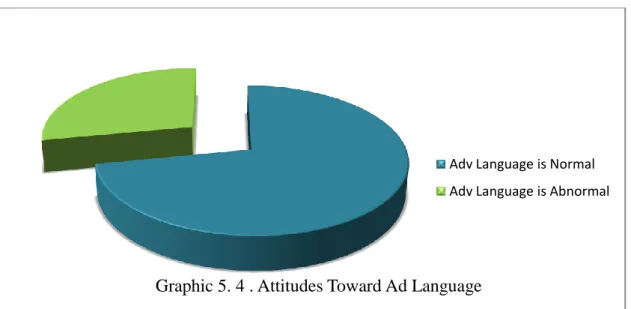
Graphic 5.4. Attitudes toward Ad Language………66
Graphic 5.5. Children Influence via Ad ……….……….…67
x Arabic Transcription
Ɂ
ء
ɤ
غ
b
ب
f
ف
t
ت
q
ق
ɵ
ث
k
ك
ʒ/ʤ
ج
l
ل
ħ
ح
m
م
χ
خ
n
ن
d
د
h
ه
ð
ذ
w
و
r
ر
j
ي
z
ز
a/æ
َ
ʃ
ش
ɪ
ِ
s
س
ʊ
ُ
ѕˤ
ص
ə
dˤ
ض ʕ
ع
tˤ
ط ɵˤ ظ
1
Language has a strong influence over people and their manners. It is remarked in advertising when a particular message is transmitted through language, which is chosen carefully, carrying an intention of influencing a group of audience. Furthermore, the design and the elements that construct an advertisement are accomplished via the role played by the code. Then, advertisers pay attention to the languages they select, purposefully, aiming at creating a flourishing advertisement.
The subject studied concerns our surrounding milieu describing the realistic and the dynamic phenomena observed in the Algerian setting. Remarkably, those changes and shifts complicate the examination more and more.
The research questions tried to be analyzed are as follows: 1. What are the characteristics used in advertising texts? 2. Is the language of advertising an accepted written code?
3. What are people’s attitudes towards printed advertising?
To answer the above questions, we suggested the following hypotheses:
1. Advertising texts may be stylistic, long and informative. 2. Advertising language may not be accepted.
2
that affect printed advertising codes dealing mainly with multilingualism and its dynamic correlated phenomena.
Such notions are analyzed progressively trying to find answers to the questioned issues starting by Arabic / French code switching through introducing the notion of multilingualism and the use of both varieties of Arabic (high and low) in addition to the new forms that occur in Algerian publicity such as the use of English. The notion of contact languages is explained specifying the linguistic profile of Algeria.
More to the point, we attempted to clarify the principles of variant codes used in advertising language, typically, in the Algerian context with the measurement of the linguistic and the cultural features that are manifested in printed advertising.
The structure of advertising mirrors the social reflection of the Algerian consumers, their thoughts, behaviours and attitudes. Hence, its language is marked by both social and linguistic norms respected by Algerian copywriters.
It has been chosen to start by elaborating the field of sociolinguistics dealing with the essential basis that serve language of advertising and the field of contact languages as a whole, then , we introduced advertising from different spots, and we described the process of communication and how advertising is a means of communication . Soon after, we checked the attitudes; we analyzed and interpreted the results on the basis of the sampling.
For the most part, language contact outcomes feature not only our vernacular but it is even adopted for different formal and informal functions increasing the energetic state of the allied phenomena and escalating the problematical issues of contact linguistics .
3
1.1- Introduction
Language echoes the way individuals communicate with each other. The essential phase at divergent language acquisition stages, is to learn the various patterns and styles of language interaction that enable speakers to function as competent conversationalists in different situations. Deeply to the point, the codes chosen by the operators of advertising address the individual‟s personality and feelings, i.e, it functions in an expressive manner. The overall aim is to affect positively the consumers to have the action of purchasing or at least to have some emotions and attitudes towards the products.
1.2- Sociolinguistics
Language is a tool for social interaction since it makes people understand each other .It is studied in relation to society under a scientific discipline named “Sociolinguistics”.
Sociolinguistics is the study of language in a social context. It focuses on the relationship between the linguistic behaviour and the social situations, roles and functions. Alan McGee (2006, 2) used in his article Trudgill‟s (1983: 20) definition of sociolinguistics as be it a “[…] part of linguistics which is
concerned with language as a social and cultural phenomenon. It investigates the field of language and society and has close connections with the social sciences […]”. Therefore, language is the key that conducts an
effective social communication.
Sociolinguistics classifies two kinds of approaches of research covering the micro-sociolinguistics and the macro-sociolinguistics. At the micro level the emphasis is over the individual in a group interaction. This approach is usually applied for studying a narrow scope in a given speech community such as style and register, discourse analysis, speech levels, domain of use and other
4
phenomena of a certain group; whereas, the macro level focuses on the interaction between a large group or the whole society. As this research focuses on the attitudes and the individual behaviour towards the language of print advertising, it belongs to the micro-sociolinguistics.
1.3-Languages in Contact
By the last part of the eighteenth century, the field of contact linguistics was highly regarded. It is traced back to the fact that lexicographers tried to assemble all resources for writing dictionaries but unfortunately, they were faced to an infinite range of complications intended for the insertion of a sum of foreign words in their dictionaries. Thus, it was a serious issue of various researches on language. It is varied to discuss the surrounding problematic related to the original principle. The dissimilar studies tackled the problems of borrowings, bilingualism, code switching …etc. Consequently, they became regular themes of numerous studies.
Even though philologists, centuries ago, knew that there is no language free from the inclusion of foreign basics; it was not clear for them that languages must have affected one another under various circumstances. The outcome of such influence refers to the possession of words originated by genetically related languages. Afterward, philologists reached the conclusion that it was a situation of language mixture.
1.3.1- Terminologies
Language contact outcomes selected for examination are not the only ones that exist in the field of contact linguistics but one can speak about pidgin and Creole, language shift, language death, language maintenance…
5
1.3.1.1- Language contact and linguistic borrowings
The twentieth century marked the use of a new appropriate term to the linguistic situation, discussed in the lines above, to introduce a widely accepted call for language situation by most all scholars. Languages in Contact is the title of Weinreich‟s book. Simultaneously, Haugen‟s Linguistic borrowing was presented.
Both terms brought into play concurrently, though the term borrowing was not completely novel since the cultural borrowing was already indicated by Sapir as early as 1921. Furthermore, Bloomfield‟s monograph carrying precisely the same title (i. e, borrowing) three chapters dealt with three borrowing types; cultural, intimate and dialect borrowings.
Broadly speaking, borrowing is a process in which the individual bilingual introduces words from one language to another with the support and the acceptance of the bilingual group. Sometimes, the words are adapted phonetically as well as morphologically as saying in Algerian vernacular /kuzina/ from the Spanish „cocina‟ and /ţabla/ from the French „table‟; correspondingly Kitchen and table .
1.3.1.2- Bilingualism / Multilingualism
It is an outcome of language contact situation; it is the fact of using more than a language by a certain society. Due to the complex interplay between more than a language in Algeria a chain of linguistic varieties are connected to multilingualism. Many definitions were given to this language phenomenon which is an upshot of the contact among people .Myers Scotton (2006, 44) defined it as “the ability to use two or more languages sufficiently to carry
on a limited casual conversation”. In the main; it is the exchange use of two or
more languages by the same person with an unstable capability level. Such a skill ranges from narrow to highly, native-like mastery of the second language.
6
Sometimes, it is beneficial since it “[…]offers a unique opportunity to
understand the structures of a particular language” (ibid: 12). Conversely,
some others have negative connotations towards bilingualism.
Specifying Algeria, societal bilingualism traces back to the French colonization that led to the co-existence of two distinct languages , Arabic and French while individual bilingualism focuses over the bilingual speaker with all the variables . The Algerian bilingual proficiency is heterogeneous; it is featured by the use of some French mixed with other language forms; though the situation was different during the colonial period .Through the daily contact with the natives those Algerians were purely balanced bilinguals noting that people coming after them are unbalanced, they are competent in Arabic more than French, as they may even lack a skill or more. Additionally, some bilinguals, particularly the pre-independent generation, have a certain ability of producing and perceiving a language even if they are illiterate. Therefore, they are regarded as active bilinguals while some others cannot speak French though they understand it; they are passive bilinguals, they have a passive capacity in one of the languages.
1.3.1.3- Code Switching / Diglossia
It is a daily practice processed by bilingual (multilingual) speakers shifting back and forth between languages in the same conversation. Such a linguistic behaviour occurs in multilingual speech communities, where people have the autonomy to pick up an understood code from the language varieties and make it in use. Most of the time, conversations are designed by the switch between more than a code or even mixing between codes.
Poplack identifies three types of code switching and the three of them explain the situation of Algeria.
7
Intersentential switching, which transpires between sentences; A: /sǝlǝfli 'lɒţɒ/ (Borrow me the car.)
B: Pas de probléme . (No problem) .
Intrasentential switching takes place within a sentence boundary; A: /sǝlǝfli 'lɒţɒ s‟il vous plaît/. (Borrow me the car, please). B: /Pas de probléme , here you go/ (No problem, here you go).
Extrasentential switching refers to the insertion of unoriginal expressions or tags.
A: /memʃi:tʃlaplaӡ , maɛli:ʃ ! ᴦɒbaḍaᴦatinna:fiɛa/
(I did not go to the beach, all right! it might be good for me)
Furthermore, the diglossic phenomenon is correlated with code switching as well as bilingualism .The way Algerians speak is featured by the use of Algerian Arabic (AA), French and standard Arabic (high variety). This mixture sways between bilingual states and diglossic ones. all forms of speech are the area under discussion of variation, as well as, the issue of language creativity and the emergence of new words adapted to the Algerian vernacular like /bipili/ (give me a page).
1.4- The Markedness Model
Code-switching is often studied in sociolinguistics because of its common use by bilinguals. The markedness theory tries to examine the social meanings of switching. It attempts to explain the social motivations of code-switching taking into account language choice as a means of communicating much loved interpersonal relationships. “One of the premises of the
8
choices as negotiations of 'position.' ” (Luna, David; Peracchio, Laura A, 2005:02). In other words, speakers use their linguistic choices as tools to
establish a set of rights and obligations (RO). An individual's language choice indicates a specific social identity and/or belonging to a specific community. Speakers negotiate RO stability with their audience for a specific speech event, based on norms well-known by the community and the sociopsychological features are essential in that event. Some codes or languages are associated with some particular features, and speakers choose the language they will use by corresponding language to the outstanding features of a particular event.
Taking the case of Algeria, as an example, where French is connected to features like education, prestige and wealth. In situations where those features are given much importance, the expected language choice (unmarked choice) would be French. Grosjean sees that the markedness theory proposes that individuals will switch languages or include other-language elements into their speech when they would like to communicate certain meanings or to become group member in a particular conversation. Another language element becomes marked because of its dissimilarity with the listener's expectations. A marked element is known by the characteristics involved in the exchange as communicating a specific planned meaning. In fact, code-switching is socially motivated and is rarely a sign of a lack of fluency in any language. (ibid)
Myers-Scotton (2006) reported a case taped in a countryside bar in western Kenya in which everybody speaks the local dialect, Lwidakho (the minority language). When a local farmer looked for a reward of money from a local man who is a paid worker in the city, the salary-man switched languages and expressed his refusal in three languages –English, Swahili, and Lwidakho. English and Swahili were used as a distancing tool in this case, as both are the majority languages.
9
In brief, the markedness model can be used as an outline to study the social motivations of code-switching. Moreover, codes or languages are able to be coupled with particular connotations, and individuals can communicate those meanings from first to last by their language choice. Furthermore, various factors affect the suitability of code-switching in particular occasions including cases of monolingualism, negative attitudes towards code switching and even sociopsychological factors.
1.5- Language Variety
Language is a complicated term associated with grammar and expression of thoughts. It is defined as a means of communication and it is viewed “as a set
of skills acquired in school.” (Downes, 1998: 2). Downes defines
sociolinguistics as a “[…] branch of linguistics which studies just those
properties of language and languages which require reference to social, including contextual, factors in their explanation.[Italics in original]” (Downes, 1998 : 9) . The interaction between the social and the linguistic
factors is the target point of this vast discipline.
Linguistics is a discipline which aims at describing the systematic nature of language. Furthermore, the study of people's attitudes towards one variety or another is motivating sub field of linguistics; it helps to understand the social distribution of dialects.
As language is a social phenomenon, it is ordinary to assume that the structure of a society has some impact on the speakers‟ language. It is clear that there are many systematic differences between different languages. By “systematic” we mean governed by rules. But what is complicated is that languages surround many levels of internal variation, related to variables such as age, region, socioeconomic status, group identification, and others. Therefore,
10
Rickford (2002: 1) affirms this principle saying that “These various
dimensions of variation are systematic in the same way as the variation between different languages is”.
In the same wave, Hudson etal (1996: 22) defines “a variety of language
as a set of linguistic items with similar social distribution because what makes one variety of language different from another is the linguistic items.” . Thus, for him it is all about words and vocabulary.
Globally speaking, a variety of a language is a linguistic system whose use shows a relationship and is causally linked to social factors (the setting and the users). Algeria as a case in point gathers various languages and varieties. In printed advertisements only the formal languages were used up to the modern time where the varieties of the Algerian Arabic are written as they are spoken. (See appendix A, 16)
The examplified advertisement contains A A /English code switching besides the use of standard Arabic in the word /qa:lu:/ اولاق which means "they said" and more importantly , English in an informal writing scripts that might be considered by the non-specialists and foreign people as an abnormal phenomenon .
1.6- Eagle view about Advertising
The origin of the word „advertisement‟ is the Latin verb „advertere‟ which
means „to turn towards‟. In fact „texts‟ make us turn toward them and they magnetise our attention; thus, we get curious to know more about the product. When reading about car‟s advertisements, for instance, “ لامكنا وحن Besturn” , our attention is upon the essential part of the car‟s functions and we do not even perceive that as an advertising word choice .
11
Furthermore, advertisements are designed to spread information about different products .American Marketing Association (AMA) defines advertising in an online paper as:
Therefore, Advertising is a sort of communicating information, usually; it is highly paid and strongly persuasive by nature for business purposes. The notion of advertising is related to economics. In a broad sense, it has been part of trade since the merchants always show the advantages of their goods in the market. In most all civilizations, Advertising signs were glued in trees, walls and news papers. The objectives and the different styles of advertising stood as a model for the new era of modern advertising .The focus was on the product, its uses and the price.
After 1920‟s the product information model changed, products imagery and personality were emphasised. The natural social settings and people making the advertisement were given much more importance in order to show the meanings and values associated with those settings such as cinema, public spaces…etc.
In the early 1950‟s, technological advancements created new forms of advertising based on photography and radio. The technological developments offered better opportunities for the product presentation .The radio‟s sound facilitates the transmission of the commercial messages, in addition to the realistic photography which conveys images in ways that the older forms of illustrations could not.
the non-personal communication of information usually paid for and usually persuasive in nature about
products, services or ideas by identified sponsors through the various media.
12
By the 1960‟s, the popularity of television promotes the delivery of advertising programs. Time became expensive when commercial television was the medium; the original time was shortened so no enough time for argumentation.
In the late 19th century, ways of communicating advertisements have changed in parallel with the urban growth.
From another perspective, advertising is seen as a genre of discourse. The meaningful interaction in advertisements makes this sort of communication. In fact, the discourse of advertising is the interaction between text and context together.
The main focus of discourse analysis is language, and some scholars like Cook give importance to the other elements that accomplish the text such as, images, colors, sounds (in spoken ad)…etc.
1.7- The Concept of Advertising
It is almost impossible not to be faced to some forms of advertisements, on TV, radio, public spaces or press. Advertising has become an inseparable piece of our lives.
Nowadays, advertisements reached a higher stage in convincing the consumers for purchasing. Therefore, two major categories of advertisements are marked: commercial and non-commercial advertisements. The first kind takes the greatest part in advertising; it is about selling the products through exposing the options, as well as the, positive side of goods ;whereas, the second type, it is informative related to selling notions of cultures or even religious matters or simply to transmit a simple messages as the texted announcements published in the newspapers (see appendix A, ad 2). Yet; pressed advertisements in Algerian newspapers are, most of the time, commercial for the reason that the majority of Algerians share the cultural background. The overall aim of
13
advertising companies is successful business through persuasive announcements.
Non-commercial advertisements do exist as an informative tool such as the advertisement published in AlWatan newspaper on 01.05.2013 about the
mastercard (see appendix A, ad 3). The advertisement sells information about
this new device in addition to the notion of modernity and more practical bank operations.
1.8-The Aim behind Examining Advertisements
Advertisements in their different forms are forms of communication, they are accepted by people and they become part of their daily life. Commercial advertisements aim at increasing the familiarity with the company rather than the product itself. A specific example of this is seen in (appendix A ,16) where Coca-Cola trade mark is targeted and in (ad 22), too, where no product is advertised but the company “Ruiba” is required, they inform people that they have participated in the exchange. Ruiba as well as Coca-Cola are even connected to a specific image even in terms of writing (i.e, character and size) and the colors used. In the audiences‟ mind they are good quality of drink, universal, delicious and well conserved.
Advertisements are worthy to study because they create feelings of love or detest to various announcements and products as well. In other words, it is quite important to study advertisements according to different disciplines and to see their effect over society and individuals. Publicity could be examined from various perspectives, in looking at the language used in advertising, many elements can be studied, the structure, the meaning, the effect. Thus, investigating these aspects people realize how advertisements work, and what makes us buy those products.
14
The language of advertising is created to spread a specific image they want to communicate it with public. It often uses a literary device in addition to aspects of scientific technology to bring its messages to a commercial market for business purposes. In contrast, “advertising texts can sometimes be
considerably more dramatic than the programmes or articles they punctuate.” (Goddard, 2001: 28). Sometimes, the texts are vivid and
noticeable and other times they do not serve the theme of the announcement.
1.9-The Objectives of Advertising
Various methods and ways show how to capture the readers‟ attention either by the text, the image, the colors, the characters, the style, the size and so many other elements which could make the advertisement attractive through its ambiguity or even simplicity and clarity.
Advertising is an activity that plays a fundamental role in achieving profits for the competitive companies. Their overall aim is to influence the consumers for the sake of changing their opinions and attitudes to some extent for purchasing. Therefore, the consumers‟ attention is captured by the help of what is known as attention-seeking devices. Goddard (2001: 12) states that
“One attention- seeking strategy developed in recent years to increasing levels of sophistication is the startling image”. Subsequently, the good
representation of the image is one of the essential devices in seeking consumers‟ attention. There must be certain awareness about the cultural ideologies to reflect on what is acceptable or unacceptable as far as the social values are concerned. Furthermore, the success of any advertisement does not lie on the social values only but the originality and the uniqueness of the message as a whole plays a great role in the success of the publicity though there might be some specific economic reasons that intervene to prevent some advertisements to be successful.
15
As Kateřinekrčmářová (2008, 6) quoted from Bovée and Arens (1992) five main objectives of advertising:
These objectives are abbreviated AIDA(S) which stands for Attention, Interest, Desire and Action and supplementary Satisfaction. Advertisers try to provide complementary and credible advertisements to convince people of the value of the advertised product, even though; a credible advertisement must reach satisfied consumers‟ attitudes. Some products are described as needed and worth having in addition to their advantages, as a result, the consumers‟ desire is heighten for getting the product.
1.10- Types of Advertisement
Advertisements were classified differently: Trade and technical advertisements
Prestige, business and financial advertisements Small advertisements
Government and charity advertising
The overall aim of all types is to promote public confidence and create a positive image of the product in the consumers‟ point of view.
Critics agreed that, in terms of commercial advertisements, they do not reflect truly the products, especially, in terms of quality. Besides, non-commercial advertisements may create false ideas and connotations about the notion purchased. Some people see advertising as an anti-social feeling since it
to gain attention
to create interest
to achieve credibility
to heighten desire
16
lies at them. However, the buyers should not lose sight and follow the advertisements blindly; they should follow the ideological and economic functions.
1.11 - Verbal Vs Non-Verbal Advertising
Communication, in advertising, is divided into verbal and non-verbal. Most of the time, they are used simultaneously. The use of language to transmit a message is the verbal communication, whereas; the non-verbal communication implies the use of gestures or sounds like waving your hand to mean “good bye” or making a sound like “shshsh” to mean “keep silence”.
Leech (1966 in Krčmáčová, 2008: 21) classified four basic elements in communicating advertisements:
Advertising is a form of public communication. This process happens between the participants who are the advertisers and the consumers, i.e., sender – receiver relationship. The objects in this interesting process vary from different services and ideas which are transmitted through a medium which is itself unlimited , the channel could be radio, newspaper (in this case), television, magazine , public spaces and so forth .Therefore, advertisers seek to effect the purchasers to get the products advertised and leave a positive impact on them.
participants
objects (relevant to the communication) medium of communication
17
1.12-Functions of advertising
The overall concern of any advertiser is to create an advertisement which possesses the most successful characteristics abbreviated in AIDA, which stands for Attention, Interest, Desire and Action. In other words, an advertisement should attract the consumers‟ attention to the product being advertised. They will be interested in the product and they realize that this product is just what they want, so, they wish to get it. Thus, they take the action of purchasing. Goddard (2001: 11) sees that
Broadly speaking, advertising functions are characterised into informing about a product or buying it. Informative and persuasive announcements are exemplified with pictures and written texts or spoken messages depending on the channel of transmitting a message. Jacobson (1960) classified language functions into six fundamental functions which are, in brief: Referential, Emotive, Conative, Phatic, Poetic, and Metalingual. For the purpose of advertising, two functions are over emphasised; referential (providing facts) and conative (aiming at the addressee, when the addresser makes addressee active). The poetic function can be also important by highlighting and playing with words, which is often typical for advertisements.
1.13-Advertising Components
On the basis of the advertisements under investigation, the following components are concluded. Some features of printed advertisements have already been generalized such as the image, the text and the elements‟
[…] advertisers want to make their texts capture our attention. The whole aim of the copywriters is to get us to register their communication […], written advertisements have to complete with each other and with all sorts of other texts.
18
organization. It is a hard task to describe the various universal advertising components. In the printed advertisements explored the following components occurred: Headline, Sub headline, image, body copy, trade mark or symbols, slogan and signature. The leading element for attracting the readers‟ attention in a printed advertisement is the headline; it paves the way to text comprehension. The headline is short and clear; it is characterised by the use of bold and different styles and size character. Advertisements‟ headlines accomplish their function ones the body copy, i.e, text is read.
The advertisements under examination are portrayed by short, expressive and sophisticated headlines that they turn into slogans to be memorable, easy, special and connected to the product. For illustration, here are some headlines that are considered as slogans as well.
! تهئاعنا مكن ديزمنا A chacun son Pack Nescafé Généra
x
ion NOUVELLE DACIA SANDERO ةرمع
LES SMARTPHONES NOKIA ASHA
It is often remarked under the headlines or slogans what is called small
headlines or subheadings. They are clarifying statements for the heading; it is an introductory phase for the body copy.
Generally, the small headlines provide the readers with some detailed information . Occasionally, it is written in a distinct style and size from the slogan. The example below can clarify more:
19
Trade mark LIFEBUOY
ايريتكبهن داضمنا نوباصنا Headline مقر 1 ايملاع * Subheading رئازجنا يف نلآا تيامح 100 % ميثارجنا دض مضفأ Body copy
The image can be seen in appendix A, ad 03 The text that details the information of the advertisement is called “Body copy”, it should not be long for not to lose the readers‟ attention. It has to explain the topic. Body copies differ from one advertisement to another even though they may share some linguistic features as being noun phrases, verb phrases or nouns and so one. Furthermore, the trademark is a graphical element; it is given the name of logotype shortened in the word logo which comprises even the symbol such as Lacoste, Nike and Coca-Cola along with the colors. The red logo is associated with Coca-Cola. The image is an element adapted by, almost, all advertising operators.
1.14- The audience
Different theories tackled the notion of audience. There are advertisements that are for everyone and there are others that concern a specific type of audience. Silver Bullet‟s (1999) approach sees the audience as passive since they do not interact with the media texts, and these texts as well are not multidirectional but they function in one direction in communicating a message i.e. they only send the message. The audiences do not neither agree nor disagree with the printed text. In contrast, the encoding – decoding model or what is known as the active audience theory (1980) was developed by Hall Stuart. It checks the relationship between the text and the addressees. The written text is encoded and the audience is motivated, they are active and dynamic for decoding the message. In addition to that, texts are read in different ways
20
depending on the reader, his culture, background knowledge and identity. Hall‟s reception theory sees the audience as responsible in making out the written text. Thus, reading is classified into three types, the preferred reading, the negotiated reading and the oppositional reading.
1.15- Some Literary Features of Advertising
Distinct features appear and disappear in advertising texts in order to convince the consumers to buy the products. Literary devices are used for persuasive advertising texts such as:
Hyperbole is exaggeration.
Neologisms is characterised in the use of new words or in the way they are
written. Thus, it results in an original impact.
Short sentences aiming at influencing the readers positively. The impact is,
essentially, clear at the beginning of the text, habitually using bold or large type for the "Headline" or "slogan" to capture the attention of the reader.
Ambiguitybe it syntactic or semantic is common in advertisements. It may make
the sentences unforgettable and re-readable.
Weasel words are often used. These are words which propose a meaning without
being specific such as Start (posing a question start what?) or the use of imperatives like buy .
Euphemisms is the use of nice words to avoid the unpleasant words.
Avoidance of negatives when advertising emphasises the positive side of a
product such as options of mobiles, washing machines and cars …
Simple and Colloquial language is more natural for ordinary people, even
21
The use of second person singular the use of “you” in addressing the audience
creates a friendly atmosphere .
Simplicity in vocabulary simple words are chosen unless in speaking about
exceptions and technical matters to focus on the scientific aspects of the products advertised.
Humour can be spoken, written or visual. It is used to show the positive side of
the product.
Glamorization is a technique used by all most all advertising operators, they
show (see ad 08) where an old polluted factory became new, charming and clean.
1.16- International Advertising
International advertising is a business activity that affects the social values of countries. It, also, spreads various standards and ethics worldwide. Douglas etal add that: “International advertising can, therefore, be viewed as a
communication process that takes place in multiple cultures that differ in terms of values, communication styles, and consumption patterns”.
(Article 31:1). In global marketplaces, the communicating process to a marked audience is more complex for the reason that communication takes place across dissimilar contexts, which vary in terms of language, literacy, as well as, extra cultural factors. On top, media differ in their efficiency in carrying different requests. A message may, therefore, not reach the audience because of people's lack of ability to understand it (due to literacy problems), because they misinterpret the message by affixing different connotations to the words or symbols used, or because they do not respond to the message due to a lack of profits to purchase the advertised product. Media limitations also play a role in the failure of a communication to reach its intended audience. (ibid)
22
Communication process, in such an international market, entails certain steps to be effective starting by forming a clear message for the audience to be plainly understood in different cultural contexts, then, comes the role of the media which reacts on the point. However, a range of cultural obstacles could hamper the efficient transmission of the point communicated and it results a sort of miscommunication. Moreover, in programming verbal messages various areas need to be taken into consideration among them the sphere of culture when translating publicity from one language to another. For instance, in appendix A, ad 28 the text says: حرملا ةلفاق عم ٬حرفلا يف انكراش
It does not really fit to be translated like “join us in happiness with the trail of cheer”. Therefore, it results a low literary level. Thus far, the colors used may have different connotations depending on the cultural background. In addition to that, the media channel should be selected in relation with the audience ; printed media ,as a model, cannot be effective in some countries where the level of literacy is high .Eventually, the cultural context affects the effectiveness of communication.
1.16.1-Social Function of International Advertising
There are some hidden issues discussed after achieving the business primary goal of advertising. “Advertising exerts a formative influence whose
character is both persuasive and pervasive” (Douglas etal, Article31: 5).
That aim is achieved through language reinforcement, as well as, the principles and the social values. As a result, People‟s attitudes and their social behaviour are affected.
In an international setting, advertising has a social influence featured in many aspects. The overall aim why international advertising is created is to establish, develop and introduce new products in many societies. Consequently, a radical transformation occur in life style, believes and the social behaviour as
23
well. For illustrating, we give the example of fast food which becomes a wide well-known fact in some Algerian social behaviour. This event is adored by people, especially, youngsters. Sometimes, they look for some specific brand name like MacDonald or Pizza Hot. More than that, the families are trying to get used for having their meals in restaurants or buying the cooked food at home; that is something which was not customary in Algeria, years ago .On the other hand, it is recognised that the Algerians are conservative, they had some principles which they did not even think to get rid of them, among them this new fashion of fast food.
International advertising tries to draw a perfect image about good life; it shows all what is nice in a real perfect manner and it establishes new models of consumptions. At a large scale, advertising a strong force of change that makes the social behaviour, in one way or another, either reinforce certain values or make a complete shift. International advertising portrays the Western society and culture. In the course of advertising accomplishments, well known trade names are branded all over the world such as Levi's, Nike, Marlboro , and other different products targeting the young adults throughout the world. Correspondingly, the images in international advertisements are either Western in origin, or at least, they reflect their culture.
As a consequence, this advertising type is harshly criticized all over the world, especially by the Islamic religious countries that have some negative attitudes ; thus, it causes strong depressing reactions. Moreover, international advertising acts as an integrating force across national boundaries through the transmission of slogans and universal symbols that establishes a unique mode of communication among people in different parts of the globe.
24
1.17- Conclusion
The consumers‟ social behaviour is influenced by advertisements. Therefore, it results in an impact on the social and the cultural values. The influence of advertising can be noted in cases when the personal needs, as to be fashionable and cute, are accomplished by purchasing the advertised products, even if they are not in need of them. Consequently, people buy more and the society becomes materialistic. Despite, it is not an easy task to assess the effect of advertising upon the individual because of various social and cultural reasons, advertising could be beneficial to some extent, in the sense that it supports the free market economy, as it introduces the new products to the public.
25
2.1-Introduction
It is commonly accepted that media are very powerful, and have an enormous impact on an extensive public. They can influence people‟s estimations and their viewpoints. Massmedia gather TV, radio, magazines, newspapers and journals ….
2.2- What is a Newspaper?
As the word newspaper denotes, it is a piece of writing that informs and gives the news of the day accompanied with some comments and analysis. Likewise, it is defined by Babylon online dictionary (2013) as “daily or
monthly news publication printed on large sheets of cheap paper”.
Nonetheless, news is not the only concern of a newspaper, it “is very eclectic,
from the stylist point of view” 1 . Newspapers are full of topics written in different forms, advertisements, entertainment space, editorials, criticism and original writings of various kinds prose and poetry.
Any kind of newspapers‟ texts contains some basic elements such as the headlines through which you can have a global idea about the topic. Occasionally, they are ambiguous and misleading to attract attention.
Newspapers have a very specific language labeled „journalese‟. Crystal
defines this word as “a composite, a blend of what is characteristic of a number of
different kinds of journalistic material” 2 .
As Crystal (1997) said, the key function of the newspapers is to inform and report. Newspapers, often, focus upon a specific targeted group selected on the basis of certain variables like political course, age, education and social status.
26
Increasingly, there are not too many ways for classifying types of newspapers. The major building block that makes a distinction between newspapers is the format (Tabloid and Broadsheet) and the content (subject matters dealt with) but still they can be classified depending on their frequent issuing.
Tabloid type is defined by Babylon online dictionary (2013) as “small
format newspaper providing news in a condensed form and containing sensational material or gossip”. Therefore, it is characterised by an inevitable
role of the heads; they usually take more space than the articles. Headlines use the visual aspect of text, to draw the reader‟s eye. They count on the use of colors and especially intertextuality, ambiguity, loaded language, omission of words and sound such as alliteration and rhyme.
Then again, the second type is not widely adapted. Babylon online dictionary (2013) defines the broadsheet as a “large sheet of paper printed on
one side; advertising circular or flier; full-size newspaper” .This kind of
newspapers is not found in Algeria In United Kingdom, such a sort of newspapers is found and the best known broadsheets The Daily Telegraph, The Sunday Telegraph, The Sunday Times and The Financial Times.
So far, the term „broadsheet‟ usually designates a quality of papers, and it refers to the size of the newspaper, which is so large. The broadsheet format is characterized by long vertical pages. Broadsheet newspapers center its attention over serious issues, such as politics, economics, education, business; they contain editorial comments, long articles and extensive vocabulary and usually gives attention to more educated people.
2.3- Journalistic Register in Algerian Printed Media
People around the world are not able to live by their own without interaction. Through communication people express themselves, their thoughts, ideas, and they transmit messages.
27
In human communication process, language is the most suitable medium used to deliver a message. This explains what Ellis (1999, iii) states: “language
is the fundamental tool of communication and experience”. In short, the
strategic use of language focuses on how language is used to achieve a goal. Thus, it is the medium used in everyday life as a means of communication.
Communication also occurs in business matters. It is shaped in different forms between the producers and the consumers aiming at achieving success to the company. Advertising is a form of communication and a representative image to our everyday life. It is composed of texts and goals to attract people‟s attention and influence their motives for the sake of buying the products. The manufacturers select an effective language to extend information about their products. Therefore, advertising language is special; it is influenced by linguistic and non-linguistic features characterized in the language itself and the social factors that affect its use. Such a kind of language used in advertisement is concerned with register.
Register is a language variety based on its functional use. In its broad sense “it is a kind of social genre of linguistic usage” (Al-Rugi , LANE
422:1). Advertisements attempt perfectly to interest the consumers and attract
their attention as it is clearly seen in the example bellow which is written in English. In fact, the use of English is something new in the Algerian printed advertising which does not exist years ago.
THE RENAULT MEGANE EXPERIENCE
Discover the Renault Megane 2012 In unexpected detail
28
(car advertisement) (Echorouk newspaper: 10th January 2012) THE RENAULT MEGANE
EXPERIENCE
These two sentences are considered as the initiation of this advertisement; they are capitalized, aiming at opening an area to the consumer to imagine something and think deeply. Then, the next text, Discover the Renault Megane
2012aims at warming up the consumers making them feel that there is
something special in this car .After that , the rest of the text want to make the consumers ambitious towards this product. However, depending on the need of situations, different styles are used and language contact outcomes appear. Therefore, a formal language (code) requires a different style than the informal one. Al-Rugi (ibid: 5) defines language style as “variations within registers
that can represent individual choices along social dimensions.” .This means
that we try to relate the level of formality chosen depending on various social factors such as the kind of occasion; the various social differences like age, gender, social class, educational background and other differences that exist between the participants.
For this reason, style and register are important elements in printed advertising. Several words and phrases are formed to show the style used in advertisement such as
اهٍف ىنتسن تنك ًل يذه /hæðіlіkəntnəstənafihæ/ (this is what I was waiting for)
(Al khaber newspaper : Novembre , 28th ,2012 )
From the advertisement above, the style used can be clearly observed. It is an informal style, where [the advertiser intends to create an intimate and casual relationship with the purchaser.]
29
Language contact outcomes, Diglossia , Bilingualism and code switching , are the sociolinguistic phenomena pointed at for investigation .
Advertisements like, ةيناجم sms و تاملاكم ( calls and texts for free) /mekalama:t wa s-m-s maʤa:nija/, explain code switching situations . Diglossic situations are noted in advertisements like :
رابك اونياحم و ريغص –
ةيعفنلا ةلومحلا 1075
غك which means ( small and it does many
things - expedience loading 1075 kg) /şɤi:rwəmħa:jnʊkba:r - əlħemu:lanefʕija 1075kileɤra:m/ where the first part of the sentence is in the low variety while the second part is written in the high variety.
For bilingual advertisements, there is no difficulty to notice neither Arabic/ French bilingualism like in شيعla vie /ʕi:ʃ 1a vi/ nor Arabic / Eglish bilingualism such as HD super AMOLED ةصوب 4.8 ةشاش or even French / English bilingualism as in (motion et emotion, let your body drive) .
On the basis of the sociolinguistic phenomena mentioned above, this piece of work is conducted to investigate language contact outcomes ( Diglossia, Bilingualism and code switching ) that appear in printed advertising in Algerian newspapers . Moreover, members of the same society share common linguistic features in using their language. There are a number of phenomena which characterise the Algerian linguistic situation as be it diglossic and bilingual country where Arabic and French are used.
2.4- Communication Process in Print Advertising Texts
Different terms are given to the participants who communicate through advertising texts such as :
Writer reader Producer consumer
30
Such terms reflect the communicative relationship between the addresser and the addressee. Moreover, it is a mirror that draws differences between various academic domains such as Marketing, Linguistics, Sociolinguistics and Sociology ….etc. From this perspective “different subject areas […] think of
advertising in a particular way” (Goddard: 2006, 28) .Thus, it is concluded
that the audience is the target of this kind of relationship. The truthful element in every version differs from one advertisement to another; most of the time, printed advertising texts are based on a literary device as it uses a scientific technology for business purposes. Furthermore, “advertising texts can
sometimes be considerably more dramatic than the programmes or articles they punctuate” (idem). Consequently, it is beneficial that different areas of
studies tackled the subject of advertising, in the end, different results, models and viewpoints construct the analytical frame work of advertising.
Written texts establish a kind of non-personal relationship between the two communication agents; it is more impersonal and less expressive emotionally for the reason that the physical aspect in the speech context is absent. On the other hand, there are some original texts which are referred to in order to elaborate another text. This fact is known as intertextuality which is, in fact, an important component of an advertisements‟ meaning , in this way, the original text has left a print that the new formulated text benefit from it . “For
intertextuality [… ] readers have to be able to remember the original advert [….] if they don’t, it doesn’t matter, too much, for the contemporary advert will simply be enigmatic ” (ibid: 69)
Therefore, people question the main aim of the advertisement or they will ignore it.There are some theories named “Advertising Communication Models” that explain how advertising works. These models attempt to describe and examine the purchaser level “the process by which advertising communicates
31
(Rossiter etal: 1985, 510). Therefore, these theories are used when creating and
testing a given advertisement.
To accomplish the process of advertising requires at least six steps but no further details will be given about this, since it is the task of Marketing. Yet; the concept of communication is important, since it reflects the individual‟s ability to transmit messages and express ideas .Moreover, it is exactly what Widdowson (1983) described as capacity to use information to create different meanings in language.
2.5- Linguistic Properties of Written Texts
Speaking about „texts‟, two types are recognised, the complete text with a clear start and end such as articles, sermons,… and text excerpt which is a part of a discourse extracted from a larger and complete text. Thus, text is a cover term “for any extended segment of discourse from speech or writing” (Biber
etal: 2009, 05)
Any text is described according to the context taking into account the situation, the purpose and the characters coupled with the text. Additionally,
“Every linguistic element of an advertisement’s text is now chosen based on intricate psycholinguistic models of human language processing”. (Leetaru: 2001, 2). Advertising codes are not used haphazardly but they are
rather selected on the basis of psycholinguistic principles besides other variables.
On the whole, it is named advertising register and the term register is a variety of language which refers to a kind of social genre of linguistic usage.
a register is a variety associated with a particular situation of use (including particular communicative purposes).
32
As the Figure bellow explains, when describing a specific register, three main components are covered: the situational context, the linguistic characteristics and the function between the two components. The figure is taken from the Biber etal (2009), but it is adapted into a different schema to be different.
Figure 3.1. Components of Register
The notion of register is portrayed through a variety of lexical, as well as, grammatical qualities including mainly the linguistic features. Nevertheless, registers are also depicted by their situational contexts. The functional perspective is also significant since the linguistic functions occur in register because they are, above all, appropriate to the target along with the situational context of the register. As a consequence, the functional analysis is the third component of any register.
2.6-Fundamental varieties of Texts Qualities
Usually, conversations are the common type of communication via the spoken language .The written language also plays a vital role on a daily basis.
33
Although many writings are produced by different ordinary people who, at least, write phone short messages (SMS) or E-mails, persons read more than they write. In this sense, Biber etal (2009, 1) state the following:
Despite register, genre and style figure the essential varieties of language; they refer to three dissimilar standpoints characterised by slight differences between them. The linguistic feature analysis of texts, in addition to the situational context, is the intention of register but while including descriptions of the purpose and the context; it becomes the function of the genre .The conventional structure in constructing a text is over emphasised such as the usual form of which official or administrative letters are detailed, begin and end. Furthermore, though the notion of style is itemised before in this research; it is worthy to note that just like register, style care of the analysis of texts‟ linguistic features .The functional aspect creates the slight gap separating both perspectives from each other .As Biber etal (ibid) confirm:
Most closely, register and style work hand in hand in almost every written text. In fact, many people read even more different kinds of texts
than they listen to: newspaper articles, editorials, novels, e-mail messages, blogs, text messages, letters and ads in the e-mail, magazine articles, ads in magazines, textbooks, research articles, course syllabi, and other written assignments or handouts.
The key difference from the register perspective is that the use of these features is not functionally motivated by the situational context; rather, style features reflect aesthetic preferences, associated with particular authors or historical periods.