Ministry of Higher Education and Scientific Research University of Mohammed Seddik Ben Yahia, Jijel
An Evaluation of the
School Textbook « At the Crossroads
The Case of First Year Secondary Schools, El
A Dissertation Submitted in Partial Fulfillment of the Requirement for
Submitted by: Supervised by: Nesrine BOULTIF Mrs. Safia NEGHIZ Sarra ALLOUACHE
Chairperson: Abdeljalil BOUZENOUN Supervisor: Safia NEGHIZ Examiner: Chadia CHIOUKH
Ministry of Higher Education and Scientific Research University of Mohammed Seddik Ben Yahia, Jijel
Department of English
An Evaluation of the Writing Component of the First Year Secondary
At the Crossroads » from Teachers’ Perspectives
of First Year Secondary Schools, El-Milia, JijelA Dissertation Submitted in Partial Fulfillment of the Requirement for a Didactics of English.
Submitted by: Supervised by: Nesrine BOULTIF Mrs. Safia NEGHIZ
Board of Examiners
BOUZENOUN Mohammed Seddik Ben Yahia Mohammed Sadikk Ben Yahia Chadia CHIOUKH Mohammed Sadikk Ben Yahia
October, 2020
Ministry of Higher Education and Scientific Research
Writing Component of the First Year Secondary
from Teachers’ Perspectives
Jijela Master Degree in
Submitted by: Supervised by: Nesrine BOULTIF Mrs. Safia NEGHIZ
Mohammed Seddik Ben Yahia University Mohammed Sadikk Ben Yahia University Mohammed Sadikk Ben Yahia University
An Evaluation of the Writing Component of the First Year Secondary School Textbook « At the Crossroads » from Teachers’ Perspectives : The Case of First Year Secondary
Schools in El-Milia/Jijel
Nesrine BOULTIF
Sarra ALLOUACH
Dedication
This work dedicated to :
My dear parents ; no words can ever be strong to express my gratitude, appreciation, thanks, for beign always there for me. There is no word to describe what you mean to me.
My beloved brother and sister : Amir and Rania, thank you for your everlasting support and encouragement when things look bleak.
My supportive fiance, thank you for believing in and supporting me.
My sweetest partener in work Sarra, thank you for all the time we have passed together at the university, for supporting and encouraging each other.
My dearest friends : Raouia, Romayssa, Ikram ; thank you for your great support.
To all the beautiful souls that we have crossed our paths with. Thank you.
Dedication
This thesis is dedicated to :
My parents, who never stop giving of themselves in countless ways.
My beloved brothers and sisters, for their whole-hearted support.
To all my family, the symbol of love and giving.
My partner in work, my support in the hardest days, you are such a gift.
My friends who encourage and support me.
All the people in my life who touch my heart.
I dedicate this simple work.
Acknowledgments
Thanks to « Allah » who guides, helps, and gives us the capacity to do this work.
We would like to express our respect and grattitude to our supervisor : MRS. Safia NAGHIZ, for her constant help, precious suggestions and constructive feedback.
We extend our thanks to the board of examiners ; Chadia CHIOUKH and Abdeldjalil BOUZENOUN for examining our work .
Abstract
The present study aims to evaluate the writing component of the first year secondary school textbook of English “At the Crossroads” from secondary school teachers’ perspectives. This study based on the hypothesis that the more teachers base their teaching using the textbook on the principles of the competency-based approach and on their pupils’ needs and proficiency level, the more satisfied they will be with the writing component in the textbook of English “At the Crossroads”. The dissertation is presented in the form of three chapters. The first and the second chapters expose the theoretical aspects related to the writing skill and textbook evaluation. The third chapter is practical and presents the data collection procedure and the study findings. A questionnaire was submitted to a sample of 25 secondary school teachers of English in El-Milia/Jijel district, with the intent to know their views on the teaching of writing under the present approach, and on the writing component in “At the Crossroads”. The results revealed that the teachers acknowledged that they face some difficulties while teaching their pupils writing. The teachers also expressed their dissatisfaction with the writing parts included in the first year textbook of English. Moreover, they reported that the first year textbook corresponded to the principles of the competency-based approach, and that most of them followed the process approach to teaching writing, which does not fully match to what theory spells. The teachers claimed that the writing tasks matched to the general aims of teaching English, but not to their learners’ needs and levels of ability. This can confirm that existence of some problems in teaching first year secondary school pupils the writing skill. Based on these findings, which seem to confirm the hypothesis, some pedagogical recommendations are suggested.
Key words: Textbook Evaluation; Writing Component; Competency-Based Approach Principles, Teachers’ Perspectives.
List of Abbreviations
CBA: The Competency Based Approach
DM : The Direct Method
EFL: English as a Foreign Language
GTM: Grammar-Translation Method
OALD : The Oxford Advanced Learner’s Dictionary
SE1 : Secondary Educational level
List of Tables
Table 01 : Controlled and Free Techniques………..…….22
Table 02 : The Presentation of the « Say it in Writing » Tasks………...…..57
Table 03 : The Presentation of the « Write it Right » Tasks………..61
Table 04 : The Presentation of the « Write it Out » Tasks……….65
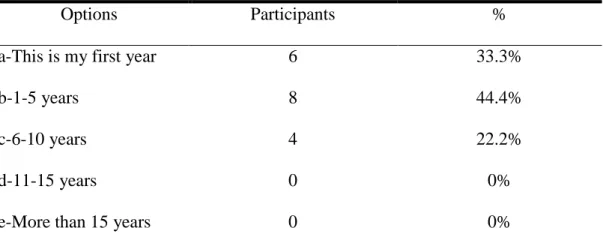
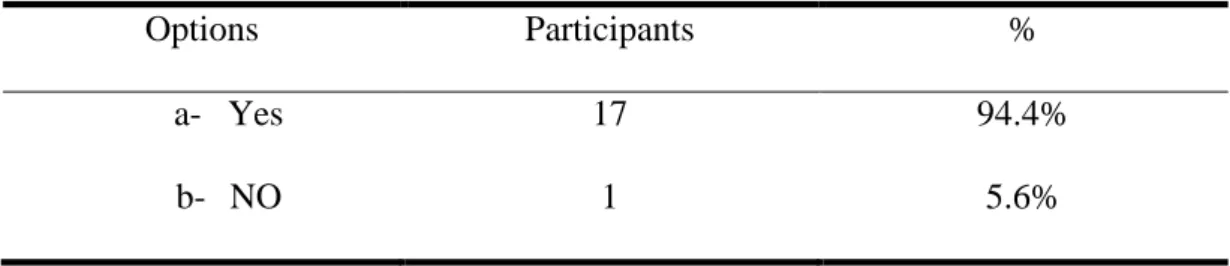
Table 05 : Teachers’ Teaching Experience………...69
Table 06 : Teachers Experience with First Year pupils………..70
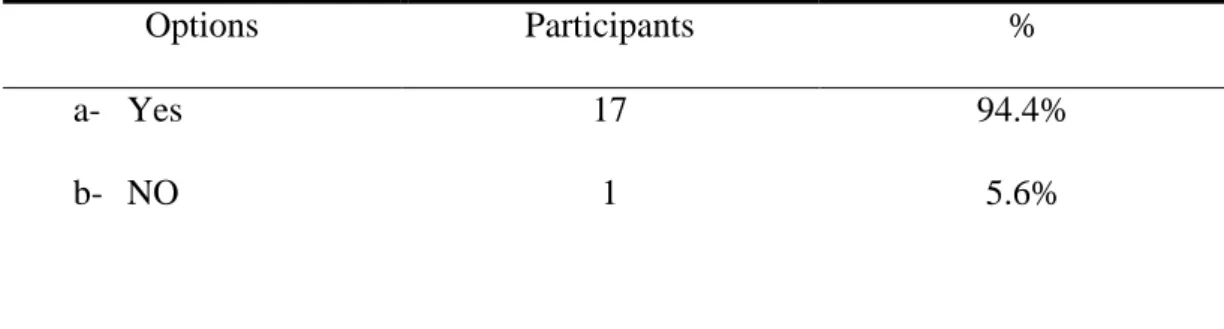
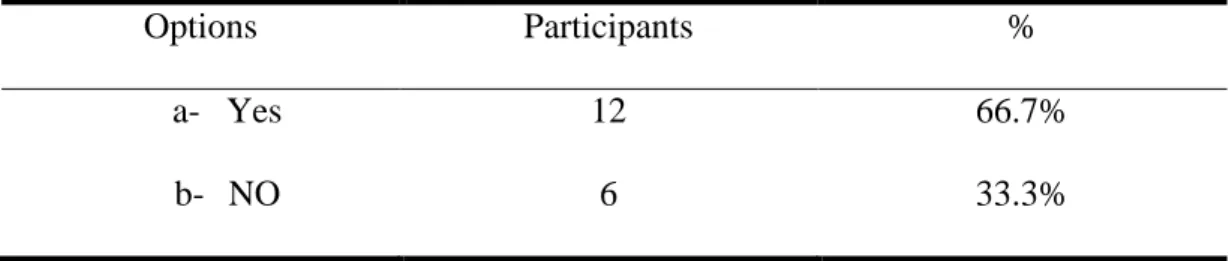
Table 07 : The Centrality of the Writing Skill to Foreign Language mastery………..71
Table 08 : Teachers’ Estimation of Their Pupils’Level in Writing………...71
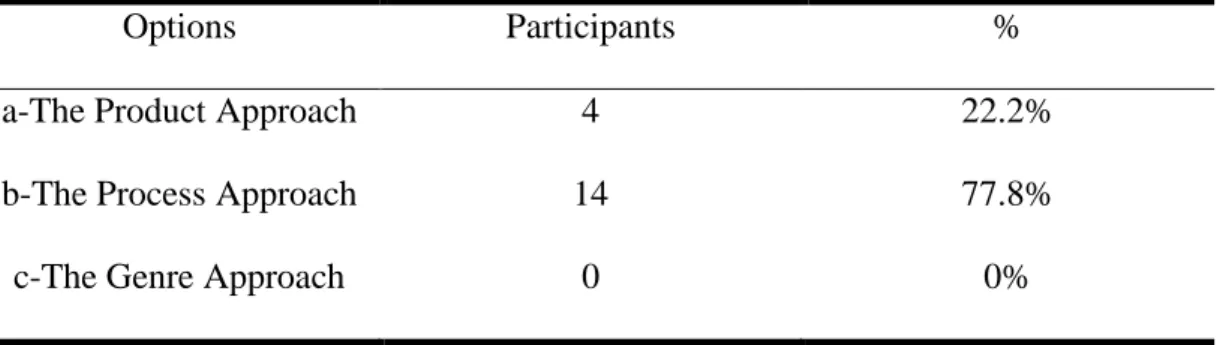
Table 09 : The Teachers’ Adopted Writing Approach………72
Table 10 : The Objective(s) of Teaching Writing to First Year Pupils………...73
Table 11 : The Encountered of Difficulties in Teaching Writing ………..………..74
Table 12 : The Teachers’ Encountered Difficulties and the Suggested Solutions………75
Table 13 : The Teachers’ Use of Uthentic Materials in Teaching Writing………77
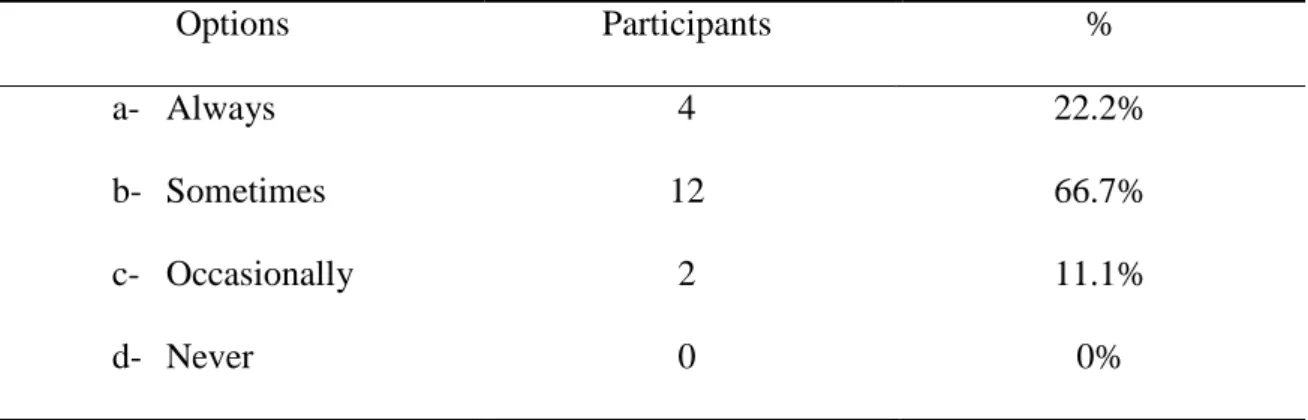
Table 14 : Teachers’ Frequency of Materials Adaptation Practices………79
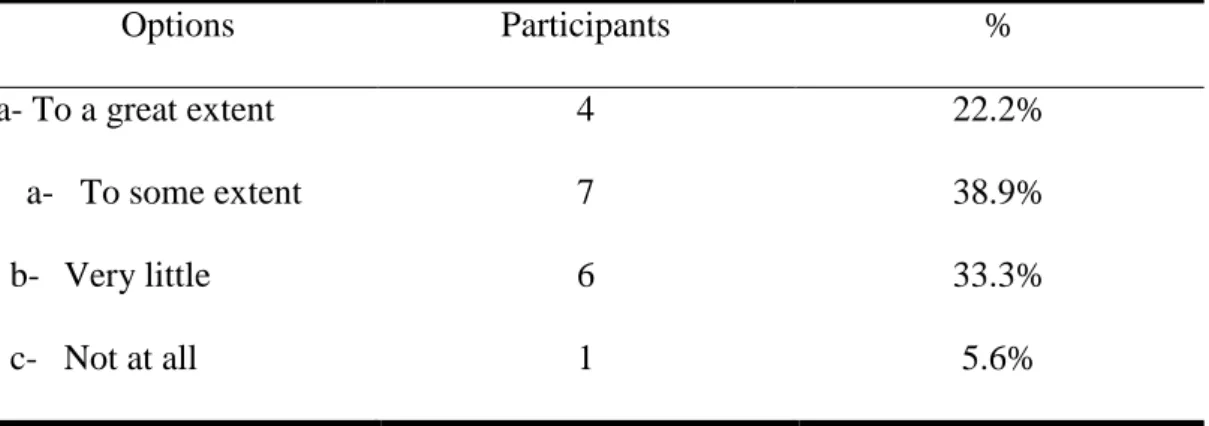
Table 15 : Teachers’ View on the Relevance of the The Writing Component to Developing Pupils’ Writing Abilities ……….………...79
Table 16 : Teachers’ Views on their Application of The CBA Principles in Teaching The Writing Skill………80
Table 17 : Teachers’ Views on their Success in Teaching Writing Under The CBA …...81
Table 18 : Teachers’ Evaluation of The Textbook’s Aims and Objectives………...82
Table 19 : Teachers’ Evaluation of The Textbook’s Suggested Methodology for Teaching the Writing Component………...83
Table20 : Teachers’ Evaluation of The Writing Compone,t’s Suitability To Learners ….87
Table of Contents Dedication ………..….2 acknowledgments……….…...4 Abstract ………..………....5 List of Abbreviation ………....6 List of Tables ………...7 Table of Contents………..………..9 General Introduction 1. Background of the Study……….….14
2. Statement of the Problem………..15
3. Aim of the Study………...15
4. Research Questions………...15
5. Hypothesis……….16
6. Research Method and Tool………...16
7. Structure of the Study………..16
Chapter one :Teaching the Writing Skill Introduction ……….19
1.1 Definition of Writing……….19
1.2 Types of Writing ………...20
1.3.1 The Controlled-to- Free Approach ………..21
1.3.2 The Free-Writing Approach ………22
1.3.3 The product-Oriented Approach ………23
1.3.4 The Process Approach ………....24
1.3.5 The Genre Approach ………...25
1.4 Writing Strategies………....26
1.5 Writing Materials………...27
1.6 The Importance of Writing in Foreign Language Teaching ……….28
1.7 Student’s Difficulties in Wriing ……….29
1.8 Writing Under Major Language Teaching Methods/Approaches………...30
1.8.1 Writing Under the Grammar –Translation Method………..30
1.8.2 Writing Under the Direct Method ……….31
1.8.3 Writing Under the Audio-lingual Approach………..31
1.8.4 Writing Under the Communicative Approach……….32
1.9 Writing Under the Competency –based Approach……….….34
1.9.1 What is the Competency-Based Approach? ………...34
1.9.2 The CBA in Algeria ………...37
Conclusion ……….40
Chapter Two: Textbook Evaluation Introduction ………...….42
2.1 Definition of The Textbook ………...42
2.2 The Role of Textbook in Foreign Language Teaching………...43
2.3 Characteristics of a Good Textbook ……….….44
2.4 Textbook Evaluation ……….….46
2.4.2 Definition of Textbook Evaluation ……….…47
2.5 The Importance of Textbook Evaluation in Language Teaching……….…48
2.6 Types of Textbook Evaluation………48
2.7 Checklists as A Tool of Evaluation ………49
2.7.1 Cunningsworth’s Checklist ……….….50
2.7.2 Sheldon’s Checklist………51
2.7.3 Tucker’s Checklist ……….51
2.7.4 Daoud and Celce-Murcia Checklist ………..51
2.7.5 Williams’ Checklist ………...52
Conclusion ………...52
Chapter Three: Field work Introduction ………...54
3.1 Research Design and Data Collection Instrument………...…..54
3.1.1 Population and Sampling ………...55
3.1.2 Aim of the Questionnaire ………...55
3.1.3 Administration of the Questionnaire ………..……55
3.1.4 Description of the Questionnaire ………56
3.1.5 Description of the Writing Component in the Textbook “At the Crossroads”……….57
3.2 Analysis of the Questionnaire ………..69
Pedagogical Recommendations ……….92
Limitation of the Study ………...……93
Conclusion ………...…93 General conclusion ………...94 References ……….……..96 Appendices Résumé ا
General Introduction
1. Background of the Study 2. Statement of the Problem 3. Aims of the Study
4. Research Questions 5. Hypothesis
6. Research Method and Tool 7. Structure of the Study
1. Background of the Study
Writing is without doubt the most important and the most demanding skill. It plays a vital role in the teaching and learning process. Thus, it has become a necessary aspect for a good mastery of the target language. Because of such an importance, teaching writing, especially at beginning and intermediate levels taught by non-native teachers, should be aided with the use of ready-made materials and textbooks. Accordingly, textbooks have actually come to exert a very important and positive influence on the teaching and the learning of English in general and the writing skill in particular. However, adopting textbooks for classroom use goes beyond the mere selection of materials to the consideration of the very principles of the approach being adopted and the needs and interests of those who will be consumers of such a product. More importantly, textbooks should be subject to varied types of evaluation in terms of purpose and timing, in order to determine what works well, what could be improved, or what alternative could be suggested.
In the Algerian context, secondary education, like all other levels of education, go through some changes, the last of which is the adoption of the Competency -Based Approach (CBA) in 2003, an approach that puts forward preparing pupils to be good future citizens capable of functioning effectively using English in the global community of which they are part. Within such a scope, the present research comes as an attempt to shed light on the current situation of teaching writing to secondary education level (SE1) and to hopefully evaluate how writing is presented in the textbook « At the Crossroads ».
2. Statement of the Problem
Informal discussions with secondary school teachers of English have recorded some kind of dissatisfaction with the current teaching/learning situation and the existence of some problems, especially with pupils who struggling with the difficult nature of writing, found themselves reluctant to practise the composing activity and to express themselves and their ideas through writing. Still, the teaching of writing, with the use of the textbook, is supposed to be taught according to the CBA requirements and with consideration of pupils’ levels of ability and needs, in hopes of becoming good writers of English. Hence, the current piece of research relates to evaluating the writing component in « At the crossroads » textbook from the secondary school teachers’ perspectives.
3. Aims of the Study
This research is descriptive and aims to evaluate the writing component of the first year secondary school textbook « At the Crossroads » from teachers’ perspectives. It also aims at making clear the status of the teaching of writing under the CBA approach, and reviews teachers' point of view towards the writing parts contained in the textbook of English.
4. Research Questions
To fulfill the aim of the study, the following questions should be answered.
1- What attitudes do secondary school teachers of English hold towards the writing skill and its teaching to SE1 level?
3- What perspectives do the teachers have with regard to the writing component of the SE1 textbook in terms of aims and objectives, methodology, and suitability to both teachers and pupils?
5. Hypothesis
Based on the research questions mentioned above, the present research is directed by the hypothesis that the more teachers base their teaching using the textbook on the CBA principles and on their pupils’ needs and level, teachers might be more satisfied they will be with the writing component in the SE1 textbook of English.
6. Research Method and Tool
To reach the study aim, a descriptive quantitative method is used. The data gathering tool is a questionnaire, which is used to collect data about the teachers’ points of view on the teaching of writing under the CBA, and on the writing component in « At the Crossroads » textbook. The questionnaire firstly addresses the issue of teaching the writing skill in general and SE1 pupils in particular. Then, part of the questionnaire is a likert scale checklist the items of which were designed on the basis of famous adopted relevant checklists used for textbook evaluation practice. The checklist section contains four parts: Aims and objectives, methodology, suitability to learners, and suitability to teachers. This checklist section of the questionnaire is supposed to yield information about the teachers’ perspectives on the writing activities included in the SE1 textbook of English and is supposed to answer the last research question.
7. Structure of the Study
This research is divided into three chapters. The first chapter is theoretical and deals with a literature review on writing in the foreign language classes. Starting with a definition of writing, types of writing, approaches to teaching writing, it also makes clear
the importance of writing in EFL teaching. Last, it points to the teaching of writing under the major approaches, and tackles writing from the CBA perspective.
The second chapter is also a theoretical one. Starting with a literature review on the concept of textbook and its role in foreign language teaching, it also sheds the light on the definition of textbook evaluation and its importance. Moreover, it presents some types of textbook evaluation, and some examples of checklists. Concerning the third chapter, it is about the field work. It provides a detailed description of the used methodology in this research work. Hence, it sheds the light on the research methodology and instrument, the aim of the questionnaire, the sample population, and the description of the questionnaire. Moreover, it briefly introduces the writing activities included the textbook « At the Crossroads » before coming to the analysis and discussion of the questionnaire results. The chapter ends with a discussion of the main findings and provision of some recommendations, followed by some limitations of the study.
Chapter one : Teaching the Writing Skill Introduction
1.1 Definition of Writing 1.2 Types of Writing
1.3 Approaches to Teaching Writing
1.3.1 The Controlled-to- Free Approach 1.3.2 The Free-Writing Approach 1.3.3 The product-Oriented Approach 1.3.4 The Process Approach
1.3.5 The Genre Approach 1.4 Writing Strategies
1.5 Writing Materials
1.6 The Importance of Writing in Foreign Language Teaching 1.7 Student’s Difficulties in Wriing
1.8 Writing Under Major Language Teaching Methods/Approaches 1.8.1 Writing Under the Grammar –Translation Method 1.8.2 Writing Under the Direct Method
1.8.3 Writing Under the Audio-lingual Approach 1.8.4 Writing Under the Communicative Approach 1.9 Writing Under the Competency –based Approach
1.9.1 What is the Competency-Based Approach? 1.9.2 The CBA in Algeria
Introduction
Writing has magnetized an ever-growing attention in the field of applied linguistics because of its importance and the serious challenges it poses to English as foreign language learners, as a result, several approaches have been used and developed in the field of teaching writing.
This chapter reviews the major elements related to writing and the teaching of writing to foster the teaching and learning processes. It includes: definitions of writing from different points of views. Besides, it tackles the major types of writing. Additionally, it discusses the different approaches to teaching writing and writing strategies. It also covers the writing materials and discusses the writing difficulties and the importance of writing in foreign language teaching. Finally, it elucidate the teaching of writing under the major language teaching methods/approaches, namely, the Grammar –Translation Method, the Direct Method , the Audio-lingual Approach, the Communicative Approach and lastly, the Competency –based Approach ( CBA ) , starting from the CBA definition, its background, the major reforms that happened in Algeria, and at the end, the CBA in Algeria.
1.1 Definition of Writing
Writing is one of the most important skills in teaching/learning a foreign language. Nowadays, it has become more important than ever before. Writers use writing to express their feelings, ideas, and transfer them into a written form. Writing is a major skill which impacts on the learning/teaching process. Many skills come together in harmony to help learners develop their writing skills: phonetics, vocabulary, grammar…etc. Learners need to work hard to acquire those skills to be good communicators.
Many scholars define writing in different ways, but the shared meaning is that writing is to transfer ideas and feelings into printed materials. Widdowson (as cited in Saleha, 2008, p.15) stated that, writing is a communicative activity and is carried out in accordance with certain general principles which underline the use of language in communication . Another statement for Grebhard ( as cited in Rahmatia, 2010, p. 22) is that “writing is a process of creating an idea and express the meaning in written form. Writing is a way of communicating a message to trader for purpose. The purpose of writing is to provide information for and persuade a reader.”. kroma (1988, p. 37) argued that, writing is a kind of activity where the writer expresses all the ideas in his mind in the paper (print ) from words to sentence, sentence to paragraph, and from paragraph to essay. 1.2 Types of Writing
According to Schmidt and Richards (2010, p. 371), there are four main modes of writing: descriptive, narrative, expository, and argumentative.
First, descriptive writing deals with perception through sensory experience, mostly a visual one (Kane, 2008). To generate, in descriptive writing, the writer uses seeing, hearing, and touching senses. Generally, descriptive writing is a kind of writing through which the author brings a mental picture about a subject , place, or person to readers by
using various senses that give them a sense of self-experience (Sinaga, 2017, pp. 69-75). Second, Schmidt and Richard also defined exposition as follows :
“ …it provides information about and explains a particular subject. Patterns of development within expository writing include giving examples, describing a process of doing or making something, analyzing causes and effects, comparing and/or contrasting,
defining a term or concept, and dividing something into parts or classifying it into categories.” (2010, pp. 371-372).
Third, narration is a kind of text that is used to tell about the activities or events in the past, that show problematic experience and resolution means to amuse often times meant to give moral lessons to the readers (Pardiyono, 2007, p. 94). Last and not least, argumentative writing “ …attempts to support a controversial point or defend a position on which there is a difference of opinion” (Schmidt and Richards, 2010, p. 372).
1.3 Approaches to Teaching Writing
Approaches to teaching cover a set of principles and methods used for education. They include a series of linked and ongoing acts carried out by the teacher and the students in order to achieve the pre-listed aims and objectives of the learning situation. The key criterion that answers the question ‘what method or approach should be used?’ depends primarily on the skill that is being taught and also the students’ nature and characteristics should be taken into consideration including : the age, the educational level, the abilities,…etc.
The teaching of writing can be challenging and that’s why there was a considerable shift in methods and approaches over the last decades, in order to find the more appropriate one. Simply put, the teaching of writing has dealt with plentiful approaches and methods. Yet, none of these approaches can be seen faultless; an approach can be successful for a period of time and as a result, nowadays, there exist many approaches that compete in teaching writing and in course book.
1.3.1 The Controlled-To-Free Approach
Writing during the dominance of the audio-lingual approach was taught only to reinforce speech and to perfect grammatical control and that was at the 1950s and 1960s. It was believed that the mastery of grammatical rules could lead to that of the foreign language, especially in its spoken form. In this approach, the teacher provides the students with a piece of writing such as sentences or paragraphs, and asking them to make some
grammatical or lexical changes such as using the present tense instead of the past, or the plural instead of the singular etc...or gives them parts of sentences and has them to write complete sentences using the given parts. This type of writing activities gives students the opportunity to write without making errors, because their productions are strictly controlled. Only after having improved this first type of highly controlled-writing can the students move to free compositions in which they express their own ideas. (Nemouchi, 2014, pp. 32-34).
The table below drew by Crookes and Chaudron, (1991, p. 52) showed the main differences between controlled and free techniques in the practical stages of a lesson: Table01: Controlled and Free Techniques
Controlled Free
Teacher-centered Student-centered
Manipulative Communicative
Structured Open-ended
Predicted student responses Unpredicted responses Pre-planned objectives set curriculum Negotiated objectives cooperative
curriculum
1-3-2 The Free-Writing Approach
The Free-writing approach was established on the belief that our writing skill get better when we write freely and frequently. In Free writing, the students write without the interference of the teacher, and are encouraged to emphasize content and fluency first without regard to grammar or spelling. Once the students expressed their ideas on paper, the teacher intervenes to help them in order to improve grammatical accuracy (Nemouchi, 2014. P. 34). This approach stresses writing quantity rather than quality and is very
effective for intermediate to advanced students to help them beat the fear of making mistakes ( Sastoque, 2010, p. 2). As an illustration of this point, the teacher first ask the students to choose a topic and write freely about it without taking into consideration grammar and spelling for a period of time. “The teachers do not correct these short pieces of free writing ; They simply read them and perhaps comment on the ideas the writer expressed. Alternatively, some students may volunteer to read their own writing aloud to the class.” ( Raimes, 1983, p. 7). In other words ,the instructions were given first at the beginning by the teacher, thus, the interference is limited ; at this point, the teacher reads the students’ papers and comments on the ideas and not to correct the mistakes. From time to time, the students may volunteer to read loudly their writing.
1-3-3 The Product-Oriented Approach
Nunan (1989, p. 186) explained that the product approach focuses on writing tasks in which the learner imitates, copies and transforms teacher supplied models, it focuses on the steps involved in creating a piece of work. said differently, the product- oriented-approach focuses on the final result followed the writing process which gives priority to the classroom writing activities that seek the imitation and the transformation of the
models given by the teacher in order to make the students able to create a piece of work. Accuracy in the product-oriented-approach is the centre of attention because it based on
the identification and the quantification of the students’ strengths and weaknesses after analysing their writing. In fact, it aims to make the students able to write starting from a model before reaching the final draft. The model text considered as the starting point. It is studied and analysed from all points of view: structures of grammar, content, sentences organisation, and rhetorical patterns. After manipulating these features, student are given a new topic and invited for a parallel writing task. (Nemouchi, 2014, P. 38)
1-3-4 The Process Approach
Teaching writing witnessed a turning point lately, from the concentration on the written product to the process of writing, due to the uniqueness each piece of writing has. In other terms, each piece of writing has to be treated differently because each one has its own history and follow a unique way to produce it. The main focus in the process approach is no more about the finished text, rather on, the steps they should follow in order to came up with the final drawing out, including : produce drafts, revise, edit, and give and receive feedback on their work. The main different between product and process approaches is that the product approach focuses on the reproduction and the imitation of the model text given by the teacher.
According to Zakime (2018) and Nemouchi (2014), the stages of the writing
process are the following: Prewriting: In this stage, learners are asked to come up with ideas and plan what they are
going to write. This stage might include: brainstorming ideas, planning, organising, selecting ideas. Learners can - and should - work collaboratively during this stage. They can use techniques such as creating lists, mind maps and charts in order to brainstorm and select the ideas they had liked to include in their texts. (Zakime, 2018)
Writing :In this stage, learners can compose the first draft of their texts. As students will be given the chance to revise and edit their texts later, accuracy of language, punctuation and vocabulary is not essential at this point. Composing the text can be done individually or collaboratively - learners can be given the chance to choose, according to their preference. (Zakime, 2018)
Revising: During this stage, learners make whatever changes they feel are necessary. Revision may involve additions and deletions; changes in syntax, sentence structure, and organization; and in some cases, starting over completely. (Nemouchi, 2014, p. 43)
Editing : After writing several drafts, it is time to proofread, check grammar, spelling and punctuation. Again, encouraging peer help and getting students to read each other's work might be useful. (Zakime, 2018)
Publishing: It is the final stage in the process of writing; it involves the production of the final piece of writing.
The major aim of the process approach is to train students how to generate ideas for writing, plan these ideas, take into account the type of audience, draft and redraft in order to produce a final written paper that is likely to communicate their own ideas (Nemouchi, 2014, p. 43).
1-3-5 The Genre Approach
The word ‘genre’ is a French word meaning ‘kind, sort, style’, used to refer to ‘independent style’. Genres are the general categories of the written form. The term used to
refer to the major genres of poetry, prose and drama. (Rose & Martin, 2012). The genre approach to teaching writing, as a rule, concerned with teaching specific genres
that students need to control in order to succeed in particular situations. So, it has different goals and different teaching situations. In this approach, language was seen as a means to achieve certain goals. Moreover, language was considered as a social activity, and it cannot be understood outside its context due to the social conventions. (Nemouchi, 2014, p. 44). The aim behind choosing this approach is to help learners understand the lexical and grammatical features of different contexts, in order to understand the communicative purposes, social interactions. It is obvious that the focus of the teachers on the genres in teaching plays an important role in helping learners to acquire conceptual and cultural frameworks to undertaking writing tasks. (Mandarin, 2014)
The genre approach is a hybrid approach which is a result of mixture of both, product and process approaches.
It is a kind of one coin with two facets which implies two sides that is genre as an approach or method or strategy to teaching and learning writing, and as a product of the writing itself. As an approach, genre refers to process of writing showing its systematical orders or steps to follow either by teacher or students. Whereas, genre as a product shows its distinctive features of writing either in terms of organization, physical design or layout ( Dirgeyasa, 2016, p. 50).
Simply put, genre approach is an approach that focuses on the final text as in the product approach, and on the steps that the learners should follow in order to create the final version of the text as in the process approach.
1.4Writing Strategies
According to Torrance et al, (2012), writing strategy is defined as “ the sequence in which a writer engages in planning, composing, revising and other writing related activities.” . (Rahmawati et al, 2019, p. 36) As they see it, writing strategies are a range of activities rather than just one. The phases that activities pass through three phases ; planning, composing, and revising. Moreover, writing strategies are also defined as “conscious decisions made by the writers to solve a writing problem.”. (Mu and Carrington, 2007; as cited in Rahmawati et all, 2019, p. 36) according to them, when users face a writing problem, the decision about what strategies need to be used are totally conscious to see whether this strategy can work or not. Based on the previous ‘definitions’, writing strategies are : conscious behaviors and techniques the writers used to solve specific writing problems to achieve a cenrtain goal. The term strategies classed with both, beaviors and techniques that used by the writers consciously. The aim of the writing strategies is to solve a problem in the writing activities.
1-5 Writing Materials
Most researchers found undesirable results in written classes because of the wrong choice of the appropriate and suitable teaching strategies and Materials in their classrooms. First, it is very important to use materials in teaching a foreign language class. Nunan (2001) stated that “Authentic materials helps the students learn and use the foreign language more indicative” (2001, p. 212). Second, it is very important to define authentic materials. According to Little et al. (1988), “ An authentic text is one created to fulfill some social purpose in the language community in which it was produced” ( in Guariento and Marley, 2001 , p.347). However, its importance also lies in the fact that “ it is a window into Culture.” (Scheman ,2003,as cited in Azri & Al Rachdi 2014 , p.252). Martinez (2002) also stated that authentic materials may be “ inspirational for some students.” ( Nematollahi &Maghsodi ,2015 , p .113). Third, what matters most for teachers when applying authentic materials in their writing classes is that they sometimes need to make changes that suit the learner's level and purpose. Furthermore, teacher adapts materials for the writing classes, for example, bringing pictures to explain a task .In addition to that , this type of materials helps learners to relate their writing classes to the real life situations. Moreover, this can keep the learners with the outside world. To sum up, using authentic materials in writing classes can be very effective for the learners if the teacher can provide the appropriate environment; they are an important factor to increase learner's motivation and this led the learners to gather more information and knowledge about the outside world using a foreign language like English to communicate.
Furthermore, teachers should take into consideration avoiding repetition of tasks and activities in order to avoid boredom; tasks should be attractive and interesting to
learners, which it is the responsibility of the teacher to make a balance between the content and learner's needs.
1-6 The Importance of Writing in Foreign Language Teaching
Writing is considerably important in foreign language teaching. Among the four key skills of English language, writing is the most difficult one in structure and grammar, and as it is a productive skill, it needs practice so as to master it. To learn a second or a foreign language, learners need to learn at least the basics of the four skills (listening, speaking, reading, and writing). There is no doubt that learning /teaching writing to second language learners is a difficult task, so they need a lot of practice. According to Harmer (2004, PP. 31-33), writing is important in that it:
A- encourages students to focus on accurate language use because they think as they write; it may provoke well development as they resolve problems which writing puts in their mind.
B- Is often used as a means if reinforcing language that has been taught. C- Is frequently useful as preparation for some other activities.
D- can be used as an integral part of a larger activity where the focus is on something else such as language practice, acting out, or speaking.
E- is also used in questionnaire type of activities . Writing is important to face questionnaire test. In the examination, students are asked to answer in the written form. Teachers should allocate more time to the writing skill, and to focus on teaching grammar and vocabulary. Once learners have fundamental basics of both, they can start expressing themselves in a well structured text.
1-7 Students’ Difficulties in Writing
Writing is one of the four basic language skills. It has been considered on a par
with grammar teaching and sentence structures. A lot of researches confirm that writing is a difficult and a complex process (Muhammad & Nazir, 2016, p. 735). Like all learning problems, the difficulties in writing that may face the students on their way to learn can have a negative impact on their educational process. Heaton (1975), assumed that “writing skill is complex and sometimes it is difficult to teach. Requiring mastery not only of grammatical and rhetorical devices but also of conceptual and judgmental elements. As students’ progress, they are increasingly expected to express what they know about many different subjects through writing.” (Kristy, 2011-2012, p. 4), i.e., writing is not an easy skill to master, or a natural process that just happens. Students need to control and develop particular skills in order to be able to write in the way required. According to Jordan (1997), the core point that makes writing difficult is the process of putting words down on paper in the same order as the way an outline has been prepared with appropriate style and vocabulary, and the arrangement of the major ideas. (Kristy, 2011-2012, p. 5)
Byrne (1988; as cited in Kristy, 2011-2012, p. 5) divided the problems that make writing
difficult into three categories: The first is ‘Linguistic Difficulty’. Linguistic aspect like grammar, vocabulary, language use and choice of sentence in writing must have fully monitoring. The second is ‘Physiology Difficulty’, which focuses more on the writer’s difficulty because there aren’t direct interaction and feedback from the reader when they are writing. This difficulty focuses on difficulty in developing written material or content of composition. The third is ‘Cognitive Difficulty’. Writing has to be taught through formal instruction like spelling, punctuation, capitalization and paragraphing.
1-8 Writing Under Major Language Teaching Methods/Approaches
Writing has been differently viewed all along the successive approaches and methods in foreign language teaching.
1-8-1 Writing under the Grammar –Translation Method
The Grammar-Translation Method (GTM) is considered as the first method used in language teaching. It was originally used to teach « dead » languages such as Latin and Greek, involving little or no spoken communication or listening comprehension, aimed at accessing classical literature.(Ramos, 2010). The focus in GTM was on the study of the grammatical rules and morphology, doing written exercises, memorizing vocabulary and texts translation (Aliouchouche, 2016-2017, p. 12). According to Richards and Rodgers (2001) “ the Grammar Translation Method approaches the language first through detailed analysis of its grammar rules, followed by application of this knowledge to the task of translating sentences and texts into and out of the target language.” (Aliouchouche 2016-2017, p.13 ) . That is to say, in grammar translation method approach, the rules are the first thing that should be presented, then, the practice by applying the previous rules to translate sentences from the target language to the mother tongue and vice versa. Furthermore, Rivers( 1986; as cited in Aliouchouche 2016-2017, p.13) mentioned that : “ writing is emphasized as a back up to grammar: after long and complex grammatical explanations and demonstrations in the native language, students practise their knowledge of grammar by: writing paradigms, constructing sentences in the foreign language, and writing responses to highly literary texts” . Written exercises and translation are a concrete proof that students have grasped those grammatical details. The GTM stressed accuracy and not fluency. Emphasis is on the use of the necessary vocabulary and grammar rules correctly.
1-8-2 Writing under the Direct Method
The Direct method (DM) came to existence as a response to the weaknesses and the critics of the GTM because it stressed language and not how to speak it. (Aliouchouche, 2016-2017, p. 13)
The purpose set behind the Direct Method is “ to develop the ability to think in the language, whether conversing, reading, or writing” (Rivers, 1986; as cited in Aliouchouche, 2016-2017, p.13 ). Since the conversational skills (listening and speaking) became the corner stone of the direct method, thus they take precedence over written skills. That is to say, learners should hear the language first before they seen it in its written form. In this method, students learn how to write the language after they compose summaries of what they have already discussed orally.
1-8-3 Writing under the Audio-lingual Approach
The integration of structuralism as a linguistic trend and behaviorism as a theory of learning, gave birth to a new method in language teaching known as the Audio-Lingual
Method.(Aliouchouche,2016-2017,p.14). The Audio-lingual Method, also called audio-lingualism, the Aural-Oral Approach gained
attention in the 1950s, largely in the USA where it was rooted in the military's need during World War II. Although it claimed to have turned language teaching from an art to a science, it shared several aspects with the Direct Method. Both were a reaction to the perceived failures of the GTM. Both ban the use of the mother tongue, and both prioritize listening and speaking skills over reading and writing. (TEFL.NET)
The audio-lingual method consists of teaching a new language through reading a dialogue or text and carrying out drills associated with it. According to this method learning a language consists of getting to know its grammar and practicing its rules through different types of drills until habits in the new language are formed and speech becomes
spontaneous (Murah, 2010). Through listening, imitating and performing controlled tasks, students acquire a new form of verbal behavior.(Aicart, 2015). In other words, the teacher in the written course presents a model and the students are required to produce a written product following the given model. For example, before asking the students to write a narrative paragraph, the teacher first present a model for this type to show them its features. Under the Audio-lingual approach, writing is strictly controlled by the teacher. Since the audio-lingual method rooted back to behaviourism, learning is considered as a habit formation, i.e., according to Skinner’s behaviourism theory, positive behavior receives positive feedback and negative behavior receives netagive feedback. Habits are settled when reinforcement follows the response. That is why “negative assessment is to be avoided as far as possible since it functions as ‘punishment’ and may inhibit or discourage learning. Positive assessment provides reinforcement of correct responses and promotes learning.” (Ur, 1984; as cited in Aliouchouche 2016-2017, p.14 ). The teacher’s response on their writing has to be positive in order to encourage them and as a result they promote their writing skills.
1-8-4 Writing Under the Communicative Approach
The communicative approach came as a reaction to the shortcomings of the previous approaches and methods, which ignored the functional and communicative dimensions of language, which resulted in communication failure even if learners master both grammatical rules and vocabulary. It rooted back to the ideas presented by Krashen,
and emerged during 1980s and 1990s (Aliouchouche 2016-2017, p.15). In the Communicative Approach, in order to success in learning a language,
learners need to be involved in a real communication, that can be helpful for them to learn how to use the language. The mastery of any language should not be measured only by
how well the learner knows about the language, but by how well s/he can use it to communicate as well.
The communicative approach gave writing an important place. As Finocchiaro and Brumfit (1983; as cited in Aliouchouche 2016-2017, p.15) noted, writing is not just a way to practice the language, but also it avails communication. Writing in this approach might be presented from the beginning. Under the Communicative approach, writing is communicative; what one writes is not just a language practice, or a string of linguistic items that reinforce speech, but an act that entails a writer writing about a particular topic, with a purpose. Raimes (1983) asserted that “ some feel that writers do their best when writing is truly a communicative act with a writer writing for a real reader.” (p.9). Pincas (1984; as cited in Bader, 2007, p. 53) suggested that writing in its communicative dimension can be grouped under three main headings: The first one involves communicative skills, in which writing is functional, i.e., it fulfills a specific purpose and suits a specific subject matter.
The second one involves organization skills, where it is question of coordinating ideas, building paragraphs, and employing linking words.
The third and last one relates to stylistic skills in which the four main styles have to be handled: narrative, descriptive, expository, and argumentative, besides the right level of formality and the appropriate tone.
Writing in this approach shifted from accuracy to fluency; it encouraged the learners to write down their ideas and not to do language exercises. Errors are considered allowable because they encourage learners to develop competence in the foreign language , in spite of the fact that correction does not involve all the mistakes, but the ones that could change the meaning.
1-9 Writing Under the Competency –based Approach 1-9-1 What is the Competency-Based Approach?
The Competency-based approach (CBA) is a language teaching approach that followed the communicative approach. In order to better know what CBA is, we should first define what a competency is.
There are a lot of definitions of the concepts competence and competency. ‘Competence’ as defined in the Oxford Advanced Learner's Dictionary ( as cited in Bader, 2007, p. 33) is “the ability to do something well”. ‘Competency’ refers to “ the skill that one needs in a particular job or for a particular task.”
Hedge (1996, quoted by Hyde, as cited in Chelli, 2010, p. 3) defined competency as “ … a skill or characteristic of a person which enables him or her to carry out specific or superior actions at a superior level of performance”. competency and performance are two different terms with two different meaning, but they are interlinked , in terms of competency enables performance to occur. DeSeCoo ( 2002 ; as cited in Chelli, 2010, p. 4), defined competence as “ a system of internal and external mental structures and abilities assuming mobilization of knowledge, cognitive skills and also social behavioural components such as attitudes, emotions for successful realization of activity in a particular context.”. Put differently, from this point of view, competence is the adaptation of various situations by a person in order to gain experience and practice.
Also, a competency is “ a know -how to act process which integrates and mobilizes a set of capacities, skills and an amount of knowledge that will be used effectively in various problem-solving situations in circumstances that have never occurred before.” (chelli, 2010, p. 6). Simply put, competency is the ability of the students to fulfill the tasks by finding the appropriate solutions.
In this regard, the CBA is an approach which focuses on measurable and useable knowledge, skills and abilities. It consists of teachers basing their instruction on concepts expecting to foster deeper and broader understanding (Chelli, 2010, p. 11). The competency based approach has become a prosperous subject matter in curriculum discourse as it demands the learners to gather their knowledge, skills, attitudes, values, and behaviours, in order to face the challenges with success using their personal independent way, either academic or real life challenges. This approach not just focuses on input but on the results and outcomes which are not just about the academic knowledge like in the traditional way of tests requiring memorization and learning by heart; this new approach requires knowledge. (Chelli, 2010, p. 11)
The CBA has come into sight in the USA in the late 1960s. It came to bridge the gap between the school life and the real life, by bringing together what the learners learn inside schools to varied and relevant contexts of use inside as well outside school. (Bader, 2007, pp. 32-33).
The major focus of the CBA is to build a strong relationship between what is taught in the schools and how to be able to use this knowledge in the real life. Say it differently, the focus of the CBA is on the learners .i.e. learner’s centered. According to Auerbach (1986, pp. 414, 415), there are eight key features that framed the English curriculum which serve the CBA’s goal, are:
• A focus on successful functioning in society: the goal is to enable students to become autonomous or independent individuals capable of coping with the demands of the world.
• A focus on life skills: rather than teaching language in isolation, CBA teaches language as a function of communication about concrete tasks. Students are taught
just those language forms/skills required by the situations in which they will function in the real life.
• Task- or performance-centered orientation: what counts is what students can do as a result of instruction. The emphasis is on overt behaviors rather than on knowledge or the ability to talk about language and skills.
• Modularized instruction: objectives are broken into narrowly focused subobjectives so that both teachers and students can get a clear sense of progres.
• Outcomes which are made explicit a priori: outcomes are public knowledge, known and agreed upon by both learner and teacher. They are specified in terms of behavioral objectives so that students know exactly what behaviors are expected of them.
• Continuous and ongoing assessment: students are pretested to determine what skills they lack and posttested after instruction in that skill. If they do not achieve the desired level of mastery, they continue to work on the objective and are retested. Program evaluation is based on test results and, as such, is considered objectively quantifiable.
• Demonstrated mastery-of performance objectives: rather than the traditional paper-and-pencil tests, assessment is based on the ability to demonstrate prespecified behaviors.
• Individualized, student-centered instruction: in content, level, and pace, objectives are defined in terms of individual needs; prior learning and achievement are taken into account in developing curricula. Instruction is not time based; students progress at their own rates and concentrate on just those areas in which they lack competence.
1-9-2 The CBA in Algeria
Since the independence (1962), the Algerian educational system has seen an alternation of teaching methods, as is the case for the whole world. The GTM was the French colonization remains. The Audio lingual was soon adopted but was incapable to form students who can easily communicate. As a reaction to the latter approach, the communicative approach paved its way in 1980s, under the aim of the ability to communicate easily using the target language. Algerian classrooms gave a little attention to this approach and as a result, it failed. (Mirza, 2016-2017, p. 27).
According to Harqaas (2010; as cited in Ghettas, 2016-2017, pp. 6-7), from 2000 till 2019, the year 2000 was the turning point, where the president of that era decided to establish a National Commission to reform the educational system. Later, a global reform was established on March, 2001. A year later, on 30 April, 2002, the reforms were presented and implemented in the scholar year( 2002/2003).
The Ministry of National Education in the national program of EFL in the First Year Secondary School teachers’ guide (2004) gave a definition of the CBA in relation with the definition of competency, which is “ … A know how to act process which interacts and mobilizes a set of capacities, skills and an amount of knowledge that will be used effectively in various problem-situations or in circumstances that have never occurred before.” (Mirza, 2017, p. 33)
The program of the CBA is new, unlike its objectives. The ‘know-how’ processes have been always under the educationists interest in order to develop them. this new program presented in the Algerian educational system, will help the learners to develop their capacity to think and act according to the whole world vision. The new world vision based on the principle in linking between learning and context of use. In order to make the learning process meaningful.( Mirza, 2017, p. 33)
The goal of the Ministry of National Education for the national education reform has been the development of the school curricula aligned to a CBA. The major focus was to facilitate the process by guarantee that the teachers and supervisors specialists for English language trained to the highest standards to best carried the CBA syllabus.( Mirza, 2016-2017, p. 34)
The Algerian authorities expressed their desire to adopt the new world educational system (CBA). And as a result they design new textbook based on the CBA principles (Ghettas, 2017, p. 12)
This new approach gave more attention to EFL learning by making the students able to communicate easily using what they have learnt and not just keep it to solve classrooms’ problems. Since the focus on oral communication the same as the written one, i.e., that the four skills are all needed in the CBA program from the first year ; the learners first start with listening and speaking, including the pronunciation of various English sounds in order to be familiar with. Then, teachers expose students to written texts to explore the different functions and different linguistic forms they need later to reproduce (Mirza, 2017, p. 34). As incorporated in almost all official documents delivered by the Algerian Ministry of National Education,
…learners are generally requested to draw upon what they have discovered about the functioning of written language through reading to produce a limited but
meaningful piece of writing. The learners are always asked to write with a purpose, e.g., a letter of reply to a pen-friend giving information about their families and country…Writing tasks emphasise the product as much as the process (Riche, 2005, p.7).
Conclusion
This chapter has discussed different aspects related to the writing skill. First, it defined writing and stated its main types. Then, it listed the major approaches to
teaching writing and shed the light on some writing strategies. After that, it discussed the importance of writing in foreign language teaching and dealt with the difficulties that face students when learning writing. Writing materials were also introduced in the chapter. Finally, the chapter culminated with a brief overview of the teaching of writing under the major language teaching methods/approaches, with particular reference to the CBA in the Algerian context.
Chapter Two: Textbook Evaluation Introduction
2.1 Definition of The Textbook
2.2 The Role of Textbook in Foreign Language Teaching 2.3 Characteristics of a Good Textbook
2.4 Textbook Evaluation
2.4.1 definition of Evaluation
2.4.2 Definition of Textbook Evaluation
2.5 The Importance of Textbook Evaluation in Language Teaching 2.6 Types of Textbook Evaluation
2.7 Checklists as a Tool of Evaluation 2.7.1 Cunningsworth’s Checklist 2.7.2 Sheldon’s Checklist
2.7.3 Tucker’s Checklist
2.7.4 Daoud and Celce-Murcia Checklist 2.7.5 Williams’ Checklist
Introduction
Textbooks are the main pillars in the educational process; they are considered as an important means in teaching and learning a language. Textbooks serve as a container carrying knowledge in a satisfactory way which provide both the learners and the teachers with the necessary information they need in order to reach the pre-planned objectives. It is important that the curriculum of the textbook should fit the learners’ level and needs. This chapter reviews the major elements related to textbooks and textbook evaluation; it includes definitions of ‘textbook’ and its role in foreign language teaching. Then, it sheds light on the characteristics of a good textbook. Next, it deals with textbook evaluation, starting with its definition, and moving to its importance in language teaching. Besides, it tackles the major types of textbook evaluation. Finally, it introduces the checklist approaches with examples of Sheldon’s checklist and Cunningsworth’s checklist, Tucker’s checklist, Daoud and Celce-Murcia’ s checklist, and Williams’ checklist.
2.1 Definition of Textbook
There are many of definitions attributed to the word textbook. The Oxford Advanced Learner’s Dictionary defines textbook as : “ a book that teaches a
particular subject and that is used especially in schools and colleges.” (OALD, 2000, p.1238). According to Hutchinson and Torres (1994), textbooks are the source of information in the classroom in the form of texts, activities, explanations, and so on. In other words, textbooks satisfy certain needs by providing the required structure for both the teachers and the learners (p. 317). Cunningsworth (1995) also stated that the pre-planned aims and objectives that were set based on the learners needs were achieved through textbooks because they are considered as the resource (p. 7). He sees textbook as “ an effective resource for self-directed learning, a support for less experienced teachers, an effective source of presentation of materials, a source of ideas and activities, a syllabus,
and a reference source for students.” (Kourosh & Moosavi, 2014, p. 2). It seems that Cunningsworth’s definition covers many things. Broadly speaking, a textbook is defined differently by different authors, but they all share one similar point; it is that textbook play the role of the source of both teachers and learners.
2.2 The Role of Textbook in Foreign Language Teaching
Textbooks play an important role in foreign language teaching. It is difficult to define every role in a perfect and exact way. Textbooks are major elements of any EFL classroom. They are among the most used ready-made materials in foreign language classes.Textbooks give support to the teachers to provide learners with the appropriate activities and materials to foster the learning of a foreign language, and at the same time to achieve aims and objectives that suits the needs of the learners.
From Cunningsworth' s point of view (1995, p. 7), textbooks play many roles in the process of teaching/learning a foreign language
• A source for presentation material (spoken and written).
• A source of activities for learner practice and communicative interaction . • A reference source for learners on grammar , vocabulary, pronunciation , etc. • A source of stimulation and ideas for classroom language activities.
• A syllabus (where they reflect learning objectives which have already been determined).
• A resource for self-directed learning or self-access work.
• A support for less experienced teachers who have yet to gain in confidence.
All in all, the main role of textbooks is to help teachers and learners and to be in their service but not to be their master. It is an essential Material for both teachers and learners. Textbooks give the teacher instructions and important information so that they can provide learners with the appropriate practice that suits their needs and purposes.
2.3 Characteristics of a Good Textbook
In order to make a functional textbook for both learners and teachers, it should take into consideration some qualities and characteristics to fulfill the learning process. According to Khan Baba (2016, https://studypoints.blogspot.com/2016/12/define-textbook-and-also-discuss.html ), the textbook should include the following characteristics :
• Conformity with the objectives of curriculum :
The textbook and the pre-determined objectives of curriculum should be coordinated; there must be a sort of conformity between them. Because it will be defeatable if there will be no matching between both of them, they complete each other in the sense that the textbook is the foundation of the educational process and the outline that both the teachers and the students follow in order to achieve the pre-determined objectives of the curriculum. (Khan Baba,2016)
• Logical organization :
The phrase “logical organization” represents the rules that should be followed in organizing a textbook starting from the content to the skills and the activities presented on it. The shifting in the elements should be as follows: simple to complicated, known to the unknown, easy to difficult and from abstract to concrete. Integration, balance, sequence, accuracy and harmonization, are all required to be presented in the textbook’s content. All the concepts must be interlinked and logically connected, not disintegrated and parted, consequently that will be a significant factor in understanding one another. (Khan Baba, 2016)
• Conformity with the capabilities of the learners :
Since textbooks are, firstly, meant to be for students and they represent the crucial part of their learning, a good one have to be based on their interests, needs, psychological demands and mental level. In this case, the student will be the core center of the
educational process. If there is no harmony between the textbook’s content and the student’s psychological needs and cognitive level, the educational process might fail. It will confuse the students and lead them to lose interest if the level is more advanced. As a result, a good textbook should fit the learners from all the aspects, and if it is developed based on the already mentioned principles, the educational process will end with success. (Khan Baba, 2016)
• Unbiased content :
The useful textbook has to be unbiased; its content should be free from gender and group stereotypes including race, age, ethnicity…etc, and also need to be neutral, in other words, it must not include any personal aspiration or comments of the writers. The textbook content should be addressed to the whole people with no exception. (Khan Baba, 2016)
• Comprehensiveness and simplicity :
Textbooks content should be simple in the sense of its nature, and comprehensive in the sense of its impression and effect (Khan Baba, 2016)
• Real-life experiences :
The learning process is a part of learners life, it help them develop their personality through textbook content which cover real life experiences that classified as a human heritage. (Khan Baba, 2016)
• External impression :
The external appearance of the textbook plays an important role in attracting the students’ intention including : packaging, attractive title, good quality paper, appropriate volume, reasonable price and availability in the markets. Otherwise, if the title is unimpressive or the textbook contains of a fair amout of typographical grammar, that can leave a negative impression on the learning process. (Khan Baba,2016)
• Objectivity :
Objectivity is one of the main features, a good textbook might be based on. Objectivity is a concept that refers to seeing things from a neutral vision without the interference of emotions, perceptions,personal desires or imagination…etc. The content of the textbooks should be accurate and appropriate in order to realize the expectation of the education system concerning the students. (Khan Baba, 2016)
• Explanation of the content :
The immaterial concepts given in the textbook are difficult to explain, thus the teachers use explanatory tools such as : pictures, sketches, tables, concrete examples and diagrams. The use of those tools can make the learning process easier for the recipient. (Khan Baba,2016)
2.4 Textbook Evaluation
As mentioned before, textbook is defined as a book used for instructional purposes, especially in schools and colleagues. »(Harris and Hodges, 1995. P.124 ).they are considered among the main important materials that support teaching/learning. When talking about textbooks as materials used in the classroom ,there should be an evaluation to check the effectiveness of those materials.
Textbook evaluation plays a major role in foreign language teaching and learning program, it has become an important and necessary practice in the process of teaching to facilitate the choice of the suitable book for a specific context. Textbook evaluation helps both teachers (especially novice teachers) and learners to know whether the process of teaching and learning are effective or not.
2.4.1 Definition of Evaluation
The term evaluation has been differently formulated and interpreted. A common definition is that of Tayler in ( Basic Principles of Curriculum and Instruction), who