HAL Id: hal-00003912
https://hal.archives-ouvertes.fr/hal-00003912
Submitted on 17 Jan 2005
HAL is a multi-disciplinary open access archive for the deposit and dissemination of sci-entific research documents, whether they are pub-lished or not. The documents may come from teaching and research institutions in France or abroad, or from public or private research centers.
L’archive ouverte pluridisciplinaire HAL, est destinée au dépôt et à la diffusion de documents scientifiques de niveau recherche, publiés ou non, émanant des établissements d’enseignement et de recherche français ou étrangers, des laboratoires publics ou privés.
Generalized Parton Distributions and Deep Exclusive
Reactions: Present Program at JLab.
Michel Garçon
To cite this version:
Michel Garçon. Generalized Parton Distributions and Deep Exclusive Reactions: Present Program at JLab.. 2nd International Workshop on the Structure of the Nucleon at Large Bjorken X, Jul 2004, Marseille, France. �hal-00003912�
ccsd-00003912, version 1 - 17 Jan 2005
Generalized Parton Distributions
and
Deep Exclusive Reactions:
Present Program at JLab
Michel Garçon
DAPNIA/SPhN, CEA-Saclay, 91191 Gif-sur-Yvette, France
Abstract. We review briefly the physical concept of generalized parton distributions and the
ex-perimental challenges associated with the corresponding measurements of deep exclusive reactions. The first data obtained at Jefferson Lab for exclusive photon (DVCS) and vector meson (DVMP) electroproduction above the resonance-excitation region are described. Two upcoming dedicated DVCS experiments are presented in some detail.
GENERALIZED PARTON DISTRIBUTIONS
The physical concepts and underlying theory of generalized parton distributions (GPD) were to be reviewed at this Workshop by A. Schäfer, who could not attend. We certainly missed his insight and rigor on the subject. In a much more heuristic way than he would have done, I recall some of the main features of GPDs.
In the Bjorken limit, exclusive processes of the type γ∗p→ pγ,π,ρ,ω· · · are
de-scribed in term of a handbag diagram. The corresponding amplitude factorizes [1, 2] into a hard scattering process involving one participant parton (e.g. γ∗q→γq) and a soft rearrangement in the nucleon parameterized by four GPDs, denoted by H, E
(“un-polarized” or more exactly independent of the quark helicity) and ˜H, ˜E (“polarized”). In addition to the scale variable Q2, these are functions of three variables: x, the aver-age longitudinal parton momentum fraction before and after the hard scattering;ξ, half the difference between these two momentum fractions, and a four-momentum transfer squared t.
An oversimplified physical image can be given in terms of ordinary quantum mechan-ics. Schematically, a nucleon reduced to a 3-quark configuration can be described by a wave functionψ(x1,~k1, x2,~k2, x3,~k3) where x is again a parton longitudinal momentum fraction and ~k its transverse momentum. An “ordinary” parton distribution is given by the probability integral
q(x) ∼
Z
with[dX ] =δ(x+x2+x3−1)δ(2)(~k1+~k2+~k3)dx2dx3d~k1d~k2d~k3. In this representation, a GPD can be thought of as an overlap integral
H(x,ξ,t) ∼
Z
ψ∗(x −ξ,~k
1+~∆⊥, x2,~k2, x3,~k3) ·ψ(x +ξ,~k1, x2,~k2, x3,~k3)[dX ] (2)
The off-diagonal character of the GPD appears in the change of longitudinal momentum: a GPD thus expresses the coherence between states of different longitudinal momenta. Kinematically, this rearrangement cannot occur without a non-zero squared momentum transfer t = f (ξ,~∆⊥). Through a Fourier transform with respect to ~∆⊥ atξ = 0, GPDs
can be related to spatial transverse distributions of partons. Thus, through the x-t cor-relation, the GPDs contain information about the transverse distribution of partons of given x. This opens the way for a femto-photography of the nucleon. Qualitatively, this correlation between the transverse position ~b and the longitudinal momentum~p gives
also access to information about the orbital angular momentum of the partons (~b∧~p).
This picture can be extended to include quark-antiquark configurations in the initial and/or final states.
EXPERIMENTAL CHALLENGES
At high virtuality Q2 of the exchanged photon, the measurements of exclusive produc-tion reacproduc-tions are very challenging. Precision measurements require high luminosity×
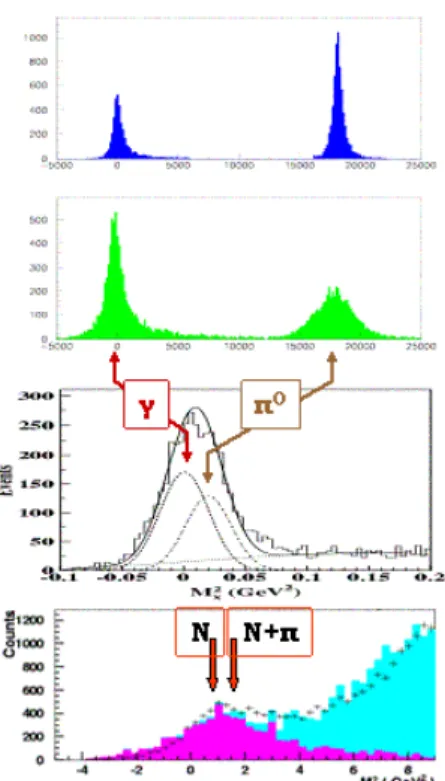
acceptance since the cross sections are small. Exclusivity is necessary for a quantita-tive comparison with theory and for a detailed study of scaling laws. This puts high demands on resolution and/or complete coverage of reaction products. For example, in the ep→ epγ process, it is in principle sufficient to identify two of the three particles in the final state and measure their momentum vector (this is the case in the first two graphs of figure 1). In practice, as beam and secondary particles energies increase, it becomes increasingly difficult to separate DVCS from exclusiveπ0production when measuring only the scattered electron and proton (third graph of fig. 1). It is then necessary to detect all three particles in the final state.
DEEPLY VIRTUAL COMPTON SCATTERING
The first measurements of beam spin asymmetry in the~ep → epγ exhibit an azimuthal dependence characteristic of the interference of a helicity conserving process such as DVCS with the Bethe-Heitler process [4, 5]. Moreover the magnitude of this asymmetry is agreement with models based on GPDs, including small higher-twist contributions and next-to-leading orderαScorrections. Note however that the same results may also
be described within a Regge model [6].
Since then, other CLAS data taken at beam energies of 4.8 and 5.75 GeV are being analyzed as well. This is still based on the study of ep→ epX configurations. At 4.8
GeV, the resolution still allows to perform a shape analysis of the missing mass spectra, similar to the procedure in Ref. [4], thus separating theγ and π0 contributions [7]. An
FIGURE 1. Squared missing mass for performed VCS or DVCS experiments. From top to bottom:
ep→ epX from MAMI (850 MeV beam energy) [3], from JLab/Hall A (4 GeV) [3], and from JLab/CLAS
(4.2 GeV) [4], ep→ eγX from HERMES (27 GeV) [5].
exemple of such a separation is given in the third graph of fig. 1, where each contribution is independently calibrated using subsets of unambiguously identified events [4]. At 5.75 GeV, the missing mass resolution worsens and precludes such an analysis. The pion contribution is then minimized (but not yet quantified) through an approriate choice of kinematical cuts, guided by a Monte-Carlo simulation of both processes [8]. In both cases, earlier results are confirmed, and the higher statistics allow for a finer binning, in Q2, xBand/or t. The measured beam spin asymmetry, at fixed xBand t, is consistent with
a 1/Q behaviour, as expected from the leading-twist (handbag) contribution to DVCS.
Target spin asymmetries, using a polarized NH3target, were investigated as well [9]. Here again the contribution of the ep→ epπ0 process remains to be quantified.
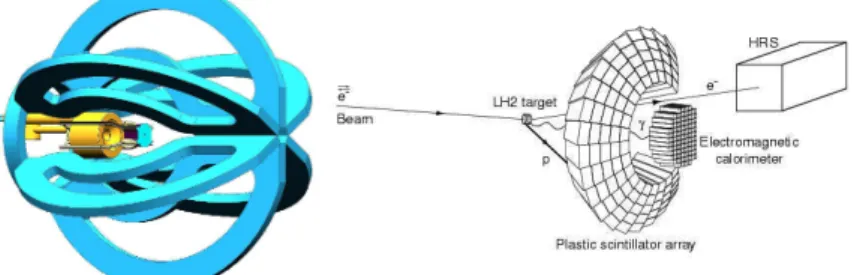
Dedicated experiments now aim at detecting the three particles in the final state, in order to ensure a complete exclusivity in the measurements. See figure 2.
In CLAS [10], the photons emitted in a forward cone (3-14◦) will be detected in a new inner calorimeter, consisting of 424 small lead-tungstate crystals read by avalanche photodiodes. In addition, a specifically designed two-coil solenoid will focus the back-ground low energy electrons along the beam axis. A 100-crystal prototype was tested with success in December 2003. The whole experiment is to be mounted in February
FIGURE 2. Shematic views of dedicated CLAS (left) and Hall A (right) DVCS experiments. The standard CLAS detection is not shown; the new solenoid and calorimeter are positioned at the center of the CLAS toroidal magnet.
2005.
In Hall A [11], a lead-fluoride calorimeter is mounted in direct view of the target, along the direction of the virtual photon, for each of three spectrometer settings for the scattered electron. The recoil protons are detected in a concentric annular plastic scintillator array. The experiment is currently running at the designed luminosity of 1037 cm−2s−1. A follow-up experiment will study DVCS on the neutron [12]. The quasi-free e(n) → enγ reaction will be measured using a liquid deuterium target and complementing the proton array with thin scintillator for proton/neutron discrimination. The DVCS beam spin asymmetry on the neutron has been shown to be more sensitive to the quark total angular momentum in the nucleon.
Double DVCS (ep→ epe+e− proceeding through γ∗q→γ∗q) has the potential to access GPDs at a tunable kinematical point x = f (ξ, q′2), where q′2 is the virtuality of the outgoing photon (or equivalently the invariant mass of the corresponding lepton pair) [17]. Positrons were cleanly selected in CLAS and ep → epe+X configurations analyzed [18]. Although ep→ epe+e− events could be clearly identified, the analysis faces a theoretical and experimental challenge: there are two electrons in the final state. Antisymmetrisation was not taken into account in the calculations. Experimentally, the kinematical variables depend on the identification of an electron either as scattered or coming from the lepton pair. One of the two possible choices result in the observation of clear peaks associated with very low Q2 vector meson production. Our preliminary conclusion is then that the observed ep→ epe+e− events cannot be interpreted in the framework of DDVCS and GPDs.
DEEPLY VIRTUAL MESON PRODUCTION
The hard electroproduction of mesons, or DVMP, should also proceed through the same handbag diagram. In this case, factorization has been demonstrated for longitudinal virtual photons [2]. According to the nature of the emitted meson, one probes different GPDs (H and E for vector mesons, ˜H and ˜E for pseudoscalar mesons) and different flavor combinations (e.g. ρ vs ω, or π0 vs η). The difficulty here is in isolating the contribution of longitudinal photons and reaching high enough Q2, since the additional gluon exchange necessary to produce the meson moves the asymptotic regime to higher values of Q2.
Longitudinal cross sections have been extracted for ρ electroproduction at 4.2 GeV [13]. A similar analysis for higher energy (5.75 GeV), with higher statistics data, is underway. In this channel, both the CLAS and HERMES data are in semi-quantitative agreement with a model based on GPDs, and including an effective description of higher-twist effects.
The φ [14] and ω [15] channels have been analyzed as well. In the latter case, a determination of the emitted ω spin density parameters led to the conclusion that helicity is not conserved between the virtual photon and the emitted meson. Thus the handbag diagram does not dominate the reaction ep→ epω and the longitudinal cross sections could not be extracted. The ω channel thus appears the most challenging one to access the GPDs. Within a Regge approach, it was shown that this behaviour is due to the dominantly transverse t-channelπ0exchange, or rather the exchange of the corresponding saturating Regge trajectory [16]. Only for theω channel is this specific exchange contribution dominant. This calculation gives a new insight in the high-Q2and high-t behaviour of such exclusive reactions [16].
CONCLUSIONS
Generalized Parton Distributions have merged as a powerful, attractive and unifying con-cept for the nucleon structure. The relation between GPDs and deep exclusive reactions still needs experimental validation. There are experimental indications that the handbag diagram is at work in DVCS and this is being studied with increased statistics data sets at CLAS. In DVMP, extensive data sets on vector meson production, also from CLAS, will be coming shortly. Dedicated DVCS experiments, in Hall A (2004) and CLAS (2005), will measure beam spin asymmetries, detecting all three particles in the final state to ensure full exclusivity. They should establish on firm grounds the validity of the ap-proach. Detailed tests of scaling will be performed. If scaling is indeed observed, or deviations thereof understood, these experiments, in conjunction with theoretical input, will provide the first significant measurements of GPDs.
REFERENCES
1. X. Ji, Phys. Rev. D 55 (1997) 7114; A.V. Radyushkin, Phys. Rev. D 56 (1997) 5524. 2. J.C. Collins, L. Frankfurt, and M. Strikman, Phys. Rev. D 56 (1997) 2982-3006.
3. H. Fonvieille, private communication.
4. S. Stepanyanet al.(CLAS collaboration), Phys. Rev. Lett. 87 (2001) 182002. 5. A. Airapetianet al.(HERMES collaboration), Phys. Rev. Lett. 87 (2001) 182001. 6. F. Cano and J.-M. Laget, Phys. Lett. B551 (2003) 317.
7. G. Gavalianet al.(CLAS collaboration), preliminary results. 8. H. Avakianet al.(CLAS collaboration), preliminary results. 9. S. Chenget al.(CLAS collaboration), preliminary results.
10. V. Burkert, L. Elouadrhiri, M. Garçon, S. Stepanyanet al., CEBAF experiment 01-113. 11. P. Bertin, C. Hyde-Wright, R. Ransome, F. Sabatiéet al., CEBAF experiment 00-110. 12. P. Bertin, C. Hyde-Wright, F. Sabatié, E. Voutieret al., CEBAF experiment 03-106. 13. C. Hadjidakiset al.(CLAS collaboration), hep-ex/0408005.
14. J. Santoroet al.(CLAS collaboration), preliminary results.
15. L. Morandet al.(CLAS collaboration), in preparation. M. Garçon, contr. to the10th Int. Symp. on Meson-Nucleon Physics and the Nucleon Structure, Beijing, Aug. 2004.
16. J.-M. Laget, Phys. Rev. D 70 (2004) 054023.
17. M. Guidal and M. Vanderhaeghen, Phys. Rev. Lett. 90 (2003) 012001; A.V. Belitsky and D. Müller, Phys. Rev. Lett. 90 (2003) 022001.