Fourteen years of evolution of ESMO
Guidelines: from the minimum
recommendations to the Consensus
Conference-derived guidelines
introduction
During the last two decades various Clinical Practice Guidelines (CPGs) have been developed by professional associations, institutions or medical societies at an international, national or regional level.
CPGs are defined as ‘systematically developed statements to assist practitioner and patient decisions about appropriate health care for specific clinical circumstances’ [1]. CPGs are based on the evidence-based medicine system and are a tool for transferring evidence from clinical research into practice and for influencing practitioner’s attitude [2].
As a matter of fact, CPGs are intended: (i) to assist practitioners in appropriate clinical decision making; (ii) to improve quality of healthcare and outcomes for patients; and (iii) to influence national policies for efficient allocation of resources and for better delivery systems [3]. As Eisenberg and Power pointed out, CPGs are intended to provide the right care, at the right time, for the right person and in the right way [4].
The development process of CPGs in not homogeneous among the internationally available guidelines. The differences are mainly related to several methodological issues, such as multidisciplinarity, production process, etc. Not all CPGs are produced through a systematic review of evidence, a process that consists of (i) formulation of a clinical question/ problem; (ii) identification of relevant papers by support staff and an expert taskforce; (iii) tabulation and synthesis of evidence by methodological experts; and (iv) process of CPGs, drafting by the experts. On the other hand,
some CPGs are also developed through a narrative literature search.
Heterogeneity in the development of CPGs is a vital issue. In a recent report, nine well-known CPGs (ASCO, ESMO, NICE, SIGH, START, NHMRC, NCI, NCCN and CCO) and three representative tumors (advanced breast, lung and colon cancer) were selected and scrutinized. Results have shown that a diverse heterogeneity in development, structure, target user and endpoints was prominent among them [5].
CPGs should be properly and effectively implemented and disseminated in order to be adequately incorporated into daily clinical practice. This can be achieved by: (i) direct mailing; (ii) publication in journals or newsletters; (iii) organization or sponsoring of scientific events; (iv) training by opinion leaders;
(v) publicizing to patients or the public; and (vi) integration in recertification or licensing examinations.
Assessment of the quality of the process of development and reporting of CPGs is of paramount importance taking into account their benefits, harm, costs and practicalities. An example is the AGREE Instrument (Appraisal of Guidelines Research and Evaluation) that was established in 1998. In addition, due to both cultural and organizational differences that could exist among countries, a ‘trans-contextual adaptation’ strategy has been suggested by the ADAPTE framework [6].
historical development of ESMO CPGs
1998The original idea for the creation of the ESMO Clinical Guidelines came from Professor Heine H. Hansen via the Central European Task Force in 1998. In particular, he visualized the need for clinical recommendations that might be more practical in daily use. This was supported at a meeting of the ESMO national representatives, who felt that the
development of guidelines would contribute to the standing of medical oncology in Europe.
1999
Thus, in 1999, the ESMO Guidelines Task Force was constituted. Initially, the group began with a chairman (R. Stahel, Switzerland), a central coordinator (L. Jost, Switzerland), an ESMO officer (M. C. Reinhart) and five members (J. Herrstedt, Denmark; O. Kloke, Germany; N. Pavlidis, Greece; G. Purkalne, Latvia; and S. Jelic,
Yugoslavia). During the next 5 years more members joined the task force (J. Berg, Sweden; R. Greil, Austria; V. Kataja, Finland; and J. Oliveira, Portugal).
2006
Since 1 January 2006, the Guidelines Task Force has been an independent group—the ESMO Guidelines Working Group (GLWG)—under the new ESMO Education Committee structure. It consists of: (i) an Editorial Board with a chairman (N. Pavlidis, Greece), three members (R. Stahel, Switzerland; H. Hansen, Denmark; and S. Jelic, Serbia), an Annals of Oncology executive (L. Rowett, UK) and an ESMO Coordinator (P. Minotti); and (ii) the seven Subject Editors responsible for the topics, the authors, the revision of the manuscripts and the presentation and discussion of final drafts with the editorial board (M. Castiglione, Switzerland; J. Oliveira, Portugal;
E. Felip, Spain; V. Kataja, Finland; M. Dreyling, Germany; L. Jost, Switzerland; and F. Roila, Italy).
2008
In 2008 the GLWG made some changes as follows: (i) an Editorial Board with a Chairman (N. Pavlidis, Greece), two members (R. Stahel, Switzerland; and H. Hansen, Denmark), an Annals of Oncology executive (L. Rowett, UK) and an ESMO Coordinator (R. Vecchi) and (ii) nine Subject Editors: M. Castiglione, Switzerland for breast and gynecological cancer; M. Dreyling, Germany for hematological malignancies; E. Felip, Spain for lung and head/neck cancer; P. Casali, Italy for sarcomas; V. Kataja, Finland for genitourinary cancer; A. Cervantes, Spain for gastrointestinal cancer; F. Roila, Italy for supportive care; S. Jelic, Serbia for liver, pancreatic cancer and neuroendocrine tumors; and G. Pentheroudakis, Greece for rare tumors.
2009
In 2009 F. Cardoso (Lisbon, Portugal) was appointed as the Subject Editor for breast cancer.
2011
In 2011 the Chairmanship has changed. Andres Cervantes became the Chairman of the ESMO GLWG, and N. Pavlidis became the Co-Chairman. In addition, C. Sessa (Bellinzona, Switzerland) for gynecological cancer and C. Bramley as the ESMO Guidelines and Publishing Manager.
the structure and function of the ESMO
GLWG through the years
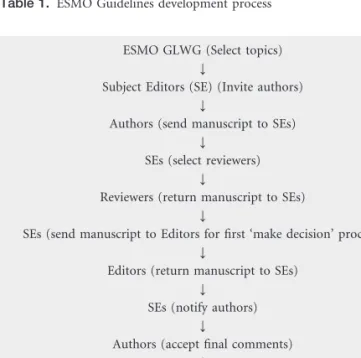
The structure of the GLWG consists of: (i) the Editorial Board; (ii) the Subject Editors; (iii) the authors; and (iv) the reviewers (five reviewers for each CPG). Both authors and reviewers are on a multidisciplinary platform and should all be ESMO Faculty members (Figure 1). The process of ESMO CPG development is demonstrated in Table 1. Nearly 14 years after the inception of the ESMO Guidelines Task Force, 54 clinical guidelines (GLs) were freely available on the ESMO website and in Annals of Oncology.
The initial vision of ESMO GLs was not to compete with other national or international GLs, but to be complementary recommendations to other existing guidelines and to continue to be used in day-to-day practice; in other words, ESMO GLs were based on a philosophy of providing basic and practical information to oncologists and protecting them from ‘what and how not to do things’. Therefore, ESMO GLs were at that time called ‘ESMO Minimum Clinical Recommendations’ and included GLs: (i) of a short size (1–3 pages); (ii) annually published in Annals of Oncology and on the ESMO website; (iii) produced by and dedicated to medical oncologists; and (iv) covering most tumor types.
Since 2006 ESMO decided to expand the size of GLs and to call them simply ‘ESMO Clinical Recommendations’. In 2007 ESMO introduced Consensus Conferences to address
Editorial Board
Chairman 2 Members
1 Ann. Oncology Executive 1 ESMO Officer
Subject Editors (10)
1. Breast
2. Gynecological Cancer 3. Hematological Malignancies 4. Head/Neck and Lung Cancer 5. Urogenital Cancer
6. Upper and lower gastrointestinal tract cancers 7. Pancreato-hepatobiliary cancers 8. Sarcomas 9. Supportive Care 10. Rare tumors Authors Reviewers
5 ESMO Faculty Members per topic on A multidisciplinary platform
Figure 1. The structure of the EMSO Guidelines Working Group.
Table 1. ESMO Guidelines development process
ESMO GLWG (Select topics) Y
Subject Editors (SE) (Invite authors) Y
Authors (send manuscript to SEs) Y
SEs (select reviewers) Y
Reviewers (return manuscript to SEs) Y
SEs (send manuscript to Editors for first ‘make decision’ process) Y
Editors (return manuscript to SEs) Y
SEs (notify authors) Y
Authors (accept final comments) Y
SEs (send manuscript to Editors for final approval) Y
preselected questions on specific tumor types. The objective of these conferences is to address difficult issues using a much wider input from the oncology community by utilizing 30–40 experts. Up to now eight Consensus Conferences have taken place in various European cities (Table 2). Recently, it has also been proposed that ESMO GLs will be called ‘ESMO Clinical Practice Guidelines (CPGs)’ and all GLs will be available on the ESMO website and only the updated ESMO CPGs will be published annually in Annals of Oncology (Table 3). ESMO
Consensus Conference-derived CPGs will also appear in Annals of Oncology [7–10].
Based on the lessons learned from the first Consensus Conferences, a detailed Standard Operating Procedures platform has been developed and will be implemented from 2011 onwards.
implementation of ESMO CPGs
Successful establishment of guidelines requires both adequate implementation and sufficient dissemination. Effective
Table 2. Consensus meeting-derived ESMO CPGs
Date Event Venue Funded by
October 2007 Soft tissue sarcomas and GIST Lugano, Switzerland Conticanet May 2008 Testicular cancer Munich, Germany ESMO (EIS) May 2009 Communication skills Kappel am Albis, Switzerland Swiss Cancer League
June 2009 Antiemetics Perugia, Italy MASCC/ESMO
November 2009 Sarcomas (STS) Lugano, Switzerland Conticanet November 2009 Sarcomas (bone) Lugano, Switzerland Eurobonet
May 2010 Lung cancer Lugano, Switzerland ESMO, San Salvatore Foundation September 2010 Colorectal cancer Lugano, Switzerland ESMO June 2011 Malignant lymphoma Lugano, Switzerland ESMO
Table 3. ESMO Guidelines evolution (1998–2011)
Year Name
1998 ESMO Minimum Clinical Recommendations
2006 ESMO Clinical Recommendations 2010 ESMO Clinical Practice Guidelines
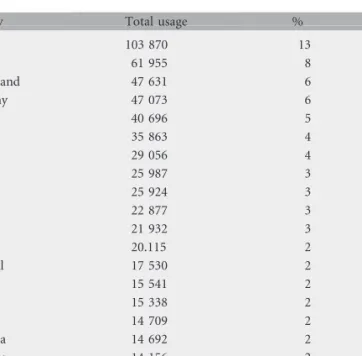
Table 4. Universal geographical breakdown of usage (2008–2010)
Country Total usage %
USA 103 870 13 Italy 61 955 8 Switzerland 47 631 6 Germany 47 073 6 UK 40 696 5 Spain 35 863 4 India 29 056 4 Mexico 25 987 3 China 25 924 3 France 22 877 3 Brazil 21 932 3 Canada 20.115 2 Portugal 17 530 2 Egypt 15 541 2 Turkey 15 338 2 Japan 14 709 2 Australia 14 692 2 Romania 14 156 2 Others 232 181 28 Total 807 137 100
Figure 2. Guidelines downloads overview (2009–2010). Total usage during the first 6 months post-publication.
Table 5. Geographical breakdown of usage by continent (2008–2010)
Continent Total usage %
Europe 388 047 48 America North 123 985 15.5 South 55 600 7.0 Central 32 696 4.0 Asia 146 187 18.0 Africa 26 336 3.5 Australasia 16 902 2.0 Japan 14 713 1.8 Unknown 2671 0.3 Total 807 137 100
implementation of CPGs facilitates knowledge uptake and more efficient patient-focused care.
The targeted health professionals for ESMO CPGs are mainly medical oncologists. The two methodological tools used to implement ESMO CPGs are the availability of CPGs in Annals of Oncology and the ESMO website, and the questionnaire administered (by a electronic answering system) to all attendees of the ESMO Guidelines Interactive Sessions held at every ESMO Congress. From 2005 and up to 2010 all ESMO CPGs were published annually in the Annals of Oncology, but they also appeared on the ESMO website. From 2011 onwards, Annals of Oncology will only publish the updated CPGs and the Consensus Conference-derived CPGs, while the ESMO website will host all available ESMO CPGs.
The number of downloads from data extracted form the Oxford Journals usage statistics through the years showed an exponential increase (Figure 2). The five most downloaded CPGs in 2008–2010 were breast cancer, non-small cell lung cancer, gastric cancer, epithelial ovarian cancer and colon cancer. An analysis of the geographical distribution of usage of CPGs published in Supplements of the Annals of Oncology from 2008 to 2010 (volume 19/suppl 2, volume 20/suppl 4, volume 21/suppl 5) is also available.
Universally the three most highly ranked countries are the USA, Italy and Switzerland. Geographical breakdown by continent showed that Europe is by far the most highly ranked continent accounting for almost the half of the downloads (Table 5). It is also interesting to point out that the total usage in North America is mostly attributed to the USA (84%) and only 16% to Canada. Concerning the European geographical distribution, Italy, Switzerland and Germany are the three nations with the highest percentage usage (Table 6).
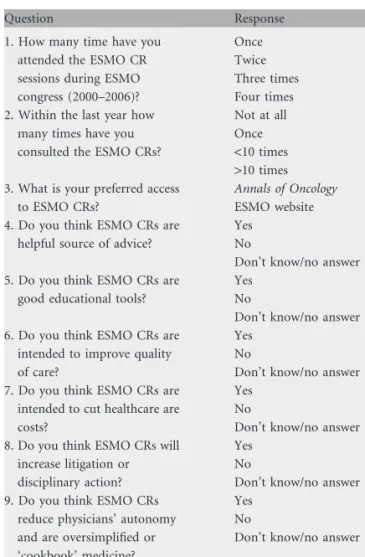
Another tool used to evaluate the spectrum of implementation was a survey/questionnaire given during the ESMO Congresses (Table 7). The first three questions, asked at the onset, were related to audience exposure to ESMO clinical recommendations, while the seven questions asked at the end of the session were taken from the survey of Tunis et al. [11]. This questionnaire was prepared to assess the familiarity, confidence and attitudes relating to ESMO CPGs. More than 80% of the responders feel that ESMO CPGs are helpful for their daily practice, 85% believe that they are also a good educational tool, and 95% think that they are intended to improve patients’ quality of care.
dissemination of ESMO CPGs
During the last several years ESMO CPGs have been disseminated using different methodological tools. The first tool is the translation of ESMO CPGs into various languages. Up to now they have been translated into 13 languages (Bulgarian, Chinese, French, German, Greek, Italian, Japanese, Latvian, Polish, Portuguese, Romanian, Russian and Spanish). The second tool is the organization of the ESMO interactive sessions during the ESMO Congresses. In these 2 h interactive events 2–3 cases on various tumors or other oncology topics are presented by a young medical oncologist and discussed by an expert European oncologist based on the ESMO CPGs. Each case is followed by three multiple-choice questions which should first be answered by the audience through an electronic
Table 6. Geographical breakdown of usage in Europe (2008–2010)
Country Total usage %
Italy 61 955 16 Switzerland 47 631 12 Germany 47 073 12 UK 40 696 10 Spain 35 863 9 France 22 877 6 Portugal 17 530 5 Romania 14 156 4 Greece 10 499 3 Poland 10 284 3 Belgium 9785 3 The Netherlands 7503 2 Others (35 countries) 62 195 16 Total 388 047 100
Table 7. Audience questionnaire administered during the ESMO Congresses
Question Response
1. How many time have you attended the ESMO CR sessions during ESMO congress (2000–2006)?
Once Twice Three times Four times 2. Within the last year how
many times have you consulted the ESMO CRs?
Not at all Once <10 times >10 times 3. What is your preferred access
to ESMO CRs?
Annals of Oncology ESMO website 4. Do you think ESMO CRs are
helpful source of advice?
Yes No
Don’t know/no answer 5. Do you think ESMO CRs are
good educational tools?
Yes No
Don’t know/no answer 6. Do you think ESMO CRs are
intended to improve quality of care?
Yes No
Don’t know/no answer 7. Do you think ESMO CRs are
intended to cut healthcare are costs?
Yes No
Don’t know/no answer 8. Do you think ESMO CRs will
increase litigation or disciplinary action?
Yes No
Don’t know/no answer 9. Do you think ESMO CRs
reduce physicians’ autonomy and are oversimplified or ‘cookbook’ medicine?
Yes No
Don’t know/no answer 10. Do you think ESMO CRs are
impractical and too rigid to apply to individual patients?
Yes No
Don’t know/no answer CRs, clinical recommendations.
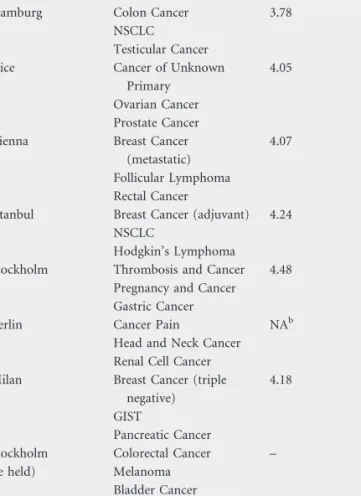
voting system. All these sessions are well attended and it is worth mentioning that at the 35th ESMO Congress in Milan in 2010, the audience had increased up to 3200 attendees (Table 8).
The third tool is the presentation of ESMO CPGs by members of the GLWG in Congresses Symposia or other scientific events both in and outside Europe.
The last tool of dissemination of ESMO CPGs is the publication of editorials or articles in oncology journals. The aims are to increase the awareness of the European and international oncological societies about the availability, the quality and the utility of ESMO CPGs.
future developments
ESMO is introducing new ideas on CPG implementation and dissemination by producing pocket-sized booklets and mobile apps. Pocket-sized booklets will present the key information from CPG/Consensus manuscripts in a quick references format including treatment algorithms and all recommendations.
Mobile apps will present the information in pocket versions in SmartPhone and other app formats for use on mobile devices.
In addition, ESMO is aiming to produce CPG slide-sets for use by ESMO members as a teaching resource. Good clinical guidelines can have a deep impact on the quality of cancer care in a community. Moreover, if the recommendations provided are well implemented, this may eventually have a potential benefit in cancer outcomes. For this reason, ESMO is committed to produce high quality, evidence-based guidelines to offer a useful tool to the whole oncology community. Our aim is to help in keeping clinical practice within the current understanding and best science in a multidisciplinary setting. To provide such an instrument, a tremendous effort has to be made and a long, controlled process has to be organized every year with the cooperation of authors, reviewers, Subject Editors and ESMO officers. The final product of this cooperative undertaking has to benefit not only oncologists, helping them in optimal clinical practice, but also patients, giving them the opportunity for the best possible outcomes.
N. Pavlidis1, R. Stahel2, H. Hansen3& A. Cervantes4
1
Department of Medical Oncology, Ioannina University Hospital, Ioannina, Greece,2Clinic and Polyclinic of Oncology, University Hospital Zu¨rich, Switzerland,3The Finsen Centre, Copenhagen University Hospital, Copenhagen, Denmark,
4
Hematology and Medical Oncology Department, Hospital Clinico Universitario, Valencia, Spain
literature
1. Field MJ, Lohr KN. Attributes of good practice guidelines. In Field M, Lohr KN (eds): Clinical Practice Guidelines: Directions for a New Program. Washington DC: National Academy Press, 1990; 53–77.
2. Pavlidis N. Evidence-based medicine: development and implementation of guidelines in oncology. Eur J Cancer 2009; 45: 468–470.
3. Woolf H, Grol R, Hutchinson A et al. Clinical guidelines: potential benefits, limitations and harms of clinical guidelines. BMJ 1999; 318: 527–530. 4. Eisenberg J, Power E. Transforming insurance coverage into quality healthcare:
voltage drops from potential to delivered quality. JAMA 2000; 284: 2100–2107. 5. Pentheroudakis G, Stahel R, Hansen H, Pavlidis N. Heterogeneity in cancer
guidelines: should we eradicate or tolerate? Ann Oncol 2008; 19: 2067–2078. 6. Fervers B, Burgers JS, Haugh MC et al. Adaptation of clinical guidelines:
literature review and proposition for a framework and procedure. Int J Quality Health Care 2006; 189: 167–176.
7. Pavlidis N, Hansen H, Stahel R. ESMO clinical recommendations: a practical guide for medical oncologists. Ann Oncol 2007; 18: 1759–1763.
8. Pavlidis N. Towards a convenient way to practice medical oncology. Ann Oncol 2007; 18(suppl 2): ii3–ii4.
9. Pavlidis N, Hansen H, Stahel R. ESMO Clinical Recommendations using the easier and faster approach to oncology guidelines. The original idea. Ann Oncol 2009; 20(suppl 4): iv7–iv9.
10. Pavlidis N, Hansen H, Stahel R. ESMO Clinical Practice Guidelines:
developmemnt, implementation and dissemination. Ann Oncol 2010; (suppl 5): v7–v8.
11. Tunis SR, Hayward RSA, Wilson MC et al. Internists’ attitudes about clinical practice guidelines. Ann Intern Med 1994; 120: 956–963.
Table 8. ESMO Interactive Guidelines Sessionsa
Date and place of Congress
Topics discussed Average score
2000, Hamburg Colon Cancer 3.78 NSCLC
Testicular Cancer 2002, Nice Cancer of Unknown
Primary
4.05 Ovarian Cancer
Prostate Cancer 2004, Vienna Breast Cancer
(metastatic)
4.07 Follicular Lymphoma
Rectal Cancer
2006, Istanbul Breast Cancer (adjuvant) 4.24 NSCLC
Hodgkin’s Lymphoma
2008, Stockholm Thrombosis and Cancer 4.48 Pregnancy and Cancer Gastric Cancer
2009, Berlin Cancer Pain NAb Head and Neck Cancer Renal Cell Cancer 2010, Milan Breast Cancer (triple
negative) 4.18 GIST Pancreatic Cancer 2011, Stockholm (to be held) Colorectal Cancer – Melanoma Bladder Cancer aOn a scale of 1–5. bNA, not available.