by
Robert W. Dies
Bachelor of Applied Science
University of British Columbia, Canada, 2001
Submitted to the Department of Civil and Environmental Engineering In Partial Fulfillment of the Requirements for the Degree of
MASTER OF ENGINEERING IN CIVIL AND ENVIRONMENTAL ENGINEERING at the
MASSACHUSETTS INSTITUTE OF TECHNOLOGYMASCUSTSINTTTEO ECNLG
June 2003 © 2003 Robert Dies.
All right reserved. The author hereby grants to MIT permission to reproduce
and electronic copies of this thesis document in
MASSAHUSETTS INSTUE OF TECHNOLOGY
JUN 0 2 2003
LIBRARIES
and distribute'phtblidy paplr whole and in part.
Signature of the Author... -- ...
Department of Civil and Environmental Engineering May 16, 2003 Certified by... ...
Dusan Murcott
Lecturer, Depa ent of Civil and Environmental Engineering
Thesis Advisor
Certified by... ...
Patrick Jaillet Head, Department of Civil and Environmental Engineering Thesis Advisor
Accepted by...
Oral Buyukozturk Chairman, Departmental Committee on Graduate Studies
by
Robert W. Dies
Submitted to the Department of Civil and Environmental Engineering on May 16, 2003 in partial fulfillment of the requirements for the Degree of Master of Engineering in Civil and Environmental Engineering
Abstract
Countries like Nepal face tough challenges in terms of providing safe, clean drinking water for their citizens. The World Health Organization estimates that nearly 5 million people in
Nepal lack access to safe drinking water while globally, 1.1 billion lack access to improved water supplies. Point-of-use water treatment technologies, such as household ceramic water filters, offer an affordable and effective means of treating water to standards suitable for drinking. The fact that ceramic water filters can be manufactured and produced by local ceramists with local materials makes ceramic filters particularly attractive as a point-of-use treatment technology that is affordable, appropriate, and sustainable.
This thesis examines existing ceramic water filter technologies, production processes, and methods for bringing a low-cost ceramic water filter to market in Nepal. Three types of disk filters and five types of candle filters are evaluated in terms of microbiological removal efficiency and flow rate. A red-clay grog disk filter coated with colloidal silver and three of the five candle filters (Katadyn* Ceradyn, Katadyn® Gravidyn, and the Hari Govinda white-clay candle filter capped on both ends) also coated with colloidal silver, performed the best in terms of microbiological removal efficiency (>98%) and flow rate (ranging from 641 mL/hr/candle (Ceradyn) to 844 mL/hr/candle (Gravidyn)). In addition to filter testing, a guideline for developing a ceramic water filter in preparation for bringing a product to market is presented, along with a discussion on the importance of laboratory and field testing to ensure overall product performance. A step-by-step summary of the production process is also presented along with a comparison of the theoretical flow rate through a candle filter versus a disk filter. Recommendations for future work include testing and modifying the current disk-filter prototype design and research on the most appropriate filter element for the proposed prototype.
Thesis Advisor: Susan Murcott
Title: Lecturer, Department of Civil and Environmental Engineering Thesis Advisor: Patrick Jaillet
Acknowledgements
What has impressed me the most in the last eight months of research and work on ceramic water filters is the number of individuals and organizations passionately engaged in the quest to improve the health and welfare of those in need in countries like Nepal. Their hard work has inspired me to not only write this thesis, but to consider how I can incorporate
development work into my career as an engineer. If engineering is about solving problems, then there is no greater a problem to solve right now than getting clean water to the 1.1 billion who lack access to safe drinking water. I hope this thesis, which is based on the hard work of the following individuals and many others, will contribute to solving this problem. First and foremost, I would like to thank Susan Murcott, my advisor, for her tremendous support and guidance throughout the last eight months. Susan's work on water and sanitation in developing countries has brought new meaning to the concept of engineering and sustainability. The MIT Nepal Water Project would not exist without her hard work and dedication.
To my fantastic CeraMIT teammates Bobby Wilson, Steve Perreault, and Laura-Ann Jones: thank you for all of your hard work, insight, and business acumen. I would also like to thank Professor Simon Johnson and Professor Richard Locke for including the MIT Nepal Water Project in the Global Entrepreneurship Lab course.
In Nepal, I would like to thank Mr. Hari Govinda Prajapati for his hard work and ongoing collaboration with the MIT Nepal Water Project. A lot of this thesis is based on Hari's work as a ceramist and I wish him all the best in the future.
I would also like to thank Dr. Roshan Shrestha and the ENPHO staff (especially the
microbiological lab staff) for providing such a wonderful working atmosphere during my stay at ENPHO. Lunch on the roof was an enjoyable break from testing.
Reid Harvey, Deepak Lochan Adhikari, Chittra Gurung, and Bob Nanes of IDE-Nepal were an immense help to the CeraMIT team during our stay in January. Most of the research work outside of the laboratory was arranged through the effort of Mr. Adhikari. Mr. Gurung also helped me with lab experiments on the roof of ENPHO. Thank you IDE-Nepal for all of your help.
Georges Tabbal, Mandy Richards, as well as Ralph Coffman and Tetsuji Arata for their help doing research as well as climbing mountains.
I would also like to thank Professor E.E. Adams, the Director of the MEng Program, and the rest of the staff in the Department of Civil and Environmental Engineering for organizing and coordinating such a fantastic nine-month program.
There are many others who have contributed either directly or indirectly to this thesis. In particular, the work of Lily Cheung (2003), Rebeca Hwang (2003), C.S. Low (2002), Daniele Lantagne (2001), and Junko Sagara (2000). Furthermore, thanks goes to Ron Rivera and Potters for Peace for providing a wealth of information on ceramic water filters. Lee Hersh was also very helpful at providing information on ceramic material properties.
Finally, I would like to thank Professor Patrick Jaillet, the Head of the Department, for having the time to meet with the CeraMIT team and to provide feedback in his "spare time" between starting his new position as Head of the Department of Civil and Environmental Engineering.
Woman collecting water from a stone tap
Thimi, Nepal.
January 2003.
Development of a
Ceramic Water Filter
Table of Contents
Abstract ... 3
Acknow ledgem ents ... 4
Table of Contents... 7 List of Figures ... 11 List of Tables... 12 List of Equations... 13 List of Abbreviations ... 14 Chapter 1 Introduction... 15
1.1 MIT Nepal W ater Project ... 15
1.2 Thesis Objectives ... 16
1.3 Thesis Outline ... 17
Chapter 2 Overview of Ceram ic W ater Filters ... 18
2.1 Disk Filters ... 20
2.2 Pot Filters ... 24
2.3 Candle Filters ... 27
2.3.1 Indian Candle Filters ... 27
2.3.2 Nepal Candle Filters ... 28
2.3.3 Swiss Katadyn* Drip Filters... 31
2.3.4 Hong Phuc* Candle Filters... 32
2.3.5 Kisii W ater Filter Bucket ... 33
Chapter 3 January 2003 Laboratory Tests of Ceramic Filter Media ... 35
3.1 Research Objective... 35
3.2 Study Design ... 35
3.3 Material Setup ... 37
3.4 Testing Methodology ... 39
3.4.1 Testing Procedure... 39
3.4.2 Raw W ater Preparation... 40
3.4.3 Flow rate Calculation ... 41
3.4.4 Microbial Testing Methodology... 42
3.5 Test Results... 42
Development of a Ceramic Water Filter for Nepal
3.5.2 Microbial Concentrations... 43
3.6 Limitation of Results... 49
3.7 Discussion of Results... 50
Chapter 4 Ceramic Water Filter Production Process... 52
4.1 Materials ... 52 4.1.1 Clay ... 54 4.1.2 Combustible Material ... 56 4.1.3 Grog or Temper ... 57 4.2 Equipment ... 58 4.3 Production Process ... 61
4.3.1 Material Processing & Preparation... 61
4.3.2 Mixing ... 63
4.3.3 Filter Pressing or Shaping...64
4.3.4 Drying and Firing... 68
4.3.5 Colloidal Silver ... 70
4.3.6 Quality Control...73
4.4 Parameters That Affect Filter Performance...73
4.5 Theoretical Flow Rate ... 75
Chapter 5 Development of a Ceramic Water Filter for Nepal ... 80
5.1 A Framework for Developing a Ceramic W ater Filter ... 80
5.2 Organizations Engaged in the Development of a Ceramic Water Filter...82
Chapter 6 Assessment of Need and Market for Clean Drinking Water... 86
6.1 Global Need for Clean Drinking W ater... 86
6.2 Point-of-Use Household Water Treatment Technology...87
6.3 Regional Needs for Clean Drinking W ater in Nepal... 89
6.4 Preliminary Consumer Analysis ... 95
6.4.1 End-Users...96
6.4.1.1 Urban Users... 96
6.4.1.2 Rural Users - Accessible ... 98
6.4.1.3 Rural Users - Remote... 101
6.4.2 Third-Party Users...102
Chapter 7 Prototype Developm ent ... 104
7.1.1 Filter System Material and Capacity...105
7.1.2 Spigot ... 107
7.1.3 Filter Media/Element ... 108
7.1.4 Interface between the Filter Element and Filter System ... 109
7.1.4.1 Design 1: Clamp System ... 110
7.1.4.2 Design 2: Screw System ... 110
7.1.4.3 Design 3: The Lily Filter ... 110
7.1.4.4 Design 4: A Mechanic Connection ... 112
7.2 Product Performance Goals: Certification and Field Testing ... 114
7.2.1 Technical Certification...114
7.2.1.1 M icrobial Performance ... 116
7.2.1.2 Flow rate ... 121
7.2.1.3 Other Parameters ... 122
7.2.2 Field Testing ... 122
7.3 Prelim inary Financial Analysis...124
Chapter 8 Bringing a Product to M arket ... 127
8.1 Business Plans ... 127
8.2 Marketing Strategy...128
8.2.1 Product Strategy ... 129
8.2.2 Price ... 129
8.2.3 Production and Distribution...131
8.2.4 Prom otion ... 133
Chapter 9 Conclusions...137
9.1 Laboratory Test Results ... 137
9.2 Theoretical Flow Rate Calculation...138
9.3 Prototype Developm ent...138
Chapter 10 Recom m endations...139
10.1 Colloidal Silver Research ... 139
10.2 Colloidal Silver Production Process...139
10.3 Ceram ic Media/Material Research ... 139
10.4 Hydraulic Studies...140
10.5 Product Certification...140
10.6 Field Testing...140
10.7 Prototype Developm ent...141
Development of a Ceramic Water Filter for Nepal
10.9 Future W ork: Project Schedule...142
10.9.1 Complete Certification Protocol and/or Grading System...142
10.9.2 Complete Final Prototype Design...142
10.9.3 Complete Prototype Financial Analysis ... 143
10.9.4 Prepare for Field Testing...143
10.9.5 Preliminary Filter Element/Media Testing...143
10.9.6 Filter Element/Media Laboratory Testing...144
10.9.7 Recommend Complete Filter Design...145
10.9.8 Complete Field Testing Design and Implementation ... 145
10.9.9 First Production Run ... 145
10.9.10 Develop Business Plan ... 146
Appendix 1. Sum m ary of Literature Review ... 147
Appendix 2. Interviews w ith Experts ... 150
Appendix 3. Interviews w ith Villagers ... 153
Appendix 4. Business Plan Outline ... 157
Appendix 5. Project Schedule... 160
Appendix 6. Contact Inform ation...163
List of
Figures
Figure 2.1: Types of Ceramic Water Filter Elements ... 18
Figure 2.2: Ceramic Water Filter System and Media... 19
Figure 2.3: 100-Year Old Disk Filter from Spain... 21
Figure 2.4: Indian TERAFIL Ceramic Disk Filter... 22
Figure 2.5: Terracotta Ceramic Disk Filters... 23
Figure 2.6: Arsenic Filter by Hari Govinda Prajapati... 23
Figure 2.7: Potters for Peace Filtron ... 24
Figure 2.8: Potters for Peace Instructions for Use...26
Figure 2.9: Indian Ceramic Candle Filters (BAJAJ filter on the right)49... . ... ... . . 27
Figure 2.10: Hari Govinda Prajapati Ceramic Candle Filter ... 28
Figure 2.11: Hari Govinda Prajapati Candle Filters with Capped Ends... 29
Figure 2.12: Production of a Ceramic Candle Filter... 30
Figure 2.13: Katadyn* Drip Filter... 31
Figure 2.14: Hong Phuc* Candle Filter ... 33
Figure 2.15: Kisii Candle Filter (Western Kenya)... 34
Figure 3.1: Laboratory Setup - Schematic of Container System Dimensions... 37
Figure 3.2: Laboratory Setup - Disks and Candle Filters ... 38
Figure 3.3: Laboratory Setup - Filter Systems Ready for Testing ... 38
Figure 3.4: Average Flow Rate Results for the Candle Filters... 46
Figure 3.5: Microbial Reduction Results for the Candle Filters... 46
Figure 3.6: Average Flow Rate Results for the Hari White Clay Disk Filter... 47
Figure 3.7: Microbial Reduction Results for the Hari White Clay Disk Filters... 47
Figure 3.8: Average Flow Rate Results for the Reid Harvey Grog Disk Filters ... 48
Figure 3.9: Microbial Reduction Results for the Reid Harvey Grog Disk Filters ... 48
Figure 4.1: Raw Clay (left) and Processed Clay in Powder Form (right) used in the Production of Ceramic Water Filters at Madhyapur Clay Crafts ... 55
Figure 4.2: A Potter Preparing Sawdust... 56
Figure 4.3: Worker Grinding Grog Using a Plate Mill... 58
Figure 4.4: Ceramic Water Filter Production Process based on Madhyapur Clay Crafts in T h im i, N e p a l ... 62
Figure 4.5: Worker Preparing a Mixture of Clay, Grog, and Water ... 63
Figure 4.6: Example Filter Presses: Metal Frame and Car Jack (left), Hydraulic Jack System used by Potters for Peace (right). ... 65
Development of a Ceramic Water Filter for Nepal
Figure 4.8: Candle Filter Press used at Madhyapur Clay Crafts... 67
Figure 4.9: Pottery Kiln used at Madhyapur Clay Crafts, Thimi, Nepal... 68
Figure 4.10: Colloidal Silver Production ... 72
Figure 4.11: Relating the Flow Rate to the Properties of a Ceramic Disk Filter ... 74
Figure 4.12: Definitional Diagram Showing Dimensions of Candle and Disk Filters ... 76
Figure 5.1: Framework for Developing a Ceramic Water Filter... 81
Figure 6.1: Nepali Woman Collecting Drinking Water from a Stone Tap ... 88
Figure 6.2: Map of Nepal and Regional Districts ... 89
Figure 6.3: Map of Road Density... 90
Figure 6.4: 1991 Population Densities by District... 91
Figure 6.5: Percentage Population Change by District, 1981-1991 ... 91
Figure 6.6: Ranking of Districts in Terms of Development... 93
Figure 6.7: Drinking Water Coverage... 94
Figure 7.1: Filter System and Filter Element/Media... 104
Figure 7.2: Kisii Filter System, Kenya (left); Example of a Durable Clean Plastic Container (rig h t) ... 1 0 6 Figure 7.3: Potters for Peace Filtron with Spring-Operated Spigot ... 108
Figure 7.4: Design 3: The Lily Filter (Prototype)... 111
Figure 7.5: Design 4: Filter System with Mechanical Latch ... 112
Figure 7.6: Closing the Behavior and Technical Gaps Associated with Using Point of User Technology to Treat Drinking Water... 124
Figure 8.1: Grameen Bank Decision Number 10: "We shall drink water from tubewells. If it is not available, we shall boil water or use alum. "...135
Figure 8.2: Demonstrating Benefits: Turbid Raw Water and Clear Filtered Water... 136
List of Tables
Table 2.1: General Strengths and Weaknesses of Ceramic Water Filters... 20Table 3.1: Ceramic Water Filters Tested at ENPHO during January 2003 ... 36
Table 3.2: Summary of Filter Tests Performed in January 2003... 39
Table 3.3: Summary of Candle Filter Test Results ... 45
Table 3.4: Summary of Disk Filter Test Results ... 45
Table 4.1: List of Materials Used in the Production of Ceramic Water Filters ... 53
Table 4.2: List of Equipment Typically Required for the Production of Ceramic Water F ilte rs ... 5 9 Table 4.3: Summary of How Disk Filter Properties influence Flow Rate... 75
Table 4.4: An Example Comparing Flow Rate through a Disk Filter to Flow Rate through a
C a n d le F ilte r ... 7 9 Table 7.1: Product Attributes to Consider for the Development of a Ceramic Water Filter
S ystem for N epa l...105
Table 7.2: Suggested US EPA Microbial Reduction Requirements for Water Purifiers61 .... 117
Table 7.3: The First Water® Ltd Grading System for Water Purifiers ... 118
Table 7.4: Preliminary Cost Analysis... 124
Table 8.1: List of Activities Leading to the Sale of a Filter ... 132
List of Equations
Equation 3.1: Flow Rate Calculation ... 41Equation 3.2: Log Reduction Value (LRV)... 43
Equation 3.3: % Removal Efficiency ... 43
Equation 4.1: The Theoretical Flow Rate through a Disk Filter based on Darcy's Law...74
Equation 4.2: Theoretical Flow rate through a Candle Filter with Constant Head... 77
Equation 4.3: Theoretical Flow rate through a Disk Filter with Constant Head ... 77 Equation 4.4: Theoretical Ratio of Flow Rate through a Disk Filter to Flow Rate through a
Development of a Ceramic Water Filter for Nepal
List of Abbreviations
Acronym Full Name
CeraMIT Joint MIT business-engineering student team (2002/2003)
CS Colloidal Silver
DWSS Department of Water Supply and Sewerage ENPHO Environment and Public Health Organization
HDI Human Development Index
ICIMDS International Center for Integrated Mountain Development
IDE International Development Enterprises
INR Indian Rupee
LRV Log Reduction Value
MIT Massachusetts Institute of Technology
NRs Nepalese Rupee
NWSC Nepal Water Supply Corporation
PFP Potters for Peace
POU Point of Use
PPM Pottery Purification Media
RWSSP Rural Water Supply and Sanitation Support Program
USD United States Dollar
Chapter 1 Introduction
The global community faces a tough challenge: to halve the number of people without access to improved water supply and sanitation by the year 2015. This bold objective, also known as one of the Millennium Development Goals, was again committed to by
governments from around the world during the 2002 World Summit on Sustainable
Development in Johannesburg South Africa.60 Considering the World Health Organization's
estimate of 1.1 billion people who lack access to improved drinking water supply, the Millennium Development Goal for water works out to delivering access to improved water supply at a rate of -100,000 people per day between the years 2000 and 2015. Can governments alone realistically meet this ambitious goal by the year 2015 through conventional centralized water supply systems?
In the pursuit of solutions to providing safe drinking water to those in need, point-of-use household water treatment has emerged as a complementary solution to centralized water supply systems. Household ceramic water filters, in particular, offer an affordable and effective means of treating water to a standard suitable for drinking. Although the use of ceramic water collection and storage vessels goes back centuries, there is little
documentation and testing of the effectiveness of low-cost ceramic water filters both in the laboratory and in the field.
What research has been done suggests that the commercially available ceramic water filter systems in places such as India, Nepal, Nicaragua, and Brazil are adequate, but could be improved to better meet the drinking water needs of citizens - especially the poor. In
particular, many commercially available filter systems are too expensive for the poor who are suffering the most from waterborne diseases. Several organizations, including the
Massachusetts Institute of Technology (MIT), are currently trying to address this issue by developing a new low-cost ceramic water filter.
1.1
MIT
Nepal Water
Project
The MIT Department of Civil and Environmental Engineering (CEE) has been working in Nepal since 1999 to help provide clean drinking water and improved sanitation to those in
Development of a Ceramic Water Filter for Nepal
need. MIT engineering student Junko Sagara was the first student to study ceramic water filters in Nepal in 1999/2000 as part of her Master of Engineering thesis.49 C.S. Low
continued research on ceramic water filters in 2001/2002 as part of his thesis on "Appropriate Microbial Indicator Tests for Drinking Water in Developing Countries and Assessment of Ceramic Water Filters".35. Low worked closely with ceramist Mr. Hari Govinda Prajapati of Madhyapur Clay Crafts in Thimi Nepal, who had originally been located and contacted by Junko Sagara, to develop the first version of a ceramic disk filter.
A number of engineering students have also carried out research on ceramic water filters in Nicaragua. In particular, Daniele Lantagne conducted an in-depth study of the Potters for Peace (PFP) Filtron filter in 200133,34 and Rebeca Hwang recently carried out research on evaluating the effectiveness of a monitoring program in conjunction with the PFP Filtron.28 As part of the ongoing effort to understand and improve ceramic water filters in Nepal, Nicaragua and elsewhere, a team of engineering and business students (named CeraMIT) was formed this year to continue working on developing a ceramic water filter for Nepal. Four students formed the CeraMIT Nepal Team:
. Rob Dies, Department of Civil and Environmental Engineering, MEng Candidate
. Steve Perreault, Sloan School of Management, MBA Candidate
. Bobby Wilson, Sloan School of Management, MBA Candidate
* Laura Ann Jones, Sloan School of Management, MBA/TPP Candidate
CeraMIT conducted a three-week-long field study in Nepal during January 2003. This research culminated in several recommendations for the development of a grassroots ceramic water filter business in Nepal.10
On return from Nepal, mechanical engineering senior student Lily Cheung joined the
CeraMIT team to develop one of the prototype designs that was recommended by CeraMIT, as part of her senior thesis.
1.2
Thesis Objectives
The intent of this thesis is to lay the foundation for developing a ceramic water filter for Nepal. The overall goal of developing a low-cost ceramic water filter is to provide an affordable means for Nepali citizens to improve their drinking water quality to standards
suitable for human consumption. In addition to improving drinking water quality, the development of a sustainable ceramic water filter industry within Nepal will hopefully contribute to economic development whereby local entrepreneurs, such as ceramist Hari
Govinda Prajapati of Madhyapur Clay Crafts, can develop a sustainable business through manufacturing and marketing ceramic water filters to higher quality control/quality assurance standards than those currently being produced.
The thesis is based on six months of research and three weeks of field work in Nepal. It builds on the work of past and present MIT students and faculty who have been working on ceramic water filter projects since 1999. In particular, it builds on the work carried out by the CeraMIT team in January 2003. Furthermore, this thesis also builds on the work of many organizations and individuals who have dedicated much of their time and effort to developing and promoting ceramic water filters as an effective household water treatment technology.
1.3
Thesis Outline
The thesis begins with some background on ceramic water filters in Chapter 2, followed by a summary of the laboratory test results of three different disk filters and five candle filters in Chapter 3. Chapter 4 presents an overview of the production process along with a discussion on the parameters that affect filter performance. Chapter 4 also presents the theoretical flow rate for a disk filter versus a single candle filter. A framework for guiding and assessing the progress of developing a ceramic water filter for Nepal is then presented in Chapter 5. Chapter 6 summarizes the current need for clean drinking water in Nepal and includes a preliminary analysis of the potential customers/users of a ceramic water filter. Chapter 6 is followed by an overview of the development of a prototype, focusing on the important product attributes and performance goals that were used to develop the first prototype design.
Chapter 7 also includes a discussion on product certification and field testing. Chapter 8 briefly discusses methods for bringing a ceramic filter to market. The last two chapters present a list of conclusions and recommendations respectively. The recommendations are intended to help guide future students, faculty and others involved in taking the CeraMIT water filter to the next step.
Development of a Ceramic Water Filter for Nepal
Chapter 2 Overview of Ceramic Water Filters
Ceramic water filters have been used in various places around the world as a means of treating drinking water at the household level. Some examples include the Potters for Peace Filtron (Nicaragua), the TERAFIL terracotta filter (India), and the candle filter (India, Nepal, Bangladesh, Brazil, etc).
Ceramic water filters can be categorized according to various key parameters: 1.
2. 3.
Shape (e.g.: candle element, disk, pot) (Figure 2.1);
Type of clay (e.g.: white kaolin, red terracotta, black clay...); Combustible material (e.g.: sawdust, flour, risk husk...).
Figure 2.1: Types of Ceramic Water Filter Elements
Ceramic water filters can also be described by their function(s): 1.
2.
Microbial removal (e.g.: Potters for Peace Filtron);
Chemical contaminant removal such as arsenic and iron (e.g.: 3 Kolshi filter for
3. Secondary contaminant removal like taste and odor (e.g.: Katadyn* Gravidyn ceramic candle filter with activated carbon).
Other key variables that influence the properties of ceramic water filters include: 1.
2. 3.
Use of additional materials in production (e.g.: grog, sand, combustible materials...); Firing temperature;
Mode of production (e.g.: hand mold, wheel, mechanical press).
The entire filter unit is often defined in terms of two components: the filter element or media through which water passes and the filter system which houses the media, usually consisting of an upper and lower storage vessel for holding water (Figure 2.2)
U;
Disk CandleFilter System Filter Element/Media
Figure 2.2: Ceramic Water Filter System and Media
Some general strengths and weaknesses of ceramic water filters are listed in Table 2.1 below. A summary of the three most common ceramic filter media shapes: disk filters, pot filters, and candle filters, is presented in the following sections. An overall summary table is presented in Appendix 1.
Development of a Ceramic Water Filter for Nepal
Table 2.1: General Strengths and Weaknesses of Ceramic Water Filters
Strengths Weaknesses
. Relatively cheap to manufacture and . Very slow filtration rates. (typically ranging
produce; between 0.5 and 4 L/day);
. The ceramics trade is well . Filter maintenance and reliability depends on
established in many countries; the user - herein lies many non-technical
. Materials (clay, sawdust, rice social issues;
husk...) are often readily available; . Breakage during distribution or use can be a
. If designed and used properly, can problem since ceramic filters are often fragile;
remove up to >99% of indicator . Requires regular cleaning;
organisms and reduce turbidity to . The rate of production as implemented in
below World Health Organization countries such as Nicaragua and Nepal has
guideline values. tended to be relatively slow;
. It is difficult to maintain consistency (quality control is an issue).
2.1
Disk Filters
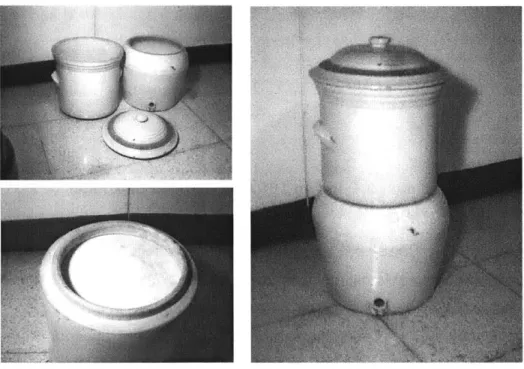
Ceramic disk filter systems consist of an upper and lower container with a ceramic disk inserted between the two containers. Water is poured into the upper container and then allowed to filter through the disk into the lower collection vessel. A spigot is placed in the bottom container for dispensing the treated water. An example of a 100-year old ceramic disk filter from Spain is shown in Figure 2.3.
A more recent example of a disk filter system from India, called the Indian TERAFIL filter, is shown in Figure 2.4. The TERAFIL consists of two metal or terracotta containers and a ceramic disk fitted into the bottom of the upper container. The disk retails for approximately 25 Indian Rupees (INR 25) (USD $0.49)a and a complete set consisting of a disk and two ceramic containers (not metal as in Figure 2.4) retails for approximately INR 180 (USD $3.51 ).35
In January 2002, civil engineering student, Jason Low, and Mr. Hari Govinda Prajapati experimented with different material compositions and production processes to produce a terracotta clay disk filter (Figure 2.5) similar to the TERAFIL filter, but based on variations of the production process shared by Ron Rivera of Potters for Peace, Nicaragua (Section 2.2). They used local red terracotta clay from Thimi, a village outside Kathmandu, as the primary
material for both the ceramic disk and the containers. The results from their work are published in Low's thesis.5 The production cost for these terracotta filters is approximately NRs 76 (USD $1.00) for the disk and NRs 267 (USD $3.50) for the disk filter and two terracotta containers." Mr. Hari Govinda Prajapati's business, Madhyapur Clay Crafts, is
now selling a modified version of this disk filter as an arsenic filter (Figure 2.6) as part of a joint program by the Environment and Public Health (ENPHO) and the Nepal Red Cross to
remediate the arsenic problem in the Terai.
Figure 2.3: 100-Year Old Disk Filter from Spain
Previous studies of the Indian TERAFIL disk filter show mixed results for filter performance in terms of microbial removal and flow rate. In his 2002 thesis, Low summarized a number of these studies, as well as conducted his own studies on the Indian TERAFIL and the Nepali disk filter that he and Hari Govinda Prajapati had created.5 Of concern in previous studies, including Low's, was the improved, but unsatisfactory microbial removal rates ranging from 93% to 99.99% (% total coliform removal), which did not meet the strict World Health
Development of a Ceramic Water Filter for Nepal
Organization (WHO) guideline of 0 coliform forming units (cfu) per 100 milliliters of water.356 5' .
Percent turbidity removal was reported to be quite good, typically approaching 99% removal, below the WHO guideline of 5 NTU. Flow rates were another major issue, ranging from 1.0 to 11.0 Uhr with the average among all of the studies being around 3 L/hr. Most studies
concluded that the ceramic filters should be used in conjunction with some form of disinfection such as chlorination, colloidal silver, or solar disinfection.
Figure 2.4: Indian TERAFIL Ceramic Disk Filter
Picture Source: Low. 2002 3.
Tests by Low at MIT on the Nepali terracotta disk filters he had produced with Hari Govinda in Nepal showed comparable microbial removal rates and turbidity reduction as the Indian
TERAFIL filters; however, the flow rates were unacceptably low at 0.2-0.3 L/hr.35 Considering
this was the first attempt at making the terracotta disk filters at Madhyapur Clay Crafts, Low concluded that there was considerable room for improving the production process to achieve
acceptable flow rates.5
Tests by Low on the TERAFIL filter unit at the Environment and Public Health Organization (ENPHO) laboratory in Kathmandu measured flow rates ranging from 5.9 Uhr to 6.9 Uhr35
while similar tests performed a month earlier at MIT measured flow rates ranging from 1.1
Uhr to 1.9 Uhr. Despite the wide discrepancy in flow rates between the two seemingly
identical TERAFIL units, the microbial removal rates of both units were comparable, ranging
without sacrificing microbial removal performance was of considerable interest and formed the basis for the next stage of studies.
Most studies28'33'34'35 also report that regular cleaning (scrubbing of the filter) is required to
maintain filter performance primarily with respect to maintaining satisfactory flow rates.
Figure 2.5: Terracotta Ceramic Disk Filters Madhyapur Clay Crafts, Thimi, Nepal. January 2002
Picture Source: Low. 2002 '
Figure 2.6: Arsenic Filter by Hari Govinda Prajapati Madhyapur Clay Crafts, Thimi, Nepal
Development of a Ceramic Water Filter for Nepal
2.2
Pot Filters
The Potters for Peacea (PFP) Filtron system consists of a colloidal silver-impregnated ceramic pot perched inside a collection bucket (Figure 2.7). The flower-pot shaped filter unit is approximately 17 L (4.5 gallons) in capacity and the lower storage/collection unit ranges from 7.5 - 20 L (2 to 5 gallons).4 The PFP filter element is fired as one complete, unit, unlike the disk filters based on the TERAFIL and Low/Prajapati Thimi examples which consist of two materials (ceramic disk element and plastic, terracotta, or metal containers) combined together using a white or gray cement that attaches the disk to the upper container. Thus, the
PFP filter eliminates the potential for leakage along the interface between the disk and the
container (i.e., if the cement seal cracks in the disk filter, then the filter is more or less useless in terms of removing microbial contamination). Typical flow rates for the PFP Filtron range from 1.0 - 1.75 Uhr.4
Figure 2.7: Potters for Peace Filtron
Picture source: Potters for Peace website (http://ww.potpazo.or
Consultant Daniele S. Lantagne conducted a thorough investigation of the PFP Filtron during 2001 a33,34. Some of the conclusions from her report are presented below.
. Analysis using a scanning electron microscope found pore sizes typically ranged
between 0.6-3 microns. The PFP ideal is a 1.0-micron pore size to physically remove E.coli without the need for disinfection.33
. The majority of the water appears to filter through the sides of the filter and not directly through the bottom. Lantagne's recommendation was to ensure proper application of colloidal silver along the sides of the filter to ensure that water passing along the sidewalls comes in contact with colloidal silver.33
. A prior study of the PFP Filtron done in 1984 found the flow rate to decrease by -50% over a one-year period. Lantagne confirmed that regular scrubbing of the filter should
help to rejuvenate the diminished flow rate.33
. A summary of historical data showed that the PFP filter was effective at removing 98-100% of the indicator bacteria present in the source water in laboratory testing (Report 1, pg 58), but gave poor indicator bacteria removal rate in actual household practice.34 . Studies of two-to-seven year-old PFP filters showed that the filters were still effective at
removing microbiological contaminants, suggesting that the colloidal silver may remain
effective over extended periods of time 33 (how effective still remains unknown).
The flow rate for every PFP filter produced is measured for quality control before it is sold. The flow rate must fall within a specified range: a minimum for practical purposes (likely 1
L/hr) and a maximum to ensure that the water is in contact with the colloidal silver long enough to achieve disinfection (-2 L/hr).33 Filters with flow rates outside this range are discarded.
A preliminary cost analysis of the PFP filter shows the total cost of producing one complete unit is approximately USD $6.00 with a wholesale price of USD $9.00.46 The wholesale price likely depends on the quantity purchased, USD $9.00 probably being for a single Filtron. The price of the filter is roughly equivalent to the price of a machete, which is one of the most
important tools required for work in rural areas of Nicaragua.4 2
Development of a Ceramic Water Filter for Nepal
As a point of interest, the PFP website also has a one-page graphical summary
demonstrating how to use and maintain their filters (Figure 2.8). This instructional material is also attached to each bucket as a waterproof sticker.
HOW TO USE YOUR FILTER
2) Place the day filter intheplasticrecepta-de immediately, only touching the top lip.
1) Before using the newflilter,
A) Fill the filter receptacle halfwaywith water and
B) Add 10 drops of chlorine bleach or 16 drops of iodine to this
water.
C) Let it sitfor30minutes.
D) Use this water to rinse the receptacle, clay filter, lid and faucet
and your hands. If chlorine or iodine Is not available fill the recepta-cle halfwaywith boilingwater and when it cools pour this water over thelid, faucet and filter.Discard all the water
Only chlorinated, boiling, or bacteria in the receptacle.
water treated with iodine wil kill
4) If your river or well
water is cloudy, use a piece of fine cloth over the filter element to prefilter the water each time. Tie a string around the cloth so that it does not fall into
the filter
5) Your filter will flow fasterwhen itisfull. so
fillitoften.
Prefiltering will help your filter to flow
faster
I~r [TI
3) Fill the filter several
times and discard the: filtered water.This will remove the taste of thecay,
1 FILTER CLEANING You do not need to clean your filter more than once a month unless it starts to filter too
sloNly.
Wen this happens, carefully remove the filter, Leave the receptacle at least half full of filtered water. Place the filter on a cloth that has been washed in chlorinated or boiled water
21 Using water from the receptacle, fill the filter half way and scrub it vigorously with a brush to unclog the pores. Discard the dirty water, You will have some small particles of clay come off if you are scrubbing hard enough,
K CLEANING THE
RECEPTACLE
Clean the receptacle monthly. Follow the directions above
beginning with "1-A" for
cleaning your receptacle,
The clay filterwill usually lasta
year before it becomes too
clogged to provide enough water. Atthistimeit should be replaced. If cleaning still restores the flow, it does not need to be replaced.To replace your filter contact
Figure 2.8: Potters for Peace Instructions for Use
Picture Source: Potters for Peace website (htt://ww.ootnaz.org)4 3
HOW TO CLEAN YOUR FILTER AND RECEPTACLE
Plastic top Clay filtering a element Plastic faucet Plastic receptacle 3
2.3
Candle Filters
Indian candle filters are the most common type of ceramic water filter used in India and Nepal49 and are also commonly available in other countries such as Brazil. Candle filter systems consist of two containers and one or several ceramic candle filter elements, shaped
like a thick candle, screwed into the base of the upper container (Figure 2.9). Water is poured into the upper container and then allowed to filter through the ceramic filter element into the lower collection vessel.
Candle filters can have very low flow rates, and thus it is common to find filter systems with two or three candle filter elements. Recent laboratory tests of five candle elements of
different compositions showed flow rates ranging from 300 - 840 mL/hr/candle (Chapter 3).
Figure 2.9: Indian Ceramic Candle Filters (BAJAJ filter on the right)49
2.3.1 Indian Candle Filters
A number of Indian companies (e.g.: Puro, Himal, Kimal, Swagat, and Milton) manufacture ceramic candle filter systems49. Typical retail prices for these systems (i.e., one or several candles plus the two containers, lid and spigot) in Nepal range from 600 NRs to 1600 NRs (USD $8.00 -$21 ).49 The containers are often made of aluminum, stainless steel, or copper
Development of a Ceramic Water Filter for Nepal
in order of price (Figure 2.9). Some Nepalese families purchase plastic buckets at 170 NRs (USD $2.22) and the Indian candle filter unit separately to construct and assemble their own system to reduce the overall costs.49 A hole is drilled in the bottom of the plastic bucket and the filter element is screwed into place. The candle filter elements are often made with white kaolin clay.
2.3.2 Nepal Candle Filters
Very few candle filters appear to be manufactured within Nepal. One example; however, is a white kaolin clay candle manufactured at Madhyapur Clay Crafts in Thimi by Mr. Hari
Govinda Prajapati (Figure 2.10). The white kaolin clay that is used by Hari is imported from India because it is not available locally within the Kathmandu Valley. The upper and lower containers are made of red terracotta clay from Thimi, Nepal. Each container has a holding capacity of approximately 10 L. The candle filter element is roughly 17 cm high and 5 cm in
diameter.49 The complete unit sells for approximately 312 NRs (USD $4.07). Madhyapur Clay
Crafts sells the complete unit in bulk quantity to retailers for 175 NRs (USD $2.29) (140 NRs (USD $1.83) for the containers and 35 NRs (USD $0.46) for the candle filter element).
Typical replacement time for ceramic candle filters is six to twelve months.49 The filters must
be periodically cleaned with a brush to remove surface buildup of particles.
Figure 2.10: Hari Govinda Prajapati Ceramic Candle Filter Madhyapur Clay Crafts, Thimi, Nepal.
Laboratory tests of the Hari candle filter were performed by Junko Sagara in 2000.49 Presence-Absence tests for both the unfiltered and filtered water showed positive readings suggesting that the filter was not effective at removing H2S-forming bacteria, which is used
as an indicator species for the presence of pathogens. MPN results for the same filter showed a raw water microbial concentration >8 MPN (bacteria/1 O0mL) and a filtered water
microbial concentration of 3.9 MPN (bacteria/100mL) confirming the results obtained from the Presence-Absence tests. The flow rate per candle was also quite low at 240 mL/hr
initially, reducing to 80 mL/hr over a 16-hour perioda.
A similar, but slightly different version of the candle tested by Sagara was tested in January 2003 at ENPHO in Kathmandu Nepal (Chapter 3). The candle tested in January 2003 had
both ends capped with a piece of plastic (Figure 2.11) as opposed to just one end as shown in Figure 2.10. The results were more favorable, in terms of microbial removal rates -especially for the filter unit that was coated with colloidal silver which removed >99% of the total coliform and E.coli bacteria given a raw water concentration of 89 cfu/1 00 mL and 56
cf u/1 00 mL for total coliform and E.coli, respectively.
Not coated with colloidal silver
Coated with colloida\ silver
Figure 2.11: Hari Govinda Prajapati Candle Filters with Capped Ends Madhyapur Clay Crafts, Thimi, Nepal January 2003
Development of a Ceramic Water Filter for Nepal
One reason for the improvement in the microbial removal rates for the candles capped on both ends, vis-&-vis the Hari candles with only the bottom-end capped (Figure 2.10) as tested by Sagara, was suggested by ceramic consultant Reid Harvey. Upon inspection of the one-capped end candle elements, Harvey noticed that those candles were manufactured with two pieces of clay: the main shaft piece and a round cap placed on the top-end. Harvey's
hypothesis is that the cap-to-shaft interface produces a micro-fracture during the firing process thus allowing a pathway for the water, and possibly microbes, to bypass the filter element, giving rise to the presence of microbial contamination in the filtered water. This fracture can be observed when the filter unit is filled with water from the inside. Watching the point at which the water first exits the filter element, one notices that it typically exits first through the least path of resistance, which happens to be along a line where the interface between the two pieces of clay is roughly located. Harvey's theory is that capping the top-end of the candle eliminates this problem, and thus suggests one reason why the recent laboratory results for the two-capped end candles are better than those results obtained by Sagara.
The potter is making some finishing touches to a candle filter before it is fired. These candles are
manufactured by
Madhyapur Clay Crafts in Thimi Nepal using white kaolin clay imported from India. Once these candle filters are fired, they will be fitted into a 1-cap plastic base that is then inserted into the upper container of a filter system.
Figure 2.12: Production of a Ceramic Candle Filter Madhyapur Clay Crafts, Thimi, Nepal. January 2003
2.3.3 Swiss Katadyn* Drip Filters
The Katadyn® Drip Filter is a candle filter manufactured by a Swiss company called
Katadynea (Figure 2.13). Two versions of this filter, the Gravidyn and Ceradyn, currently retail for US $160 and US $190, respectively.2 The current market for these filters is for use in cabins and base camp expeditions.
0/
Figure 2.13: Katadyn* Drip Filter
Picture source: Black Mountain Stores Website: http://www.Katadyn.net/Katadyn drip.html
The filters are rated for removing bacteria, protozoa and cysts (but not 99.9% viruses) and are quoted on their website to operate at a flow rate of 4 L/hr per 3 candles or 1.3
L/hr/candle.b2 The pore-size of both filters is 0.2 microns. The estimated service life for the
Gravidyn is 6 months and the Ceradyn -150,000 L2. Both of the filter elements are
impregnated with a fine silver powder. The Gravidyn also incorporates granular activated
a Katadyn website: http://www.katadyn.com
b First Water Ltd has a rating system from Grade A through to Grade B depending on a filter's
log-reduction value (LRV). Katadyn filters are rated Grade A filters (the highest quality). This is discussed in Chapter 7.
Development of a Ceramic Water Filter for Nepal
carbon, which helps to improve taste and odor. Both filter elements are approximately 0.45-m in height and are capped with plastic on both endsa.
The filter system (containers, lid and spigot) is made of a heavy translucent white plastic and the containers are shaped such that the upper container fits into the lower container for ease of transport. An exact imitation of the filter system (containers, lid, and spigot) is being
manufactured by Hong Phuc* Co. Ltd but with a one-cap standard white candle element (Section 2.3.4).
Katadyn* has an extensive collection of laboratory test results demonstrating filter
effectiveness dating back to the 1940's. The filter performance, according to these tests, is very good in terms of log reduction value (LRV) efficiencies and the range of organisms tested. Overall, these filters appear to be excellent candle filters in terms of treating water for microbial contamination; however, the cost of the filters is beyond the range of most households in Nepal where the annual GDP is $1,224/year/capita (purchasing power parity) or $239/year/capita USD, or most other developing countries for that matter.
2.3.4 Hong Phuc* Candle Filters
The Hong Phuc® candle filter (Figure 2.14) is manufactured by Hong Phuc® Co. Ltd., located in Vietnam. The filter system (bucket, lid, and tap) is identical to the Katadyn® filter system; however, the filter element is similar in shape to the typical one-end cap Indian candle filter elements that are available in market areas of Nepal and India.
The Hong-Phuc* media is composed of diatomaceous earth26. Diatomaceous earth filters are
apparently efficient at removing waterborne pathogens, but are impractical for household
water treatment since they require special materials, construction and regular maintenance.54
They also pose a potential respiratory hazard for the production workers due to the fine particles.54
The average lifespan of a Hong Phuc® filter element is quoted on a company brochure as
being four years.25 Cleaning with a soft brush and clean water is recommended once every
two weeks. The total capacity of the system is 20 L (upper container = 10 L and lower
a Three 10-year old Katadyn filter candles obtained from IDE-Nepal in January 2003 used stainless
container = 10 L). The specified filter rate for a complete system (3 filter elements) is 1.5-2.5 L/hr. The company also offers a 6-month free-of-charge warranty.
Figure 2.14: Hong Phuc* Candle Filter
Hong Phuc® has apparently sold 250,000 units in 18 provinces in Vietnam since August 1995.25 Furthermore, UNICEF apparently distributed 17,500 Hong Phuc® drip filters
throughout Vietnam.9 According to Simon Collin of First Water® Ltd., the entire filter system
including three candle filters retails for US $7.50.9 First Water® Ltd and Oxfam GB are currently testing the Hong Phuc® filter in Cambodia. Preliminary results have shown 3 log
reductions in Klebsiella terrigena.9 2.3.5 Kisii Water Filter Bucket
The Rural Water Development Programme (RWD), located in Western Kenya, has developed a filter system called the Kisii Water Filter Bucket. The Kisii filter system is composed of two translucent food-grade polyethylene containers and a tap in the bottom container (Figure 2.15). The containers are available in local markets and are manufactured
by a company called Kentainers Ltd., based in Embakasi, Nairobi Kenyaa.
Development of a Ceramic Water Filter for Nepal
Figure 2.15: Kisil Candle Filter (Western Kenya)
Picture Source: RWD Promotional Brochure.
RWD uses two types of candle filters: a "slow" speed ceramic candle filter from India ($1 USD) that filters approximately 3 L of water per day and a "high" speed ceramic candle filter ($12 USD) from Brazil that filters 20 L of water per day. The Brazilian candle filter uses silver and activated carbon.
RWD uses translucent containers so that users can see when the system needs refilling and if the containers need cleaning. Moreover, the users can watch the water filter through the candle filters into the lower container. RWD has observed that users have more trust in the system if they can view what is going on inside.48
An Italian-made "ball" tap is chosen for the spigot after experiencing difficulty with low-quality plastic taps that leaked after awhile.
Various container capacities are offered, one in particular being a "jumbo" container system with 5-8 candle filters, which is typically offered to small hospitals, schools, and kitchens. RWD offers a weekly pay-back system for customers who cannot to pay for the filter system in one installment. Observation has shown that users tend not to value the system if it is simply given away at a subsidized price. RWD promotes the fact that the filter project operates at cost plus a small profit with no subsidization of the price.
Chapter 3 January 2003 Laboratory Tests of Ceramic Filter Media
Laboratory tests of twelve disk filters (three types) and five candle filters were carried out by engineering student Rob Dies at the Environment and Public Health Organization (ENPHO)
in January 2003. The results from these tests are presented in this chapter.
3.1
Research Objective
The purpose of the laboratory testing of various ceramic filter element shapes and media was to do a preliminary comparison of filter shapes (candle versus disk); filter media (white clay versus red clay versus black clay); filter flow rates; production methodology; and to evaluate the effectiveness of colloidal silver at removing microbial contamination across a fairly broad range of materials and products. This testing distinguishes the testing from previous years where only one type of ceramic filter (e.g.: Hari Govinda candle filter, Potters for Peace Filtron, TERAFIL disk filter) was tested.
3.2
Study Design
Twelve disk filters (three types) and five candle filters were tested by Rob Dies at ENPHO for microbial removal efficiency (total coliform and E.coli) and flow rate. The tests were
performed over a seven-day period starting January 12, 2003.
Building on the knowledge base and experience of ceramists Hari Govinda Prajapati of Madhyapur Clay Crafts, Reid Harvey, and Ron Rivera from Potters for Peace, as well as
previous research by MIT students, specifically engineering student C.S. Low35, three
different types of disk filters were developed by Prajapati and Harvey for testing. Two of the filters were based on Harvey's method of using grog (See Chapter 4). The third disk used the same white kaolin clay (imported from India) that Prajapati uses for the production of his candle filters. In comparison, Low and Prajapati developed and tested a disk filter similar in composition to the Potters for Peace Filtron in January 2002.35
All of the disk filters had the same dimensions (diameter: 152-mm (- 6 inches); thickness: 40-mm (-1.5 inches thick)), while the candle filters varied in shape. Half of the disk filters were soaked in colloidal silver. For the Hari candle filters, of which there were two, one was
Development of a Ceramic Water Filter for Nepal
coated with colloidal silver. The purpose of coating the filters with colloidal silver was to measure the effectiveness of colloidal silver at removing microbial contamination. A summary of the filters that were tested is presented in Table 3.1.
Table 3.1: Ceramic Water Filters Tested at ENPHO during January 2003 Filter Element # Coated Production Comments
with CS Method
White Clay Disk 2 No Hari White kaolin clay imported from India.
Govinda Prajapati uses the same clay for
Prajapati production of his candle filters.
White Clay Disk 2 Yes Hari White kaolin clay imported from India.
Govinda Prajapati uses the same clay for
Prajapati production of his candle filters. Disk
soaked in colloidal silver.
Red Clay Grog 2 No Reid Red Thimi clay from Thimi, Nepal mixed
Disk Harvey with grog made from Red Thimi clay.
Production methodology uses grog. Disk soaked in colloidal silver.
Red Clay Grog 2 Yes Reid Red Thimi clay from Thimi, Nepal mixed
Disk Harvey with grog made from Red Thimi clay.
Production methodology uses grog. Disk soaked in colloidal silver.
Black Clay Grog 2 No Reid Black Bhaktapur clay from Bhaktapur,
Disk Harvey Nepal mixed with grog made from Red
Thimi clay.
Black Clay Grog 2 Yes Reid Black Bhaktapur clay from Bhaktapur,
Disk Harvey Nepal mixed with grog made from Red
Thimi clay.
Katadyn" 1 Yes Katadyn* Impregnated silver powder candle filter
Ceradyn Candle with 2-capped ends (plastic).
Katadyn* 1 Yes Katadyn" Impregnated silver powder candle filter
Gravidyn plus granular activated carbon with
Filter Element # Coated Production Comments with CS Method
Hari White Clay 1 No Hari Similar to the current white clay (imported
Candle Filter Govinda from India) candle filter that Prajapati
Prajapati manufactures, except both ends are
capped with plastic.
Hari White Clay 1 Yes Hari Similar to the current white clay (imported
Candle Filter Govinda from India) candle filter that Prajapati
Prajapati manufactures, except both ends are
capped with plastic.
Hong Phuc* 1 No Hong PhucO The Hong Phuc" candle filter is
Candle Filter manufactured by Hong Phuc® in Vietnam.
3.3
Material Setup
Plastic buckets and taps were purchased from local shops for housing the disk and candle filters (for dimensions, see Figure 3.1). The bottoms of the upper containers were cut to fit the disk or candle filters. The 152-mm (six-inch) disk filters required a -108-mm (4 -inch) diameter hole and were glued to the bottom of the buckets using silicone. The candle filters required a -15-mm ( -inch) diameter hole and were screwed into place with a plastic nut.
25R8 Plastic 295 Upper Container 108 200 301 152 295 r '.15 200 Plastic Lower Container: [ * 18 dia 172
Development of a Ceramic Water Filter for Nepal
Figure 3.2: Laboratory Setup - Disks and Candle Filters
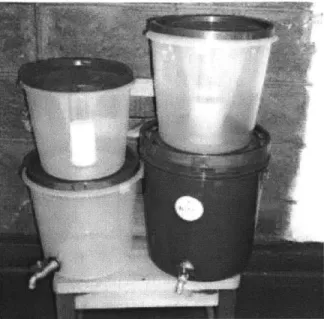
Plastic lids were used to cover the upper containers. A layer of tape was put around the interface between the upper and lower containers (Figure 3.3) to ensure that the inside of the lower container was sealed off from the external environment.
3.4
Testing Methodology
Three separate test runs were completed as summarized in Table 3.2. The first test consisted of all five candle filters. The second test consisted of just the Hari Govinda
Prajapati white clay disk filters. The third test consisted of all the Reid Harvey disk filters. Table 3.2: Summary of Filter Tests Performed in January 2003
Test Number Filters Tested # of Raw Water Concentration
Filters (cfu/100 mL)
Tested
Total Ecoli
Coliform
1. Candles Katadyn® candle filters (Ceradyn 5 89 56
and Gravidyn); Hari candle filters (1 coated with CS; 1 without); and Hong Phuc candle filter.
2. Hari Disks Hari white clay disk filters (4: 2 4 2,861 1,550 coated with CS; 2 without)
3. Reid Disks Reid Harvey Grog Disk Filters (4 8 2,500 1,561 red clay + red clay grog: 2
coated with CS; 2 without. 4 black clay + red clay grog: 2 coated with CS; 2 without)
3.4.1 Testing Procedure
Each of the three tests was carried out over a period of approximately six hours. The filters were primed overnight with tap water to ensure that they would be saturated at the beginning of the test. In the morning, the buckets, taps, and lids were cleaned with soap and water (water from the roof tap) and allowed to dry completely in the sun for one to two hours. Each
Development of a Ceramic Water Filter for Nepal
filter element was cleaned by lightly brushing the surface of the filter with an abrasive scrub brush.
A sample from the Dhobi Khola River was collected and mixed with tap water in an 80-L container (garbage pail purchased at a local market) to achieve the desired raw water
coliform concentrations (See the next Section 3.4.2). A raw water sample was then collected from the 80-L container for microbial analysis.
The upper containers of the filter systems (Figure 3.3 for picture) were then filled with the raw water to a height of -240-mm for the candle filters and 170-mm for the disk filtersa. The time was recorded as time T = 0 hours.
The filters were then left to operate for approximately two to three hours to allow water to collect in the lower containers. A water sample was then taken from each of the lower containers for microbial analysis. Most of the water samples were collected within three hours of the upper containers being filled with raw water (T = 3 hours). The time of collection depended on how fast the lower containers filled. All water samples were collected at the same time and analyzed within one hour of collection at the ENPHO Laboratory.
3.4.2 Raw Water Preparation
The raw water was prepared by mixing various combinations of river water from the Dhobi Khola River next to the bridge in New Baneswor and water from the tap on the roof of
ENPHO. ENPHO often uses water from the Dhobi Khola River to prepare raw water for water quality testing in their lab. For the SODIS project, for example, ENPHO uses approximately 200 mL of Dhobi Khola River water per 20 L of tap water, collected from the tap on the roof, to create a microbial concentration of approximately 4,000 - 5,000 colony forming units
(cfu)/1 00 mL.52 The roof-top tap water originates from the municipal drinking water supply.
The roof-top tap water was tested twice in January 2003 for the presence of coliform bacteria:
* January 12, 2003
o total coliform = 3 cfu/100 mL
a In retrospect, the water elevation in the upper containers should have been the same for all tests so that the flow rates for the candle filters and the disk filters could be compared for a given water column height.
o E.coli= 0 cfu/100 mL * January 15, 2003
o total coliform = 1,550 cfu/100 mL o E.coli= 0 cfu/100 mL
The large discrepancy in total coliform concentrations is likely due to the refilling of the rooftop reservoir, which occurred sometime between January 12th and 1 5th. It is possible that
refilling the tank either brought in contaminated water or mixed the contents of the tank (the tank may contain contaminated sediments/organic material that has settled over time) causing a spike in the concentration of total coliform.
The raw water for the candle filter test run # 1 was produced by mixing approximately 10 mL of river water with 40 L of tap water in an 80-L clean container (garbage pail). The resulting total coliform concentration was measured to be 89 cf u/1 00 mL and the E.coli concentration was 56 cf u/1 00 mL.
The raw water for the remaining two filter test runs # 2 and # 3 was produced by mixing approximately 80 mL of river water with 40 L of tap water. The proportion of river water was increased to achieve greater microbial concentrations since the raw water microbial
concentrations in the first run were too low. The resulting microbial concentrations measured for Test # 2 were 2,861 cfu/1 00 mL (total coliform) and 1,550 cfu/1 00 mL (E.coli). The raw water microbial concentrations for Test # 3 were 2,500 cfu/1 00 mL (total coliform) and 1,561 cfu/100 mL (E.coli).
3.4.3 Flow rate Calculation
The flow rate was calculated by dividing the volume of water measured in the lower container by the time at which the volumetric measurement was taken (Equation 3.1).
Flow Rate = Volume of water measured at time T (mL) Equation 3.1: Flow Rate