e-Commerce Fulfillment Models for Luxury Brands in Asia
Benjamin R. Thomson B.A. Economics
University of California, San Diego
Hao Hu
B.S. Material Science and Engineering Massachusetts Institute of Technology
MASSACHUSETTS INSTITUTEf OF TECHNOLOGY
OCT
2
0
20111
LiBRARIES
ARCHIVES
Submitted to the Engineering Systems Division in Partial Fulfillment of the Requirements for the Degree of
Master of Engineering in Logistics
at theMassachusetts Institute of Technology
June 20110 2011
Benjamin Thomson, Hao Hu
All rights reserved.
The author hereby grants to MIT permission to reproduce and to distribute publicly paper and electronic copies of this document in whole or in part.
Signature of Authors.. ...
(Qaster of Epiineering in Logistics Program, Engineering Systems Division
May 6, 2011
C ertified by... ...
Dr. Donald Rosenfield Director, Leaders for Global Operations Program
Senior Lecturer, Sloan School of Management Thesis Supe 6o
A ccepted by ...
Prof. Yossw ffi
Professor, Engineering Systems Division Professor, Civil and Environmental Engineering Department Director, Center for Transportation and Logistics Director, Engineering Systems Division
e-Commerce Fulfillment Models for Luxury Brands in Asia
by Ben Thomson, Hao HuSubmitted to the Engineering Systems Division on May 6, 2011 in Partial Fulfillment of the
Requirements for the Degree of Master of Engineering in Logistics at the Massachusetts Institute of Technology
Abstract
Asia-Pacific countries have experienced a rapid rise in Internet usage in recent history. China, in particular, has seen 40% of its population (or 500M people) connect to the Internet in the past 10 years, and continues to experience an increase in its user base. This large user base, coupled with a rise in wealthy households and per capita spending, is driving a dramatic increase in e-Commerce retail, specifically in the luxury goods space. Consumption of luxury goods in China has reached $9.4B in 2010, second only to Japan in the world. As luxury purchase rates continue to increase in China, luxury fashion brands are investing many resources to understand the customer, develop the market, establish the supply chain, and deliver the products.
Polo Ralph Lauren (PRL), in order to continue its growth in China, is expanding aggressively through license reacquisitions and retail store developments. Furthermore, to provide its existing customers with additional products and enhanced services, and to capture consumers who live in cities without access to PRL's brick and mortar stores, PRL has set its vision to develop an e-Commerce business in China. This thesis provides a fundamental understanding of PRL's current business operations and of current e-Commerce fulfillment models for luxury apparel brands in China. An assessment of gaps was also conducted between current fulfillment operations of PRL and those of other luxury brands and 3PLs operating in China, specifically on delivery lead-time, last mile delivery options, end-to-end customer service, and return logistics.
From this research, we recommend general methods for luxury brands to manage and provide best in class fulfillment service. For PRL, we specifically recommend the company maintain ownership of all customer-facing activities to ensure quality. We also advise PRL to integrate all customer information from retail to e-Commerce, further strengthening its service offering and brand image. Furthermore, we recommend PRL to locate and outsource its initial DC in Shanghai and partner with FedEx and EMS for fulfillment.
Thesis Advisor:
Dr. Donald B. Rosenfield
Director: Leaders for Global Operations Program Senior Lecturer, Sloan School of Management
Acknowledgements
We would like to thank Jay Kimpton, our thesis sponsor, from whom we have learned a great deal about Polo Ralph Lauren and the luxury fashion industry. Without his efforts, insights, and many early morning international conference calls from Hong Kong, this project would not have been possible.
We would also like to take this opportunity and thank Dr. Donald Rosenfield, our thesis advisor, for his guidance and invaluable insights on the project, and motivating us throughout the year.
We are truly grateful for Dr. Neal Lerner's continual guidance on our writing and grammar, and for his diligence in helping us refine this thesis.
Throughout the project, we have had the pleasure to work and learn from David Gleeson, Ping Chan, Austin Whyte, Jason Wong, Tracy But, Tim Spratt, Wendy Kwok, Fredrick Lim, Yvonne Yeo and Xavier Maisondieu, through their knowledge and experience laid the foundation for our research.
We would also like to take this opportunity to acknowledge the people we interviewed for this research. While we cannot mention the companies or names here, we appreciate all the time each and every one of you took to provide us with industry data and practices.
Finally, we would like to thank the people who made it possible for us to succeed at MIT. To our parents, fiances, siblings, friends and colleagues, with your support and encouragement, we made it!
Last but not least, special thanks to Dr. Jarrod Goentzel, executive director of the SCM program, for giving us the opportunity to participate in this great learning experience and providing us worthy advice throughout the year.
Table of Contents
ABSTRACT ... 2
ACKNOW LEDG EM ENTS... 3
TABLE OF CONTENTS... 4
LIST O F TABLES ...- . --. ---... 6
LIST O F FIG URES ... 7
INTRO DUCTIO N ...---.... --... ---... 8
PO LO RALPH LAUREN... 12
POLO'S CURRENT OPERATIONS IN ASIA ... 13
M ARK ET INFO RM ATION ... 19
THE CHINESE E-COMMERCE M ARKET... 19
CHINESE LUXURY CONSUMERS... 21
LUXURY APPAREL...25
SERVICE LEVEL DEFINITION...26
PAYMENT OPTIONS...28
IT ... 2 9 INVENTORY M ANAGEMENT AND RISK POOLING... 29
THIRD-PARTY LOGISTICS ... 30 SUMMARY ... 32 M ETH O DOLO GY ... 34 CASE STUDIES...40 COMPANY A ... 40 Strategy ... 40 Service Level ... ... 40 Customer... ... 42 Distribution / Fulfillment ... ... 43 Delivery ... ... 44 Technology... ... 45 N ex t S tep s ... ... 4 6 COMPANY B ... 46 S tra teg y ... ... 4 6 Service level .. ... 48
Distribution and Fulfillment ... 49
COMPANY C KOREA LTD...51
S ervic e L evel... 52
Distribution and Fulfillment ... 53
I T .. ... ... 5 3 YOOX ... 54
S tra teg y ... 5 4 S ervic e L evel... 5 4 Distribution and Fulfillment... 55
IT ... 5 5 E-COMMERCE CONSULTANT...55
S tra teg y ... 5 5 S ervice L evel . ... 5 6 Distribution and Fulfillment... 56
ANALYSIS...58 STRATEGY ... 58 SERVICE LEVEL ... 59 DISTRIBUTION ... 61 FULFILLMENT...63 DELIVERY...64 IT ... 7 1 RECO M M ENDATION / CONCLUSION ... 72
DISTRIBUTION ... 72
INVENTORY M ANAGEMENT AND RISK POOLING... 73
FULFILLMENT...74 DELIVERY...75 PREMIUM DELIVERY...77 IT ... 7 8 M OBILE TECHNOLOGY ... 80 CUSTOMER SERVICE...80 CONCLUSION ... 83 BIBLIO G RAPH Y ... 85
List of Tables
TABLE 1 PER CAPITA RETAIL SPENDING ONLINE IN CHINA BY C2C AND B2C, 2005 TO 2010 (ASIA A CCESS LIM ITED, 2011)... 20 TABLE 2 MAJOR TIER 1 AND TIER 2 MARKETS IN CHINA, OLIGIVELY REFERENCE ... 21
TABLE 3 DELIVERY RATES THROUGHOUT CHINA WITH SHANGHAI OR GUANGZHOU AS CENTRAL DC LO CA TIO N ... 67
TABLE 4 DELIVERY RATES THROUGHOUT CHINA WITH BEIJING AND FUZHOU THE CENTRAL DC LO CATIO N ... 68
List of Figures
FIGURE 1 INTERNET PENETRATION RATE IN CHINA (POLO RALPH LAUREN, 2011)... 8 FIGURE 2 FORRESTER RESEARCH: CHINA ONLINE RETAIL MARKET FORECAST 2009 - 2015
(W IGDER, SEHGAL, EVANS, & JOHNSON, 2010)... 9 FIGURE 3 PRL's ASIA SUPPLY CHAIN SERVICE STRUCTURE... 14 FIGURE 4 PRL'S CURRENT OUTBOUND LOGISTICS AND FULFILLMENT FOR RETAIL STORES (POLO
RALPH LAUREN ASIA SUPPLY CHAIN, 20 10) ... 17 FIGURE 5 CURRENT AND PROJECTED NUMBER OF LUXURY SHOPPERS IN ASIA (BAIN AND COMPANY,
2 0 10 )... 1 9 FIGURE 6 LUXURY CONSUMER TYPE AND SPENDING BREAKDOWN (ATSMON, DIXIT, LEIBOWITZ, &
WU, 2011) (ATSMON, DIXIT, LEIBOWITZ, & WU, 2011)... 24
FIGURE 7 USING SHANGHAI AS THE CENTRAL DC, AVERAGE DELIVERY RATES ARE SHOWN FOR
PRL'S TIER I AND TIER 2 MARKETS GREEN: FEDEX DEMONSTRATED THE LOWEST RATE TEAL: SF-EXPRESS DEMONSTRATES THE LOWEST RATE PURPLE: RATES WERE SIMILAR BETWEEN
FEDEX AND SF-E XPRESS... 69 FIGURE 8 USING FEDEX AS THE PRIMARY CARRIER, COLORED CITIES DENOTE LOWEST SHIPPING
RATE FROM RESPECTIVE DC. RED: SHIPPED FROM BEIJING YELLOW: SHIPPED FROM SHANGHAI
GREEN: SHIPPED FROM GUANGZHOU... 70 FIGURE 9 RECOMMENDED DC FOR PRL IN ITS INITIAL E-COMMERCE LAUNCH ... 73 FIGURE 10 CUSTOMIZED DRESSING ROOM ALLOWS THE USER TO CHOOSE DIFFERENT TOPS,
BOTTOMS, AND SHOE; THE WEBSITE WILL AUTOMATICALLY FIT THE CLOTHING TO THE MODEL THAT IS OF APPROPRIATE SIZE OF THE CUSTOMER AND OFFER FEEDBACK ON HIS/HER
Introduction
Nowhere in the world is online shopping growing as quickly as in Asia. The region now
includes more than 40% of the world's online population. This user base, coupled with a
growing percentage of online shoppers and increasing per-capita online spending, is outpacing
the North American and European e-Commerce market (Asia Access Limited, 2011). As shown
in Figure 1, the greatest Internet penetration is occurring along the coast of China, but is moving
in-land at a fast pace. Experiencing a 33% increase in users every six-month, China is expected
to see its total sales triple over the next five years (Wigder, Sehgal, Evans, & Johnson, 2010). To
gain a better understanding of this shifting trend in Asia-Pacific e-Commerce and what that will
mean for the luxury apparel companies, we conducted focused research on the e-Commerce
market in China, paying specific attention to market dynamics, consumer behavior, e-Commerce
technology readiness, and fulfillment capabilities.
M Internet Penetration >28.9% 25.%>Internet Penetration> 28.9%
Internet Penetration< 25.6%
Prior to 2010, consumer-to-consumer (C2C) sales growth dominated e-Commerce retail.
Websites such as Taobao.com, Alibaba's business-to-consumer (B2C) and C2C market place,
had an estimated 75% of the e-Commerce market share. As of 2011, however, B2C has
accelerated to become the fastest growing segment of total Internet transaction volume, leading
e-Commerce to become an ever more-structured business channel in China (Asia Access
Limited, 2011). As shown in Figure 2, Forrester Research estimates that the combined B2C and
C2C revenues in China to reach $159B by 2015 (Wigder, Sehgal, Evans, & Johnson, 2010).
$159.4 $138.4 $117.2 $94.6 $72.2 2009 2010 2011 2012 2013 2014 2015 (US$ billions)
Figure 2 Forrester Research: China Online Retail Market Forecast 2009 - 2015 (Wigder, Sehgal, Evans, & Johnson, 2010)
This rapid rise in B2C e-Commerce has given brands that traditionally operate brick and
mortar retail shops the opportunity to better serve their existing customers and reach new
consumers in regions of China they currently do not operate in. Therefore, it is of little surprise
that the luxury apparel companies is investing a great deal of resources in Internet technology,
logistics infrastructure, and transaction systems to build a robust supply chain that will allow
them to secure a significant slice of this market.
At the start of this study, no luxury brands offered e-Commerce services in China. For
retail stores, but only operate non-transactional websites in China. Armani was the first true
luxury brand to launch e-Commerce in November 2010. This trepidation to enter the
e-Commerce space highlights the industry's lack of experience of how best to serve the Chinese
consumer.
Polo Ralph Lauren (PRL) has operated in China through joint ventures with department
stores and franchisees for many years. Recognizing the importance of the growing Chinese
market, PRL has recently begun to reacquire its operating licenses in China to retake control of
the brand and to expand its presence in the country. With over 50 physical stores fronts in
China's top cities, PRL is looking to further expand its sales in country via the Internet while
maintaining its strong adherence to service, quality, and timeliness. To develop the market and
grow the business, PRL is examining innovative fulfillment strategies to service the Chinese
e-Commerce market. PRL looks to differentiate itself in China as a leader in the e-e-Commerce
channel by providing a luxury shopping and fulfillment experience to its customers.
Because B2C e-Commerce is a relatively new concept in China, few proven supply chain
models exist to deliver luxury service throughout the country. Major cities with well-developed
infrastructure require different logistics and fulfillment services compared with emerging inland
cities. Similarly, payment and return services also differ based on geography and city tier. To
fully understand the market complexity, we conducted interviews with luxury apparel brands and
third party logistics providers (3PL) in China on their supply chain operations. Through these
interviews, common industry practices were compiled into case studies. Lastly, we generated
In the following chapters, we will discuss Polo Ralph Lauren, the current state of
e-Commerce in China, and the Chinese consumer to provide a fundamental understanding of the
marketplace. We will then highlight the importance of the supply chain both as a strategic and
Polo Ralph Lauren
Polo Ralph Lauren, a luxury apparel and accessories, home furnishings and fragrance
company, was started in 1967 by the American icon Ralph Lauren with the opening of his first
retail store on Rodeo Drive in Beverly Hills, CA. This maiden store only carried a women's
line; however, in the next forty years PRL has expanded into the $4,978.9MM luxury group we
know today. PRL currently has 14 business units that include Polo by Ralph Lauren, Purple
Label, Black Label, Blue Label, Accessories, Fragrance, Home Furnishing, Children, Chaps,
RRL, Rugby, Club Monaco, American Living, and watches. Currently, PRL is sold in 9,000
stores world-wide including 350 of its own Ralph Lauren, Club Monaco and Rugby retail stores.
PRL's largest account is Macy's, which makes up 18% of its wholesale revenue. Additionally,
PRL launched its first online stores, ralphlauren.com and rugby.com in the U.S., in 2000 making
up 10% of its revenue (Hoover's Online, 2011).
Over the past few years, PRL has been aggressively expanding into new markets and
buying back licensees outside of the United States. In 2006, PRL launched its flagship Japan
store in Tokyo. Similarly, PRL purchased its greater China license from Dickson Concepts in
2010 as well as its Korean license from Doosan Corp in 2011. PRL believes Asia is a large
growth market; however, it currently represents less than 10% of sales for the company.
Moreover, PRL has also been aggressive in creating visible international partnerships. For
example the company is the official outfitter for the US Olympic Team, United States Tennis
Association, US Open, and Wimbledon. These partnerships and acquisitions have positioned
PRL operates based on two main seasons, Spring and Fall, and three sub-seasons,
Summer, Cruise, and Holiday. To manage the inventory for these seasons, production orders for
all regions are placed at the same time and shipments are made 6-8 weeks prior to the season.
The inventory that arrives is segmented by wholesale, retail, e-Commerce, and basic stock
replenishment. In the US, PRL's business is broken down to 70% wholesale, 20% retail, and
10% e-Commerce. Conversely, 98% of PRL's business in Asia is retail (Kimpton, 2010).
Polo's Current Operations in Asia
To best serve its customer and meet its business objectives, PRL's supply chain team is
guided by five core principles (Kimpton, 2010). These principles are:
1. No operational constraints on business development 2. Minimize investment in infrastructure
3. Scalable
4. Leverage full global network capability
5. Service measurement and alignment
These five principles have been utilized by PRL operations around the world; however,
because the Chinese market is vastly bigger in size and faster in growth rates, the five principles
have been tailored to fit the market dynamics (Kimpton, 2010). The guiding principles have
become:
1. Flexibility to support growth and diversification 2. External partner capital for start-up
3. Operating costs appropriate to scope of business 4. Synergize with partner operations in region
5. Match solution to requirements
These tailored approaches are intended to encourage growth with minimal investment in
scalable and integrated operations to meet service goals, and will also be the cornerstone for
The overarching objective for PRL's Asia Supply Chain and Global Transportation team
is to make certain products are available for Polo Ralph Lauren's customers. The team's
customers are the store and sales associates. In order to provide the right merchandise to the
right stores at the right time, the operations team manages vendor compliance, inbound
operations, inbound transportation, DC operations, outbound transport creative logistics and
supply chain finance. From an internal operational review report, we were able to recreate
PRL's supply chain service structure shown by Figure 3 and outline PRL's current operations
(Polo Ralph Lauren Asia Supply Chain, 2010).
Asia Supply Chain Panning Buying Merchandising, Aocation, RetaOps, Finance
Service
Structure
Figure 3 PRL's Asia Supply Chain Service Structure
Vendor compliance is an integral part of production because each country within Asia
has unique import regulations. These regulations differ in China, Korea, Japan and the other
APAC countries, and as a result pose challenges to taking advantage of pooled inventory. Pooling inventory is important because it decreases holding cost by allowing PRL to carry less inventory; however, this approach only works if the product can be universally used. Between
different end users and country requirements, PRL has had to understand how to take advantage of pooled inventory while still remaining flexible to meet the various regulations. Since many of these regulations have to do with product labeling, PRL has acquired the capability to create
country specific labels in the DC and attach them to its garments as one of the value added steps
before shipping to stores. In order to coordinate these requirements, the vendor compliance team
must work with the following internal teams: New York manufacturing, Hong Kong sourcing,
US vendor compliance, inbound operations, trade compliance, and supply chain operations. This cross-functional approach has worked well for PRL, and as a result, the company has been able
to decrease its inactive stock by three weeks over the past year (Polo Ralph Lauren Asia Supply
Chain, 2010).
Similar to the vendor compliance team, the inbound operations group works with many
cross functional groups to support the customer and manages a core set of services. The inbound
team works with manufacturing, New York buying and planning, Hong Kong merchandising,
technical services supply chain operations, and Hong Kong merchandise operations. The four
core services the group provides are purchase order and delivery management, supply - supply
matching, supply - demand matching, and product eligibility.
In order to manage the actual movement of goods into Hong Kong, PRL has a team
working on inbound transportation. Half of PRL's products that enter the Hong Kong DC come
from approximately 120 manufactures based in China. The majority of these manufactures are
located in southern China near the coast, but a trend is afoot of manufacturers moving inland.
The remaining product comes from other Asia (25%), Europe (10%), South America, North
America and Africa (15%) countries. These products are delivered to Hong Kong by DHL
through air, sea and truck with the majority by truck. The inbound team works closely with
global transportation, inbound operations, marketing, DC operations, finance, inventory control,
and IT. Since requiring the licensed operations in China, PRL has cleared 3 million units with a
99.99% service level in on time delivery to its retail stores.
PRL has outsourced its DC operations in Asia to Om Log, a 3PL that specializes in
fashion logistics including receipt count and sorting, warehousing, retail shop delivery and
distribution (Om Log Supply Chain Solutions, 2010). PRL was able to leverage its working
relationship with SNATT Logistics, Om Log's parent company, in Europe to quickly expand
into Asia without having to recreate the trust and service expectations with a new 3PL. With its
DC located in Hong Kong, Om Log has offered impressive results with 99.9% on time to store delivery and carrier handover to date while remaining flexible. The company has room to
expand with the increasing demand in Asia; however, its current location is limited in space. Om
Log's warehouse capacity is 1 million units, and it has achieved 3-4 inventory turns per year and
growing. From this DC, Om Log manages creative storage, DC inbound operations, DC
outbound operations, and local Hong Kong deliveries.
We had the opportunity to visit PRL's DC and interviewed the Distribution Director of
Supply Chain, who conducts outbound audits and performance. This facility has a fairly
sophisticated automatic sorter and a solid staff to manage hundreds of thousands outbound
documentation to meet all vendor compliance regulations. The DC communicates with the local
stores twice a day and regional stores regularly to manage shipments, including end of season
returns and current season slow movers.
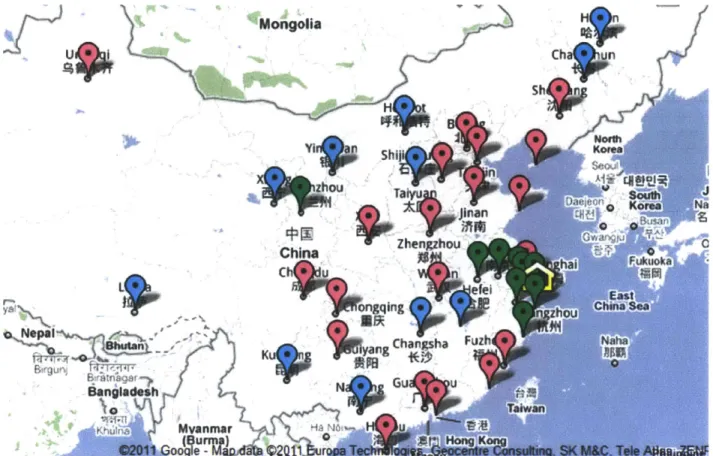
From the DC in Hong Kong as in Figure 4, 45% of the products are sent to China, 24% to
Hong Kong, 26% to Taiwan, and the rest to other Asia-Pacific countries. The outbound
transportation team works with merchandising and distribution, retail, inventory control, global
trade compliance, DC operations, and finance to ensure products are delivered to the customer.
The objectives for this team are to develop the China network, enhance distribution lanes and
mostly lie in customs regulations, which are always changing. The key to success for this
department given customs control is the usage of pool points. Pool points allow PRL to keep
some physical products in China without having to go through the import process by storing
them in bonded logistic parks. Once it is decided where the products will go, then the necessary
paper work for importation will be processed. This delay in importing goods allows PRL to stay
flexible and take advantage of common inventory; however, there is a 4-5 day lead-time to clear
customs. Currently, PRL has pool points in Malaysia, Singapore, Macau, Taipei, and Shanghai.
From these locations the outbound transport team will also manage last mile delivery. The key
aspect for the outbound logistics team to focus is to maintain visibility of all products because
data are coming in from multiple sources, but they need to be extracted and centralized.
Mongolia
China
East
India
Ulu
Figure 4 PRL's current outbound logistics and fulfillment for retail stores (Polo Ralph Lauren Asia Supply Chain, 2010)
The Creative logistics team provides support for all retail store build outs and interior
creative logistics, freight forwarders, retail operations transportation team, and AP Finance to
ensure the storage, delivery and pick up of non-merchandise retail items. These products can
also be stored at pool points to service nearby stores.
PRL also has a supply chain finance team that works with supply chain operations, Hong
Kong finance, planning team, US supply chain finance, Om Log, and DHL to manage all supply
chain related finance. Additionally, the team manages cash flow for custom clearance, weekly
freight costs, budget forecasts, and daily financial management. This department translates
business strategy into financial facts to aid decision making.
In summary, the current objective of the Asia supply chain team is to serve the sales
associates in PRL's retail stores and make sure they have the right product at the right time to
sell to PRL customers. Because PRL has only recently re-acquired its licensed brand in Asia, the
company is in the stage of building a platform that provides high service levels while remaining
flexible to the ever changing business environment.
PRL's current operations team has laid a solid foundation for its e-Commerce business;
however, in order for PRL to succeed in this new channel, the company needs to address certain
gaps we have identified. These gaps are: ordering policy for the e-Commerce channel, inventory
management at the DC level, warehouse location, integrated information technology, fulfillment
for non-bulk orders, delivery to end user and finally, customer service.
In the following chapters, we will discuss general market and supply chain information to
Market Information
The Chinese e-Commerce Market
We are in the midst of a technology revolution that is paving the way for businesses to
reach new markets and consumers. China's online retail growth results primarily from the sheer
size of the country's population and the increase in per-capita spending as living standards
improve. As of 2010, Internet users in China have reached 450 million, the highest number in
the world (Asia Access Limited, 2011). In addition, consumption of luxury goods topped $9.4B,
approximately 27.5% of the global market, making China the second largest luxury goods
market behind Japan (Yoox Group, 2011).
As shown in Figure 5, 20 million luxury consumers in China account for $130MM in
e-Commerce sales of luxury apparel product. Double-digit growth rate in consumer base is
projected per year between the present at 2015, with sales number projected to increase almost
30% year over year (Bain and Company, 2010).
# of reference consumers 4M3 40,5 (0 21 34,1 ESouth Korea 4% 30 27,7 NHK, Taiwan, Macau 5% (residents) SMainland China 14% 10 10 2008 2009 2010 2011 2012 YoY growth 11% 10% 9% 9%
Figure 5 Current and projected number of luxury shoppers in Asia (Bain and Company, 2010).
While the percentage of online shoppers in metropolitan China remains significant
smaller than in Japan or mature markets such as UK, and US, per-capita online spending is
increasing quickly. Even through the economic downturn between 2008 and 2010, China was
one of the few markets where online spending continued its upward trajectory. However, online
shopping revenues remain geographically concentrated, with the overwhelming majority of
e-Commerce taking place in China's largest cities (Wigder, Sehgal, Evans, & Johnson, 2010).
The Internet is seen as a shop window by most users, and as the technology of online
shopping improves, the shop window has increasingly becomes a shop door. Growing
confidence among consumers about the safety of buying goods online is illustrated by the rapid
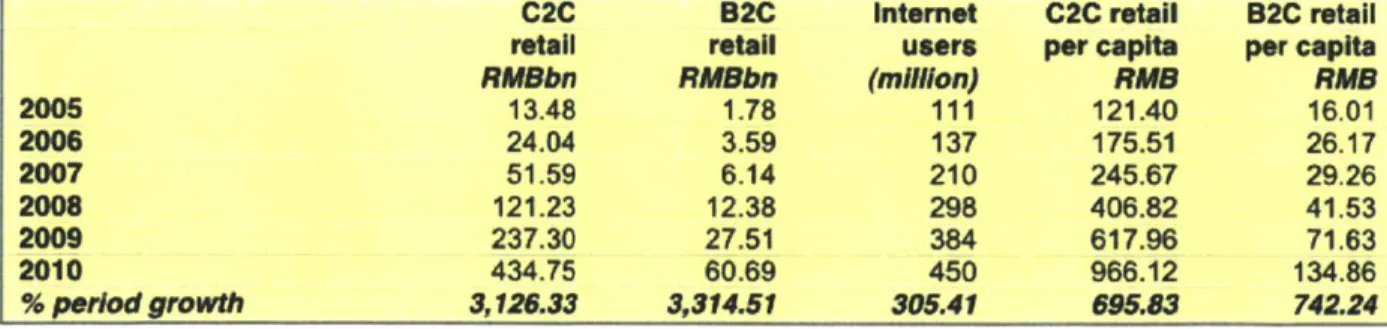
rise in per capita online spending as seen in Table 1. Consumers are gradually learning to trust
the services and reliability of an increasing number of established online retailers and are
adapting their habits to spending more money with them. That confidence has especially helped
sales from B2C site accelerate markedly (Asia Access Limited, 2011).
Table I Per capita retail spending online in China by C2C and B2C, 2005 to 2010 (Asia Access Limited, 2011)
C2C B2C Internet C2C retail B2C retail
retail retail users per capita per capita
RMBbn RMBbn (million) RUB RUB
2005 13.48 1.78 111 121.40 16.01 2006 24.04 3.59 137 175.51 26.17 2007 51.59 6.14 210 245.67 29.26 2008 121.23 12.38 298 406.82 41.53 2009 237.30 27.51 384 617.96 71.63 2010 434.75 60.69 450 966.12 134.86 % period growth 3,126.33 3,314.51 305.41 695.83 742.24
Along with growing consumer confidence, the number of wealthy households in China is
increasing as well. McKinsey & Co. projects that by 2015, China will have 4 million wealthy
households, making it the world's 4h largest behind the United States, Japan and the United
region of the country, and around 30% of these households reside in China's four largest cities,
such as Shanghai, Beijing, Shenzhen, and Guangzhou. By 2015, however, a larger proportion of
the new wealthy will come from smaller tier 2-4 cities, making expansion to serve the newly
wealthy from inner China a top priority for many brands (Atsmon , Ding, Dixit, St Maurice, &
Suessmuth-Dyckerhoff, 2009).
Table 2 lists major tier 1 and tier 2 cities in China that are undergoing major economic
growth in the coming years.
Table 2 Major tier I and tier 2 markets in China, Oligively reference
Beijing, Chongqing, Shanghai, Tianjin, Changchun, Chengdu, Guangzhou, Tier 1 Cities Hangzhou, Harbin, Jinan, Nanjing, Shenyang, Wuhan, Xian, Dalian,
Qingdao, Shenzhen, Xiamen
Changsha, Fuzhou, Guiyang, Haikou, Hefei, Hohhot, Kunming, Lanzhou, Tier 2 Cities Lhasa, Nanchang, Nanning, Shijiazhuang, Taiyuan, Urumqi, Xining,
Yinchuan, Zhengzhou, Ningbo, Suzhou, Wuxi, Wenzhou, Nantong
Chinese Luxury Consumers
With increasing wealth, Chinese consumers are becoming more comfortable with
purchasing luxury goods and displaying their newfound wealth. These new luxury consumers,
of which a growing number are residents of lower-tier 3 and 4 cities, are reshaping the luxury
market landscape in China. Upper-middle-class consumers in China are now stretching their
disposable income to purchase luxury watches, jewelry, handbags, shoes, and clothing, goods
that until very recently were the exclusive domain of the very wealthy. Although
upper-middle-class consumers only make the occasional luxury purchase, they already account for 12% of the
luxury market. With their number and purchase frequency steadily increasing, the
upper-middle-class consumers are expected to account for 22% of the luxury market share by 2015 (Atsmon,
A closer look at the Chinese luxury consumer will reveal four distinct consumer types. Mckinsey and Co. in a 2011 report defined them as core luxury consumers, luxury role models,
fashion fanatics, and middle class aspirants. These character types dictate their disposable
income spent on luxury items and their purchase patterns:
Core Luxury Buyers
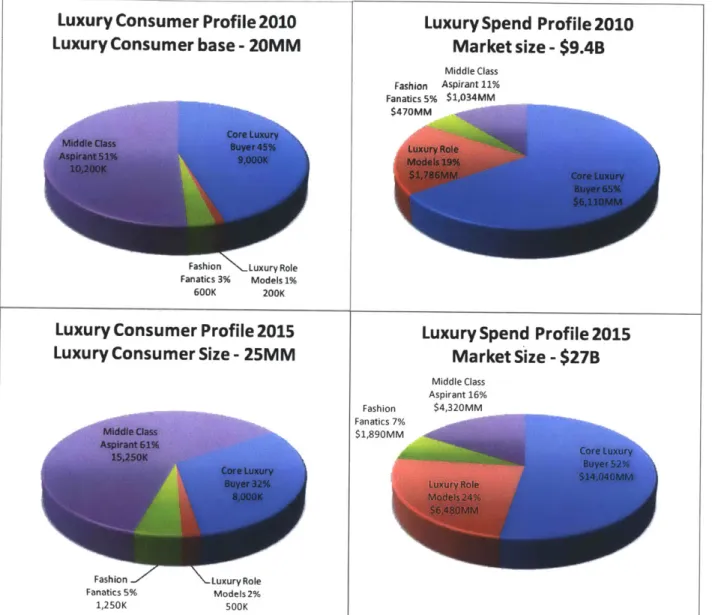
According to the report, the first consumer type is the core luxury buyer, these are households that spend between 12% and 20% of their income on luxury goods - a total of RMB20,000 - 60,000 (US$6,000-9,000) on luxury goods a year. In 2010, this group accounted for 45% of all luxury shoppers in China (9MM) and consumed 65% of all luxury goods sold that year ($6.1B).
Luxury Role Model
The next consumer type is the luxury role model consumer. They are rich, young and fashionable, living the ideal luxury lifestyle. They make up only 1% of luxury consumers but are projected to account for 24% of spending by 2015. Most are self-employed or corporate executives and many live in tier 1 cities like Beijing or Shanghai. Many have studied or worked overseas, and they have had long-term exposure to luxury brands. These luxury consumers on average spend more than RMB 150,000 annual on luxury goods, or 10% of their disposable income. Many have been buying luxury items for some time and they often buy to indulge themselves and to feel unique rather than to simply display their wealth. These luxury consumers also tend to buy spontaneously, snapping up an item if it catches their attention. Good service is paramount to these consumers; they are sensitive to the attitudes of the sales people and often prefer to shop in stores outside of China, where they believe the sales staff is more courteous (Atsmon, Dixit, Leibowitz, & Wu, 2011).
Fashion Fanatics
The next group of luxury consumers is considered fashion fanatics. They are not rich and make up only 3% of the luxury consumers; however, these consumers spend a much larger portion of their income on luxury goods, up to 40%. These consumers spend a great deal of time learning about the latest fashion trends and closely follow seasonal offerings. They tend to exert a strong influence on peer consumers, sharing their purchases and opinions in social circles and online. Because these consumers want to be fashion forward, they tend to purchase more luxury items on credit. Fashion mavens enjoy window-shopping at stores and tend to care less about store services than do the luxury consumers. They are also more likely to buy a product after a recommendation or when they see celebrities wearing it (Atsmon, Dixit, Leibowitz, & Wu, 2011).
Middle Class Aspirants
Middle class aspirants make up the largest share of the luxury goods purchasers at 51%, a number that will continue to rise as income and living standards improve. By 2015, these consumers will account for 16% of spend in the luxury sector. Many of these consumers live in tier 2 or tier 3 cities with lower living expenses, which allow them to occasionally splurge n luxury goods. Their relatively conservative attitudes toward money often means after spending money on a luxury item, they are likely to reduce spending on other things to keep their budgets on track. This group spends between RMB 5,000 to 15,000 per year or 9% of their household income on luxury items. They tend to have less experience with luxury items than other groups, but aspire to higher social circles and seek to stand out from the crowd. Purchases of luxury items for this group make these consumers feel successful. Because luxury items constitute a larger share of their income, these consumers are more cautious and spend a great deal of time researching an item before purchase, up to two to three months before deciding to buy. These consumers are not as well traveled internationally and are currently more inclined to purchase traditional Chinese Brands (Atsmon, Dixit, Leibowitz, & Wu, 2011).
Figure 6 shows a breakdown of luxury consumer types as well as their spending profile on
luxury goods in 2010 and forecasted spending in 2015.
Luxury Consumer Profile 2010 Luxury Consumer base -20MM
Fashion "".Luxury Role Fanatics 3% Models 1%
600K 200K
Luxury Consumer Profile 2015 Luxury Consumer Size - 25MM
Fashion .Z \Luxury Role Fanatics 5% Models 2%
1,250K 500K
Luxury Spend Profile 2010
Market size - $9.4B Middle Class Fashion Aspirant 11% Fanatics 5% $1,034MM $470MM O Fashion Fanatics 7% $1,890MM
Luxury Spend Profile 2015
Market Size - $27B
Middle Class Aspirant 16% $4,320MM
Figure 6 Luxury consumer type and spending breakdown
Luxury Apparel
In order to understand the specific challenges luxury apparel companies face with
launching an e-Commerce platform, we will attempt to define luxury apparel. This seemingly
simple task is actually quite difficult because luxury has a different meaning for people across
socioeconomic levels. A senior lecturer from the University of Brighton in the UK states, "the
word luxury originates from the Latin term 'luxus' signifying, 'soft or extravagant living,
indulgence, sumptuousness or opulence'. However, luxury is quite slippery term to define
because of the strong involvement of human element and value recognition from others"
(Shukla, 2010). It's about history, experience, and identity as much as it is about design, quality
and performance. Brands that quickly come to mind are often Italian and French like Prada,
Gucci, Armani and the largest of the group, Louis Vuitton Moet Hennessy (LVMH). A
common thread in these brands is the fact that they have a lineage and a vision for fashion and
excellence. They connect with the end user and create more than just a wardrobe; they create a
lifestyle. Ralph Lauren strives to achieve the same experience with his designs. In 1992 Audrey
Hepburn distinctly introduced Ralph Lauren with his Life Time Achievement award from the
Council of American Fashion Designers by saying, "There is no one adjective or ten adjectives,
for that matter, that can describe all that you represent. But your consistency and integrity
always remind us of the best things in life. As a designer you conger up all things we most care
about" (Rose, 1993). "Luxury wasn't simply a product," Ms. Thomas from the New York Times
writes. "It denoted a history of tradition, superior quality, and often a pampered buying
experience" (Hurt III, 2007). Similarly, when speaking with the PRL staff in Hong Kong, it is
evident that there is a real admiration for Ralph Lauren, himself, and the vision he has for PRL.
all want to live in. Ralph has said, "Designers do clothes, I do life" (Rose, 1993). In other words,
he designs clothes to fit his aspirations. Like a character in a movie dresses for the part, Ralph
Lauren designs for a lifestyle people dream of.
Service Level Definition
Companies strive to service luxury fashion consumers through both high service levels in
the stores and high service levels in their supply chain. Supply Chain service level is the typical
measure used to quantify a company's market conformance. In practice, the definition of service
level can vary from company to company, but service level is usually related to the ability to
satisfy a customer's time to market expectation. In other words, it is the measure of how often a
product is delivered on or before the promised delivery date. Many companies consider this
measure so critical to their ability to succeed in today's market that they invest in
decision-support systems that allow them to quote delivery dates accurately by analyzing information
from the entire supply chain. According to Dr. Simchi-Levi, "Customer value drives changes
and improvements in the supply chain, some forced by customers and competitor activities and
others undertaken to achieve competitive advantage" (Simchi-Levi, Kaminsky, & Simchi-Levi,
2008).
He goes further and breaks the customer perception into five dimensions of service level
(Simchi-Levi, Kaminsky, & Simchi-Levi, 2008).
1. Conformance to requirements 2. Product selection
3. Price and brand 4. Value-added services
5. Relationship and experiences
While consumers in Asia differ from those in North America or Europe, these dimensions
still hold true in both cultures and even more for luxury fashion brands. Because fashion varies
season to season, luxury fashion companies require even more of a responsive supply chain,
which values short lead times, flexibility and speed over costs. (Simchi-Levi, Kaminsky, &
Simchi-Levi, 2008)
In addition to high service levels throughout the said supply chain, e-Commerce
consumers place great values on their Internet shopping experience, namely convenience of the
transaction, confidence in the exchange and control of the purchase decision (Walsh, Gazala, &
DeMoulin, 2001).
First, luxury fashion companies need to focus on creating a convenient shopping
environment for their customers, whereby research, consideration, purchase, and return tools are
all easily available. e-Commerce shoppers often purchase online to save time, shop 24x7, and
purchase from the comfort from home or office.
Second, security of the transaction should never be a concern for the customer. Luxury
shoppers' focus on convenience often leads them to store their billing information with the
retailer compared with non-luxury shoppers. Therefore, luxury fashion companies should
consistently communicate the quality and confidence in its transaction security.
Third, luxury shoppers want more control online. From FAQs to emails to
click-to-call-back, luxury shoppers want the tools and the website tailored so that product selection, purchase
decision, transaction and product tracking are all easily within reach (Paderni, Favier, &
Payment Options
As part of a great shopping experience, convenient payment options are necessary. In
North America, one of PRL's primary e-Commerce markets, many different payment methods
are available. These methods include credit card, debit card, alternative payment systems such
as PayPal and prepaid gift cards.
Conversely, in the Chinese market, consumers utilize different methods to pay for their
online merchandise. The most readily used payment methods are Alipay, Cash on Delivery
(COD), credit cards, and online bank transfers. A 2010 Forrester Research study demonstrates that more than half of Mainland Chinese e-Commerce consumers pay for online purchases using
Alipay, a leading alternative payment system in the country. Alipay is owned by the Alibaba
Group, and is the primary payment method for Alibaba's highly successful consumer
e-Commerce site Taobao.com (Wigder, Evans, & McGowan, 2010).
Aside from Alipay, COD is prevalent in China, with over 40% of e-Commerce buyers
using this form of payment where a local courier is hired to collect payment on behalf of the
merchant. This model relies upon a considerable amount of two-way trust. Dangdang.com, an
online retailer, provides customers with a door-to-door return policy within seven days and
allows exchange of goods within fifteen days (Asia Access Limited, 2011). Another alternative
is Postal remittance where consumers can pay online for purchases by providing payment at their
local post office. Consumers can also replenish their Alipay accounts at China Post locations
(Wigder, Evans, & McGowan, Understanding Online Payment Preferences In International
IT
IT can take a variety of forms such as EDI, direct link-ups with suppliers, Internet,
electronic catalog ordering and email. To support sharing of information and resources between
point of sale, warehouse, and company central, communication and coordination need to be
maintained. IT has a pivotal role in improving communication and coordination by acting as an
enabler. The Internet helps to manage supply chain activates by offering information about what
kind of product is demanded, what is available in the warehouse, what is in the manufacturing
process, and what is entering and exiting he physical facilities and customer sites. For example,
ERP systems such as SAP can only connect different functions within a firm but also connect the
firm's suppliers, distributors and 3PLs, enabling the partners to share information such as order
status, product schedules, and sales records, all to integrate major supply chain processes and to
plan production, logistics and marketing promotions (Gunasekaran & Ngai, 2004).
In addition to facilitating information up and down the supply chain, IT has become
instrumental in use for purchasing. Cost savings resulting from reduced paper transactions,
shorter cycle time and the subsequent inventory reduction resulting from speed transmission of
purchase order related information, and enhanced opportunities for the supplier/buyer
partnership through establishment of web of business-to-business communication networks. The
adoption of more integrated IT models would further strength global supply chain management
(Gunasekaran & Ngai, 2004).
Inventory Management and Risk Pooling
While technology can drive great efficiencies in the supply chain, risk
safety stock and average inventory. There are three critical components that will impact the
effectiveness of risk pooling. First and foremost, centralizing inventory will reduce safety stock
and average inventory because it allows companies to use items that are in low demand in one
region to fulfill high demand in another. Secondly, the higher the coefficient of variation, the
greater the benefit obtained from centralized systems. Higher variations lead to higher safety
stock and since risk pooling decreases the need for safety stock the greater potential to cut costs.
Lastly, these benefits also depend on the correlation between market demands. If two markets
are positively correlated then the benefit of pooled inventory will decrease because both markets
will experience high or low demand at the same time (Simchi-Levi, Kaminsky, & Simchi-Levi,
2008).
If done properly with the right market conditions, pooling inventory in a centralized DC can have many benefits, but there are also some trade-offs. A centralized system allows a
company to provide higher service levels with fewer inventories on hand, which decreases
overhead costs. Conversely, decentralized DC's are closer to customers and allow for shorter
deliver lead times. However, the impact on transportation costs is unclear because it depends on
whether it is more costly to ship products from suppliers to warehouses or from warehouses to
customers (Simchi-Levi, Kaminsky, & Simchi-Levi, 2008). There are obvious advantages to
pooling inventory, but with these trade-offs it is important to thoroughly assess the priorities of
the company and the market characteristics.
Third-Party Logistics
Third Party logistics (3PL) providers are external companies who manage, control and
include all or part of the logistics activities required for the client, such as warehousing,
distribution, and pick &pack. Three types of 3PLs exist in the market place with different
strategies on how to serve their customers and are described below.
The 3PL acting as a service provider is seen as to offer advanced value-added services.
This activity could involve differentiated services for different customers, performing specific
packing, cross docking, track and trace, and offering security systems. An advanced service
package often involves several sets of more standardized activities turned into modules that
could be combined according to each client's demands. With more advanced services, a capable
IT system is often necessary to facilitate such development.
The customer adapter could be described as the 3PL firm taking over clients' existing
activities and improving the efficiency in the handling. This type of provider might take over
customers' total warehouses and the logistics activities and relies on a few very key clients.
The customer developer is the most advanced 3PL service provider. It involves a high
integration with the client often in the form of taking over its whole logistics operations. The
possibilities to coordinate customers lie in the know-how, the methods, the knowledge
development, and the design of the supply chain. The number of customers would be limited
and the work for each customer extensive (Hertz & Alfredsson, 2003).
In the Chinese market currently, finding a 3PL capable of providing any and all of the
services mentioned above is still rare.
Not only will delivery be important for shaping success and failure in the online retail
market in China, but managing inventory also proves to be an increasing headache for many
online retail companies as their business, and trade volume increases. When the companies find
their retail transaction volume rapidly rise from 10 a day to 10,000 a day, they have to react
quickly to find a solution. This solution is usually outsourced, as the time and investments
necessary to build the capacity to distribute large volume of goods takes considerable amount of
time, which is short in an online market that is growing at over 100% a year (Asia Access
Limited, 2011).
The growth of the Internet retail business has led many 3PL businesses to enter the field;
however, with so many firms short on experience, problems with quality often arise. Because
3PL operations often lie outside the control of customer companies, poor service often results.
Poor quality and service, if persistent, can kill an online business in China just as quickly as it
can help it grow. China's Internet users utilize social media greatly, and bad press about any
company can often spread quickly. When the market is growing as fast as online retail in China,
bad press surrounding fulfillment can hinder consumer confidence effectively killing the online
retail channel. Hence, it is of great importance to control logistics and establish cooperative
relationships with 3PL providers (Asia Access Limited, 2011).
Many companies have grown in China recently into significant logistics providers to fill
the gap that has existed in the domestic economy. Previously, the only logistics companies
providing effective China-wide coverage were China Post and EMS, but others have emerged
since then, such as Zhongtong and Shanghai Yuantong, along with foreign imports such as
FedEx, UPS and DHL.
Summary
As B2C sales of luxury fashion continue its fast growth in China, PRL is entering the
companies before now have launched e-Commerce in China and; thus, no standard supply chain
models exist for the luxury e-Commerce channel reinforcing the need for this study. We used
interviews with Polo Ralph Lauren staff, research journals, consultancy studies, and industry
interviews to document luxury e-Commerce and the gaps that exist to offer this service across
Methodology
A market review was conducted initially through journal research to gather current information on the following topics: luxury apparel, luxury apparel supply chain, Asia market
place general trends, Asia Luxury apparel space, and e-Commerce fulfillment in China. This
search and compilation allowed for a fundamental understanding of the brands operating in the
luxury apparel space in China as well as the current state of their e-Commerce fulfillment.
Primary sources of information for the market review were conducted through Forrester
Research, academic journals, interviews as well as consulting reports prepared for PRE.
Next, companies were selected for interviews to gain specific insights on their practices
in the e-Commerce fulfillment space. The choice of companies was not limited to luxury brand
companies only, but also to third party logistics (3PLs) that serve to fulfill orders for luxury
brand companies both in the traditional retail channel as well as the e-Commerce channel.
Questions were designed to not jeopardizing their strategic or operational advantages in the
current marketplace. Still, many companies we approached for this study declined to be
interviewed to protect their competitiveness; however, we were able to interview five companies
and gain insight into current practices.
The following people and resources were used to gather and compile data on current
e-Commerce operations in China.
o Market Feasibility Study Conducted By Consulting Firm
Vice President of Global Supply Chain PMO
- Vice President of Global Transportation & Logistics Asia
- Senior Director, Supply Chain
- Inbound Operations Director
- Transportation Director
- Senior Director, Global Transportation
- Director Global Transportation
- Vice President Information Technology
- Distribution Director Supply Chain
o General Manager / Representative Director - Company C Korea Ltd.
o CEO and Senior Operations Director - Company A
o CEO - Company B Asia
o Yoox
- China Group Press Release
- General China Presentation
The luxury brands interviewed were selected based on the criteria of length of operating
time in the luxury space, consumer perception, and history. These criteria were used for several
the company is a long-standing brand or a newly established venture. While established brands
offered the closest comparison to PRL in history and value, newly established ventures offered
strategies and solutions that are both exciting and innovative.
Within the 3PLs, companies were selected based on past histories of working with luxury
brands, operational capacity to fulfill a given volume of orders, technology platform capability,
local knowledge of culture and customs, and experience working in China
Interviewees were selected based on their position within these companies and their
overall experiences in the luxury goods space. We chose these individuals because they often
had a great deal of experience working in the luxury space from a strategy and operational
perspective, as well as in setting up previous e-Commerce ventures.
Interview questions were kept deliberately open ended to allow the speaker to answer
from his/her frame of reference as to take advantage of his/her experience in the field.
Interviewees were encouraged to describe in as much detail as he/she felt comfortable about the
general company strategy and established operations. Additional discussions focused on how the
company strategy and operations have evolved as it entered the Chinese luxury market place.
Furthermore, follow up questions were directed at specific areas within operations to gain a more
clear understanding of on the ground tactics vs. top line strategy; because often times, "what
companies do is a more clear reflection of their fulfillment strategy rather than what they claim
their strategic intent to be" (Weiss, 1994; Rubin & Rubin, 2005; Holstein & Gubrium, 1995).
Questionnaire for luxury brand e-Commerce in Asia
Strategy
1. When did you enter the Asia e-Commerce market?
2. What are the key similarities and differences you see between Asian e-Commerce
customers and those in North America and Europe?
3. How has the introduction of e-Commerce in Asia changed your operations in terms of location, volume and customer reach in new regions?
Service Level
1. What regions in China do you provide e-Commerce service to?
2. Do you provide different service levels for different cities (tier 1 vs. tier 2, vs. tier 3)?
3. Did you enter every region at the same time?
4. What are your service level goals in Asia and how are they unique to the luxury mark
5. How do you manage returns?
6. What are the challenges you face with providing a luxury service with your current m and service providers?
Distribution
1. Do you hold your inventory in a centralized DC or in multiple country DC's? 2. How many DC do you have in China?
3. Where are they located?
4. Do you have a strategy for opening more DC's as the market grows?
a. Active or Reactive approach to increase fulfillment to new markets.
5. Do you own and operate these DC's or do you outsource?
odel et?
a. If you outsource what are the requirements in terms of logistics, IT, and
experience?
b. How many options did you have to choose from and can you share with us who those companies are?
Fulfillment
1. Do you work with a 3PL or in house staff for the integration of fulfillment, front end operations, and the last mile delivery?
a. If working with a 3PL what kind of option do you have to tailor the inbound and
outbound operations?
b. What is the volume handled per DC?
2. Do you utilize pool points or other fulfillment locations that vary from your DC
locations?
3. Are any of them located in bonded logistic parks?
4. What kind of service options do you offer for the last mile of delivery?
a. What do your customers want and what would you like to be able to offer?
i. Examples: Next day deliveries, time specific delivery, return options.
5. What is your return policy and what options do customers have to return a product?
IT
1. What IT systems are you currently working with and are they integrated across all sales regions in Asia or globally?
2. How are your MRP, ERP, and WMS for e-Commerce merged with the traditional sales
Each interview was recorded with permission and transcribed to ensure accuracy.
Qualitative data from these interviews were gathered and compiled. Trends were then explored
within the responses to look for strategic goals of the company, operational focus, as well as
metrics for success.
These trends are then aggregated to present a high level snap shot of the practices that are
currently done within the Chinese e-Commerce industry. Following an aggregation of the data,
further analysis was conducted to determine whether these firm's current practices fit with PRL's
corporate goals for its e-Commerce business within China. This procedure was done through the
Case Studies
Three companies were interviewed for this study; Company A, Company B and
Company C. One 3PL provider, Yoox was studied through its publications, and finally, a luxury
fashion consultant provided industry feedback. The responses to interview questions were
condensed and presented below.
Company A
Strategy
Person A is the Founder and CEO of Company A, an online private sales website for
luxury lifestyle and fashion brands operating in Japan and China and looking to expand to Korea
in 2012. Prior to launching this-e-Commerce business, Person A was the President of Company
B Asia, the Vice President of Company X. He has five years of e-Commerce experience in Asia.
Now at the helm of Company A, he uses online flash sales-limited products sold for a limited
time at a discount-to sell a diverse range of luxury goods. The company has five categories that
include: previous season fashion, shoes, cosmetics, accessories, and leather goods. Company A
rotates the brands it works with every week and will work with each brand 3-4 times per year.
Since launching in early 2009 in Japan, Company A has developed working relationships with
450 brands. China's market is growing, but having launched more recently in July 2010, it is
only working with 130 brands.
Service Level
Service level is an important factor to the success of Company A, for this reason all
customer service is managed by Company A employees. Company A has 35 dedicated customer