DOI 10.1007/s11334-006-0001-0 O R I G I NA L PA P E R
Pattern componentization: the factory example
Karine Arnout · Bertrand Meyer
Received: 12 June 2005 / Accepted: 21 September 2005 / Published online: 6 May 2006 © Springer-Verlag London Limited 2006
Abstract Can Design Patterns be turned into reusable
components? To help answer this question, we have per-formed a systematic study of the standard design pat-terns. One of the most interesting is Abstract Factory, for which we were indeed able to build a reusable com-ponent fulfilling the same needs as the original pattern. This article presents the component’s design and its les-sons for the general issue of pattern componentization.
1 Patterns and components
In hardly more than a decade, Design Patterns have established themselves as a major resource for effec-tive software design. “Each pattern describes a problem
which occurs over and over again in our environment and then describes the core of the solution to this problem”
[17]. Thanks to the published catalogs of such solutions, starting with [17] itself, software designers can benefit from the wisdom and experience of their predecessors.
K. Arnout
AXA Rosenberg Investment Management LLC, Barr Rosenberg Research Center, 4 Orinda Way, Building E, Orinda, CA 94563, USA
e-mail: [email protected] B. Meyer (
B
)Computer Science Department, ETH Zurich, Clausiusstrasse 59, 8092 ETH-Zentrum, Zurich, Switzerland e-mail: [email protected] B. Meyer Eiffel Software, 356 Storke Road, Goleta, CA 93117, USA
The idea that we should avoid reinventing the wheel in software construction predates patterns by a long time; reuse is a running theme in standard discussions of software engineering. The idea of reuse is to pro-vide software components covering standard needs and make them available through a standard API (Abstract Program Interface1) to any program that experiences the corresponding needs.
For all the benefits of design patterns, it is hard to ignore that the idea as usually expressed runs contrary to decades of advances in reuse, which have profoundly improved the state of software development. Pattern advocates themselves often sound skeptical about reuse. The preceding citation was actually truncated: the full sentence states that a pattern describes the core of the solution to the problem “in such a way that you can use
this solution a million times over, without ever doing it the same way twice”. The pattern literature frequently
confirms this view that patterns are not reusable com-ponents; for example [20]: “Patterns are not, by
defini-tion, fully formalized descriptions. They can’t appear as a deliverable”.
Why not? It is hard to accept that patterns, however useful, should force us to step back to pre-reuse times, when sorting an array required finding a solution out-line in an algorithms textbook and then adapting it to your needs. Today we use library routines for such tasks. Patterns should provide similarly reusable solution at a higher level of granularity. Inexplicably, the pattern
lit-1 The original expansion of “API”, “Application Program
Inter-face”, apparently going back to old IBM software, is no longer meaningful. The acronym itself remains well-understood and rel-evant. We expand it as “Abstract Program Interface”, which cap-tures the idea precisely.
erature rejects the idea, claiming that patterns are some-how of a higher essence than components. We find this view questionable in the absence of concrete evidence and suspect that it may be influenced by the limitations of the programming languages (typically C++ and Java) in which patterns are generally described. Disproving it, at least for some commonly used patterns, would be beneficial, since it is almost always preferable to reuse than to redo: everything else being equal, performance in particular, relying on a reusable component through a well-documented API provides better guarantees of correctness and of general quality than if every devel-oper must code the implementation anew; and it’s of course much less effort.
In this view, while patterns as a whole are an admira-ble advance, a pattern that remains just a pattern is an admission of failure: the failure to abstract the idea to a level where it can be turned into an off-the-shelf solution — rather than studied, understood (or misunderstood), and reimplemented separately by each potential bene-ficiary. The failure can have various causes:
• Perhaps it is possible to derive a component covering all cases of the pattern, but you did not work hard enough.
• You may be facing a limitation of the programming language you use; another programming language would offer a solution.
• The general assertion (from the pattern literature, as mentioned) that patterns somehow transcend com-ponents may hold in the case of a particular pattern. • For some patterns, you may be able to derive a par-tial solution in the form of a component that doesn’t cover all uses of the pattern, but provides a reus-able basis, reducing the amount of specific adapta-tion work that each user of the pattern must perform. Patterns have become so important in the practice of software design, and the benefit of reusable solutions over endless individual reimplementation are so com-pelling, that it is important to examine the principal de-sign patterns in the light of this discussion. We may call the overall goal componentization: turning design pat-terns, whenever possible, into reusable components.
A previous article [28] showed that the “Observer” pattern can be profitably replaced by a simple reusable solution, the Event Library, taking advantage of Eif-fel mechanisms (genericity, tuples, agents); the benefits including ease of use and greatly improved generality.
Encouraged by that initial success, we set out to per-form a systematic analysis [5] of the componentization potential of all the design patterns of [17]. The results include:
• An analysis of the challenge of componentization and of the techniques that address it.
• A new classification of design patterns in terms of their suitability, or resistance, to componentization. • The application of componentization techniques to
the major design patterns, yielding full or partial componentization in two thirds of the cases.
• Concretely, a Pattern Library providing reusable implementations of the successfully componentized patterns.
• For the remaining cases, a Pattern Wizard facilitating the semi-automatic integration of the patterns into an application.
Both the Pattern Library and the Pattern Wizard are open-source, freely downloadable software available from our download page [16].
We report here on some of the results of this effort, with a special application to one of the best-known pat-tern: Abstract Factory. (A companion paper [29] details a similar study applied to the Visitor pattern, also result-ing in a reusable solution as part of the Pattern Library.) In the rest of this discussion:
• Section 2 presents the componentization effort, describing the criteria we considered to determine whether a pattern is componentizable and the over-all results of the study.
• Section 3 presents the intent, advantages and limita-tions of the Abstract Factory pattern.
• Section 4 describes the design and implementation of our reusable solution: the Factory component of the Pattern Library.
• Section 5 compares the two approaches: use of the Factory Pattern vs. the reusable solution provided by the Factory component of the Pattern Library. • Section 6 explains the limitations of the
componen-tization approach.
• Section 7 presents some related work about the implementation of design patterns using different programming paradigms and the integration of pat-terns as programming language features.
• Section 8 draws conclusion about the componenti-zation approach and results.
• Section 9 gives some further research directions.
2 Pattern componentization
Before turning to the specific example of the Abstract Factory pattern, we summarize the componentization study, its assumptions and its results.
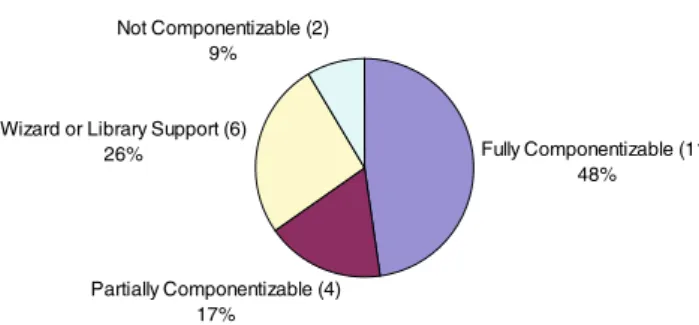
Fully Componentizable (11) 48%
Partially Componentizable (4) 17%
Wizard or Library Support (6) 26%
Not Componentizable (2) 9%
Fig. 1 Componentization results for the patterns in “Design
Pat-terns”
2.1 Overview
Our first pattern analysis, targeting the Observer pattern, led to successful componentization through the Event Library [6, 28] covering the general idea of publish-subscribe and event-driven development. This provided the basis for the componentization of other patterns including Visitor [29], Composite, Factory as described below, and others all yielding reusable components in the Pattern Library. We confirmed the practical applica-bility of these components by using them in a number of production applications.
After this first experience we turned to the systematic study of all the 23 patterns in “Design Patterns” [17], the original reference on the topic.
2.2 Overall componentization results
Figure 1 summarizes the results; the precise definition of the categories and the criteria retained are described next.2
As the figure indicates:
• For two-thirds (65%) of the original patterns we are able to provide a componentized replacement, en-abling application developers to rely on an API from the Pattern Library rather than reimplementing the pattern. More precisely the solution is fully satisfac-tory in 48% of the cases; in 17% of the cases, it leaves out some cases of the original pattern.
• A quarter of the patterns have “Wizard or library support”: we cannot provide a component ready for off-the-shelf use, but we can help through some combination of components addressing part of the problem and the support of the Pattern Wizard to integrate the pattern into an application.
• The remaining 9% are classified as “not componen-tizable” to reflect that we were not able to make any progress towards a reusable solution. This could
2 Figure 1 and part of the material in Sect. 2.2 also appear in [29].
Design pattern Fully Componentizable Partially Componentizable Partial Library Support Skeleton New Component Library- supported Wizard or Library Support Language- supported Not Componentizable
Fig. 2 Pattern componentizability classification
of course just reflect our own failure rather than a problem inherent in the patterns themselves.
2.3 Evaluation criteria
In assessing the success of componentization we apply the following criteria:
• Completeness: Does the reusable component cover all cases described in the original presentation of the pattern (as given for this study in [17])?
• Faithfulness: Does the component provide the same benefits as the original pattern description?
• Usefulness: Is it useful to rely on the component rather than merely implementing the pattern? • Type-safety: Is the component type-safe?
• Performance: How does the efficiency of using the component compare to a solution that implements the pattern?
• Extended applicability: Does the component cover more cases than the pattern?
2.4 Definition of the categories3
Figure 2 shows the classification, adapted from the fuller discussion in [5].
The patterns in the first of the top-level categories,
Fully Componentizable (48% from Fig. 1), are the most
interesting result of this study: we can provide an API that fully covers the need for implementing the pattern in an application.4There are three subcategories: • Language-supported: no need to do anything at all,
the mechanism is already provided by the language. This is the case with the Prototype pattern, for which Eiffel’s built-in “clone” facility handles the issue. • Library-supported: in this case the mechanisms of
an existing library do the job. This subcategory is
3 Figure 2 and part of the material in Sect. 2.4 also appear in [29]. 4 The inclusion of one pattern, Memento, in the “Fully
Compo-nentizable” category is a matter of convention since in that case it is simpler to use the pattern than the component.
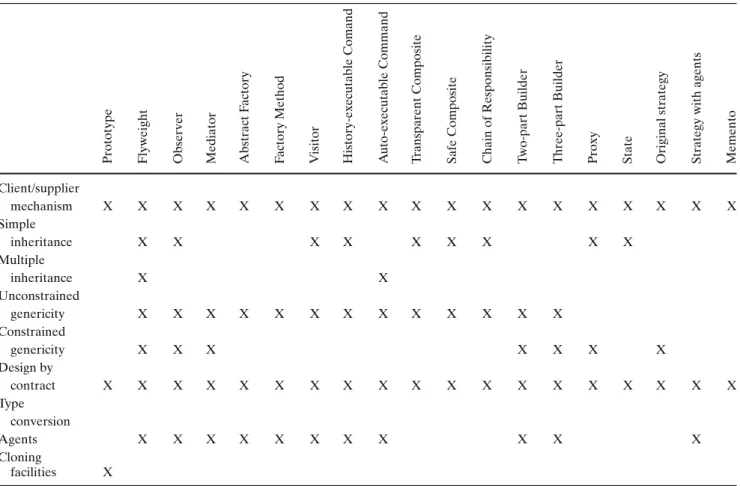
Table 1 Eiffel language mechanisms and their use in the Pattern Library
Prototype Flyweight Observer Mediator Abstract
F a ctory F a ctory M ethod V isitor History-executable Comand A u to-executable Command T ransparent C omposite Safe Composite Chain o f R esponsibility T w o-part Builder T h ree-part Builder
Proxy State Original
strategy Strategy with agents Memento Client/supplier mechanism X X X X X X X X X X X X X X X X X X X Simple inheritance X X X X X X X X X Multiple inheritance X X Unconstrained genericity X X X X X X X X X X X X X Constrained genericity X X X X X X X Design by contract X X X X X X X X X X X X X X X X X X X Type conversion Agents X X X X X X X X X X X Cloning facilities X
included for completeness since we have not so far uncovered any example.
• New Component: this is the most original case, indi-cating that we were able to develop a component that removes the need for the pattern. The Factory family of patterns, discussed below, is an example. The second category, Partially Componentizable, covers patterns for which we were also able to develop a com-ponent for the Pattern Library, but the resulting solution is not quite complete or faithful as defined above.
In the Wizard or Library Support category, there is no reusable component in the Pattern Library, but we are able to help developers integrate the pattern into their application through either or both of two techniques: • They can use the Pattern Wizard to produce a
skel-eton describing the architecture of the pattern, then fill in the specific elements.
• They can rely on some partial component support from existing libraries.
Patterns of the last category, Not Componentizable, have resisted all our efforts: we can neither provide a
component, even partial, nor generate a skeleton. These are the patterns truly justifying the reuse-skeptic atti-tude of the pattern literature highlighted in the citations at the beginning of this article. Fortunately for our ef-fort, only two of the standard design patterns belong to that category: Façade and Interpreter.
2.5 Role of specific language and library mechanisms The results of componentization are clearly dependent on the target programming language. The effort re-ported here benefits from the mechanisms of Eiffel [26, 30], as described in the corresponding ECMA standard [14]. The following language capabilities play a partic-ularly important role; Table 1 shows their actual use in the Pattern Library.
• Genericity: a basic Eiffel facility for defining classes parameterized by types, and already used in all Eif-fel data structure libraries. Genericity is constrained if the actual generic parameter must be a descen-dant of a specific type, unconstrained otherwise. All the Pattern Library classes (for the fully compo-nentized patterns) rely on unconstrained genericity;
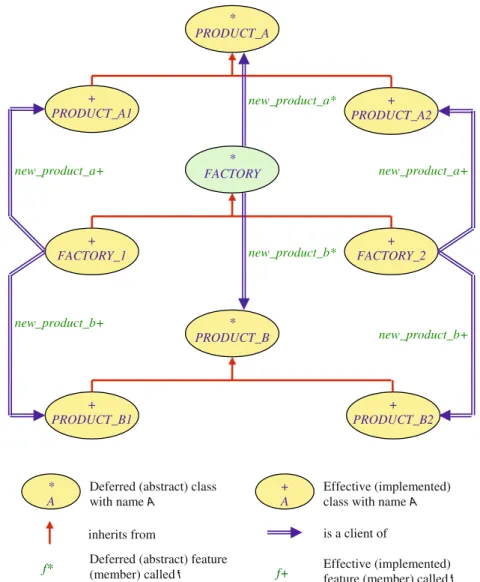
Fig. 3 Class structure for the
Abstract Factory pattern
* FACTORY + FACTORY_1 + FACTORY_2 * PRODUCT_A + PRODUCT_A1 + PRODUCT_A2 + PRODUCT_B1 + PRODUCT_B2 * PRODUCT_B new_product_a* new_product_b* new_product_a+ new_product_b+ new_product_b+ new_product_a+ * A + A
Deferred (abstract) class with nameA
Effective (implemented) class with name A
inherits from is a client of
f* Deferred (abstract) feature (member) called f f+ Effective (implemented) feature (member) called f
three (Observer, Mediator and Flyweight) use the constrained form.
• Agents [12]: objects encapsulating routines ready to be called. 73% (8 out of 11) of the fully componen-tized patterns use agents.
• Tuples: sequences of values of set types, similar to classes but anonymous.
• Support for Design by Contract™ [23–25] to equip the componentized patterns with precise semantic properties. All Pattern Library classes take advan-tage of contracts.
• Client-supplier relationships. • Single and multiple inheritance.
• Automatic type conversion, which exists in all lan-guages for basic types (as in converting from inte-gers to reals) but benefit in Eiffel from a full-fledged mechanism applicable to any user-defined type and carefully combined with inheritance [28]. This facil-ity is mentioned here even though it is not used in any of the currently componentized patterns; informal
investigations of other patterns show that it can play a useful role.
• Cloning: built-in facilities for duplicating objects.
3 “Abstract factory” as a pattern
The Abstract Factory design pattern is a widely used solution to create object families without specifying the concrete type of each object. In this section we describe the pattern, its benefits and limitations.
3.1 Pattern description
The Abstract Factory pattern is intended to “provide an
interface for creating families of related or dependent objects without specifying their concrete classes” [17].
Figure 3 (using, as other class diagrams in this article, the conventions of the BON method [32], explained by the legend below) shows the classes involved and their relationships.
Fig. 4 Traffic simulation with the Abstract Factory pattern
In this example and others, some of the names and conventions have been changed from [17] for consis-tency with the rest of the discussion, but this does not affect the substance of the patterns. A feature is “effec-tive” if it is implemented, “deferred” if it is only specified (with a contract if applicable). A class is effective if all its features are effective, deferred otherwise. A deferred class does not have to be fully abstract: it may contain a mix of deferred and effective features.
The deferred class FACTORY declares the deferred factory functions, new_ product_a and new_ product_b, which create and return anew instance of PRODUCT_A and PRODUCT_B. These functions are effected (made effective) in FACTORY_1 and FACTORY_2, in a covariant way: in FACTORY_1, new_ product_a returns an instance of PRODUCT_A1 and new_ product_b of
PRODUCT_B1; in FACTORY_2, they produce a PRODUCT_A2 or a PRODUCT_B2.
3.2 Using the pattern
Because the factory pattern is just a pattern, the above software structure must be instantiated anew for each application. Here is such an example, covering a traffic simulation system. Cities have people and vehicles; we will use factories for both of these kinds of objects. A vehicle – car, bus, tram – has an engine, wheels, and doors, which vary with the vehicle type.
Figure 4 shows the structure. The _FACTORY classes implement the pattern; the others describe the
application domain. To create a new person, clients will use the factory class PERSON_FACTORY; to create a vehicle, they use VEHICLE_FACTORY, deferred but with three effective descendants CAR_FACTORY,
BUS_FACTORY and TRAM_FACTORY. Note how
these mirror the VEHICLE hierarchy.
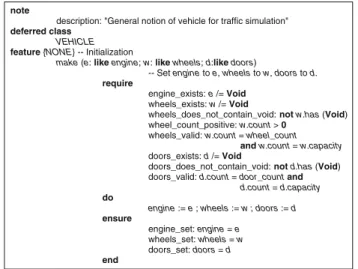
The example has been spelled out, including classes such as VEHICLE, CAR, WHEEL and CAR_WHEEL which have no direct relation to the pattern but help make this application of the pattern complete and real-istic. Here are possible versions of these classes, starting with VEHICLE5:
note
description: "General notion of vehicle for traffic simulation" deferred class
VEHICLE feature {NONE} -- Initialization
make (e: like engine; w: like wheels; d:like doors)
-- Set engine to e, wheels to w, doors to d. require
engine_exists: e /= Void wheels_exists: w /= Void
wheels_does_not_contain_void: not w.has (Void) wheel_count_positive: w.count > 0
wheels_valid: w.count = wheel_count and w.count = w.capacity doors_exists: d /= Void
doors_does_not_contain_void: not d.has (Void) doors_valid: d.count = door_count and
d.count = d.capacity do
engine := e ; wheels := w ; doors := d ensure
engine_set: engine = e wheels_set: wheels = w doors_set: doors = d end
feature -- Access
engine: ENGINE
-- Engine wheels: ARRAYED_LIST [WHEEL]
-- Wheels doors: ARRAYED_LIST [DOOR]
-- Doors wheel_count: INTEGER -- Number of wheels deferred end door_count: INTEGER -- Number of doors deferred end invariant
engine_exists: engine /= Void doors_exists: doors /= Void wheels_exists: wheels /= Void
doors_does_not_contain_void: not doors.has (Void) wheels_does_not_contain_void: not wheels.has (Void) wheel_count_positive: wheel_count > 0
door_count_valid: door_count = doors.capacity and doors.count = door_count
wheel_count_valid: wheel_count = wheels.capacity and wheels.count = wheel_count
end
A typical descendant of VEHICLE:
note
description: "General notion of car for traffic simulation"
class
CAR inherit
VEHICLE
redefine engine, wheels, doors end create
make feature -- Access
engine: CAR_ENGINE
-- Engine
wheels: ARRAYED_LIST [CAR_WHEEL]
-- Wheels
doors: ARRAYED_LIST [CAR_DOOR]
-- Doors
Wheel_count: INTEGER = 4 ; Door_count: INTEGER = 4
-- Number of wheels and doors
invariant
four_wheels: wheel_count = 4
four_doors: door_count = 4
end
Other descendants include BUS, TRAIN etc. We also need wheels:
note
description: "General notion of wheel for traffic simulation"
deferred class WHEEL feature -- Initialization
make (d: like diameter)
-- Set diameter to d. require diameter_valid: d >= minimum_diameter and d <= maximum_diameter do diameter := d ensure diameter_set: diameter = d end feature -- Access diameter: INTEGER
-- Diameter (in millimeters)
minimum_diameter: INTEGER
-- Minimum diameter (in millimeters)
deferred end
maximum_diameter: INTEGER
-- Maximum diameter (in millimeters)
deferred end feature -- Status report
is_valid: BOOLEAN
-- Is wheel meaningful?
do
Result := (diameter >= minimum_diameter and diameter <= maximum_diameter) ensure
definition: Result = (diameter >=
minimum_diameter and diameter <= maximum_diameter) end
invariant
minimum_diameter_positive: minimum_diameter > 0 min_and_max_valid: minimum_diameter <= maximum_diameter ivalid: is_valid
end
Descendants of WHEEL may include CAR_WHEEL etc.
Now the factory classes. VEHICLE_FACTORY, de-ferred, contains the factory operations such as
new_vehicle (p,d,w,h: INTEGER): VEHICLE
-- New vehicle with engine power p, wheel diameter d, -- door width w and door height h
require
power_valid: p >= minimum_power and p <= maximum_power diameter_valid: d >= minimum_diameter and
d <= maximum_diameter
width_valid: w >= minimum_width and w <= maximum_width height_valid: h >= minimum_height and
h <= maximum_height deferred
ensure
vehicle_exists: Result /= Void
end
The contracts use features such as minimum_ power, declared in class VEHICLE_FACTORY as deferred and made effective in the descendants; these features will in practice have to duplicate code that exists in classes
ENGINE, WHEEL, and DOOR.
Descendants of VEHICLE_FACTORY, such as
CAR_FACTORY, define their own factory features, this
time effective, for example:
new_car (p, d, w, h: INTEGER): CAR
-- New car with engine power p, wheel diameter d, -- door width w and door height h
do
create Result.make (
new_engine (p), new_wheels (d), new_doors (w, h)) end
new_engine is another factory feature declared in VEHI-CLE_FACTORY. new_wheels and new_doors are not
part of the class interface, but deal with the imple-mentation; they use the factory features new_wheel and
new_door.
Using the Abstract Factory pattern, the root creation procedure (feature make of class SIMULATION) has such calls as:
zurich_city.vehicles.extend (car_factory.new_car (
power, wheel_diameter, door_width, door_height))
We can define car_ factory as a once function (creating an object on first call, then returning on every subse-quent call a reference to that object):
car_factory: CAR_FACTORY
-- Car factory object, shared
once
create Result ensure
car_factory_exists: Result /= Void
end
This technique ensures that we have exactly one “car factory” object in the system, and is applied to other factories as well. The rest of the factory-based part of the traffic simulation system follows directly from the above models.
3.3 Abstract Factory as a pattern: an analysis
From a software engineering perspective, the Abstract Factory pattern lends itself to criticism on two grounds: • It causes considerable code redundancy; remember in particular that (in the general model of Sect. 3.1) classes FACTORY_1, PRODUCT_A and
PRODUCT_A1 are templates for m, n and m∗ n
classes respectively, where m is the number of factories (two in this example, 1 and 2) and n the number of products (also two, A and B). [17] acknowl-edges this problem by noting that the pattern “requires a new concrete factory subclass for each
product family, even if the product family differs only slightly”.
It is well known that code duplication is the source of considerable trouble in software construction and maintenance. Future changes made to one variant must be carried over to the others; ditto for bug cor-rections. The software becomes uselessly complex,
raising new challenges for project and configuration management.
• Another problem is the solution’s lack of flexibil-ity. The deferred class FACTORY must specify a fixed number of factory functions and their signa-tures. As a consequence, “supporting new kinds of
products is difficult”: introducing a new family of
products requires changing class FACTORY and all its descendants. No wonder this leads to conclusions that patterns are inherently non-componentizable. To address these issues, [17] suggests combining Ab-stract Factory with the Prototype pattern. In Eiffel there is no need for this pattern, as its purpose, pro-ducing clones of objects, is directly addressed by a built-in language and library mechanism.
Combining cloning with genericity leads to the basic idea behind the reusable solution – the Factory compo-nents of the Pattern Library.
4 “Abstract Factory” as a component
We now examine the reusable solution devised for the Abstract Factory pattern.
A reusable component lives or dies by its API – by how easy it is for client programmers to take advantage of the component through the purely abstract descrip-tion of its interface. For this reason we first illustrate the Abstract Factory component through a typical example of its use; next we study how this solution compares, for the application developer, with implementing the pattern directly; then we look at the component’s inter-nal design and implementation.
4.1 Using the Abstract Factory component
Instead of having to write one factory class per vehi-cle type, users of the Pattern Library’s Abstract Factory component rely on a single generic class FACTORY[G]. This is the only class we need to examine.
The root creation procedure make is similar to its original version: the difference is that instead of calls such as
zurich_city.vehicles.extend (car_factory.new_car
(power, wheel_diameter, door_width, door_height))
it suffices to call the factory function new_with_args from class FACTORY[G]:
zurich_city.vehicles.extend (car_factory.new_with_args (
Function new_with_args returning a new instance of
G – the generic parameter type of FACTORY – created
by calling the creation procedures of G with the ment given. The function indeed takes a single argu-ment, an Eiffel tuple, given by a list of values in square brackets. The function car_ factory is defined simply as
car_factory: FACTORY [CAR]
-- Car factory
once
create Result.make (agent new_car) ensure
car_factory_created: Result /= Void
end
and new_car as
new_car (p, d, w, h: INTEGER): CAR
-- New car with power engine p, wheel diameter d, -- door width w and door height h
require
power_valid: p >= {CAR_ENGINE}.minimum_power and
p <= {CAR_ENGINE}.maximum_power
diameter_valid: d >= {CAR_WHEEL}.minimum_diameter and
d <= {CAR_WHEEL}.maximum_diameter
width_valid: w >= {CAR_DOOR}.minimum_width and
w <= {CAR_DOOR}.maximum_width
height_valid: h >= {CAR_DOOR}.minimum_height and
h <= {CAR_DOOR}.maximum_height do create Result.make (car_engine_factory.new_with_args ([p]), new_car_wheels (d), new_car_doors (w, h)) ensure
car_exists: Result /= Void
end
The notation {C}.m yields the value of a constant m declared in a class C.
4.2 Discussion: pattern versus reusable component On the basis of the API (even though we have not seen the implementation yet) we can now compare, from a cli-ent’s perspective, the component-based solution against the original direct implementation of the pattern. The traffic simulation program provides an appropriate example.
On the negative side, the new solution loses some flex-ibility: it no longer uses specific factory classes such as
CAR_FACTORY and BUS_FACTORY inheriting from
a common ancestor VEHICLE_FACTORY; the equiv-alent code is in a single SIMULATION class. This may cause some code redundancy, for example between fea-tures new_car, new_bus, and new_tram; in addition class
SIMULATION can be bulky.
On the positive side we note:
• Reusability: the single remaining factory class,
FACTORY [G] is a library class that can be reused
in many applications whereas classes such as CAR_
FACTORY were specific to one application and
could not be reused without considerable changes. • Ease of use: although simplicity of an API is partly
a matter of opinion, we think the traffic simula-tion example demonstrates that the Pattern Library makes it particularly easy to equip any application with abstract factories.
• Fewer classes: there is now just one factory class, the general-purpose FACTORY [G], instead of five (VEHICLE_FACTORY and one for each other type of vehicle).
• No code duplication for contracts: there is no more need to duplicate in the root class SIMULATION the constant features minimum_ power, maximum_
power etc. from ENGINE, WHEEL, and DOOR,
since we can now just use {CAR_ENGINE}.
minimum_ power etc. This was not possible in the
original version since {like new_engine}. minimum_
power is not a valid notation (a language limitation
which conceptually seems impossible to remove).
4.3 Towards a reusable component
We now examine the internal design of the Abstract Fac-tory component of the Pattern Library. Before present-ing the final version, which involves several advanced language mechanisms such as constrained genericity and agents, we briefly present a few intermediate attempts and show why they were not completely satisfactory. The reader who is only interested in the final version can skip to Sect. 4.4.
In a first approach, the factory function new returns a new instance of G by cloning a prototype, through the built-in function cloned coming in Eiffel from the universal ancestor class ANY and hence available to all classes. (In earlier versions it was known as clone or
twin.)
note
description: "[
Mechanisms for creating objects of type 'G' by shallow cloning of a prototype. ]"
version: "Version 1, not final"
class
FACTORY [G] create
make feature -- Initialization
make (p: like prototype)
-- Set prototype to p. require prototype_exists: p /= Void do prototype := p ensure prototype_set: prototype = p end
feature -- Factory function new: G
-- New instance of type G
do
Result := prototype.cloned ensure
Result_exists: Result /= Void
end feature {NONE} -- Implementation
prototype: G
-- Prototype from which new objects are created invariant
prototype_exists: prototype /= Void end
Function new uses shallow cloning, as provided by the library feature cloned. It is possible to use deep cloning instead (see [5] for more details on this and other vari-ants). To define actual factory classes we provide actual generic parameters, as in FACTORY[VEHICLE].
This solution, however, does not provide a direct way to initialize newly created objects. For this we should rely on Eiffel’s constrained genericity: we force the generic parameter of FACTORY[G] to provide default_create as creation procedure; Eiffel rules imply that in this case the creation instruction create x (without an explicit cre-ation procedure) is valid for x of type G; it will call as creation procedure the version of default_create cor-responding to the actual generic parameter. The class becomes just:
note
description: "Object factory" version: "Version 2, not final"
class
FACTORY [G -> ANY create default_create end] feature -- Factory
new: G
-- Instantiate a new object of type G.
do
create Result ensure
new_instance_exists: Result /= Void
end end
In this version FACTORY[PRODUCT] is only valid if class PRODUCT lists feature default_create as one of its creation procedures. As a consequence, class PRODUCT has to be an effective (non-deferred) class.
Whenever we need a product, we call the feature new on the appropriate factory instead of creating the object directly. As in the original pattern, this design helps sep-arate the object creations from the application logic. There is no more need for defining a prototype to be cloned.
A number of drawbacks remain. In our example we need factories of types FACTORY [CAR], FACTORY [BUS] etc. A typical one reads:
car_factory: FACTORY [CAR] -- Car factory
once
create Result ensure
factory_exists: Result /= Void
end
(using a once function to guarantee sharing). CAR must now provide default_create as a creation procedure. There is no reason it did before since this is just an ordinary application class. Even if we accept the prospect of mod-ifying the class text, this could break a class invariant clause such as
engine_exists: engine /= Void
which any creation procedure must ensure. This requires redefining default_create in CAR :
default_create
-- Set up maze.
do
create engine.make (…) end
This scheme may be made to work in this particular case, but it does not generalize to classes with more sophis-ticated invariants and creation procedures that (corre-spondingly) require arguments. Updating such classes to make them usable as actual generic param-eters for FACTORY would break their existing clients. In any case the prospect of modifying existing classes from the application domain just to enable them to par-ticipate in factories is not practical.
All this indicates that the reusable solution as ob-tained so far does not scale up.
The root of the remaining problem is that the solution as obtained so far requires creation to be specified stat-ically. We can make the solution more dynamic thanks to agents.
4.4 The factory component: using agents
An agent in Eiffel is an object that wraps a routine; for a known routine r, agent r defines the associated agent; another routine to which this agent has been passed as the argument a does not need to know what the original
r was, but will be able to call it anyway through the call
feature available on all agents, in the form a.call ([…]), where the argument is a tuple.
By passing a creation procedure to the factory as an agent, we can wait until run time to provide every factory object with its tailor-made initialization mechanism.
This observation gives us the final version of the class
FACTORY as used in the Pattern Library.
note
description: "Object factory"
version: "Final version from the Pattern Library" class FACTORY [G] create
make feature -- Initialization
make (func: like factory_function)
-- Set factory_function to func. require
func_exists: func /= Void do
set_factory_function (func) ensure
function_set: factory_function = func end
feature -- Access
factory_function: FUNCTION [ANY, TUPLE, G]
-- Factory function creating instances of G feature -- Factory functions
new: G -- New instance of G do factory_function.call ([]) Result := factory_function.last_result ensure
new_exists: Result /= Void end
new_with_args (args: TUPLE): G
-- New instance of type G initialized with args require
valid: factory_function.valid_operands (args) do
factory_function.call (args) Result := factory_function.last_result ensure
new_exists: Result /= Void end
feature -- Element change
set_factory_function (func: like factory_function) -- Set factory_function to func. require
func_exists: func /= Void do
factory_function := func ensure
function_set: factory_function = func end
invariant
factory_function_exists: factory_function /= Void end
4.5 Component properties
We note the following properties of the componentiza-tion of the Abstract Factory pattern using the criteria of Sect. 2.5:
• Completeness: The Factory component covers all cases described in the original Abstract Factory pat-tern. An apparent limitation is that it is possible to create only one kind of product; but this is simply a matter of convention: if you need to create two kinds of product, you’ll just use two factories.
• Usefulness: The Factory component can indeed be used in practice as an effective replacement for the pattern.
• Faithfulness: While the architecture is different, the Factory component retains the intent and spirit of the original Abstract Factory pattern.
• Type-safety: The Factory component mainly relies on type-safe mechanisms of constrained genericity and agents.
• Performance: The main difference between the inter-nal implementation of the Factory component and the Abstract Factory design pattern is the use of agent calls instead of direct calls to factory functions. Agents carry a performance overhead, but that over-head is very small on the overall application. Our benchmarks on a typical application show a degra-dation of only 7%.
• Extended applicability: The Factory component does not cover more cases than the original Abstract Fac-tory pattern.
5 Limitations of the approach
We have shown on the example of Abstract Factory (confirmed by many others in our study) that it is pos-sible to turn that design patterns into reusable com-ponents. There are, however, some limitations to this approach.
5.1 One pattern, several implementations
The first limitation does not apply to the example of this article but to the approach as a whole: not all pat-terns appear fully componentizable. Counter-examples include “State”, “Builder” and “Proxy”. So we will in the short term continue to need some patterns that are only patterns, not components.
5.2 Language dependency
We heavily rely on Eiffel mechanisms. We have not tried to transpose the approach to other languages. As an ini-tial assessment for two recent languages:
• Genericity plays an important role and until recently was specific to Eiffel (and C++ with its macro-like “template” mechanism). Both Java and C# [21] are in the process of adding a generic mechanism, which will help.
• Neither Java nor C# support multiple inheritance except from interfaces; this precludes the direct
imitation of the Eiffel solutions using multiple inher-itance.
• Neither Java nor C# support contracts; this affects the clarity of reusable solutions and the ease of mak-ing arguments supportmak-ing their correctness, but not the architecture per se. We may point here to our earlier work [2, 3] on automatically extracting con-tracts from non-contracted classes, for example on .NET, which may prove useful here.
• C#’s “delegates” are a more limited form of agents, which may be applicable to the many Pattern Library solutions relying on agents.
• Java has explicitly rejected any form of agents or delegates. This puts into question the applicability to Java of most of the Pattern Library ideas (although reflection might provide some solutions).
5.3 Usefulness
Some programmers may prefer to write their own cus-tomized design pattern implementation for any of the following reasons:
• Usage complexity: In some cases, using the reusable component may be less user-friendly than a custom-ized pattern implementation. It may also be some-what overkill when the pattern implementation is very simple. The Memento pattern is an example of this case.
• Performance: Some componentized versions of de-sign patterns imply a performance overhead com-pared to a “traditional” pattern implementation. This is not the case with Abstract Factory, but for example the componentized Visitor may imply an overhead of 30–50% over direct use of the pattern [29]. Although the pattern typically accounts for only part of the execution time of an entire application, this overhead may be intolerable in some perfor-mance-critical cases.
6 Related work
6.1 C++ implementation of design patterns
Alexandrescu explains [1] how to implement some de-sign patterns in C++. Although related, his work only addresses a few design patterns, and its focus is differ-ent: providing different implementations of the patterns, many of them relying on C++ templates, rather than reusable (componentized) solutions.
6.2 Aspect implementation of design patterns
Hannemann and Kiczales [19, henceforth “H & K”] explored how to take advantage of aspect-oriented pro-gramming (AOP) [22] to implement aspects; they imple-mented the same 23 patterns as our study, in both Java and AspectJ [13], an aspect-oriented extension for Java. They evaluated the resulting code according to four properties:
• Locality: The pattern code is confined in aspects; it does not extend to existing classes participating in the pattern.
• Reusability: The abstract aspect can be reused (pro-grammers still need to write concrete aspects). • Composition transparency: Some classes can be
in-volved in many patterns transparently (because the pattern code is located in an aspect and does not touch the participant classes).
• (Un)pluggability: Adding or removing a pattern is easy because participant classes do not know about their involvement in the pattern implementation. Using AspectJ sometimes came down to an implemen-tation change and sometimes resulted in a completely new design structure.
The reusability classification of the aspect implemen-tations is the most closely related to this work. While H & K’s definition of reusability differs from the one presented in this article (abstract aspects vs. concrete classes), it is interesting to see the similarities.
H & K note that Observer code usually spreads across several classes, making maintenance harder. For exam-ple, concrete subjects are likely to have many similar features which call a procedure update_observers. Using aspects solves the problem through the notion of point-cut: one can define a set of points in the program exe-cution where the feature update_observers needs to be called – no need to pollute the code of all concrete sub-jects anymore. As a result H & K categorize Observer as reusable with AspectJ. They found eleven other pat-terns for which “a core part of the implementation can be
abstracted into reusable code”. Comparing these results
with our componentizability classification:
• Our classification agrees on ten of their twelve reus-able patterns. The Singleton and Iterator patterns resisted componentization work; note however that Iterator is already supported to some extent by exist-ing Eiffel libraries and that the notion of “frozen class” now introduced in standard Eiffel makes it possible to generate skeleton classes for Singleton.
• For Proxy, Builder and State we achieve partial com-ponentization. The difference simply reflects that our classification is more fine-grained; H & K only con-sider “yes” or “no” answers.
• H & K’s results did not succeed in handling Abstract Factory and Factory Method through AspectJ as-pects; we were able to componentized them thanks to Eiffel’s genericity and agents.
• Both classifications find Adapter, Decorator, Tem-plate Method, Bridge, Interpreter and Façade not to be componentizable.
H & K explain their results by the nature of design patterns. They distinguish between patterns with
defin-ing roles (classes participatdefin-ing in the pattern have no
functionality outside the pattern) and those with
super-imposing role (participating classes have outside
func-tionality) and state that most reusability improvements concern patterns of the second category, since superim-posed pattern behavior can be moved into an indepen-dent reusable module.
In addition to H & K there is considerable activity in the area of applying aspects to patterns; see for exam-ple [18]. The expected advantages include a reduction of the number of pattern participants (typically one aspect instead of several classes); better traceability of the code and hence better documentation; more localized pattern code; and more reuse. We may note, however the fol-lowing limitations:
• Just as our componentization work depends on the programming language used to write the compo-nents, AOP approaches depend on the choice of aspect language. For example [18] mentions the diffi-culty of translating code from AspectJ to HyperJ. • An aspect implementation typically introduces (as
also pointed out by [18]) many small aspects, which are necessary to understand the design. As a result it is not so clear to us what exactly is gained over a stan-dard pattern implementation. With full componen-tization, the pattern implementation resides entirely in a class or a few classes from a library, understand-able through the sole provision of its API.
6.3 Language support of design patterns
Chambers et al. write [11] that design patterns “have
proved so useful that some have called for their promo-tion to programming language features”. As an example,
Bosch describes [8] a new language called LayOM with original support for design patterns through such con-structs as “layer” and “state”, which permit to represent patterns.
Clearly, the inability to componentize patterns fully is an interesting source of language design ideas. An example is the introduction of “frozen” classes into stan-dard Eiffel, which was motivated in part by the need to support better componentization of Singleton [4]. But to avoid what Chambers et al. call the “kitchen
sink problem” one cannot add a language feature for
every need. The spirit behind Eiffel’s design is that every new functionality should add a significant power of expressiveness to the language at low cost on the overall language complexity, avoiding “featurism” and keeping instead a “high signal to noise ratio” [14, 26, 30]. A programming language is, in any case, a com-plex engineering construction; while it is possible and pleasurable to play with tentative language constructs in an academic environment with the hope of influenc-ing future industrial languages, the industrial languages themselves tend to evolve slowly, and the addition of any new concept is a major endeavor that must be reconciled with many engineering criteria: backward compatibil-ity, consistency with other language constructs, imple-mentability at reasonable cost, possible performance hits (compile-time and run-time), teachability, insertion into release schedules etc. So we cannot envision turning every great language design idea, however attractive on paper, into a realistic language feature.
Componentization, whenever applicable, seems the more desirable approach. Only when it fails for reasons that appear fundamental (rather than lack of insight on the part of those attempting it) should one turn to the investigation of possible language extensions.
6.4 Automatic code generation from patterns
Budinsky et al. [9] describe a tool (dating back to as early as 1996) for generating code from design patterns; this is a precursor to our Pattern Wizard. There are, however, important differences. Some are of implemen-tation (HTML browser and Perl scripts instead of an object-oriented design, generation of C++ rather than Eiffel). More fundamentally: our Pattern Wizard is sim-pler to use and meant solely to complement the use of the Pattern Library.
The “Presenter” part of the tool by Budinsky et al., on the other hand, provides more options and in general more flexibility, from which the Pattern Wizard could benefit.
7 Conclusion
The goal of this work was to explore a conjecture from [27]: “A successful pattern cannot just be a book
description: it must be a software component, or a set of components”; see also Pinto et al. [31]: “The Design Pat-terns fail providing a solution because it is necessary to ap-ply and implement the same design pattern over and over, for each component”. The results obtained so far show
that, for a large part, patterns can indeed be replaced by components. The success ratio cited in 2.2 (48% full componentization, 17% partial) are encouraging. The Abstract Factory example shows the process at work.
The results of componentization – the classes in the Pattern Library – are of good quality: type-safe and con-tract-equipped. Significant practical usage, including in industrial applications, has demonstrated their practi-cality.
Another directly usable result is the componentizabil-ity classification, which gives programmers a reference to know where to look for help: in the best case, just go to the applicable API and do not bother any further; otherwise, use the Pattern Wizard if applicable; in the couple of remaining cases, you know you have no one to turn to but yourself.
The progress of software engineering suggests that it is usually better to reuse than to redo; the componenti-zation results shows that, for design patterns, it is often possible to use the better alternative.
8 Future work
The following directions appear interesting for continu-ation of this work.
• Componentizing more design patterns: there are plenty of patterns beyond those we studied so far; see e.g. [10].
• Testing componentized patterns: testing the reusable components resulting from pattern componentiza-tion is essential because reuse increases both good and bad aspects of the software. Robert Binder ex-plains that “components offered for reuse should be
highly reliable; extensive testing is warranted when reuse is intended” [7]. The AutoTest environment
[15] supports the automatic testing of contracted components and could be fruitfully applied to the results of pattern componentization.
Acknowledgements We are grateful to Éric Bezault for com-ments on this article and the componentization work in general.
References
1. Alexandrescu A (2001) Modern C++ design, generic program-ming and design patterns applied. Addison-Wesley, Reading
2. Arnout K, Meyer B (2003) Finding Implicit Contracts in .NET Components. In: de Boer F, Bonsangue M, Graf S, de Ro-ever WP (eds) Proceedings of FMCO 2002 (Ist international symposium on formal methods for components and objects, Leiden, The Netherlands, November 2002), LNCS vol 2852. Springer, Berlin Heidelberg New York, pp 285–318,
3. Arnout K, Meyer B (2003) Uncoverring hidden contracts: the .NET example. IEEE Comput 36(11):48–55
4. Arnout K, Bezault E (2004) How to get a Singleton in Eiffel? In: Proceedings of TOOLS USA 2003 (44th inter-national conference on the technology of object-oriented languages and systems), Santa Barbara, CA, September 2003, in J Object Technol 3(4), 75–95. Available (March 2006) at http://www.jot.fm/issues/issue_2004_04/article5
5. Arnout K (2004) From patterns to components, PhD thesis, ETH Zurich. Available (2006) at http://se.ethz.ch/ people/arnout/patterns/
6. Arslan V, Nienaltowski P, Arnout K (2003) An object-oriented library for event-driven design. In: Böszörmenyi L, Schojer P (eds) Proceedings of JMLC (joint modular lan-guages conference), Klagenfurt, Austria, August 2003. LNCS 2789. Springer, Berlin Heidelberg New York, pp 174–183 7. Binder RV (1999) Testing object-oriented systems, models,
patterns and tools. Addison-Wesley, Reading
8. Bosch J (1998) Design patterns as language constructs. J Ob-ject Oriented Programm 11(2): 18–32
9. Budinski F, Finnie M, Yu P, Vlissides J (1996) Automatic code generation from design patterns. IBM Syst J, 35(2):151–171. Available (March 2006) at http://www.research.ibm.com/de-signpatterns/pubs/codegen.pdf
10. Bushmann F, Meunier R, Rohnert H, Sommerlad P, Stal M (1996) Pattern-oriented software architecture: A system of patterns, Vol 1. Wiley, New York
11. Chambers C, Harrison B, Vlissides J (2000) A debate on lan-guage and tool support for design patterns. In Proceedings of POPL 2000 (27th ACM SIGPLAN-SIGACT symposium on principles of programming languages), Boston, ACM Press, pp 277–289
12. Dubois P, Howard M, Meyer B, Schweitzer M, Stapf E (1999) From calls to agents. JOOP (J Object Ori-ented Programm), 12(6): 1999. Available (March 2006) at http://www.inf.ethz.ch/∼meyer/publications/joop/agent.pdf 13. Eclipse (2006) Aspectj project. Available (March 2006) at
http://www.eclipse.org/aspectj
14. ECMA International (2005) ECMA Standard 367: Eiffel: analysis, design and programming language, approved 21 June 2005. (Expected to become ISO standard in 2006)
15. ETH Zurich (2006) Chair of Software Engineering: Auto-Test project pages and articles, available (March 2006) from http://se.ethz.ch/people/leitner/auto_test/
16. ETH Zurich (2006) Chair of software engineering: pattern library and pattern wizard; available (March 2006) from the download page. http://se.ethz.ch/download
17. Gamma E, Helm R, Johnson R, Vlissides J (1995) Design Patterns. Addison-Wesley, Reading
18. Hachani O, Bardou D (2003) On Aspect-oriented technology and object-oriented design patterns. In: Proceedings of the workshop on Analysis of Aspect-Oriented Software, held in conjunction with ECOOP 2003 (17th European conference for object-oriented programming), Darmstadt, Germany. Available (March 2006) at www.comp.lancs.ac.uk/comput-ing/users/chitchya/AAOS2003/Assets/hachani_bardou.pdf 19. Hannemann J, Kiczales G (2002) Design pattern
implementa-tion in Java and AspectJ. In: OOPSLA 2002 (17th ACM con-ference on object-oriented programming, systems, languages and applications, Seattle 4–8 November 2002, ACM Press, pp 161–173
20. Jézéquel J-M, Train M, Mingins C (1999) Design patterns and contracts. Addison-Wesley, Reading
21. Kennedy A, Syme D (2001) Design and implementation of generics for the .NET common language runtime. In: Proceedings of PLDI 2001 (ACM conference on program-ming language design and implementation), Snowbird, UT. Available (March 2006) at research.microsoft.com/projects/ clrgen/generics.pdf
22. Kiczales G, Lamping J, Mendhekar A, Maeda C, Videira Lopes C, Loingtier J-M, Irwin J (1997) Aspect-oriented pro-gramming. ECOOP 1997 (European conference for object-oriented programming), Jyväskylä, Finland, 9–13 June 1997. In: Aksit M, Matsuoka S (eds) LNCS 1241. Springer, Berlin Heidelberg New York, pp 220–242. Available (March 2006, registration required) at http://www.link.springer.de/link/ service/series/0558/papers/1241/12410220.pdf
23. Meyer B (1986) Applying ‘Design by Contract’. Technical Report TR-EI-12/CO, Interactive Software Engineering Inc; also in IEEE Comput 25(10):40–51
24. Meyer B (1988) Object-oriented software construction. Pren-tice Hall, Eaglewood cliffs
25. Meyer B (1991) Design by contract. In: Mandrioli D, Meyer B (eds) Advances in object-oriented software engineering, Prentice Hall, pp 1–50
26. Meyer B (1991) Eiffel: the language. Prentice Hall, Eagle-wood cliffs (second printing, 1992)
27. Meyer B (1997) Object-oriented software construction, 2nd edn. Prentice Hall, Eaglewood cliffs
28. Meyer B (2004) The power of abstraction, reuse and sim-plicity: an object-oriented library for event-driven design. In: Owe O, Krogdahl S, Lyche T (eds) From object-orientation to formal methods: essays in memory of Ole-Johan Dahl. Lecture notes in computer science, vol 2635. Springer Berlin Heidelberg New York, pp 236–271. Available (March 2006) at http://se.ethz.ch/∼meyer/publications/lncs/events.pdf 29. Meyer B, Arnout K (2006) Componentization: The visitor
example, to appear in Computer (IEEE). Draft avail-able (March 2006) at http://se.ethz.ch/∼meyer/publications/ patterns/visitor.pdf
30. Meyer B (2006) Eiffel sthe language, 3rd edn. Draft available at http://se.ethz.ch/∼meyer/ongoing/etl/ (in preparation) 31. Pinto M, Amor M, Fuentes L, Troya JM (2001) Run-time
coordination of components: design patterns vs. component & aspect based platforms. In: ASoC workshop (Advanced Separation of Concerns), 18–22 June 2001, Budapest. Available (March 2006) at http://www.lcc.uma.es/∼lff/papers/ pinto-asoc-eccop01.pdf
32. Waldén K, Nerson J-M (1995) Seamless object-oriented soft-ware architecture. Prentice Hall, Englewood cliffs