Adding Support for MC/DC Instrumentation in
the Green Hills C/C++ compiler
by
Sagnik Saha
S.B., Massachusetts Institute of Technology (2018)
Submitted to the
Department of Electrical Engineering and Computer Science
in partial fulfillment of the requirements for the degree of
Master of Engineering in Electrical Engineering and Computer Science
at the
MASSACHUSETTS INSTITUTE OF TECHNOLOGY
February 2019
c
2019 Massachusetts Institute of Technology. All rights reserved.
Author . . . .
Department of Electrical Engineering and Computer Science
February 1, 2019
Certified by . . . .
Martin Rinard
Professor
Thesis Supervisor
Certified by . . . .
Nikola Valerjev
Director of Engineering at Green Hills Software
Thesis Supervisor
Accepted by . . . .
Katrina LaCurts
Chair, Master of Engineering Thesis Committee
Adding Support for MC/DC Instrumentation in the Green
Hills C/C++ compiler
by
Sagnik Saha
Submitted to the Department of Electrical Engineering and Computer Science on February 1, 2019, in partial fulfillment of the
requirements for the degree of
Master of Engineering in Electrical Engineering and Computer Science
Abstract
This thesis presents the design and implementation of Modified Condition / Decision Coverage (MC/DC) instrumentation in the Green Hills C/C++ compiler. When a specific option is enabled, the compiler now identifies each boolean expression and annotates the generated binary with special instructions. When a test suite is run, these extra instructions emit logging information. A separate program then uses that information to determine and display the degree of coverage achieved. Taken together, my tools allow a user to run any program and determine the extent of MC/DC coverage achieved by their tests.
Thesis Supervisor: Martin Rinard Title: Professor
Thesis Supervisor: Nikola Valerjev
Contents
1 Introduction 9
1.1 Overview and Applicability . . . 10
1.2 Standard Coverage Metrics . . . 11
1.2.1 Function Coverage . . . 11
1.2.2 Statement Coverage . . . 11
1.2.3 Branch Coverage . . . 11
1.2.4 Condition Coverage . . . 12
1.2.5 Condition / Decision Coverage (C/DC) . . . 12
1.2.6 Multiple Condition Coverage (MCC) . . . 12
1.3 Modified Condition / Decision Coverage (MC/DC) . . . 13
1.3.1 Definition . . . 13
1.3.2 Example . . . 14
1.3.3 Motivation . . . 15
1.4 Thesis Organization . . . 15
2 Front-End Modifications 17 2.1 Maintaining Position Information . . . 17
2.2 Handling Inline Functions . . . 18
2.3 Identifying Expressions to Instrument . . . 19
3 Instrumentation Process 21 3.1 Known Algorithms . . . 21
3.1.2 Implied Decision Algorithm . . . 22
3.1.3 Masking Algorithm . . . 23
3.2 Preliminary Design . . . 24
3.3 Optimizing single-variable Decisions . . . 24
3.4 Removing the branch instruction from DC instrumentation . . . 25
3.5 Future work . . . 26
3.5.1 Optimizing two-condition decisions . . . 26
3.5.2 Loop Optimization . . . 27
3.5.3 Removing instrumentation when possible . . . 28
4 Supporting utilities 31 4.1 Interpreting results of instrumentation . . . 31
4.2 Testing . . . 33 5 Experimental Results 35 5.1 Benchmark Suites . . . 35 5.2 Time Overhead . . . 37 5.3 Space Overhead . . . 40 6 Related Work 43 7 Conclusion 45 A EEMBC benchmarks 47
List of Tables
5.1 Coverage Information of Stanford and Coremark Test Suites . . . 38 5.2 Reduction of Time Overheads due to Single Condition Decision
Opti-mizations . . . 39 5.3 Reduction of Time Overheads after Optimizing Two-condition
Deci-sions and Loops . . . 40 5.4 Reduction of Size Overheads due to Single Condition Decision
Opti-mizations . . . 41 5.5 Reduction of Size Overheads after Optimizing Two-condition Decisions
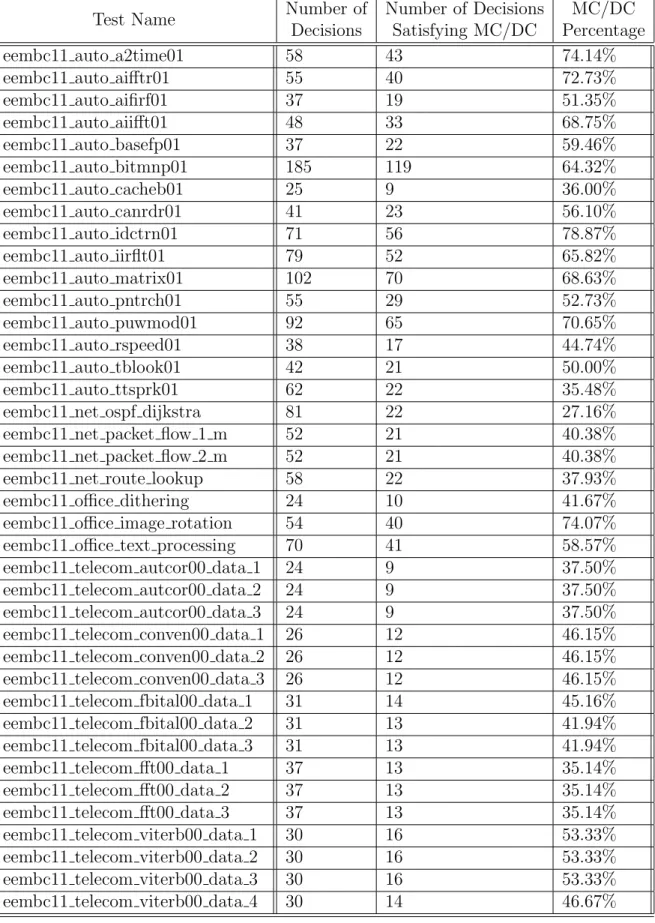
and Loops . . . 41 A.1 Coverage Information of EEMBC test suite . . . 48
Chapter 1
Introduction
Testing code is an integral part of the software development process [17]. It is standard practice to develop a test suite which any new code must pass before being released for production. The quality of industrial software produced often depends heavily on how extensive the test suite is, since developers rely on the tests catching their bugs before the code is released. It is therefore very useful to be able to gauge the effectiveness of a test suite.
Ideally, a test suite would test that the program behaves as expected for every possible input; that would guarantee that the program is correct. However, the space of all possible inputs is practically infinite for most industrial programs. Hence, this approach is almost always impossible (except perhaps a few low-level hardware implementations where the number of possible inputs is tractable).
This leads us to the concept of code coverage. Even though it might be impractical to run our code on every possible input, we would like to exercise every part of the codebase as often as possible through the test suite. Intuitively, if running our tests exercises a certain part of our code, we gain confidence on that part of the code if the tests pass. Thus, we can judge a test suite by the parts of the source code it exercises.
1.1
Overview and Applicability
In this thesis, I present a system that helps programmers with the aforementioned evaluation. Using my tools, one can run a test suite on a program and quickly determine the extent of coverage achieved by that suite. Specifically, my system outputs whether MC/DC (defined below in section 1.3) has been achieved by the test suite for each boolean expression in the target program. Note that for many of the metrics mentioned below, it is often impossible to achieve 100% coverage because of the code structure (programmers often build redundancies in their code to improve readability, robustness or even performance). Keeping this in mind, I produce detailed information when maximum coverage is not achieved within a file or a module.
Certain regulatory and certification authorities require full MC/DC coverage. For example, the DO-178B standard requires it for all level A software used in the avi-ation industry, and automotive standard ISO 26262 highly recommends it for ASIL (Automotive Safety Integrity Level) D software [15]. Software developers in these industries can use tools like mine to determine which parts of their system are in-sufficiently tested, and can add more tests to achieve the desired level of coverage. In cases where getting 100% coverage is impossible, they have to provide adequate justification in order to get their code certified.
Even when 100% coverage is not an explicit requirement, developers might try to achieve the same anyway to gain confidence in the correctness of their software. For example, SQLite, a very popular database management system, is advertised to achieve full MC/DC coverage with their testing ([10]) and it has a reputation for being highly reliable. In some applications, certain core components are deemed more important to get working correctly, and are subjected to more intensive testing (e.g. OS kernels). Systems like mine can be used to ensure full MC/DC coverage for those components. Lastly, my system can also be used as a profiling tool to just get an idea of how extensively each part of a codebase is tested, and developers can make informed decisions about which components they want to test more.
1.2
Standard Coverage Metrics
The notion of part was deliberately left vague earlier. Different definitions of part lead to different coverage metrics. We explore a few of the popular definitions in the subsections below.
1.2.1
Function Coverage
The simplest notion of part corresponds to functions in a program. A test suite satisfies function coverage if and only if all of the functions in the source code are executed when we run our tests. This is one of the weakest metrics in existence.
1.2.2
Statement Coverage
Instead of the functions, we can also consider the statements of the program as its units. Statement coverage monitors whether each statement is executed by the test suite. Note that this is a strictly stronger metric than function coverage. Statement coverage almost always implies function coverage since most functions contain at least one statement. However the reverse is not true, since it’s possible to have conditional code within a function that is not executed even though the function itself gets executed.
1.2.3
Branch Coverage
Branch coverage, also known as decision coverage, asks whether every branching point in the program assumed both true and false values. This is strictly stronger than statement coverage. As long as both branch directions are taken at every decision point, we are bound to execute every statement reachable from the start. But even when statement coverage is achieved, some branches may not evaluate to both values; in C, a do - while loop that executes only once provides a simple example.
1.2.4
Condition Coverage
Condition coverage is very similar to decision coverage. Instead of requiring every boolean decision to assume both possible values, this metric requires every individual condition appearing in boolean expressions to take both values. As an example, if we have the following code :
i f ( x && y ) { . . .
}
branch coverage requires that the decision in the if statement evaluates to both true and false while condition coverage requires that x and y individually assume both values.
1.2.5
Condition / Decision Coverage (C/DC)
A test suite is said to satisfy C/DC if and only if it satisfies branch coverage as well as condition coverage. Obviously, this is a strictly stronger metric than both condition coverage and decision coverage by themselves.
1.2.6
Multiple Condition Coverage (MCC)
This is one of the strongest coverage metrics in use. MCC requires that every possible combination of boolean assignments to conditions must be covered for each expres-sions. In the above example, we would require the following 4 assignments:
• x = true, y = true
• x = true, y = f alse
• x = f alse, y = true
Clearly, MCC is stronger than C/DC. However, for a boolean expression with n conditions, this metric requires 2nexecutions with distinct truth value combinations.
This exponential blowup makes MCC infeasible in a lot of practical situations.
1.3
Modified Condition / Decision Coverage (MC/DC)
The MC/DC metric was introduced by avionics software development guidance docu-ment DO-178B [3]. This docudocu-ment mandated that the test suite for the most critical software (whose failure can lead to loss of life) must satisfy MC/DC, a more stringent form of condition/decision coverage. This metric is weaker than MCC, but is almost as good at catching bugs.
1.3.1
Definition
The following 4 conditions need to be satisfied for this metric :
• Each entry and exit point is invoked.
• Each decision takes every possible outcome.
• Each condition in a decision takes every possible outcome.
• Each condition in a decision is shown to independently affect the outcome of the decision.
The first condition is only slightly stronger than function coverage, and follows from statement coverage. The next two conditions are exactly decision coverage and condition coverage, respectively. The last condition is the main feature distinguishing MC/DC.
A condition independently affects the outcome of the decision if and only if flipping the value of that condition keeping the other values constant might change the decision outcome.
1.3.2
Example
Consider the boolean expression d = a && ( b | | c )
The full truth table corresponding to this is given below:
Row a b c d 1 T T T T 2 T T F T 3 T F T T 4 T F F F 5 F T T F 6 F T F F 7 F F T F 8 F F F F
To satisfy decision coverage, we just need to choose one of the first 3 rows and one of the last 5 rows. To satisfy condition/decision coverage, we could choose rows 1, 6 and 7. However, we need to choose at least 4 rows to satisfy MC/DC.
One combination of rows satisfying MC/DC is rows 2, 3, 4 and 5. Only changing the value of b changes the decision between rows 2 and 4. Similarly, only changing the value of c changes the decision between rows 3 and 4. We haven’t chosen such a pair corresponding to a. However, a independently impacts the value of d in row 5 while being false (since flipping a would lead to row 1, where d is true), and it independently impacts the value of d in rows 2 and 3 while being true (since flipping a would lead to rows 6 and 7 respectively, where d is false). Thus we have shown that all the conditions independently impact the decision while assuming both truth values. It is easy to check that condition/decision coverage is also satisfied by these group of rows.
1.3.3
Motivation
Observe that the definition of MC/DC requires 2 separate test vectors corresponding to each condition in a boolean expression; one where the condition evaluates to true and impacts the final decision, and another one where the condition evaluates to false and impacts the final decision. The number of tests needed to satisfy MC/DC is therefore linear in the number of conditions an expression has, which is much smaller than the exponential number required to satisfy MCC. However, the description of the metric is significantly more complicated. Intuitively, MC/DC seeks to guarantee that if your program calculates the wrong value for any one of the conditions, it would calculate the wrong value for the whole decision at least once (corresponding to the test where that condition independently affects the decision).
1.4
Thesis Organization
This project involves significant changes in multiple layers of the compiler. Chapter 2 describes how we modify the front-end to annotate certain nodes in the AST as well as determine which nodes should be processed for instrumentation. Chapter 3 describes the algorithms used to instrument nodes corresponding to boolean expressions and explores various optimizations to improve space and time overheads. In Chapter 4, we discuss the various changes made outside the compiler which were necessary to support MC/DC as a stand-alone feature of the Green Hills developer suite. In Chapter 5, we demonstrate the results obtained using the optimization techniques presented in the thesis.
Chapter 2
Front-End Modifications
The front-end of the compiler is responsible for parsing the source program, perform-ing syntactic & semantic analysis, and producperform-ing an abstract syntax tree. In the following sections, I describe the different modifications made to this layer.
2.1
Maintaining Position Information
Like most of the other code coverage metrics we discussed, the definition of MC/DC is very closely tied to the source files of a program. The developer writing the tests needs to know which expressions in the source file were properly covered, and which were not. In order to display this information, we have to keep track of the start and end position (including line number, column and file name) of each expression we instrument.
I added an extra field in the expression nodes used in the AST to hold the position range corresponding to that expression. This field first gets populated as we scan the file to create individual tokens for each symbol appearing in the source code. I also ensure that as we build the tree, each node maintains its position range by properly combining the position ranges of its children.
The front-end often modifies expressions from their original form in the source. For example, during semantic analysis, integer conditions inside an if or while clause get a ! = 0 appended to them. It is important to identify each such case and ensure
that expression modified by the compiler have the same position range as the original expression they are derived from.
I do not maintain meaningful position information for expression inside macro definitions. This is a deliberate choice. Macro substitution takes place at the prepro-cessing stage, and the compiler front-end only sees the expanded form. As a result, all such expressions have their position range set to the position range of the macro invocation site. I could have modified the preprocessor to avoid this issue, but that would mean treating each macro invocation as a call to the same body of code, which violates the spirit of macros.
2.2
Handling Inline Functions
For the purpose of code coverage, inline functions should not be treated any differently from normal functions. One reason for this is that the inline keyword only serves as a hint to the compiler; the compiler can inline functions which are not so marked (e.g. if it is a member function containing just a simple return expression) and can refuse to inline functions which are marked inline without generating an error message (e.g. if the function is too large).
Consider the following code snippet: i n l i n e b o o l f o o ( ) {
return x | | y ; }
. . .
d = f o o ( ) && z ;
There are two boolean expressions in the above code, and they should be instrumented separately. However, the front-end simply replaces the node corresponding to an inline function call by the node corresponding to the appropriate function body, creating one composite expression
Although the above two expressions for d are semantically equivalent, MC/DC for the two code snippets entail different requirements and hence, this substitution is illegal when performing MC/DC instrumentation. To prevent this, I create a temporary variable t and perform the following replacement:
d = ( t = x | | y , t ) && z ;
Note that this retains semantic equivalence, while not merging the two expressions from the source file. As mentioned in the previous section, this ensures that the position range of the comma expression node I generated is the same as the position range of the function call node in the source (foo() in our example).
2.3
Identifying Expressions to Instrument
MC/DC is applicable to all boolean expressions. However, a lot of intuitive ap-proaches to identify such expressions are not general enough.
It is tempting to look at the type of an expression to determine whether it is boolean. The problem with this approach is versions of C predating C99 didn’t have a bool type. Since boolean variables are internally represented by integers, we can’t rely on the type of an expression to determine whether the expression should be in-strumented or not. Another sensible approach would be instrumenting expressions inside if, while, do-while and for clauses (this is a standard approach for imple-menting branch coverage instrumentation). Although this takes care of most boolean expressions in practice, MC/DC requires even assignments and return statements to be instrumented if they involve boolean expressions. Instead, I use the topmost op-erator in the AST node corresponding to an expression. An expression is considered boolean if and only if it is a result of a relational (<, >, <=, >=, ==, ! =) or a logical (!, ||, &&) operator.
Since the definition of MC/DC mentions individual conditions as well as the final decision, MC/DC instrumentation can’t be implemented in a modular fash-ion. I determine which expressions qualify as decisions, and pass only those to our instrumentation function. In order to do this, I added an extra parameter
is outermost expression to the function that processes expression nodes. This parameter is always set to true for non-recursive calls and almost always false for recursive calls, which is expected. However, there are a few cases where this is true in a recursive call. The first operand of a comma operation is treated as its own expression, not a sub-expression, and is instrumented accordingly. The same holds for each operand of a ternary if, array subscripts, function call arguments and the right-hand side of an assignment operation.
Chapter 3
Instrumentation Process
After the front-end passes certain expression objects for instrumentation, I replace them by functionally equivalent expressions which stores some extra information used for coverage in special sections of memory. This involves the most complicated piece of code in this project.
3.1
Known Algorithms
I experimented with different algorithms for instrumentation. I briefly describe 3 of those algorithms below. I also show the effect of transforming an expression using the algorithm on the following boolean expression :
D = A && (B | | C)
3.1.1
Naive Implementation
The simplest algorithm for instrumentation is just recording the value of each con-dition as well as the decision every time the code is run. If the expression has n conditions, this method requires 2n+1 bits to instrument it. Since I use a 32-bit logging variable, this algorithm can handle expressions with up to 4 conditions.
I create an accumulator variable whose first bit represents the decision and the further bits represent the individual conditions in order. As we evaluate each
condi-tion, I keep updating this variable. Finally, I use the accumulator variable to get the index of the bit to mark in the logging variable.
The sample expression is turned into the following: D = ( accum = 0 ,
r e s = ( ( temp = A, accum |= ( temp ? 2 : 0 ) , temp ) && ( ( temp = B, accum |= ( temp ? 4 : 0 ) , temp ) | |
( temp = C, accum |= ( temp ? 8 : 0 ) , temp ) ) ) , accum |= ( r e s ? 1 : 0 ) ,
l o g g i n g |= 1 << accum , r e s )
3.1.2
Implied Decision Algorithm
We can improve on the previous algorithm by noticing that if we record the value of each condition, the decision can be calculated in the post-processing stage. Thus, we can simply omit recording the decision. If the expression has n conditions, this method requires 2n bits to instrument it. Since I use a 32-bit logging variable, this
algorithm can handle expressions with up to 5 conditions.
The details of this algorithm are almost exactly the same as the previous one, except that we don’t need a bit in the accumulator variable for the result. However, I now need to record the expression in order to be able to recalculate the decision.
The sample expression is turned into the following: D = ( accum = 0 ,
r e s = ( ( temp = A, accum |= ( temp ? 1 : 0 ) , temp ) && ( ( temp = B, accum |= ( temp ? 2 : 0 ) , temp ) | |
( temp = C, accum |= ( temp ? 4 : 0 ) , temp ) ) ) , l o g g i n g |= 1 << accum ,
3.1.3
Masking Algorithm
The masking algorithm is a space-efficient algorithm for MC/DC instrumentation. This algorithm requires only 2 bits per condition to instrument a boolean expression. Since I use a 32-bit logging variable, this algorithm can handle expressions with up to 15 conditions (2 bits are reserved for the decision). However, the extra complexity needed to save space makes this slower than the previous approaches.
In this algorithm, the ith condition is represented by bits 2i + 1 and 2i + 2 of
the logging variable. While evaluating the expression, our instrumentation calculates which conditions have an independent effect on the decision with what value in the accumulator variable. The algorithm traverses the boolean expression tree by doing a Depth-First Search. Whenever a leaf node is evaluated, we know that it has an independent effect on the expression at that point. So, if the leaf node had position i in the expression, I set bit 2i + 1 (if the variable was true) or bit 2i + 2 (if the variable was false) in the accumulator. Finally, if the decision overall is false I set the last bit and otherwise, I set the penultimate bit.
However, the result of the evaluation sometimes masks previous subexpressions. If this variable caused the right child of an AND node to be false, the left child of that AND node ceases to independently affect the final expression (because the AND would evaluate to false regardless of its left child). Similarly, if this variable caused the right child of an OR node to be true, the left child of that OR node gets masked out. I keep track of these cases and remove all bits set in the left children getting masked out when applicable.
In some cases, a particular evaluation of a condition determines the final decision. The algorithm also keeps track of when that’s the case. In those cases, I flush the accumulator to the logging variable.
D = ( accum = 0 , r e s =
(A ? ( accum |= 4 , 1 )
: ( accum |= 8 , l o g g i n g |= accum , 0 ) ) && ( (B ? ( accum |= 1 6 , l o g g i n g |= accum , 1 )
: ( accum |= 3 2 , 0 ) ) | |
(C ? ( accum |= 6 4 , accum &= ˜ 4 8 , l o g g i n g |= accum , 1 ) : ( accum |= 1 2 8 , accum &= ˜ 1 2 , l o g g i n g |= accum , 0 ) ) ) , l o g g i n g |= ( 1 << r e s ) ,
r e s )
Note that a variable which isn’t evaluated due to short circuiting doesn’t affect the decision. Bits corresponding to such variables remain 0, which is the correct value. Therefore we don’t need any special processing for short- circuited variables.
3.2
Preliminary Design
It’s pretty clear from the above discussion that the implied decision algorithm is strictly better than the naive implementation. Therefore, I use the implied decision algorithm for all decisions with less than six conditions. For decisions with 6-15 conditions, I use the masking algorithm. If we encounter a decision with 16 or more conditions, I do not instrument it. A recursive function that traverses the expression tree is used at the beginning to count the number of conditions.
Without any further optimizations, this incurs unacceptably high space and time overheads.
3.3
Optimizing single-variable Decisions
In practice, it turns out that a large fraction of boolean expressions contain only one condition. Most notably, the loop condition for a for loop is generally a single comparison and if and while clauses generally contain a single variable or condition.
Therefore, optimizing our instrumentation for single-condition decisions can lead to significant improvements in overall performance.
Note that the implied decision algorithm transforms a boolean variable x into accum = 0 ,
r e s = ( temp = x , accum |= ( temp ? 1 : 0 ) , temp ) , l o g g i n g |= ( 1 << accum ) ,
r e s
It is easy to see that we do not need so many instructions in this simple case. In fact, all we need to do is to record the value of x. Keeping that in mind, we can simplify the above to decision coverage instrumentation as follows :
r e s = x ,
l o g g i n g |= ( r e s ? 2 : 1 ) , r e s
Note that although this captures the same information, the format is slightly different. In this version, the last bit records if the decision was ever false, whereas in the previous version the last bit records whether the condition was ever wrong. Therefore, if the single condition is negated, we should interpret the logging variable a bit differently.
We can use this algorithm whenever the expression to be instrumented contains a single condition.
3.4
Removing the branch instruction from DC
in-strumentation
Profiling the code shows that majority of the time overhead still comes from instru-menting single-condition expressions. In particular, the branch expression generated by ternary if-expression is expensive. To try to get rid of that branch, it is tempting to rewrite the DC instrumentation code as
r e s = x ,
l o g g i n g |= ( 1 << r e s ) , r e s
Since res is a boolean variable the above transformation is almost always valid. However, since boolean variables are internally just integers, the above code doesn’t behave as expected if the result variable is greater than 1 (which can happen if we had an integer constant inside an if clause, for example).
We can fix the above issue by ensuring that res can only be 0 or 1. A simple way to do that is the following:
r e s = x ,
l o g g i n g |= ( 1 << ( r e s != 0 ) ) , r e s
Although this form looks slightly more complicated than the code in the previous section, getting rid of the branch instruction actually reduces timing overhead by a significant margin.
3.5
Future work
The two optimizations mentioned above brought the overhead down to a reasonable level. I also considered a few other optimization ideas which I ended up discarding. Further research into these avenues might produce promising results.
3.5.1
Optimizing two-condition decisions
We saw in section 3.3 that we can use the specific form of the boolean expression to create customized instrumentation code which incurs less overhead than the fully general implied decision algorithm. This insight can be used to optimize boolean expressions with 2 conditions too.
As an example, consider the expression x && y. When instrumented, this gets turned into
accum = 0 ,
r e s = ( ( temp = x , accum |= ( temp ? 1 : 0 ) , temp ) && ( temp = y , accum |= ( temp ? 2 : 0 ) , temp ) ) , l o g g i n g |= 1 << accum ,
r e s
We can actually eliminate the accumulator and the temporary variable altogether by replacing the above with
x ? ( y ? ( l o g g i n g |= 8 , 1 ) : ( l o g g i n g |= 4 , 0 ) ) : ( l o g g i n g |= 1 , 0 )
This expression has the same number of branch instructions, and gets rid of a few assignments and a shift instruction. In fact, we can use a similar trick as in 3.4 to get rid of the branch instruction generated by the inner if-expression if we use the following semantically equivalent code snippet.
x ? ( temp = y , l o g g i n g |= ( 4 << ( temp != 0 ) ) , temp ) : ( l o g g i n g |= 1 , 0 )
Some special handling would be required if any of these conditions were negated, but the above represents a viable proof of concept. Similar optimizations could be done for x || y too.
I decided that the marginal benefit provided by these optimizations is not worth the extra complexity to handle all the cases indicated above at the current stage of development. As these instrumentation tools see more use, I might consider revisiting that decision. Some of these optimizations could also be combined with the loop optimization discussed next.
3.5.2
Loop Optimization
A lot of boolean expressions come from loop constructs. Since these expressions are evaluated quite a lot of times and each evaluation results in at least 1 write to memory (since the logging variable is in memory), it is no surprise that runtime
overhead drops significantly once we stop instrumenting loop conditions. Therefore, optimizing instrumentation of these loop conditions could potentially lead to large improvements.
Note that the body of a for or while loop is executed if and only if the loop condition evaluates to true. Furthermore, the loop condition evaluates to false if and only if we exit the loop normally (not through a break, throw, goto or return statement). These observations can be leveraged to avoid a linear number of writes to memory in the case where the loop expression has a single condition.
I create a local boolean variable which is set to false at loop initialization. I set it to true at the start of the body of the loop. This variable denotes whether the condition ever evaluated to true. Before every statement inside the loop body that takes the control flow outside the loop (such as break), I insert an instruction to set the logging variable to 2 (since the loop condition was set to true but not false). Finally, I create a new basic block between the block for evaluating the loop condition and the first block following the loop such that if the condition evaluates to false, control reaches this new basic block before going to the block immediately after the loop as usual. In this block, I set the logging variable to twice the local variable I created plus 1 (the least significant bit is set since the loop condition was set to false, and the second least significant bit should be set if and only if the loop body was ever executed).
Based on our initial experiments so far, this seems to be a very promising optimiza-tion. However, identifying all commands which take control flow outside the loop, and in particular dealing with goto statements and nested loops, is quite challeng-ing. Once the feature is somewhat more stable, I plan to implement this optimization fully. It might also be possible to extend this optimization by moving instrumentation instructions out of multiply nested loops.
3.5.3
Removing instrumentation when possible
One interesting feature all the algorithms presented above share is that the bits of the logging variable are never erased. If we somehow knew that a certain bit is already
set, we could remove the part of instrumentation responsible for setting that bit. In practice, a binary is first generated from the source code. We then run the binary against a multitude of tests. Finally, I use logical or to combine the corre-sponding logging variables from each run and then analyze it. Instead, I could analyze the logging variables after each test is run. If MC/DC is already satisfied for a cer-tain expression, I can remove all the instructions responsible for instrumenting that decision from the binary. In certain cases, I could use an even more precise method to eliminate more instructions (e.g. if a certain condition is covered when using the masking algorithm, I can delete just the instructions instrumenting that variable). This could potentially trim down the binary as we go through our test suite, and both the time and space overhead could go down a lot for the later tests.
It is theoretically possible to remove the extra instructions even earlier if the program has permission to write to the text section. Self-modifying code could get rid of the above instructions as soon as they become redundant, as evidenced in [8], [22] and [6]. If the instrumentation overhead turns out to be too high for users, this could be a very promising avenue of research.
Chapter 4
Supporting utilities
I had to make a few other changes in various parts of the Green Hills code-base to fully support MC/DC instrumentation. The logging variables mentioned above are emitted in a special section; I had to add an option to the linker which includes that section into the section map. The driver (the program that reads input from the command line and calls the compiler and linker with appropriate arguments) also needed a little modification. It now recognizes the option -mcdc and passes the aforementioned option to the linker and the debug flag corresponding to MC/DC instrument to the compiler when this option is passed.
4.1
Interpreting results of instrumentation
All the modifications discussed above change the executable file produced when we build a program. Running this executable has all the same effects as running an exe-cutable built without my changes, except that it also populates the logging variables with appropriate coverage information. These logging variables are stored in two special sections of the executable file. A separate program was written to interpret these sections and display coverage information in a human-readable way.
Depending on the structure of the expression, I use one of 3 different algorithms I discussed earlier to record information. If the expression has a single boolean con-dition, I use DC instrumentation as described in section 3.4. If it has between two
and five conditions, I use the implied decision algorithm from section 3.1.2. I use the masking algorithm from section 3.1.3 if the expression has between six and fifteen conditions. It is necessary for the interpreter program to know which logging variable represents which expression and which algorithm was used to encode the information present in it. Furthermore, note that the implied decision algorithm relies upon the interpreter to figure out the value of the decision based on the values of its conditions; I therefore need to also record the structure of the expression.
In the compiler, I actually collect all of this information. When an expression is instrumented, I record the name of the file it belongs to as well as its starting and ending line and column numbers. I then traverse the AST corresponding to the expression and record the boolean structure in reverse Polish notation (for example, the expression a && (b || !c) is recorded as A(X)(O(X)(N(X)))). While traversing, I also record the start and end positions of each of the conditions.
The interpreter program first reads the auxiliary information and counts the num-ber of conditions (Xs in our notation) to figure out the algorithm used. It then displays the form of the expression and the relevant source position information about the en-tire decision as well as all the conditions. The rest depends on the specific algorithm used.
If DC instrumentation was used, I only need to figure out if the condition was negated by checking if there is an odd number of Ns. The last two bits of the logging variable describe if the decision was ever set to false and true, respectively. I use them to determine the values taken by the decision as well as those taken by the condition. Then I display the values taken by the condition, draw the full truth table and indicate which rows were encountered.
If the masking algorithm was used, I don’t have enough information to deduce which rows of the full truth table were encountered. Therefore, I simply read the last two bits of the logging variable to determine the values taken by the decision, and keep reading pairs of bits from the right starting at the third least significant bit to determine if each condition impacted the decision while assuming true and false values.
In case the implied decision algorithm was used, I use the form of the expression recorded to build a simplified AST. If the ith least significant bit is set, the indices of
the 1 bits in the binary expansion of i − 1 correspond to the conditions that evaluated to true in one particular execution of the expression. By mimicking the evaluation process on our simplified AST, I can also figure out which conditions were evaluated to false and which conditions were never evaluated due to short-circuiting. Thus, I can record which row of the truth table this execution corresponds to, as well as which conditions impacted the decision with what values. I combine all of this information as I iterate through all the set bits of the logging variable, and then display it.
Sometimes, the same expression has multiple logging variables associated with it. For example, every invocation of an inline function creates a separate logging variable. To handle these correctly, our interpreter program doesn’t display the coverage infor-mation as soon as a logging variable is processed. Instead, it stores all the relevant information in a giant class. After all the variables are processed, it identifies entries corresponding to the same expression (the source information must match exactly) and merges them. Once all the entries in our class have distinct source positions, I group them by file name, and display them in order of line number.
4.2
Testing
The testing of this feature was mostly done manually. Our test suite consists of func-tions with different kinds of boolean expressions in them. I call these funcfunc-tions with different combinations of arguments, and check if the coverage information displayed for each function is correct.
I’ve tested every possible combination of arguments for all possible boolean ex-pressions with one and two conditions. I also test all possible boolean exex-pressions with three conditions; if the truth table has four rows I try all combinations of those rows, and I try about 18 combinations when the truth table has five rows. I tested a few randomly chosen expressions with four and five rows. To test the masking algorithm, I tested a few expressions with six, ten and fifteen conditions, respectively.
I have tests with expressions inside for, while and do-while loop conditions. I’ve tested expressions in if clauses, return statements and assignments. To test whether the source position information is collected properly, I’ve tested inline functions and macros. I also have tests using member functions and member variables of C++ classes.
Before this feature is released as a part of a product, it will go through more inten-sive testing. Internal teams at Green Hills have started using the feature, and their feedback is being continuously incorporated to make MC/DC instrumentation more robust and bug-free. Regression tests are added whenever a new bug is discovered.
Chapter 5
Experimental Results
I discussed a few optimizations which were explored during development in sections 3.3, 3.4, 3.5.2 and 3.5.1. In the following sections, we’ll explore how they impact both the space and the time overhead of MC/DC instrumentation.
5.1
Benchmark Suites
To evaluate various characteristics of my system, I used a large set of benchmark suites available at Green Hills. In the following sections, I use a small but representative subset of that to demonstrate my results and overall trends. I’ll now go over each of those benchmarks and provide a brief description and some statistics. All of these suites were derived from third-party software, but had to be modified enough in order to be integrated into the Green Hills testing environment.
Some of the suites contain a single program, whereas some contain many. In the latter case, the different constituent programs generally share code, which makes it impossible to mechanically calculate aggregate statistics from combining individual test statistics.
• zlib is a compression library [9] that provides in-memory compression and de-compression functions, including integrity checks of the uncompressed data. It includes some unit tests which also serve as examples of how to use the library;
these are not meant to test the zlib library extensively. It contains approxi-mately 6700 lines of code. When I ran this, my tools detected and instrumented 844 decisions, out of which only 242 (≈ 29%) satisfy MC/DC.
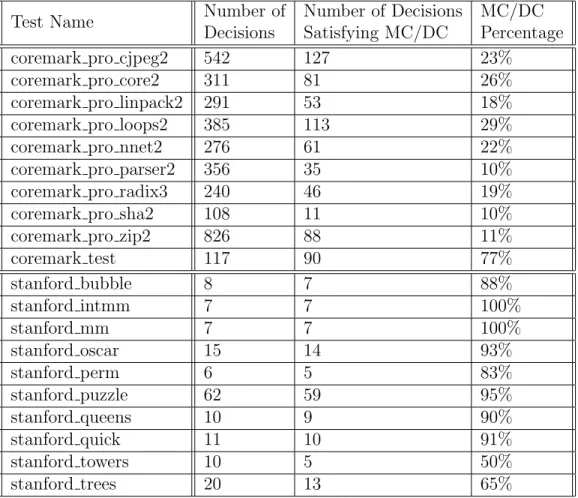
• stanford is a suite of benchmarks that are relatively short, both in program size and execution time. It contains simple, standard programs such as matrix multiplication and sorting routines. It contains approximately 600 lines of code. There were 155 boolean decisions instrumented, 135 (90%) of which satisfy MC/DC. Table 5.1 provides statistics for individual tests in this suite.
• specint is derived from benchmark suites published by the Standard Perfor-mance Evaluation Corporation (SPEC) [12]. This mostly consists of the integer benchmarks from the now obsolete CPU89 suite. Selected files from later release including CPU92 [11] and CPU95 [20] were also included. These suites were designed to provide a comparative measure of compute-intensive performance across the widest practical range of hardware using workloads developed from real user applications. Among other things, specint includes a lisp interpreter and a PLA optimizing tool. It contains more than 10000 lines of code. This is a legacy test suite at Green Hills, and we can’t run these programs anymore because of hardware compatibility issues. So I used this only for calculating space overhead by compiling the files with and without various optimizations enabled, and comparing the sizes of the resulting binaries generated.
• fbench is a floating point intensive benchmark. It contains two programs: one implementing an optical design ray tracing algorithm and one calculating the Fast Fourier Transform of a square matrix. These are self-contained programs; they can be compiled and run directly and don’t need any input files or param-eters. It contains around 500 lines of code. The first program has 20 boolean expressions, 12 (60%) of which satisfy MC/DC. The second program has 26 such expressions, 22 (≈ 85%) of which satisfy MC/DC. Overall, there are 45 boolean expressions here, 33 (≈ 73%) of which satisfy MC/DC.
• eembc2 is a collection of the automotive, networking, office and telecom bench-marks published by the Embedded Microprocessor Benchmark Consortium (EMBC) [18]. It contains around 14600 lines of code. My program instrumented 1166 expressions in this suite, 786 (≈ 70%) of which satisfy MC/DC. More detailed statistics and description are provided in the appendix.
• dhrystone is a synthetic computing benchmark intended to be representative of system programming [23]. The author collected statistics about the frequencies of different programming structures such as assignments control statements, function calls, structs, arrays, different types of loops, different operators, etc. appearing in real-life applications, and tried to recreate those statistical ratios in this benchmark. The entire benchmark suite consists of 2 .c files and a header file; the programs don’t do anything meaningful and there are no tests. It contains 375 lines of code. There were only 18 expressions here, 5 (≈ 28%) of which satisfy MC/DC.
• coremark is a benchmark that measures the performance of microcontrollers and CPUs used in embedded systems. Some of the algorithms implemented here include list processing (find and sort), matrix manipulation (common ma-trix operations), state machine (determine if an input stream contains valid numbers), and CRC (cyclic redundancy check). The programs resemble appli-cation code written by end users. Each program has one test associated with it to validate its functionality. Input files are included in the suite which are needed to test some of these programs. It contains roughly 91500 lines of code. We instrumented a total of 2326 boolean expressions, 629 (≈ 27%) of which satisfy MC/DC. Table 5.1 provides statistics for individual tests in this suite.
5.2
Time Overhead
To measure the timing overhead, I used two benchmark suites; coremark and stanford. Below, we present the total number of decisions in each test of these suites and the
corresponding MC/DC coverage achieved.
Test Name Number of
Decisions
Number of Decisions Satisfying MC/DC
MC/DC Percentage
coremark pro cjpeg2 542 127 23%
coremark pro core2 311 81 26%
coremark pro linpack2 291 53 18%
coremark pro loops2 385 113 29%
coremark pro nnet2 276 61 22%
coremark pro parser2 356 35 10%
coremark pro radix3 240 46 19%
coremark pro sha2 108 11 10%
coremark pro zip2 826 88 11%
coremark test 117 90 77% stanford bubble 8 7 88% stanford intmm 7 7 100% stanford mm 7 7 100% stanford oscar 15 14 93% stanford perm 6 5 83% stanford puzzle 62 59 95% stanford queens 10 9 90% stanford quick 11 10 91% stanford towers 10 5 50% stanford trees 20 13 65%
Table 5.1: Coverage Information of Stanford and Coremark Test Suites
The following tables display the overhead for each test in both of those suites, and also provide aggregate statistics.
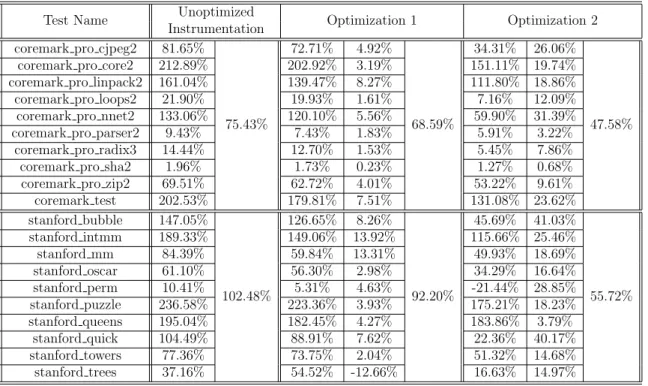
First, we consider the two optimizations on single-condition decisions. In the table below, the first column represents the overhead of an unoptimized implementation. The second column aggregates this information using geometric means for each suite. The next 3 columns describe the effect of the first optimization from 3.3, while the following 3 columns are dedicated to the impact of removing the branch condition as described in 3.4. Within each group of 3 columns, the first column shows the overhead of instrumentation, the second column shows the percentage improvement over the unoptimized version, and the third column shows the same data as the first column aggregated for the entire suite using geometric means.
Test Name Unoptimized
Instrumentation Optimization 1 Optimization 2 coremark pro cjpeg2 81.65%
75.43%
72.71% 4.92%
68.59%
34.31% 26.06%
47.58% coremark pro core2 212.89% 202.92% 3.19% 151.11% 19.74%
coremark pro linpack2 161.04% 139.47% 8.27% 111.80% 18.86% coremark pro loops2 21.90% 19.93% 1.61% 7.16% 12.09% coremark pro nnet2 133.06% 120.10% 5.56% 59.90% 31.39% coremark pro parser2 9.43% 7.43% 1.83% 5.91% 3.22%
coremark pro radix3 14.44% 12.70% 1.53% 5.45% 7.86% coremark pro sha2 1.96% 1.73% 0.23% 1.27% 0.68% coremark pro zip2 69.51% 62.72% 4.01% 53.22% 9.61% coremark test 202.53% 179.81% 7.51% 131.08% 23.62% stanford bubble 147.05% 102.48% 126.65% 8.26% 92.20% 45.69% 41.03% 55.72% stanford intmm 189.33% 149.06% 13.92% 115.66% 25.46% stanford mm 84.39% 59.84% 13.31% 49.93% 18.69% stanford oscar 61.10% 56.30% 2.98% 34.29% 16.64% stanford perm 10.41% 5.31% 4.63% -21.44% 28.85% stanford puzzle 236.58% 223.36% 3.93% 175.21% 18.23% stanford queens 195.04% 182.45% 4.27% 183.86% 3.79% stanford quick 104.49% 88.91% 7.62% 22.36% 40.17% stanford towers 77.36% 73.75% 2.04% 51.32% 14.68% stanford trees 37.16% 54.52% -12.66% 16.63% 14.97%
Table 5.2: Reduction of Time Overheads due to Single Condition Decision Optimiza-tions
Note that the first optimization reduces overhead by roughly 10%, while the second optimization (just removing a branch instruction) causes a further 30 - 40% drop. These two optimizations bring the average time overhead down from 88% to 52%. This is a pretty significant improvement, and both of these optimizations were kept in the final version.
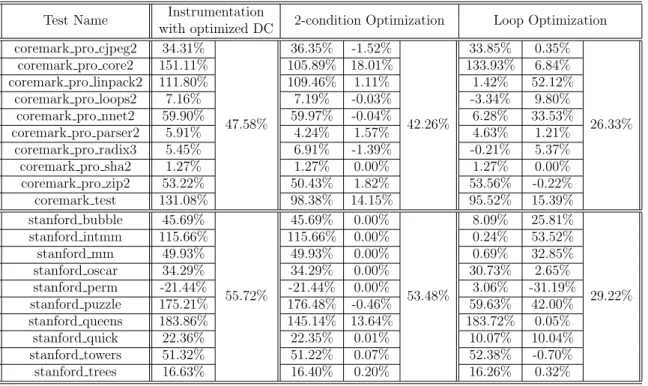
The next table showcases the 2 optimizations mentioned in 3.5.1 and 3.5.2. We follow the same overall syntax as in the previous table, except that the baseline to compare with is now a version of MC/DC with the previous two optimizations en-abled. In each group, the first and last columns represent the absolute overhead for instrumentation, while the middle column (if present) shows the percentage improve-ment as compared to the baseline.
It is readily apparent that optimizing two-condition decisions is only slightly help-ful; it generally has a negligible impact, but in some cases, it improves performance significantly. The overall gain is around 3%. The loop optimization is also of a similar nature, but gains from it are much more frequent as well as substantial. Taken to-gether, these two optimizations have the potential to farther halve the time overhead
Test Name Instrumentation
with optimized DC 2-condition Optimization Loop Optimization coremark pro cjpeg2 34.31%
47.58%
36.35% -1.52%
42.26%
33.85% 0.35%
26.33% coremark pro core2 151.11% 105.89% 18.01% 133.93% 6.84%
coremark pro linpack2 111.80% 109.46% 1.11% 1.42% 52.12% coremark pro loops2 7.16% 7.19% -0.03% -3.34% 9.80%
coremark pro nnet2 59.90% 59.97% -0.04% 6.28% 33.53% coremark pro parser2 5.91% 4.24% 1.57% 4.63% 1.21%
coremark pro radix3 5.45% 6.91% -1.39% -0.21% 5.37% coremark pro sha2 1.27% 1.27% 0.00% 1.27% 0.00% coremark pro zip2 53.22% 50.43% 1.82% 53.56% -0.22% coremark test 131.08% 98.38% 14.15% 95.52% 15.39% stanford bubble 45.69% 55.72% 45.69% 0.00% 53.48% 8.09% 25.81% 29.22% stanford intmm 115.66% 115.66% 0.00% 0.24% 53.52% stanford mm 49.93% 49.93% 0.00% 0.69% 32.85% stanford oscar 34.29% 34.29% 0.00% 30.73% 2.65% stanford perm -21.44% -21.44% 0.00% 3.06% -31.19% stanford puzzle 175.21% 176.48% -0.46% 59.63% 42.00% stanford queens 183.86% 145.14% 13.64% 183.72% 0.05% stanford quick 22.36% 22.35% 0.01% 10.07% 10.04% stanford towers 51.32% 51.22% 0.07% 52.38% -0.70% stanford trees 16.63% 16.40% 0.20% 16.26% 0.32%
Table 5.3: Reduction of Time Overheads after Optimizing Two-condition Decisions and Loops
of MC/DC instrumentation.
5.3
Space Overhead
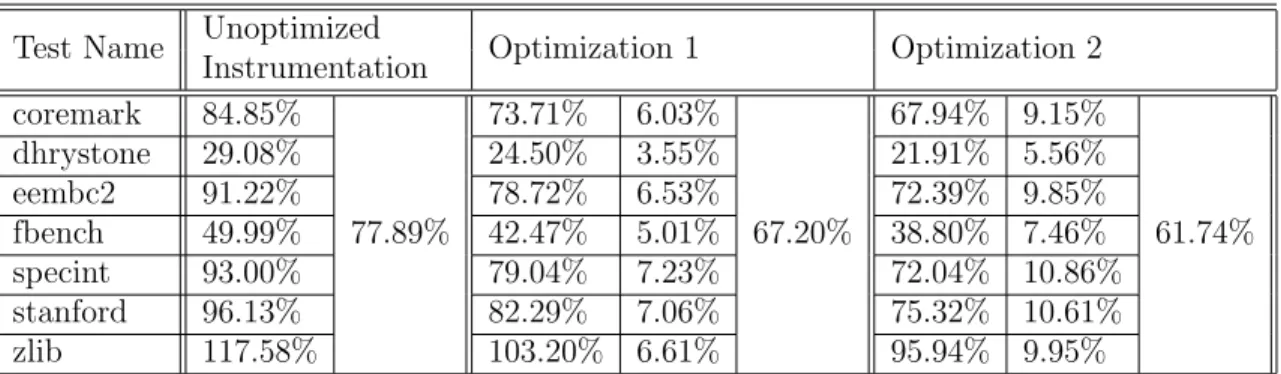
The space overhead was measured using a large set of benchmarks; these are used for evaluating compiler optimizations throughout the company. A total of almost 3.3 million lines of code were instrumented. I’ll show the results from a small subset of these benchmarks to highlight the overall trends. The next two tables are exactly analogous to the previous two tables in 5.2, except that the numbers refer to the size of the binary generated instead of the time taken to execute it.
Observe that both of the single-condition optimizations are quite effective on all of the benchmarks; the aggregate overhead goes down from 78% to 62%. The next two optimizations are, however, almost ineffective; so they are considered mainly for improving performance and not size overhead.
Test Name Unoptimized
Instrumentation Optimization 1 Optimization 2 coremark 84.85% 77.89% 73.71% 6.03% 67.20% 67.94% 9.15% 61.74% dhrystone 29.08% 24.50% 3.55% 21.91% 5.56% eembc2 91.22% 78.72% 6.53% 72.39% 9.85% fbench 49.99% 42.47% 5.01% 38.80% 7.46% specint 93.00% 79.04% 7.23% 72.04% 10.86% stanford 96.13% 82.29% 7.06% 75.32% 10.61% zlib 117.58% 103.20% 6.61% 95.94% 9.95%
Table 5.4: Reduction of Size Overheads due to Single Condition Decision Optimiza-tions
Test Name
Instrumentation
with optimized DC Two-condition Optimization Loop Optimization coremark 67.94% 61.74% 65.06% 1.72% 59.29% 63.87% 2.43% 59.70% dhrystone 21.91% 21.91% 0.00% 21.29% 0.51% eembc2 72.39% 68.62% 2.18% 70.53% 1.07% fbench 38.80% 37.05% 1.26% 37.58% 0.88% specint 72.04% 69.43% 1.52% 70.22% 1.06% stanford 75.32% 73.31% 1.14% 71.09% 2.41% zlib 95.94% 90.52% 2.76% 95.06% 0.45%
Table 5.5: Reduction of Size Overheads after Optimizing Two-condition Decisions and Loops
Chapter 6
Related Work
Achieving high code coverage has always been considered important for good testing; the notion was around as early as 1963 [16]. The various metrics I described in sec-tion 1.2 are fairly standard by now [2]. Tools for computing branch and statement coverage are commonly available ([4], [1]). There has been a lot of research to op-timize the instrumentation required for coverage. [22] and [6] introduce the idea of dynamic instrumentation to reduce the overhead of statement coverage. In [8], the authors combine static and dynamic instrumentation to speed up branch coverage instrumentation.
The notion of MC/DC was introduced by document DO-178B [3] in 1992, where the Federal Aviation Administration (FAA) mandated MC/DC for testing all level A (the most safety critical) software. The definition of MC/DC was later expanded to include masking MC/DC in 2001 ([7], [14]) and document DO-178C formally accepted the modified decision in 2010 [5]. The definition of MC/DC given in section 1.3 follows this masking definition. [21] gives a justification of why masking MC/DC should be accepted for certification purposes, and [13] conducts an empirical study establishing that satisfying this definition of MC/DC is not significantly harder than satisfying Condition/Decision Coverage, but it catches a wider range of bugs. However, the dependence of the MC/DC definition on source code makes it extremely sensitive to small semantically equivalent changes; [19] shows that performing MC/DC analysis on inlined vs non-inlined code leads to drastically different results.
There has been limited investigation into implementing MC/DC instrumentation. The masking algorithm described in 3.1.3 was first described in [24]. In [25], the authors used that algorithm to develop a flexible non-intrusive approach for compute metrics similar to MC/DC.
Chapter 7
Conclusion
This thesis presents the design of a system that allows programmers to visualize which parts of their code achieve modified condition/decision coverage (MC/DC) after that run their test suite. This tool is built on top of the Green Hills C/C++ compiler. I inserted static instrumentation by modifying the abstract syntax tree (AST) generated in the computer back end. I also modified some of the compiler front end code to maintain and propagate position information for each such expression. I wrote a separate utility program that interprets the extra data generated by the instrumented code and uses the associated position information to produce human readable output.
Although the main algorithms for instrumentation were already known, it was a significant engineering challenge to adapt them to an industrial compiler that has to deal with a myriad of unusual cases. Integrating my system into the Green Hills testing environment also required a fair bit of work. Finally, I had to make several benchmark-driven tweaks and optimizations to the instrumentation process in order to bring the space and time overhead down to acceptable levels. As shown in section 5.2, I was able to cut down the time overhead by almost a factor of 3.
As previously mentioned, internal teams at Green Hills Software have already started using this system. However, further testing is necessary before this system can be released to production.
Appendix A
EEMBC benchmarks
As mentioned earlier, there are 4 subcategories in our eembc benchmark suite; these roughly correspond to the AutoBench, Networking, OABench and TeleBench suites published by EMBC. These suites contain utility programs useful in specific indus-tries, and those programs are tested extensively to ensure correctness.
In the table next page, we describe the number of boolean decisions in each in-dividual test of these 4 suites and their MC/DC coverage statistics. Note that each row corresponds to a unique test. Some programs have only one test file associated with them whereas others have multiple tests using different datasets to test them; for example, the last 4 rows all test a Viterbi encoding program using 4 different datasets. Some of these tests require images or sound clips as input files, while others are self-contained C programs.
Test Name Number of Decisions Number of Decisions Satisfying MC/DC MC/DC Percentage
eembc11 auto a2time01 58 43 74.14%
eembc11 auto aifftr01 55 40 72.73%
eembc11 auto aifirf01 37 19 51.35%
eembc11 auto aiifft01 48 33 68.75%
eembc11 auto basefp01 37 22 59.46%
eembc11 auto bitmnp01 185 119 64.32%
eembc11 auto cacheb01 25 9 36.00%
eembc11 auto canrdr01 41 23 56.10%
eembc11 auto idctrn01 71 56 78.87%
eembc11 auto iirflt01 79 52 65.82%
eembc11 auto matrix01 102 70 68.63%
eembc11 auto pntrch01 55 29 52.73%
eembc11 auto puwmod01 92 65 70.65%
eembc11 auto rspeed01 38 17 44.74%
eembc11 auto tblook01 42 21 50.00%
eembc11 auto ttsprk01 62 22 35.48%
eembc11 net ospf dijkstra 81 22 27.16%
eembc11 net packet flow 1 m 52 21 40.38%
eembc11 net packet flow 2 m 52 21 40.38%
eembc11 net route lookup 58 22 37.93%
eembc11 office dithering 24 10 41.67%
eembc11 office image rotation 54 40 74.07%
eembc11 office text processing 70 41 58.57%
eembc11 telecom autcor00 data 1 24 9 37.50%
eembc11 telecom autcor00 data 2 24 9 37.50%
eembc11 telecom autcor00 data 3 24 9 37.50%
eembc11 telecom conven00 data 1 26 12 46.15%
eembc11 telecom conven00 data 2 26 12 46.15%
eembc11 telecom conven00 data 3 26 12 46.15%
eembc11 telecom fbital00 data 1 31 14 45.16%
eembc11 telecom fbital00 data 2 31 13 41.94%
eembc11 telecom fbital00 data 3 31 13 41.94%
eembc11 telecom fft00 data 1 37 13 35.14%
eembc11 telecom fft00 data 2 37 13 35.14%
eembc11 telecom fft00 data 3 37 13 35.14%
eembc11 telecom viterb00 data 1 30 16 53.33%
eembc11 telecom viterb00 data 2 30 16 53.33%
eembc11 telecom viterb00 data 3 30 16 53.33%
eembc11 telecom viterb00 data 4 30 14 46.67%
Bibliography
[1] Khalid Alemerien and Kenneth Magel. Examining the effectiveness of testing coverage tools: An empirical study. International journal of Software Engineering and its Applications, 8(5):139–162, 2014.
[2] Paul Ammann and Jeff Offutt. Introduction to software testing. Cambridge University Press, 2016.
[3] Federal Aviation Authority. Software considerations in airborne systems and equipment certification. Document No. RTCA/DO-178B, 1992.
[4] Ira D Baxter. Branch coverage for arbitrary languages made easy, 2002.
[5] Ben Brosgol and Cyrille Comar. Do-178c: A new standard for software safety certification. Technical report, ADA CORE TECHNOLOGIES NEW YORK NY, 2010.
[6] Kalyan-Ram Chilakamarri and Sebastian Elbaum. Reducing coverage collection overhead with disposable instrumentation. In Software Reliability Engineering, 2004. ISSRE 2004. 15th International Symposium on, pages 233–244. IEEE, 2004.
[7] John J Chilenski. An investigation of three forms of the modified condition decision coverage (mcdc) criterion. Technical report, BOEING COMMERCIAL AIRPLANE CO SEATTLE WA, 2001.
[8] Olivier Crameri, Ricardo Bianchini, and Willy Zwaenepoel. Striking a new bal-ance between program instrumentation and debugging time. In Proceedings of the sixth conference on Computer systems, pages 199–214. ACM, 2011.
[9] Peter Deutsch and Jean-Loup Gailly. Zlib compressed data format specification version 3.3. Technical report, 1996.
[10] SQL Developers. How sqlite is tested, 2017.
[11] Kaivalya M Dixit. New cpu benchmark suites from spec. In COMPCON Spring 1992, pages 305–310. IEEE, 1992.
[12] Jozo J Dujmovic and Ivo Dujmovic. Evolution and evaluation of spec bench-marks. ACM SIGMETRICS Performance Evaluation Review, 26(3):2–9, 1998.
[13] Arnaud Dupuy and Nancy Leveson. An empirical evaluation of the mc/dc cover-age criterion on the hete-2 satellite software. In Digital Avionics Systems Confer-ence, 2000. Proceedings. DASC. The 19th, volume 1, pages 1B6–1. IEEE, 2000. [14] Kelly J Hayhurst, Dan S Veerhusen, John J Chilenski, and Leanna K Rierson.
A practical tutorial on modified condition/decision coverage. 2001.
[15] M Kucharski, A Trujillo, C Dunlop, and B Ahdab. Iso 26262 software compliance: Achieving functional safety in the automotive industry. Technical report, 2012. [16] J Philip Miller and Clifford J. Maloney. Systematic mistake analysis of digital
computer programs. Commun. ACM, 6:58–63, 1963.
[17] Glenford J Myers, Corey Sandler, and Tom Badgett. The art of software testing. John Wiley & Sons, 2011.
[18] Jason A Poovey, Thomas M Conte, Markus Levy, and Shay Gal-On. A bench-mark characterization of the eembc benchbench-mark suite. IEEE micro, 29(5), 2009. [19] Ajitha Rajan, Michael W Whalen, and Mats PE Heimdahl. The effect of program and model structure on mc/dc test adequacy coverage. In Proceedings of the 30th international conference on Software engineering, pages 161–170. ACM, 2008. [20] Jeff Reilly. A brief introduction to the spec cpu95 benchmark. IEEE-CS TCCA
Newsletter, 1996.
[21] CAS Team et al. Rationale for accepting masking mcdc in certification projects. Position Paper 6, Tech. Rep., 2001.
[22] Mustafa M Tikir and Jeffrey K Hollingsworth. Efficient instrumentation for code coverage testing. In ACM SIGSOFT Software Engineering Notes, volume 27, pages 86–96. ACM, 2002.
[23] Alan R Weiss. Dhrystone benchmark. History, Analysis,Scores and Recommen-dations, White Paper, ECL/LLC, 2002.
[24] Michael W Whalen, Mats P Heimdahl, and Ian J De Silva. Efficient test coverage measurement for mc/dc. 2013.
[25] Michael W Whalen, Suzette Person, Neha Rungta, Matt Staats, and Daniela Grijincu. A flexible and non-intrusive approach for computing complex structural coverage metrics. In Proceedings of the 37th International Conference on Software Engineering-Volume 1, pages 506–516. IEEE Press, 2015.